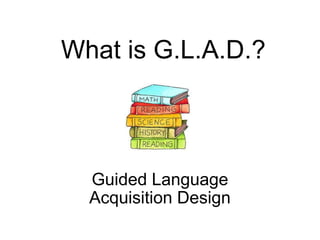
What is G.L.A.D.?     Guided Language Acquisition Design
Researc  h ~ Language Acquisition Krashen & Terrell Monitor ~ give students time Comprehensible input ~ visuals/realia Affective filter ~ create a safe environment Natural order ~ simple to complex    
Research ~ Language Acquisition Vygotsky Zone of Proximal Development ~ Example first, no one thought he could learn second, he learned with his group third, he was able to learn alone Memorizing lists of words vs. knowing what to do with them Definitions only have meaning if you sit and think about it, talk about it and act upon it.
Research ~ Language Acquisition Cummins Comprehensible output visuals, organizers, graphs peer teaching cooperative learning discussions ESL integrated with teaching of other content areas
4 Main Strategies ~ Focus and Motivation   Input Guided Oral Practice Reading and Writing
Focus and Motivation  Cognitive Content Dictionary   Exploration Report Observation Chart Teacher Made Big Books Inquiry Charts Awards    
Input Graphic Organizer Pictorial Input Comparative Input Narrative Input
Guided Oral Practice 10/2 T Graph for Social Skills Chants/Poems/Raps Sentence Patterning Chart Exploration Report Picture File Cards
Reading and Writing Cooperative Strip Paragraph Team Tasks Process Grid Expert Groups Story Maps Poetry Frame Found Poetry Learning Log Student Poetry/Chant Booklet Interactive Journal Writer's Workshop
Conclusion G.L.A.D. makes significant differences  in student achievement because it teaches language through cognitively complex academic content. Students use metacognition to think about their thinking, activites reach the 8 intelligences and help pattern the brain for success.

What is G.L.A.D.?

  • 1.
    What is G.L.A.D.?    Guided Language Acquisition Design
  • 2.
    Researc  h~ Language Acquisition Krashen & Terrell Monitor ~ give students time Comprehensible input ~ visuals/realia Affective filter ~ create a safe environment Natural order ~ simple to complex    
  • 3.
    Research ~ Language AcquisitionVygotsky Zone of Proximal Development ~ Example first, no one thought he could learn second, he learned with his group third, he was able to learn alone Memorizing lists of words vs. knowing what to do with them Definitions only have meaning if you sit and think about it, talk about it and act upon it.
  • 4.
    Research ~ LanguageAcquisition Cummins Comprehensible output visuals, organizers, graphs peer teaching cooperative learning discussions ESL integrated with teaching of other content areas
  • 5.
    4 Main Strategies~ Focus and Motivation   Input Guided Oral Practice Reading and Writing
  • 6.
    Focus and Motivation Cognitive Content Dictionary  Exploration Report Observation Chart Teacher Made Big Books Inquiry Charts Awards    
  • 7.
    Input Graphic OrganizerPictorial Input Comparative Input Narrative Input
  • 8.
    Guided Oral Practice10/2 T Graph for Social Skills Chants/Poems/Raps Sentence Patterning Chart Exploration Report Picture File Cards
  • 9.
    Reading and WritingCooperative Strip Paragraph Team Tasks Process Grid Expert Groups Story Maps Poetry Frame Found Poetry Learning Log Student Poetry/Chant Booklet Interactive Journal Writer's Workshop
  • 10.
    Conclusion G.L.A.D. makessignificant differences  in student achievement because it teaches language through cognitively complex academic content. Students use metacognition to think about their thinking, activites reach the 8 intelligences and help pattern the brain for success.