Understanding
Generative AI
Development
What is Generative AI
Development?
Generative AI development refers to the process of creating artificial
intelligence systems capable of producing new content, such as text,
images, music, or code, that mimics human creativity. Unlike traditional
AI, which focuses on pattern recognition and task execution, generative
AI leverages advanced models to generate novel outputs from learned
data.
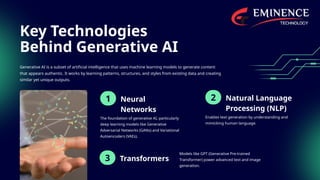
Key Technologies
Behind Generative AI
Generative AI is a subset of artificial intelligence that uses machine learning models to generate content
that appears authentic. It works by learning patterns, structures, and styles from existing data and creating
similar yet unique outputs.
The foundation of generative AI, particularly
deep learning models like Generative
Adversarial Networks (GANs) and Variational
Autoencoders (VAEs).
Enables text generation by understanding and
mimicking human language.
1 2
Neural
Networks
Natural Language
Processing (NLP)
Models like GPT (Generative Pre-trained
Transformer) power advanced text and image
generation.
3 Transformers
Applications of
Generative AI
Generative AI can produce text, art,
and music, making it a powerful tool
for content creators, marketers, and
entertainment industries.
Developers use generative AI to write
and debug code, speeding up software
development processes.
In industries like fashion, architecture, and
graphic design, generative AI helps create
innovative designs and prototypes.
Content Creation Code Generation Design and Prototyping
Generative AI assists in drug discovery,
medical imaging analysis, and creating
synthetic datasets for research.
Healthcare
Generative AI breaks
barriers to human
creativity, offering
endless possibilities in
content and product
design.
Creativity and Innovation
It enables highly
personalized
experiences, such as
tailored marketing
campaigns or user-
specific
recommendations.
Customization
By automating tasks,
generative AI saves
time and resources,
improving productivity
across industries.
Efficiency
Generative AI can
produce large volumes
of high-quality
outputs, making it
ideal for scaling
operations.
Scalability
1 2 3 4
Benefits of
Generative AI
Development
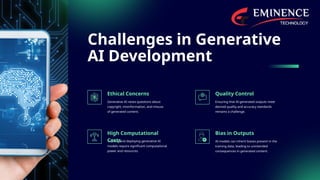
Challenges in Generative
AI Development
Generative AI raises questions about
copyright, misinformation, and misuse
of generated content.
Training and deploying generative AI
models require significant computational
power and resources.
Ethical Concerns
High Computational
Costs
Ensuring that AI-generated outputs meet
desired quality and accuracy standards
remains a challenge.
Quality Control
AI models can inherit biases present in the
training data, leading to unintended
consequences in generated content.
Bias in Outputs
The Future of Generative AI
Generative AI is poised to revolutionize industries by driving innovation
and transforming workflows. As models become more sophisticated,
their potential applications will expand, offering solutions to complex
problems and enhancing human capabilities. Ethical frameworks and
technological advancements will play a critical role in shaping the
responsible development of generative AI.
Conclusion
Generative AI is transforming industries with its ability to automate creativity, improve
efficiency, and enable innovation. While challenges like ethical concerns and computational
costs persist, the potential benefits far outweigh the hurdles. Eminence Technology offers
comprehensive generative AI development services, helping businesses leverage this cutting-
edge technology to stay ahead in a rapidly evolving digital landscape. Partner with us to unlock
the full potential of generative AI for your organization.
https://eminencetechnology.com

What is Generative AI Development? Explain

  • 1.
  • 2.
    What is GenerativeAI Development? Generative AI development refers to the process of creating artificial intelligence systems capable of producing new content, such as text, images, music, or code, that mimics human creativity. Unlike traditional AI, which focuses on pattern recognition and task execution, generative AI leverages advanced models to generate novel outputs from learned data.
  • 3.
    Key Technologies Behind GenerativeAI Generative AI is a subset of artificial intelligence that uses machine learning models to generate content that appears authentic. It works by learning patterns, structures, and styles from existing data and creating similar yet unique outputs. The foundation of generative AI, particularly deep learning models like Generative Adversarial Networks (GANs) and Variational Autoencoders (VAEs). Enables text generation by understanding and mimicking human language. 1 2 Neural Networks Natural Language Processing (NLP) Models like GPT (Generative Pre-trained Transformer) power advanced text and image generation. 3 Transformers
  • 4.
    Applications of Generative AI GenerativeAI can produce text, art, and music, making it a powerful tool for content creators, marketers, and entertainment industries. Developers use generative AI to write and debug code, speeding up software development processes. In industries like fashion, architecture, and graphic design, generative AI helps create innovative designs and prototypes. Content Creation Code Generation Design and Prototyping Generative AI assists in drug discovery, medical imaging analysis, and creating synthetic datasets for research. Healthcare
  • 5.
    Generative AI breaks barriersto human creativity, offering endless possibilities in content and product design. Creativity and Innovation It enables highly personalized experiences, such as tailored marketing campaigns or user- specific recommendations. Customization By automating tasks, generative AI saves time and resources, improving productivity across industries. Efficiency Generative AI can produce large volumes of high-quality outputs, making it ideal for scaling operations. Scalability 1 2 3 4 Benefits of Generative AI Development
  • 6.
    Challenges in Generative AIDevelopment Generative AI raises questions about copyright, misinformation, and misuse of generated content. Training and deploying generative AI models require significant computational power and resources. Ethical Concerns High Computational Costs Ensuring that AI-generated outputs meet desired quality and accuracy standards remains a challenge. Quality Control AI models can inherit biases present in the training data, leading to unintended consequences in generated content. Bias in Outputs
  • 7.
    The Future ofGenerative AI Generative AI is poised to revolutionize industries by driving innovation and transforming workflows. As models become more sophisticated, their potential applications will expand, offering solutions to complex problems and enhancing human capabilities. Ethical frameworks and technological advancements will play a critical role in shaping the responsible development of generative AI.
  • 8.
    Conclusion Generative AI istransforming industries with its ability to automate creativity, improve efficiency, and enable innovation. While challenges like ethical concerns and computational costs persist, the potential benefits far outweigh the hurdles. Eminence Technology offers comprehensive generative AI development services, helping businesses leverage this cutting- edge technology to stay ahead in a rapidly evolving digital landscape. Partner with us to unlock the full potential of generative AI for your organization. https://eminencetechnology.com