WHAT
IS BERT?
UNDERSTANDING GOOGLE’S
ALGORITHM UPDATE
By Shane Black
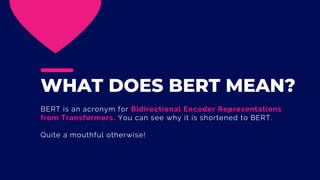
WHAT DOES BERT MEAN?
BERT is an acronym for Bidirectional Encoder Representations
from Transformers. You can see why it is shortened to BERT.
Quite a mouthful otherwise!
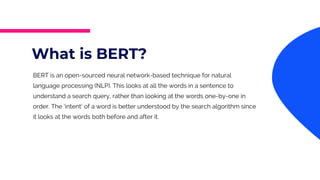
What is BERT?
BERT is an open-sourced neural network-based technique for natural
language processing (NLP). This looks at all the words in a sentence to
understand a search query, rather than looking at the words one-by-one in
order. The ‘intent‘ of a word is better understood by the search algorithm since
it looks at the words both before and after it.
EXAMPLES
Google also provided a few examples.
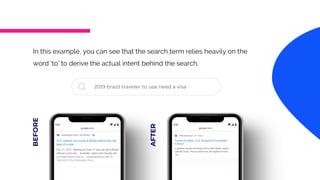
In this example, you can see that the search term relies heavily on the
word ‘to’ to derive the actual intent behind the search.
BEFORE
AFTER
2019 brazil traveler to usa need a visa
After the update, Google is able to
better recognise the intent behind the
search and deliver a more appropriate
search result.
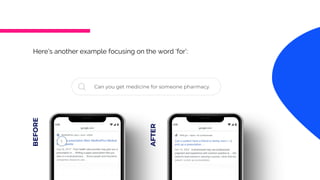
Here’s another example focusing on the word ‘for’:
BEFORE
AFTER
Can you get medicine for someone pharmacy
In this example, the search engine
could not distinguish the importance of
the word ‘for’. After the update, it is
able to identify that the search intent is
to know whether you can pick up a
prescription for someone, rather than
just providing general information
about pharmacy prescriptions.
IMPLICATIONS ON SEO
Anything that changes the way search queries are understood
will impact SEO. As mentioned before, Google stated that BERT
will impact one in 10 searches. Some people will naturally think
that ‘impact’ is negative, however, it can be positive as well.
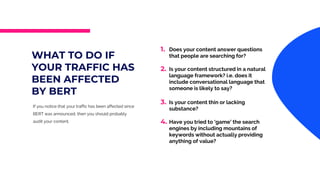
If you notice that your traffic has been affected since
BERT was announced, then you should probably
audit your content.
WHAT TO DO IF
YOUR TRAFFIC HAS
BEEN AFFECTED
BY BERT
1. Does your content answer questions
that people are searching for?
2. Is your content structured in a natural
language framework? i.e. does it
include conversational language that
someone is likely to say?
3. Is your content thin or lacking
substance?
4. Have you tried to ‘game’ the search
engines by including mountains of
keywords without actually providing
anything of value?
The announcement of
BERT is a big step
forward for Google.
THANK YOU!

What is Bert? Understanding Google's Algorithm Update

  • 1.
  • 2.
    WHAT DOES BERTMEAN? BERT is an acronym for Bidirectional Encoder Representations from Transformers. You can see why it is shortened to BERT. Quite a mouthful otherwise!
  • 3.
    What is BERT? BERTis an open-sourced neural network-based technique for natural language processing (NLP). This looks at all the words in a sentence to understand a search query, rather than looking at the words one-by-one in order. The ‘intent‘ of a word is better understood by the search algorithm since it looks at the words both before and after it.
  • 4.
  • 5.
    In this example,you can see that the search term relies heavily on the word ‘to’ to derive the actual intent behind the search. BEFORE AFTER 2019 brazil traveler to usa need a visa
  • 6.
    After the update,Google is able to better recognise the intent behind the search and deliver a more appropriate search result.
  • 7.
    Here’s another examplefocusing on the word ‘for’: BEFORE AFTER Can you get medicine for someone pharmacy
  • 8.
    In this example,the search engine could not distinguish the importance of the word ‘for’. After the update, it is able to identify that the search intent is to know whether you can pick up a prescription for someone, rather than just providing general information about pharmacy prescriptions.
  • 9.
    IMPLICATIONS ON SEO Anythingthat changes the way search queries are understood will impact SEO. As mentioned before, Google stated that BERT will impact one in 10 searches. Some people will naturally think that ‘impact’ is negative, however, it can be positive as well.
  • 10.
    If you noticethat your traffic has been affected since BERT was announced, then you should probably audit your content. WHAT TO DO IF YOUR TRAFFIC HAS BEEN AFFECTED BY BERT 1. Does your content answer questions that people are searching for? 2. Is your content structured in a natural language framework? i.e. does it include conversational language that someone is likely to say? 3. Is your content thin or lacking substance? 4. Have you tried to ‘game’ the search engines by including mountains of keywords without actually providing anything of value?
  • 11.
    The announcement of BERTis a big step forward for Google.
  • 12.