


• So, the process is known as Digenesis that turns sediment to rock.
During digenesis, water squeezes out of the pore spaces and
forms Grains in the mass of the rock — the size of grains ranging
from 0.001mm to 0.00004 inches. When grain formation takes
place due to fossils, the size of fossils determines the shapes,
patterns, and orientation of the grains.
Sedimentation – A Process of Rock 
Formation
• How Limestone Defined?
Geologists and other professionals define limestone as a rock,
which has at least 50% calcium carbonate by weight and famously
known as Calcite.
• What Is the Constitution of Limestone?
Apart from calcites, limestone also contains other minerals and
forms small particles found in quartz, feldspar, pyrite, siderite, and
clay minerals — large nodules in Chert (chalcedony, flint, Jasper),
pyrite, and siderite.
How Is Limestone Formed
• At geological perspective, the formation of limestone takes place in
two different environments
1. Sedimentation in deep marine water
2. By water evaporation during cave formation.
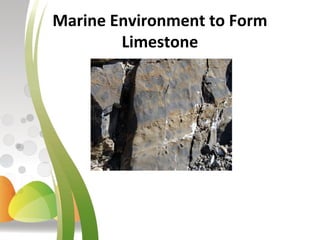
Marine Environment to Form 
Limestone
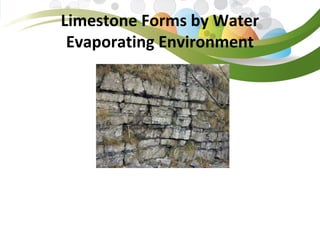
Limestone Forms by Water 
Evaporating Environment
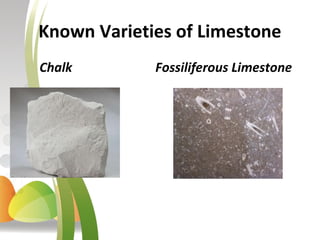
Known Varieties of Limestone
Chalk Fossiliferous Limestone
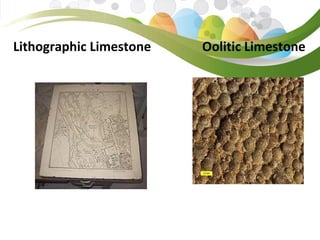
Lithographic Limestone Oolitic Limestone
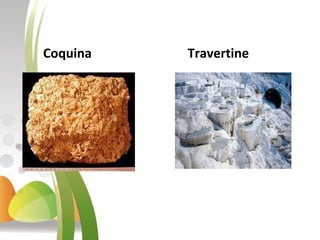
Coquina Travertine
Uses of Limestone in General
• Agricultural
• Aggregates
• Reagent
• Glass Making
• Smelting & Refining
• Pharmacy and Healthcare
• Animal Feed
• Plaster of Paris
• Filter
Uses of Limestone in the Construction
Industry for Exterior Applications
• Limestone as Dimension Stones:
We know limestone can be cut into pieces of any dimension. Whole
stones or cubes also prove better structural material and gives the
property a classic look.
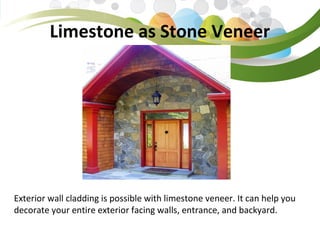
Limestone as Stone Veneer
Exterior wall cladding is possible with limestone veneer. It can help you
decorate your entire exterior facing walls, entrance, and backyard.
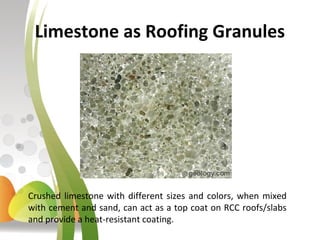
Limestone as Roofing Granules
Crushed limestone with different sizes and colors, when mixed
with cement and sand, can act as a top coat on RCC roofs/slabs
and provide a heat-resistant coating.
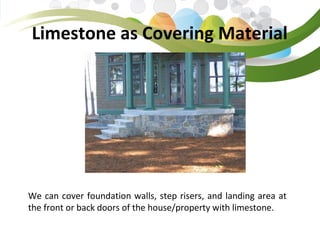
Limestone as Covering Material
We can cover foundation walls, step risers, and landing area at
the front or back doors of the house/property with limestone.
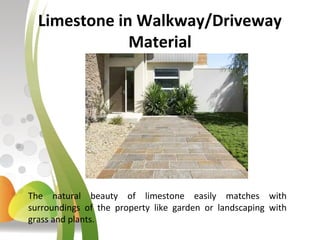
Limestone in Walkway/Driveway
Material
The natural beauty of limestone easily matches with
surroundings of the property like garden or landscaping with
grass and plants.
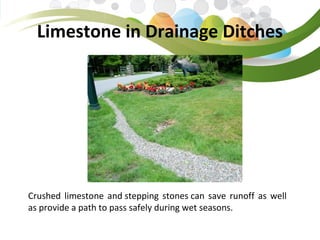
Limestone in Drainage Ditches
Crushed limestone and stepping stones can save runoff as well
as provide a path to pass safely during wet seasons.
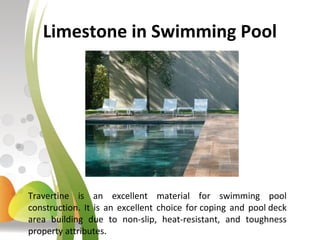
Limestone in Swimming Pool
Travertine is an excellent material for swimming pool
construction. It is an excellent choice for coping and pool deck
area building due to non-slip, heat-resistant, and toughness
property attributes.
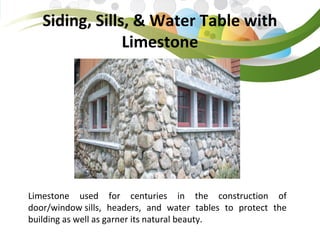
Siding, Sills, & Water Table with
Limestone
Limestone used for centuries in the construction of
door/window sills, headers, and water tables to protect the
building as well as garner its natural beauty.
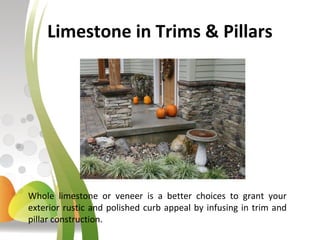
Limestone in Trims & Pillars
Whole limestone or veneer is a better choices to grant your
exterior rustic and polished curb appeal by infusing in trim and
pillar construction.
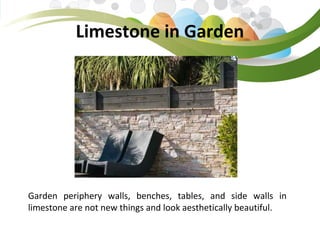
Limestone in Garden
Garden periphery walls, benches, tables, and side walls in
limestone are not new things and look aesthetically beautiful.
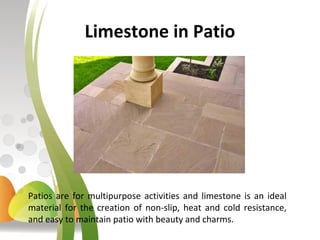
Limestone in Patio
Patios are for multipurpose activities and limestone is an ideal
material for the creation of non-slip, heat and cold resistance,
and easy to maintain patio with beauty and charms.
Where You Will Find the Best Natural
Limestone for Your Next Project?
‘World of Stones’ in the USA is an ideal destination to get you all
limestone requirements with perfect guidance and at competitive
rates in the global market.
THANK YOU
Contact Us
https://worldofstonesusa.com/
info@worldofstonesusa.com

What is a Limestone - Formation & Benefits

  • 2.
    • So, theprocess is known as Digenesis that turns sediment to rock. During digenesis, water squeezes out of the pore spaces and forms Grains in the mass of the rock — the size of grains ranging from 0.001mm to 0.00004 inches. When grain formation takes place due to fossils, the size of fossils determines the shapes, patterns, and orientation of the grains. Sedimentation – A Process of Rock  Formation
  • 3.
    • How Limestone Defined? Geologists andother professionals define limestone as a rock, which has at least 50% calcium carbonate by weight and famously known as Calcite. • What Is the Constitution of Limestone? Apart from calcites, limestone also contains other minerals and forms small particles found in quartz, feldspar, pyrite, siderite, and clay minerals — large nodules in Chert (chalcedony, flint, Jasper), pyrite, and siderite.
  • 4.
    How Is Limestone Formed • At geologicalperspective, the formation of limestone takes place in two different environments 1. Sedimentation in deep marine water 2. By water evaporation during cave formation.
  • 5.
  • 6.
  • 7.
    Known Varieties ofLimestone Chalk Fossiliferous Limestone
  • 8.
  • 9.
  • 10.
    Uses of Limestonein General • Agricultural • Aggregates • Reagent • Glass Making • Smelting & Refining • Pharmacy and Healthcare • Animal Feed • Plaster of Paris • Filter
  • 11.
    Uses of Limestonein the Construction Industry for Exterior Applications • Limestone as Dimension Stones: We know limestone can be cut into pieces of any dimension. Whole stones or cubes also prove better structural material and gives the property a classic look.
  • 12.
    Limestone as StoneVeneer Exterior wall cladding is possible with limestone veneer. It can help you decorate your entire exterior facing walls, entrance, and backyard.
  • 13.
    Limestone as RoofingGranules Crushed limestone with different sizes and colors, when mixed with cement and sand, can act as a top coat on RCC roofs/slabs and provide a heat-resistant coating.
  • 14.
    Limestone as CoveringMaterial We can cover foundation walls, step risers, and landing area at the front or back doors of the house/property with limestone.
  • 15.
    Limestone in Walkway/Driveway Material Thenatural beauty of limestone easily matches with surroundings of the property like garden or landscaping with grass and plants.
  • 16.
    Limestone in DrainageDitches Crushed limestone and stepping stones can save runoff as well as provide a path to pass safely during wet seasons.
  • 17.
    Limestone in SwimmingPool Travertine is an excellent material for swimming pool construction. It is an excellent choice for coping and pool deck area building due to non-slip, heat-resistant, and toughness property attributes.
  • 18.
    Siding, Sills, &Water Table with Limestone Limestone used for centuries in the construction of door/window sills, headers, and water tables to protect the building as well as garner its natural beauty.
  • 19.
    Limestone in Trims& Pillars Whole limestone or veneer is a better choices to grant your exterior rustic and polished curb appeal by infusing in trim and pillar construction.
  • 20.
    Limestone in Garden Gardenperiphery walls, benches, tables, and side walls in limestone are not new things and look aesthetically beautiful.
  • 21.
    Limestone in Patio Patiosare for multipurpose activities and limestone is an ideal material for the creation of non-slip, heat and cold resistance, and easy to maintain patio with beauty and charms.
  • 22.
    Where You WillFind the Best Natural Limestone for Your Next Project? ‘World of Stones’ in the USA is an ideal destination to get you all limestone requirements with perfect guidance and at competitive rates in the global market.
  • 23.

Editor's Notes

  • #2 www.freepptbackgrounds.net – We are waiting you to visit us.