Computer? What’s a computer?
Until the 1930s a “computer” was a
person who did mathematical
calculations.
This changed at least in part due to
World War II --
The US, Great Britain and Germany
all had active research into computer
technology.
Copyright © 2008 by Helene G. Kershner
Computer? What’s a computer?
Man vs. Machine
Albert Einstein said:
Computers are incredibly fast, accurate, and stupid:
Humans are incredibly slow, inaccurate and
brilliant;
Together they are powerful beyond imagination.1
--
Albert Einstein
www.quotiki.com
Copyright © 2008 by Helene G. Kershner
Computer? What’s a computer?
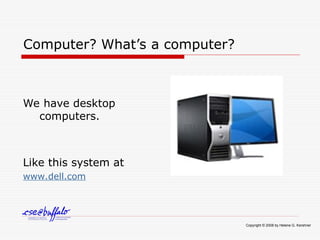
We have desktop
computers.
Like this system at
www.dell.com
Copyright © 2008 by Helene G. Kershner
Computer? What’s a computer?
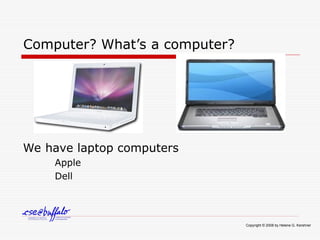
We have laptop computers
Apple
Dell
Copyright © 2008 by Helene G. Kershner
Computer? What’s a computer?
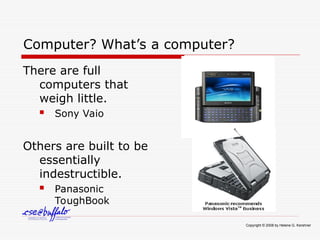
There are full
computers that
weigh little.
 Sony Vaio
Others are built to be
essentially
indestructible.
 Panasonic
ToughBook
Copyright © 2008 by Helene G. Kershner
Computer? What’s a computer?

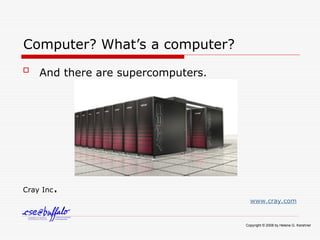
And there are supercomputers.
Cray Inc.
www.cray.com
Copyright © 2008 by Helene G. Kershner
Computer? What’s a computer?
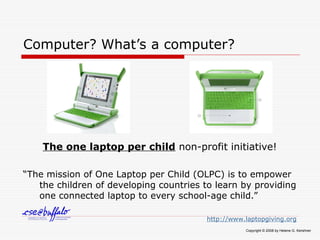
The one laptop per child non-profit initiative!
“The mission of One Laptop per Child (OLPC) is to empower
the children of developing countries to learn by providing
one connected laptop to every school-age child.”
http://www.laptopgiving.org
Copyright © 2008 by Helene G. Kershner
Computer? What’s a computer?
 Much of what we own, use and do contains
computers.
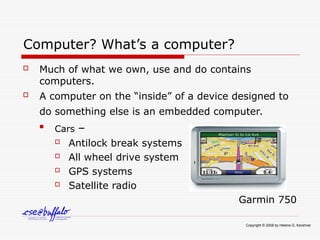
 A computer on the “inside” of a device designed to
do something else is an embedded computer.

Cars –
 Antilock break systems
 All wheel drive system
 GPS systems
 Satellite radio
Garmin 750
Copyright © 2008 by Helene G. Kershner
Computer? What’s a computer?
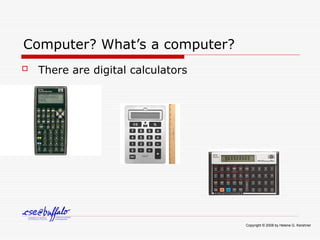
 There are digital calculators
Copyright © 2008 by Helene G. Kershner
Computer? What’s a computer
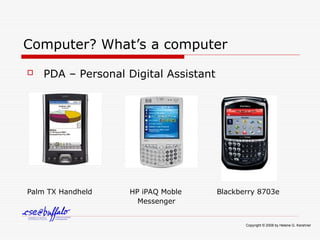
 PDA – Personal Digital Assistant
Palm TX Handheld HP iPAQ Moble Blackberry 8703e
Messenger
Copyright © 2008 by Helene G. Kershner
Computer? What’s a computer?
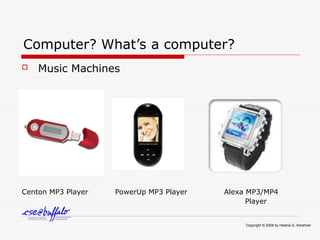
 Music Machines
Centon MP3 Player PowerUp MP3 Player Alexa MP3/MP4
Player
Copyright © 2008 by Helene G. Kershner
Computer? What’s a computer?
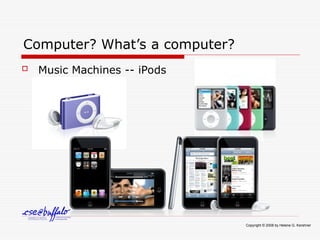
 Music Machines -- iPods
Copyright © 2008 by Helene G. Kershner
Computer? What’s a computer?
Then there are computers in
 Deep Fryers
 Microwave Ovens
 Alarm Clocks
 Cameras
 Augmentative Communication Devices
(Talkers)
 Cash registers
 Gasoline pumps
Copyright © 2008 by Helene G. Kershner
Computer? What’s a computer?
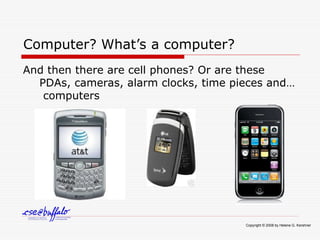
And then there are cell phones? Or are these
PDAs, cameras, alarm clocks, time pieces and…
computers
Copyright © 2008 by Helene G. Kershner
Computers, Where did they come from?
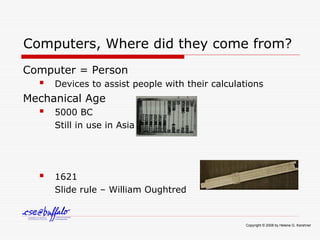
Computer = Person
 Devices to assist people with their calculations
Mechanical Age
 5000 BC
Still in use in Asia
 1621
Slide rule – William Oughtred
Copyright © 2008 by Helene G. Kershner
Computers, Where did they come from?
Mechanical Devices
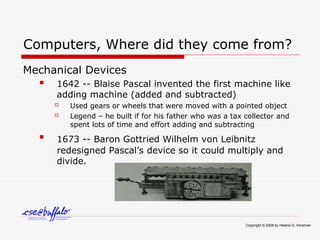
 1642 -- Blaise Pascal invented the first machine like
adding machine (added and subtracted)
 Used gears or wheels that were moved with a pointed object
 Legend – he built if for his father who was a tax collector and
spent lots of time and effort adding and subtracting

1673 -- Baron Gottried Wilhelm von Leibnitz
redesigned Pascal’s device so it could multiply and
divide.
Copyright © 2008 by Helene G. Kershner
Computers, Where did they come from?
Mechanical Devices
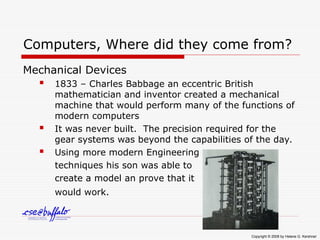
 1833 – Charles Babbage an eccentric British
mathematician and inventor created a mechanical
machine that would perform many of the functions of
modern computers
 It was never built. The precision required for the
gear systems was beyond the capabilities of the day.
 Using more modern Engineering
techniques his son was able to
create a model an prove that it
would work.
Copyright © 2008 by Helene G. Kershner
Computers, Where did they come from?
The Industrial Age – mid 1800s through early 1900s
 Agrarian world  Industrialization
 Farms  factories
 Cloth made by hand  textile industries (mechanical loom)
 Animal power  steam  internal combustion engine
 Gas lights  electic lights
 Herman Hollerith’s Tabulating machine
 Contest to calculate the 1900 census
 “Grandparent” company of IBM
 1888 – William Burroughs’ created & patented a paper
tape adding machine
 Burroughs Corp. moved from adding machines to computers in
1961.
Copyright © 2008 by Helene G. Kershner
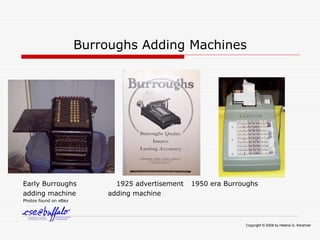
Burroughs Adding Machines
Early Burroughs 1925 advertisement 1950 era Burroughs
adding machine adding machine
Photos found on eBay
Copyright © 2008 by Helene G. Kershner
Computers, Where did they come from?
Next major step: late 1930
What was happening in the world in the late 1930s?
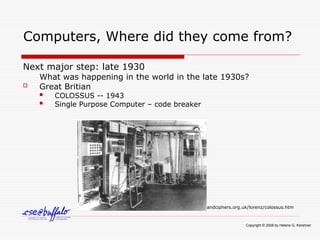
 Great Britian
 COLOSSUS -- 1943
 Single Purpose Computer – code breaker
www.codesandciphers.org.uk/lorenz/colossus.htm
Copyright © 2008 by Helene G. Kershner
Computers, Great Ideas
 In 1936, mathematician Alan Turing theorized
that a general purpose computer could be built.
 Great Idea – He asked, what is computable? He
then suggested that “a task is computable if one
can specify a sequence of instructions which when
followed will result in the completion of the task.” *
 This was intended strictly as a mathematical idea.
This concept/thought experiment is known as a
Turing machine.
 In 1943, Turing helped the British government
develop COLOSSUS.
*plato.stanford.edu/entries/turing-machine/
Copyright © 2008 by Helene G. Kershner
Computers, Great Ideas
 In 1944, scientist John Von Neumann added
his talents to the ENIAC team.
 Great Idea -- Developed the concept of
storing a program in the computer’s memory,
rather part of it’s circuitry.
 This is called the stored program concept.
 Each program was a numeric code using binary
digits (0 or 1) (off or on).
 Both the program and the data could now be
stored in memory.
Kershner, Computer Literacy 3rd Ed.
Copyright © 2008 by Helene G. Kershner
Computers, Where did they come from?
Next major step: late 1930
What was happening in the world in the late 1930s?
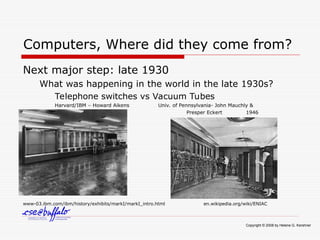
Telephone switches vs Vacuum Tubes
Harvard/IBM – Howard Aikens Univ. of Pennsylvania- John Mauchly &
1943 Presper Eckert 1946
www-03.ibm.com/ibm/history/exhibits/markI/markI_intro.html en.wikipedia.org/wiki/ENIAC
Copyright © 2008 by Helene G. Kershner
History
Computer Generations
Each Generation notes a major change in
technology.
 First Generation (1951 – 1958)
 Vacuum tube technology
 Punched card or magnetic tape
 Machine language
 Magnetic core
 Second Generation (1959 – 1964)
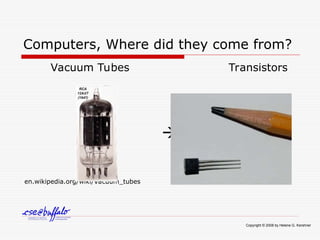
 Great Idea -- Transistor
 Solid-state technology – no moving parts
 Punched card or magnetic tape
 Assembly language or higher level language
 Magnetic core
Copyright © 2008 by Helene G. Kershner
Computers, Where did they come from?
Vacuum Tubes Transistors

en.wikipedia.org/wiki/Vacuum_tubes Schindler, Kris
Copyright © 2008 by Helene G. Kershner
History
Computer Generations
 Third Generation (1965 – early 1970s)
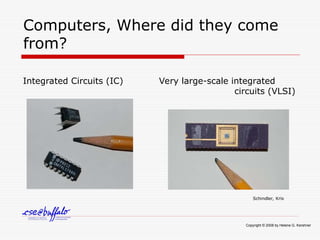
 Great Idea -- Integrated circuits (IC) – multiple
transistors on a chip
 Silicon chips
 Large-scale integration
 Punched cards, magnetic tape, magnetic disks
 Magnetic core, some semiconductor memory
 Fourth Generation Computers (early 1970s – present?)
 Very large-scale integration (VLSI)
 Great Idea– Computer on a chip - Microprocessor chip
 Magnetic disks, floppy disks, flash/memory sticks
 Great Idea – High level programming language“ --user
friendly” software
 Semiconductor memory
Copyright © 2008 by Helene G. Kershner
Computers, Where did they come
from?
Integrated Circuits (IC) Very large-scale integrated
circuits (VLSI)
Schindler, Kris
Copyright © 2008 by Helene G. Kershner

What is a Computer What is a Computer .ppt

  • 1.
    Computer? What’s acomputer? Until the 1930s a “computer” was a person who did mathematical calculations. This changed at least in part due to World War II -- The US, Great Britain and Germany all had active research into computer technology. Copyright © 2008 by Helene G. Kershner
  • 2.
    Computer? What’s acomputer? Man vs. Machine Albert Einstein said: Computers are incredibly fast, accurate, and stupid: Humans are incredibly slow, inaccurate and brilliant; Together they are powerful beyond imagination.1 -- Albert Einstein www.quotiki.com Copyright © 2008 by Helene G. Kershner
  • 3.
    Computer? What’s acomputer? We have desktop computers. Like this system at www.dell.com Copyright © 2008 by Helene G. Kershner
  • 4.
    Computer? What’s acomputer? We have laptop computers Apple Dell Copyright © 2008 by Helene G. Kershner
  • 5.
    Computer? What’s acomputer? There are full computers that weigh little.  Sony Vaio Others are built to be essentially indestructible.  Panasonic ToughBook Copyright © 2008 by Helene G. Kershner
  • 6.
    Computer? What’s acomputer?  And there are supercomputers. Cray Inc. www.cray.com Copyright © 2008 by Helene G. Kershner
  • 7.
    Computer? What’s acomputer? The one laptop per child non-profit initiative! “The mission of One Laptop per Child (OLPC) is to empower the children of developing countries to learn by providing one connected laptop to every school-age child.” http://www.laptopgiving.org Copyright © 2008 by Helene G. Kershner
  • 8.
    Computer? What’s acomputer?  Much of what we own, use and do contains computers.  A computer on the “inside” of a device designed to do something else is an embedded computer.  Cars –  Antilock break systems  All wheel drive system  GPS systems  Satellite radio Garmin 750 Copyright © 2008 by Helene G. Kershner
  • 9.
    Computer? What’s acomputer?  There are digital calculators Copyright © 2008 by Helene G. Kershner
  • 10.
    Computer? What’s acomputer  PDA – Personal Digital Assistant Palm TX Handheld HP iPAQ Moble Blackberry 8703e Messenger Copyright © 2008 by Helene G. Kershner
  • 11.
    Computer? What’s acomputer?  Music Machines Centon MP3 Player PowerUp MP3 Player Alexa MP3/MP4 Player Copyright © 2008 by Helene G. Kershner
  • 12.
    Computer? What’s acomputer?  Music Machines -- iPods Copyright © 2008 by Helene G. Kershner
  • 13.
    Computer? What’s acomputer? Then there are computers in  Deep Fryers  Microwave Ovens  Alarm Clocks  Cameras  Augmentative Communication Devices (Talkers)  Cash registers  Gasoline pumps Copyright © 2008 by Helene G. Kershner
  • 14.
    Computer? What’s acomputer? And then there are cell phones? Or are these PDAs, cameras, alarm clocks, time pieces and… computers Copyright © 2008 by Helene G. Kershner
  • 15.
    Computers, Where didthey come from? Computer = Person  Devices to assist people with their calculations Mechanical Age  5000 BC Still in use in Asia  1621 Slide rule – William Oughtred Copyright © 2008 by Helene G. Kershner
  • 16.
    Computers, Where didthey come from? Mechanical Devices  1642 -- Blaise Pascal invented the first machine like adding machine (added and subtracted)  Used gears or wheels that were moved with a pointed object  Legend – he built if for his father who was a tax collector and spent lots of time and effort adding and subtracting  1673 -- Baron Gottried Wilhelm von Leibnitz redesigned Pascal’s device so it could multiply and divide. Copyright © 2008 by Helene G. Kershner
  • 17.
    Computers, Where didthey come from? Mechanical Devices  1833 – Charles Babbage an eccentric British mathematician and inventor created a mechanical machine that would perform many of the functions of modern computers  It was never built. The precision required for the gear systems was beyond the capabilities of the day.  Using more modern Engineering techniques his son was able to create a model an prove that it would work. Copyright © 2008 by Helene G. Kershner
  • 18.
    Computers, Where didthey come from? The Industrial Age – mid 1800s through early 1900s  Agrarian world  Industrialization  Farms  factories  Cloth made by hand  textile industries (mechanical loom)  Animal power  steam  internal combustion engine  Gas lights  electic lights  Herman Hollerith’s Tabulating machine  Contest to calculate the 1900 census  “Grandparent” company of IBM  1888 – William Burroughs’ created & patented a paper tape adding machine  Burroughs Corp. moved from adding machines to computers in 1961. Copyright © 2008 by Helene G. Kershner
  • 19.
    Burroughs Adding Machines EarlyBurroughs 1925 advertisement 1950 era Burroughs adding machine adding machine Photos found on eBay Copyright © 2008 by Helene G. Kershner
  • 20.
    Computers, Where didthey come from? Next major step: late 1930 What was happening in the world in the late 1930s?  Great Britian  COLOSSUS -- 1943  Single Purpose Computer – code breaker www.codesandciphers.org.uk/lorenz/colossus.htm Copyright © 2008 by Helene G. Kershner
  • 21.
    Computers, Great Ideas In 1936, mathematician Alan Turing theorized that a general purpose computer could be built.  Great Idea – He asked, what is computable? He then suggested that “a task is computable if one can specify a sequence of instructions which when followed will result in the completion of the task.” *  This was intended strictly as a mathematical idea. This concept/thought experiment is known as a Turing machine.  In 1943, Turing helped the British government develop COLOSSUS. *plato.stanford.edu/entries/turing-machine/ Copyright © 2008 by Helene G. Kershner
  • 22.
    Computers, Great Ideas In 1944, scientist John Von Neumann added his talents to the ENIAC team.  Great Idea -- Developed the concept of storing a program in the computer’s memory, rather part of it’s circuitry.  This is called the stored program concept.  Each program was a numeric code using binary digits (0 or 1) (off or on).  Both the program and the data could now be stored in memory. Kershner, Computer Literacy 3rd Ed. Copyright © 2008 by Helene G. Kershner
  • 23.
    Computers, Where didthey come from? Next major step: late 1930 What was happening in the world in the late 1930s? Telephone switches vs Vacuum Tubes Harvard/IBM – Howard Aikens Univ. of Pennsylvania- John Mauchly & 1943 Presper Eckert 1946 www-03.ibm.com/ibm/history/exhibits/markI/markI_intro.html en.wikipedia.org/wiki/ENIAC Copyright © 2008 by Helene G. Kershner
  • 24.
    History Computer Generations Each Generationnotes a major change in technology.  First Generation (1951 – 1958)  Vacuum tube technology  Punched card or magnetic tape  Machine language  Magnetic core  Second Generation (1959 – 1964)  Great Idea -- Transistor  Solid-state technology – no moving parts  Punched card or magnetic tape  Assembly language or higher level language  Magnetic core Copyright © 2008 by Helene G. Kershner
  • 25.
    Computers, Where didthey come from? Vacuum Tubes Transistors  en.wikipedia.org/wiki/Vacuum_tubes Schindler, Kris Copyright © 2008 by Helene G. Kershner
  • 26.
    History Computer Generations  ThirdGeneration (1965 – early 1970s)  Great Idea -- Integrated circuits (IC) – multiple transistors on a chip  Silicon chips  Large-scale integration  Punched cards, magnetic tape, magnetic disks  Magnetic core, some semiconductor memory  Fourth Generation Computers (early 1970s – present?)  Very large-scale integration (VLSI)  Great Idea– Computer on a chip - Microprocessor chip  Magnetic disks, floppy disks, flash/memory sticks  Great Idea – High level programming language“ --user friendly” software  Semiconductor memory Copyright © 2008 by Helene G. Kershner
  • 27.
    Computers, Where didthey come from? Integrated Circuits (IC) Very large-scale integrated circuits (VLSI) Schindler, Kris Copyright © 2008 by Helene G. Kershner