HISTORY OF COMPUTER
CC101 INTRODUCTION TO COMPUTING
http://www.free-powerpoint-templates-design.com
Computer
Computer is a programmable machine.
Computer is a machine that manipulates data
according to a list of instructions.
Computer is any device which aids humans in
performing various kinds of computations or
calculations.
Three principles characteristic of computer:
 It responds to a specific set of instructions in a well-
defined manner.
 It can execute a pre-recorded list of instructions.
 It can quickly store and retrieve large amounts of
data.
Earliest Computer
 Originally calculations were computed by humans, whose job
title was computers.
 These human computers were typically engaged in the
calculation of a mathematical expression.
 The calculations of this period were specialized and expensive,
requiring years of training in mathematics.
 The first use of the word "computer“ was recorded in 1613,
referring to a person who carried out calculations, or
computations, and the word continued to be used in that sense
until the middle of the 20th century.
Earliest Computer
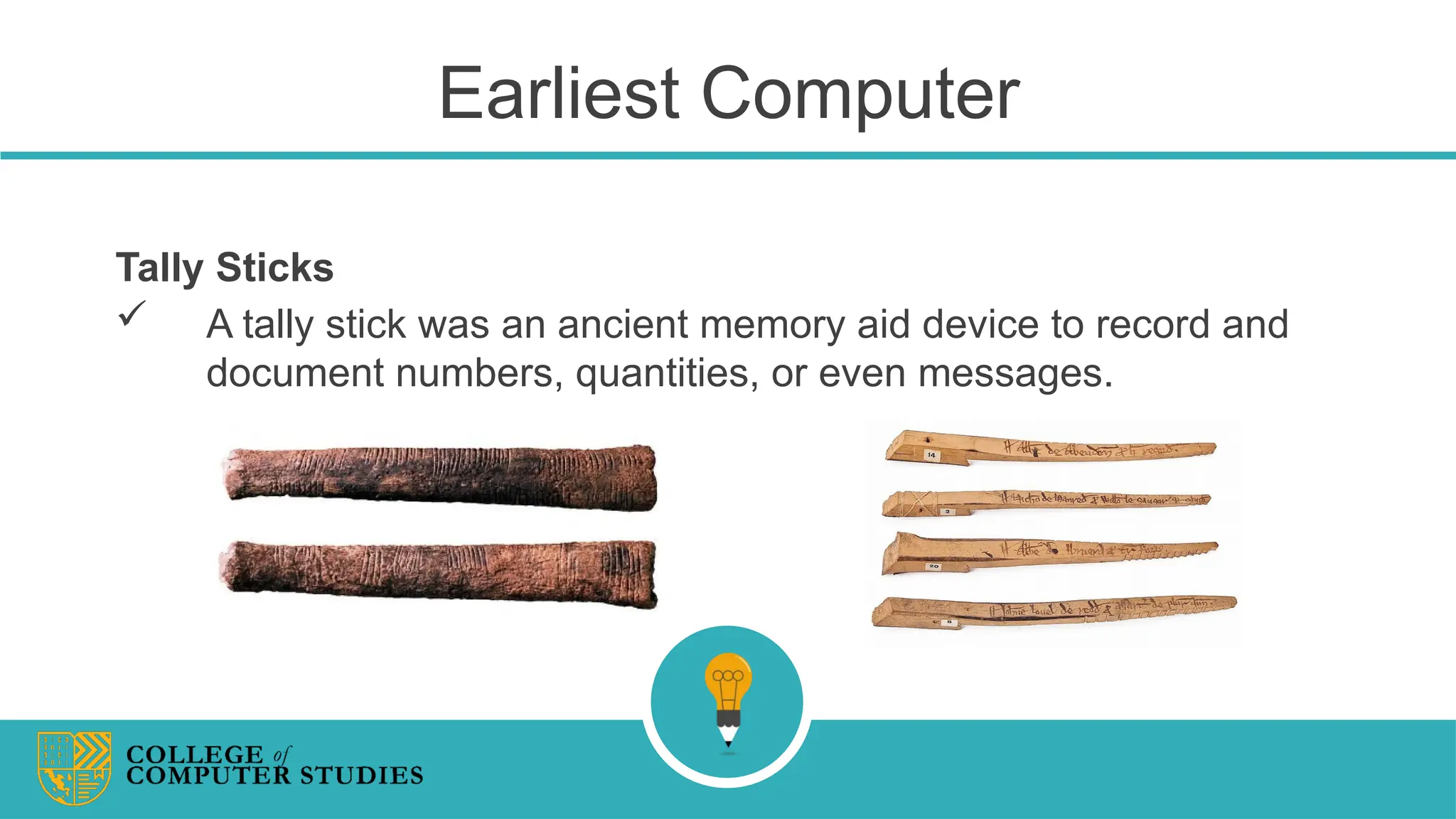
Tally Sticks
 A tally stick was an ancient memory aid device to record and
document numbers, quantities, or even messages.
Earliest Computer
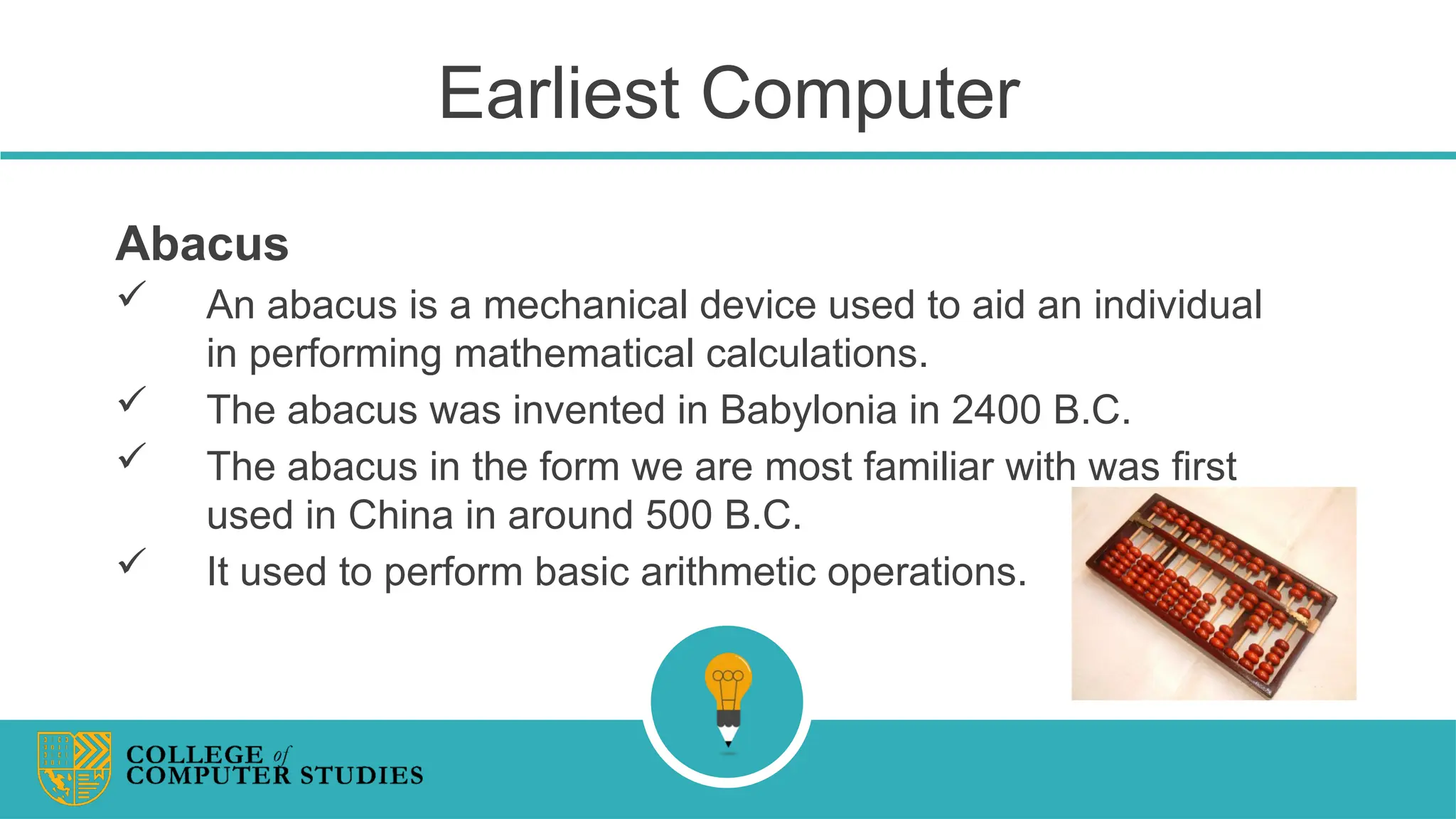
Abacus
 An abacus is a mechanical device used to aid an individual
in performing mathematical calculations.
 The abacus was invented in Babylonia in 2400 B.C.
 The abacus in the form we are most familiar with was first
used in China in around 500 B.C.
 It used to perform basic arithmetic operations.
Earliest Computer
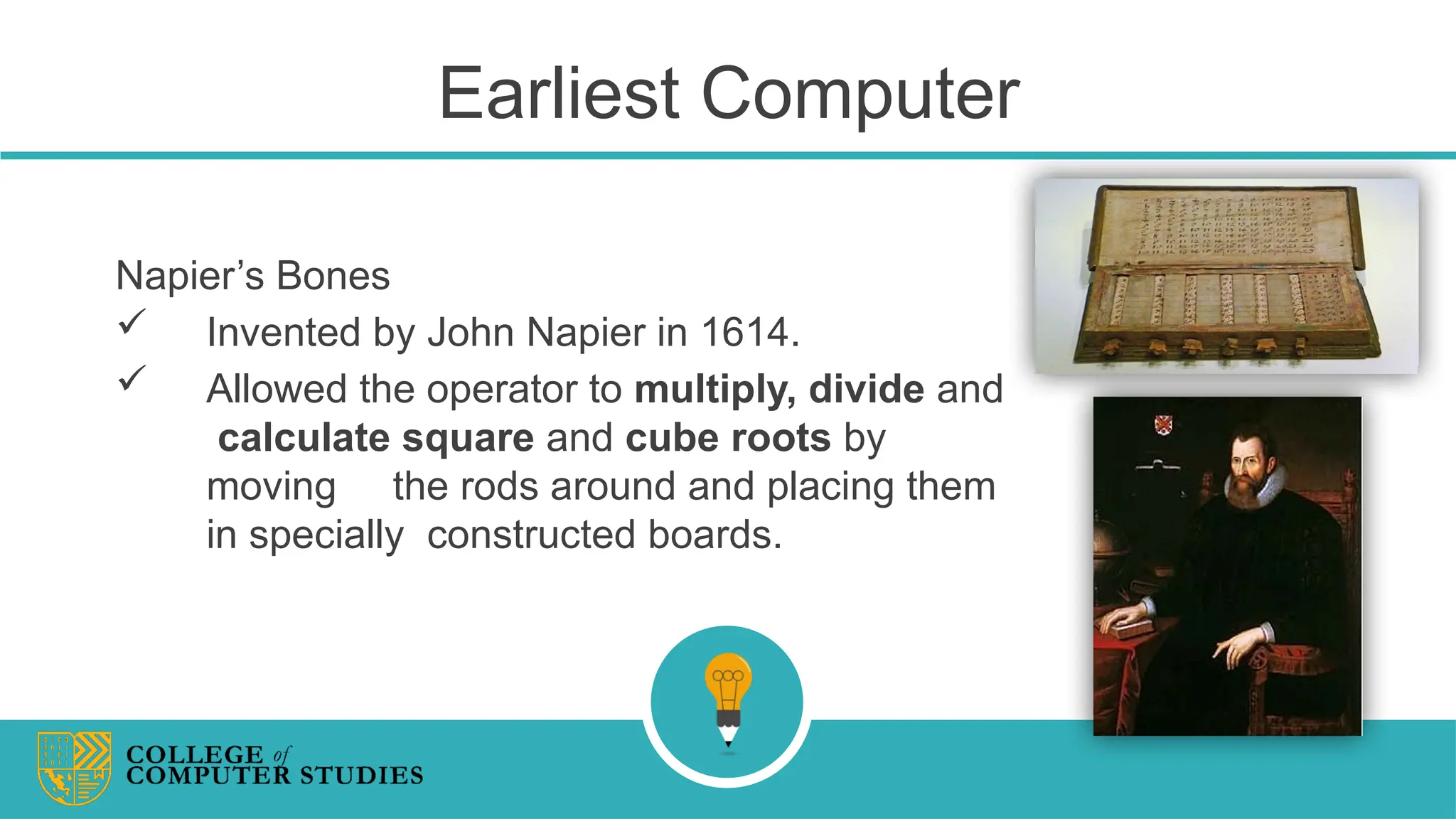
Napier’s Bones
 Invented by John Napier in 1614.
 Allowed the operator to multiply, divide and
calculate square and cube roots by
moving the rods around and placing them
in specially constructed boards.
Earliest Computer
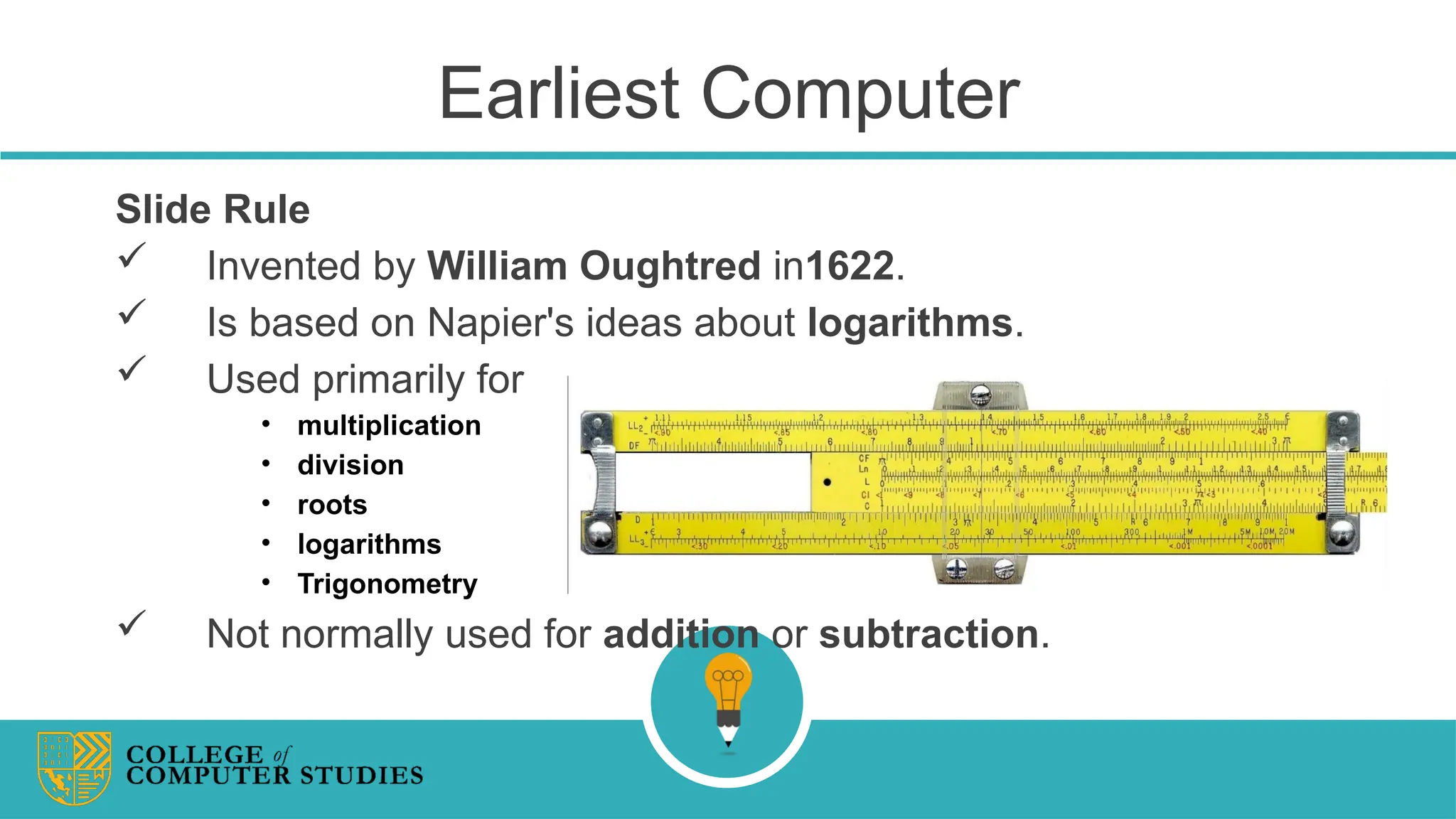
Slide Rule
 Invented by William Oughtred in1622.
 Is based on Napier's ideas about logarithms.
 Used primarily for
• multiplication
• division
• roots
• logarithms
• Trigonometry
 Not normally used for addition or subtraction.
Earliest Computer
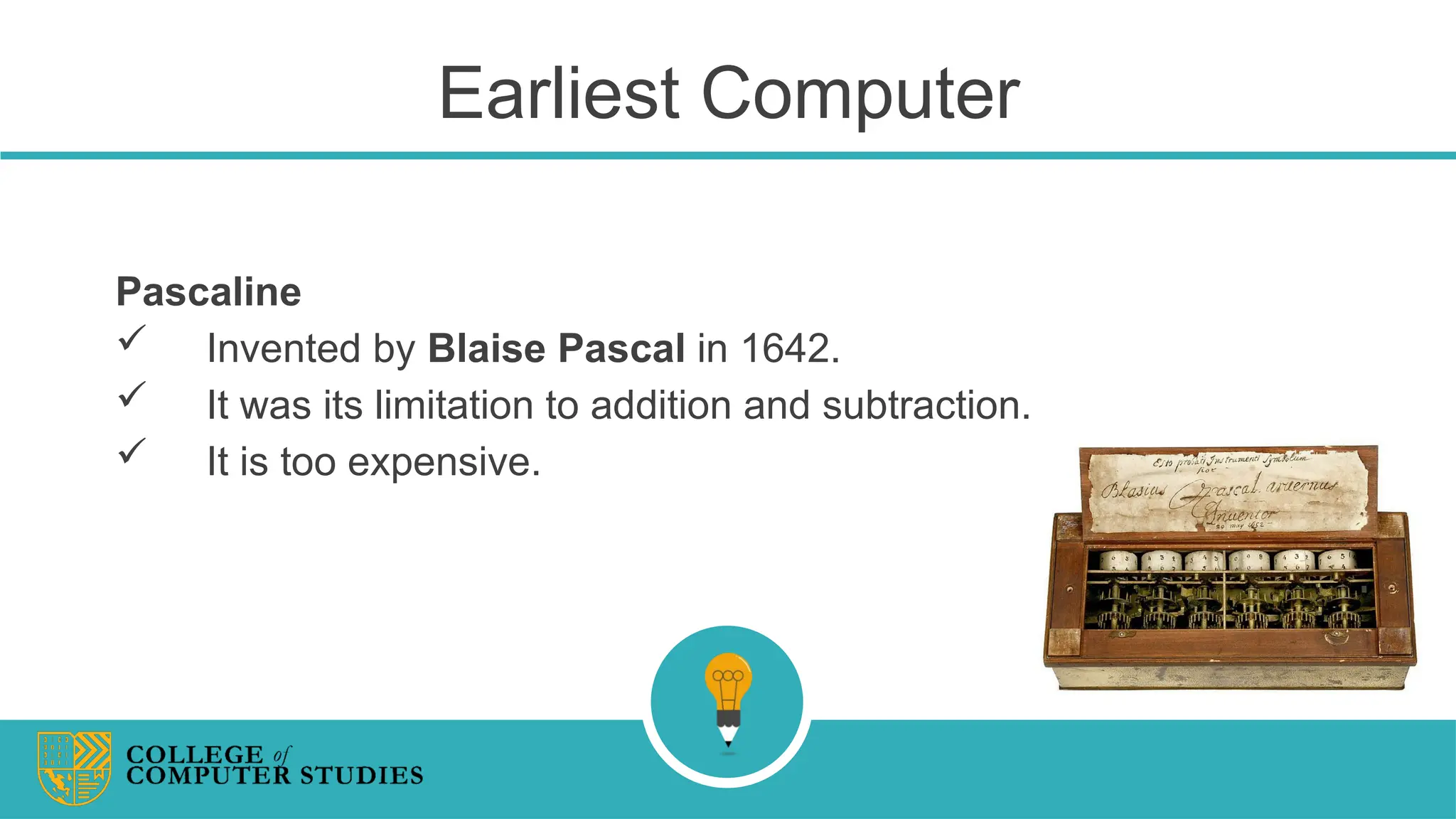
Pascaline
 Invented by Blaise Pascal in 1642.
 It was its limitation to addition and subtraction.
 It is too expensive.
Earliest Computer
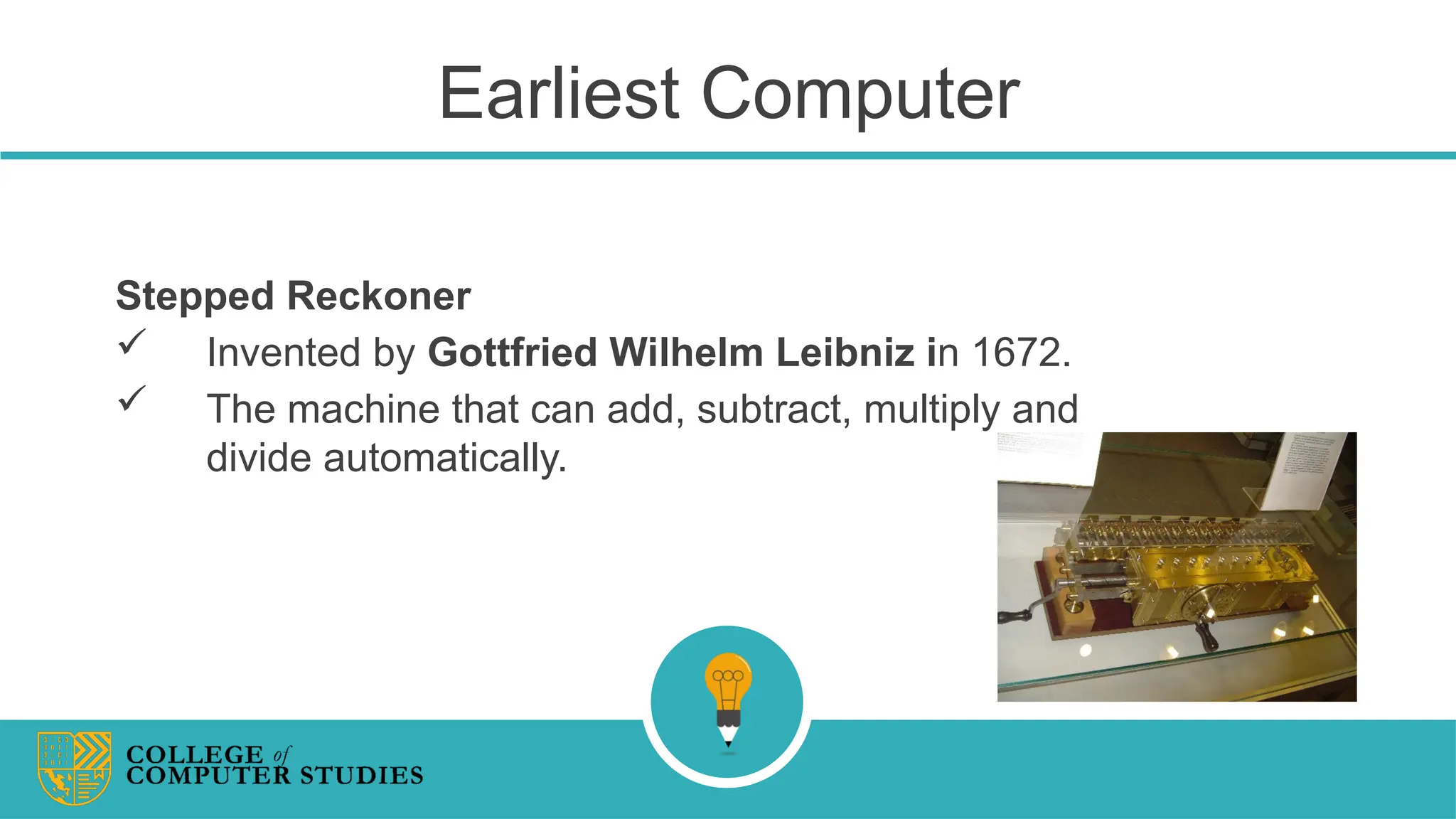
Stepped Reckoner
 Invented by Gottfried Wilhelm Leibniz in 1672.
 The machine that can add, subtract, multiply and
divide automatically.
Earliest Computer
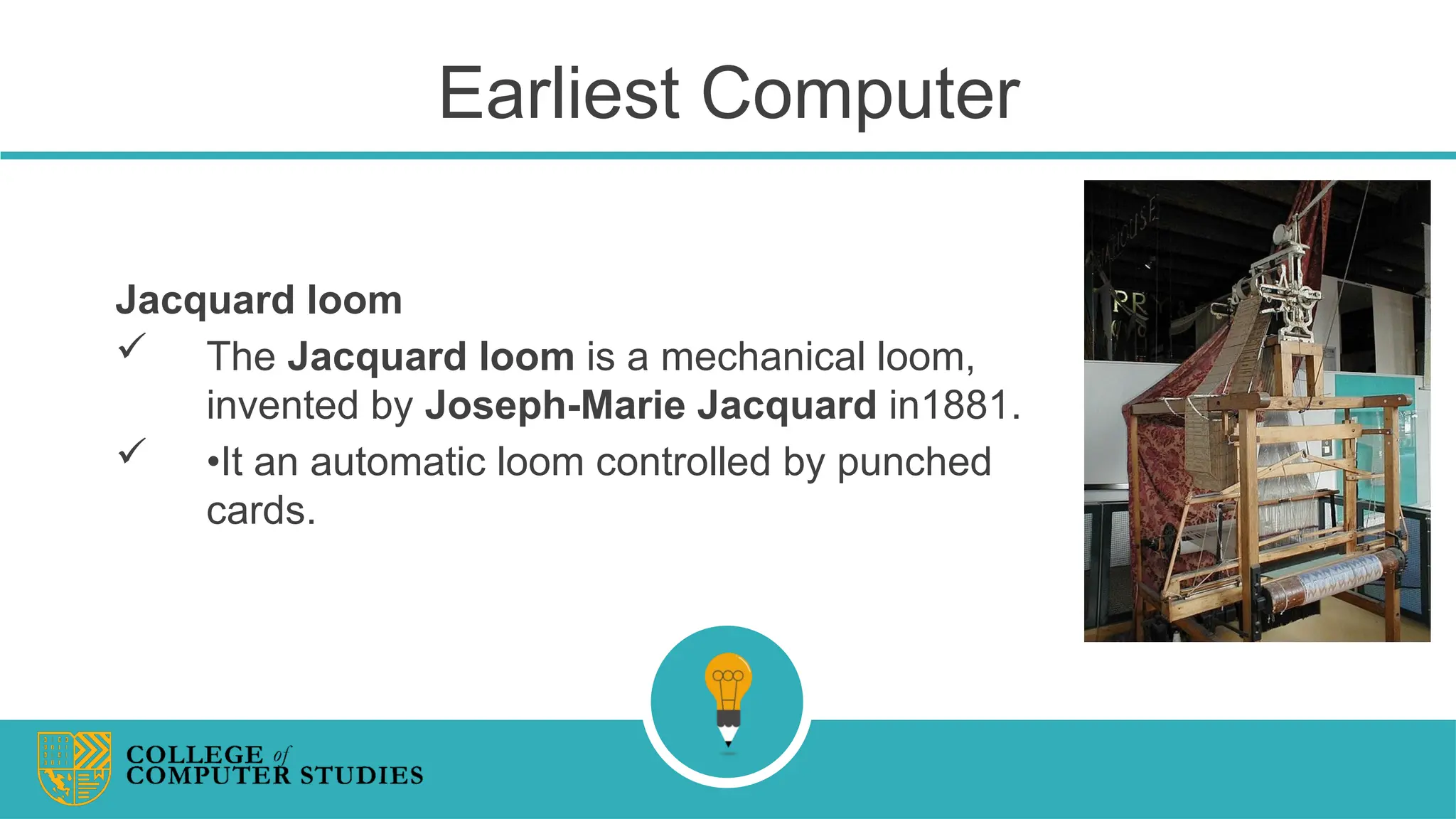
Jacquard loom
 The Jacquard loom is a mechanical loom,
invented by Joseph-Marie Jacquard in1881.
 •It an automatic loom controlled by punched
cards.
Earliest Computer
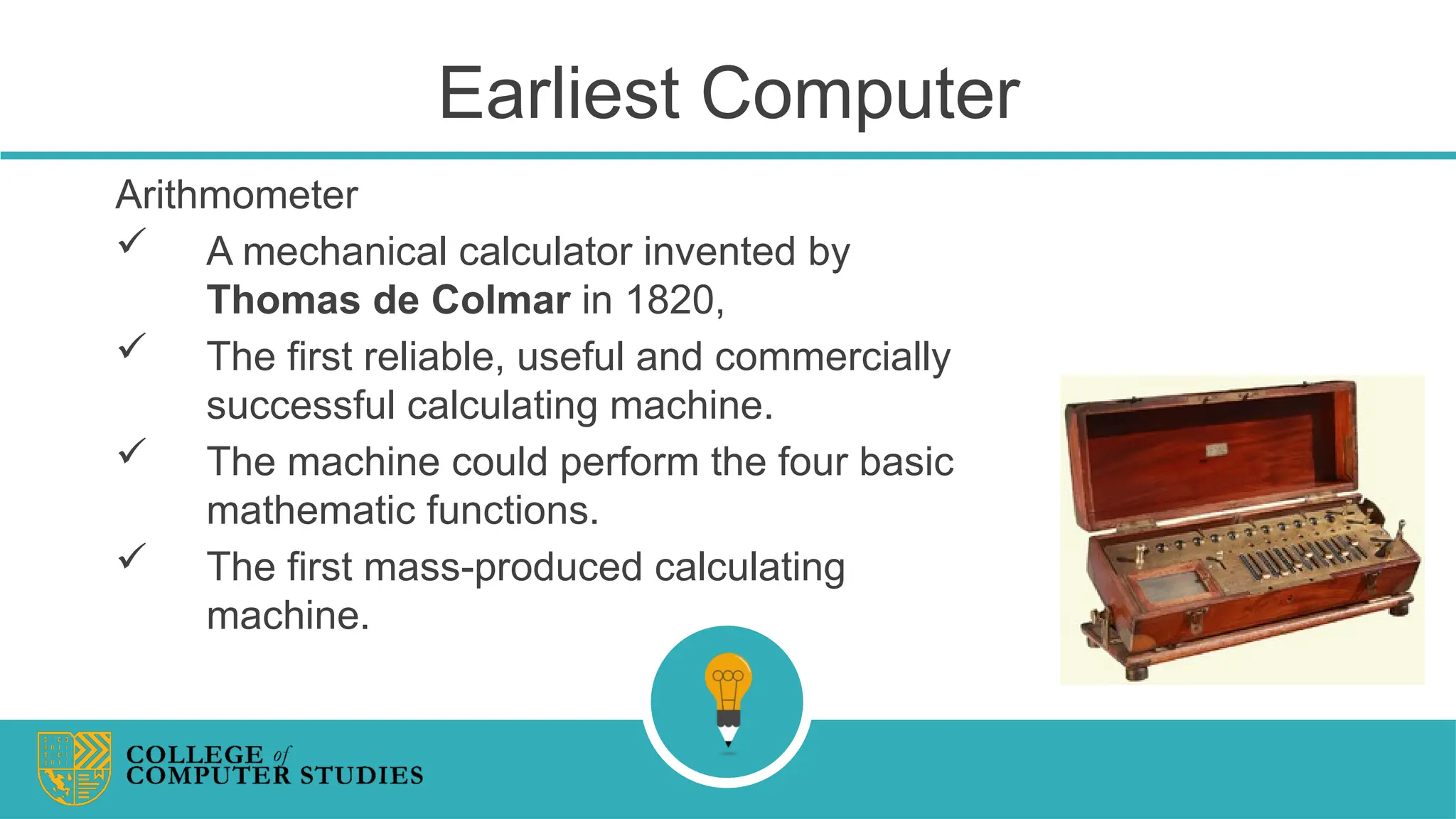
Arithmometer
 A mechanical calculator invented by
Thomas de Colmar in 1820,
 The first reliable, useful and commercially
successful calculating machine.
 The machine could perform the four basic
mathematic functions.
 The first mass-produced calculating
machine.
Earliest Computer
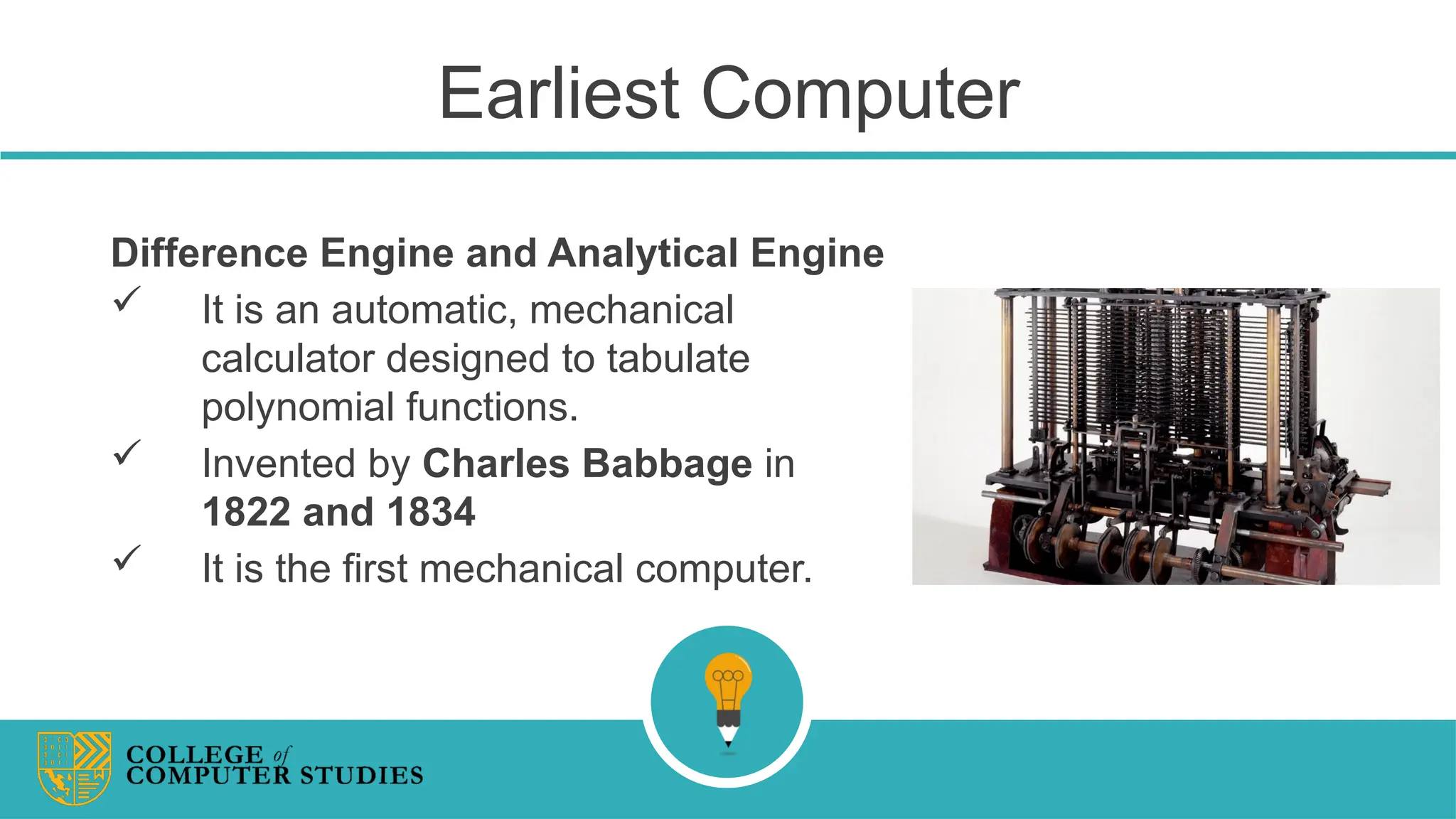
Difference Engine and Analytical Engine
 It is an automatic, mechanical
calculator designed to tabulate
polynomial functions.
 Invented by Charles Babbage in
1822 and 1834
 It is the first mechanical computer.
Earliest Computer
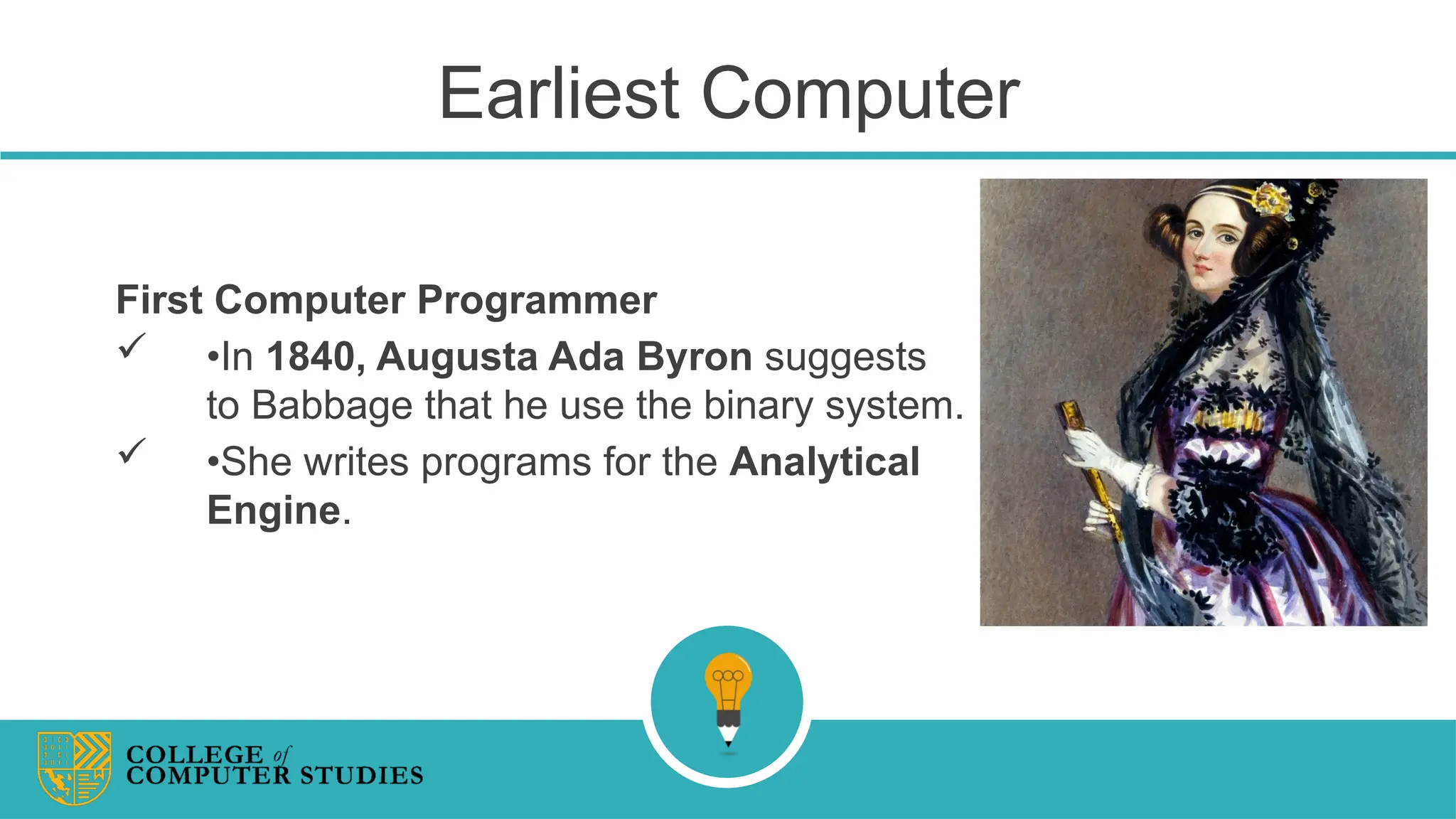
First Computer Programmer
 •In 1840, Augusta Ada Byron suggests
to Babbage that he use the binary system.
 •She writes programs for the Analytical
Engine.
Earliest Computer
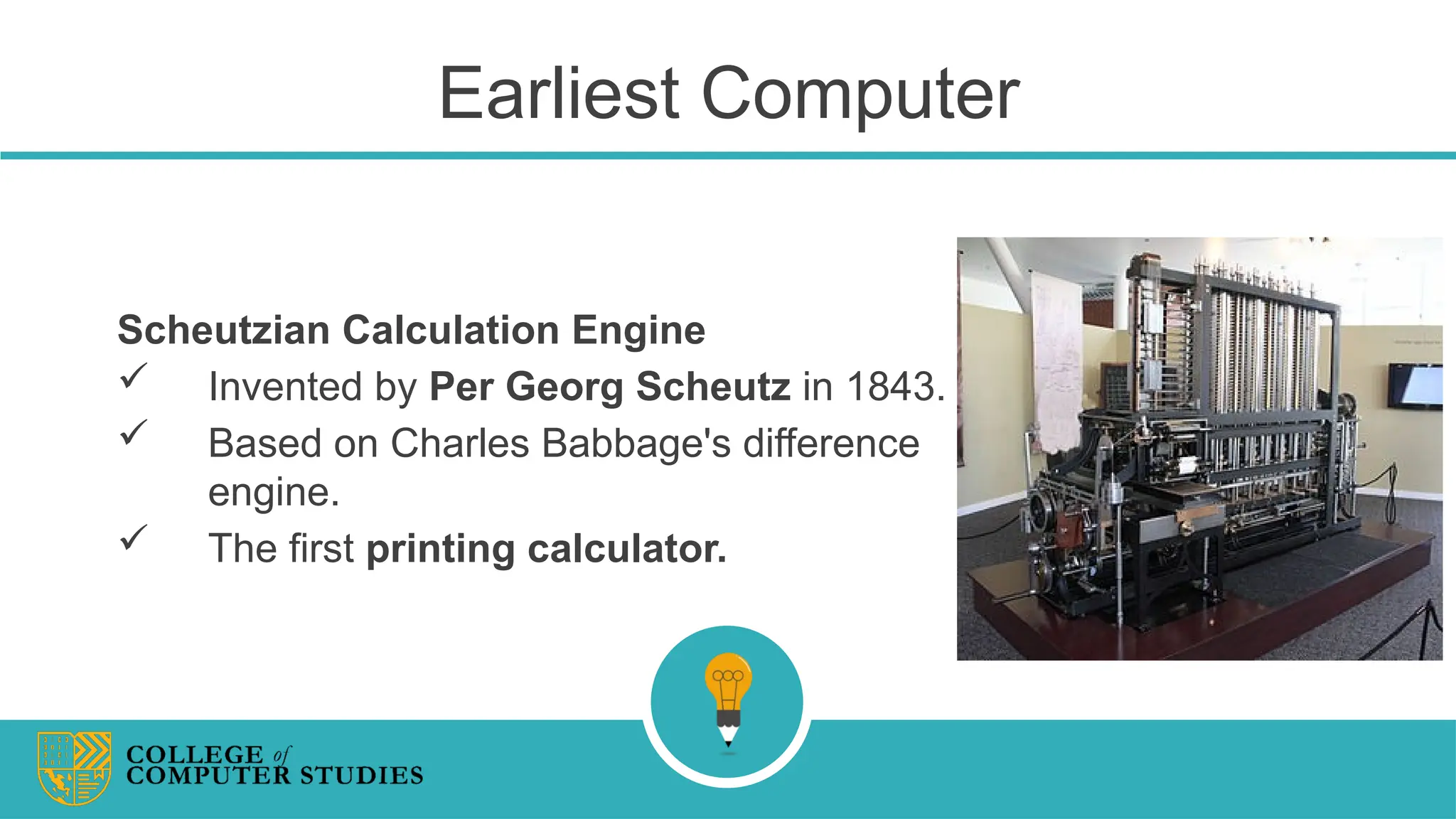
Scheutzian Calculation Engine
 Invented by Per Georg Scheutz in 1843.
 Based on Charles Babbage's difference
engine.
 The first printing calculator.
Earliest Computer
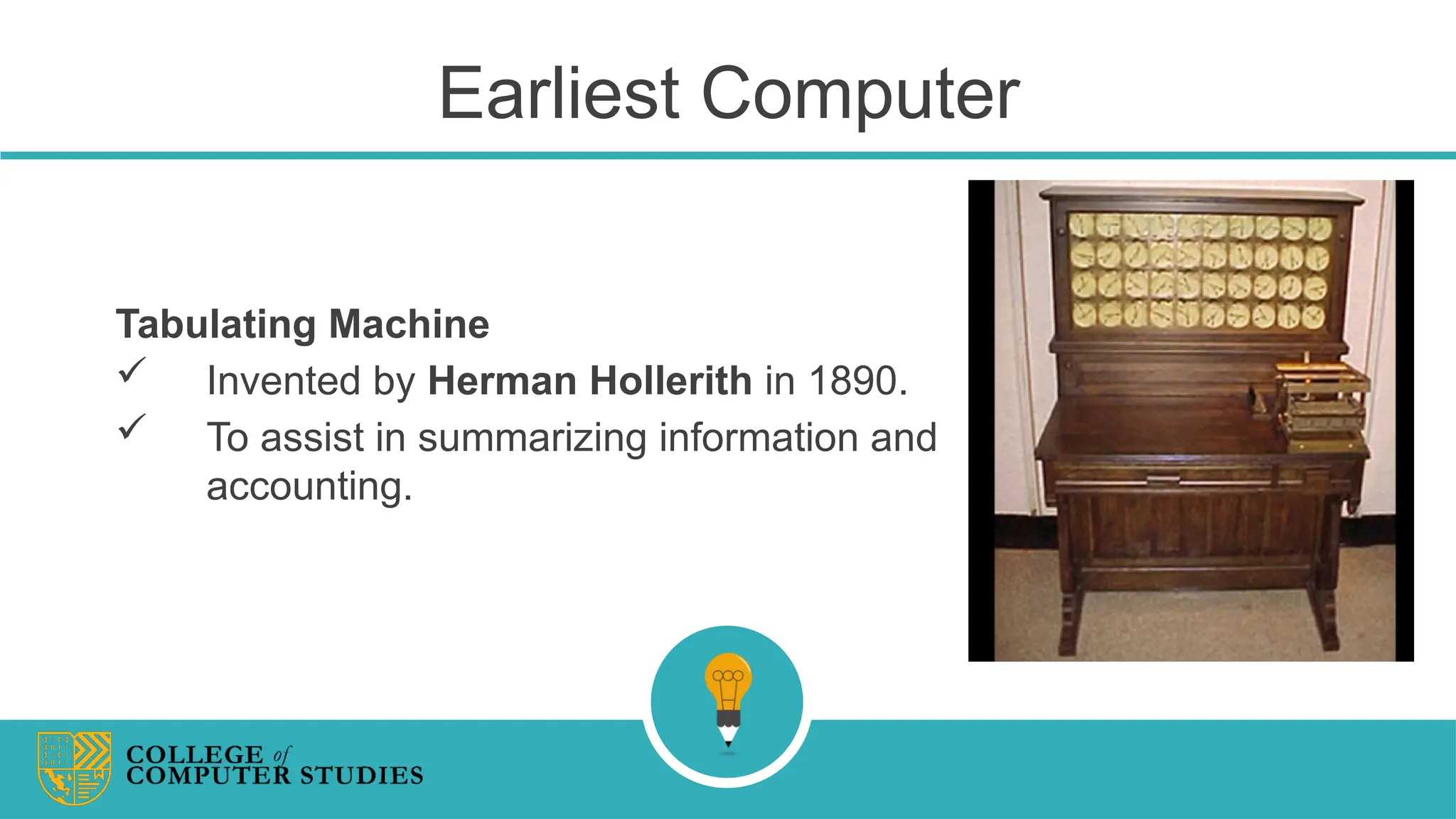
Tabulating Machine
 Invented by Herman Hollerith in 1890.
 To assist in summarizing information and
accounting.
Earliest Computer
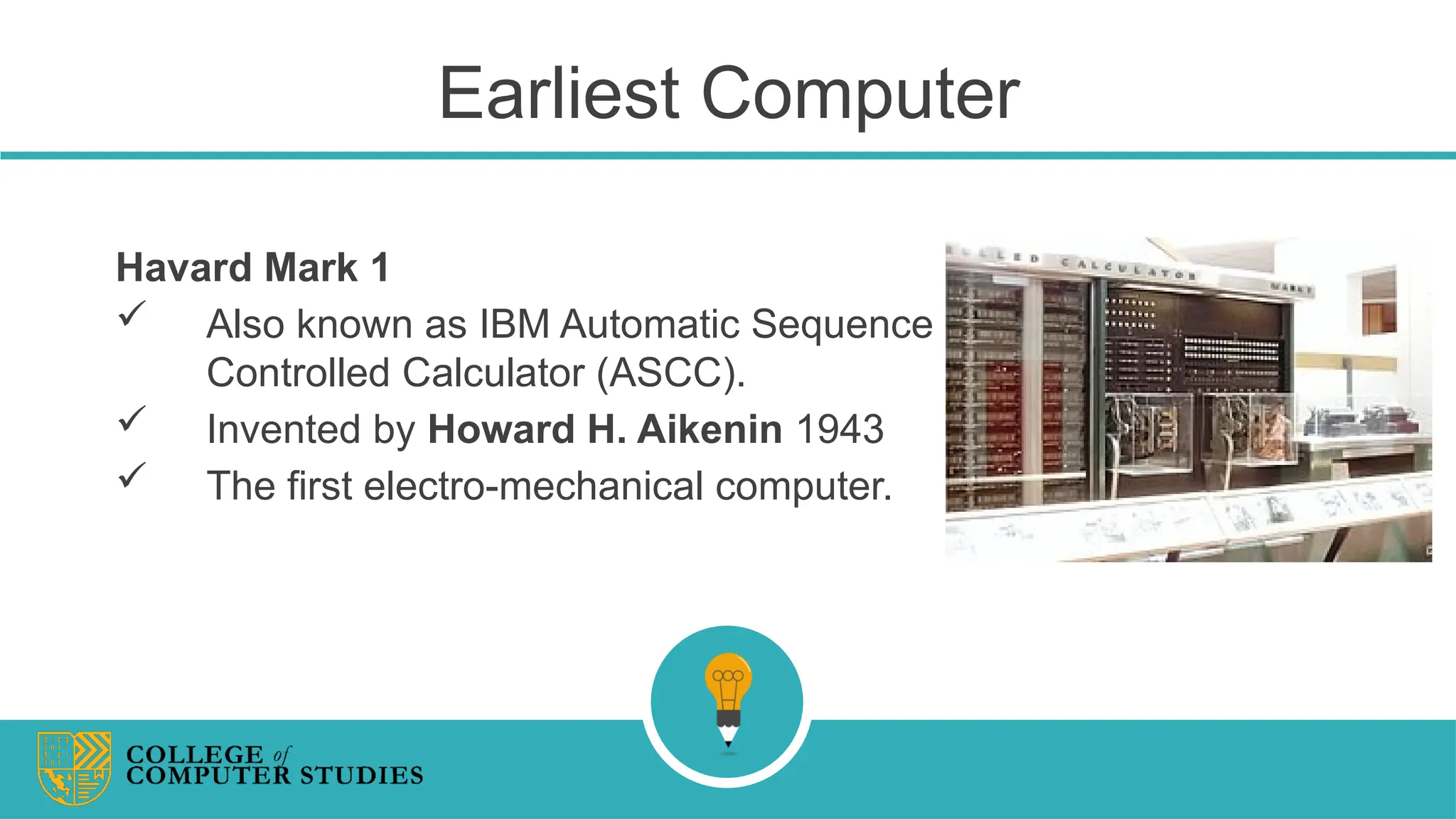
Havard Mark 1
 Also known as IBM Automatic Sequence
Controlled Calculator (ASCC).
 Invented by Howard H. Aikenin 1943
 The first electro-mechanical computer.
Earliest Computer
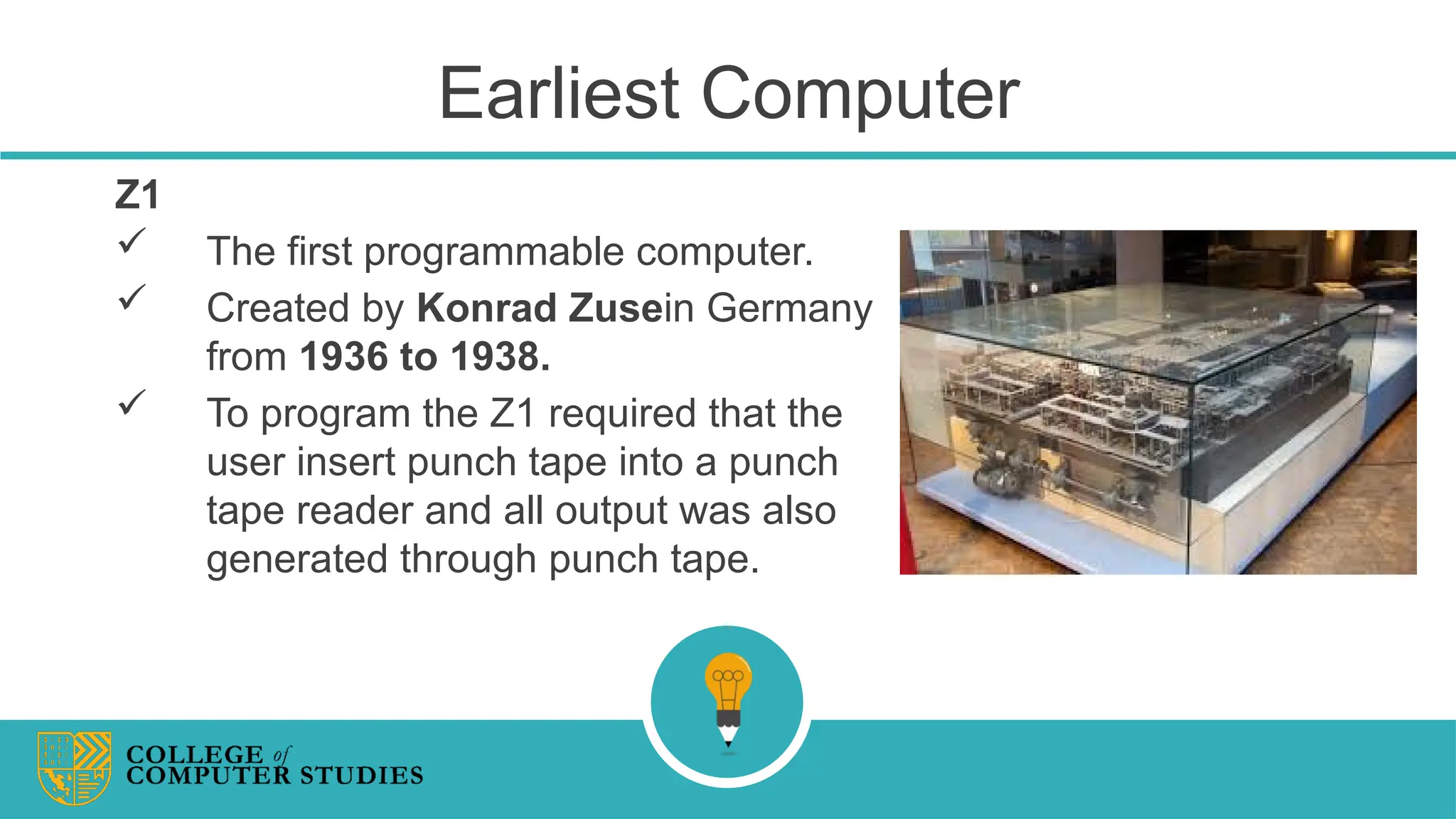
Z1
 The first programmable computer.
 Created by Konrad Zusein Germany
from 1936 to 1938.
 To program the Z1 required that the
user insert punch tape into a punch
tape reader and all output was also
generated through punch tape.
Earliest Computer
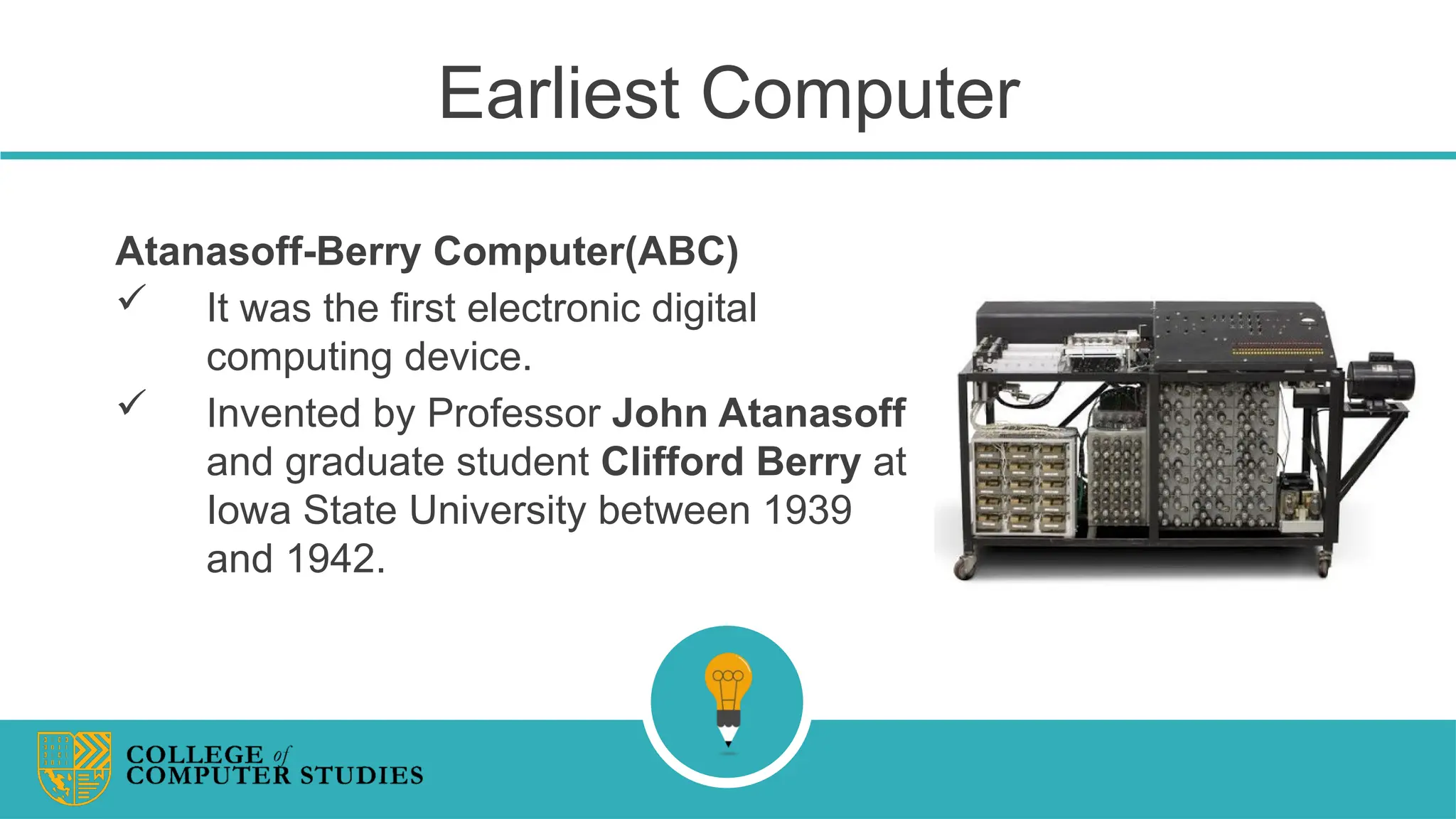
Atanasoff-Berry Computer(ABC)
 It was the first electronic digital
computing device.
 Invented by Professor John Atanasoff
and graduate student Clifford Berry at
Iowa State University between 1939
and 1942.
Earliest Computer
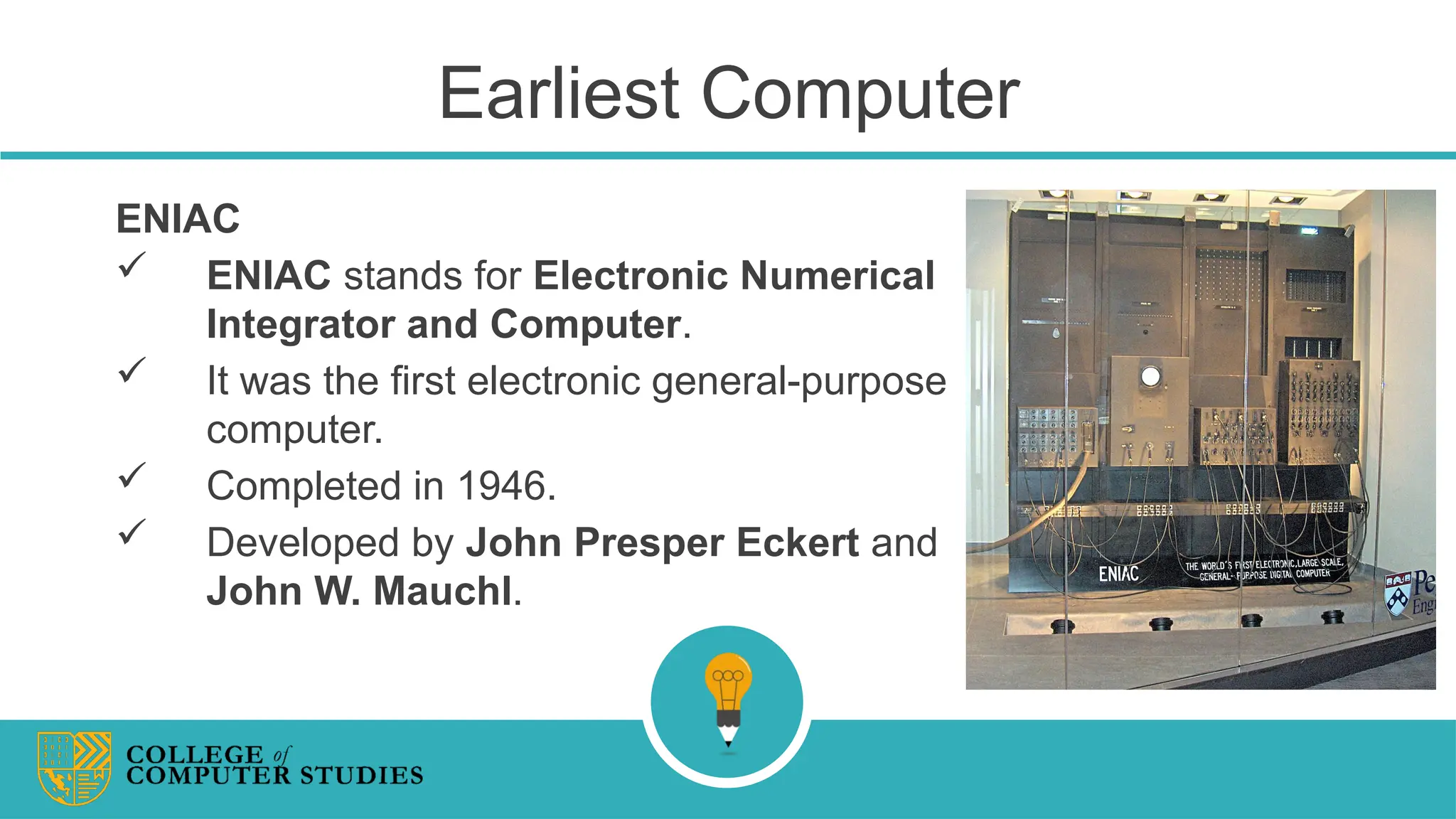
ENIAC
 ENIAC stands for Electronic Numerical
Integrator and Computer.
 It was the first electronic general-purpose
computer.
 Completed in 1946.
 Developed by John Presper Eckert and
John W. Mauchl.
Earliest Computer
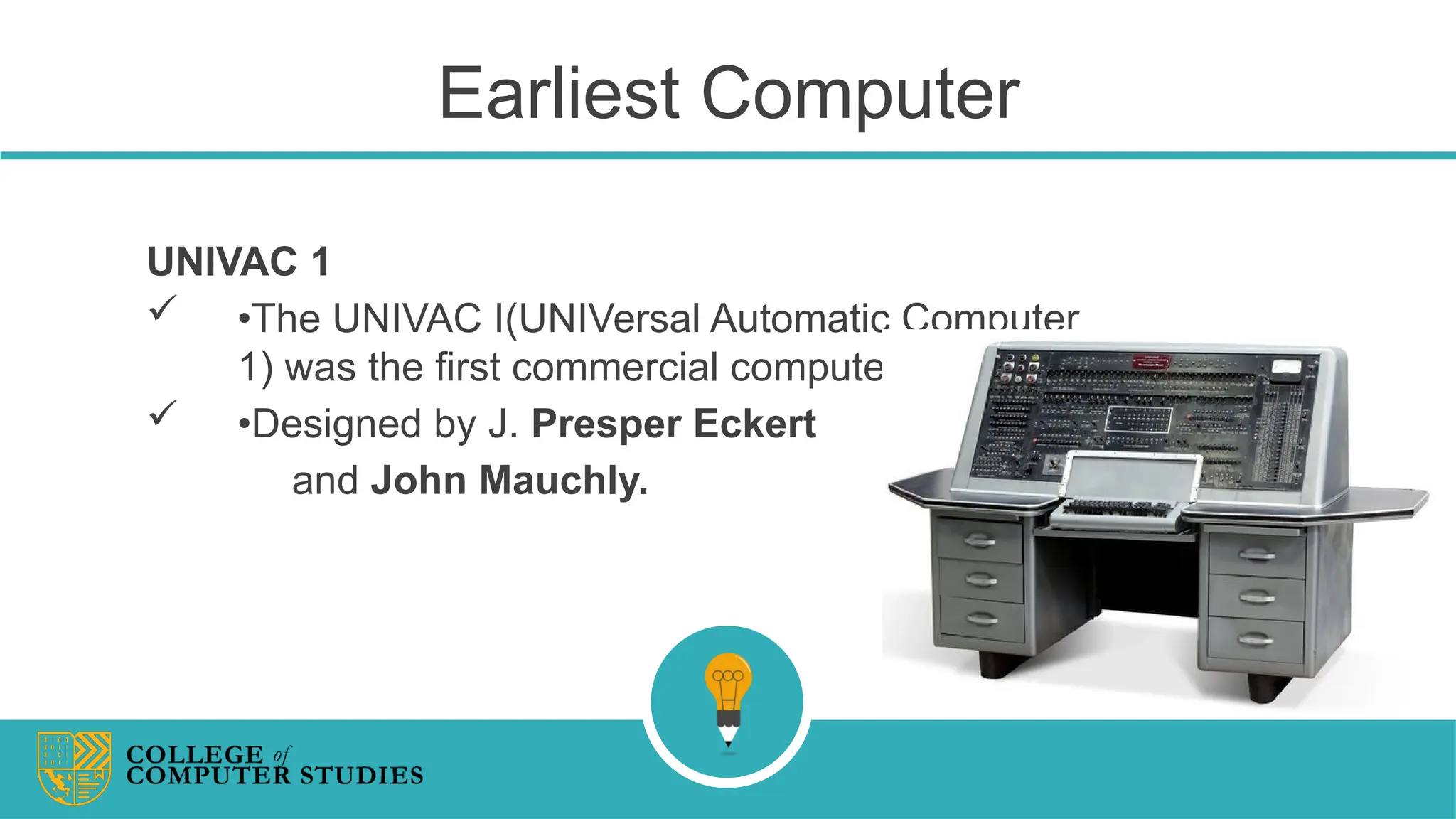
UNIVAC 1
 •The UNIVAC I(UNIVersal Automatic Computer
1) was the first commercial computer.
 •Designed by J. Presper Eckert
and John Mauchly.
Earliest Computer
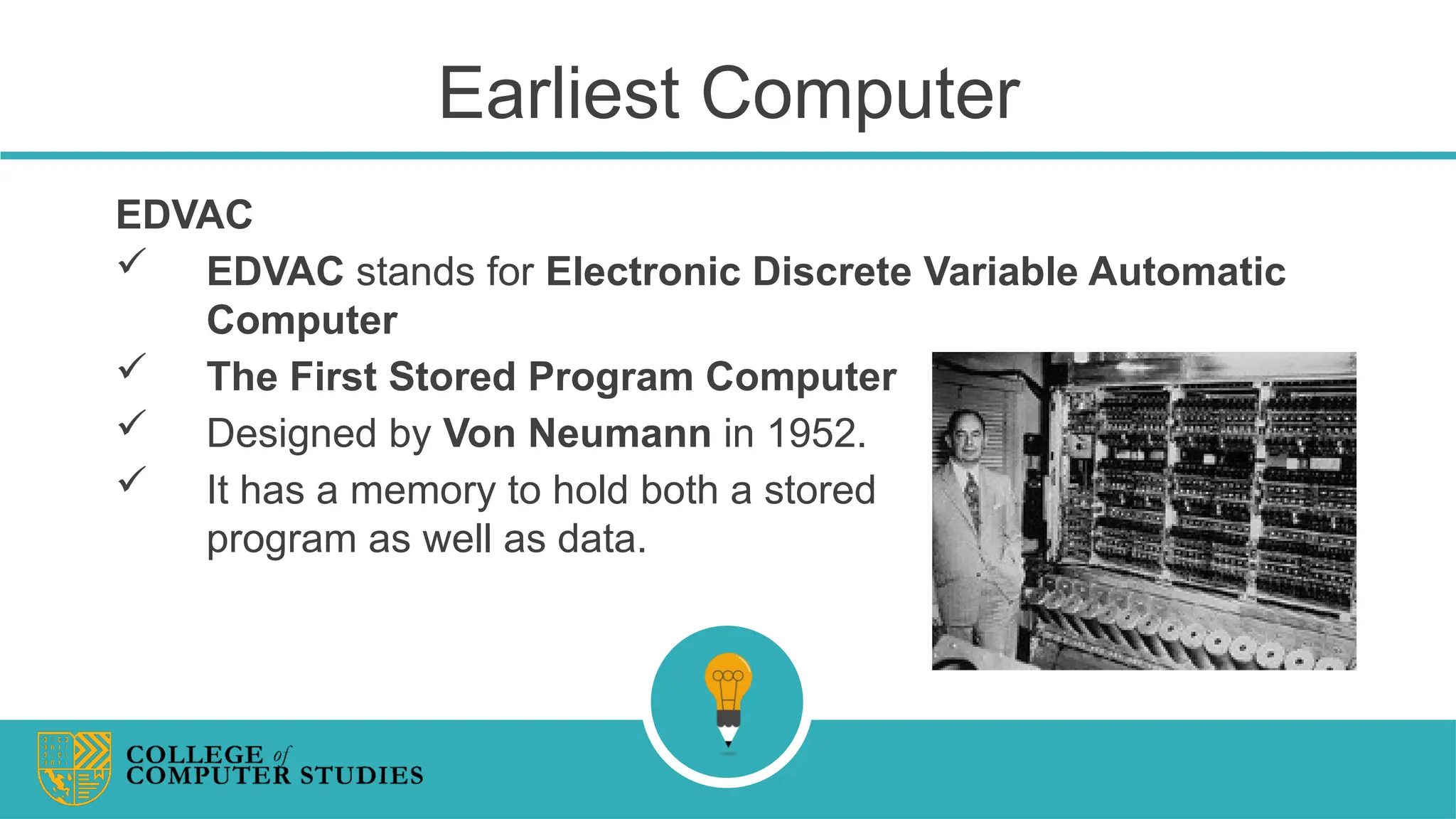
EDVAC
 EDVAC stands for Electronic Discrete Variable Automatic
Computer
 The First Stored Program Computer
 Designed by Von Neumann in 1952.
 It has a memory to hold both a stored
program as well as data.
Earliest Computer
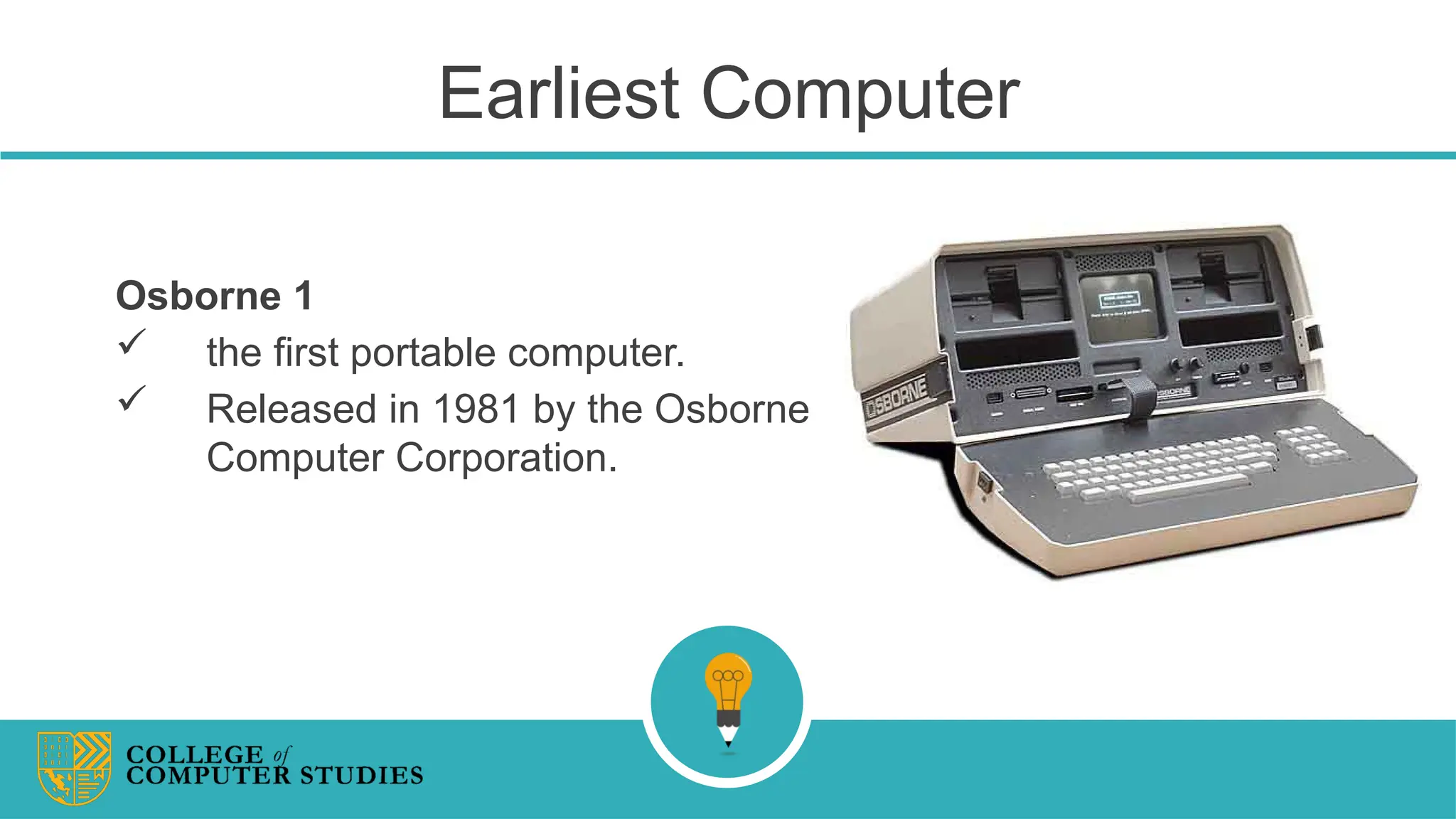
Osborne 1
 the first portable computer.
 Released in 1981 by the Osborne
Computer Corporation.
Earliest Computer
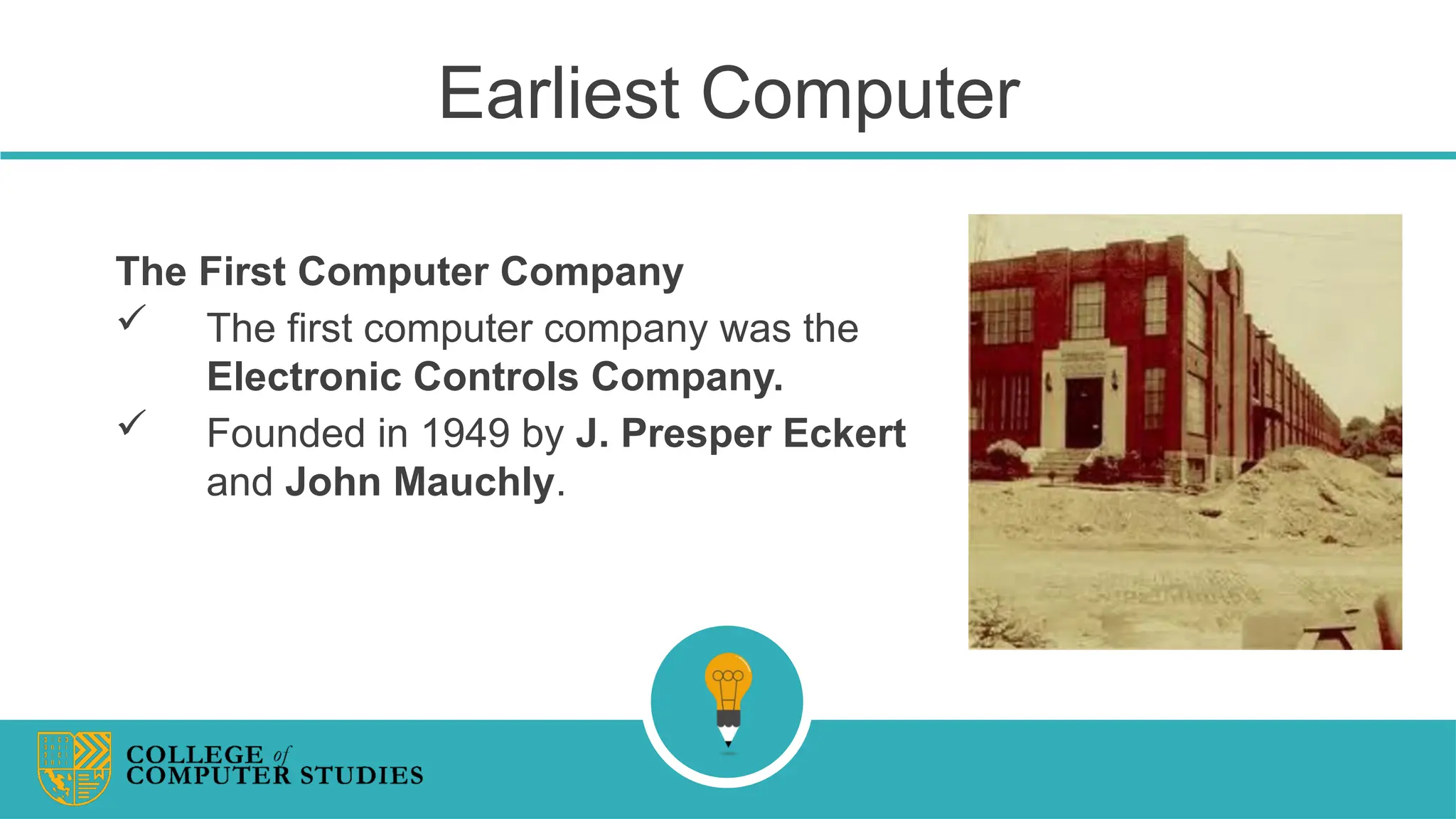
The First Computer Company
 The first computer company was the
Electronic Controls Company.
 Founded in 1949 by J. Presper Eckert
and John Mauchly.
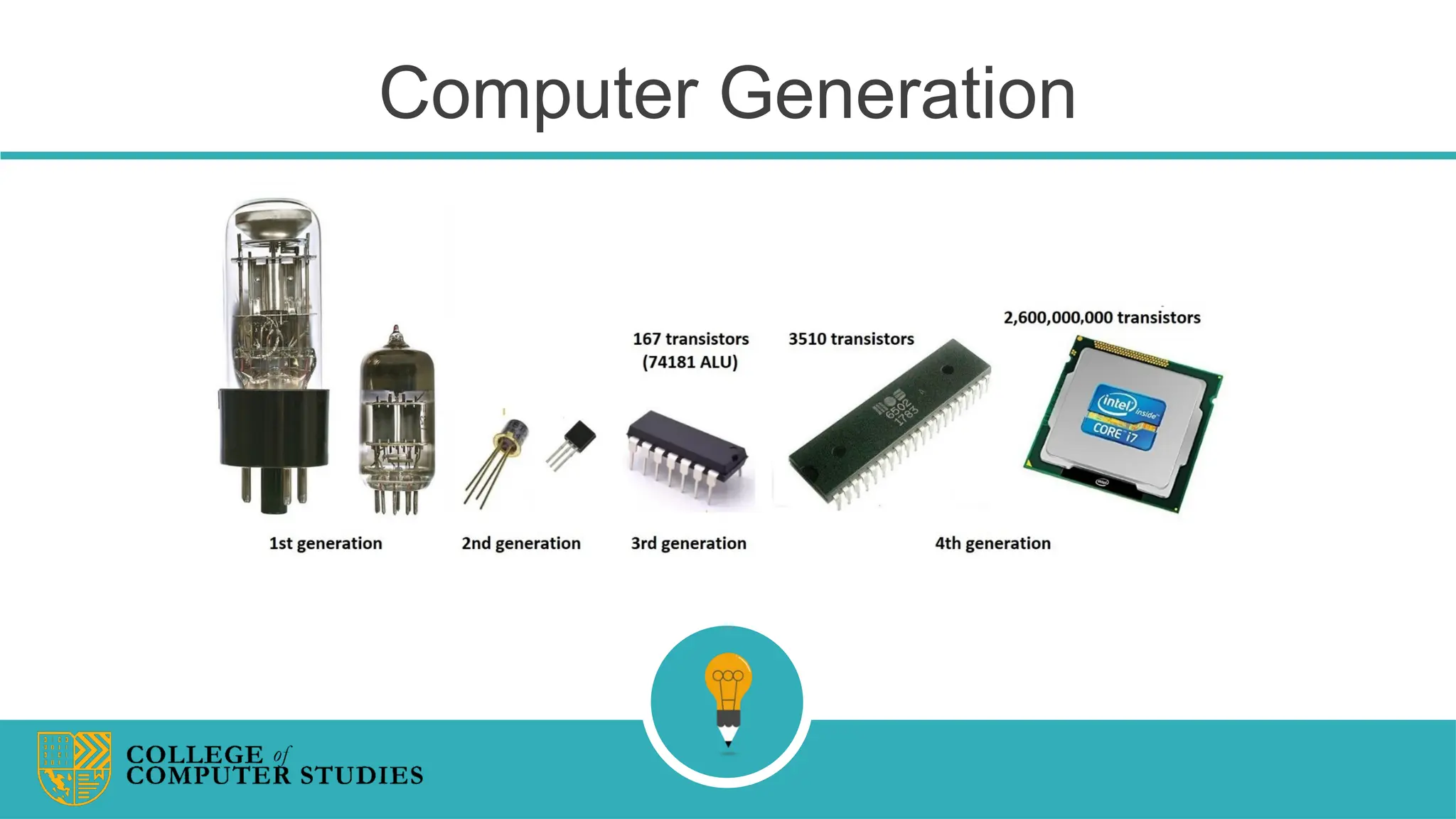
Computer Generation
There are five generations of computer:
1. First generation - 1946 -1958
2. Second generation - 1959 -1964
3. Third generation - 1965 -1970
4. Fourth generation - 1971 -today
5. Fifth generation - Today to future
Computer Generation
First Generation
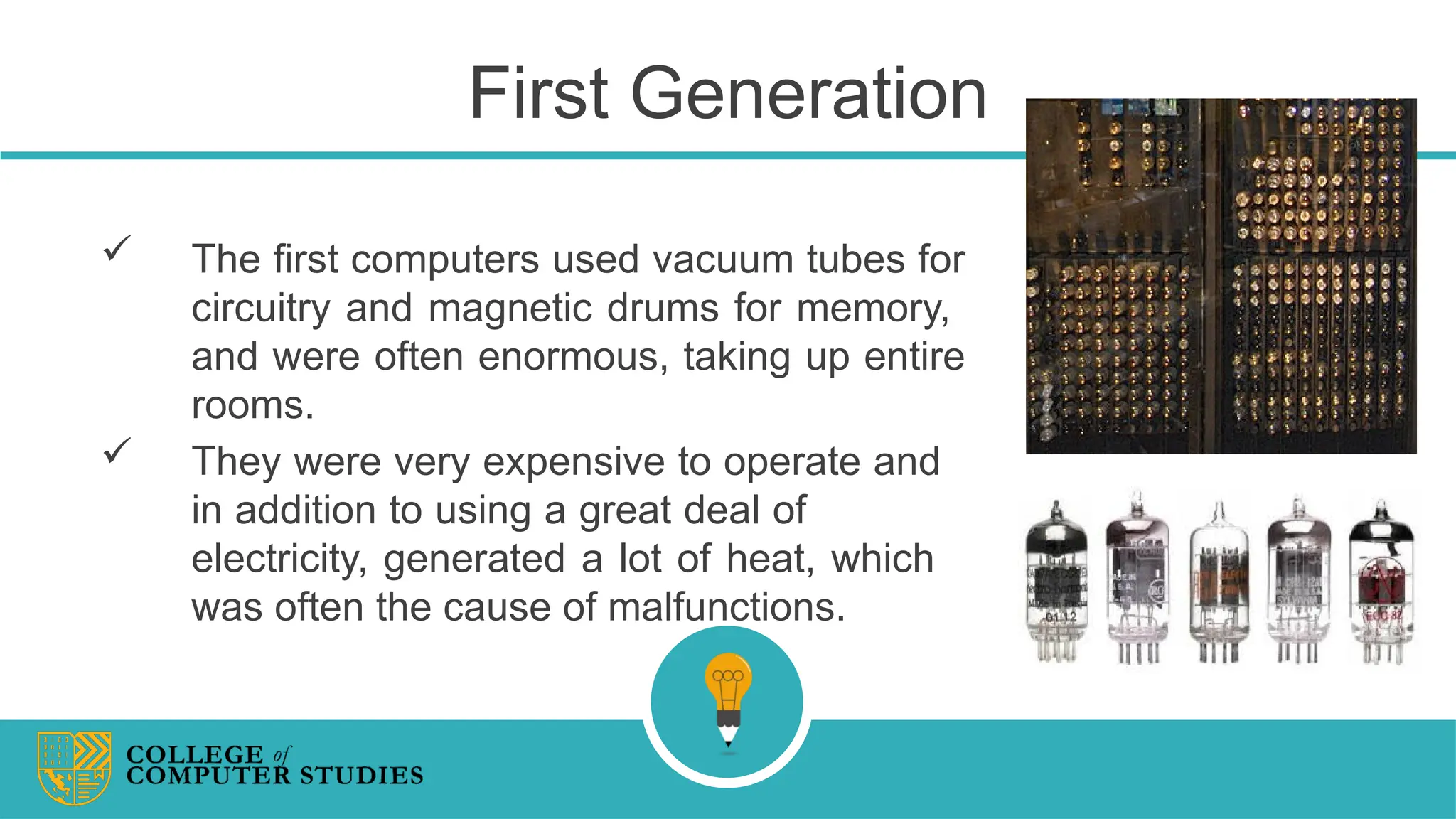
 The first computers used vacuum tubes for
circuitry and magnetic drums for memory,
and were often enormous, taking up entire
rooms.
 They were very expensive to operate and
in addition to using a great deal of
electricity, generated a lot of heat, which
was often the cause of malfunctions.
The First Generation
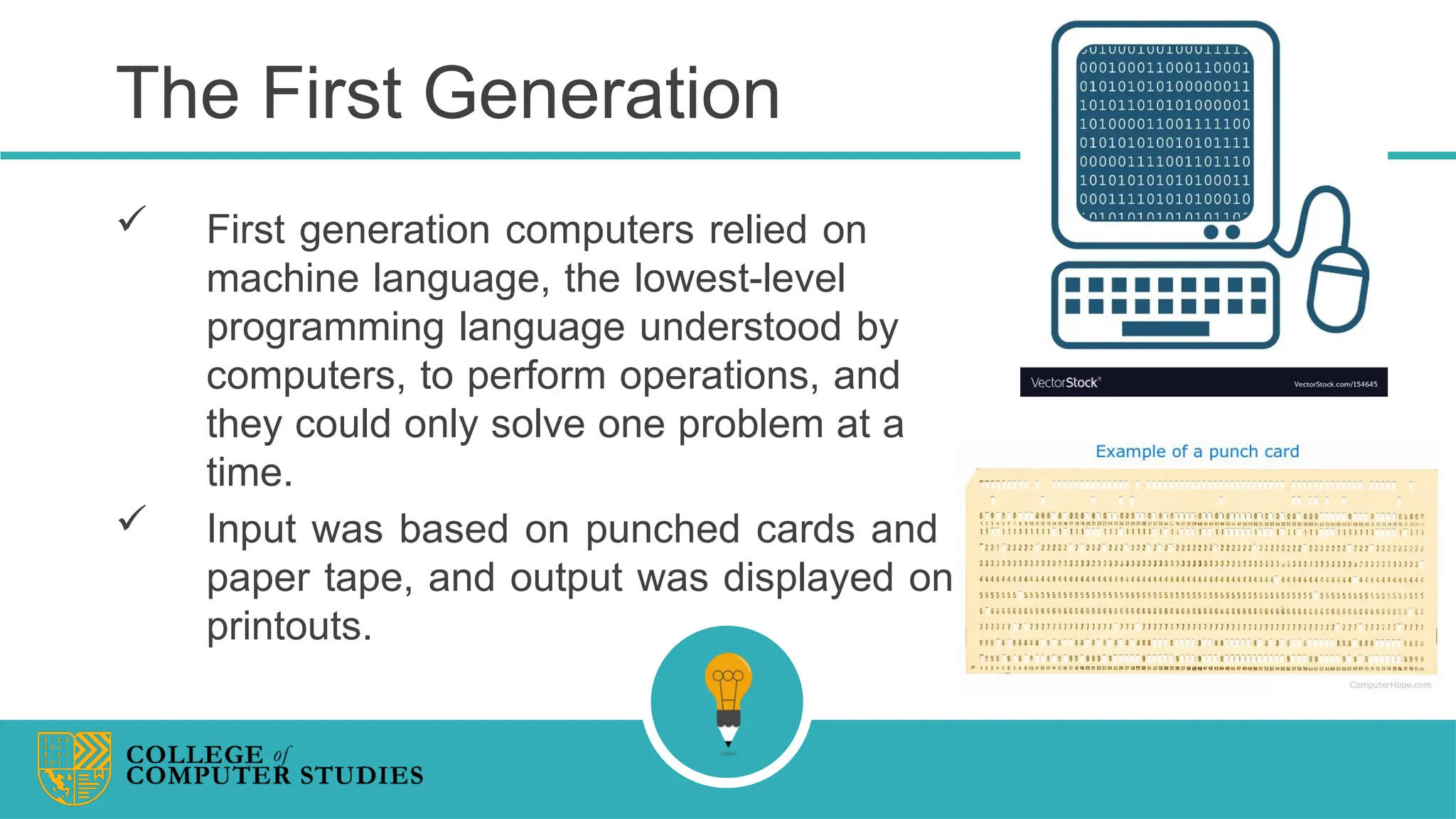
 First generation computers relied on
machine language, the lowest-level
programming language understood by
computers, to perform operations, and
they could only solve one problem at a
time.
 Input was based on punched cards and
paper tape, and output was displayed on
printouts.
The Second Generation
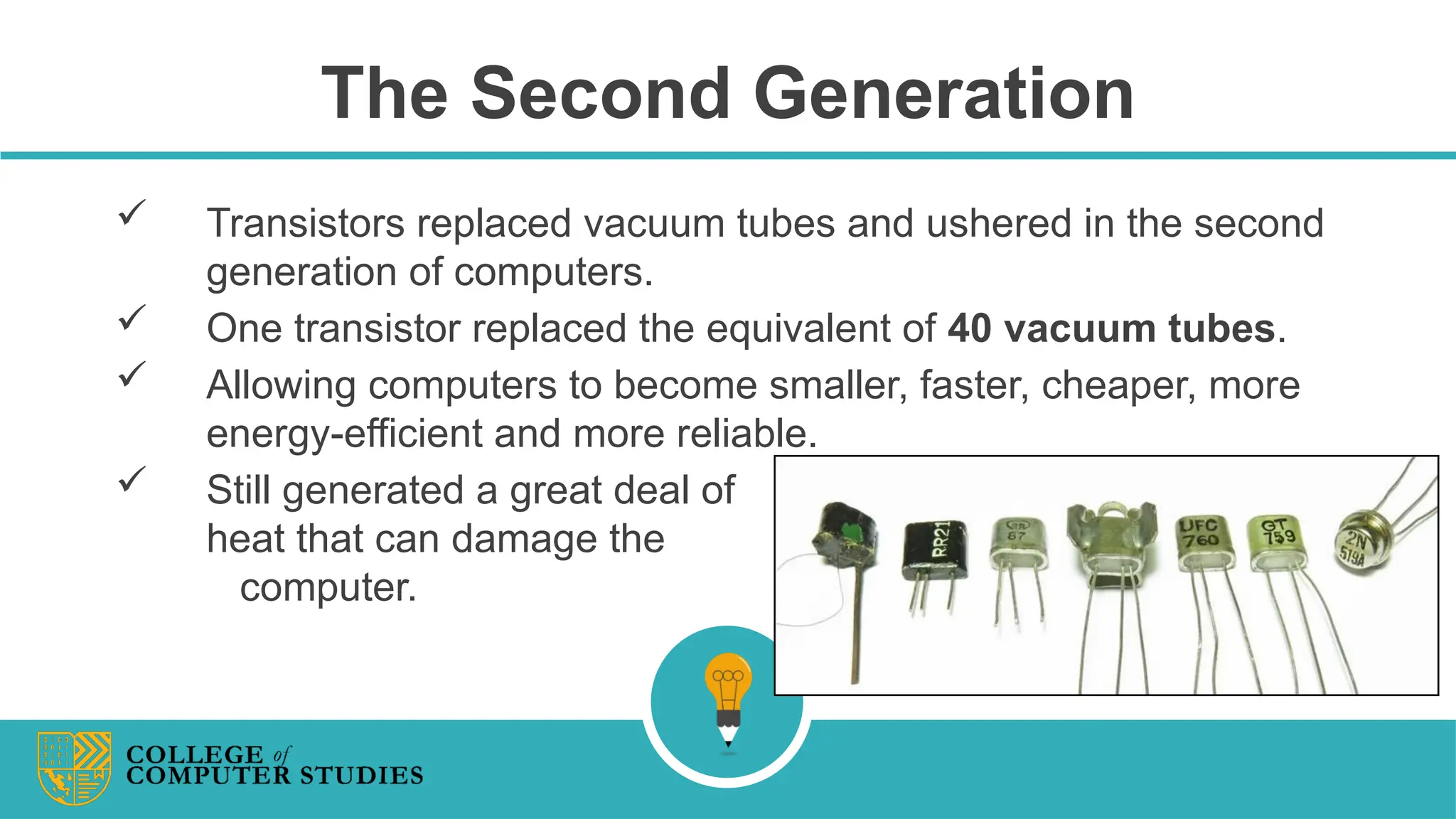
 Transistors replaced vacuum tubes and ushered in the second
generation of computers.
 One transistor replaced the equivalent of 40 vacuum tubes.
 Allowing computers to become smaller, faster, cheaper, more
energy-efficient and more reliable.
 Still generated a great deal of
heat that can damage the
computer.
The Second Generation
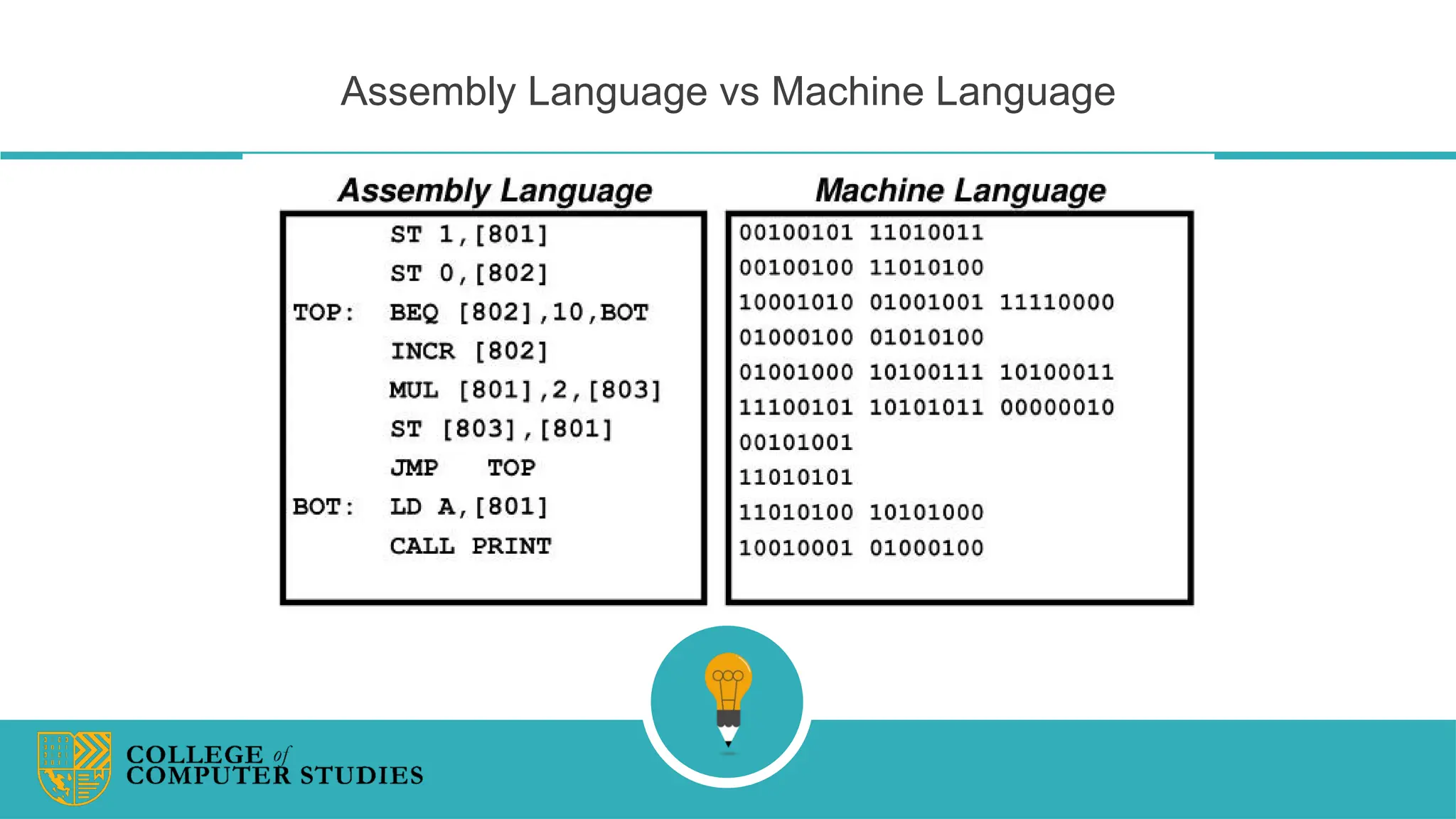
 Second-generation computers moved from cryptic binary machine
language to symbolic, or assembly languages, which allowed
programmers to specify instructions in words.
 Second-generation computers still relied on punched cards for
input and printouts for output.
 These were also the first computers that stored their instructions
in their memory, which moved from a magnetic drum to magnetic
core technology.
Assembly Language vs Machine Language
The Third Generation
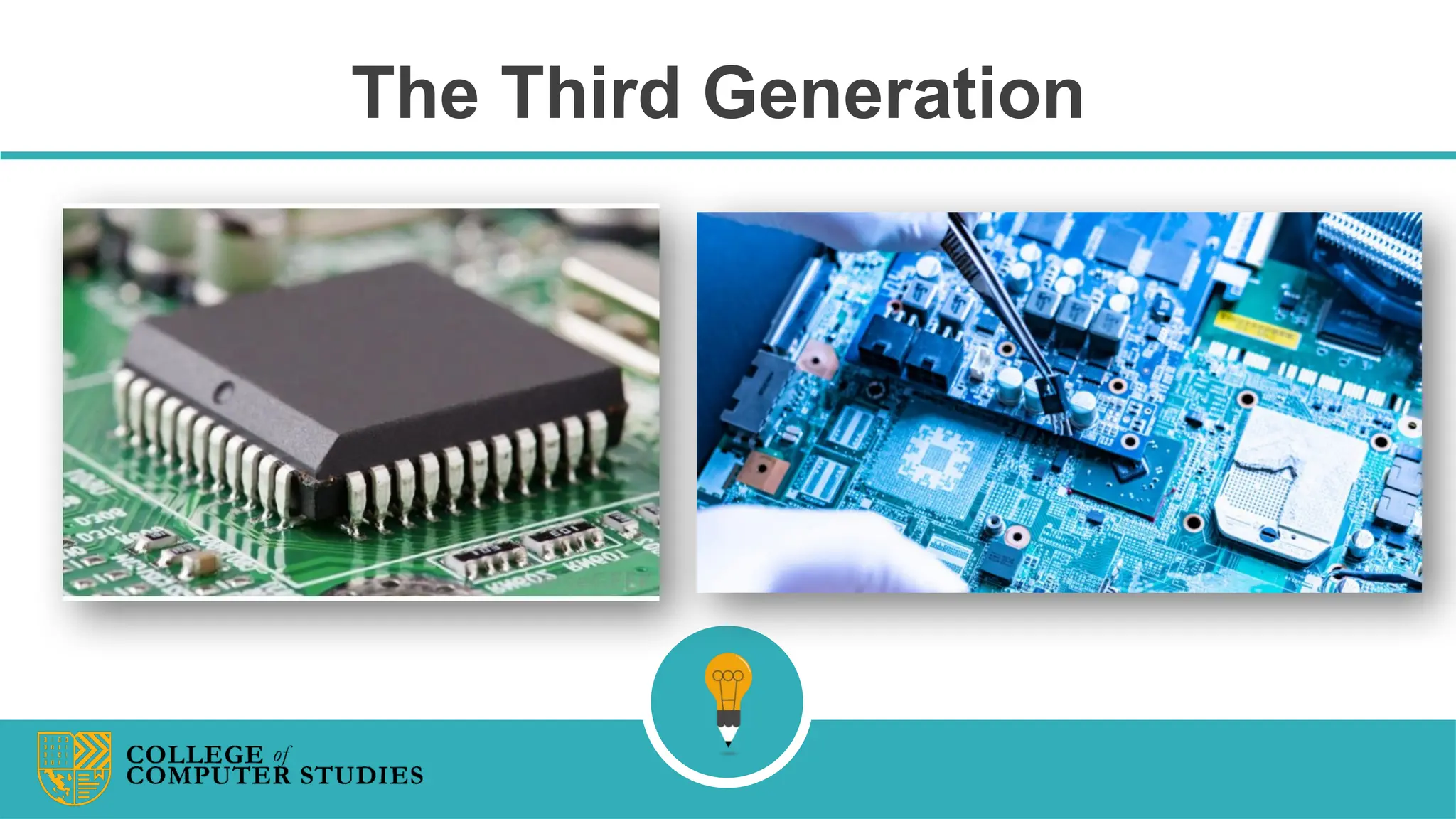
 The development of the integrated circuit was the hallmark of the
third generation of computers.
 Transistors were miniaturized and placed on silicon chips, called
semiconductors, which drastically increased the speed and
efficiency of computers.
 Much smaller and cheaper compare to the second generation
computers.
 It could carry out instructions in billionths of a second.
The Third Generation
 Users interacted with third generation computers through
keyboards and monitors and interfaced with an operating
system, which allowed the device to run many different
applications at one time with a central program that
monitored the memory.
 Computers for the first time became accessible to a mass
audience because they were smaller and cheaper than their
predecessors.
The Fourth Generation
 The microprocessor brought the fourth generation of
computers, as thousands of integrated circuits were built onto a
single silicon chip.
 As these small computers became more powerful, they could be
linked together to form networks, which eventually led to the
development of the Internet.
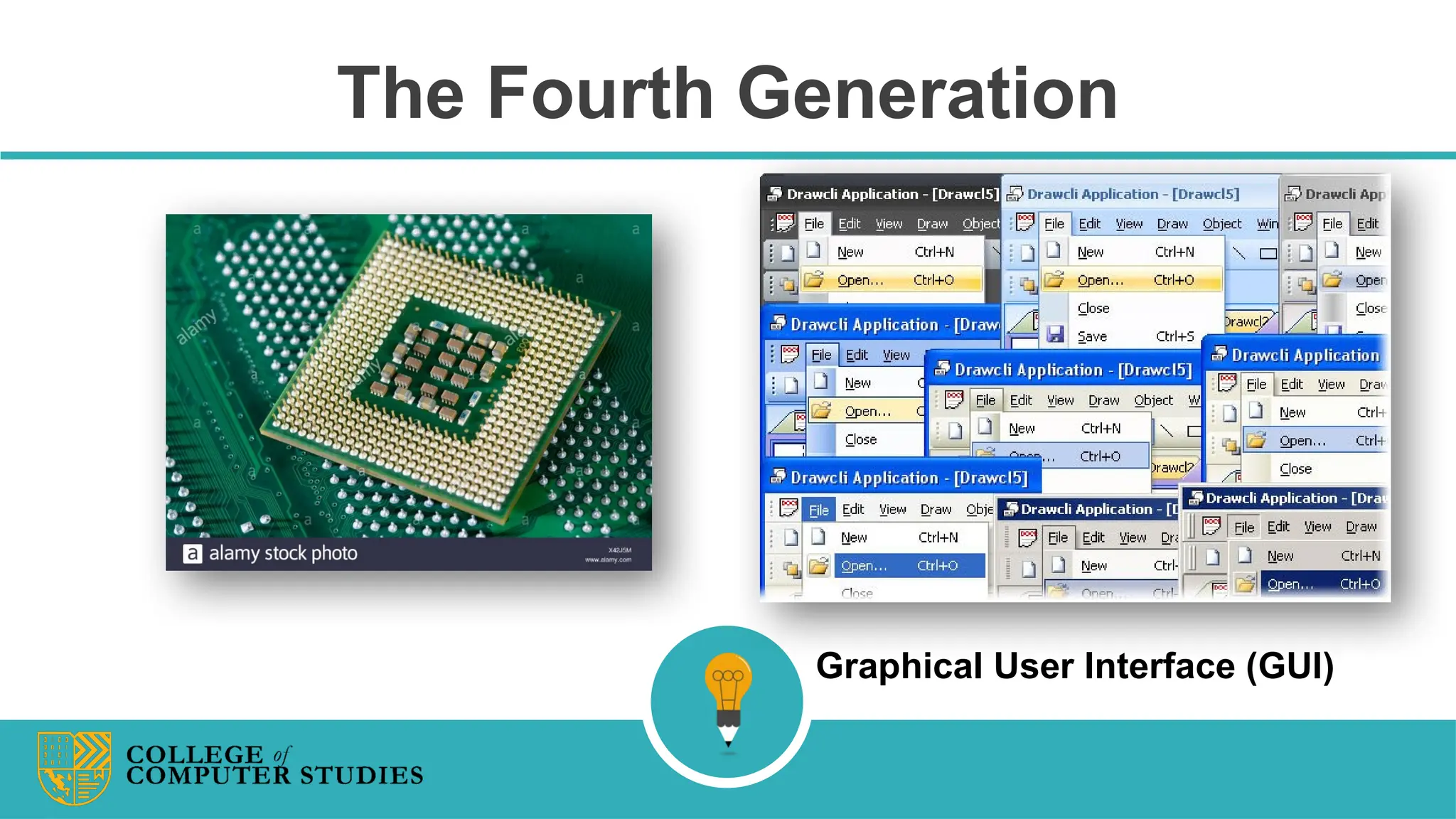
 Fourth generation computers also saw the development of GUIs,
the mouse and handheld devices.
The Fourth Generation
Graphical User Interface (GUI)
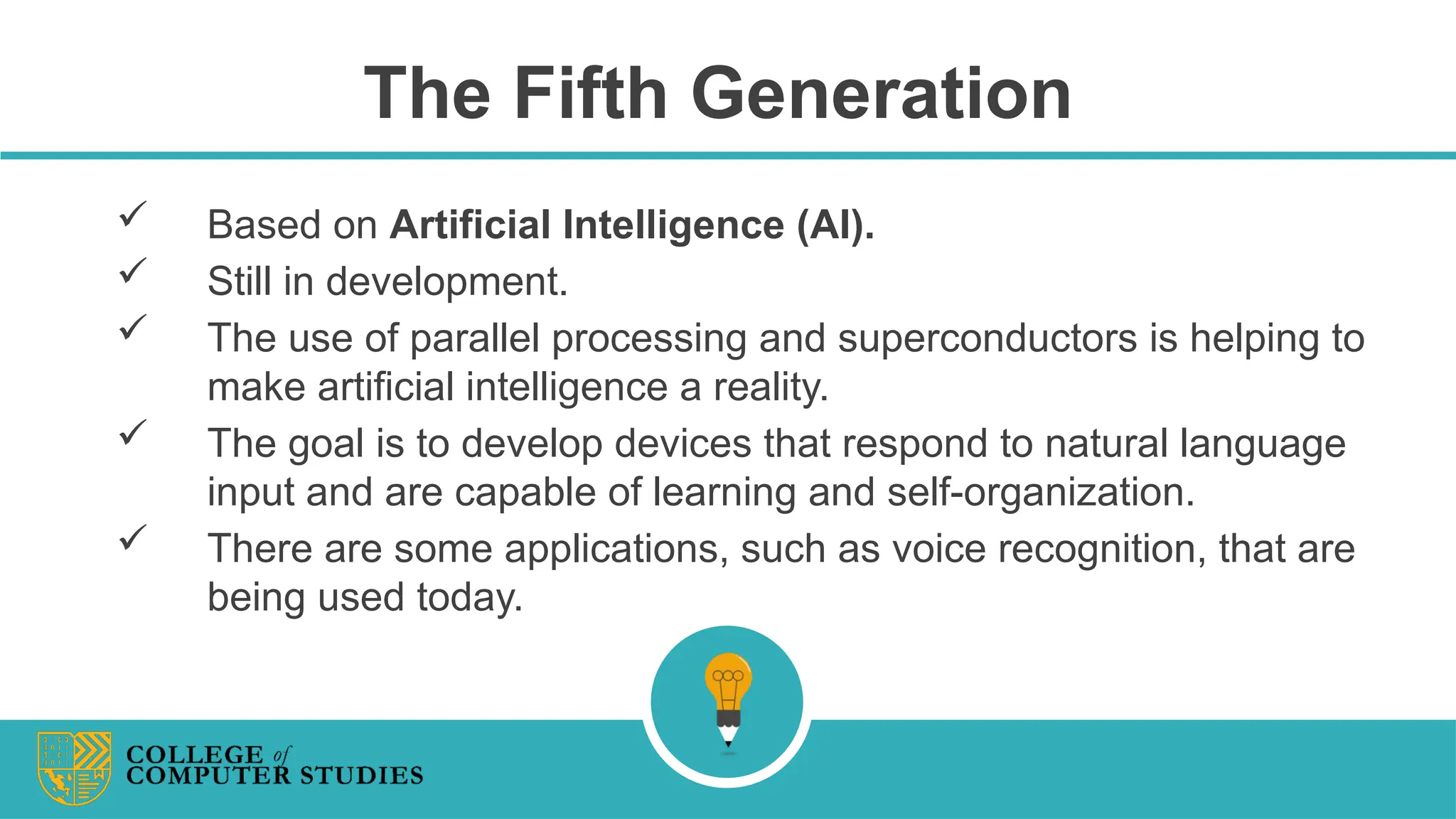
The Fifth Generation
 Based on Artificial Intelligence (AI).
 Still in development.
 The use of parallel processing and superconductors is helping to
make artificial intelligence a reality.
 The goal is to develop devices that respond to natural language
input and are capable of learning and self-organization.
 There are some applications, such as voice recognition, that are
being used today.
REFERENCE/S
 https://ftms.edu.my/v2/current-student/foundation-student/csca
0101-computing-basics/

COMPUTER-HISTORYyyyyyyyyyyyyyyyyyyy.pptx

  • 1.
    HISTORY OF COMPUTER CC101INTRODUCTION TO COMPUTING http://www.free-powerpoint-templates-design.com
  • 2.
    Computer Computer is aprogrammable machine. Computer is a machine that manipulates data according to a list of instructions. Computer is any device which aids humans in performing various kinds of computations or calculations.
  • 3.
    Three principles characteristicof computer:  It responds to a specific set of instructions in a well- defined manner.  It can execute a pre-recorded list of instructions.  It can quickly store and retrieve large amounts of data.
  • 4.
    Earliest Computer  Originallycalculations were computed by humans, whose job title was computers.  These human computers were typically engaged in the calculation of a mathematical expression.  The calculations of this period were specialized and expensive, requiring years of training in mathematics.  The first use of the word "computer“ was recorded in 1613, referring to a person who carried out calculations, or computations, and the word continued to be used in that sense until the middle of the 20th century.
  • 5.
    Earliest Computer Tally Sticks A tally stick was an ancient memory aid device to record and document numbers, quantities, or even messages.
  • 6.
    Earliest Computer Abacus  Anabacus is a mechanical device used to aid an individual in performing mathematical calculations.  The abacus was invented in Babylonia in 2400 B.C.  The abacus in the form we are most familiar with was first used in China in around 500 B.C.  It used to perform basic arithmetic operations.
  • 7.
    Earliest Computer Napier’s Bones Invented by John Napier in 1614.  Allowed the operator to multiply, divide and calculate square and cube roots by moving the rods around and placing them in specially constructed boards.
  • 8.
    Earliest Computer Slide Rule Invented by William Oughtred in1622.  Is based on Napier's ideas about logarithms.  Used primarily for • multiplication • division • roots • logarithms • Trigonometry  Not normally used for addition or subtraction.
  • 9.
    Earliest Computer Pascaline  Inventedby Blaise Pascal in 1642.  It was its limitation to addition and subtraction.  It is too expensive.
  • 10.
    Earliest Computer Stepped Reckoner Invented by Gottfried Wilhelm Leibniz in 1672.  The machine that can add, subtract, multiply and divide automatically.
  • 11.
    Earliest Computer Jacquard loom The Jacquard loom is a mechanical loom, invented by Joseph-Marie Jacquard in1881.  •It an automatic loom controlled by punched cards.
  • 12.
    Earliest Computer Arithmometer  Amechanical calculator invented by Thomas de Colmar in 1820,  The first reliable, useful and commercially successful calculating machine.  The machine could perform the four basic mathematic functions.  The first mass-produced calculating machine.
  • 13.
    Earliest Computer Difference Engineand Analytical Engine  It is an automatic, mechanical calculator designed to tabulate polynomial functions.  Invented by Charles Babbage in 1822 and 1834  It is the first mechanical computer.
  • 14.
    Earliest Computer First ComputerProgrammer  •In 1840, Augusta Ada Byron suggests to Babbage that he use the binary system.  •She writes programs for the Analytical Engine.
  • 15.
    Earliest Computer Scheutzian CalculationEngine  Invented by Per Georg Scheutz in 1843.  Based on Charles Babbage's difference engine.  The first printing calculator.
  • 16.
    Earliest Computer Tabulating Machine Invented by Herman Hollerith in 1890.  To assist in summarizing information and accounting.
  • 17.
    Earliest Computer Havard Mark1  Also known as IBM Automatic Sequence Controlled Calculator (ASCC).  Invented by Howard H. Aikenin 1943  The first electro-mechanical computer.
  • 18.
    Earliest Computer Z1  Thefirst programmable computer.  Created by Konrad Zusein Germany from 1936 to 1938.  To program the Z1 required that the user insert punch tape into a punch tape reader and all output was also generated through punch tape.
  • 19.
    Earliest Computer Atanasoff-Berry Computer(ABC) It was the first electronic digital computing device.  Invented by Professor John Atanasoff and graduate student Clifford Berry at Iowa State University between 1939 and 1942.
  • 20.
    Earliest Computer ENIAC  ENIACstands for Electronic Numerical Integrator and Computer.  It was the first electronic general-purpose computer.  Completed in 1946.  Developed by John Presper Eckert and John W. Mauchl.
  • 21.
    Earliest Computer UNIVAC 1 •The UNIVAC I(UNIVersal Automatic Computer 1) was the first commercial computer.  •Designed by J. Presper Eckert and John Mauchly.
  • 22.
    Earliest Computer EDVAC  EDVACstands for Electronic Discrete Variable Automatic Computer  The First Stored Program Computer  Designed by Von Neumann in 1952.  It has a memory to hold both a stored program as well as data.
  • 23.
    Earliest Computer Osborne 1 the first portable computer.  Released in 1981 by the Osborne Computer Corporation.
  • 24.
    Earliest Computer The FirstComputer Company  The first computer company was the Electronic Controls Company.  Founded in 1949 by J. Presper Eckert and John Mauchly.
  • 25.
    Computer Generation There arefive generations of computer: 1. First generation - 1946 -1958 2. Second generation - 1959 -1964 3. Third generation - 1965 -1970 4. Fourth generation - 1971 -today 5. Fifth generation - Today to future
  • 26.
  • 27.
    First Generation  Thefirst computers used vacuum tubes for circuitry and magnetic drums for memory, and were often enormous, taking up entire rooms.  They were very expensive to operate and in addition to using a great deal of electricity, generated a lot of heat, which was often the cause of malfunctions.
  • 28.
    The First Generation First generation computers relied on machine language, the lowest-level programming language understood by computers, to perform operations, and they could only solve one problem at a time.  Input was based on punched cards and paper tape, and output was displayed on printouts.
  • 29.
    The Second Generation Transistors replaced vacuum tubes and ushered in the second generation of computers.  One transistor replaced the equivalent of 40 vacuum tubes.  Allowing computers to become smaller, faster, cheaper, more energy-efficient and more reliable.  Still generated a great deal of heat that can damage the computer.
  • 30.
    The Second Generation Second-generation computers moved from cryptic binary machine language to symbolic, or assembly languages, which allowed programmers to specify instructions in words.  Second-generation computers still relied on punched cards for input and printouts for output.  These were also the first computers that stored their instructions in their memory, which moved from a magnetic drum to magnetic core technology.
  • 31.
    Assembly Language vsMachine Language
  • 32.
    The Third Generation The development of the integrated circuit was the hallmark of the third generation of computers.  Transistors were miniaturized and placed on silicon chips, called semiconductors, which drastically increased the speed and efficiency of computers.  Much smaller and cheaper compare to the second generation computers.  It could carry out instructions in billionths of a second.
  • 33.
  • 34.
    The Third Generation Users interacted with third generation computers through keyboards and monitors and interfaced with an operating system, which allowed the device to run many different applications at one time with a central program that monitored the memory.  Computers for the first time became accessible to a mass audience because they were smaller and cheaper than their predecessors.
  • 35.
    The Fourth Generation The microprocessor brought the fourth generation of computers, as thousands of integrated circuits were built onto a single silicon chip.  As these small computers became more powerful, they could be linked together to form networks, which eventually led to the development of the Internet.  Fourth generation computers also saw the development of GUIs, the mouse and handheld devices.
  • 36.
    The Fourth Generation GraphicalUser Interface (GUI)
  • 37.
    The Fifth Generation Based on Artificial Intelligence (AI).  Still in development.  The use of parallel processing and superconductors is helping to make artificial intelligence a reality.  The goal is to develop devices that respond to natural language input and are capable of learning and self-organization.  There are some applications, such as voice recognition, that are being used today.
  • 38.