© 2016 Enroll America | StateOfEnrollment.org
How to Make Enrollment Efforts
Permanent
© 2016 Enroll America | StateOfEnrollment.org
Goals for this session:
• Identify organizations in your community where
health insurance enrollment is a regular
practice
• What are the shared benefits for this practice
that can be applied to other organizations?
• A list of steps you can take to begin building
institutional partnerships in your community
How to Make Enrollment Efforts Permanent
2
© 2016 Enroll America | StateOfEnrollment.org
What does “institutionalization” of
health insurance enrollment mean?
How to Make Enrollment Efforts Permanent
3
© 2016 Enroll America | StateOfEnrollment.org
Small Group Breakouts
• Introductions
• What did you come to learn today?
• Where is health insurance enrollment a
permanent or “routine” practice in your
community?
How to Make Enrollment Efforts Permanent
4
© 2016 Enroll America | StateOfEnrollment.org
Partnerships in Three Communities
• Hospital and Faith Community
Partnership
• Criminal Justice Community
Partnership
• School Community Partnership
How to Make Enrollment Efforts Permanent
5
© 2016 Enroll America | StateOfEnrollment.org
Vincent DeMarco, President, Maryland Citizens Health Initiative
Maryland Faith Community Health
Network
© 2016 Enroll America | StateOfEnrollment.org
Maryland Faith Community Health Network
• 3 Lifebridge Hospitals provide staff navigators who connect
hospitalized congregation members to volunteer liaisons in faith
community
• Congregation liaisons in 50 faith communities coordinate
support services such as pet care, picking up prescriptions,
home meals
• Congregation liaisons and hospital navigators collaborate in
preventive health programs including health insurance
enrollment
• Maryland Faith Community Health Network facilitates training
for Congregation liaisons and evaluates pilot program
A Hospital and Faith Community Partnership
7
© 2016 Enroll America | StateOfEnrollment.org
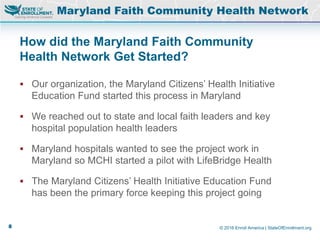
How did the Maryland Faith Community
Health Network Get Started?
Maryland Faith Community Health Network
 Our organization, the Maryland Citizens’ Health Initiative
Education Fund started this process in Maryland
ď‚§ We reached out to state and local faith leaders and key
hospital population health leaders
ď‚§ Maryland hospitals wanted to see the project work in
Maryland so MCHI started a pilot with LifeBridge Health
 The Maryland Citizens’ Health Initiative Education Fund
has been the primary force keeping this project going
8
© 2016 Enroll America | StateOfEnrollment.org
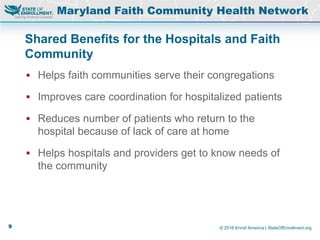
Shared Benefits for the Hospitals and Faith
Community
Maryland Faith Community Health Network
ď‚§ Helps faith communities serve their congregations
ď‚§ Improves care coordination for hospitalized patients
ď‚§ Reduces number of patients who return to the
hospital because of lack of care at home
ď‚§ Helps hospitals and providers get to know needs of
the community
9
© 2016 Enroll America | StateOfEnrollment.org
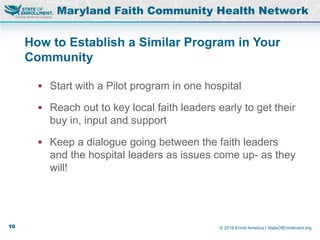
How to Establish a Similar Program in Your
Community
Maryland Faith Community Health Network
ď‚§ Start with a Pilot program in one hospital
ď‚§ Reach out to key local faith leaders early to get their
buy in, input and support
ď‚§ Keep a dialogue going between the faith leaders
and the hospital leaders as issues come up- as they
will!
10
© 2016 Enroll America | StateOfEnrollment.org
Vincent Demarco
President ,
Maryland Citizens’ Health Initiative
2600 St. Paul Street
Baltimore, MD 21218
(410)235-9000
Demarco@mdinitiative.Org
www.Healthcareforall.Com
11
© 2016 Enroll America | StateOfEnrollment.org
David M. Young, Community Health Specialist, Extension and College of
Nursing, MSU
Making Enrollment Efforts Permanent
in the Criminal Justice Community
Preparing Incarcerated Inmates for
Reentry into the Community
• Work with the Reentry Coordinator on their
application for health insurance coverage
• Make application to one or two reentry programs:
– Fresh Start
– TEAM Mentoring
• Review curricula on computers on:
– Health Literacy
– Health Insurance Literacy
13
Educating and Enrolling the Justice
Involved Population - Background
• 2009 – 2010 launched a multi-disciplinary community-
based Reentry Task Force, formulated a strategic slan with
mission, vision, goals & objectives, created website.
• 2011 – 2013 received grants to improve health literacy, self-
care management, and health insurance literacy.
• 2015 – state legislature and governor approved Medicaid
Expansion and CMS approved Medicaid waiver
• 2016 – enrollment began under Medicaid Expansion
14
Key Stakeholders Involved
• Detention Center (jail)
• Sheriff’s Office & Police Department
• County Commissioners
• County Health Department
• Community Health Center (FQHC)
• Mental Health Center
• County Attorney, Court Services & Judges
• Probation/Parole (community corrections)
15
Shared Benefits for the Criminal
Justice Community
• Improved health and well-being of the justice-
involved population
• Improved continuum of care in community
• Reduced health care costs for county and state
government (i.e., Medicaid Admin Claiming)
• Reduced recidivism rates
• Improved community health & public safety
• Increased numbers of healthy, productive, law-
abiding, contributing citizens
16
How to Establish a Program in Your
Community
• Organize a multi-disciplinary community-based
task force or committee with a shared vision
• Develop a strategic plan with goals and objectives
– Decide on intercept point for enrollment
http://static.nicic.gov/UserShared/2014-06-19_nic_decisionmap.pdf
• Recruit buy-in from key community stakeholders
– Office of Sheriff and Jail Program Director
– Community Health Center/County Health Department
– Courts and county corrections officials (P&P)
Lessons Learned
• Multiple county and state agencies are involved in the
criminal justice system; politics and turf issues exist
• The Affordable Care Act (ACA) is a major game changer for
the justice-involved population
• Continuum of care for returning citizens is critical in reducing
recidivism, improving public health & safety
• Factors impacting health insurance coverage for inmates
– Medicaid expansion
– Medicaid suspension/termination upon arrest
• Important interventions while incarcerated –health literacy,
health insurance literacy & relationship education
18
David M. Young,
Community Health Specialist
Research Professor, College of Nursing
Culbertson Hall, Room 235B
Bozeman, MT 59717-2230
(406) 994-5552
dyoung@montana.edu
19
http://msucommunityresources.org/
http://gallatincomt.virtualtownhall.net/Public_Documents/GallatinCoMT_CJC
C_Recid/cjcchp
© 2016 Enroll America | StateOfEnrollment.org
Kristelle Jose, All IN For Health Campaign Senior Outreach Associate
Making Enrollment Efforts Permanent
in Schools
© 2016 Enroll America | StateOfEnrollment.org
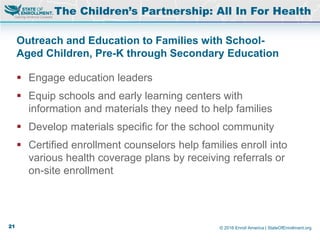
The Children’s Partnership: All In For Health
Outreach and Education to Families with School-
Aged Children, Pre-K through Secondary Education
ď‚§ Engage education leaders
ď‚§ Equip schools and early learning centers with
information and materials they need to help families
ď‚§ Develop materials specific for the school community
ď‚§ Certified enrollment counselors help families enroll into
various health coverage plans by receiving referrals or
on-site enrollment
21
© 2016 Enroll America | StateOfEnrollment.org
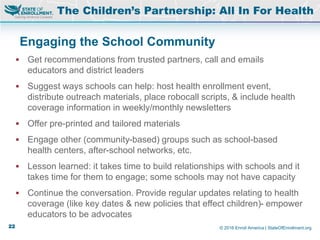
Engaging the School Community
ď‚§ Get recommendations from trusted partners, call and emails
educators and district leaders
ď‚§ Suggest ways schools can help: host health enrollment event,
distribute outreach materials, place robocall scripts, & include health
coverage information in weekly/monthly newsletters
ď‚§ Offer pre-printed and tailored materials
ď‚§ Engage other (community-based) groups such as school-based
health centers, after-school networks, etc.
ď‚§ Lesson learned: it takes time to build relationships with schools and it
takes time for them to engage; some schools may not have capacity
ď‚§ Continue the conversation. Provide regular updates relating to health
coverage (like key dates & new policies that effect children)- empower
educators to be advocates
The Children’s Partnership: All In For Health
22
© 2016 Enroll America | StateOfEnrollment.org
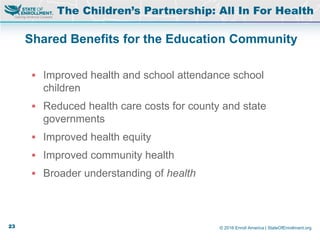
Shared Benefits for the Education Community
ď‚§ Improved health and school attendance school
children
ď‚§ Reduced health care costs for county and state
governments
ď‚§ Improved health equity
ď‚§ Improved community health
ď‚§ Broader understanding of health
The Children’s Partnership: All In For Health
23
© 2016 Enroll America | StateOfEnrollment.org
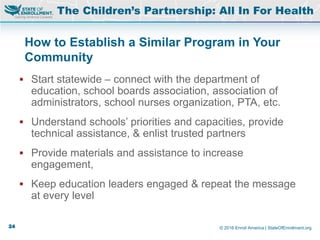
How to Establish a Similar Program in Your
Community
 Start statewide – connect with the department of
education, school boards association, association of
administrators, school nurses organization, PTA, etc.
 Understand schools’ priorities and capacities, provide
technical assistance, & enlist trusted partners
ď‚§ Provide materials and assistance to increase
engagement,
ď‚§ Keep education leaders engaged & repeat the message
at every level
The Children’s Partnership: All In For Health
24
© 2016 Enroll America | StateOfEnrollment.org
Kristelle Jose
Senior Outreach Associate
All In For Health Campaign
The Children’s Partnership
1351 Third Street Promenade, Suite 206
Santa Monica, CA 90401
PH: (310) 260-1220
kjose@childrenspartnership.org
www.allinforhealth.org
25
© 2016 Enroll America | StateOfEnrollment.org
Questions?
• What common themes do we see in
these programs?
• What makes these institutional
partnerships work?
How to Make Enrollment Efforts Permanent
26
© 2016 Enroll America | StateOfEnrollment.org
Small Group Breakout 2:
• What opportunities exist in your community to
build upon or implement a new collaborative
partnership?
• What will the shared benefits look like from
both sides of the partnership?
• Who will you engage in the conversation?
• How do you start the conversation?
• What is a step you can take now?
How to Make Enrollment Efforts Permanent
27
© 2016 Enroll America | StateOfEnrollment.org
Debrief and Next Steps
How to Make Enrollment Efforts Permanent
28

What Does it Take to Make Enrollment Efforts Permanent?

  • 1.
    © 2016 EnrollAmerica | StateOfEnrollment.org How to Make Enrollment Efforts Permanent
  • 2.
    © 2016 EnrollAmerica | StateOfEnrollment.org Goals for this session: • Identify organizations in your community where health insurance enrollment is a regular practice • What are the shared benefits for this practice that can be applied to other organizations? • A list of steps you can take to begin building institutional partnerships in your community How to Make Enrollment Efforts Permanent 2
  • 3.
    © 2016 EnrollAmerica | StateOfEnrollment.org What does “institutionalization” of health insurance enrollment mean? How to Make Enrollment Efforts Permanent 3
  • 4.
    © 2016 EnrollAmerica | StateOfEnrollment.org Small Group Breakouts • Introductions • What did you come to learn today? • Where is health insurance enrollment a permanent or “routine” practice in your community? How to Make Enrollment Efforts Permanent 4
  • 5.
    © 2016 EnrollAmerica | StateOfEnrollment.org Partnerships in Three Communities • Hospital and Faith Community Partnership • Criminal Justice Community Partnership • School Community Partnership How to Make Enrollment Efforts Permanent 5
  • 6.
    © 2016 EnrollAmerica | StateOfEnrollment.org Vincent DeMarco, President, Maryland Citizens Health Initiative Maryland Faith Community Health Network
  • 7.
    © 2016 EnrollAmerica | StateOfEnrollment.org Maryland Faith Community Health Network • 3 Lifebridge Hospitals provide staff navigators who connect hospitalized congregation members to volunteer liaisons in faith community • Congregation liaisons in 50 faith communities coordinate support services such as pet care, picking up prescriptions, home meals • Congregation liaisons and hospital navigators collaborate in preventive health programs including health insurance enrollment • Maryland Faith Community Health Network facilitates training for Congregation liaisons and evaluates pilot program A Hospital and Faith Community Partnership 7
  • 8.
    © 2016 EnrollAmerica | StateOfEnrollment.org How did the Maryland Faith Community Health Network Get Started? Maryland Faith Community Health Network  Our organization, the Maryland Citizens’ Health Initiative Education Fund started this process in Maryland  We reached out to state and local faith leaders and key hospital population health leaders  Maryland hospitals wanted to see the project work in Maryland so MCHI started a pilot with LifeBridge Health  The Maryland Citizens’ Health Initiative Education Fund has been the primary force keeping this project going 8
  • 9.
    © 2016 EnrollAmerica | StateOfEnrollment.org Shared Benefits for the Hospitals and Faith Community Maryland Faith Community Health Network  Helps faith communities serve their congregations  Improves care coordination for hospitalized patients  Reduces number of patients who return to the hospital because of lack of care at home  Helps hospitals and providers get to know needs of the community 9
  • 10.
    © 2016 EnrollAmerica | StateOfEnrollment.org How to Establish a Similar Program in Your Community Maryland Faith Community Health Network  Start with a Pilot program in one hospital  Reach out to key local faith leaders early to get their buy in, input and support  Keep a dialogue going between the faith leaders and the hospital leaders as issues come up- as they will! 10
  • 11.
    © 2016 EnrollAmerica | StateOfEnrollment.org Vincent Demarco President , Maryland Citizens’ Health Initiative 2600 St. Paul Street Baltimore, MD 21218 (410)235-9000 Demarco@mdinitiative.Org www.Healthcareforall.Com 11
  • 12.
    © 2016 EnrollAmerica | StateOfEnrollment.org David M. Young, Community Health Specialist, Extension and College of Nursing, MSU Making Enrollment Efforts Permanent in the Criminal Justice Community
  • 13.
    Preparing Incarcerated Inmatesfor Reentry into the Community • Work with the Reentry Coordinator on their application for health insurance coverage • Make application to one or two reentry programs: – Fresh Start – TEAM Mentoring • Review curricula on computers on: – Health Literacy – Health Insurance Literacy 13
  • 14.
    Educating and Enrollingthe Justice Involved Population - Background • 2009 – 2010 launched a multi-disciplinary community- based Reentry Task Force, formulated a strategic slan with mission, vision, goals & objectives, created website. • 2011 – 2013 received grants to improve health literacy, self- care management, and health insurance literacy. • 2015 – state legislature and governor approved Medicaid Expansion and CMS approved Medicaid waiver • 2016 – enrollment began under Medicaid Expansion 14
  • 15.
    Key Stakeholders Involved •Detention Center (jail) • Sheriff’s Office & Police Department • County Commissioners • County Health Department • Community Health Center (FQHC) • Mental Health Center • County Attorney, Court Services & Judges • Probation/Parole (community corrections) 15
  • 16.
    Shared Benefits forthe Criminal Justice Community • Improved health and well-being of the justice- involved population • Improved continuum of care in community • Reduced health care costs for county and state government (i.e., Medicaid Admin Claiming) • Reduced recidivism rates • Improved community health & public safety • Increased numbers of healthy, productive, law- abiding, contributing citizens 16
  • 17.
    How to Establisha Program in Your Community • Organize a multi-disciplinary community-based task force or committee with a shared vision • Develop a strategic plan with goals and objectives – Decide on intercept point for enrollment http://static.nicic.gov/UserShared/2014-06-19_nic_decisionmap.pdf • Recruit buy-in from key community stakeholders – Office of Sheriff and Jail Program Director – Community Health Center/County Health Department – Courts and county corrections officials (P&P)
  • 18.
    Lessons Learned • Multiplecounty and state agencies are involved in the criminal justice system; politics and turf issues exist • The Affordable Care Act (ACA) is a major game changer for the justice-involved population • Continuum of care for returning citizens is critical in reducing recidivism, improving public health & safety • Factors impacting health insurance coverage for inmates – Medicaid expansion – Medicaid suspension/termination upon arrest • Important interventions while incarcerated –health literacy, health insurance literacy & relationship education 18
  • 19.
    David M. Young, CommunityHealth Specialist Research Professor, College of Nursing Culbertson Hall, Room 235B Bozeman, MT 59717-2230 (406) 994-5552 dyoung@montana.edu 19 http://msucommunityresources.org/ http://gallatincomt.virtualtownhall.net/Public_Documents/GallatinCoMT_CJC C_Recid/cjcchp
  • 20.
    © 2016 EnrollAmerica | StateOfEnrollment.org Kristelle Jose, All IN For Health Campaign Senior Outreach Associate Making Enrollment Efforts Permanent in Schools
  • 21.
    © 2016 EnrollAmerica | StateOfEnrollment.org The Children’s Partnership: All In For Health Outreach and Education to Families with School- Aged Children, Pre-K through Secondary Education  Engage education leaders  Equip schools and early learning centers with information and materials they need to help families  Develop materials specific for the school community  Certified enrollment counselors help families enroll into various health coverage plans by receiving referrals or on-site enrollment 21
  • 22.
    © 2016 EnrollAmerica | StateOfEnrollment.org Engaging the School Community  Get recommendations from trusted partners, call and emails educators and district leaders  Suggest ways schools can help: host health enrollment event, distribute outreach materials, place robocall scripts, & include health coverage information in weekly/monthly newsletters  Offer pre-printed and tailored materials  Engage other (community-based) groups such as school-based health centers, after-school networks, etc.  Lesson learned: it takes time to build relationships with schools and it takes time for them to engage; some schools may not have capacity  Continue the conversation. Provide regular updates relating to health coverage (like key dates & new policies that effect children)- empower educators to be advocates The Children’s Partnership: All In For Health 22
  • 23.
    © 2016 EnrollAmerica | StateOfEnrollment.org Shared Benefits for the Education Community  Improved health and school attendance school children  Reduced health care costs for county and state governments  Improved health equity  Improved community health  Broader understanding of health The Children’s Partnership: All In For Health 23
  • 24.
    © 2016 EnrollAmerica | StateOfEnrollment.org How to Establish a Similar Program in Your Community  Start statewide – connect with the department of education, school boards association, association of administrators, school nurses organization, PTA, etc.  Understand schools’ priorities and capacities, provide technical assistance, & enlist trusted partners  Provide materials and assistance to increase engagement,  Keep education leaders engaged & repeat the message at every level The Children’s Partnership: All In For Health 24
  • 25.
    © 2016 EnrollAmerica | StateOfEnrollment.org Kristelle Jose Senior Outreach Associate All In For Health Campaign The Children’s Partnership 1351 Third Street Promenade, Suite 206 Santa Monica, CA 90401 PH: (310) 260-1220 kjose@childrenspartnership.org www.allinforhealth.org 25
  • 26.
    © 2016 EnrollAmerica | StateOfEnrollment.org Questions? • What common themes do we see in these programs? • What makes these institutional partnerships work? How to Make Enrollment Efforts Permanent 26
  • 27.
    © 2016 EnrollAmerica | StateOfEnrollment.org Small Group Breakout 2: • What opportunities exist in your community to build upon or implement a new collaborative partnership? • What will the shared benefits look like from both sides of the partnership? • Who will you engage in the conversation? • How do you start the conversation? • What is a step you can take now? How to Make Enrollment Efforts Permanent 27
  • 28.
    © 2016 EnrollAmerica | StateOfEnrollment.org Debrief and Next Steps How to Make Enrollment Efforts Permanent 28