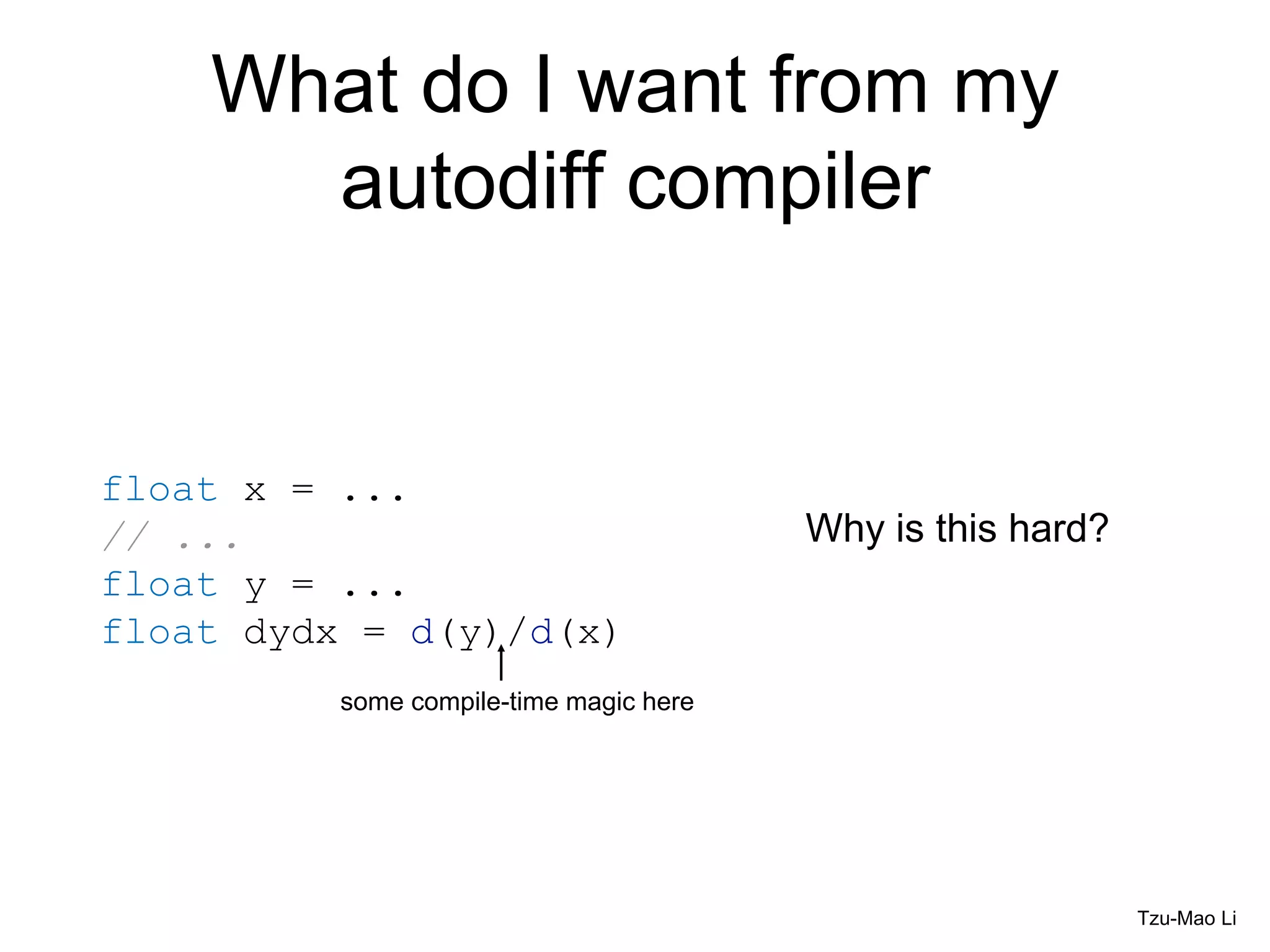
What do I want from my
autodiff compiler
Why is this hard?
float x = ...
// ...
float y = ...
float dydx = d(y)/d(x)
some compile-time magic here
Tzu-Mao Li
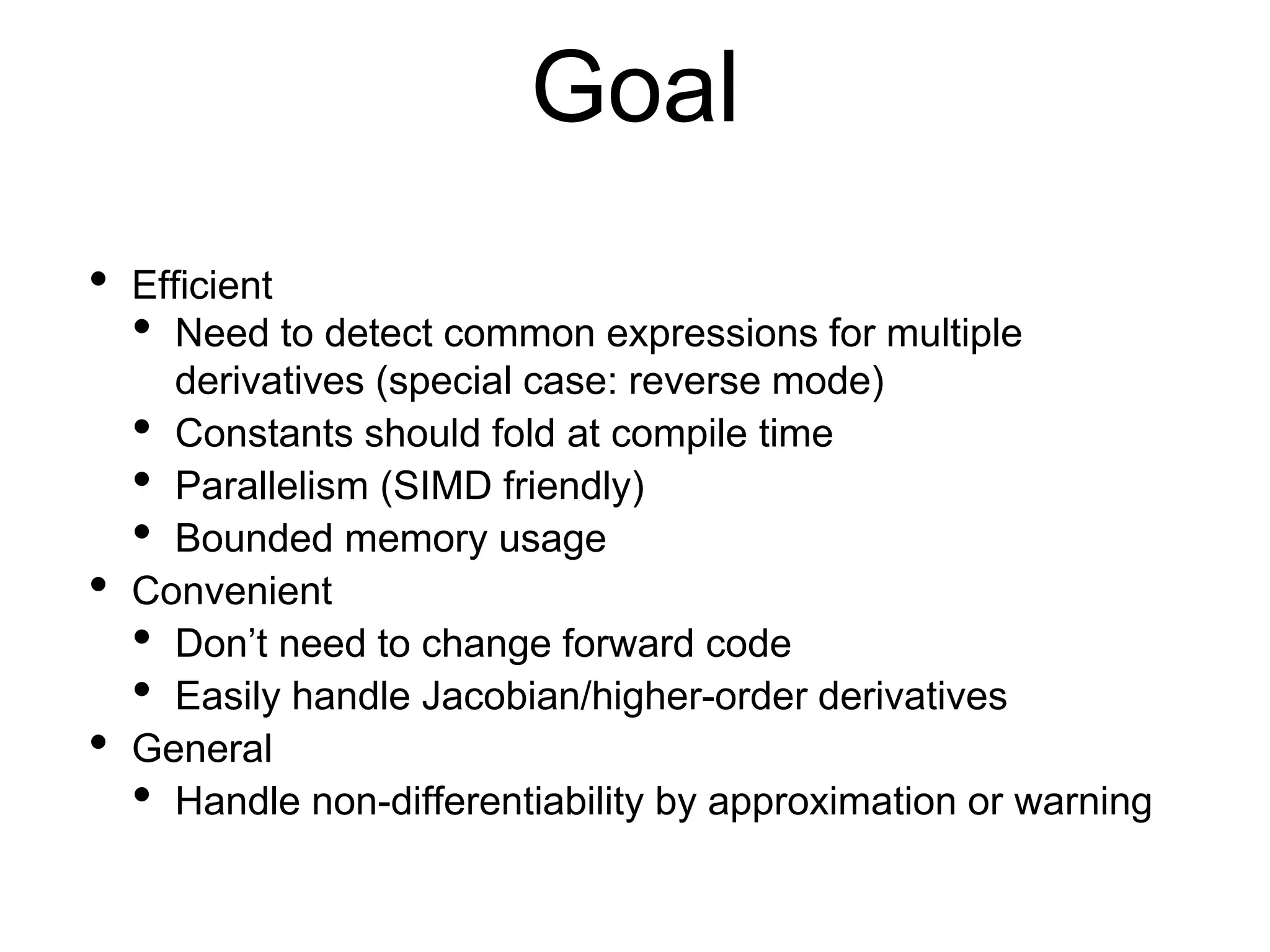
Goal
• Efficient
• Need to detect common expressions for multiple
derivatives (special case: reverse mode)
• Constants should fold at compile time
• Parallelism (SIMD friendly)
• Bounded memory usage
• Convenient
• Don’t need to change forward code
• Easily handle Jacobian/higher-order derivatives
• General
• Handle non-differentiability by approximation or warning
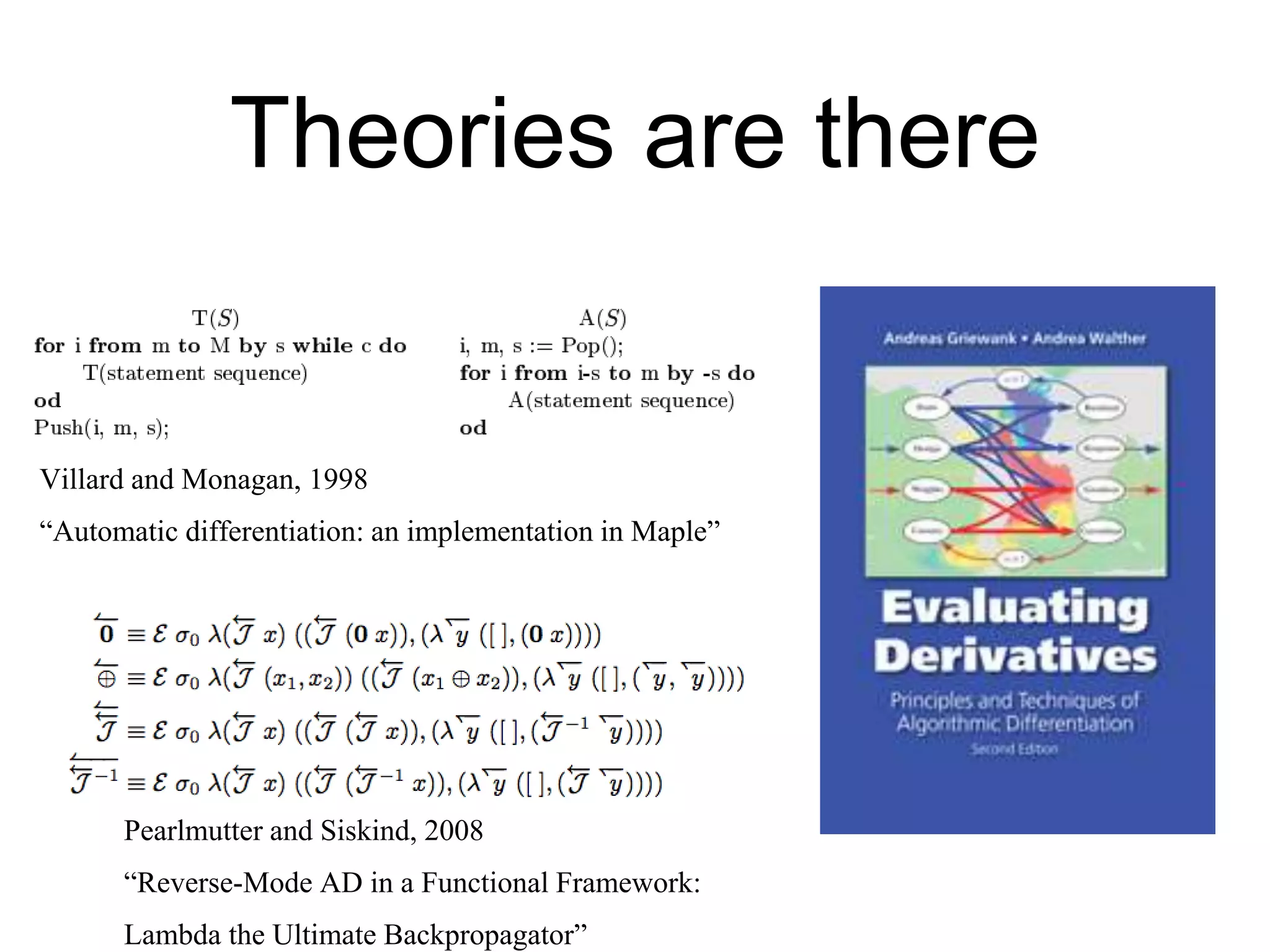
Theories are there
Pearlmutter and Siskind, 2008
“Reverse-Mode AD in a Functional Framework:
Lambda the Ultimate Backpropagator”
Villard and Monagan, 1998
“Automatic differentiation: an implementation in Maple”
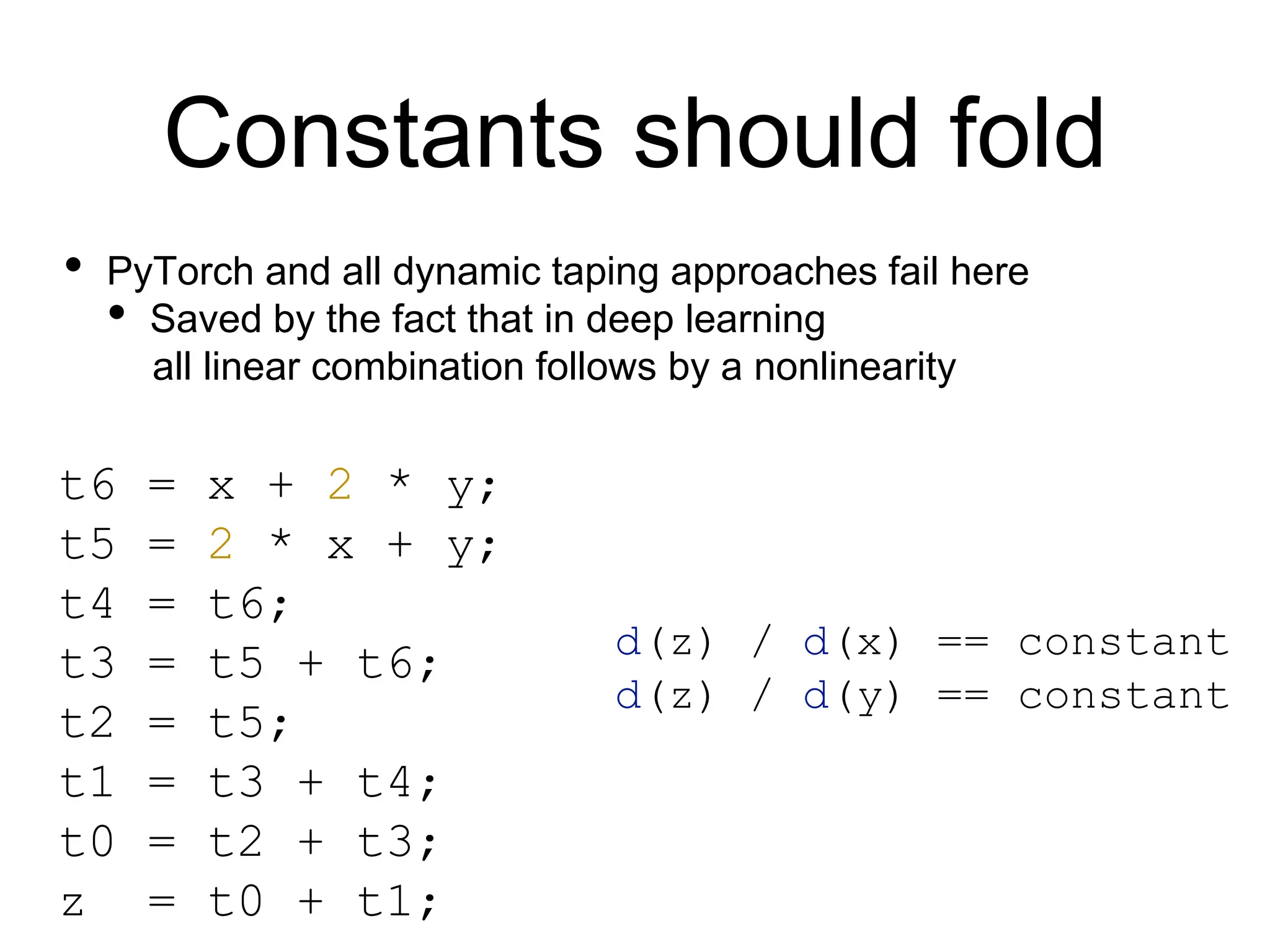
Constants should fold
t6 = x + 2 * y;
t5 = 2 * x + y;
t4 = t6;
t3 = t5 + t6;
t2 = t5;
t1 = t3 + t4;
t0 = t2 + t3;
z = t0 + t1;
• PyTorch and all dynamic taping approaches fail here
• Saved by the fact that in deep learning
all linear combination follows by a nonlinearity
d(z) / d(x) == constant
d(z) / d(y) == constant
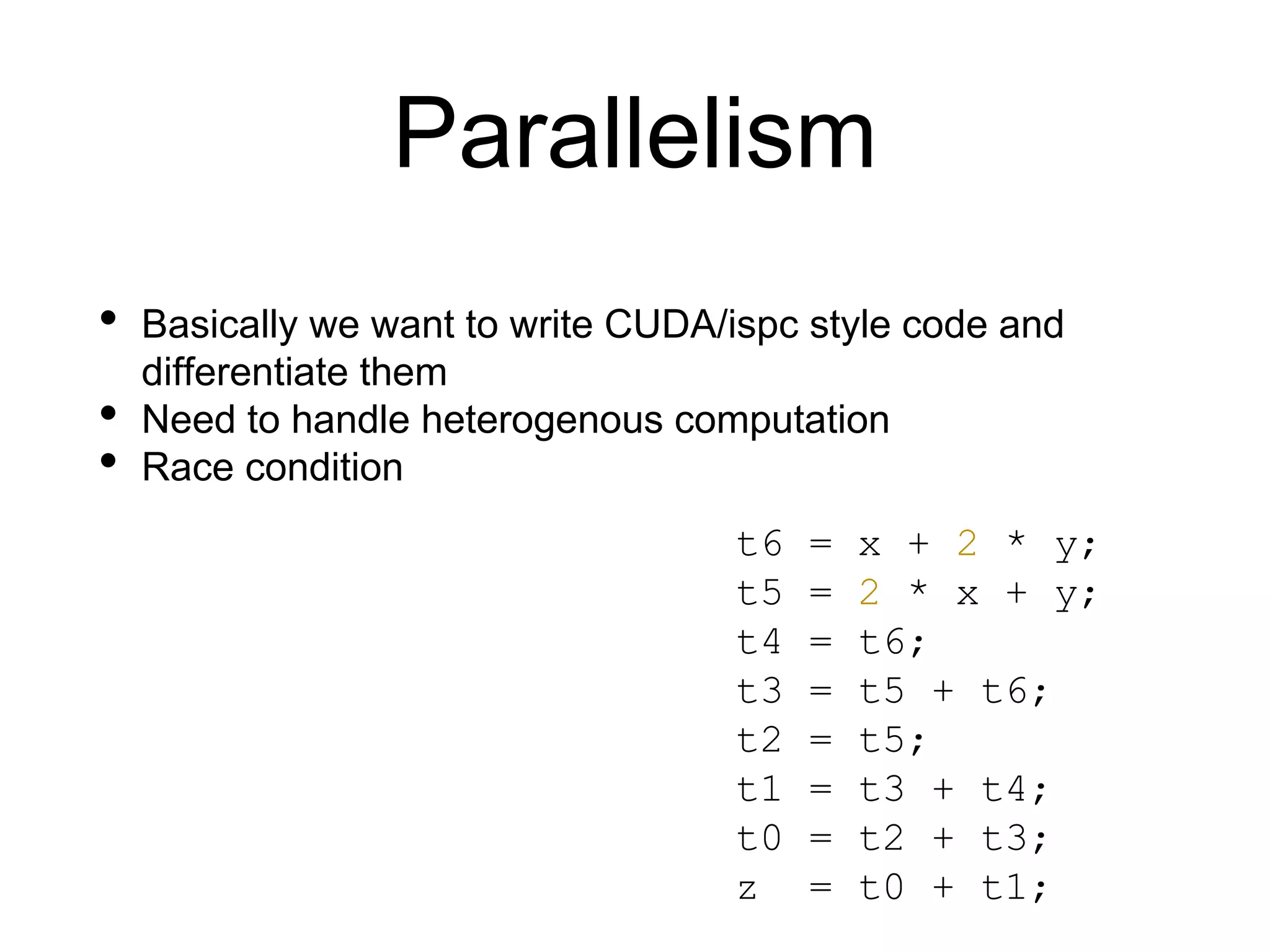
Parallelism
• Basically we want to write CUDA/ispc style code and
differentiate them
• Need to handle heterogenous computation
• Race condition
t6 = x + 2 * y;
t5 = 2 * x + y;
t4 = t6;
t3 = t5 + t6;
t2 = t5;
t1 = t3 + t4;
t0 = t2 + t3;
z = t0 + t1;
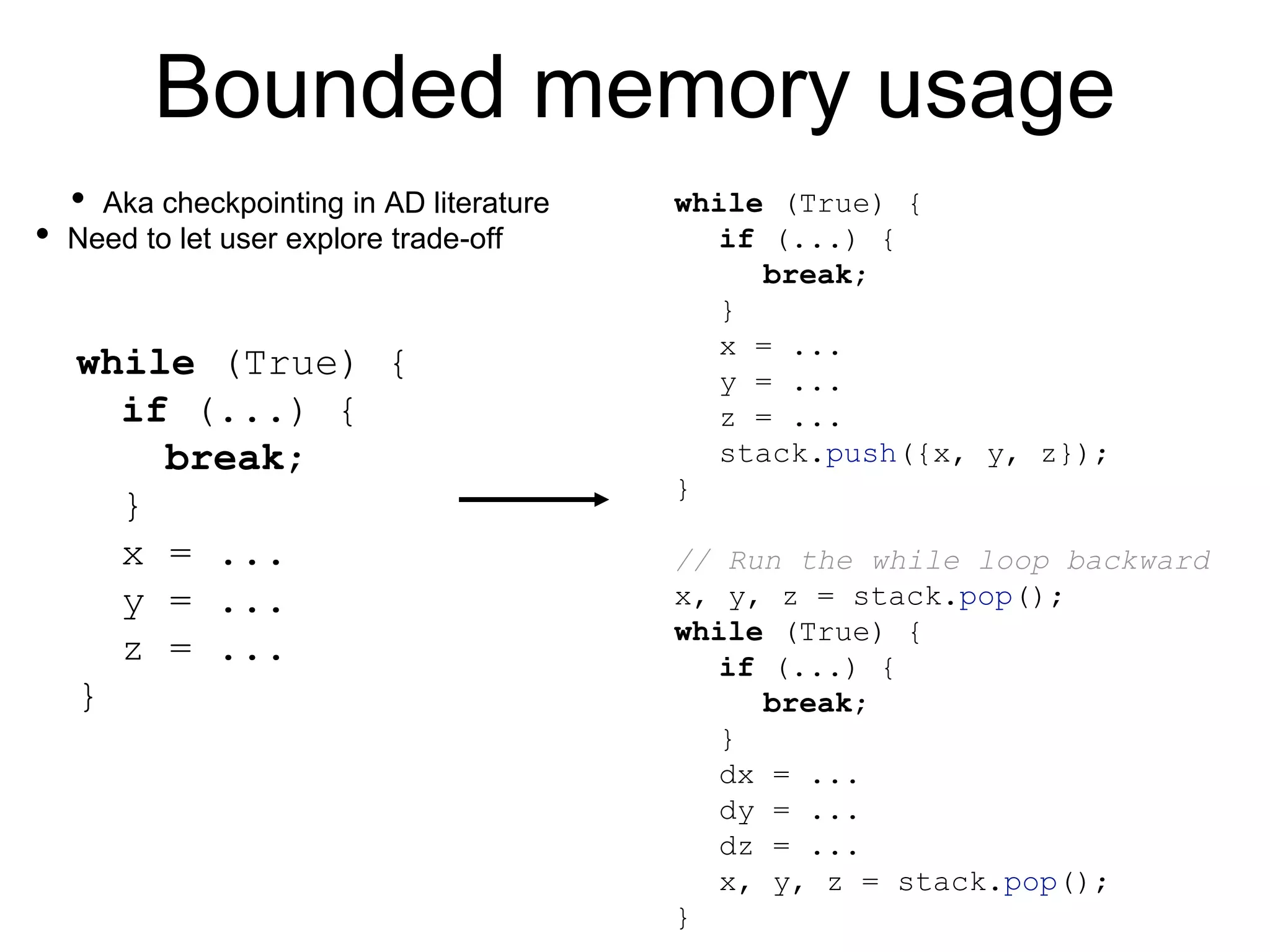
Bounded memory usage
while (True) {
if (...) {
break;
}
x = ...
y = ...
z = ...
}
while (True) {
if (...) {
break;
}
x = ...
y = ...
z = ...
stack.push({x, y, z});
}
// Run the while loop backward
x, y, z = stack.pop();
while (True) {
if (...) {
break;
}
dx = ...
dy = ...
dz = ...
x, y, z = stack.pop();
}
• Aka checkpointing in AD literature
• Need to let user explore trade-off
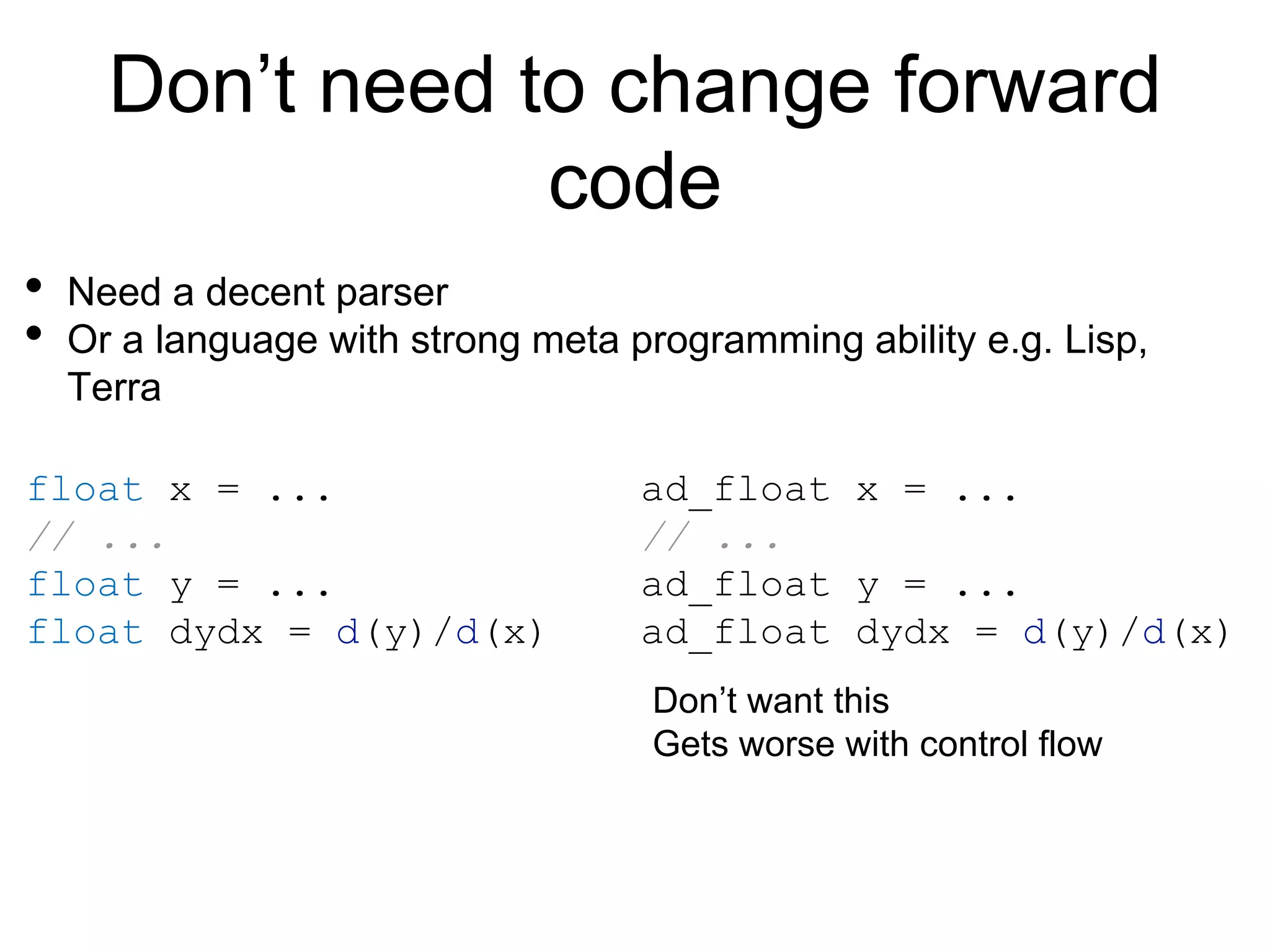
Don’t need to change forward
code
• Need a decent parser
• Or a language with strong meta programming ability e.g. Lisp,
Terra
float x = ...
// ...
float y = ...
float dydx = d(y)/d(x)
ad_float x = ...
// ...
ad_float y = ...
ad_float dydx = d(y)/d(x)
Don’t want this
Gets worse with control flow
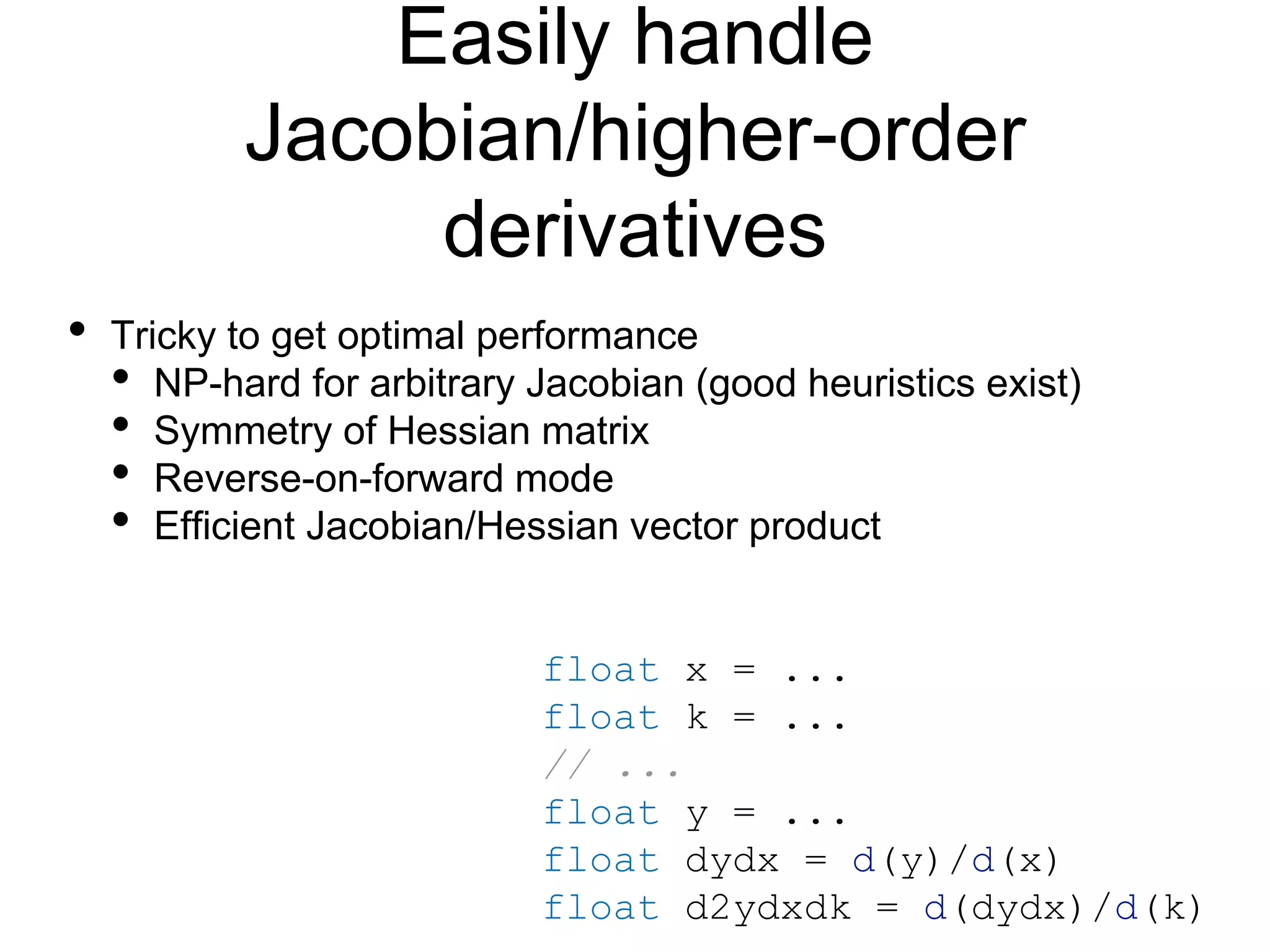
Easily handle
Jacobian/higher-order
derivatives
float x = ...
float k = ...
// ...
float y = ...
float dydx = d(y)/d(x)
float d2ydxdk = d(dydx)/d(k)
• Tricky to get optimal performance
• NP-hard for arbitrary Jacobian (good heuristics exist)
• Symmetry of Hessian matrix
• Reverse-on-forward mode
• Efficient Jacobian/Hessian vector product
Handle non-differentiability
• e.g. Piecewise-constant function
• Users may not know that their functions are not
differentiable for certain input ranges
• Either automatically approximate or warn the users
• Numerical issues at boundaries: e.g. d/dx sqrt(x) = -
1/sqrt(x) when x->0
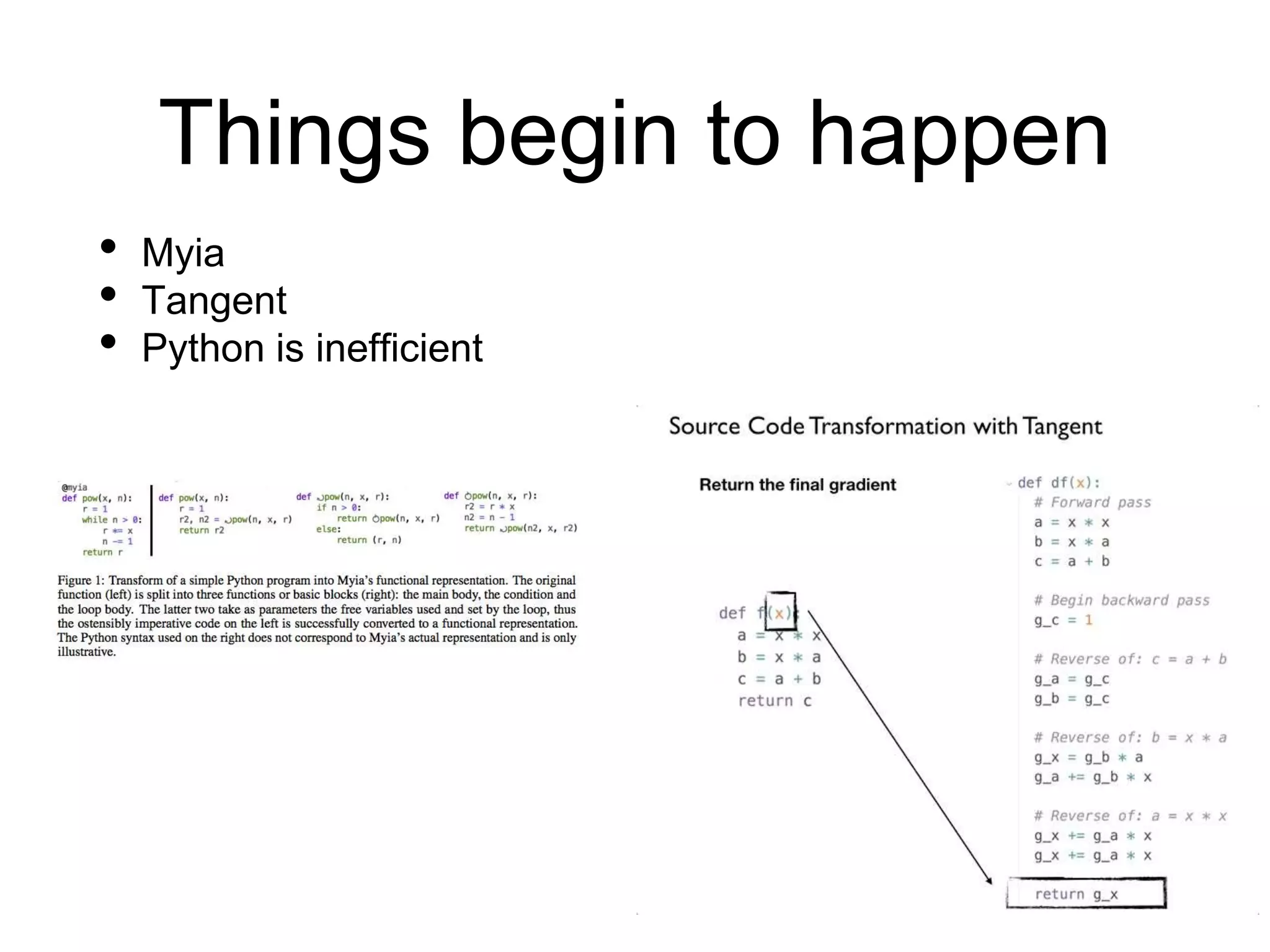
Things begin to happen
• Myia
• Tangent
• Python is inefficient

What do I want from my automatic differentiation compiler

  • 1.
    What do Iwant from my autodiff compiler Why is this hard? float x = ... // ... float y = ... float dydx = d(y)/d(x) some compile-time magic here Tzu-Mao Li
  • 2.
    Goal • Efficient • Needto detect common expressions for multiple derivatives (special case: reverse mode) • Constants should fold at compile time • Parallelism (SIMD friendly) • Bounded memory usage • Convenient • Don’t need to change forward code • Easily handle Jacobian/higher-order derivatives • General • Handle non-differentiability by approximation or warning
  • 3.
    Theories are there Pearlmutterand Siskind, 2008 “Reverse-Mode AD in a Functional Framework: Lambda the Ultimate Backpropagator” Villard and Monagan, 1998 “Automatic differentiation: an implementation in Maple”
  • 4.
    Constants should fold t6= x + 2 * y; t5 = 2 * x + y; t4 = t6; t3 = t5 + t6; t2 = t5; t1 = t3 + t4; t0 = t2 + t3; z = t0 + t1; • PyTorch and all dynamic taping approaches fail here • Saved by the fact that in deep learning all linear combination follows by a nonlinearity d(z) / d(x) == constant d(z) / d(y) == constant
  • 5.
    Parallelism • Basically wewant to write CUDA/ispc style code and differentiate them • Need to handle heterogenous computation • Race condition t6 = x + 2 * y; t5 = 2 * x + y; t4 = t6; t3 = t5 + t6; t2 = t5; t1 = t3 + t4; t0 = t2 + t3; z = t0 + t1;
  • 6.
    Bounded memory usage while(True) { if (...) { break; } x = ... y = ... z = ... } while (True) { if (...) { break; } x = ... y = ... z = ... stack.push({x, y, z}); } // Run the while loop backward x, y, z = stack.pop(); while (True) { if (...) { break; } dx = ... dy = ... dz = ... x, y, z = stack.pop(); } • Aka checkpointing in AD literature • Need to let user explore trade-off
  • 7.
    Don’t need tochange forward code • Need a decent parser • Or a language with strong meta programming ability e.g. Lisp, Terra float x = ... // ... float y = ... float dydx = d(y)/d(x) ad_float x = ... // ... ad_float y = ... ad_float dydx = d(y)/d(x) Don’t want this Gets worse with control flow
  • 8.
    Easily handle Jacobian/higher-order derivatives float x= ... float k = ... // ... float y = ... float dydx = d(y)/d(x) float d2ydxdk = d(dydx)/d(k) • Tricky to get optimal performance • NP-hard for arbitrary Jacobian (good heuristics exist) • Symmetry of Hessian matrix • Reverse-on-forward mode • Efficient Jacobian/Hessian vector product
  • 9.
    Handle non-differentiability • e.g.Piecewise-constant function • Users may not know that their functions are not differentiable for certain input ranges • Either automatically approximate or warn the users • Numerical issues at boundaries: e.g. d/dx sqrt(x) = - 1/sqrt(x) when x->0
  • 10.
    Things begin tohappen • Myia • Tangent • Python is inefficient