© 2018
What Do Editors Do All Day?
Dr. John Uhlrich
Editor
IMPRS 2018
Schloss Ringberg
© 2018
Science
Publishing
© 2018
1) About Wiley-VCH
2) Why we publish and what editors look
for in a manuscript. What do publishers
do?
3) Careers in publishing and the challenges
ahead
4) Q & A
Today’s Talk
© 2018
• PhD students?
• Post-Docs or beyond?
• Who has already published something?
• Have you had the opportunity to act as a
peer reviewer for a submitted research
manuscript?
• Who can imagine a career in publishing?
Who are you?
© 2018
Who am I?
• Chemical Engineering, PhD University of
Wisconsin, USA
• Interface Chemistry of Hybrid Photovoltaic
Materials/Devices
• Postdoc 2009-2011: Fritz Haber Institute, Berlin
Department of Chemical Physics (H.J. Freund)
• Surface Science for Model Catalysis
• 2011– 2012:
– Editor, Advanced Materials, Advanced Functional
Materials
• 2012-present:
– Editor, Energy Technology
© 2018
Who am I?
• Chemical Engineering, PhD University of
Wisconsin, USA
• Interface Chemistry of Hybrid Photovoltaic
Materials/Devices
• Postdoc 2009-2011: Fritz Haber Institute, Berlin
Department of Chemical Physics (H.J. Freund)
• Surface Science for Model Catalysis
• 2011– 2012:
– Editor, Advanced Materials, Advanced Functional
Materials
• 2012-present:
– Editor, Energy Technology
© 2018
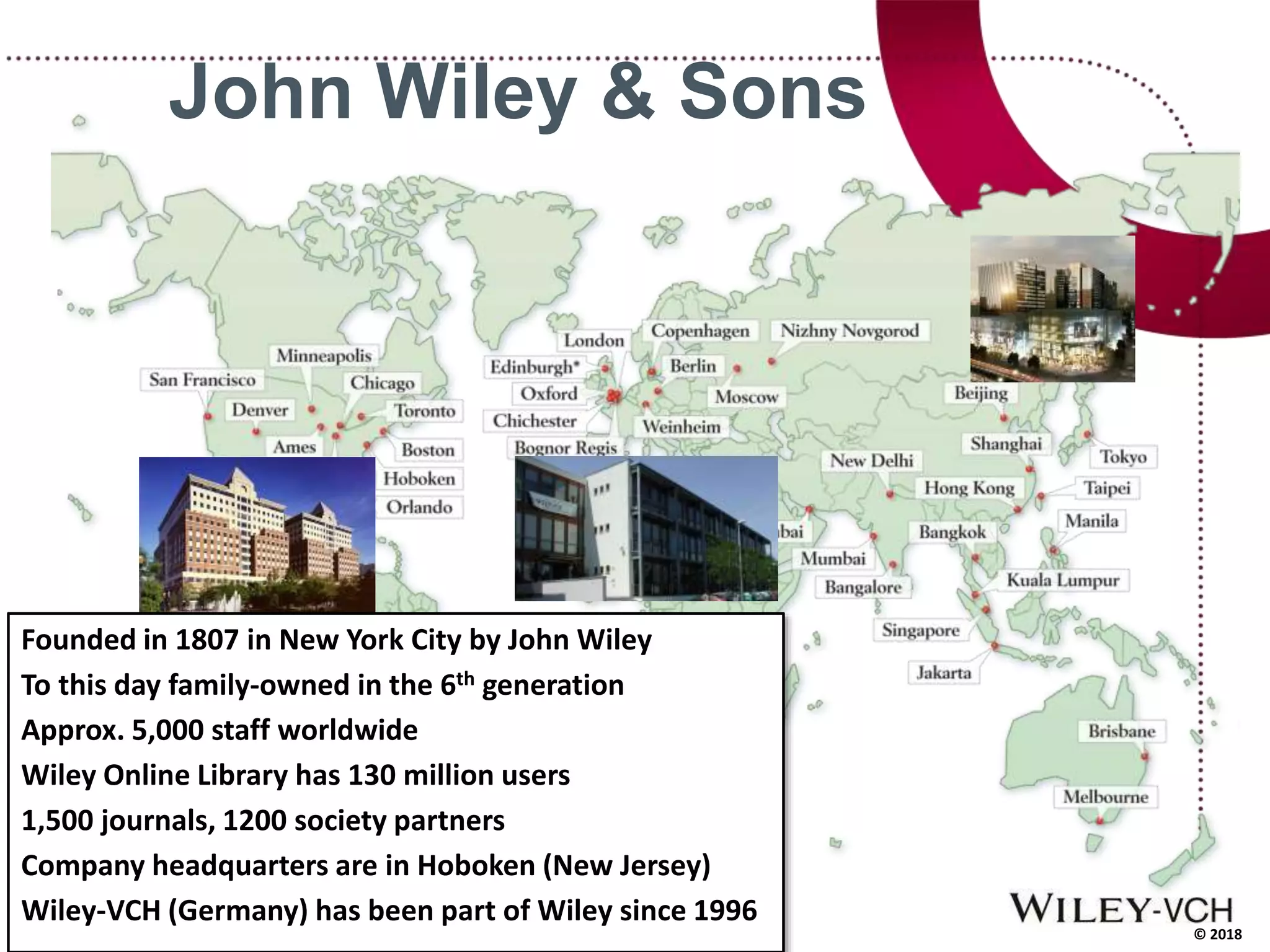
John Wiley & Sons
South Korea
Founded in 1807 in New York City by John Wiley
To this day family-owned in the 6th generation
Approx. 5,000 staff worldwide
Wiley Online Library has 130 million users
1,500 journals, 1200 society partners
Company headquarters are in Hoboken (New Jersey)
Wiley-VCH (Germany) has been part of Wiley since 1996
© 2018
Weinheim office
Schloss Ringberg
© 2018
• Wiley-VCH, Wiley-Blackwell, Ernst & Sohn, GIT
• Weinheim, Berlin, Zürich (CH)
• 530 employees (450/ 70/ 14)
– ~ 70% female - 30% male
– Average age ~ 42 years
– Average time with Wiley-VCH ~ 10 years
– Foreign employees 40%
from 24 different nations
• Primarily chemists, followed by materials scientists, physicists, biologists,
mathematicians
Our Office
© 2018
Wiley-VCH Journal Genealogy
© 2018
1500 journals, books
And More...
© 2018
•Covering the technical aspects of
applied energy research
–Generation
–Conversion
–Storage
–Distribution
•Companion journal of other related
Wiley titles (Advanced Energy
Materials, ChemSusChem, etc.)
•Listed in important databases
(ISI, Web of Knowledge, Scopus)
•Impact Factor (2016): 2.789
•Online publication (no color fees)
Launched in 2013
Editor-in-Chief
Dr. John Uhlrich
© 2018
“If your research does not generate papers, it
might just as well not have been done.
‘Interesting and unpublished‘ is equivalent to
non-existant.“
“Realize that your objective in research is to
formulate and test hypotheses, to draw
conclusions from these tests, and to teach
these conclusions to others. Your objective is
not to ‘collect data‘.“
George Whitesides, “Whitesides‘ Group: Writing a
Paper“, Essay in Advanced Materials, 2004, 16, 1375 .
Why publish at all?
© 2018
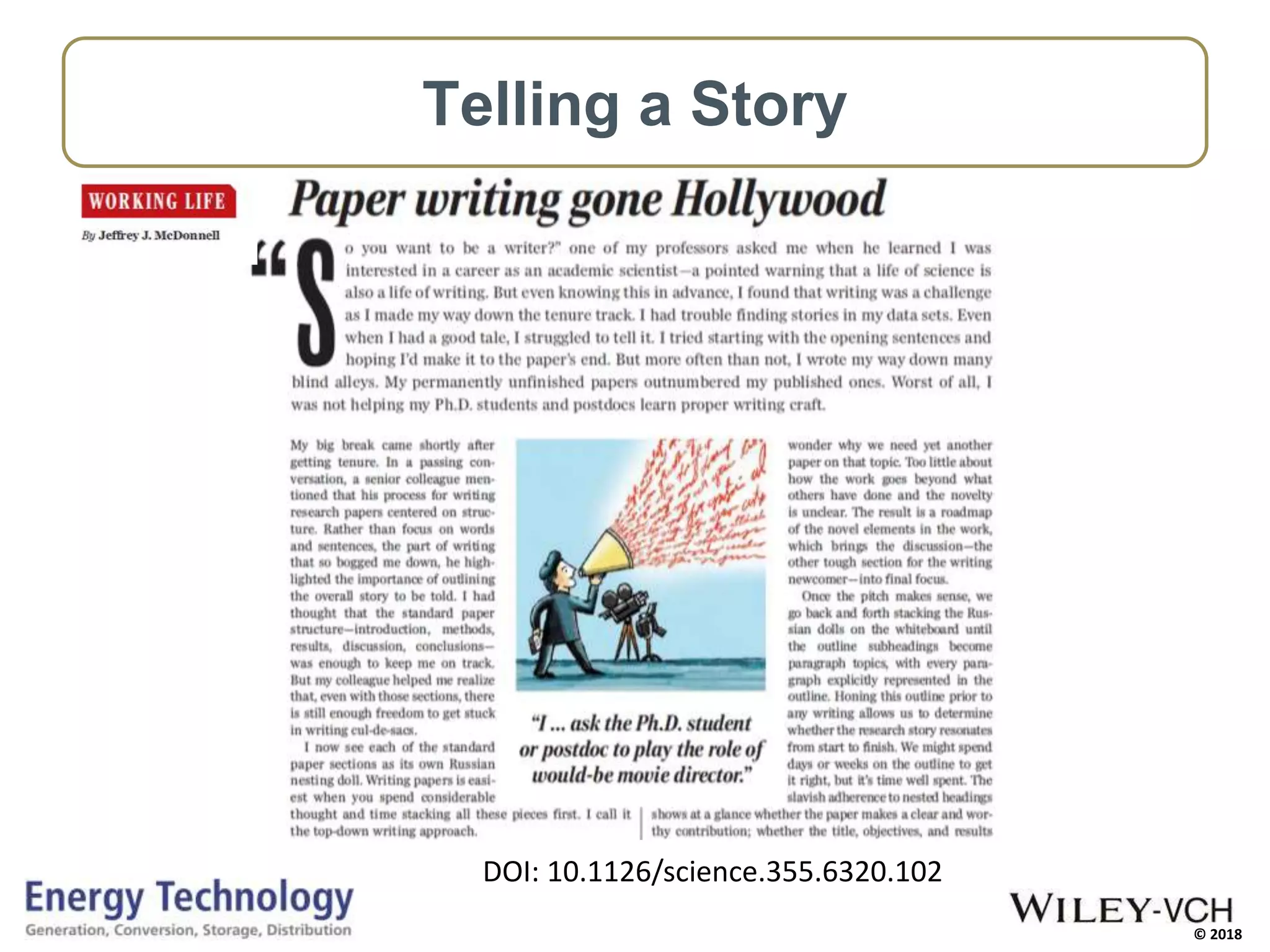
DOI: 10.1126/science.355.6320.102
Telling a Story
© 2018
DOI: 10.1126/science.355.6320.102
Answer 3 Questions:
• What is the Status Quo?
– Too little: Risk losing a large audience who may
not be experts on this topic.
• What is wrong with the Status Quo?
– Too little: “Why do we need yet another paper
on this topic?“
• How does this work go beyond the Status
Quo?
– Too little: The novelty of your work is not clear.
Telling a Story
© 2018
Is the novelty
high enough?
Difference to
prior work?
Important to the
whole readership?
Important to
researchers
in this field?
After the initial check for scope and length is done,
the manuscript is examined more closely:
the most
important
hurdle!
„Publishing space is
limited – choose a journal
whose readership will be
keen to see your results!“
What Editors Look For (Manuscript Suitability)
© 2018
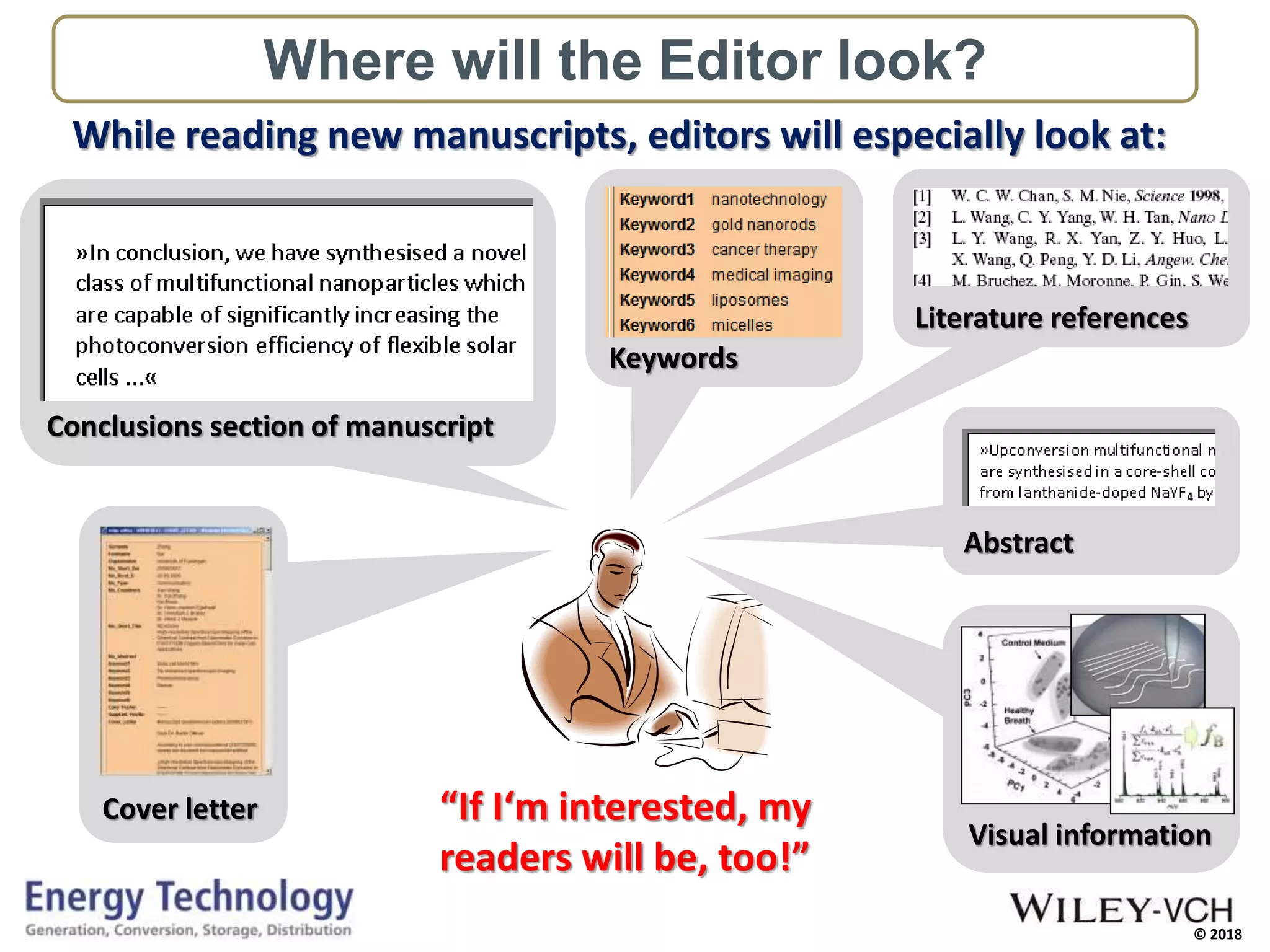
Conclusions section of manuscript
While reading new manuscripts, editors will especially look at:
Cover letter “If I‘m interested, my
readers will be, too!ˮ
Keywords
Literature references
Visual information
Abstract
Where will the Editor look?
© 2018
Cover Letter: The Worst Type
© 2018
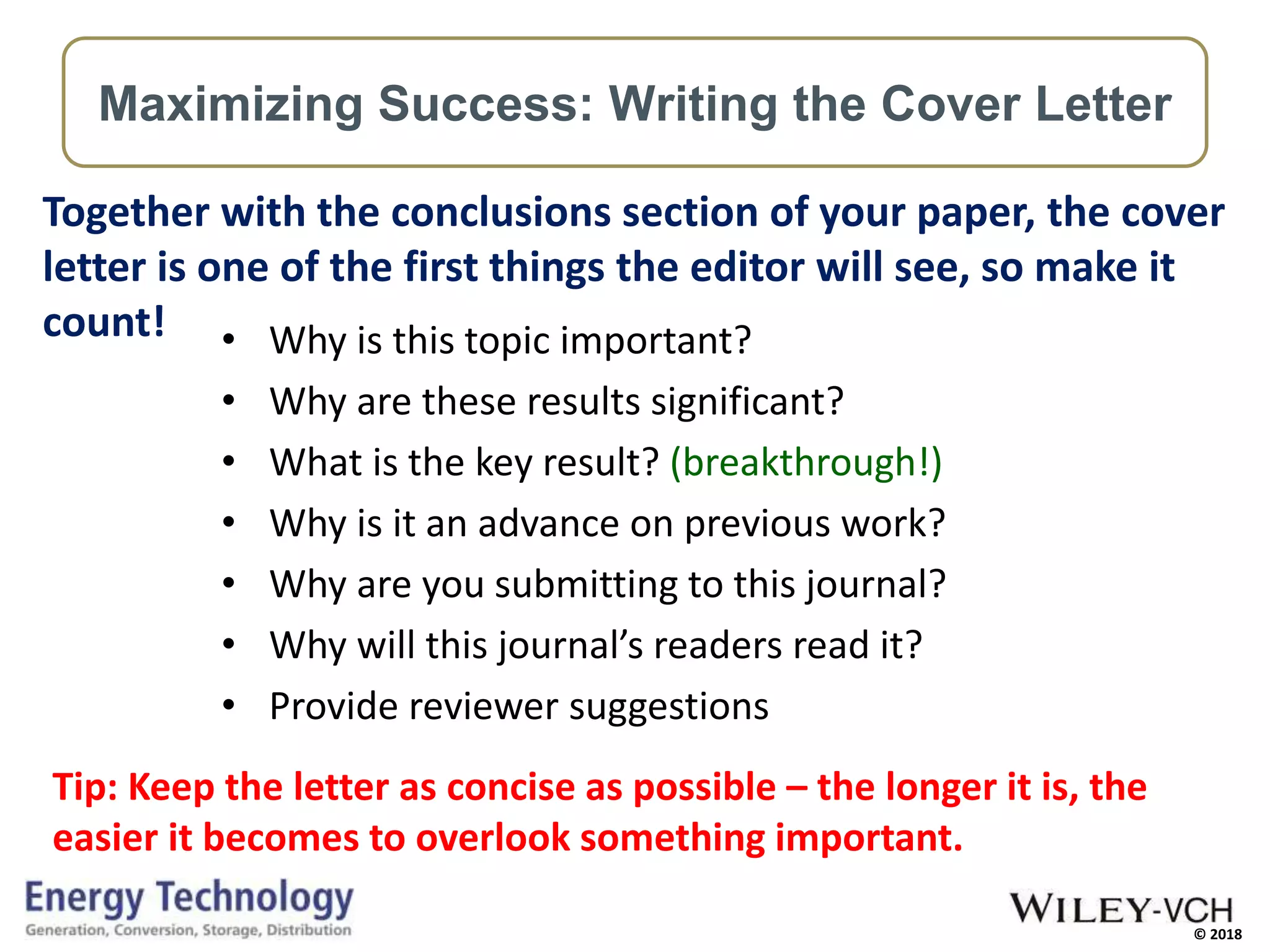
• Why is this topic important?
• Why are these results significant?
• What is the key result? (breakthrough!)
• Why is it an advance on previous work?
• Why are you submitting to this journal?
• Why will this journal’s readers read it?
• Provide reviewer suggestions
Together with the conclusions section of your paper, the cover
letter is one of the first things the editor will see, so make it
count!
Tip: Keep the letter as concise as possible – the longer it is, the
easier it becomes to overlook something important.
Maximizing Success: Writing the Cover Letter
© 2018
• Why is this topic important?
• Why are these results significant?
• What is the key result? (breakthrough!)
• Why is it an advance on previous work?
• Why are you submitting to this journal?
• Why will this journal’s readers read it?
• Provide reviewer suggestions
Together with the conclusions section of your paper, the cover
letter is one of the first things the editor will see, so make it
count!
Tip: Keep the letter as concise as possible – the longer it is, the
easier it becomes to overlook something important.
Maximizing Success: Writing the Cover Letter
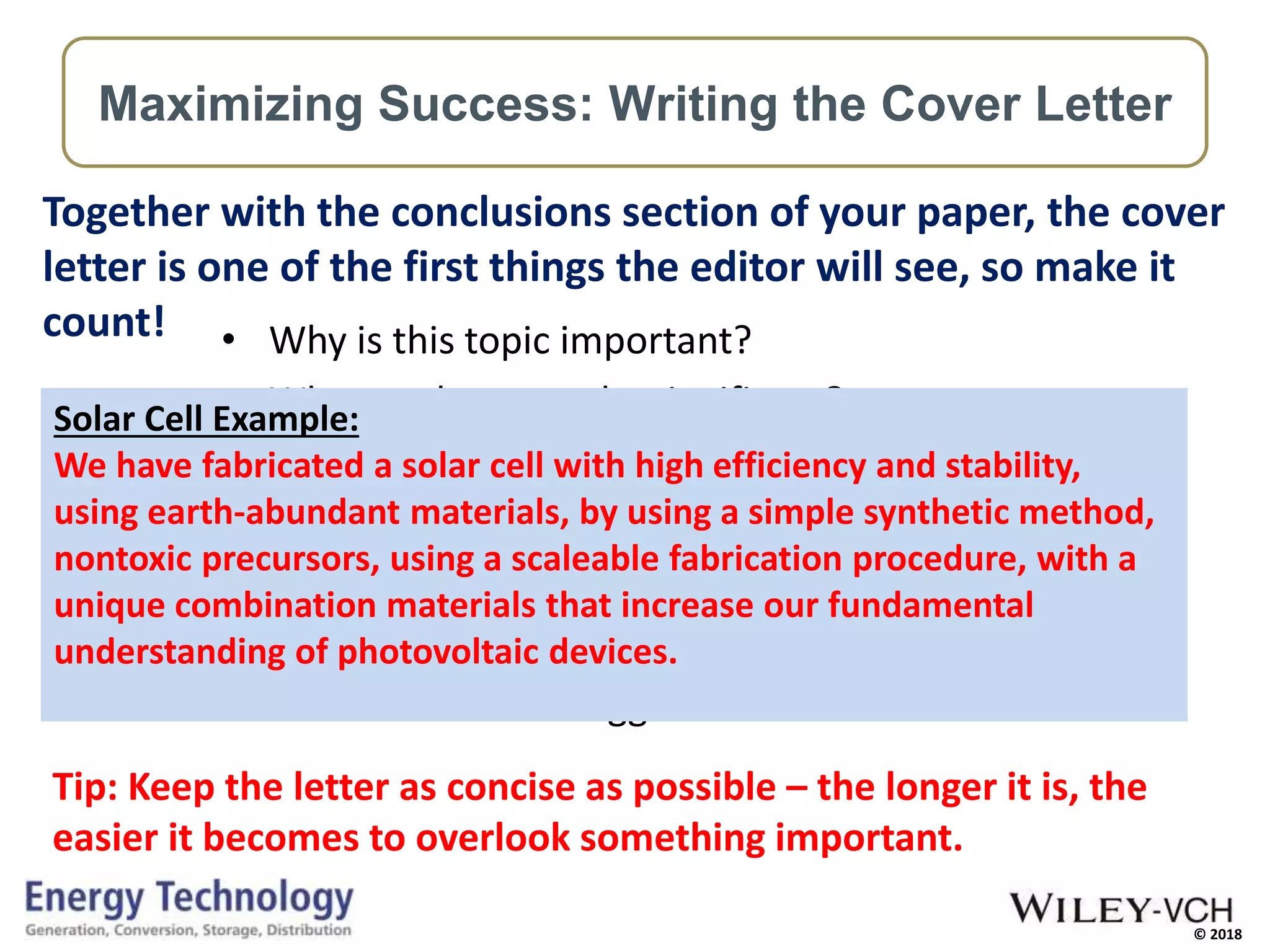
Solar Cell Example:
We have fabricated a solar cell with high efficiency and stability,
using earth-abundant materials, by using a simple synthetic method,
nontoxic precursors, using a scaleable fabrication procedure, with a
unique combination materials that increase our fundamental
understanding of photovoltaic devices.
© 2018
Manuscript rejected on reports
Manuscript submitted
Editors examine &
make initial decision in house
Manuscript sent out
for external peer review
Editor makes decision
based on reports
Manuscript is accepted as
is or with minor revisions
Manuscript transferred
to the publication workflow
Manuscript rejected on reports
but reinvited if
major revisions promising
Manuscript rejected on topic,
novelty, or quality
Revisions requested
if possible in short time
Manuscript rejected on format
but reinvited (e.g., shorten)
Peer Review Editorial Workflow
© 2018
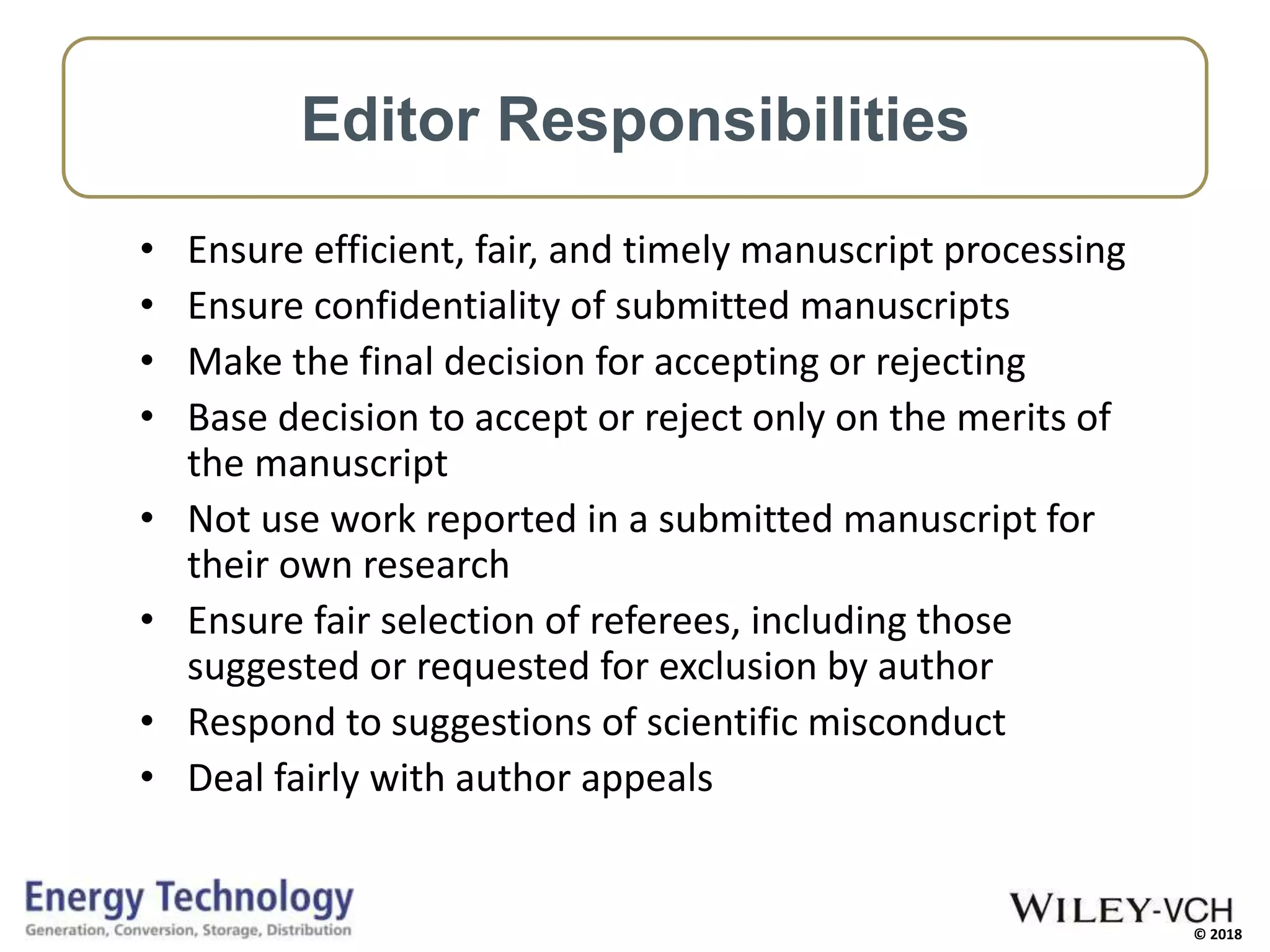
• Ensure efficient, fair, and timely manuscript processing
• Ensure confidentiality of submitted manuscripts
• Make the final decision for accepting or rejecting
• Base decision to accept or reject only on the merits of
the manuscript
• Not use work reported in a submitted manuscript for
their own research
• Ensure fair selection of referees, including those
suggested or requested for exclusion by author
• Respond to suggestions of scientific misconduct
• Deal fairly with author appeals
Editor Responsibilities
© 2018
https://scholarlykitchen.sspnet.org/2018/02/06/focusing-value-102-things-
journal-publishers-2018-update/?informz=1
© 2018
Some highlights
46. Search engine optimization.
50. Dealing with data.
55. Media relations and publicity.
56. Social media distribution and management.
58. Integrating new standards.
60. Hosting and archiving.
73. Managing and protecting
editorial records.
101. Work together to solve more general
access and fairness issues.
86. Provide training in emerging publishing
markets. (but not just emerging markets!)
34. Copy-editing, proofreading, and styling of
materials.
27. Ethics investigations.
26. Management of peer review process.
© 2018
Thinking of a career as an editor?
• The science comes first! Cultivate your scientific
expertise.
• Experience the publication process both as an author
and a reviewer.
• Develop your language skills (particularly reading and
writing).
• Read broadly. Read critically.
• Get international experience.
• Pay attention to the larger
discussions and debates in
the field of publishing.
© 2018
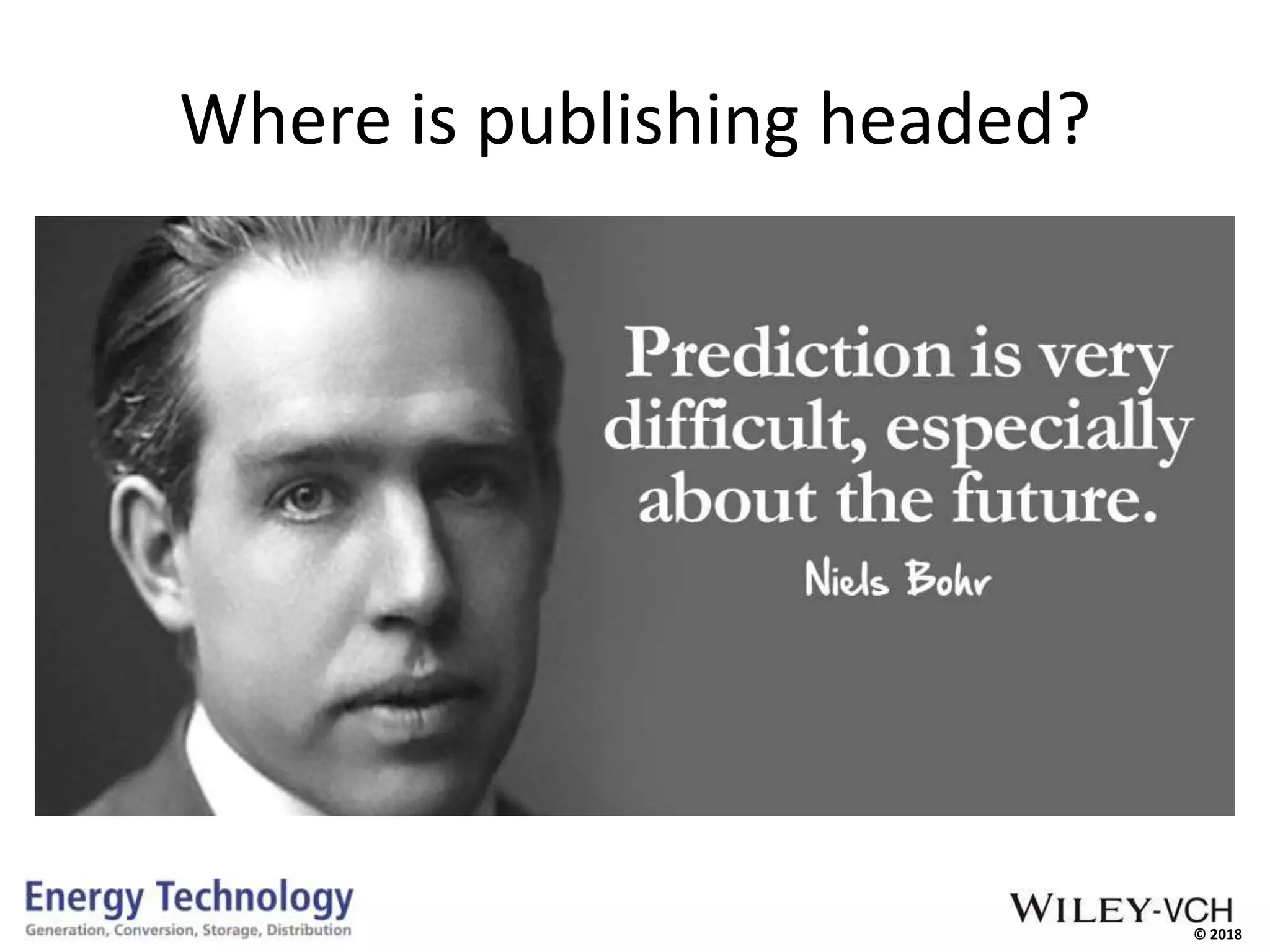
Where is publishing headed?
© 2018
Some emerging challenges
A fundamental
shift of the
customer from the
reader to the
author.
Open Access
© 2018
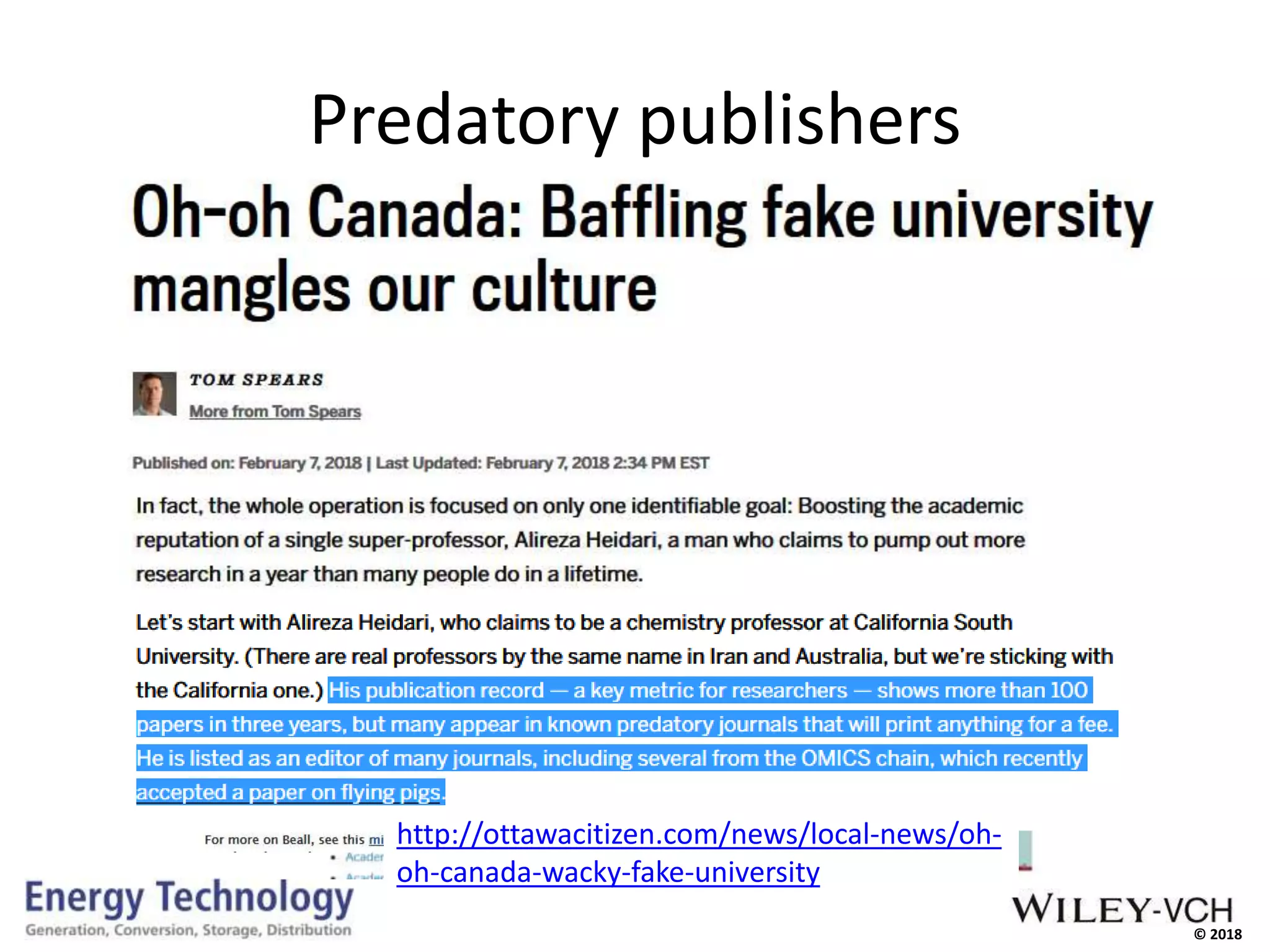
Predatory publishers
© 2018
Predatory publishers
http://ottawacitizen.com/news/local-news/oh-
oh-canada-wacky-fake-university
© 2018
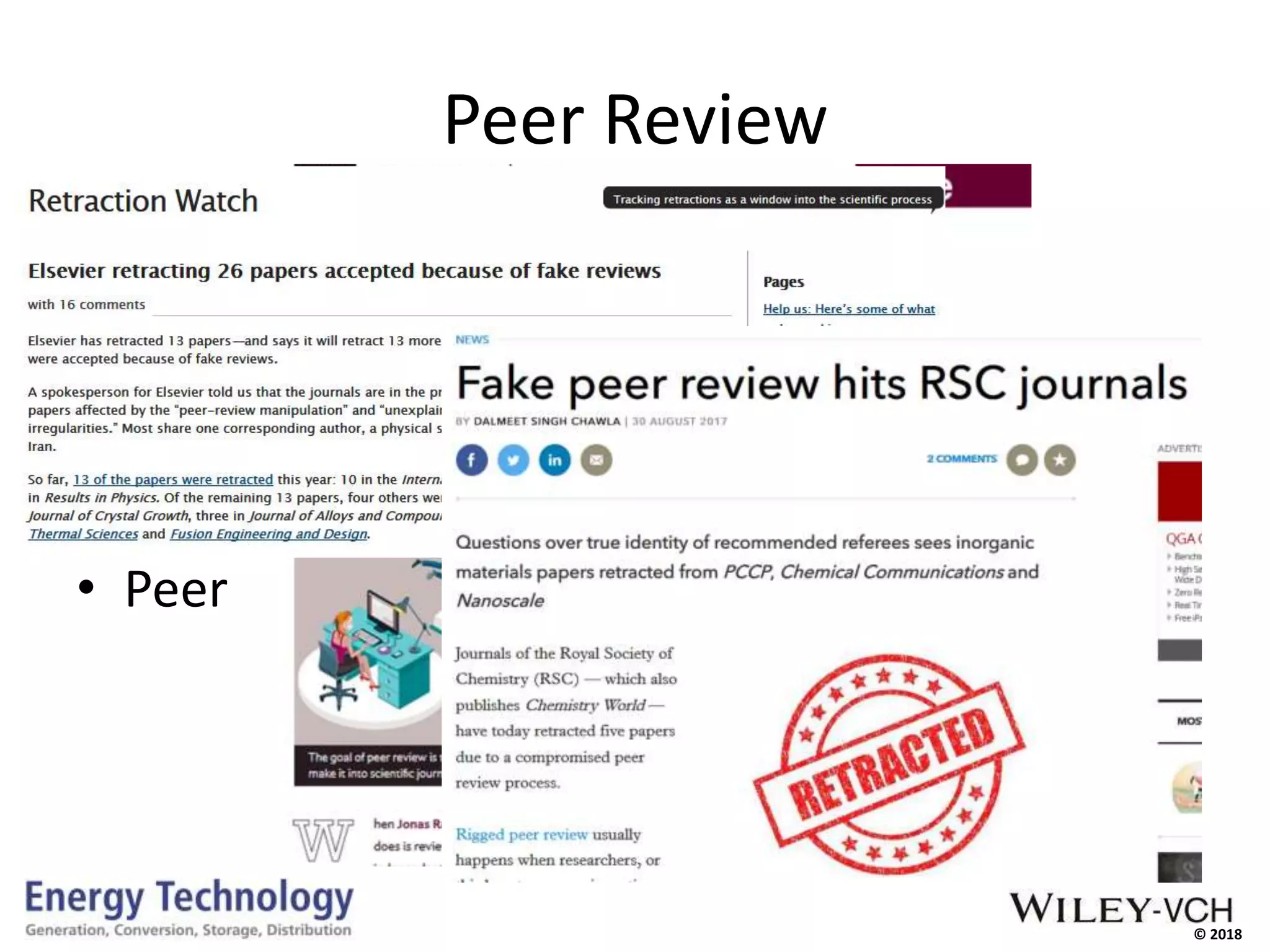
• Single-blind peer review
• Double-blind peer review
• Open peer review
• Post peer review
• Peer review motivation/compensation
Peer Review
© 2018
• Single-blind peer review
• Double-blind peer review
• Open peer review
• Post peer review
• Peer review motivation/compensation
Peer Review
© 2018
• Single-blind peer review
• Double-blind peer review
• Open peer review
• Post peer review
• Peer review motivation/compensation
Peer Review
© 2018
Copyright and article sharing
© 2018
Copyright and article sharing
© 2018
@EnergyTechnol
Questions?
• Contact me:
– John Uhlrich
jjuhlrich@wiley.com
Energy Technology
www.entechnol.de
energy-technology@wiley.com
Submissions:
www.editorialmanager.com/ente/
https://www.facebook.com/EnergyTechnologyJournal/
© 2018

What Do Editors Do All Day? From Science to Publishing.

  • 1.
    © 2018 What DoEditors Do All Day? Dr. John Uhlrich Editor IMPRS 2018 Schloss Ringberg
  • 2.
  • 3.
    © 2018 1) AboutWiley-VCH 2) Why we publish and what editors look for in a manuscript. What do publishers do? 3) Careers in publishing and the challenges ahead 4) Q & A Today’s Talk
  • 4.
    © 2018 • PhDstudents? • Post-Docs or beyond? • Who has already published something? • Have you had the opportunity to act as a peer reviewer for a submitted research manuscript? • Who can imagine a career in publishing? Who are you?
  • 5.
    © 2018 Who amI? • Chemical Engineering, PhD University of Wisconsin, USA • Interface Chemistry of Hybrid Photovoltaic Materials/Devices • Postdoc 2009-2011: Fritz Haber Institute, Berlin Department of Chemical Physics (H.J. Freund) • Surface Science for Model Catalysis • 2011– 2012: – Editor, Advanced Materials, Advanced Functional Materials • 2012-present: – Editor, Energy Technology
  • 6.
    © 2018 Who amI? • Chemical Engineering, PhD University of Wisconsin, USA • Interface Chemistry of Hybrid Photovoltaic Materials/Devices • Postdoc 2009-2011: Fritz Haber Institute, Berlin Department of Chemical Physics (H.J. Freund) • Surface Science for Model Catalysis • 2011– 2012: – Editor, Advanced Materials, Advanced Functional Materials • 2012-present: – Editor, Energy Technology
  • 7.
    © 2018 John Wiley& Sons South Korea Founded in 1807 in New York City by John Wiley To this day family-owned in the 6th generation Approx. 5,000 staff worldwide Wiley Online Library has 130 million users 1,500 journals, 1200 society partners Company headquarters are in Hoboken (New Jersey) Wiley-VCH (Germany) has been part of Wiley since 1996
  • 8.
  • 9.
    © 2018 • Wiley-VCH,Wiley-Blackwell, Ernst & Sohn, GIT • Weinheim, Berlin, Zürich (CH) • 530 employees (450/ 70/ 14) – ~ 70% female - 30% male – Average age ~ 42 years – Average time with Wiley-VCH ~ 10 years – Foreign employees 40% from 24 different nations • Primarily chemists, followed by materials scientists, physicists, biologists, mathematicians Our Office
  • 10.
  • 11.
    © 2018 1500 journals,books And More...
  • 12.
    © 2018 •Covering thetechnical aspects of applied energy research –Generation –Conversion –Storage –Distribution •Companion journal of other related Wiley titles (Advanced Energy Materials, ChemSusChem, etc.) •Listed in important databases (ISI, Web of Knowledge, Scopus) •Impact Factor (2016): 2.789 •Online publication (no color fees) Launched in 2013 Editor-in-Chief Dr. John Uhlrich
  • 13.
    © 2018 “If yourresearch does not generate papers, it might just as well not have been done. ‘Interesting and unpublished‘ is equivalent to non-existant.“ “Realize that your objective in research is to formulate and test hypotheses, to draw conclusions from these tests, and to teach these conclusions to others. Your objective is not to ‘collect data‘.“ George Whitesides, “Whitesides‘ Group: Writing a Paper“, Essay in Advanced Materials, 2004, 16, 1375 . Why publish at all?
  • 14.
  • 15.
    © 2018 DOI: 10.1126/science.355.6320.102 Answer3 Questions: • What is the Status Quo? – Too little: Risk losing a large audience who may not be experts on this topic. • What is wrong with the Status Quo? – Too little: “Why do we need yet another paper on this topic?“ • How does this work go beyond the Status Quo? – Too little: The novelty of your work is not clear. Telling a Story
  • 16.
    © 2018 Is thenovelty high enough? Difference to prior work? Important to the whole readership? Important to researchers in this field? After the initial check for scope and length is done, the manuscript is examined more closely: the most important hurdle! „Publishing space is limited – choose a journal whose readership will be keen to see your results!“ What Editors Look For (Manuscript Suitability)
  • 17.
    © 2018 Conclusions sectionof manuscript While reading new manuscripts, editors will especially look at: Cover letter “If I‘m interested, my readers will be, too!ˮ Keywords Literature references Visual information Abstract Where will the Editor look?
  • 18.
    © 2018 Cover Letter:The Worst Type
  • 19.
    © 2018 • Whyis this topic important? • Why are these results significant? • What is the key result? (breakthrough!) • Why is it an advance on previous work? • Why are you submitting to this journal? • Why will this journal’s readers read it? • Provide reviewer suggestions Together with the conclusions section of your paper, the cover letter is one of the first things the editor will see, so make it count! Tip: Keep the letter as concise as possible – the longer it is, the easier it becomes to overlook something important. Maximizing Success: Writing the Cover Letter
  • 20.
    © 2018 • Whyis this topic important? • Why are these results significant? • What is the key result? (breakthrough!) • Why is it an advance on previous work? • Why are you submitting to this journal? • Why will this journal’s readers read it? • Provide reviewer suggestions Together with the conclusions section of your paper, the cover letter is one of the first things the editor will see, so make it count! Tip: Keep the letter as concise as possible – the longer it is, the easier it becomes to overlook something important. Maximizing Success: Writing the Cover Letter Solar Cell Example: We have fabricated a solar cell with high efficiency and stability, using earth-abundant materials, by using a simple synthetic method, nontoxic precursors, using a scaleable fabrication procedure, with a unique combination materials that increase our fundamental understanding of photovoltaic devices.
  • 21.
    © 2018 Manuscript rejectedon reports Manuscript submitted Editors examine & make initial decision in house Manuscript sent out for external peer review Editor makes decision based on reports Manuscript is accepted as is or with minor revisions Manuscript transferred to the publication workflow Manuscript rejected on reports but reinvited if major revisions promising Manuscript rejected on topic, novelty, or quality Revisions requested if possible in short time Manuscript rejected on format but reinvited (e.g., shorten) Peer Review Editorial Workflow
  • 22.
    © 2018 • Ensureefficient, fair, and timely manuscript processing • Ensure confidentiality of submitted manuscripts • Make the final decision for accepting or rejecting • Base decision to accept or reject only on the merits of the manuscript • Not use work reported in a submitted manuscript for their own research • Ensure fair selection of referees, including those suggested or requested for exclusion by author • Respond to suggestions of scientific misconduct • Deal fairly with author appeals Editor Responsibilities
  • 23.
  • 24.
    © 2018 Some highlights 46.Search engine optimization. 50. Dealing with data. 55. Media relations and publicity. 56. Social media distribution and management. 58. Integrating new standards. 60. Hosting and archiving. 73. Managing and protecting editorial records. 101. Work together to solve more general access and fairness issues. 86. Provide training in emerging publishing markets. (but not just emerging markets!) 34. Copy-editing, proofreading, and styling of materials. 27. Ethics investigations. 26. Management of peer review process.
  • 25.
    © 2018 Thinking ofa career as an editor? • The science comes first! Cultivate your scientific expertise. • Experience the publication process both as an author and a reviewer. • Develop your language skills (particularly reading and writing). • Read broadly. Read critically. • Get international experience. • Pay attention to the larger discussions and debates in the field of publishing.
  • 26.
    © 2018 Where ispublishing headed?
  • 27.
    © 2018 Some emergingchallenges A fundamental shift of the customer from the reader to the author. Open Access
  • 28.
  • 29.
  • 30.
    © 2018 • Single-blindpeer review • Double-blind peer review • Open peer review • Post peer review • Peer review motivation/compensation Peer Review
  • 31.
    © 2018 • Single-blindpeer review • Double-blind peer review • Open peer review • Post peer review • Peer review motivation/compensation Peer Review
  • 32.
    © 2018 • Single-blindpeer review • Double-blind peer review • Open peer review • Post peer review • Peer review motivation/compensation Peer Review
  • 33.
    © 2018 Copyright andarticle sharing
  • 34.
    © 2018 Copyright andarticle sharing
  • 35.
    © 2018 @EnergyTechnol Questions? • Contactme: – John Uhlrich jjuhlrich@wiley.com Energy Technology www.entechnol.de energy-technology@wiley.com Submissions: www.editorialmanager.com/ente/ https://www.facebook.com/EnergyTechnologyJournal/
  • 36.