What are service patterns and do we
need them?
Kay Dale & Ignacia Orellana
Service designers
Government Digital Service
@kayjdale @ignaciaorellana
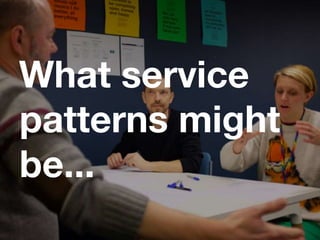
What service
patterns might
be...
…and can they
be used to
scale service
design in gov?
GDS
SPOILER ALERT!!!
WE DO NOT HAVE THE
ANSWER
@kayjdale @ignaciaorellana
Today’s agenda
GDSGDS
Introduction to patterns
● what we mean by ‘patterns’
● brief history of service patterns
in central government
● 3 statements
@kayjdale @ignaciaorellana
GDSGDS
Activities
● discuss what service patterns
might be (25 mins)
● discuss how we might use them
(40 mins)
@kayjdale @ignaciaorellana
GDSGDS
Wrap-up
● conclusions
@kayjdale @ignaciaorellana
What we
mean by
‘service’
GDS
A service is something that helps
users (be they citizens or civil
servants) achieve a goal
GDS@kayjdale @ignaciaorellana
What we mean
by ‘patterns’
GDS
Design patterns
A reusable solution to a
common design problem
@kayjdale @ignaciaorellana
GDSGDS
*Make idea of pattern tangible slide*
GDS
GDS
Until now… ‘patterns’ in central
government have been mainly
interaction and content design
patterns
@kayjdale @ignaciaorellana
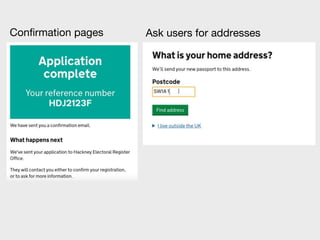
Ask users for addressesConfirmation pages
GDSGDS
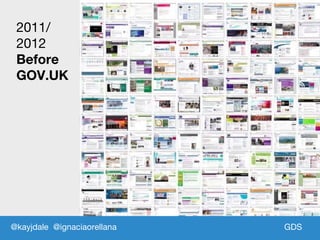
2011/
2012
Before
GOV.UK
@kayjdale @ignaciaorellana
GDSGDS
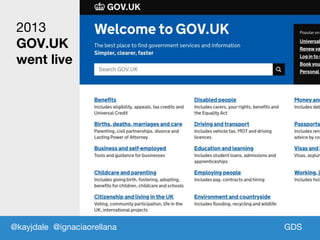
2013
GOV.UK
went live
@kayjdale @ignaciaorellana
GDSGDS
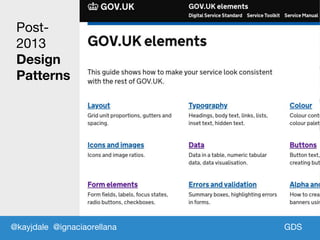
Post-
2013
Design
Patterns
@kayjdale @ignaciaorellana
GDSGDS
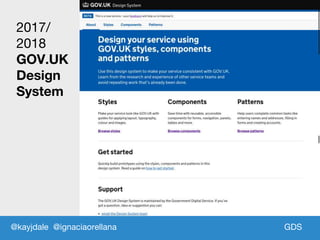
2017/
2018
GOV.UK
Design
System
@kayjdale @ignaciaorellana
Can we apply
pattern thinking
to whole
services in
government?
GDSGDS
Service patterns
Service design
Interaction & content patterns
User interface design
@kayjdale @ignaciaorellana
GDSGDS
2015
A ‘discovery’ across departments
to look at 3 potential service
patterns:
● get permission to do a thing
● exchange ownership of a thing
● get funding
@kayjdale @ignaciaorellana
GDSGDS
We found more than 300 ways
to get ‘get permission’ and
finding a single pattern became
difficult because the scope was
so broad
@kayjdale @ignaciaorellana
GDSGDS
2016-2017
A pilot with 20+ local authorities
to design a common way to get
a parking permit
@kayjdale @ignaciaorellana
GDSGDS
This is kind of working…
@kayjdale @ignaciaorellana
GDSGDS
2017-now
Opening the conversation wider
:)
@kayjdale @ignaciaorellana
3 statements
GDSGDS@kayjdale @ignaciaorellana
GDSGDS
1.
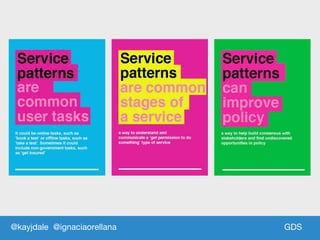
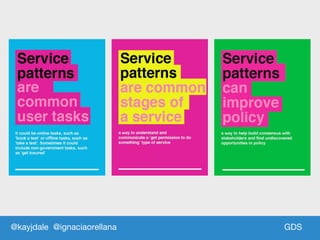
Service patterns are useful as a
way to deliver common user
tasks
@kayjdale @ignaciaorellana
GDSGDS
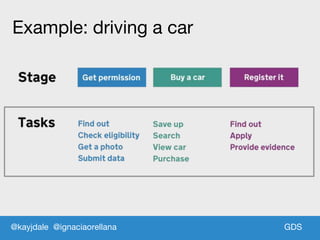
Online tasks, such as ‘book a test’
Offline tasks, such as ‘take a test’
Non-government tasks users must
do, such as ‘get insured’
@kayjdale @ignaciaorellana
GDSGDS
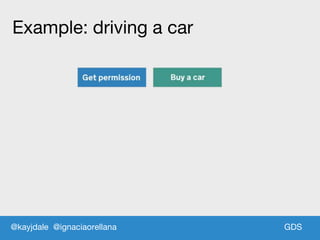
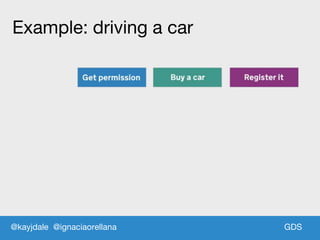
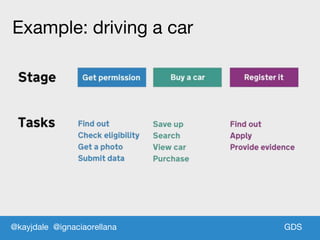
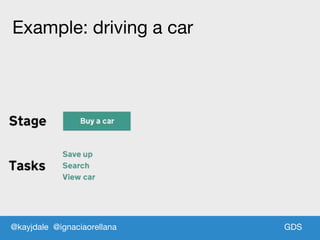
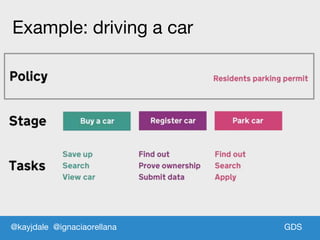
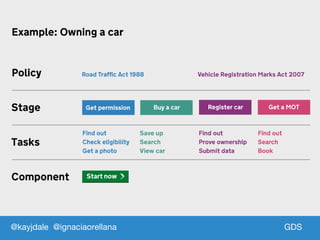
Example: driving a car
@kayjdale @ignaciaorellana
GDSGDS
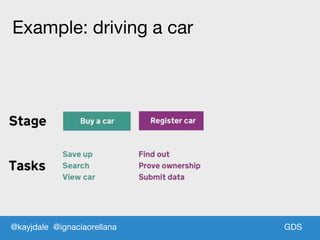
Example: driving a car
@kayjdale @ignaciaorellana
GDSGDS
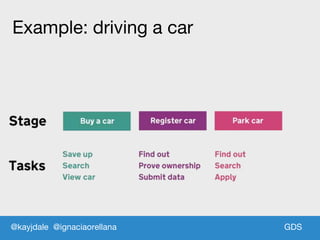
Example: driving a car
@kayjdale @ignaciaorellana
GDSGDS
Example: driving a car
@kayjdale @ignaciaorellana
GDSGDS
Example: driving a car
@kayjdale @ignaciaorellana
GDSGDS
2.
Service patterns are useful as a
way to deliver common stages of
a service
@kayjdale @ignaciaorellana
GDSGDS
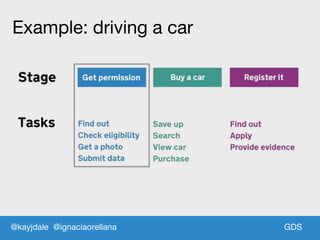
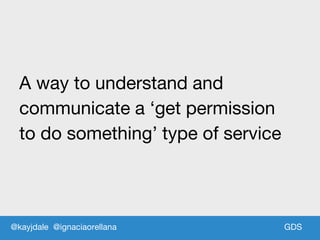
A way to understand and
communicate a ‘get permission
to do something’ type of service
@kayjdale @ignaciaorellana
GDSGDS
Example: driving a car
@kayjdale @ignaciaorellana
GDSGDS
Example: driving a car
@kayjdale @ignaciaorellana
GDSGDS
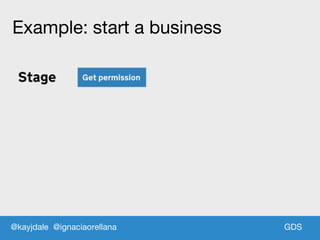
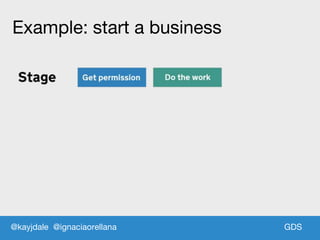
Example: start a business
@kayjdale @ignaciaorellana
GDSGDS
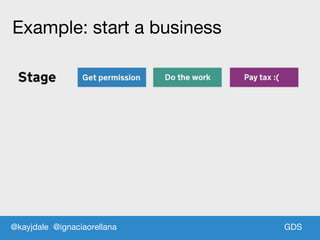
Example: start a business
@kayjdale @ignaciaorellana
GDSGDS
Example: start a business
@kayjdale @ignaciaorellana
GDSGDS
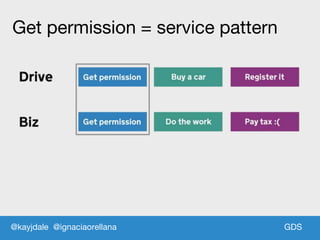
Get permission = service pattern
@kayjdale @ignaciaorellana
GDSGDS
3.
Service patterns are useful as a
way to improve policy
@kayjdale @ignaciaorellana
GDSGDS
A way to help build consensus
and find undiscovered
opportunities in policy
@kayjdale @ignaciaorellana
GDSGDS
Example: driving a car
@kayjdale @ignaciaorellana
GDSGDS
Example: driving a car
@kayjdale @ignaciaorellana
GDSGDS
Example: driving a car
@kayjdale @ignaciaorellana
GDSGDS
Example: driving a car
@kayjdale @ignaciaorellana
GDSGDS
GDS
So how we
feeling?
Activity 1
GDSGDS
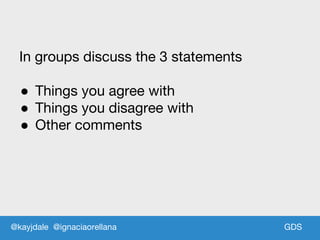
In groups discuss the 3 statements
● Things you agree with
● Things you disagree with
● Other comments
@kayjdale @ignaciaorellana
GDSGDS@kayjdale @ignaciaorellana
GDSGDS
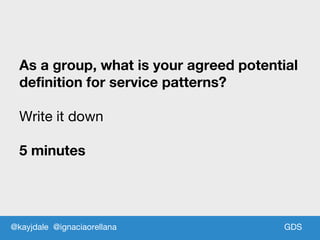
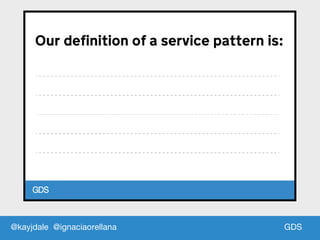
As a group, what is your agreed potential
definition for service patterns?
Write it down
5 minutes
@kayjdale @ignaciaorellana
GDSGDS@kayjdale @ignaciaorellana
GDSGDS
Finally, each team shares their
definition
@kayjdale @ignaciaorellana
GDS
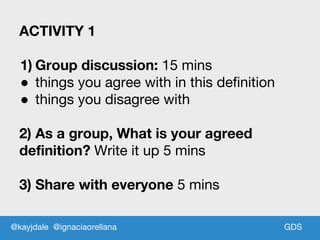
ACTIVITY 1
1) Group discussion: 15 mins
● things you agree with in this definition
● things you disagree with
2) As a group, What is your agreed
definition? Write it up 5 mins
3) Share with everyone 5 mins
@kayjdale @ignaciaorellana
Activity 2
GDSGDS
Based on the statement you
chose:
how could service patterns
be created and used in
government?
@kayjdale @ignaciaorellana
GDSGDS
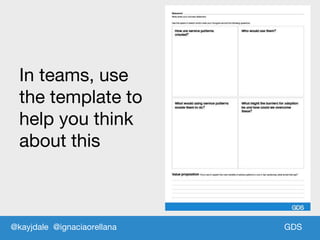
In teams, use
the template to
help you think
about this
@kayjdale @ignaciaorellana
GDSGDS
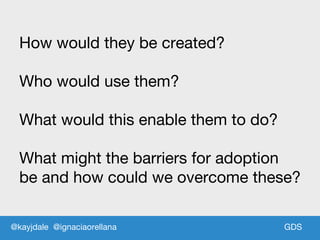
How would they be created?
Who would use them?
What would this enable them to do?
What might the barriers for adoption
be and how could we overcome these?
@kayjdale @ignaciaorellana
GDSGDS
Then, plan a 2 minute pitch
to share with the rest of the teams
Create a poster which helps you
capture the most important things
to be presented
@kayjdale @ignaciaorellana
GDSGDS
You will have:
● 20 mins to discuss and write
your thoughts using template
● 10 mins to plan your pitch and
make the poster
@kayjdale @ignaciaorellana
GDS
Pitches - 2 min pitch each
@kayjdale @ignaciaorellana
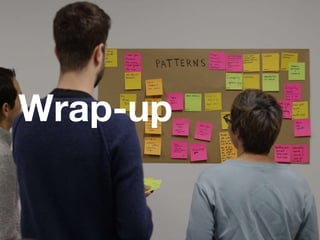
Wrap-up
GDSGDS@kayjdale @ignaciaorellana
GDS
Next steps
We will be collecting the feedback and
thoughts for today’s session and share them
as part of a blog post soon.
@kayjdale @ignaciaorellana
Interested in
getting involved or
sharing your
experiences?
Get in touch!
Thanks!
Kay Dale & Ignacia Orellana
Service designers
Government Digital Service
@kayjdale @ignaciaorellana

What are service patterns and do we need them?

Editor's Notes

  • #2 I'm Ignacia Orellana, and this is Kay Dale we’re both service designers at GDS
  • #3 and today we aim to explore what service patterns might be
  • #4 and if they can be a way to scale service design in government
  • #5 We are not experts on service patterns, we are just service designers in GDS interested in findings out more about what they might mean for scaling service design in government. We have a working hypothesis that they are a thing… but as we haven’t found a clear model yet we want to have a discussion with you today to help us build that understanding better
  • #10 Before we get into service pattern thinking, we need to lay out what we mean by ‘services’ in government
  • #11 So this can be from simple digital transactions to more complex online-offline multi channel interactions E.g: Renew my passport, or validate if a person is allowed to work in the UK
  • #12 What we mean by ‘patterns’ in government central government until now
  • #13 They are design resources (code, guidance and best practice) that help service teams build consistent and accessible services. They are user-focused and can be adapted to many different contexts
  • #14 Design patterns are like cooking recipes, they give you a starting point to approach a challenge (an omelette) but you might need to find out what works best. Like recips, design patterns are flexible and adaptable depending on the context.
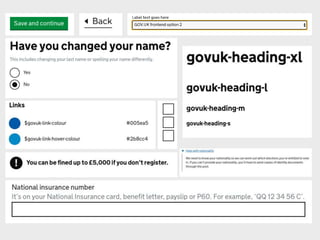
  • #16 They are made of components as ‘buttons’ or ‘back link’ and styles like ‘typography’ or ‘colour’ etc…
  • #17 which when pieced together in a particular way they create design patterns…like ‘ask users for a address’ or ‘confirmation pages’. These help designer/dev build prototypes or live services
  • #18 To set a bit of context to on why patterns became a thing in government, we need to point out that before GOV.K, there were hundreds our government websites, no design consistency and no design community to think about user needs. Making citizens journey thought government services less smooth
  • #19 In 2013 GOV.UK went live, a single place to go for government services. The need to have design patterns to have consistent user experiences became important
  • #20 We started generating patterns as best practice to approach common design problems across services and published the first ones in Service Manual and GOV.UK Elements Generated patterns from the first set of services GDS worked on. And later, published in the Service Manual Published GOV.UK Elements
  • #21 Now we have a dedicated team at GDS building a one place for design patterns to live, a cross government design system. With help and collaboration from people and pattern libraries in other departments. I will not talk about this today but if you are interested in knowing more about this work, join Tim Pauls talk on building a GOV.UK design system in the afternoon at 3:30
  • #22 Can we scale the design pattern thinking to a service level?
  • #23 Can Service patterns do for service design what interaction and content design patterns have done for user interface design? There seems to be no common language for this right now, but there is definitely work being done in the space to figure out how can we use a repeatable solution, like design patterns, to scale service design in government
  • #24 This is what’ we’ve done around service patterns until now.
  • #25 From a service pattern perspective, we found that there were 300 different ways to get permission to do a thing - such as getting permission to drive a car, or to export handbags. Finding a single implementable pattern for that was really hard because the scope was so broad.
  • #26 In 2016 we started working with 20 local authorities who all delivered parking permit services in slightly different ways to find out if there was a common way to deliver parking permits.
  • #27 and that approach kind of worked, the local authorities who participate though to the end are just in private beta so it’s hard to say for sure how successful that was as an approach because the outcome is still emerging.
  • #28 So late last year we held a similar event with the network of service designers in central government and now we are getting your thoughts. Because this is a global event, across all different kinds of government roles and we’re hopefully going to have some rich perspectives on this.
  • #29 and as a result of all of the blogs, the workshops, the case studies building up to today, we have synthesised this into three statements which could describe what service patterns are to help guide our discussion today.
  • #30 They are presented in these lovely posters and its important to note that these are not facts, they could all be true or they could be merged
  • #32 A user task is an activity performed by a user in order to create an outcome. Most services involve multiple tasks and tasks can be online or offline. Tasks aren't necessarily what users want to do, they might not be the goal as such, but they can be a protective or preventative measure put in place by government.
  • #33 So with an example of driving a car
  • #34 You might need to learn to drive first,
  • #35 You might buy a car
  • #36 The you might need to register the car as yours
  • #37 But within those stages, there will be certain tasks the user needs to do to progress.
  • #38 Which segways nicely on to another statement which is that. 2. Service patterns are useful as a way to deliver common stages of a service
  • #39 So that could be Get permission to drive Get permission to export Get permission to own a gun
  • #40 So again in the example of driving a car
  • #41 You have the get permission bit
  • #42 But then also within starting a business you also have this get permission bit
  • #43 Before you can start trading
  • #44 And pay some taxes
  • #45 So whether its permission to drive or permission to start a business. The stage of getting permission is what the service pattern is applied to
  • #48 You’ve bought the car
  • #49 You’ve registered the car
  • #50 Now you want to park the car
  • #51 So the policy surrounding that is dependant on where you live - so currently there isn’t a consistent experience for parking your car
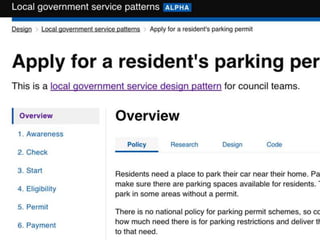
  • #52 So there was this work, which I mentioned earlier to see if those inconsistencies could be designed out. Read this blog post for more information on ‘service patterns for local governmetn’ for GOV.UK Verify https://designnotes.blog.gov.uk/2017/10/16/designing-the-first-service-patterns-for-local-government/
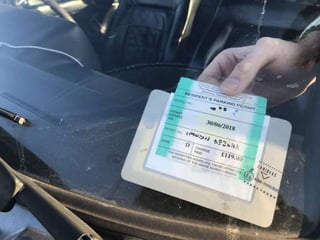
  • #53 And the contentious point was around whether or not a physical permit was a mandatory requirement. So by working collaboratively to create a common pattern for a parking permit - this team were able to challenge and clarify that grey bit of policy for many local authorities.
  • #56 We want to use the three statements we talked about as a way to guide our discussion today. Divide into 4 groups, around the set tables. We want you to have a discussion in groups about these 3 statements. Capture your thoughts using post-its as we will be sharing with the rest of the room afterwards
  • #57 You can find the posters on the wall to reference - any questions please do ask
  • #58 It could be one of them, all of them together, or you could craft your own
  • #59 For that, you have this template were you can capture that potential definition
  • #61 Recap of the activity
  • #63 Choose a prefered definition within your tables and think about how could service patterns be created and used in government?
  • #64 In your table you will find a template to help to think about this. Fill it in as a team.
  • #65 Think of these questions to facilitate this discussion
  • #66 Use the ‘Value proposition’ section in the template to help you think of that pitch. Try to explain in 2 to 3 sentences, the main benefits, the users and the potential impact. Think of it as a building a short and concise business case and try t represent this visually after using th posters.
  • #68 Share with the rest of the room your pitch using the posters.
  • #69 Today we have identified some common points around service patterns. What we have agreed on that to take this work further and have more understanding we should start a discovery phase to do research and test some of these ideas.
  • #70 This is what we think is happening with service patterns. We have the bottom layer pretty much covered (components), we can see this in design libraries and design systems. Then we have started working on spotting patterns based on user task, and stage of certain types of services. Could we start applying patterns to high level service processes, policy, and legislation? Will this be something that will change as the design culture across government evolves? In which way service patterns are more usable and reusable?
  • #71 So what’s next? We will be collecting the feedback and thoughts for today’s session and share them as part as a blog post soon. We will also be sharing a outcomes deck so you can access this information as well
  • #72 GIVE A SHOUT IF ANYONE IS INTERESTED IN WORKING WITH US, OR SHARING EXPERIENCES…. JUST GET IN TOUCH
  • #73  Here are our emails: kay.dale@digital.cabinet-office.gov.uk ignacia.orellana@digital.cabinet-office.gov.uk Or contact us by twitter or slack channel in the SDinGov