A Walk Through History
THE WESTERVILLE PUBLIC LIBRARY
LOCAL HISTORY RESOURCE CENTER NEWSLETTER
MARCH 2009


RANDALL R. ARNOLD: pIONEER, SURVEYOR,
CARPENTER AND WRITER
        Randall R. Arnold (1806-1897) was one of the pioneer leaders of the Westerville community. He
constructed the first frame house in the village, helped plat the original village, and helped bring Otter-
bein College to the community.
In his youth Arnold traveled with his family to Central Ohio and settled in Orange Township in Delaware
County. After years of helping his father create a farm from the wilderness, he moved as an adult to the
                                                             area that later became Westerville. He was a
 “R.R. Arnold wrote about the history of the                 carpenter and constructed the first frame home
Methodist Church in Westerville, the travels of in the village in 1838. He assisted in survey-
his family and pioneer life, and also wrote                  ing the village and laying out its town lots and
                                                             streets in 1839.
poetry”                                                             When the Blendon Young Men’s Semi-
                                                             nary, a Methodist school founded on land
donated by the Westervelts, failed in 1845 one of its original trustees, R. R. Arnold, was instrumental in
finding another college to replace it. Arnold was visiting a store in Columbus and overheard a conversa-
tion about the desire of the United Brethren Church to have land for a college. Arnold rushed back to
Westerville and informed fellow citizens of what he had
heard. Representatives were sent to the next meeting of the
trustees of the United Brethren Church with a proposal to of-
fer the grounds of the Blendon Young Men’s Seminary to the
church for assumption of the debt on the land and buildings.
As a result Otterbein College was opened in Westerville.
        For fifty years Randall R. Arnold served as justice of
the peace in Westerville. He assisted in settling law suits and
signing legal papers. R. R. Arnold wrote about the history of
the Methodist Church in Westerville, the travels of his family
and pioneer life, and also wrote poetry. The local newspaper
published his writings.
                                                                    Association Building at Otterbein, torn
        R. R. Arnold had 8 children but only 4 survived to
                                                                    down in 1975
adulthood. One of the tragedies of his life occurred in 1886
when a fire killed his beloved grandson, nine-year-old Harry
Evans, at the Weyant Opera House on State St. (the building that currently houses Old Bag of Nails).
Randall is buried near this grandson in the Old Pioneer Cemetery on South State Street. When R. R.
Arnold died at the age of 92 he was the oldest person living in Westerville.

                                                Page 1
Traveling to Ohio
      Randall R. Arnold was six years old when his parents decided to move
                                to Ohio. Leaving Vermont in August of
                                1812, the family encountered many hard-
                                ships. Randall, his wife Eunice, and their
                                nine children, ranging in age from one to
                                nineteen years old, traveled with a large
                                company of families making their way to
                                the new state of Ohio. R. R. Arnold de-
                                scribed it thus, “The long train of horses
                                and wagons on that beautiful morning was
an imposing sight.”
The wagon train traveled “The long train of horses and wagons on
across the state of New      that beautiful morning was an imposing
York to Buffalo and on to
Cleveland.                   sight.”
      Farmers shared
fruit from their overflow-
ing peach trees with the passing wagon train. The wagon train traveled
through the “40 mile woods” after leaving Cleveland and turning toward
Central Ohio. In the midst of the trek through the heavy forest the mem-
bers of the wagon train found a deserted log cabin and a small garden
patch whose only crop was turnips. So the group acquired the second food
treat of their long journey.
      In the “40 mile woods” the travelers faced the danger of an attack
from NativeAmericans. They chose one of their group – Joshua Prince – as
“captain” of the wagon train. He was charged with the protection of his
fellow travelers. Two soldiers who were traveling back to their homes after
serving in the army crossed paths with the wagon train and were asked to
serve as sentries as the wagons moved through this dangerous territory.
The soldiers were paid a dollar and given supper in payment for their ser-
vices.

                               page 2
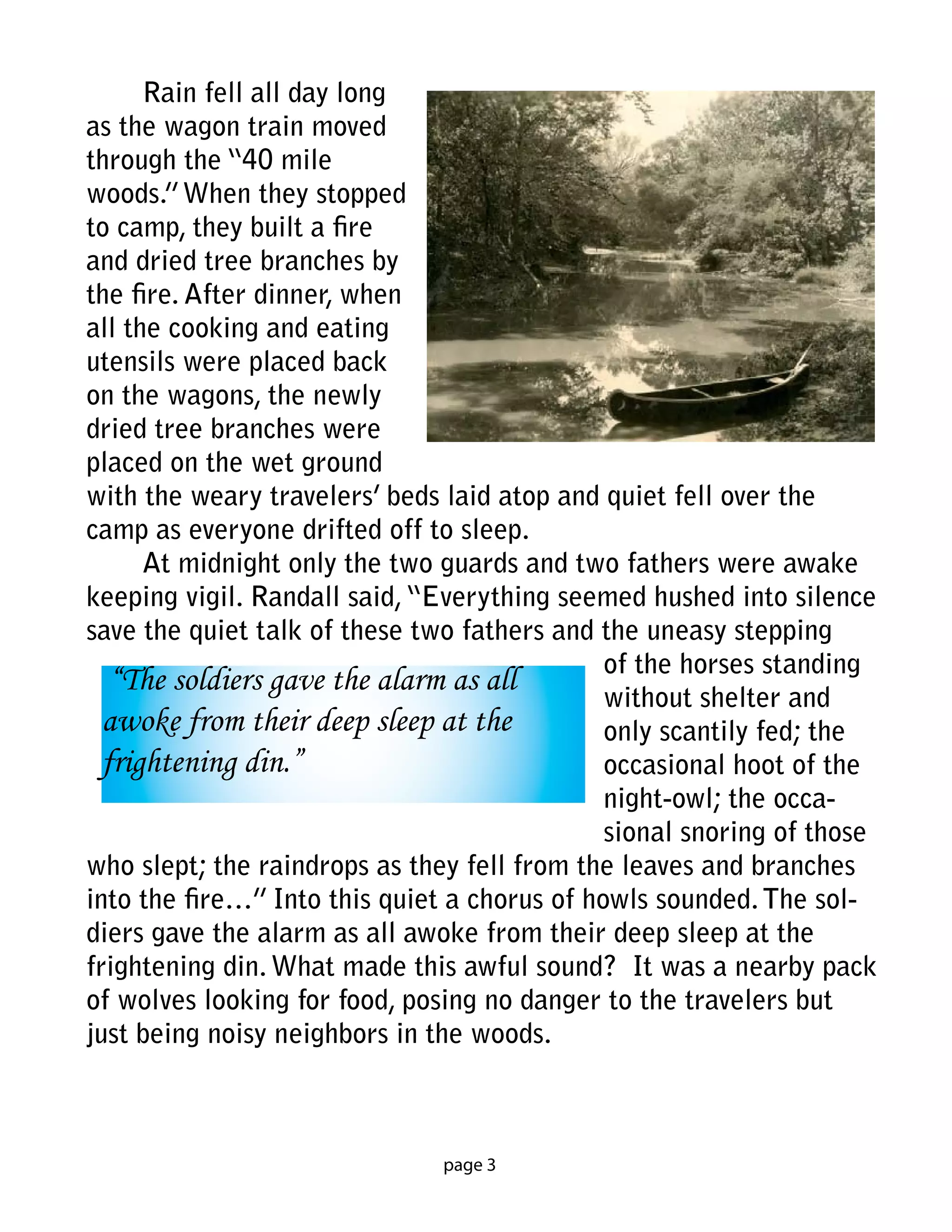
Rain fell all day long
as the wagon train moved
through the “40 mile
woods.” When they stopped
to camp, they built a fire
and dried tree branches by
the fire. After dinner, when
all the cooking and eating
utensils were placed back
on the wagons, the newly
dried tree branches were
placed on the wet ground
with the weary travelers’ beds laid atop and quiet fell over the
camp as everyone drifted off to sleep.
      At midnight only the two guards and two fathers were awake
keeping vigil. Randall said, “Everything seemed hushed into silence
save the quiet talk of these two fathers and the uneasy stepping
                                              of the horses standing
   “The soldiers gave the alarm as all
                                              without shelter and
  awoke from their deep sleep at the          only scantily fed; the
  frightening din.”                           occasional hoot of the
                                              night-owl; the occa-
                                              sional snoring of those
who slept; the raindrops as they fell from the leaves and branches
into the fire…” Into this quiet a chorus of howls sounded. The sol-
diers gave the alarm as all awoke from their deep sleep at the
frightening din. What made this awful sound? It was a nearby pack
of wolves looking for food, posing no danger to the travelers but
just being noisy neighbors in the woods.


                               page 3
a special guest

      As the travelers left the “40 mile
 woods,” two men on horseback drew near.
 Both were in military uniform and both
 were leading pack horses laden with sacks
 of food. The first man identified himself as
 General William H. Harrison. The wagon
 train halted and felt honored to be in
 the presence of such an important man.
 Randall said, “It was by an urgent and
 respectful invitation that the General al-
 lowed his horses to be held while he made
 a well-timed speech.” At the end of the

 “The wagon train halted and felt honoroed
 to be in the presence of such an important   speech and the enthusias-
 man.”                                        tic applause of those gath-
                                              ered in the woods the Gen-
                                              eral saw Randall’s mother
 sitting by her wagon looking very fatigued. He walked to her side
 and asked if he could assist her with the gift of some food. He then
 generously divided the food on his pack horse with her providing tea,
 coffee, sugar and other items. (This gracious man became the Presi-
 dent of the United States in 1840
 but served only one month before
 dying.) The encounter with the
 general was the last adventure in
 the trip, for soon the wagon train
 reached their final destination in
 Delaware County, Ohio.

                                   PAge 4

March 2009: Randall R. Arnold

  • 1.
    A Walk ThroughHistory THE WESTERVILLE PUBLIC LIBRARY LOCAL HISTORY RESOURCE CENTER NEWSLETTER MARCH 2009 RANDALL R. ARNOLD: pIONEER, SURVEYOR, CARPENTER AND WRITER Randall R. Arnold (1806-1897) was one of the pioneer leaders of the Westerville community. He constructed the first frame house in the village, helped plat the original village, and helped bring Otter- bein College to the community. In his youth Arnold traveled with his family to Central Ohio and settled in Orange Township in Delaware County. After years of helping his father create a farm from the wilderness, he moved as an adult to the area that later became Westerville. He was a “R.R. Arnold wrote about the history of the carpenter and constructed the first frame home Methodist Church in Westerville, the travels of in the village in 1838. He assisted in survey- his family and pioneer life, and also wrote ing the village and laying out its town lots and streets in 1839. poetry” When the Blendon Young Men’s Semi- nary, a Methodist school founded on land donated by the Westervelts, failed in 1845 one of its original trustees, R. R. Arnold, was instrumental in finding another college to replace it. Arnold was visiting a store in Columbus and overheard a conversa- tion about the desire of the United Brethren Church to have land for a college. Arnold rushed back to Westerville and informed fellow citizens of what he had heard. Representatives were sent to the next meeting of the trustees of the United Brethren Church with a proposal to of- fer the grounds of the Blendon Young Men’s Seminary to the church for assumption of the debt on the land and buildings. As a result Otterbein College was opened in Westerville. For fifty years Randall R. Arnold served as justice of the peace in Westerville. He assisted in settling law suits and signing legal papers. R. R. Arnold wrote about the history of the Methodist Church in Westerville, the travels of his family and pioneer life, and also wrote poetry. The local newspaper published his writings. Association Building at Otterbein, torn R. R. Arnold had 8 children but only 4 survived to down in 1975 adulthood. One of the tragedies of his life occurred in 1886 when a fire killed his beloved grandson, nine-year-old Harry Evans, at the Weyant Opera House on State St. (the building that currently houses Old Bag of Nails). Randall is buried near this grandson in the Old Pioneer Cemetery on South State Street. When R. R. Arnold died at the age of 92 he was the oldest person living in Westerville. Page 1
  • 2.
    Traveling to Ohio Randall R. Arnold was six years old when his parents decided to move to Ohio. Leaving Vermont in August of 1812, the family encountered many hard- ships. Randall, his wife Eunice, and their nine children, ranging in age from one to nineteen years old, traveled with a large company of families making their way to the new state of Ohio. R. R. Arnold de- scribed it thus, “The long train of horses and wagons on that beautiful morning was an imposing sight.” The wagon train traveled “The long train of horses and wagons on across the state of New that beautiful morning was an imposing York to Buffalo and on to Cleveland. sight.” Farmers shared fruit from their overflow- ing peach trees with the passing wagon train. The wagon train traveled through the “40 mile woods” after leaving Cleveland and turning toward Central Ohio. In the midst of the trek through the heavy forest the mem- bers of the wagon train found a deserted log cabin and a small garden patch whose only crop was turnips. So the group acquired the second food treat of their long journey. In the “40 mile woods” the travelers faced the danger of an attack from NativeAmericans. They chose one of their group – Joshua Prince – as “captain” of the wagon train. He was charged with the protection of his fellow travelers. Two soldiers who were traveling back to their homes after serving in the army crossed paths with the wagon train and were asked to serve as sentries as the wagons moved through this dangerous territory. The soldiers were paid a dollar and given supper in payment for their ser- vices. page 2
  • 3.
    Rain fell allday long as the wagon train moved through the “40 mile woods.” When they stopped to camp, they built a fire and dried tree branches by the fire. After dinner, when all the cooking and eating utensils were placed back on the wagons, the newly dried tree branches were placed on the wet ground with the weary travelers’ beds laid atop and quiet fell over the camp as everyone drifted off to sleep. At midnight only the two guards and two fathers were awake keeping vigil. Randall said, “Everything seemed hushed into silence save the quiet talk of these two fathers and the uneasy stepping of the horses standing “The soldiers gave the alarm as all without shelter and awoke from their deep sleep at the only scantily fed; the frightening din.” occasional hoot of the night-owl; the occa- sional snoring of those who slept; the raindrops as they fell from the leaves and branches into the fire…” Into this quiet a chorus of howls sounded. The sol- diers gave the alarm as all awoke from their deep sleep at the frightening din. What made this awful sound? It was a nearby pack of wolves looking for food, posing no danger to the travelers but just being noisy neighbors in the woods. page 3
  • 4.
    a special guest As the travelers left the “40 mile woods,” two men on horseback drew near. Both were in military uniform and both were leading pack horses laden with sacks of food. The first man identified himself as General William H. Harrison. The wagon train halted and felt honored to be in the presence of such an important man. Randall said, “It was by an urgent and respectful invitation that the General al- lowed his horses to be held while he made a well-timed speech.” At the end of the “The wagon train halted and felt honoroed to be in the presence of such an important speech and the enthusias- man.” tic applause of those gath- ered in the woods the Gen- eral saw Randall’s mother sitting by her wagon looking very fatigued. He walked to her side and asked if he could assist her with the gift of some food. He then generously divided the food on his pack horse with her providing tea, coffee, sugar and other items. (This gracious man became the Presi- dent of the United States in 1840 but served only one month before dying.) The encounter with the general was the last adventure in the trip, for soon the wagon train reached their final destination in Delaware County, Ohio. PAge 4