Scaling-Up HIV Treatment  Experience from Cameroon in Operational Research: Main outcomes   Sinata Koulla-Shiro MD Chief, Division Of Operations Research, Cameroon, Vice Chair, National AIDS Control Committee and Infectious Disease Service,Yaoundé Central Hospital XVII International AIDS Conference 3-8 August 2008, Mexico City
OUTLINE Background The Public Health Approach to Scaling –Up Cameroon Model of scaling-up ARV drug access Operations Research and scaling-up programme  Characterisics Main Outcomes Key challenges
Background (1/2) 2001: 1 st  UN General Assembly Special Session on HIV/AIDS(UNGASS):Targets  and member states committment 2004- 2005: Political Committment accompanied by flow of  financial ressources(Domestic, multilateral, Bilateral and Private) 2006:  UNGASS: Countries agreed toward Universal Access to Comprehensive Prevention, Care  and Support by 2010
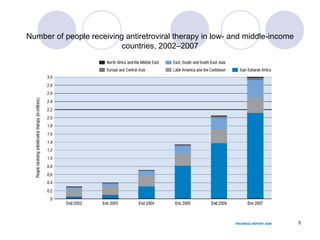
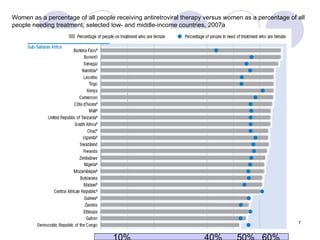
Background (2/2) 2007: Better tools led to Readjustment of figures by UNAIDS and WHO 33 million people live with HIV at global level 2.7 million people newly infected in 2007 9.7 million need treatment in low and middle income countries end 2007 (WHO,UNAIDS,UNICEFprogress report) Unprecedented Momentum of Antiretroviral Treatment in Africa 3 million received ART and >2 million in sub-saharan Africa Access equal or higher among women Adherence equal or greater than un Europe and North America
Number of people receiving antiretroviral therapy in low- and middle-income countries, 2002–2007
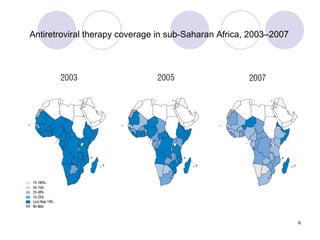
Antiretroviral therapy coverage in sub-Saharan Africa, 2003–2007
Women as a percentage of all people receiving antiretroviral therapy versus women as a percentage of all people needing treatment, selected low- and middle-income countries, 2007a 10%  40%  50%  60%
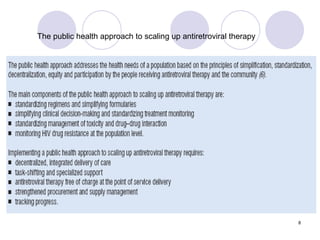
The public health approach to scaling up antiretroviral therapy
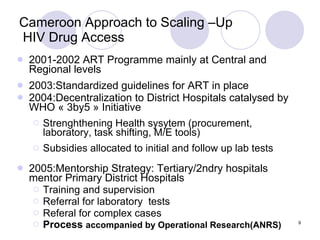
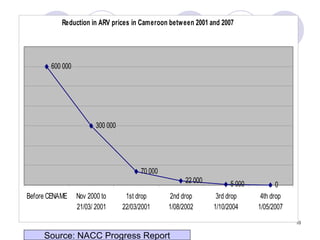
Cameroon Approach to Scaling –Up  HIV Drug Access  2001-2002 ART Programme mainly at Central and Regional levels 2003:Standardized guidelines for ART in place 2004:Decentralization to District Hospitals catalysed by WHO « 3by5 » Initiative Strenghthening Health sysytem (procurement, laboratory, task shifting, M/E tools)  Subsidies allocated to initial and follow up lab tests 2005:Mentorship Strategy: Tertiary/2ndry hospitals mentor Primary District Hospitals  Training and supervision Referral for laboratory  tests Referal for complex cases Process  accompanied by Operational Research(ANRS)
Source: NACC Progress Report
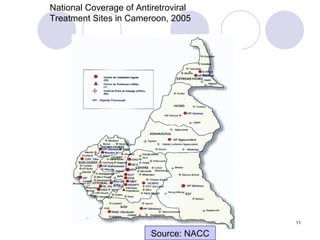
National Coverage of Antiretroviral Treatment Sites in Cameroon, 2005  Source: NACC
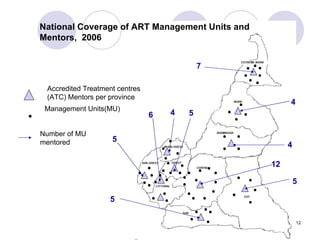
Accredited Treatment centres (ATC) Mentors per province Management Units(MU) Number of MU mentored  National Coverage of ART Management Units and Mentors,  2006 5 12 4 4 7 5 4 6 5 5
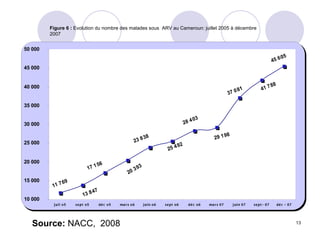
Figure 6 :  Evolution du nombre des malades sous  ARV au Cameroun: juillet 2005 à décembre 2007 Source:  NACC,  2008
 
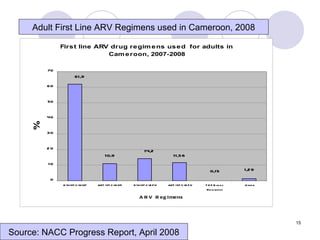
Adult First Line ARV Regimens used in Cameroon, 2008 Source: NACC Progress Report, April 2008
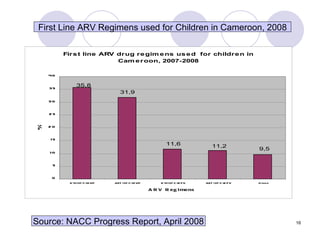
Source: NACC Progress Report, April 2008 First Line ARV Regimens used for Children in Cameroon, 2008
 
 
Components of Scaling-Up Operations Research 4 Complementary Projects ANRS 12110 trial Stratall,Charles Kouanfack ANRS 12120: Problematic of Access to Treatment: Advances, Limits and perspectives of decentralization, F. Eboko ANRS 12108: Scaling –Up and Procurement of Drugs and Biological Tools, B. Coriat/M.J Essi (Presented yesteday) ANRS 12116: Impact of Access to HIV Management and living conditions of Patients, J. P Moatti/SC Abega
The Eval  ANRS 12116 Study Primary Objective: Evaluate the quality of care of patients on ART About 3000 patients; 26 Health care Facilities;Urban and rural Variables studied Medical Effeciency: Sociobehavioral Factors  Adherence to treatment Health Related Quality of life Sociodemograhic and economic factors Cost effectiveness Equity Impact on risky behaviour:  Impact on Health System KAP
Outcome of decentralization Early outcomes better at district level : Early access to treatment HIV service performance HRQL especially mental Adherence to therapy Task shifting Positive role of associations of PLWH Patients perception in favour of decentralization Financial accessibility of HIV services remains a major barrier Other Challenges of ART scale-Up ARV drug stocks out unsafe sex common among PLWH on ART and erronous beliefs that ART efficacy prevents HIV transmission is a major determinant Unfelt impact of Community relay workers: need revisiting Health workers dissatisfied with working conditions Sustained efforts on HIV Prevention
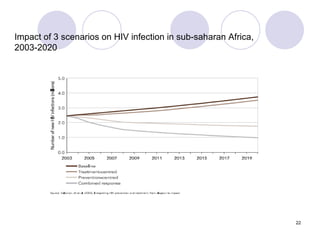
Impact of 3 scenarios on HIV infection in sub-saharan Africa, 2003-2020

Wesat2001

  • 1.
    Scaling-Up HIV Treatment Experience from Cameroon in Operational Research: Main outcomes Sinata Koulla-Shiro MD Chief, Division Of Operations Research, Cameroon, Vice Chair, National AIDS Control Committee and Infectious Disease Service,Yaoundé Central Hospital XVII International AIDS Conference 3-8 August 2008, Mexico City
  • 2.
    OUTLINE Background ThePublic Health Approach to Scaling –Up Cameroon Model of scaling-up ARV drug access Operations Research and scaling-up programme Characterisics Main Outcomes Key challenges
  • 3.
    Background (1/2) 2001:1 st UN General Assembly Special Session on HIV/AIDS(UNGASS):Targets and member states committment 2004- 2005: Political Committment accompanied by flow of financial ressources(Domestic, multilateral, Bilateral and Private) 2006: UNGASS: Countries agreed toward Universal Access to Comprehensive Prevention, Care and Support by 2010
  • 4.
    Background (2/2) 2007:Better tools led to Readjustment of figures by UNAIDS and WHO 33 million people live with HIV at global level 2.7 million people newly infected in 2007 9.7 million need treatment in low and middle income countries end 2007 (WHO,UNAIDS,UNICEFprogress report) Unprecedented Momentum of Antiretroviral Treatment in Africa 3 million received ART and >2 million in sub-saharan Africa Access equal or higher among women Adherence equal or greater than un Europe and North America
  • 5.
    Number of peoplereceiving antiretroviral therapy in low- and middle-income countries, 2002–2007
  • 6.
    Antiretroviral therapy coveragein sub-Saharan Africa, 2003–2007
  • 7.
    Women as apercentage of all people receiving antiretroviral therapy versus women as a percentage of all people needing treatment, selected low- and middle-income countries, 2007a 10% 40% 50% 60%
  • 8.
    The public healthapproach to scaling up antiretroviral therapy
  • 9.
    Cameroon Approach toScaling –Up HIV Drug Access 2001-2002 ART Programme mainly at Central and Regional levels 2003:Standardized guidelines for ART in place 2004:Decentralization to District Hospitals catalysed by WHO « 3by5 » Initiative Strenghthening Health sysytem (procurement, laboratory, task shifting, M/E tools) Subsidies allocated to initial and follow up lab tests 2005:Mentorship Strategy: Tertiary/2ndry hospitals mentor Primary District Hospitals Training and supervision Referral for laboratory tests Referal for complex cases Process accompanied by Operational Research(ANRS)
  • 10.
  • 11.
    National Coverage ofAntiretroviral Treatment Sites in Cameroon, 2005 Source: NACC
  • 12.
    Accredited Treatment centres(ATC) Mentors per province Management Units(MU) Number of MU mentored National Coverage of ART Management Units and Mentors, 2006 5 12 4 4 7 5 4 6 5 5
  • 13.
    Figure 6 : Evolution du nombre des malades sous ARV au Cameroun: juillet 2005 à décembre 2007 Source: NACC, 2008
  • 14.
  • 15.
    Adult First LineARV Regimens used in Cameroon, 2008 Source: NACC Progress Report, April 2008
  • 16.
    Source: NACC ProgressReport, April 2008 First Line ARV Regimens used for Children in Cameroon, 2008
  • 17.
  • 18.
  • 19.
    Components of Scaling-UpOperations Research 4 Complementary Projects ANRS 12110 trial Stratall,Charles Kouanfack ANRS 12120: Problematic of Access to Treatment: Advances, Limits and perspectives of decentralization, F. Eboko ANRS 12108: Scaling –Up and Procurement of Drugs and Biological Tools, B. Coriat/M.J Essi (Presented yesteday) ANRS 12116: Impact of Access to HIV Management and living conditions of Patients, J. P Moatti/SC Abega
  • 20.
    The Eval ANRS 12116 Study Primary Objective: Evaluate the quality of care of patients on ART About 3000 patients; 26 Health care Facilities;Urban and rural Variables studied Medical Effeciency: Sociobehavioral Factors Adherence to treatment Health Related Quality of life Sociodemograhic and economic factors Cost effectiveness Equity Impact on risky behaviour: Impact on Health System KAP
  • 21.
    Outcome of decentralizationEarly outcomes better at district level : Early access to treatment HIV service performance HRQL especially mental Adherence to therapy Task shifting Positive role of associations of PLWH Patients perception in favour of decentralization Financial accessibility of HIV services remains a major barrier Other Challenges of ART scale-Up ARV drug stocks out unsafe sex common among PLWH on ART and erronous beliefs that ART efficacy prevents HIV transmission is a major determinant Unfelt impact of Community relay workers: need revisiting Health workers dissatisfied with working conditions Sustained efforts on HIV Prevention
  • 22.
    Impact of 3scenarios on HIV infection in sub-saharan Africa, 2003-2020