Reading @ Work Including: Work instructions E-mails and memos Policies Reports Health and safety manuals
Document Use @ Work Icons Labels Lists Tables Forms Graphs Signs Maps Gauges Images Schedules Schematics Touch screens Technical drawings
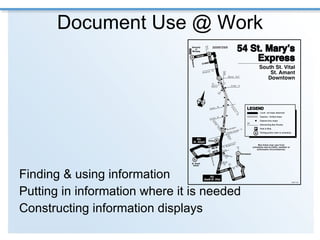
Document Use @ Work Finding & using information Putting in information where it is needed Constructing information displays
Numeracy @ Work Using numbers  and thinking mathematically to: Measure Make calculations  Estimate Work with money Analyze numerical trends Create schedules and budgets
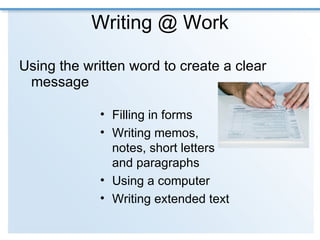
Writing @ Work Using the written word to create a clear message Filling in forms Writing memos, notes, short letters and paragraphs Using a computer Writing extended text
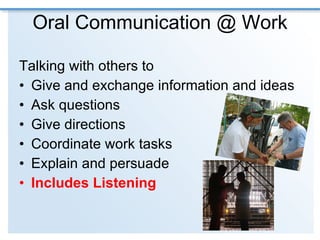
Oral Communication @ Work Talking with others to Give and exchange information and ideas Ask questions Give directions Coordinate work tasks Explain and persuade Includes Listening
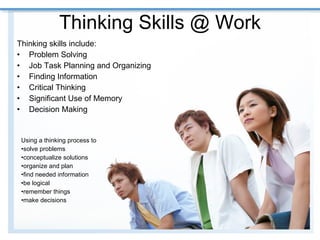
Thinking Skills @ Work Thinking skills include:  Problem Solving Job Task Planning and Organizing  Finding Information  Critical Thinking  Significant Use of Memory Decision Making  Using a thinking process to  solve problems conceptualize solutions organize and plan  find needed information  be logical  remember things  make decisions
Digital Technology @ Work Using information and communication technology
Continuous Learning @ Work Applying strategies which support workplace learning and the ability to adapt to change
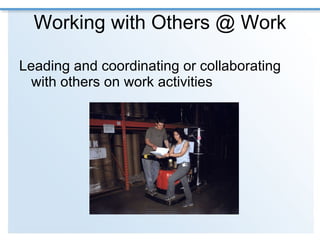
Working with Others @ Work Leading and coordinating or collaborating with others on work activities
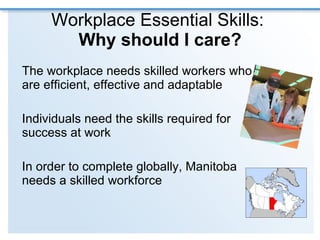
Workplace Essential Skills:  Why should I care? The workplace needs skilled workers who are efficient, effective and adaptable  Individuals need the skills required for success at work In order to complete globally, Manitoba needs a skilled workforce

Wem pm info session oct 2011 mini version

  • 1.
    Reading @ WorkIncluding: Work instructions E-mails and memos Policies Reports Health and safety manuals
  • 2.
    Document Use @Work Icons Labels Lists Tables Forms Graphs Signs Maps Gauges Images Schedules Schematics Touch screens Technical drawings
  • 3.
    Document Use @Work Finding & using information Putting in information where it is needed Constructing information displays
  • 4.
    Numeracy @ WorkUsing numbers and thinking mathematically to: Measure Make calculations Estimate Work with money Analyze numerical trends Create schedules and budgets
  • 5.
    Writing @ WorkUsing the written word to create a clear message Filling in forms Writing memos, notes, short letters and paragraphs Using a computer Writing extended text
  • 6.
    Oral Communication @Work Talking with others to Give and exchange information and ideas Ask questions Give directions Coordinate work tasks Explain and persuade Includes Listening
  • 7.
    Thinking Skills @Work Thinking skills include: Problem Solving Job Task Planning and Organizing Finding Information Critical Thinking Significant Use of Memory Decision Making Using a thinking process to solve problems conceptualize solutions organize and plan find needed information be logical remember things make decisions
  • 8.
    Digital Technology @Work Using information and communication technology
  • 9.
    Continuous Learning @Work Applying strategies which support workplace learning and the ability to adapt to change
  • 10.
    Working with Others@ Work Leading and coordinating or collaborating with others on work activities
  • 11.
    Workplace Essential Skills: Why should I care? The workplace needs skilled workers who are efficient, effective and adaptable Individuals need the skills required for success at work In order to complete globally, Manitoba needs a skilled workforce