Cross-Cultural Research
2015, Vol. 49(2) 174­
–203
© 2014 SAGE Publications
Reprints and permissions:
sagepub.com/journalsPermissions.nav
DOI: 10.1177/1069397114539268
ccr.sagepub.com
Article
Variation and Persistence
in Latin American Beliefs
About Evil Eye
Susan C. Weller1, Roberta D. Baer2, Javier
Garcia de Alba Garcia3,6, Mark Glazer4, Robert
Trotter II5, Ana L. Salcedo Rocha3,6, Robert E.
Klein7, and Lee M. Pachter8
Abstract
In a comparative study of evil eye (mal de ojo), we demonstrate a methodology
appropriate for the study of cultural transmission of beliefs. We studied
four diverse populations with historical links to Spain: Puerto Ricans in
Connecticut, Mexican Americans in south Texas, Mexicans in Guadalajara,
and rural Guatemalans. Using agreement on ideas or themes about evil eye
within and across sites, we identify specific ideas that may have persisted
through time. The relevance of specific themes was estimated with a cultural
consensus analysis. Mal de ojo was widely recognized in each community
and higher community prevalence was associated with higher agreement
on reported causes, symptoms, and treatments. Each community exhibited
a distinct model for ojo, although models were highly similar between sites.
1University of Texas Medical Branch, Galveston, USA
2University of South Florida, Tampa, USA
3Instituto Mexicano del Seguro Social, Guadalajara, Mexico
4University of Texas, Edinburg, USA
5University of Northern Arizona, Flagstaff, USA
6Universidad de Guadalajara, Mexico
7Medical Entomology Research and Training Unit, Guatemala City, Guatemala
8Drexel University, Philadelphia, PA, USA
Corresponding Author:
Susan C. Weller, Department of Preventive Medicine & Community Health, and Director,
Research Program, Department of Family Medicine, University of Texas Medical Branch,
Galveston, TX 77555-1153, USA.
Email: sweller@utmb.edu
539268CCRXXX10.1177/1069397114539268Cross-Cultural ResearchWeller et al.
research-article2014
at University of Birmingham on June 14, 2015
ccr.sagepub.com
Downloaded from
Weller et al.	 175
Agreement among individuals and across communities suggests a pan-
regional description for mal de ojo and possible content of older versions of
these beliefs in Latin America.
Keywords
evil eye, mal de ojo, Latin America/Latino, consensus model, age–area
hypothesis
Introduction
The diffusion of culture—material and non-material—has been a focus of
research in three of the four disciplines in our field (archeology, linguistics,
and cultural anthropology). This study demonstrates a methodology appropri-
ate for the study of cultural transmission of beliefs, an aspect of non-material
culture. Here, we describe a comparative study of a single culture pattern, evil
eye (mal de ojo or ojo), across four populations with historical links to 16th-
century Spain. Beliefs about evil eye were most likely brought to Latin
America by Spanish settlers and handed down within families and communi-
ties for centuries. Using contemporary data, we focus on consistency within
and across regions to make inferences about the content of evil eye beliefs that
may have persisted through time. We identify relevant thematic content in
contemporary descriptions, and use agreement across people and regions to
identify shared ideas that may have been part of older beliefs about mal de ojo.
Evil eye, believed to be caused by greed or envy, is a cultural phenomenon
that is widespread across Indo-European and Semitic-derived cultures (Dundes,
1981; Levy & Zumwalt, 2002; Maloney, 1976). The basic concept is that one
can cause harm to another, either intentionally or unintentionally, by expressing
or thinking about praise or jealousy. In a detailed global study, Roberts (1976)
suggested that evil eye may have developed in India or in the Near East and
Europe and may be thousands of years old. Cultural transmission through
migration and diffusion is thought to be responsible for the occurrence of the
evil eye culture pattern around the world. Beliefs about evil eye were common
in 16th-century Spain (archival sources contain descriptions of cases of evil
eye; de Castañega, 1946), and were probably brought to Spain by the Moors.
Beliefs about evil eye were then most likely exported from Spain to Latin
America (Foster, 1953) as the Spanish colonized the New World.
In contemporary Latin American populations, evil eye continues to be
widely recognized. Mexican Americans in the southwestern United States
believe mal de ojo is caused by the glances or power of stronger persons act-
ing on a weaker person, particularly a child (Schreiber & Homiak, 1981;
Trotter, 2005; Trotter & Chavira, 1997). As with other Latin American folk
at University of Birmingham on June 14, 2015
ccr.sagepub.com
Downloaded from
176	 Cross-Cultural Research 49(2)
illnesses, mal de ojo has a social dimension and can be caused by someone
who has been more familiar than social and cultural norms permit (Rubel,
1960). Symptoms include severe headaches, high fever, fretfulness, and in
the case of children, weeping (Rubel, 1960). Treatments often attempt to find
the person responsible to break the “spell.” If this is not possible, a cure is
attempted using an egg rubbed over the patient’s body, along with prayer
(Rubel, 1960). The egg is put into a glass of water and placed under the bed
of the affected person to drain off the disturbing power. Ojo is not considered
fatal, although if not treated or treated incorrectly, it may develop into ojo
pasado (characterized by vomiting and severe coughing), which can be fatal
(Rubel, 1960).
Similar descriptions are obtained from contemporary indigenous and non-
indigenous Latin Americans. Zapotecs (Sault, 1990) and Tarascans (Garro,
2000) in Mexico and the indigenous populations in Patzun (Mendez
Dominguez, 1983) and Santa Maria de Jesus, Sacatepequez (Burleigh,
Dardano, & Cruz, 1990) in Guatemala report mal de ojo. Mal de ojo is also
recognized by non-indigenous populations in rural (Weller, 1983) and urban
Guatemala (Solien de Gonzalez, 1964). Among Puerto Ricans, belief in mal
de ojo is reported to be widespread and is the diagnosis used for a range of
childhood symptoms that appear with a sudden onset (Harwood, 1981). More
recently, beliefs in mal de ojo were reported by Central American immigrants
in Washington, D.C. (Murguia, Peterson, & Zea, 2003).
This study describes intra- and inter-cultural variation in contemporary
beliefs about evil eye. First, we aim to describe the “culture pattern” (Kroeber,
1948) within contemporary Latino populations, where pattern refers to the set
of related ideas or behaviors about evil eye, a complex of cultural material
that acts as a coherent unit or system (Chick, 2002; Roberts, Strand, &
Burmeister, 1974; Romney & Moore, 1999, 2001). We use an “explanatory
model” framework, which focuses on causes, symptoms, and treatments of
illnesses (Kleinman, Eisenberg, & Good, 1978) and collected descriptions of
causes, who is at risk, symptoms, and treatments for evil eye. We then exam-
ine patterns of within-community variation to see if there is consistency
across individual descriptions of evil eye. We also examine whether commu-
nity prevalence of evil eye is related to consistency and detail in the
descriptions.
Second, we aim to identify possible longstanding core elements or themes
in community culture patterns concerning evil eye. Elements in the evil eye
belief system that are shared across regions may reflect older beliefs. More
than 80 years ago, Wissler (1927, 1928) presented the age–area concept as a
device for inferring time sequences from geographic distribution of related
culture traits throughout a culture area (Kroeber, 1931). In this formulation,
at University of Birmingham on June 14, 2015
ccr.sagepub.com
Downloaded from
Weller et al.	 177
the “center” of a culture area radiates cultural content to surrounding areas,
which then radiates the content to more peripheral areas. Meanwhile, the
center may change its content, but older forms may be evident in peripheral
areas. For example, the distribution of pottery styles in the southwestern
United States matched stratigraphic evidence for age (Wissler, in Freed &
Freed 1983). The more widely distributed elements within a culture area were
the older elements; and the oldest versions of culture patterns appeared on the
periphery of a culture area. Elements of a culture pattern may be dropped or
added through time, but elements shared across a wide geographical region
would reflect the older, original pattern. Here, we focus on the flow of evil
eye beliefs from Spain to the New World and assume that shared features in
the widely dispersed explanatory models of mal de ojo may be some of the
older features.
The contributions of Wissler were criticized and largely ignored in anthro-
pology (Freed & Freed, 1983). Critiques of his approach have included
examples where the age–area concept did not hold and examples where
Wissler had over-stated the geographical–age relationship present in cultural
data (Dixon, discussed in Kroeber, 1931). Kroeber notes, however, that the
age–area relationship is limited to the distribution of related traits and does
not hold for inferences regarding the relative age of unrelated culture traits
(e.g., mud-brick dwellings and bronze use). Also, the distribution of culture
traits may not follow a predictable pattern of spread or diffusion from a cul-
ture “center” as Wissler suggested, but age–area inferences are supported
within a historical context and geographic area (Kroeber, 1931).
Despite criticism, the age–area hypothesis and the idea of culture areas
may still be useful for conceptualizing the flow of cultural ideas across space
and time. Bashkow (2004) recently argued that the idea of culture areas may
be useful for describing areas of cultural concentration with isobars of
increasing and decreasing cultural influence. “Boundaries” of such areas are
permeable and open to the flow of ideas and influence and are not synony-
mous with national–political boundaries. Urban (2010) also recently
described the “motion,” the waxing and waning of salience, and exposure
across time, of specific culture patterns (songs and the importation of French
words into English), as empirical evidence of the changing nature of culture
patterns and their influence.
The age–area hypothesis continues to be of use in reconstructing historical
relations in the study of cultigens and anthropological linguistics. The histori-
cal pathways of bananas in Africa were re-interpreted using linguistic regu-
larities in the distribution of words for bananas to conclude that bananas were
most likely introduced on the Western coast of Africa (not the East) along
with yams and other foods in the “tropical tool kit” proposed by Murdock
at University of Birmingham on June 14, 2015
ccr.sagepub.com
Downloaded from
178	 Cross-Cultural Research 49(2)
(Blench, 2009). Similarly, the distribution of linguistic forms for the word for
cacao throughout Latin America suggests that the change in economic impor-
tance of cacao associated with the Jesuits resulted in the importation of a new
term for cacao in Ka’apor language spoken in the Gurupi and Turiaqu river
basins in eastern Amazonia, Brazil (Balée, 2003).
The study of cultural values among immigrants also illustrates the disper-
sion of older aspects of culture. Oscar Handlin’s (1973) study of immigrants
to the United States describes “old world” (European) values and how immi-
grants conserve elements of their cultures, such as religion. The immigrants
held onto their old ways because they resided in ghettos and were alienated
from mainstream society. Identity and alienation may be related to mainte-
nance of older culture patterns. Meanwhile, the old-world cultures from
which the immigrants came (the Irish, the Jews, the Italians, the Poles, etc.)
evolved, as all cultures do. This process would predict that earlier cultural
features would be preserved in immigrant communities.
We feel that the age–area hypothesis may deserve new consideration and
explore its relevance with regard to regional variation and historical elements
in beliefs about evil eye. This article describes the contemporary set of beliefs
or themes about evil eye in each of four Latino communities and identifies
thematic elements in those community culture patterns that are shared across
regions and thus may have persisted over time. As there are no systematic
data on evil eye from 16th-century Spain, we rely on assumptions and tech-
niques from historical linguistics and theories regarding the distribution of
culture traits to attempt to estimate older beliefs. Similarly, Swadesh (1950)
estimated a proto-Salishan vocabulary from the percent of shared vocabulary
between Salishan languages based only on synchronous information (see also
Kronenfeld & Thomas, 1983; Weller & Buchholtz, 1986). Here, we attempt
a similar reconstruction based on the sharing of descriptive themes across
populations and draw on the age–area hypothesis and linguistic methods. We
acknowledge the limitations of such inferences, due to the possibility that
evil eye features can be added or dropped over time in each of the popula-
tions. We also examine whether descriptions from geographically closer
samples or samples with the strongest historical link (e.g., Mexico and
Mexican Americans in Texas) have the highest similarity in the content of
their explanatory models (Dow & Eff, 2008; Naroll, 1961).
Method
Setting
We studied four populations to sample the diversity in beliefs within and
across Latino communities. The localities include Puerto Ricans in a small
at University of Birmingham on June 14, 2015
ccr.sagepub.com
Downloaded from
Weller et al.	 179
city in Connecticut, Mexicans and Mexican Americans in a small town in
Texas on the Mexican border, Mexicans in a large city in central Mexico, and
Guatemalans living in small rural villages on the Pacific Coast of Guatemala.
These sites differ in the prevalence of specific diseases and access to care.
Health care in the United States and other developed nations focuses more on
chronic diseases. Puerto Rico and Mexico have made the demographic transi-
tion to greater longevity and now also struggle with chronic diseases, whereas
infectious diseases are primary health issues in Guatemala. Mexico has a
nationally organized health care system that provides heath services to many
workers, whereas the United States and Puerto Rico do not. Access to care in
rural Guatemala is a function of the distance to government health post and/
or pharmacy, and in this case, it is more than a half hour by dirt road. The sites
represent a great diversity in social and political histories as well as health
contexts and challenges and have the potential to maximize differences in
beliefs and practices concerning mal de ojo.
Each of the populations derive part of their current culture and religious
traditions from those of Spain. In Puerto Rico, indigenous cultures largely did
not survive the immediate conquest period. Immigration from Spain, as well
as populations originally brought as slaves from Africa, resulted in the pres-
ent population, which is a mix of Spanish andAfrican influences. Puerto Rico
became a possession of the United States in 1989, and residents became U.S.
citizens in 1917. Large-scale migration to the United States mainland began
after World War II, initially to New York City, and later to smaller cities in the
northeast (Harwood, 1981). Guatemalan indigenous groups strongly resisted
the Spanish colonizers, as well as later attempts on the part of the Guatemalan
government to integrate them into national life. Although many aspects of
their current culture derive from those of Spain, these are built over strong
and enduring pre-Columbian Mayan traditions. Areas of west Mexico, the
site of contemporary Guadalajara, were somewhat separate from the more
well-known pre-Columbian cultures of the Valley of Mexico, such as the
Aztecs. Nevertheless, in contemporary Jalisco, most cultural patterns follow
those of larger Mexican mestizo culture; however, the political separation/
orientation somewhat apart from that of central Mexico has persisted.
Mexican American cultures in the contemporary southwest of the United
States derive from a variety of influences and periods of migration from
Mexico. In Texas, the original settlements were established by those who
accompanied the original explorers of the area. The area became part of the
United States in 1845, following the Mexican American War. Migration from
northern Mexico to areas in what is now Texas has continued over the period
since then. The culture of this area combines that of Mexico with strong
influences from the culture of Texas, as well as that of the mainstream United
States.
at University of Birmingham on June 14, 2015
ccr.sagepub.com
Downloaded from
180	 Cross-Cultural Research 49(2)
We selected the communities for study based on the long-term research
and participant observation by one or more of the authors at each site and
then selected people for interviewing from the community at-large. In rural
Guatemala on the Pacific Coastal Plain, in the Department of Esquintla, four
small rural communities (with a population of 500) were selected. Residents
are Spanish-speakers of mixed European–Mayan Indian descent and support
themselves with wage labor on sugar cane and cotton plantations. In Mexico,
Guadalajara (metropolitan area population 3.7 million, 2000) was selected. It
is the second largest city in Mexico and is a modern industrial city. Residents
of Guadalajara come from both rural and urban backgrounds and are pre-
dominately Spanish-speakers of mixed ancestry. In the United States,
Edinburg (2000 population 48,465), Texas, was selected because it is located
on the Mexican border in the Lower Rio Grande Valley and is predominately
Mexican American. The region is agricultural and includes one of the three
poorest Standard Metropolitan Statistical Areas in the United States. Hartford
(2000 population 121,578), Connecticut, in the Northeast United States was
selected because approximately one third of the population is Puerto Rican.
It is a medium-sized industrial and commercial center.
Development of Interview Materials
To understand local beliefs about ojo, a two-step process was used. First,
open-ended interviews collected descriptions of evil eye and second, the
responses to those interviews were used to design a structured interview to
facilitate comparisons across people and sites. The initial phase of interviews
elicited salient ideas, descriptions, and themes relevant to mal de ojo to cap-
ture the breadth of individual descriptions in each community. To do this,
descriptive and free-listing interviews were conducted with 15 to 21 people
at each site. These interviews collected ideas about who is susceptible to ojo
and possible causes, symptoms, and treatments. We use “theme” to refer to
the ideas, descriptions, and features associated with evil eye. Themes men-
tioned by at least 10% of people at each site appear in Table 1 (the number of
people mentioning each theme appears to the left of each theme).
Then, in a second phase of interviews, a structured interview was designed
so that people at each site could be asked about all themes, allowing for
detailed comparisons across people and sites. The structured interview
included all themes in Table 1 (regardless of which site generated the theme),
as well as themes from published descriptions of Latin American folk ill-
nesses and a range of bodily symptoms (adapted from the Cornell Medical
Index by Brodman, Erdmann, & Wolff, 1949; Finkler, 1981). We also sought
feedback from experts in the field about content.1 The final interview con-
sisted of 128 questions about evil eye: 43 questions on causes and
at University of Birmingham on June 14, 2015
ccr.sagepub.com
Downloaded from
Weller et al.	 181
Table 1.  Mal de ojo Themes Mentioned in Open-ended Interviews.
Who is susceptible Causes Symptoms Treatments
Esquintla, Guatemala (n = 20)
  12 infants
  7 young children
 
6 those with weak
blood
4 from a strong
stare
8 people with strong
blood
14 drunken men
6 pregnant women
7 menstruating
women
6 sweaty people
18 crying alot
17 fever
8 restlessness
8 diarrhea
5 boils
4 hot head
3 vomiting
2 headache
2 limp neck
2 bad smelling head
20 passing an egg over
the body
14 with herbs
12 liquor and a cigar
8 allspice
7 rubbing alcohol
17 cure at home
8 midwife-healer
5 older women
16 can die without
treatment
Guadalajara, Mexico (n = 21)
21 children 9 a strong stare
3 a handsome child
2 jealousy
13 vomiting
11 diarrhea
8 weepy eyes that
do not stop
6 eye problems
6 fever
4 nervous and sad
2 headache
9 with an egg
4 doctor or medicine
3 massage
2 spearmint or herbal
tea
2 prayers
Edinburg, Texas (n = 20)
8 everyone
7 Hispanics,
Mexicans
6 those who believe
in it
4 some who stands
out
2 adults
2 animals
15 staring when you
attract attention
for prettiness/
ugliness
5 envy, jealousy,
anger
5 person who gives
ojo has very strong
eyes
15 headaches
14 fever
6 body aches
4 stomach ache
4 nausea
4 weight loss/loss of
appetite
3 babies cry
3 red eyes, watery
eyes
3 vomiting
3 tired weak
20 sweep with
egg/Barrida
14 can not prevent it
7 person who
complimented you
must touch you
6 prevent it with ojo de
venado
3 sweep with special
herbs
2 prayer
Hartford, Connecticut (n = 15)
10 children
(defenseless)
8 babies
(defenseless)
2 newborns
4 adult places curse
on baby
3 saying a baby is
beautiful without
saying God Bless
You
2 ill-meaning envious
person
7 loss of appetite
5 gets very sick
4 crying
4 child does not get
better when you
visit doctor
3 fever
3 diarrhea
2 vomiting
2 will not be active
7 go to someone who
can drive out curse
6 rub baby’s body
with oil and different
herbs; say prayers
to drive curse out of
baby’s body
Note. The number of people mentioning each theme appears to the left of each theme.
at University of Birmingham on June 14, 2015
ccr.sagepub.com
Downloaded from
182	 Cross-Cultural Research 49(2)
susceptibility, 41 possible symptoms, and 44 questions on treatments and
healers. We attempted to balance the number of positive and negative ques-
tions. Additional questions covered socio-demographic characteristics and
enquired about personal experience with evil eye to determine community
lifetime prevalence of ojo. Interview materials were translated into the
Spanish dialect appropriate for each site and English.
Procedure
To validate impressions from the initial open-ended interviews and gain a
more representative picture of ojo beliefs in each community, the structured
interview was conducted with a larger, more representative community sam-
ple at each site. A multistage random sampling strategy was used, where first
a village, neighborhood, or census tract was selected, and then blocks and
households. In Hartford, two census tracts with the highest concentration of
Puerto Ricans were used, and blocks and households were randomly selected
from within those tracts. In Edinburg, census tracts were used to sample
blocks and then households. In Guadalajara, three neighborhoods were
selected that represented middle, working, and poor socioeconomic classes.
Then, blocks were randomly chosen within each neighborhood and a house-
hold randomly selected from each block. In rural Esquintla, four villages
were selected and an equal number of households selected from each village,
from the center of the villages to the periphery (to capture economic varia-
tion). A target or quota sample size of 40 (41 in Texas) was designated for
each site.
Local interviewers conducted the interviews in the language preferred by
the respondent (English, Spanish, or a combination). Only adults who heard
of the illness and believed that it existed were invited to participate.
Respondents had to self-identify as Mexican, Mexican American, or Chicano
in Texas, or as Puerto Rican in Connecticut. Assuming that women had more
responsibility for health, especially children’s health, the preferred respon-
dent was the female head of household. Data collection was carried out in the
mid-1990s.
Analysis
A cultural consensus analysis was used to determine the degree of consis-
tency in individual responses to the 128 questions and to identify beliefs
about ojo shared within each community. This approach provided informa-
tion on the likelihood that beliefs were shared among community members
and identified the more salient descriptors concerning ojo within each
at University of Birmingham on June 14, 2015
ccr.sagepub.com
Downloaded from
Weller et al.	 183
community sample. Although the majority answer to each question can be
used to estimate beliefs (D’Andrade, 1987), moderate agreement among
respondents is a prerequisite to a meaningful aggregation of responses.
Cultural consensus analysis (Batchelder  Romney, 1988; Romney, Weller,
 Batchelder, 1986; Weller, 2007) can be used to determine whether or not
responses are sufficiently homogeneous to describe responses as a single
belief system and to estimate the culturally correct answers to questions.
Knowledge is not assumed to be uniformly and universally shared, but when
there is high agreement or consistency across participants, responses can be
described with a single set of answers. The consensus model provides an
estimate of the culturally preferred answer to each question and a probability
value indicating the degree of confidence in each answer. The model also
estimates the degree to which each person knows (cultural competence or
cultural knowledge scores) or shares the group normative beliefs (the set of
culturally preferred answers). Cultural knowledge scores range from 0 to 1
and are also expressed as percentages, where higher scores indicate greater
knowledge or correspondence with group beliefs.
When using the cultural consensus model, a few parameters must be spec-
ified. For this analysis, the covariance method was used to measure the simi-
larity between individual response profiles because it is less sensitive to
response bias (Batchelder  Romney, 1988; Weller  Mann, 1997). Also, a
conservative level of confidence was used to classify the answers. Cultural
consensus models were estimated separately for each community and also for
all four communities together. A confidence level (Bayesian posteriori prob-
ability level) of .99 was used to classify answers for each sample (n = 40)
and .999 was used for all samples together (n = 160).
Comparisons between communities were made based on the relevance of
each theme for each community. A cultural consensus analysis estimated the
likelihood that each of the 128 themes was relevant for each community.
Themes also were classified by the percent of respondents that endorsed each
answer: (1) themes with a strong majority, consistently reported by commu-
nity members (66% or more reported the theme as relevant); (2) those judged
by some respondents to be part of the explanatory model and judged by oth-
ers to be absent (34%-65% reported the theme); and (3) those consistently
judged as absent with a strong negative majority (0%-33% reported the
theme). Thus, themes in the explanatory models were considered as two
(present/absent) or three categories (continuum). Similarity between com-
munities was estimated for dichotomous models with Yule’s Q (equivalent to
Goodman and Kruskal’s gamma; the odds ratio expressed as a −1.0 to +1.0
correlation) and a simple count of matching themes. For the three category
continuum, Goodman and Kruskal’s gamma (an ordinal correlation
at University of Birmingham on June 14, 2015
ccr.sagepub.com
Downloaded from
184	 Cross-Cultural Research 49(2)
coefficient, ranging from 0.0 no association to 1.0 perfect monotonic associa-
tion) compared the relative presence of themes between samples.
Results
In total, 236 people were interviewed. In the first phase, open-ended inter-
views with 76 people (15-21 from each locality) elicited descriptions of
causes, symptoms, treatments, and so on for mal de ojo. Then, in the second
phase of interviewing, 160 people who had heard of ojo and believed in it,
were interviewed (approximately 40 per site) with the structured interview.
Detailed comparisons within and across sites are based on the structured
interviews. Women were approximately 40 years of age in each sample,
although samples differed in average educational level (p  .05) and house-
hold size (p  .05). (Sample characteristics appear in Table 2.) In the Texas
sample, 76% were born in the United States; 32% of interviews were com-
pleted in Spanish, 46% in a combination of Spanish–English, and 22% in
English. In Connecticut, 5% were born in mainland United States and 88%
were interviewed in Spanish.
The Culture Pattern of Evil Eye Within Each Region
Mal de ojo was widely recognized in each community. Almost everyone in
the samples knew someone who had experienced ojo and many had experi-
enced it in their own family (Table 2). Among those approached for inter-
views in Mexico, belief in ojo varied by neighborhood social class (89%
lower class, 70% working class, and 40% middle class). The lifetime preva-
lence of mal de ojo in each community was 56% in Texas, 30% in Guatemala,
15% in Connecticut, and 13% in Mexico.2
Table 2.  Sample Description.
Guatemala
(n = 38) Mexico (n = 39) Texas (n = 41)
Connecticut
(n = 42)
Age 34.5 (18-65) 38.5 (18-69) 41.6 (19-68) 42.7 (18-82)
Education 1.6 (0-6) 6.4 (0-16) 8.7 (0-16) 8.9 (2-15)
Household size 5.3 (2-13) 5.8 (1-20) 4.1 (2-9) 3.5 (1-8)
Total children 5.1 (1-15) 4.3 (0-17) 3.6 (1-11) 4.1 (0-13)
Ojo experience
  Has known someone 97% 87% 100% 81%
  Someone in family 97% 69%  90% 48%
  Has had it personally 32% 21%  61% 17%
at University of Birmingham on June 14, 2015
ccr.sagepub.com
Downloaded from
Weller et al.	 185
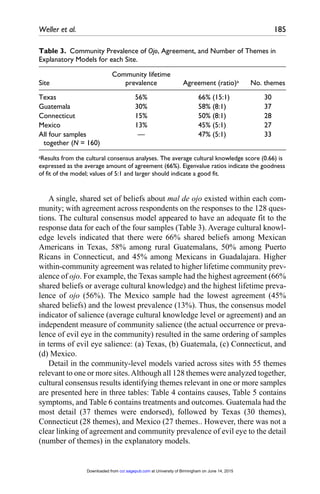
A single, shared set of beliefs about mal de ojo existed within each com-
munity; with agreement across respondents on the responses to the 128 ques-
tions. The cultural consensus model appeared to have an adequate fit to the
response data for each of the four samples (Table 3). Average cultural knowl-
edge levels indicated that there were 66% shared beliefs among Mexican
Americans in Texas, 58% among rural Guatemalans, 50% among Puerto
Ricans in Connecticut, and 45% among Mexicans in Guadalajara. Higher
within-community agreement was related to higher lifetime community prev-
alence of ojo. For example, the Texas sample had the highest agreement (66%
shared beliefs or average cultural knowledge) and the highest lifetime preva-
lence of ojo (56%). The Mexico sample had the lowest agreement (45%
shared beliefs) and the lowest prevalence (13%). Thus, the consensus model
indicator of salience (average cultural knowledge level or agreement) and an
independent measure of community salience (the actual occurrence or preva-
lence of evil eye in the community) resulted in the same ordering of samples
in terms of evil eye salience: (a) Texas, (b) Guatemala, (c) Connecticut, and
(d) Mexico.
Detail in the community-level models varied across sites with 55 themes
relevant to one or more sites.Although all 128 themes were analyzed together,
cultural consensus results identifying themes relevant in one or more samples
are presented here in three tables: Table 4 contains causes, Table 5 contains
symptoms, and Table 6 contains treatments and outcomes. Guatemala had the
most detail (37 themes were endorsed), followed by Texas (30 themes),
Connecticut (28 themes), and Mexico (27 themes.. However, there was not a
clear linking of agreement and community prevalence of evil eye to the detail
(number of themes) in the explanatory models.
Table 3.  Community Prevalence of Ojo, Agreement, and Number of Themes in
Explanatory Models for each Site.
Site
Community lifetime
prevalence Agreement (ratio)a No. themes
Texas 56% 66% (15:1) 30
Guatemala 30% 58% (8:1) 37
Connecticut 15% 50% (8:1) 28
Mexico 13% 45% (5:1) 27
All four samples
together (N = 160)
— 47% (5:1) 33
aResults from the cultural consensus analyses. The average cultural knowledge score (0.66) is
expressed as the average amount of agreement (66%). Eigenvalue ratios indicate the goodness
of fit of the model; values of 5:1 and larger should indicate a good fit.
at University of Birmingham on June 14, 2015
ccr.sagepub.com
Downloaded from
186	 Cross-Cultural Research 49(2)
To identify interpretable intra-cultural variation in knowledge about mal
de ojo, we compared cultural knowledge scores (how well each person’s
answers matched the aggregated group answers) within each sample with
socio-demographic characteristics (age, educational level, etc.). Cultural
knowledge scores did not vary significantly by socio-demographic character-
istics within the Connecticut, Mexico, and Guatemalan samples, but did
within the Texas sample. In Texas, women who were born in Mexico (p ≤
.01), interviewed in Spanish (p ≤ .003), were older (p ≤ .0005), less educated
(p ≤ .0005), and had more children (p ≤ .0005) were more knowledgeable
about ojo. Older, less educated women were also more likely to have experi-
enced ojo (p ≤ .0005).
Table 4.  Causes and Susceptibility.
GUA MEX TEX CON TOT  
Y Y Y Y Y   6.   Do babies get mal de ojo?
Y Y Y Y Y   4.   Do young children get mal de ojo?
N Y Y Y Y 30.  
Can mal de ojo be caused by a
hard, envious stare?
Y Y Y N Y 39.  
Can mal de ojo be caused by
someone with strong blood?
N N Y Y Y   5.   Do older children get mal de ojo?
N N Y Y Y   3.   Do adults get mal de ojo?
N N Y Y Y   7.  
Can anyone get mal de ojo
regardless of age and gender/sex?
— N Y Y Y 10.  
Occur more often to very pretty
or handsome people?
Y Y — — Y 9.  
Does mal de ojo occur mainly in
weak people?
Y N N N N 14.  
Can people with low resistance
get mal de ojo?
Y N N N N 40.  
Caused by drunk or hung-over
men?
Y N N N N 41.  
Caused by pregnant or
menstruating women?
N N Y N N 29.  
Can mal de ojo be caused by
strong emotions (good or bad)?
N N N Y N 32.  Does brujeria (witchcraft) cause
mal de ojo?
Note. GUA = Guatemala, MEX = Mexico, TEX = Texas, and CON = Connecticut; TOT =
total. Y and N indicate classifications of themes as “yes” or “no” with high confidence. “—”
indicates themes that may be in the model (with low confidence).
at University of Birmingham on June 14, 2015
ccr.sagepub.com
Downloaded from
Weller et al.	 187
Table 5. Symptoms.
GUA MEX TEX CON TOT  
Y Y Y Y Y 80.   Is weakness a symptom of mal de ojo?
Y Y Y Y Y 81.  
With mal de ojo are you tired (fatigue,
loss of energy)?
Y Y Y — Y 71.  
Are crankiness and irritability
symptoms of mal de ojo?
Y Y Y N Y 79.   Is fever a symptom of mal de ojo?
Y Y Y N Y 72.   Is crying a symptom of mal de ojo?
Y Y Y N Y 74.  
Is sadness (and depression) a symptom
of mal de ojo?
N Y Y Y Y 60.   Is vomiting a symptom of mal de ojo?
Y — Y Y Y 54.  
Is a lack of appetite a symptom of mal
de ojo?
Y N Y Y Y 73.   Is agitation a symptom of mal de ojo?
Y — Y — Y 44.  
Is a headache a symptom of mal de
ojo?
Y — Y Y Y 55.  
Is weight loss a symptom of mal de
ojo?
N Y Y Y Y 59.   Is nausea a symptom of mal de ojo?
Y Y N N — 82.  
Do you have muscle and body aches/
pains with mal de ojo?
— Y N N N 62.   Is diarrhea a symptom of mal de ojo?
N Y N N N 63.  
Change in the color of bowel
movements?
N N N Y N 58.  
Is a swollen or bloated stomach a
symptom of mal de ojo?
Y N N N N 45.  
Are red and inflamed eyes a symptom
of mal de ojo?
Y N N N — 46.  
Does mal de ojo cause your eyes to
water?
Y N N N N 67.   Are boils a symptom of mal de ojo?
Y N N N N 68.   Is itching a symptom of mal de ojo?
Y N N N N 76.  
Is a limp neck a symptom of mal de
ojo?
Y N N N N 77.   A bad smelling head (like a rotten egg)?
Y N N N N 78.   Tossing and screaming during sleep?
Note. GUA = Guatemala, MEX = Mexico, TEX = Texas, and CON = Connecticut; TOT =
total. Y and N indicate classifications of themes as “yes” or “no” with high confidence. “—”
indicates themes that may be in the model (with low confidence).
at University of Birmingham on June 14, 2015
ccr.sagepub.com
Downloaded from
188	 Cross-Cultural Research 49(2)
To validate the content of themes included in the cultural consensus mod-
els, we compared themes in the initial descriptive interviews with those
obtained with a consensus analysis. Overall, themes in the initial descriptive
interviews (Table 1) matched well with those identified in the cultural con-
sensus analysis on the structured interviews (Tables 4-6), with few excep-
tions. Sometimes themes not mentioned at a particular site in the initial
descriptive interviews were reported when people from that site were specifi-
cally asked about the theme in the structured interviews. For example, the
idea that people with strong blood can cause ojo was mentioned in the open-
ended interviews only in Guatemala (Table 1), but in the structured inter-
views Guatemalans, Mexicans, and Mexican Americans in Texas endorsed
this idea (Table 4: #39). Occasionally, a theme reported in the initial inter-
views was not reported in the structured interviews. For example, the idea
that ojo only occurs in those who believe in it, reported by MexicanAmericans
in Texas during the open-ended interviews (Table 1) was not endorsed in the
structured interviews by any of the four sites. This may have been due to
sampling differences: We used small, convenience samples for the descrip-
tive interviews and larger, more representative samples for the structured
interviews. So, the structured interviews would be expected to give a better
picture of the salience of features in the community at-large. Ideas not men-
tioned by anyone at any of the sites during the initial interviews, were not
included in the structured interview. However, we had also included themes
from published descriptions of other folk illnesses and an expanded list of
symptoms from the Cornell Medical Index, so that, some themes appeared in
the regional models, even though they were not mentioned during the initial
descriptive interviews. For example, witchcraft was not explicitly mentioned
in the initial interviews, but was included in our structured interview and was
endorsed by the Connecticut sample (Table 4: #32, Table 6: #123).
Comparison of Regional Explanatory Models
Although each community had a distinct model, similarity between pairs of
samples was very high and indicated that highly salient themes in one com-
munity were also salient in another (Table 7). Even a simple count of match-
ing themes (positive themes present) between pairs of samples shows the
high similarity between samples. When themes were considered as a three-
category continuum by the percent of respondents that endorsed each answer
and the direction of responses (strongly positive, intermediate, or strongly
negative), it was evident that highly salient themes at one site were more
likely to have a strong majority or to fall into the intermediate category at
another site rather than to be judged as absent (correlations ranged from 0.50
at University of Birmingham on June 14, 2015
ccr.sagepub.com
Downloaded from
Weller et al.	 189
Table 6. Treatments.
GUA MEX TEX CONN TOT  
Y Y Y Y Y 122.  
Would you go to a curandero to
treat mal de ojo?
Y Y Y Y Y 124.  
A wise old woman or grandmother
to treat mal de ojo?
Y Y Y Y Y 128.  
If mal de ojo is not treated, can
one die?
N Y Y Y Y   96.  
Does praying help treat mal de
ojo?
N Y Y Y Y 101.  
Holy water sprinkled on the body
in the shape of a cross?
Y Y N Y Y 106.  
Does sweeping a person with
herbs help treat mal de ojo?
Y Y Y N Y 107.  
Rubbing the person with an egg
help treat mal de ojo?
Y Y Y N Y 113.  
To prevent ojo, do you use an ojo
de venado (deer’s eye)?
Y Y Y N Y 117.  
Must the person who caused the
illness touch the sick person?
Y Y N Y Y 121.  
Do you need to go to an herbalist
to treat mal de ojo?
Y — Y Y Y 126.  
Best person to treat mal de ojo,
the woman of the family?
Y N N — Y 105.  
Does a barrida (sweeping a person)
with pine or rue (ruda) help?
N Y N Y N   85.  
Does yerbabuena (spearmint) tea
help treat mal de ojo?
N — N Y N   97.  
Do massages help treat mal de ojo?
N N N Y N   98.  
Does massaging the stomach with
warm oil help?
— N N Y N 123.  
Would you go to a brujo to treat
mal de ojo?
Y N N N N 115.  
Does a barrida (sweeping a person)
with liquor and a cigar help?
Y N N — N 125.  
Would you go to a midwife to
treat mal de ojo?
Note. GUA = Guatemala, MEX = Mexico, TEX = Texas, and CON = Connecticut; TOT =
total. Y and N indicate classifications of themes as “yes” or “no” with high confidence. “—”
indicates themes that may be in the model (with low confidence).
at University of Birmingham on June 14, 2015
ccr.sagepub.com
Downloaded from
190	 Cross-Cultural Research 49(2)
to 0.88). Thematic content in the regional models of Texas and Mexico was
most similar (γ = 0.88) and the Guatemalan and Connecticut models were the
least similar (γ = 0.50). When the dichotomous consensus answers (Tables
4-6) were used, the Connecticut and Mexican answers were most similar and
the Guatemalan and Connecticut answers were least similar.
Identification of a Shared, Pan-Regional Explanatory Model
Acore set of themes or features was shared across sites. Using individual data
from all sites to maximize heterogeneity (n = 160), a consensus analysis indi-
cated that a core explanatory model was shared across the four sites for the
128 questions. The level of agreement was low (0.47), but the eigenvalue
ratio (5:1) suggested a shared model (Table 3). Each site reported 27 to 37
themes in their explanatory model and the pooled or pan-regional model con-
tained 33 themes, and the Texas sample had the highest match (29/33) with
this model. There were 9 themes concerning susceptibility and potential
causes, 12 symptoms, and 12 treatments from the 128 potential themes.
Detail on the explanatory model themes for all respondents together is pre-
sented in Tables 4 to 6 in the TOT column.
We conducted an additional analysis to ensure that the shared explanatory
model was stable not an artifact of items that were not part of the explanatory
model (63 items were classified as absent or “no” by all four sites). Although
when performing a cultural consensus analysis on dichotomous responses
half of the answers should be positive and half negative, we ran a consensus
analysis after randomly omitting three quarters of the items classified as “no”
by all four sites. After omission of 48 negative items (80 total questions
retained), the results were unchanged, indicating a shared model across the
four sites (shared level of knowledge was 0.46 and the goodness-of-fit ratio
Table 7.  Similarity in Themes Between Pairs of Samples.
Three-category
continuum
Cultural consensus
themes present/absent
Matching
positive themes
Pairs of sites Gamma Yule’s Q Driver’s G Count
Texas–Mexico .88 .87 .53 20
Texas–Connecticut .81 .72 .41 20
Mexico–Guatemala .78 .74 .43 19
Texas–Guatemala .77 .81 .53 20
Connecticut–Mexico .76 .92 .61 15
Connecticut–Guatemala .50 .26 .28 13
at University of Birmingham on June 14, 2015
ccr.sagepub.com
Downloaded from
Weller et al.	 191
exceeded 5:1). Thus, we conclude that the four groups shared a core model of
ojo and that agreement was not due to the proportion of features judged to be
absent from the explanatory model.
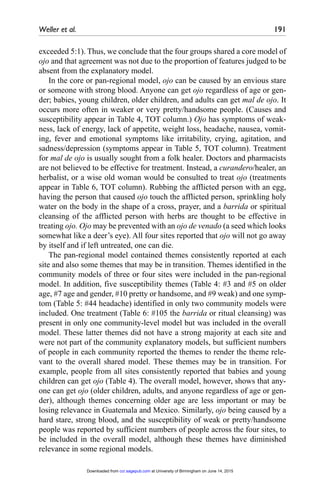
In the core or pan-regional model, ojo can be caused by an envious stare
or someone with strong blood. Anyone can get ojo regardless of age or gen-
der; babies, young children, older children, and adults can get mal de ojo. It
occurs more often in weaker or very pretty/handsome people. (Causes and
susceptibility appear in Table 4, TOT column.) Ojo has symptoms of weak-
ness, lack of energy, lack of appetite, weight loss, headache, nausea, vomit-
ing, fever and emotional symptoms like irritability, crying, agitation, and
sadness/depression (symptoms appear in Table 5, TOT column). Treatment
for mal de ojo is usually sought from a folk healer. Doctors and pharmacists
are not believed to be effective for treatment. Instead, a curandero/healer, an
herbalist, or a wise old woman would be consulted to treat ojo (treatments
appear in Table 6, TOT column). Rubbing the afflicted person with an egg,
having the person that caused ojo touch the afflicted person, sprinkling holy
water on the body in the shape of a cross, prayer, and a barrida or spiritual
cleansing of the afflicted person with herbs are thought to be effective in
treating ojo. Ojo may be prevented with an ojo de venado (a seed which looks
somewhat like a deer’s eye). All four sites reported that ojo will not go away
by itself and if left untreated, one can die.
The pan-regional model contained themes consistently reported at each
site and also some themes that may be in transition. Themes identified in the
community models of three or four sites were included in the pan-regional
model. In addition, five susceptibility themes (Table 4: #3 and #5 on older
age, #7 age and gender, #10 pretty or handsome, and #9 weak) and one symp-
tom (Table 5: #44 headache) identified in only two community models were
included. One treatment (Table 6: #105 the barrida or ritual cleansing) was
present in only one community-level model but was included in the overall
model. These latter themes did not have a strong majority at each site and
were not part of the community explanatory models, but sufficient numbers
of people in each community reported the themes to render the theme rele-
vant to the overall shared model. These themes may be in transition. For
example, people from all sites consistently reported that babies and young
children can get ojo (Table 4). The overall model, however, shows that any-
one can get ojo (older children, adults, and anyone regardless of age or gen-
der), although themes concerning older age are less important or may be
losing relevance in Guatemala and Mexico. Similarly, ojo being caused by a
hard stare, strong blood, and the susceptibility of weak or pretty/handsome
people was reported by sufficient numbers of people across the four sites, to
be included in the overall model, although these themes have diminished
relevance in some regional models.
at University of Birmingham on June 14, 2015
ccr.sagepub.com
Downloaded from
192	 Cross-Cultural Research 49(2)
Themes that are similar across sites can come from a common source or
from the independent addition or omission of items, although themes strongly
classified by three or more sites may be likely to share a common source.
Also when two sites strongly classify a theme and the other two sites have
only moderate endorsement, it may be that the theme had been shared and is
diminishing in importance, as for vulnerability of older children, adults, and
the idea that anyone can get ojo in Guatemala and Mexico. Although we can-
not rule-out the independent addition or deletion of themes, themes detected
in the pan-regional model may reflect the content of an older, shared version
of an ojo explanatory model.
Distinctive patterns in agreement across sites may identify thematic con-
tent that is in transition. When a theme has a strong majority at one site, but
negligible endorsement at other sites it may reflect adaptations to local cul-
tural values by addition or omission of features. In Guatemala for example,
drunk or hung-over men can cause ojo (Table 4: #40). The percent of people
who agreed with this were: 92% in Guatemala, 21% in Mexico, 0% in Texas,
and 2% in Connecticut. At the two U.S. sites, this feature was not even rec-
ognized suggesting this aspect of ojo was dropped long ago or this is a new
addition in Guatemala. The Guatemalan symptoms of boils, itching, limp
neck, bad smell, and tossing during sleep (Table 4), as well as using liquor
and a cigar with a barrida for treatment (Table 5) also may be elaborations of
local values. This pattern contrasts with that of strong agreement at one site
and moderate agreement at the other sites. For example, the belief in
Connecticut that witchcraft can cause ojo (Table 3) may also suggest an older
theme, although the theme is not part of the contemporary core model.
Witchcraft is reported by 18% in Guatemala, 49% in Mexico, 34% in Texas,
and 76% in Connecticut. Although only one site has strong agreement, the
intermediate level of agreement at two additional sites makes it less likely
that this is a new addition in Connecticut. The possibility of independent
additions and omissions across sites cannot be entirely ruled-out and it is pos-
sible that all four sites have introduced a literal translation of mal ojo, as red
and inflamed eyes (Table 5: #45, reported by 68% in Guatemala, 41% in
Mexico, and 37% in Texas, and 21% in Connecticut).
Discussion
This study demonstrates a methodology appropriate for the study of cultural
transmission of beliefs within a historical context. We first began with four
Latin American populations with historical links to Spain, spanning over 500
years. Second, we elicited explanatory model descriptions of evil eye from
those four diverse populations. Third, a structured interview was created
at University of Birmingham on June 14, 2015
ccr.sagepub.com
Downloaded from
Weller et al.	 193
from their thematic content and administered to larger, more representative
community samples at each site. Fourth, individual responses were examined
for consistency in responses for each community and for all individuals
together using cultural consensus analysis. A detailed analysis of the thematic
content of community-level models facilitated the identification of salient
themes that are likely to be a mixture of new and old elements. The pan-
regional model identified shared themes that may represent older elements of
the explanatory model. Using a single snap-shot or cross-sectional sampling
of contemporary beliefs about evil eye, we combined the historical relation-
ship among sites with methods from cultural consensus analysis and linguis-
tic historical reconstruction to estimate older evil eye beliefs. This
methodological approach might be adapted to research on other cultural
beliefs and their transmission.
A first goal of this study was to describe beliefs about evil eye in contem-
porary Latin American populations. In examining patterns of intra-cultural or
within-community variation in individual descriptions of evil eye, we found
that each of the four communities studied, despite their diversity, had mean-
ingful consistency in explanatory models across individuals. Our findings
indicated that a shared, cultural model about mal de ojo exists within each of
these communities. The shared model is consistent with a distributional
model of culture (Atran, Medin,  Ross, 2005; Roberts, 1964). Even though
individuals’ responses varied in some of the descriptive elements linked to
mal de ojo, the themes were sufficiently homogeneous across individuals to
enable us to identify and describe an explanatory model for each
community.
Ojo, however, appears to thrive in some communities more than others.
The Mexican American community in Texas and rural Guatemala reported a
fairly high lifetime prevalence of ojo with many individuals in these com-
munities personally having had experienced mal de ojo. Community preva-
lence was much lower among Puerto Ricans in Connecticut and Mexicans in
Guadalajara. Community prevalence was associated with consistency in
reporting of causes, symptoms, and treatments for ojo, so that communities
with greater experience with ojo also agreed more on what ojo is. The linking
of these two independent measures (prevalence and agreement) also validates
the relative salience of evil eye in these communities. Thematic detail in
explanatory models (number of themes), however, was not clearly related to
prevalence or agreement, although the Texan and Guatemalan models also
had the most detail.
Second, we sought to identify themes that were shared across regions. The
consistency of reports from individuals across the four regions enabled us to
identify a shared, pan-regional explanatory model. This core model likely
at University of Birmingham on June 14, 2015
ccr.sagepub.com
Downloaded from
194	 Cross-Cultural Research 49(2)
reflects content of older descriptions, as it is unlikely that there has been
much formal exchange of knowledge and beliefs about ojo between these
sites. Although migration and media are generally important to the study of
globalization, their effects are not at all clear in this case. The most contact
has been between the Texan and Mexican populations, the two closest sites,
linked by historical ties as well as contemporary patterns of migration. We
would predict the highest flow of ideas between these two sites. There is,
however, little evidence for a role of media in diffusion of beliefs about evil
eye. In Latin America and in the United States, formal institutions and media
do not discuss evil eye as they do other biomedical illnesses, such as the com-
mon cold and influenza. And in the United States, mainstream culture does
not share a belief in evil eye.
Beliefs about ojo have themes unique to individuals, themes shared within
a community but unique to that community, and themes that are shared within
and across communities. The pattern of shared and distinct themes may offer
information about historical changes in the culture pattern across regions.
Although the dropping or adding of features for evil eye may have occurred
over time and independently in each region, it is important to note that the
effect of these changes would be to reduce the similarity between samples.
Over time, the correlation between samples would then approach zero.
Instead, what we found was a consistent description of evil eye across four
regions with highly correlated answers across those sites. An alternative
explanation is that all four groups added or dropped the same themes, possi-
bly due to factors that affected all four sites. While it is unlikely that media or
inter-site migration between the four sites has had this effect, it is possible
that longer term influences on all four sites possibly by the Roman Catholic
Church may have had some effect on evil eye beliefs over time. The Roman
Catholic Church may have affected these beliefs, as evil eye is explicitly
mentioned in church policies concerning exorcisms. In a recent revision of
17th-century policies, exorcisms may be used in cases of possession, but not
for those with psychological problems or for superstitious beliefs like for
“evil eye or some other form of black magic” (von Reisswitz, n.d.). The strik-
ingly high agreement between sites, however, especially given the lack of
evil eye beliefs in the dominant U.S. culture surrounding the Texas and
Connecticut Latinos, seems to suggest that the core set of shared themes
reflects a shared source.
The age–area hypothesis also would predict that the shared elements
across the wide geographic region would be older elements. The age–area
hypothesis posits that communities on the periphery of a culture area are
more likely to retain older versions of culture patterns (Kroeber, 1931), and
perhaps that is one reason why ojo beliefs are so pronounced among Mexican
at University of Birmingham on June 14, 2015
ccr.sagepub.com
Downloaded from
Weller et al.	 195
Americans in Texas. In terms of the Spanish colonization, the most likely
flow of ideas was directly from Spain to Puerto Rico, Mexico, and Guatemala,
then from Puerto Rico to Connecticut and from Mexico to Texas. Central
Mexico would represent an older version of Spanish influence and Texas
would be more peripheral to contemporary Mexican culture patterns. In his-
torical linguistics, the sample that is most similar to all other samples is
assumed to be closest to the ancestral dialect (Swadesh, 1950). For these
samples, the Texas and Mexican models have the highest average correlation
to all other samples, and the Texas explanatory model has the highest propor-
tion of matching themes with the pan-regional model.
Third, we tested whether explanatory model themes with the highest
agreement within a community were more likely to be shared across com-
munities. The correlation between regional explanatory models indicated that
the sites were more likely to agree than disagree on whether a theme was
present or absent in the ojo explanatory model. Furthermore, when disagree-
ment occurred, a theme with high agreement in one community was more
likely to have moderate agreement in another community than to be judged
as absent. This patterning may distinguish themes that once were recognized
across regions, themes with a strong majority in one or more communities
and moderate agreement in other communities may reflect more recent
changes in beliefs than those that with strong agreement at one site and very
low agreement in other communities.
Finally, the patterning of responses within- and across regions suggests
that an estimation of older ojo beliefs may be possible. The consensus-derived
pan-regional model appears to provide a sensitive means of pooling informa-
tion across sites. Some themes identified as relevant in the pan-regional
model were significant in only one or two community models. The pooling of
individual-level data across sites detected a sufficient amount of “minority”
opinions at each site to carry a theme into the pan-regional model. When a
few sites demonstrated strong endorsement and the other sites demonstrated
moderate—rather than negligible—endorsement of a theme, it suggests that
the theme may have been more important previously than it is today. This
distinctive pattern facilitates identification of themes that are most likely in
transition, those that no longer have a strong majority within a community
but are still present in the population to some degree. These themes are the
ones most likely to be losing ground. Thus, the pan-regional model may be a
more sensitive estimate of shared, older elements in the explanatory model
than either the Mexican or Mexican American models, although the corre-
spondence between the pan-regional and Texas model is quite high. Notably,
the pan-regional model identified four themes not present in the Texas model
that may have been part of the older beliefs (Table 4: #9 does ojo occur in
at University of Birmingham on June 14, 2015
ccr.sagepub.com
Downloaded from
196	 Cross-Cultural Research 49(2)
weak people; Table 6: #105 and #106 ritual sweeping of a person with herbs,
and #121 can an herbalist treat ojo).
This approach, however, cannot detect themes already diminished at mul-
tiple sites. For example, earlier emphases on the role of heat as a cause of evil
eye (Cosminsky, 1976) may be declining as no one explicitly mentioned hot–
cold forces in the initial interviews. However, people with strong blood, preg-
nant or menstruating women, and drunken men may represent potentially
“hot” exposures increasing risk for ojo (Cosminsky, 1976). Strong blood
appears as a possible cause at all sites except Connecticut and is included in
the pan-regional model, whereas drunk or hung-over men and pregnant or
menstruating women appear to be important only in the Guatemalan model.
Whether these features have been retained only in Guatemala or added to the
Guatemalan belief system is unclear.
With regard to cultural transmission (in this case inter-generational trans-
mission of beliefs and the preservation of those beliefs), an interesting issue
is why some features are maintained and others disappear. The Texas and
Mexico explanatory models are similar, yet the prevalence of having had ojo
was highest in Texas and lowest in Mexico. This pattern is consistent with the
age–area hypothesis, that patterns will be conserved further from their source.
In Texas, the older, less educated, Mexican-born respondents, who preferred
to be interviewed in Spanish, knew more about ojo. The Texas site reported
older children and adults as susceptible, but Mexico retained only the vulner-
ability of young children. Texas also did not report the diarrheal symptoms
that Mexico did. The Texas sample also contrasts with the Connecticut sam-
ple, where ojo is less prevalent and perhaps less important. These two “immi-
grant” groups also differ in their patterns of acculturation and identity, and
possibly border communities experience mores stress and alienation which is
expressed in folk illnesses such as mal de ojo.
Over time, some folk illnesses have transformed into entities compatible
with newer contexts. Beliefs about folk illnesses contrast with those for bio-
medical diseases because they are not reinforced through formal systems.
Folk illnesses in each of these populations have evolved and modified within
each locality, resulting in higher levels of heterogeneity in beliefs between
localities. The result is greater regional heterogeneity in beliefs about folk
illnesses than for biomedical illnesses (Weller  Baer, 2002). However, some
folk illnesses overlap with biomedical conditions resulting in more interac-
tion between the condition and biomedical health care. Kay (1979) described
the transformation of the folk illness empacho from a bolus that becomes
stuck in the stomach into “a more serious version of ‘irregularity’” (Kay,
1979). She suggested also that the folk illness caida de mollera was “moving
toward legitimization as the scientific condition of dehydration” (Kay, 1979).
at University of Birmingham on June 14, 2015
ccr.sagepub.com
Downloaded from
Weller et al.	 197
The descriptions of mal de ojo in the four populations we studied and
those in ethnographic work done over the past 50 years, however, are fairly
consistent (Madsen, 1964; Rubel, 1960; Trotter, 1991). The persistence of ojo
beliefs is striking, particularly in that the most likely place where beliefs of
this type would be learned is within the family (inter-generational transfer of
beliefs, probably in the context of communication from mothers and grand-
mothers about child care) and, possibly, within the community. Kay (1979)
also noted this and reported that ojo has been “impervious to meaning change
from scientific medicine, for these are not diseases that would be brought to
a medical doctor, or are last resorts in folk diagnosis to be used when expla-
nations from scientific medicine fail” (Kay, 1979, p.89). However, we now
see that some people report a literal translation of mal ojo as red and inflamed
eyes.
This study focused on a set of beliefs that can only be transmitted cultur-
ally. Mal de ojo has persisted among Latin Americans for more than five
centuries, most likely passed down informally within families and communi-
ties. This is a remarkable case of inter-generational transmission of beliefs
and the maintenance and preservation of those beliefs. Beliefs about ojo must
be learned from others and cannot be learned by independent observation. In
contrast, studies of cultural transmission of ecological knowledge (Atran et
al., 2005) must grapple with the confounding effect that a person can walk
through the forest and gain ecological knowledge by observation. Ecological
knowledge can be gained by learning or by personal experience and observa-
tion. Studies of cultural transmission are difficult if knowledge can be gained
from sources other than sharing of knowledge from others (e.g., from per-
sonal experience). Evil eye offers an important contrast as it cannot be inde-
pendently observed; it can only be taught.
A strength of this study is in the mixed-method approach to estimate
beliefs about evil eye. A combination of qualitative, open-ended interviews
with structured interviews takes advantage of the strengths of each approach.
Also, the use of representative sampling allows for better generalization of
findings and the estimation of prevalence. Thus, the combination of interview
types and sampling methods should result in more complete and reliable
descriptions. Without systematic historical data on ojo beliefs over time,
however, we cannot be absolutely sure about the content of those older
beliefs.
We conclude that mal de ojo is alive and well for the present in the popula-
tions studied, although there are meaningful regional variations in features
and prevalence. This study demonstrates a methodology appropriate for the
study of cultural transmission of beliefs with the estimation of a pan-regional
at University of Birmingham on June 14, 2015
ccr.sagepub.com
Downloaded from
198	 Cross-Cultural Research 49(2)
model using cultural consensus analysis. Future research might investigate
the models of ojo in populations that share historical relations with the popu-
lations sampled in this study, perhaps Puerto Rico, Spain, and cultures of the
Mediterranean and Middle East, to see how models of evil eye have fared in
the 21st century in those cultural contexts (Baer, Weller, Gonzales Faraco, 
Martin, 2006). Another avenue of research might be to investigate how mod-
els of mal de ojo seen at present compare with written descriptions in Spanish
sources from previous centuries (de Castañega  Fray, 1946; Kay, 1977).
Although only limited comparisons can be made with archival texts, the
sources could confirm some aspects of evil eye. Also, systematic, inter-gen-
erational comparisons within a community might shed insight on the mainte-
nance and preservation of beliefs and features. The persistence of ojo through
time remains intriguing and additional systematic data would help to under-
stand the patterns we see in contemporary beliefs about ojo.
In summary, we have demonstrated a methodology with respect to the dif-
fusion of cultural beliefs, a key focus in our discipline. We used qualitative
data to create a structured interview and analyzed responses with consensus
analysis to estimate core patterns or older beliefs about evil eye concepts. We
then used concepts from historical linguistics as well as ideas from Wissler’s
age–area hypothesis to interpret those patterns. We feel this is an innovative
use of consensus theory, as well as an innovative contribution to cultural
anthropology. Wissler’s contributions were criticized years ago, but as often
happens in our field, the critique led to abandonment of the method rather
than improvement. In this study, we have reconsidered these approaches and
suggest a way to estimate older culture patterns from shared, contemporary
culture patterns.
Our findings suggest that that the complete dismissal of the age–area
hypothesis may have been premature, and that more work should be done to
establish the situations in which the age–area hypothesis does or does not
work. The consistency of reports from our four samples enabled the identifi-
cation of a single, core explanatory model. This shared pan-regional model
likely reflects content of older descriptions, as it is unlikely that there has
been much formal exchange of knowledge and beliefs about evil eye between
these sites. Thus, our findings seem to agree with an age–area interpretation.
We suggest that this approach might be explored to understand other types of
cultural patterns.
Declaration of Conflicting Interests
The author(s) declared no potential conflicts of interest with respect to the research,
authorship, and/or publication of this article.
at University of Birmingham on June 14, 2015
ccr.sagepub.com
Downloaded from
Weller et al.	 199
Funding
The author(s) disclosed receipt of the following financial support for the research,
authorship, and/or publication of this article: Susan C. Weller and Roberta D. Baer
received funding for this research from the National Science Foundation (NSF, BNS-
920455, SBR-9727322, BCS-0108232).
Notes
1.	 An initial, master set of questions for a series of folk illnesses was reviewed by
Arthur Rubel, Margarita Kay, Kaja Finkler, and Peter Guarnaccia. Any errors or
omissions are our own. Kaja Finkler also provided us with Spanish version of the
Cornell Medical Index of symptoms.
2.	 Lifetime community prevalence is different from the proportion in each sample
that had experienced mal de ojo. To estimate community prevalence, the denomi-
nator needs to include all people who agreed to participate in the study whether
or not they believed in mal de ojo. Of 194 people agreeing to be interviewed in
the second phase, 160 reported a belief in ojo. Our interviews focused on those
who recognized and reported a belief in mal de ojo. The lifetime prevalence of
mal de ojo for each community was estimated from the number of those report-
ing personal experience with ojo divided by the total number of people agreeing
to participate whether or not they believed in ojo: 56% (25 / 45) in Texas, 30%
(12 / 40) in Guatemala, 15% (7 / 46) in Connecticut, and 13% (8 / 61) Mexico.
References
Atran, S., Medin, D.,  Ross, N. (2005). The cultural mind: Environmental deci-
sion making and cultural modeling within and across populations. Psychological
Review, 112, 744-776.
Baer, R. D., Weller, S. C., Gonzales Faraco, J. C.,  Martin, J. F. (2006). Las enferme-
dades populares en la cultura española actual: Un estudio comparado sobre el mal
de ojo.[Folk illness in contemporary Spanish culture: A comparative study about
evil eye.] Revista de Dialectología y Tradiciones Populares, 61(1), 139-156.
Balée, W. (2003). Historical-ecological influences on the word for cacao in Ka’apor.
Anthropological Linguistics, 45, 259-280.
Bashkow, I. (2004). Neo-Boasian conception of cultural boundaries. American
Anthropologist, 106, 443-458.
Batchelder, W.,  Romney, K. (1988). Test theory without an answer key.
Psychometrika, 53, 1-92.
Blench, R. (2009). Bananas and plantains in Africa: Re-interpreting the linguistic
evidence. Ethnobotany Research  Applications, 7, 363-380.
Brodman, K., Erdmann, A. J., Jr.,  Wolff, H. G. (1949). Cornell Medical Index
Health Questionnaire manual. Ithaca, NY: Cornell University Press.
Burleigh, E., Dardano, C.,  Cruz, J. R. (1990). Colors, humors and evil eye; indig-
enous classification and treatment of childhood diarrhea in highland Guatemala.
Medical Anthropology, 12, 419-441.
at University of Birmingham on June 14, 2015
ccr.sagepub.com
Downloaded from
200	 Cross-Cultural Research 49(2)
Chick, G. (2002). Writing culture reliably: The analysis of high concordance codes.
Ethnology, 39, 365-393.
Cosminsky, S. (1976). The evil eye in a Quiche community. In C. Maloney (Ed.), The
evil eye (pp. 163-173). New York, NY: Columbia University Press.
D’Andrade, R. G. (1987). Modal responses and cultural expertise. American
Behavioral Scientist, 31, 194-202.
de Castañega, M., R. P. F. (1946). Tratado de Las Supersticiones Y Hechicerias.
[Treatise on superstitions and witchcraft] Madrid, Spain: La Sociedad de
Bibliófilos Españoles.
Dow, M. M.,  Eff, E. A. (2008). Global, regional, and local network autocorrelation
in the standard cross-cultural sample. Cross-Cultural Research, 42, 148-171.
Dundes, A. (1981). The evil eye: A folklore casebook. New York, NY: Garland
Publishing.
Finkler, K. (1981). Comparative study of health seekers: Or why do some people go
to doctors rather than spiritualist healers? Medical Anthropology, 5, 383-424.
Foster, G. M. (1953). Relationships between Spanish and Spanish-American folk
medicine. Journal of American Folklore, 66(261), 201-217.
Freed, S. A.,  Freed, R. S. (1983). Clark Wissler and the development of anthropol-
ogy in the United States. American Anthropologist, 85, 800-815.
Garro, L. C. (2000). Cultural meaning, explanations of illness, and the development
of comparative frameworks. Ethnology, 39, 305-334.
Handlin, O. (1973). The uprooted. Boston, MA: Little, Brown.
Harwood, A. (1981). Mainland Puerto Ricans. In A. Harwood (Ed.), Ethnicity and
medical care (pp. 397-481). Cambridge, MA: Harvard University Press.
Kay, M. (1977). The Florilegio medicinal: Source of southwest ethnomedicine.
Ethnohistory, 24, 251-259.
Kay, M. (1979). Lexemic change and semantic shift in disease names. Culture,
Medicine, and Psychiatry, 3, 73-94.
Kleinman, A., Eisenberg, L.,  Good, B. (1978). Culture, illness, and care: Clinical
lessons from anthropologic and cross-cultural research. Annals of Internal
Medicine, 88, 251-258.
Kroeber, A. L. (1931). The culture-area and age-area concepts of Clark Wissler. In
S. Rice (Ed.), Methods in social science (pp. 248-265). Chicago, IL: University
of Chicago Press.
Kroeber, A. L. (1948). Anthropology. Orlando, FL: Harcourt Brace.
Kronenfeld, D. B.,  Thomas, L. L. (1983). Revised lexicostatistical classification of
Salishan languages. American Anthropologist, 85, 372-378.
Levy, I. J.,  Zumwalt, R. L. (2002). Ritual medical lore of Sephardic women:
Sweetening the Spirits, healing the sick. Urbana: University of Illinois Press.
Madsen, W. (1964). The Mexican Americans of South Texas. New York, NY: Holt,
Reinhart and Winston.
Maloney, C. (1976). The evil eye. New York, NY: Columbia University Press.
Mendez Dominguez, A. (1983). Illness and medical theory among Guatemalan
Indians. In C. Kendall (Ed.), Heritage of conquest: Thirty years later (pp. 267-
298). Albuquerque: University of New Mexico Press.
at University of Birmingham on June 14, 2015
ccr.sagepub.com
Downloaded from
Weller et al.	 201
Murguia, A., Peterson, R.,  Zea, M. C. (2003). Use and Implications of ethnomedi-
cal health care approaches among central American immigrants. Health  Social
Work, 28, 43-51.
Naroll, R. (1961). Two solutions to Galton’s problem. In F. W. Moore (Ed.), Readings
in cross-cultural methodology (pp. 15-39). New Haven, CT: HRAF Press.
Roberts, J. M. (1964). The self-management of cultures. In W. H. Goodenough (Ed.),
Explorations in cultural anthropology (pp. 433-454). New York, NY: McGraw-
Hill.
Roberts, J. M. (1976). Belief in the evil eye in world perspective. In C. Maloney (Ed.),
The evil eye (pp. 223-278). New York, NY: Columbia University Press.
Roberts, J. M., Strand, R. F.,  Burmeister, E. (1974). Preferential pattern analy-
sis. In P. Kay (Ed.), Explorations in mathematical anthropology (pp. 266-279).
Cambridge, MA: MIT Press.
Romney, A. K.,  Moore, C. C. (1999). Toward a theory of culture as shared cogni-
tive structures. Ethos, 26, 314-337.
Romney, A. K.,  Moore, C. C. (2001). Systemic culture patterns as basic units of
cultural transmission and evolution. Journal of Cross-Cultural Research, 35,
154-178.
Romney, A. K., Weller, S. C.,  Batchelder, W. H. (1986). Culture as consensus: A
theory of cultural and informant accuracy. American Anthropologist, 88, 313-
338.
Rubel, A. (1960). Concepts of disease in Mexican-American culture. American
Anthropologist, 62, 795-814.
Sault, N. (1990). The evil eye, both hot and dry. Journal of Latin American Lore,
16(1), 69-89.
Schreiber, J. M.,  Homiak, J. P. (1981). Mexican Americans. In A. Harwood (Ed.),
Ethnicity and medical care (pp. 264-336). Cambridge, MA: Harvard University
Press.
Solien de  Gonzalez, N. (1964). Beliefs and practices concerning medicine and
nutrition among lower-class urban Guatemalans. American Journal of Public
Health, 54, 1726-1734.
Swadesh, M. (1950). Salish internal relationships. International Journal of American
Linguistics, 16, 157-167.
Trotter, R. T., II. (1991). A survey of four illnesses and their relationship to intracul-
tural variation in a Mexican-American community. American Anthropologist, 93,
115-125.
Trotter, R. T., II. (2005). Latin American Curanderismo. In M. Miccozzi (Ed.),
Fundamentals of complementary and alternative medicine (3rd ed., pp. 578-595).
New York, NY: Churchill Livingstone.
Trotter, R. T., II,  Chavira, J. A. (1997). Curanderismo: Mexican American folk
healing (2nd ed.). Athens: University of Georgia Press.
Urban, G. (2010). A method for measuring the motion of culture. American
Anthropologist, 112, 122-139.
at University of Birmingham on June 14, 2015
ccr.sagepub.com
Downloaded from
202	 Cross-Cultural Research 49(2)
von Reisswitz, C. K. (n.d.). Exorcism rite reformed [Web article]. Retrieved from
http://www.catholicculture.org/culture/library/view.cfm?recnum=2824 accessed
on 02-28-14.
Weller, S. C. (1983). New data on intra-cultural variability: The hot-cold classifica-
tion of illness. Human Organization, 42, 249-257.
Weller, S. C. (2007). Cultural consensus theory: Applications and frequently asked
questions. Field Methods, 19, 339-368.
Weller, S. C.,  Baer, R. D. (2002). Measuring within and between group agreement:
Identifying the proportion of shared and unique beliefs across samples. Field
Methods, 14, 6-25.
Weller, S. C.,  Buchholtz, C. H. (1986). When a single clustering method cre-
ates more than one tree: A re-analysis of the Salish languages. American
Anthropologist, 88, 667-674.
Weller, S. C.,  Mann, N. C. (1997). Assessing rater performance without a “gold
standard” using consensus theory. Medical Decision Making, 17, 71-79.
Wissler, C. (1927). The culture-area concept in social anthropology. American
Journal of Sociology, 32, 881-891.
Wissler, C. (1928). The culture-area concept as a research lead. American Journal of
Sociology, 33, 894-900.
Author Biographies
Susan C. Weller, PhD, is a professor in the Departments of Preventive Medicine and
Community Health, and the director of the Research Program in the Department of
Family Medicine, University of Texas Medical Branch, Galveston, TX.
Roberta D. Baer, PhD, is a professor in the Department of Anthropology, University
of South Florida, Tampa, FL.
JavierGarciadeAlbaGarcia,MD,PhD,isthedirectoroftheSocial,Epidemiological
and Health Services Research Unit of the Instituto Mexicano de Seguro Social
(IMSS), Guadalajara; a physician at the Hospital Civil of Guadalajara, J. 1., Menchaca,
Guadalajara; and co-coordinator of the Socio-Medicine Program of the University of
Guadalajara, Mexico.
MarkGlazer,PhD,isprofessoremeritus,DepartmentofSociologyandAnthropology,
University of Texas - Pan American, Edinburg, TX.
Robert Trotter II, PhD, is associate vice president for Heath Research Initiatives,
Arizona Regent’s Professor in anthropology, University of Northern Arizona,
Flagstaff, AZ.
Ana L. Salcedo Rocha, MD, PhD, is a researcher in the Social, Epidemiological, and
Health Services Research Unit of the Instituto Mexicano de Seguro Social (IMSS),
Guadalajara, and co-coordinator of the Social-Medicine Program of the University of
Guadalajara, Mexico.
at University of Birmingham on June 14, 2015
ccr.sagepub.com
Downloaded from
Weller et al.	 203
Robert E. Klein, PhD, past director, University of the Valley of Guatemala and
Medical Entomology Research Training Unit/Guatemala (MERTU/G), Centers for
Disease Control and Prevention (CDC), Guatemala City, Guatemala.
Lee M. Pachter, DO, is a professor in the Department of Pediatrics at Drexel
University College of Medicine and chief of the Section of General Pediatrics at St.
Christopher’s Hospital for Children in Philadelphia, PA.
at University of Birmingham on June 14, 2015
ccr.sagepub.com
Downloaded from

Weller2014

  • 1.
    Cross-Cultural Research 2015, Vol.49(2) 174­ –203 © 2014 SAGE Publications Reprints and permissions: sagepub.com/journalsPermissions.nav DOI: 10.1177/1069397114539268 ccr.sagepub.com Article Variation and Persistence in Latin American Beliefs About Evil Eye Susan C. Weller1, Roberta D. Baer2, Javier Garcia de Alba Garcia3,6, Mark Glazer4, Robert Trotter II5, Ana L. Salcedo Rocha3,6, Robert E. Klein7, and Lee M. Pachter8 Abstract In a comparative study of evil eye (mal de ojo), we demonstrate a methodology appropriate for the study of cultural transmission of beliefs. We studied four diverse populations with historical links to Spain: Puerto Ricans in Connecticut, Mexican Americans in south Texas, Mexicans in Guadalajara, and rural Guatemalans. Using agreement on ideas or themes about evil eye within and across sites, we identify specific ideas that may have persisted through time. The relevance of specific themes was estimated with a cultural consensus analysis. Mal de ojo was widely recognized in each community and higher community prevalence was associated with higher agreement on reported causes, symptoms, and treatments. Each community exhibited a distinct model for ojo, although models were highly similar between sites. 1University of Texas Medical Branch, Galveston, USA 2University of South Florida, Tampa, USA 3Instituto Mexicano del Seguro Social, Guadalajara, Mexico 4University of Texas, Edinburg, USA 5University of Northern Arizona, Flagstaff, USA 6Universidad de Guadalajara, Mexico 7Medical Entomology Research and Training Unit, Guatemala City, Guatemala 8Drexel University, Philadelphia, PA, USA Corresponding Author: Susan C. Weller, Department of Preventive Medicine & Community Health, and Director, Research Program, Department of Family Medicine, University of Texas Medical Branch, Galveston, TX 77555-1153, USA. Email: sweller@utmb.edu 539268CCRXXX10.1177/1069397114539268Cross-Cultural ResearchWeller et al. research-article2014 at University of Birmingham on June 14, 2015 ccr.sagepub.com Downloaded from
  • 2.
    Weller et al. 175 Agreement among individuals and across communities suggests a pan- regional description for mal de ojo and possible content of older versions of these beliefs in Latin America. Keywords evil eye, mal de ojo, Latin America/Latino, consensus model, age–area hypothesis Introduction The diffusion of culture—material and non-material—has been a focus of research in three of the four disciplines in our field (archeology, linguistics, and cultural anthropology). This study demonstrates a methodology appropri- ate for the study of cultural transmission of beliefs, an aspect of non-material culture. Here, we describe a comparative study of a single culture pattern, evil eye (mal de ojo or ojo), across four populations with historical links to 16th- century Spain. Beliefs about evil eye were most likely brought to Latin America by Spanish settlers and handed down within families and communi- ties for centuries. Using contemporary data, we focus on consistency within and across regions to make inferences about the content of evil eye beliefs that may have persisted through time. We identify relevant thematic content in contemporary descriptions, and use agreement across people and regions to identify shared ideas that may have been part of older beliefs about mal de ojo. Evil eye, believed to be caused by greed or envy, is a cultural phenomenon that is widespread across Indo-European and Semitic-derived cultures (Dundes, 1981; Levy & Zumwalt, 2002; Maloney, 1976). The basic concept is that one can cause harm to another, either intentionally or unintentionally, by expressing or thinking about praise or jealousy. In a detailed global study, Roberts (1976) suggested that evil eye may have developed in India or in the Near East and Europe and may be thousands of years old. Cultural transmission through migration and diffusion is thought to be responsible for the occurrence of the evil eye culture pattern around the world. Beliefs about evil eye were common in 16th-century Spain (archival sources contain descriptions of cases of evil eye; de Castañega, 1946), and were probably brought to Spain by the Moors. Beliefs about evil eye were then most likely exported from Spain to Latin America (Foster, 1953) as the Spanish colonized the New World. In contemporary Latin American populations, evil eye continues to be widely recognized. Mexican Americans in the southwestern United States believe mal de ojo is caused by the glances or power of stronger persons act- ing on a weaker person, particularly a child (Schreiber & Homiak, 1981; Trotter, 2005; Trotter & Chavira, 1997). As with other Latin American folk at University of Birmingham on June 14, 2015 ccr.sagepub.com Downloaded from
  • 3.
    176 Cross-Cultural Research49(2) illnesses, mal de ojo has a social dimension and can be caused by someone who has been more familiar than social and cultural norms permit (Rubel, 1960). Symptoms include severe headaches, high fever, fretfulness, and in the case of children, weeping (Rubel, 1960). Treatments often attempt to find the person responsible to break the “spell.” If this is not possible, a cure is attempted using an egg rubbed over the patient’s body, along with prayer (Rubel, 1960). The egg is put into a glass of water and placed under the bed of the affected person to drain off the disturbing power. Ojo is not considered fatal, although if not treated or treated incorrectly, it may develop into ojo pasado (characterized by vomiting and severe coughing), which can be fatal (Rubel, 1960). Similar descriptions are obtained from contemporary indigenous and non- indigenous Latin Americans. Zapotecs (Sault, 1990) and Tarascans (Garro, 2000) in Mexico and the indigenous populations in Patzun (Mendez Dominguez, 1983) and Santa Maria de Jesus, Sacatepequez (Burleigh, Dardano, & Cruz, 1990) in Guatemala report mal de ojo. Mal de ojo is also recognized by non-indigenous populations in rural (Weller, 1983) and urban Guatemala (Solien de Gonzalez, 1964). Among Puerto Ricans, belief in mal de ojo is reported to be widespread and is the diagnosis used for a range of childhood symptoms that appear with a sudden onset (Harwood, 1981). More recently, beliefs in mal de ojo were reported by Central American immigrants in Washington, D.C. (Murguia, Peterson, & Zea, 2003). This study describes intra- and inter-cultural variation in contemporary beliefs about evil eye. First, we aim to describe the “culture pattern” (Kroeber, 1948) within contemporary Latino populations, where pattern refers to the set of related ideas or behaviors about evil eye, a complex of cultural material that acts as a coherent unit or system (Chick, 2002; Roberts, Strand, & Burmeister, 1974; Romney & Moore, 1999, 2001). We use an “explanatory model” framework, which focuses on causes, symptoms, and treatments of illnesses (Kleinman, Eisenberg, & Good, 1978) and collected descriptions of causes, who is at risk, symptoms, and treatments for evil eye. We then exam- ine patterns of within-community variation to see if there is consistency across individual descriptions of evil eye. We also examine whether commu- nity prevalence of evil eye is related to consistency and detail in the descriptions. Second, we aim to identify possible longstanding core elements or themes in community culture patterns concerning evil eye. Elements in the evil eye belief system that are shared across regions may reflect older beliefs. More than 80 years ago, Wissler (1927, 1928) presented the age–area concept as a device for inferring time sequences from geographic distribution of related culture traits throughout a culture area (Kroeber, 1931). In this formulation, at University of Birmingham on June 14, 2015 ccr.sagepub.com Downloaded from
  • 4.
    Weller et al. 177 the “center” of a culture area radiates cultural content to surrounding areas, which then radiates the content to more peripheral areas. Meanwhile, the center may change its content, but older forms may be evident in peripheral areas. For example, the distribution of pottery styles in the southwestern United States matched stratigraphic evidence for age (Wissler, in Freed & Freed 1983). The more widely distributed elements within a culture area were the older elements; and the oldest versions of culture patterns appeared on the periphery of a culture area. Elements of a culture pattern may be dropped or added through time, but elements shared across a wide geographical region would reflect the older, original pattern. Here, we focus on the flow of evil eye beliefs from Spain to the New World and assume that shared features in the widely dispersed explanatory models of mal de ojo may be some of the older features. The contributions of Wissler were criticized and largely ignored in anthro- pology (Freed & Freed, 1983). Critiques of his approach have included examples where the age–area concept did not hold and examples where Wissler had over-stated the geographical–age relationship present in cultural data (Dixon, discussed in Kroeber, 1931). Kroeber notes, however, that the age–area relationship is limited to the distribution of related traits and does not hold for inferences regarding the relative age of unrelated culture traits (e.g., mud-brick dwellings and bronze use). Also, the distribution of culture traits may not follow a predictable pattern of spread or diffusion from a cul- ture “center” as Wissler suggested, but age–area inferences are supported within a historical context and geographic area (Kroeber, 1931). Despite criticism, the age–area hypothesis and the idea of culture areas may still be useful for conceptualizing the flow of cultural ideas across space and time. Bashkow (2004) recently argued that the idea of culture areas may be useful for describing areas of cultural concentration with isobars of increasing and decreasing cultural influence. “Boundaries” of such areas are permeable and open to the flow of ideas and influence and are not synony- mous with national–political boundaries. Urban (2010) also recently described the “motion,” the waxing and waning of salience, and exposure across time, of specific culture patterns (songs and the importation of French words into English), as empirical evidence of the changing nature of culture patterns and their influence. The age–area hypothesis continues to be of use in reconstructing historical relations in the study of cultigens and anthropological linguistics. The histori- cal pathways of bananas in Africa were re-interpreted using linguistic regu- larities in the distribution of words for bananas to conclude that bananas were most likely introduced on the Western coast of Africa (not the East) along with yams and other foods in the “tropical tool kit” proposed by Murdock at University of Birmingham on June 14, 2015 ccr.sagepub.com Downloaded from
  • 5.
    178 Cross-Cultural Research49(2) (Blench, 2009). Similarly, the distribution of linguistic forms for the word for cacao throughout Latin America suggests that the change in economic impor- tance of cacao associated with the Jesuits resulted in the importation of a new term for cacao in Ka’apor language spoken in the Gurupi and Turiaqu river basins in eastern Amazonia, Brazil (Balée, 2003). The study of cultural values among immigrants also illustrates the disper- sion of older aspects of culture. Oscar Handlin’s (1973) study of immigrants to the United States describes “old world” (European) values and how immi- grants conserve elements of their cultures, such as religion. The immigrants held onto their old ways because they resided in ghettos and were alienated from mainstream society. Identity and alienation may be related to mainte- nance of older culture patterns. Meanwhile, the old-world cultures from which the immigrants came (the Irish, the Jews, the Italians, the Poles, etc.) evolved, as all cultures do. This process would predict that earlier cultural features would be preserved in immigrant communities. We feel that the age–area hypothesis may deserve new consideration and explore its relevance with regard to regional variation and historical elements in beliefs about evil eye. This article describes the contemporary set of beliefs or themes about evil eye in each of four Latino communities and identifies thematic elements in those community culture patterns that are shared across regions and thus may have persisted over time. As there are no systematic data on evil eye from 16th-century Spain, we rely on assumptions and tech- niques from historical linguistics and theories regarding the distribution of culture traits to attempt to estimate older beliefs. Similarly, Swadesh (1950) estimated a proto-Salishan vocabulary from the percent of shared vocabulary between Salishan languages based only on synchronous information (see also Kronenfeld & Thomas, 1983; Weller & Buchholtz, 1986). Here, we attempt a similar reconstruction based on the sharing of descriptive themes across populations and draw on the age–area hypothesis and linguistic methods. We acknowledge the limitations of such inferences, due to the possibility that evil eye features can be added or dropped over time in each of the popula- tions. We also examine whether descriptions from geographically closer samples or samples with the strongest historical link (e.g., Mexico and Mexican Americans in Texas) have the highest similarity in the content of their explanatory models (Dow & Eff, 2008; Naroll, 1961). Method Setting We studied four populations to sample the diversity in beliefs within and across Latino communities. The localities include Puerto Ricans in a small at University of Birmingham on June 14, 2015 ccr.sagepub.com Downloaded from
  • 6.
    Weller et al. 179 city in Connecticut, Mexicans and Mexican Americans in a small town in Texas on the Mexican border, Mexicans in a large city in central Mexico, and Guatemalans living in small rural villages on the Pacific Coast of Guatemala. These sites differ in the prevalence of specific diseases and access to care. Health care in the United States and other developed nations focuses more on chronic diseases. Puerto Rico and Mexico have made the demographic transi- tion to greater longevity and now also struggle with chronic diseases, whereas infectious diseases are primary health issues in Guatemala. Mexico has a nationally organized health care system that provides heath services to many workers, whereas the United States and Puerto Rico do not. Access to care in rural Guatemala is a function of the distance to government health post and/ or pharmacy, and in this case, it is more than a half hour by dirt road. The sites represent a great diversity in social and political histories as well as health contexts and challenges and have the potential to maximize differences in beliefs and practices concerning mal de ojo. Each of the populations derive part of their current culture and religious traditions from those of Spain. In Puerto Rico, indigenous cultures largely did not survive the immediate conquest period. Immigration from Spain, as well as populations originally brought as slaves from Africa, resulted in the pres- ent population, which is a mix of Spanish andAfrican influences. Puerto Rico became a possession of the United States in 1989, and residents became U.S. citizens in 1917. Large-scale migration to the United States mainland began after World War II, initially to New York City, and later to smaller cities in the northeast (Harwood, 1981). Guatemalan indigenous groups strongly resisted the Spanish colonizers, as well as later attempts on the part of the Guatemalan government to integrate them into national life. Although many aspects of their current culture derive from those of Spain, these are built over strong and enduring pre-Columbian Mayan traditions. Areas of west Mexico, the site of contemporary Guadalajara, were somewhat separate from the more well-known pre-Columbian cultures of the Valley of Mexico, such as the Aztecs. Nevertheless, in contemporary Jalisco, most cultural patterns follow those of larger Mexican mestizo culture; however, the political separation/ orientation somewhat apart from that of central Mexico has persisted. Mexican American cultures in the contemporary southwest of the United States derive from a variety of influences and periods of migration from Mexico. In Texas, the original settlements were established by those who accompanied the original explorers of the area. The area became part of the United States in 1845, following the Mexican American War. Migration from northern Mexico to areas in what is now Texas has continued over the period since then. The culture of this area combines that of Mexico with strong influences from the culture of Texas, as well as that of the mainstream United States. at University of Birmingham on June 14, 2015 ccr.sagepub.com Downloaded from
  • 7.
    180 Cross-Cultural Research49(2) We selected the communities for study based on the long-term research and participant observation by one or more of the authors at each site and then selected people for interviewing from the community at-large. In rural Guatemala on the Pacific Coastal Plain, in the Department of Esquintla, four small rural communities (with a population of 500) were selected. Residents are Spanish-speakers of mixed European–Mayan Indian descent and support themselves with wage labor on sugar cane and cotton plantations. In Mexico, Guadalajara (metropolitan area population 3.7 million, 2000) was selected. It is the second largest city in Mexico and is a modern industrial city. Residents of Guadalajara come from both rural and urban backgrounds and are pre- dominately Spanish-speakers of mixed ancestry. In the United States, Edinburg (2000 population 48,465), Texas, was selected because it is located on the Mexican border in the Lower Rio Grande Valley and is predominately Mexican American. The region is agricultural and includes one of the three poorest Standard Metropolitan Statistical Areas in the United States. Hartford (2000 population 121,578), Connecticut, in the Northeast United States was selected because approximately one third of the population is Puerto Rican. It is a medium-sized industrial and commercial center. Development of Interview Materials To understand local beliefs about ojo, a two-step process was used. First, open-ended interviews collected descriptions of evil eye and second, the responses to those interviews were used to design a structured interview to facilitate comparisons across people and sites. The initial phase of interviews elicited salient ideas, descriptions, and themes relevant to mal de ojo to cap- ture the breadth of individual descriptions in each community. To do this, descriptive and free-listing interviews were conducted with 15 to 21 people at each site. These interviews collected ideas about who is susceptible to ojo and possible causes, symptoms, and treatments. We use “theme” to refer to the ideas, descriptions, and features associated with evil eye. Themes men- tioned by at least 10% of people at each site appear in Table 1 (the number of people mentioning each theme appears to the left of each theme). Then, in a second phase of interviews, a structured interview was designed so that people at each site could be asked about all themes, allowing for detailed comparisons across people and sites. The structured interview included all themes in Table 1 (regardless of which site generated the theme), as well as themes from published descriptions of Latin American folk ill- nesses and a range of bodily symptoms (adapted from the Cornell Medical Index by Brodman, Erdmann, & Wolff, 1949; Finkler, 1981). We also sought feedback from experts in the field about content.1 The final interview con- sisted of 128 questions about evil eye: 43 questions on causes and at University of Birmingham on June 14, 2015 ccr.sagepub.com Downloaded from
  • 8.
    Weller et al. 181 Table 1.  Mal de ojo Themes Mentioned in Open-ended Interviews. Who is susceptible Causes Symptoms Treatments Esquintla, Guatemala (n = 20)   12 infants   7 young children   6 those with weak blood 4 from a strong stare 8 people with strong blood 14 drunken men 6 pregnant women 7 menstruating women 6 sweaty people 18 crying alot 17 fever 8 restlessness 8 diarrhea 5 boils 4 hot head 3 vomiting 2 headache 2 limp neck 2 bad smelling head 20 passing an egg over the body 14 with herbs 12 liquor and a cigar 8 allspice 7 rubbing alcohol 17 cure at home 8 midwife-healer 5 older women 16 can die without treatment Guadalajara, Mexico (n = 21) 21 children 9 a strong stare 3 a handsome child 2 jealousy 13 vomiting 11 diarrhea 8 weepy eyes that do not stop 6 eye problems 6 fever 4 nervous and sad 2 headache 9 with an egg 4 doctor or medicine 3 massage 2 spearmint or herbal tea 2 prayers Edinburg, Texas (n = 20) 8 everyone 7 Hispanics, Mexicans 6 those who believe in it 4 some who stands out 2 adults 2 animals 15 staring when you attract attention for prettiness/ ugliness 5 envy, jealousy, anger 5 person who gives ojo has very strong eyes 15 headaches 14 fever 6 body aches 4 stomach ache 4 nausea 4 weight loss/loss of appetite 3 babies cry 3 red eyes, watery eyes 3 vomiting 3 tired weak 20 sweep with egg/Barrida 14 can not prevent it 7 person who complimented you must touch you 6 prevent it with ojo de venado 3 sweep with special herbs 2 prayer Hartford, Connecticut (n = 15) 10 children (defenseless) 8 babies (defenseless) 2 newborns 4 adult places curse on baby 3 saying a baby is beautiful without saying God Bless You 2 ill-meaning envious person 7 loss of appetite 5 gets very sick 4 crying 4 child does not get better when you visit doctor 3 fever 3 diarrhea 2 vomiting 2 will not be active 7 go to someone who can drive out curse 6 rub baby’s body with oil and different herbs; say prayers to drive curse out of baby’s body Note. The number of people mentioning each theme appears to the left of each theme. at University of Birmingham on June 14, 2015 ccr.sagepub.com Downloaded from
  • 9.
    182 Cross-Cultural Research49(2) susceptibility, 41 possible symptoms, and 44 questions on treatments and healers. We attempted to balance the number of positive and negative ques- tions. Additional questions covered socio-demographic characteristics and enquired about personal experience with evil eye to determine community lifetime prevalence of ojo. Interview materials were translated into the Spanish dialect appropriate for each site and English. Procedure To validate impressions from the initial open-ended interviews and gain a more representative picture of ojo beliefs in each community, the structured interview was conducted with a larger, more representative community sam- ple at each site. A multistage random sampling strategy was used, where first a village, neighborhood, or census tract was selected, and then blocks and households. In Hartford, two census tracts with the highest concentration of Puerto Ricans were used, and blocks and households were randomly selected from within those tracts. In Edinburg, census tracts were used to sample blocks and then households. In Guadalajara, three neighborhoods were selected that represented middle, working, and poor socioeconomic classes. Then, blocks were randomly chosen within each neighborhood and a house- hold randomly selected from each block. In rural Esquintla, four villages were selected and an equal number of households selected from each village, from the center of the villages to the periphery (to capture economic varia- tion). A target or quota sample size of 40 (41 in Texas) was designated for each site. Local interviewers conducted the interviews in the language preferred by the respondent (English, Spanish, or a combination). Only adults who heard of the illness and believed that it existed were invited to participate. Respondents had to self-identify as Mexican, Mexican American, or Chicano in Texas, or as Puerto Rican in Connecticut. Assuming that women had more responsibility for health, especially children’s health, the preferred respon- dent was the female head of household. Data collection was carried out in the mid-1990s. Analysis A cultural consensus analysis was used to determine the degree of consis- tency in individual responses to the 128 questions and to identify beliefs about ojo shared within each community. This approach provided informa- tion on the likelihood that beliefs were shared among community members and identified the more salient descriptors concerning ojo within each at University of Birmingham on June 14, 2015 ccr.sagepub.com Downloaded from
  • 10.
    Weller et al. 183 community sample. Although the majority answer to each question can be used to estimate beliefs (D’Andrade, 1987), moderate agreement among respondents is a prerequisite to a meaningful aggregation of responses. Cultural consensus analysis (Batchelder Romney, 1988; Romney, Weller, Batchelder, 1986; Weller, 2007) can be used to determine whether or not responses are sufficiently homogeneous to describe responses as a single belief system and to estimate the culturally correct answers to questions. Knowledge is not assumed to be uniformly and universally shared, but when there is high agreement or consistency across participants, responses can be described with a single set of answers. The consensus model provides an estimate of the culturally preferred answer to each question and a probability value indicating the degree of confidence in each answer. The model also estimates the degree to which each person knows (cultural competence or cultural knowledge scores) or shares the group normative beliefs (the set of culturally preferred answers). Cultural knowledge scores range from 0 to 1 and are also expressed as percentages, where higher scores indicate greater knowledge or correspondence with group beliefs. When using the cultural consensus model, a few parameters must be spec- ified. For this analysis, the covariance method was used to measure the simi- larity between individual response profiles because it is less sensitive to response bias (Batchelder Romney, 1988; Weller Mann, 1997). Also, a conservative level of confidence was used to classify the answers. Cultural consensus models were estimated separately for each community and also for all four communities together. A confidence level (Bayesian posteriori prob- ability level) of .99 was used to classify answers for each sample (n = 40) and .999 was used for all samples together (n = 160). Comparisons between communities were made based on the relevance of each theme for each community. A cultural consensus analysis estimated the likelihood that each of the 128 themes was relevant for each community. Themes also were classified by the percent of respondents that endorsed each answer: (1) themes with a strong majority, consistently reported by commu- nity members (66% or more reported the theme as relevant); (2) those judged by some respondents to be part of the explanatory model and judged by oth- ers to be absent (34%-65% reported the theme); and (3) those consistently judged as absent with a strong negative majority (0%-33% reported the theme). Thus, themes in the explanatory models were considered as two (present/absent) or three categories (continuum). Similarity between com- munities was estimated for dichotomous models with Yule’s Q (equivalent to Goodman and Kruskal’s gamma; the odds ratio expressed as a −1.0 to +1.0 correlation) and a simple count of matching themes. For the three category continuum, Goodman and Kruskal’s gamma (an ordinal correlation at University of Birmingham on June 14, 2015 ccr.sagepub.com Downloaded from
  • 11.
    184 Cross-Cultural Research49(2) coefficient, ranging from 0.0 no association to 1.0 perfect monotonic associa- tion) compared the relative presence of themes between samples. Results In total, 236 people were interviewed. In the first phase, open-ended inter- views with 76 people (15-21 from each locality) elicited descriptions of causes, symptoms, treatments, and so on for mal de ojo. Then, in the second phase of interviewing, 160 people who had heard of ojo and believed in it, were interviewed (approximately 40 per site) with the structured interview. Detailed comparisons within and across sites are based on the structured interviews. Women were approximately 40 years of age in each sample, although samples differed in average educational level (p .05) and house- hold size (p .05). (Sample characteristics appear in Table 2.) In the Texas sample, 76% were born in the United States; 32% of interviews were com- pleted in Spanish, 46% in a combination of Spanish–English, and 22% in English. In Connecticut, 5% were born in mainland United States and 88% were interviewed in Spanish. The Culture Pattern of Evil Eye Within Each Region Mal de ojo was widely recognized in each community. Almost everyone in the samples knew someone who had experienced ojo and many had experi- enced it in their own family (Table 2). Among those approached for inter- views in Mexico, belief in ojo varied by neighborhood social class (89% lower class, 70% working class, and 40% middle class). The lifetime preva- lence of mal de ojo in each community was 56% in Texas, 30% in Guatemala, 15% in Connecticut, and 13% in Mexico.2 Table 2.  Sample Description. Guatemala (n = 38) Mexico (n = 39) Texas (n = 41) Connecticut (n = 42) Age 34.5 (18-65) 38.5 (18-69) 41.6 (19-68) 42.7 (18-82) Education 1.6 (0-6) 6.4 (0-16) 8.7 (0-16) 8.9 (2-15) Household size 5.3 (2-13) 5.8 (1-20) 4.1 (2-9) 3.5 (1-8) Total children 5.1 (1-15) 4.3 (0-17) 3.6 (1-11) 4.1 (0-13) Ojo experience   Has known someone 97% 87% 100% 81%   Someone in family 97% 69%  90% 48%   Has had it personally 32% 21%  61% 17% at University of Birmingham on June 14, 2015 ccr.sagepub.com Downloaded from
  • 12.
    Weller et al. 185 A single, shared set of beliefs about mal de ojo existed within each com- munity; with agreement across respondents on the responses to the 128 ques- tions. The cultural consensus model appeared to have an adequate fit to the response data for each of the four samples (Table 3). Average cultural knowl- edge levels indicated that there were 66% shared beliefs among Mexican Americans in Texas, 58% among rural Guatemalans, 50% among Puerto Ricans in Connecticut, and 45% among Mexicans in Guadalajara. Higher within-community agreement was related to higher lifetime community prev- alence of ojo. For example, the Texas sample had the highest agreement (66% shared beliefs or average cultural knowledge) and the highest lifetime preva- lence of ojo (56%). The Mexico sample had the lowest agreement (45% shared beliefs) and the lowest prevalence (13%). Thus, the consensus model indicator of salience (average cultural knowledge level or agreement) and an independent measure of community salience (the actual occurrence or preva- lence of evil eye in the community) resulted in the same ordering of samples in terms of evil eye salience: (a) Texas, (b) Guatemala, (c) Connecticut, and (d) Mexico. Detail in the community-level models varied across sites with 55 themes relevant to one or more sites.Although all 128 themes were analyzed together, cultural consensus results identifying themes relevant in one or more samples are presented here in three tables: Table 4 contains causes, Table 5 contains symptoms, and Table 6 contains treatments and outcomes. Guatemala had the most detail (37 themes were endorsed), followed by Texas (30 themes), Connecticut (28 themes), and Mexico (27 themes.. However, there was not a clear linking of agreement and community prevalence of evil eye to the detail (number of themes) in the explanatory models. Table 3.  Community Prevalence of Ojo, Agreement, and Number of Themes in Explanatory Models for each Site. Site Community lifetime prevalence Agreement (ratio)a No. themes Texas 56% 66% (15:1) 30 Guatemala 30% 58% (8:1) 37 Connecticut 15% 50% (8:1) 28 Mexico 13% 45% (5:1) 27 All four samples together (N = 160) — 47% (5:1) 33 aResults from the cultural consensus analyses. The average cultural knowledge score (0.66) is expressed as the average amount of agreement (66%). Eigenvalue ratios indicate the goodness of fit of the model; values of 5:1 and larger should indicate a good fit. at University of Birmingham on June 14, 2015 ccr.sagepub.com Downloaded from
  • 13.
    186 Cross-Cultural Research49(2) To identify interpretable intra-cultural variation in knowledge about mal de ojo, we compared cultural knowledge scores (how well each person’s answers matched the aggregated group answers) within each sample with socio-demographic characteristics (age, educational level, etc.). Cultural knowledge scores did not vary significantly by socio-demographic character- istics within the Connecticut, Mexico, and Guatemalan samples, but did within the Texas sample. In Texas, women who were born in Mexico (p ≤ .01), interviewed in Spanish (p ≤ .003), were older (p ≤ .0005), less educated (p ≤ .0005), and had more children (p ≤ .0005) were more knowledgeable about ojo. Older, less educated women were also more likely to have experi- enced ojo (p ≤ .0005). Table 4.  Causes and Susceptibility. GUA MEX TEX CON TOT   Y Y Y Y Y   6.   Do babies get mal de ojo? Y Y Y Y Y   4.   Do young children get mal de ojo? N Y Y Y Y 30.   Can mal de ojo be caused by a hard, envious stare? Y Y Y N Y 39.   Can mal de ojo be caused by someone with strong blood? N N Y Y Y   5.   Do older children get mal de ojo? N N Y Y Y   3.   Do adults get mal de ojo? N N Y Y Y   7.   Can anyone get mal de ojo regardless of age and gender/sex? — N Y Y Y 10.   Occur more often to very pretty or handsome people? Y Y — — Y 9.   Does mal de ojo occur mainly in weak people? Y N N N N 14.   Can people with low resistance get mal de ojo? Y N N N N 40.   Caused by drunk or hung-over men? Y N N N N 41.   Caused by pregnant or menstruating women? N N Y N N 29.   Can mal de ojo be caused by strong emotions (good or bad)? N N N Y N 32.  Does brujeria (witchcraft) cause mal de ojo? Note. GUA = Guatemala, MEX = Mexico, TEX = Texas, and CON = Connecticut; TOT = total. Y and N indicate classifications of themes as “yes” or “no” with high confidence. “—” indicates themes that may be in the model (with low confidence). at University of Birmingham on June 14, 2015 ccr.sagepub.com Downloaded from
  • 14.
    Weller et al. 187 Table 5. Symptoms. GUA MEX TEX CON TOT   Y Y Y Y Y 80.   Is weakness a symptom of mal de ojo? Y Y Y Y Y 81.   With mal de ojo are you tired (fatigue, loss of energy)? Y Y Y — Y 71.   Are crankiness and irritability symptoms of mal de ojo? Y Y Y N Y 79.   Is fever a symptom of mal de ojo? Y Y Y N Y 72.   Is crying a symptom of mal de ojo? Y Y Y N Y 74.   Is sadness (and depression) a symptom of mal de ojo? N Y Y Y Y 60.   Is vomiting a symptom of mal de ojo? Y — Y Y Y 54.   Is a lack of appetite a symptom of mal de ojo? Y N Y Y Y 73.   Is agitation a symptom of mal de ojo? Y — Y — Y 44.   Is a headache a symptom of mal de ojo? Y — Y Y Y 55.   Is weight loss a symptom of mal de ojo? N Y Y Y Y 59.   Is nausea a symptom of mal de ojo? Y Y N N — 82.   Do you have muscle and body aches/ pains with mal de ojo? — Y N N N 62.   Is diarrhea a symptom of mal de ojo? N Y N N N 63.   Change in the color of bowel movements? N N N Y N 58.   Is a swollen or bloated stomach a symptom of mal de ojo? Y N N N N 45.   Are red and inflamed eyes a symptom of mal de ojo? Y N N N — 46.   Does mal de ojo cause your eyes to water? Y N N N N 67.   Are boils a symptom of mal de ojo? Y N N N N 68.   Is itching a symptom of mal de ojo? Y N N N N 76.   Is a limp neck a symptom of mal de ojo? Y N N N N 77.   A bad smelling head (like a rotten egg)? Y N N N N 78.   Tossing and screaming during sleep? Note. GUA = Guatemala, MEX = Mexico, TEX = Texas, and CON = Connecticut; TOT = total. Y and N indicate classifications of themes as “yes” or “no” with high confidence. “—” indicates themes that may be in the model (with low confidence). at University of Birmingham on June 14, 2015 ccr.sagepub.com Downloaded from
  • 15.
    188 Cross-Cultural Research49(2) To validate the content of themes included in the cultural consensus mod- els, we compared themes in the initial descriptive interviews with those obtained with a consensus analysis. Overall, themes in the initial descriptive interviews (Table 1) matched well with those identified in the cultural con- sensus analysis on the structured interviews (Tables 4-6), with few excep- tions. Sometimes themes not mentioned at a particular site in the initial descriptive interviews were reported when people from that site were specifi- cally asked about the theme in the structured interviews. For example, the idea that people with strong blood can cause ojo was mentioned in the open- ended interviews only in Guatemala (Table 1), but in the structured inter- views Guatemalans, Mexicans, and Mexican Americans in Texas endorsed this idea (Table 4: #39). Occasionally, a theme reported in the initial inter- views was not reported in the structured interviews. For example, the idea that ojo only occurs in those who believe in it, reported by MexicanAmericans in Texas during the open-ended interviews (Table 1) was not endorsed in the structured interviews by any of the four sites. This may have been due to sampling differences: We used small, convenience samples for the descrip- tive interviews and larger, more representative samples for the structured interviews. So, the structured interviews would be expected to give a better picture of the salience of features in the community at-large. Ideas not men- tioned by anyone at any of the sites during the initial interviews, were not included in the structured interview. However, we had also included themes from published descriptions of other folk illnesses and an expanded list of symptoms from the Cornell Medical Index, so that, some themes appeared in the regional models, even though they were not mentioned during the initial descriptive interviews. For example, witchcraft was not explicitly mentioned in the initial interviews, but was included in our structured interview and was endorsed by the Connecticut sample (Table 4: #32, Table 6: #123). Comparison of Regional Explanatory Models Although each community had a distinct model, similarity between pairs of samples was very high and indicated that highly salient themes in one com- munity were also salient in another (Table 7). Even a simple count of match- ing themes (positive themes present) between pairs of samples shows the high similarity between samples. When themes were considered as a three- category continuum by the percent of respondents that endorsed each answer and the direction of responses (strongly positive, intermediate, or strongly negative), it was evident that highly salient themes at one site were more likely to have a strong majority or to fall into the intermediate category at another site rather than to be judged as absent (correlations ranged from 0.50 at University of Birmingham on June 14, 2015 ccr.sagepub.com Downloaded from
  • 16.
    Weller et al. 189 Table 6. Treatments. GUA MEX TEX CONN TOT   Y Y Y Y Y 122.   Would you go to a curandero to treat mal de ojo? Y Y Y Y Y 124.   A wise old woman or grandmother to treat mal de ojo? Y Y Y Y Y 128.   If mal de ojo is not treated, can one die? N Y Y Y Y   96.   Does praying help treat mal de ojo? N Y Y Y Y 101.   Holy water sprinkled on the body in the shape of a cross? Y Y N Y Y 106.   Does sweeping a person with herbs help treat mal de ojo? Y Y Y N Y 107.   Rubbing the person with an egg help treat mal de ojo? Y Y Y N Y 113.   To prevent ojo, do you use an ojo de venado (deer’s eye)? Y Y Y N Y 117.   Must the person who caused the illness touch the sick person? Y Y N Y Y 121.   Do you need to go to an herbalist to treat mal de ojo? Y — Y Y Y 126.   Best person to treat mal de ojo, the woman of the family? Y N N — Y 105.   Does a barrida (sweeping a person) with pine or rue (ruda) help? N Y N Y N   85.   Does yerbabuena (spearmint) tea help treat mal de ojo? N — N Y N   97.   Do massages help treat mal de ojo? N N N Y N   98.   Does massaging the stomach with warm oil help? — N N Y N 123.   Would you go to a brujo to treat mal de ojo? Y N N N N 115.   Does a barrida (sweeping a person) with liquor and a cigar help? Y N N — N 125.   Would you go to a midwife to treat mal de ojo? Note. GUA = Guatemala, MEX = Mexico, TEX = Texas, and CON = Connecticut; TOT = total. Y and N indicate classifications of themes as “yes” or “no” with high confidence. “—” indicates themes that may be in the model (with low confidence). at University of Birmingham on June 14, 2015 ccr.sagepub.com Downloaded from
  • 17.
    190 Cross-Cultural Research49(2) to 0.88). Thematic content in the regional models of Texas and Mexico was most similar (γ = 0.88) and the Guatemalan and Connecticut models were the least similar (γ = 0.50). When the dichotomous consensus answers (Tables 4-6) were used, the Connecticut and Mexican answers were most similar and the Guatemalan and Connecticut answers were least similar. Identification of a Shared, Pan-Regional Explanatory Model Acore set of themes or features was shared across sites. Using individual data from all sites to maximize heterogeneity (n = 160), a consensus analysis indi- cated that a core explanatory model was shared across the four sites for the 128 questions. The level of agreement was low (0.47), but the eigenvalue ratio (5:1) suggested a shared model (Table 3). Each site reported 27 to 37 themes in their explanatory model and the pooled or pan-regional model con- tained 33 themes, and the Texas sample had the highest match (29/33) with this model. There were 9 themes concerning susceptibility and potential causes, 12 symptoms, and 12 treatments from the 128 potential themes. Detail on the explanatory model themes for all respondents together is pre- sented in Tables 4 to 6 in the TOT column. We conducted an additional analysis to ensure that the shared explanatory model was stable not an artifact of items that were not part of the explanatory model (63 items were classified as absent or “no” by all four sites). Although when performing a cultural consensus analysis on dichotomous responses half of the answers should be positive and half negative, we ran a consensus analysis after randomly omitting three quarters of the items classified as “no” by all four sites. After omission of 48 negative items (80 total questions retained), the results were unchanged, indicating a shared model across the four sites (shared level of knowledge was 0.46 and the goodness-of-fit ratio Table 7.  Similarity in Themes Between Pairs of Samples. Three-category continuum Cultural consensus themes present/absent Matching positive themes Pairs of sites Gamma Yule’s Q Driver’s G Count Texas–Mexico .88 .87 .53 20 Texas–Connecticut .81 .72 .41 20 Mexico–Guatemala .78 .74 .43 19 Texas–Guatemala .77 .81 .53 20 Connecticut–Mexico .76 .92 .61 15 Connecticut–Guatemala .50 .26 .28 13 at University of Birmingham on June 14, 2015 ccr.sagepub.com Downloaded from
  • 18.
    Weller et al. 191 exceeded 5:1). Thus, we conclude that the four groups shared a core model of ojo and that agreement was not due to the proportion of features judged to be absent from the explanatory model. In the core or pan-regional model, ojo can be caused by an envious stare or someone with strong blood. Anyone can get ojo regardless of age or gen- der; babies, young children, older children, and adults can get mal de ojo. It occurs more often in weaker or very pretty/handsome people. (Causes and susceptibility appear in Table 4, TOT column.) Ojo has symptoms of weak- ness, lack of energy, lack of appetite, weight loss, headache, nausea, vomit- ing, fever and emotional symptoms like irritability, crying, agitation, and sadness/depression (symptoms appear in Table 5, TOT column). Treatment for mal de ojo is usually sought from a folk healer. Doctors and pharmacists are not believed to be effective for treatment. Instead, a curandero/healer, an herbalist, or a wise old woman would be consulted to treat ojo (treatments appear in Table 6, TOT column). Rubbing the afflicted person with an egg, having the person that caused ojo touch the afflicted person, sprinkling holy water on the body in the shape of a cross, prayer, and a barrida or spiritual cleansing of the afflicted person with herbs are thought to be effective in treating ojo. Ojo may be prevented with an ojo de venado (a seed which looks somewhat like a deer’s eye). All four sites reported that ojo will not go away by itself and if left untreated, one can die. The pan-regional model contained themes consistently reported at each site and also some themes that may be in transition. Themes identified in the community models of three or four sites were included in the pan-regional model. In addition, five susceptibility themes (Table 4: #3 and #5 on older age, #7 age and gender, #10 pretty or handsome, and #9 weak) and one symp- tom (Table 5: #44 headache) identified in only two community models were included. One treatment (Table 6: #105 the barrida or ritual cleansing) was present in only one community-level model but was included in the overall model. These latter themes did not have a strong majority at each site and were not part of the community explanatory models, but sufficient numbers of people in each community reported the themes to render the theme rele- vant to the overall shared model. These themes may be in transition. For example, people from all sites consistently reported that babies and young children can get ojo (Table 4). The overall model, however, shows that any- one can get ojo (older children, adults, and anyone regardless of age or gen- der), although themes concerning older age are less important or may be losing relevance in Guatemala and Mexico. Similarly, ojo being caused by a hard stare, strong blood, and the susceptibility of weak or pretty/handsome people was reported by sufficient numbers of people across the four sites, to be included in the overall model, although these themes have diminished relevance in some regional models. at University of Birmingham on June 14, 2015 ccr.sagepub.com Downloaded from
  • 19.
    192 Cross-Cultural Research49(2) Themes that are similar across sites can come from a common source or from the independent addition or omission of items, although themes strongly classified by three or more sites may be likely to share a common source. Also when two sites strongly classify a theme and the other two sites have only moderate endorsement, it may be that the theme had been shared and is diminishing in importance, as for vulnerability of older children, adults, and the idea that anyone can get ojo in Guatemala and Mexico. Although we can- not rule-out the independent addition or deletion of themes, themes detected in the pan-regional model may reflect the content of an older, shared version of an ojo explanatory model. Distinctive patterns in agreement across sites may identify thematic con- tent that is in transition. When a theme has a strong majority at one site, but negligible endorsement at other sites it may reflect adaptations to local cul- tural values by addition or omission of features. In Guatemala for example, drunk or hung-over men can cause ojo (Table 4: #40). The percent of people who agreed with this were: 92% in Guatemala, 21% in Mexico, 0% in Texas, and 2% in Connecticut. At the two U.S. sites, this feature was not even rec- ognized suggesting this aspect of ojo was dropped long ago or this is a new addition in Guatemala. The Guatemalan symptoms of boils, itching, limp neck, bad smell, and tossing during sleep (Table 4), as well as using liquor and a cigar with a barrida for treatment (Table 5) also may be elaborations of local values. This pattern contrasts with that of strong agreement at one site and moderate agreement at the other sites. For example, the belief in Connecticut that witchcraft can cause ojo (Table 3) may also suggest an older theme, although the theme is not part of the contemporary core model. Witchcraft is reported by 18% in Guatemala, 49% in Mexico, 34% in Texas, and 76% in Connecticut. Although only one site has strong agreement, the intermediate level of agreement at two additional sites makes it less likely that this is a new addition in Connecticut. The possibility of independent additions and omissions across sites cannot be entirely ruled-out and it is pos- sible that all four sites have introduced a literal translation of mal ojo, as red and inflamed eyes (Table 5: #45, reported by 68% in Guatemala, 41% in Mexico, and 37% in Texas, and 21% in Connecticut). Discussion This study demonstrates a methodology appropriate for the study of cultural transmission of beliefs within a historical context. We first began with four Latin American populations with historical links to Spain, spanning over 500 years. Second, we elicited explanatory model descriptions of evil eye from those four diverse populations. Third, a structured interview was created at University of Birmingham on June 14, 2015 ccr.sagepub.com Downloaded from
  • 20.
    Weller et al. 193 from their thematic content and administered to larger, more representative community samples at each site. Fourth, individual responses were examined for consistency in responses for each community and for all individuals together using cultural consensus analysis. A detailed analysis of the thematic content of community-level models facilitated the identification of salient themes that are likely to be a mixture of new and old elements. The pan- regional model identified shared themes that may represent older elements of the explanatory model. Using a single snap-shot or cross-sectional sampling of contemporary beliefs about evil eye, we combined the historical relation- ship among sites with methods from cultural consensus analysis and linguis- tic historical reconstruction to estimate older evil eye beliefs. This methodological approach might be adapted to research on other cultural beliefs and their transmission. A first goal of this study was to describe beliefs about evil eye in contem- porary Latin American populations. In examining patterns of intra-cultural or within-community variation in individual descriptions of evil eye, we found that each of the four communities studied, despite their diversity, had mean- ingful consistency in explanatory models across individuals. Our findings indicated that a shared, cultural model about mal de ojo exists within each of these communities. The shared model is consistent with a distributional model of culture (Atran, Medin, Ross, 2005; Roberts, 1964). Even though individuals’ responses varied in some of the descriptive elements linked to mal de ojo, the themes were sufficiently homogeneous across individuals to enable us to identify and describe an explanatory model for each community. Ojo, however, appears to thrive in some communities more than others. The Mexican American community in Texas and rural Guatemala reported a fairly high lifetime prevalence of ojo with many individuals in these com- munities personally having had experienced mal de ojo. Community preva- lence was much lower among Puerto Ricans in Connecticut and Mexicans in Guadalajara. Community prevalence was associated with consistency in reporting of causes, symptoms, and treatments for ojo, so that communities with greater experience with ojo also agreed more on what ojo is. The linking of these two independent measures (prevalence and agreement) also validates the relative salience of evil eye in these communities. Thematic detail in explanatory models (number of themes), however, was not clearly related to prevalence or agreement, although the Texan and Guatemalan models also had the most detail. Second, we sought to identify themes that were shared across regions. The consistency of reports from individuals across the four regions enabled us to identify a shared, pan-regional explanatory model. This core model likely at University of Birmingham on June 14, 2015 ccr.sagepub.com Downloaded from
  • 21.
    194 Cross-Cultural Research49(2) reflects content of older descriptions, as it is unlikely that there has been much formal exchange of knowledge and beliefs about ojo between these sites. Although migration and media are generally important to the study of globalization, their effects are not at all clear in this case. The most contact has been between the Texan and Mexican populations, the two closest sites, linked by historical ties as well as contemporary patterns of migration. We would predict the highest flow of ideas between these two sites. There is, however, little evidence for a role of media in diffusion of beliefs about evil eye. In Latin America and in the United States, formal institutions and media do not discuss evil eye as they do other biomedical illnesses, such as the com- mon cold and influenza. And in the United States, mainstream culture does not share a belief in evil eye. Beliefs about ojo have themes unique to individuals, themes shared within a community but unique to that community, and themes that are shared within and across communities. The pattern of shared and distinct themes may offer information about historical changes in the culture pattern across regions. Although the dropping or adding of features for evil eye may have occurred over time and independently in each region, it is important to note that the effect of these changes would be to reduce the similarity between samples. Over time, the correlation between samples would then approach zero. Instead, what we found was a consistent description of evil eye across four regions with highly correlated answers across those sites. An alternative explanation is that all four groups added or dropped the same themes, possi- bly due to factors that affected all four sites. While it is unlikely that media or inter-site migration between the four sites has had this effect, it is possible that longer term influences on all four sites possibly by the Roman Catholic Church may have had some effect on evil eye beliefs over time. The Roman Catholic Church may have affected these beliefs, as evil eye is explicitly mentioned in church policies concerning exorcisms. In a recent revision of 17th-century policies, exorcisms may be used in cases of possession, but not for those with psychological problems or for superstitious beliefs like for “evil eye or some other form of black magic” (von Reisswitz, n.d.). The strik- ingly high agreement between sites, however, especially given the lack of evil eye beliefs in the dominant U.S. culture surrounding the Texas and Connecticut Latinos, seems to suggest that the core set of shared themes reflects a shared source. The age–area hypothesis also would predict that the shared elements across the wide geographic region would be older elements. The age–area hypothesis posits that communities on the periphery of a culture area are more likely to retain older versions of culture patterns (Kroeber, 1931), and perhaps that is one reason why ojo beliefs are so pronounced among Mexican at University of Birmingham on June 14, 2015 ccr.sagepub.com Downloaded from
  • 22.
    Weller et al. 195 Americans in Texas. In terms of the Spanish colonization, the most likely flow of ideas was directly from Spain to Puerto Rico, Mexico, and Guatemala, then from Puerto Rico to Connecticut and from Mexico to Texas. Central Mexico would represent an older version of Spanish influence and Texas would be more peripheral to contemporary Mexican culture patterns. In his- torical linguistics, the sample that is most similar to all other samples is assumed to be closest to the ancestral dialect (Swadesh, 1950). For these samples, the Texas and Mexican models have the highest average correlation to all other samples, and the Texas explanatory model has the highest propor- tion of matching themes with the pan-regional model. Third, we tested whether explanatory model themes with the highest agreement within a community were more likely to be shared across com- munities. The correlation between regional explanatory models indicated that the sites were more likely to agree than disagree on whether a theme was present or absent in the ojo explanatory model. Furthermore, when disagree- ment occurred, a theme with high agreement in one community was more likely to have moderate agreement in another community than to be judged as absent. This patterning may distinguish themes that once were recognized across regions, themes with a strong majority in one or more communities and moderate agreement in other communities may reflect more recent changes in beliefs than those that with strong agreement at one site and very low agreement in other communities. Finally, the patterning of responses within- and across regions suggests that an estimation of older ojo beliefs may be possible. The consensus-derived pan-regional model appears to provide a sensitive means of pooling informa- tion across sites. Some themes identified as relevant in the pan-regional model were significant in only one or two community models. The pooling of individual-level data across sites detected a sufficient amount of “minority” opinions at each site to carry a theme into the pan-regional model. When a few sites demonstrated strong endorsement and the other sites demonstrated moderate—rather than negligible—endorsement of a theme, it suggests that the theme may have been more important previously than it is today. This distinctive pattern facilitates identification of themes that are most likely in transition, those that no longer have a strong majority within a community but are still present in the population to some degree. These themes are the ones most likely to be losing ground. Thus, the pan-regional model may be a more sensitive estimate of shared, older elements in the explanatory model than either the Mexican or Mexican American models, although the corre- spondence between the pan-regional and Texas model is quite high. Notably, the pan-regional model identified four themes not present in the Texas model that may have been part of the older beliefs (Table 4: #9 does ojo occur in at University of Birmingham on June 14, 2015 ccr.sagepub.com Downloaded from
  • 23.
    196 Cross-Cultural Research49(2) weak people; Table 6: #105 and #106 ritual sweeping of a person with herbs, and #121 can an herbalist treat ojo). This approach, however, cannot detect themes already diminished at mul- tiple sites. For example, earlier emphases on the role of heat as a cause of evil eye (Cosminsky, 1976) may be declining as no one explicitly mentioned hot– cold forces in the initial interviews. However, people with strong blood, preg- nant or menstruating women, and drunken men may represent potentially “hot” exposures increasing risk for ojo (Cosminsky, 1976). Strong blood appears as a possible cause at all sites except Connecticut and is included in the pan-regional model, whereas drunk or hung-over men and pregnant or menstruating women appear to be important only in the Guatemalan model. Whether these features have been retained only in Guatemala or added to the Guatemalan belief system is unclear. With regard to cultural transmission (in this case inter-generational trans- mission of beliefs and the preservation of those beliefs), an interesting issue is why some features are maintained and others disappear. The Texas and Mexico explanatory models are similar, yet the prevalence of having had ojo was highest in Texas and lowest in Mexico. This pattern is consistent with the age–area hypothesis, that patterns will be conserved further from their source. In Texas, the older, less educated, Mexican-born respondents, who preferred to be interviewed in Spanish, knew more about ojo. The Texas site reported older children and adults as susceptible, but Mexico retained only the vulner- ability of young children. Texas also did not report the diarrheal symptoms that Mexico did. The Texas sample also contrasts with the Connecticut sam- ple, where ojo is less prevalent and perhaps less important. These two “immi- grant” groups also differ in their patterns of acculturation and identity, and possibly border communities experience mores stress and alienation which is expressed in folk illnesses such as mal de ojo. Over time, some folk illnesses have transformed into entities compatible with newer contexts. Beliefs about folk illnesses contrast with those for bio- medical diseases because they are not reinforced through formal systems. Folk illnesses in each of these populations have evolved and modified within each locality, resulting in higher levels of heterogeneity in beliefs between localities. The result is greater regional heterogeneity in beliefs about folk illnesses than for biomedical illnesses (Weller Baer, 2002). However, some folk illnesses overlap with biomedical conditions resulting in more interac- tion between the condition and biomedical health care. Kay (1979) described the transformation of the folk illness empacho from a bolus that becomes stuck in the stomach into “a more serious version of ‘irregularity’” (Kay, 1979). She suggested also that the folk illness caida de mollera was “moving toward legitimization as the scientific condition of dehydration” (Kay, 1979). at University of Birmingham on June 14, 2015 ccr.sagepub.com Downloaded from
  • 24.
    Weller et al. 197 The descriptions of mal de ojo in the four populations we studied and those in ethnographic work done over the past 50 years, however, are fairly consistent (Madsen, 1964; Rubel, 1960; Trotter, 1991). The persistence of ojo beliefs is striking, particularly in that the most likely place where beliefs of this type would be learned is within the family (inter-generational transfer of beliefs, probably in the context of communication from mothers and grand- mothers about child care) and, possibly, within the community. Kay (1979) also noted this and reported that ojo has been “impervious to meaning change from scientific medicine, for these are not diseases that would be brought to a medical doctor, or are last resorts in folk diagnosis to be used when expla- nations from scientific medicine fail” (Kay, 1979, p.89). However, we now see that some people report a literal translation of mal ojo as red and inflamed eyes. This study focused on a set of beliefs that can only be transmitted cultur- ally. Mal de ojo has persisted among Latin Americans for more than five centuries, most likely passed down informally within families and communi- ties. This is a remarkable case of inter-generational transmission of beliefs and the maintenance and preservation of those beliefs. Beliefs about ojo must be learned from others and cannot be learned by independent observation. In contrast, studies of cultural transmission of ecological knowledge (Atran et al., 2005) must grapple with the confounding effect that a person can walk through the forest and gain ecological knowledge by observation. Ecological knowledge can be gained by learning or by personal experience and observa- tion. Studies of cultural transmission are difficult if knowledge can be gained from sources other than sharing of knowledge from others (e.g., from per- sonal experience). Evil eye offers an important contrast as it cannot be inde- pendently observed; it can only be taught. A strength of this study is in the mixed-method approach to estimate beliefs about evil eye. A combination of qualitative, open-ended interviews with structured interviews takes advantage of the strengths of each approach. Also, the use of representative sampling allows for better generalization of findings and the estimation of prevalence. Thus, the combination of interview types and sampling methods should result in more complete and reliable descriptions. Without systematic historical data on ojo beliefs over time, however, we cannot be absolutely sure about the content of those older beliefs. We conclude that mal de ojo is alive and well for the present in the popula- tions studied, although there are meaningful regional variations in features and prevalence. This study demonstrates a methodology appropriate for the study of cultural transmission of beliefs with the estimation of a pan-regional at University of Birmingham on June 14, 2015 ccr.sagepub.com Downloaded from
  • 25.
    198 Cross-Cultural Research49(2) model using cultural consensus analysis. Future research might investigate the models of ojo in populations that share historical relations with the popu- lations sampled in this study, perhaps Puerto Rico, Spain, and cultures of the Mediterranean and Middle East, to see how models of evil eye have fared in the 21st century in those cultural contexts (Baer, Weller, Gonzales Faraco, Martin, 2006). Another avenue of research might be to investigate how mod- els of mal de ojo seen at present compare with written descriptions in Spanish sources from previous centuries (de Castañega Fray, 1946; Kay, 1977). Although only limited comparisons can be made with archival texts, the sources could confirm some aspects of evil eye. Also, systematic, inter-gen- erational comparisons within a community might shed insight on the mainte- nance and preservation of beliefs and features. The persistence of ojo through time remains intriguing and additional systematic data would help to under- stand the patterns we see in contemporary beliefs about ojo. In summary, we have demonstrated a methodology with respect to the dif- fusion of cultural beliefs, a key focus in our discipline. We used qualitative data to create a structured interview and analyzed responses with consensus analysis to estimate core patterns or older beliefs about evil eye concepts. We then used concepts from historical linguistics as well as ideas from Wissler’s age–area hypothesis to interpret those patterns. We feel this is an innovative use of consensus theory, as well as an innovative contribution to cultural anthropology. Wissler’s contributions were criticized years ago, but as often happens in our field, the critique led to abandonment of the method rather than improvement. In this study, we have reconsidered these approaches and suggest a way to estimate older culture patterns from shared, contemporary culture patterns. Our findings suggest that that the complete dismissal of the age–area hypothesis may have been premature, and that more work should be done to establish the situations in which the age–area hypothesis does or does not work. The consistency of reports from our four samples enabled the identifi- cation of a single, core explanatory model. This shared pan-regional model likely reflects content of older descriptions, as it is unlikely that there has been much formal exchange of knowledge and beliefs about evil eye between these sites. Thus, our findings seem to agree with an age–area interpretation. We suggest that this approach might be explored to understand other types of cultural patterns. Declaration of Conflicting Interests The author(s) declared no potential conflicts of interest with respect to the research, authorship, and/or publication of this article. at University of Birmingham on June 14, 2015 ccr.sagepub.com Downloaded from
  • 26.
    Weller et al. 199 Funding The author(s) disclosed receipt of the following financial support for the research, authorship, and/or publication of this article: Susan C. Weller and Roberta D. Baer received funding for this research from the National Science Foundation (NSF, BNS- 920455, SBR-9727322, BCS-0108232). Notes 1. An initial, master set of questions for a series of folk illnesses was reviewed by Arthur Rubel, Margarita Kay, Kaja Finkler, and Peter Guarnaccia. Any errors or omissions are our own. Kaja Finkler also provided us with Spanish version of the Cornell Medical Index of symptoms. 2. Lifetime community prevalence is different from the proportion in each sample that had experienced mal de ojo. To estimate community prevalence, the denomi- nator needs to include all people who agreed to participate in the study whether or not they believed in mal de ojo. Of 194 people agreeing to be interviewed in the second phase, 160 reported a belief in ojo. Our interviews focused on those who recognized and reported a belief in mal de ojo. The lifetime prevalence of mal de ojo for each community was estimated from the number of those report- ing personal experience with ojo divided by the total number of people agreeing to participate whether or not they believed in ojo: 56% (25 / 45) in Texas, 30% (12 / 40) in Guatemala, 15% (7 / 46) in Connecticut, and 13% (8 / 61) Mexico. References Atran, S., Medin, D., Ross, N. (2005). The cultural mind: Environmental deci- sion making and cultural modeling within and across populations. Psychological Review, 112, 744-776. Baer, R. D., Weller, S. C., Gonzales Faraco, J. C., Martin, J. F. (2006). Las enferme- dades populares en la cultura española actual: Un estudio comparado sobre el mal de ojo.[Folk illness in contemporary Spanish culture: A comparative study about evil eye.] Revista de Dialectología y Tradiciones Populares, 61(1), 139-156. Balée, W. (2003). Historical-ecological influences on the word for cacao in Ka’apor. Anthropological Linguistics, 45, 259-280. Bashkow, I. (2004). Neo-Boasian conception of cultural boundaries. American Anthropologist, 106, 443-458. Batchelder, W., Romney, K. (1988). Test theory without an answer key. Psychometrika, 53, 1-92. Blench, R. (2009). Bananas and plantains in Africa: Re-interpreting the linguistic evidence. Ethnobotany Research Applications, 7, 363-380. Brodman, K., Erdmann, A. J., Jr., Wolff, H. G. (1949). Cornell Medical Index Health Questionnaire manual. Ithaca, NY: Cornell University Press. Burleigh, E., Dardano, C., Cruz, J. R. (1990). Colors, humors and evil eye; indig- enous classification and treatment of childhood diarrhea in highland Guatemala. Medical Anthropology, 12, 419-441. at University of Birmingham on June 14, 2015 ccr.sagepub.com Downloaded from
  • 27.
    200 Cross-Cultural Research49(2) Chick, G. (2002). Writing culture reliably: The analysis of high concordance codes. Ethnology, 39, 365-393. Cosminsky, S. (1976). The evil eye in a Quiche community. In C. Maloney (Ed.), The evil eye (pp. 163-173). New York, NY: Columbia University Press. D’Andrade, R. G. (1987). Modal responses and cultural expertise. American Behavioral Scientist, 31, 194-202. de Castañega, M., R. P. F. (1946). Tratado de Las Supersticiones Y Hechicerias. [Treatise on superstitions and witchcraft] Madrid, Spain: La Sociedad de Bibliófilos Españoles. Dow, M. M., Eff, E. A. (2008). Global, regional, and local network autocorrelation in the standard cross-cultural sample. Cross-Cultural Research, 42, 148-171. Dundes, A. (1981). The evil eye: A folklore casebook. New York, NY: Garland Publishing. Finkler, K. (1981). Comparative study of health seekers: Or why do some people go to doctors rather than spiritualist healers? Medical Anthropology, 5, 383-424. Foster, G. M. (1953). Relationships between Spanish and Spanish-American folk medicine. Journal of American Folklore, 66(261), 201-217. Freed, S. A., Freed, R. S. (1983). Clark Wissler and the development of anthropol- ogy in the United States. American Anthropologist, 85, 800-815. Garro, L. C. (2000). Cultural meaning, explanations of illness, and the development of comparative frameworks. Ethnology, 39, 305-334. Handlin, O. (1973). The uprooted. Boston, MA: Little, Brown. Harwood, A. (1981). Mainland Puerto Ricans. In A. Harwood (Ed.), Ethnicity and medical care (pp. 397-481). Cambridge, MA: Harvard University Press. Kay, M. (1977). The Florilegio medicinal: Source of southwest ethnomedicine. Ethnohistory, 24, 251-259. Kay, M. (1979). Lexemic change and semantic shift in disease names. Culture, Medicine, and Psychiatry, 3, 73-94. Kleinman, A., Eisenberg, L., Good, B. (1978). Culture, illness, and care: Clinical lessons from anthropologic and cross-cultural research. Annals of Internal Medicine, 88, 251-258. Kroeber, A. L. (1931). The culture-area and age-area concepts of Clark Wissler. In S. Rice (Ed.), Methods in social science (pp. 248-265). Chicago, IL: University of Chicago Press. Kroeber, A. L. (1948). Anthropology. Orlando, FL: Harcourt Brace. Kronenfeld, D. B., Thomas, L. L. (1983). Revised lexicostatistical classification of Salishan languages. American Anthropologist, 85, 372-378. Levy, I. J., Zumwalt, R. L. (2002). Ritual medical lore of Sephardic women: Sweetening the Spirits, healing the sick. Urbana: University of Illinois Press. Madsen, W. (1964). The Mexican Americans of South Texas. New York, NY: Holt, Reinhart and Winston. Maloney, C. (1976). The evil eye. New York, NY: Columbia University Press. Mendez Dominguez, A. (1983). Illness and medical theory among Guatemalan Indians. In C. Kendall (Ed.), Heritage of conquest: Thirty years later (pp. 267- 298). Albuquerque: University of New Mexico Press. at University of Birmingham on June 14, 2015 ccr.sagepub.com Downloaded from
  • 28.
    Weller et al. 201 Murguia, A., Peterson, R., Zea, M. C. (2003). Use and Implications of ethnomedi- cal health care approaches among central American immigrants. Health Social Work, 28, 43-51. Naroll, R. (1961). Two solutions to Galton’s problem. In F. W. Moore (Ed.), Readings in cross-cultural methodology (pp. 15-39). New Haven, CT: HRAF Press. Roberts, J. M. (1964). The self-management of cultures. In W. H. Goodenough (Ed.), Explorations in cultural anthropology (pp. 433-454). New York, NY: McGraw- Hill. Roberts, J. M. (1976). Belief in the evil eye in world perspective. In C. Maloney (Ed.), The evil eye (pp. 223-278). New York, NY: Columbia University Press. Roberts, J. M., Strand, R. F., Burmeister, E. (1974). Preferential pattern analy- sis. In P. Kay (Ed.), Explorations in mathematical anthropology (pp. 266-279). Cambridge, MA: MIT Press. Romney, A. K., Moore, C. C. (1999). Toward a theory of culture as shared cogni- tive structures. Ethos, 26, 314-337. Romney, A. K., Moore, C. C. (2001). Systemic culture patterns as basic units of cultural transmission and evolution. Journal of Cross-Cultural Research, 35, 154-178. Romney, A. K., Weller, S. C., Batchelder, W. H. (1986). Culture as consensus: A theory of cultural and informant accuracy. American Anthropologist, 88, 313- 338. Rubel, A. (1960). Concepts of disease in Mexican-American culture. American Anthropologist, 62, 795-814. Sault, N. (1990). The evil eye, both hot and dry. Journal of Latin American Lore, 16(1), 69-89. Schreiber, J. M., Homiak, J. P. (1981). Mexican Americans. In A. Harwood (Ed.), Ethnicity and medical care (pp. 264-336). Cambridge, MA: Harvard University Press. Solien de Gonzalez, N. (1964). Beliefs and practices concerning medicine and nutrition among lower-class urban Guatemalans. American Journal of Public Health, 54, 1726-1734. Swadesh, M. (1950). Salish internal relationships. International Journal of American Linguistics, 16, 157-167. Trotter, R. T., II. (1991). A survey of four illnesses and their relationship to intracul- tural variation in a Mexican-American community. American Anthropologist, 93, 115-125. Trotter, R. T., II. (2005). Latin American Curanderismo. In M. Miccozzi (Ed.), Fundamentals of complementary and alternative medicine (3rd ed., pp. 578-595). New York, NY: Churchill Livingstone. Trotter, R. T., II, Chavira, J. A. (1997). Curanderismo: Mexican American folk healing (2nd ed.). Athens: University of Georgia Press. Urban, G. (2010). A method for measuring the motion of culture. American Anthropologist, 112, 122-139. at University of Birmingham on June 14, 2015 ccr.sagepub.com Downloaded from
  • 29.
    202 Cross-Cultural Research49(2) von Reisswitz, C. K. (n.d.). Exorcism rite reformed [Web article]. Retrieved from http://www.catholicculture.org/culture/library/view.cfm?recnum=2824 accessed on 02-28-14. Weller, S. C. (1983). New data on intra-cultural variability: The hot-cold classifica- tion of illness. Human Organization, 42, 249-257. Weller, S. C. (2007). Cultural consensus theory: Applications and frequently asked questions. Field Methods, 19, 339-368. Weller, S. C., Baer, R. D. (2002). Measuring within and between group agreement: Identifying the proportion of shared and unique beliefs across samples. Field Methods, 14, 6-25. Weller, S. C., Buchholtz, C. H. (1986). When a single clustering method cre- ates more than one tree: A re-analysis of the Salish languages. American Anthropologist, 88, 667-674. Weller, S. C., Mann, N. C. (1997). Assessing rater performance without a “gold standard” using consensus theory. Medical Decision Making, 17, 71-79. Wissler, C. (1927). The culture-area concept in social anthropology. American Journal of Sociology, 32, 881-891. Wissler, C. (1928). The culture-area concept as a research lead. American Journal of Sociology, 33, 894-900. Author Biographies Susan C. Weller, PhD, is a professor in the Departments of Preventive Medicine and Community Health, and the director of the Research Program in the Department of Family Medicine, University of Texas Medical Branch, Galveston, TX. Roberta D. Baer, PhD, is a professor in the Department of Anthropology, University of South Florida, Tampa, FL. JavierGarciadeAlbaGarcia,MD,PhD,isthedirectoroftheSocial,Epidemiological and Health Services Research Unit of the Instituto Mexicano de Seguro Social (IMSS), Guadalajara; a physician at the Hospital Civil of Guadalajara, J. 1., Menchaca, Guadalajara; and co-coordinator of the Socio-Medicine Program of the University of Guadalajara, Mexico. MarkGlazer,PhD,isprofessoremeritus,DepartmentofSociologyandAnthropology, University of Texas - Pan American, Edinburg, TX. Robert Trotter II, PhD, is associate vice president for Heath Research Initiatives, Arizona Regent’s Professor in anthropology, University of Northern Arizona, Flagstaff, AZ. Ana L. Salcedo Rocha, MD, PhD, is a researcher in the Social, Epidemiological, and Health Services Research Unit of the Instituto Mexicano de Seguro Social (IMSS), Guadalajara, and co-coordinator of the Social-Medicine Program of the University of Guadalajara, Mexico. at University of Birmingham on June 14, 2015 ccr.sagepub.com Downloaded from
  • 30.
    Weller et al. 203 Robert E. Klein, PhD, past director, University of the Valley of Guatemala and Medical Entomology Research Training Unit/Guatemala (MERTU/G), Centers for Disease Control and Prevention (CDC), Guatemala City, Guatemala. Lee M. Pachter, DO, is a professor in the Department of Pediatrics at Drexel University College of Medicine and chief of the Section of General Pediatrics at St. Christopher’s Hospital for Children in Philadelphia, PA. at University of Birmingham on June 14, 2015 ccr.sagepub.com Downloaded from