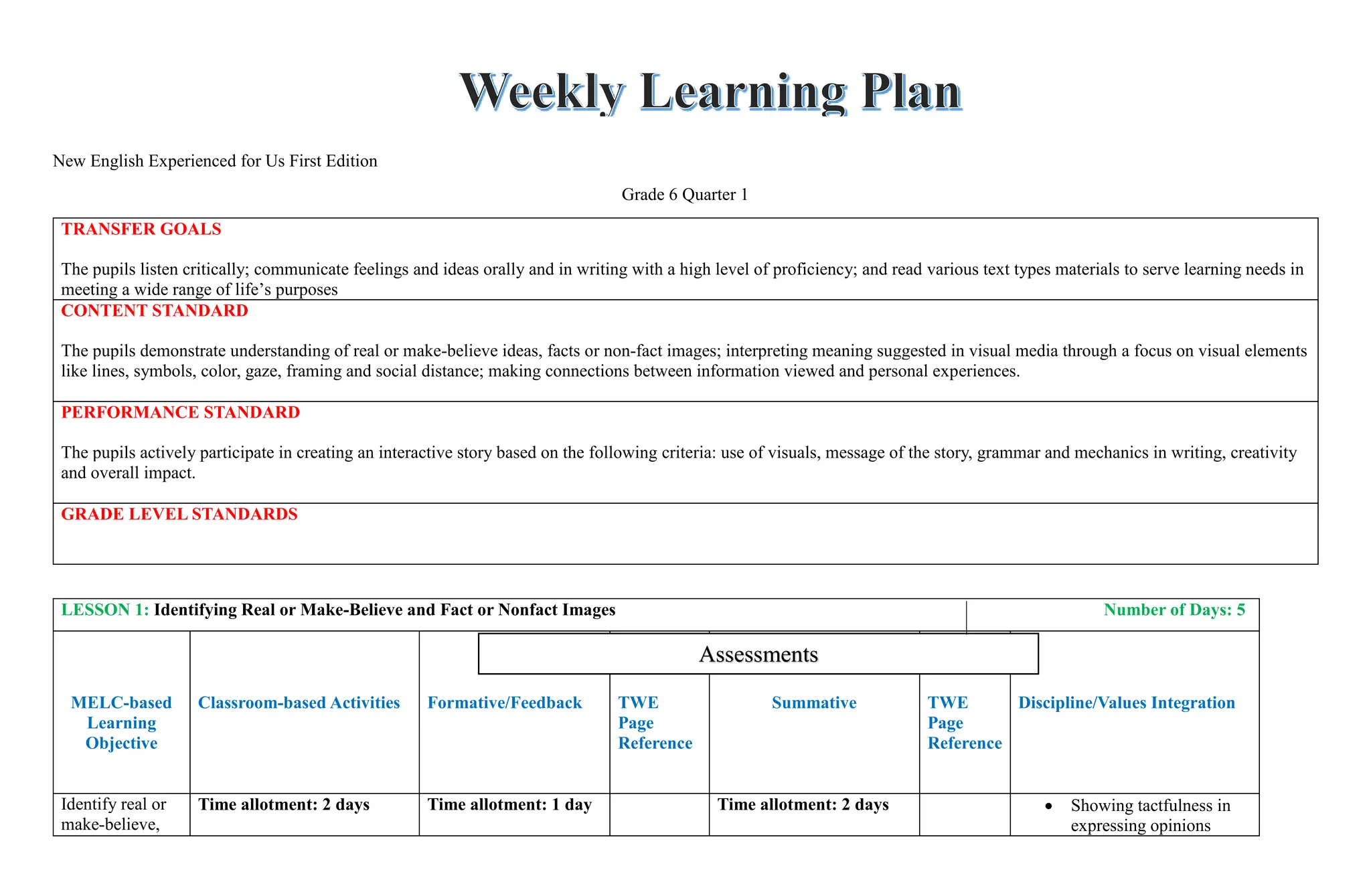
New English Experienced for Us First Edition
Grade 6 Quarter 1
TRANSFER GOALS
The pupils listen critically; communicate feelings and ideas orally and in writing with a high level of proficiency; and read various text types materials to serve learning needs in
meeting a wide range of life’s purposes
CONTENT STANDARD
The pupils demonstrate understanding of real or make-believe ideas, facts or non-fact images; interpreting meaning suggested in visual media through a focus on visual elements
like lines, symbols, color, gaze, framing and social distance; making connections between information viewed and personal experiences.
PERFORMANCE STANDARD
The pupils actively participate in creating an interactive story based on the following criteria: use of visuals, message of the story, grammar and mechanics in writing, creativity
and overall impact.
GRADE LEVEL STANDARDS
LESSON 1: Identifying Real or Make-Believe and Fact or Nonfact Images Number of Days: 5
MELC-based
Learning
Objective
Classroom-based Activities Formative/Feedback TWE
Page
Reference
Summative TWE
Page
Reference
Discipline/Values Integration
Identify real or
make-believe,
Time allotment: 2 days Time allotment: 1 day Time allotment: 2 days  Showing tactfulness in
expressing opinions
Assessments
fact or nonfact
images
EN6VC-IIIa-
6.2
1. Facilitate a direct
discussion of the concept of
Identify real or make-believe,
fact or nonfact images to
answer the questions found in
CHECK In A
2. Process the answer of
students during their sharing
of insights.
3. Instruct the Class to pair
up. Instruct the partners to
share any superstition snd
urban legends they know.
4. To practice the students’
understanding of the lesson,
lead the class in thinking of
one supertstition and one
urban legend answer the
activity Check In B.
5. Call on pupils to share their
answers.
6. Engage the class by
allowing them to visit the
librabrary and picking a
storybook for the next
activity.
7. Remind the class to
observe proper citation of
sources….afterwards process
the pupils answer….
8. instruct the pupils to
complete Challenge 2 and 3
Distinguish the real ones
from the make-believe
4
(Days 4
and 5)
Understanding real or
make-believe, fact or nonf
act images
Interpret messages through
images.
5
(Days 6
and 7)
 Expressing truthfulness
in ideas
9. Provide the class that these
three characters can come
from different movies.
Remind them to have both
real abd make-believe
characters.
10. to wrap up the lesson,
have the students complete
the phrase in check out.
LESSON 2: Interpreting the Meaning Suggested in Visual Media through a Focus on Visual Elements: Lines and Symbol Number of Days: 5
MELC-based
Learning
Objective
Classroom-based Activities Formative/Feedback TWE
Page
Reference
Summative TWE
Page
Reference
Discipline/Values Integration
The pupils
should be able to
Interpret the
meaning
suggested in
visual media
through a focus
on visual
elements: lines
and symbols;
elements: color,
gaze, framing
and social
distance.
EN5VC-IIIf-3.8
Time allotment: 2 days
1. Identifying the meaning of
symbols through personal
illustrations and Analyze
concepts found in personal
images
2. Highlight the clues the
pupils usd for them to be able
to answer the rebus in Check
In
3. Discuss the important
concepts in interpreting
symbols, colors, kind of lines
and vector found in Connect
Time allotment: 2 days
Analyze the visual
elements: lines and
symbols, color, gaze,
framing and social
distance affect the way I
see things around me.
11, 12, 13
(Day 12)
Time allotment: 1 day
interpret visual elements.
Lines, symbols, color,
gaze, framing and social
distance. Practice exercises
about symbols.
CHALLEGE 2 and
CHALLENGE 3
14, 15
(Day 12)
 Showing respect in
giving interpretations of
symbols
 Showing positivity
through creating symbols
Assessments
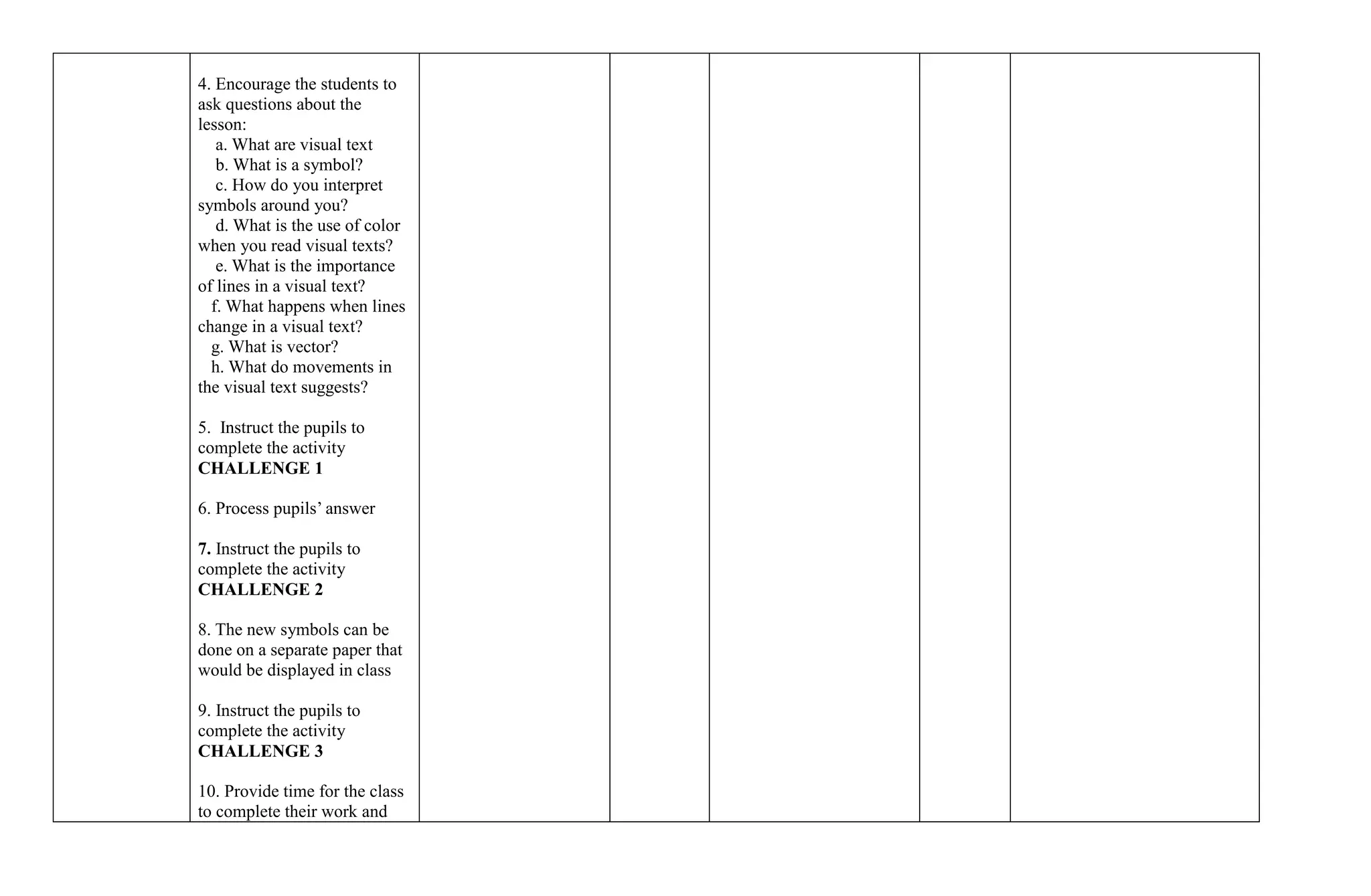
4. Encourage the students to
ask questions about the
lesson:
a. What are visual text
b. What is a symbol?
c. How do you interpret
symbols around you?
d. What is the use of color
when you read visual texts?
e. What is the importance
of lines in a visual text?
f. What happens when lines
change in a visual text?
g. What is vector?
h. What do movements in
the visual text suggests?
5. Instruct the pupils to
complete the activity
CHALLENGE 1
6. Process pupils’ answer
7. Instruct the pupils to
complete the activity
CHALLENGE 2
8. The new symbols can be
done on a separate paper that
would be displayed in class
9. Instruct the pupils to
complete the activity
CHALLENGE 3
10. Provide time for the class
to complete their work and
call out pupils for the
presentation.
11. Have the pupils complete
the Check Out
LESSON 3: Interpreting the Meaning Suggested in Visual Media through a Focus on Visual Elements: Color, Gaze, Framing, and Social Distance
Number of Days: 5
MELC-based
Learning
Objective
Classroom-based Activities Formative/Feedback TWE
Page
Reference
Summative TWE
Page
Reference
Discipline/Values Integration
The pupils
should be able to
Interpret the
meaning
suggested in
visual media
through a focus
on visual
elements: lines
and symbols;
elements: color,
gaze, framing
and social
distance.
EN5VC-IIIf-3.8
Time allotment: 3 days
1. Show series of pictures
showing different themes
taken from the internet. Then
ask the class for their
reactions about each photo by
engaging them in a fast
activity. Check In
2. Engage the class in a show
and tell activity. Process the
answer od pupils on why they
chose those pictures.
3. Ask the questions process:
a. What are visual text
b. What is visual literacy?
c. What are the other
elements in analyzing visual
content?
d. What is color?
Time allotment: 1 day
Identify the techniques
applied in the photos.
Interpret and explain the
message that conveyed
to you as the viewer
19, 20 21,
22
(Day 17)
Time allotment: 2 days
In a group of 3 to 5
members, instruct the
pupils to complete the
Challenge 2.
Give an interpretation in
what you have learned
Challenge 3
22, 23
(Days 18
and 19)
 Showing appreciations
to the beauty of things
around us.
 Expressing good values
through visual media
Assessments
e. How do you interpret
colors around you?
f. What is the use colors
when you read visual text?
g. What is the importance of
colors in a visual text?
h. what is gaze?
i. what is framing?
j. What is social distance?
k. What is gaze distance
does the visual text suggest?
4. Discuss the important
concepts about literarcy,
visual content, visual texts,
elements in visual content
like color, gaze, framing and
social distance found in
Connect.
5.Pair up the pupils. Instruct
them to complete the activity
In Challenge 1
6. Engage the class iin a
breakout rooms dividing them
in 3-5 members
7. In groups of 3-5 members
instruct the pupils to complete
Challenge 2
8. Instruct the class to present
their report in a creative
manner through the use of
visual aids or presentations.
9.Call on groups to present
their work.
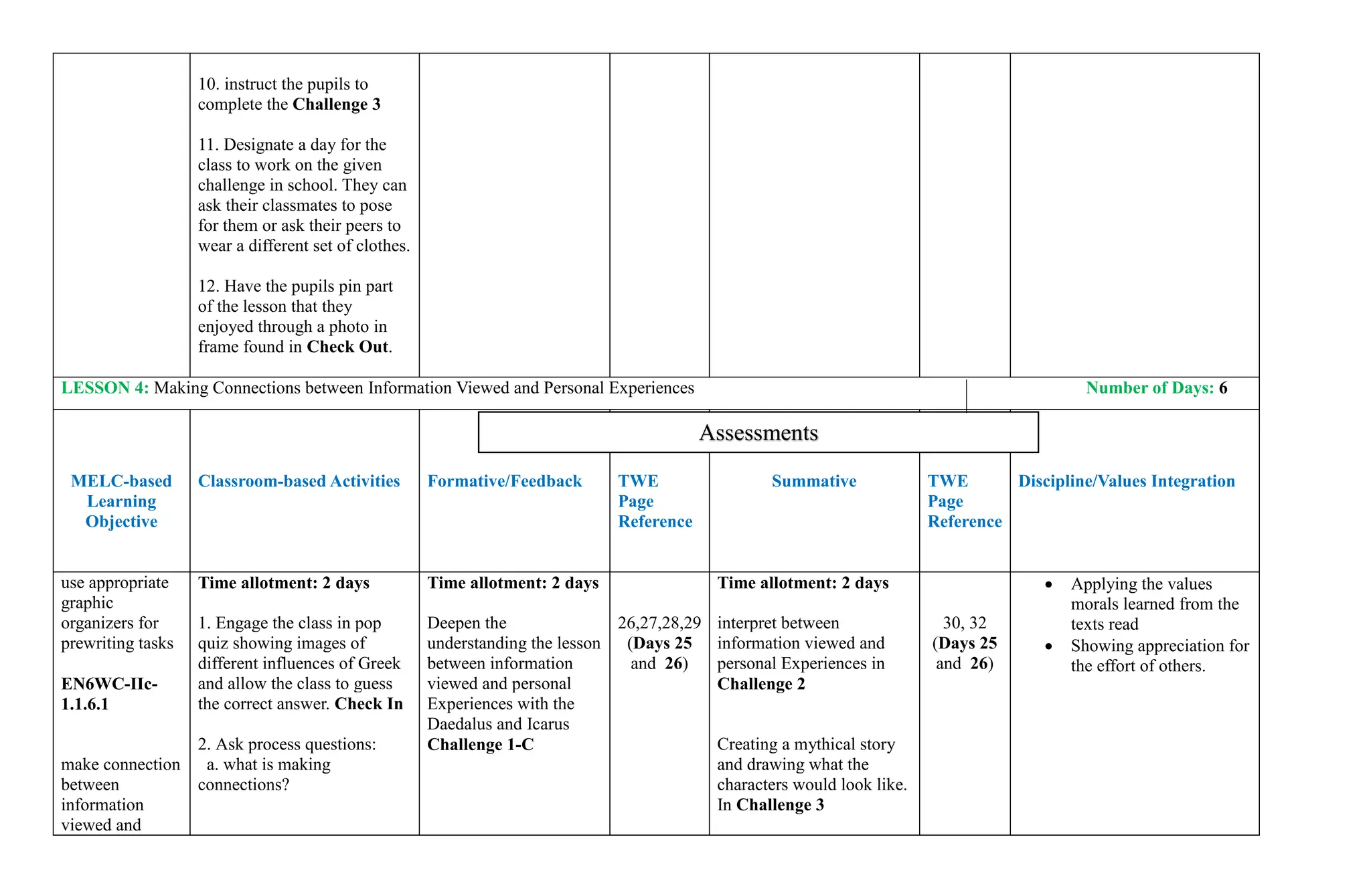
10. instruct the pupils to
complete the Challenge 3
11. Designate a day for the
class to work on the given
challenge in school. They can
ask their classmates to pose
for them or ask their peers to
wear a different set of clothes.
12. Have the pupils pin part
of the lesson that they
enjoyed through a photo in
frame found in Check Out.
LESSON 4: Making Connections between Information Viewed and Personal Experiences Number of Days: 6
MELC-based
Learning
Objective
Classroom-based Activities Formative/Feedback TWE
Page
Reference
Summative TWE
Page
Reference
Discipline/Values Integration
use appropriate
graphic
organizers for
prewriting tasks
EN6WC-IIc-
1.1.6.1
make connection
between
information
viewed and
Time allotment: 2 days
1. Engage the class in pop
quiz showing images of
different influences of Greek
and allow the class to guess
the correct answer. Check In
2. Ask process questions:
a. what is making
connections?
Time allotment: 2 days
Deepen the
understanding the lesson
between information
viewed and personal
Experiences with the
Daedalus and Icarus
Challenge 1-C
26,27,28,29
(Days 25
and 26)
Time allotment: 2 days
interpret between
information viewed and
personal Experiences in
Challenge 2
Creating a mythical story
and drawing what the
characters would look like.
In Challenge 3
30, 32
(Days 25
and 26)
 Applying the values
morals learned from the
texts read
 Showing appreciation for
the effort of others.
Assessments
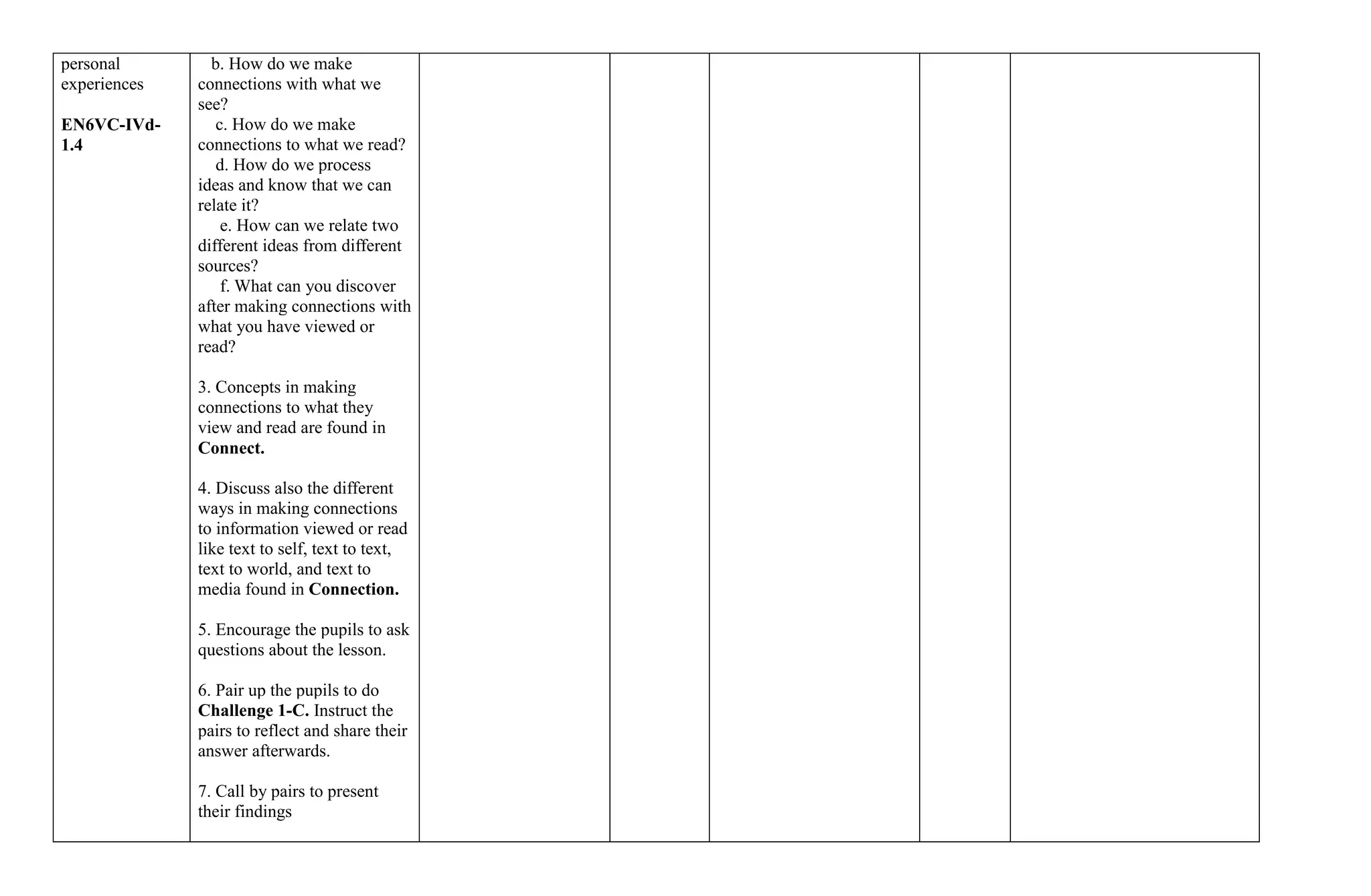
personal
experiences
EN6VC-IVd-
1.4
b. How do we make
connections with what we
see?
c. How do we make
connections to what we read?
d. How do we process
ideas and know that we can
relate it?
e. How can we relate two
different ideas from different
sources?
f. What can you discover
after making connections with
what you have viewed or
read?
3. Concepts in making
connections to what they
view and read are found in
Connect.
4. Discuss also the different
ways in making connections
to information viewed or read
like text to self, text to text,
text to world, and text to
media found in Connection.
5. Encourage the pupils to ask
questions about the lesson.
6. Pair up the pupils to do
Challenge 1-C. Instruct the
pairs to reflect and share their
answer afterwards.
7. Call by pairs to present
their findings
8.Instruct to complete the
Challenge 2
9. Engage the class in a mnini
debate wherein they can share
their insights on how they can
relate the story in real-life-
events.
10. Instruct the pupils to
complete the Challenge 3
11. Provide time fo the class
to complete their work.
Students can be present their
work as a form of poster.
12. Have the pupils Complete
the ranking log found in
Check Out
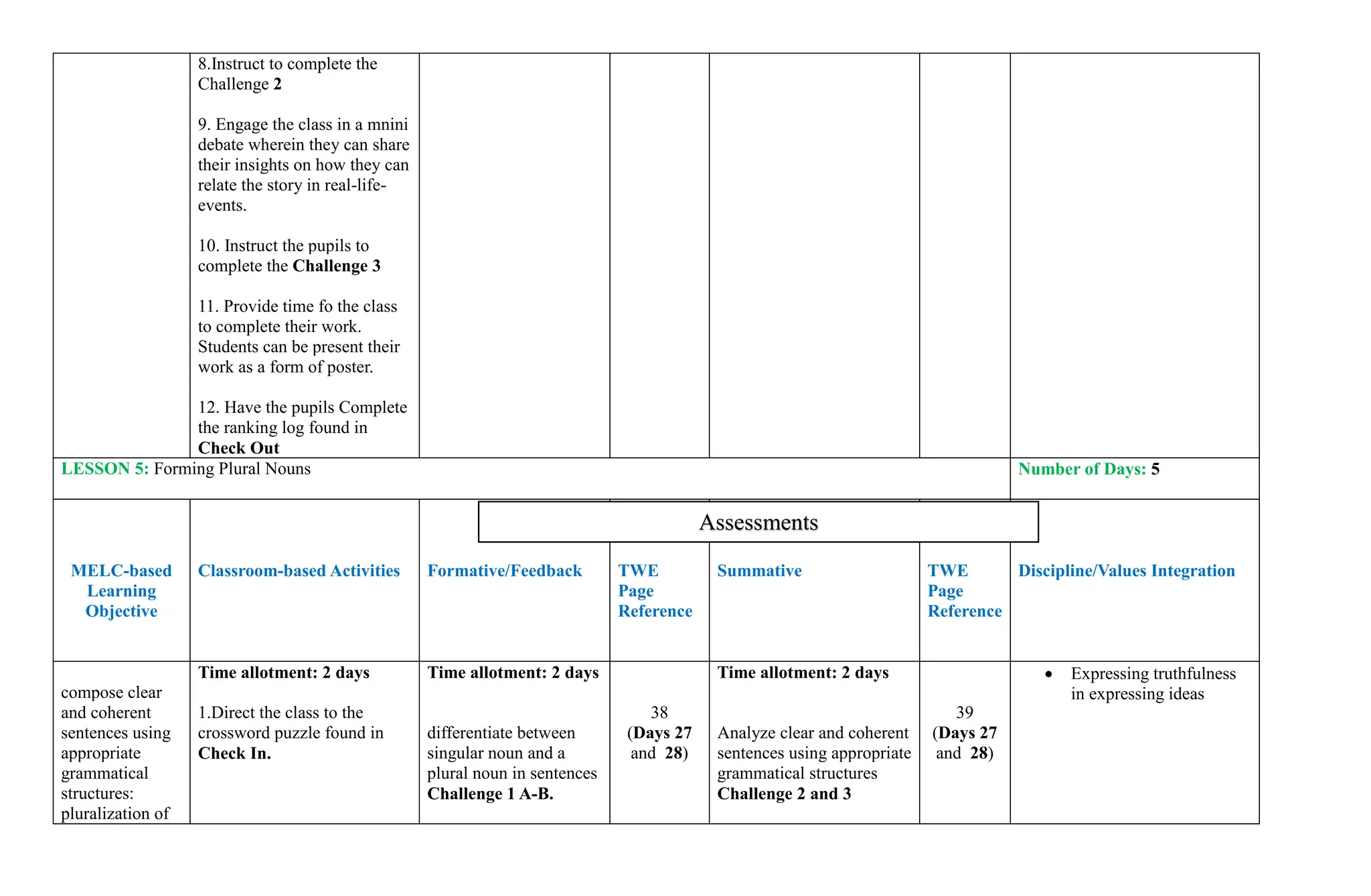
LESSON 5: Forming Plural Nouns Number of Days: 5
MELC-based
Learning
Objective
Classroom-based Activities Formative/Feedback TWE
Page
Reference
Summative TWE
Page
Reference
Discipline/Values Integration
compose clear
and coherent
sentences using
appropriate
grammatical
structures:
pluralization of
Time allotment: 2 days
1.Direct the class to the
crossword puzzle found in
Check In.
Time allotment: 2 days
differentiate between
singular noun and a
plural noun in sentences
Challenge 1 A-B.
38
(Days 27
and 28)
Time allotment: 2 days
Analyze clear and coherent
sentences using appropriate
grammatical structures
Challenge 2 and 3
39
(Days 27
and 28)
 Expressing truthfulness
in expressing ideas
Assessments
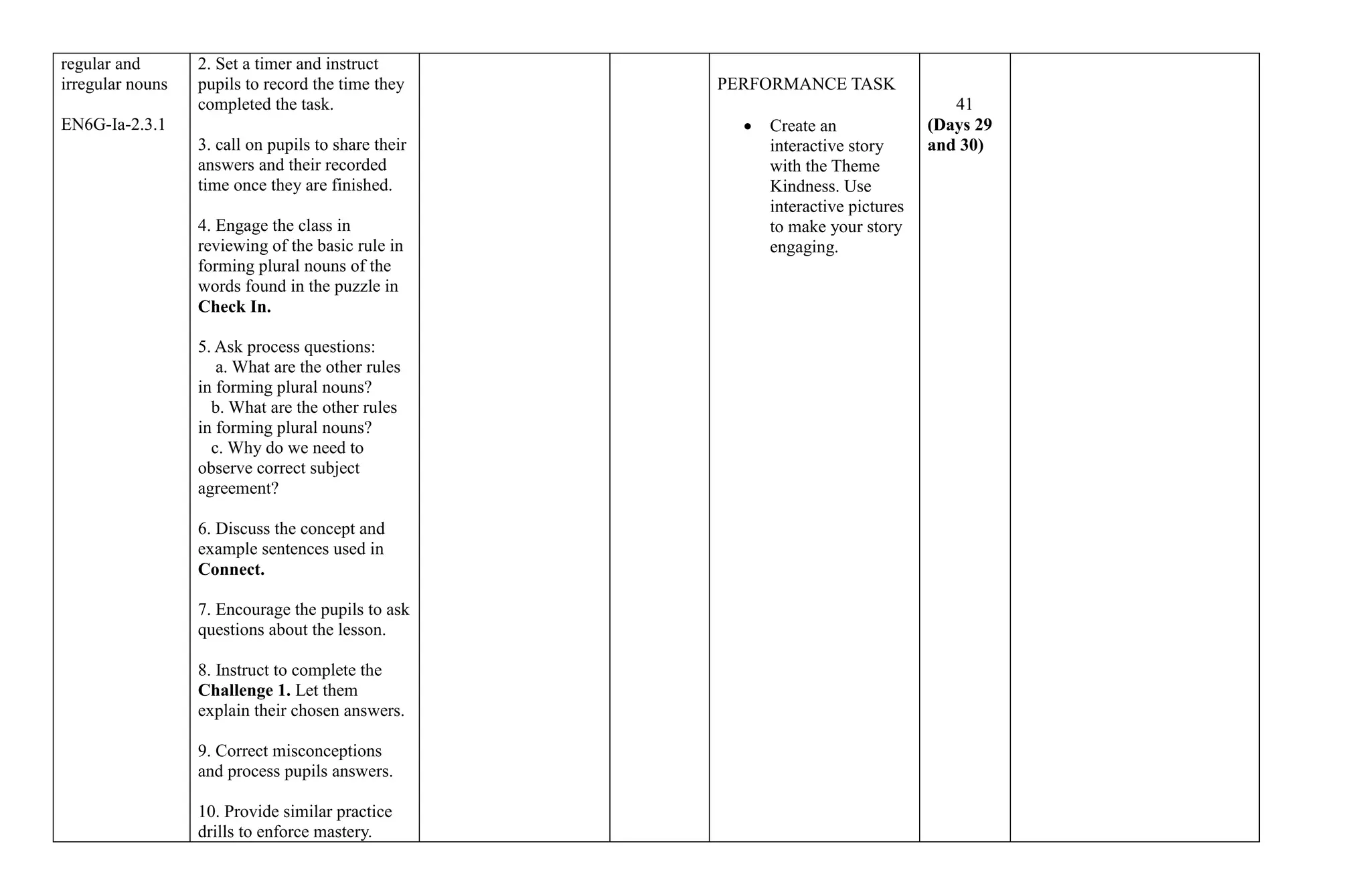
regular and
irregular nouns
EN6G-Ia-2.3.1
2. Set a timer and instruct
pupils to record the time they
completed the task.
3. call on pupils to share their
answers and their recorded
time once they are finished.
4. Engage the class in
reviewing of the basic rule in
forming plural nouns of the
words found in the puzzle in
Check In.
5. Ask process questions:
a. What are the other rules
in forming plural nouns?
b. What are the other rules
in forming plural nouns?
c. Why do we need to
observe correct subject
agreement?
6. Discuss the concept and
example sentences used in
Connect.
7. Encourage the pupils to ask
questions about the lesson.
8. Instruct to complete the
Challenge 1. Let them
explain their chosen answers.
9. Correct misconceptions
and process pupils answers.
10. Provide similar practice
drills to enforce mastery.
PERFORMANCE TASK
 Create an
interactive story
with the Theme
Kindness. Use
interactive pictures
to make your story
engaging.
41
(Days 29
and 30)
11. Instruct the pupils to
answer Challenge 2,
afterwards pupils present their
work in class.
12.Explain to the pupils the
performance task for this unit
found in CREATE
Transfer Activity
Interactive Story for Children. The Theme is Kindness. Use interesting tpictures to make your story engaging. You can
draw and take original photos to make it more compelling for your readers. Use a multimedia resource so that your story
will have a better reflect on the presentation.
For your story to be more interactive, consider the following elements:
 Well-thought-out characters (make-believe or real Characters)
 Excellent visuals that apply the different elements
 Guide questions for your readers
TWE Page Reference
Nexus 6 - Page 41
Criteria Proficient
4
Approaching Profiency
3
Developing
2
Beginning
1
Rating
Use od visuals The visuals show excellent use
in lines, symbols, color, gaze,
framing and social distance.
The visuals show good use
in lines, symbols, color,
gaze, framing and social
distance.
The visuals show
minimal use in lines,
symbols, color, gaze,
framing and social
distance.
The visuals do not show use in lines,
symbols, color, gaze, framing and
social distance.
Message of the
Story
The Message of the story is
very relatable.
The message of the story is
relatable.
The message of the story
is somewhat relatable.
The message of the story is not
relatable at all.
Gammar and
Mechanics in
Writing
There no errors in grammar,
spelling, capitalization and
punctuations
There are one to two errors
in grammar, spelling,
capitalization and
punctuations
There are three to four
errors in grammar,
spelling, capitalization
and punctuations
There are five or more errors in
grammar, spelling, capitalization and
punctuations
School of St. Joseph the Worker Inc.
(Formerly Lyceum of Echague)
Cabugao, Echague, Isabela
QUARTER 1
ENGLISH 6
ON
PROGRESSIVE
CLASSROOM
ENGAGEMENT
PREPARED BY:
RENATO C PINTO JR, LPT
English Teacher

WEEKLY-PLAN-GRADE6 lesson plan for grade 6

  • 1.
    New English Experiencedfor Us First Edition Grade 6 Quarter 1 TRANSFER GOALS The pupils listen critically; communicate feelings and ideas orally and in writing with a high level of proficiency; and read various text types materials to serve learning needs in meeting a wide range of life’s purposes CONTENT STANDARD The pupils demonstrate understanding of real or make-believe ideas, facts or non-fact images; interpreting meaning suggested in visual media through a focus on visual elements like lines, symbols, color, gaze, framing and social distance; making connections between information viewed and personal experiences. PERFORMANCE STANDARD The pupils actively participate in creating an interactive story based on the following criteria: use of visuals, message of the story, grammar and mechanics in writing, creativity and overall impact. GRADE LEVEL STANDARDS LESSON 1: Identifying Real or Make-Believe and Fact or Nonfact Images Number of Days: 5 MELC-based Learning Objective Classroom-based Activities Formative/Feedback TWE Page Reference Summative TWE Page Reference Discipline/Values Integration Identify real or make-believe, Time allotment: 2 days Time allotment: 1 day Time allotment: 2 days  Showing tactfulness in expressing opinions Assessments
  • 2.
    fact or nonfact images EN6VC-IIIa- 6.2 1.Facilitate a direct discussion of the concept of Identify real or make-believe, fact or nonfact images to answer the questions found in CHECK In A 2. Process the answer of students during their sharing of insights. 3. Instruct the Class to pair up. Instruct the partners to share any superstition snd urban legends they know. 4. To practice the students’ understanding of the lesson, lead the class in thinking of one supertstition and one urban legend answer the activity Check In B. 5. Call on pupils to share their answers. 6. Engage the class by allowing them to visit the librabrary and picking a storybook for the next activity. 7. Remind the class to observe proper citation of sources….afterwards process the pupils answer…. 8. instruct the pupils to complete Challenge 2 and 3 Distinguish the real ones from the make-believe 4 (Days 4 and 5) Understanding real or make-believe, fact or nonf act images Interpret messages through images. 5 (Days 6 and 7)  Expressing truthfulness in ideas
  • 3.
    9. Provide theclass that these three characters can come from different movies. Remind them to have both real abd make-believe characters. 10. to wrap up the lesson, have the students complete the phrase in check out. LESSON 2: Interpreting the Meaning Suggested in Visual Media through a Focus on Visual Elements: Lines and Symbol Number of Days: 5 MELC-based Learning Objective Classroom-based Activities Formative/Feedback TWE Page Reference Summative TWE Page Reference Discipline/Values Integration The pupils should be able to Interpret the meaning suggested in visual media through a focus on visual elements: lines and symbols; elements: color, gaze, framing and social distance. EN5VC-IIIf-3.8 Time allotment: 2 days 1. Identifying the meaning of symbols through personal illustrations and Analyze concepts found in personal images 2. Highlight the clues the pupils usd for them to be able to answer the rebus in Check In 3. Discuss the important concepts in interpreting symbols, colors, kind of lines and vector found in Connect Time allotment: 2 days Analyze the visual elements: lines and symbols, color, gaze, framing and social distance affect the way I see things around me. 11, 12, 13 (Day 12) Time allotment: 1 day interpret visual elements. Lines, symbols, color, gaze, framing and social distance. Practice exercises about symbols. CHALLEGE 2 and CHALLENGE 3 14, 15 (Day 12)  Showing respect in giving interpretations of symbols  Showing positivity through creating symbols Assessments
  • 4.
    4. Encourage thestudents to ask questions about the lesson: a. What are visual text b. What is a symbol? c. How do you interpret symbols around you? d. What is the use of color when you read visual texts? e. What is the importance of lines in a visual text? f. What happens when lines change in a visual text? g. What is vector? h. What do movements in the visual text suggests? 5. Instruct the pupils to complete the activity CHALLENGE 1 6. Process pupils’ answer 7. Instruct the pupils to complete the activity CHALLENGE 2 8. The new symbols can be done on a separate paper that would be displayed in class 9. Instruct the pupils to complete the activity CHALLENGE 3 10. Provide time for the class to complete their work and
  • 5.
    call out pupilsfor the presentation. 11. Have the pupils complete the Check Out LESSON 3: Interpreting the Meaning Suggested in Visual Media through a Focus on Visual Elements: Color, Gaze, Framing, and Social Distance Number of Days: 5 MELC-based Learning Objective Classroom-based Activities Formative/Feedback TWE Page Reference Summative TWE Page Reference Discipline/Values Integration The pupils should be able to Interpret the meaning suggested in visual media through a focus on visual elements: lines and symbols; elements: color, gaze, framing and social distance. EN5VC-IIIf-3.8 Time allotment: 3 days 1. Show series of pictures showing different themes taken from the internet. Then ask the class for their reactions about each photo by engaging them in a fast activity. Check In 2. Engage the class in a show and tell activity. Process the answer od pupils on why they chose those pictures. 3. Ask the questions process: a. What are visual text b. What is visual literacy? c. What are the other elements in analyzing visual content? d. What is color? Time allotment: 1 day Identify the techniques applied in the photos. Interpret and explain the message that conveyed to you as the viewer 19, 20 21, 22 (Day 17) Time allotment: 2 days In a group of 3 to 5 members, instruct the pupils to complete the Challenge 2. Give an interpretation in what you have learned Challenge 3 22, 23 (Days 18 and 19)  Showing appreciations to the beauty of things around us.  Expressing good values through visual media Assessments
  • 6.
    e. How doyou interpret colors around you? f. What is the use colors when you read visual text? g. What is the importance of colors in a visual text? h. what is gaze? i. what is framing? j. What is social distance? k. What is gaze distance does the visual text suggest? 4. Discuss the important concepts about literarcy, visual content, visual texts, elements in visual content like color, gaze, framing and social distance found in Connect. 5.Pair up the pupils. Instruct them to complete the activity In Challenge 1 6. Engage the class iin a breakout rooms dividing them in 3-5 members 7. In groups of 3-5 members instruct the pupils to complete Challenge 2 8. Instruct the class to present their report in a creative manner through the use of visual aids or presentations. 9.Call on groups to present their work.
  • 7.
    10. instruct thepupils to complete the Challenge 3 11. Designate a day for the class to work on the given challenge in school. They can ask their classmates to pose for them or ask their peers to wear a different set of clothes. 12. Have the pupils pin part of the lesson that they enjoyed through a photo in frame found in Check Out. LESSON 4: Making Connections between Information Viewed and Personal Experiences Number of Days: 6 MELC-based Learning Objective Classroom-based Activities Formative/Feedback TWE Page Reference Summative TWE Page Reference Discipline/Values Integration use appropriate graphic organizers for prewriting tasks EN6WC-IIc- 1.1.6.1 make connection between information viewed and Time allotment: 2 days 1. Engage the class in pop quiz showing images of different influences of Greek and allow the class to guess the correct answer. Check In 2. Ask process questions: a. what is making connections? Time allotment: 2 days Deepen the understanding the lesson between information viewed and personal Experiences with the Daedalus and Icarus Challenge 1-C 26,27,28,29 (Days 25 and 26) Time allotment: 2 days interpret between information viewed and personal Experiences in Challenge 2 Creating a mythical story and drawing what the characters would look like. In Challenge 3 30, 32 (Days 25 and 26)  Applying the values morals learned from the texts read  Showing appreciation for the effort of others. Assessments
  • 8.
    personal experiences EN6VC-IVd- 1.4 b. How dowe make connections with what we see? c. How do we make connections to what we read? d. How do we process ideas and know that we can relate it? e. How can we relate two different ideas from different sources? f. What can you discover after making connections with what you have viewed or read? 3. Concepts in making connections to what they view and read are found in Connect. 4. Discuss also the different ways in making connections to information viewed or read like text to self, text to text, text to world, and text to media found in Connection. 5. Encourage the pupils to ask questions about the lesson. 6. Pair up the pupils to do Challenge 1-C. Instruct the pairs to reflect and share their answer afterwards. 7. Call by pairs to present their findings
  • 9.
    8.Instruct to completethe Challenge 2 9. Engage the class in a mnini debate wherein they can share their insights on how they can relate the story in real-life- events. 10. Instruct the pupils to complete the Challenge 3 11. Provide time fo the class to complete their work. Students can be present their work as a form of poster. 12. Have the pupils Complete the ranking log found in Check Out LESSON 5: Forming Plural Nouns Number of Days: 5 MELC-based Learning Objective Classroom-based Activities Formative/Feedback TWE Page Reference Summative TWE Page Reference Discipline/Values Integration compose clear and coherent sentences using appropriate grammatical structures: pluralization of Time allotment: 2 days 1.Direct the class to the crossword puzzle found in Check In. Time allotment: 2 days differentiate between singular noun and a plural noun in sentences Challenge 1 A-B. 38 (Days 27 and 28) Time allotment: 2 days Analyze clear and coherent sentences using appropriate grammatical structures Challenge 2 and 3 39 (Days 27 and 28)  Expressing truthfulness in expressing ideas Assessments
  • 10.
    regular and irregular nouns EN6G-Ia-2.3.1 2.Set a timer and instruct pupils to record the time they completed the task. 3. call on pupils to share their answers and their recorded time once they are finished. 4. Engage the class in reviewing of the basic rule in forming plural nouns of the words found in the puzzle in Check In. 5. Ask process questions: a. What are the other rules in forming plural nouns? b. What are the other rules in forming plural nouns? c. Why do we need to observe correct subject agreement? 6. Discuss the concept and example sentences used in Connect. 7. Encourage the pupils to ask questions about the lesson. 8. Instruct to complete the Challenge 1. Let them explain their chosen answers. 9. Correct misconceptions and process pupils answers. 10. Provide similar practice drills to enforce mastery. PERFORMANCE TASK  Create an interactive story with the Theme Kindness. Use interactive pictures to make your story engaging. 41 (Days 29 and 30)
  • 11.
    11. Instruct thepupils to answer Challenge 2, afterwards pupils present their work in class. 12.Explain to the pupils the performance task for this unit found in CREATE Transfer Activity Interactive Story for Children. The Theme is Kindness. Use interesting tpictures to make your story engaging. You can draw and take original photos to make it more compelling for your readers. Use a multimedia resource so that your story will have a better reflect on the presentation. For your story to be more interactive, consider the following elements:  Well-thought-out characters (make-believe or real Characters)  Excellent visuals that apply the different elements  Guide questions for your readers TWE Page Reference Nexus 6 - Page 41 Criteria Proficient 4 Approaching Profiency 3 Developing 2 Beginning 1 Rating Use od visuals The visuals show excellent use in lines, symbols, color, gaze, framing and social distance. The visuals show good use in lines, symbols, color, gaze, framing and social distance. The visuals show minimal use in lines, symbols, color, gaze, framing and social distance. The visuals do not show use in lines, symbols, color, gaze, framing and social distance. Message of the Story The Message of the story is very relatable. The message of the story is relatable. The message of the story is somewhat relatable. The message of the story is not relatable at all. Gammar and Mechanics in Writing There no errors in grammar, spelling, capitalization and punctuations There are one to two errors in grammar, spelling, capitalization and punctuations There are three to four errors in grammar, spelling, capitalization and punctuations There are five or more errors in grammar, spelling, capitalization and punctuations
  • 12.
    School of St.Joseph the Worker Inc. (Formerly Lyceum of Echague) Cabugao, Echague, Isabela QUARTER 1 ENGLISH 6 ON PROGRESSIVE CLASSROOM ENGAGEMENT PREPARED BY: RENATO C PINTO JR, LPT English Teacher