• False promiseof biofuels
o Corn ethanol
GHGs
Environment
Global effects
o Cellulosic ethanol
o Algae biofuels
• Fool’s errand?
2
Photo Sources (this and previous slide):
1) Biello, D. (2011). The false promise of biofuels. Scientific American, 305, 58–65.
2) DeCicco, J. (2021, December 2). The U.S. biofuel mandate helps farmers, but does little for energy security and harms the environmen t. The Conversation. Retrieved March 21, 2022
from https://theconversation.com/the-us-biofuel-mandate-helps-farmers-but-does-little-for-energy-security-and-harms-the-environment-168459 [corn being
harvested on previous slide]
Outline
Reference:
2.
False promise ofbiofuels
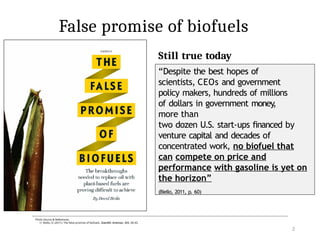
“Despite the best hopes of
scientists, CEOs and government
policy makers, hundreds of millions
of dollars in government money
,
more than
two dozen U.S. start-ups financed by
venture capital and decades of
concentrated work, no biofuel that
can compete on price and
performance with gasoline is yet on
the horizon”
(Biello, 2011, p. 60)
Published: 2005
Still true today
Photo Source & References:
1) Biello, D. (2011). The false promise of biofuels. Scientific American, 305, 58–65.
2
3.
Biofuels – goodidea?
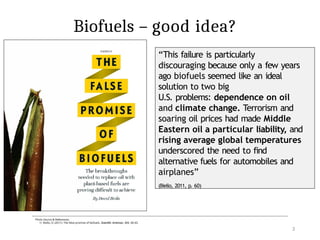
“This failure is particularly
discouraging because only a few years
ago biofuels seemed like an ideal
solution to two big
U.S. problems: dependence on oil
and climate change. Terrorism and
soaring oil prices had made Middle
Eastern oil a particular liability, and
rising average global temperatures
underscored the need to find
alternative fuels for automobiles and
airplanes”
(Biello, 2011, p. 60)
Published: 2005
Photo Source & References:
1) Biello, D. (2011). The false promise of biofuels. Scientific American, 305, 58–65.
3
4.
Biofuels – goodidea?
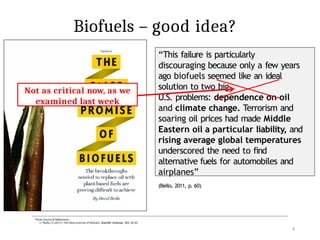
“This failure is particularly
discouraging because only a few years
ago biofuels seemed like an ideal
solution to two big
U.S. problems: dependence on oil
and climate change. Terrorism and
soaring oil prices had made Middle
Eastern oil a particular liability, and
rising average global temperatures
underscored the need to find
alternative fuels for automobiles and
airplanes”
(Biello, 2011, p. 60)
Published: 2005
Not as critical now, as we
examined last week
Photo Source & References:
1) Biello, D. (2011). The false promise of biofuels. Scientific American, 305, 58–65.
4
5.
6
Figure Source &References:
1) EIA. (2020, March 3). U.S. crude oil production grew 11% in 2019, surpassing 12 million barrels per day. Retrieved March 22, 2021 from https://www.hellenicshippingnews.com/u-s-crude-oil-
production- grew-11-in-2019-surpassing-12-million-barrels-per-day/
2) EIA. (2020, April 27). Oil and petroleum products explained. Retrieved March 22, 2021 from https://www.eia.gov/energyexplained/oil-and-petroleum-products/imports-and-exports.php
[reference]
1973: 40% net
petroleum
import 2019: 3% net petroleum
import lowest level
since 1954
2008: Oil shale
production began
2005: Record 60%
net petroleum
import
U.S. production & net import
Hubbert’s Peak Oil
(conventional oil)
6.
U.S. production in2020
Top 5 producers
represent 54% of the
total production
Figure Source:
1) U.S. Energy Information Administration. (2021, December 8). What countries are the top producers and consumers of oil? Retrieved March 14, 2022
from https://www.eia.gov/tools/faqs/faq.php?id=709&t=6 [reference]
6
The 10 largest oil production and share of total world oil production in 2020
7.
U.S. consumption in2019
Figure Source:
1) U.S. Energy Information Administration. (2021, December 8). What countries are the top producers and consumers of oil? Retrieved March 14, 2022
from https://www.eia.gov/tools/faqs/faq.php?id=709&t=6 [reference]
7
Top 5 consumers
represent 47% of the
total consumption
The 10 largest oil consumers and share of total oil consumption in 2019
8.
Biofuels – goodidea?
Photo Source & References:
1) Biello, D. (2011). The false promise of biofuels. Scientific American, 305, 58–65.
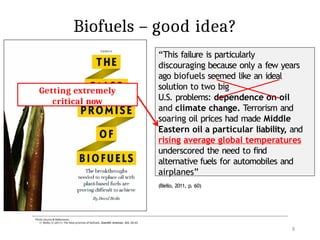
“This failure is particularly
discouraging because only a few years
ago biofuels seemed like an ideal
solution to two big
U.S. problems: dependence on oil
and climate change. Terrorism and
soaring oil prices had made Middle
Eastern oil a particular liability, and
rising average global temperatures
underscored the need to find
alternative fuels for automobiles and
airplanes”
(Biello, 2011, p. 60)
Published: 2005
Getting extremely
critical now
8
9.
10
Biofuels – goodidea?
Figure Source & References:
1) Biello, D. (2011). The false promise of biofuels. Scientific American, 305, 58–65.
2) Small Cycle. (2020, December 12). Biofuels for beginners: Definition, type, advantage. Retrieved March 15, 2022 from https://
www.smallcycle.com/2020/12/biofuels-for-beginners-definition-type- advantage.html [figure of biofuel cycle]
“Because biofuels come
from plants, which absorb
carbon dioxide from the
atmosphere as they grow,
burning biofuels in
vehicles would in theory
slow the buildup of
greenhouse gases,
compared with burning
fossil fuels” (Biello, 2011, p. 60)
10.
Energy Independence andSecurity Act of 2007
• Originally named Clean Energy Act of 2007
• Established Renewable Fuel Standard (RFS)
o Requires transportation fuel sold in U.S. to
contain minimum volume of
renewable fuels
o Increasing amounts of renewable fuel each
year reaching 36 billion gallons
by 2022
o Each renewable fuel must emit lower
levels of GHGs relative to fuel it
replaces
11
Photo Source & References:
1) U.S. Department of Energy. (n.d.). Renewable fuel standard. Retrieved March 21, 2022 from
https://afdc.energy.gov/laws/RFS.html#:~:text=The%20Renewable%20Fuel%20Standard%20(RFS,Act%20of%202007%20(EISA). [reference for
program]
2) U.S. Environmental Protection Agency. (2021, April 1). Summary of the Energy Independence and Security Act. Retrieved March 20, 2022 from https:/
/www.epa.gov/laws-regulations/summary-energy- independence-and-security-act [quotation]
The beginning . . .
“. . . aims to move the United States toward
greater energy independence and security; to
increase the production of clean renewable fuels;
protect
consumers . . .” (U.S. Environmental Protection Agency, 2021)
Ethanol production facility in South
Bend, Indiana (U.S.)
11.
12
References:
1) U.S. EnvironmentalProtection Agency. (2021, April 1). Summary of the Energy Independence and Security Act. Retrieved March 20, 2022 from https:/
/www.epa.gov/laws-regulations/summary-energy- independence-and-security-act [quotation]
2) Griffin, W. M., Saville, B. A., & MacLean, H. L. (2016). Ethanol use in the United States: Status, threats and the potential future. In S. L. M. Salles-Filho, L. A. B. Cortez, J. M. F. Jardim da Silveira, S.
C. Trindade, & M. d. G. D. Fonseca (Eds.), Global bioethanol: Evolution, risks, and uncertainties (pp. 34–62). London, UK: Elsevier Inc.
The beginning . . .
“The Energy Independence and
Security Act of 2007 mandates
the following GHG reductions
compared to gasoline (or diesel
for biodiesel):
• 60% for cellulosic
biofuels [16 billion
gallons]
• 50% for advanced
biofuels [5 billion gallons]
• 20% for new corn
ethanol capacity [15
billion gallons]”
(Griffin, Saville, & MacLean, 2016, p. 44)
Original goals
Volume requirements for renewable fuels
through 2022 as mandated by Energy
Independence and Security Act of 2007
(36 billion gallons by 2022)
12.
Biofuels
13
Figure Source &References:
1) Gewin, V. (2022, February 14). How corn ethanol for biofuel fed climate change. Retrieved March 21, 2022 from https://civileats.com/2022/02/14/how-corn-ethanol-for-biofuel-fueled-climate-change/ [facts about being
world leader]
2) nternational Energy Agency. (2021). Bioenergy. Retrieved March 14, 2022 from https://www.iea.org/fuels-and-technologies/bioenergy [facts about bioenergy usage in 2021]
3) Sönnichsen, M. (2021, July 29). Leading countries based on biofuel production worldwide in 2020. Retrieved March 14, 2022 from https://
www.statista.com/statistics/274168/biofuel-production-in-leading-countries-in-oil-equivalent/
Leading countries based on biofuel
production in 2020 (in petajoules)
• U.S. is world leader in biofuel
production
• 47% of global output over last
10 years
• Accounted for 38% of global
biofuel production in 2020
o Major user is U.S. military
o Many vehicles can be fueled
with blends up to 10%
ethanol
13.
“Great Green Fleet”demonstration (2012)
14
Photo Source & References:
1) Goldenberg, S. (2012, July 20). U.S. Navy defends „great green fleet“ from Republican attacks. The Guardian. Retrieved March 22, 2022 from https://
www.theguardian.com/environment/2012/jul/20/us-navy-great-green-fleet-republicans [quotation reference]
2) Hicks, T. (2012, July 27). Navy: We‘ll never, ever overpay for biofuels. Retrieved March 22, 2022 from https://www.wired.com/2012/07/biofuel-pushback/ [photo of Great Green Fleet demonstration]
The Great Green Fleet demonstration
Photo: U.S. Navy
“The aircraft carrier USS Nimitz and a
strike force of 71 jet fighters,
helicopters and transport planes, set
off on a demonstration voyage off the
Hawaiian island of Oahu this week [in
July 2012], powered by a 50-50 mix of
conventional fuels and algae or cooking
oil. . . .
But the project became controversial late
last year when the navy spent $450,000
on biofuels, paying about $15 a gallon for
used chicken fat with a dash of algae,
compared to $3.60 for conventional
fuel” (Goldenberg, 2012)
14.
“Great Green Fleet”demonstration (2012)
15
Photo Source & Reference:
1) Goldenberg, S. (2012, July 20). U.S. Navy defends „great green fleet“ from Republican attacks. The Guardian. Retrieved March 22, 2022 from https://
www.theguardian.com/environment/2012/jul/20/us- navy-great-green-fleet-republicans [photo & quotation reference]
• Chief of naval operations Admiral Jonathan
Greenert (left)
• U.S. Navy Secretary Ray Mabus (blue shirt)
“Absolutely it was worthwhile to show
that biofuels can compete and can be
used in every single thing that we do in
the navy
," [U.S. Navy Secretary] Mabus
said. ‘This shows that it's operational.
Everything before now has been a test.
This shows we can use biofuels and
other alternative energies in an
operational manner
. . . .
We simply have to figure out a way to
get American-made, homegrown
fuel that is stably priced, that is
competitive with oil,’ he said”
(Goldenberg, 2012)
15.
• False promiseof biofuels
o Corn ethanol
GHGs
Environment
Global effects
o Cellulosic ethanol
o Algae biofuels
• Fool’s errand?
16
Photo Sources (this and previous slide):
1) Biello, D. (2011). The false promise of biofuels. Scientific American, 305, 58–65.
2) DeCicco, J. (2021, December 2). The U.S. biofuel mandate helps farmers, but does little for energy security and harms the environmen t. The Conversation. Retrieved March 21, 2022
from https://theconversation.com/the-us-biofuel-mandate-helps-farmers-but-does-little-for-energy-security-and-harms-the-environment-168459 [corn being
harvested on previous slide]
Outline
Reference:
16.
17
Photo Source &References:
1) Sakai, J. (2022, February 14). At bioenergy crossroads, should corn ethanol be left in the rearview mirror? Retrieved March 21, 2022 from https://news.wisc.edu/at-bioenergy-crossroads-
should-corn- ethanol-be-left-in-the-rearview-mirror/ [quotation reference]
2) U.S. Environmental Protection Agency. (2021, November 19). Overview of greenhouse gases. Retrieved March 21, 2022 from https://www.epa.gov/ghgemissions/overview-greenhouse-gases
[CO2 emissions by source]
“Transportation is responsible for a
larger share of greenhouse gas emissions
than any other sector of the U.S.
economy, making biofuels a promising
strategy to mitigate human-driven
climate change.The
U.S. Renewable Fuel Standard, created
by 2007 legislation, mandates that such
fuels partially replace petroleum-based
ones. So far
, however
, the mandate has
been nearly entirely fulfilled by corn
ethanol, a fuel that may be worse for
the climate than the gasoline it
replaces”
(Sakai, 2022)
Corn ethanol
17.
18
“Under the RenewableFuel Standard, a fuel
had to achieve at least a 20% reduction in
greenhouse gas emissions relative to
petroleum to qualify as renewable. Corn
ethanol just met the threshold in the EPA’s
2010 regulatory impact analysis, with
emissions estimated to be 20–21%
lower compared with gasoline.
But ethanol’s environmental profile hasn’t
matched expectations. In the EPA’s
regulatory analysis, they estimated a very
small amount of domestic land use
change . . . and maybe rightfully so. No
one expected such a big response,
because cropland area in the U.S. had been
declining for the previous 30 years”
(Sakai, 2022)
Reference:
1) Sakai, J. (2022, February 14). At bioenergy crossroads, should corn ethanol be left in the rearview mirror? Retrieved March 21, 2022 from https://news.wisc.edu/at-bioenergy-crossroads-
should-corn- ethanol-be-left-in-the-rearview-mirror/ [reference]
Corn ethanol
18.
19
Figure Source &References:
1) U.S. Energy Information Administration. (2021, September 3). U.S. fuel ethanol plant production capacity. Retrieved March 20, 2022 from https://www.eia.gov/petroleum/ethanolcapacity/ [U.S. fuel
ethanol plants figure & reference of corn ethanol gallons in 2020]
2) Wulfeck, A. (2022, February 22). Corn ethanol may be worse for the planet than gasoline, study stays. Fox Weather. Retrieved March 21, 2022 from https:/
/www.foxweather.com/lifestyle/corn-ethanol-may- be-worse-for-the-planet-than-gasoline-study-says [quotation reference]
“According to the U.S. Energy
Information Administration, six states
produce more than 70 percent of U.S.
fuel ethanol in the country, with Iowa
leading the pack”
(Wulfeck, 2022)
U.S. fuel ethanol plant count by state,
2021
Corn ethanol & GHGs
19.
20
Photo Source &References:
1) Biello, D. (2011). The false promise of biofuels. Scientific American, 305, 58–65.
2) U.S. Energy Information Administration. (2021, September 3). U.S. fuel ethanol plant production capacity. Retrieved March 20, 2022 from https://www.eia.gov/petroleum/ethanolcapacity/ [U.S. fuel
ethanol plants figure & reference of corn ethanol gallons in 2020]
“The notion that biofuels technology is
not living up to expectations may seem
odd, given the rapid expansion in recent
years of corn ethanol. U.S. production
went from 50 million gallons in 1979
to 13 billion gallons in 2010 [17.5 billion
gallons in 2020]. A government
mandate to supply 10 percent of the
country’s passenger vehicle fuel drove
that enormous growth, however
, and the
product has been affordable only
because of massive federal
subsidies”
(Biello, 2011, p. 60)
U.S. fuel ethanol plant count by state,
2021
Corn ethanol
20.
Photo Source &References:
1) Biello, D. (2011). The false promise of biofuels. Scientific American, 305, 58–65.
20
21.
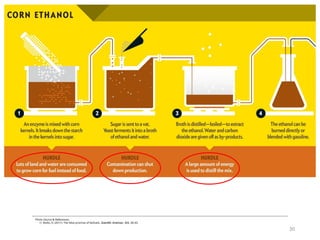
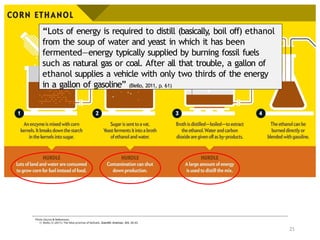
“Lots of energyis required to distill (basically
, boil off) ethanol
from the soup of water and yeast in which it has been
fermented—energy typically supplied by burning fossil fuels
such as natural gas or coal. After all that trouble, a gallon of
ethanol supplies a vehicle with only two thirds of the energy
in a gallon of gasoline” (Biello, 2011, p. 61)
Photo Source & References:
1) Biello, D. (2011). The false promise of biofuels. Scientific American, 305, 58–65.
21
22.
23
Photo Source &References:
1) Biello, D. (2011). The false promise of biofuels. Scientific American, 305, 58–65.
2) DeCicco, J. (2021, December 2). Opinion: It’s time to admit that ethanol in gasoline has failed to fulfill its promises (except to farmers). The Conversation. Retrieved march 20,
2022 from https://www.marketwatch.com/story/its-time-to-admit-that-ethanol-in-gasoline-has-failed-to-fulfill-its-promises-except-to-farmers-11638463480 [data for
21.8% in 2020]
3) Gewin, V. (2022, February 14). How corn ethanol for biofuel fed climate change. Retrieved March 21, 2022 from https://civilea ts.com/2022/02/14/how-corn-ethanol-for-biofuel-fueled-climate-
“Those energy inputs cost money, too, and corn ethanol may
never compete on price with gasoline without subsidies.
Greater production is also limited by fertile land. In October
2010 the Congressional Research Service reported that if the
entire record U.S. corn crop of 2009 was used to make
ethanol, it would replace only 18 percent [still 18% in 2020
due to increased consumption] of the country’s gasoline
consumption. ‘Expanding corn-based ethanol to significantly
promote U.S. energy security is likely to be infeasible,’
the researchers concluded” (Biello, 2011, p. 61)
23.
• False promiseof biofuels
o Corn ethanol
GHGs
Environment
Global effects
o Cellulosic ethanol
o Algae biofuels
• Fool’s errand?
24
Photo Sources (this and previous slide):
1) Biello, D. (2011). The false promise of biofuels. Scientific American, 305, 58–65.
2) DeCicco, J. (2021, December 2). The U.S. biofuel mandate helps farmers, but does little for energy security and harms the environmen t. The Conversation. Retrieved March 21, 2022
from https://theconversation.com/the-us-biofuel-mandate-helps-farmers-but-does-little-for-energy-security-and-harms-the-environment-168459 [corn being
harvested on previous slide]
Outline
Reference:
24.
25
Reference:
1) Sakai, J.(2022, February 14). At bioenergy crossroads, should corn ethanol be left in the rearview mirror? Retrieved March 21, 2022 from https://news.wisc.edu/at-bioenergy-crossroads-
should-corn- ethanol-be-left-in-the-rearview-mirror/ [reference]
Corn ethanol & GHGs
• Does substituting corn ethanol for
gasoline lead to an overall decrease
in GHG emissions?
• What do you think?
• Short answer: No one yet knows for
sure
25.
Corn ethanol &GHGs
“A U.S. Department of Agriculture report
in 2019 said greenhouse gas emissions
from corn-based ethanol were 39%
lower than gasoline over the entire life
cycle, from initial production of raw
materials to eventual combustion in
vehicles.The study also states that when
ethanol is refined at natural gas-powered
refineries, the greenhouse gas emissions
are even lower,
around 43% below gasoline” (Smith, 2022)
References:
1) Smith, A. N. (2022, February 15). Ethanol less green than gas, study funded by biofuel critics says. Bloomberg Green. Retrieved March 21, 2022 from https:/
/www.bloomberg.com/news/articles/2022-02- 14/study-funded-by-biofuel-critics-says-ethanol-less-green-than-gas [quotation reference]
2) U.S. Department of Agricutture. (2019, April 2). USDA study shows significant greenhouse gas benefits of ethanol compared with gasoline. Retrieved March 12 ,
2022 from https://www.usda.gov/media/press-releases/2019/04/02/usda-study-shows-significant-greenhouse-gas-benefits-ethanol
25
• Does substituting corn ethanol for
gasoline lead to an overall decrease
in GHG emissions?
• USDA says YES!
26.
Corn ethanol &GHGs
“‘These new findings provide further
evidence that biofuels from America's
heartland reduce greenhouse gases even
more than we thought, and that our
farmers and ethanol plants continue to
become more efficient and effective,’ said
Secretary [of Agriculture] Sonny Perdue.
‘President Trump has made it abundantly
clear he is unleashing the full potential of
American energy production as we retake
our rightful place as the world’s leader’” (U.S.
Department of Agriculture, 2019)
References:
1) Smith, A. N. (2022, February 15). Ethanol less green than gas, study funded by biofuel critics says. Bloomberg Green. Retrieved March 21, 2022 from https:/
/www.bloomberg.com/news/articles/2022-02- 14/study-funded-by-biofuel-critics-says-ethanol-less-green-than-gas [quotation reference]
2) U.S. Department of Agricutture. (2019, April 2). USDA study shows significant greenhouse gas benefits of ethanol compared with gasoline. Retrieved March 12 ,
2022 from https://www.usda.gov/media/press-releases/2019/04/02/usda-study-shows-significant-greenhouse-gas-benefits-ethanol
26
• USDA says YES! But, there seems to
be a conflict of interest . . .
27.
28
Higher profits formany farmers
The [Renewable Fuel Standard] RFS’s
clearest success has been boosting income
for corn and soybean farmers and
related agricultural firms. It also has built
up a sizable domestic biofuel industry.
The Renewable Fuels Association, a trade
group for the biofuels industry, estimates
that the RFS has generated over 300,000
jobs in recent years.Two-thirds of these jobs
are in the top ethanol-producing states:
Iowa, Nebraska, Illinois, Minnesota, Indiana
and South Dakota. Given Iowa’s key role
in presidential primaries, most
politicians with national ambitions find it
prudent to embrace biofuels” (DeCicco, 2021)
Reference:
1) DeCicco, J. (2021, December 2). The U.S. biofuel mandate helps farmers, but does little for energy security and harms the environmen t. The Conversation. Retrieved March 21, 2022
from https://theconversation.com/the-us-biofuel-mandate-helps-farmers-but-does-little-for-energy-security-and-harms-the-environment-168459 [corn ethanol problems]
• USDA says YES! But, there seems
more conflicts of interest . . .
Corn ethanol & GHGs
28.
Corn ethanol &GHGs
Tyler Lark
• Lead study author
• Nelson Institute for
Environment Studies at
• University of
Wisconsin–
Madison
References:
1) Gewin, V. (2022, February 14). How corn ethanol for biofuel fed climate change. Retrieved March 21, 2022 from https://civilea ts.com/2022/02/14/how-corn-ethanol-for-biofuel-fueled-climate-
change/ [quotation]
2) Sakai, J. (2022, February 14). At bioenergy crossroads, should corn ethanol be left in the rearview mirror? Retrieved March 21, 2022 from https://news.wisc.edu/at-bioenergy-crossroads-
should-corn- ethanol-be-left-in-the-rearview-mirror/ [reference]
28
• Does substituting corn ethanol for
gasoline lead to an overall decrease in
GHG emissions?
• University of Wisconsin says NO!
“Tyler Lark, who studies land use change at
the University of Wisconsin at Madison, has
been tracking cropland expansion for
years, but the burning research question in
his field has been:To what degree have
biofuels driven that expansion? Lark teamed
up with agricultural economists and water
quality experts for five years to produce
what is one of the most comprehensive
studies to date” (Gewin, 2022)
29.
Corn ethanol &GHGs
Tyler Lark
• Lead study author
• Nelson Institute for
Environment Studies at
• University of
Wisconsin–
Madison
References:
1) Gewin, V. (2022, February 14). How corn ethanol for biofuel fed climate change. Retrieved March 21, 2022 from https://civilea ts.com/2022/02/14/how-corn-ethanol-for-biofuel-fueled-climate-
change/ [quotation]
2) Sakai, J. (2022, February 14). At bioenergy crossroads, should corn ethanol be left in the rearview mirror? Retrieved March 21, 2022 from https://news.wisc.edu/at-bioenergy-crossroads-
should-corn- ethanol-be-left-in-the-rearview-mirror/ [reference]
29
“Corn production expanded by 8.7 percent,
or
2.8 million hectares (6.9 million acres),
between 2008 and 2016. As a result, the
researchers found that nationwide annual
fertilizer use surged by 3 to 8 percent
and water pollutants rose by 3 to 5
percent. The sheer extent of domestic land
use change, however
, generated greenhouse
gas emissions that are, at best, equivalent to
those caused by gasoline use—and likely at
least 24 percent higher” (Gewin, 2022)
30.
Corn ethanol &GHGs
“The federal Conservation Reserve
Program (CRP), which pays farmers
to keep some of their land
uncultivated, saw the acreage in the
program decrease precipitously
after 2007 as farmers chose to
capitalize on high corn prices. As
a result, the carbon storage gained
via the CRP was lost to the
atmosphere. And now, the CRP
is at its lowest enrollment in
over 30 years”
(Gewin, 2022)
Corn for all
purposes in 2019
• Planted acres by
county
• 6.9 million acres
~
size of Maryland
Figure Source & Reference:
1) Gewin, V. (2022, February 14). How corn ethanol for biofuel fed climate change. Retrieved March 21, 2022 from https://civilea ts.com/2022/02/14/how-corn-ethanol-for-biofuel-fueled-climate-
change/ [quotation]
2) Maryland. (n.d.). In Wikipedia. Retrieved March 21, 2022 from https://en.wikipedia.org/wiki/Maryland [exploded map of Maryland] 30
![• False promise of biofuels
o Corn ethanol
GHGs
Environment
Global effects
o Cellulosic ethanol
o Algae biofuels
• Fool’s errand?
2
Photo Sources (this and previous slide):
1) Biello, D. (2011). The false promise of biofuels. Scientific American, 305, 58–65.
2) DeCicco, J. (2021, December 2). The U.S. biofuel mandate helps farmers, but does little for energy security and harms the environmen t. The Conversation. Retrieved March 21, 2022
from https://theconversation.com/the-us-biofuel-mandate-helps-farmers-but-does-little-for-energy-security-and-harms-the-environment-168459 [corn being
harvested on previous slide]
Outline
Reference:](https://image.slidesharecdn.com/week6lecture-renewableenergyproblems-250521024214-d1953122/85/Week-6-Lecture-Renewable-energy-problems-pptx-1-320.jpg)
![6
Figure Source & References:
1) EIA. (2020, March 3). U.S. crude oil production grew 11% in 2019, surpassing 12 million barrels per day. Retrieved March 22, 2021 from https://www.hellenicshippingnews.com/u-s-crude-oil-
production- grew-11-in-2019-surpassing-12-million-barrels-per-day/
2) EIA. (2020, April 27). Oil and petroleum products explained. Retrieved March 22, 2021 from https://www.eia.gov/energyexplained/oil-and-petroleum-products/imports-and-exports.php
[reference]
1973: 40% net
petroleum
import 2019: 3% net petroleum
import lowest level
since 1954
2008: Oil shale
production began
2005: Record 60%
net petroleum
import
U.S. production & net import
Hubbert’s Peak Oil
(conventional oil)](https://image.slidesharecdn.com/week6lecture-renewableenergyproblems-250521024214-d1953122/85/Week-6-Lecture-Renewable-energy-problems-pptx-5-320.jpg)
![U.S. production in 2020
Top 5 producers
represent 54% of the
total production
Figure Source:
1) U.S. Energy Information Administration. (2021, December 8). What countries are the top producers and consumers of oil? Retrieved March 14, 2022
from https://www.eia.gov/tools/faqs/faq.php?id=709&t=6 [reference]
6
The 10 largest oil production and share of total world oil production in 2020](https://image.slidesharecdn.com/week6lecture-renewableenergyproblems-250521024214-d1953122/85/Week-6-Lecture-Renewable-energy-problems-pptx-6-320.jpg)
![U.S. consumption in 2019
Figure Source:
1) U.S. Energy Information Administration. (2021, December 8). What countries are the top producers and consumers of oil? Retrieved March 14, 2022
from https://www.eia.gov/tools/faqs/faq.php?id=709&t=6 [reference]
7
Top 5 consumers
represent 47% of the
total consumption
The 10 largest oil consumers and share of total oil consumption in 2019](https://image.slidesharecdn.com/week6lecture-renewableenergyproblems-250521024214-d1953122/85/Week-6-Lecture-Renewable-energy-problems-pptx-7-320.jpg)
![10
Biofuels – good idea?
Figure Source & References:
1) Biello, D. (2011). The false promise of biofuels. Scientific American, 305, 58–65.
2) Small Cycle. (2020, December 12). Biofuels for beginners: Definition, type, advantage. Retrieved March 15, 2022 from https://
www.smallcycle.com/2020/12/biofuels-for-beginners-definition-type- advantage.html [figure of biofuel cycle]
“Because biofuels come
from plants, which absorb
carbon dioxide from the
atmosphere as they grow,
burning biofuels in
vehicles would in theory
slow the buildup of
greenhouse gases,
compared with burning
fossil fuels” (Biello, 2011, p. 60)](https://image.slidesharecdn.com/week6lecture-renewableenergyproblems-250521024214-d1953122/85/Week-6-Lecture-Renewable-energy-problems-pptx-9-320.jpg)
![Energy Independence and Security Act of 2007
• Originally named Clean Energy Act of 2007
• Established Renewable Fuel Standard (RFS)
o Requires transportation fuel sold in U.S. to
contain minimum volume of
renewable fuels
o Increasing amounts of renewable fuel each
year reaching 36 billion gallons
by 2022
o Each renewable fuel must emit lower
levels of GHGs relative to fuel it
replaces
11
Photo Source & References:
1) U.S. Department of Energy. (n.d.). Renewable fuel standard. Retrieved March 21, 2022 from
https://afdc.energy.gov/laws/RFS.html#:~:text=The%20Renewable%20Fuel%20Standard%20(RFS,Act%20of%202007%20(EISA). [reference for
program]
2) U.S. Environmental Protection Agency. (2021, April 1). Summary of the Energy Independence and Security Act. Retrieved March 20, 2022 from https:/
/www.epa.gov/laws-regulations/summary-energy- independence-and-security-act [quotation]
The beginning . . .
“. . . aims to move the United States toward
greater energy independence and security; to
increase the production of clean renewable fuels;
protect
consumers . . .” (U.S. Environmental Protection Agency, 2021)
Ethanol production facility in South
Bend, Indiana (U.S.)](https://image.slidesharecdn.com/week6lecture-renewableenergyproblems-250521024214-d1953122/85/Week-6-Lecture-Renewable-energy-problems-pptx-10-320.jpg)
![12
References:
1) U.S. Environmental Protection Agency. (2021, April 1). Summary of the Energy Independence and Security Act. Retrieved March 20, 2022 from https:/
/www.epa.gov/laws-regulations/summary-energy- independence-and-security-act [quotation]
2) Griffin, W. M., Saville, B. A., & MacLean, H. L. (2016). Ethanol use in the United States: Status, threats and the potential future. In S. L. M. Salles-Filho, L. A. B. Cortez, J. M. F. Jardim da Silveira, S.
C. Trindade, & M. d. G. D. Fonseca (Eds.), Global bioethanol: Evolution, risks, and uncertainties (pp. 34–62). London, UK: Elsevier Inc.
The beginning . . .
“The Energy Independence and
Security Act of 2007 mandates
the following GHG reductions
compared to gasoline (or diesel
for biodiesel):
• 60% for cellulosic
biofuels [16 billion
gallons]
• 50% for advanced
biofuels [5 billion gallons]
• 20% for new corn
ethanol capacity [15
billion gallons]”
(Griffin, Saville, & MacLean, 2016, p. 44)
Original goals
Volume requirements for renewable fuels
through 2022 as mandated by Energy
Independence and Security Act of 2007
(36 billion gallons by 2022)](https://image.slidesharecdn.com/week6lecture-renewableenergyproblems-250521024214-d1953122/85/Week-6-Lecture-Renewable-energy-problems-pptx-11-320.jpg)
![Biofuels
13
Figure Source & References:
1) Gewin, V. (2022, February 14). How corn ethanol for biofuel fed climate change. Retrieved March 21, 2022 from https://civileats.com/2022/02/14/how-corn-ethanol-for-biofuel-fueled-climate-change/ [facts about being
world leader]
2) nternational Energy Agency. (2021). Bioenergy. Retrieved March 14, 2022 from https://www.iea.org/fuels-and-technologies/bioenergy [facts about bioenergy usage in 2021]
3) Sönnichsen, M. (2021, July 29). Leading countries based on biofuel production worldwide in 2020. Retrieved March 14, 2022 from https://
www.statista.com/statistics/274168/biofuel-production-in-leading-countries-in-oil-equivalent/
Leading countries based on biofuel
production in 2020 (in petajoules)
• U.S. is world leader in biofuel
production
• 47% of global output over last
10 years
• Accounted for 38% of global
biofuel production in 2020
o Major user is U.S. military
o Many vehicles can be fueled
with blends up to 10%
ethanol](https://image.slidesharecdn.com/week6lecture-renewableenergyproblems-250521024214-d1953122/85/Week-6-Lecture-Renewable-energy-problems-pptx-12-320.jpg)
![“Great Green Fleet” demonstration (2012)
14
Photo Source & References:
1) Goldenberg, S. (2012, July 20). U.S. Navy defends „great green fleet“ from Republican attacks. The Guardian. Retrieved March 22, 2022 from https://
www.theguardian.com/environment/2012/jul/20/us-navy-great-green-fleet-republicans [quotation reference]
2) Hicks, T. (2012, July 27). Navy: We‘ll never, ever overpay for biofuels. Retrieved March 22, 2022 from https://www.wired.com/2012/07/biofuel-pushback/ [photo of Great Green Fleet demonstration]
The Great Green Fleet demonstration
Photo: U.S. Navy
“The aircraft carrier USS Nimitz and a
strike force of 71 jet fighters,
helicopters and transport planes, set
off on a demonstration voyage off the
Hawaiian island of Oahu this week [in
July 2012], powered by a 50-50 mix of
conventional fuels and algae or cooking
oil. . . .
But the project became controversial late
last year when the navy spent $450,000
on biofuels, paying about $15 a gallon for
used chicken fat with a dash of algae,
compared to $3.60 for conventional
fuel” (Goldenberg, 2012)](https://image.slidesharecdn.com/week6lecture-renewableenergyproblems-250521024214-d1953122/85/Week-6-Lecture-Renewable-energy-problems-pptx-13-320.jpg)
![“Great Green Fleet” demonstration (2012)
15
Photo Source & Reference:
1) Goldenberg, S. (2012, July 20). U.S. Navy defends „great green fleet“ from Republican attacks. The Guardian. Retrieved March 22, 2022 from https://
www.theguardian.com/environment/2012/jul/20/us- navy-great-green-fleet-republicans [photo & quotation reference]
• Chief of naval operations Admiral Jonathan
Greenert (left)
• U.S. Navy Secretary Ray Mabus (blue shirt)
“Absolutely it was worthwhile to show
that biofuels can compete and can be
used in every single thing that we do in
the navy
," [U.S. Navy Secretary] Mabus
said. ‘This shows that it's operational.
Everything before now has been a test.
This shows we can use biofuels and
other alternative energies in an
operational manner
. . . .
We simply have to figure out a way to
get American-made, homegrown
fuel that is stably priced, that is
competitive with oil,’ he said”
(Goldenberg, 2012)](https://image.slidesharecdn.com/week6lecture-renewableenergyproblems-250521024214-d1953122/85/Week-6-Lecture-Renewable-energy-problems-pptx-14-320.jpg)
![• False promise of biofuels
o Corn ethanol
GHGs
Environment
Global effects
o Cellulosic ethanol
o Algae biofuels
• Fool’s errand?
16
Photo Sources (this and previous slide):
1) Biello, D. (2011). The false promise of biofuels. Scientific American, 305, 58–65.
2) DeCicco, J. (2021, December 2). The U.S. biofuel mandate helps farmers, but does little for energy security and harms the environmen t. The Conversation. Retrieved March 21, 2022
from https://theconversation.com/the-us-biofuel-mandate-helps-farmers-but-does-little-for-energy-security-and-harms-the-environment-168459 [corn being
harvested on previous slide]
Outline
Reference:](https://image.slidesharecdn.com/week6lecture-renewableenergyproblems-250521024214-d1953122/85/Week-6-Lecture-Renewable-energy-problems-pptx-15-320.jpg)
![17
Photo Source & References:
1) Sakai, J. (2022, February 14). At bioenergy crossroads, should corn ethanol be left in the rearview mirror? Retrieved March 21, 2022 from https://news.wisc.edu/at-bioenergy-crossroads-
should-corn- ethanol-be-left-in-the-rearview-mirror/ [quotation reference]
2) U.S. Environmental Protection Agency. (2021, November 19). Overview of greenhouse gases. Retrieved March 21, 2022 from https://www.epa.gov/ghgemissions/overview-greenhouse-gases
[CO2 emissions by source]
“Transportation is responsible for a
larger share of greenhouse gas emissions
than any other sector of the U.S.
economy, making biofuels a promising
strategy to mitigate human-driven
climate change.The
U.S. Renewable Fuel Standard, created
by 2007 legislation, mandates that such
fuels partially replace petroleum-based
ones. So far
, however
, the mandate has
been nearly entirely fulfilled by corn
ethanol, a fuel that may be worse for
the climate than the gasoline it
replaces”
(Sakai, 2022)
Corn ethanol](https://image.slidesharecdn.com/week6lecture-renewableenergyproblems-250521024214-d1953122/85/Week-6-Lecture-Renewable-energy-problems-pptx-16-320.jpg)
![18
“Under the Renewable Fuel Standard, a fuel
had to achieve at least a 20% reduction in
greenhouse gas emissions relative to
petroleum to qualify as renewable. Corn
ethanol just met the threshold in the EPA’s
2010 regulatory impact analysis, with
emissions estimated to be 20–21%
lower compared with gasoline.
But ethanol’s environmental profile hasn’t
matched expectations. In the EPA’s
regulatory analysis, they estimated a very
small amount of domestic land use
change . . . and maybe rightfully so. No
one expected such a big response,
because cropland area in the U.S. had been
declining for the previous 30 years”
(Sakai, 2022)
Reference:
1) Sakai, J. (2022, February 14). At bioenergy crossroads, should corn ethanol be left in the rearview mirror? Retrieved March 21, 2022 from https://news.wisc.edu/at-bioenergy-crossroads-
should-corn- ethanol-be-left-in-the-rearview-mirror/ [reference]
Corn ethanol](https://image.slidesharecdn.com/week6lecture-renewableenergyproblems-250521024214-d1953122/85/Week-6-Lecture-Renewable-energy-problems-pptx-17-320.jpg)
![19
Figure Source & References:
1) U.S. Energy Information Administration. (2021, September 3). U.S. fuel ethanol plant production capacity. Retrieved March 20, 2022 from https://www.eia.gov/petroleum/ethanolcapacity/ [U.S. fuel
ethanol plants figure & reference of corn ethanol gallons in 2020]
2) Wulfeck, A. (2022, February 22). Corn ethanol may be worse for the planet than gasoline, study stays. Fox Weather. Retrieved March 21, 2022 from https:/
/www.foxweather.com/lifestyle/corn-ethanol-may- be-worse-for-the-planet-than-gasoline-study-says [quotation reference]
“According to the U.S. Energy
Information Administration, six states
produce more than 70 percent of U.S.
fuel ethanol in the country, with Iowa
leading the pack”
(Wulfeck, 2022)
U.S. fuel ethanol plant count by state,
2021
Corn ethanol & GHGs](https://image.slidesharecdn.com/week6lecture-renewableenergyproblems-250521024214-d1953122/85/Week-6-Lecture-Renewable-energy-problems-pptx-18-320.jpg)
![20
Photo Source & References:
1) Biello, D. (2011). The false promise of biofuels. Scientific American, 305, 58–65.
2) U.S. Energy Information Administration. (2021, September 3). U.S. fuel ethanol plant production capacity. Retrieved March 20, 2022 from https://www.eia.gov/petroleum/ethanolcapacity/ [U.S. fuel
ethanol plants figure & reference of corn ethanol gallons in 2020]
“The notion that biofuels technology is
not living up to expectations may seem
odd, given the rapid expansion in recent
years of corn ethanol. U.S. production
went from 50 million gallons in 1979
to 13 billion gallons in 2010 [17.5 billion
gallons in 2020]. A government
mandate to supply 10 percent of the
country’s passenger vehicle fuel drove
that enormous growth, however
, and the
product has been affordable only
because of massive federal
subsidies”
(Biello, 2011, p. 60)
U.S. fuel ethanol plant count by state,
2021
Corn ethanol](https://image.slidesharecdn.com/week6lecture-renewableenergyproblems-250521024214-d1953122/85/Week-6-Lecture-Renewable-energy-problems-pptx-19-320.jpg)
![23
Photo Source & References:
1) Biello, D. (2011). The false promise of biofuels. Scientific American, 305, 58–65.
2) DeCicco, J. (2021, December 2). Opinion: It’s time to admit that ethanol in gasoline has failed to fulfill its promises (except to farmers). The Conversation. Retrieved march 20,
2022 from https://www.marketwatch.com/story/its-time-to-admit-that-ethanol-in-gasoline-has-failed-to-fulfill-its-promises-except-to-farmers-11638463480 [data for
21.8% in 2020]
3) Gewin, V. (2022, February 14). How corn ethanol for biofuel fed climate change. Retrieved March 21, 2022 from https://civilea ts.com/2022/02/14/how-corn-ethanol-for-biofuel-fueled-climate-
“Those energy inputs cost money, too, and corn ethanol may
never compete on price with gasoline without subsidies.
Greater production is also limited by fertile land. In October
2010 the Congressional Research Service reported that if the
entire record U.S. corn crop of 2009 was used to make
ethanol, it would replace only 18 percent [still 18% in 2020
due to increased consumption] of the country’s gasoline
consumption. ‘Expanding corn-based ethanol to significantly
promote U.S. energy security is likely to be infeasible,’
the researchers concluded” (Biello, 2011, p. 61)](https://image.slidesharecdn.com/week6lecture-renewableenergyproblems-250521024214-d1953122/85/Week-6-Lecture-Renewable-energy-problems-pptx-22-320.jpg)
![• False promise of biofuels
o Corn ethanol
GHGs
Environment
Global effects
o Cellulosic ethanol
o Algae biofuels
• Fool’s errand?
24
Photo Sources (this and previous slide):
1) Biello, D. (2011). The false promise of biofuels. Scientific American, 305, 58–65.
2) DeCicco, J. (2021, December 2). The U.S. biofuel mandate helps farmers, but does little for energy security and harms the environmen t. The Conversation. Retrieved March 21, 2022
from https://theconversation.com/the-us-biofuel-mandate-helps-farmers-but-does-little-for-energy-security-and-harms-the-environment-168459 [corn being
harvested on previous slide]
Outline
Reference:](https://image.slidesharecdn.com/week6lecture-renewableenergyproblems-250521024214-d1953122/85/Week-6-Lecture-Renewable-energy-problems-pptx-23-320.jpg)
![25
Reference:
1) Sakai, J. (2022, February 14). At bioenergy crossroads, should corn ethanol be left in the rearview mirror? Retrieved March 21, 2022 from https://news.wisc.edu/at-bioenergy-crossroads-
should-corn- ethanol-be-left-in-the-rearview-mirror/ [reference]
Corn ethanol & GHGs
• Does substituting corn ethanol for
gasoline lead to an overall decrease
in GHG emissions?
• What do you think?
• Short answer: No one yet knows for
sure](https://image.slidesharecdn.com/week6lecture-renewableenergyproblems-250521024214-d1953122/85/Week-6-Lecture-Renewable-energy-problems-pptx-24-320.jpg)
![Corn ethanol & GHGs
“A U.S. Department of Agriculture report
in 2019 said greenhouse gas emissions
from corn-based ethanol were 39%
lower than gasoline over the entire life
cycle, from initial production of raw
materials to eventual combustion in
vehicles.The study also states that when
ethanol is refined at natural gas-powered
refineries, the greenhouse gas emissions
are even lower,
around 43% below gasoline” (Smith, 2022)
References:
1) Smith, A. N. (2022, February 15). Ethanol less green than gas, study funded by biofuel critics says. Bloomberg Green. Retrieved March 21, 2022 from https:/
/www.bloomberg.com/news/articles/2022-02- 14/study-funded-by-biofuel-critics-says-ethanol-less-green-than-gas [quotation reference]
2) U.S. Department of Agricutture. (2019, April 2). USDA study shows significant greenhouse gas benefits of ethanol compared with gasoline. Retrieved March 12 ,
2022 from https://www.usda.gov/media/press-releases/2019/04/02/usda-study-shows-significant-greenhouse-gas-benefits-ethanol
25
• Does substituting corn ethanol for
gasoline lead to an overall decrease
in GHG emissions?
• USDA says YES!](https://image.slidesharecdn.com/week6lecture-renewableenergyproblems-250521024214-d1953122/85/Week-6-Lecture-Renewable-energy-problems-pptx-25-320.jpg)
![Corn ethanol & GHGs
“‘These new findings provide further
evidence that biofuels from America's
heartland reduce greenhouse gases even
more than we thought, and that our
farmers and ethanol plants continue to
become more efficient and effective,’ said
Secretary [of Agriculture] Sonny Perdue.
‘President Trump has made it abundantly
clear he is unleashing the full potential of
American energy production as we retake
our rightful place as the world’s leader’” (U.S.
Department of Agriculture, 2019)
References:
1) Smith, A. N. (2022, February 15). Ethanol less green than gas, study funded by biofuel critics says. Bloomberg Green. Retrieved March 21, 2022 from https:/
/www.bloomberg.com/news/articles/2022-02- 14/study-funded-by-biofuel-critics-says-ethanol-less-green-than-gas [quotation reference]
2) U.S. Department of Agricutture. (2019, April 2). USDA study shows significant greenhouse gas benefits of ethanol compared with gasoline. Retrieved March 12 ,
2022 from https://www.usda.gov/media/press-releases/2019/04/02/usda-study-shows-significant-greenhouse-gas-benefits-ethanol
26
• USDA says YES! But, there seems to
be a conflict of interest . . .](https://image.slidesharecdn.com/week6lecture-renewableenergyproblems-250521024214-d1953122/85/Week-6-Lecture-Renewable-energy-problems-pptx-26-320.jpg)
![28
Higher profits for many farmers
The [Renewable Fuel Standard] RFS’s
clearest success has been boosting income
for corn and soybean farmers and
related agricultural firms. It also has built
up a sizable domestic biofuel industry.
The Renewable Fuels Association, a trade
group for the biofuels industry, estimates
that the RFS has generated over 300,000
jobs in recent years.Two-thirds of these jobs
are in the top ethanol-producing states:
Iowa, Nebraska, Illinois, Minnesota, Indiana
and South Dakota. Given Iowa’s key role
in presidential primaries, most
politicians with national ambitions find it
prudent to embrace biofuels” (DeCicco, 2021)
Reference:
1) DeCicco, J. (2021, December 2). The U.S. biofuel mandate helps farmers, but does little for energy security and harms the environmen t. The Conversation. Retrieved March 21, 2022
from https://theconversation.com/the-us-biofuel-mandate-helps-farmers-but-does-little-for-energy-security-and-harms-the-environment-168459 [corn ethanol problems]
• USDA says YES! But, there seems
more conflicts of interest . . .
Corn ethanol & GHGs](https://image.slidesharecdn.com/week6lecture-renewableenergyproblems-250521024214-d1953122/85/Week-6-Lecture-Renewable-energy-problems-pptx-27-320.jpg)
![Corn ethanol & GHGs
Tyler Lark
• Lead study author
• Nelson Institute for
Environment Studies at
• University of
Wisconsin–
Madison
References:
1) Gewin, V. (2022, February 14). How corn ethanol for biofuel fed climate change. Retrieved March 21, 2022 from https://civilea ts.com/2022/02/14/how-corn-ethanol-for-biofuel-fueled-climate-
change/ [quotation]
2) Sakai, J. (2022, February 14). At bioenergy crossroads, should corn ethanol be left in the rearview mirror? Retrieved March 21, 2022 from https://news.wisc.edu/at-bioenergy-crossroads-
should-corn- ethanol-be-left-in-the-rearview-mirror/ [reference]
28
• Does substituting corn ethanol for
gasoline lead to an overall decrease in
GHG emissions?
• University of Wisconsin says NO!
“Tyler Lark, who studies land use change at
the University of Wisconsin at Madison, has
been tracking cropland expansion for
years, but the burning research question in
his field has been:To what degree have
biofuels driven that expansion? Lark teamed
up with agricultural economists and water
quality experts for five years to produce
what is one of the most comprehensive
studies to date” (Gewin, 2022)](https://image.slidesharecdn.com/week6lecture-renewableenergyproblems-250521024214-d1953122/85/Week-6-Lecture-Renewable-energy-problems-pptx-28-320.jpg)
![Corn ethanol & GHGs
Tyler Lark
• Lead study author
• Nelson Institute for
Environment Studies at
• University of
Wisconsin–
Madison
References:
1) Gewin, V. (2022, February 14). How corn ethanol for biofuel fed climate change. Retrieved March 21, 2022 from https://civilea ts.com/2022/02/14/how-corn-ethanol-for-biofuel-fueled-climate-
change/ [quotation]
2) Sakai, J. (2022, February 14). At bioenergy crossroads, should corn ethanol be left in the rearview mirror? Retrieved March 21, 2022 from https://news.wisc.edu/at-bioenergy-crossroads-
should-corn- ethanol-be-left-in-the-rearview-mirror/ [reference]
29
“Corn production expanded by 8.7 percent,
or
2.8 million hectares (6.9 million acres),
between 2008 and 2016. As a result, the
researchers found that nationwide annual
fertilizer use surged by 3 to 8 percent
and water pollutants rose by 3 to 5
percent. The sheer extent of domestic land
use change, however
, generated greenhouse
gas emissions that are, at best, equivalent to
those caused by gasoline use—and likely at
least 24 percent higher” (Gewin, 2022)](https://image.slidesharecdn.com/week6lecture-renewableenergyproblems-250521024214-d1953122/85/Week-6-Lecture-Renewable-energy-problems-pptx-29-320.jpg)
![Corn ethanol & GHGs
“The federal Conservation Reserve
Program (CRP), which pays farmers
to keep some of their land
uncultivated, saw the acreage in the
program decrease precipitously
after 2007 as farmers chose to
capitalize on high corn prices. As
a result, the carbon storage gained
via the CRP was lost to the
atmosphere. And now, the CRP
is at its lowest enrollment in
over 30 years”
(Gewin, 2022)
Corn for all
purposes in 2019
• Planted acres by
county
• 6.9 million acres
~
size of Maryland
Figure Source & Reference:
1) Gewin, V. (2022, February 14). How corn ethanol for biofuel fed climate change. Retrieved March 21, 2022 from https://civilea ts.com/2022/02/14/how-corn-ethanol-for-biofuel-fueled-climate-
change/ [quotation]
2) Maryland. (n.d.). In Wikipedia. Retrieved March 21, 2022 from https://en.wikipedia.org/wiki/Maryland [exploded map of Maryland] 30](https://image.slidesharecdn.com/week6lecture-renewableenergyproblems-250521024214-d1953122/85/Week-6-Lecture-Renewable-energy-problems-pptx-30-320.jpg)


