C. ETHICAL PRINCIPLES
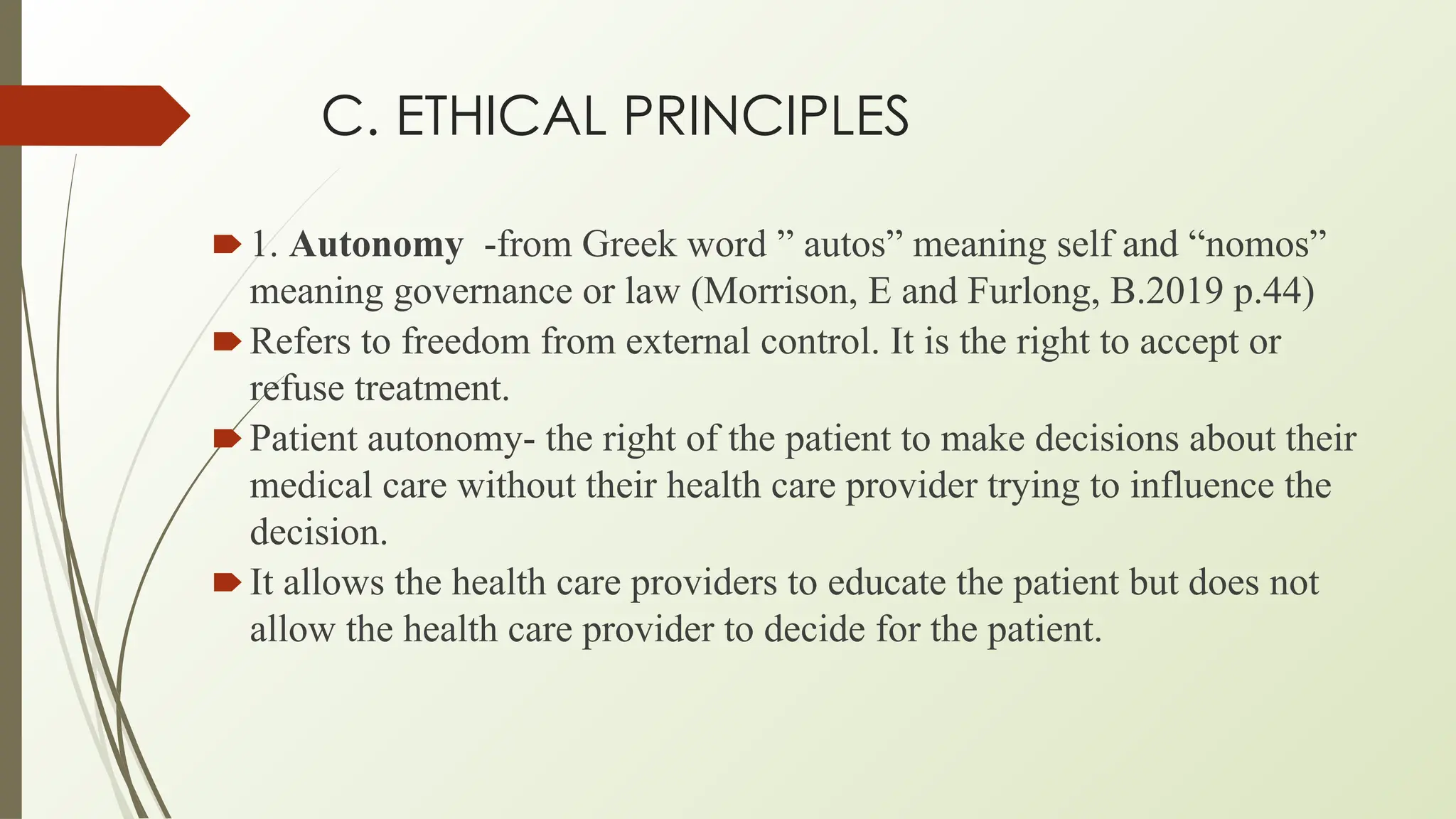
🠶 1. Autonomy -from Greek word ” autos” meaning self and “nomos”
meaning governance or law (Morrison, E and Furlong, B.2019 p.44)
🠶 Refers to freedom from external control. It is the right to accept or
refuse treatment.
🠶 Patient autonomy- the right of the patient to make decisions about their
medical care without their health care provider trying to influence the
decision.
🠶 It allows the health care providers to educate the patient but does not
allow the health care provider to decide for the patient.
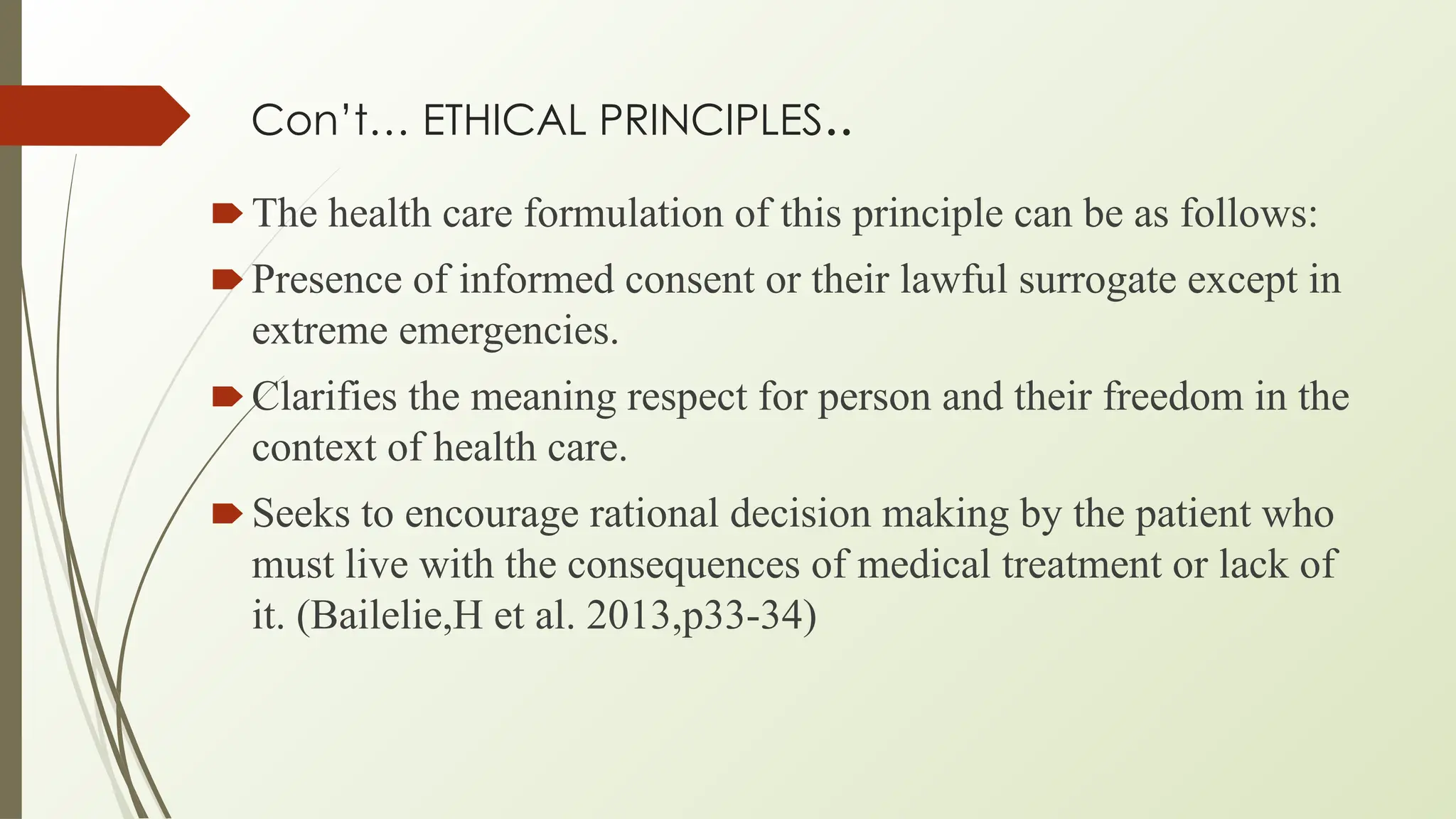
Con’t… ETHICAL PRINCIPLES..
🠶 The health care formulation of this principle can be as follows:
🠶 Presence of informed consent or their lawful surrogate except in
extreme emergencies.
🠶 Clarifies the meaning respect for person and their freedom in the
context of health care.
🠶 Seeks to encourage rational decision making by the patient who
must live with the consequences of medical treatment or lack of
it. (Bailelie,H et al. 2013,p33-34)
PATIENT’S RIGHTS
🠶 Basic rule of conduct between patients and medical caregivers
as well the institutions and people that supports them.
• The right to be treated with respect – regardless of their means or
health care challenges without discrimination by their providers,
practitioners, and payers.
• The right to obtain medical records – including doctors notes,
medical test results, and other documentation related to their
care.
• The right to privacy of medical records – who else, besides the
patient, may obtain patient’s records, and for what purposes/s.
Con’t…PATIENT’S RIGHTS
• The right to make treatment choice – as long as the patient
are considered to be of sound mind, it is both their right and
responsibility to know what are the options available for
treatments and then make the choice they feel is right for
them.
• The right to informed consent – no reputable practitioner or
facility that performs tests, procedures, or treatments will do so
without asking the patient or his guardian to sign a consent.
The practitioner is expected to provide clear explanations of
the risk and benefits prior to the patient’s participation.
Con’t.. Patient’s Rights
• The right to refuse treatment – as long as he/she is
considered to be: capable of making sound decisions, or
he/she made that choice when he/she was of sound mind
through written expressions (as is often in end-of-life-care)
This includes surgery, use of ventilator machine, CPR, and
other invasive procedures or extraordinary means.
• The right to make decisions about end-of-life-care - patient
may make or legally record his/her decisions about how
their lives will end, including life preserving measures
( ventilators, feeding tubes)This information may be found in
the patient’s “Advance Directives”
🠶 In a capsule: the patient’s rights are as follows:
🠶 P-rivacy
🠶 A-utonomy
🠶 T- reatment refusal
🠶 I- nformation
🠶 E- ducation
🠶 N –ot to be restrained
🠶 T- o be treated with confidentiality
🠶 S- ervices
PATIENT’S BILL OF RIGHTS
(Patient Care Partnership)
🠶 A document that provide patients with information on how they can
reasonably expect to be treated during the course of their treatment or
hospital stay. They provide goals and expectations for patient treatment.
1. Considerate and respectful care
2. Complete current information
3. Receive from his doctor information necessary to give informed consent
4. Refuse treatment to the extent permitted by law
5. Consideration of his privacy
6. Confidentiality
con’t…PATIENT’S BILL OF RIGHTS
(Patient Care Partnership)
7. Reasonable response to the request of the patient for services
8. Obtain information as to any relationship of his hospital to other
health care and educational institutions
9. Refuse to participate if hospital proposes to perform human
experimentation
10. Continuity of care
11. Examine and receive an explanation of his bills
12. Hospital rules and regulations that apply to his conduct
INFORMED CONSENT
🠶 Consent – a patient’s signed consent form is necessary
for:
✔ admission to a health care agency
✔Invasive procedures – central line insertion, surgery,
treatments like chemo
✔Participation in research studies
A patient or his representative needs to sign a separate
special consent or treatment forms before the
performance of a specialized procedure.
Con’t ..INFORMED CONSENT
When a competent patient refuses care or
treatment, this act is legally his or her right…
▪ assess the reason for refusal
▪ Inform the physician/health care provider
▪ Document this in the medical record
Principle of Informed Consent
🠶 It is the right and responsibility of every individual to advance
his/her welfare by freely and voluntarily giving consent.
🠶 Designating agreement or refusal to undergo any procedures,
treatments based on sufficient knowledge of the benefits, burdens,
and the risks involved.
🠶 4 requirements:
• Decision- making capacity
• Documentation of consent
• Disclosure of information
• Comprehension of the information
Con’t ....Principle of Informed Consent
🠶 Upon fulfilment of the 4 requirements of informed
consent, three essential conditions are fulfilled:
• That the individual’s decision is voluntary
• That he decision is made with appropriate
understanding of the circumstances
• That the patient’s choice is deliberate in so far as the
patient has carefully considered all of the benefits,
burdens, risks, and reasonable alternatives
🠶 In health care, informed consent is a patient’s agreement to
have a medical procedure after receiving full disclosure of
risks, benefits, alternatives, and consequences of refusal
(Westrick, 2014)
🠶 Failure to obtain such can result to a claim of battery.
🠶 Must be obtained when patient is not under the influence of
medication such as opioids/ narcotic analgesics.
🠶 THE PERSON RESPONSIBLE FOR PERFORMING THE PROCEDURE
IS RESPONSIBLE FOR OBTAINING THE INFORMED CONSENT i.e.
physician, surgeon.
🠶 Parents are usually the legal guardians of pediatric patients
🠶 Occasionally a parent/guardian refuses, in tis case the court
intervenes. The courts generally considers to the child’s ultimate safety
and well – being.
🠶 In emergency cases, if it is impossible to obtain consent from the
patient or an authorized person, a health care provider may perform a
procedure required to benefit the patient or save a life without a
liability for failure to obtain consent.
🠶 In such cases, the law assumes that the patient would wish to be
cured.
🠶 2 physicians will sign the consent and document the emergency
nature of the situation
🠶 For there be emergency justifying treatment without informed
consent, 3 conditions must be present (Rosoff, 1981. Cited in
Baillie, H et al., 2013)
⮚ Patient must be incapable of giving consent and no lawful
surrogate is available to give the consent
⮚ There is danger to life or danger of serious impairment of health
⮚ Immediate treatment is necessary to avert these dangers.
🠶 Patients with mental illness must also give consent in the
patient’s Bill of Rights. They retain the right to refuse
treatment until a court has determined legally that they
are incompetent.
The primary function of informed consent is the protection
of the patient’s right to self-determination to accept the
proposed treatment.
The patient is free to decide what will be done to their
body.
PROXY CONSENT (Legally Acceptable
Representative)
🠶 The process by which people with legal right to consent to
medical treatment for themselves or a minor or ward,
delegate that right to another person.
🠶 Three fundamental constraints on this delegation:
❖The person making the delegation must have the right to
consent.
❖The person must be legally and medically competent to
delegate the right to consent.
❖The right to consent must be delegated to a legally and
medically competent adult.
🠶 2 Types of Proxy Consent for adults
1.Durable –power- of- attorney (power of attorney), healthcare
proxy
The patient who wants medical care, uses the power of attorney
to delegate the right to consent to a specific person, if they are
rendered temporarily incompetent by the medical care.
It is an authorization that enables any competent individual to
name someone to exercise decision- making in the event of the
person’s incapacitation, unable to make decisions personally.
As in end-of-life-care
🠶 2. Living will – is a written, legal document prepared by a
competent adult that spells out medical treatments a patient
would or would not want to be used to keep him /her alive, as
well as his/her preferences for other medical decisions such as:
▪ Pain management or
▪ Organ donation
An expression of the person’s wishes regarding end-of-life-
care..where he/she thinks of her values (www.mayoclinic.org,
living wills, art-2004603 AUG.22, 2020)
2. CONFIDENTIALITY
In health care, refers to the obligation of the professionals who
have access to patient records or communication to hold that
information in confidence. Confidence means trust.
The information will be kept secret from the reach of
unauthorized people until the parties agree to uncover the
information.
It prevents the access of sensitive information from being public.
Confidentiality implies:
1.Information about the patient be kept private
2.Information in the patient’s record is accessible only to those
providing care to the patient
3. No one else is entitled unless the patient signed a “Consent for
Release of Information” that identifies with whom the information
may be shared and for what purpose.
4. Discussing about the patient outside clinical setting violates
patient confidentiality. Like:
a.Telling friends or family
b.Discussing patients in elevator, cafeteria
c.Any area outside nursing unit
The patient has the right to review records pertaining to his/her
medical care
🠶 To have the information explained or interpreted as necessary
except when restricted by law.
🠶 Maintaining confidentiality may be observed by:
1. Not discussing patient issues with other patients or uninvolved staff
2. Not sharing health information to others without patient’s permission
3. Not publishing information, embarrassing facts about the patient
4. Not accessing medical records when unauthorized to do so
5. Sharing patient information only in private and scheduled areas
6. Protecting the medical record from all unauthorized recorders
PRIVACY
🠶 An individual is free from public interruption and intrusion
🠶 The person is apart from the public attention, and observation
🠶 It is a tendency to hide certain facts about himself or else people
will use them against him (Surbhi, S.,2018)
🠶 “Privacy is a necessary condition, the necessary atmosphere for
maintaining intimate relationships of respect, love, friendship,
and trust. Without privacy, these relationships are inconceivable”
(Fried, 1990).
🠶 The patient grants the nurse and the physician access to his/her
body and mind in order to protect his/her health.
🠶 Rightly or wrongly , many diseases and treatments are
considered shameful.
🠶 Examples of violations and invasion of patient’s privacy:
❖Taking photograph of the patient
❖Use of patient’s name or picture for the sole advantage of the
health care agency
❖Leaving curtains or doors open while treatment or procedure is
being performed
❖Allowing individuals to observe a treatment or procedure
without the patient’s consent
❖Leaving a confused or agitated patient sitting in the nursing
unit hallway
🠶 Interviewing a patient in a room with only a curtain between
patients or where conversations can be overheard.
🠶 Surbhi (2018) states the differences between privacy and
confidentiality
Privacy –state of being secluded; free from public interference
Confidentiality –situation when information is kept secret from any
other person
Privacy- talks about a person
Confidentiality – talks about information
Privacy- everyone is disallowed from interfering personal
matters
Confidentiality –some specified and trustworthy people
are allowed to have access to the information
Privacy is voluntary; confidentiality is compulsory if the
relationship between parties is fudiciary (involving trust)
Privacy is a right; confidentiality is an agreement
In the Phil 1987 Constitution art. 3 sec. 3. Right to privacy
and confidentiality
3. VERACITY
Truth telling and the Right to Information
🠶 To respect veracity in relationships is to deal honestly with
patients and colleagues as they are.
🠶 The ordinary ethics of truthfulness is summed up in 2 commands:
1. do not lie- “if you communicate, do not lie”
2. You must communicate to those who have a right to the truth. “
you communicate if the other person has the right to
communication”
Neither says you must everyone everything you know or
everything they want to know.
🠶 Veracity in the Health Care Setting – refers to comprehensive,
accurate, and objective transmission of information as well as to
the way professional fosters the patient’s understanding.
🠶 This is connected to respect of autonomy.
🠶 Veracity in Nursing – where do we stand?
🠶 Truth telling is important because it shows respect for people and
allows them the right to autonomy-giving them all the information
they need to make their own choices.
🠶 In certain circumstances withholding the truth from a patient is
the compassionate and moral choice- to protect them from
mental and emotional distress.
🠶 Veracity is necessary for 3 reasons:
1. Respect owed to others.
2. Obligation of fidelity and promise-keeping.
3. Successful intervention and cooperation.
This is supported by the Patient’s Bill of Rights – right to information
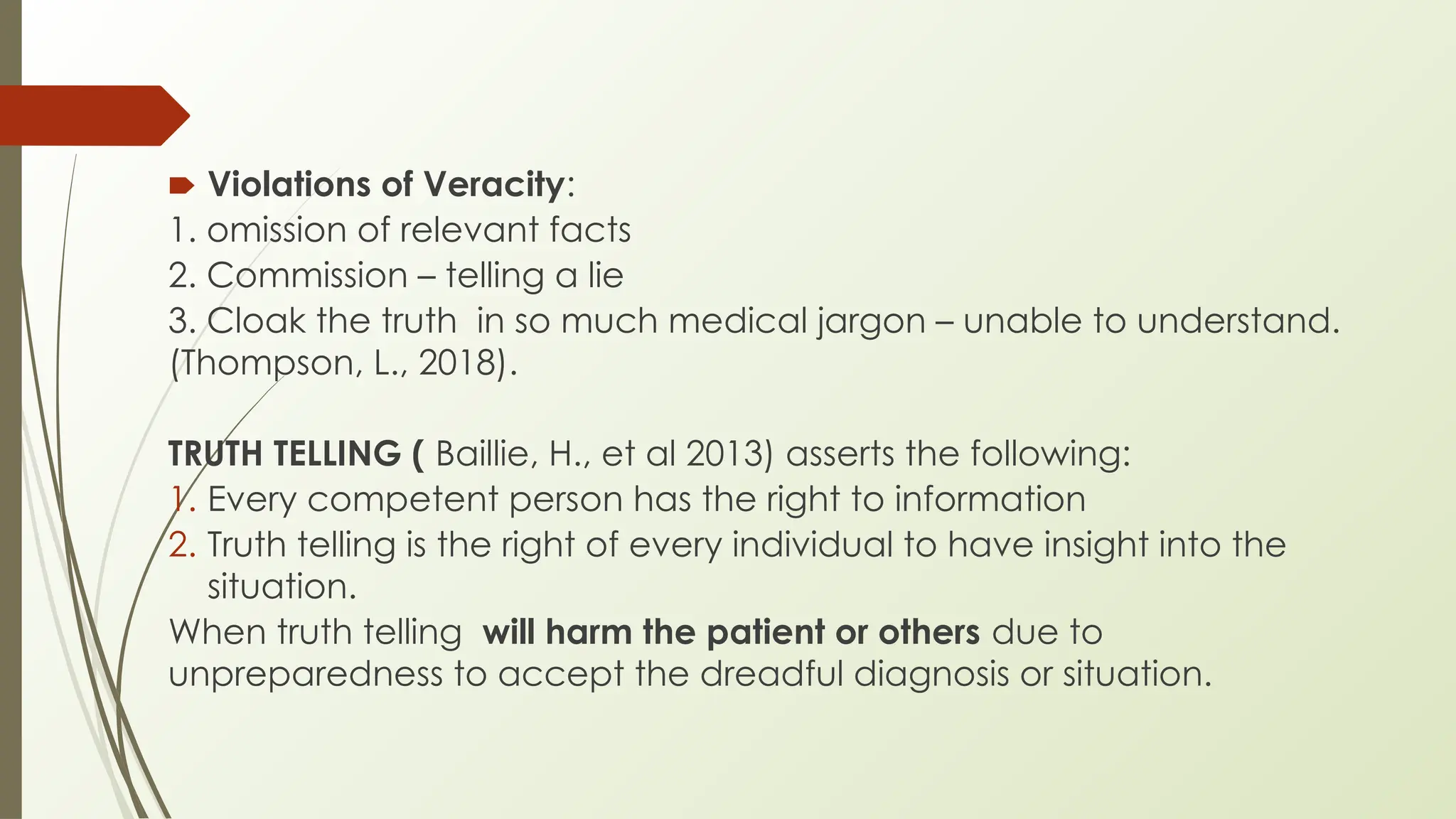
🠶 Violations of Veracity:
1. omission of relevant facts
2. Commission – telling a lie
3. Cloak the truth in so much medical jargon – unable to understand.
(Thompson, L., 2018).
TRUTH TELLING ( Baillie, H., et al 2013) asserts the following:
1. Every competent person has the right to information
2. Truth telling is the right of every individual to have insight into the
situation.
When truth telling will harm the patient or others due to
unpreparedness to accept the dreadful diagnosis or situation.
🠶 In the Filipino culture, traits of family orientation to illness and the
non-confrontational attitude affect truth telling.
This depicts that family members are often informed before the
patient, on serious diagnosis because this may:
a. bring more harm, like hopelessness, depression,
b. refusal to undergo treatments.
The nonconfrontational attitude prevents us from disclosing
unpleasant views, may be traceable to Filipino value system as
shame or “hiya”.
We subscribe to death denial culture.
4. FIDELITY
🠶 Keeping of promises
🠶 Remaining faithful to the professional promises made to provide
quality, competent care to patients.
🠶 The obligation to:
a. act in good faith and
b. to keep vows and promises,
c. fulfill agreements,
d. maintain relationships and fiduciary responsibilities.
Fiduciary responsibilities – nurse and physician becomes the trustees of
patients health and welfare. They can not withdraw care without giving
notice to the patient and family.
🠶 The model of Fidelity is : keeping one’s word of honor,
loyalty to commitments and oaths, and reliability.
🠶 Standing true to one’s word
🠶 “palabra de honor”
🠶 Encompasses traits of maturity and commitment
🠶 Fidelity is the most important ethical principles. It
requires that all patients are treated with respect
regardless of the circumstances.
5. JUSTICE
🠶 Morrison and Furlong (2019) assert the following
statements on justice:
⮚ Governs social fairness –determines who should receive
or is entitled to receive a resource.
⮚ Giving each one his/her due, entitlements, benefits one
has a right to
⮚ Fairness – care must be equitably , fairly and justly to
each individual
⮚ In health care the benefits must be balanced with the
burdens to determine who is eligible to receive some
type of care.
2 Major Categories of Justice
1.Procedural – due process. In legal system, we speak of being
equal before the law. You receive the same treatment as
everyone else.
In health care, did you receive the same attention and care as
the person who preceded you?
2. Distributive – determining how to divide burdens and benefits.
This refers to fair, equitable, and appropriate distribution/
allocation of responsibilities, or share of rights and roles.
Ex. Busy nurses have to decide how quickly to respond to call
button relative to the task in which they are currently engaged.
6. BENEFICENCE
Latin word “bene” for “well” or “good”.
✔Action done for the good of others
✔Associated with the acts of mercy, kindness, charity,
✔humanity, altruism, love at times are also considered forms
of beneficence
Benevolence refers to virtue of being inclined to do good and
act for the benefit of others.
There are instances when one is obliged to do emergency
care to one who is hovering between life and death.
🠶 Beneficence and a higher moral burden- we are morally
obliged to take positive and direct steps to help others.
🠶 Relative to ethical theories, consequentialism, the greatest
good for the greatest number.
🠶 Acts of kindness and courtesy, compassion and
understanding even under extremely stressful circumstances
is part of professionalism
🠶 Requires the ability to see every patient as a unique person
who has worth. (Morison, E. and Furlong, B., 2019)

WEEK-3-HEALTH-CARE-ETHICS (AUTONOMY)pptx

  • 1.
    C. ETHICAL PRINCIPLES 🠶1. Autonomy -from Greek word ” autos” meaning self and “nomos” meaning governance or law (Morrison, E and Furlong, B.2019 p.44) 🠶 Refers to freedom from external control. It is the right to accept or refuse treatment. 🠶 Patient autonomy- the right of the patient to make decisions about their medical care without their health care provider trying to influence the decision. 🠶 It allows the health care providers to educate the patient but does not allow the health care provider to decide for the patient.
  • 2.
    Con’t… ETHICAL PRINCIPLES.. 🠶The health care formulation of this principle can be as follows: 🠶 Presence of informed consent or their lawful surrogate except in extreme emergencies. 🠶 Clarifies the meaning respect for person and their freedom in the context of health care. 🠶 Seeks to encourage rational decision making by the patient who must live with the consequences of medical treatment or lack of it. (Bailelie,H et al. 2013,p33-34)
  • 3.
    PATIENT’S RIGHTS 🠶 Basicrule of conduct between patients and medical caregivers as well the institutions and people that supports them. • The right to be treated with respect – regardless of their means or health care challenges without discrimination by their providers, practitioners, and payers. • The right to obtain medical records – including doctors notes, medical test results, and other documentation related to their care. • The right to privacy of medical records – who else, besides the patient, may obtain patient’s records, and for what purposes/s.
  • 4.
    Con’t…PATIENT’S RIGHTS • Theright to make treatment choice – as long as the patient are considered to be of sound mind, it is both their right and responsibility to know what are the options available for treatments and then make the choice they feel is right for them. • The right to informed consent – no reputable practitioner or facility that performs tests, procedures, or treatments will do so without asking the patient or his guardian to sign a consent. The practitioner is expected to provide clear explanations of the risk and benefits prior to the patient’s participation.
  • 5.
    Con’t.. Patient’s Rights •The right to refuse treatment – as long as he/she is considered to be: capable of making sound decisions, or he/she made that choice when he/she was of sound mind through written expressions (as is often in end-of-life-care) This includes surgery, use of ventilator machine, CPR, and other invasive procedures or extraordinary means. • The right to make decisions about end-of-life-care - patient may make or legally record his/her decisions about how their lives will end, including life preserving measures ( ventilators, feeding tubes)This information may be found in the patient’s “Advance Directives”
  • 6.
    🠶 In acapsule: the patient’s rights are as follows: 🠶 P-rivacy 🠶 A-utonomy 🠶 T- reatment refusal 🠶 I- nformation 🠶 E- ducation 🠶 N –ot to be restrained 🠶 T- o be treated with confidentiality 🠶 S- ervices
  • 7.
    PATIENT’S BILL OFRIGHTS (Patient Care Partnership) 🠶 A document that provide patients with information on how they can reasonably expect to be treated during the course of their treatment or hospital stay. They provide goals and expectations for patient treatment. 1. Considerate and respectful care 2. Complete current information 3. Receive from his doctor information necessary to give informed consent 4. Refuse treatment to the extent permitted by law 5. Consideration of his privacy 6. Confidentiality
  • 8.
    con’t…PATIENT’S BILL OFRIGHTS (Patient Care Partnership) 7. Reasonable response to the request of the patient for services 8. Obtain information as to any relationship of his hospital to other health care and educational institutions 9. Refuse to participate if hospital proposes to perform human experimentation 10. Continuity of care 11. Examine and receive an explanation of his bills 12. Hospital rules and regulations that apply to his conduct
  • 9.
    INFORMED CONSENT 🠶 Consent– a patient’s signed consent form is necessary for: ✔ admission to a health care agency ✔Invasive procedures – central line insertion, surgery, treatments like chemo ✔Participation in research studies A patient or his representative needs to sign a separate special consent or treatment forms before the performance of a specialized procedure.
  • 10.
    Con’t ..INFORMED CONSENT Whena competent patient refuses care or treatment, this act is legally his or her right… ▪ assess the reason for refusal ▪ Inform the physician/health care provider ▪ Document this in the medical record
  • 11.
    Principle of InformedConsent 🠶 It is the right and responsibility of every individual to advance his/her welfare by freely and voluntarily giving consent. 🠶 Designating agreement or refusal to undergo any procedures, treatments based on sufficient knowledge of the benefits, burdens, and the risks involved. 🠶 4 requirements: • Decision- making capacity • Documentation of consent • Disclosure of information • Comprehension of the information
  • 12.
    Con’t ....Principle ofInformed Consent 🠶 Upon fulfilment of the 4 requirements of informed consent, three essential conditions are fulfilled: • That the individual’s decision is voluntary • That he decision is made with appropriate understanding of the circumstances • That the patient’s choice is deliberate in so far as the patient has carefully considered all of the benefits, burdens, risks, and reasonable alternatives
  • 13.
    🠶 In healthcare, informed consent is a patient’s agreement to have a medical procedure after receiving full disclosure of risks, benefits, alternatives, and consequences of refusal (Westrick, 2014) 🠶 Failure to obtain such can result to a claim of battery. 🠶 Must be obtained when patient is not under the influence of medication such as opioids/ narcotic analgesics. 🠶 THE PERSON RESPONSIBLE FOR PERFORMING THE PROCEDURE IS RESPONSIBLE FOR OBTAINING THE INFORMED CONSENT i.e. physician, surgeon.
  • 14.
    🠶 Parents areusually the legal guardians of pediatric patients 🠶 Occasionally a parent/guardian refuses, in tis case the court intervenes. The courts generally considers to the child’s ultimate safety and well – being. 🠶 In emergency cases, if it is impossible to obtain consent from the patient or an authorized person, a health care provider may perform a procedure required to benefit the patient or save a life without a liability for failure to obtain consent. 🠶 In such cases, the law assumes that the patient would wish to be cured. 🠶 2 physicians will sign the consent and document the emergency nature of the situation
  • 15.
    🠶 For therebe emergency justifying treatment without informed consent, 3 conditions must be present (Rosoff, 1981. Cited in Baillie, H et al., 2013) ⮚ Patient must be incapable of giving consent and no lawful surrogate is available to give the consent ⮚ There is danger to life or danger of serious impairment of health ⮚ Immediate treatment is necessary to avert these dangers.
  • 16.
    🠶 Patients withmental illness must also give consent in the patient’s Bill of Rights. They retain the right to refuse treatment until a court has determined legally that they are incompetent. The primary function of informed consent is the protection of the patient’s right to self-determination to accept the proposed treatment. The patient is free to decide what will be done to their body.
  • 17.
    PROXY CONSENT (LegallyAcceptable Representative) 🠶 The process by which people with legal right to consent to medical treatment for themselves or a minor or ward, delegate that right to another person. 🠶 Three fundamental constraints on this delegation: ❖The person making the delegation must have the right to consent. ❖The person must be legally and medically competent to delegate the right to consent. ❖The right to consent must be delegated to a legally and medically competent adult.
  • 18.
    🠶 2 Typesof Proxy Consent for adults 1.Durable –power- of- attorney (power of attorney), healthcare proxy The patient who wants medical care, uses the power of attorney to delegate the right to consent to a specific person, if they are rendered temporarily incompetent by the medical care. It is an authorization that enables any competent individual to name someone to exercise decision- making in the event of the person’s incapacitation, unable to make decisions personally. As in end-of-life-care
  • 19.
    🠶 2. Livingwill – is a written, legal document prepared by a competent adult that spells out medical treatments a patient would or would not want to be used to keep him /her alive, as well as his/her preferences for other medical decisions such as: ▪ Pain management or ▪ Organ donation An expression of the person’s wishes regarding end-of-life- care..where he/she thinks of her values (www.mayoclinic.org, living wills, art-2004603 AUG.22, 2020)
  • 20.
    2. CONFIDENTIALITY In healthcare, refers to the obligation of the professionals who have access to patient records or communication to hold that information in confidence. Confidence means trust. The information will be kept secret from the reach of unauthorized people until the parties agree to uncover the information. It prevents the access of sensitive information from being public. Confidentiality implies: 1.Information about the patient be kept private 2.Information in the patient’s record is accessible only to those providing care to the patient
  • 21.
    3. No oneelse is entitled unless the patient signed a “Consent for Release of Information” that identifies with whom the information may be shared and for what purpose. 4. Discussing about the patient outside clinical setting violates patient confidentiality. Like: a.Telling friends or family b.Discussing patients in elevator, cafeteria c.Any area outside nursing unit The patient has the right to review records pertaining to his/her medical care
  • 22.
    🠶 To havethe information explained or interpreted as necessary except when restricted by law. 🠶 Maintaining confidentiality may be observed by: 1. Not discussing patient issues with other patients or uninvolved staff 2. Not sharing health information to others without patient’s permission 3. Not publishing information, embarrassing facts about the patient 4. Not accessing medical records when unauthorized to do so 5. Sharing patient information only in private and scheduled areas 6. Protecting the medical record from all unauthorized recorders
  • 23.
    PRIVACY 🠶 An individualis free from public interruption and intrusion 🠶 The person is apart from the public attention, and observation 🠶 It is a tendency to hide certain facts about himself or else people will use them against him (Surbhi, S.,2018) 🠶 “Privacy is a necessary condition, the necessary atmosphere for maintaining intimate relationships of respect, love, friendship, and trust. Without privacy, these relationships are inconceivable” (Fried, 1990). 🠶 The patient grants the nurse and the physician access to his/her body and mind in order to protect his/her health. 🠶 Rightly or wrongly , many diseases and treatments are considered shameful.
  • 24.
    🠶 Examples ofviolations and invasion of patient’s privacy: ❖Taking photograph of the patient ❖Use of patient’s name or picture for the sole advantage of the health care agency ❖Leaving curtains or doors open while treatment or procedure is being performed ❖Allowing individuals to observe a treatment or procedure without the patient’s consent ❖Leaving a confused or agitated patient sitting in the nursing unit hallway
  • 25.
    🠶 Interviewing apatient in a room with only a curtain between patients or where conversations can be overheard. 🠶 Surbhi (2018) states the differences between privacy and confidentiality Privacy –state of being secluded; free from public interference Confidentiality –situation when information is kept secret from any other person Privacy- talks about a person Confidentiality – talks about information
  • 26.
    Privacy- everyone isdisallowed from interfering personal matters Confidentiality –some specified and trustworthy people are allowed to have access to the information Privacy is voluntary; confidentiality is compulsory if the relationship between parties is fudiciary (involving trust) Privacy is a right; confidentiality is an agreement In the Phil 1987 Constitution art. 3 sec. 3. Right to privacy and confidentiality
  • 27.
    3. VERACITY Truth tellingand the Right to Information 🠶 To respect veracity in relationships is to deal honestly with patients and colleagues as they are. 🠶 The ordinary ethics of truthfulness is summed up in 2 commands: 1. do not lie- “if you communicate, do not lie” 2. You must communicate to those who have a right to the truth. “ you communicate if the other person has the right to communication” Neither says you must everyone everything you know or everything they want to know.
  • 28.
    🠶 Veracity inthe Health Care Setting – refers to comprehensive, accurate, and objective transmission of information as well as to the way professional fosters the patient’s understanding. 🠶 This is connected to respect of autonomy. 🠶 Veracity in Nursing – where do we stand? 🠶 Truth telling is important because it shows respect for people and allows them the right to autonomy-giving them all the information they need to make their own choices.
  • 29.
    🠶 In certaincircumstances withholding the truth from a patient is the compassionate and moral choice- to protect them from mental and emotional distress. 🠶 Veracity is necessary for 3 reasons: 1. Respect owed to others. 2. Obligation of fidelity and promise-keeping. 3. Successful intervention and cooperation. This is supported by the Patient’s Bill of Rights – right to information
  • 30.
    🠶 Violations ofVeracity: 1. omission of relevant facts 2. Commission – telling a lie 3. Cloak the truth in so much medical jargon – unable to understand. (Thompson, L., 2018). TRUTH TELLING ( Baillie, H., et al 2013) asserts the following: 1. Every competent person has the right to information 2. Truth telling is the right of every individual to have insight into the situation. When truth telling will harm the patient or others due to unpreparedness to accept the dreadful diagnosis or situation.
  • 31.
    🠶 In theFilipino culture, traits of family orientation to illness and the non-confrontational attitude affect truth telling. This depicts that family members are often informed before the patient, on serious diagnosis because this may: a. bring more harm, like hopelessness, depression, b. refusal to undergo treatments. The nonconfrontational attitude prevents us from disclosing unpleasant views, may be traceable to Filipino value system as shame or “hiya”. We subscribe to death denial culture.
  • 32.
    4. FIDELITY 🠶 Keepingof promises 🠶 Remaining faithful to the professional promises made to provide quality, competent care to patients. 🠶 The obligation to: a. act in good faith and b. to keep vows and promises, c. fulfill agreements, d. maintain relationships and fiduciary responsibilities. Fiduciary responsibilities – nurse and physician becomes the trustees of patients health and welfare. They can not withdraw care without giving notice to the patient and family.
  • 33.
    🠶 The modelof Fidelity is : keeping one’s word of honor, loyalty to commitments and oaths, and reliability. 🠶 Standing true to one’s word 🠶 “palabra de honor” 🠶 Encompasses traits of maturity and commitment 🠶 Fidelity is the most important ethical principles. It requires that all patients are treated with respect regardless of the circumstances.
  • 34.
    5. JUSTICE 🠶 Morrisonand Furlong (2019) assert the following statements on justice: ⮚ Governs social fairness –determines who should receive or is entitled to receive a resource. ⮚ Giving each one his/her due, entitlements, benefits one has a right to ⮚ Fairness – care must be equitably , fairly and justly to each individual ⮚ In health care the benefits must be balanced with the burdens to determine who is eligible to receive some type of care.
  • 35.
    2 Major Categoriesof Justice 1.Procedural – due process. In legal system, we speak of being equal before the law. You receive the same treatment as everyone else. In health care, did you receive the same attention and care as the person who preceded you? 2. Distributive – determining how to divide burdens and benefits. This refers to fair, equitable, and appropriate distribution/ allocation of responsibilities, or share of rights and roles. Ex. Busy nurses have to decide how quickly to respond to call button relative to the task in which they are currently engaged.
  • 36.
    6. BENEFICENCE Latin word“bene” for “well” or “good”. ✔Action done for the good of others ✔Associated with the acts of mercy, kindness, charity, ✔humanity, altruism, love at times are also considered forms of beneficence Benevolence refers to virtue of being inclined to do good and act for the benefit of others. There are instances when one is obliged to do emergency care to one who is hovering between life and death.
  • 37.
    🠶 Beneficence anda higher moral burden- we are morally obliged to take positive and direct steps to help others. 🠶 Relative to ethical theories, consequentialism, the greatest good for the greatest number. 🠶 Acts of kindness and courtesy, compassion and understanding even under extremely stressful circumstances is part of professionalism 🠶 Requires the ability to see every patient as a unique person who has worth. (Morison, E. and Furlong, B., 2019)