


Week 12
Neural basis of consciousness:
Frontiers in Consciousness Research
Prof Nao Tsuchiya
Twitter: @conscious_tlab
Email: naotsugu.tsuchiya@monash.edu
Facebook: Naotsugu Tsuchiya
Recap of Wk 11
Outline of Integrated Information Theory (IIT)
Level, Border and Contents of consciousness
How to compute integrated information & complex
IIT explanations on consciousness in patients:
without cerebellum, split brain and conjoined twins
In Wk 12,
We will:
Outline frontiers in consciousness research
with some exemplar research from my lab,
List empirical questions
with strategies, frameworks and techniques
for future research, and
Situate consciousness research in a broader context
Learning Objectives
To be able to answer the following questions:
● What does IIT propose about qualia?
● How can we characterize qualia structures?
● What are the possible empirical experiments that can be
used to reveal the relationship between qualia and brain?
● What are societal impacts of consciousness research?
Optional: Maier & Tsuchiya 2020 APP
Remaining questions from Week 11
How does IIT explain contents of consciousness (=qualia)?
Level - big Phi
Border - Complex
Qualia - a connected pattern of small Phis
IIT and qualia
Remaining questions from Week 11
How does IIT explain contents of consciousness?
Level - big Phi
Border - Complex
Qualia - a connected pattern of small Phis
IIT and qualia
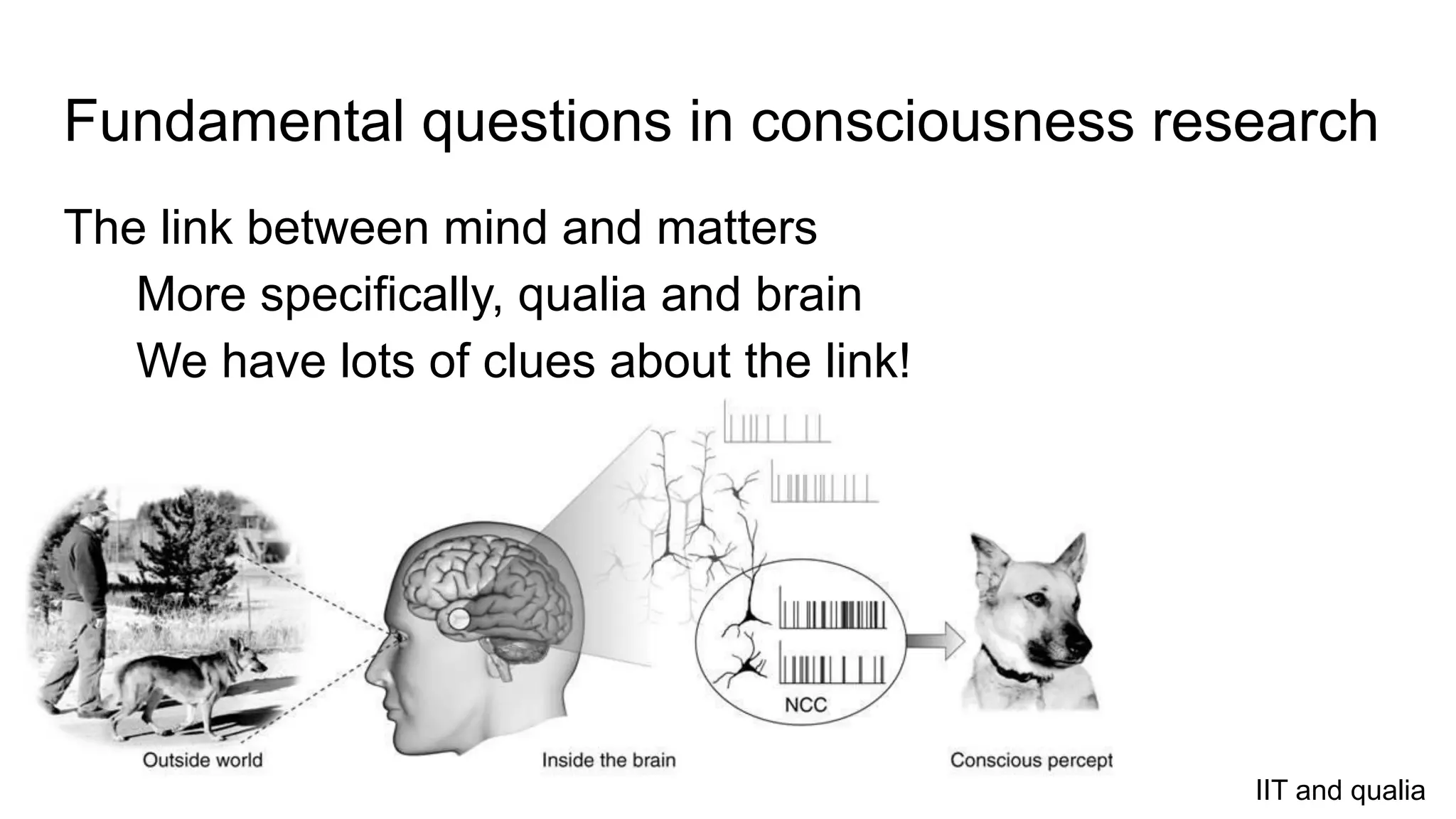
Fundamental questions in consciousness research
The link between mind and matters
More specifically, qualia and brain
We have lots of clues about the link!
IIT and qualia
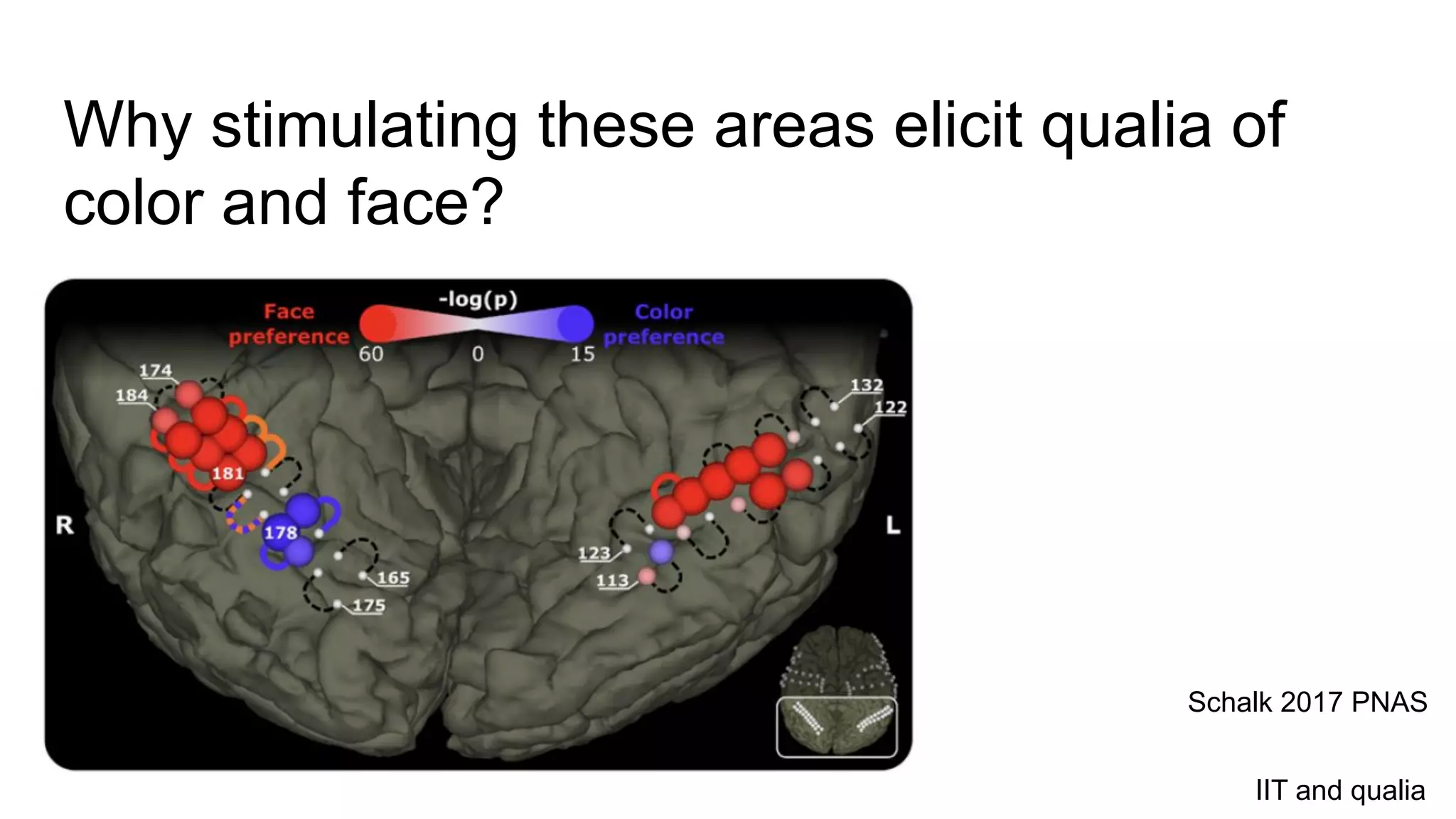
Why stimulating these areas elicit qualia of
color and face?
Schalk 2017 PNAS
IIT and qualia
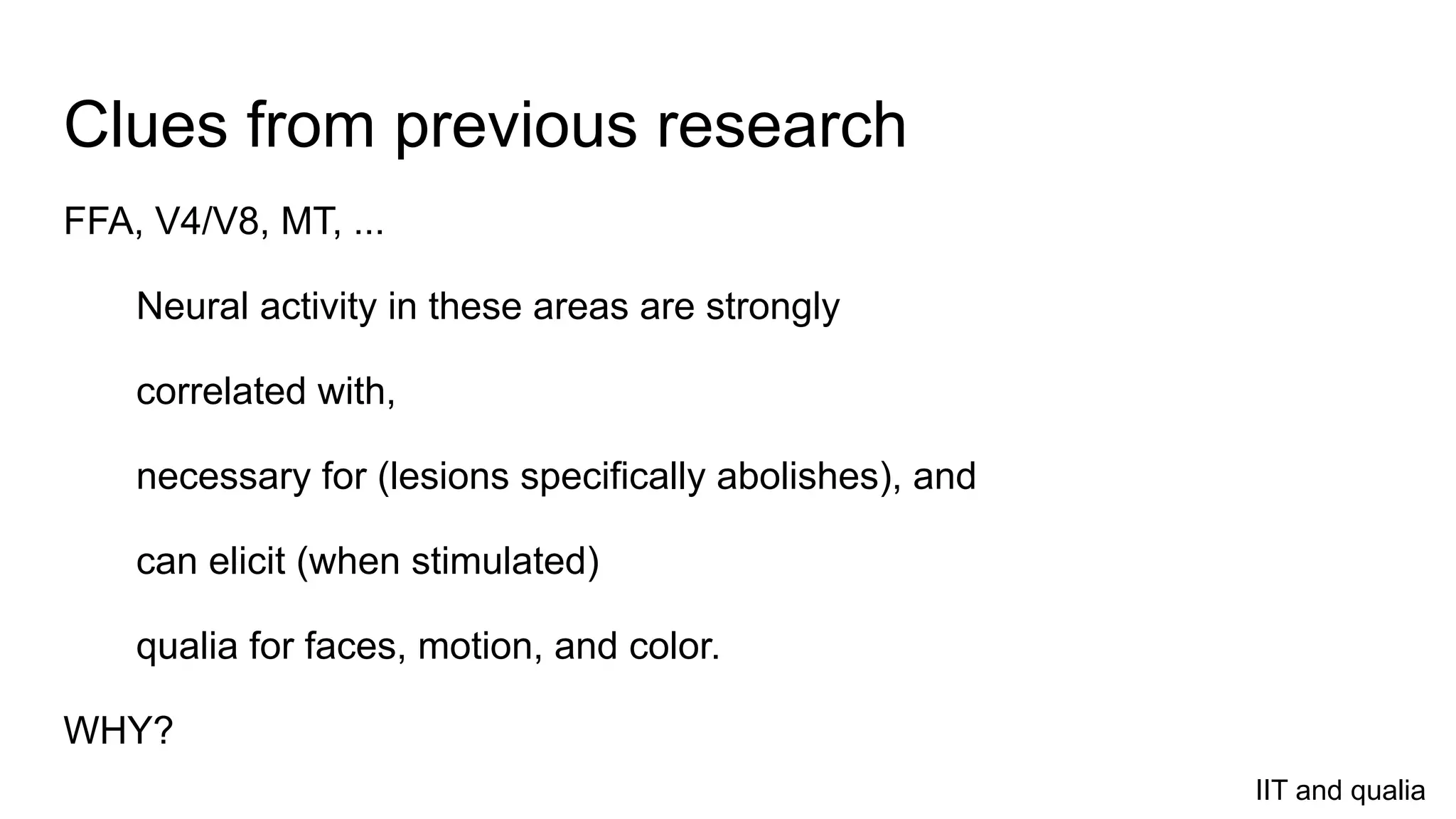
Clues from previous research
FFA, V4/V8, MT, ...
Neural activity in these areas are strongly
correlated with,
necessary for (lesions specifically abolishes), and
can elicit (when stimulated)
qualia for faces, motion, and color.
WHY?
IIT and qualia
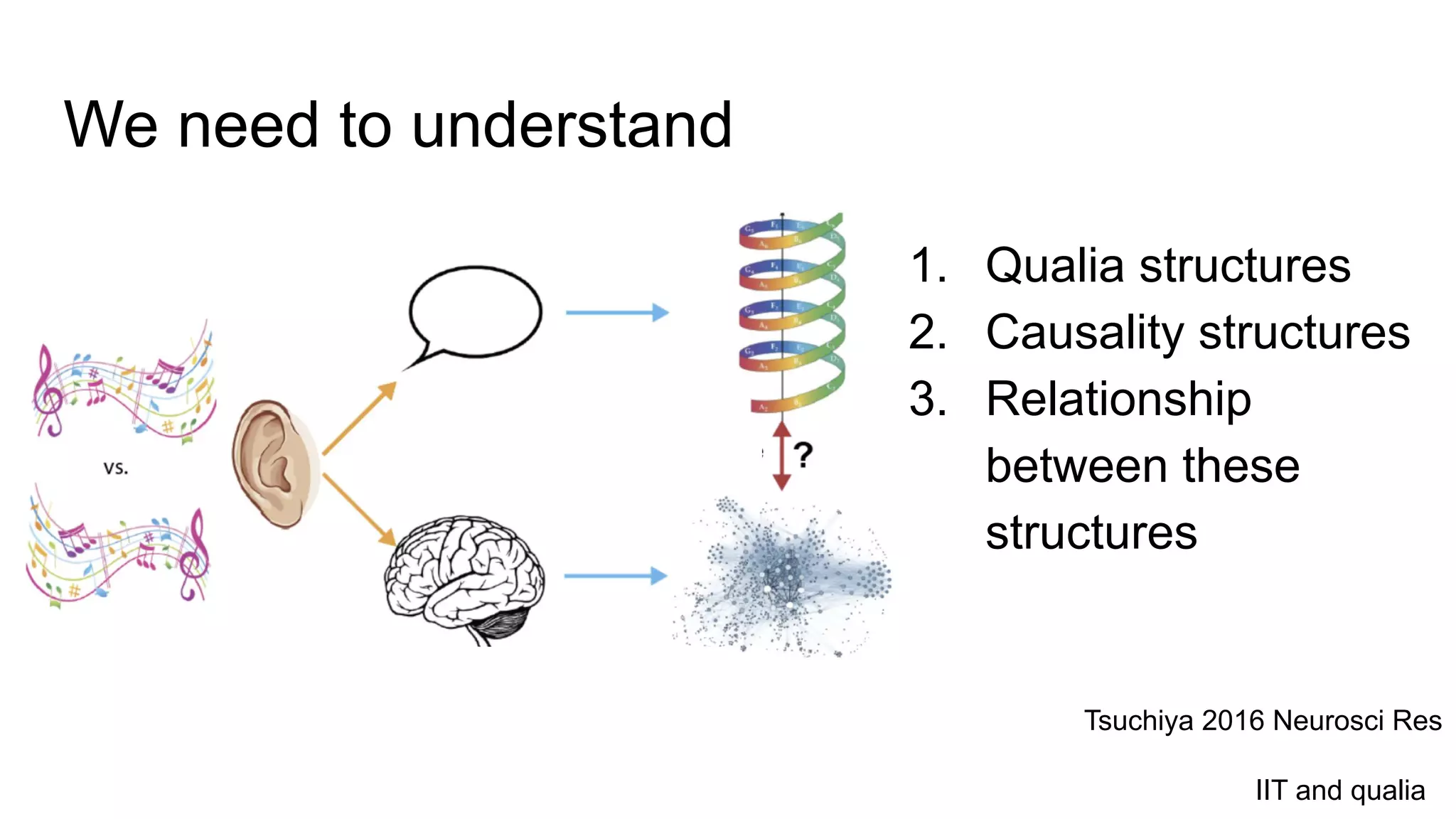
We need to understand
1. Qualia structures
2. Causality structures
3. Relationship
between these
structures
Tsuchiya 2016 Neurosci Res
IIT and qualia
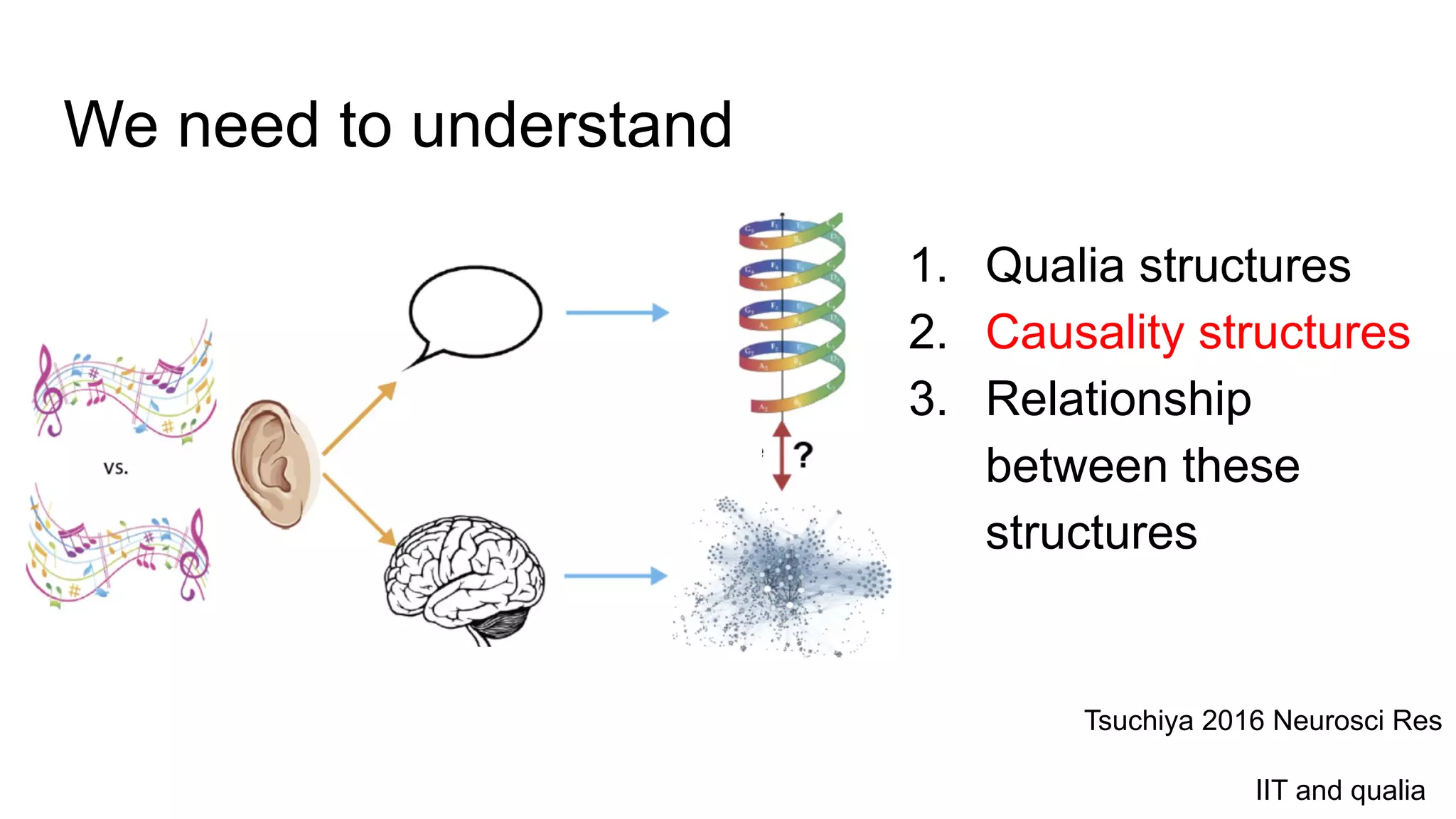
We need to understand
1. Qualia structures
2. Causality structures
3. Relationship
between these
structures
Tsuchiya 2016 Neurosci Res
IIT and qualia
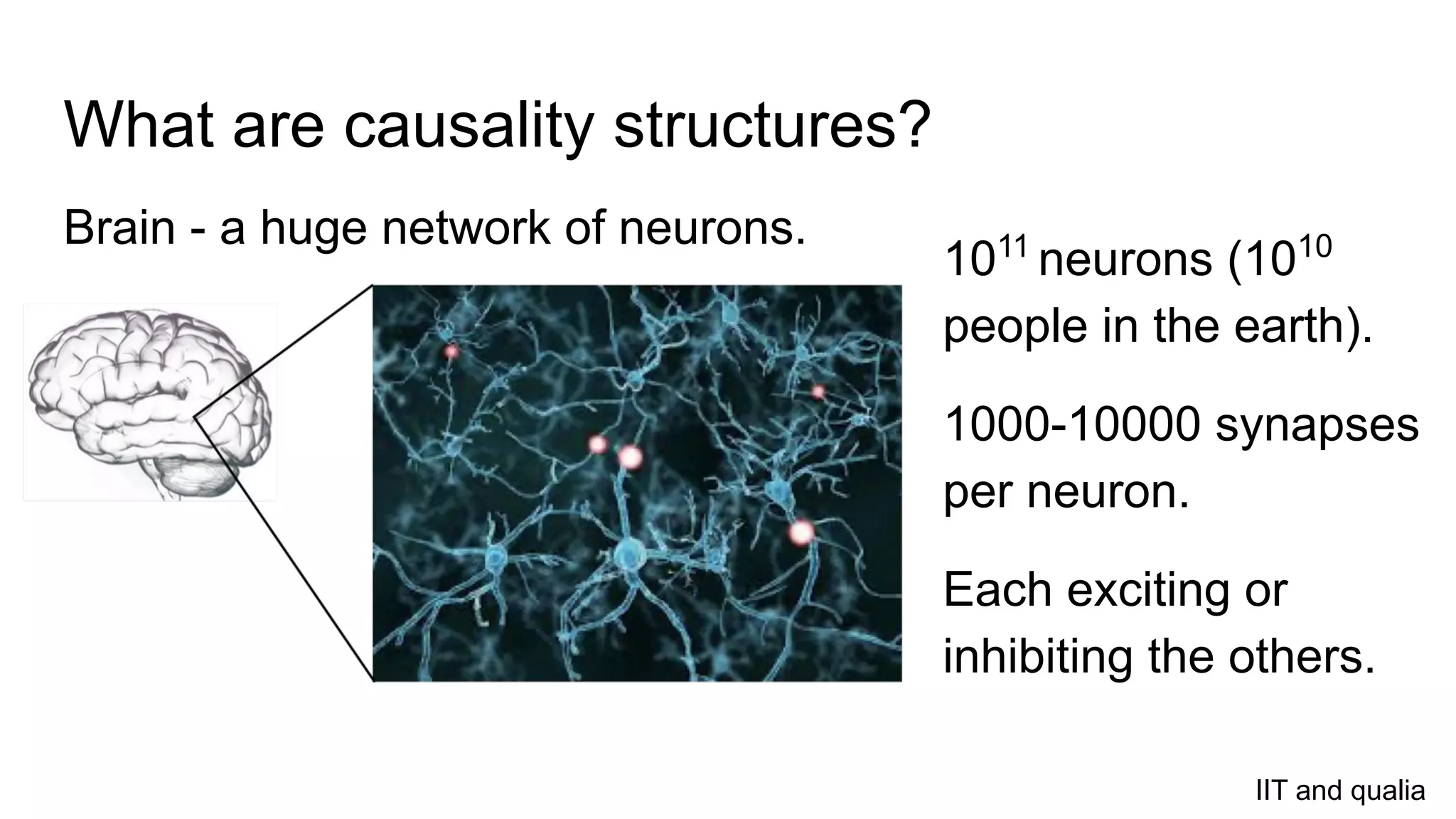
What are causality structures?
Brain - a huge network of neurons.
1011
neurons (1010
people in the earth).
1000-10000 synapses
per neuron.
Each exciting or
inhibiting the others.
IIT and qualia
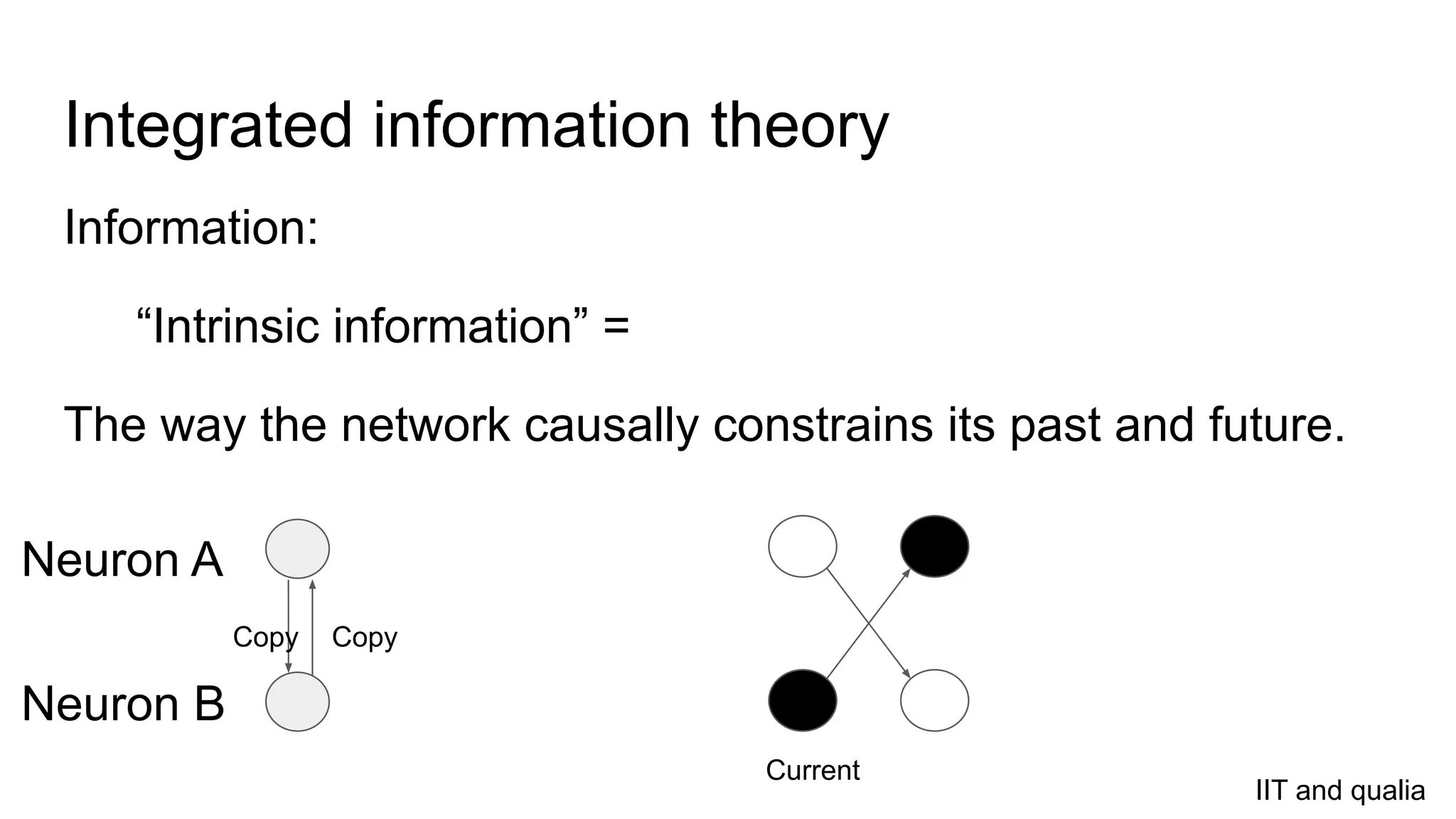
Integrated information theory
Information:
“Intrinsic information” =
The way the network causally constrains its past and future.
Neuron A
Neuron B
Current
CopyCopy
IIT and qualia
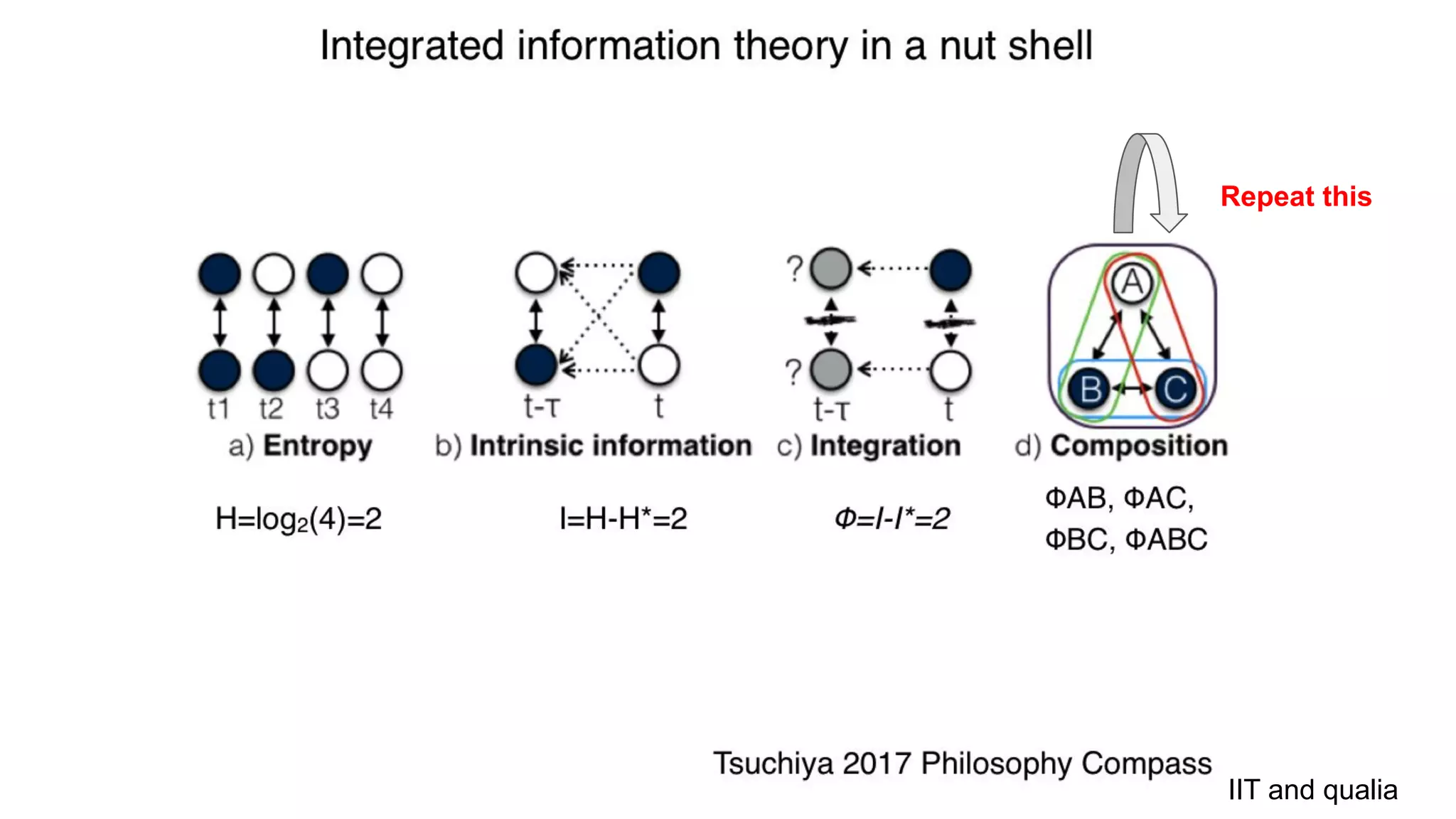
Repeat this
IIT and qualia
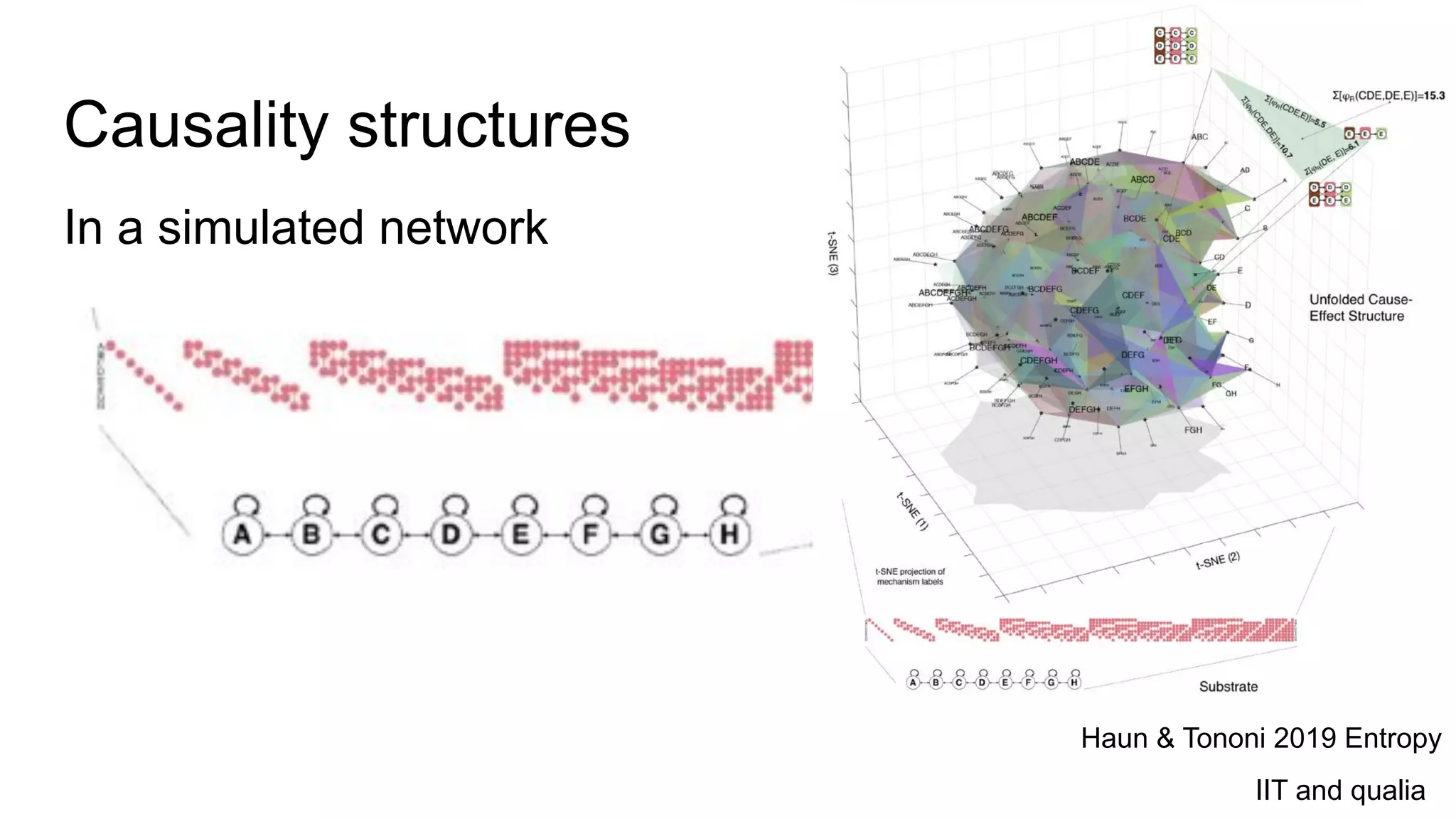
Causality structures
In a simulated network
Haun & Tononi 2019 Entropy
IIT and qualia
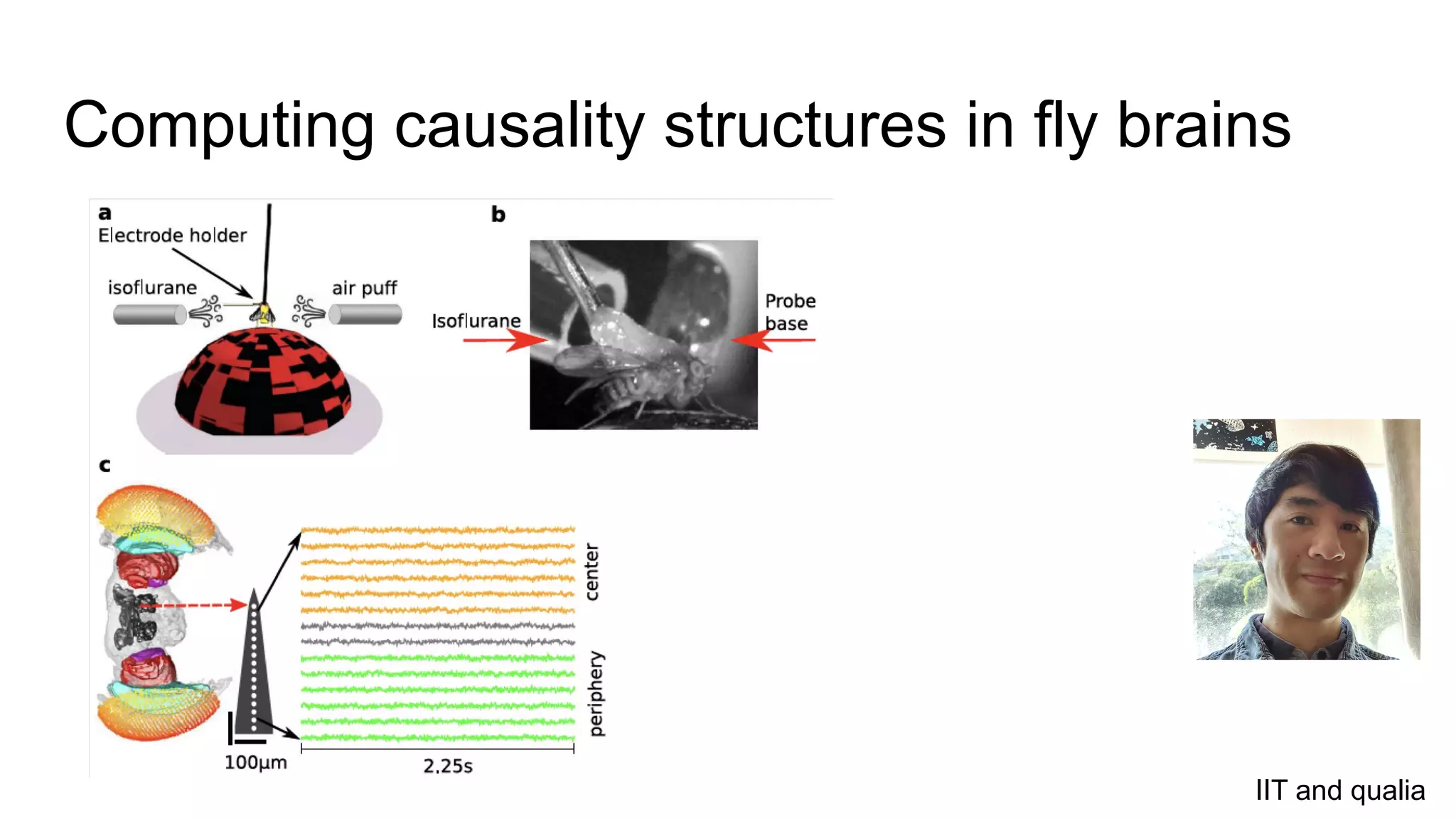
Computing causality structures in fly brains
IIT and qualia
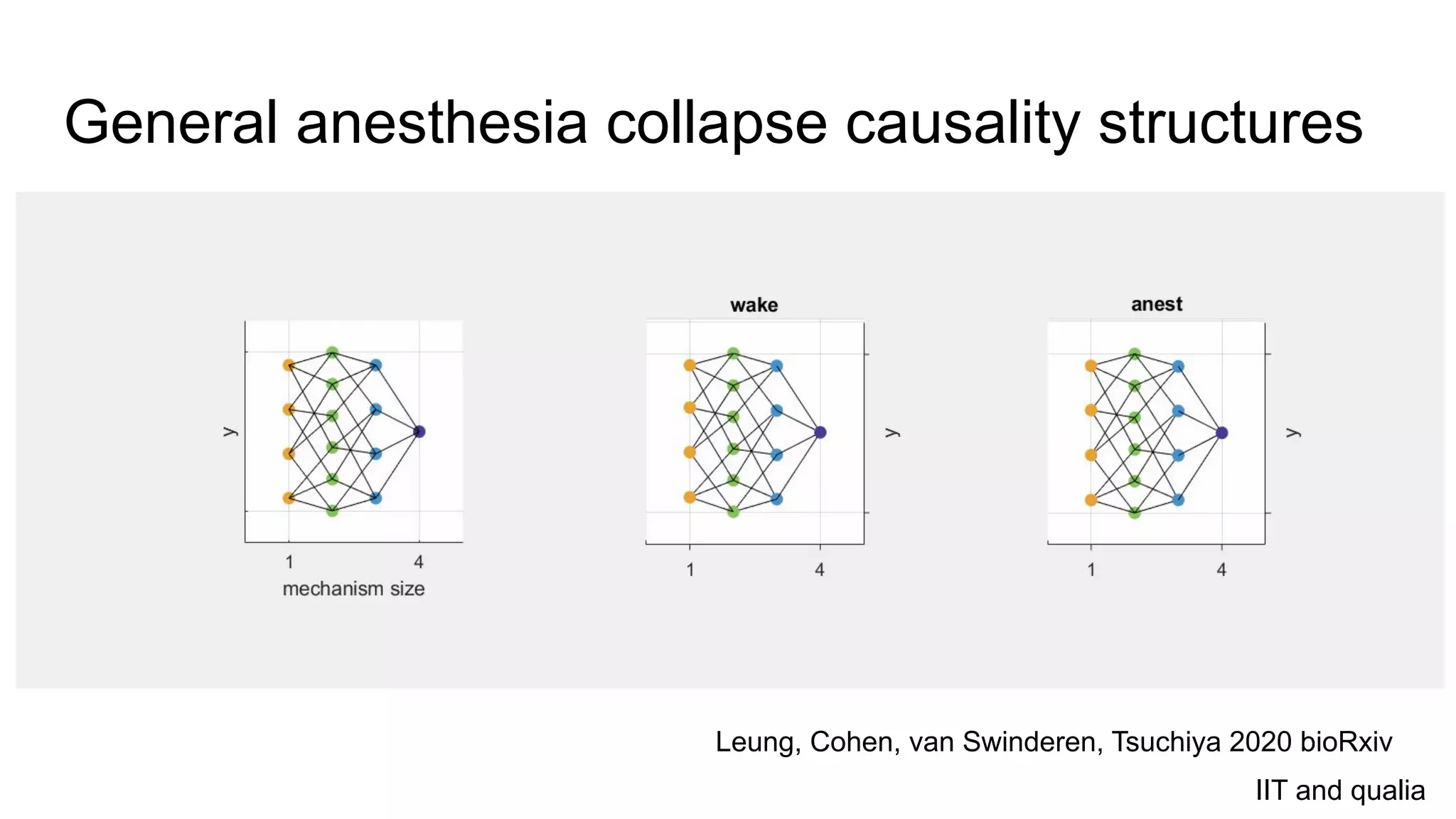
General anesthesia collapse causality structures
IIT and qualia
Leung, Cohen, van Swinderen, Tsuchiya 2020 bioRxiv
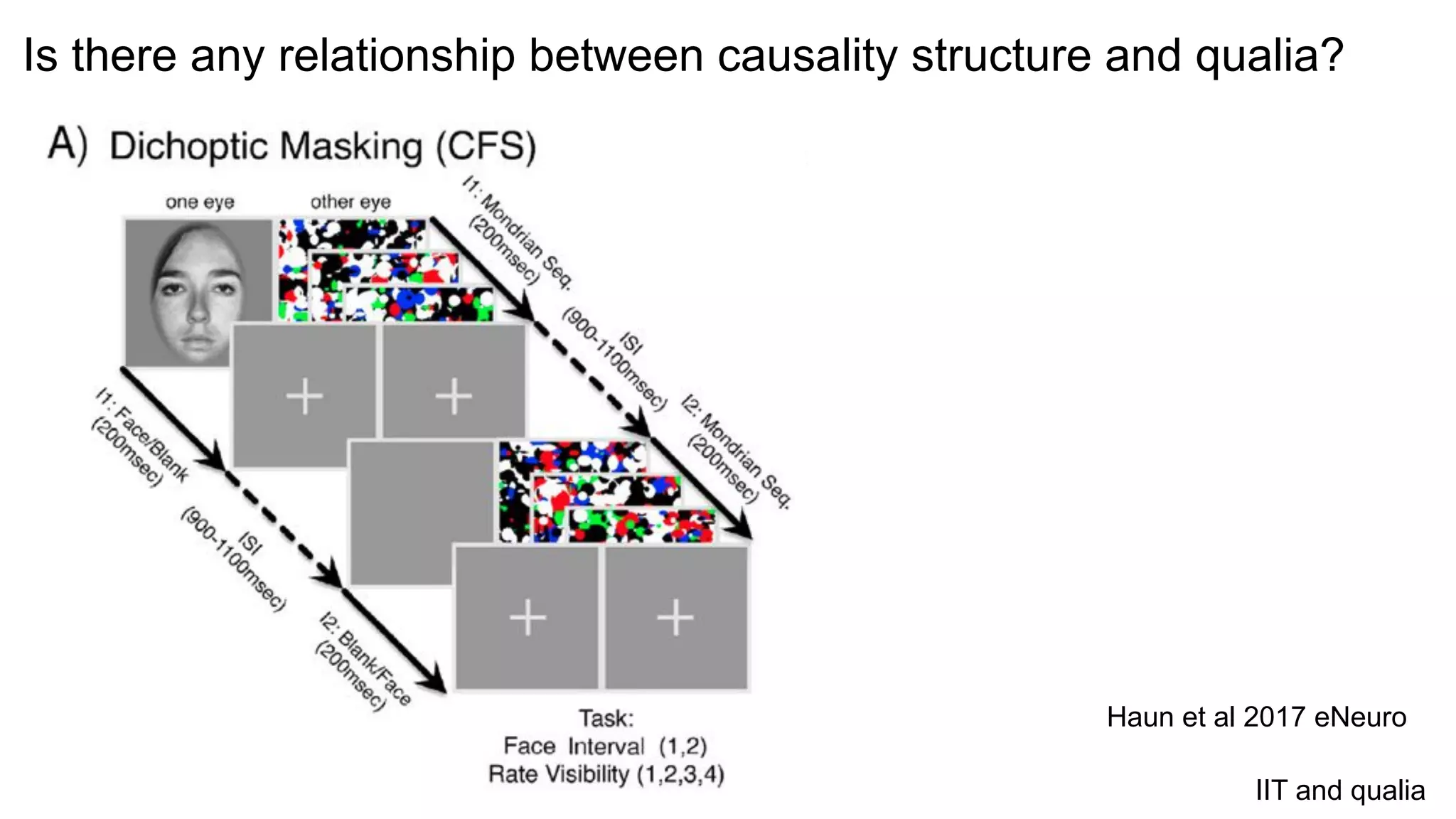
Is there any relationship between causality structure and qualia?
Haun et al 2017 eNeuro
IIT and qualia
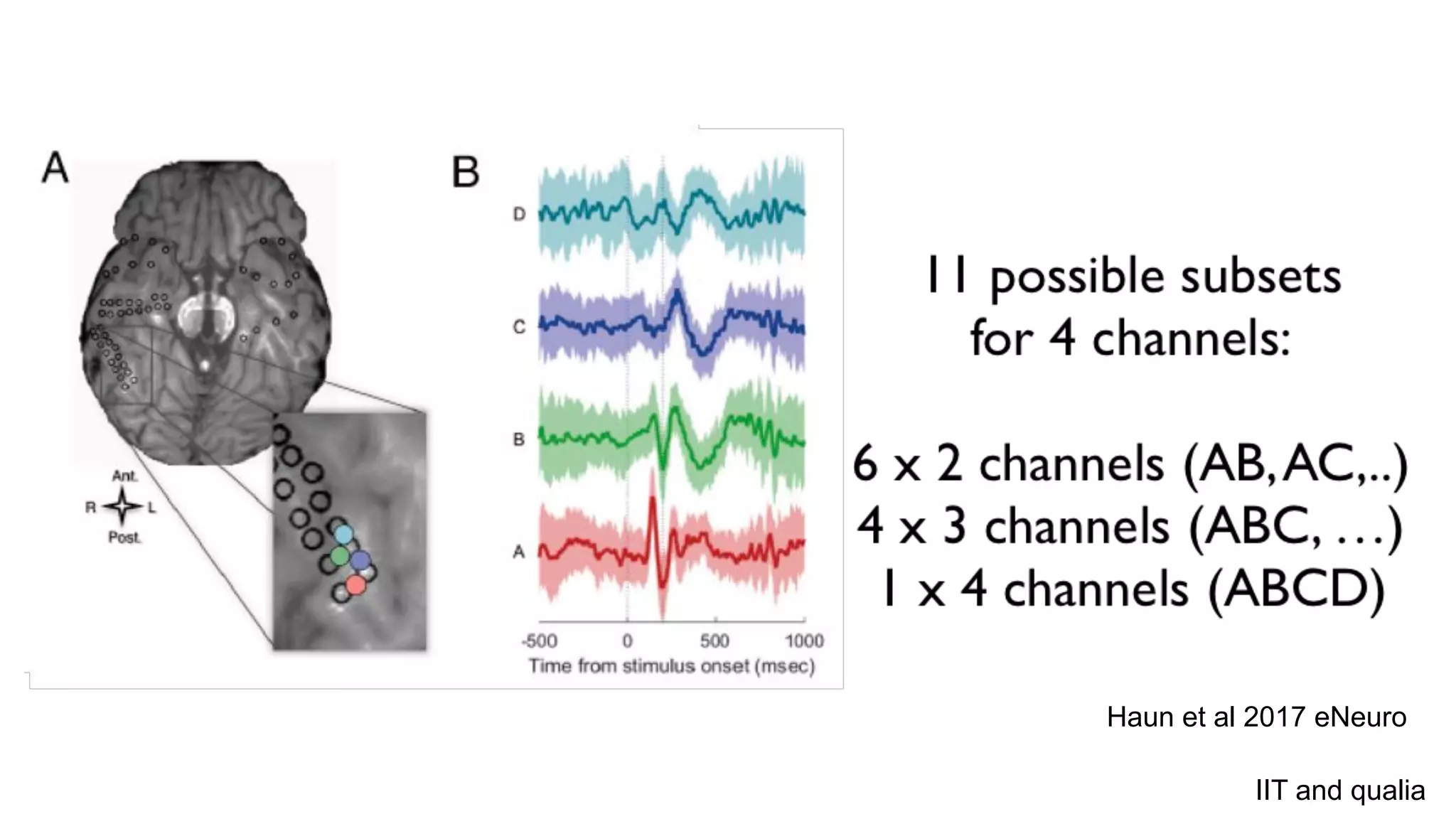
Haun et al 2017 eNeuro
IIT and qualia
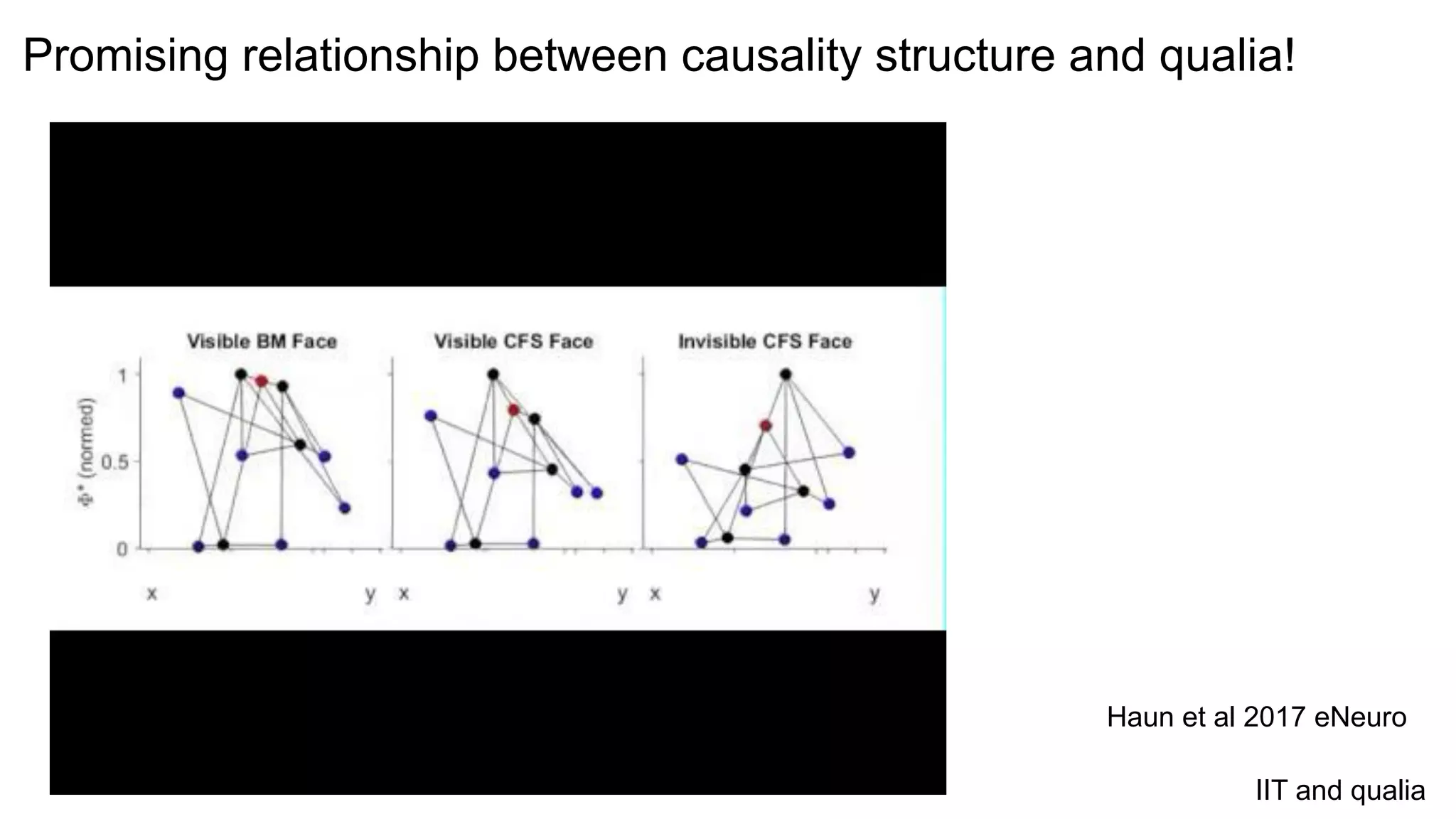
Haun et al 2017 eNeuro
Promising relationship between causality structure and qualia!
IIT and qualia
Are causality structures related to qualia?
Unique in FFA, V4/V8, MT, …?
Can we compute them from single neuron activity?
IIT and qualia
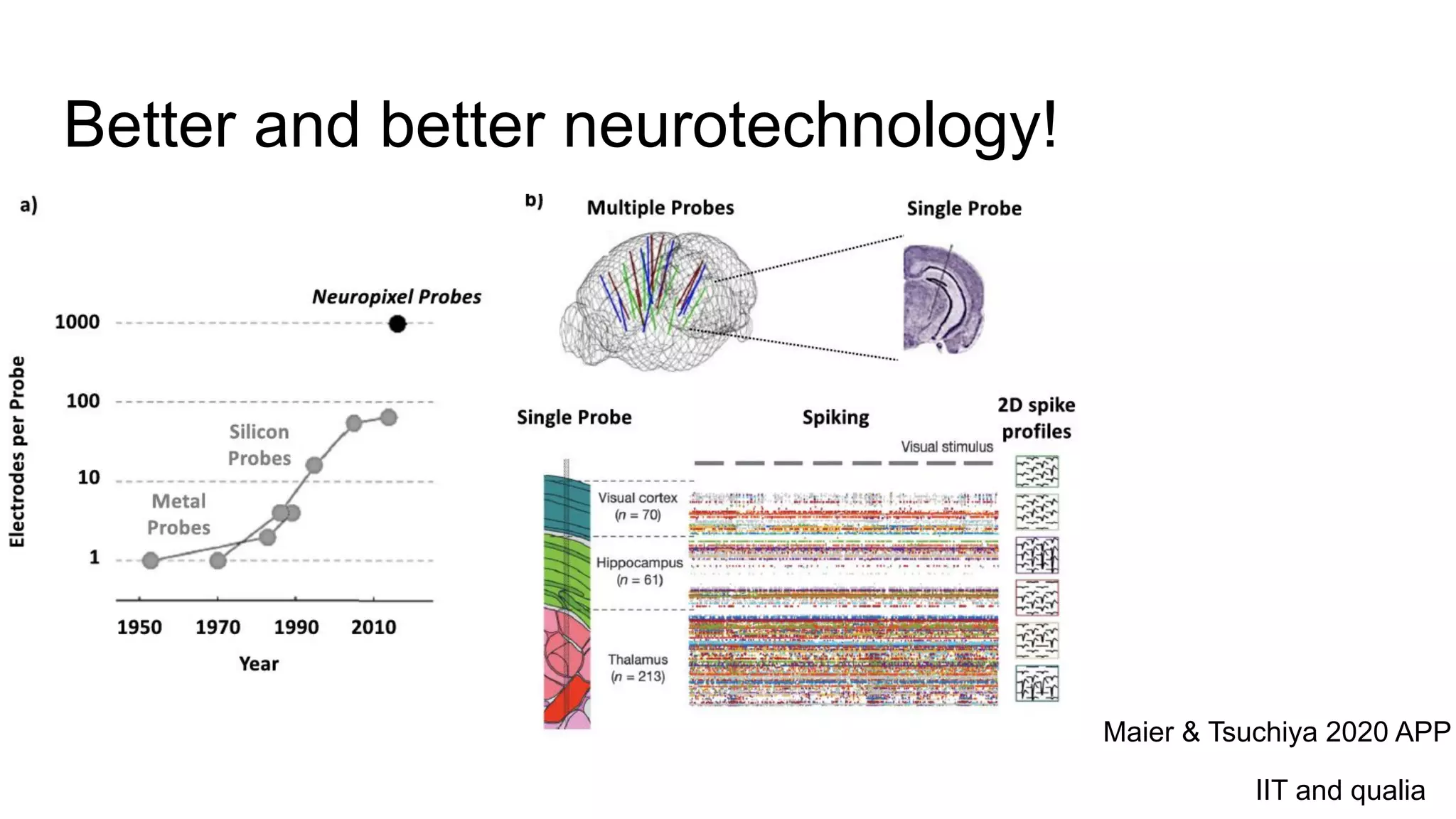
Better and better neurotechnology!
Maier & Tsuchiya 2020 APP
IIT and qualia
Summary:
Integrated information can be computed in a hierarchical
manner.
We can estimate causality structures of neural network.
Causality structures should depend on specific neural
connectivity within an area as well as between areas
Can causality structures explain different qualia?
IIT and qualia
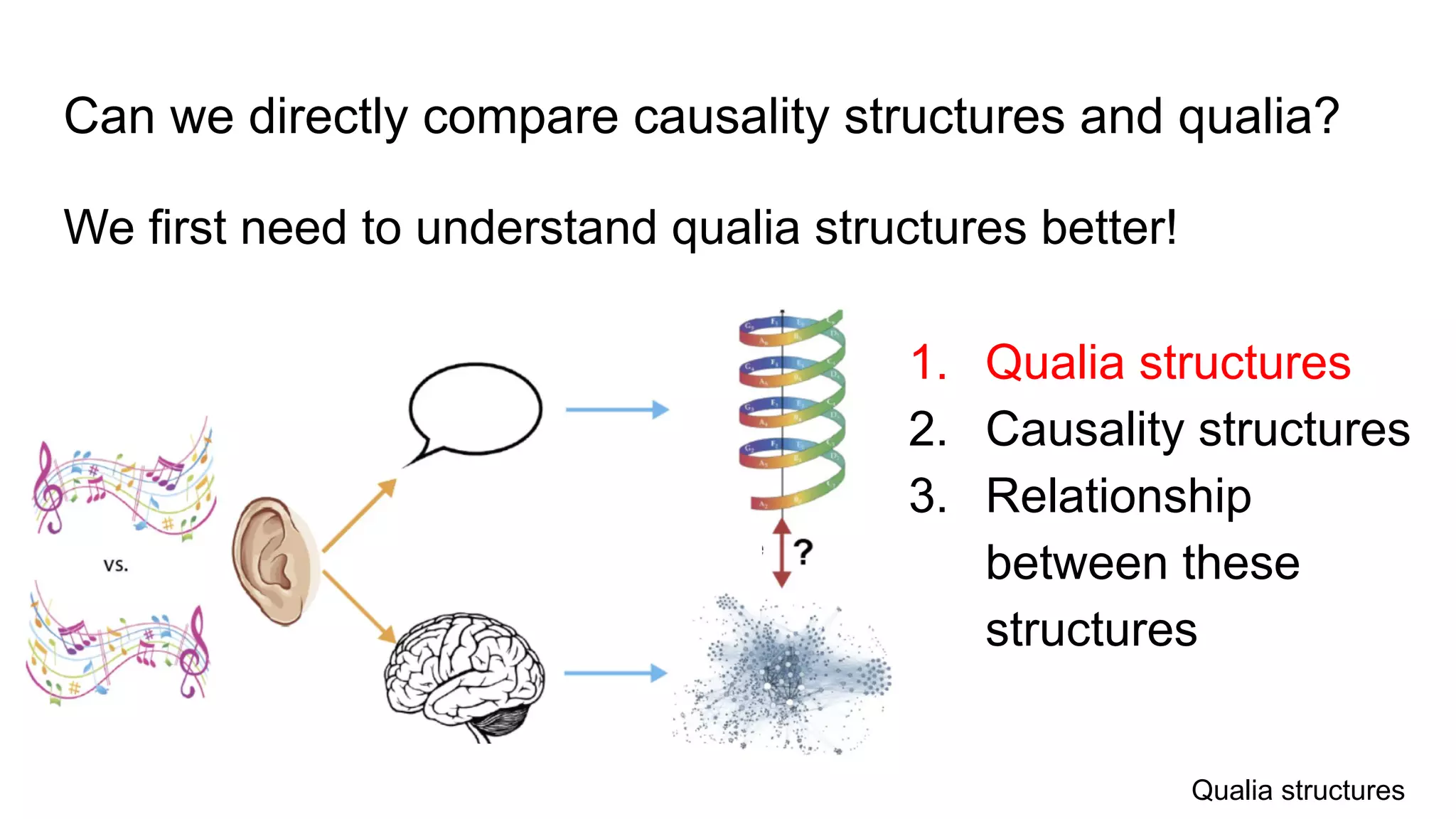
Can we directly compare causality structures and qualia?
We first need to understand qualia structures better!
1. Qualia structures
2. Causality structures
3. Relationship
between these
structures
Qualia structures
What are qualia structures?
Qualia structures
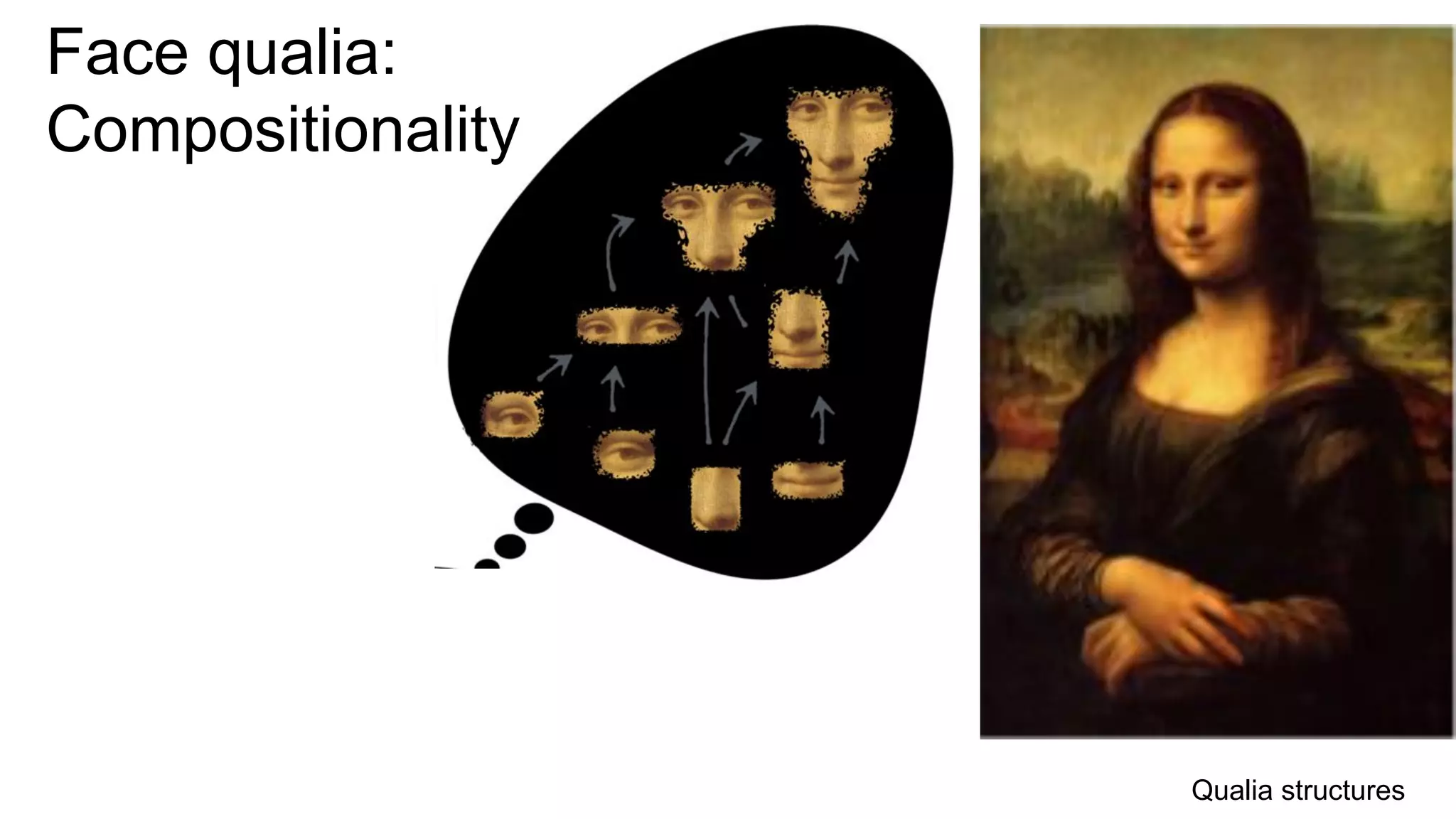
Face qualia:
Compositionality
Qualia structures
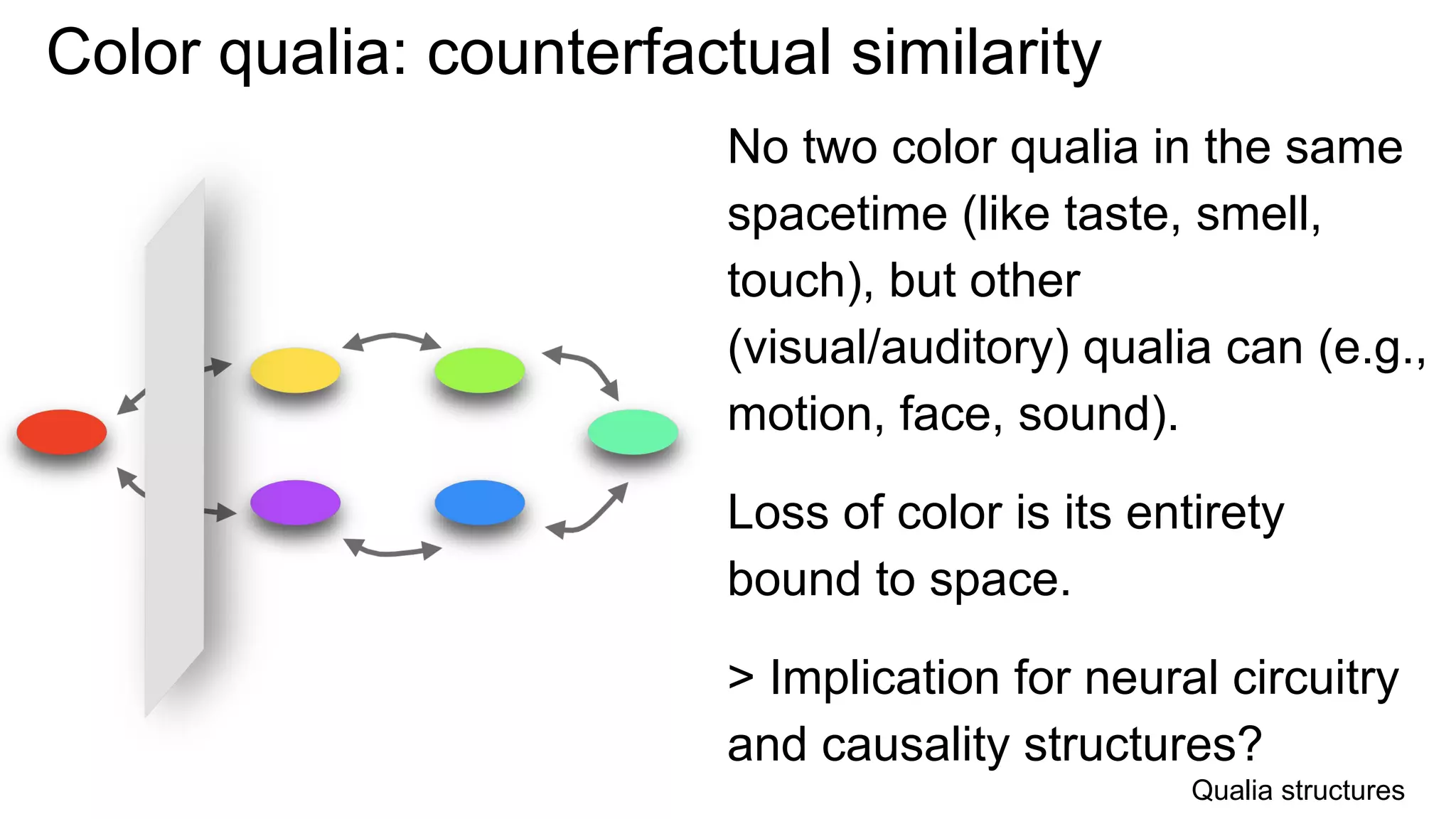
Color qualia: counterfactual similarity
No two color qualia in the same
spacetime (like taste, smell,
touch), but other
(visual/auditory) qualia can (e.g.,
motion, face, sound).
Loss of color is its entirety
bound to space.
> Implication for neural circuitry
and causality structures?
Qualia structures
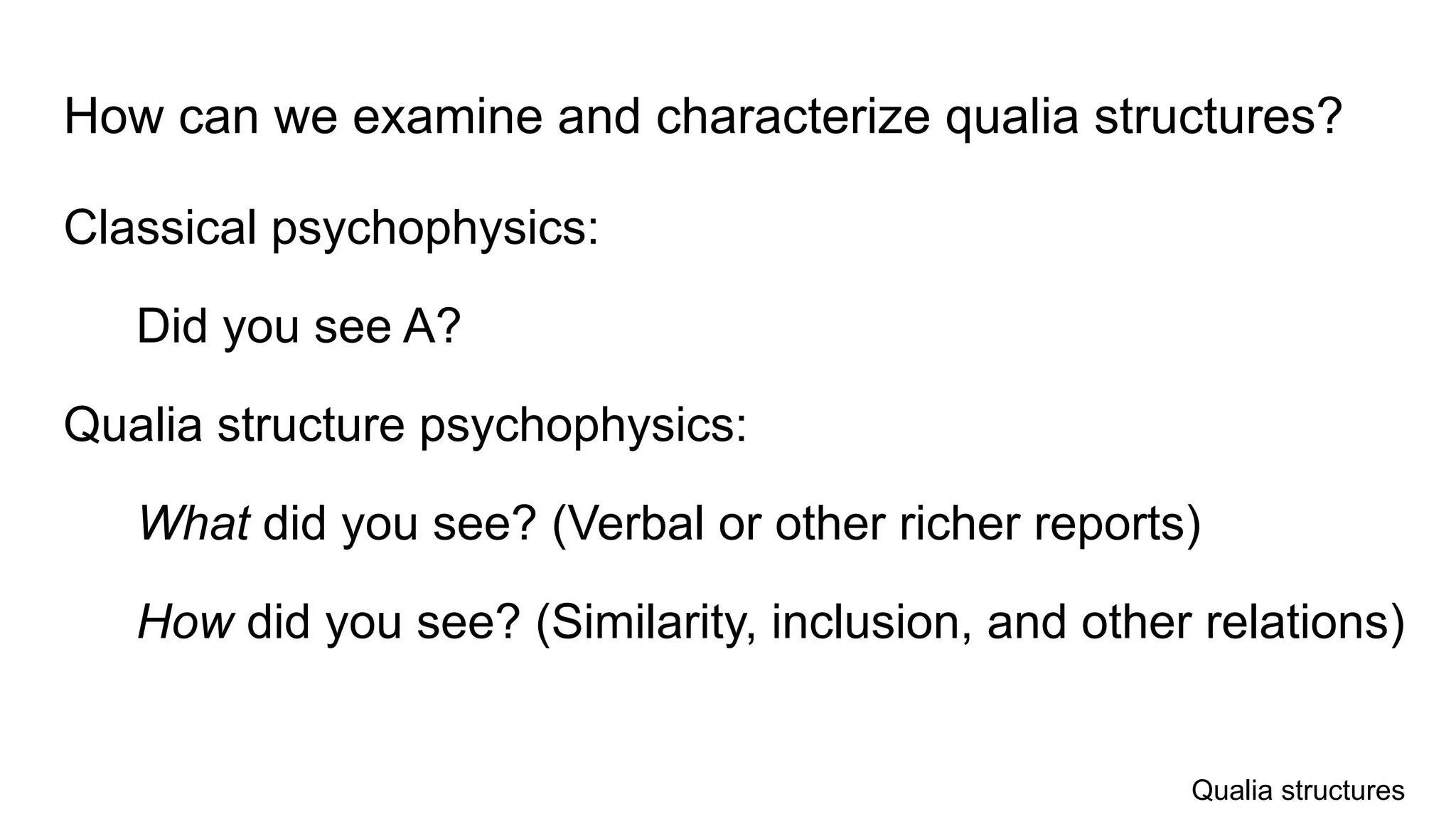
How can we examine and characterize qualia structures?
Classical psychophysics:
Did you see A?
Qualia structure psychophysics:
What did you see? (Verbal or other richer reports)
How did you see? (Similarity, inclusion, and other relations)
Qualia structures
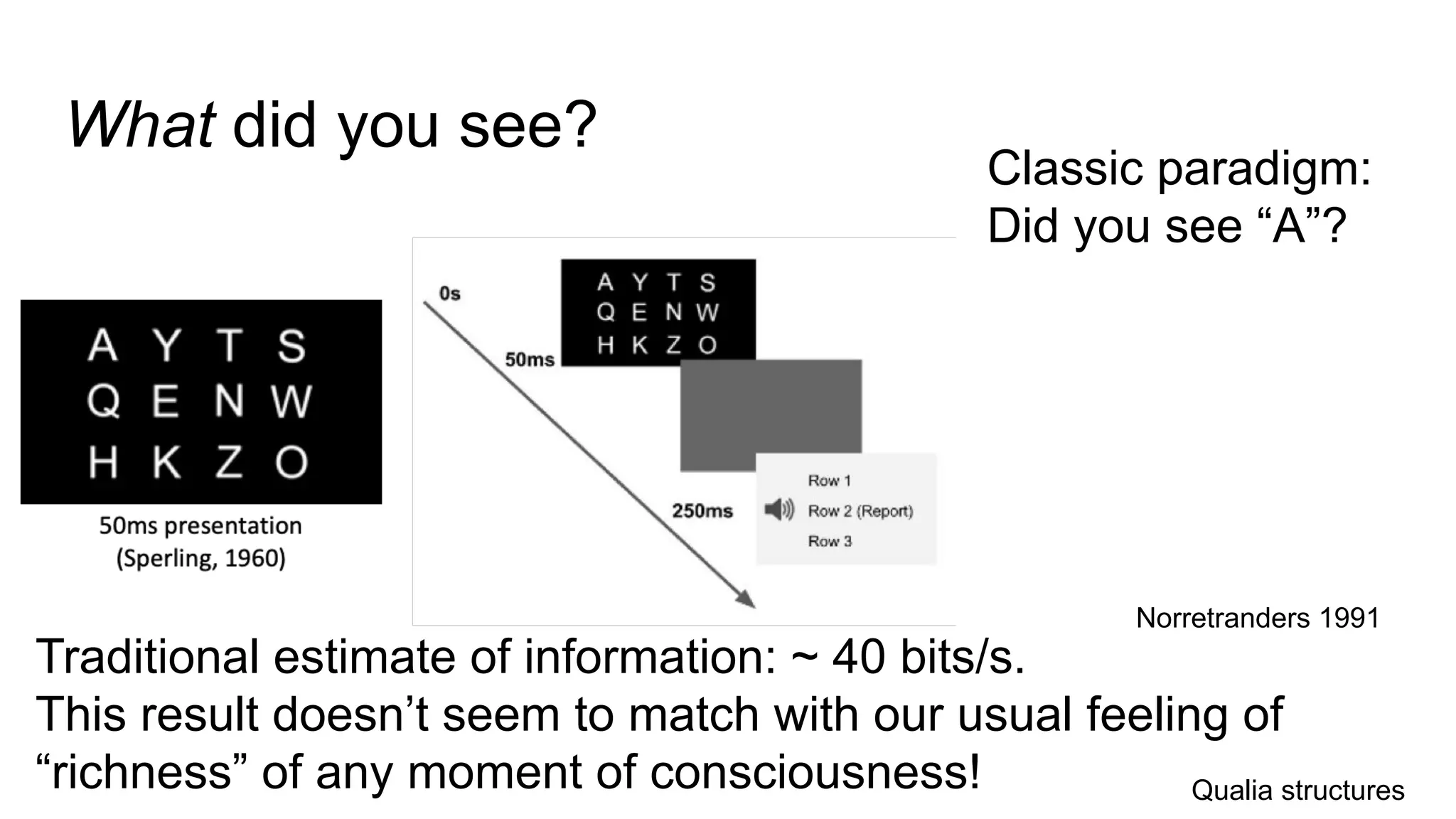
What did you see?
Traditional estimate of information: ~ 40 bits/s.
This result doesn’t seem to match with our usual feeling of
“richness” of any moment of consciousness!
Norretranders 1991
Classic paradigm:
Did you see “A”?
Qualia structures
Massive report paradigm
Koh, Gallagher, Nishimoto, Tsuchiya (2019 SOBR poster; in preparation)
Are the classic
results reflecting the
limitation in stimuli
and reports?
Qualia structures
Massive report paradigm
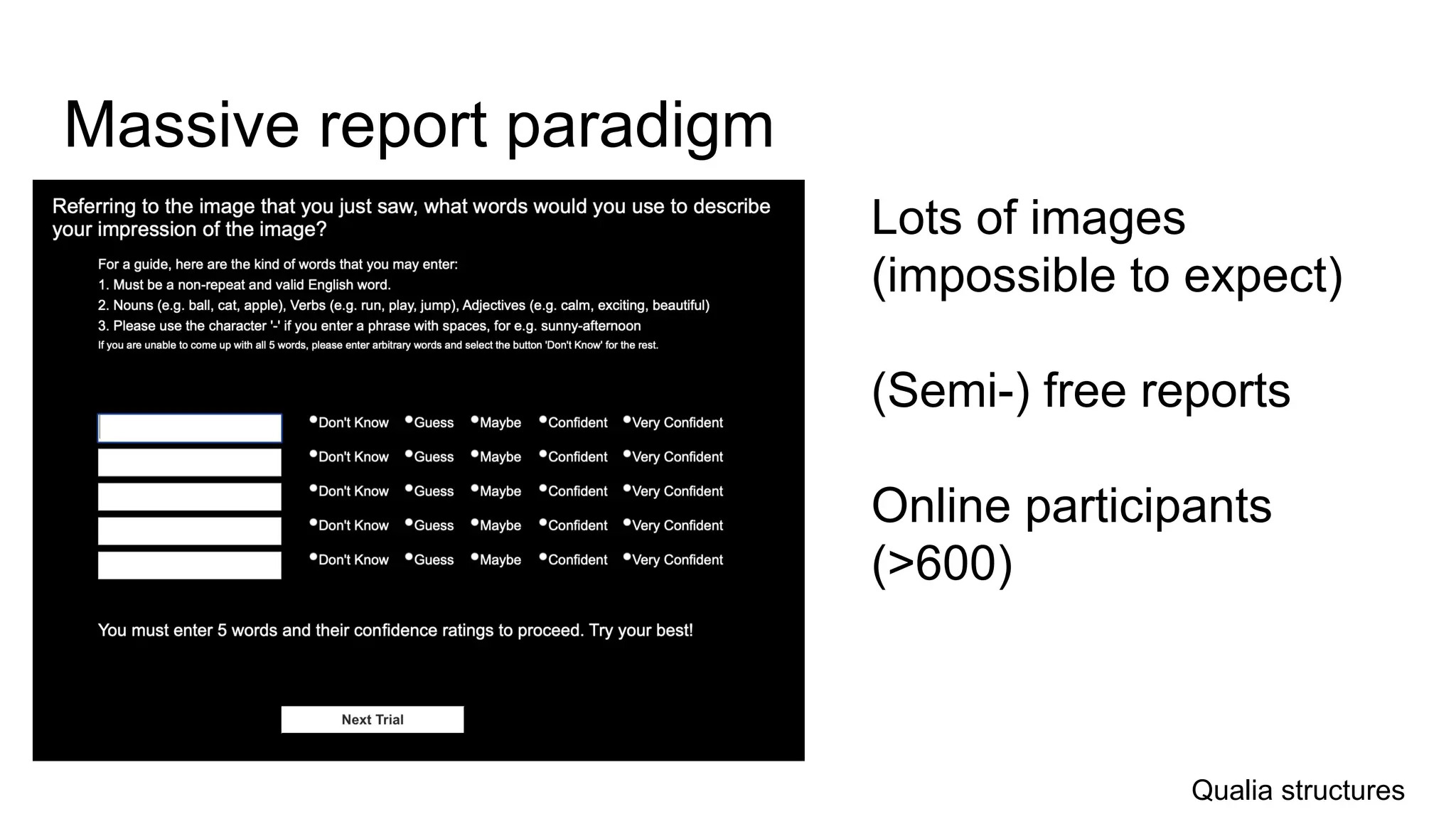
Lots of images
(impossible to expect)
(Semi-) free reports
Online participants
(>600)
Qualia structures
Massive report paradigm
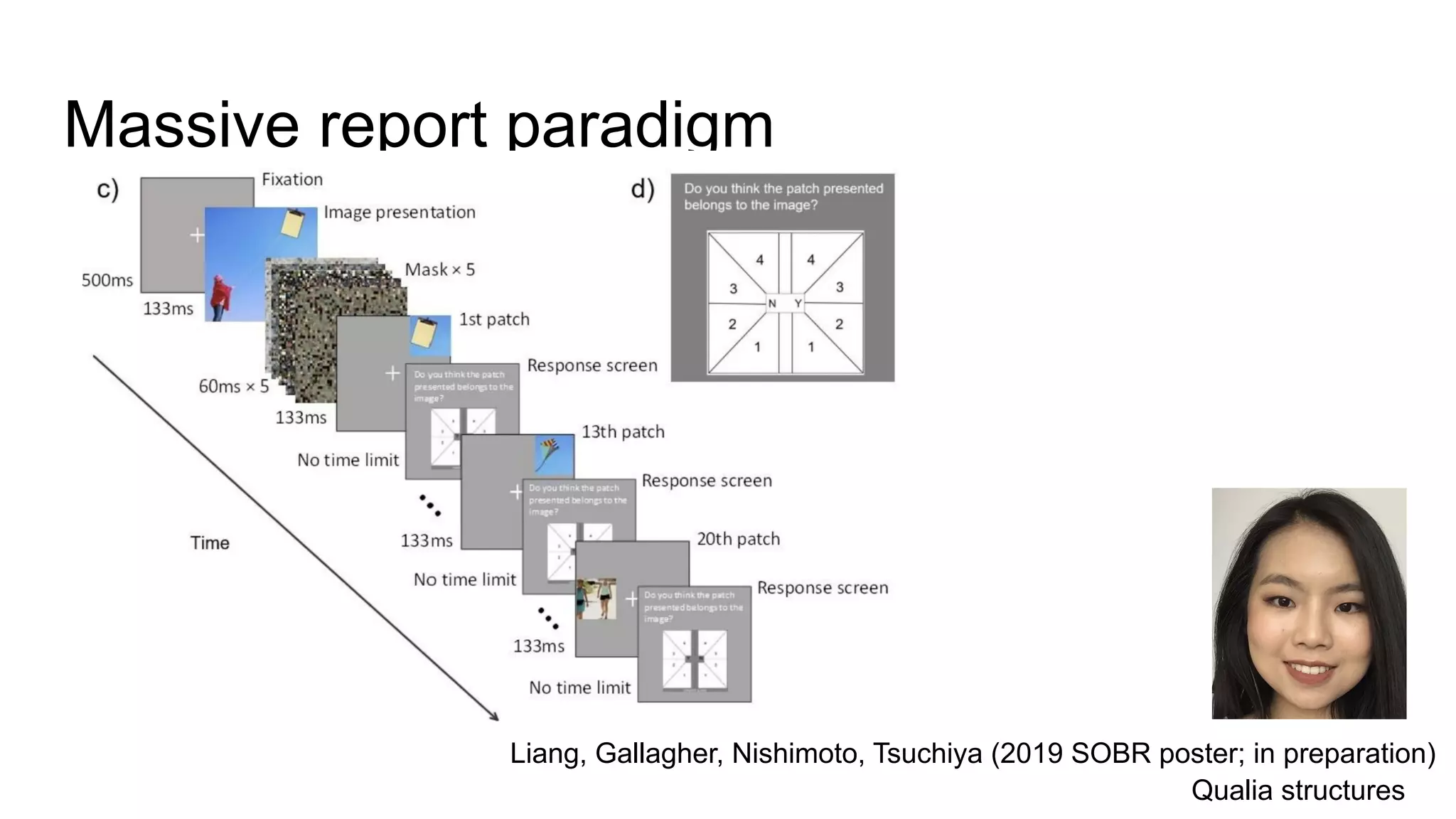
Liang, Gallagher, Nishimoto, Tsuchiya (2019 SOBR poster; in preparation)
Qualia structures
What do you see?
Generally, the massive report paradigms reveal structure of
experience that matches with our (reasonable) intuition.
Any moment of experience seems highly structured.
People can differentiate many different concepts and
images without much difficulty.
Qualia structures
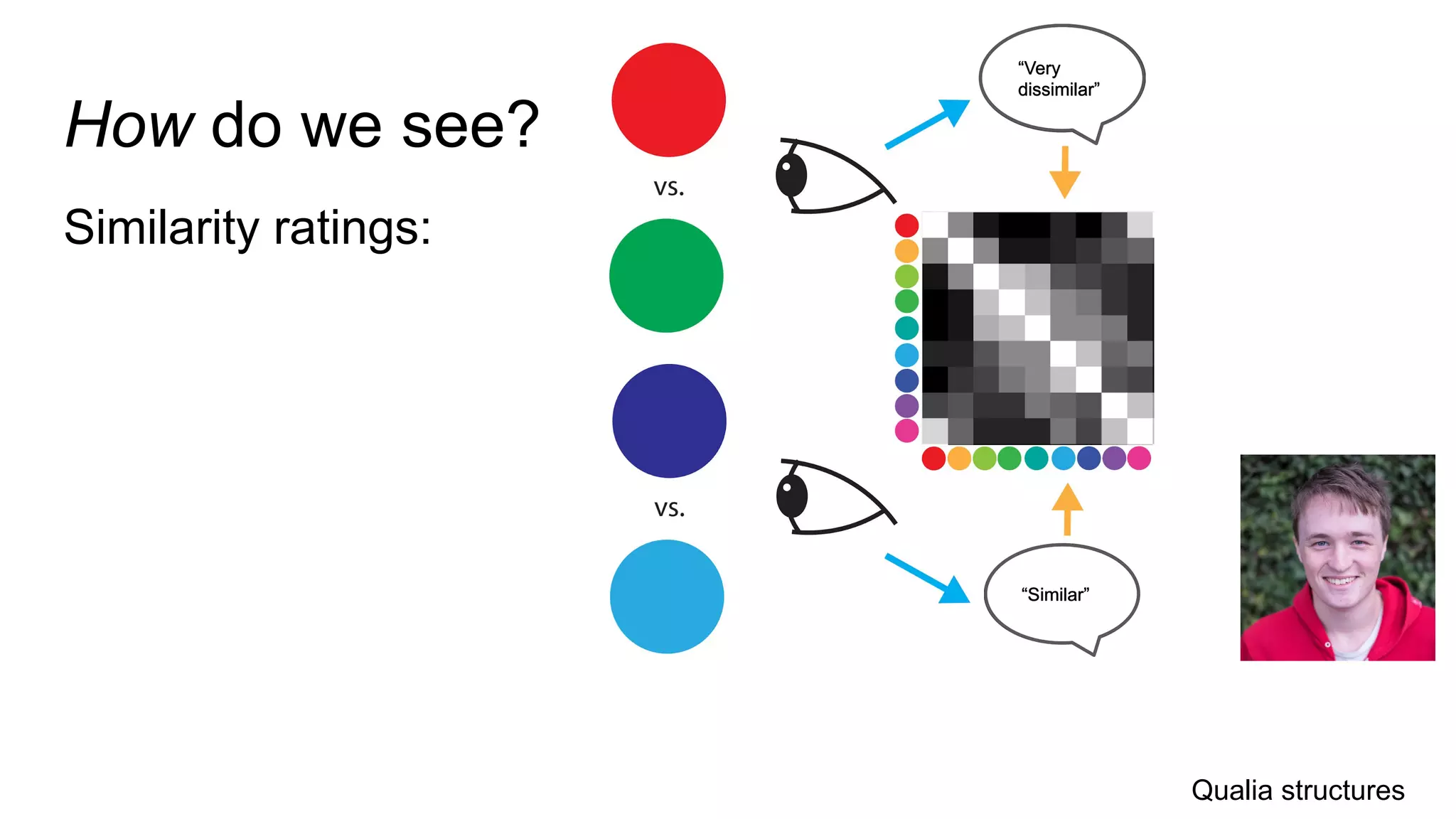
How do we see?
Similarity ratings:
“Similar”
“Very
dissimilar”
Qualia structures
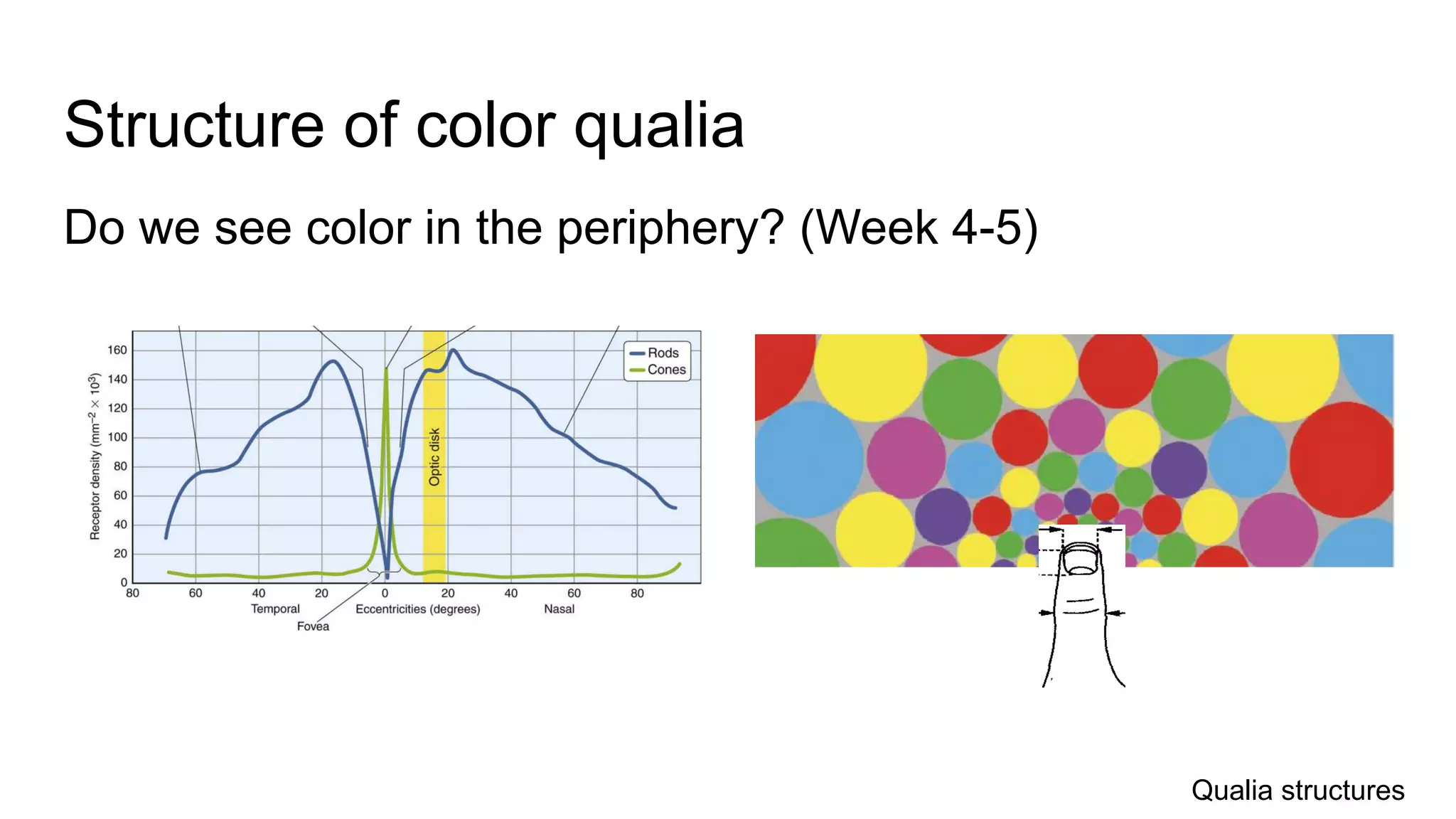
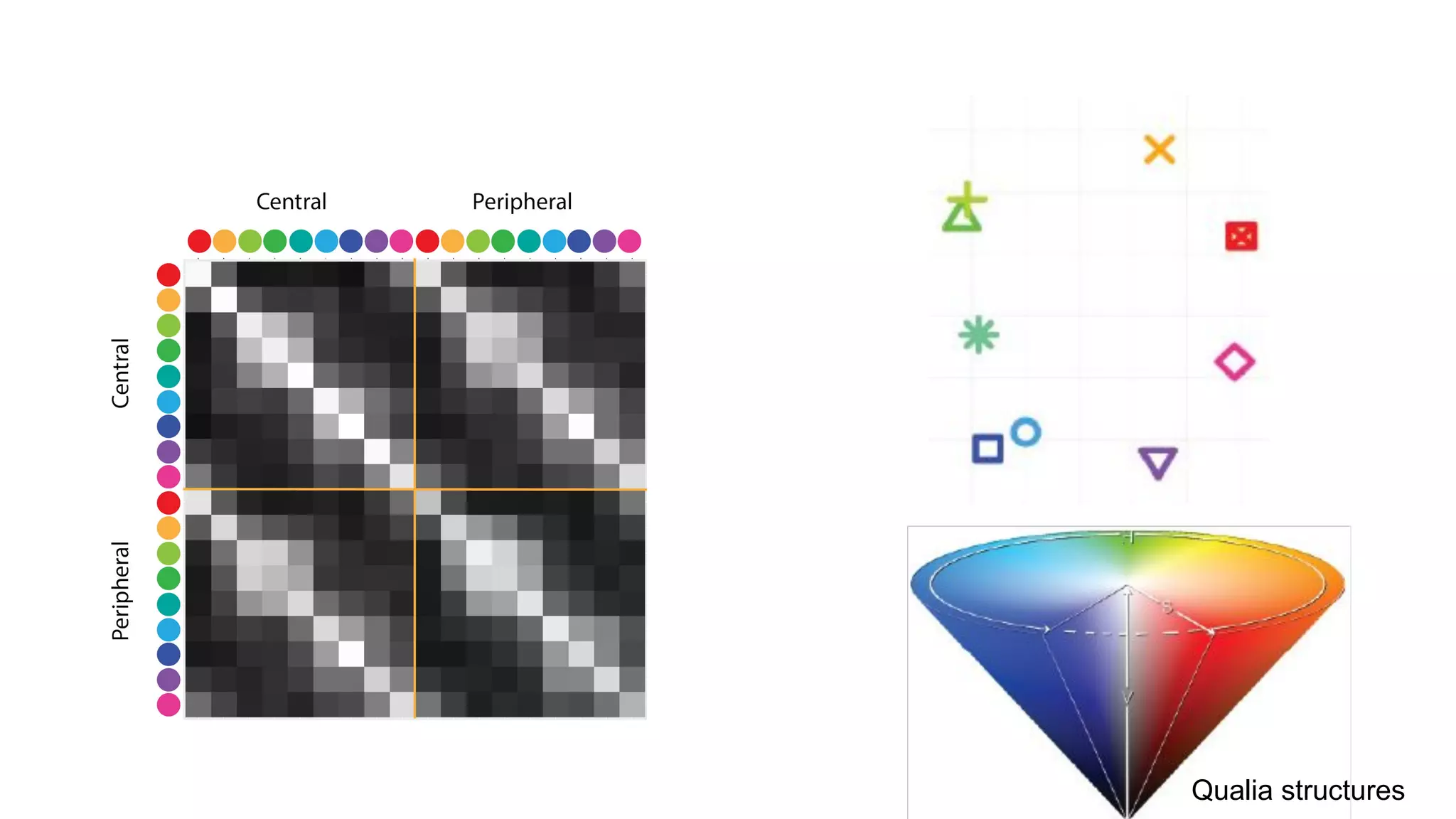
Structure of color qualia
Do we see color in the periphery? (Week 4-5)
Qualia structures
Are similarity structures equivalent across visual fields?
? ?
?
Qualia structures
Color similarity task
Qualia structures
Qualia structures
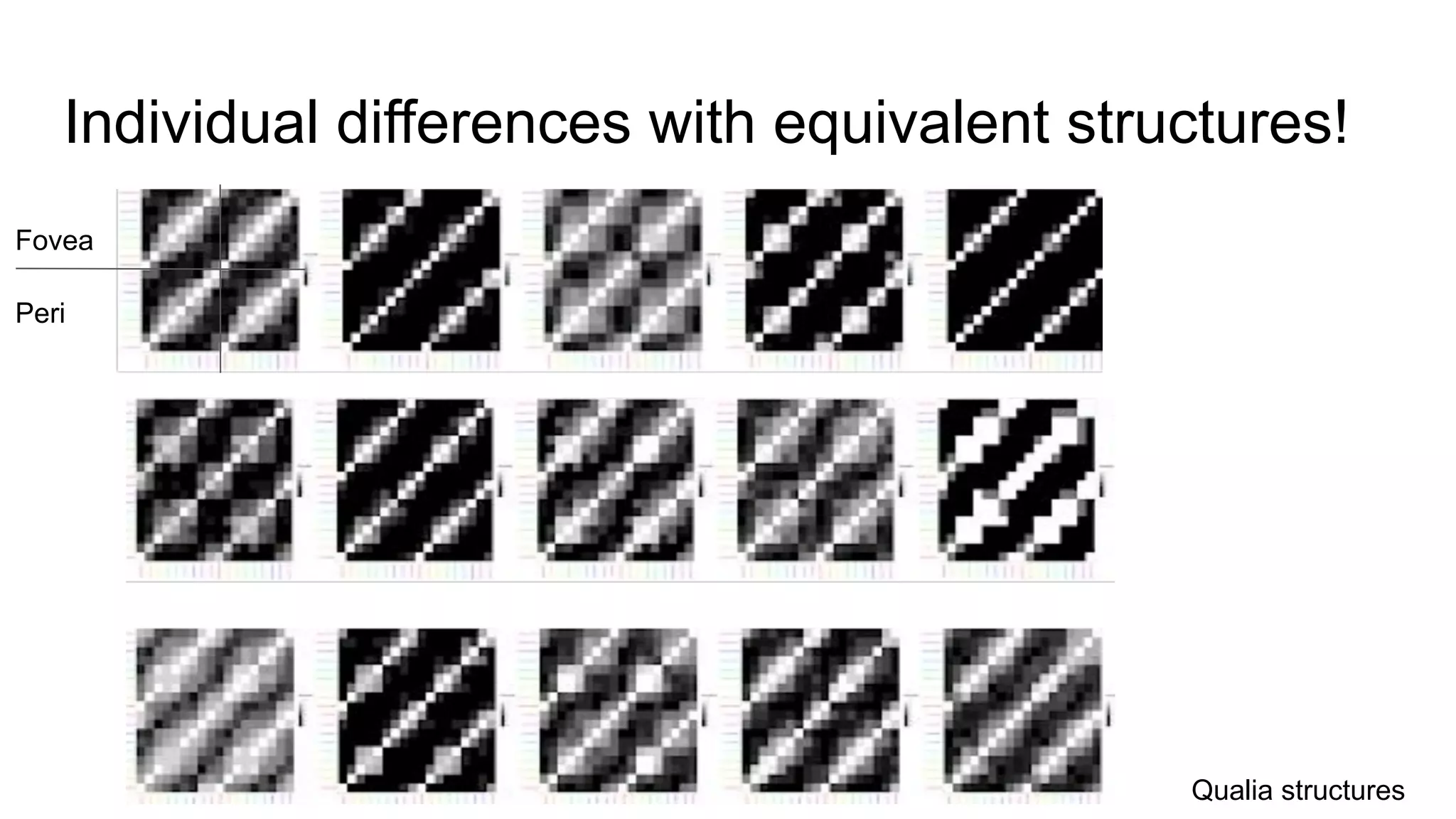
Individual differences with equivalent structures!
Fovea
Peri
Qualia structures
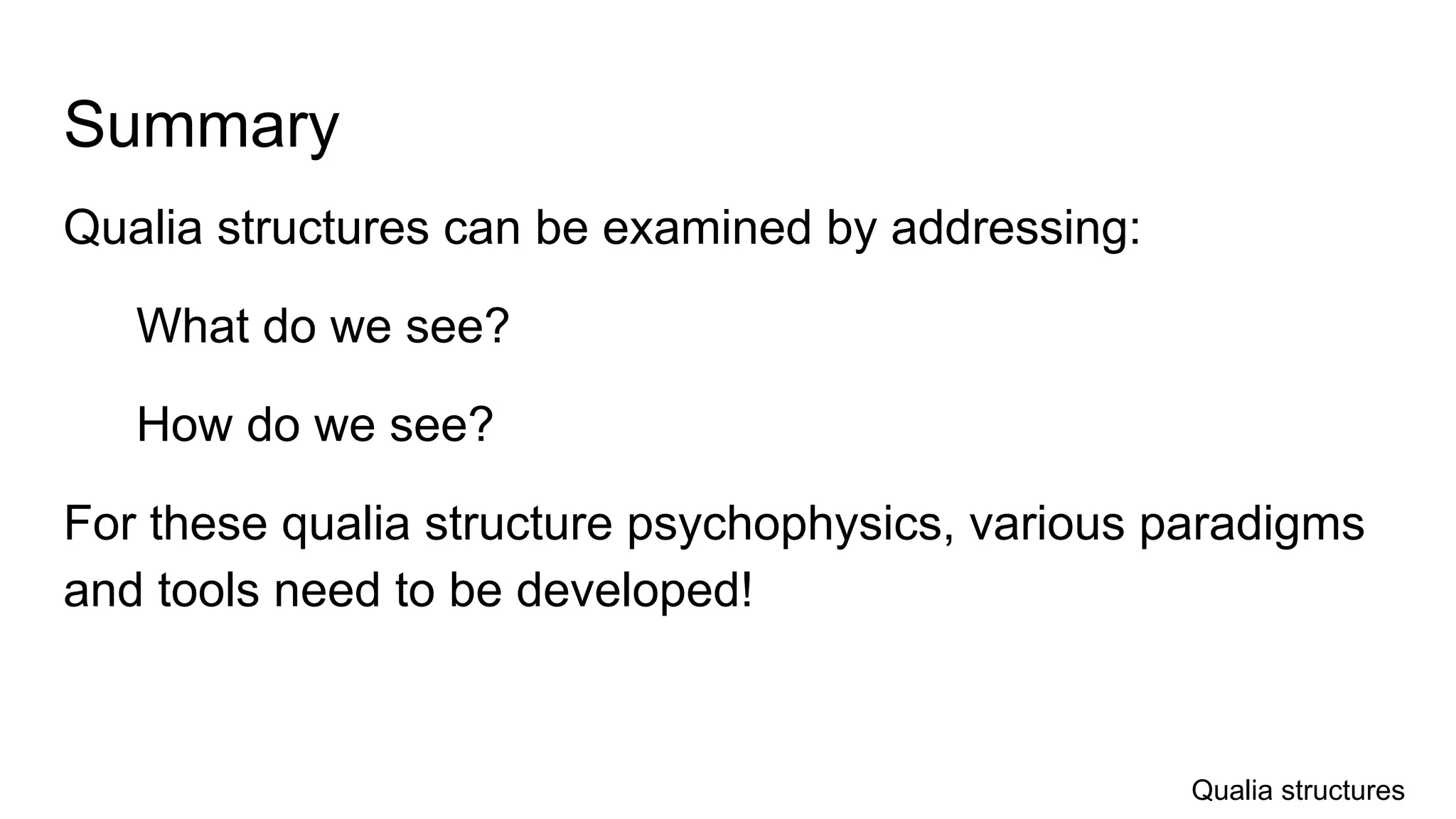
Summary
Qualia structures can be examined by addressing:
What do we see?
How do we see?
For these qualia structure psychophysics, various paradigms
and tools need to be developed!
Qualia structures
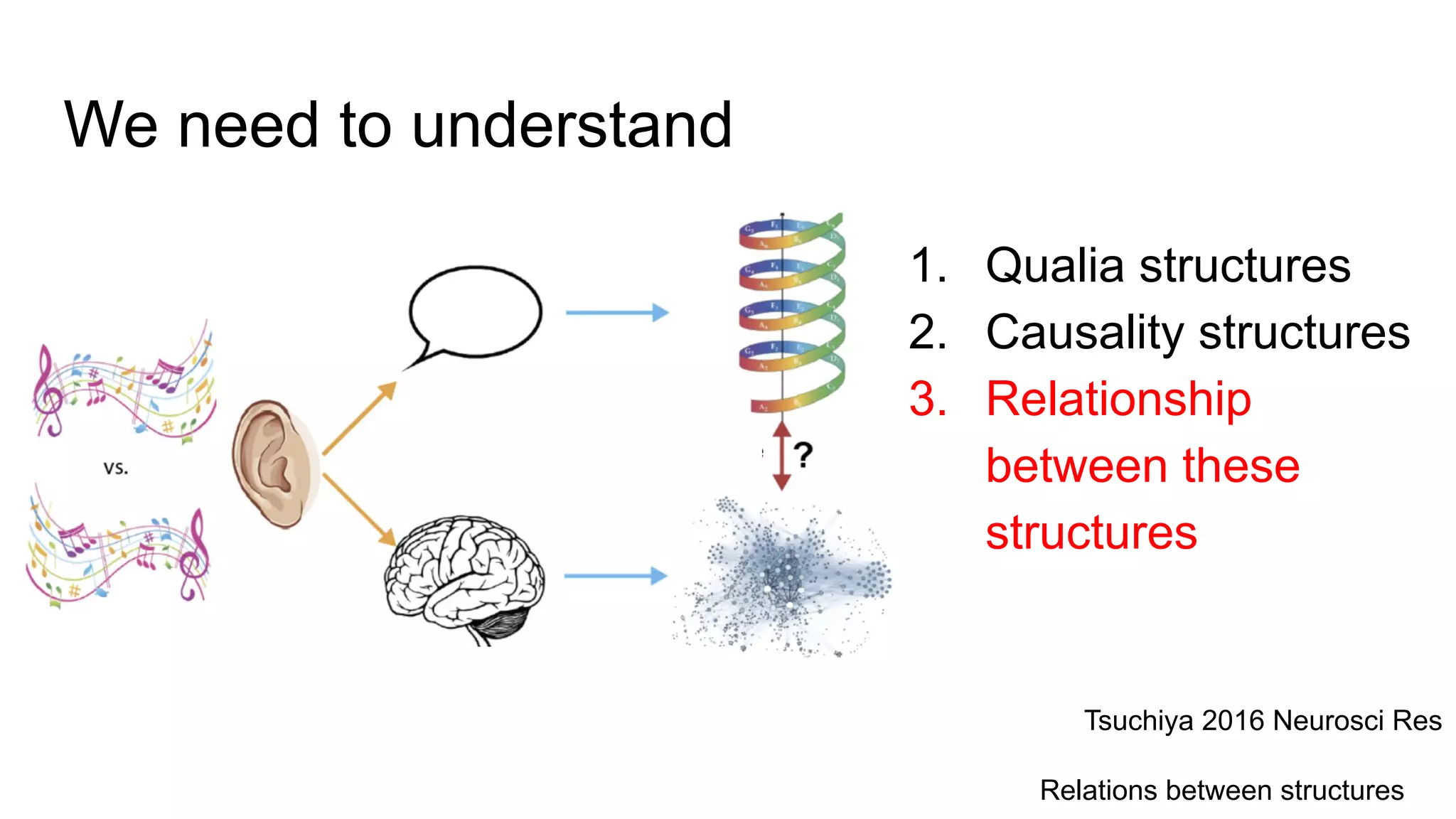
We need to understand
1. Qualia structures
2. Causality structures
3. Relationship
between these
structures
Tsuchiya 2016 Neurosci Res
Relations between structures
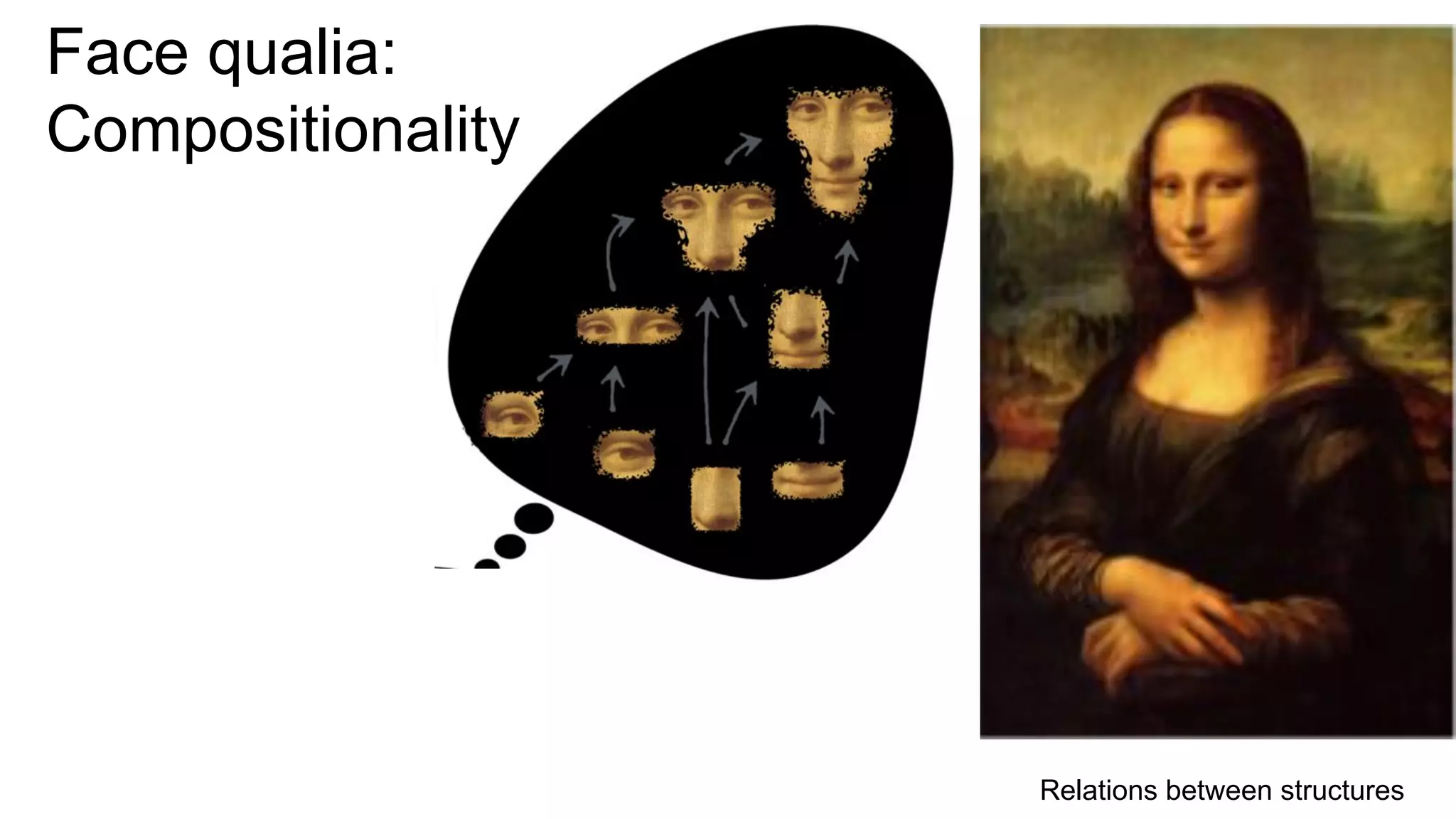
Face qualia:
Compositionality
Relations between structures
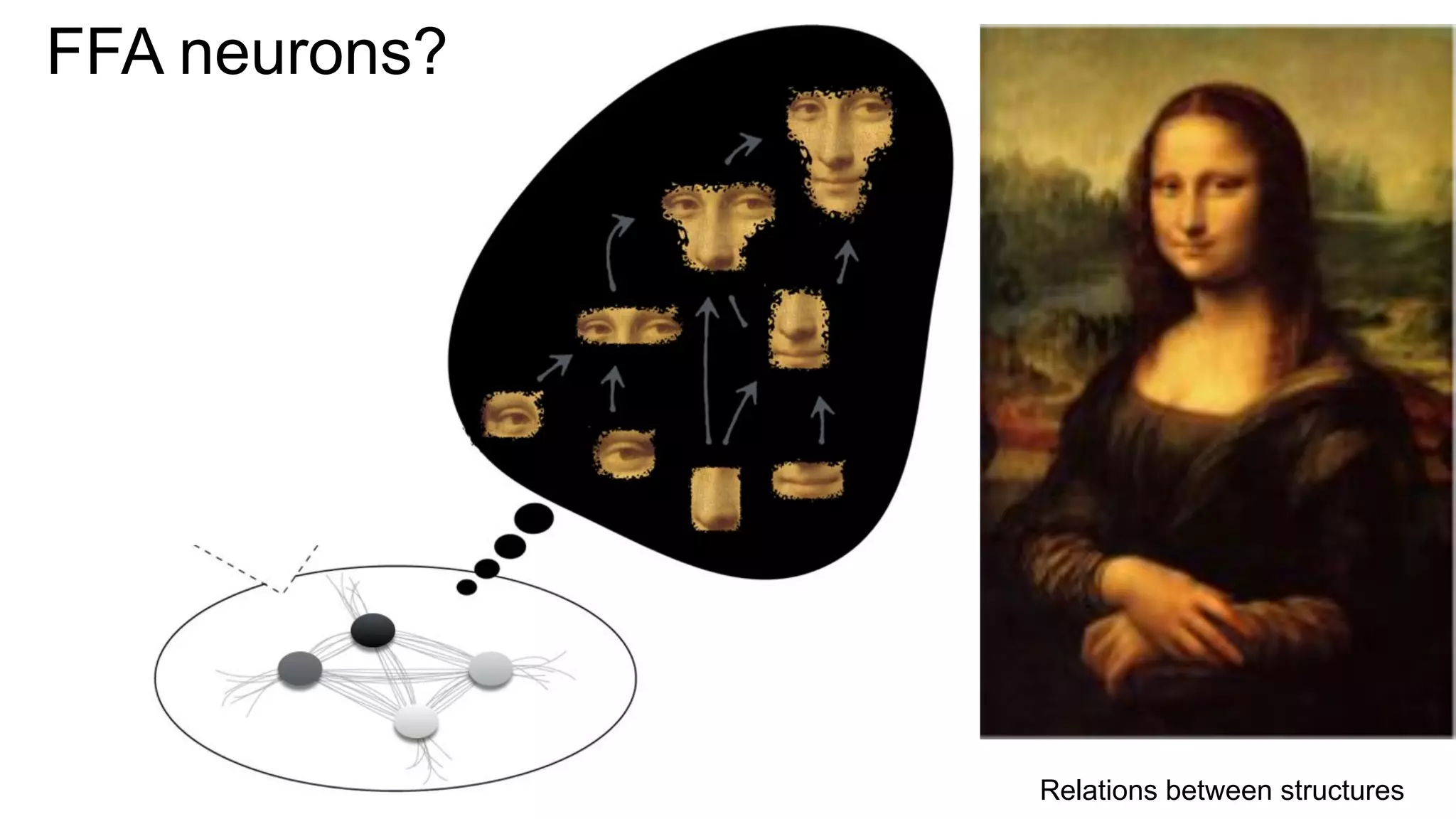
FFA neurons?
Relations between structures
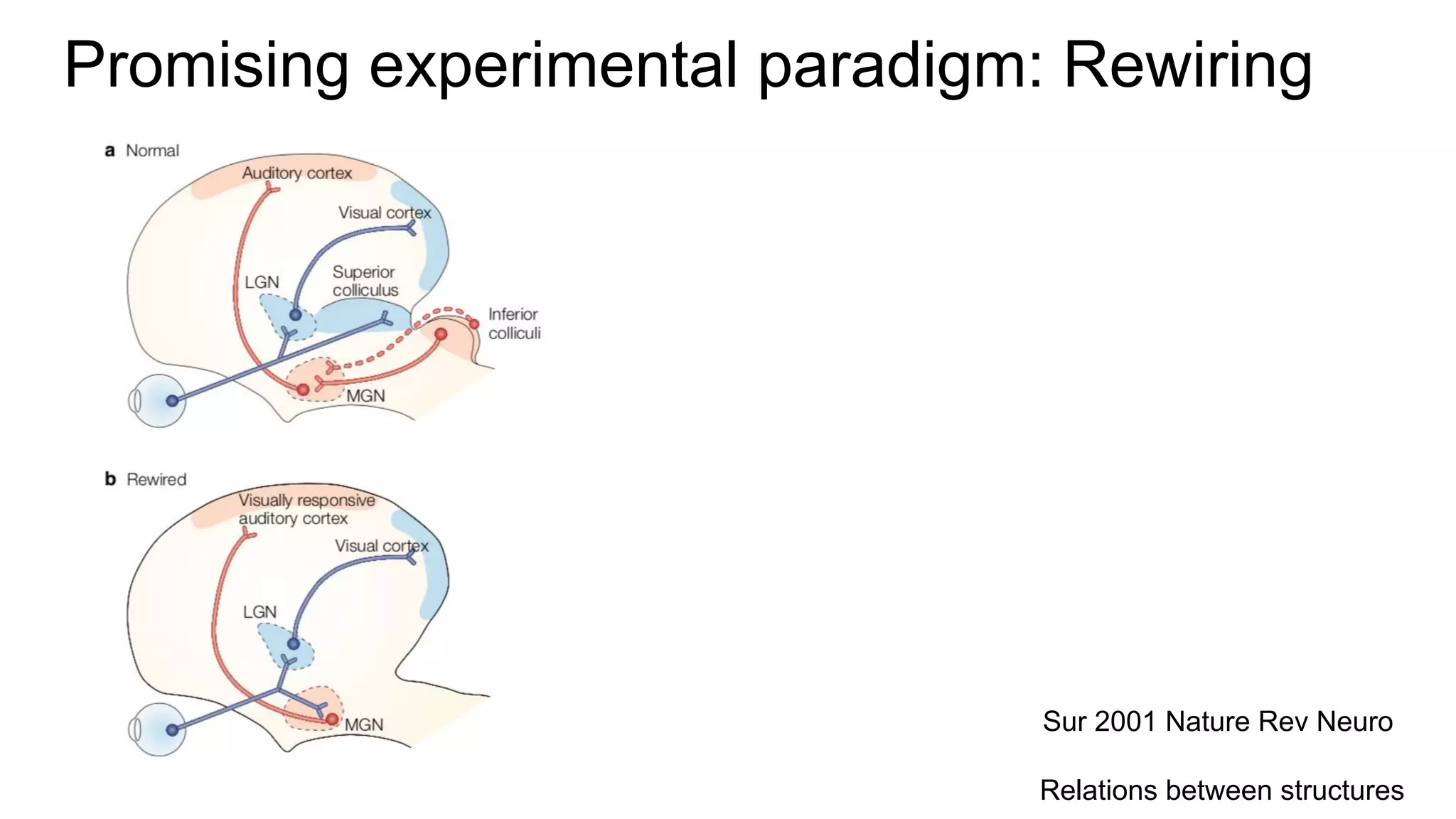
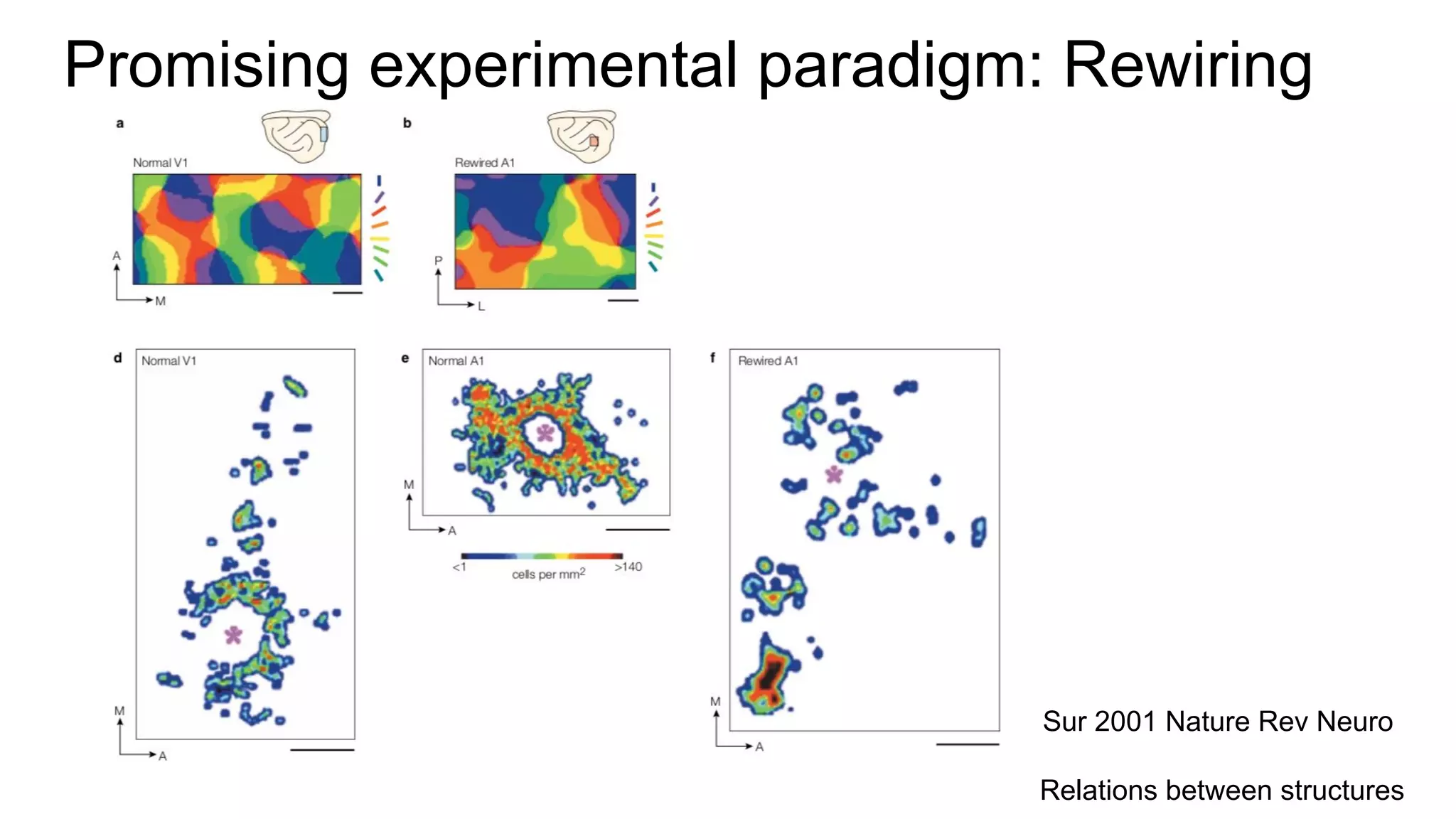
Promising experimental paradigm: Rewiring
Sur 2001 Nature Rev Neuro
Relations between structures
Sur 2001 Nature Rev Neuro
Promising experimental paradigm: Rewiring
Relations between structures
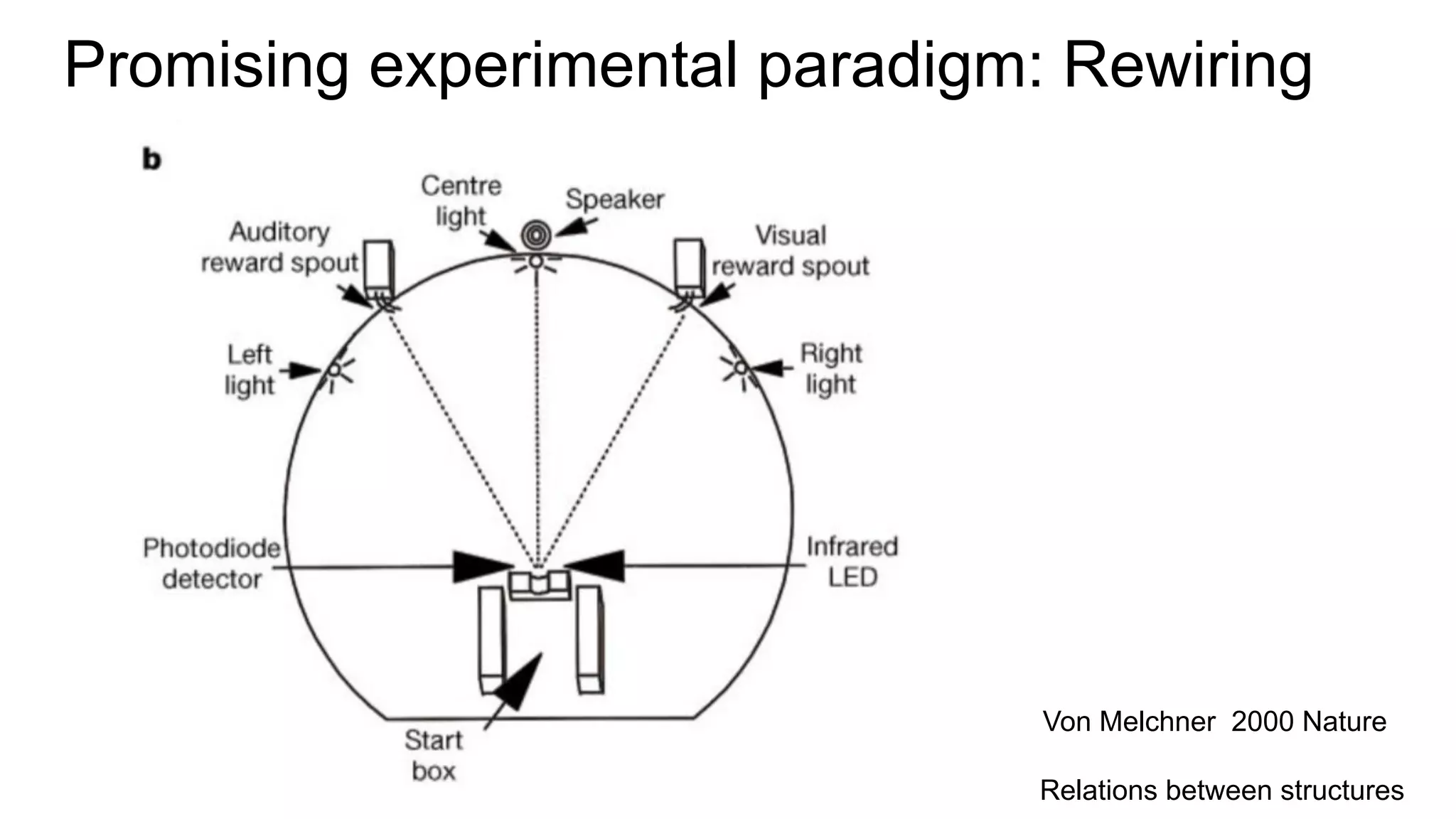
Von Melchner 2000 Nature
Promising experimental paradigm: Rewiring
Relations between structures
Summary:
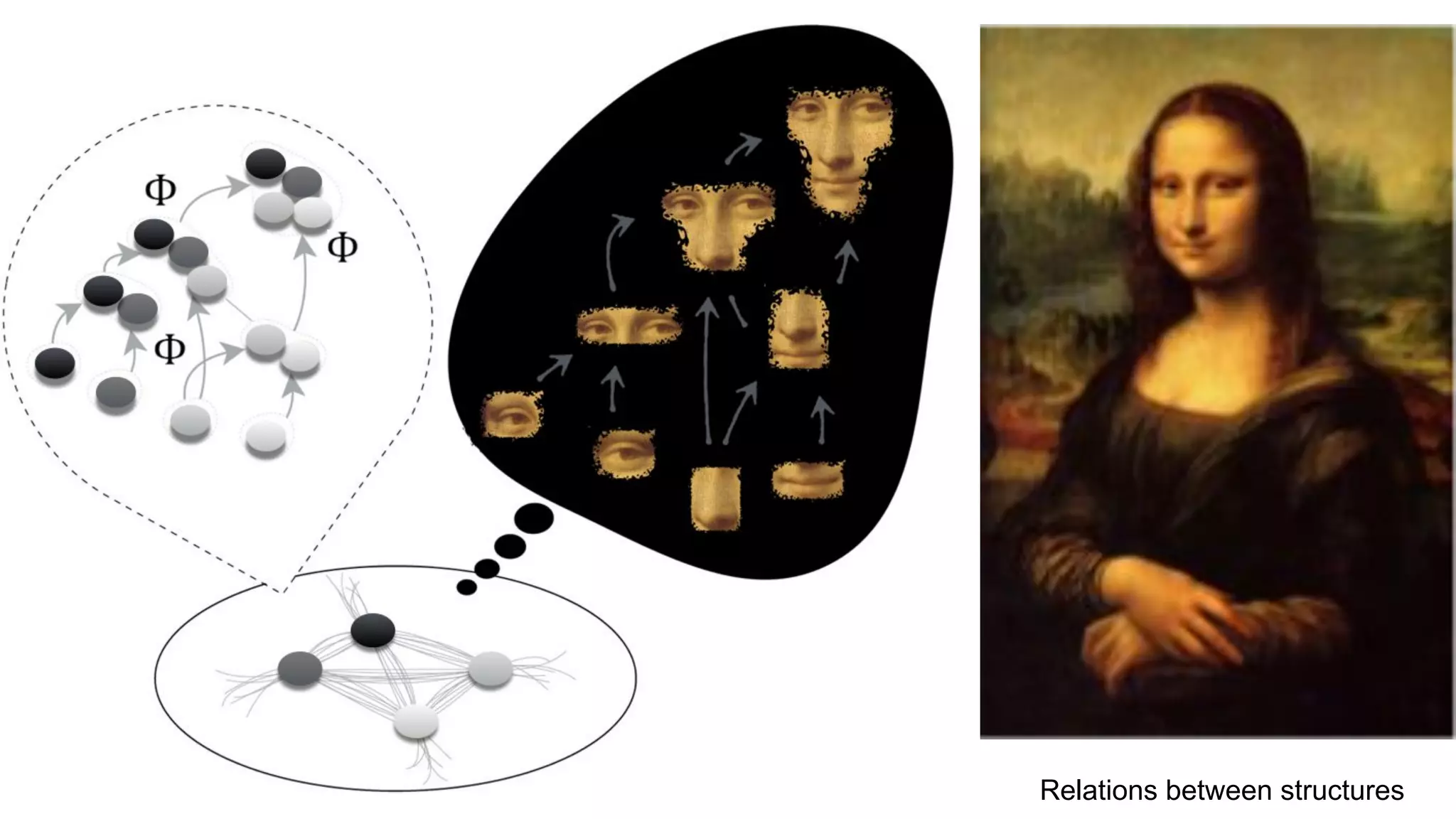
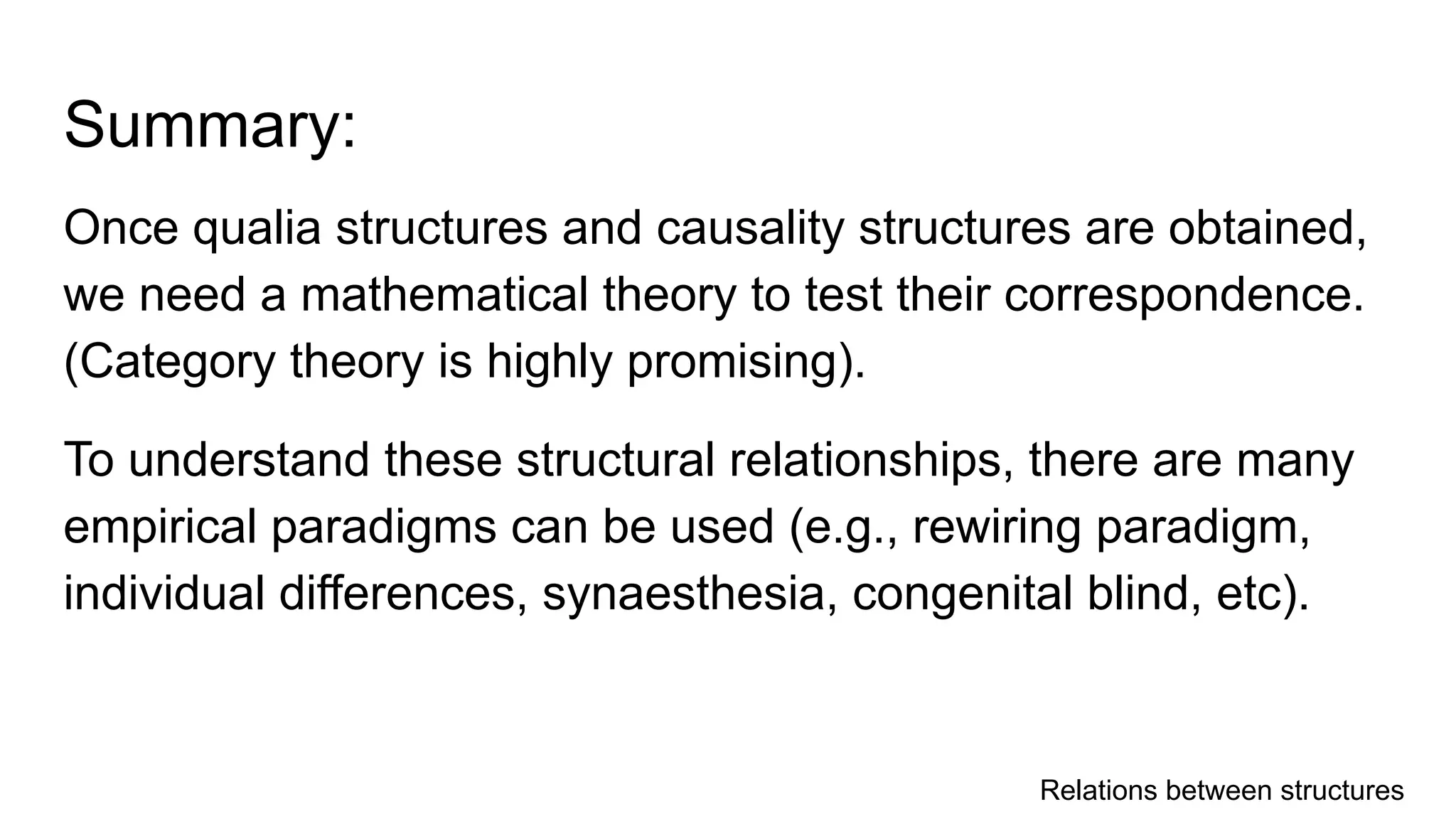
Once qualia structures and causality structures are obtained,
we need a mathematical theory to test their correspondence.
(Category theory is highly promising).
To understand these structural relationships, there are many
empirical paradigms can be used (e.g., rewiring paradigm,
individual differences, synaesthesia, congenital blind, etc).
Relations between structures
Concluding remarks!
Consciousness impacts
Consciousness
Clinical
EngineeringAcademic
Curiosity
Artificial intelligence
Robotics
Brain-Machine interface
Consciousness-meter
Restoring qualia
Sensory substitutionMind vs matter
Laws in physics
Development
Evolution Organoid
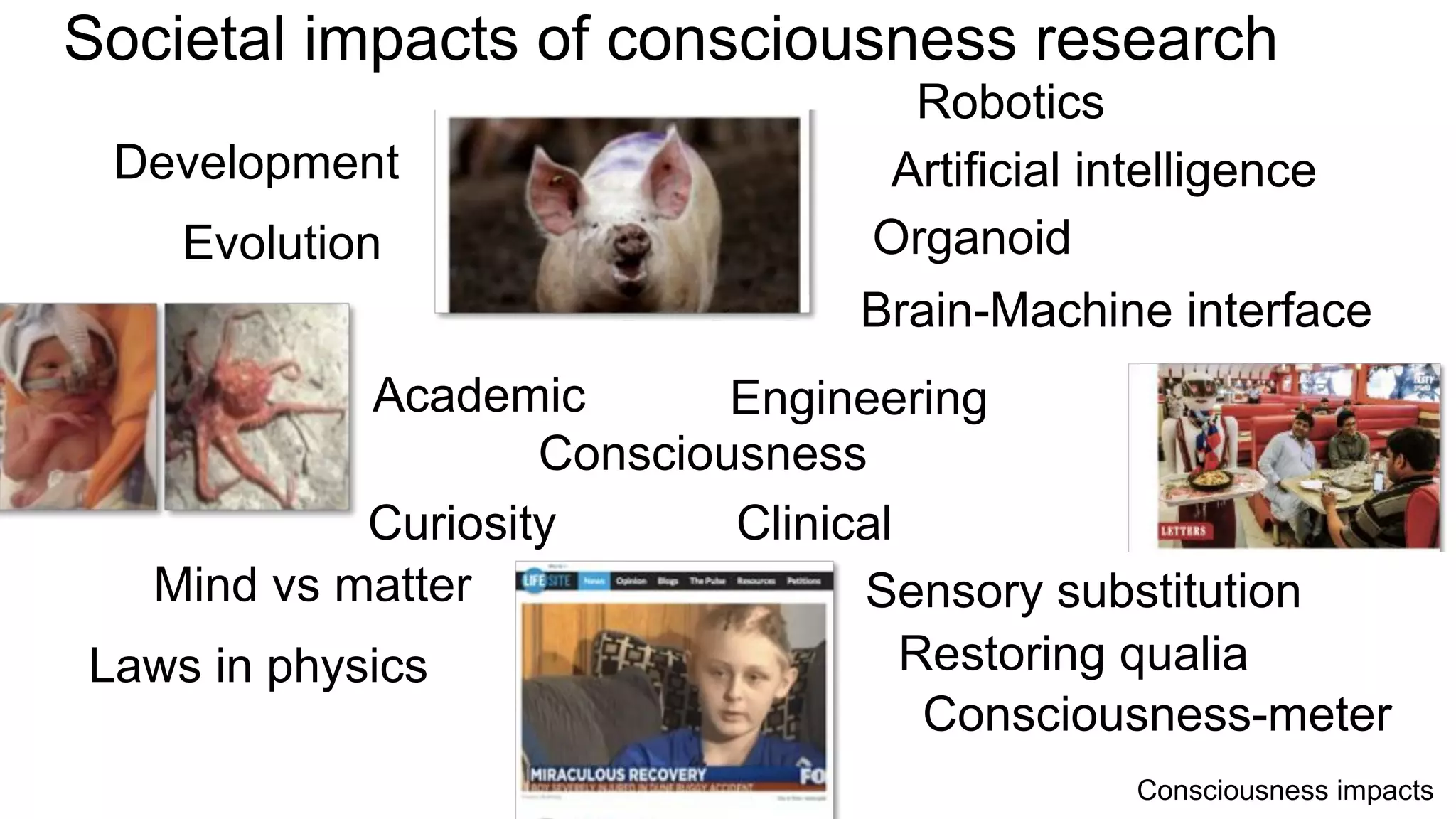
Societal impacts of consciousness research
Consciousness impacts
Consciousness
Clinical science
Engineering
Artificial intelligence Robotics
Development
Information theory
Pharmacology
Philosophy
Computer science
Physics
Mathematics
Linguistics
Psychology Neuroscience
Cognitive
Evolution
Ethics
Biology
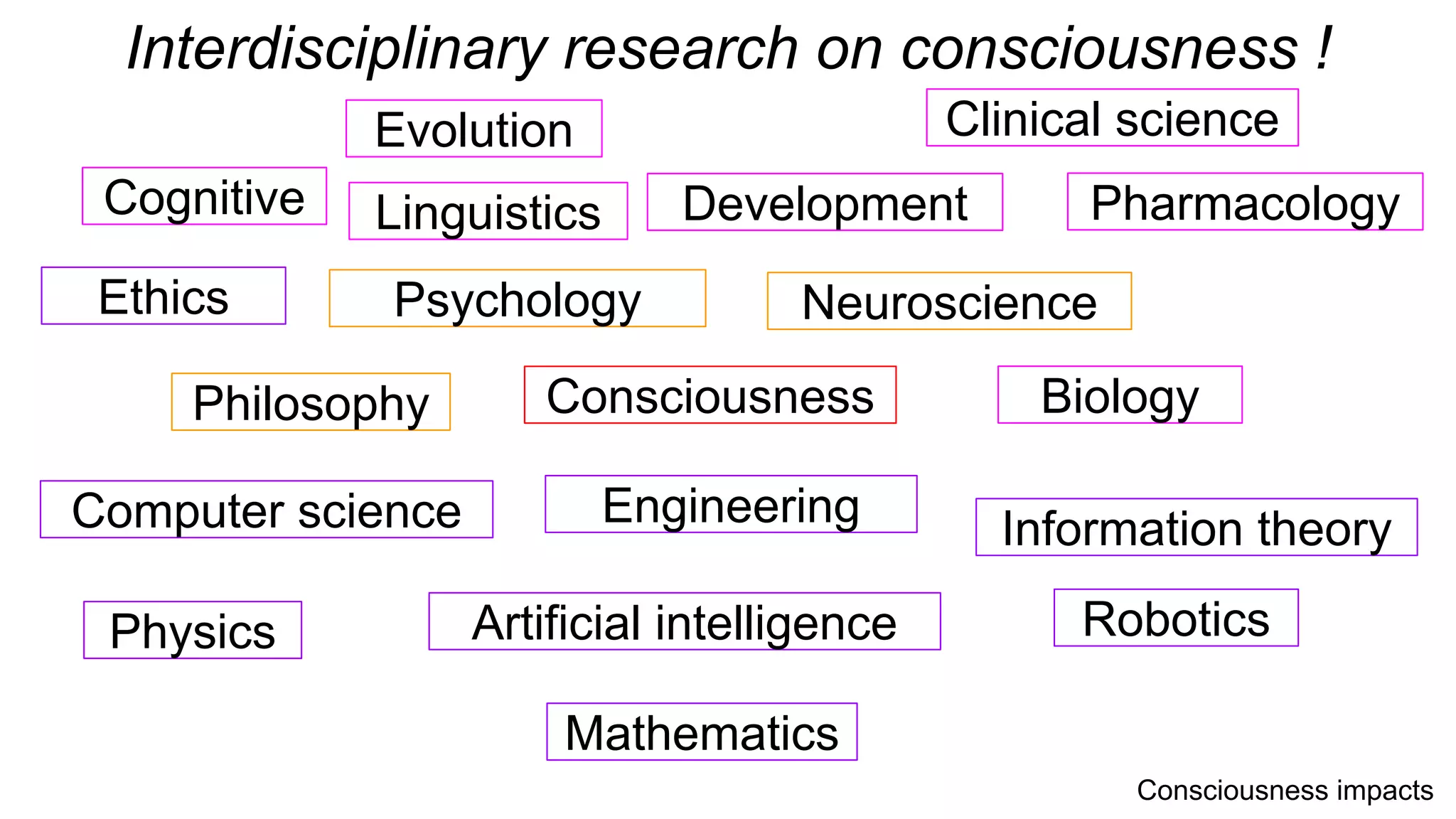
Interdisciplinary research on consciousness !
Consciousness impacts
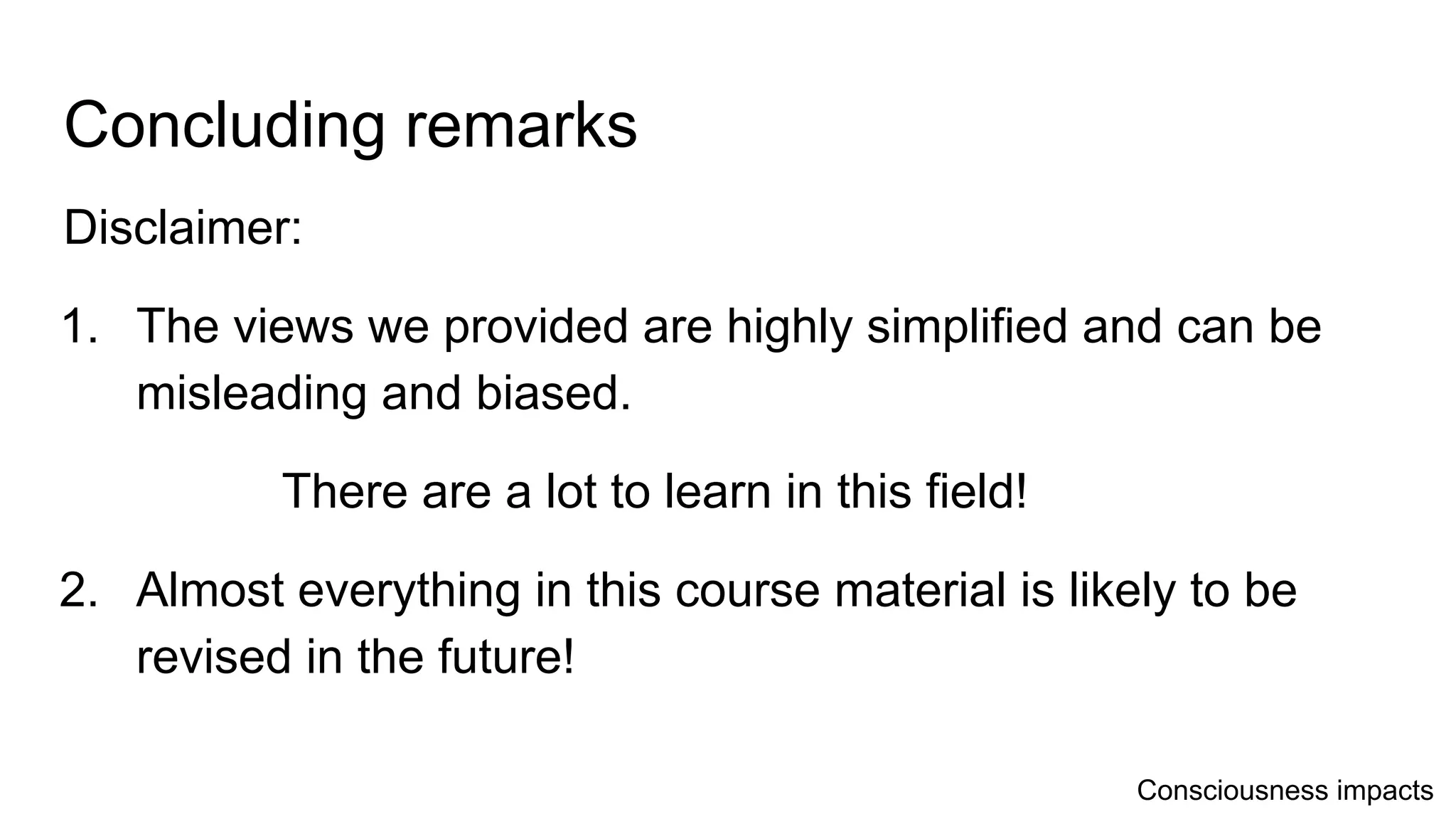
Concluding remarks
Disclaimer:
1. The views we provided are highly simplified and can be
misleading and biased.
There are a lot to learn in this field!
2. Almost everything in this course material is likely to be
revised in the future!
Consciousness impacts
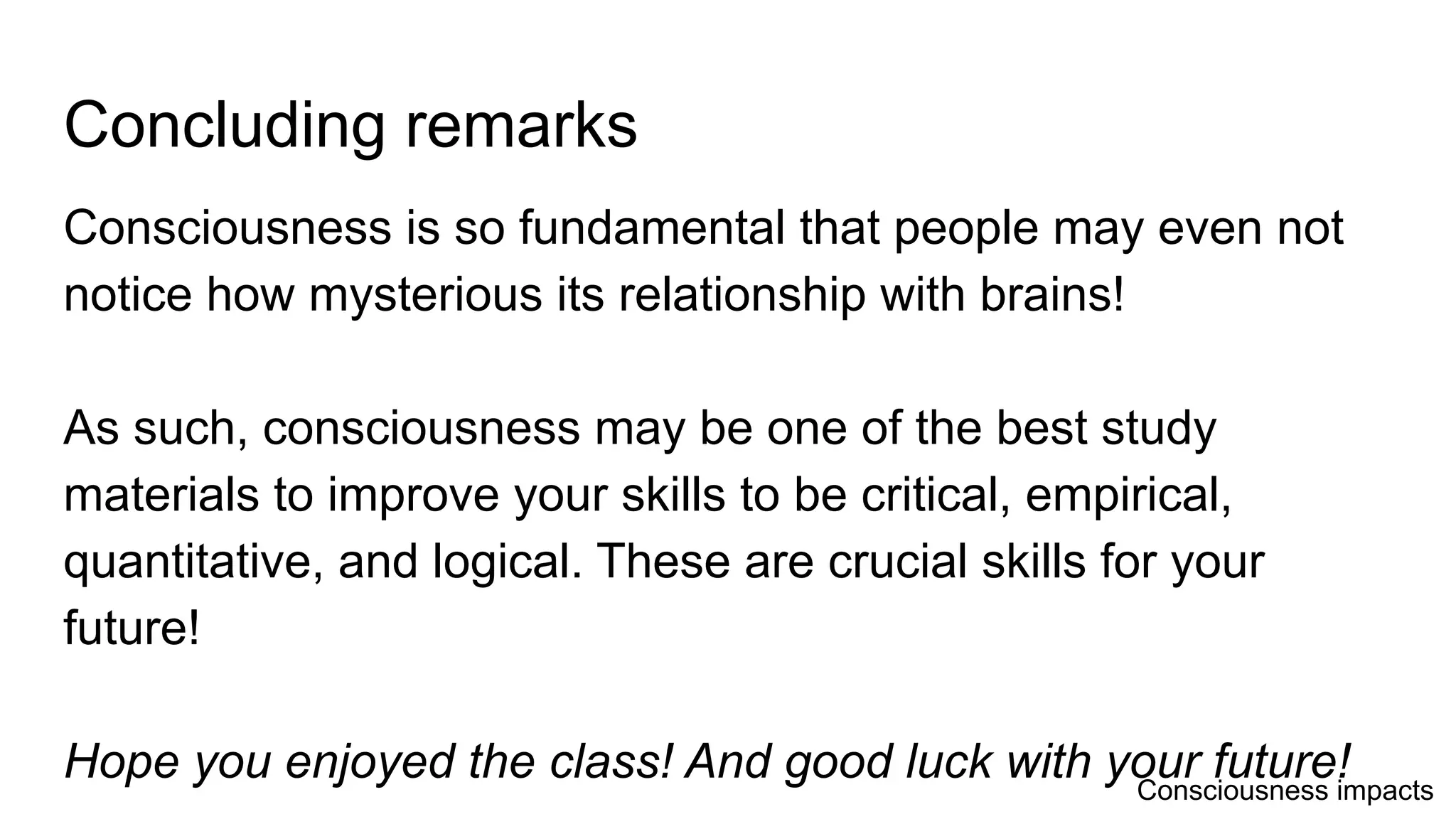
Concluding remarks
Consciousness is so fundamental that people may even not
notice how mysterious its relationship with brains!
As such, consciousness may be one of the best study
materials to improve your skills to be critical, empirical,
quantitative, and logical. These are crucial skills for your
future!
Hope you enjoyed the class! And good luck with your future!Consciousness impacts
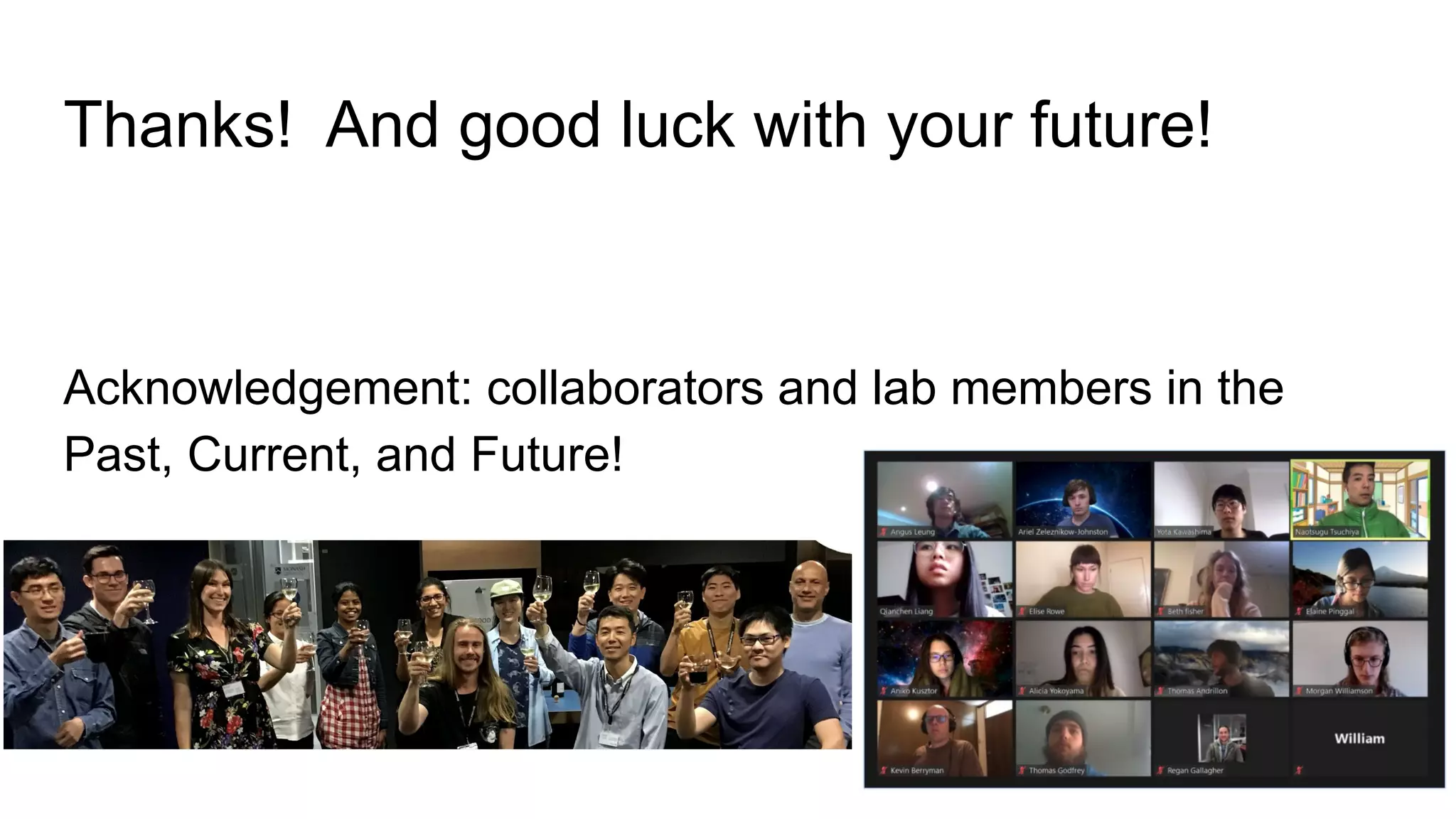
Thanks! And good luck with your future!
Acknowledgement: collaborators and lab members in the
Past, Current, and Future!

Week 12 neural basis of consciousness : frontiers in consciousness research

  • 1.
    Week 12 Neural basisof consciousness: Frontiers in Consciousness Research Prof Nao Tsuchiya Twitter: @conscious_tlab Email: naotsugu.tsuchiya@monash.edu Facebook: Naotsugu Tsuchiya
  • 2.
    Recap of Wk11 Outline of Integrated Information Theory (IIT) Level, Border and Contents of consciousness How to compute integrated information & complex IIT explanations on consciousness in patients: without cerebellum, split brain and conjoined twins
  • 3.
    In Wk 12, Wewill: Outline frontiers in consciousness research with some exemplar research from my lab, List empirical questions with strategies, frameworks and techniques for future research, and Situate consciousness research in a broader context
  • 4.
    Learning Objectives To beable to answer the following questions: ● What does IIT propose about qualia? ● How can we characterize qualia structures? ● What are the possible empirical experiments that can be used to reveal the relationship between qualia and brain? ● What are societal impacts of consciousness research? Optional: Maier & Tsuchiya 2020 APP
  • 5.
    Remaining questions fromWeek 11 How does IIT explain contents of consciousness (=qualia)? Level - big Phi Border - Complex Qualia - a connected pattern of small Phis IIT and qualia
  • 6.
    Remaining questions fromWeek 11 How does IIT explain contents of consciousness? Level - big Phi Border - Complex Qualia - a connected pattern of small Phis IIT and qualia
  • 7.
    Fundamental questions inconsciousness research The link between mind and matters More specifically, qualia and brain We have lots of clues about the link! IIT and qualia
  • 8.
    Why stimulating theseareas elicit qualia of color and face? Schalk 2017 PNAS IIT and qualia
  • 9.
    Clues from previousresearch FFA, V4/V8, MT, ... Neural activity in these areas are strongly correlated with, necessary for (lesions specifically abolishes), and can elicit (when stimulated) qualia for faces, motion, and color. WHY? IIT and qualia
  • 10.
    We need tounderstand 1. Qualia structures 2. Causality structures 3. Relationship between these structures Tsuchiya 2016 Neurosci Res IIT and qualia
  • 11.
    We need tounderstand 1. Qualia structures 2. Causality structures 3. Relationship between these structures Tsuchiya 2016 Neurosci Res IIT and qualia
  • 12.
    What are causalitystructures? Brain - a huge network of neurons. 1011 neurons (1010 people in the earth). 1000-10000 synapses per neuron. Each exciting or inhibiting the others. IIT and qualia
  • 13.
    Integrated information theory Information: “Intrinsicinformation” = The way the network causally constrains its past and future. Neuron A Neuron B Current CopyCopy IIT and qualia
  • 14.
  • 15.
    Causality structures In asimulated network Haun & Tononi 2019 Entropy IIT and qualia
  • 16.
    Computing causality structuresin fly brains IIT and qualia
  • 17.
    General anesthesia collapsecausality structures IIT and qualia Leung, Cohen, van Swinderen, Tsuchiya 2020 bioRxiv
  • 18.
    Is there anyrelationship between causality structure and qualia? Haun et al 2017 eNeuro IIT and qualia
  • 19.
    Haun et al2017 eNeuro IIT and qualia
  • 20.
    Haun et al2017 eNeuro Promising relationship between causality structure and qualia! IIT and qualia
  • 21.
    Are causality structuresrelated to qualia? Unique in FFA, V4/V8, MT, …? Can we compute them from single neuron activity? IIT and qualia
  • 22.
    Better and betterneurotechnology! Maier & Tsuchiya 2020 APP IIT and qualia
  • 23.
    Summary: Integrated information canbe computed in a hierarchical manner. We can estimate causality structures of neural network. Causality structures should depend on specific neural connectivity within an area as well as between areas Can causality structures explain different qualia? IIT and qualia
  • 25.
    Can we directlycompare causality structures and qualia? We first need to understand qualia structures better! 1. Qualia structures 2. Causality structures 3. Relationship between these structures Qualia structures
  • 26.
    What are qualiastructures? Qualia structures
  • 27.
  • 28.
    Color qualia: counterfactualsimilarity No two color qualia in the same spacetime (like taste, smell, touch), but other (visual/auditory) qualia can (e.g., motion, face, sound). Loss of color is its entirety bound to space. > Implication for neural circuitry and causality structures? Qualia structures
  • 29.
    How can weexamine and characterize qualia structures? Classical psychophysics: Did you see A? Qualia structure psychophysics: What did you see? (Verbal or other richer reports) How did you see? (Similarity, inclusion, and other relations) Qualia structures
  • 30.
    What did yousee? Traditional estimate of information: ~ 40 bits/s. This result doesn’t seem to match with our usual feeling of “richness” of any moment of consciousness! Norretranders 1991 Classic paradigm: Did you see “A”? Qualia structures
  • 31.
    Massive report paradigm Koh,Gallagher, Nishimoto, Tsuchiya (2019 SOBR poster; in preparation) Are the classic results reflecting the limitation in stimuli and reports? Qualia structures
  • 32.
    Massive report paradigm Lotsof images (impossible to expect) (Semi-) free reports Online participants (>600) Qualia structures
  • 33.
    Massive report paradigm Liang,Gallagher, Nishimoto, Tsuchiya (2019 SOBR poster; in preparation) Qualia structures
  • 34.
    What do yousee? Generally, the massive report paradigms reveal structure of experience that matches with our (reasonable) intuition. Any moment of experience seems highly structured. People can differentiate many different concepts and images without much difficulty. Qualia structures
  • 35.
    How do wesee? Similarity ratings: “Similar” “Very dissimilar” Qualia structures
  • 36.
    Structure of colorqualia Do we see color in the periphery? (Week 4-5) Qualia structures
  • 37.
    Are similarity structuresequivalent across visual fields? ? ? ? Qualia structures
  • 38.
  • 39.
  • 40.
    Individual differences withequivalent structures! Fovea Peri Qualia structures
  • 41.
    Summary Qualia structures canbe examined by addressing: What do we see? How do we see? For these qualia structure psychophysics, various paradigms and tools need to be developed! Qualia structures
  • 43.
    We need tounderstand 1. Qualia structures 2. Causality structures 3. Relationship between these structures Tsuchiya 2016 Neurosci Res Relations between structures
  • 44.
  • 45.
  • 46.
  • 47.
    Promising experimental paradigm:Rewiring Sur 2001 Nature Rev Neuro Relations between structures
  • 48.
    Sur 2001 NatureRev Neuro Promising experimental paradigm: Rewiring Relations between structures
  • 49.
    Von Melchner 2000Nature Promising experimental paradigm: Rewiring Relations between structures
  • 50.
    Summary: Once qualia structuresand causality structures are obtained, we need a mathematical theory to test their correspondence. (Category theory is highly promising). To understand these structural relationships, there are many empirical paradigms can be used (e.g., rewiring paradigm, individual differences, synaesthesia, congenital blind, etc). Relations between structures
  • 52.
  • 53.
    Consciousness Clinical EngineeringAcademic Curiosity Artificial intelligence Robotics Brain-Machine interface Consciousness-meter Restoringqualia Sensory substitutionMind vs matter Laws in physics Development Evolution Organoid Societal impacts of consciousness research Consciousness impacts
  • 54.
    Consciousness Clinical science Engineering Artificial intelligenceRobotics Development Information theory Pharmacology Philosophy Computer science Physics Mathematics Linguistics Psychology Neuroscience Cognitive Evolution Ethics Biology Interdisciplinary research on consciousness ! Consciousness impacts
  • 55.
    Concluding remarks Disclaimer: 1. Theviews we provided are highly simplified and can be misleading and biased. There are a lot to learn in this field! 2. Almost everything in this course material is likely to be revised in the future! Consciousness impacts
  • 56.
    Concluding remarks Consciousness isso fundamental that people may even not notice how mysterious its relationship with brains! As such, consciousness may be one of the best study materials to improve your skills to be critical, empirical, quantitative, and logical. These are crucial skills for your future! Hope you enjoyed the class! And good luck with your future!Consciousness impacts
  • 57.
    Thanks! And goodluck with your future! Acknowledgement: collaborators and lab members in the Past, Current, and Future!