GARY DESSLER
HUMAN RESOURCE MANAGEMENT
Global Edition 12e
Chapter 1
Introduction to
Human Resource
Management
PowerPoint Presentation by Charlie Cook
The University of West Alabama
Copyright © 2011 Pearson Education
Part 1 Introduction
Copyright © 2011 Pearson Education 1–2
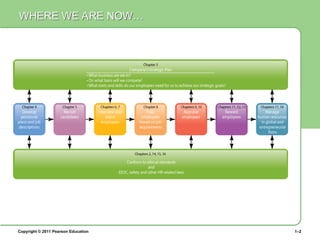
WHERE WE ARE NOW…
Copyright © 2011 Pearson Education 1–3
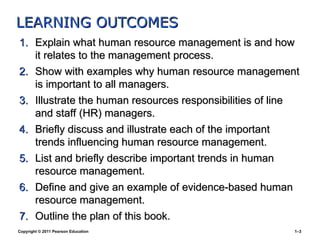
1.
1. Explain what human resource management is and how
Explain what human resource management is and how
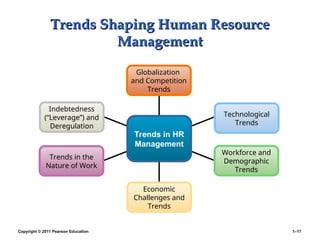
it relates to the management process.
2.
2. Show with examples why human resource management
Show with examples why human resource management
is important to all managers.
3.
3. Illustrate the human resources responsibilities of line
Illustrate the human resources responsibilities of line
and staff (HR) managers.
4.
4. Briefly discuss and illustrate each of the important
Briefly discuss and illustrate each of the important
trends influencing human resource management.
5.
5. List and briefly describe important trends in human
List and briefly describe important trends in human
resource management.
6.
6. Define and give an example of evidence-based human
Define and give an example of evidence-based human
resource management.
7.
7. Outline the plan of this book.
Outline the plan of this book.
LEARNING OUTCOMES
LEARNING OUTCOMES
Copyright © 2011 Pearson Education 1–4
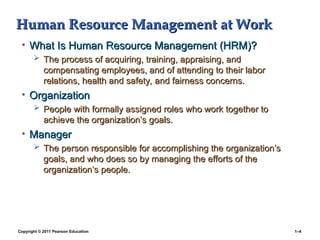
Human Resource Management at Work
• What Is Human Resource Management (HRM)?
What Is Human Resource Management (HRM)?
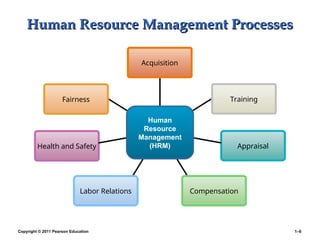
 The process of acquiring, training, appraising, and
The process of acquiring, training, appraising, and
compensating employees, and of attending to their labor
relations, health and safety, and fairness concerns.
• Organization
Organization
 People with formally assigned roles who work together to
People with formally assigned roles who work together to
achieve the organization’s goals.
• Manager
Manager
 The person responsible for accomplishing the organization’s
The person responsible for accomplishing the organization’s
goals, and who does so by managing the efforts of the
organization’s people.
Copyright © 2011 Pearson Education 1–5
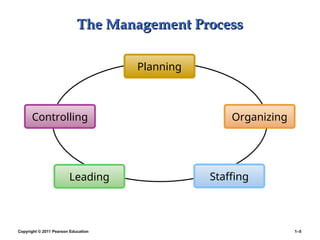
The Management Process
Planning
Organizing
Leading Staffing
Controlling
Copyright © 2011 Pearson Education 1–6
Human Resource Management Processes
Acquisition
Training
Appraisal
Compensation
Labor Relations
Health and Safety
Fairness
Human
Resource
Management
(HRM)
Copyright © 2011 Pearson Education 1–7
Personnel Aspects of a Manager’s Job
• Conducting job analyses
Conducting job analyses
• Planning labor needs and recruiting job candidates
Planning labor needs and recruiting job candidates
• Selecting job candidates
Selecting job candidates
• Orienting and training new employees
Orienting and training new employees
• Managing wages and salaries
Managing wages and salaries
• Providing incentives and benefits
Providing incentives and benefits
• Appraising performance
Appraising performance
• Communicating
Communicating
• Training and developing managers
Training and developing managers
• Building employee commitment
Building employee commitment
Copyright © 2011 Pearson Education 1–8
Personnel Mistakes
Personnel Mistakes
• Hire the wrong person for the job
Hire the wrong person for the job
• Experience high turnover
Experience high turnover
• Have your people not doing their best
Have your people not doing their best
• Waste time with useless interviews
Waste time with useless interviews
• Have your firm in court because of discriminatory actions
Have your firm in court because of discriminatory actions
• Have your firm cited by OSHA for unsafe practices
Have your firm cited by OSHA for unsafe practices
• Have some employees think their salaries are unfair and
Have some employees think their salaries are unfair and
inequitable relative to others in the organization
• Allow a lack of training to undermine your department’s
Allow a lack of training to undermine your department’s
effectiveness
effectiveness
• Commit any unfair labor practices
Commit any unfair labor practices
Copyright © 2011 Pearson Education 1–9
Basic HR Concepts
Basic HR Concepts
• The bottom line of managing:
The bottom line of managing:
Getting results
Getting results
• HR creates value by engaging in activities
HR creates value by engaging in activities
that produce the employee behaviors that
the organization needs to achieve its
strategic goals.
strategic goals.
• Looking ahead: Using evidence-based
Looking ahead: Using evidence-based
HRM to measure the value of HR activities
in achieving those goals.
Copyright © 2011 Pearson Education 1–10
Line and Staff Aspects of HRM
• Line Manager
Line Manager
 Is authorized (has line authority) to direct the work of
Is authorized (has line authority) to direct the work of
subordinates and is responsible for accomplishing the
organization’s tasks.
• Staff Manager
Staff Manager
 Assists and advises line managers.
Assists and advises line managers.
 Has functional authority to coordinate personnel activities
Has functional authority to coordinate personnel activities
and enforce organization policies.
Copyright © 2011 Pearson Education 1–11
Line Managers’ HRM Responsibilities
1.
1. Placing the right person on the right job
Placing the right person on the right job
2.
2. Starting new employees in the organization (orientation)
Starting new employees in the organization (orientation)
3.
3. Training employees for jobs that are new to them
Training employees for jobs that are new to them
4.
4. Improving the job performance of each person
Improving the job performance of each person
5.
5. Gaining creative cooperation and developing smooth
Gaining creative cooperation and developing smooth
working relationships
6.
6. Interpreting the firm’s policies and procedures
Interpreting the firm’s policies and procedures
7.
7. Controlling labor costs
Controlling labor costs
8.
8. Developing the abilities of each person
Developing the abilities of each person
9.
9. Creating and maintaining department morale
Creating and maintaining department morale
10.
10. Protecting employees’ health and physical condition
Protecting employees’ health and physical condition
Copyright © 2011 Pearson Education 1–12
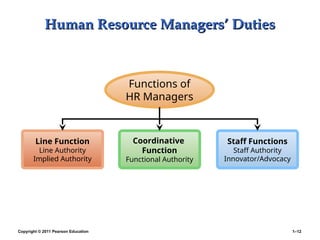
Human Resource Managers’ Duties
Line Function
Line Authority
Implied Authority
Staff Functions
Staff Authority
Innovator/Advocacy
Functions of
HR Managers
Coordinative
Function
Functional Authority
Copyright © 2011 Pearson Education 1–13
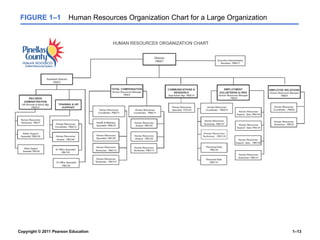
FIGURE 1–1 Human Resources Organization Chart for a Large Organization
Copyright © 2011 Pearson Education 1–14
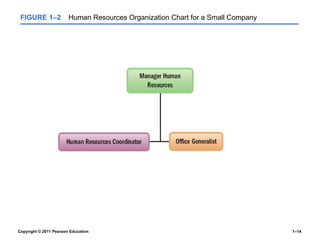
FIGURE 1–2 Human Resources Organization Chart for a Small Company
Copyright © 2011 Pearson Education 1–15
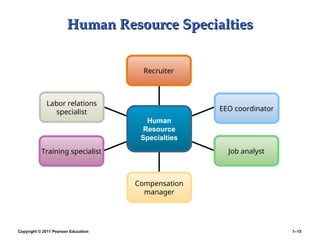
Human Resource Specialties
Recruiter
EEO coordinator
Labor relations
specialist
Training specialist Job analyst
Compensation
manager
Human
Resource
Specialties
Copyright © 2011 Pearson Education 1–16
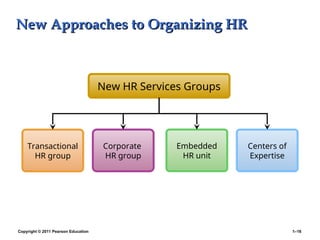
New Approaches to Organizing HR
Transactional
HR group
Corporate
HR group
Embedded
HR unit
New HR Services Groups
Centers of
Expertise
Copyright © 2011 Pearson Education 1–17
Trends Shaping Human Resource
Management
Management
Globalization
and Competition
Trends
Technological
Trends
Indebtedness
(“Leverage”) and
Deregulation
Trends in the
Nature of Work
Workforce and
Demographic
Trends
Economic
Challenges and
Trends
Trends in HR
Management
Copyright © 2011 Pearson Education 1–18
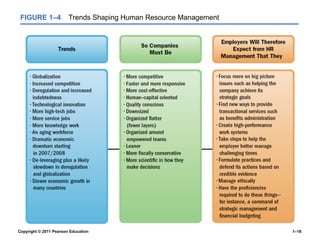
FIGURE 1–4 Trends Shaping Human Resource Management
Copyright © 2011 Pearson Education 1–19
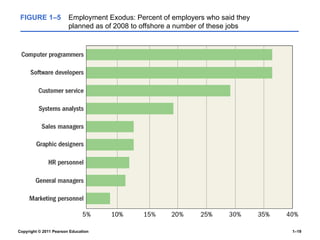
FIGURE 1–5 Employment Exodus: Percent of employers who said they
planned as of 2008 to offshore a number of these jobs
Copyright © 2011 Pearson Education 1–20
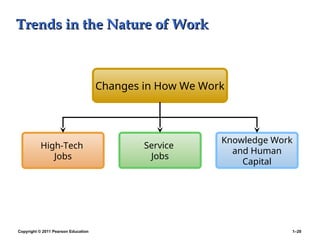
Trends in the Nature of Work
High-Tech
Jobs
Service
Jobs
Changes in How We Work
Knowledge Work
and Human
Capital
Copyright © 2011 Pearson Education 1–21
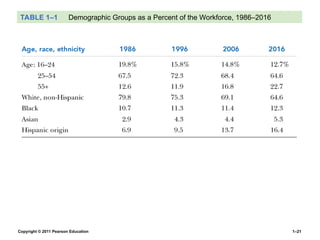
TABLE 1–1 Demographic Groups as a Percent of the Workforce, 1986–2016
Copyright © 2011 Pearson Education 1–22
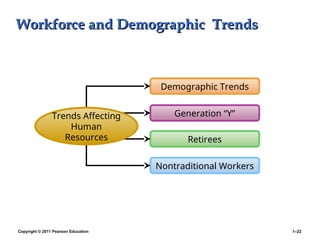
Workforce and Demographic Trends
Demographic Trends
Generation “Y”
Retirees
Nontraditional Workers
Trends Affecting
Human
Resources
Copyright © 2011 Pearson Education 1–23
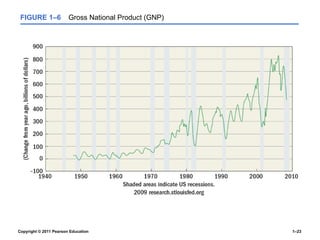
FIGURE 1–6 Gross National Product (GNP)
Copyright © 2011 Pearson Education 1–24
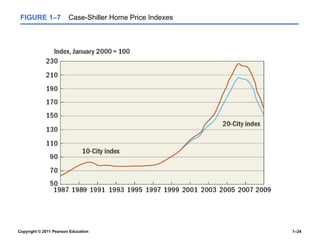
FIGURE 1–7 Case-Shiller Home Price Indexes
Copyright © 2011 Pearson Education 1–25
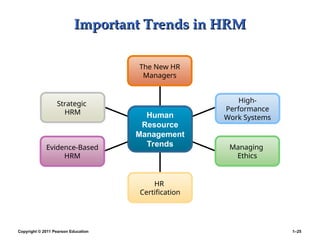
Important Trends in HRM
The New HR
Managers
High-
Performance
Work Systems
Strategic
HRM
Evidence-Based
HRM
Managing
Ethics
HR
Certification
Human
Resource
Management
Trends
Copyright © 2011 Pearson Education 1–26
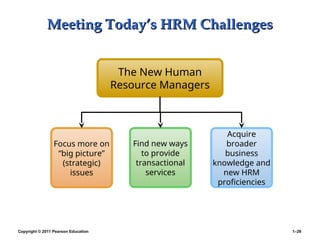
Meeting Today’s HRM Challenges
Focus more on
“big picture”
(strategic)
issues
Find new ways
to provide
transactional
services
The New Human
Resource Managers
Acquire
broader
business
knowledge and
new HRM
proficiencies
Copyright © 2011 Pearson Education 1–27
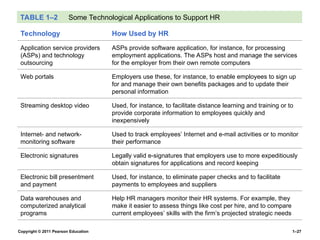
TABLE 1–2 Some Technological Applications to Support HR
Technology How Used by HR
Application service providers
(ASPs) and technology
outsourcing
ASPs provide software application, for instance, for processing
employment applications. The ASPs host and manage the services
for the employer from their own remote computers
Web portals Employers use these, for instance, to enable employees to sign up
for and manage their own benefits packages and to update their
personal information
Streaming desktop video Used, for instance, to facilitate distance learning and training or to
provide corporate information to employees quickly and
inexpensively
Internet- and network-
monitoring software
Used to track employees’ Internet and e-mail activities or to monitor
their performance
Electronic signatures Legally valid e-signatures that employers use to more expeditiously
obtain signatures for applications and record keeping
Electronic bill presentment
and payment
Used, for instance, to eliminate paper checks and to facilitate
payments to employees and suppliers
Data warehouses and
computerized analytical
programs
Help HR managers monitor their HR systems. For example, they
make it easier to assess things like cost per hire, and to compare
current employees’ skills with the firm’s projected strategic needs
Copyright © 2011 Pearson Education 1–28
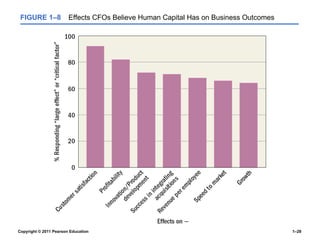
FIGURE 1–8 Effects CFOs Believe Human Capital Has on Business Outcomes
Copyright © 2011 Pearson Education 1–29
High-Performance Work Systems
• Increase productivity and performance by:
Increase productivity and performance by:
 Recruiting, screening and hiring more effectively
Recruiting, screening and hiring more effectively
 Providing more and better training
Providing more and better training
 Paying higher wages
Paying higher wages
 Providing a safer work environment
Providing a safer work environment
 Linking pay to performance
Linking pay to performance
Copyright © 2011 Pearson Education 1–30
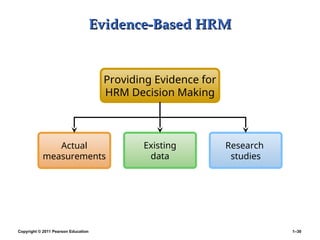
Evidence-Based HRM
Evidence-Based HRM
Actual
measurements
Existing
data
Providing Evidence for
HRM Decision Making
Research
studies
Copyright © 2011 Pearson Education 1–31
Managing Ethics
Managing Ethics
• Ethics
Ethics
 Standards that someone uses to decide
Standards that someone uses to decide
what his or her conduct should be
• HRM-related Ethical Issues
HRM-related Ethical Issues
 Workplace safety
Workplace safety
 Security of employee records
Security of employee records
 Employee theft
Employee theft
 Affirmative action
Affirmative action
 Comparable work
Comparable work
 Employee privacy rights
Employee privacy rights
Copyright © 2011 Pearson Education 1–32
HR Certification
HR Certification
• HR is becoming more professionalized.
HR is becoming more professionalized.
• Society for Human Resource Management (SHRM)
Society for Human Resource Management (SHRM)
 SHRM’s Human Resource Certification Institute (HRCI)
SHRM’s Human Resource Certification Institute (HRCI)
 SPHR (Senior Professional in HR) certificate
SPHR (Senior Professional in HR) certificate
 GPHR (Global Professional in HR) certificate
GPHR (Global Professional in HR) certificate
 PHR (Professional in HR) certificate
PHR (Professional in HR) certificate
Copyright © 2011 Pearson Education 1–33
The Plan of This Book: Basic Themes
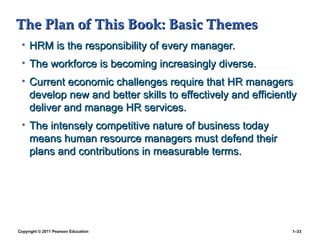
• HRM is the responsibility of every manager.
HRM is the responsibility of every manager.
• The workforce is becoming increasingly diverse.
The workforce is becoming increasingly diverse.
• Current economic challenges require that HR managers
Current economic challenges require that HR managers
develop new and better skills to effectively and efficiently
deliver and manage HR services.
• The intensely competitive nature of business today
The intensely competitive nature of business today
means human resource managers must defend their
plans and contributions in measurable terms.
Copyright © 2011 Pearson Education 1–34
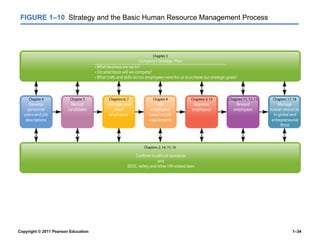
FIGURE 1–10 Strategy and the Basic Human Resource Management Process
Copyright © 2011 Pearson Education 1–35
K E Y T E R M S
organization
manager
management process
human resource management (HRM)
authority
line authority
staff authority
line manager
staff manager
functional authority
globalization
human capital
Copyright © 2011 Pearson Education 1–36
All rights reserved. No part of this publication may be reproduced,
stored in a retrieval system, or transmitted, in any form or by any
means, electronic, mechanical, photocopying, recording, or
otherwise, without the prior written permission of the publisher.
Printed in the United States of America.

Dessler_HRM12e_PPT_01 Presentation regarding HRM

  • 1.
    GARY DESSLER HUMAN RESOURCEMANAGEMENT Global Edition 12e Chapter 1 Introduction to Human Resource Management PowerPoint Presentation by Charlie Cook The University of West Alabama Copyright © 2011 Pearson Education Part 1 Introduction
  • 2.
    Copyright © 2011Pearson Education 1–2 WHERE WE ARE NOW…
  • 3.
    Copyright © 2011Pearson Education 1–3 1. 1. Explain what human resource management is and how Explain what human resource management is and how it relates to the management process. it relates to the management process. 2. 2. Show with examples why human resource management Show with examples why human resource management is important to all managers. is important to all managers. 3. 3. Illustrate the human resources responsibilities of line Illustrate the human resources responsibilities of line and staff (HR) managers. and staff (HR) managers. 4. 4. Briefly discuss and illustrate each of the important Briefly discuss and illustrate each of the important trends influencing human resource management. trends influencing human resource management. 5. 5. List and briefly describe important trends in human List and briefly describe important trends in human resource management. resource management. 6. 6. Define and give an example of evidence-based human Define and give an example of evidence-based human resource management. resource management. 7. 7. Outline the plan of this book. Outline the plan of this book. LEARNING OUTCOMES LEARNING OUTCOMES
  • 4.
    Copyright © 2011Pearson Education 1–4 Human Resource Management at Work Human Resource Management at Work • What Is Human Resource Management (HRM)? What Is Human Resource Management (HRM)?  The process of acquiring, training, appraising, and The process of acquiring, training, appraising, and compensating employees, and of attending to their labor compensating employees, and of attending to their labor relations, health and safety, and fairness concerns. relations, health and safety, and fairness concerns. • Organization Organization  People with formally assigned roles who work together to People with formally assigned roles who work together to achieve the organization’s goals. achieve the organization’s goals. • Manager Manager  The person responsible for accomplishing the organization’s The person responsible for accomplishing the organization’s goals, and who does so by managing the efforts of the goals, and who does so by managing the efforts of the organization’s people. organization’s people.
  • 5.
    Copyright © 2011Pearson Education 1–5 The Management Process The Management Process Planning Organizing Leading Staffing Controlling
  • 6.
    Copyright © 2011Pearson Education 1–6 Human Resource Management Processes Human Resource Management Processes Acquisition Training Appraisal Compensation Labor Relations Health and Safety Fairness Human Resource Management (HRM)
  • 7.
    Copyright © 2011Pearson Education 1–7 Personnel Aspects of a Manager’s Job Personnel Aspects of a Manager’s Job • Conducting job analyses Conducting job analyses • Planning labor needs and recruiting job candidates Planning labor needs and recruiting job candidates • Selecting job candidates Selecting job candidates • Orienting and training new employees Orienting and training new employees • Managing wages and salaries Managing wages and salaries • Providing incentives and benefits Providing incentives and benefits • Appraising performance Appraising performance • Communicating Communicating • Training and developing managers Training and developing managers • Building employee commitment Building employee commitment
  • 8.
    Copyright © 2011Pearson Education 1–8 Personnel Mistakes Personnel Mistakes • Hire the wrong person for the job Hire the wrong person for the job • Experience high turnover Experience high turnover • Have your people not doing their best Have your people not doing their best • Waste time with useless interviews Waste time with useless interviews • Have your firm in court because of discriminatory actions Have your firm in court because of discriminatory actions • Have your firm cited by OSHA for unsafe practices Have your firm cited by OSHA for unsafe practices • Have some employees think their salaries are unfair and Have some employees think their salaries are unfair and inequitable relative to others in the organization inequitable relative to others in the organization • Allow a lack of training to undermine your department’s Allow a lack of training to undermine your department’s effectiveness effectiveness • Commit any unfair labor practices Commit any unfair labor practices
  • 9.
    Copyright © 2011Pearson Education 1–9 Basic HR Concepts Basic HR Concepts • The bottom line of managing: The bottom line of managing: Getting results Getting results • HR creates value by engaging in activities HR creates value by engaging in activities that produce the employee behaviors that that produce the employee behaviors that the organization needs to achieve its the organization needs to achieve its strategic goals. strategic goals. • Looking ahead: Using evidence-based Looking ahead: Using evidence-based HRM to measure the value of HR activities HRM to measure the value of HR activities in achieving those goals. in achieving those goals.
  • 10.
    Copyright © 2011Pearson Education 1–10 Line and Staff Aspects of HRM Line and Staff Aspects of HRM • Line Manager Line Manager  Is authorized (has line authority) to direct the work of Is authorized (has line authority) to direct the work of subordinates and is responsible for accomplishing the subordinates and is responsible for accomplishing the organization’s tasks. organization’s tasks. • Staff Manager Staff Manager  Assists and advises line managers. Assists and advises line managers.  Has functional authority to coordinate personnel activities Has functional authority to coordinate personnel activities and enforce organization policies. and enforce organization policies.
  • 11.
    Copyright © 2011Pearson Education 1–11 Line Managers’ HRM Responsibilities Line Managers’ HRM Responsibilities 1. 1. Placing the right person on the right job Placing the right person on the right job 2. 2. Starting new employees in the organization (orientation) Starting new employees in the organization (orientation) 3. 3. Training employees for jobs that are new to them Training employees for jobs that are new to them 4. 4. Improving the job performance of each person Improving the job performance of each person 5. 5. Gaining creative cooperation and developing smooth Gaining creative cooperation and developing smooth working relationships working relationships 6. 6. Interpreting the firm’s policies and procedures Interpreting the firm’s policies and procedures 7. 7. Controlling labor costs Controlling labor costs 8. 8. Developing the abilities of each person Developing the abilities of each person 9. 9. Creating and maintaining department morale Creating and maintaining department morale 10. 10. Protecting employees’ health and physical condition Protecting employees’ health and physical condition
  • 12.
    Copyright © 2011Pearson Education 1–12 Human Resource Managers’ Duties Human Resource Managers’ Duties Line Function Line Authority Implied Authority Staff Functions Staff Authority Innovator/Advocacy Functions of HR Managers Coordinative Function Functional Authority
  • 13.
    Copyright © 2011Pearson Education 1–13 FIGURE 1–1 Human Resources Organization Chart for a Large Organization
  • 14.
    Copyright © 2011Pearson Education 1–14 FIGURE 1–2 Human Resources Organization Chart for a Small Company
  • 15.
    Copyright © 2011Pearson Education 1–15 Human Resource Specialties Human Resource Specialties Recruiter EEO coordinator Labor relations specialist Training specialist Job analyst Compensation manager Human Resource Specialties
  • 16.
    Copyright © 2011Pearson Education 1–16 New Approaches to Organizing HR New Approaches to Organizing HR Transactional HR group Corporate HR group Embedded HR unit New HR Services Groups Centers of Expertise
  • 17.
    Copyright © 2011Pearson Education 1–17 Trends Shaping Human Resource Trends Shaping Human Resource Management Management Globalization and Competition Trends Technological Trends Indebtedness (“Leverage”) and Deregulation Trends in the Nature of Work Workforce and Demographic Trends Economic Challenges and Trends Trends in HR Management
  • 18.
    Copyright © 2011Pearson Education 1–18 FIGURE 1–4 Trends Shaping Human Resource Management
  • 19.
    Copyright © 2011Pearson Education 1–19 FIGURE 1–5 Employment Exodus: Percent of employers who said they planned as of 2008 to offshore a number of these jobs
  • 20.
    Copyright © 2011Pearson Education 1–20 Trends in the Nature of Work Trends in the Nature of Work High-Tech Jobs Service Jobs Changes in How We Work Knowledge Work and Human Capital
  • 21.
    Copyright © 2011Pearson Education 1–21 TABLE 1–1 Demographic Groups as a Percent of the Workforce, 1986–2016
  • 22.
    Copyright © 2011Pearson Education 1–22 Workforce and Demographic Trends Workforce and Demographic Trends Demographic Trends Generation “Y” Retirees Nontraditional Workers Trends Affecting Human Resources
  • 23.
    Copyright © 2011Pearson Education 1–23 FIGURE 1–6 Gross National Product (GNP)
  • 24.
    Copyright © 2011Pearson Education 1–24 FIGURE 1–7 Case-Shiller Home Price Indexes
  • 25.
    Copyright © 2011Pearson Education 1–25 Important Trends in HRM Important Trends in HRM The New HR Managers High- Performance Work Systems Strategic HRM Evidence-Based HRM Managing Ethics HR Certification Human Resource Management Trends
  • 26.
    Copyright © 2011Pearson Education 1–26 Meeting Today’s HRM Challenges Meeting Today’s HRM Challenges Focus more on “big picture” (strategic) issues Find new ways to provide transactional services The New Human Resource Managers Acquire broader business knowledge and new HRM proficiencies
  • 27.
    Copyright © 2011Pearson Education 1–27 TABLE 1–2 Some Technological Applications to Support HR Technology How Used by HR Application service providers (ASPs) and technology outsourcing ASPs provide software application, for instance, for processing employment applications. The ASPs host and manage the services for the employer from their own remote computers Web portals Employers use these, for instance, to enable employees to sign up for and manage their own benefits packages and to update their personal information Streaming desktop video Used, for instance, to facilitate distance learning and training or to provide corporate information to employees quickly and inexpensively Internet- and network- monitoring software Used to track employees’ Internet and e-mail activities or to monitor their performance Electronic signatures Legally valid e-signatures that employers use to more expeditiously obtain signatures for applications and record keeping Electronic bill presentment and payment Used, for instance, to eliminate paper checks and to facilitate payments to employees and suppliers Data warehouses and computerized analytical programs Help HR managers monitor their HR systems. For example, they make it easier to assess things like cost per hire, and to compare current employees’ skills with the firm’s projected strategic needs
  • 28.
    Copyright © 2011Pearson Education 1–28 FIGURE 1–8 Effects CFOs Believe Human Capital Has on Business Outcomes
  • 29.
    Copyright © 2011Pearson Education 1–29 High-Performance Work Systems High-Performance Work Systems • Increase productivity and performance by: Increase productivity and performance by:  Recruiting, screening and hiring more effectively Recruiting, screening and hiring more effectively  Providing more and better training Providing more and better training  Paying higher wages Paying higher wages  Providing a safer work environment Providing a safer work environment  Linking pay to performance Linking pay to performance
  • 30.
    Copyright © 2011Pearson Education 1–30 Evidence-Based HRM Evidence-Based HRM Actual measurements Existing data Providing Evidence for HRM Decision Making Research studies
  • 31.
    Copyright © 2011Pearson Education 1–31 Managing Ethics Managing Ethics • Ethics Ethics  Standards that someone uses to decide Standards that someone uses to decide what his or her conduct should be what his or her conduct should be • HRM-related Ethical Issues HRM-related Ethical Issues  Workplace safety Workplace safety  Security of employee records Security of employee records  Employee theft Employee theft  Affirmative action Affirmative action  Comparable work Comparable work  Employee privacy rights Employee privacy rights
  • 32.
    Copyright © 2011Pearson Education 1–32 HR Certification HR Certification • HR is becoming more professionalized. HR is becoming more professionalized. • Society for Human Resource Management (SHRM) Society for Human Resource Management (SHRM)  SHRM’s Human Resource Certification Institute (HRCI) SHRM’s Human Resource Certification Institute (HRCI)  SPHR (Senior Professional in HR) certificate SPHR (Senior Professional in HR) certificate  GPHR (Global Professional in HR) certificate GPHR (Global Professional in HR) certificate  PHR (Professional in HR) certificate PHR (Professional in HR) certificate
  • 33.
    Copyright © 2011Pearson Education 1–33 The Plan of This Book: Basic Themes The Plan of This Book: Basic Themes • HRM is the responsibility of every manager. HRM is the responsibility of every manager. • The workforce is becoming increasingly diverse. The workforce is becoming increasingly diverse. • Current economic challenges require that HR managers Current economic challenges require that HR managers develop new and better skills to effectively and efficiently develop new and better skills to effectively and efficiently deliver and manage HR services. deliver and manage HR services. • The intensely competitive nature of business today The intensely competitive nature of business today means human resource managers must defend their means human resource managers must defend their plans and contributions in measurable terms. plans and contributions in measurable terms.
  • 34.
    Copyright © 2011Pearson Education 1–34 FIGURE 1–10 Strategy and the Basic Human Resource Management Process
  • 35.
    Copyright © 2011Pearson Education 1–35 K E Y T E R M S organization manager management process human resource management (HRM) authority line authority staff authority line manager staff manager functional authority globalization human capital
  • 36.
    Copyright © 2011Pearson Education 1–36 All rights reserved. No part of this publication may be reproduced, stored in a retrieval system, or transmitted, in any form or by any means, electronic, mechanical, photocopying, recording, or otherwise, without the prior written permission of the publisher. Printed in the United States of America.

Editor's Notes

  • #2 The purpose of this chapter is to explain what human resource management is, and why it’s important to all managers. We’ll see that HRM activities such as hiring, training, appraising, compensating, and developing employees are part of every manager’s job. And we’ll see that HRM is also a separate function, usually with its own human resource or “HR” manager. The main topics we’ll cover include the meaning of human resource management; why HRM is important to all managers; global and competitive trends; HRM trends; and the plan of this book. The framework (which introduces each chapter) makes this point: That to formulate and apply HR practices like testing and training you should understand the strategic and legal context in which you’re managing.
  • #4 Human resource management is the process of acquiring, training, appraising, and compensating employees, and of attending to their labor relations, health and safety, and fairness concerns.
  • #5 Most experts agree that managing involves five functions: planning, organizing, staffing, leading, and controlling. In total, these functions represent the management process.
  • #6 HRM involves several processes. The topics we’ll discuss will provide you with concepts and techniques needed to perform the “people” or personnel aspects of your job as a manager.
  • #7 Managers are involved daily with many of the personnel aspects of HRM in accomplishing the organization’s goals, and managing the efforts of the organization’s people.
  • #8 Why are the concepts and techniques of HRM important to all managers? Perhaps it’s easier to answer this by listing some of the personnel mistakes you don’t want to make while managing. Carefully studying this book will help you avoid mistakes like these.
  • #9 Hiring the right people for the right jobs and motivating, appraising, and developing them will likely get the results you are seeking. Remember that success comes through people.
  • #10 Line managers manage operational functions that are crucial for the company’s survival. Staff managers run departments that are advisory or supportive, like purchasing, HRM, and quality control. Human resource managers are usually staff managers. They assist and advise line managers with recruiting, hiring, and compensation. However, line managers still have human resource duties.
  • #11 In small organizations, line managers carry out many personnel duties unassisted. As the organization grows, the need arises for the specialized assistance, knowledge, and advice of a human resource department.
  • #12 An HR manager directs the activities of the people in the HR department, coordinates organizational-wide personnel activities and provides HRM assistance and advice to line managers.
  • #13 The size of the human resource department reflects the size of the employer. For a very large employer, an organization chart like the one in Figure 1-1 would be typical, containing a full complement of specialists for each HR function.
  • #14 The HR team for a small firm may contain just five or six (or fewer) staff, and have an organization similar to that in Figure 1-2. There is generally about one human resource employee per 100 company employees.
  • #15 • Recruiters search for qualified job applicants. • Equal employment opportunity (EEO) coordinators investigate and resolve EEO grievances; examine organizational practices for potential violations; and compile and submit EEO reports. • Job analysts collect and examine information about jobs to prepare job descriptions. • Compensation managers develop compensation plans and handle the employee benefits program. • Training specialists plan, organize, and direct training activities. • Labor relations specialists advise management on all aspects of union–management relations.
  • #16 Employers are experimenting with offering HR services in new ways. For example, some employers organize their HR services around four groups: transactional, corporate, embedded, and centers of expertise.
  • #17 Some trends shaping human resource management practices include globalization, technology, deregulation, debt or “leverage,” changes in demographics and the nature of work, and economic challenges.
  • #18 Trends shaping HRM are summarized in Figure 1-4.
  • #19 Figure 1-5 illustrates that in the next few years, many employers plan to offshore even highly skilled jobs such as sales managers, general managers—and HR managers.
  • #20 Technology has also had a huge impact on how people work, and on the skills and training today’s workers need. Jobs are becoming more high tech, less-labor intensive, and require more knowledge and higher skill levels (human capital).
  • #21 Table 1-1, from the U.S. Department of Labor’s Bureau of Labor Statistics, shows how quickly the U.S. workforce is becoming older and more multi-ethnic.
  • #22 Demographic trends are making finding, hiring, and supervising employees more challenging.
  • #23 In Figure 1-6, the gross national product (GNP)—a measure of the United States of America’s total output—boomed between 2001 and 2007.
  • #24 Figure 1-7 shows that home prices leaped as much as 20% per year between 2001 and 2007.
  • #25 Trends like these translate into changes in HRM practices, and in what employers expect from their human resource managers.
  • #26 HR managers can play big roles in strategic planning and management by helping the top managers in devising functional and departmental plans that support the organization’s overall strategic plan, and then assisting in execution of the plans.
  • #27 Table 1-2 lists some important ways employers use technology to support their HRM activities.
  • #28 Figure 1-8 summarizes how human capital—the employees’ knowledge, skills, and experiences—can have a big effect on important organizational outcomes, such as customer satisfaction and profitability.
  • #29 A high-performance work system is a set of HRM policies and practices that together produce superior employee performance.
  • #30 Evidence-based HRM is the deliberate use of the best-available evidence in making decisions about the human resource management practices you are focusing on.
  • #31 Every line manager or human resource manager needs to keep in mind the ethical implications of his or her employee-related decisions.
  • #32 As the human resource manager’s job becomes more demanding, HRM is becoming more professionalized. The Society for Human Resource Management’s (SHRM) HR professional certification exams test the HR professional’s knowledge of all aspects of HRM.
  • #33 In this book, we’ll use several themes and features to emphasize particularly important issues, and to provide continuity from chapter to chapter.
  • #34 In practice, don’t think of each of this book’s 18 chapters and topics as being unrelated to the others. Each topic interacts with and affects the others, and all should align with the employer’s strategic plan. Figure 1-10 summarizes this idea.