EMPLOYING DEEP LEARNING
TECHNIQUES FOR THE
IDENTIFICATION OF WEED
PLANTS IN DIGITAL
PHOTOGRAPHS
PRESENTED BY
V P YOGANANDHAM
V RAKESH
OUR SPECIAL THANKS TO:
• DR. M K STALIN (ADDITIONAL SURVEYOR GENERAL)
• THIRU. YOGACHANDAR P.A (SUPERINTENDING SURVEYOR)
• DR. N N RAMA PRASAD (OFFICER SURVEYOR)
• THIRU ANANDA SAGAR (OFFICER SURVEYOR)
• NATIONAL INSTITUTE FOR GEO-INFORMATICS SCIENCE AND TECHNOLOGY
(NIGST), UPPAL, HYDERABAD, TELANGANA.
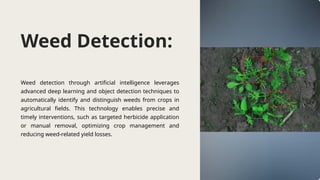
Weed Detection:
Weed detection through artificial intelligence leverages
advanced deep learning and object detection techniques to
automatically identify and distinguish weeds from crops in
agricultural fields. This technology enables precise and
timely interventions, such as targeted herbicide application
or manual removal, optimizing crop management and
reducing weed-related yield losses.
What is Artificial
Intelligence?
1 Simulating Human Intelligence
Artificial Intelligence (AI) refers to the simulation of
human intelligence in machines that are programmed
to think and learn like humans.
2 Automation of Tasks
AI can automate various tasks, from image recognition to
language translation, to improve efficiency and
productivity.
3 Adaptable and Evolving
AI algorithms can continuously learn and adapt, becoming
more sophisticated over time.
Types of AI:
Narrow AI(weak)
Narrow AI is designed to perform a specific
task or a narrow range of tasks. These
systems excel in their specific domain but do
not possess general intelligence or
understanding beyond their programmed
tasks.
Example: Virtual personal assistants like Siri
and Alexa, facial recognition software, and
self-driving cars.
General AI(strong)
General AI refers to strong AI that exhibits
human-like intelligence, capable of
understanding, learning, reasoning, and
applying knowledge across different
domains.
General AI is still largely a concept and has
not been achieved yet.
Subsets of AI:
Machine Learning
Machine Learning is perhaps the
most prominent subset of AI,
focusing on algorithms and
models that enable computers to
learn from data and make
predictions or decisions.
Deep Learning
Deep Learning is a specialized
subset of ML that uses artificial
neural networks with multiple
layers (deep neural networks). It
excels in tasks that involve
complex patterns or large
amounts of data.
Natural Language Processing
NLP focuses on enabling
computers to understand,
interpret, and generate human
language in a way that is
meaningful and contextually
relevant
Computer
Vision:
It enables computers and systems
to interpret, understand, and derive
meaningful information from visual
data such as images and videos. It
allow machines to automatically
process and analyse visual inputs,
similar to how humans perceive
and understand the visual world.
Expert system:
It system that emulates the
decision-making ability of a human
expert in a specific domain. It is
designed to solve complex
problems by reasoning through
knowledge and rules acquired from
human experts. It focuses on
providing expert-level advice and
Machine Learning:
Machine learning is a branch of artificial intelligence (AI) that enables systems to learn and improve from experience without
being explicitly programmed. It focuses on developing algorithms that automatically learn patterns and make data-driven
predictions or decisions.
Data
Machine learning algorithms
rely on vast amounts of data to
identify patterns and make
predictions.
Algorithms
There are various machine
learning algorithms, such as
regression, classification, and
clustering, each suited for
different tasks.
Training
The process of training machine
learning models to improve
their performance on specific
tasks.
• Supervised learning
• Unsupervised learning
• Reinforcement learning
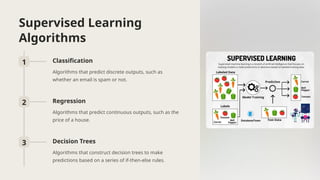
Supervised Learning
Algorithms
1 Classification
Algorithms that predict discrete outputs, such as
whether an email is spam or not.
2 Regression
Algorithms that predict continuous outputs, such as the
price of a house.
3 Decision Trees
Algorithms that construct decision trees to make
predictions based on a series of if-then-else rules.
Unsupervised Learning Algorithms
Clustering
Algorithms that group similar data points together without any predefined labels.
Dimensionality Reduction
Algorithms that simplify complex data by identifying the most important features.
Association Rule Learning
Algorithms that discover hidden relationships and patterns in data.
Anomaly Detection
Algorithms that identify unusual or outlier data points in a dataset.
Reinforcement Learning:
1 Agent:
The agent, or decision-making algorithm, interacts
with an environment and takes actions to achieve a
goal.
2 Rewards:
The agent receives rewards or penalties based on the
outcomes of its actions, providing feedback to guide
its learning
3 Learning:
The agent learns to optimize its behavior over time,
aiming to maximize the cumulative rewards it receives
Deep Learning:
Deep learning is a subset of machine learning where artificial neural networks,
inspired by the human brain's structure and function, learn from large amounts of
data to make decisions or predictions. It is characterized by multiple layers of
interconnected neurons that enable the model to automatically learn hierarchical
representations of data.
Neural Network:
A neural network is a computational model inspired by the structure and function of
the human brain. It consists of interconnected nodes, called neurons, organized in
layers. Each neuron processes input signals, applies a transformation using learned
weights, and generates an output signal.
Neurons:
The basic building blocks of neural networks, designed to mimic the human brain.
Types of neural networks:
Convolutional Neural
Networks (CNNs)
Designed for processing
structured grid-like data
such as images. Uses
convolutional layers to
automatically learn
hierarchical
representations
Recurrent Neural
Networks (RNNs)
Specialized for sequential
data processing. Contains
loops to allow information
to persist, making it
suitable for tasks like
language modelling and
speech recognition.
Long Short Term
Memory(LSTM)
A type of RNN that
addresses the
vanishing gradient
problem. Effective for
learning long-term
dependencies in
sequential data.
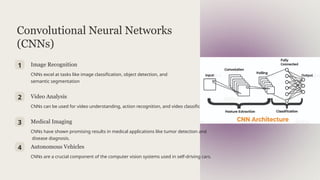
Convolutional Neural Networks
(CNNs)
1 Image Recognition
CNNs excel at tasks like image classification, object detection, and
semantic segmentation
2 Video Analysis
CNNs can be used for video understanding, action recognition, and video classification.
3 Medical Imaging
CNNs have shown promising results in medical applications like tumor detection and
disease diagnosis.
4 Autonomous Vehicles
CNNs are a crucial component of the computer vision systems used in self-driving cars.
Recurrent Neural Networks
(RNNs)
1
Sequence Modeling
RNNs are designed to process and generate sequences of data, such as text,
speech, and time series.
2
Memory
RNNs maintain an internal state that allows them to consider previous inputs when processing
the current input, enabling them to model dependencies in sequential data.
3 Applications
RNNs are used for tasks like language modeling, machine translation, speech recognition,
and text generation.
METHODOLOGY
DATA COLLECTION
MANUAL TRAINING
PRE-PROCESSING
DATA AUGUMENTATION
OBJECT DETECTION
DATA COLLECTION:
GitHub supports continuous integration and deployment, enabling
automated testing and streamlined release processes. Its user-friendly
interface and extensive documentation make it accessible to both
beginners and experienced developers.
MANUAL TRAINING:
Roboflow is a feature-rich platform with tools for dataset
administration, annotation, pre-processing, and augmentation that is
specifically tailored for computer vision projects. It easily interfaces
with well-known machine learning frameworks like PyTorch and
TensorFlow and supports several picture formats.
PRE-PROCESSING:
In image processing, resizing entails altering a picture's proportions to
a predetermined width and height. In image processing, rescaling is
the act of bringing a picture's pixel values inside a specified range,
usually between 0 and 1. By standardizing the data, this phase
guarantees consistency and enhances the functionality of machine
learning models
DATA AUGMENTATION:
A technique to artificially expand the size of a training dataset is data
augmentation, which involves modifying already-existing data. Data
augmentation seeks to increase the variety and volatility of the
training data to improve the effectiveness and adaptability of the
given models.
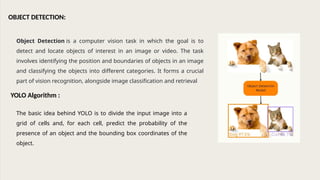
OBJECT DETECTION:
Object Detection is a computer vision task in which the goal is to
detect and locate objects of interest in an image or video. The task
involves identifying the position and boundaries of objects in an image
and classifying the objects into different categories. It forms a crucial
part of vision recognition, alongside image classification and retrieval
YOLO Algorithm :
The basic idea behind YOLO is to divide the input image into a
grid of cells and, for each cell, predict the probability of the
presence of an object and the bounding box coordinates of the
object.
RESULTS:
ACTUAL FEATURES
PREDICTED FEATURES
TRUE POSITIVE = 2
FALSE POSITIVE= 1
TRUE NEGATIVE= 1
FALSE NEGATIVE= 1
PRECISION:
Precision is a metric that measures how often a machine
learning model correctly predicts the positive class. You can
calculate precision by dividing the number of correct positive
predictions (true positives) by the total number of instances
the model predicted as positive (both true and false
positives).
RECALL:
Recall is a metric that measures how often a machine learning
model correctly identifies positive instances (true positives)
from all the actual positive samples in the dataset. You can
calculate recall by dividing the number of true positives by the
number of positive instances.
THANK YOU

Weed Detection and Identification using Deep learning Techniques

  • 1.
    EMPLOYING DEEP LEARNING TECHNIQUESFOR THE IDENTIFICATION OF WEED PLANTS IN DIGITAL PHOTOGRAPHS PRESENTED BY V P YOGANANDHAM V RAKESH
  • 2.
    OUR SPECIAL THANKSTO: • DR. M K STALIN (ADDITIONAL SURVEYOR GENERAL) • THIRU. YOGACHANDAR P.A (SUPERINTENDING SURVEYOR) • DR. N N RAMA PRASAD (OFFICER SURVEYOR) • THIRU ANANDA SAGAR (OFFICER SURVEYOR) • NATIONAL INSTITUTE FOR GEO-INFORMATICS SCIENCE AND TECHNOLOGY (NIGST), UPPAL, HYDERABAD, TELANGANA.
  • 3.
    Weed Detection: Weed detectionthrough artificial intelligence leverages advanced deep learning and object detection techniques to automatically identify and distinguish weeds from crops in agricultural fields. This technology enables precise and timely interventions, such as targeted herbicide application or manual removal, optimizing crop management and reducing weed-related yield losses.
  • 4.
    What is Artificial Intelligence? 1Simulating Human Intelligence Artificial Intelligence (AI) refers to the simulation of human intelligence in machines that are programmed to think and learn like humans. 2 Automation of Tasks AI can automate various tasks, from image recognition to language translation, to improve efficiency and productivity. 3 Adaptable and Evolving AI algorithms can continuously learn and adapt, becoming more sophisticated over time.
  • 5.
    Types of AI: NarrowAI(weak) Narrow AI is designed to perform a specific task or a narrow range of tasks. These systems excel in their specific domain but do not possess general intelligence or understanding beyond their programmed tasks. Example: Virtual personal assistants like Siri and Alexa, facial recognition software, and self-driving cars. General AI(strong) General AI refers to strong AI that exhibits human-like intelligence, capable of understanding, learning, reasoning, and applying knowledge across different domains. General AI is still largely a concept and has not been achieved yet.
  • 6.
    Subsets of AI: MachineLearning Machine Learning is perhaps the most prominent subset of AI, focusing on algorithms and models that enable computers to learn from data and make predictions or decisions. Deep Learning Deep Learning is a specialized subset of ML that uses artificial neural networks with multiple layers (deep neural networks). It excels in tasks that involve complex patterns or large amounts of data. Natural Language Processing NLP focuses on enabling computers to understand, interpret, and generate human language in a way that is meaningful and contextually relevant Computer Vision: It enables computers and systems to interpret, understand, and derive meaningful information from visual data such as images and videos. It allow machines to automatically process and analyse visual inputs, similar to how humans perceive and understand the visual world. Expert system: It system that emulates the decision-making ability of a human expert in a specific domain. It is designed to solve complex problems by reasoning through knowledge and rules acquired from human experts. It focuses on providing expert-level advice and
  • 7.
    Machine Learning: Machine learningis a branch of artificial intelligence (AI) that enables systems to learn and improve from experience without being explicitly programmed. It focuses on developing algorithms that automatically learn patterns and make data-driven predictions or decisions. Data Machine learning algorithms rely on vast amounts of data to identify patterns and make predictions. Algorithms There are various machine learning algorithms, such as regression, classification, and clustering, each suited for different tasks. Training The process of training machine learning models to improve their performance on specific tasks. • Supervised learning • Unsupervised learning • Reinforcement learning
  • 8.
    Supervised Learning Algorithms 1 Classification Algorithmsthat predict discrete outputs, such as whether an email is spam or not. 2 Regression Algorithms that predict continuous outputs, such as the price of a house. 3 Decision Trees Algorithms that construct decision trees to make predictions based on a series of if-then-else rules.
  • 9.
    Unsupervised Learning Algorithms Clustering Algorithmsthat group similar data points together without any predefined labels. Dimensionality Reduction Algorithms that simplify complex data by identifying the most important features. Association Rule Learning Algorithms that discover hidden relationships and patterns in data. Anomaly Detection Algorithms that identify unusual or outlier data points in a dataset.
  • 10.
    Reinforcement Learning: 1 Agent: Theagent, or decision-making algorithm, interacts with an environment and takes actions to achieve a goal. 2 Rewards: The agent receives rewards or penalties based on the outcomes of its actions, providing feedback to guide its learning 3 Learning: The agent learns to optimize its behavior over time, aiming to maximize the cumulative rewards it receives
  • 11.
    Deep Learning: Deep learningis a subset of machine learning where artificial neural networks, inspired by the human brain's structure and function, learn from large amounts of data to make decisions or predictions. It is characterized by multiple layers of interconnected neurons that enable the model to automatically learn hierarchical representations of data. Neural Network: A neural network is a computational model inspired by the structure and function of the human brain. It consists of interconnected nodes, called neurons, organized in layers. Each neuron processes input signals, applies a transformation using learned weights, and generates an output signal. Neurons: The basic building blocks of neural networks, designed to mimic the human brain.
  • 12.
    Types of neuralnetworks: Convolutional Neural Networks (CNNs) Designed for processing structured grid-like data such as images. Uses convolutional layers to automatically learn hierarchical representations Recurrent Neural Networks (RNNs) Specialized for sequential data processing. Contains loops to allow information to persist, making it suitable for tasks like language modelling and speech recognition. Long Short Term Memory(LSTM) A type of RNN that addresses the vanishing gradient problem. Effective for learning long-term dependencies in sequential data.
  • 13.
    Convolutional Neural Networks (CNNs) 1Image Recognition CNNs excel at tasks like image classification, object detection, and semantic segmentation 2 Video Analysis CNNs can be used for video understanding, action recognition, and video classification. 3 Medical Imaging CNNs have shown promising results in medical applications like tumor detection and disease diagnosis. 4 Autonomous Vehicles CNNs are a crucial component of the computer vision systems used in self-driving cars.
  • 14.
    Recurrent Neural Networks (RNNs) 1 SequenceModeling RNNs are designed to process and generate sequences of data, such as text, speech, and time series. 2 Memory RNNs maintain an internal state that allows them to consider previous inputs when processing the current input, enabling them to model dependencies in sequential data. 3 Applications RNNs are used for tasks like language modeling, machine translation, speech recognition, and text generation.
  • 15.
  • 16.
    DATA COLLECTION: GitHub supportscontinuous integration and deployment, enabling automated testing and streamlined release processes. Its user-friendly interface and extensive documentation make it accessible to both beginners and experienced developers. MANUAL TRAINING: Roboflow is a feature-rich platform with tools for dataset administration, annotation, pre-processing, and augmentation that is specifically tailored for computer vision projects. It easily interfaces with well-known machine learning frameworks like PyTorch and TensorFlow and supports several picture formats.
  • 17.
    PRE-PROCESSING: In image processing,resizing entails altering a picture's proportions to a predetermined width and height. In image processing, rescaling is the act of bringing a picture's pixel values inside a specified range, usually between 0 and 1. By standardizing the data, this phase guarantees consistency and enhances the functionality of machine learning models DATA AUGMENTATION: A technique to artificially expand the size of a training dataset is data augmentation, which involves modifying already-existing data. Data augmentation seeks to increase the variety and volatility of the training data to improve the effectiveness and adaptability of the given models.
  • 18.
    OBJECT DETECTION: Object Detectionis a computer vision task in which the goal is to detect and locate objects of interest in an image or video. The task involves identifying the position and boundaries of objects in an image and classifying the objects into different categories. It forms a crucial part of vision recognition, alongside image classification and retrieval YOLO Algorithm : The basic idea behind YOLO is to divide the input image into a grid of cells and, for each cell, predict the probability of the presence of an object and the bounding box coordinates of the object.
  • 19.
    RESULTS: ACTUAL FEATURES PREDICTED FEATURES TRUEPOSITIVE = 2 FALSE POSITIVE= 1 TRUE NEGATIVE= 1 FALSE NEGATIVE= 1
  • 20.
    PRECISION: Precision is ametric that measures how often a machine learning model correctly predicts the positive class. You can calculate precision by dividing the number of correct positive predictions (true positives) by the total number of instances the model predicted as positive (both true and false positives). RECALL: Recall is a metric that measures how often a machine learning model correctly identifies positive instances (true positives) from all the actual positive samples in the dataset. You can calculate recall by dividing the number of true positives by the number of positive instances.
  • 22.