Arusha Gordon
Dariely Rodriguez
drodriguez@lawyerscommittee.org
agordon@lawyerscommittee.org
Promoting Tolerance and Preventing Discrimination
DISCLAIMER
This presentation does not provide legal advice
but rather provides general legal information.
No attorney-client relationship is created by
using any information in the presentation. You
should consult and retain an attorney if you
need legal advice specific to your situation.
WHO WE ARE
Our Mission
To secure equal justice for all
through the rule of law, targeting in
particular the inequities confronting
African Americans and other racial
and ethnic minorities.
WHO WE ARE
Economic Justice Project
The Economic Justice Project (EJP) seeks to address
persisting inequality and high poverty rates faced by
African American and other minority communities.
EJP also brings litigation seeking to lift the
employment barriers faced by individuals with
criminal histories who are seeking to reintegrate into
their communities.
WHO WE ARE
The Stop Hate Project seeks to strengthen the
capacity of community leaders, law
enforcement, and organizations around the
country to combat hate by connecting these
groups with established legal and social services
resources.
Stop Hate Project
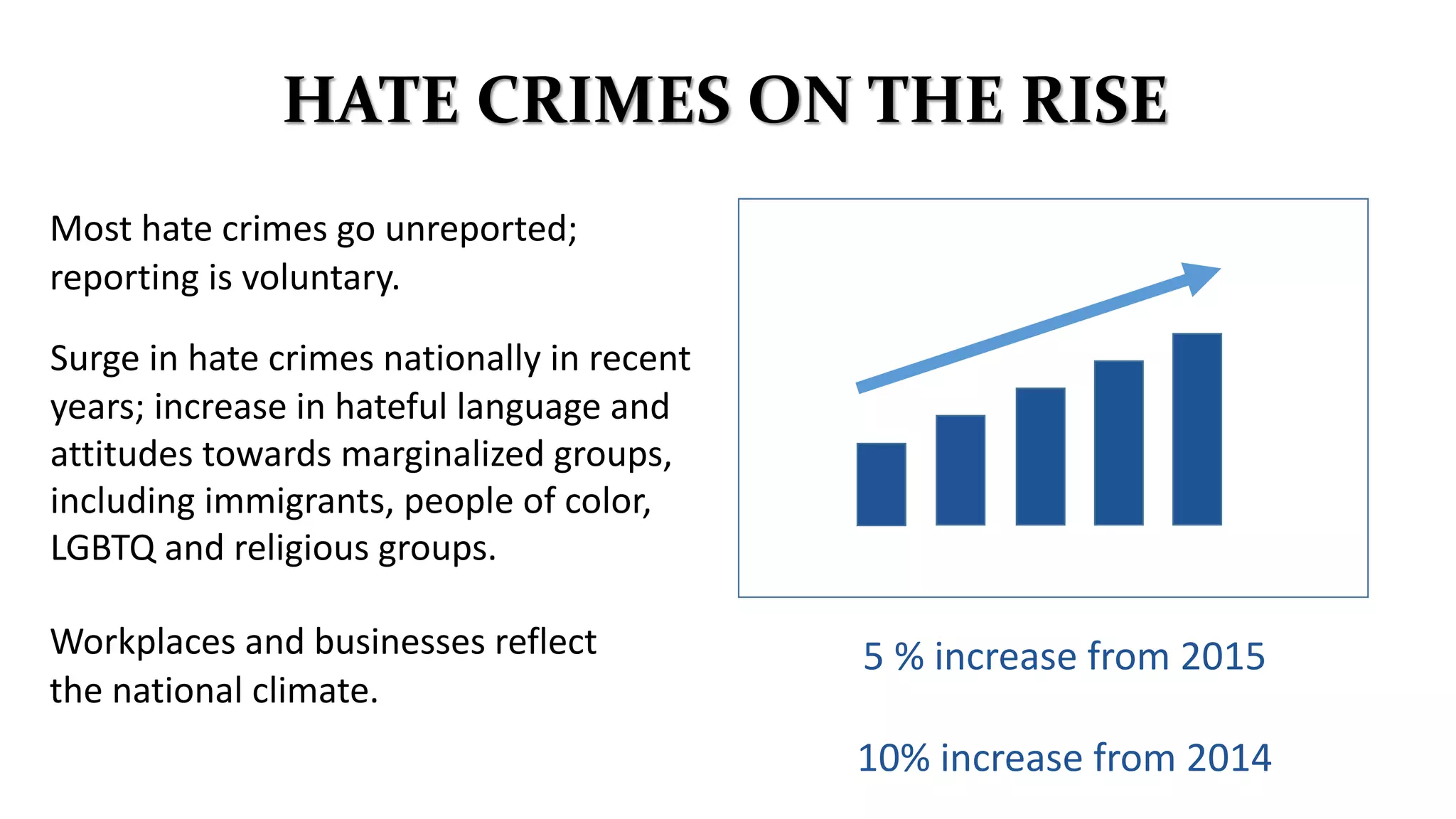
HATE CRIMES ON THE RISE
5 % increase from 2015
10% increase from 2014
Most hate crimes go unreported;
reporting is voluntary.
Surge in hate crimes nationally in recent
years; increase in hateful language and
attitudes towards marginalized groups,
including immigrants, people of color,
LGBTQ and religious groups.
Workplaces and businesses reflect
the national climate.
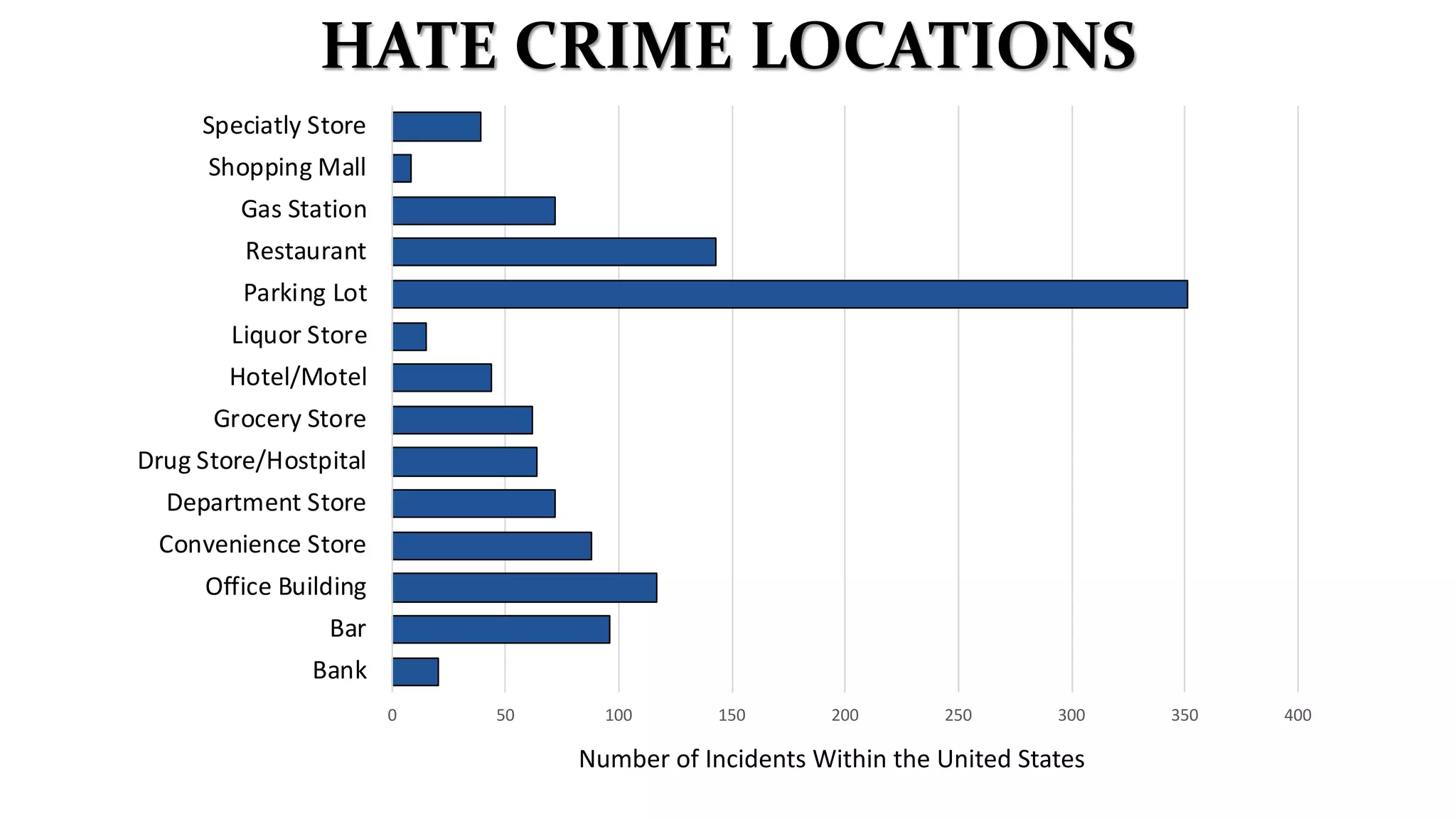
0 50 100 150 200 250 300 350 400
Bank
Bar
Office Building
Convenience Store
Department Store
Drug Store/Hostpital
Grocery Store
Hotel/Motel
Liquor Store
Parking Lot
Restaurant
Gas Station
Shopping Mall
Speciatly Store
HATE CRIME LOCATIONS
Number of Incidents Within the United States
LEGAL OVERVIEW
Federal, state, and local laws prohibit discrimination, including
harassment, based on certain characteristics or protected categories
such as race, sex, pregnancy, religion, national origin, disability, age,
and citizenship status.
At the federal level, employment anti-
discrimination laws apply to employers
engaged in interstate commerce with more
than 15 employees.
*The threshold may be lower at the state or
local levels.
LEGAL OVERVIEW
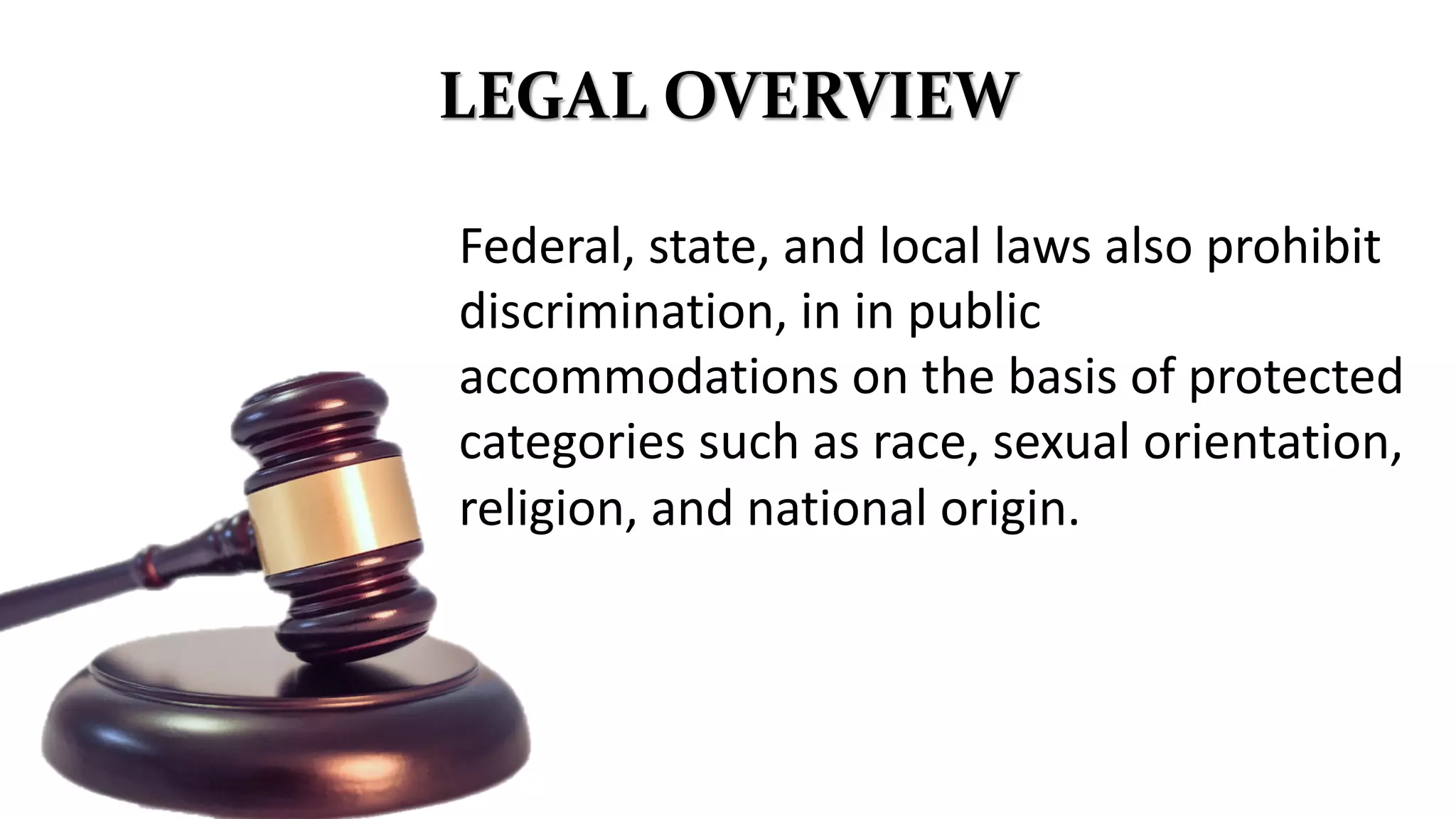
Federal, state, and local laws also prohibit
discrimination, in in public
accommodations on the basis of protected
categories such as race, sexual orientation,
religion, and national origin.
WHAT OBLIGATIONS DO YOU HAVE?
• Businesses have an obligation to provide a work environment
that is free from discrimination and harassment
• Businesses also have an obligation to treat customers equally
and fairly.
• Eliminating harassment begins with treating people with
respect.
• Discrimination and harassment have negative impacts in the
workplace and on employee morale.
• Discrimination or harassment against customers is bad for
business!
WHO CAN PERPETRATE HARASSMENT?
1. Perpetrator w/no relationship
Perpetrator with no legitimate
relationship to the business
(protestor/ political demonstration).
2. Customer/Client
External individual who has
relationship to the business
(harassing employees, refusing to
work with specific individuals)
3. Worker-on-Worker
Internal problems between co-workers;
usually manifests as verbal or physical
conduct on the basis of someone’s
protected category.
WORKPLACE HARASSMENT
RECOGNIZE
1. Harassment can be overt or subtle. It can manifest itself
physically, verbally, and non-verbally (written, visual).
2. It’s motivated by bias, prejudice, or personal hatred
toward the actual or perceived characteristics of a
victim, including race, color, national origin, religion,
disability, sexual orientation, gender, or gender identity.
RESPOND to Complaints
WORKPLACE HARASSMENT
2. Investigate
3. Take appropriate action, if necessary
1. Take all complaints seriously
WORKPLACE HARASSMENT
PREVENT
2. Be mindful of your own biases
1. Cultural sensitivity; be aware of how cultural
dynamics (including ‘identity’ based on religion,
sex, race, ethnicity, gender identity, sexual
orientation, disability etc.) inform one’s reactions
HYPOTHETICALS
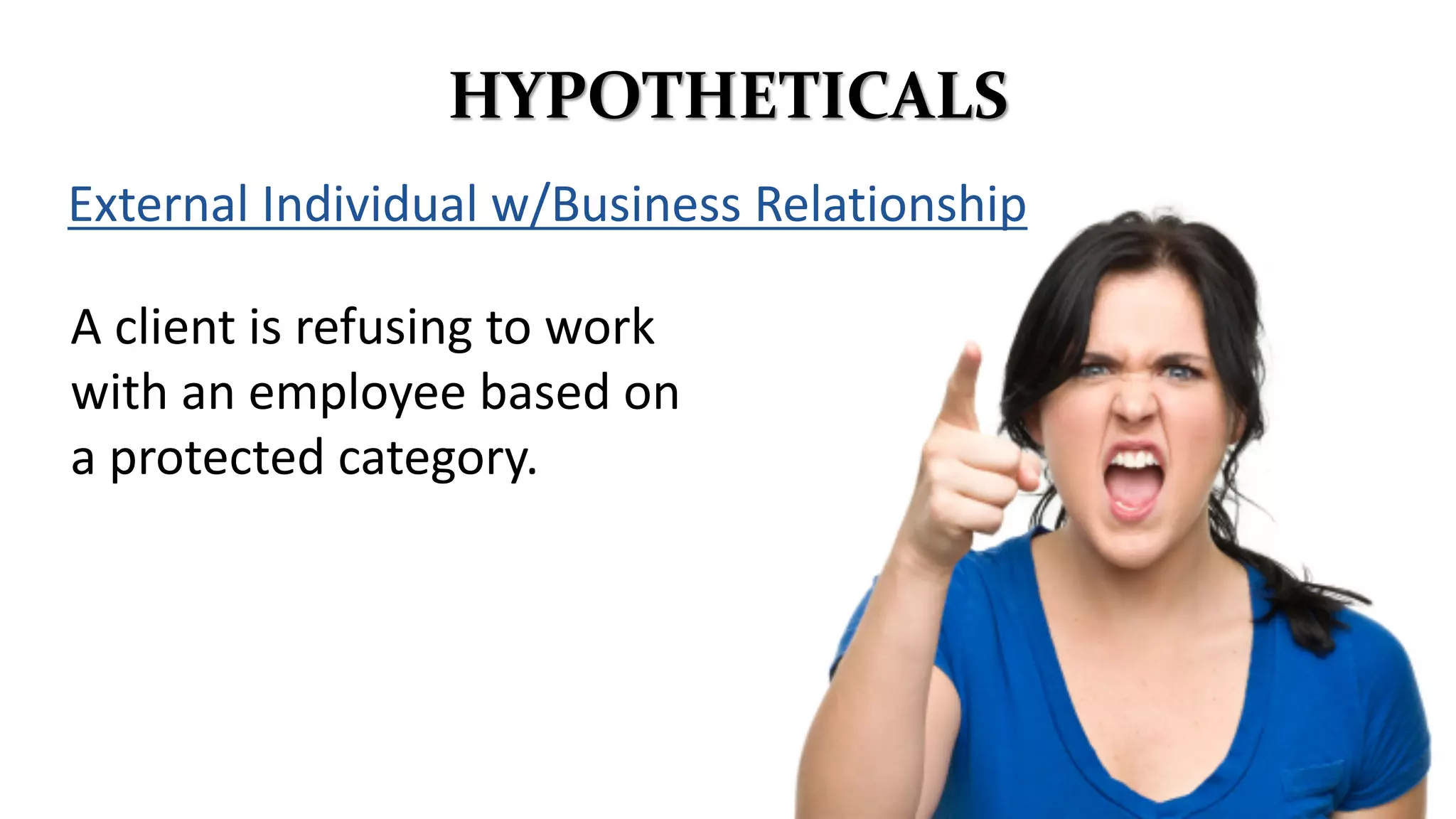
A client is refusing to work
with an employee based on
a protected category.
External Individual w/Business Relationship
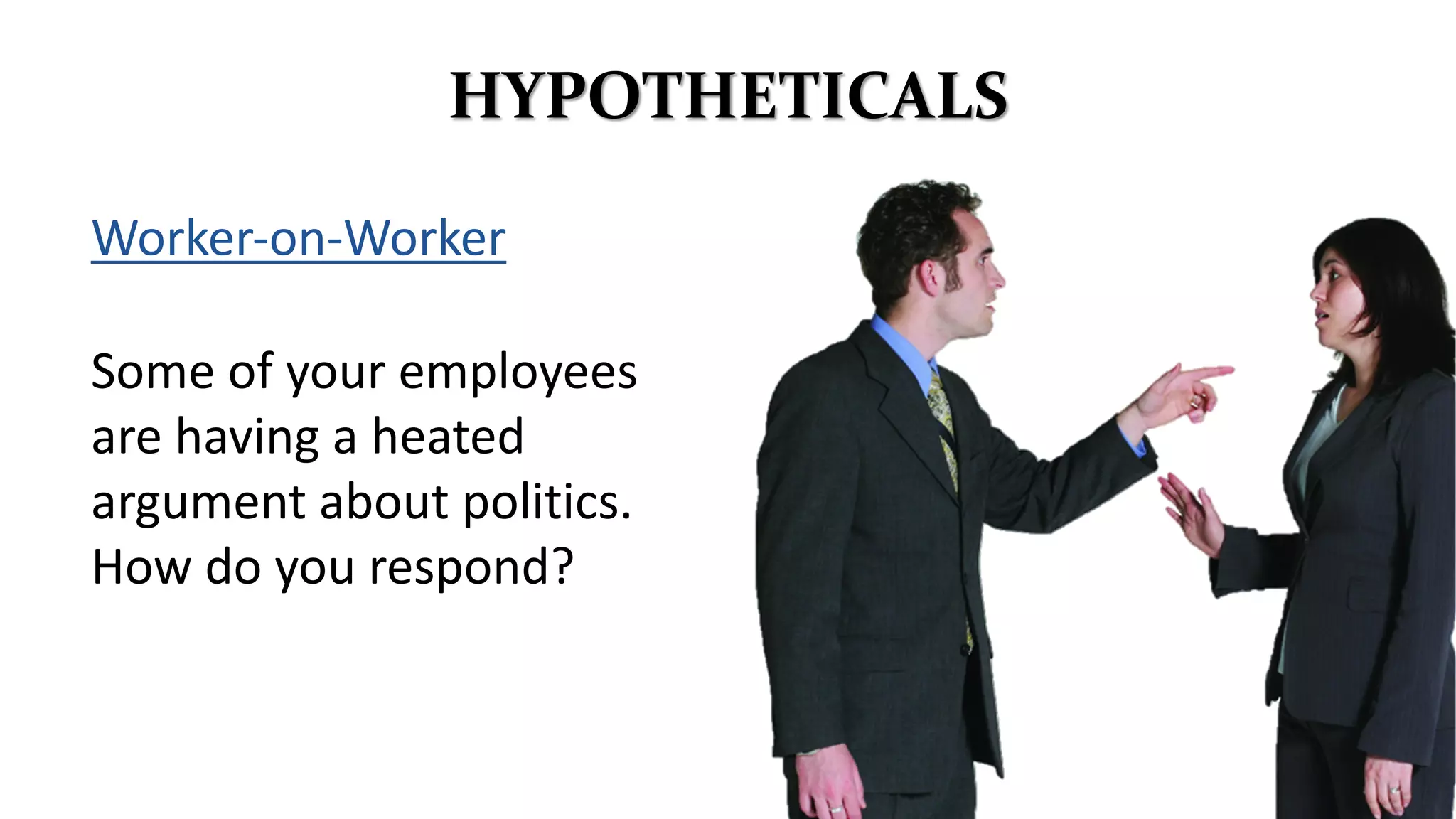
Worker-on-Worker
Some of your employees
are having a heated
argument about politics.
How do you respond?
HYPOTHETICALS
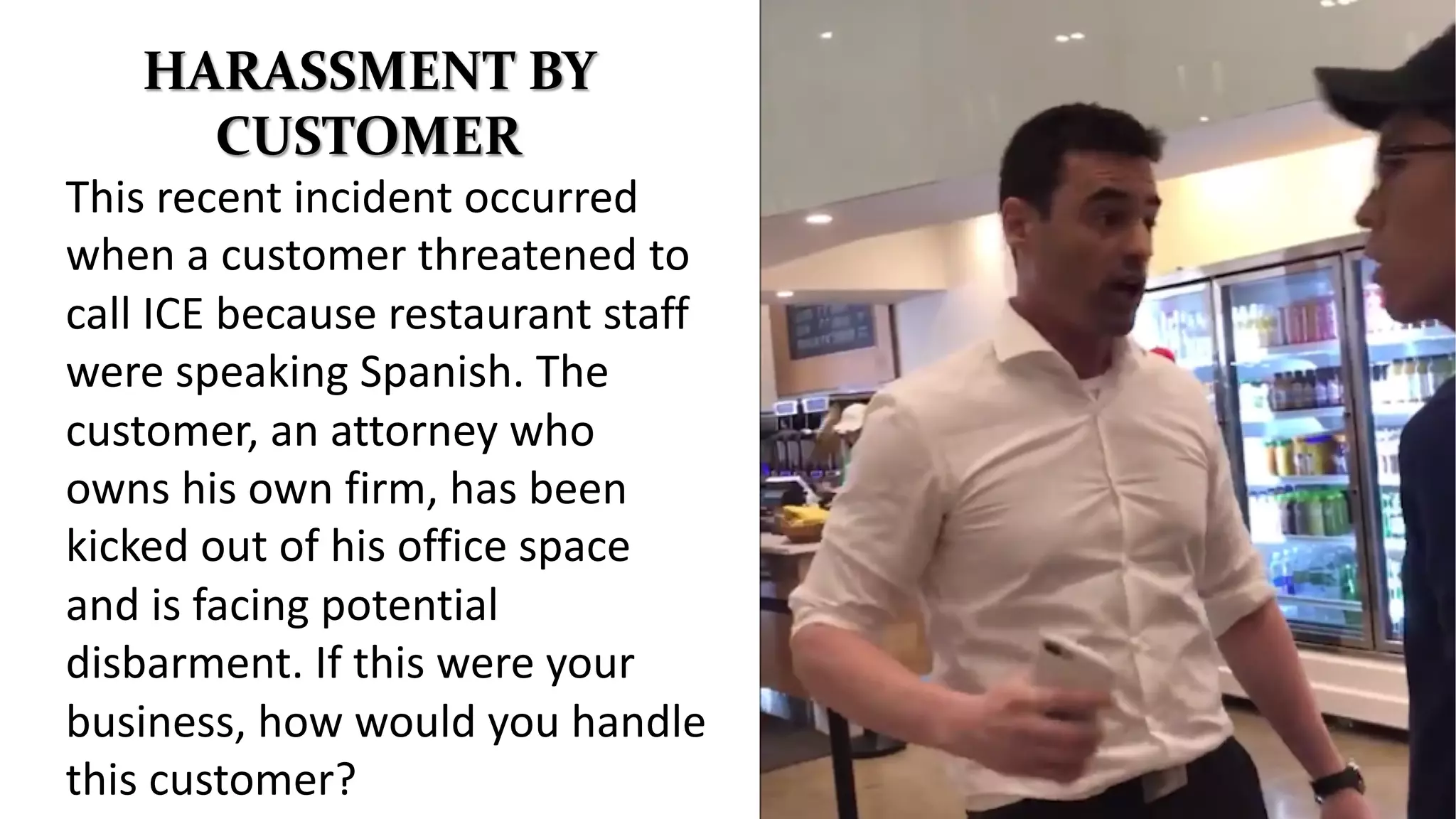
HARASSMENT BY
CUSTOMER
This recent incident occurred
when a customer threatened to
call ICE because restaurant staff
were speaking Spanish. The
customer, an attorney who
owns his own firm, has been
kicked out of his office space
and is facing potential
disbarment. If this were your
business, how would you handle
this customer?
SUGGESTED ACTION ITEMS
ØLetter to the editor/op-ed using your voice as a business leader
(“Hate is bad for business”)
ØHost a know your rights workshop, bystander intervention training, or
community round table on hate
ØMake and display inclusive and welcoming messages
(e.g. consumer bill of rights, “all are welcome here”)
ØFundraise for repairs/security equipment for organizations or residents that
have been vandalized
ØDonate proceeds on a certain day to anti-hate or community groups.
ØAttend community meetings to stay informed about hateful activity
ØSupport businesses that have been targets of hate
RESOURCES
• LCCRUL Stop Hate Project (8449nohate.org)
• Society for Human Resource Management (SHRM)
• American Bar Association (ABA)
• Crisis Prevention Institute (CPI)
19
THANK YOU!
.
QUESTIONS?

Webinar: Recognizing and Responding to Discrimination in the Workplace

  • 1.
  • 2.
    DISCLAIMER This presentation doesnot provide legal advice but rather provides general legal information. No attorney-client relationship is created by using any information in the presentation. You should consult and retain an attorney if you need legal advice specific to your situation.
  • 3.
    WHO WE ARE OurMission To secure equal justice for all through the rule of law, targeting in particular the inequities confronting African Americans and other racial and ethnic minorities.
  • 4.
    WHO WE ARE EconomicJustice Project The Economic Justice Project (EJP) seeks to address persisting inequality and high poverty rates faced by African American and other minority communities. EJP also brings litigation seeking to lift the employment barriers faced by individuals with criminal histories who are seeking to reintegrate into their communities.
  • 5.
    WHO WE ARE TheStop Hate Project seeks to strengthen the capacity of community leaders, law enforcement, and organizations around the country to combat hate by connecting these groups with established legal and social services resources. Stop Hate Project
  • 6.
    HATE CRIMES ONTHE RISE 5 % increase from 2015 10% increase from 2014 Most hate crimes go unreported; reporting is voluntary. Surge in hate crimes nationally in recent years; increase in hateful language and attitudes towards marginalized groups, including immigrants, people of color, LGBTQ and religious groups. Workplaces and businesses reflect the national climate.
  • 7.
    0 50 100150 200 250 300 350 400 Bank Bar Office Building Convenience Store Department Store Drug Store/Hostpital Grocery Store Hotel/Motel Liquor Store Parking Lot Restaurant Gas Station Shopping Mall Speciatly Store HATE CRIME LOCATIONS Number of Incidents Within the United States
  • 8.
    LEGAL OVERVIEW Federal, state,and local laws prohibit discrimination, including harassment, based on certain characteristics or protected categories such as race, sex, pregnancy, religion, national origin, disability, age, and citizenship status. At the federal level, employment anti- discrimination laws apply to employers engaged in interstate commerce with more than 15 employees. *The threshold may be lower at the state or local levels.
  • 9.
    LEGAL OVERVIEW Federal, state,and local laws also prohibit discrimination, in in public accommodations on the basis of protected categories such as race, sexual orientation, religion, and national origin.
  • 10.
    WHAT OBLIGATIONS DOYOU HAVE? • Businesses have an obligation to provide a work environment that is free from discrimination and harassment • Businesses also have an obligation to treat customers equally and fairly. • Eliminating harassment begins with treating people with respect. • Discrimination and harassment have negative impacts in the workplace and on employee morale. • Discrimination or harassment against customers is bad for business!
  • 11.
    WHO CAN PERPETRATEHARASSMENT? 1. Perpetrator w/no relationship Perpetrator with no legitimate relationship to the business (protestor/ political demonstration). 2. Customer/Client External individual who has relationship to the business (harassing employees, refusing to work with specific individuals) 3. Worker-on-Worker Internal problems between co-workers; usually manifests as verbal or physical conduct on the basis of someone’s protected category.
  • 12.
    WORKPLACE HARASSMENT RECOGNIZE 1. Harassmentcan be overt or subtle. It can manifest itself physically, verbally, and non-verbally (written, visual). 2. It’s motivated by bias, prejudice, or personal hatred toward the actual or perceived characteristics of a victim, including race, color, national origin, religion, disability, sexual orientation, gender, or gender identity.
  • 13.
    RESPOND to Complaints WORKPLACEHARASSMENT 2. Investigate 3. Take appropriate action, if necessary 1. Take all complaints seriously
  • 14.
    WORKPLACE HARASSMENT PREVENT 2. Bemindful of your own biases 1. Cultural sensitivity; be aware of how cultural dynamics (including ‘identity’ based on religion, sex, race, ethnicity, gender identity, sexual orientation, disability etc.) inform one’s reactions
  • 15.
    HYPOTHETICALS A client isrefusing to work with an employee based on a protected category. External Individual w/Business Relationship
  • 16.
    Worker-on-Worker Some of youremployees are having a heated argument about politics. How do you respond? HYPOTHETICALS
  • 17.
    HARASSMENT BY CUSTOMER This recentincident occurred when a customer threatened to call ICE because restaurant staff were speaking Spanish. The customer, an attorney who owns his own firm, has been kicked out of his office space and is facing potential disbarment. If this were your business, how would you handle this customer?
  • 18.
    SUGGESTED ACTION ITEMS ØLetterto the editor/op-ed using your voice as a business leader (“Hate is bad for business”) ØHost a know your rights workshop, bystander intervention training, or community round table on hate ØMake and display inclusive and welcoming messages (e.g. consumer bill of rights, “all are welcome here”) ØFundraise for repairs/security equipment for organizations or residents that have been vandalized ØDonate proceeds on a certain day to anti-hate or community groups. ØAttend community meetings to stay informed about hateful activity ØSupport businesses that have been targets of hate
  • 19.
    RESOURCES • LCCRUL StopHate Project (8449nohate.org) • Society for Human Resource Management (SHRM) • American Bar Association (ABA) • Crisis Prevention Institute (CPI) 19
  • 20.
  • 21.