Legal Framework
for E-Assessements
Why Security Issues, Personal
Data Protection and
Fundamental Rights matter
Lic. iur. Jacqueline Gasser-Beck, EMBA HSG
Webinar - August 10th 2017
03
01
02
Agenda
Why should we care?
How can we be on the Safe Side
Pilot - Checklist – Good Practice
Are students going to sue universities?
Source:
https://www.theguardian.com/money/20
10/dec/18/refund-if-university-fails-
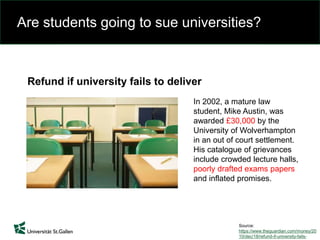
Refund if university fails to deliver
In 2002, a mature law
student, Mike Austin, was
awarded £30,000 by the
University of Wolverhampton
in an out of court settlement.
His catalogue of grievances
include crowded lecture halls,
poorly drafted exams papers
and inflated promises.
For their endangered future careers?
Source: BGE 136 I 229
X received a 5.0 for her master thesis at the
University of Bern resulting in a grade point
average of 5.43, which lead to a masters
degree with predicate «magna cum laude».
With a 5.5 in for her thesis she would have
reached a «summa cum laude».
…this particular grade had a significant
impact on her final degree predicate and
therefore on her future career (specification
of judicial practice; BGE 136 I 229).
For technical issues?
Source: https://www.nzz.ch/zuerich/server-der-
universitaet-abgestuerzt-1.18220461
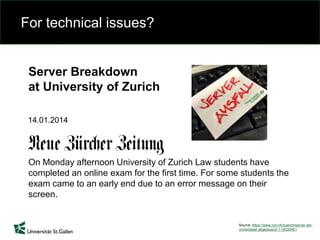
Server Breakdown
at University of Zurich
On Monday afternoon University of Zurich Law students have
completed an online exam for the first time. For some students the
exam came to an early end due to an error message on their
screen.
14.01.2014
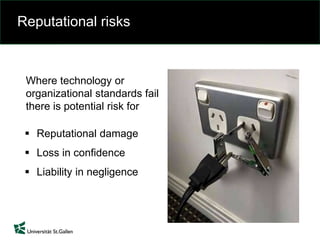
Reputational risks
 Reputational damage
 Loss in confidence
 Liability in negligence
Where technology or
organizational standards fail
there is potential risk for
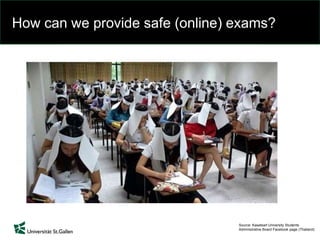
How can we provide safe (online) exams?
Source: Kasetsart University Students
Administrative Board Facebook page (Thailand)
Features of a fair and legally save exam
Just like any written exam, e-exams must maintain
the features of traditional assessment such as
 Objectivity
 Validity
 Reliability
 Fairness
 Authenticity
 Accessibility
 Transparency
Source: Baker, O'Neil, & Linn, 1993; Shute, 2009;
www.let.ethz.ch; Glossar Prüfungen
Legally protected rights (Fundamental Rights)
Source: Federal Constitution of the Swiss Confederation
of 18 April 1999 (Status as of 1 January 2016)
 Freedom of career choice
(Art. 27 Abs. 2 BV)
 Equal opportunities of examinees
(Art. 8 BV)
 Protection against arbitrary conduct
and principle of good faith
(Art. 9 BV)
Concerning exams the following (fundamental)
rights are protected by the Federal Constitution
of the Swiss Confederation
Legally protected rights (Personal Data)
Source: Federal Act on Data Protection
(FADP) of 19 June 1992 (Status as of 1 January 2014)
Art. 4 Principles
1 Personal data may only be processed lawfully.
2 Its processing must be carried out in good faith and must be proportionate.
3,4, …
5 If the consent of the data subject is required for the processing of personal data, such
consent is valid only if given voluntarily on the provision of adequate information.
Additionally, consent must be given expressly in the case of processing of sensitive
personal data or personality profiles.
Art. 3 Definitions
a. personal data (data): all information relating to an identified or identifiable
person;
…
c. sensitive personal data:
1. religious, ideological, political or trade union-related views or activities,
2. health, the intimate sphere or the racial origin,
3. social security measures,
4. administrative or criminal proceedings and sanctions
Data Protection
Source: http://www.zentralplus.ch/de/news/politik/26676/Hochschule-Luzern-
ver%C3%B6ffentlichte-Noten-aller-Studierenden-im-Internet.htm
https://www.nzz.ch/meinung/kommentare/meine-bildungsdaten-gehoeren-mir-
1.18575426
http://www.sueddeutsche.de/bildung/datenschutz-bei-online-kursen-der-
glaeserne-student-1.2762465
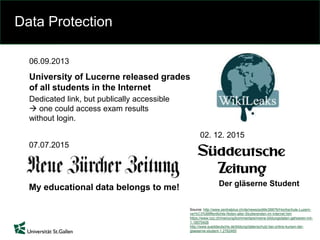
Dedicated link, but publically accessible
 one could access exam results
without login.
06.09.2013
University of Lucerne released grades
of all students in the Internet
My educational data belongs to me!
07.07.2015
Der gläserne Student
02. 12. 2015
Data Protection - Student Data in the Cloud?
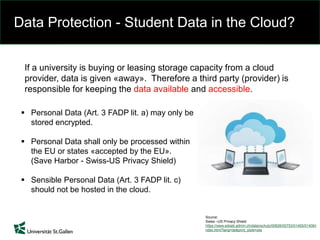
If a university is buying or leasing storage capacity from a cloud
provider, data is given «away». Therefore a third party (provider) is
responsible for keeping the data available and accessible.
 Personal Data (Art. 3 FADP lit. a) may only be
stored encrypted.
 Personal Data shall only be processed within
the EU or states «accepted by the EU».
(Save Harbor - Swiss-US Privacy Shield)
 Sensible Personal Data (Art. 3 FADP lit. c)
should not be hosted in the cloud.
Source:
Swiss –US Privacy Shield
https://www.edoeb.admin.ch/datenschutz/00626/00753/01405/01406/i
ndex.html?lang=de&print_style=yes
Data Protection - Access to Files?
Source: BGE 1C_200/2016
Final judgement of August 12, 2016
«The appellant considers it arbitrary, if not
only the personal equipment, but also
«notes, computer files and correspondence
are exepted form access (Art. 21 Abs. 3 and
4 KDSG; Art. 18 Abs. 1 KV/BE)…»
Y was studying biology at the University of Berne since1984. In
summer of 2014 he requested access to all «processed or
archived files» concerning his studies.
The University disclosed all records on file. Y was not satisfied
with the disclosure of just «official records»:
Appeal denied
E-Assessment @ University of St.Gallen
Great opportunity for students,
faculty and administration
 High maintenance
 High risk
 Expensive
BUT
 Embrace Digitalization
 Manageable (costs, staff,
infrastructure)
 Save and fair
OUR
APPROACH
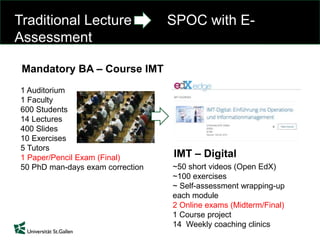
Traditional Lecture SPOC with E-
Assessment
1 Auditorium
1 Faculty
600 Students
14 Lectures
400 Slides
10 Exercises
5 Tutors
1 Paper/Pencil Exam (Final)
50 PhD man-days exam correction ~50 short videos (Open EdX)
~100 exercises
~ Self-assessment wrapping-up
each module
2 Online exams (Midterm/Final)
1 Course project
14 Weekly coaching clinics
Mandatory BA – Course IMT
IMT – Digital
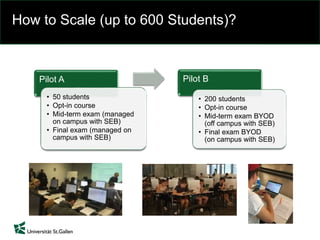
How to Scale (up to 600 Students)?
Pilot A
• 50 students
• Opt-in course
• Mid-term exam (managed
on campus with SEB)
• Final exam (managed on
campus with SEB)
Pilot B
• 200 students
• Opt-in course
• Mid-term exam BYOD
(off campus with SEB)
• Final exam BYOD
(on campus with SEB)
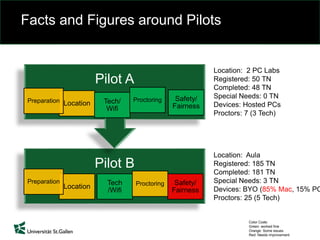
Facts and Figures around Pilots
Location: Aula
Registered: 185 TN
Completed: 181 TN
Special Needs: 3 TN
Devices: BYO (85% Mac, 15% PC
Proctors: 25 (5 Tech)
Pilot B
Safety/
Fairness
Location
Tech
/Wifi
ProctoringPreparation
Pilot A
Safety/
FairnessLocation Tech/
Wifi
ProctoringPreparation
Location: 2 PC Labs
Registered: 50 TN
Completed: 48 TN
Special Needs: 0 TN
Devices: Hosted PCs
Proctors: 7 (3 Tech)
Color Code:
Green: worked fine
Orange: Some issues
Red: Needs improvement
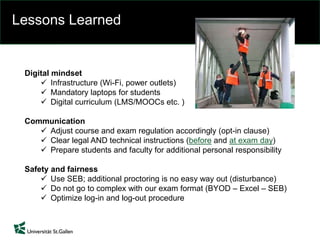
Lessons Learned
Digital mindset
 Infrastructure (Wi-Fi, power outlets)
 Mandatory laptops for students
 Digital curriculum (LMS/MOOCs etc. )
Communication
 Adjust course and exam regulation accordingly (opt-in clause)
 Clear legal AND technical instructions (before and at exam day)
 Prepare students and faculty for additional personal responsibility
Safety and fairness
 Use SEB; additional proctoring is no easy way out (disturbance)
 Do not go to complex with our exam format (BYOD – Excel – SEB)
 Optimize log-in and log-out procedure
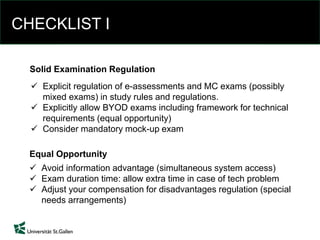
CHECKLIST I
 Explicit regulation of e-assessments and MC exams (possibly
mixed exams) in study rules and regulations.
 Explicitly allow BYOD exams including framework for technical
requirements (equal opportunity)
 Consider mandatory mock-up exam
Solid Examination Regulation
 Avoid information advantage (simultaneous system access)
 Exam duration time: allow extra time in case of tech problem
 Adjust your compensation for disadvantages regulation (special
needs arrangements)
Equal Opportunity
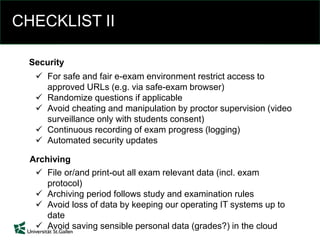
CHECKLIST II
Archiving
 File or/and print-out all exam relevant data (incl. exam
protocol)
 Archiving period follows study and examination rules
 Avoid loss of data by keeping our operating IT systems up to
date
 Avoid saving sensible personal data (grades?) in the cloud
Security
 For safe and fair e-exam environment restrict access to
approved URLs (e.g. via safe-exam browser)
 Randomize questions if applicable
 Avoid cheating and manipulation by proctor supervision (video
surveillance only with students consent)
 Continuous recording of exam progress (logging)
 Automated security updates
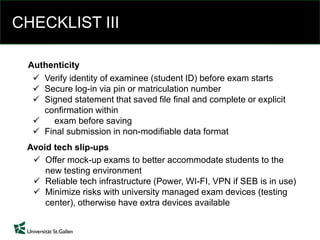
CHECKLIST III
 Offer mock-up exams to better accommodate students to the
new testing environment
 Reliable tech infrastructure (Power, WI-FI, VPN if SEB is in use)
 Minimize risks with university managed exam devices (testing
center), otherwise have extra devices available
Avoid tech slip-ups
 Verify identity of examinee (student ID) before exam starts
 Secure log-in via pin or matriculation number
 Signed statement that saved file final and complete or explicit
confirmation within
 exam before saving
 Final submission in non-modifiable data format
Authenticity
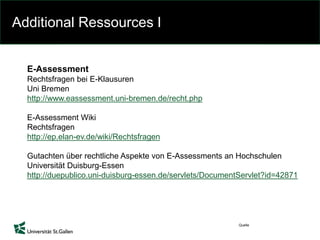
Additional Ressources I
Quelle
E-Assessment
Rechtsfragen bei E-Klausuren
Uni Bremen
http://www.eassessment.uni-bremen.de/recht.php
E-Assessment Wiki
Rechtsfragen
http://ep.elan-ev.de/wiki/Rechtsfragen
Gutachten über rechtliche Aspekte von E-Assessments an Hochschulen
Universität Duisburg-Essen
http://duepublico.uni-duisburg-essen.de/servlets/DocumentServlet?id=42871
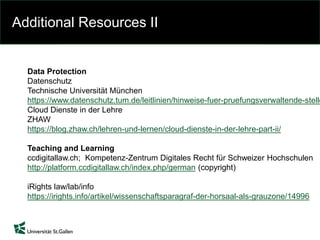
Additional Resources II
Data Protection
Datenschutz
Technische Universität München
https://www.datenschutz.tum.de/leitlinien/hinweise-fuer-pruefungsverwaltende-stelle
Cloud Dienste in der Lehre
ZHAW
https://blog.zhaw.ch/lehren-und-lernen/cloud-dienste-in-der-lehre-part-ii/
Teaching and Learning
ccdigitallaw.ch; Kompetenz-Zentrum Digitales Recht für Schweizer Hochschulen
http://platform.ccdigitallaw.ch/index.php/german (copyright)
iRights law/lab/info
https://irights.info/artikel/wissenschaftsparagraf-der-horsaal-als-grauzone/14996
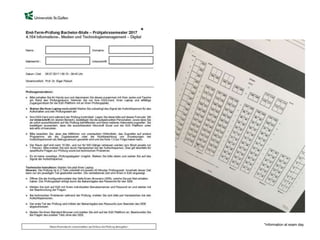
*Information E-Mail for students taking the BYOD
exam.
Liebe Studierende*,
Das IMT Digital Final Exam 2017 wird die erste offizielle digitale bring-your-own-device Prüfung an der HSG sein und symbolisiert
somit einen Meilenstein auf dem Weg zu einer digitalen Form der Lehre!
Damit diese Prüfung reibungslos funktioniert, ist eine gute Vorbereitung aller Beteiligten entscheidend. Bitte beachten Sie deshalb für
das Final Exam im eigenen Interesse die folgenden Informationen:
 Das Final Exam startet am 06.07.2017 um 08:15. Die Prüfungszeit beträgt 90 Minuten.
 Die Prüfung wird aus einem Multiple-Choice Teil (45 min.) und aus einem Excel Teil (45 min.) bestehen. Der Zweite Teil wird
gemeinsam gestartet, sobald die 45 Minuten für den ersten Teil abgelaufen sind.
 Das Final Exam absolvieren Sie auf Ihrem eigenen Notebook. Sie sind selbst für die Funktionalität Ihres Gerätes verantwortlich!
Wenn Ihr Notebook in der Prüfung wegen unzureichender Vorbereitung (s. unten) nicht funktioniert oder ausfällt, haben
Sie KEINEN Anspruch auf eine Nachprüfung und die Prüfung wird mit der Note 1 gewertet.
 Für einen reibungslosen Prüfungsablauf muss Ihr Notebook die folgenden Anforderungen erfüllen:
o Mind. 2h Akkulaufzeit
o Multiple Choice Aufgaben müssen mit dem Safe Exam Browser gelöst werden. Dies hat beim Mid-Term Exam nicht bei
allen Kursteilnehmern funktioniert. Wir haben deshalb nochmals einen ausführlichen Test des SEB auf edX aufgeschaltet
und bitten Sie darum, diesen durchzuführen. Nur wenn dieser Test erfolgreich ist, können Sie die Prüfung ohne
Probleme absolvieren. Stellen Sie sicher, dass Sie für die Prüfung ein Notebook zur Verfügung haben, auf dem der Safe
Exam Browser funktioniert.
Der Test des Safe Exam Browsers befindet sich in edX im Kapitel „Test Exam“. Wenn Sie den Test wiederholen möchten,
wenden Sie sich bitte kurz per Mail an uns. Wir müssen in diesem Fall Ihre Antworten für den Test zurücksetzen.
o Sie können über Ihr Notebook eine Verbindung zum Universitätsnetzwerk eduroam herstellen (eine VPN Verbindung ist
deshalb nicht notwendig)
 Stellen Sie darüber hinaus sicher, dass Excel auf Ihrem Notebook einwandfrei funktioniert. Prüfen Sie, ob Sie alle Softwareupdates
installiert haben und ob der Excel-Solver richtig funktioniert.
 Bitte halten Sie in der Prüfung Ihre Zugangsdaten zu edX und eduroam bereit
 Achten Sie darauf, dass Sie alle Softwareupdates (Windows, iOS, Office) installiert haben und die oben genannten Anforderungen
damit ebenfalls erfüllt sind.
Mit freundlichen Grüssen,
Ihr IMT Digital Team
*Information at exam day
*
03
01
02
Thank you
http://til.unisg.ch/
jacqueline.gasser-beck@unisg.ch
@JGasserBeck jgasser-beck

Webinar: Legal framework for e-assessments

  • 1.
    Legal Framework for E-Assessements WhySecurity Issues, Personal Data Protection and Fundamental Rights matter Lic. iur. Jacqueline Gasser-Beck, EMBA HSG Webinar - August 10th 2017
  • 2.
    03 01 02 Agenda Why should wecare? How can we be on the Safe Side Pilot - Checklist – Good Practice
  • 3.
    Are students goingto sue universities? Source: https://www.theguardian.com/money/20 10/dec/18/refund-if-university-fails- Refund if university fails to deliver In 2002, a mature law student, Mike Austin, was awarded £30,000 by the University of Wolverhampton in an out of court settlement. His catalogue of grievances include crowded lecture halls, poorly drafted exams papers and inflated promises.
  • 4.
    For their endangeredfuture careers? Source: BGE 136 I 229 X received a 5.0 for her master thesis at the University of Bern resulting in a grade point average of 5.43, which lead to a masters degree with predicate «magna cum laude». With a 5.5 in for her thesis she would have reached a «summa cum laude». …this particular grade had a significant impact on her final degree predicate and therefore on her future career (specification of judicial practice; BGE 136 I 229).
  • 5.
    For technical issues? Source:https://www.nzz.ch/zuerich/server-der- universitaet-abgestuerzt-1.18220461 Server Breakdown at University of Zurich On Monday afternoon University of Zurich Law students have completed an online exam for the first time. For some students the exam came to an early end due to an error message on their screen. 14.01.2014
  • 6.
    Reputational risks  Reputationaldamage  Loss in confidence  Liability in negligence Where technology or organizational standards fail there is potential risk for
  • 7.
    How can weprovide safe (online) exams? Source: Kasetsart University Students Administrative Board Facebook page (Thailand)
  • 8.
    Features of afair and legally save exam Just like any written exam, e-exams must maintain the features of traditional assessment such as  Objectivity  Validity  Reliability  Fairness  Authenticity  Accessibility  Transparency Source: Baker, O'Neil, & Linn, 1993; Shute, 2009; www.let.ethz.ch; Glossar Prüfungen
  • 9.
    Legally protected rights(Fundamental Rights) Source: Federal Constitution of the Swiss Confederation of 18 April 1999 (Status as of 1 January 2016)  Freedom of career choice (Art. 27 Abs. 2 BV)  Equal opportunities of examinees (Art. 8 BV)  Protection against arbitrary conduct and principle of good faith (Art. 9 BV) Concerning exams the following (fundamental) rights are protected by the Federal Constitution of the Swiss Confederation
  • 10.
    Legally protected rights(Personal Data) Source: Federal Act on Data Protection (FADP) of 19 June 1992 (Status as of 1 January 2014) Art. 4 Principles 1 Personal data may only be processed lawfully. 2 Its processing must be carried out in good faith and must be proportionate. 3,4, … 5 If the consent of the data subject is required for the processing of personal data, such consent is valid only if given voluntarily on the provision of adequate information. Additionally, consent must be given expressly in the case of processing of sensitive personal data or personality profiles. Art. 3 Definitions a. personal data (data): all information relating to an identified or identifiable person; … c. sensitive personal data: 1. religious, ideological, political or trade union-related views or activities, 2. health, the intimate sphere or the racial origin, 3. social security measures, 4. administrative or criminal proceedings and sanctions
  • 11.
    Data Protection Source: http://www.zentralplus.ch/de/news/politik/26676/Hochschule-Luzern- ver%C3%B6ffentlichte-Noten-aller-Studierenden-im-Internet.htm https://www.nzz.ch/meinung/kommentare/meine-bildungsdaten-gehoeren-mir- 1.18575426 http://www.sueddeutsche.de/bildung/datenschutz-bei-online-kursen-der- glaeserne-student-1.2762465 Dedicatedlink, but publically accessible  one could access exam results without login. 06.09.2013 University of Lucerne released grades of all students in the Internet My educational data belongs to me! 07.07.2015 Der gläserne Student 02. 12. 2015
  • 12.
    Data Protection -Student Data in the Cloud? If a university is buying or leasing storage capacity from a cloud provider, data is given «away». Therefore a third party (provider) is responsible for keeping the data available and accessible.  Personal Data (Art. 3 FADP lit. a) may only be stored encrypted.  Personal Data shall only be processed within the EU or states «accepted by the EU». (Save Harbor - Swiss-US Privacy Shield)  Sensible Personal Data (Art. 3 FADP lit. c) should not be hosted in the cloud. Source: Swiss –US Privacy Shield https://www.edoeb.admin.ch/datenschutz/00626/00753/01405/01406/i ndex.html?lang=de&print_style=yes
  • 13.
    Data Protection -Access to Files? Source: BGE 1C_200/2016 Final judgement of August 12, 2016 «The appellant considers it arbitrary, if not only the personal equipment, but also «notes, computer files and correspondence are exepted form access (Art. 21 Abs. 3 and 4 KDSG; Art. 18 Abs. 1 KV/BE)…» Y was studying biology at the University of Berne since1984. In summer of 2014 he requested access to all «processed or archived files» concerning his studies. The University disclosed all records on file. Y was not satisfied with the disclosure of just «official records»: Appeal denied
  • 14.
    E-Assessment @ Universityof St.Gallen Great opportunity for students, faculty and administration  High maintenance  High risk  Expensive BUT  Embrace Digitalization  Manageable (costs, staff, infrastructure)  Save and fair OUR APPROACH
  • 15.
    Traditional Lecture SPOCwith E- Assessment 1 Auditorium 1 Faculty 600 Students 14 Lectures 400 Slides 10 Exercises 5 Tutors 1 Paper/Pencil Exam (Final) 50 PhD man-days exam correction ~50 short videos (Open EdX) ~100 exercises ~ Self-assessment wrapping-up each module 2 Online exams (Midterm/Final) 1 Course project 14 Weekly coaching clinics Mandatory BA – Course IMT IMT – Digital
  • 16.
    How to Scale(up to 600 Students)? Pilot A • 50 students • Opt-in course • Mid-term exam (managed on campus with SEB) • Final exam (managed on campus with SEB) Pilot B • 200 students • Opt-in course • Mid-term exam BYOD (off campus with SEB) • Final exam BYOD (on campus with SEB)
  • 17.
    Facts and Figuresaround Pilots Location: Aula Registered: 185 TN Completed: 181 TN Special Needs: 3 TN Devices: BYO (85% Mac, 15% PC Proctors: 25 (5 Tech) Pilot B Safety/ Fairness Location Tech /Wifi ProctoringPreparation Pilot A Safety/ FairnessLocation Tech/ Wifi ProctoringPreparation Location: 2 PC Labs Registered: 50 TN Completed: 48 TN Special Needs: 0 TN Devices: Hosted PCs Proctors: 7 (3 Tech) Color Code: Green: worked fine Orange: Some issues Red: Needs improvement
  • 18.
    Lessons Learned Digital mindset Infrastructure (Wi-Fi, power outlets)  Mandatory laptops for students  Digital curriculum (LMS/MOOCs etc. ) Communication  Adjust course and exam regulation accordingly (opt-in clause)  Clear legal AND technical instructions (before and at exam day)  Prepare students and faculty for additional personal responsibility Safety and fairness  Use SEB; additional proctoring is no easy way out (disturbance)  Do not go to complex with our exam format (BYOD – Excel – SEB)  Optimize log-in and log-out procedure
  • 19.
    CHECKLIST I  Explicitregulation of e-assessments and MC exams (possibly mixed exams) in study rules and regulations.  Explicitly allow BYOD exams including framework for technical requirements (equal opportunity)  Consider mandatory mock-up exam Solid Examination Regulation  Avoid information advantage (simultaneous system access)  Exam duration time: allow extra time in case of tech problem  Adjust your compensation for disadvantages regulation (special needs arrangements) Equal Opportunity
  • 20.
    CHECKLIST II Archiving  Fileor/and print-out all exam relevant data (incl. exam protocol)  Archiving period follows study and examination rules  Avoid loss of data by keeping our operating IT systems up to date  Avoid saving sensible personal data (grades?) in the cloud Security  For safe and fair e-exam environment restrict access to approved URLs (e.g. via safe-exam browser)  Randomize questions if applicable  Avoid cheating and manipulation by proctor supervision (video surveillance only with students consent)  Continuous recording of exam progress (logging)  Automated security updates
  • 21.
    CHECKLIST III  Offermock-up exams to better accommodate students to the new testing environment  Reliable tech infrastructure (Power, WI-FI, VPN if SEB is in use)  Minimize risks with university managed exam devices (testing center), otherwise have extra devices available Avoid tech slip-ups  Verify identity of examinee (student ID) before exam starts  Secure log-in via pin or matriculation number  Signed statement that saved file final and complete or explicit confirmation within  exam before saving  Final submission in non-modifiable data format Authenticity
  • 22.
    Additional Ressources I Quelle E-Assessment Rechtsfragenbei E-Klausuren Uni Bremen http://www.eassessment.uni-bremen.de/recht.php E-Assessment Wiki Rechtsfragen http://ep.elan-ev.de/wiki/Rechtsfragen Gutachten über rechtliche Aspekte von E-Assessments an Hochschulen Universität Duisburg-Essen http://duepublico.uni-duisburg-essen.de/servlets/DocumentServlet?id=42871
  • 23.
    Additional Resources II DataProtection Datenschutz Technische Universität München https://www.datenschutz.tum.de/leitlinien/hinweise-fuer-pruefungsverwaltende-stelle Cloud Dienste in der Lehre ZHAW https://blog.zhaw.ch/lehren-und-lernen/cloud-dienste-in-der-lehre-part-ii/ Teaching and Learning ccdigitallaw.ch; Kompetenz-Zentrum Digitales Recht für Schweizer Hochschulen http://platform.ccdigitallaw.ch/index.php/german (copyright) iRights law/lab/info https://irights.info/artikel/wissenschaftsparagraf-der-horsaal-als-grauzone/14996
  • 24.
    *Information E-Mail forstudents taking the BYOD exam. Liebe Studierende*, Das IMT Digital Final Exam 2017 wird die erste offizielle digitale bring-your-own-device Prüfung an der HSG sein und symbolisiert somit einen Meilenstein auf dem Weg zu einer digitalen Form der Lehre! Damit diese Prüfung reibungslos funktioniert, ist eine gute Vorbereitung aller Beteiligten entscheidend. Bitte beachten Sie deshalb für das Final Exam im eigenen Interesse die folgenden Informationen:  Das Final Exam startet am 06.07.2017 um 08:15. Die Prüfungszeit beträgt 90 Minuten.  Die Prüfung wird aus einem Multiple-Choice Teil (45 min.) und aus einem Excel Teil (45 min.) bestehen. Der Zweite Teil wird gemeinsam gestartet, sobald die 45 Minuten für den ersten Teil abgelaufen sind.  Das Final Exam absolvieren Sie auf Ihrem eigenen Notebook. Sie sind selbst für die Funktionalität Ihres Gerätes verantwortlich! Wenn Ihr Notebook in der Prüfung wegen unzureichender Vorbereitung (s. unten) nicht funktioniert oder ausfällt, haben Sie KEINEN Anspruch auf eine Nachprüfung und die Prüfung wird mit der Note 1 gewertet.  Für einen reibungslosen Prüfungsablauf muss Ihr Notebook die folgenden Anforderungen erfüllen: o Mind. 2h Akkulaufzeit o Multiple Choice Aufgaben müssen mit dem Safe Exam Browser gelöst werden. Dies hat beim Mid-Term Exam nicht bei allen Kursteilnehmern funktioniert. Wir haben deshalb nochmals einen ausführlichen Test des SEB auf edX aufgeschaltet und bitten Sie darum, diesen durchzuführen. Nur wenn dieser Test erfolgreich ist, können Sie die Prüfung ohne Probleme absolvieren. Stellen Sie sicher, dass Sie für die Prüfung ein Notebook zur Verfügung haben, auf dem der Safe Exam Browser funktioniert. Der Test des Safe Exam Browsers befindet sich in edX im Kapitel „Test Exam“. Wenn Sie den Test wiederholen möchten, wenden Sie sich bitte kurz per Mail an uns. Wir müssen in diesem Fall Ihre Antworten für den Test zurücksetzen. o Sie können über Ihr Notebook eine Verbindung zum Universitätsnetzwerk eduroam herstellen (eine VPN Verbindung ist deshalb nicht notwendig)  Stellen Sie darüber hinaus sicher, dass Excel auf Ihrem Notebook einwandfrei funktioniert. Prüfen Sie, ob Sie alle Softwareupdates installiert haben und ob der Excel-Solver richtig funktioniert.  Bitte halten Sie in der Prüfung Ihre Zugangsdaten zu edX und eduroam bereit  Achten Sie darauf, dass Sie alle Softwareupdates (Windows, iOS, Office) installiert haben und die oben genannten Anforderungen damit ebenfalls erfüllt sind. Mit freundlichen Grüssen, Ihr IMT Digital Team
  • 25.
  • 26.

Editor's Notes

  • #5 Beispiel:  Die Universität Bern erteilte X. für die Masterarbeit die Note 5.0 und teilte X. gleichzeitig mit, dass sie bei einem Notendurchschnitt von 5.43 den Titel „Master of of the University of Bern“ mit dem Gesamtprädikat „magna cum laude“ erworben habe. Ab einer Bewertung der Masterarbeit mit der Note 5.5 hätte sie das Prädikat „summa cum laude“ erzielt. Die Note der Masterarbeit wirkt sich daher auf das Gesamtergebnis aus. Der Entscheid über die Note der Masterarbeit stellt daher ein Anfechtungsobjekt im Rahmen der subsidiären Verfassungsbeschwerde dar (BGE 136 I 229).
  • #9 1. Validity Validity is arguably the most important criteria for the quality of a test. The term validity refers to whether or not the test measures what it claims to measure. On a test with high validity the items will be closely linked to the test's intended focus. For many certification and licensure tests this means that the items will be highly related to a specific job or occupation. If a test has poor validity then it does not measure the job-related content and competencies it ought to. When this is the case, there is no justification for using the test results for their intended purpose. There are several ways to estimate the validity of a test including content validity, concurrent validity, and predictive validity. The face validity of a test is sometimes also mentioned. 2. Reliability Reliability is one of the most important elements of test quality. It has to do with the consistency, or reproducibility, or an examinee's performance on the test. For example, if you were to administer a test with high reliability to an examinee on two occasions, you would be very likely to reach the same conclusions about the examinee's performance both times. A test with poor reliability, on the other hand, might result in very different scores for the examinee across the two test administrations. If a test yields inconsistent scores, it may be unethical to take any substantive actions on the basis of the test. There are several methods for computing test reliability including test-retest reliability, parallel forms reliability, decision consistency, internal consistency, and interrater reliability. For many criterion-referenced tests decision consistency is often an appropriate choice. 3. Fairness The fairness of an exam refers to its freedom from any kind of bias. The exam should be appropriate for all qualified examinees irrespective of race, religion, gender, or age. The test should not disadvantage any examinee, or group of examinees, on any basis other than the examinee's lack of the knowledge and skills the test is intended to measure. Item writers should address the goal of fairness as they undertake the task of writing items. In addition, the items should also be reviewed for potential fairness problems during the item review phase. Any items that are identified as displaying potential bias or lack of fairness should then be revised or dropped from further consideration. 4. Legal Defensibility For an exam program to have legal defensibility there must be evidence as to the test’s quality that would stand up in a court challenge. You will need to be able to provide evidence that sound, professionally recommended guidelines were followed throughout the design, development, and maintenance of the exam program. Professional guidelines for testing are offered by the American Psychological Association (APA), American Educational Research Association (AERA), and the National Council on Measurement in Education (NCME). Studies should also be conducted to investigate and confirm that the test has reasonable degrees of validity, reliability, and fairness. Among the most important elements that courts look for are a well-conducted job analysis and strong content validity (that is, the items need to have a high degree of “job relatedness”). Finally, good documentation of the design, development, and analysis of the exam program should be collected and maintained.
  • #10 Art. 27 Economic freedom 1 Economic freedom is guaranteed. 2 Economic freedom includes in particular the freedom to choose an occupation as well as the freedom to pursue a private economic activity.  Art. 8 Equality before the law 1 Every person is equal before the law. 2 No person may be discriminated against, in particular on grounds of origin, race, gender, age, language, social position, way of life, religious, ideological, or political convictions, or because of a physical, mental or psychological disability. 3 Men and women have equal rights. The law shall ensure their equality, both in law and in practice, most particularly in the family, in education, and in the workplace. Men and women have the right to equal pay for work of equal value. 4 The law shall provide for the elimination of inequalities that affect persons with disabilities.
  • #11 Datenvermeidung und Datensparsamkeit
  • #13 physical storage spans multiple servers and often locations
  • #14 Korrespondenzen von der Akteneinsicht ausgenommen
  • #15 Try to avoid compulsory exams