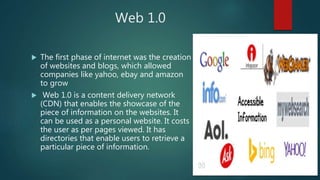
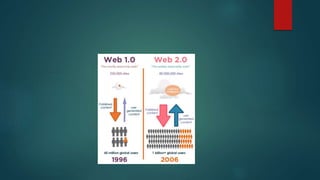
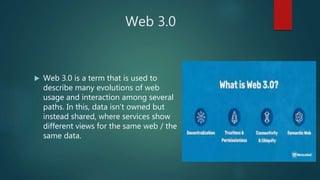
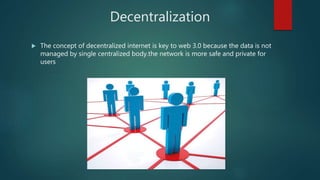
This document discusses the evolution of the World Wide Web from Web 1.0 to the current Web 2.0 to the future Web 3.0. Web 1.0 allowed for the growth of early websites and companies through basic content delivery. Web 2.0 enabled user-generated content and social interactions online. Web 3.0 aims to make the web more decentralized, intelligent and connected by incorporating new technologies like semantic web, artificial intelligence, 3D graphics and increased connectivity between systems and data. Some potential advantages include improved search capabilities and knowledge sharing, while disadvantages include requirements for more advanced devices and potential privacy issues.