Node.js
Atul Jain
Naman Gupta
what is javascript?
nothing to do with java
a complete language
moving parts of a web
page
not just window.open()
nodejs
And then came Node.js.
JavaScript on the server,
how cool is that?
Node.js is a JavaScript
runtime built on Chrome's
V8 JavaScript engine.
Node.js uses an event-
driven, non-blocking I/O
model.
nodejs
Node.js is really two things:
a runtime environment and
a library
why nodejs?
much easier to setup and faster to code a web app in node.js than any other
MVC (models, views, controllers) framework (say, django, flask etc).
great for single page apps
Odyssey 15 website was hosted on a five lines of code server. WUT? :O
node.js is faster, (HELL YEAH!)
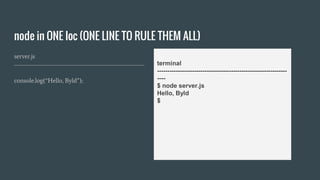
node in ONE loc (ONE LINE TO RULE THEM ALL)
server.js
-------------------------------------------------------------------
console.log(“Hello, Byld”);
terminal
---------------------------------------------------------------
----
$ node server.js
Hello, Byld
$
event driven
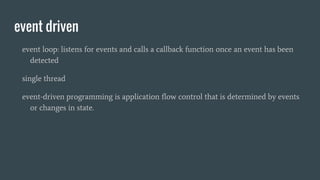
event loop: listens for events and calls a callback function once an event has been
detected
single thread
event-driven programming is application flow control that is determined by events
or changes in state.
non blocking code (for real)
var result = database.query("SELECT * FROM hugetable");
console.log("Hello World");
event-driven, asynchronous callbacks, by utilizing an event loop.
non blocking code (for real)
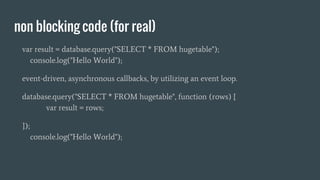
var result = database.query("SELECT * FROM hugetable");
console.log("Hello World");
event-driven, asynchronous callbacks, by utilizing an event loop.
database.query("SELECT * FROM hugetable", function (rows) {
var result = rows;
});
console.log("Hello World");
npm
Node.js' package
ecosystem, npm, is the
largest ecosystem of open
source libraries in the
world.
dependency tree
Ok, this stuff is boring, right?
Let’s write some real stuff.
We will now create a web application serving a
basic purpose of “file-uploading”
What will our application do?
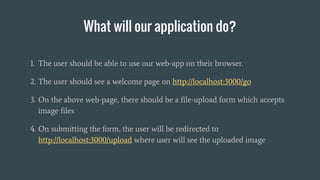
1. The user should be able to use our web-app on their browser.
2. The user should see a welcome page on http://localhost:3000/go
3. On the above web-page, there should be a file-upload form which accepts
image files
4. On submitting the form, the user will be redirected to
http://localhost:3000/upload where user will see the uploaded image
what do we need for this?
1. To server HTTP requests - A HTTP server.
2. Our server will answer differently to requests, depending on the URL we
need some kind of router which maps requests to request /handlers.
3. We need request handlers once the server has successfully routed a URL
request.
a. This request handler should be able to handle the POST data coming through static HTML
page from our website
b. We have to store the image temporarily on the server storage and show it in the /upload.
4. Once the requested URL is routed to proper route and the incoming data is
retrieved from that request, we will show that image on next URL (‘/upload’)
let the coding begin
file upload
middlewares
app.use()
listens to the requests and runs some code selectively
example express.static
node.js is funny
https://medium.com/@c2c/nodejs-a-
quick-optimization-advice-7353b820c92e
thanks

Web with Nodejs

  • 1.
  • 2.
    what is javascript? nothingto do with java a complete language moving parts of a web page not just window.open()
  • 3.
    nodejs And then cameNode.js. JavaScript on the server, how cool is that? Node.js is a JavaScript runtime built on Chrome's V8 JavaScript engine. Node.js uses an event- driven, non-blocking I/O model.
  • 4.
    nodejs Node.js is reallytwo things: a runtime environment and a library
  • 5.
    why nodejs? much easierto setup and faster to code a web app in node.js than any other MVC (models, views, controllers) framework (say, django, flask etc). great for single page apps Odyssey 15 website was hosted on a five lines of code server. WUT? :O node.js is faster, (HELL YEAH!)
  • 6.
    node in ONEloc (ONE LINE TO RULE THEM ALL) server.js ------------------------------------------------------------------- console.log(“Hello, Byld”); terminal --------------------------------------------------------------- ---- $ node server.js Hello, Byld $
  • 7.
    event driven event loop:listens for events and calls a callback function once an event has been detected single thread event-driven programming is application flow control that is determined by events or changes in state.
  • 8.
    non blocking code(for real) var result = database.query("SELECT * FROM hugetable"); console.log("Hello World"); event-driven, asynchronous callbacks, by utilizing an event loop.
  • 9.
    non blocking code(for real) var result = database.query("SELECT * FROM hugetable"); console.log("Hello World"); event-driven, asynchronous callbacks, by utilizing an event loop. database.query("SELECT * FROM hugetable", function (rows) { var result = rows; }); console.log("Hello World");
  • 10.
    npm Node.js' package ecosystem, npm,is the largest ecosystem of open source libraries in the world. dependency tree
  • 11.
    Ok, this stuffis boring, right? Let’s write some real stuff. We will now create a web application serving a basic purpose of “file-uploading”
  • 12.
    What will ourapplication do? 1. The user should be able to use our web-app on their browser. 2. The user should see a welcome page on http://localhost:3000/go 3. On the above web-page, there should be a file-upload form which accepts image files 4. On submitting the form, the user will be redirected to http://localhost:3000/upload where user will see the uploaded image
  • 13.
    what do weneed for this? 1. To server HTTP requests - A HTTP server. 2. Our server will answer differently to requests, depending on the URL we need some kind of router which maps requests to request /handlers. 3. We need request handlers once the server has successfully routed a URL request. a. This request handler should be able to handle the POST data coming through static HTML page from our website b. We have to store the image temporarily on the server storage and show it in the /upload. 4. Once the requested URL is routed to proper route and the incoming data is retrieved from that request, we will show that image on next URL (‘/upload’)
  • 14.
  • 15.
  • 16.
    middlewares app.use() listens to therequests and runs some code selectively example express.static
  • 17.
  • 18.

Editor's Notes

  • #2 start with prerequisities
  • #3 compiler, operating system, apps on JS
  • #4 In order to execute the JavaScript you intend to run in the backend, it needs to be interpreted and, well, executed. This is what Node.js does, by making use of Google’s V8 VM, the same runtime environment for JavaScript that Google Chrome uses
  • #5 In order to execute the JavaScript you intend to run in the backend, it needs to be interpreted and, well, executed. This is what Node.js does, by making use of Google’s V8 VM, the same runtime environment for JavaScript that Google Chrome uses
  • #8 event control c in terminal touch event listener in your phone
  • #9 different xxectuion from python, ruby, java etc php
  • #10 different xxectuion from python, ruby, java etc example of php When at some point in the future the database server is done and sends the result of the query, then I have to execute the anonymous function that was passed to database.query().
  • #14 Make some coding slides. http://rmdaustralia.com.au/wp-content/uploads/2014/03/nodebeginner.pdf