Web Engineering
Book- Web Engineering;
Author- Gerti Kappel, Birgit , Siegfried Reich, Werner Retschitzegger
https://digitalpadm.com INCHARGE - A. P. PANDE 1
What is Web application
• A Web application is a software system
• based on technologies and standards of the
• World Wide Web Consortium (W3C)
• that provides Web specific resources such as content and services
through a user interface, the Web browser
h t t p s : / / d i g i t a l p a d m . c o m I N C H A R G E - A . P. PA N D E 2
What is Web Engineering
• Web Engineering is the application of
• systematic and finite approaches (concepts, methods, techniques,
tools) to cost-effective
• requirements analysis, design, implementation,
• testing, operation,
• and maintenance
• of high-quality Web applications.
h t t p s : / / d i g i t a l p a d m . c o m I N C H A R G E - A . P. PA N D E 3
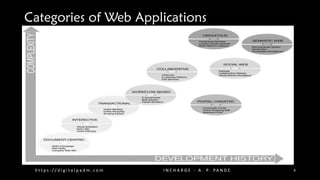
Categories of Web Applications
h t t p s : / / d i g i t a l p a d m . c o m I N C H A R G E - A . P. PA N D E 4
Categories of Web Applications,
• Document centric Web sites
• Web pages are stored on a Web server as ready-made, i.e. static,
HTML documents
• and sent to the Web client in response to a request.
• These Web pages are usually updated manually using respective
tools
• Examples
• news sites
• Organization sites, informative sites
h t t p s : / / d i g i t a l p a d m . c o m I N C H A R G E - A . P. PA N D E 5
Categories of Web Applications,
• Transactional Web applications
• provide more interactivity,
• giving the user the possibility of not only interacting with the
application in a read-only manner,
• but also by performing updates on the underlying content.
• Examples
• Online banking, online shopping, and
• booking systems belong in this category.
h t t p s : / / d i g i t a l p a d m . c o m I N C H A R G E - A . P. PA N D E 6
Categories of Web Applications
• Workflow-based Web applications
• allow the handling of workflows within or between different
• companies, public authorities, and private users
• Examples
• Business-to-Business solutions (B2B solutions) in e-commerce, e-
government applications in
• the area of public administration, or Web-based support of
patient workflows in the health sectors
h t t p s : / / d i g i t a l p a d m . c o m I N C H A R G E - A . P. PA N D E 7
Categories of Web Applications
• collaborative Web applications
• Collaborative Web applications support shared information
• and workspaces in order to generate, edit, and manage shared
information.
• They are also used to keep logs of many small entries and edits
(as in Weblogs), simple chat rooms, as scheduling systems, or as
e-learning platforms like google class room.
h t t p s : / / d i g i t a l p a d m . c o m I N C H A R G E - A . P. PA N D E 8
Categories of Web Applications
• Portal-oriented Web applications
• Portal applications provide data in an easily understandable
format, modify or manipulate the data, and communicate with
companies or individuals about the data.
• Contents in a web portal are dynamic and changed frequently.
• The visibility of one content changes from person to person
which means a content could be unique.
h t t p s : / / d i g i t a l p a d m . c o m I N C H A R G E - A . P. PA N D E 9
Categories of Web Applications
• portal acts as a gateway to world wide web and provides many
services.
• Horizontal portals are public website which tries to deliver every
type of service that its users may need.
• Vertical portals work in a user-centric manner and deliver
information that is organization-specific.
h t t p s : / / d i g i t a l p a d m . c o m I N C H A R G E - A . P. PA N D E 10
Categories of Web Applications
• Portal-oriented Web applications
• single point of access to separate, potentially heterogeneous
sources of information and services.
• It is central point of access to the Web business portals
• marketplace portals in the form of online shopping malls
• Business portals give employees and/or business partners focused
access to different sources of information and services through
an intranet or extranet.
h t t p s : / / d i g i t a l p a d m . c o m I N C H A R G E - A . P. PA N D E 11
Categories of Web Applications
• Portal-oriented Web applications
• Horizontal marketplaces
• operate on the business-to-consumer market offering consumer
goods directly to the general public,
• and in business-to-business,
• selling their products to companies
• from other sectors.
h t t p s : / / d i g i t a l p a d m . c o m I N C H A R G E - A . P. PA N D E 12
Categories of Web Applications
• Portal-oriented Web applications
• Vertical marketplaces
• consist of companies from a single sector,
• e.g. suppliers on one side
• and manufacturing companies on the other
h t t p s : / / d i g i t a l p a d m . c o m I N C H A R G E - A . P. PA N D E 13
Categories of Web Applications
• ubiquitous Web applications
• provides customized services anytime anywhere and for any
device, thus facilitating ubiquitous access.
• It is either personalization or location-aware services or multi-
platform. It can provide analysis of data collected from sensors.
h t t p s : / / d i g i t a l p a d m . c o m I N C H A R G E - A . P. PA N D E 14
Categories of Web Applications
• Most of the Internet of Things (IOT) devices are based on
Ubiquitous Computing.
• examples are: Apple Watch, Amazon Echo Speaker
• Fitbit, Electronic Toll Systems, Smart Traffic Lights
• Self Driving Cars
• ubiquitous computing is new business models and services.
• Example
• TIMES industry (Telecommunications, Information technology,
Multimedia, Education and Entertainment, Security)
h t t p s : / / d i g i t a l p a d m . c o m I N C H A R G E - A . P. PA N D E 15
Characteristics of Web Applications
• Product-related Characteristics
• Content
• Hypertext
• Presentation
• Usage-related Characteristics
• Social Context: Users
• Technical Context: Network and Devices
• Natural Context: Location and Time
• Development-related Characteristics
• The Development Team
• Technical Infrastructure
h t t p s : / / d i g i t a l p a d m . c o m I N C H A R G E - A . P. PA N D E 16
Product-related Characteristics
• content –
• content is king in web applications
• document-centered and multi-media
• text, tables, graphics, animation, audio, video
• main objective of web applications is to communicate content
• e-shopping: information about price, availability of products
h t t p s : / / d i g i t a l p a d m . c o m I N C H A R G E - A . P. PA N D E 17
Product-related Characteristics
• Hypertext
• main distinction to traditional software systems – systematic
reading (“browsing, query, guided tour”)
• Sitemaps, key word searches, retracing of “paths” (history mode)
• display of access time and time spent on the site help users to
keep their orientation within the application
• In online shopping applications, queries, In virtual exhibitions,
and guided tours, In e-learning applications
h t t p s : / / d i g i t a l p a d m . c o m I N C H A R G E - A . P. PA N D E 18
Product-related Characteristics
• Presentation
• the user interface are aesthetics and self-explanation.
• Aesthetics - “look and feel” of the user interface. It should be
user friendly.
• self-explanation - it should be possible to use Web application
without documentation.
• so that users can quickly become familiar with the usage of the
Web application
h t t p s : / / d i g i t a l p a d m . c o m I N C H A R G E - A . P. PA N D E 19
Usage-related Characteristics
• Usage of Web applications is extremely heterogeneous.
• Users vary in numbers and cultural background, devices have
differing hardware & software characteristics
• time and location from where the application is accessed cannot
be predicted
h t t p s : / / d i g i t a l p a d m . c o m I N C H A R G E - A . P. PA N D E 20
Usage-related Characteristics
• Social Context: Users
• The social context refers to user-specific aspects
• Spontaneity:
• Users can visit a Web application whenever they want and leave
it
• Again
• Multiculturality:
• limited knowledge about previous knowledge, handicaps,
preferences of users
h t t p s : / / d i g i t a l p a d m . c o m I N C H A R G E - A . P. PA N D E 21
Usage-related Characteristics
• Technical Context: Network and Devices
• concerning quality of service-
• known network characteristics (e.g., bandwith, reliability)
• Multi-platform delivery:
• Web applications usually offer services not only to a specific type
of device, but rather any, increasingly mobile, devices with very
different specifications
h t t p s : / / d i g i t a l p a d m . c o m I N C H A R G E - A . P. PA N D E 22
Usage-related Characteristics
• Natural Context: Location and Time
• aspects of the location and time of access
• Globality and availability
• create a high degree of heterogeneity.
h t t p s : / / d i g i t a l p a d m . c o m I N C H A R G E - A . P. PA N D E 23
Usage-related Characteristics
• Globality:
• The location from which a Web application is accessed, e.g. the
geographical position, is important for the internationalization
• Availability: instant delivery mechanism
• Permanent availability 24/7 also increases the demands on the
stability of Web applications.
h t t p s : / / d i g i t a l p a d m . c o m I N C H A R G E - A . P. PA N D E 24
Development-related Characteristics
• The Development Team
• development teams are multidisciplinary and generally rather
young
h t t p s : / / d i g i t a l p a d m . c o m I N C H A R G E - A . P. PA N D E 25
Development-related Characteristics
• Multidisciplinarity:
• Multidisciplinary approach requiring knowledge and expertise
from different areas.
• IT experts responsible for the technical implementation of the
system, while domain experts should be responsible for the
content.
• There is therefore a larger variety of competence and knowledge
in the development team than in traditional software
development
h t t p s : / / d i g i t a l p a d m . c o m I N C H A R G E - A . P. PA N D E 26
Development-related Characteristics
• Community development:
• The development of open source software freely available on
the Web and its integration in “real” application
h t t p s : / / d i g i t a l p a d m . c o m I N C H A R G E - A . P. PA N D E 27
Development-related Characteristics
• technical infrastructure
• two essential components –
• inhomogeneity
• Web server under control of developer
• Web browser (out of control of developer)
• immaturity
• buggy components due to time-to-market pressure
• continuous evolution of base technology
h t t p s : / / d i g i t a l p a d m . c o m I N C H A R G E - A . P. PA N D E 28
Development-related Characteristics
• Process
• development-related characteristics influenced by flexibility and
parallelism
• Flexibility:
• In Web application development it is impossible to adhere to a rigid,
predefined project plan. It is vital to apply flexibly to changing
conditions.
h t t p s : / / d i g i t a l p a d m . c o m I N C H A R G E - A . P. PA N D E 29
Development-related Characteristics
• Process continue..
• Parallelism:
• Due to the necessity for short development times
• Web applications can often be split up into autonomous components
like authentication, search function, news ticker, etc.
• many Web applications are developed in parallel by various subgroups
of the development team
h t t p s : / / d i g i t a l p a d m . c o m I N C H A R G E - A . P. PA N D E 30
Development-related Characteristics
• Integration
• A special characteristic of many Web applications is the need for
internal and external integration
• internal integration
• add web access to legacy systems to access existing contents.
• external integration
• of content and web services or web methods of external web
applications
• integration of heterogeneous database systems.
h t t p s : / / d i g i t a l p a d m . c o m I N C H A R G E - A . P. PA N D E 31
Thanks ..
Reference:
https://digitalpadm.com/categories-of-web-applications/
https://digitalpadm.com INCHARGE - A. P. PANDE 32

Web Engineering- Web Application Categories & Characteristics Book Gerti Kappel

  • 1.
    Web Engineering Book- WebEngineering; Author- Gerti Kappel, Birgit , Siegfried Reich, Werner Retschitzegger https://digitalpadm.com INCHARGE - A. P. PANDE 1
  • 2.
    What is Webapplication • A Web application is a software system • based on technologies and standards of the • World Wide Web Consortium (W3C) • that provides Web specific resources such as content and services through a user interface, the Web browser h t t p s : / / d i g i t a l p a d m . c o m I N C H A R G E - A . P. PA N D E 2
  • 3.
    What is WebEngineering • Web Engineering is the application of • systematic and finite approaches (concepts, methods, techniques, tools) to cost-effective • requirements analysis, design, implementation, • testing, operation, • and maintenance • of high-quality Web applications. h t t p s : / / d i g i t a l p a d m . c o m I N C H A R G E - A . P. PA N D E 3
  • 4.
    Categories of WebApplications h t t p s : / / d i g i t a l p a d m . c o m I N C H A R G E - A . P. PA N D E 4
  • 5.
    Categories of WebApplications, • Document centric Web sites • Web pages are stored on a Web server as ready-made, i.e. static, HTML documents • and sent to the Web client in response to a request. • These Web pages are usually updated manually using respective tools • Examples • news sites • Organization sites, informative sites h t t p s : / / d i g i t a l p a d m . c o m I N C H A R G E - A . P. PA N D E 5
  • 6.
    Categories of WebApplications, • Transactional Web applications • provide more interactivity, • giving the user the possibility of not only interacting with the application in a read-only manner, • but also by performing updates on the underlying content. • Examples • Online banking, online shopping, and • booking systems belong in this category. h t t p s : / / d i g i t a l p a d m . c o m I N C H A R G E - A . P. PA N D E 6
  • 7.
    Categories of WebApplications • Workflow-based Web applications • allow the handling of workflows within or between different • companies, public authorities, and private users • Examples • Business-to-Business solutions (B2B solutions) in e-commerce, e- government applications in • the area of public administration, or Web-based support of patient workflows in the health sectors h t t p s : / / d i g i t a l p a d m . c o m I N C H A R G E - A . P. PA N D E 7
  • 8.
    Categories of WebApplications • collaborative Web applications • Collaborative Web applications support shared information • and workspaces in order to generate, edit, and manage shared information. • They are also used to keep logs of many small entries and edits (as in Weblogs), simple chat rooms, as scheduling systems, or as e-learning platforms like google class room. h t t p s : / / d i g i t a l p a d m . c o m I N C H A R G E - A . P. PA N D E 8
  • 9.
    Categories of WebApplications • Portal-oriented Web applications • Portal applications provide data in an easily understandable format, modify or manipulate the data, and communicate with companies or individuals about the data. • Contents in a web portal are dynamic and changed frequently. • The visibility of one content changes from person to person which means a content could be unique. h t t p s : / / d i g i t a l p a d m . c o m I N C H A R G E - A . P. PA N D E 9
  • 10.
    Categories of WebApplications • portal acts as a gateway to world wide web and provides many services. • Horizontal portals are public website which tries to deliver every type of service that its users may need. • Vertical portals work in a user-centric manner and deliver information that is organization-specific. h t t p s : / / d i g i t a l p a d m . c o m I N C H A R G E - A . P. PA N D E 10
  • 11.
    Categories of WebApplications • Portal-oriented Web applications • single point of access to separate, potentially heterogeneous sources of information and services. • It is central point of access to the Web business portals • marketplace portals in the form of online shopping malls • Business portals give employees and/or business partners focused access to different sources of information and services through an intranet or extranet. h t t p s : / / d i g i t a l p a d m . c o m I N C H A R G E - A . P. PA N D E 11
  • 12.
    Categories of WebApplications • Portal-oriented Web applications • Horizontal marketplaces • operate on the business-to-consumer market offering consumer goods directly to the general public, • and in business-to-business, • selling their products to companies • from other sectors. h t t p s : / / d i g i t a l p a d m . c o m I N C H A R G E - A . P. PA N D E 12
  • 13.
    Categories of WebApplications • Portal-oriented Web applications • Vertical marketplaces • consist of companies from a single sector, • e.g. suppliers on one side • and manufacturing companies on the other h t t p s : / / d i g i t a l p a d m . c o m I N C H A R G E - A . P. PA N D E 13
  • 14.
    Categories of WebApplications • ubiquitous Web applications • provides customized services anytime anywhere and for any device, thus facilitating ubiquitous access. • It is either personalization or location-aware services or multi- platform. It can provide analysis of data collected from sensors. h t t p s : / / d i g i t a l p a d m . c o m I N C H A R G E - A . P. PA N D E 14
  • 15.
    Categories of WebApplications • Most of the Internet of Things (IOT) devices are based on Ubiquitous Computing. • examples are: Apple Watch, Amazon Echo Speaker • Fitbit, Electronic Toll Systems, Smart Traffic Lights • Self Driving Cars • ubiquitous computing is new business models and services. • Example • TIMES industry (Telecommunications, Information technology, Multimedia, Education and Entertainment, Security) h t t p s : / / d i g i t a l p a d m . c o m I N C H A R G E - A . P. PA N D E 15
  • 16.
    Characteristics of WebApplications • Product-related Characteristics • Content • Hypertext • Presentation • Usage-related Characteristics • Social Context: Users • Technical Context: Network and Devices • Natural Context: Location and Time • Development-related Characteristics • The Development Team • Technical Infrastructure h t t p s : / / d i g i t a l p a d m . c o m I N C H A R G E - A . P. PA N D E 16
  • 17.
    Product-related Characteristics • content– • content is king in web applications • document-centered and multi-media • text, tables, graphics, animation, audio, video • main objective of web applications is to communicate content • e-shopping: information about price, availability of products h t t p s : / / d i g i t a l p a d m . c o m I N C H A R G E - A . P. PA N D E 17
  • 18.
    Product-related Characteristics • Hypertext •main distinction to traditional software systems – systematic reading (“browsing, query, guided tour”) • Sitemaps, key word searches, retracing of “paths” (history mode) • display of access time and time spent on the site help users to keep their orientation within the application • In online shopping applications, queries, In virtual exhibitions, and guided tours, In e-learning applications h t t p s : / / d i g i t a l p a d m . c o m I N C H A R G E - A . P. PA N D E 18
  • 19.
    Product-related Characteristics • Presentation •the user interface are aesthetics and self-explanation. • Aesthetics - “look and feel” of the user interface. It should be user friendly. • self-explanation - it should be possible to use Web application without documentation. • so that users can quickly become familiar with the usage of the Web application h t t p s : / / d i g i t a l p a d m . c o m I N C H A R G E - A . P. PA N D E 19
  • 20.
    Usage-related Characteristics • Usageof Web applications is extremely heterogeneous. • Users vary in numbers and cultural background, devices have differing hardware & software characteristics • time and location from where the application is accessed cannot be predicted h t t p s : / / d i g i t a l p a d m . c o m I N C H A R G E - A . P. PA N D E 20
  • 21.
    Usage-related Characteristics • SocialContext: Users • The social context refers to user-specific aspects • Spontaneity: • Users can visit a Web application whenever they want and leave it • Again • Multiculturality: • limited knowledge about previous knowledge, handicaps, preferences of users h t t p s : / / d i g i t a l p a d m . c o m I N C H A R G E - A . P. PA N D E 21
  • 22.
    Usage-related Characteristics • TechnicalContext: Network and Devices • concerning quality of service- • known network characteristics (e.g., bandwith, reliability) • Multi-platform delivery: • Web applications usually offer services not only to a specific type of device, but rather any, increasingly mobile, devices with very different specifications h t t p s : / / d i g i t a l p a d m . c o m I N C H A R G E - A . P. PA N D E 22
  • 23.
    Usage-related Characteristics • NaturalContext: Location and Time • aspects of the location and time of access • Globality and availability • create a high degree of heterogeneity. h t t p s : / / d i g i t a l p a d m . c o m I N C H A R G E - A . P. PA N D E 23
  • 24.
    Usage-related Characteristics • Globality: •The location from which a Web application is accessed, e.g. the geographical position, is important for the internationalization • Availability: instant delivery mechanism • Permanent availability 24/7 also increases the demands on the stability of Web applications. h t t p s : / / d i g i t a l p a d m . c o m I N C H A R G E - A . P. PA N D E 24
  • 25.
    Development-related Characteristics • TheDevelopment Team • development teams are multidisciplinary and generally rather young h t t p s : / / d i g i t a l p a d m . c o m I N C H A R G E - A . P. PA N D E 25
  • 26.
    Development-related Characteristics • Multidisciplinarity: •Multidisciplinary approach requiring knowledge and expertise from different areas. • IT experts responsible for the technical implementation of the system, while domain experts should be responsible for the content. • There is therefore a larger variety of competence and knowledge in the development team than in traditional software development h t t p s : / / d i g i t a l p a d m . c o m I N C H A R G E - A . P. PA N D E 26
  • 27.
    Development-related Characteristics • Communitydevelopment: • The development of open source software freely available on the Web and its integration in “real” application h t t p s : / / d i g i t a l p a d m . c o m I N C H A R G E - A . P. PA N D E 27
  • 28.
    Development-related Characteristics • technicalinfrastructure • two essential components – • inhomogeneity • Web server under control of developer • Web browser (out of control of developer) • immaturity • buggy components due to time-to-market pressure • continuous evolution of base technology h t t p s : / / d i g i t a l p a d m . c o m I N C H A R G E - A . P. PA N D E 28
  • 29.
    Development-related Characteristics • Process •development-related characteristics influenced by flexibility and parallelism • Flexibility: • In Web application development it is impossible to adhere to a rigid, predefined project plan. It is vital to apply flexibly to changing conditions. h t t p s : / / d i g i t a l p a d m . c o m I N C H A R G E - A . P. PA N D E 29
  • 30.
    Development-related Characteristics • Processcontinue.. • Parallelism: • Due to the necessity for short development times • Web applications can often be split up into autonomous components like authentication, search function, news ticker, etc. • many Web applications are developed in parallel by various subgroups of the development team h t t p s : / / d i g i t a l p a d m . c o m I N C H A R G E - A . P. PA N D E 30
  • 31.
    Development-related Characteristics • Integration •A special characteristic of many Web applications is the need for internal and external integration • internal integration • add web access to legacy systems to access existing contents. • external integration • of content and web services or web methods of external web applications • integration of heterogeneous database systems. h t t p s : / / d i g i t a l p a d m . c o m I N C H A R G E - A . P. PA N D E 31
  • 32.