
2 0 1 3 讀 
O a s e s
PageRank 7.3 
Introduction 
PageRank Algorithm 
Strengths and Weaknesses 
Timed PageRank & Recency Search
PageRank 7.3 Introduction 
HITS was presented by Jon Kleinberg in January, 1998 at 
the Ninth Annual ACM-SIAM Symposium on Discrete 
Algorithms.. 
PageRank was presented by Sergey Brin and Larry Page 
at the Seventh International World Wide Web Conference 
(WWW7) in April, 1998. 
-Based on the algorithm, they built the search engine 
Google
PageRank 7.3.1 PageRank Algorithm 
PageRank (PR)is a static ranking of Web pages. 
PageRank is based on the measure of prestige in social 
networks, the PageRank value of each page can be 
regarded as its prestige.
PageRank 7.3.1 PageRank Algorithm 
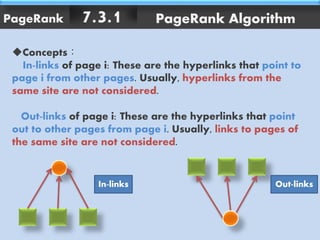
Concepts: 
In-links of page i: These are the hyperlinks that point to 
page i from other pages. Usually, hyperlinks from the 
same site are not considered. 
Out-links of page i: These are the hyperlinks that point 
out to other pages from page i. Usually, links to pages of 
the same site are not considered. 
In-links Out-links
PageRank 7.3.1 PageRank Algorithm 
 uses G=(V, E) [G=graph, V=pages, E=links] 
PageRank Score: 
※ Oj is the number of 
out-links of page j
PageRank 7.3.1 PageRank Algorithm 
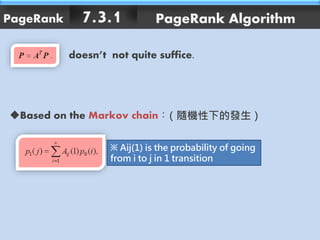
doesn’t not quite suffice. 
(隨機性下的發生) 
Based on the Markov chain: 
※ Aij(1) is the probability of going 
from i to j in 1 transition
PageRank 7.3.1 PageRank Algorithm 
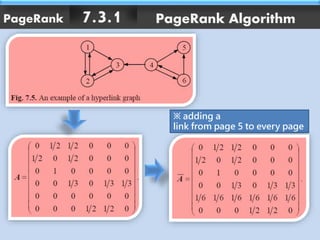
※ adding a 
link from page 5 to every page
PageRank 7.3.1 PageRank Algorithm 
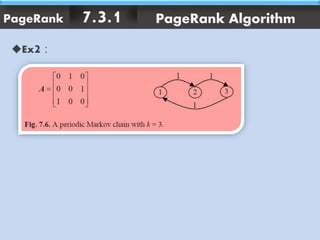
Ex2:
PageRank 7.3.1 PageRank Algorithm 
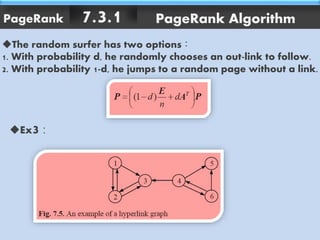
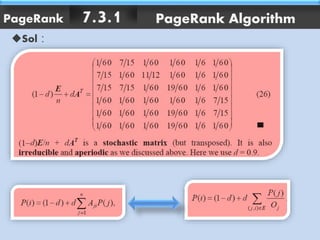
The random surfer has two options: 
1. With probability d, he randomly chooses an out-link to follow. 
2. With probability 1-d, he jumps to a random page without a link. 
Ex3:
PageRank 7.3.1 PageRank Algorithm 
Sol:
PageRank 7.3.2 Strengths and Weaknesses 
1.The advantage of PageRank is its ability to fight spam. 
Since it is not easy for Web page owner to add in-links into 
his/her page from other important pages, it is thus not easy 
to influence PageRank. 
Nevertheless, there are reported ways to influence PageRank. 
Recognizing and fighting spam is an important issue in 
Web search.
PageRank 7.3.2 Strengths and Weaknesses 
2. Another major advantage of PageRank is that it is a global 
measure and is query independent. 
At the query time, only a lookup is needed to find the value 
to be integrated with other strategies to rank the pages. 
It is thus very efficient at the query time.
PageRank 7.3.2 Strengths and Weaknesses 
1. The main criticism is also the query-independence nature of 
PageRank. It could not distinguish between pages that are 
authoritative in general and pages that are authoritative on 
the query topic.
PageRank 7.3.3 Timed PageRank and Recency Search 
The Web is a dynamic environment. It changes constantly. 
Quality pages in the past may not be quality pages now or 
in the future. 
Many outdated pages and links are not deleted. This causes 
problems for Web search because such outdated pages 
may still be ranked high. - Thus, search has a temporal 
dimension.
PageRank 7.3.3 Timed PageRank and Recency Search 
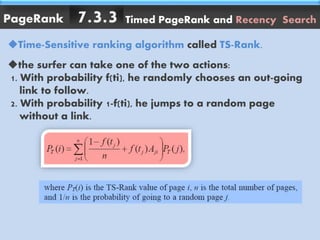
Time-Sensitive ranking algorithm called TS-Rank. 
the surfer can take one of the two actions: 
1. With probability f(ti), he randomly chooses an out-going 
link to follow. 
2. With probability 1-f(ti), he jumps to a random page 
without a link.
PageRank 7.3.3 Timed PageRank and Recency Search 
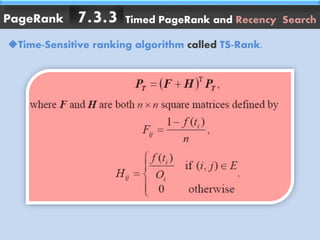
Time-Sensitive ranking algorithm called TS-Rank.
HITS 7.4 
Introduction 
HITS Algorithm 
Finding Other Eigenvectors 
Relationships with Co-Citation and 
Bibliographic Coupling 
Strengths and Weaknesses of HITS
HITS 7.4 Introduction 
HITS stands for Hypertext Induced Topic Search 
Statement : 
expands the list of relevant pages returned by a search 
engine and then produces two rankings of the expanded 
set of pages, authority ranking and hub ranking. 
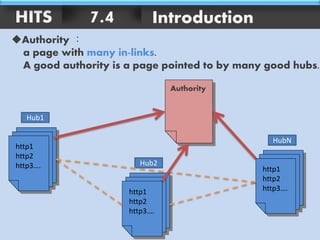
Authority : 
a page with many in-links. 
A good authority is a page pointed to by many good hubs. 
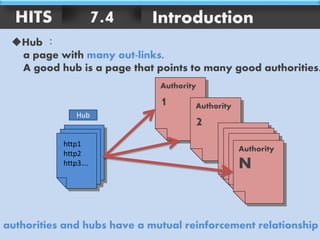
Hub : 
a page with many out-links. 
A good hub is a page that points to many good authorities.
HITS 7.4 Introduction 
Authority : 
a page with many in-links. 
A good authority is a page pointed to by many good hubs. 
Hub1 
http1 
http2 
http3…. 
HubN 
http1 
http2 
http3…. 
Hub2 
http1 
http2 
http3…. 
Authority
HITS 7.4 Introduction 
Hub : 
a page with many out-links. 
A good hub is a page that points to many good authorities. 
Hub 
http1 
http2 
http3…. 
Authority 
1 Authority 
2 
Authority 
N 
authorities and hubs have a mutual reinforcement relationship
HITS 7.4.1 HITS Algorithm 
 uses G=(V, E) [G=graph, V=pages, E=links] 
 計算page i 的authority 分數a(i), hub 分數h(i). 
The mutual reinforcing relationship of the two scores is 
represented as follows:
HITS 7.4.1 HITS Algorithm 
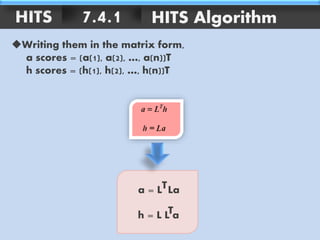
Writing them in the matrix form, 
a scores = (a(1), a(2), …, a(n))T 
h scores = (h(1), h(2), …, h(n))T 
a = LT La 
h = L LTa
HITS 7.4.1 HITS Algorithm 
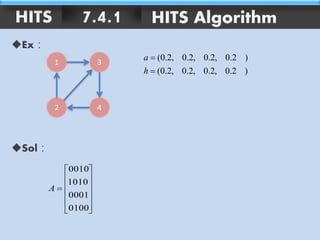
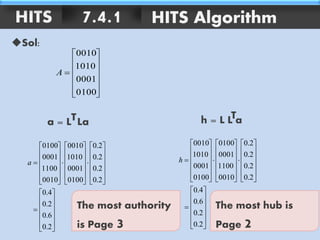
Ex: 
1 3 
2 4 
0010 
 
 
 
 
1010 
0001 
 
 
 
 
 
 
 
 
 
0100 
A 
(0.2, 0.2, 0.2, 0.2 ) 
 
(0.2, 0.2, 0.2, 0.2 ) 
a 
 
h 
Sol:
HITS 7.4.1 HITS Algorithm 
0010 
 
 
 
 
1010 
0001 
 
 
 
 
 
 
 
 
 
0100 
A 
Sol: 
a = LT La h = L L a T 
0100 
0001 
1100 
 
 
 
 
 
 
 
 
 
 
 
 
 
 
 
 
 
 
 
 
 
 
 
 
 
 
 
 
 
0010 
 
 
 
 
 
 
1010 
0001 
 
 
 
 
 
 
 
 
 
 
 
 
 
 
 
 
 
0.4 
0.2 
0.6 
0.2 
0.2 
0.2 
0.2 
0.2 
0100 
0010 
a 
0010 
1010 
0001 
 
 
 
 
 
 
 
 
 
 
 
 
 
 
 
 
 
 
 
 
 
 
 
 
 
 
 
 
 
0100 
 
 
0001 
 
 
 
 
 
 
 
 
 
1100 
 
 
 
 
 
 
 
 
 
 
 
 
0.4 
0.6 
0.2 
0.2 
0.2 
0.2 
0.2 
0.2 
0010 
0100 
h 
The most authority 
is Page 3 
The most hub is 
Page 2
HITS 7.4.2 Finding Other Eigenvectors 
Each of such collections could potentially be relevant to the 
query topic, but they could be well separated from one 
another in the graph G for a variety of reasons. 
For example, 
1. The query string may represent a topic that may arise as 
a term in the multiple communities, e.g. “classification”. 
2. The query string may refer to a highly polarized issue, 
involving groups that are not likely to link to one another, 
e.g. “abortion”.
HITS 7.4.3 Relationships with Co-Citation and 
Bibliographic Coupling 
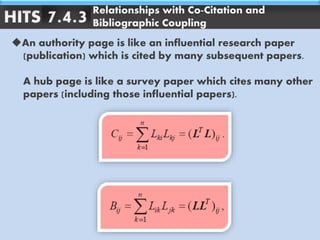
An authority page is like an influential research paper 
(publication) which is cited by many subsequent papers. 
A hub page is like a survey paper which cites many other 
papers (including those influential papers).
HITS 7.4.4 Strengths and Weaknesses of HITS 
The main strength of HITS is its ability to rank pages 
according to the query topic, which may be able to 
provide more relevant authority and hub pages. 
However, HITS has several disadvantages: 
1. HITS does not have the anti-spam capability of PageRank. 
2. HITS is topic drift. because people put hyperlinks 
for all kinds of reasons, including favor, spamming… 
3. The query time evaluation is also a major drawback. 
Performing eigenvector computation are all time 
consuming operations.
END

WEB Data Mining

  • 1.
    2 0 13 讀 O a s e s
  • 2.
    PageRank 7.3 Introduction PageRank Algorithm Strengths and Weaknesses Timed PageRank & Recency Search
  • 3.
    PageRank 7.3 Introduction HITS was presented by Jon Kleinberg in January, 1998 at the Ninth Annual ACM-SIAM Symposium on Discrete Algorithms.. PageRank was presented by Sergey Brin and Larry Page at the Seventh International World Wide Web Conference (WWW7) in April, 1998. -Based on the algorithm, they built the search engine Google
  • 4.
    PageRank 7.3.1 PageRankAlgorithm PageRank (PR)is a static ranking of Web pages. PageRank is based on the measure of prestige in social networks, the PageRank value of each page can be regarded as its prestige.
  • 5.
    PageRank 7.3.1 PageRankAlgorithm Concepts: In-links of page i: These are the hyperlinks that point to page i from other pages. Usually, hyperlinks from the same site are not considered. Out-links of page i: These are the hyperlinks that point out to other pages from page i. Usually, links to pages of the same site are not considered. In-links Out-links
  • 6.
    PageRank 7.3.1 PageRankAlgorithm  uses G=(V, E) [G=graph, V=pages, E=links] PageRank Score: ※ Oj is the number of out-links of page j
  • 7.
    PageRank 7.3.1 PageRankAlgorithm doesn’t not quite suffice. (隨機性下的發生) Based on the Markov chain: ※ Aij(1) is the probability of going from i to j in 1 transition
  • 8.
    PageRank 7.3.1 PageRankAlgorithm ※ adding a link from page 5 to every page
  • 9.
    PageRank 7.3.1 PageRankAlgorithm Ex2:
  • 10.
    PageRank 7.3.1 PageRankAlgorithm The random surfer has two options: 1. With probability d, he randomly chooses an out-link to follow. 2. With probability 1-d, he jumps to a random page without a link. Ex3:
  • 11.
    PageRank 7.3.1 PageRankAlgorithm Sol:
  • 12.
    PageRank 7.3.2 Strengthsand Weaknesses 1.The advantage of PageRank is its ability to fight spam. Since it is not easy for Web page owner to add in-links into his/her page from other important pages, it is thus not easy to influence PageRank. Nevertheless, there are reported ways to influence PageRank. Recognizing and fighting spam is an important issue in Web search.
  • 13.
    PageRank 7.3.2 Strengthsand Weaknesses 2. Another major advantage of PageRank is that it is a global measure and is query independent. At the query time, only a lookup is needed to find the value to be integrated with other strategies to rank the pages. It is thus very efficient at the query time.
  • 14.
    PageRank 7.3.2 Strengthsand Weaknesses 1. The main criticism is also the query-independence nature of PageRank. It could not distinguish between pages that are authoritative in general and pages that are authoritative on the query topic.
  • 15.
    PageRank 7.3.3 TimedPageRank and Recency Search The Web is a dynamic environment. It changes constantly. Quality pages in the past may not be quality pages now or in the future. Many outdated pages and links are not deleted. This causes problems for Web search because such outdated pages may still be ranked high. - Thus, search has a temporal dimension.
  • 16.
    PageRank 7.3.3 TimedPageRank and Recency Search Time-Sensitive ranking algorithm called TS-Rank. the surfer can take one of the two actions: 1. With probability f(ti), he randomly chooses an out-going link to follow. 2. With probability 1-f(ti), he jumps to a random page without a link.
  • 17.
    PageRank 7.3.3 TimedPageRank and Recency Search Time-Sensitive ranking algorithm called TS-Rank.
  • 18.
    HITS 7.4 Introduction HITS Algorithm Finding Other Eigenvectors Relationships with Co-Citation and Bibliographic Coupling Strengths and Weaknesses of HITS
  • 19.
    HITS 7.4 Introduction HITS stands for Hypertext Induced Topic Search Statement : expands the list of relevant pages returned by a search engine and then produces two rankings of the expanded set of pages, authority ranking and hub ranking. Authority : a page with many in-links. A good authority is a page pointed to by many good hubs. Hub : a page with many out-links. A good hub is a page that points to many good authorities.
  • 20.
    HITS 7.4 Introduction Authority : a page with many in-links. A good authority is a page pointed to by many good hubs. Hub1 http1 http2 http3…. HubN http1 http2 http3…. Hub2 http1 http2 http3…. Authority
  • 21.
    HITS 7.4 Introduction Hub : a page with many out-links. A good hub is a page that points to many good authorities. Hub http1 http2 http3…. Authority 1 Authority 2 Authority N authorities and hubs have a mutual reinforcement relationship
  • 22.
    HITS 7.4.1 HITSAlgorithm  uses G=(V, E) [G=graph, V=pages, E=links]  計算page i 的authority 分數a(i), hub 分數h(i). The mutual reinforcing relationship of the two scores is represented as follows:
  • 23.
    HITS 7.4.1 HITSAlgorithm Writing them in the matrix form, a scores = (a(1), a(2), …, a(n))T h scores = (h(1), h(2), …, h(n))T a = LT La h = L LTa
  • 24.
    HITS 7.4.1 HITSAlgorithm Ex: 1 3 2 4 0010     1010 0001          0100 A (0.2, 0.2, 0.2, 0.2 )  (0.2, 0.2, 0.2, 0.2 ) a  h Sol:
  • 25.
    HITS 7.4.1 HITSAlgorithm 0010     1010 0001          0100 A Sol: a = LT La h = L L a T 0100 0001 1100                              0010       1010 0001                  0.4 0.2 0.6 0.2 0.2 0.2 0.2 0.2 0100 0010 a 0010 1010 0001                              0100   0001          1100             0.4 0.6 0.2 0.2 0.2 0.2 0.2 0.2 0010 0100 h The most authority is Page 3 The most hub is Page 2
  • 26.
    HITS 7.4.2 FindingOther Eigenvectors Each of such collections could potentially be relevant to the query topic, but they could be well separated from one another in the graph G for a variety of reasons. For example, 1. The query string may represent a topic that may arise as a term in the multiple communities, e.g. “classification”. 2. The query string may refer to a highly polarized issue, involving groups that are not likely to link to one another, e.g. “abortion”.
  • 27.
    HITS 7.4.3 Relationshipswith Co-Citation and Bibliographic Coupling An authority page is like an influential research paper (publication) which is cited by many subsequent papers. A hub page is like a survey paper which cites many other papers (including those influential papers).
  • 28.
    HITS 7.4.4 Strengthsand Weaknesses of HITS The main strength of HITS is its ability to rank pages according to the query topic, which may be able to provide more relevant authority and hub pages. However, HITS has several disadvantages: 1. HITS does not have the anti-spam capability of PageRank. 2. HITS is topic drift. because people put hyperlinks for all kinds of reasons, including favor, spamming… 3. The query time evaluation is also a major drawback. Performing eigenvector computation are all time consuming operations.
  • 29.

Editor's Notes

  • #10 Periodic週期性
  • #11 Periodic週期性
  • #12 suffice 充足
  • #16 outdated 過時、未更新的 temporal 時間的
  • #17 outdated 過時、未更新的 temporal 時間的
  • #18 outdated 過時、未更新的 temporal 時間的 For a complete new page in a Web site, which has few or no in-links, we can use the average TS-Rank value of the past pages of the site, which represents the reputation of the site.
  • #27 Eigenvectors 特徵向量 Abortion 墮胎
  • #29 Spamming使用網路來作為廣播媒體傳送相同的訊息給大量未要求傳送訊息的使用者的一種不適當的企圖 Drift 趨勢 computation 計算結果的數值 consuming 耗時的