6 STAGES OF THE WEB
DEVELOPMENT LIFE
CYCLE
Curated by a Professional Website
Design & Development Company
Topics Covered
A brief outline
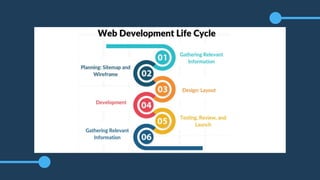
• The Six Stages:
• Gathering Relevant Information
• Planning: Sitemap and Wireframe
• Design: Layout
• Development
• Testing, Review, and Launch
• Maintenance and Updation
What Is Web Development
Life Cycle?
WHY IS IT IMPORTANT
WHAT IS..
• a software development life cycle
• adheres to a specific standard that has to be followed to move
in the right direction
WHY IS..
• gives an insight into development of a website
• a professionally designed website can enhance online presence,
generate leads, and increase sales.
Stage 1:
GATHERING RELEVANT
INFORMATION
Key Considerations:
PURPOSE
• What is the purpose of the website that the developer will
be building?
OBJECTIVES
• What is the main goal of building the website?
TARGET AUDIENCE
• Is there is a specific group of people that will help in
accomplishing your objectives?
CONTENT
• What type of content do you post on the site?
Stage 2:
PLANNING: SITEMAP AND
WIREFRAME
Key Considerations:
SITEMAP
• With all the information that has been gathered from stage
one, the design and implementation strategies are planned
according to the type of website and target audience.
• This is a guide that describes what content will be there on
the site, and there is an easy to understand navigational
system.
WIREFRAME
• The wireframes give an outline of the pages of the website.
• Take help of tools for creating the wireframe.
• All the planning process should have the involvement of the
client.
Stage 3:
DESIGN: LAYOUT
Key Considerations:
LOOK AND FEEL OF THE WEBSITE
• It is essential to embed elements like the logo of the
company and the colors that help to enhance to identify
the company on the website.
• The designer gives life to the graphics, typography, colors,
animations, buttons, drop-down and pop-up menus and
more as per the project requirement.
MEETING THE DEMAND
• Meeting the demand of the audience with the help of web
design is crucial.
• The elements should reflect the brand image as well as
business vision.
Stage 4:
DEVELOPMENT
Key Considerations:
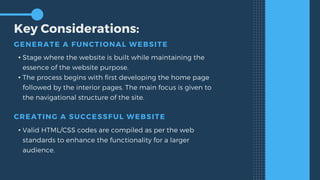
GENERATE A FUNCTIONAL WEBSITE
• Stage where the website is built while maintaining the
essence of the website purpose.
• The process begins with first developing the home page
followed by the interior pages. The main focus is given to
the navigational structure of the site.
CREATING A SUCCESSFUL WEBSITE
• Valid HTML/CSS codes are compiled as per the web
standards to enhance the functionality for a larger
audience.
Stage 5:
TESTING, REVIEW, AND
LAUNCH
Key Considerations:
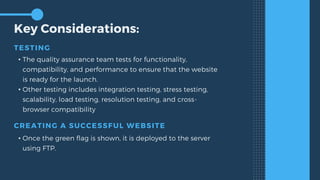
TESTING
• The quality assurance team tests for functionality,
compatibility, and performance to ensure that the website
is ready for the launch.
• Other testing includes integration testing, stress testing,
scalability, load testing, resolution testing, and cross-
browser compatibility
CREATING A SUCCESSFUL WEBSITE
• Once the green flag is shown, it is deployed to the server
using FTP.
Stage 6:
MAINTENANCE AND
UPDATION
Key Considerations:
MAINTENANCE
• The web development stages don't end after deployment
• Some elements are changed as per the user's feedback,
support, and maintenance.
UPDATION
• Once the green flag is shown, it is deployed to the server
using FTP.
ADDITIONAL READING
HOW CAN I FIND THE BEST CUSTOM
WEB DEVELOPMENT SERVICES?
www.signitysolutions.com
TOP 10 CUSTOM WEB DESIGN AND
DEVELOPMENT COMPANIES 2019
www.signitysolutions.com
5 KEY QUESTIONS TO ASK BEFORE
BUILDING A RESPONSIVE WEBSITE
www.signitysolutions.com
Get in Touch
We'd love to hear your thoughts
ADDRESS
762 Green St, Suite 1-R,Iselin, NJ 08830
PHONE
+1-619-309-4653
EMAIL
sales@signitysolutions.com

Web development life cycle by a web design & development company

  • 1.
    6 STAGES OFTHE WEB DEVELOPMENT LIFE CYCLE Curated by a Professional Website Design & Development Company
  • 2.
    Topics Covered A briefoutline • The Six Stages: • Gathering Relevant Information • Planning: Sitemap and Wireframe • Design: Layout • Development • Testing, Review, and Launch • Maintenance and Updation
  • 3.
    What Is WebDevelopment Life Cycle? WHY IS IT IMPORTANT
  • 4.
    WHAT IS.. • asoftware development life cycle • adheres to a specific standard that has to be followed to move in the right direction WHY IS.. • gives an insight into development of a website • a professionally designed website can enhance online presence, generate leads, and increase sales.
  • 6.
  • 7.
    Key Considerations: PURPOSE • Whatis the purpose of the website that the developer will be building? OBJECTIVES • What is the main goal of building the website? TARGET AUDIENCE • Is there is a specific group of people that will help in accomplishing your objectives? CONTENT • What type of content do you post on the site?
  • 8.
  • 9.
    Key Considerations: SITEMAP • Withall the information that has been gathered from stage one, the design and implementation strategies are planned according to the type of website and target audience. • This is a guide that describes what content will be there on the site, and there is an easy to understand navigational system. WIREFRAME • The wireframes give an outline of the pages of the website. • Take help of tools for creating the wireframe. • All the planning process should have the involvement of the client.
  • 10.
  • 11.
    Key Considerations: LOOK ANDFEEL OF THE WEBSITE • It is essential to embed elements like the logo of the company and the colors that help to enhance to identify the company on the website. • The designer gives life to the graphics, typography, colors, animations, buttons, drop-down and pop-up menus and more as per the project requirement. MEETING THE DEMAND • Meeting the demand of the audience with the help of web design is crucial. • The elements should reflect the brand image as well as business vision.
  • 12.
  • 13.
    Key Considerations: GENERATE AFUNCTIONAL WEBSITE • Stage where the website is built while maintaining the essence of the website purpose. • The process begins with first developing the home page followed by the interior pages. The main focus is given to the navigational structure of the site. CREATING A SUCCESSFUL WEBSITE • Valid HTML/CSS codes are compiled as per the web standards to enhance the functionality for a larger audience.
  • 14.
  • 15.
    Key Considerations: TESTING • Thequality assurance team tests for functionality, compatibility, and performance to ensure that the website is ready for the launch. • Other testing includes integration testing, stress testing, scalability, load testing, resolution testing, and cross- browser compatibility CREATING A SUCCESSFUL WEBSITE • Once the green flag is shown, it is deployed to the server using FTP.
  • 16.
  • 17.
    Key Considerations: MAINTENANCE • Theweb development stages don't end after deployment • Some elements are changed as per the user's feedback, support, and maintenance. UPDATION • Once the green flag is shown, it is deployed to the server using FTP.
  • 18.
    ADDITIONAL READING HOW CANI FIND THE BEST CUSTOM WEB DEVELOPMENT SERVICES? www.signitysolutions.com TOP 10 CUSTOM WEB DESIGN AND DEVELOPMENT COMPANIES 2019 www.signitysolutions.com 5 KEY QUESTIONS TO ASK BEFORE BUILDING A RESPONSIVE WEBSITE www.signitysolutions.com
  • 19.
    Get in Touch We'dlove to hear your thoughts ADDRESS 762 Green St, Suite 1-R,Iselin, NJ 08830 PHONE +1-619-309-4653 EMAIL sales@signitysolutions.com