< Slide 1 >
Building a Better Wearable
Device – What You Need to
Know
Walt Maclay
President, Voler Systems
Product Development
< Slide 2 >
Agenda
• Common physiological measurements
• Battery limitations
• Things that impact power
• Data security
< Slide 3 >
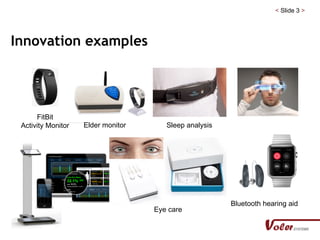
Innovation examples
FitBit
Activity Monitor Elder monitor
Bluetooth hearing aid
Eye care
Sleep analysis
< Slide 4 >
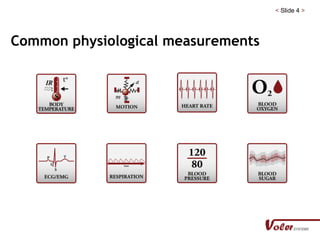
Common physiological measurements
< Slide 5 >
Body Temperature
• Few good locations to measure core temperature
• Axilla (under arm) or forehead are best locations
• Not convenient for a wearable device
• Extremeties (eg wrist) have variable temperature
• Algorithms can partially adjust over time
• Good contact is important – heat flow causes
errors
< Slide 6 >
Motion
• The most studied and used parameter
• Step counts
• Gait analysis (illness)
• Types of motion (walking, standing, sitting)
• Dead reckoning (9-axis motion)
• Works on wrist, ankle, torso, etc.
• Different algorithms at different locations
< Slide 7 >
Heart Rate
• Measured by
• ECG electrodes – two are sufficient
• Pulse oximeter sensing – transmissive
• Transmitted works on finger and ear
• Pulse oximeter – reflected
• Works more places on body
• Pressure sensing of the pulse in the wrist
• Heart rate can be measured on many parts of the
body
< Slide 8 >
Blood Oxygen
• Oxygen saturation in blood
• Measured by pulse oximeter (infra-red) technology
• Measure loss through body of 2 IR wavelengths
• Separates changes in blood from other changes
• Measure pulse at the same time
• Transmissive or reflective measurement
• Reflective for more places on body
• Transmissive for better accuracy
< Slide 9 >
ECG / EMG / EEG
• Measure of electrical and muscle activity
• ECG measurement points have to be rather far
apart
• At least one and a half inches – larger devices needed
• More leads is better (up to 12 for standard ECG)
• EMG requires accurate placement (millimeters)
• Measure the wrong muscle
• EEG must use electrodes on the head
< Slide 10 >
Respiration Rate
• Number of breaths per minute
• Few good locations to measure
• Movement of chest
• Chest strap
• Not convenient for a wearable device except shirt
• Thoracic Impedance eliminates chest strap
• Device can be small
• Difficult on wrist
< Slide 11 >
Blood Pressure
• Measure of systolic and diastolic pressure
• Accurate measurement requires pressure cuff that
is compressed and released
• Cuff on arm or wrist
• Pulse Transit Time – measure at wrist or
elsewhere
• Currently not accurate enough for medical diagnosis
< Slide 12 >
Blood Sugar (Glucose)
• Measure of glucose level in blood sample
• Widely used
• Becoming a wearable
• with microneedles or implanted
• Frequent calibration required
• Attempts to not use finger tip – less accurate
• Not accurate on wrist
• Closed loop system replaces the pancreas
• Measure and control glucose with a pump
< Slide 13 >
Agenda
• Common physiological measurements
• Battery limitations
• Things that impact power
• Data security
< Slide 14 >
Battery Limitations
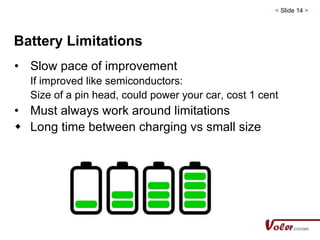
• Slow pace of improvement
If improved like semiconductors:
Size of a pin head, could power your car, cost 1 cent
• Must always work around limitations
w Long time between charging vs small size
< Slide 15 >
When Will Battery Technology Improve?
• Chemical energy storage is approaching the limit
of its efficiency
• Nuclear energy is out of the question
• A lot of research being done on higher density
and better safety
• Perhaps 2 times higher density in a few years
• Will safety suffer?
< Slide 16 >
Agenda
• Common physiological measurements
• Battery limitations
• Things that impact power
• Data security
< Slide 17 >
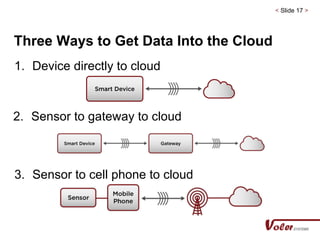
Three Ways to Get Data Into the Cloud
1. Device directly to cloud
2. Sensor to gateway to cloud
3. Sensor to cell phone to cloud
< Slide 18 >
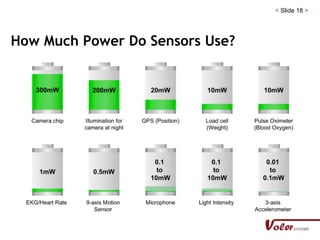
How Much Power Do Sensors Use?
< Slide 19 >
Agenda
• Common physiological measurements
• Battery limitations
• Things that impact power
• Data security
< Slide 20 >
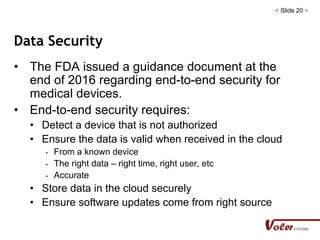
Data Security
• The FDA issued a guidance document at the
end of 2016 regarding end-to-end security for
medical devices.
• End-to-end security requires:
• Detect a device that is not authorized
• Ensure the data is valid when received in the cloud
• From a known device
• The right data – right time, right user, etc
• Accurate
• Store data in the cloud securely
• Ensure software updates come from right source
< Slide 21 >
Data Security Technology
• SecureRF Corporation has an encryption
algorithm that runs on processors as small as 8
bits.
• Most algorithms too slow, need powerful processors
• Intrinsic ID Corporation generates secret key
from random SRAM power-up state
• Provides authentication device to cloud
• SecurePush Corporation provides end-to-end
solution with
• System on a chip
• Mobile app
• Cloud service
< Slide 22 >
Walt Maclay, Voler Systems
Walt@volersystems.com
Quality Electronic Design & Software
Wearable Devices
Sensor Interfaces
Wireless
Medical Devices
< Slide 23 >

Wearable Devices 2019

  • 1.
    < Slide 1> Building a Better Wearable Device – What You Need to Know Walt Maclay President, Voler Systems Product Development
  • 2.
    < Slide 2> Agenda • Common physiological measurements • Battery limitations • Things that impact power • Data security
  • 3.
    < Slide 3> Innovation examples FitBit Activity Monitor Elder monitor Bluetooth hearing aid Eye care Sleep analysis
  • 4.
    < Slide 4> Common physiological measurements
  • 5.
    < Slide 5> Body Temperature • Few good locations to measure core temperature • Axilla (under arm) or forehead are best locations • Not convenient for a wearable device • Extremeties (eg wrist) have variable temperature • Algorithms can partially adjust over time • Good contact is important – heat flow causes errors
  • 6.
    < Slide 6> Motion • The most studied and used parameter • Step counts • Gait analysis (illness) • Types of motion (walking, standing, sitting) • Dead reckoning (9-axis motion) • Works on wrist, ankle, torso, etc. • Different algorithms at different locations
  • 7.
    < Slide 7> Heart Rate • Measured by • ECG electrodes – two are sufficient • Pulse oximeter sensing – transmissive • Transmitted works on finger and ear • Pulse oximeter – reflected • Works more places on body • Pressure sensing of the pulse in the wrist • Heart rate can be measured on many parts of the body
  • 8.
    < Slide 8> Blood Oxygen • Oxygen saturation in blood • Measured by pulse oximeter (infra-red) technology • Measure loss through body of 2 IR wavelengths • Separates changes in blood from other changes • Measure pulse at the same time • Transmissive or reflective measurement • Reflective for more places on body • Transmissive for better accuracy
  • 9.
    < Slide 9> ECG / EMG / EEG • Measure of electrical and muscle activity • ECG measurement points have to be rather far apart • At least one and a half inches – larger devices needed • More leads is better (up to 12 for standard ECG) • EMG requires accurate placement (millimeters) • Measure the wrong muscle • EEG must use electrodes on the head
  • 10.
    < Slide 10> Respiration Rate • Number of breaths per minute • Few good locations to measure • Movement of chest • Chest strap • Not convenient for a wearable device except shirt • Thoracic Impedance eliminates chest strap • Device can be small • Difficult on wrist
  • 11.
    < Slide 11> Blood Pressure • Measure of systolic and diastolic pressure • Accurate measurement requires pressure cuff that is compressed and released • Cuff on arm or wrist • Pulse Transit Time – measure at wrist or elsewhere • Currently not accurate enough for medical diagnosis
  • 12.
    < Slide 12> Blood Sugar (Glucose) • Measure of glucose level in blood sample • Widely used • Becoming a wearable • with microneedles or implanted • Frequent calibration required • Attempts to not use finger tip – less accurate • Not accurate on wrist • Closed loop system replaces the pancreas • Measure and control glucose with a pump
  • 13.
    < Slide 13> Agenda • Common physiological measurements • Battery limitations • Things that impact power • Data security
  • 14.
    < Slide 14> Battery Limitations • Slow pace of improvement If improved like semiconductors: Size of a pin head, could power your car, cost 1 cent • Must always work around limitations w Long time between charging vs small size
  • 15.
    < Slide 15> When Will Battery Technology Improve? • Chemical energy storage is approaching the limit of its efficiency • Nuclear energy is out of the question • A lot of research being done on higher density and better safety • Perhaps 2 times higher density in a few years • Will safety suffer?
  • 16.
    < Slide 16> Agenda • Common physiological measurements • Battery limitations • Things that impact power • Data security
  • 17.
    < Slide 17> Three Ways to Get Data Into the Cloud 1. Device directly to cloud 2. Sensor to gateway to cloud 3. Sensor to cell phone to cloud
  • 18.
    < Slide 18> How Much Power Do Sensors Use?
  • 19.
    < Slide 19> Agenda • Common physiological measurements • Battery limitations • Things that impact power • Data security
  • 20.
    < Slide 20> Data Security • The FDA issued a guidance document at the end of 2016 regarding end-to-end security for medical devices. • End-to-end security requires: • Detect a device that is not authorized • Ensure the data is valid when received in the cloud • From a known device • The right data – right time, right user, etc • Accurate • Store data in the cloud securely • Ensure software updates come from right source
  • 21.
    < Slide 21> Data Security Technology • SecureRF Corporation has an encryption algorithm that runs on processors as small as 8 bits. • Most algorithms too slow, need powerful processors • Intrinsic ID Corporation generates secret key from random SRAM power-up state • Provides authentication device to cloud • SecurePush Corporation provides end-to-end solution with • System on a chip • Mobile app • Cloud service
  • 22.
    < Slide 22> Walt Maclay, Voler Systems Walt@volersystems.com Quality Electronic Design & Software Wearable Devices Sensor Interfaces Wireless Medical Devices
  • 23.