COMM 101:
UNDERSTANDING MASS MEDIA
Professor Eric Luther
• TX Community College transfer student
• SMU: Dallas, TX – Bachelors of Humanities
• NYU: New York, NY – Masters in Arts & Humanities Education
• 10 years in media production (mainly TV news)
• Taught communications and media courses as adjunct at other
community colleges, but came full-time to WCC as of Fall 2010
• Curriculum Chair, Communications & Media Arts
COMM 101:
UNDERSTANDING MASS MEDIA
Students:
• Who are you and what brings you to
this class?
• What are your communications &
media interests?
• What do you expect/hope to get out
of this class?
COMM 101:
UNDERSTANDING MASS MEDIA
TODAY’S OVERVIEW:
• Go over Course Outline + Book +
Blackboard
• Discuss Course & Mass Media Basics
• Discuss Project #1
• Remember - Class Materials are posted on
Blackboard prior to meeting
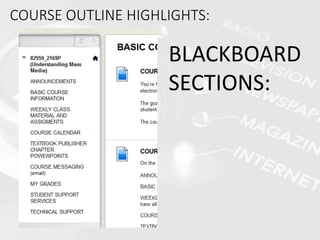
COURSE OUTLINE HIGHLIGHTS:
BLACKBOARD
SECTIONS:
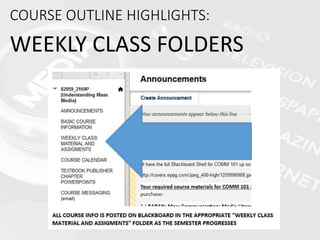
COURSE OUTLINE HIGHLIGHTS:
WEEKLY CLASS FOLDERS
COMM 101:
UNDERSTANDING MASS MEDIA
• This course has four distinct graded/credit parts:
• 25% = COURSE REFLECTIVE PROJECTS: 3 Written Reflective
Projects
• 25% = COURSE ASSIGNMENTS:
• 14 LEARNSMART Chapters
• 14 CONNECT Chapter Quizzes
• 10 In-Class Media/Study Focus Questions
• (5 lowest scores from this category will be dropped)
• 25% = COURSE PAPER: Semester Research Paper/Discussion
• 25% = COURSE FINAL: Final Exam (online-cumulative from
chapter quizzes + in-class media work)
• Total = 100%
COMM 101:
UNDERSTANDING MASS MEDIA
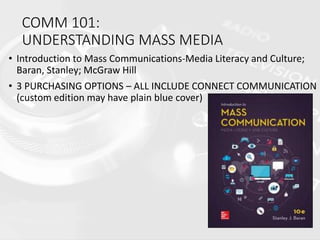
• Introduction to Mass Communications-Media Literacy and Culture;
Baran, Stanley; McGraw Hill
• 3 PURCHASING OPTIONS – ALL INCLUDE CONNECT COMMUNICATION
(custom edition may have plain blue cover)
COMM 101:
UNDERSTANDING MASS MEDIA
• LATE WORK POLICY:
Any late reflective projects, study focus questions, or research papers
accepted are worth a maximum of 50% credit.
• No late LEARNSMART chapters are accepted for extra credit
• CONNECT QUIZZES - You have two chances to take quizzes with the higher
of the two scores being recorded. You may submit quizzes after the due
date(s) but your score will be deducted 5% each day it is late.
• Material covered in class will always be posted in the appropriate area/class
folder on Blackboard so physical absences are not an excuse for falling
behind when completing work. You are held responsible for the material
whether you are physically present or not.
• Again, the five lowest scores found in the COURSE ASSIGNMENTS category
will be dropped when your final semester grade is calculated.
COMM 101:
UNDERSTANDING MASS MEDIA
•ATTENDANCE POLICY:
Students are allowed to miss a total of 2 class
periods (approximately six hours of
instruction) before being penalized. After
that, each absence may result in a 5%
reduction of your final grade. In addition,
there will be in-class work that is not
available beyond the day/time of assignment
and, therefore, unavailable for later
completion.
What is “COMM 101: Understanding Mass
Media”?
•How will this class foster your
understanding of mass media?
•Provide history/context
•Provide opportunity for knowledge
application and research
•Provide opportunity for personal
reflection
MASS MEDIA ASBOLUTES
•“Mass Media” channels always use
technology of some kind to deliver
the SAME message to a great
number of people at widely
separated points who typically
don’t know each other.
MASS MEDIA ASBOLUTES
•“Mass Media” is basically the
opposite concept of
“interpersonal”
communication.
Why study “MASS MEDIA”?
•We need to understand it because it
informs and shapes just about every aspect
of our daily lives – it’s all around us, like
oxygen. Mass Media can be thought of as
the “nervous system” of society.
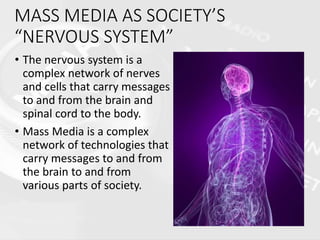
MASS MEDIA AS SOCIETY’S
“NERVOUS SYSTEM”
• The nervous system is a
complex network of nerves
and cells that carry messages
to and from the brain and
spinal cord to the body.
• Mass Media is a complex
network of technologies that
carry messages to and from
the brain to and from
various parts of society.
MEDIA LITERACY
•What does “Media Literacy” mean?
• Media literacy is the ability to access, analyze, evaluate,
and create media. Media-literate youth and adults are
better able to understand the complex messages we
receive from television, radio, Internet, newspapers,
magazines, books, billboards, video games, music, and all
other forms of media.
MASS MEDIA CHANNELS
•A Mass Media “Channel” is the delivery
system by which we get mass media; it’s how
we receive mass media information and
messages – specifically the technology
involved.
• REMEMBER: “Mass Media” channels always use technology of
some kind to deliver the SAME message to a great number of
people at widely separated points who typically don’t know each
other.
MASS MEDIA MESSAGES
•A Mass Media “Message” is the
content/message itself rather than
the delivery system/technology; it’s
what we receive via mass media
delivery system/technology
• e.g. “Modern Family” is the Mass Media
Message and Television is the Mass Media
Channel.
MEDIA LITERACY
•We’ll be looking at Mass Media (channels +
messages) of all kinds and examining how
we interact with them as both a society and
individuals so we can sharpen our “Media
Literacy” skills.
•Your feedback and input is crucial to getting
the most out of this class – I want to learn
from you, too…
•Print from the late 1400s
~ books, pamphlets, newspapers, magazines,
etc.
•Recordings from the late 1800s
~ records, tapes, cassettes, 8-track
cartridges, CDs, DVDs, Blu-Ray
•Cinema/Film from about 1900
~ feature films, short films, documentaries –
all shown in theaters
MASS MEDIA CHANNELS
•Radio from about 1910
~ news/talk shows, music programs, live
concerts…(BROADCAST MEDIA)
•Television from about 1950
~ news, dramas, sitcoms, educational,
reality… (BROADCAST MEDIA)
MASS MEDIA CHANNELS
• By and large the previous 5 mass media channels were
clearly defined. TV and Radio programming were
broadcast through your TV & Radio, books and
newspapers were printed, movies were shown in theaters,
albums were played on your stereo, etc. In other words,
you didn’t go to one Mass Media Channel expecting
anything OTHER than what it specialized in and the
channels were distinct and different…but something
changed all that…
MASS MEDIA CHANNELS
MASS MEDIA CHANNELS
•Internet: from about 1990
~ websites, email, webisodes, chat rooms,
streaming audio/video, online
newspapers/magazines (DIGITAL MEDIA -
including video games)
•Mobile: from about 2000
~ text messaging, video, photos, music -
cell phone transmissions of all kinds
(DIGITAL MEDIA)
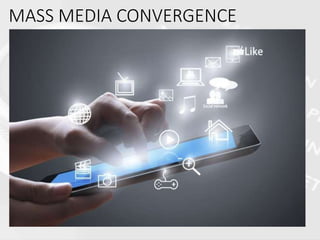
MASS MEDIA CONVERGENCE
•With the advent of DIGITAL MEDIA, mass
media of all kinds are converging into
one type of channel – you can now
watch TV, read a book, listen to music,
see a movie, play a game, and check in
on your favorite radio station all in the
SAME MASS MEDIA CHANNEL. This is
called “MEDIA CONVERGENCE”.
MASS MEDIA CONVERGENCE
•The merging of previously distinct
media technologies and media forms
resulting from digitization and
computer networking
7 MAJOR MASS MEDIA CHANNELS
•Print=from the late 1400s
•Recordings=from the late 1800s
•Cinema/Film=from about 1900
•Radio=from about 1910
•Television=from about 1950
•Internet/Digital=from about 1990
•Mobile/Digital=from about 2000
REFLECTIVE PROJECT #1 DETAILS
•AVOIDING MASS
MEDIA
MESSAGES FOR
24 HOURS
FUTURE OF MASS MEDIA CHANNELS
•So, what will be the 8th, 9th,
10th, etc. Mass Media
Channel?
•What new media/information
delivery system is on our
horizon?
FUTURE OF MASS MEDIA CHANNELS
•Brain Implants
• Brain implants or other types of neural links, such as
Brain Computer Interfaces (BCIs) between the brain, the
internet, and the cloud, are quickly entering the realm
of science rather than science fiction.
• The Defense Advanced Research Agency is ready to run
trials with closed-loop mood control chips linked to AI
that can deliver an electrical impulse to regulate a
soldier’s mood. In the private sector, Elon Musk has
announced Neuralink — a neurotechnology venture that
will not only focus on fighting diseases but also on
augmenting humans so they can better compete with
machines.
FUTURE OF MASS MEDIA CHANNELS
•PROFESSOR GOOGLE?
•Humans, without making a sound or typing a
single thing, will hear the answer to any
question we may have inside our heads. “The
need to actually learn something parrot
fashion is going to disappear because we will
have access to that instantly.
FUTURE OF MASS MEDIA CHANNELS
REAL WORLD EXAMPLE:
•Microchip Implants
• More than four dozen employees of a
Wisconsin company are getting microchip
implants that will enable them to go through
doors, log onto computers and more. NBC’s
Ron Mott reports from the company’s first-
ever “chip day,” where employees have the
chips implanted and one demonstrates buying
a candy bar from a vending machine with a
wave of his hand.

WCC COMM 101 COURSE INTRODUCTION

  • 1.
    COMM 101: UNDERSTANDING MASSMEDIA Professor Eric Luther • TX Community College transfer student • SMU: Dallas, TX – Bachelors of Humanities • NYU: New York, NY – Masters in Arts & Humanities Education • 10 years in media production (mainly TV news) • Taught communications and media courses as adjunct at other community colleges, but came full-time to WCC as of Fall 2010 • Curriculum Chair, Communications & Media Arts
  • 2.
    COMM 101: UNDERSTANDING MASSMEDIA Students: • Who are you and what brings you to this class? • What are your communications & media interests? • What do you expect/hope to get out of this class?
  • 3.
    COMM 101: UNDERSTANDING MASSMEDIA TODAY’S OVERVIEW: • Go over Course Outline + Book + Blackboard • Discuss Course & Mass Media Basics • Discuss Project #1 • Remember - Class Materials are posted on Blackboard prior to meeting
  • 4.
  • 5.
  • 6.
    COMM 101: UNDERSTANDING MASSMEDIA • This course has four distinct graded/credit parts: • 25% = COURSE REFLECTIVE PROJECTS: 3 Written Reflective Projects • 25% = COURSE ASSIGNMENTS: • 14 LEARNSMART Chapters • 14 CONNECT Chapter Quizzes • 10 In-Class Media/Study Focus Questions • (5 lowest scores from this category will be dropped) • 25% = COURSE PAPER: Semester Research Paper/Discussion • 25% = COURSE FINAL: Final Exam (online-cumulative from chapter quizzes + in-class media work) • Total = 100%
  • 7.
    COMM 101: UNDERSTANDING MASSMEDIA • Introduction to Mass Communications-Media Literacy and Culture; Baran, Stanley; McGraw Hill • 3 PURCHASING OPTIONS – ALL INCLUDE CONNECT COMMUNICATION (custom edition may have plain blue cover)
  • 8.
    COMM 101: UNDERSTANDING MASSMEDIA • LATE WORK POLICY: Any late reflective projects, study focus questions, or research papers accepted are worth a maximum of 50% credit. • No late LEARNSMART chapters are accepted for extra credit • CONNECT QUIZZES - You have two chances to take quizzes with the higher of the two scores being recorded. You may submit quizzes after the due date(s) but your score will be deducted 5% each day it is late. • Material covered in class will always be posted in the appropriate area/class folder on Blackboard so physical absences are not an excuse for falling behind when completing work. You are held responsible for the material whether you are physically present or not. • Again, the five lowest scores found in the COURSE ASSIGNMENTS category will be dropped when your final semester grade is calculated.
  • 9.
    COMM 101: UNDERSTANDING MASSMEDIA •ATTENDANCE POLICY: Students are allowed to miss a total of 2 class periods (approximately six hours of instruction) before being penalized. After that, each absence may result in a 5% reduction of your final grade. In addition, there will be in-class work that is not available beyond the day/time of assignment and, therefore, unavailable for later completion.
  • 10.
    What is “COMM101: Understanding Mass Media”? •How will this class foster your understanding of mass media? •Provide history/context •Provide opportunity for knowledge application and research •Provide opportunity for personal reflection
  • 11.
    MASS MEDIA ASBOLUTES •“MassMedia” channels always use technology of some kind to deliver the SAME message to a great number of people at widely separated points who typically don’t know each other.
  • 12.
    MASS MEDIA ASBOLUTES •“MassMedia” is basically the opposite concept of “interpersonal” communication.
  • 13.
    Why study “MASSMEDIA”? •We need to understand it because it informs and shapes just about every aspect of our daily lives – it’s all around us, like oxygen. Mass Media can be thought of as the “nervous system” of society.
  • 14.
    MASS MEDIA ASSOCIETY’S “NERVOUS SYSTEM” • The nervous system is a complex network of nerves and cells that carry messages to and from the brain and spinal cord to the body. • Mass Media is a complex network of technologies that carry messages to and from the brain to and from various parts of society.
  • 15.
    MEDIA LITERACY •What does“Media Literacy” mean? • Media literacy is the ability to access, analyze, evaluate, and create media. Media-literate youth and adults are better able to understand the complex messages we receive from television, radio, Internet, newspapers, magazines, books, billboards, video games, music, and all other forms of media.
  • 16.
    MASS MEDIA CHANNELS •AMass Media “Channel” is the delivery system by which we get mass media; it’s how we receive mass media information and messages – specifically the technology involved. • REMEMBER: “Mass Media” channels always use technology of some kind to deliver the SAME message to a great number of people at widely separated points who typically don’t know each other.
  • 17.
    MASS MEDIA MESSAGES •AMass Media “Message” is the content/message itself rather than the delivery system/technology; it’s what we receive via mass media delivery system/technology • e.g. “Modern Family” is the Mass Media Message and Television is the Mass Media Channel.
  • 18.
    MEDIA LITERACY •We’ll belooking at Mass Media (channels + messages) of all kinds and examining how we interact with them as both a society and individuals so we can sharpen our “Media Literacy” skills. •Your feedback and input is crucial to getting the most out of this class – I want to learn from you, too…
  • 19.
    •Print from thelate 1400s ~ books, pamphlets, newspapers, magazines, etc. •Recordings from the late 1800s ~ records, tapes, cassettes, 8-track cartridges, CDs, DVDs, Blu-Ray •Cinema/Film from about 1900 ~ feature films, short films, documentaries – all shown in theaters MASS MEDIA CHANNELS
  • 20.
    •Radio from about1910 ~ news/talk shows, music programs, live concerts…(BROADCAST MEDIA) •Television from about 1950 ~ news, dramas, sitcoms, educational, reality… (BROADCAST MEDIA) MASS MEDIA CHANNELS
  • 21.
    • By andlarge the previous 5 mass media channels were clearly defined. TV and Radio programming were broadcast through your TV & Radio, books and newspapers were printed, movies were shown in theaters, albums were played on your stereo, etc. In other words, you didn’t go to one Mass Media Channel expecting anything OTHER than what it specialized in and the channels were distinct and different…but something changed all that… MASS MEDIA CHANNELS
  • 22.
    MASS MEDIA CHANNELS •Internet:from about 1990 ~ websites, email, webisodes, chat rooms, streaming audio/video, online newspapers/magazines (DIGITAL MEDIA - including video games) •Mobile: from about 2000 ~ text messaging, video, photos, music - cell phone transmissions of all kinds (DIGITAL MEDIA)
  • 23.
    MASS MEDIA CONVERGENCE •Withthe advent of DIGITAL MEDIA, mass media of all kinds are converging into one type of channel – you can now watch TV, read a book, listen to music, see a movie, play a game, and check in on your favorite radio station all in the SAME MASS MEDIA CHANNEL. This is called “MEDIA CONVERGENCE”.
  • 24.
    MASS MEDIA CONVERGENCE •Themerging of previously distinct media technologies and media forms resulting from digitization and computer networking
  • 25.
    7 MAJOR MASSMEDIA CHANNELS •Print=from the late 1400s •Recordings=from the late 1800s •Cinema/Film=from about 1900 •Radio=from about 1910 •Television=from about 1950 •Internet/Digital=from about 1990 •Mobile/Digital=from about 2000
  • 26.
    REFLECTIVE PROJECT #1DETAILS •AVOIDING MASS MEDIA MESSAGES FOR 24 HOURS
  • 27.
    FUTURE OF MASSMEDIA CHANNELS •So, what will be the 8th, 9th, 10th, etc. Mass Media Channel? •What new media/information delivery system is on our horizon?
  • 28.
    FUTURE OF MASSMEDIA CHANNELS •Brain Implants • Brain implants or other types of neural links, such as Brain Computer Interfaces (BCIs) between the brain, the internet, and the cloud, are quickly entering the realm of science rather than science fiction. • The Defense Advanced Research Agency is ready to run trials with closed-loop mood control chips linked to AI that can deliver an electrical impulse to regulate a soldier’s mood. In the private sector, Elon Musk has announced Neuralink — a neurotechnology venture that will not only focus on fighting diseases but also on augmenting humans so they can better compete with machines.
  • 29.
    FUTURE OF MASSMEDIA CHANNELS •PROFESSOR GOOGLE? •Humans, without making a sound or typing a single thing, will hear the answer to any question we may have inside our heads. “The need to actually learn something parrot fashion is going to disappear because we will have access to that instantly.
  • 30.
    FUTURE OF MASSMEDIA CHANNELS REAL WORLD EXAMPLE: •Microchip Implants • More than four dozen employees of a Wisconsin company are getting microchip implants that will enable them to go through doors, log onto computers and more. NBC’s Ron Mott reports from the company’s first- ever “chip day,” where employees have the chips implanted and one demonstrates buying a candy bar from a vending machine with a wave of his hand.