GWP NETWORK MEETING AND  CONSULTING PARTNERS MEETING 2010   Stockholm, 3-4 September 2010 Akiça Bahri  Coordinator, AWF AWF WORK ON  WATER SECURITY ISSUES
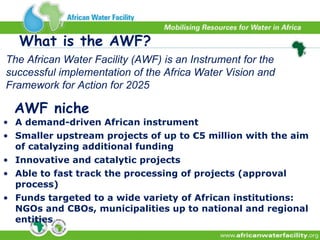
A demand-driven African instrument  Smaller upstream projects of up to €5 million with the aim of catalyzing additional funding Innovative and catalytic projects Able to fast track the processing of projects (approval process) Funds targeted to a wide variety of African institutions: NGOs and CBOs, municipalities up to national and regional entities AWF niche The African Water Facility (AWF) is an Instrument for the successful implementation of the Africa Water Vision and Framework for Action for 2025 What is the AWF?
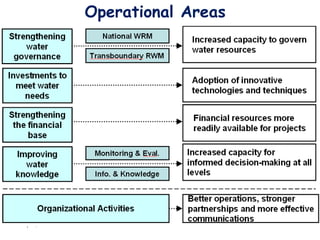
Operational Areas Sep 6, 2010
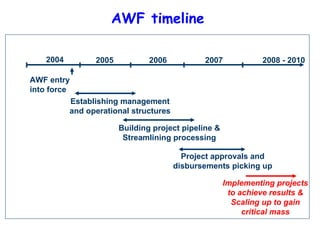
AWF timeline 2004 2005 2006 2007 2008 - 2010 AWF entry into force Establishing management and operational structures Building project pipeline &  Streamlining processing Implementing projects to achieve results & Scaling up to gain critical mass Project approvals and disbursements picking up
AWF in Africa AWF tackles in its water projects most of the contemporary challenges, including:  Ensuring water security Providing support to fragile States Increasing agricultural productivity Adaptation to climate change impacts
Diversity of projects
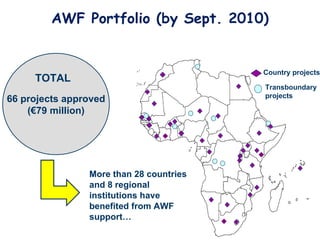
AWF Portfolio (by Sept. 2010) 66 projects approved (€79 million) TOTAL More than 28 countries and 8 regional institutions have benefited from AWF support… Transboundary projects Country projects
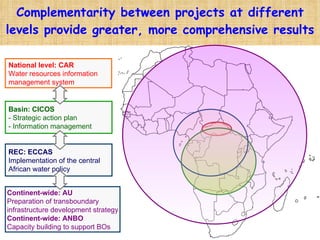
Complementarity between projects at different levels provide greater, more comprehensive results National level: CAR Water resources information  management system Basin: CICOS  - Strategic action plan  - Information management REC: ECCAS Implementation of the central  African water policy Continent-wide: AU Preparation of transboundary infrastructure development strategy Continent-wide: ANBO Capacity building to support BOs
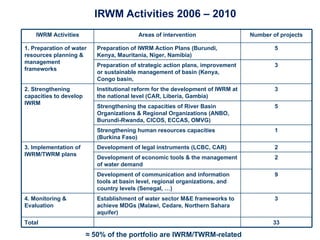
IRWM Activities 2006 – 2010 ≈  50% of the portfolio are IWRM/TWRM-related IWRM Activities Areas of intervention Number of projects 1. Preparation of water resources planning & management frameworks Preparation of IWRM Action Plans (Burundi, Kenya, Mauritania, Niger, Namibia) 5 Preparation of strategic action plans, improvement or sustainable management of basin (Kenya, Congo basin,  3 2. Strengthening capacities to develop IWRM Institutional reform for the development of IWRM at the national level (CAR, Liberia, Gambia) 3 Strengthening the capacities of River Basin Organizations & Regional Organizations (ANBO, Burundi-Rwanda, CICOS, ECCAS, OMVG) 5 Strengthening human resources capacities (Burkina Faso) 1 3. Implementation of IWRM/TWRM plans Development of legal instruments (LCBC, CAR) 2 Development of economic tools & the management of water demand 2 Development of communication and information tools at basin level, regional organizations, and country levels (Senegal, …) 9 4. Monitoring & Evaluation Establishment of water sector M&E frameworks to achieve MDGs (Malawi, Cedare, Northern Sahara aquifer) 3 Total 33
Added value of IWRM projects Strengthening of collaboration and synergies among donors through the organization of roundtable meetings in order to finance the implementation of action plans:  Congo Basin, Mali, Burundi… Intervention in post-conflict countries, which allowed a better coverage of countries with regard to IWRM development:  Liberia, Gambia,  Congo basin, Burundi, Rwanda, Togo, CAR Follow-up of actions undertaken by other donors, which made effective the implementation of IWRM Action Plans in some countries:  Senegal’s IWRM Action Plan developed with the support of Canada and GWP Mali’s IWRM Action Plan developed with the support of the Netherlands and GWP… Development of cooperation dynamics through the establishment of multi-actors dialogue and inter-institutional frameworks at basin level:  Congo basin, the Volta and ANBO
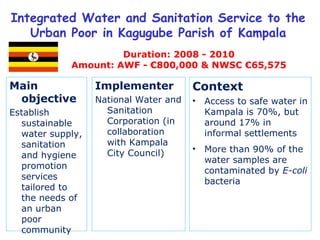
Main objective  Establish sustainable water supply, sanitation and hygiene promotion services tailored to the needs of an urban poor community  Integrated Water and Sanitation Service to the Urban Poor in Kagugube Parish of Kampala Duration: 2008 - 2010 Amount: AWF - €800,000 & NWSC €65,575 Implementer National Water and Sanitation Corporation (in collaboration with Kampala City Council) Context Access to safe water in Kampala is 70%, but around 17% in informal settlements More than 90% of the water samples are contaminated by  E-coli  bacteria
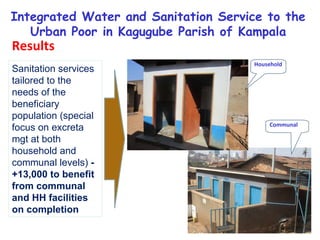
Sanitation services tailored to the needs of the beneficiary population (special focus on excreta  mgt at both household and communal levels)  - +13,000 to benefit from communal and HH facilities on completion Integrated Water and Sanitation Service to the Urban Poor in Kagugube Parish of Kampala Results Household Communal
Integrated WSS for Urban Poor in Kagugube - contd Strengthened institutional  management capacity for more  effective operation of services to the urban poor :  Urban Pro-Poor Branch of NWSC, Kampala City Council Results Improved access to water for the urban poor at official NWSC tariff through pre-paid meters:  13,000 people impacted Use of pre-paid meters provides poor and transient population with affordable and reliable (24 hours) source of water, and has been a useful ‘regulatory tool’ to eliminate overpricing by ‘middlemen’
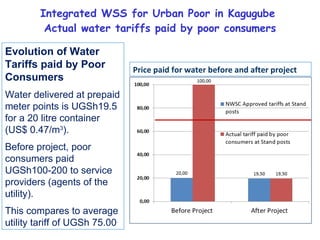
Integrated WSS for Urban Poor in Kagugube  Actual water tariffs paid by poor consumers Evolution of Water Tariffs paid by Poor Consumers Water delivered at prepaid meter points is UGSh19.5 for a 20 litre container (US$ 0.47/m 3 ).  Before project, poor consumers paid UGSh100-200 to service providers (agents of the utility). This compares to average utility tariff of UGSh 75.00 . Price paid for water before and after project
AWF is supporting AMCOW in implementing its Pan African M&E initiative  AWF funded activities undertaken in the first half of 2010 include:  Approval of a Euro 1.9 million project on strengthening water sector M&E systems in Malawi  Approval of a Euro 1.8 million regional project on Water MDG’s Monitoring and Evaluation in North Africa (Center for Environment and Development for the Arab Region and Europe) Pan African M&E Initiative
Water for Growth and Development Preparatory activities have been undertaken together with WWC to establish an African initiative to investigate the relationship between water and economic growth and development The outcomes of the study will serve as a basis for justifying actions and augmented investments in the sector  In consultation with other sector players, including OECD and GWP, AWF prepared TORs for the research assignment which is expected to start  soon Study to be presented at the 6 th  World Water Forum in March 2012
-  EC - Canada France  Sweden United Kingdom  Senegal AWF Major Funding Partners - Denmark - Norway - Austria Algeria Spain Australia AfDB
Experiences & Lessons Learned  in implementing AWF Operations There is a  large and diverse demand  for AWF support The  flexibility  AWF provides in its interventions is appreciated by beneficiaries The AWF has put in place  functional and effective  project processing systems Fast-track project processing  is a main characteristic of  AWF Partnerships  for implementation and co-financing
THANK YOU

AWF Work on Water security Issues presented by Akiça Bahri , Coordinater ,AWF at GWP Network Meeting and Consulting Partners Meeting 2010 ,Stockholm

  • 1.
    GWP NETWORK MEETINGAND CONSULTING PARTNERS MEETING 2010   Stockholm, 3-4 September 2010 Akiça Bahri Coordinator, AWF AWF WORK ON WATER SECURITY ISSUES
  • 2.
    A demand-driven Africaninstrument Smaller upstream projects of up to €5 million with the aim of catalyzing additional funding Innovative and catalytic projects Able to fast track the processing of projects (approval process) Funds targeted to a wide variety of African institutions: NGOs and CBOs, municipalities up to national and regional entities AWF niche The African Water Facility (AWF) is an Instrument for the successful implementation of the Africa Water Vision and Framework for Action for 2025 What is the AWF?
  • 3.
  • 4.
    AWF timeline 20042005 2006 2007 2008 - 2010 AWF entry into force Establishing management and operational structures Building project pipeline & Streamlining processing Implementing projects to achieve results & Scaling up to gain critical mass Project approvals and disbursements picking up
  • 5.
    AWF in AfricaAWF tackles in its water projects most of the contemporary challenges, including: Ensuring water security Providing support to fragile States Increasing agricultural productivity Adaptation to climate change impacts
  • 6.
  • 7.
    AWF Portfolio (bySept. 2010) 66 projects approved (€79 million) TOTAL More than 28 countries and 8 regional institutions have benefited from AWF support… Transboundary projects Country projects
  • 8.
    Complementarity between projectsat different levels provide greater, more comprehensive results National level: CAR Water resources information management system Basin: CICOS - Strategic action plan - Information management REC: ECCAS Implementation of the central African water policy Continent-wide: AU Preparation of transboundary infrastructure development strategy Continent-wide: ANBO Capacity building to support BOs
  • 9.
    IRWM Activities 2006– 2010 ≈ 50% of the portfolio are IWRM/TWRM-related IWRM Activities Areas of intervention Number of projects 1. Preparation of water resources planning & management frameworks Preparation of IWRM Action Plans (Burundi, Kenya, Mauritania, Niger, Namibia) 5 Preparation of strategic action plans, improvement or sustainable management of basin (Kenya, Congo basin, 3 2. Strengthening capacities to develop IWRM Institutional reform for the development of IWRM at the national level (CAR, Liberia, Gambia) 3 Strengthening the capacities of River Basin Organizations & Regional Organizations (ANBO, Burundi-Rwanda, CICOS, ECCAS, OMVG) 5 Strengthening human resources capacities (Burkina Faso) 1 3. Implementation of IWRM/TWRM plans Development of legal instruments (LCBC, CAR) 2 Development of economic tools & the management of water demand 2 Development of communication and information tools at basin level, regional organizations, and country levels (Senegal, …) 9 4. Monitoring & Evaluation Establishment of water sector M&E frameworks to achieve MDGs (Malawi, Cedare, Northern Sahara aquifer) 3 Total 33
  • 10.
    Added value ofIWRM projects Strengthening of collaboration and synergies among donors through the organization of roundtable meetings in order to finance the implementation of action plans: Congo Basin, Mali, Burundi… Intervention in post-conflict countries, which allowed a better coverage of countries with regard to IWRM development: Liberia, Gambia, Congo basin, Burundi, Rwanda, Togo, CAR Follow-up of actions undertaken by other donors, which made effective the implementation of IWRM Action Plans in some countries: Senegal’s IWRM Action Plan developed with the support of Canada and GWP Mali’s IWRM Action Plan developed with the support of the Netherlands and GWP… Development of cooperation dynamics through the establishment of multi-actors dialogue and inter-institutional frameworks at basin level: Congo basin, the Volta and ANBO
  • 11.
    Main objective Establish sustainable water supply, sanitation and hygiene promotion services tailored to the needs of an urban poor community Integrated Water and Sanitation Service to the Urban Poor in Kagugube Parish of Kampala Duration: 2008 - 2010 Amount: AWF - €800,000 & NWSC €65,575 Implementer National Water and Sanitation Corporation (in collaboration with Kampala City Council) Context Access to safe water in Kampala is 70%, but around 17% in informal settlements More than 90% of the water samples are contaminated by E-coli bacteria
  • 12.
    Sanitation services tailoredto the needs of the beneficiary population (special focus on excreta mgt at both household and communal levels) - +13,000 to benefit from communal and HH facilities on completion Integrated Water and Sanitation Service to the Urban Poor in Kagugube Parish of Kampala Results Household Communal
  • 13.
    Integrated WSS forUrban Poor in Kagugube - contd Strengthened institutional management capacity for more effective operation of services to the urban poor : Urban Pro-Poor Branch of NWSC, Kampala City Council Results Improved access to water for the urban poor at official NWSC tariff through pre-paid meters: 13,000 people impacted Use of pre-paid meters provides poor and transient population with affordable and reliable (24 hours) source of water, and has been a useful ‘regulatory tool’ to eliminate overpricing by ‘middlemen’
  • 14.
    Integrated WSS forUrban Poor in Kagugube Actual water tariffs paid by poor consumers Evolution of Water Tariffs paid by Poor Consumers Water delivered at prepaid meter points is UGSh19.5 for a 20 litre container (US$ 0.47/m 3 ). Before project, poor consumers paid UGSh100-200 to service providers (agents of the utility). This compares to average utility tariff of UGSh 75.00 . Price paid for water before and after project
  • 15.
    AWF is supportingAMCOW in implementing its Pan African M&E initiative AWF funded activities undertaken in the first half of 2010 include: Approval of a Euro 1.9 million project on strengthening water sector M&E systems in Malawi Approval of a Euro 1.8 million regional project on Water MDG’s Monitoring and Evaluation in North Africa (Center for Environment and Development for the Arab Region and Europe) Pan African M&E Initiative
  • 16.
    Water for Growthand Development Preparatory activities have been undertaken together with WWC to establish an African initiative to investigate the relationship between water and economic growth and development The outcomes of the study will serve as a basis for justifying actions and augmented investments in the sector In consultation with other sector players, including OECD and GWP, AWF prepared TORs for the research assignment which is expected to start soon Study to be presented at the 6 th World Water Forum in March 2012
  • 17.
    - EC- Canada France Sweden United Kingdom Senegal AWF Major Funding Partners - Denmark - Norway - Austria Algeria Spain Australia AfDB
  • 18.
    Experiences & LessonsLearned in implementing AWF Operations There is a large and diverse demand for AWF support The flexibility AWF provides in its interventions is appreciated by beneficiaries The AWF has put in place functional and effective project processing systems Fast-track project processing is a main characteristic of AWF Partnerships for implementation and co-financing
  • 19.

Editor's Notes

  • #5 It is important to put the status and the achievements of the AWF into context. Donors are calling for results as the Facility has now existed for 3 years. However, it was only in 2007 that the Facility became truly operational. Before that the few staff working on the Facility were setting up the frameworks surrounding the Facility. Project results may only be expected as of later in 2008 and mainly in 2009+.
  • #19 Need notes on fast-track