WATER CONSERVATION
Viveha
s
WATER CONSERVATION
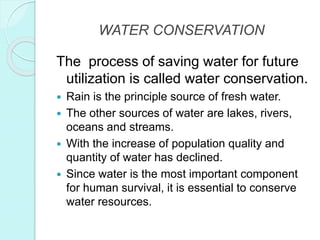
The process of saving water for future
utilization is called water conservation.
 Rain is the principle source of fresh water.
 The other sources of water are lakes, rivers,
oceans and streams.
 With the increase of population quality and
quantity of water has declined.
 Since water is the most important component
for human survival, it is essential to conserve
water resources.
NEED FOR WATER CONSERVATION
 As population increases, the requirement of
water also increases.
 Less than 1% of water on the earth is readily
available for human use.
 Due to deforestation there is a decrease in the
annual rainfall.
 Agricultural and industrial activities require
more fresh water.
 Over exploitation of ground water leads to
drought.
STRATEGIES OF WATER
CONSERVATION
The following strategies can be adopted for conservation
of water.
1. Reducing evaporation loss: evaporation of water in
humid regions can be reduced by placing horizontal
barriers of asphalt below the soil surface , which
increases water availability and crop yield.
2. Reducing irrigation loss: water loss during irrigation
can be reduced by the following methods.
 Growing hybrid crop varieties.
 Irrigation in early morning or later evening.
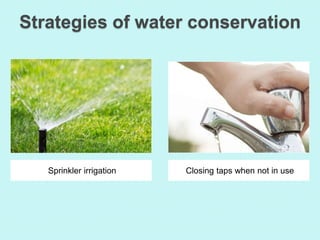
 Using drip irrigation or sprinkler irrigation.
Strategies of water conservation
Sprinkler irrigation Closing taps when not in use
3. Re-use of water:
 Treated water can be used for ferti-irrigation.
 Grey water can be used for washing cars, watering
gardens, etc .
 Water used for washing vegetables and fruits can be
used to water plants.
4. Preventing wastage of water:
wastage of water can be prevented by:
• closing the taps when not in use.
• repair any leakage from pipes.
• use small capacity taps.
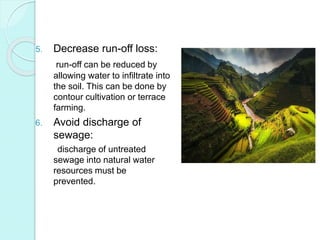
5. Decrease run-off loss:
run-off can be reduced by
allowing water to infiltrate into
the soil. This can be done by
contour cultivation or terrace
farming.
6. Avoid discharge of
sewage:
discharge of untreated
sewage into natural water
resources must be
prevented.
METHODS OF WATER
CONSERVATION
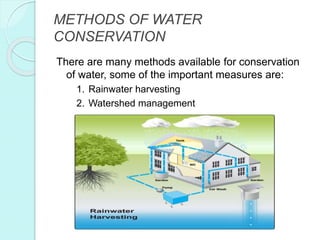
There are many methods available for conservation
of water, some of the important measures are:
1. Rainwater harvesting
2. Watershed management
RAINWATER HARVESTING
Rainwater harvesting is a technique of collecting
and storing rainwater in natural reservoirs or tanks
for future utilization.
Objecting of rainwater harvesting:
 To meet increasing demands of water.
 To reduce ground water contamination.
 To minimize eater crisis.
 To reduce soil erosion.
 To raise the water table by recharging the ground water.
ROOFTOP RAINWATER HARVESTING
It is a method of collecting rainwater from the roof of
the building and storing it for future use.
It is a low cost and effective technique for urban
buildings.
ADVANTAGES OF RAINWATER HARVESTING
 Improves the quality and quantity of ground water.
 reduces soil erosion and flooding.
 increases the availability of water.
 Promotes water and energy conservation.
WATERSHED MANAGEMENT
Watershed: land area from which water drains under
the influence of gravity into a stream, lake,
reservoir or other body of surface water.
Watershed management: the management of rainfall
and resultant runoff is called watershed
management.
Factors affecting watershed:
 Overgrazing
 deforestation
 Mining
 Construction activities
 Droughty climates
Objectives of watershed management:
 To minimize the risks of floods, droughts and landslides.
 To prevent soil erosion by runoff.
 To raise the ground water level.
 To generate employment opportunities.
 To develop rural areas in the region.
Watershed management techniques:
1. Trenches: trenches are dug at equal intervals to
improve groundwater storage.
2. Earthen dam: it is constructed in the catchment area
to check the water run-off.
3. Farm pond: it can be built to improve water storage
capacity of the catchment area.
4. Dykes :It must be built along nullahs to raise the water
table.
MAINTAINANCE 0F WATERSHED
1. Water harvesting: proper storage of water in
watershed is done so that the water can be used
during dry seasons.
2. Aforestation & agro forestry: it helps to prevent soil
erosion and retention of moisture in watershed areas.
3. Reducing soil erosion: contour cropping, strip
cropping, etc., are used to minimize soil erosion.
4. Scientific mining and quarrying: due to improper
mining, the stability of hills get disturbed resulting in
landslides. Planting soil binding plants at an interval of
1 meter on overburden dump in the mined area are
recommended for minimizing the effects of mining in
watershed areas.
5. Minimizing livestock population: livestock population
in the villages surrounding the watershed should be
Thank you

Water conservation

  • 1.
  • 2.
    WATER CONSERVATION The processof saving water for future utilization is called water conservation.  Rain is the principle source of fresh water.  The other sources of water are lakes, rivers, oceans and streams.  With the increase of population quality and quantity of water has declined.  Since water is the most important component for human survival, it is essential to conserve water resources.
  • 3.
    NEED FOR WATERCONSERVATION  As population increases, the requirement of water also increases.  Less than 1% of water on the earth is readily available for human use.  Due to deforestation there is a decrease in the annual rainfall.  Agricultural and industrial activities require more fresh water.  Over exploitation of ground water leads to drought.
  • 4.
    STRATEGIES OF WATER CONSERVATION Thefollowing strategies can be adopted for conservation of water. 1. Reducing evaporation loss: evaporation of water in humid regions can be reduced by placing horizontal barriers of asphalt below the soil surface , which increases water availability and crop yield. 2. Reducing irrigation loss: water loss during irrigation can be reduced by the following methods.  Growing hybrid crop varieties.  Irrigation in early morning or later evening.  Using drip irrigation or sprinkler irrigation.
  • 5.
    Strategies of waterconservation Sprinkler irrigation Closing taps when not in use
  • 6.
    3. Re-use ofwater:  Treated water can be used for ferti-irrigation.  Grey water can be used for washing cars, watering gardens, etc .  Water used for washing vegetables and fruits can be used to water plants. 4. Preventing wastage of water: wastage of water can be prevented by: • closing the taps when not in use. • repair any leakage from pipes. • use small capacity taps.
  • 7.
    5. Decrease run-offloss: run-off can be reduced by allowing water to infiltrate into the soil. This can be done by contour cultivation or terrace farming. 6. Avoid discharge of sewage: discharge of untreated sewage into natural water resources must be prevented.
  • 8.
    METHODS OF WATER CONSERVATION Thereare many methods available for conservation of water, some of the important measures are: 1. Rainwater harvesting 2. Watershed management
  • 9.
    RAINWATER HARVESTING Rainwater harvestingis a technique of collecting and storing rainwater in natural reservoirs or tanks for future utilization. Objecting of rainwater harvesting:  To meet increasing demands of water.  To reduce ground water contamination.  To minimize eater crisis.  To reduce soil erosion.  To raise the water table by recharging the ground water.
  • 10.
    ROOFTOP RAINWATER HARVESTING Itis a method of collecting rainwater from the roof of the building and storing it for future use. It is a low cost and effective technique for urban buildings. ADVANTAGES OF RAINWATER HARVESTING  Improves the quality and quantity of ground water.  reduces soil erosion and flooding.  increases the availability of water.  Promotes water and energy conservation.
  • 11.
    WATERSHED MANAGEMENT Watershed: landarea from which water drains under the influence of gravity into a stream, lake, reservoir or other body of surface water. Watershed management: the management of rainfall and resultant runoff is called watershed management. Factors affecting watershed:  Overgrazing  deforestation  Mining  Construction activities  Droughty climates
  • 12.
    Objectives of watershedmanagement:  To minimize the risks of floods, droughts and landslides.  To prevent soil erosion by runoff.  To raise the ground water level.  To generate employment opportunities.  To develop rural areas in the region. Watershed management techniques: 1. Trenches: trenches are dug at equal intervals to improve groundwater storage. 2. Earthen dam: it is constructed in the catchment area to check the water run-off. 3. Farm pond: it can be built to improve water storage capacity of the catchment area. 4. Dykes :It must be built along nullahs to raise the water table.
  • 13.
    MAINTAINANCE 0F WATERSHED 1.Water harvesting: proper storage of water in watershed is done so that the water can be used during dry seasons. 2. Aforestation & agro forestry: it helps to prevent soil erosion and retention of moisture in watershed areas. 3. Reducing soil erosion: contour cropping, strip cropping, etc., are used to minimize soil erosion. 4. Scientific mining and quarrying: due to improper mining, the stability of hills get disturbed resulting in landslides. Planting soil binding plants at an interval of 1 meter on overburden dump in the mined area are recommended for minimizing the effects of mining in watershed areas. 5. Minimizing livestock population: livestock population in the villages surrounding the watershed should be
  • 14.