ORIGINAL PAPER
N.L. Warren Æ P.N. Trathan Æ J. Forcada Æ A. Fleming
M.J. Jessopp
Distribution of post-weaning Antarctic fur seal Arctocephalus gazella
pups at South Georgia
Received: 27 January 2005 / Revised: 8 June 2005 / Accepted: 13 June 2005
Ó Springer-Verlag 2005
Abstract Potentially some of the biggest gaps in our
knowledge about the ecology of Antarctic fur seals
(Arctocephalus gazella) relate to juvenile animals. We
investigated the at-sea distribution of five male and five
female fur seal pups post-weaning. The study was car-
ried out at Bird Island, South Georgia during two suc-
cessive winters using satellite-linked platform
transmitter terminals (PTTs). Our results are analysed in
relation to pup sex and the physical environment and
productivity of those 2 years, as well as in the context of
our present knowledge of where post-breeding females
and males forage. The available physical and biological
data during both of the winters of this study suggest that
both years were not unusual. We report marked differ-
ences between the sexes with male pups foraging sig-
nificantly further away from land and their birth site
than do females. The pups foraged in areas to the East
of Bird Island seldom reported as foraging areas for the
adult population. Also as winter progressed they showed
a more oceanic distribution leaving the continental shelf,
possibly to exploit a different prey source that was more
readily available in the upper water column.
Introduction
The Antarctic fur seal (Arctocephalus gazella) popula-
tion at South Georgia has recovered from the brink of
extinction over the course of the twentieth century.
Initial indications of recovery started with the discovery
of a few small, isolated breeding colonies in the 1930s;
these had increased to an estimated population of over
1.5 million by the early 1990s (Boyd 1993). Today, the
population is thought to be in excess of 3 million (Bar-
low and Croxall 2002).
A recent estimate of food consumption by Antarctic
fur seals at South Georgia, assuming a diet mainly of
krill (Reid and Arnould 1996), suggests that this popu-
lation consumes approximately 3.84 million tonnes of
krill annually (Boyd 2002a), based on the 1991 popula-
tion estimates. This removal of krill from the South
Georgia region potentially brings fur seals into direct
competition with other species and with man. Compet-
itive interactions with sympatric species are thought to
be increasingly important and certainly are not negligi-
ble, especially for other krill specialists such as macaroni
penguins (Barlow and Croxall 2002). Similarly, interac-
tions between fishermen and seals, either through com-
petition for resources or through incidental mortality,
are increasingly recognised as an important issue in
ecosystem management; both entanglement in fishing
gear (Arnould and Croxall 1995) and by-catch (Hooper
et al. 2004) are now known to occur in South Georgia
waters.
Consequently, as the population of Antarctic fur
seals continues to expand and as interactions with other
marine predators and with man intensify, it is increas-
ingly important to obtain information about the diet,
feeding behaviour and foraging areas of these top pre-
dators. In the Southern Ocean, such information is
considered to be critical to the management process
(Agnew 1997); this is because Southern Ocean fisheries,
including that for Antarctic krill (a major constituent of
the diet of Antarctic fur seal), are managed using eco-
system-based methods (http://www.ccamlr.org/pu/e/
pubs/am/toc.htm; CCAMLR 2002).
Many studies have investigated the at-sea distribution
of Antarctic fur seals throughout their complete cir-
cumpolar range (e.g. Staniland et al. 2004; Boyd et al.
2002, 1998 in the Southern Atlantic; Bonadonna et al.
N.L. Warren Æ P.N. Trathan (&) Æ J. Forcada Æ A. Fleming
M.J. Jessopp
British Antarctic Survey, Natural Environment Research Council,
Madingley Road, Cambridge, CB3 0ET UK
E-mail: pnt@bas.ac.uk
Tel.: +44-1223-221602
Fax: +44-1223-221259
Present address: M.J. Jessopp
Department of Zoology, Ecology and Plant Science, University
College Cork, Lee Maltings, Cork, Ireland
Polar Biol (2005)
DOI 10.1007/s00300-005-0037-x
2001; Guinet et al. 2001 in the Indian Ocean; Robinson
et al. 2002 in the Pacific). However, most studies have
concentrated on breeding females and very little work
has been carried out on males or on other demographic
categories.
Several studies on the foraging distribution of marine
mammals have observed marked differences between
sexes (Boyd et al. 1998; Stewart 1997; Kovacs et al.
1990, Hindell et al. 1991; LeBoeuf et al. 1993; Stewart
and DeLong 1993) and age classes (Merrick and Loug-
hin 1997; McConnell et al. 2002) of pinnipeds. These
studies highlight that conclusions about feeding behav-
iour and foraging distribution could potentially be
biased if intra-specific differences are ignored. The
importance of gaining a better understanding of fur seal
distribution across different age classes and sexes is
therefore essential.
Potentially one of the biggest gaps in our knowledge
is that for juvenile animals. Very little is known about
juveniles after they leave their birth site until they return
to breed as 3-year olds (females) or 7-year olds (males).
Consequently, in this study, we investigated the at-sea
distribution of Antarctic fur seal pups in the period
immediately after they were weaned. The study was
carried out at Bird Island, South Georgia during two
successive winters using satellite-linked platform trans-
mitter terminals (PTTs). Our results are analysed in
relation to the sex of the pup and the physical environ-
ment (bathymetry, sea surface temperature) and a
measure of primary productivity (SeaWiFS), as well as
in the context of our present knowledge of where post-
breeding females forage.
Materials and methods
Experimental design
Platform transmitter terminal are expensive both in
terms of the cost of the instruments and their operations
(Boyd 2002b). Our experimental design was therefore a
compromise between sample size and our intended
protocol. Consequently to reduce variability associated
with gender and inter-annual environmental differences
we deployed tags on one gender only in each of our
study years, but were careful to monitor environmental
conditions in both years.
The study period extended from April until early
September 2001 for males and from April to late
December 2002 for females. When comparing the male
and female distributions, we have only considered the
months in which data were available for both sexes, thus
the period of interest ranged from the start of April until
the end of August in both years.
Deployments
The study was carried out from Freshwater Beach, Bird
Island, South Georgia (54°00¢S; 38°02¢W). Prior to
weaning and departure from the breeding beaches
(Doidge et al. 1986), five male and five female pups were
chosen randomly in April 2001 and 2002, respectively.
The pups were caught using a well-established restrain-
ing method (Boyd et al. 1998). Weight measurements
were collected and each individual was given a unique
identification marker with numbered tags (Dalton Sup-
plies, Henley-on-Thames, UK). The 180 g satellite-
linked platform transmitter terminals (PTTs; Model ST
À18 25% duty cycled; Telonics, USA, packaged by
Sirtrack, New Zealand) were deployed to the fur of each
study animal in the mid-dorsal region between the
scapulae using epoxy glue (Boyd et al. 1998). Total de-
vice mass always represented less than 1.5% of the fur
seal body mass. The animals were subsequently released.
No handling interval lasted more than 30 min
Data handling
The resulting Argos uplinks and locations were filtered
to remove potentially unreliable records. Locations
determined by two or fewer uplinks were removed (all
B and Z Classes). The remaining uplinks (Classes 3, 2, 1,
0 and A) were deemed to be reliable (Vincent et al. 2002)
and were further filtered by identifying fixes that would
require an unrealistic rate of travel. The ‘maximum
speed parameter’ in the filter was set to 2.0 m sÀ1
(Boyd
1996). The data were then plotted and analysed using
ESRI ArcMap 8.3. The point distributions were trans-
formed into density estimates using Kernel-based
methods.
Using the coordinates of two points, the distance
between these two were calculated using the great circle
arc which is the shortest distance between two points on
a spherical surface (Maling 1992).
Environment
The physical environment probably drives a large pro-
portion of the observed biological variability at South
Georgia (Trathan et al. 2005); we thus compared the
differences between the two study years in terms of Sea
Surface Temperatures (SST). We also compared the
biological environment during the two years in terms of
surface chlorophyll-a. These two environmental vari-
ables were used to describe the conditions that the fur
seals were experiencing during both years. Data outputs
from these analyses include monthly SST grids in units
of degrees Celsius (°C) with an approximate spatial
resolution of 4 km.
The SeaWiFS-derived estimates of surface chloro-
phyll-a concentration were obtained from the Goddard
Distributed Active Archive Centre using the standard
OC4v4 chlorophyll algorithm, described by O’Reilly
et al. (2001). The grids were in units of mg mÀ3
and had
an approximate spatial resolution of 9 km.
The area for the analysis of the SST and SeaWiFS
around South Georgia was set as 49–57° South and
20–44° West to incorporate the overall distribution of
the fur seals during both winters.
Data used to trace the Antarctic polar front and the
Southern Antarctic circumpolar current, one of the fast
moving jets of the Antarctic Circumpolar Currents were
taken from Moore et al. (1999), Orsi et al. (1995) and
Trathan et al. (1997).
To determine the extent of the differences between
years for these oceanographic variables, we analysed
differences between the means of each month and year
by regression analysis. The same method was used for
both the SeaWiFS and SST data.
Five different models were fitted to the data using
Splus (Mathsoft Inc. Cambridge MA, USA):
– A simple linear model where SeaWiFS or SST are a
function of month, year and the interaction of month
on year.
– The same model without the interaction of month on
year.
– Two linear models with separate intercept.
– Two linear models with a separate intercept and a
quadratic relationship
– A simple linear model with a quadratic relationship.
These five models were compared using a model-
order selection criterion based on parsimony, where
more complicated models are penalised for the inclusion
of additional parameters, named the Akaike Informa-
tion Criteria (AIC); the model with the lowest AIC was
chosen.
Results
Oceanography
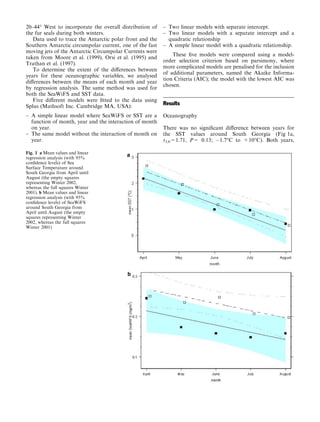
There was no significant difference between years for
the SST values around South Georgia (Fig 1a,
t3,6=1.71, P= 0.13; À1.7°C to +10°C). Both years,
Fig. 1 a Mean values and linear
regression analysis (with 95%
confidence levels) of Sea
Surface Temperature around
South Georgia from April until
August (the empty squares
representing Winter 2002,
whereas the full squares Winter
2001). b Mean values and linear
regression analysis (with 95%
confidence levels) of SeaWiFS
around South Georgia from
April until August (the empty
squares representing Winter
2002, whereas the full squares
Winter 2001)
showed a linear decline in sea temperatures as winter
progressed.
A significant difference between years for the SeaW-
iFS was recorded (Fig 1b, F3,6= 12.04, P= 0.006) and
this was to the 10À2
mg mÀ3
level; an amount we did not
consider to be biologically significant, knowing that the
difference between a productive and unproductive area
in summer around South Georgia ranges from 15–
20 mg mÀ3
to <0.3 mg mÀ3
, respectively (Korb et al.
2004). Winter productivity also declined over our study
area from April to August.
We thus assumed that both winters did not differ
greatly in terms of productivity and temperature and
therefore the weaned seals experienced similar environ-
mental conditions.
Tracking duration and overview of movements
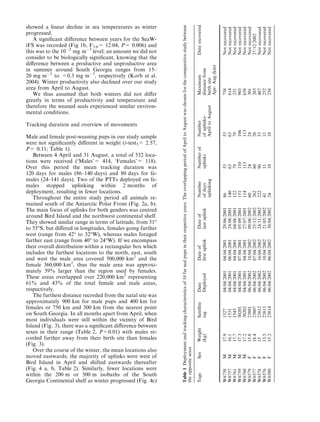
Male and female post-weaning pups in our study sample
were not significantly different in weight (t-test5= 2.57,
P= 0.11; Table 1).
Between 4 April and 31 August, a total of 532 loca-
tions were received (‘Males’= 414, ‘Females’= 118).
Over this period the mean tracking duration was
120 days for males (86–140 days) and 80 days for fe-
males (24–141 days). Two of the PTTs deployed on fe-
males stopped uplinking within 2 months of
deployment, resulting in fewer locations.
Throughout the entire study period all animals re-
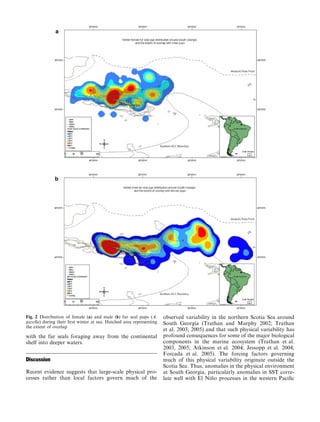
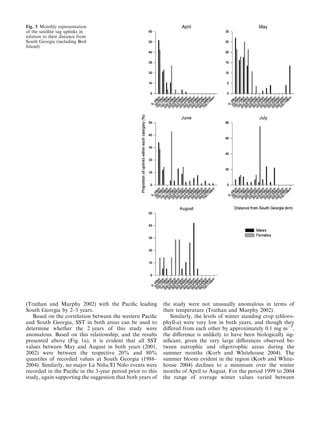
mained south of the Antarctic Polar Front (Fig. 2a, b).
The main focus of uplinks for both genders was centred
around Bird Island and the northwest continental shelf.
They showed similar range in terms of latitude, from 51°
to 55°S, but differed in longitudes, females going further
west (range from 42° to 32°W), whereas males foraged
further east (range from 40° to 24°W). If we encompass
their overall distribution within a rectangular box which
includes the furthest locations to the north, east, south
and west the male area covered 500,000 km2
and the
female 360,000 km2
, thus the male area was approxi-
mately 39% larger than the region used by females.
These areas overlapped over 220,000 km2
representing
61% and 43% of the total female and male areas,
respectively.
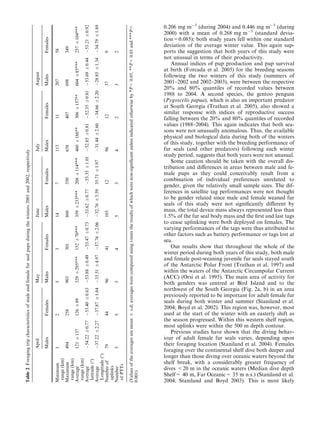
The furthest distance recorded from the natal site was
approximately 900 km for male pups and 400 km for
females or 750 km and 300 km from the nearest point
on South Georgia. In all months apart from April, when
most individuals were still within the vicinity of Bird
Island (Fig. 3), there was a significant difference between
sexes in their range (Table 2, P<0.01) with males re-
corded further away from their birth site than females
(Fig. 3).
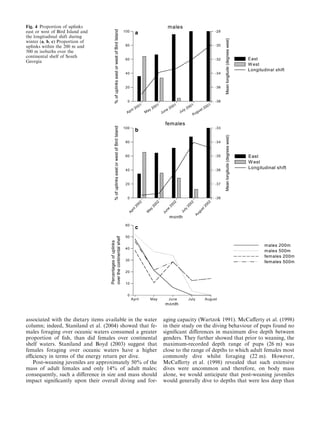
Over the course of the winter, the mean locations also
moved eastwards; the majority of uplinks were west of
Bird Island in April and shifted eastwards thereafter
(Fig. 4 a, b, Table 2). Similarly, fewer locations were
within the 200 m or 500 m isobaths of the South
Georgia Continental shelf as winter progressed (Fig. 4c)
Table1Deploymentandtrackingcharacteristicsof10fursealpupsintheirrespectiveyears.TheoverlappingperiodofApriltoAugustwaschosenforthecomparativestudybetween
theoppositesexes
TagsSexWeight
(kg)
Satellite
tag
Date
Deployed
Dateof
firstuplink
Dateof
lastuplink
Number
ofdays
uplinking
Numberof
uplinks
Number
ofuplinks-
ApriltoAugust
Maximum
distancefrom
birthsite
Apr-Aug(km)
Daterecovered
W6758M17.9152704/04/200104/04/200129/06/2001865353758Notrecovered
W6757M16.1153104/04/200106/04/200124/08/20011406363614Notrecovered
W6761M17.7154304/04/200104/04/200104/08/20011227979231Notrecovered
W6759M17.33020104/04/200107/04/200105/09/2001151110106903Notrecovered
W6760M17.23020204/04/200104/04/200127/07/2001114113113658Notrecovered
W6579F15.82380106/04/200210/04/200209/06/2002602424301Notrecovered
W6577F18.42380706/04/200207/04/200225/12/2002262802026527/12/2002
W6578F152381206/04/200216/04/200224/11/20022229053407Notrecovered
W6576F13.52381306/04/200210/04/200221/05/2002411111252Notrecovered
W6580F15.22381406/04/200206/04/200230/04/2002241010258Notrecovered
with the fur seals foraging away from the continental
shelf into deeper waters.
Discussion
Recent evidence suggests that large-scale physical pro-
cesses rather than local factors govern much of the
observed variability in the northern Scotia Sea around
South Georgia (Trathan and Murphy 2002; Trathan
et al. 2003; 2005) and that such physical variability has
profound consequences for some of the major biological
components in the marine ecosystem (Trathan et al.
2003, 2005; Atkinson et al. 2004; Jessopp et al. 2004;
Forcada et al. 2005). The forcing factors governing
much of this physical variability originate outside the
Scotia Sea. Thus, anomalies in the physical environment
at South Georgia, particularly anomalies in SST corre-
late well with El Nin˜ o processes in the western Pacific
Fig. 2 Distribution of female (a) and male (b) fur seal pups (A.
gazella) during their first winter at sea. Hatched area representing
the extent of overlap
(Trathan and Murphy 2002) with the Pacific leading
South Georgia by 2–3 years.
Based on the correlation between the western Pacific
and South Georgia, SST in both areas can be used to
determine whether the 2 years of this study were
anomalous. Based on this relationship, and the results
presented above (Fig. 1a), it is evident that all SST
values between May and August in both years (2001,
2002) were between the respective 20% and 80%
quantiles of recorded values at South Georgia (1988–
2004). Similarly, no major La Nin˜ a/El Nin˜ o events were
recorded in the Pacific in the 3-year period prior to this
study, again supporting the suggestion that both years of
the study were not unusually anomalous in terms of
their temperature (Trathan and Murphy 2002).
Similarly, the levels of winter standing crop (chloro-
phyll-a) were very low in both years, and though they
differed from each other by approximately 0.1 mg mÀ3
,
the difference is unlikely to have been biologically sig-
nificant, given the very large differences observed be-
tween eutrophic and oligotrophic areas during the
summer months (Korb and Whitehouse 2004). The
summer bloom evident in the region (Korb and White-
house 2004) declines to a minimum over the winter
months of April to August. For the period 1999 to 2004
the range of average winter values varied between
Fig. 3 Monthly representation
of the satellite tag uplinks in
relation to their distance from
South Georgia (including Bird
Island)
0.206 mg mÀ3
(during 2004) and 0.446 mg mÀ3
(during
2000) with a mean of 0.268 mg mÀ3
(standard devia-
tion=0.085); both study years fell within one standard
deviation of the average winter value. This again sup-
ports the suggestion that both years of this study were
not unusual in terms of their productivity.
Annual indices of pup production and pup survival
at birth (Forcada et al. 2005) for the breeding seasons
following the two winters of this study (summers of
2001–2002 and 2002–2003), were between the respective
20% and 80% quantiles of recorded values between
1988 to 2004. A second species, the gentoo penguin
(Pygoscelis papua), which is also an important predator
at South Georgia (Trathan et al. 2005), also showed a
similar response with indices of reproductive success
falling between the 20% and 80% quantiles of recorded
values (1988–2004). This again indicates that both sea-
sons were not unusually anomalous. Thus, the available
physical and biological data during both of the winters
of this study, together with the breeding performance of
fur seals (and other predators) following each winter
study period, suggests that both years were not unusual.
Some caution should be taken with the overall dis-
tribution and differences in areas between male and fe-
male pups as they could conceivably result from a
combination of individual preferences unrelated to
gender, given the relatively small sample sizes. The dif-
ferences in satellite tag performances were not thought
to be gender related since male and female weaned fur
seals of this study were not significantly different by
mass, the total device mass always represented less than
1.5% of the fur seal body mass and the first and last tags
to cease uplinking were both deployed on females. The
varying performances of the tags were thus attributed to
other factors such as battery performance or tags lost at
sea.
Our results show that throughout the whole of the
winter period during both years of this study, both male
and female post-weaning juvenile fur seals stayed south
of the Antarctic Polar Front (Trathan et al. 1997) and
within the waters of the Antarctic Circumpolar Current
(ACC) (Orsi et al. 1995). The main area of activity for
both genders was centred at Bird Island and to the
northwest of the South Georgia (Fig. 2a, b) in an area
previously reported to be important for adult female fur
seals during both winter and summer (Staniland et al.
2004; Boyd et al. 2002). This region was, however, most
used at the start of the winter with an easterly shift as
the season progressed. Within this western shelf region,
most uplinks were within the 500 m depth contour.
Previous studies have shown that the diving behav-
iour of adult female fur seals varies, depending upon
their foraging location (Staniland et al. 2004). Females
foraging over the continental shelf dive both deeper and
longer than those diving over oceanic waters beyond the
shelf break, with a considerably greater frequency of
dives <20 m in the oceanic waters (Median dive depth
Shelf= 40 m, Far Oceanic= 35 m n.s.) (Staniland et al.
2004; Staniland and Boyd 2003). This is most likely
Table2Foragingtripcharacteristicsofmaleandfemalefursealpupsduringthewinters2001and2002,respectively
AprilMayJuneJulyAugust
MalesFemalesMalesFemalesMalesFemalesMalesFemalesMalesFemales
Minimum
range(km)
12531471131120758
Maximum
range(km)
494258903301860350658407698349
Average
range(km)
121±137126±89329±295***152±70***359±233***208±114***460±186**306±137**604±85***257±104***
Average
latitude(°)
À54.22±0.77À53.40±0.63À53.88±0.49À53.47±0.73À53.62±0.77À53.35±1.01À52.85±0.81À52.35±0.81À53.69±0.44À53.21±0.92
Average
Longitude(°)
À37.22±2.27À37.87±1.84À33.51±4.97À37.76±2.06À32.76±3.5935.71±1.97À31.44±2.60À34.66±2.20À28.85±1.34À34.79±1.89
Numberof
uplinks
79449641103129612379
Number
ofPTTs
5554534232
(Valuesoftheaveragesaremean±s.d;averageswerecomparedusingt-teststheresultsofwhichwerenon-significantunlessindicatedotherwiseby*P<0.05,**P<0.01and***P<
0.001)
associated with the dietary items available in the water
column; indeed, Staniland et al. (2004) showed that fe-
males foraging over oceanic waters consumed a greater
proportion of fish, than did females over continental
shelf waters. Staniland and Boyd (2003) suggest that
females foraging over oceanic waters have a higher
efficiency in terms of the energy return per dive.
Post-weaning juveniles are approximately 50% of the
mass of adult females and only 14% of adult males;
consequently, such a difference in size and mass should
impact significantly upon their overall diving and for-
aging capacity (Wartzok 1991). McCafferty et al. (1998)
in their study on the diving behaviour of pups found no
significant differences in maximum dive depth between
genders. They further showed that prior to weaning, the
maximum-recorded depth range of pups (26 m) was
close to the range of depths to which adult females most
commonly dive whilst foraging (22 m). However,
McCafferty et al. (1998) revealed that such extensive
dives were uncommon and therefore, on body mass
alone, we would anticipate that post-weaning juveniles
would generally dive to depths that were less deep than
Fig. 4 Proportion of uplinks
east or west of Bird Island and
the longitudinal shift during
winter (a, b, c) Proportion of
uplinks within the 200 m and
500 m isobaths over the
continental shelf of South
Georgia
those of adult females. Thus, post-weaning juveniles
foraging over the shelf in an area intensively used by
other fur seals and higher predators would need to in-
crease their diving capacity rapidly and/or target dif-
ferent prey items.
After April, the majority of uplinks were to the east
of Bird Island and over deeper waters (Fig. 4). This ra-
pid move away from continental shelf waters is consis-
tent with post-weaning juveniles seals possibly targeting
a different prey source that was more readily available in
the upper water column. The reasons for this easterly
shift are unclear but could be partly associated with the
distribution of Antarctic krill, a major component in the
diet of adult fur seals and possibly in that of juveniles.
Although the distribution and biomass of krill has been
little studied during the winter, summer studies suggest
that there is a greater biomass of krill at the eastern end
of South Georgia, compared with the western end
(Brierley et al. 1998). Evidence from diet studies (from
Bird Island) (Reid 1995) together with information from
the fishing industry (Trathan et al. 1998; Reid et al.
2004), suggest that krill is present throughout the winter.
However, there is usually a decrease in the occurrence of
krill in the diet of fur seals during winter (Reid 1995). It
is not yet clear whether the shift in scat composition
between summer and winter recorded on Bird Island
(Reid and Arnould 1996; Reid 1995) reflects season
variability or the different sex ratio hauling out and
feeding around Bird Island during those times of year.
The fact that winter diet analysis (Reid 1995) mainly
represented adult and sub adult male Antarctic fur seals
and reported a greater consumption of shelf living fish
species such as Champsocephalus gunnari and Lepido-
notothen larseni as part of the diet, suggest yet again a
probable difference for the weaned pups foraging in
oceanic waters. Similarly, fishing vessels target krill
aggregations at greater depth over the course of the
winter (Reid et al. 2004), suggesting that krill may be-
come less accessible during some periods of the winter.
Only during the early stages of the breeding season,
do adult males and females Antarctic fur seals overlap
spatially; otherwise they show a geographic sexual seg-
regation (Boyd et al. 1998, Staniland 2005). Fur seals do
not recruit until age 3 (females) or 7 (males) and until
this age are superficially morphologically similar (al-
though some differences in body composition were no-
ted in Arnould et al. 1996, but not in Rutishauser et al.
2004), the juveniles of our study had a similar body mass
(P= 0.11, t-test 5= 2.57). A priori, and at least until
they recruit, both male and female post-weaning juve-
niles may be expected to show similar diving and for-
aging behaviour. Consistent with other marked
differences between the genders observed days after
birth, when male pups play-fight, a behaviour seldom
observed in females (Warren and Jessopp, personal
observation); the geographic separation observed be-
tween sexes and reported here, could suggest that gen-
der-specific behavioural differences in fact develop early
in life.
The performances of our satellite tags and the lack of
information about the distribution and biomass of krill
(or any other fur seal prey) during winter, does not allow
us to make firm conclusions about the reasons for our
observed results. However, we have shown that both the
physical and biological environments were similar be-
tween years as was the observed level of breeding success
each subsequent summer season. Consequently, based
on these multiple indicators, together with the known
sexual segregation of adults, we suggest that the ob-
served differences in our satellite uplinks could be the
result of early sexual segregation of fur seal juveniles.
Acknowledgements We wish to thank all staff of the British Ant-
arctic Survey research station on Bird Island for all their support
and help. Janet Silk for helping with ArcGIS. Keith Reid and Iain
Staniland for useful suggestions and two anonymous referees. We
thank the SeaWiFS Project (Project Code 970.2) and the Goddard
Earth Sciences Data and Information Services Centre / Distributed
Active Archive Centre (Project Code 902) for the production and
distribution of satellite data products and the Physical Oceanog-
raphy Distributed Active Archive Center (PO.DAAC) at the
NASA Jet Propulsion Laboratory, Pasadena, CA http://pod-
aac.jpl.nasa.gov for the distribution and production of the SST
data.
References
Agnew DJ (1997) Review: The CCAMLR ecosystem monitoring
programme. Antarct Sci 9:235–242
Arnould JPY, Croxall JP (1995) Trends in entanglement of Ant-
arctic fur seals (Arctocephalus gazella) in man-mande debris at
South Georgia. Mar Pollut Bull 30:707–712
Arnould JPY, Boyd IL, Socha DG (1996) Milk consumption and
growth efficiency in Antarctic fur seal (Arctocephalus gazella)
pups. Can J Zool 74(2):254–266
Atkinson A, Siegel V, Pakhomov E, Rothery P (2004) Long-term
decline in krill stock and increase in salps within the Southern
Ocean. Nature 432: 100–103
Barlow KE, Croxall JP (2002) Seasonal and interannual variation
in foraging range and habitat of macaroni penguins Eudyptes
chrysolophus at South Georgia. Mar Ecol Prog Ser 232: 291–304
Bonadonna F, Lea MA, Dehorter O, Guinet C (2001) Foraging
ground fidelity and route-choice tactics of a marine predator:
the Antarctic fur seal Arctocephalus gazella. Mar Ecol Prog Ser
223:287–297
Boyd IL (1993) Pup production and distribution of breeding
Antarctic fur seals (Arctocephalus gazella) at South Georgia.
Antarct Sci 5:17–24
Boyd IL (1996) Temporal scales of foraging in a marine predator.
Ecology 77:426–434
Boyd IL (2002b) The measurement of dispersal by seabirds and
seals: implications for understanding their ecology. In: Bullock
JM, Kenward RE, Heils RS (eds) Dispersal ecology, British
Ecological Society Symposium. Blackwell Science, Oxford, pp
72–88
Boyd IL (2002a) Estimating food consumption of marine preda-
tors: Antarctic fur seals and macaroni penguins. J Appl Ecol
39:103–119
Boyd IL, McCafferty DJ, Reid K, Taylor R, Walker TR (1998)
Dispersal of male and female Antarctic fur seals (Arctocephalus
gazella). Canad J Fish Aquat Sci 55:845–852
Boyd IL, Staniland IJ, Martin AR (2002) Distribution of foraging
by female Antarctic fur seals. Mar Ecol Prog Ser 242:285–294
Brierley AS, Watkins JL, Goss C, Wilkinson MT, Everson I (1998)
Acoustic estimates of krill density at South Georgia during the
eleven austral summers between 1981 and 1998. CCAMLR,
WG-EMM 98/51, Hobart
Doidge DW, McCann TS, Croxall JP (1986) Attendance behavior
of Antarctic fur seals Arctocephalus gazella. In: Gentry RL,
Kooyman GL (eds) Fur Seals: maternal strategies on land and
at sea. Princeton University Press, pp 102–114
Forcada J, Trathan PN, Reid K, Murphy EJ (2005) Climate
change, environmental forcing and nonlinear demographic re-
sponses in Antarctic fur seals. Ecology (in press)
Guinet C, Dubroca L, Lea MA, Goldsworthy S, Cherel Y, Duh-
amel G, Bonadonna F, Donnay J-P (2001) Spatial distribution
of foraging Antarctic fur seals Arctocephalus gazella in relation
to oceanographic variables: a scale-dependent approach using
geographic information systems. Mar Ecol Prog Ser 219:251–
264
Hindell MA, Burton HR, Slip DJ (1991) Foraging areas of
southern elephant seals, Mirounga leonina, as inferred from
water temperature data. Aust J Mar Freshwater Res 42:115–128
Hooper J, Reid K, Agnew D (2004) Incidental seal entanglements
on trawl vessels fishing for krill in CCAMLR subarea 48.3.
CCAMLR, WG-EMM 04/31, Hobart
Jessopp MJ, Forcada J, Reid K, Trathan PN, Murphy EJ (2004)
Winter dispersal of leopard seals (Hydrurga leptonyx) environ-
mental factors influencing demographics and seasonal abun-
dance. J Zool 263:251–258
Korb RE, Whitehouse M (2004) Contrasting primary production
regimes around South Georgia, Southern Ocean: large blooms
versus high nutrient, low chlorophyll waters. Deep-Sea Res Part
I 51:721–738
Korb RE, Whitehouse MJ, Ward P (2004) SeaWiFS in the
southern ocean: spatial and temporal variability in phyto-
plankton biomass around South Georgia. Deep-Sea Res Part II
51:99–116
Kovacs KM, Jonas KM, Welke SE (1990) Sex and age segregation
by Phoca vitulinaconcolor at haul-out sites during the breeding
season in the Passamaquoddy bay region, New Brunswick. Mar
Mammal Sci 6:204–214
LeBoeuf BJ, Crocker DE, Blackwell SB, Morris PA, Thorson PH
(1993) Sex differences in diving and foraging behaviour of
northern elephant seals. Symp Zool Soc Lond 66:149–178
Maling DH (1992) Coordinate systems and map projections.
Pergamon, Oxford
McCafferty DJ, Boyd IL, Taylor RI (1998) Diving behaviour of
Antarctic fur seal (Arctocephalus gazella) pups. Can J Zool
76:513–520
McConnell B, Fedak M, Burton HR, Engelhard GH, Reijnders
PJH (2002) Movements and foraging areas of naive, recently
weaned southern elephant seal pups. J Anim Ecol 71:65–78
Merrick RL, Loughlin TR (1997) Foraging behavior of adult fe-
male and young-of-the-year Stellar sea lions in Alaskan waters.
Can J Zool 75:776–786
Moore JK, Abbott MR, Richman JG (1999) Location and
dynamics of the Antarctic Polar Front from satellite sea surface
temperature data. J Geophys Res 104:3059–3073
O’Reilly JE, Maritorena S, Mitchell BG, Siegel DA, Carder KL,
Garver SA, Kahru M, McClain C (2001) Ocean color chloro-
phyll algorythms for SeaWiFS. J Geophys Res-Oceans
103:24937–24953
Orsi AH, Whitworth TI, Nowlin WDJ (1995) On the meridional
extent and fronts of the Antarctic Circumpolar current. Deep-
Sea Res 42: 641–673
Reid K (1995) The diet of Antarctic fur seals (Arctocephalus gaz-
ella) during winter at South Georgia. Antarctic Science 7:241–
249
Reid K, Arnould JPY (1996) The diet of Antarctic fur seals Arc-
tocephalus gazella during the breeding season at South Georgia.
Polar Biol 16:105–114
Reid K, Agnew DG, Warren NL, Owen E (2004) An initial analysis
of the characteristics of Antarctic krill taken by the commercial
fishery and Antarctic fur seals during the winters of 2002 and
2003 at South Georgia. CCAMLR, WG-EMM-04/62, Hobart
Reynolds RW, Smith TM (1994) Improved global sea-surface
temperature analyses using optimum interpolation. J Clim Res
7: 929–948
Robinson SA, Goldsworthy SG, van den Hoff J, Hindell MA
(2002) The foraging ecology of two sympatric fur seal species,
Arctocephalus gazella and Arctocephalus tropicalis, at Mac-
quarie Island during the austral summer. Mar Freshwater Res
53:1071–1082
Rutishauser MR, Costa DP, Goebel ME, Williams TM (2004)
Ecological implications of body composition and thermal
capabilities in young Antarctic fur seals (Arctocephalus gazella).
Physiol Biochem Zool 77 (4):669–681
Staniland IJ (2005) Sexual segregation in seals. In: Ruckstuhl KE,
Neuhaus P (eds) Sexual segregation in vertebrates. Cambridge
University Press, Cambridge (in press)
Staniland IJ, Boyd IL (2003) Variation in the foraging location of
Antarctic fur seals (Arctocephalus gazella) and the effects on
diving behavior. Mar Mammal Sci 19:331–343
Staniland IJ, Reid K, Boyd IL (2004) Comparing individual and
spatial influences on foraging behaviour in Antarctic fur seals
Arctocephalus gazella. Mar Ecol Prog Ser 275:263–274
Trathan PN, Croxall JP (2004) Marine predators at South Georgia:
an overview of recent bio-logging studies. Memoirs of National
Institute of Polar Research 58:118–132
Trathan PN, Murphy EJ (2002) Sea surface temperature anomalies
near South Georgia: Relationships with the Pacific El Nin˜ o
regions. Journal of Geophysical Research 107:10.1029/
2000JC000299
Trathan PN, Brandon MA, Murphy EJ (1997) Characterization of
the Antarctic Polar Frontal Zone to the north of South Georgia
in summer 1994. Journal of Geophysical Research 102:10483–
10497
Trathan PN, Everson I, Murphy EJ, Parkes G (1998) Analysis of
haul data from the South Georgia krill fishery. CCAMLR
Science 5:9–30
Trathan PN, Brierley AS, Brandon MA, Bone DG, Goss C, Grant
SA, Murphy EJ, Watkins JL (2003) Oceanographic variability
and changes in Antarctic krill (Euphausia superba) abundance at
South Georgia. Fisheries oceanography 12:569–583
Trathan PN, Murphy EJ, Forcada J, Croxall JP, Reid K, Thorpe
SE (2005) Physical forcing in the southwest Atlantic: ecosystem
control. In: Bold IL, Wanless S (eds) Management of marine
ecosystems. Zoological Society London (in press)
Vincent C, McConnell BJ, Ridoux V, Fedak MA (2002) Assess-
ment of Argos location accuracy from satellite tags deployed on
captive gray seals. Mar Mammal Sci 18:156–166
Wartozk D (1991) Physiology of behaviour in pinnipeds. In: Re-
nouf D (ed) Behaviour of Pinnipeds. Chapman and Hall,
London, pp 236–299

Warren_et_al_2005

  • 1.
    ORIGINAL PAPER N.L. WarrenÆ P.N. Trathan Æ J. Forcada Æ A. Fleming M.J. Jessopp Distribution of post-weaning Antarctic fur seal Arctocephalus gazella pups at South Georgia Received: 27 January 2005 / Revised: 8 June 2005 / Accepted: 13 June 2005 Ó Springer-Verlag 2005 Abstract Potentially some of the biggest gaps in our knowledge about the ecology of Antarctic fur seals (Arctocephalus gazella) relate to juvenile animals. We investigated the at-sea distribution of five male and five female fur seal pups post-weaning. The study was car- ried out at Bird Island, South Georgia during two suc- cessive winters using satellite-linked platform transmitter terminals (PTTs). Our results are analysed in relation to pup sex and the physical environment and productivity of those 2 years, as well as in the context of our present knowledge of where post-breeding females and males forage. The available physical and biological data during both of the winters of this study suggest that both years were not unusual. We report marked differ- ences between the sexes with male pups foraging sig- nificantly further away from land and their birth site than do females. The pups foraged in areas to the East of Bird Island seldom reported as foraging areas for the adult population. Also as winter progressed they showed a more oceanic distribution leaving the continental shelf, possibly to exploit a different prey source that was more readily available in the upper water column. Introduction The Antarctic fur seal (Arctocephalus gazella) popula- tion at South Georgia has recovered from the brink of extinction over the course of the twentieth century. Initial indications of recovery started with the discovery of a few small, isolated breeding colonies in the 1930s; these had increased to an estimated population of over 1.5 million by the early 1990s (Boyd 1993). Today, the population is thought to be in excess of 3 million (Bar- low and Croxall 2002). A recent estimate of food consumption by Antarctic fur seals at South Georgia, assuming a diet mainly of krill (Reid and Arnould 1996), suggests that this popu- lation consumes approximately 3.84 million tonnes of krill annually (Boyd 2002a), based on the 1991 popula- tion estimates. This removal of krill from the South Georgia region potentially brings fur seals into direct competition with other species and with man. Compet- itive interactions with sympatric species are thought to be increasingly important and certainly are not negligi- ble, especially for other krill specialists such as macaroni penguins (Barlow and Croxall 2002). Similarly, interac- tions between fishermen and seals, either through com- petition for resources or through incidental mortality, are increasingly recognised as an important issue in ecosystem management; both entanglement in fishing gear (Arnould and Croxall 1995) and by-catch (Hooper et al. 2004) are now known to occur in South Georgia waters. Consequently, as the population of Antarctic fur seals continues to expand and as interactions with other marine predators and with man intensify, it is increas- ingly important to obtain information about the diet, feeding behaviour and foraging areas of these top pre- dators. In the Southern Ocean, such information is considered to be critical to the management process (Agnew 1997); this is because Southern Ocean fisheries, including that for Antarctic krill (a major constituent of the diet of Antarctic fur seal), are managed using eco- system-based methods (http://www.ccamlr.org/pu/e/ pubs/am/toc.htm; CCAMLR 2002). Many studies have investigated the at-sea distribution of Antarctic fur seals throughout their complete cir- cumpolar range (e.g. Staniland et al. 2004; Boyd et al. 2002, 1998 in the Southern Atlantic; Bonadonna et al. N.L. Warren Æ P.N. Trathan (&) Æ J. Forcada Æ A. Fleming M.J. Jessopp British Antarctic Survey, Natural Environment Research Council, Madingley Road, Cambridge, CB3 0ET UK E-mail: pnt@bas.ac.uk Tel.: +44-1223-221602 Fax: +44-1223-221259 Present address: M.J. Jessopp Department of Zoology, Ecology and Plant Science, University College Cork, Lee Maltings, Cork, Ireland Polar Biol (2005) DOI 10.1007/s00300-005-0037-x
  • 2.
    2001; Guinet etal. 2001 in the Indian Ocean; Robinson et al. 2002 in the Pacific). However, most studies have concentrated on breeding females and very little work has been carried out on males or on other demographic categories. Several studies on the foraging distribution of marine mammals have observed marked differences between sexes (Boyd et al. 1998; Stewart 1997; Kovacs et al. 1990, Hindell et al. 1991; LeBoeuf et al. 1993; Stewart and DeLong 1993) and age classes (Merrick and Loug- hin 1997; McConnell et al. 2002) of pinnipeds. These studies highlight that conclusions about feeding behav- iour and foraging distribution could potentially be biased if intra-specific differences are ignored. The importance of gaining a better understanding of fur seal distribution across different age classes and sexes is therefore essential. Potentially one of the biggest gaps in our knowledge is that for juvenile animals. Very little is known about juveniles after they leave their birth site until they return to breed as 3-year olds (females) or 7-year olds (males). Consequently, in this study, we investigated the at-sea distribution of Antarctic fur seal pups in the period immediately after they were weaned. The study was carried out at Bird Island, South Georgia during two successive winters using satellite-linked platform trans- mitter terminals (PTTs). Our results are analysed in relation to the sex of the pup and the physical environ- ment (bathymetry, sea surface temperature) and a measure of primary productivity (SeaWiFS), as well as in the context of our present knowledge of where post- breeding females forage. Materials and methods Experimental design Platform transmitter terminal are expensive both in terms of the cost of the instruments and their operations (Boyd 2002b). Our experimental design was therefore a compromise between sample size and our intended protocol. Consequently to reduce variability associated with gender and inter-annual environmental differences we deployed tags on one gender only in each of our study years, but were careful to monitor environmental conditions in both years. The study period extended from April until early September 2001 for males and from April to late December 2002 for females. When comparing the male and female distributions, we have only considered the months in which data were available for both sexes, thus the period of interest ranged from the start of April until the end of August in both years. Deployments The study was carried out from Freshwater Beach, Bird Island, South Georgia (54°00¢S; 38°02¢W). Prior to weaning and departure from the breeding beaches (Doidge et al. 1986), five male and five female pups were chosen randomly in April 2001 and 2002, respectively. The pups were caught using a well-established restrain- ing method (Boyd et al. 1998). Weight measurements were collected and each individual was given a unique identification marker with numbered tags (Dalton Sup- plies, Henley-on-Thames, UK). The 180 g satellite- linked platform transmitter terminals (PTTs; Model ST À18 25% duty cycled; Telonics, USA, packaged by Sirtrack, New Zealand) were deployed to the fur of each study animal in the mid-dorsal region between the scapulae using epoxy glue (Boyd et al. 1998). Total de- vice mass always represented less than 1.5% of the fur seal body mass. The animals were subsequently released. No handling interval lasted more than 30 min Data handling The resulting Argos uplinks and locations were filtered to remove potentially unreliable records. Locations determined by two or fewer uplinks were removed (all B and Z Classes). The remaining uplinks (Classes 3, 2, 1, 0 and A) were deemed to be reliable (Vincent et al. 2002) and were further filtered by identifying fixes that would require an unrealistic rate of travel. The ‘maximum speed parameter’ in the filter was set to 2.0 m sÀ1 (Boyd 1996). The data were then plotted and analysed using ESRI ArcMap 8.3. The point distributions were trans- formed into density estimates using Kernel-based methods. Using the coordinates of two points, the distance between these two were calculated using the great circle arc which is the shortest distance between two points on a spherical surface (Maling 1992). Environment The physical environment probably drives a large pro- portion of the observed biological variability at South Georgia (Trathan et al. 2005); we thus compared the differences between the two study years in terms of Sea Surface Temperatures (SST). We also compared the biological environment during the two years in terms of surface chlorophyll-a. These two environmental vari- ables were used to describe the conditions that the fur seals were experiencing during both years. Data outputs from these analyses include monthly SST grids in units of degrees Celsius (°C) with an approximate spatial resolution of 4 km. The SeaWiFS-derived estimates of surface chloro- phyll-a concentration were obtained from the Goddard Distributed Active Archive Centre using the standard OC4v4 chlorophyll algorithm, described by O’Reilly et al. (2001). The grids were in units of mg mÀ3 and had an approximate spatial resolution of 9 km. The area for the analysis of the SST and SeaWiFS around South Georgia was set as 49–57° South and
  • 3.
    20–44° West toincorporate the overall distribution of the fur seals during both winters. Data used to trace the Antarctic polar front and the Southern Antarctic circumpolar current, one of the fast moving jets of the Antarctic Circumpolar Currents were taken from Moore et al. (1999), Orsi et al. (1995) and Trathan et al. (1997). To determine the extent of the differences between years for these oceanographic variables, we analysed differences between the means of each month and year by regression analysis. The same method was used for both the SeaWiFS and SST data. Five different models were fitted to the data using Splus (Mathsoft Inc. Cambridge MA, USA): – A simple linear model where SeaWiFS or SST are a function of month, year and the interaction of month on year. – The same model without the interaction of month on year. – Two linear models with separate intercept. – Two linear models with a separate intercept and a quadratic relationship – A simple linear model with a quadratic relationship. These five models were compared using a model- order selection criterion based on parsimony, where more complicated models are penalised for the inclusion of additional parameters, named the Akaike Informa- tion Criteria (AIC); the model with the lowest AIC was chosen. Results Oceanography There was no significant difference between years for the SST values around South Georgia (Fig 1a, t3,6=1.71, P= 0.13; À1.7°C to +10°C). Both years, Fig. 1 a Mean values and linear regression analysis (with 95% confidence levels) of Sea Surface Temperature around South Georgia from April until August (the empty squares representing Winter 2002, whereas the full squares Winter 2001). b Mean values and linear regression analysis (with 95% confidence levels) of SeaWiFS around South Georgia from April until August (the empty squares representing Winter 2002, whereas the full squares Winter 2001)
  • 4.
    showed a lineardecline in sea temperatures as winter progressed. A significant difference between years for the SeaW- iFS was recorded (Fig 1b, F3,6= 12.04, P= 0.006) and this was to the 10À2 mg mÀ3 level; an amount we did not consider to be biologically significant, knowing that the difference between a productive and unproductive area in summer around South Georgia ranges from 15– 20 mg mÀ3 to <0.3 mg mÀ3 , respectively (Korb et al. 2004). Winter productivity also declined over our study area from April to August. We thus assumed that both winters did not differ greatly in terms of productivity and temperature and therefore the weaned seals experienced similar environ- mental conditions. Tracking duration and overview of movements Male and female post-weaning pups in our study sample were not significantly different in weight (t-test5= 2.57, P= 0.11; Table 1). Between 4 April and 31 August, a total of 532 loca- tions were received (‘Males’= 414, ‘Females’= 118). Over this period the mean tracking duration was 120 days for males (86–140 days) and 80 days for fe- males (24–141 days). Two of the PTTs deployed on fe- males stopped uplinking within 2 months of deployment, resulting in fewer locations. Throughout the entire study period all animals re- mained south of the Antarctic Polar Front (Fig. 2a, b). The main focus of uplinks for both genders was centred around Bird Island and the northwest continental shelf. They showed similar range in terms of latitude, from 51° to 55°S, but differed in longitudes, females going further west (range from 42° to 32°W), whereas males foraged further east (range from 40° to 24°W). If we encompass their overall distribution within a rectangular box which includes the furthest locations to the north, east, south and west the male area covered 500,000 km2 and the female 360,000 km2 , thus the male area was approxi- mately 39% larger than the region used by females. These areas overlapped over 220,000 km2 representing 61% and 43% of the total female and male areas, respectively. The furthest distance recorded from the natal site was approximately 900 km for male pups and 400 km for females or 750 km and 300 km from the nearest point on South Georgia. In all months apart from April, when most individuals were still within the vicinity of Bird Island (Fig. 3), there was a significant difference between sexes in their range (Table 2, P<0.01) with males re- corded further away from their birth site than females (Fig. 3). Over the course of the winter, the mean locations also moved eastwards; the majority of uplinks were west of Bird Island in April and shifted eastwards thereafter (Fig. 4 a, b, Table 2). Similarly, fewer locations were within the 200 m or 500 m isobaths of the South Georgia Continental shelf as winter progressed (Fig. 4c) Table1Deploymentandtrackingcharacteristicsof10fursealpupsintheirrespectiveyears.TheoverlappingperiodofApriltoAugustwaschosenforthecomparativestudybetween theoppositesexes TagsSexWeight (kg) Satellite tag Date Deployed Dateof firstuplink Dateof lastuplink Number ofdays uplinking Numberof uplinks Number ofuplinks- ApriltoAugust Maximum distancefrom birthsite Apr-Aug(km) Daterecovered W6758M17.9152704/04/200104/04/200129/06/2001865353758Notrecovered W6757M16.1153104/04/200106/04/200124/08/20011406363614Notrecovered W6761M17.7154304/04/200104/04/200104/08/20011227979231Notrecovered W6759M17.33020104/04/200107/04/200105/09/2001151110106903Notrecovered W6760M17.23020204/04/200104/04/200127/07/2001114113113658Notrecovered W6579F15.82380106/04/200210/04/200209/06/2002602424301Notrecovered W6577F18.42380706/04/200207/04/200225/12/2002262802026527/12/2002 W6578F152381206/04/200216/04/200224/11/20022229053407Notrecovered W6576F13.52381306/04/200210/04/200221/05/2002411111252Notrecovered W6580F15.22381406/04/200206/04/200230/04/2002241010258Notrecovered
  • 5.
    with the furseals foraging away from the continental shelf into deeper waters. Discussion Recent evidence suggests that large-scale physical pro- cesses rather than local factors govern much of the observed variability in the northern Scotia Sea around South Georgia (Trathan and Murphy 2002; Trathan et al. 2003; 2005) and that such physical variability has profound consequences for some of the major biological components in the marine ecosystem (Trathan et al. 2003, 2005; Atkinson et al. 2004; Jessopp et al. 2004; Forcada et al. 2005). The forcing factors governing much of this physical variability originate outside the Scotia Sea. Thus, anomalies in the physical environment at South Georgia, particularly anomalies in SST corre- late well with El Nin˜ o processes in the western Pacific Fig. 2 Distribution of female (a) and male (b) fur seal pups (A. gazella) during their first winter at sea. Hatched area representing the extent of overlap
  • 6.
    (Trathan and Murphy2002) with the Pacific leading South Georgia by 2–3 years. Based on the correlation between the western Pacific and South Georgia, SST in both areas can be used to determine whether the 2 years of this study were anomalous. Based on this relationship, and the results presented above (Fig. 1a), it is evident that all SST values between May and August in both years (2001, 2002) were between the respective 20% and 80% quantiles of recorded values at South Georgia (1988– 2004). Similarly, no major La Nin˜ a/El Nin˜ o events were recorded in the Pacific in the 3-year period prior to this study, again supporting the suggestion that both years of the study were not unusually anomalous in terms of their temperature (Trathan and Murphy 2002). Similarly, the levels of winter standing crop (chloro- phyll-a) were very low in both years, and though they differed from each other by approximately 0.1 mg mÀ3 , the difference is unlikely to have been biologically sig- nificant, given the very large differences observed be- tween eutrophic and oligotrophic areas during the summer months (Korb and Whitehouse 2004). The summer bloom evident in the region (Korb and White- house 2004) declines to a minimum over the winter months of April to August. For the period 1999 to 2004 the range of average winter values varied between Fig. 3 Monthly representation of the satellite tag uplinks in relation to their distance from South Georgia (including Bird Island)
  • 7.
    0.206 mg mÀ3 (during2004) and 0.446 mg mÀ3 (during 2000) with a mean of 0.268 mg mÀ3 (standard devia- tion=0.085); both study years fell within one standard deviation of the average winter value. This again sup- ports the suggestion that both years of this study were not unusual in terms of their productivity. Annual indices of pup production and pup survival at birth (Forcada et al. 2005) for the breeding seasons following the two winters of this study (summers of 2001–2002 and 2002–2003), were between the respective 20% and 80% quantiles of recorded values between 1988 to 2004. A second species, the gentoo penguin (Pygoscelis papua), which is also an important predator at South Georgia (Trathan et al. 2005), also showed a similar response with indices of reproductive success falling between the 20% and 80% quantiles of recorded values (1988–2004). This again indicates that both sea- sons were not unusually anomalous. Thus, the available physical and biological data during both of the winters of this study, together with the breeding performance of fur seals (and other predators) following each winter study period, suggests that both years were not unusual. Some caution should be taken with the overall dis- tribution and differences in areas between male and fe- male pups as they could conceivably result from a combination of individual preferences unrelated to gender, given the relatively small sample sizes. The dif- ferences in satellite tag performances were not thought to be gender related since male and female weaned fur seals of this study were not significantly different by mass, the total device mass always represented less than 1.5% of the fur seal body mass and the first and last tags to cease uplinking were both deployed on females. The varying performances of the tags were thus attributed to other factors such as battery performance or tags lost at sea. Our results show that throughout the whole of the winter period during both years of this study, both male and female post-weaning juvenile fur seals stayed south of the Antarctic Polar Front (Trathan et al. 1997) and within the waters of the Antarctic Circumpolar Current (ACC) (Orsi et al. 1995). The main area of activity for both genders was centred at Bird Island and to the northwest of the South Georgia (Fig. 2a, b) in an area previously reported to be important for adult female fur seals during both winter and summer (Staniland et al. 2004; Boyd et al. 2002). This region was, however, most used at the start of the winter with an easterly shift as the season progressed. Within this western shelf region, most uplinks were within the 500 m depth contour. Previous studies have shown that the diving behav- iour of adult female fur seals varies, depending upon their foraging location (Staniland et al. 2004). Females foraging over the continental shelf dive both deeper and longer than those diving over oceanic waters beyond the shelf break, with a considerably greater frequency of dives <20 m in the oceanic waters (Median dive depth Shelf= 40 m, Far Oceanic= 35 m n.s.) (Staniland et al. 2004; Staniland and Boyd 2003). This is most likely Table2Foragingtripcharacteristicsofmaleandfemalefursealpupsduringthewinters2001and2002,respectively AprilMayJuneJulyAugust MalesFemalesMalesFemalesMalesFemalesMalesFemalesMalesFemales Minimum range(km) 12531471131120758 Maximum range(km) 494258903301860350658407698349 Average range(km) 121±137126±89329±295***152±70***359±233***208±114***460±186**306±137**604±85***257±104*** Average latitude(°) À54.22±0.77À53.40±0.63À53.88±0.49À53.47±0.73À53.62±0.77À53.35±1.01À52.85±0.81À52.35±0.81À53.69±0.44À53.21±0.92 Average Longitude(°) À37.22±2.27À37.87±1.84À33.51±4.97À37.76±2.06À32.76±3.5935.71±1.97À31.44±2.60À34.66±2.20À28.85±1.34À34.79±1.89 Numberof uplinks 79449641103129612379 Number ofPTTs 5554534232 (Valuesoftheaveragesaremean±s.d;averageswerecomparedusingt-teststheresultsofwhichwerenon-significantunlessindicatedotherwiseby*P<0.05,**P<0.01and***P< 0.001)
  • 8.
    associated with thedietary items available in the water column; indeed, Staniland et al. (2004) showed that fe- males foraging over oceanic waters consumed a greater proportion of fish, than did females over continental shelf waters. Staniland and Boyd (2003) suggest that females foraging over oceanic waters have a higher efficiency in terms of the energy return per dive. Post-weaning juveniles are approximately 50% of the mass of adult females and only 14% of adult males; consequently, such a difference in size and mass should impact significantly upon their overall diving and for- aging capacity (Wartzok 1991). McCafferty et al. (1998) in their study on the diving behaviour of pups found no significant differences in maximum dive depth between genders. They further showed that prior to weaning, the maximum-recorded depth range of pups (26 m) was close to the range of depths to which adult females most commonly dive whilst foraging (22 m). However, McCafferty et al. (1998) revealed that such extensive dives were uncommon and therefore, on body mass alone, we would anticipate that post-weaning juveniles would generally dive to depths that were less deep than Fig. 4 Proportion of uplinks east or west of Bird Island and the longitudinal shift during winter (a, b, c) Proportion of uplinks within the 200 m and 500 m isobaths over the continental shelf of South Georgia
  • 9.
    those of adultfemales. Thus, post-weaning juveniles foraging over the shelf in an area intensively used by other fur seals and higher predators would need to in- crease their diving capacity rapidly and/or target dif- ferent prey items. After April, the majority of uplinks were to the east of Bird Island and over deeper waters (Fig. 4). This ra- pid move away from continental shelf waters is consis- tent with post-weaning juveniles seals possibly targeting a different prey source that was more readily available in the upper water column. The reasons for this easterly shift are unclear but could be partly associated with the distribution of Antarctic krill, a major component in the diet of adult fur seals and possibly in that of juveniles. Although the distribution and biomass of krill has been little studied during the winter, summer studies suggest that there is a greater biomass of krill at the eastern end of South Georgia, compared with the western end (Brierley et al. 1998). Evidence from diet studies (from Bird Island) (Reid 1995) together with information from the fishing industry (Trathan et al. 1998; Reid et al. 2004), suggest that krill is present throughout the winter. However, there is usually a decrease in the occurrence of krill in the diet of fur seals during winter (Reid 1995). It is not yet clear whether the shift in scat composition between summer and winter recorded on Bird Island (Reid and Arnould 1996; Reid 1995) reflects season variability or the different sex ratio hauling out and feeding around Bird Island during those times of year. The fact that winter diet analysis (Reid 1995) mainly represented adult and sub adult male Antarctic fur seals and reported a greater consumption of shelf living fish species such as Champsocephalus gunnari and Lepido- notothen larseni as part of the diet, suggest yet again a probable difference for the weaned pups foraging in oceanic waters. Similarly, fishing vessels target krill aggregations at greater depth over the course of the winter (Reid et al. 2004), suggesting that krill may be- come less accessible during some periods of the winter. Only during the early stages of the breeding season, do adult males and females Antarctic fur seals overlap spatially; otherwise they show a geographic sexual seg- regation (Boyd et al. 1998, Staniland 2005). Fur seals do not recruit until age 3 (females) or 7 (males) and until this age are superficially morphologically similar (al- though some differences in body composition were no- ted in Arnould et al. 1996, but not in Rutishauser et al. 2004), the juveniles of our study had a similar body mass (P= 0.11, t-test 5= 2.57). A priori, and at least until they recruit, both male and female post-weaning juve- niles may be expected to show similar diving and for- aging behaviour. Consistent with other marked differences between the genders observed days after birth, when male pups play-fight, a behaviour seldom observed in females (Warren and Jessopp, personal observation); the geographic separation observed be- tween sexes and reported here, could suggest that gen- der-specific behavioural differences in fact develop early in life. The performances of our satellite tags and the lack of information about the distribution and biomass of krill (or any other fur seal prey) during winter, does not allow us to make firm conclusions about the reasons for our observed results. However, we have shown that both the physical and biological environments were similar be- tween years as was the observed level of breeding success each subsequent summer season. Consequently, based on these multiple indicators, together with the known sexual segregation of adults, we suggest that the ob- served differences in our satellite uplinks could be the result of early sexual segregation of fur seal juveniles. Acknowledgements We wish to thank all staff of the British Ant- arctic Survey research station on Bird Island for all their support and help. Janet Silk for helping with ArcGIS. Keith Reid and Iain Staniland for useful suggestions and two anonymous referees. We thank the SeaWiFS Project (Project Code 970.2) and the Goddard Earth Sciences Data and Information Services Centre / Distributed Active Archive Centre (Project Code 902) for the production and distribution of satellite data products and the Physical Oceanog- raphy Distributed Active Archive Center (PO.DAAC) at the NASA Jet Propulsion Laboratory, Pasadena, CA http://pod- aac.jpl.nasa.gov for the distribution and production of the SST data. References Agnew DJ (1997) Review: The CCAMLR ecosystem monitoring programme. Antarct Sci 9:235–242 Arnould JPY, Croxall JP (1995) Trends in entanglement of Ant- arctic fur seals (Arctocephalus gazella) in man-mande debris at South Georgia. Mar Pollut Bull 30:707–712 Arnould JPY, Boyd IL, Socha DG (1996) Milk consumption and growth efficiency in Antarctic fur seal (Arctocephalus gazella) pups. Can J Zool 74(2):254–266 Atkinson A, Siegel V, Pakhomov E, Rothery P (2004) Long-term decline in krill stock and increase in salps within the Southern Ocean. Nature 432: 100–103 Barlow KE, Croxall JP (2002) Seasonal and interannual variation in foraging range and habitat of macaroni penguins Eudyptes chrysolophus at South Georgia. Mar Ecol Prog Ser 232: 291–304 Bonadonna F, Lea MA, Dehorter O, Guinet C (2001) Foraging ground fidelity and route-choice tactics of a marine predator: the Antarctic fur seal Arctocephalus gazella. Mar Ecol Prog Ser 223:287–297 Boyd IL (1993) Pup production and distribution of breeding Antarctic fur seals (Arctocephalus gazella) at South Georgia. Antarct Sci 5:17–24 Boyd IL (1996) Temporal scales of foraging in a marine predator. Ecology 77:426–434 Boyd IL (2002b) The measurement of dispersal by seabirds and seals: implications for understanding their ecology. In: Bullock JM, Kenward RE, Heils RS (eds) Dispersal ecology, British Ecological Society Symposium. Blackwell Science, Oxford, pp 72–88 Boyd IL (2002a) Estimating food consumption of marine preda- tors: Antarctic fur seals and macaroni penguins. J Appl Ecol 39:103–119 Boyd IL, McCafferty DJ, Reid K, Taylor R, Walker TR (1998) Dispersal of male and female Antarctic fur seals (Arctocephalus gazella). Canad J Fish Aquat Sci 55:845–852 Boyd IL, Staniland IJ, Martin AR (2002) Distribution of foraging by female Antarctic fur seals. Mar Ecol Prog Ser 242:285–294 Brierley AS, Watkins JL, Goss C, Wilkinson MT, Everson I (1998) Acoustic estimates of krill density at South Georgia during the eleven austral summers between 1981 and 1998. CCAMLR, WG-EMM 98/51, Hobart
  • 10.
    Doidge DW, McCannTS, Croxall JP (1986) Attendance behavior of Antarctic fur seals Arctocephalus gazella. In: Gentry RL, Kooyman GL (eds) Fur Seals: maternal strategies on land and at sea. Princeton University Press, pp 102–114 Forcada J, Trathan PN, Reid K, Murphy EJ (2005) Climate change, environmental forcing and nonlinear demographic re- sponses in Antarctic fur seals. Ecology (in press) Guinet C, Dubroca L, Lea MA, Goldsworthy S, Cherel Y, Duh- amel G, Bonadonna F, Donnay J-P (2001) Spatial distribution of foraging Antarctic fur seals Arctocephalus gazella in relation to oceanographic variables: a scale-dependent approach using geographic information systems. Mar Ecol Prog Ser 219:251– 264 Hindell MA, Burton HR, Slip DJ (1991) Foraging areas of southern elephant seals, Mirounga leonina, as inferred from water temperature data. Aust J Mar Freshwater Res 42:115–128 Hooper J, Reid K, Agnew D (2004) Incidental seal entanglements on trawl vessels fishing for krill in CCAMLR subarea 48.3. CCAMLR, WG-EMM 04/31, Hobart Jessopp MJ, Forcada J, Reid K, Trathan PN, Murphy EJ (2004) Winter dispersal of leopard seals (Hydrurga leptonyx) environ- mental factors influencing demographics and seasonal abun- dance. J Zool 263:251–258 Korb RE, Whitehouse M (2004) Contrasting primary production regimes around South Georgia, Southern Ocean: large blooms versus high nutrient, low chlorophyll waters. Deep-Sea Res Part I 51:721–738 Korb RE, Whitehouse MJ, Ward P (2004) SeaWiFS in the southern ocean: spatial and temporal variability in phyto- plankton biomass around South Georgia. Deep-Sea Res Part II 51:99–116 Kovacs KM, Jonas KM, Welke SE (1990) Sex and age segregation by Phoca vitulinaconcolor at haul-out sites during the breeding season in the Passamaquoddy bay region, New Brunswick. Mar Mammal Sci 6:204–214 LeBoeuf BJ, Crocker DE, Blackwell SB, Morris PA, Thorson PH (1993) Sex differences in diving and foraging behaviour of northern elephant seals. Symp Zool Soc Lond 66:149–178 Maling DH (1992) Coordinate systems and map projections. Pergamon, Oxford McCafferty DJ, Boyd IL, Taylor RI (1998) Diving behaviour of Antarctic fur seal (Arctocephalus gazella) pups. Can J Zool 76:513–520 McConnell B, Fedak M, Burton HR, Engelhard GH, Reijnders PJH (2002) Movements and foraging areas of naive, recently weaned southern elephant seal pups. J Anim Ecol 71:65–78 Merrick RL, Loughlin TR (1997) Foraging behavior of adult fe- male and young-of-the-year Stellar sea lions in Alaskan waters. Can J Zool 75:776–786 Moore JK, Abbott MR, Richman JG (1999) Location and dynamics of the Antarctic Polar Front from satellite sea surface temperature data. J Geophys Res 104:3059–3073 O’Reilly JE, Maritorena S, Mitchell BG, Siegel DA, Carder KL, Garver SA, Kahru M, McClain C (2001) Ocean color chloro- phyll algorythms for SeaWiFS. J Geophys Res-Oceans 103:24937–24953 Orsi AH, Whitworth TI, Nowlin WDJ (1995) On the meridional extent and fronts of the Antarctic Circumpolar current. Deep- Sea Res 42: 641–673 Reid K (1995) The diet of Antarctic fur seals (Arctocephalus gaz- ella) during winter at South Georgia. Antarctic Science 7:241– 249 Reid K, Arnould JPY (1996) The diet of Antarctic fur seals Arc- tocephalus gazella during the breeding season at South Georgia. Polar Biol 16:105–114 Reid K, Agnew DG, Warren NL, Owen E (2004) An initial analysis of the characteristics of Antarctic krill taken by the commercial fishery and Antarctic fur seals during the winters of 2002 and 2003 at South Georgia. CCAMLR, WG-EMM-04/62, Hobart Reynolds RW, Smith TM (1994) Improved global sea-surface temperature analyses using optimum interpolation. J Clim Res 7: 929–948 Robinson SA, Goldsworthy SG, van den Hoff J, Hindell MA (2002) The foraging ecology of two sympatric fur seal species, Arctocephalus gazella and Arctocephalus tropicalis, at Mac- quarie Island during the austral summer. Mar Freshwater Res 53:1071–1082 Rutishauser MR, Costa DP, Goebel ME, Williams TM (2004) Ecological implications of body composition and thermal capabilities in young Antarctic fur seals (Arctocephalus gazella). Physiol Biochem Zool 77 (4):669–681 Staniland IJ (2005) Sexual segregation in seals. In: Ruckstuhl KE, Neuhaus P (eds) Sexual segregation in vertebrates. Cambridge University Press, Cambridge (in press) Staniland IJ, Boyd IL (2003) Variation in the foraging location of Antarctic fur seals (Arctocephalus gazella) and the effects on diving behavior. Mar Mammal Sci 19:331–343 Staniland IJ, Reid K, Boyd IL (2004) Comparing individual and spatial influences on foraging behaviour in Antarctic fur seals Arctocephalus gazella. Mar Ecol Prog Ser 275:263–274 Trathan PN, Croxall JP (2004) Marine predators at South Georgia: an overview of recent bio-logging studies. Memoirs of National Institute of Polar Research 58:118–132 Trathan PN, Murphy EJ (2002) Sea surface temperature anomalies near South Georgia: Relationships with the Pacific El Nin˜ o regions. Journal of Geophysical Research 107:10.1029/ 2000JC000299 Trathan PN, Brandon MA, Murphy EJ (1997) Characterization of the Antarctic Polar Frontal Zone to the north of South Georgia in summer 1994. Journal of Geophysical Research 102:10483– 10497 Trathan PN, Everson I, Murphy EJ, Parkes G (1998) Analysis of haul data from the South Georgia krill fishery. CCAMLR Science 5:9–30 Trathan PN, Brierley AS, Brandon MA, Bone DG, Goss C, Grant SA, Murphy EJ, Watkins JL (2003) Oceanographic variability and changes in Antarctic krill (Euphausia superba) abundance at South Georgia. Fisheries oceanography 12:569–583 Trathan PN, Murphy EJ, Forcada J, Croxall JP, Reid K, Thorpe SE (2005) Physical forcing in the southwest Atlantic: ecosystem control. In: Bold IL, Wanless S (eds) Management of marine ecosystems. Zoological Society London (in press) Vincent C, McConnell BJ, Ridoux V, Fedak MA (2002) Assess- ment of Argos location accuracy from satellite tags deployed on captive gray seals. Mar Mammal Sci 18:156–166 Wartozk D (1991) Physiology of behaviour in pinnipeds. In: Re- nouf D (ed) Behaviour of Pinnipeds. Chapman and Hall, London, pp 236–299