Warner BrosCase study:
OriginsStarted as a small production company in 1920’sBecame a vertically integrated company within a decadeKey to success were take over of Vitagraph in 1925 who were with distribution and production facilities.Purchase of the Stanley cinema chain.Western Electric sound equipment so they could make talkies.
‘Talkies’Released Don Juan short in 1925.The Jazz Singer in 1926 is known as the first talking movie and was made by WB.Began to lose money in the 1930’s because of the Depression.They began to sell of parts of their assets. Still maintaining its vertically integrated system, these new restrictions give way to the new style that WB created.
After the WarProfits began to be made.The big five needed to brand their own product and develop their own style.Warner Brothers began to specialise in low-budget contemporary genres such as gangster, social conscience films and fast-talking comedy/dramas.
StarsStars were at the beck and call of the studios.Signed contracts with them and had to stay with them until they ran out. If they did not take a project at the fear of being typecast they could be sidelined.Now Stars have agents cutting deals for them - agents the real powerbrokers in Hollywood  now control, actors, cameramen, director, just like football agents.
A simplified versionUnder the studio system a few companies tried to make, distribute and show their own films - taking direct control over the entire process.This system began to break up in the 1950s trying to embrace the advent of new technologies e.g. TV.As people moved out of town also to the suburbs - away from the old established cinemas.
New Hollywood took over…Major studios not so involved but increasingly interested in financing independent productions and then controlling their distribution.Obviously this is a rather simple way of putting it as it had to keep changing over the 30s, 40s and 50s due to war, depression.What both have in common is that they both had to react to external social factors.
Hollywood timeline
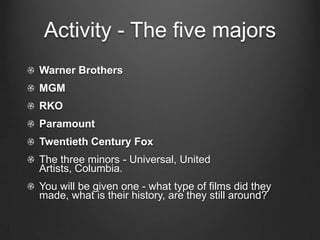
Activity - The five majorsWarner BrothersMGMRKOParamountTwentieth Century FoxThe three minors - Universal, United Artists, Columbia.You will be given one - what type of films did they made, what is their history, are they still around?

Warner bros case study

  • 1.
  • 2.
    OriginsStarted as asmall production company in 1920’sBecame a vertically integrated company within a decadeKey to success were take over of Vitagraph in 1925 who were with distribution and production facilities.Purchase of the Stanley cinema chain.Western Electric sound equipment so they could make talkies.
  • 3.
    ‘Talkies’Released Don Juanshort in 1925.The Jazz Singer in 1926 is known as the first talking movie and was made by WB.Began to lose money in the 1930’s because of the Depression.They began to sell of parts of their assets. Still maintaining its vertically integrated system, these new restrictions give way to the new style that WB created.
  • 4.
    After the WarProfitsbegan to be made.The big five needed to brand their own product and develop their own style.Warner Brothers began to specialise in low-budget contemporary genres such as gangster, social conscience films and fast-talking comedy/dramas.
  • 5.
    StarsStars were atthe beck and call of the studios.Signed contracts with them and had to stay with them until they ran out. If they did not take a project at the fear of being typecast they could be sidelined.Now Stars have agents cutting deals for them - agents the real powerbrokers in Hollywood now control, actors, cameramen, director, just like football agents.
  • 6.
    A simplified versionUnderthe studio system a few companies tried to make, distribute and show their own films - taking direct control over the entire process.This system began to break up in the 1950s trying to embrace the advent of new technologies e.g. TV.As people moved out of town also to the suburbs - away from the old established cinemas.
  • 7.
    New Hollywood tookover…Major studios not so involved but increasingly interested in financing independent productions and then controlling their distribution.Obviously this is a rather simple way of putting it as it had to keep changing over the 30s, 40s and 50s due to war, depression.What both have in common is that they both had to react to external social factors.
  • 8.
  • 9.
    Activity - Thefive majorsWarner BrothersMGMRKOParamountTwentieth Century FoxThe three minors - Universal, United Artists, Columbia.You will be given one - what type of films did they made, what is their history, are they still around?