Occupational Safety and Health Course for
Healthcare Professionals
 Describe Subpart D general requirements.
 Discuss the most cited areas of the subpart.
 Identify specific standards that relate to healthcare
work sites.
 1910.22: Applies to all permanent places of
employment, except where domestic, mining, or
agricultural work is performed.
 Standards:
* Housekeeping
* Aisles and passageways
* Covers and guiderails
* Floor loading protection
 All places of employment shall be kept clean and
orderly and in a sanitary condition.
 Workrooms clean & dry.
 Platforms, mats, or other dry standing places for wet
processes.
 Floors shall be kept free from protruding nails, splinters,
holes, or loose boards (tiles loose, holes in flooring).
 Sufficient safe clearance maintained where mechanical
handling equipment is used.
 Aisles and passageways shall be kept clear and in good repair.
 No obstruction across or in aisles that could create a hazard.
 Permanent aisles and passageways shall be
appropriately marked.
 Floor load ratings must be posted, in a
conspicuous place to which they relate.
 Floor Opening: 12” or more in its least dimension,
in a floor, platform, or yard, through which persons
may fall.
 Floor Hole: less than 12” but more than 1”,
through which materials but not persons may fall.
 Wall Opening: at least 30” high and 18” wide in
any wall or partition through which persons may
fall.
Standards specific to protective devices that
must be used – CFR 1910.23
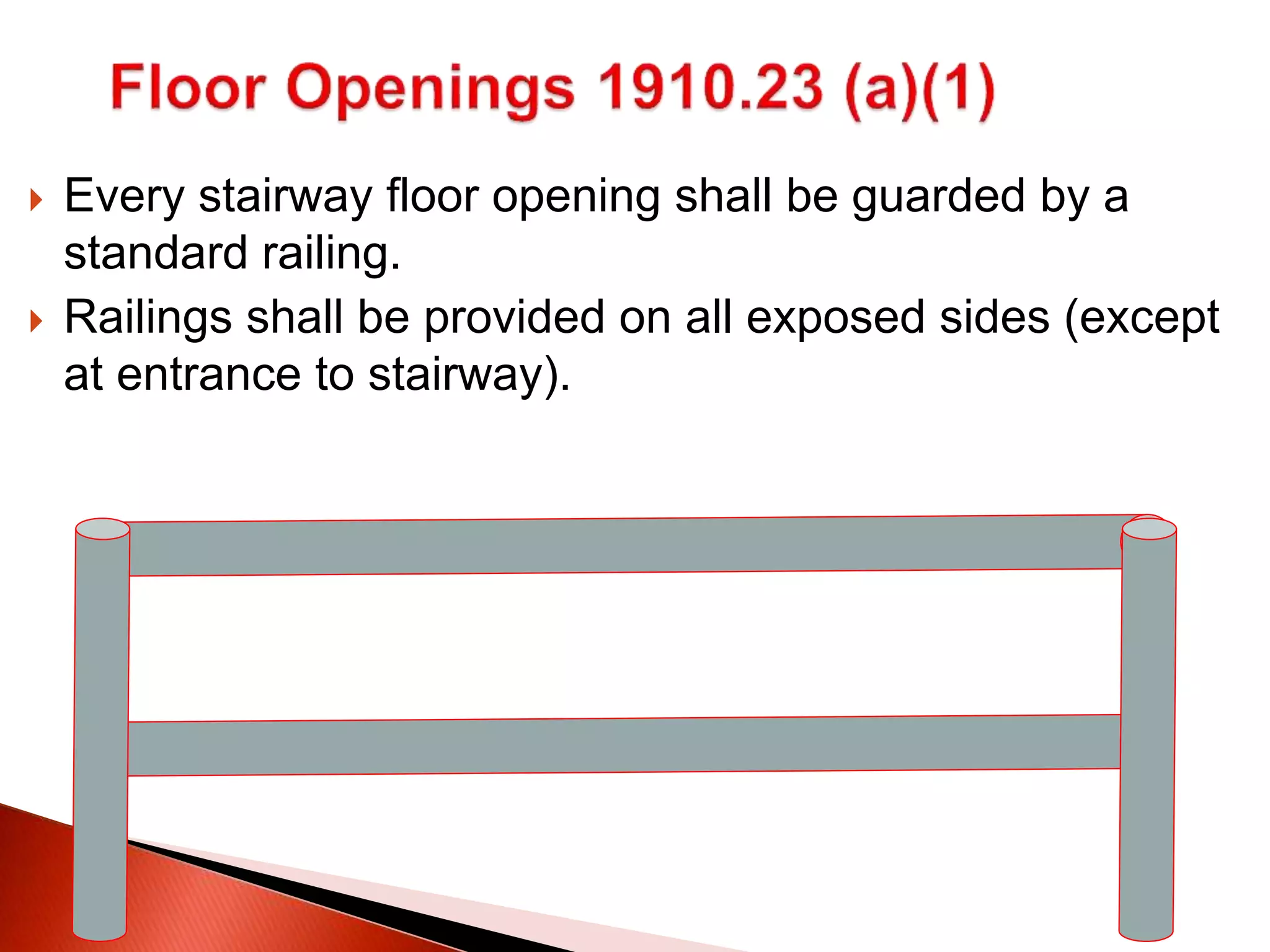
 Every stairway floor opening shall be guarded by a
standard railing.
 Railings shall be provided on all exposed sides (except
at entrance to stairway).
 (1)Every wall opening from which there is a drop
of more than 4 feet shall be guarded by one of the
following:
◦ (i)Rail, roller, picket fence, half door, or equivalent
barrier.
30"
18"
4'
Wall
Opening
W x H
Drop
 Every open-sided floor or platform 4 feet or more
shall be guarded on all open sides except where
there is entrance to a ramp, stairway, or fixed
ladder.
 Every flight of stairs having four or more risers
shall be equipped with standard stair railings or
standard handrails.
 A standard railing consists of top rail, intermediate rail, and
posts.
 Have a vertical height of 42 inches nominal from upper surface
of top rail to floor.
 The top rail smooth-surfaced.
 The ends of the rails shall not constitute a projection hazard.
 (b)(i)All wood parts free from sharp edges and splinters;
 (b)(i)Visually acceptable
 (c)(2)Stepladders 20' max.
 (c)(3)(ii)(a)Single ladders 30' max.
 No ladder should be used to gain access to a roof unless
the top of the ladder shall extend at least 3 ft above the
point of support, at eave, gutter, or roofline.
 (a)(1)Designed to produce a ladder without structural
defects or accident hazards such as sharp edges, burrs,
etc.
 (a)(1)(v)Slip resistant rungs.
 (a)(1)(v)Rungs corrugated or knurled.
 (c)(2)(iv)Ladders must be maintained in good usable
condition at all times.
 (c)(2)(vii)Ladders having defects are to be marked and
taken out of service until repaired by either maintenance
department or the manufacturer.
 Housekeeping concerns
 Corridors and aisles clean, with no obstructions
 Use of objects to reach high areas….ladders?
 There are opportunities for improvement in all
areas!
 Direct Patient Care environments:
* Wet floors – response; not always
avoidable occurrences.
* Hallways – materials, furniture, supplies.
* Space in the patient care rooms.
* Supply areas – storage, aisle and working space.
* Work surfaces – desk tops, supply room counters.
 Support Environments:
* Kitchen preparation areas – floors,
prep tables, trays, eating surfaces, etc.
* Engineering areas.
* Supply/Materials.
 Hallway clutter, disruption, difficult passageways.
 Ability of staff to move about storage/work rooms with
ease.
 Can all items be easily reached in storage areas/supply
rooms?
 Is everyone aware of potential hazards?
 Working with fluids.
 Importance of employee awareness of hazards
and appropriate actions.
 Keeping all work areas ________and__________.
 Aisles and passageways _________________.
 Keep exits free from ____________________.
 Spills need to be ________ and _______ ____.
 Use ________ ______ for wet floor areas.
 Part of our on-going training.
 Reminders help.
 Role models.
 Employees need to report hazards, take
appropriate actions.
 Safety is important for everyone!
 When it comes to the Occupational Safety and
Health regulations, including Walking & Working
Surfaces:
Think Safety, not just Compliance!

06_ww_surfaces.ppt

  • 1.
    Occupational Safety andHealth Course for Healthcare Professionals
  • 2.
     Describe SubpartD general requirements.  Discuss the most cited areas of the subpart.  Identify specific standards that relate to healthcare work sites.
  • 3.
     1910.22: Appliesto all permanent places of employment, except where domestic, mining, or agricultural work is performed.  Standards: * Housekeeping * Aisles and passageways * Covers and guiderails * Floor loading protection
  • 4.
     All placesof employment shall be kept clean and orderly and in a sanitary condition.  Workrooms clean & dry.  Platforms, mats, or other dry standing places for wet processes.
  • 5.
     Floors shallbe kept free from protruding nails, splinters, holes, or loose boards (tiles loose, holes in flooring).
  • 6.
     Sufficient safeclearance maintained where mechanical handling equipment is used.  Aisles and passageways shall be kept clear and in good repair.  No obstruction across or in aisles that could create a hazard.
  • 7.
     Permanent aislesand passageways shall be appropriately marked.
  • 8.
     Floor loadratings must be posted, in a conspicuous place to which they relate.
  • 9.
     Floor Opening:12” or more in its least dimension, in a floor, platform, or yard, through which persons may fall.  Floor Hole: less than 12” but more than 1”, through which materials but not persons may fall.  Wall Opening: at least 30” high and 18” wide in any wall or partition through which persons may fall. Standards specific to protective devices that must be used – CFR 1910.23
  • 10.
     Every stairwayfloor opening shall be guarded by a standard railing.  Railings shall be provided on all exposed sides (except at entrance to stairway).
  • 11.
     (1)Every wallopening from which there is a drop of more than 4 feet shall be guarded by one of the following: ◦ (i)Rail, roller, picket fence, half door, or equivalent barrier. 30" 18" 4' Wall Opening W x H Drop
  • 12.
     Every open-sidedfloor or platform 4 feet or more shall be guarded on all open sides except where there is entrance to a ramp, stairway, or fixed ladder.
  • 13.
     Every flightof stairs having four or more risers shall be equipped with standard stair railings or standard handrails.
  • 14.
     A standardrailing consists of top rail, intermediate rail, and posts.  Have a vertical height of 42 inches nominal from upper surface of top rail to floor.  The top rail smooth-surfaced.  The ends of the rails shall not constitute a projection hazard.
  • 15.
     (b)(i)All woodparts free from sharp edges and splinters;  (b)(i)Visually acceptable  (c)(2)Stepladders 20' max.  (c)(3)(ii)(a)Single ladders 30' max.
  • 16.
     No laddershould be used to gain access to a roof unless the top of the ladder shall extend at least 3 ft above the point of support, at eave, gutter, or roofline.
  • 17.
     (a)(1)Designed toproduce a ladder without structural defects or accident hazards such as sharp edges, burrs, etc.  (a)(1)(v)Slip resistant rungs.
  • 18.
     (a)(1)(v)Rungs corrugatedor knurled.  (c)(2)(iv)Ladders must be maintained in good usable condition at all times.  (c)(2)(vii)Ladders having defects are to be marked and taken out of service until repaired by either maintenance department or the manufacturer.
  • 19.
     Housekeeping concerns Corridors and aisles clean, with no obstructions  Use of objects to reach high areas….ladders?
  • 20.
     There areopportunities for improvement in all areas!
  • 22.
     Direct PatientCare environments: * Wet floors – response; not always avoidable occurrences. * Hallways – materials, furniture, supplies. * Space in the patient care rooms. * Supply areas – storage, aisle and working space. * Work surfaces – desk tops, supply room counters.  Support Environments: * Kitchen preparation areas – floors, prep tables, trays, eating surfaces, etc. * Engineering areas. * Supply/Materials.
  • 23.
     Hallway clutter,disruption, difficult passageways.  Ability of staff to move about storage/work rooms with ease.  Can all items be easily reached in storage areas/supply rooms?  Is everyone aware of potential hazards?  Working with fluids.
  • 24.
     Importance ofemployee awareness of hazards and appropriate actions.  Keeping all work areas ________and__________.  Aisles and passageways _________________.  Keep exits free from ____________________.  Spills need to be ________ and _______ ____.  Use ________ ______ for wet floor areas.
  • 25.
     Part ofour on-going training.  Reminders help.  Role models.  Employees need to report hazards, take appropriate actions.  Safety is important for everyone!
  • 26.
     When itcomes to the Occupational Safety and Health regulations, including Walking & Working Surfaces: Think Safety, not just Compliance!