WACC
calculation methodology review
Andrea Oglietti
Autorità per l’energia elettrica il gas e il sistema idrico
Director, Infrastructures Directorate
Analysts & Investors Seminar
Milan, 12th October 2015
Disclaimer
Infsrastructure Directorate 2
This presentation is not an official document
Official AEEGSI positions are those stated
in published consultation documents
(www.autorita.energia.it)
12th October 2015
REASONS FOR A REVIEW OF THE WACC METHODOLOGY
Infsrastructure Directorate 3
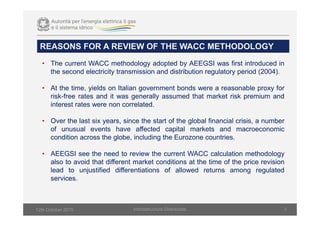
• The current WACC methodology adopted by AEEGSI was first introduced in
the second electricity transmission and distribution regulatory period (2004).
• At the time, yields on Italian government bonds were a reasonable proxy for
risk-free rates and it was generally assumed that market risk premium and
interest rates were non correlated.
• Over the last six years, since the start of the global financial crisis, a number
of unusual events have affected capital markets and macroeconomic
condition across the globe, including the Eurozone countries.
• AEEGSI see the need to review the current WACC calculation methodology
also to avoid that different market conditions at the time of the price revision
lead to unjustified differentiations of allowed returns among regulated
services.
12th October 2015
GENERAL APPROACH
Infsrastructure Directorate 4
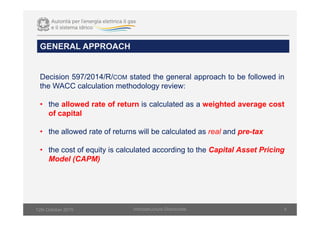
Decision 597/2014/R/COM stated the general approach to be followed in
the WACC calculation methodology review:
• the allowed rate of return is calculated as a weighted average cost
of capital
• the allowed rate of returns will be calculated as real and pre-tax
• the cost of equity is calculated according to the Capital Asset Pricing
Model (CAPM)
12th October 2015
WACC REGULATORY PERIOD
Infsrastructure Directorate 5
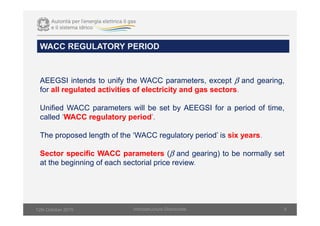
AEEGSI intends to unify the WACC parameters, except β and gearing,
for all regulated activities of electricity and gas sectors.
Unified WACC parameters will be set by AEEGSI for a period of time,
called ‘WACC regulatory period’.
The proposed length of the ‘WACC regulatory period’ is six years.
Sector specific WACC parameters (β and gearing) to be normally set
at the beginning of each sectorial price review.
12th October 2015
COST OF EQUITY
Infsrastructure Directorate 6
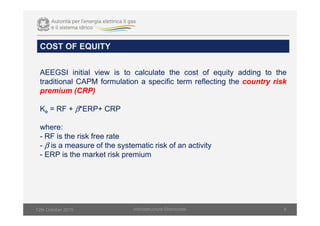
AEEGSI initial view is to calculate the cost of equity adding to the
traditional CAPM formulation a specific term reflecting the country risk
premium (CRP):
Ke = RF + β*ERP+ CRP
where:
- RF is the risk free rate
- β is a measure of the systematic risk of an activity
- ERP is the market risk premium
12th October 2015
RISK FREE RATE
Infsrastructure Directorate 7
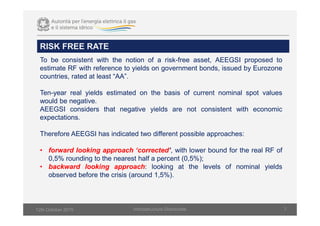
To be consistent with the notion of a risk-free asset, AEEGSI proposed to
estimate RF with reference to yields on government bonds, issued by Eurozone
countries, rated at least “AA”.
Ten-year real yields estimated on the basis of current nominal spot values
would be negative.
AEEGSI considers that negative yields are not consistent with economic
expectations.
Therefore AEEGSI has indicated two different possible approaches:
• forward looking approach ‘corrected’, with lower bound for the real RF of
0,5% rounding to the nearest half a percent (0,5%);
• backward looking approach: looking at the levels of nominal yields
observed before the crisis (around 1,5%).
12th October 2015
MARKET RISK PREMIUM
Infsrastructure Directorate 8
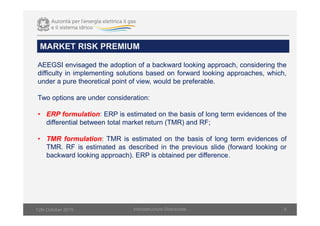
AEEGSI envisaged the adoption of a backward looking approach, considering the
difficulty in implementing solutions based on forward looking approaches, which,
under a pure theoretical point of view, would be preferable.
Two options are under consideration:
• ERP formulation: ERP is estimated on the basis of long term evidences of the
differential between total market return (TMR) and RF;
• TMR formulation: TMR is estimated on the basis of long term evidences of
TMR. RF is estimated as described in the previous slide (forward looking or
backward looking approach). ERP is obtained per difference.
12th October 2015
COUNTRY RISK PREMIUM
Infsrastructure Directorate 9
CRP reflects the compensation investors require to operate in a certain country.
Rating differentials among countries affect also companies ratings. CRP affects
both cost of debt and cost of equity.
Two approaches to estimate CRP can be followed:
• evidence from corporate debt markets;
• evidence from equity markets.
According to initial evaluations CRP was estimated to vary between 0,5% and
1%.
12th October 2015
ACTIVITY SPECIFIC PARAMETERS
Infsrastructure Directorate 10
AEEGSI initial proposal was to estimate specific β for each regulated activity,
considering evidences coming from Eurozone equity markets related to
companies with high credit rating, in a period of about two years.
In AEEGSI’s opinion β estimate cannot be considered as a pure mechanistic
exercise. It is necessary to analyse the results and evaluate the coherence with
the general regulatory framework evolution.
AEEGSI stated that it is oriented to set the gearing level taking into account the
actual levels for regulated companies and considering the perspective of a
gradual alignment towards the average levels adopted by other regulators.
12th October 2015
COST OF DEBT
Infsrastructure Directorate 11
From a theoretical point of view, cost of debt can be estimated adding to RF a
spread determined on the basis of debt β. The implementation of this approach,
however, presents some practical difficulties.
AEEGSI is examining the structure and the stratification of regulated companies’
medium and long term debt.
AEEGSI is oriented to set the cost of debt in order to reflect the cost of efficiently
incurred debt, considering the global sustainability, giving incentive to define
efficient debt portfolios, taking into account evidences from capital markets.
12th October 2015
INFLATION
Infsrastructure Directorate 12
AEEGSI is oriented to directly estimate real cost of equity and real cost of debt, in
order to avoid the problems emerged in the current regulatory periods, as a
consequence of using a fixed inflation rate to deflate nominal rates.
AEEGSI considers that the right way to deflate nominal rates is using the inflation
rate incorporated in nominal rates.
12th October 2015
MID-PERIOD REVIEW
Infsrastructure Directorate 13
In case a TMR formulation is adopted to set cost of equity, AEEGSI is oriented
to review every two years the CRP level.
For the CRP review two approaches are possible:
• trigger approach: CRP will be reviewed only in case yields on ten years BTP
benchmark reach a pre-fixed level;
• indexation approach: CRP is indexed to the spread between Italian ten years
BTP benchmark and ten years German Bund.
In case an ERP formulation is adopted to set cost of equity, AEEGSI envisages
a review of CRP and RF. The necessity to assess real yields on Eurozone high
credit rating Government bonds implies the adoption of a trigger approach.
AEEGSI objective is to define transparent and predictable review
mechanisms
12th October 2015
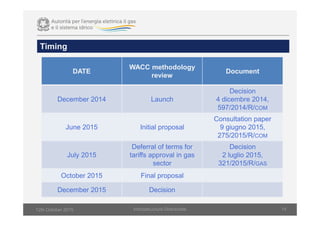
Timing
Infsrastructure Directorate 14
DATE
WACC methodology
review
Document
December 2014 Launch
Decision
4 dicembre 2014,
597/2014/R/COM
June 2015 Initial proposal
Consultation paper
9 giugno 2015,
275/2015/R/COM
July 2015
Deferral of terms for
tariffs approval in gas
sector
Decision
2 luglio 2015,
321/2015/R/GAS
October 2015 Final proposal
December 2015 Decision
12th October 2015
Thank you
(www.autorita.energia.it)
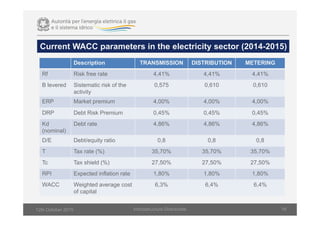
Current WACC parameters in the electricity sector (2014-2015)
Infsrastructure Directorate 16
Description TRANSMISSION DISTRIBUTION METERING
Rf Risk free rate 4,41% 4,41% 4,41%
Β levered Sistematic risk of the
activity
0,575 0,610 0,610
ERP Market premium 4,00% 4,00% 4,00%
DRP Debt Risk Premium 0,45% 0,45% 0,45%
Kd
(nominal)
Debt rate 4,86% 4,86% 4,86%
D/E Debt/equity ratio 0,8 0,8 0,8
T Tax rate (%) 35,70% 35,70% 35,70%
Tc Tax shield (%) 27,50% 27,50% 27,50%
RPI Expected inflation rate 1,80% 1,80% 1,80%
WACC Weighted average cost
of capital
6,3% 6,4% 6,4%
12th October 2015

WACC calculation methodology review

  • 1.
    WACC calculation methodology review AndreaOglietti Autorità per l’energia elettrica il gas e il sistema idrico Director, Infrastructures Directorate Analysts & Investors Seminar Milan, 12th October 2015
  • 2.
    Disclaimer Infsrastructure Directorate 2 Thispresentation is not an official document Official AEEGSI positions are those stated in published consultation documents (www.autorita.energia.it) 12th October 2015
  • 3.
    REASONS FOR AREVIEW OF THE WACC METHODOLOGY Infsrastructure Directorate 3 • The current WACC methodology adopted by AEEGSI was first introduced in the second electricity transmission and distribution regulatory period (2004). • At the time, yields on Italian government bonds were a reasonable proxy for risk-free rates and it was generally assumed that market risk premium and interest rates were non correlated. • Over the last six years, since the start of the global financial crisis, a number of unusual events have affected capital markets and macroeconomic condition across the globe, including the Eurozone countries. • AEEGSI see the need to review the current WACC calculation methodology also to avoid that different market conditions at the time of the price revision lead to unjustified differentiations of allowed returns among regulated services. 12th October 2015
  • 4.
    GENERAL APPROACH Infsrastructure Directorate4 Decision 597/2014/R/COM stated the general approach to be followed in the WACC calculation methodology review: • the allowed rate of return is calculated as a weighted average cost of capital • the allowed rate of returns will be calculated as real and pre-tax • the cost of equity is calculated according to the Capital Asset Pricing Model (CAPM) 12th October 2015
  • 5.
    WACC REGULATORY PERIOD InfsrastructureDirectorate 5 AEEGSI intends to unify the WACC parameters, except β and gearing, for all regulated activities of electricity and gas sectors. Unified WACC parameters will be set by AEEGSI for a period of time, called ‘WACC regulatory period’. The proposed length of the ‘WACC regulatory period’ is six years. Sector specific WACC parameters (β and gearing) to be normally set at the beginning of each sectorial price review. 12th October 2015
  • 6.
    COST OF EQUITY InfsrastructureDirectorate 6 AEEGSI initial view is to calculate the cost of equity adding to the traditional CAPM formulation a specific term reflecting the country risk premium (CRP): Ke = RF + β*ERP+ CRP where: - RF is the risk free rate - β is a measure of the systematic risk of an activity - ERP is the market risk premium 12th October 2015
  • 7.
    RISK FREE RATE InfsrastructureDirectorate 7 To be consistent with the notion of a risk-free asset, AEEGSI proposed to estimate RF with reference to yields on government bonds, issued by Eurozone countries, rated at least “AA”. Ten-year real yields estimated on the basis of current nominal spot values would be negative. AEEGSI considers that negative yields are not consistent with economic expectations. Therefore AEEGSI has indicated two different possible approaches: • forward looking approach ‘corrected’, with lower bound for the real RF of 0,5% rounding to the nearest half a percent (0,5%); • backward looking approach: looking at the levels of nominal yields observed before the crisis (around 1,5%). 12th October 2015
  • 8.
    MARKET RISK PREMIUM InfsrastructureDirectorate 8 AEEGSI envisaged the adoption of a backward looking approach, considering the difficulty in implementing solutions based on forward looking approaches, which, under a pure theoretical point of view, would be preferable. Two options are under consideration: • ERP formulation: ERP is estimated on the basis of long term evidences of the differential between total market return (TMR) and RF; • TMR formulation: TMR is estimated on the basis of long term evidences of TMR. RF is estimated as described in the previous slide (forward looking or backward looking approach). ERP is obtained per difference. 12th October 2015
  • 9.
    COUNTRY RISK PREMIUM InfsrastructureDirectorate 9 CRP reflects the compensation investors require to operate in a certain country. Rating differentials among countries affect also companies ratings. CRP affects both cost of debt and cost of equity. Two approaches to estimate CRP can be followed: • evidence from corporate debt markets; • evidence from equity markets. According to initial evaluations CRP was estimated to vary between 0,5% and 1%. 12th October 2015
  • 10.
    ACTIVITY SPECIFIC PARAMETERS InfsrastructureDirectorate 10 AEEGSI initial proposal was to estimate specific β for each regulated activity, considering evidences coming from Eurozone equity markets related to companies with high credit rating, in a period of about two years. In AEEGSI’s opinion β estimate cannot be considered as a pure mechanistic exercise. It is necessary to analyse the results and evaluate the coherence with the general regulatory framework evolution. AEEGSI stated that it is oriented to set the gearing level taking into account the actual levels for regulated companies and considering the perspective of a gradual alignment towards the average levels adopted by other regulators. 12th October 2015
  • 11.
    COST OF DEBT InfsrastructureDirectorate 11 From a theoretical point of view, cost of debt can be estimated adding to RF a spread determined on the basis of debt β. The implementation of this approach, however, presents some practical difficulties. AEEGSI is examining the structure and the stratification of regulated companies’ medium and long term debt. AEEGSI is oriented to set the cost of debt in order to reflect the cost of efficiently incurred debt, considering the global sustainability, giving incentive to define efficient debt portfolios, taking into account evidences from capital markets. 12th October 2015
  • 12.
    INFLATION Infsrastructure Directorate 12 AEEGSIis oriented to directly estimate real cost of equity and real cost of debt, in order to avoid the problems emerged in the current regulatory periods, as a consequence of using a fixed inflation rate to deflate nominal rates. AEEGSI considers that the right way to deflate nominal rates is using the inflation rate incorporated in nominal rates. 12th October 2015
  • 13.
    MID-PERIOD REVIEW Infsrastructure Directorate13 In case a TMR formulation is adopted to set cost of equity, AEEGSI is oriented to review every two years the CRP level. For the CRP review two approaches are possible: • trigger approach: CRP will be reviewed only in case yields on ten years BTP benchmark reach a pre-fixed level; • indexation approach: CRP is indexed to the spread between Italian ten years BTP benchmark and ten years German Bund. In case an ERP formulation is adopted to set cost of equity, AEEGSI envisages a review of CRP and RF. The necessity to assess real yields on Eurozone high credit rating Government bonds implies the adoption of a trigger approach. AEEGSI objective is to define transparent and predictable review mechanisms 12th October 2015
  • 14.
    Timing Infsrastructure Directorate 14 DATE WACCmethodology review Document December 2014 Launch Decision 4 dicembre 2014, 597/2014/R/COM June 2015 Initial proposal Consultation paper 9 giugno 2015, 275/2015/R/COM July 2015 Deferral of terms for tariffs approval in gas sector Decision 2 luglio 2015, 321/2015/R/GAS October 2015 Final proposal December 2015 Decision 12th October 2015
  • 15.
  • 16.
    Current WACC parametersin the electricity sector (2014-2015) Infsrastructure Directorate 16 Description TRANSMISSION DISTRIBUTION METERING Rf Risk free rate 4,41% 4,41% 4,41% Β levered Sistematic risk of the activity 0,575 0,610 0,610 ERP Market premium 4,00% 4,00% 4,00% DRP Debt Risk Premium 0,45% 0,45% 0,45% Kd (nominal) Debt rate 4,86% 4,86% 4,86% D/E Debt/equity ratio 0,8 0,8 0,8 T Tax rate (%) 35,70% 35,70% 35,70% Tc Tax shield (%) 27,50% 27,50% 27,50% RPI Expected inflation rate 1,80% 1,80% 1,80% WACC Weighted average cost of capital 6,3% 6,4% 6,4% 12th October 2015