Insert Subheading
Western Australian Department of Education
Focus of the session
• development of an Aboriginal Cultural Standards Framework
• structure and content of the Framework
• implementation
• examining impact
Development of an Aboriginal Cultural Standards Framework
• identified as one of a range of initiatives to strengthen
outcomes for Aboriginal children and young people
• priority for the State Government and the Department of
Education – public schools
• developed with Aboriginal staff and stakeholders
Development of an Aboriginal Cultural Standards Framework
• research and analysis
• extensive consultation
• alignment with strategic documents, existing standards,
frameworks and tools – familiar to staff
Drivers for development
• focus on an integrated approach to strengthening Aboriginal
student outcomes
• data - the educational achievement gap between Aboriginal
and non-Aboriginal students remains unacceptably wide
• setting clear expectations for all public school staff
• support for staff to reflect on their values, behaviours,
attitudes and practices
Links to key documents
• Strategic Plan for WA Public Schools 2016–2019
• Focus Documents – Focus 2016, Focus 2017, Focus 2018
• National Aboriginal and Torres Strait Islander Education
Strategy
• School Improvement and Accountability Framework
• Capability Framework – Teaching Aboriginal and Torres
Strait Islander EAL/D learners
Structure and content of the Framework
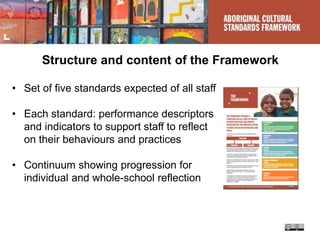
• Set of five standards expected of all staff
• Each standard: performance descriptors
and indicators to support staff to reflect
on their behaviours and practices
• Continuum showing progression for
individual and whole-school reflection
Relationships
• Relationships are critical to Aboriginal people and underpin
their actions and responses
• Engagement of parents, caregivers, families and local
Aboriginal community to support students in achieving
improved outcomes
Leadership
• At the core of a high performance – high care culture is
effective leadership
• School leaders play a critical role in driving high level
teaching practice among their teachers
• School leaders support innovation and change to improve
outcomes for all students, including Aboriginal students
Teaching
• High quality teaching for Aboriginal students is effective
teaching for all students
• Impact of highly effective teaching is cumulative - even
relatively modest increases in effectiveness can make big
differences to students’ learning
• Challenge is for high quality practices to be evident in
every classroom for every student
Learning environment
• A welcoming environment is critical in developing sense
of belonging and welcoming for students and their
families – particularly Aboriginal students
• Student wellbeing and support are enhanced when
students feel safe and secure in their learning
environment
Resources
• Focus on all resources: human, financial and physical
• Align initiatives and funding with their specified
purpose – for example student characteristic funding
• Value the contribution of Aboriginal staff and
community members
Cultural responsiveness
• Ability to understand, interact and communicate
effectively and sensitively with people from a cultural
background different to one’s own
• Demonstrating this ability with proficiency
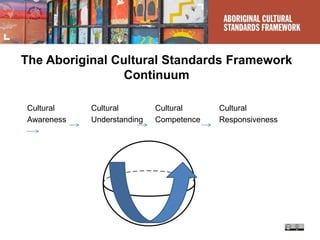
Cultural Cultural Cultural Cultural
Awareness Understanding Competence Responsiveness
The Aboriginal Cultural Standards Framework
Continuum
Implementation
• Focus 2016: begin whole-school self-reflection against the new
Aboriginal Cultural Standards Framework
• Focus 2017: use self-assessment against the Aboriginal Cultural
Standards Framework in school improvement planning
• Focus 2018: visible and deliberate
• Strategic Plan 2016-19: Implement the Aboriginal Cultural
Standards Framework as a clear statement of expected practice
and behaviour in schools and communities to increase Aboriginal
student achievement and drive improvement planning
Implementation: further initiatives to strengthen approaches
• Elders in Residence initiative
• research partnerships
• establishment of an Aboriginal Education Teaching and
Learning team:
– professional support, advice and guidance
– system advice on matters related to the enhancement of
Aboriginal students’ engagement and achievement
What do we hope to see as a result?
• Build on what is working
• Recognise individual student needs and capacities
• Integration into whole school planning
• Changed behaviour, culture and practices
• Shared responsibility
• A cohesive, focused approach to strengthening Aboriginal
student outcomes
Examining impact
• monitoring use of the framework
• professional learning, advice and guidance
– Focus on school leaders leading the implementation
• system-wide cultural change

WA Cultural Standards Framework

  • 1.
    Insert Subheading Western AustralianDepartment of Education
  • 2.
    Focus of thesession • development of an Aboriginal Cultural Standards Framework • structure and content of the Framework • implementation • examining impact
  • 3.
    Development of anAboriginal Cultural Standards Framework • identified as one of a range of initiatives to strengthen outcomes for Aboriginal children and young people • priority for the State Government and the Department of Education – public schools • developed with Aboriginal staff and stakeholders
  • 4.
    Development of anAboriginal Cultural Standards Framework • research and analysis • extensive consultation • alignment with strategic documents, existing standards, frameworks and tools – familiar to staff
  • 5.
    Drivers for development •focus on an integrated approach to strengthening Aboriginal student outcomes • data - the educational achievement gap between Aboriginal and non-Aboriginal students remains unacceptably wide • setting clear expectations for all public school staff • support for staff to reflect on their values, behaviours, attitudes and practices
  • 6.
    Links to keydocuments • Strategic Plan for WA Public Schools 2016–2019 • Focus Documents – Focus 2016, Focus 2017, Focus 2018 • National Aboriginal and Torres Strait Islander Education Strategy • School Improvement and Accountability Framework • Capability Framework – Teaching Aboriginal and Torres Strait Islander EAL/D learners
  • 7.
    Structure and contentof the Framework • Set of five standards expected of all staff • Each standard: performance descriptors and indicators to support staff to reflect on their behaviours and practices • Continuum showing progression for individual and whole-school reflection
  • 8.
    Relationships • Relationships arecritical to Aboriginal people and underpin their actions and responses • Engagement of parents, caregivers, families and local Aboriginal community to support students in achieving improved outcomes
  • 9.
    Leadership • At thecore of a high performance – high care culture is effective leadership • School leaders play a critical role in driving high level teaching practice among their teachers • School leaders support innovation and change to improve outcomes for all students, including Aboriginal students
  • 10.
    Teaching • High qualityteaching for Aboriginal students is effective teaching for all students • Impact of highly effective teaching is cumulative - even relatively modest increases in effectiveness can make big differences to students’ learning • Challenge is for high quality practices to be evident in every classroom for every student
  • 11.
    Learning environment • Awelcoming environment is critical in developing sense of belonging and welcoming for students and their families – particularly Aboriginal students • Student wellbeing and support are enhanced when students feel safe and secure in their learning environment
  • 12.
    Resources • Focus onall resources: human, financial and physical • Align initiatives and funding with their specified purpose – for example student characteristic funding • Value the contribution of Aboriginal staff and community members
  • 13.
    Cultural responsiveness • Abilityto understand, interact and communicate effectively and sensitively with people from a cultural background different to one’s own • Demonstrating this ability with proficiency
  • 14.
    Cultural Cultural CulturalCultural Awareness Understanding Competence Responsiveness The Aboriginal Cultural Standards Framework Continuum
  • 15.
    Implementation • Focus 2016:begin whole-school self-reflection against the new Aboriginal Cultural Standards Framework • Focus 2017: use self-assessment against the Aboriginal Cultural Standards Framework in school improvement planning • Focus 2018: visible and deliberate • Strategic Plan 2016-19: Implement the Aboriginal Cultural Standards Framework as a clear statement of expected practice and behaviour in schools and communities to increase Aboriginal student achievement and drive improvement planning
  • 16.
    Implementation: further initiativesto strengthen approaches • Elders in Residence initiative • research partnerships • establishment of an Aboriginal Education Teaching and Learning team: – professional support, advice and guidance – system advice on matters related to the enhancement of Aboriginal students’ engagement and achievement
  • 17.
    What do wehope to see as a result? • Build on what is working • Recognise individual student needs and capacities • Integration into whole school planning • Changed behaviour, culture and practices • Shared responsibility • A cohesive, focused approach to strengthening Aboriginal student outcomes
  • 18.
    Examining impact • monitoringuse of the framework • professional learning, advice and guidance – Focus on school leaders leading the implementation • system-wide cultural change

Editor's Notes

  • #15 Central to the framework is the notion of Cultural responsiveness. Multi dimensional- not static- not progress in a linear fashion. You go back and forth and around sitting behind one and another You have relationships and that is teaching and do something in relationships and effects teaching Interrelationship between things learnt and done previously.. Eg.. Teaching and relation ships CMS, Learning environment PBS So What Works? IS it a tool kit- no a tool for reflection… “Those who want to determine what works in education are doomed to fail, because in education, ‘What works?’ is rarely the right question, for the simple reason that in education, just about everything works somewhere, and nothing works everywhere.” Wiliam (2016) Change is a journey, not a blueprint. Change is non linear, dynamic and loaded with uncertainty and excitement, sometimes travelling through unexpected places Michael Fullan (1993)