Date 2nd
January 2013
Day Wednesday
Class 4 Cerdas
Theme World of personal relationship
Topic Personal details
Learning outcomes
1) Listen to and discriminate similar and different sounds
2) Pronounce words accurately
Activities : Lets talk about the picture
Warm-up
1. Greet pupils and introduce myself, “Good morning everyone. I am _________”
2. Using soft ball, get pupils to introduce themselves. Teacher throws the ball and anyone
who catches it has to introduce himself/herself.
3. Stress the structure: My name is _______.
Presentation
1. Tell pupils what you like to do; e.g. I like to play badminton.
2. Put the structure on the flashcard or blackboard.
3. Refer to the textbook. Get pupils to look at the concept page and identify characters on
the page.
4. Pupils read the text; e.g. Picture 1 – I like to keep pets.
5. For intermediate and high proficiency level (L2 and L3) pupils, encourage them to say
more; e.g. Azad likes to keep pets. He has a pet hamster. He feed it___________.
6. Bring to pupils’ attention that one can like to play games, keep pets and have favorite
colors.
Practice
1. Get pupils to sit in groups of four. Pupils tell their friends what they like to do.
2. Stress the structure : I like ___________.
3. For intermediate and high proficiency pupils, encourage them to talk about their likes.
Production
1. Get pupils to talk about things they like to do. Ask questions like; What do you like?
2. Put the sentence structure on the board. e.g. I like to __________. List pupils’ responses on
the board.
3. For intermediate and high proficiency level pupils, encourage them to talk about what
their friends like to do during their leisure time. E.g. Maria likes to __________.
Assesment:
Date 3rd
January 2013
Day Thursday
Class 4 Cerdas
Theme World of personal relationship
Topic Personal details
Learning outcomes
1) Give relevant information politely on one’s likes.
2) Acquire key words at various stages of development.
Activities : Lets talk about the picture
Warm-up
1. Greet pupils.
2. Revise structures learnt in Year 1,2 and 3 e.g. My name is __________. I am __________. I live
in ______. I like ___________.
3. Get pupils to prepare table (see below) and get to know three friends. Encourage pupils
to introduce themselves before getting names of three friends. For remedial pupils, prompt
with guiding questions. E.g. What is your name? How old are you?
No. Name Age Address Likes
1
2
3
Presentation
1. Refer to textbook. Get pupils to identify characters at the playground.
2. Get pupils to identify the male and female characters on the page. Categorize
characters in a matrix on the blackboard.
3. Discuss the different activities that characters are going.
4. Talk about other activities that pupils carry out with their friends at the playground.
Emphasize the importance of friendship and maintaining friends.
5. Highlight language used in introducing oneself.
Practice
1. Read the text. Pupils listen and practice reading in pairs.
2. Check pupils’ comprehension with simple questions like Who comes from Sarawak?
Production
1. Divide pupils into four groups. Give each group a little cushion to pass around. Play a
game like ‘musical chairs’ when the music stops, the pupil holding the cushion in each
group has to introduce and say something about himself/herself.
2. Refer to page. Bring pupils’ attention to the use of Proper Nouns. Get pupils to identify the
proper nouns on the page. Highlights to pupils that proper nouns begin capital letters.
3. Teacher provides more exercises.
Assesment:
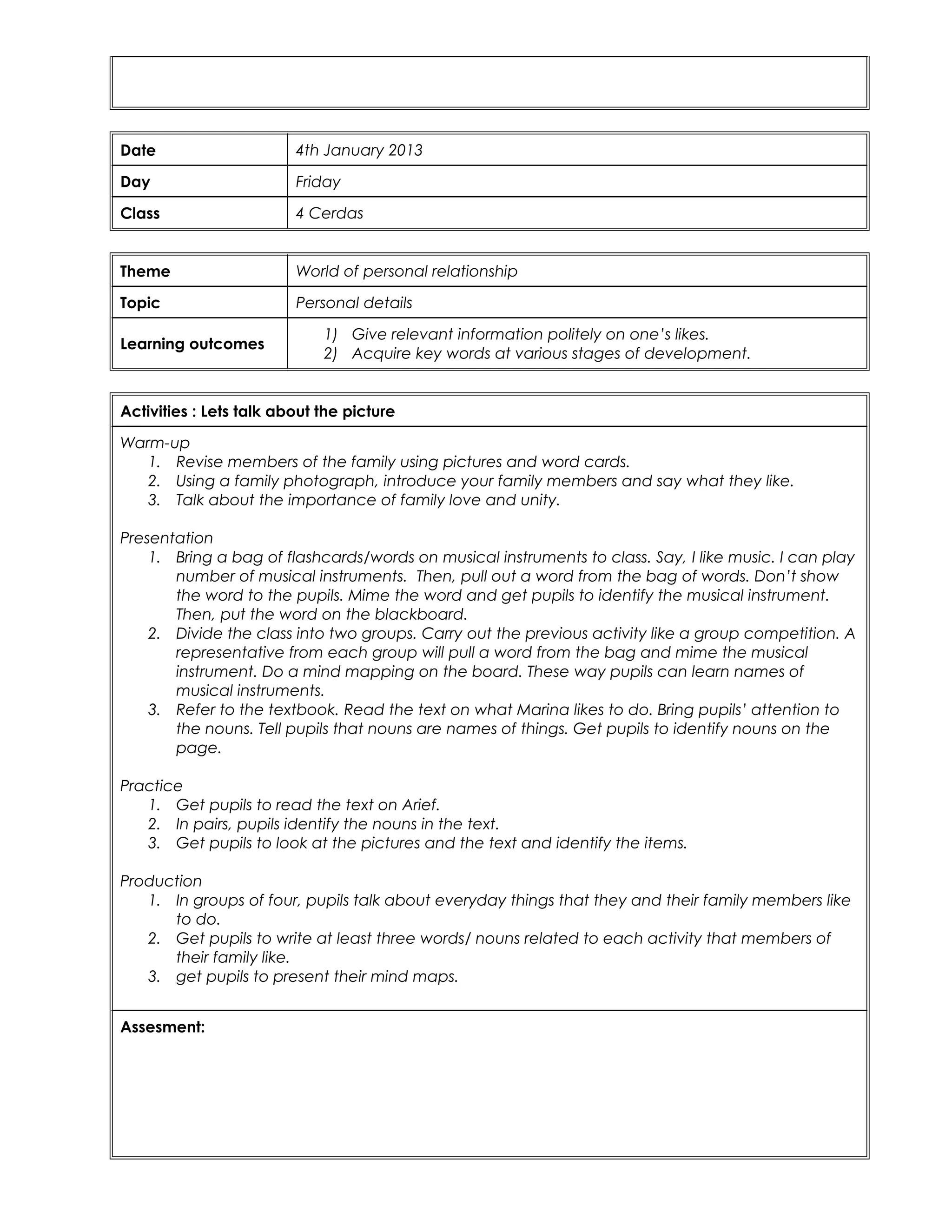
Date 4th January 2013
Day Friday
Class 4 Cerdas
Theme World of personal relationship
Topic Personal details
Learning outcomes
1) Give relevant information politely on one’s likes.
2) Acquire key words at various stages of development.
Activities : Lets talk about the picture
Warm-up
1. Revise members of the family using pictures and word cards.
2. Using a family photograph, introduce your family members and say what they like.
3. Talk about the importance of family love and unity.
Presentation
1. Bring a bag of flashcards/words on musical instruments to class. Say, I like music. I can play
number of musical instruments. Then, pull out a word from the bag of words. Don’t show
the word to the pupils. Mime the word and get pupils to identify the musical instrument.
Then, put the word on the blackboard.
2. Divide the class into two groups. Carry out the previous activity like a group competition. A
representative from each group will pull a word from the bag and mime the musical
instrument. Do a mind mapping on the board. These way pupils can learn names of
musical instruments.
3. Refer to the textbook. Read the text on what Marina likes to do. Bring pupils’ attention to
the nouns. Tell pupils that nouns are names of things. Get pupils to identify nouns on the
page.
Practice
1. Get pupils to read the text on Arief.
2. In pairs, pupils identify the nouns in the text.
3. Get pupils to look at the pictures and the text and identify the items.
Production
1. In groups of four, pupils talk about everyday things that they and their family members like
to do.
2. Get pupils to write at least three words/ nouns related to each activity that members of
their family like.
3. get pupils to present their mind maps.
Assesment:
W1

W1

  • 1.
    Date 2nd January 2013 DayWednesday Class 4 Cerdas Theme World of personal relationship Topic Personal details Learning outcomes 1) Listen to and discriminate similar and different sounds 2) Pronounce words accurately Activities : Lets talk about the picture Warm-up 1. Greet pupils and introduce myself, “Good morning everyone. I am _________” 2. Using soft ball, get pupils to introduce themselves. Teacher throws the ball and anyone who catches it has to introduce himself/herself. 3. Stress the structure: My name is _______. Presentation 1. Tell pupils what you like to do; e.g. I like to play badminton. 2. Put the structure on the flashcard or blackboard. 3. Refer to the textbook. Get pupils to look at the concept page and identify characters on the page. 4. Pupils read the text; e.g. Picture 1 – I like to keep pets. 5. For intermediate and high proficiency level (L2 and L3) pupils, encourage them to say more; e.g. Azad likes to keep pets. He has a pet hamster. He feed it___________. 6. Bring to pupils’ attention that one can like to play games, keep pets and have favorite colors. Practice 1. Get pupils to sit in groups of four. Pupils tell their friends what they like to do. 2. Stress the structure : I like ___________. 3. For intermediate and high proficiency pupils, encourage them to talk about their likes. Production 1. Get pupils to talk about things they like to do. Ask questions like; What do you like? 2. Put the sentence structure on the board. e.g. I like to __________. List pupils’ responses on the board. 3. For intermediate and high proficiency level pupils, encourage them to talk about what their friends like to do during their leisure time. E.g. Maria likes to __________. Assesment:
  • 2.
    Date 3rd January 2013 DayThursday Class 4 Cerdas Theme World of personal relationship Topic Personal details Learning outcomes 1) Give relevant information politely on one’s likes. 2) Acquire key words at various stages of development. Activities : Lets talk about the picture Warm-up 1. Greet pupils. 2. Revise structures learnt in Year 1,2 and 3 e.g. My name is __________. I am __________. I live in ______. I like ___________. 3. Get pupils to prepare table (see below) and get to know three friends. Encourage pupils to introduce themselves before getting names of three friends. For remedial pupils, prompt with guiding questions. E.g. What is your name? How old are you? No. Name Age Address Likes 1 2 3 Presentation 1. Refer to textbook. Get pupils to identify characters at the playground. 2. Get pupils to identify the male and female characters on the page. Categorize characters in a matrix on the blackboard. 3. Discuss the different activities that characters are going. 4. Talk about other activities that pupils carry out with their friends at the playground. Emphasize the importance of friendship and maintaining friends. 5. Highlight language used in introducing oneself. Practice 1. Read the text. Pupils listen and practice reading in pairs. 2. Check pupils’ comprehension with simple questions like Who comes from Sarawak? Production 1. Divide pupils into four groups. Give each group a little cushion to pass around. Play a game like ‘musical chairs’ when the music stops, the pupil holding the cushion in each group has to introduce and say something about himself/herself. 2. Refer to page. Bring pupils’ attention to the use of Proper Nouns. Get pupils to identify the proper nouns on the page. Highlights to pupils that proper nouns begin capital letters. 3. Teacher provides more exercises. Assesment:
  • 3.
    Date 4th January2013 Day Friday Class 4 Cerdas Theme World of personal relationship Topic Personal details Learning outcomes 1) Give relevant information politely on one’s likes. 2) Acquire key words at various stages of development. Activities : Lets talk about the picture Warm-up 1. Revise members of the family using pictures and word cards. 2. Using a family photograph, introduce your family members and say what they like. 3. Talk about the importance of family love and unity. Presentation 1. Bring a bag of flashcards/words on musical instruments to class. Say, I like music. I can play number of musical instruments. Then, pull out a word from the bag of words. Don’t show the word to the pupils. Mime the word and get pupils to identify the musical instrument. Then, put the word on the blackboard. 2. Divide the class into two groups. Carry out the previous activity like a group competition. A representative from each group will pull a word from the bag and mime the musical instrument. Do a mind mapping on the board. These way pupils can learn names of musical instruments. 3. Refer to the textbook. Read the text on what Marina likes to do. Bring pupils’ attention to the nouns. Tell pupils that nouns are names of things. Get pupils to identify nouns on the page. Practice 1. Get pupils to read the text on Arief. 2. In pairs, pupils identify the nouns in the text. 3. Get pupils to look at the pictures and the text and identify the items. Production 1. In groups of four, pupils talk about everyday things that they and their family members like to do. 2. Get pupils to write at least three words/ nouns related to each activity that members of their family like. 3. get pupils to present their mind maps. Assesment: