34567
                                    JUNE 15, 2011


   S TUDY EDITIO N
   STUDY ARTICLES FOR THE WEEK S OF:

   August 1-7
   There Is Good News That All Need
   PAGE 7    SONGS TO BE USED: 47, 101

   August 8-14
   God Recommends His Love to Us
   PAGE 11    SONGS TO BE USED: 18, 91

   August 15-21
  “Shepherd the Flock of God
    in Your Care”
   PAGE 20    SONGS TO BE USED: 42, 84

   August 22-28
  “Have Regard for Those Who
    Are Working Hard Among You”
   PAGE 24    SONGS TO BE USED: 123, 53
34567                                              6
                                                                                                                                          JUNE 15, 2011


THE PURPOSE OF THIS MAGAZINE, The Watchtower, is to honor Jehovah God, the Supreme Ruler of
the universe. Just as watchtowers in ancient times enabled a person to observe developments from afar,
so this magazine shows us the significance of world events in the light of Bible prophecies. It comforts
people with the good news that God’s Kingdom, which is a real government in heaven, will soon bring
an end to all wickedness and transform the earth into a paradise. It promotes faith in Jesus Christ, who
died so that we might gain everlasting life and who is now ruling as King of God’s Kingdom. This
magazine has been published by Jehovah’s Witnesses continuously since 1879 and is nonpolitical. It
adheres to the Bible as its authority.
This publication is not for sale. It is provided as part of a worldwide Bible educational work supported by voluntary donations. Unless otherwise indicated,
Scripture quotations are from the modern-language New World Translation of the Holy Scriptures—With References.


PURPOSE OF STUDY ARTICLES                                                            ALSO IN THIS ISSUE
                                                                                          3 Should Youths Get Baptized?


                                                                                        16      Did Abraham Really
                                                                                                Own Camels?


STUDY ARTICLES 1, 2 PAGES 7-15 -
In the book of Romans, the apostle Paul re-                                             18 ‘Bring the Scrolls,
ferred to an aspect of “the good news” that                                                 Especially the
concerns sinful mankind. What is it, and how                                                Parchments’ )
can you benefit from that aspect of “the good
news”? These two articles will deepen your
                                                                                        29 “Make Your
understanding of and your gratitude for Je-
                                                                                            Way Successful”
sus’ sacrifice and for God’s love expressed                                                  —How?
through it.
STUDY ARTICLES 3, 4 PAGES 20-28
These articles point out how elders can en-
hance their appreciation for the privilege of
shepherding. Also considered are ways for the
congregation to show earnest regard for the
elders.


The Watchtower (ISSN 0043-1087) is published semimonthly by Watchtower Bible and Tract Society of New York, Inc.; M. H. Larson, President; G. F. Simonis,
Secretary-Treasurer; 25 Columbia Heights, Brooklyn, NY 11201-2483, and by Watch Tower Bible and Tract Society of Canada, PO Box 4100, Georgetown,
ON L7G 4Y4. Periodicals Postage Paid at Brooklyn, NY, and at additional mailing offices. POSTMASTER: Send address changes to Watchtower, 1000 Red Mills
Road, Wallkill, NY 12589-3299. 5 2011 Watch Tower Bible and Tract Society of Pennsylvania. All rights reserved. Printed in Canada.
Vol. 132, No. 12                                                         Semimonthly                                                            ENGLISH
Should Youths Get Baptized?
“I AM so happy that my daughter is now a
   servant of Jehovah, and I know that she is
 happy too,” said Carlos,1 a Christian father
                                                progress, but is he strong enough to resist
                                                immoral pressures and remain clean before
                                                Jehovah?’ Others may ask themselves, ‘In
 in the Philippines. A father from Greece       facing the pull of materialism, will my
 wrote: “My wife and I are delighted that our   child continue serving God with joy and
 three children were baptized as Jehovah’s      zeal?’ Accordingly, what Biblical guidance
 Witnesses during their adolescence. They       can help parents determine whether their
 are making spiritual progress and are happy    children are ready for baptism?
 about serving Jehovah.”
                                                                 Discipleship
    Christian parents have reason to be over-          —The Prime Requirement
 joyed when their children get baptized, but       Instead of specifying an age to get bap-
 sometimes the joy is accompanied by un-        tized, God’s Word describes the spiritual
 easiness. “I was very happy and very anx-      condition of those qualified to take that
 ious,” said one mother. Why the mixed          step. Jesus instructed his followers: “Make
 emotions? “I understood that my son was        disciples of people of all the nations, baptiz-
 now fully accountable to Jehovah.”             ing them.” (Matt. 28:19) Hence, baptism is
    Serving Jehovah as one of his baptized      for those who are already disciples of Christ.
 Witnesses is a goal that all young ones           What is a disciple? Insight on the Scrip-
 should have. Yet, godly parents may won-       tures explains: “The principal application of
 der, ‘I know that my child has made good       the term is to all those who not only be-
     1 Some names have been changed.            lieve Christ’s teachings but also follow them
                                                closely.”Are relatively young people capable
                                                of being genuine disciples of Christ? A sister
                     A youngster can give       who has served as a missionary in Lat-
                  evidence of discipleship      in America for over 40 years writes about
                                                herself and her two sisters: “We were old


                                                          Preparation for and participation at meetings
enough to know that we wanted to serve Je-         go out in the field service and talk at the
 hovah and live in Paradise. Our dedication         doors? Is he mindful of his responsibility as
 helped us to be strong when we faced the           an unbaptized publisher? Does he have a
 temptations of youth. We do not regret hav-        desire to call back on interested ones he
 ing made our dedication to God at an early         meets in the territory? Does he make known
 age.”                                              to schoolmates and teachers that he is a Wit-
   How do you know if your child has be-            ness of Jehovah?
 come a disciple of Christ? The Bible states:          Is attending congregation meetings im-
 “Even by his practices a boy makes himself         portant to him? (Ps. 122:1) Does he enjoy
 recognized as to whether his activity is pure      commenting at the Watchtower Study and
 and upright.” (Prov. 20:11) Consider some          the Congregation Bible Study? Is he enthu-
 practices that reveal that a youth is making       siastically participating in the Theocratic
 ‘his advancement manifest’ as a disciple.          Ministry School?—Heb. 10:24, 25.
 —1 Tim. 4:15.                                         Does your child strive to stay clean moral-
            Proof of Discipleship                   ly by avoiding harmful associates in school
    Does your child obey you? (Col. 3:20)           and elsewhere? (Prov. 13:20) What are his
 Does he do his assigned chores around the          preferences regarding music, movies, televi-
 house? The Bible states about 12-year-old Je-      sion programs, video games, and the use of
 sus: “He continued subject to [his parents].”      the Internet? Do his words and actions give
 (Luke 2:51) Of course, no child today will         evidence that he wants to comply with Bible
 obey his parents perfectly. But true Chris-        standards?
 tians are to “follow [Jesus’] steps closely.”         How well does your child know the Bible?
 So youths interested in baptism should be          Can he put in his own words what he learns
 known for their obedience to their parents.        during your Family Worship evening? Can
 —1 Pet. 2:21.                                      he explain basic Bible truths? (Prov. 2:6-9)
    Consider the following questions: Does          Does reading the Bible and studying the
 your child ‘keep seeking first the Kingdom’         publications of the faithful and discreet
 in the ministry? (Matt. 6:33) Is he willing to     slave class interest him? (Matt. 24:45) Does
 share the good news with others, or do you         he ask questions about Bible teachings and
 have to give him strong encouragement to           verses?


Obedience to parents               Participation in the ministry                   Personal prayer
Those questions may help you to gauge          ever. I am glad that he has helped me to con-
the spiritual progress of your child. After       tinue in his service.”
considering them, you may conclude that              Whether young or old, a person who gives
he should improve in some area before get-        evidence of true discipleship should get bap-
ting baptized. If, however, his life course       tized. The apostle Paul wrote: “With the
gives proof of discipleship and he has in-        heart one exercises faith for righteousness,
deed dedicated his life to God, you may feel      but with the mouth one makes public decla-
that you can allow him to get baptized.           ration for salvation.” (Rom. 10:10) When a
                                                  young disciple of Christ takes the important
    Young People Can Praise Jehovah               step of baptism, both he and his parents
   Many servants of God showed faithful-          have reached a milestone. May nothing de-
ness and loyalty during adolescence or earli-     prive you or your children of the joy that
er. Think of Joseph, Samuel, Josiah, and          awaits you.
Jesus. (Gen. 37:2; 39:1-3; 1 Sam. 1:24-28; 2:
18-20; 2 Chron. 34:1-3; Luke 2:42-49) And
Philip’s four daughters, who prophesied,
must have been well-trained from an early            The Proper View of Baptism
age.—Acts 21:8, 9.
   A Witness in Greece said: “I was baptized             Some parents consider their chil-
                                                     dren’s baptism as a beneficial step
when I was 12 years old. I have never regret-
                                                     that involves risk—much like getting a
ted my decision. Since then, 24 years have
                                                     driver’s license. But do baptism and
passed, 23 of which I have spent in the full-
                                                     sacred service ever threaten a person’s
time service. My love for Jehovah always             future success? The Bible answers no.
helped me to face the difficulties of youth.           Proverbs 10:22 states: “The blessing of
At the age of 12, I did not have the Scriptural      Jehovah—that is what makes rich, and
knowledge that I have now. But I knew that I         he adds no pain with it.” And Paul
loved Jehovah and wanted to serve him for-           wrote to young Timothy: “To be sure,
                                                     it is a means of great gain, this godly
                                                     devotion along with self-sufficiency.”
                                                     —1 Tim. 6:6.
                                                         True, serving Jehovah is not easy.
                                                     Jeremiah faced many hardships in his
                                                     work as God’s prophet. Yet, he wrote
                                                     about his worship of the true God:
                                                     “Your word becomes to me the exulta-
                                                     tion and the rejoicing of my heart; for
                                                     your name has been called upon me,
                                                     O Jehovah God of armies.” (Jer. 15:16)
                                                     Jeremiah knew that God’s service was
                                                     the source of his joy. Satan’s world is a
                                                     source of hardships. Parents need to
                                                     help their children to recognize that
                                                     distinction.—Jer. 1:19.


                                                            THE WATCHTOWER ˙ JUNE 15, 2011       5
Should My Child Put Off Baptism?
       Occasionally, even when children qual-      learn to work so that, in time, they can be
    ify for baptism, their parents may decide      self-sufficient. But there is danger in en-
    that it should be postponed. What may          couraging them to take up a lifestyle cen-
    be their reasons?                              tered on education and financial security
       I fear that if my child gets baptized,      instead of true worship. Regarding a
    he might later fall into serious sin and get   “seed,” or the word of the Kingdom, that
    disfellowshipped. Is it reasonable to be-      does not grow, Jesus said: “As for the one
    lieve that a young person who puts off          sown among the thorns, this is the one
    baptism will not be accountable to God         hearing the word, but the anxiety of this
    for his conduct? Solomon directed the fol-     system of things and the deceptive power
    lowing words to young ones: “Know that         of riches choke the word, and he becomes
    on account of [your actions] the true God      unfruitful.” (Matt. 13:22) Plans for a life
    will bring you into judgment.” (Eccl. 11:9)    that subordinates spirituality to worldly
    And with no exception as to age, Paul          goals can snuff out a young person’s de-
    gave this reminder: “Each of us will ren-      sire to serve God.
    der an account for himself to God.”               Commenting on youths who qualify for
    —Rom. 14:12.                                   baptism but whose parents do not agree,
       Both baptized and unbaptized wor-           an experienced elder said: “Preventing a
    shippers are accountable to God. Do not        young one from getting baptized can
    forget, Jehovah protects his servants by       break his spiritual momentum and lead
    ‘not letting them be tempted beyond            to discouragement.” And a traveling over-
    what they can bear.’ (1 Cor. 10:13) As         seer wrote: “A youth could begin feeling
    long as they ‘keep their senses’ and fight      spiritually insecure or inferior. He might
    temptation, such ones can count on             look to the world to gain a feeling of ac-
    God’s support. (1 Pet. 5:6-9) A Christian      complishment.”
    mother writes: “Children who are bap-
    tized have more reasons to stay away
                                                                   Should university come first?
    from the bad things of the world. My son,
    baptized at 15, feels that baptism is a pro-
    tection. ‘You don’t think about doing
    something contrary to Jehovah’s law,’ he
    said. Baptism is a strong motivation for
    righteousness.”
       If you have trained your children by
    word and example to obey Jehovah, you
    can be confident that they will continue
    to do so after they are baptized. Proverbs
    20:7 states: “The righteous is walking in
    his integrity. Happy are his sons after
    him.”
       I would like to see my child reach
    certain goals first. Young people should

6   THE WATCHTOWER ˙ JUNE 15, 2011
THERE IS GOOD NEWS
                   THAT ALL NEED
           “The good news . . . is, in fact, God’s power for salvation.”—ROM. 1:16.


‘I   AM happy to share the good news each
     day.’ Likely that sentiment has crossed
 your mind or lips. As a devoted Witness of
                                                      should we keep it in mind as we preach “the
                                                      good news of God” to people in our territo-
                                                      ry?—Mark 1:14; Rom. 15:16; 1 Thess. 2:2.
 Jehovah, you know how important it is to
 preach “this good news of the kingdom.”                     What Those in Rome Needed
 You may be able to recite from memory Je-
                                                        4 It is instructive to note the topics that
 sus’ prophecy about our doing that.—Matt.            Paul addressed when he was first impris-
                                                      oned in Rome. We read that when a number
 24:14.
    2 In preaching the “good news of the
                                                      of Jews visited him, he bore ‘thorough wit-
                                                      ness concerning (1) the kingdom of God
 kingdom,” you are continuing what Jesus              and used persuasion with them concern-
 started. (Read Luke 4:43.) Doubtless, one            ing (2) Jesus.’ The result? “Some began
 point that you stress is that God will soon in-      to believe the things said; others would
 tervene in human affairs. With the “great
 tribulation,” he will end false religion and         4. During his first imprisonment in Rome, about
 clear the earth of wickedness. (Matt. 24:            what did Paul preach?
 21) You probably also highlight that God’s
 Kingdom will reestablish Paradise on earth
 so that peace and happiness can flourish. In
 fact, the “good news of the kingdom” is part
 of “the good news [declared] beforehand to
 Abraham, namely: ‘By means of you all the
 nations will be blessed.’ ”—Gal. 3:8.
    3 Could it be, though, that we might give

 little attention to a key aspect of the good
 news that people need? In the letter to the
 Romans, the apostle Paul used the word
 “kingdom” only once, but he used the ex-
 pression “good news” 12 times. (Read Ro-
 mans 14:17.) What aspect of the good news
 did Paul refer to so often in that book? Why
 is that particular good news vital? And why
 1, 2. Why do you preach the “good news of the
 kingdom,” and what aspects of it do you stress?
 3. Why can we say that the apostle Paul emphasized
 good news in the book of Romans?
not believe.” Thereafter, Paul ‘would kind-              Christian merchants and travelers spread
ly receive all those who came in to him,                 the truth in Rome? Whatever the case,
preaching (1) the kingdom of God to them                 by the time Paul wrote the book, about
and teaching the things concerning (2) the               56 C.E., the congregation was long estab-
Lord Jesus Christ.’ (Acts 28:17, 23-31) Clearly,         lished. (Rom. 1:8) What type of people
Paul gave attention to God’s Kingdom. But                made up that congregation?
what else did he stress? Something that is                  7 Some had a Jewish background. Paul

central to the Kingdom—Jesus’ role in God’s              greeted Andronicus and Junias as “my rela-
purpose.                                                 tives,” likely meaning relatives who were fel-
  5 All people need to know about Jesus and              low Jews. Tentmaker Aquila, in Rome with
put faith in him. In the book of Romans,                 his wife, Priscilla, was also Jewish. (Rom.
Paul addressed this need. Early on, he wrote             4:1; 9:3, 4; 16:3, 7; Acts 18:2) But many
                                                         brothers and sisters to whom Paul sent
                                                         greetings were likely Gentiles. Some may
The good news highlighted                                have been “of the household of Caesar,”
in Romans involved Jesus’ vital                          perhaps meaning Caesar’s slaves and minor
                                                         officials.—Phil. 4:22; Rom. 1:6; 11:13.
role in God’s purpose                                       8 Every Christian in Rome faced a predica-

                                                         ment that also confronts each one of us.
of “God, to whom I render sacred service                 Paul put it this way: “All have sinned and fall
with my spirit in connection with the good               short of the glory of God.” (Rom. 3:23)
news about his Son.” He added: “I am not                 Clearly, all to whom Paul wrote needed to
ashamed of the good news; it is, in fact,                recognize that they were sinners and had to
God’s power for salvation to everyone hav-               put faith in God’s means to meet that need.
ing faith.” Later he referred to the time
“when God through Christ Jesus judges the                      Recognizing the Problem of Sin
secret things of mankind, according to the                 9  Early in the letter to the Romans, Paul
good news I declare.” And he related: “From              pointed to the wonderful result that could
Jerusalem and in a circuit as far as Illyricum           come from the good news he kept mention-
I have thoroughly preached the good news                 ing: “I am not ashamed of the good news; it
about the Christ.” 1 (Rom. 1:9, 16; 2:16; 15:            is, in fact, God’s power for salvation to every-
19) Why, do you think, did Paul stress Jesus             one having faith, to the Jew first and also
Christ to the Romans?                                    to the Greek.” Yes, salvation was possible.
   6 We do not know how the Roman con-                   However, faith was necessary, in line with a
gregation started. Did Jews or proselytes                profound truth quoted from Habakkuk 2:4:
who were present at Pentecost 33 C.E. return             “The righteous one—by means of faith he
to Rome as Christians? (Acts 2:10) Or did                will live.” (Rom. 1:16, 17; Gal. 3:11; Heb. 10:
                                                         38) But how does that good news, which
 1 Similar expressions appear in other inspired books.
—Mark 1:1; Acts 5:42; 1 Cor. 9:12; Phil. 1:27.           can lead to salvation, relate to the fact that
                                                         “all have sinned”?
5. What real need did Paul address in the book of
Romans?                                                  8. Those in Rome faced what predicament?
6, 7. What can we say about the start and makeup         9. Paul called attention to what possible result of
of the Roman congregation?                               the good news?

8   THE WATCHTOWER ˙ JUNE 15, 2011
10  Before a person can develop lifesaving
faith, he must acknowledge that he is a sin-
ner. The idea of being such would not be
strange for those who grow up believing in
God and having some familiarity with the
Bible. (Read Ecclesiastes 7:20.) Whether
they agree or have doubts, at least they have
an idea of what Paul meant when he said:
“All have sinned.” (Rom. 3:23) Yet, in carry-
ing out our ministry, we may meet many
who do not understand that statement.
   11 In some lands, the average person is not
                                                                    We were all born
raised thinking that he (or she) was born a                    with a fatal flaw—sin!
sinner, that he inherited sin. Granted, he
probably realizes that he makes mistakes,             “no hope” and being “without God in the
has undesirable traits, and may have done             world.”—Eph. 2:12.
some bad things. And he observes that oth-               13 In the letter to the Romans, Paul pre-
ers are in a similar situation. Still, given his      sented two reasons why such a background
background, he does not really understand             cannot be an excuse—not then, not today.
why he and others are like that. In fact, in          The first reason is that creation itself bears
some languages, if you say that a person is a         witness to the existence of a Creator. (Read
sinner, others may think that you are saying          Romans 1:19, 20.) This accords with an ob-
that he is a criminal or at least a person who        servation Paul made when writing from
broke some rules. Obviously, a person grow-           Rome to the Hebrews: “Every house is con-
ing up in such an environment may not                 structed by someone, but he that construct-
readily think of himself as a sinner in the           ed all things is God.” (Heb. 3:4) That line of
sense that Paul meant.                                reasoning points to there being a Creator
   12 Even in lands of Christendom, many
                                                      who constructed, or brought into existence,
do not believe in the concept of being sin-           the entire universe.
ners. Why not? Even if they go to church on              14 So Paul was on solid ground in writing

occasion, they consider the Bible account of          to the Romans that any—including the an-
Adam and Eve to be merely a fable or a                cient Israelites—who gave their devotion to
myth. Others grow up in an anti-God cli-              lifeless images “are inexcusable.” The same
mate. They doubt that God exists and there-           can be said for those who gave in to immor-
fore do not understand that a Supreme Be-             al sexual practices contrary to the natu-
ing set moral standards for humans and that           ral use of the male and female bodies.
failure to uphold those standards amounts             (Rom. 1:22-27) Referring to such reasoning,
to sin. In a sense, they are like those in the        Paul rightly concluded that “Jews as well as
first century whom Paul described as having            Greeks are all under sin.”—Rom. 3:9.
10, 11. Why is the concept mentioned at Romans        13, 14. (a) What is one reason why those who do
3:23 not strange for some people but is for others?   not believe in God and in sin are inexcusable? (b) To
12. Why do many not believe that all are sinners?     what has disbelief led many?

                                                                  THE WATCHTOWER ˙ JUNE 15, 2011         9
A ‘Witness Bearer’
      The book of Romans identifies another
     15                                                           Do You Recall?
reason why people should recognize that               ˙ The book of Romans highlights what
they are sinners and need a way out of that             aspect of the good news?
predicament. Regarding the code of laws               ˙ What fact do we need to help others
that God gave to ancient Israel, Paul wrote:            to understand?
“All those who sinned under law will be               ˙ How can “the good news about the
judged by law.” (Rom. 2:12) Continuing his              Christ” mean blessings for us and
reasoning, he points out that people of na-             others?
tions or ethnic groups unacquainted with
that divine code often “do by nature the
things of the law.” Why do such ones com-           vah will by no means take into account.”
monly forbid incest, murder, and stealing?          (Rom. 4:7, 8) Yes, God has arranged a legally
Paul identified the reason: They have a con-         proper means for pardoning sins.
science.—Read Romans 2:14, 15.                             Good News Centered on Jesus
   16 Nonetheless, you have likely seen that
                                                      18  You might well respond, “That is really
having a conscience that functions like an          good news!” Indeed it is, which brings us
inner witness bearer does not mean that a           back to the aspect of the good news that Paul
person will follow its guidance. The case of        highlighted in the book of Romans. As men-
ancient Israel shows that. Though the Israel-       tioned, Paul wrote: “I am not ashamed of the
ites had both a God-given conscience and            good news; it is, in fact, God’s power for sal-
specific laws from God against stealing and          vation.”—Rom. 1:15, 16.
adultery, they often violated both their con-          19 That good news centered on Jesus’ role
science and Jehovah’s Law. (Rom. 2:21-23)
                                                    in the outworking of God’s purpose. Paul
They were doubly culpable and thus certain-
                                                    could look forward to “the day when God
ly were sinners, falling short of God’s stan-
                                                    through Christ Jesus judges the secret things
dards and will. This seriously marred their
                                                    of mankind, according to the good news.”
relationship with their Maker.—Lev. 19:11;
                                                    (Rom. 2:16) In stating that, he was not mini-
20:10; Rom. 3:20.
   17 What we have considered from the
                                                    mizing “the kingdom of the Christ and of
                                                    God” or what God will do by means of the
book of Romans might seem to paint a grim           Kingdom. (Eph. 5:5) But he showed that for
picture of the human situation before the           us to live and enjoy the blessings to prevail
Almighty, including ours. However, Paul did         under God’s Kingdom, we must recognize
not leave matters there. Quoting David’s            (1) our situation as sinners in God’s sight
words at Psalm 32:1, 2, the apostle wrote:          and (2) why we need to exercise faith in Je-
“Happy are those whose lawless deeds have           sus Christ to have our sins forgiven. When a
been pardoned and whose sins have been              person comes to understand and accept
covered; happy is the man whose sin Jeho-           those parts of God’s purpose and sees the fu-
15. Who have the faculty of conscience, with what   ture that this opens to him, he can rightly
effect?                                              exclaim, “Yes, that truly is good news!”
16. Why does having a conscience not necessarily
mean avoiding sin?                                  18, 19. (a) On what aspect of the good news did
17. We find what encouragement in the book of Ro-    Paul focus in Romans? (b) To get Kingdom bless-
mans?                                               ings, we must recognize what?

10        THE WATCHTOWER ˙ JUNE 15, 2011
20 We should definitely bear in mind this           Scriptures, we will need to explain Jesus’
aspect of the good news as we carry out our          role. The following article will consider how
Christian ministry. With reference to Je-            Romans chapter 5 develops this aspect of the
sus, Paul quoted Isaiah’s words: “None that          good news. You will probably find that study
rests his faith on him will be disappointed.”        to be useful in your ministry.
(Rom. 10:11; Isa. 28:16) The basic message              21 How rewarding it is to help honestheart-

about Jesus may not be strange to those who          ed ones to understand the good news men-
are acquainted with what the Bible says              tioned repeatedly in the book of Romans, the
about sin. For others, though, this message          good news that “is, in fact, God’s power for
will be quite new, something not known or            salvation to everyone having faith.” (Rom. 1:
generally believed in their culture. As such         16) Beyond our being thus rewarded, we will
ones come to believe in God and trust in the         see others agree with the sentiment that Paul
                                                     quoted at Romans 10:15: “How comely are
20, 21. In our ministry, why should we bear in
mind the good news that is stressed in the book of   the feet of those who declare good news of
Romans, and with what potential result?              good things!”—Isa. 52:7.


                    GOD RECOMMENDS
                     HIS LOVE TO US
             “Undeserved kindness [will] rule as king through righteousness
                       with everlasting life in view.”—ROM. 5:21.


“T   HE Romans’ greatest . . . bequest to those
      who succeeded them [was] their law
and their sense that life should be lived ac-
                                                     mans chapter 5, the apostle Paul did not pre-
                                                     sent these aspects as a dry, legalistic treatise.
                                                     Rather, he began with this thrilling assur-
cording to law.” (Dr. David J. Williams of the       ance: “We have been declared righteous as a
University of Melbourne, Australia) How-             result of faith, [so] let us enjoy peace with
ever valid that might be, there is a bequest or      God through our Lord Jesus Christ.” Those
gift of far greater value. This gift is a divine     who receive God’s gift are moved to love
means to have an approved and righteous              him in return. Paul was one. He wrote: “The
standing with God and the prospect of salva-         love of God has been poured out into our
tion and everlasting life.                           hearts through the holy spirit.”—Rom. 5:
   2 In a sense, there were legal aspects to         1, 5.
                                                        3 Why, though, was this loving gift neces-
how God made this gift available. In Ro-
                                                     sary? How could God offer it in a just,
1, 2. What two gifts might be considered, and
which is the greater?                                3. What questions logically arise?

                                                               THE WATCHTOWER ˙ JUNE 15, 2011      11
equitable way? And what are individuals               sin. Thus, sin and death ruled down to the
called upon to do to qualify for it? Let us find       time when God gave the Israelites a law
the satisfying answers and see how they un-           code, which clearly showed that they were
derscore God’s love.                                  sinners. (Read Romans 5:13, 14.) The effect
                                                      of inherited sin might be illustrated with
            God’s Love Versus Sin                     certain inherited diseases or defects, such as
     In an act of great love, Jehovah sent his
     4
                                                      Mediterranean anemia or hemophilia. You
only-begotten Son to help humans. Paul ex-            may have read that Alexis, son of Russian
pressed it this way: “God recommends his              Czar Nicholas II and Alexandra, inherited
own love to us in that, while we were yet sin-        the bleeding disorder hemophilia. Granted,
ners, Christ died for us.” (Rom. 5:8) Think of        even in such a family, some children do not
one fact there mentioned: “We were yet sin-           suffer from those diseases, but they still may
ners.” All need to know how that came to              be carriers. Not so with sin. The defect of sin
be so.                                                from Adam was inevitable. All are subject to
   5 Paul outlined the matter, starting with
                                                      it. It is always fatal. And it is passed on to all
this point: “Through one man sin entered              children. Could that predicament ever be
into the world and death through sin, and             overcome?
thus death spread to all men because they
had all sinned.” (Rom. 5:12) We are in a posi-                What God Provided Through
tion to understand this because God had a                               Jesus Christ
record made of how human life began. Jeho-               7 Lovingly, Jehovah made a provision for

vah created two humans, Adam and Eve. The             humans to overcome inherited sinfulness.
Creator is perfect, and so were those first hu-        Paul explained that this was possible by
mans, our ancestors. God gave them but one            means of another man, a later perfect man
limiting directive and informed them that             —in effect, a second Adam. (1 Cor. 15:45) But
disobeying that law would bring a death               the course of each of the two perfect men has
sentence. (Gen. 2:17) However, they chose             led to very different results. How so?—Read
to act ruinously, violating God’s reasonable          Romans 5:15, 16.
directive, thus rejecting him as Lawgiver and            8 “It is not with the gift as it was with the

Sovereign.—Deut. 32:4, 5.                             trespass,” Paul wrote. Adam was guilty of that
   6 It was only after Adam had become a sin-         trespass, and he justly received an adverse
ner that he fathered children, passing on sin         sentence—he died. Yet, he was not the only
and its effects to all of them. Of course, they        one to die. We read: “By [that] one man’s
had not violated the divine law as Adam had,          trespass many died.” The just sentence on
so they were not charged with the same sin;           Adam demanded the same for all his imper-
nor had any law code yet been given. (Gen.            fect progeny, including us. Still, we can take
2:17) Still, Adam’s descendants inherited             comfort in knowing that the perfect man, Je-
                                                      sus, could produce an opposite result. What
4, 5. (a) In what great way did Jehovah express his
love? (b) Knowledge of what background enables us     is the result? We see the answer in Paul’s
to understand Romans 5:12?                            mention of “a declaring of [men of all kinds]
6. (a) Why did Adam’s descendants die both be-        righteous for life.”—Rom. 5:18.
fore God gave the Mosaic Law and thereafter?
(b) What can be illustrated with a disease like he-   7, 8. How did the course of two perfect men lead to
mophilia?                                             different results?

12       THE WATCHTOWER ˙ JUNE 15, 2011
begotten Son to earth. Jesus did his Father’s
                                                    will perfectly, despite temptations, extreme
                                                    ridicule, and abuse. He kept his integrity
                                                    even to the extent of dying on a torture stake.
                                                    (Heb. 2:10) In sacrificing his perfect human
                                                    life, Jesus offered a ransom that might re-
                                                    lease, or redeem, Adam’s offspring from sin
                                                    and death.—Matt. 20:28; Rom. 5:6-8.
                                                       11 Elsewhere, Paul termed this “a corre-

                                                    sponding ransom.” (1 Tim. 2:6) What was
                                                    the correspondence? Adam brought imper-
                                                    fection and death to billions, his descen-
                                                    dants. It is true that Jesus, as a perfect man,
                                                    could have been the source of billions of per-
                                                    fect descendants.1 Hence, it was understood
                                                    that a combination of Jesus’ life plus that of
                                                    all his potential perfect descendants formed
                                                    a sacrifice equivalent to that of Adam and his
                                                    imperfect descendants. However, the Bible
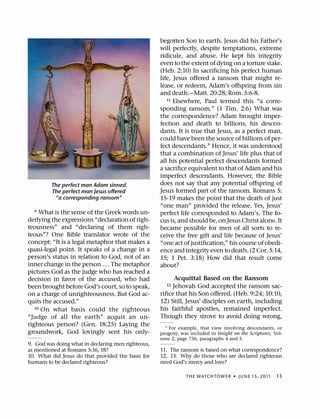
         The perfect man Adam sinned.               does not say that any potential offspring of
         The perfect man Jesus offered               Jesus formed part of the ransom. Romans 5:
          “a corresponding ransom”                  15-19 makes the point that the death of just
                                                    “one man” provided the release. Yes, Jesus’
  9  What is the sense of the Greek words un-       perfect life corresponded to Adam’s. The fo-
derlying the expressions “declaration of righ-      cus is, and should be, on Jesus Christ alone. It
teousness” and “declaring of them righ-             became possible for men of all sorts to re-
teous”? One Bible translator wrote of the           ceive the free gift and life because of Jesus’
concept: “It is a legal metaphor that makes a       “one act of justification,” his course of obedi-
quasi-legal point. It speaks of a change in a       ence and integrity even to death. (2 Cor. 5:14,
person’s status in relation to God, not of an       15; 1 Pet. 3:18) How did that result come
inner change in the person . . . The metaphor       about?
pictures God as the judge who has reached a
decision in favor of the accused, who had                 Acquittal Based on the Ransom
been brought before God’s court, so to speak,         12 Jehovah God accepted the ransom sac-
on a charge of unrighteousness. But God ac-         rifice that his Son offered. (Heb. 9:24; 10:10,
quits the accused.”                                 12) Still, Jesus’ disciples on earth, including
   10 On what basis could the righteous             his faithful apostles, remained imperfect.
“Judge of all the earth” acquit an un-              Though they strove to avoid doing wrong,
righteous person? (Gen. 18:25) Laying the
                                                      1 For example, that view involving descendants, or
groundwork, God lovingly sent his only-             progeny, was included in Insight on the Scriptures, Vol-
                                                    ume 2, page 736, paragraphs 4 and 5.
9. God was doing what in declaring men righteous,
as mentioned at Romans 5:16, 18?                    11. The ransom is based on what correspondence?
10. What did Jesus do that provided the basis for   12, 13. Why do those who are declared righteous
humans to be declared righteous?                    need God’s mercy and love?

                                                               THE WATCHTOWER ˙ JUNE 15, 2011            13
they did not always succeed. Why? Because          the prospect of being resurrected to heaven
they had inherited sin. (Rom. 7:18-20) But         as actual spirit sons to “rule as kings” with
God could and did do something about that.         Jesus Christ.—Read Romans 8:15-17, 23.
He accepted the “corresponding ransom”
and was willing to apply it in behalf of his              God’s Love Manifest to Others
human servants.                                      16  Not all who exercise faith and serve God
   13 It is not that God owed it to the apostles   as loyal Christians expect to “rule as kings”
and others to apply the ransom because they        with Christ in heaven. Many have a Bible-
had performed certain good works. Instead,         based hope similar to that of God’s pre-
God applied the ransom in their behalf out         Christian servants. They hope to live forever
of his mercy and great love. He chose to ac-       on a paradise earth. Can they even now re-
quit the apostles and others of the judgment       ceive a loving gift from God and be viewed
against them, viewing them as absolved of          as righteous with earthly life in view? Based
inherited guilt. Paul made that plain: “By         on what Paul wrote to the Romans, the re-
this undeserved kindness, indeed, you have         assuring answer is yes!
been saved through faith; and this not ow-            17 Paul discussed a prime example, Abra-

ing to you, it is God’s gift.”—Eph. 2:8.           ham, a man of faith who lived before Jeho-
   14 Think what a gift it is for the Almighty     vah provided a law code to Israel and long
to forgive the sin a person inherited as well      before Christ opened the way to heavenly
as the wrongs he committed! You could not          life. (Heb. 10:19, 20) We read: “It was not
count how many sins individuals commit-            through law that Abraham or his seed had
ted before becoming Christians; yet, on the        the promise that he should be heir of a
basis of the ransom, God can forgive those         world, but it was through the righteous-
sins. Paul wrote: “The gift resulted from          ness by faith.” (Rom. 4:13; Jas. 2:23, 24) So
many trespasses in a declaration of righ-          God counted faithful Abraham as righteous.
teousness.” (Rom. 5:16) The apostles and           —Read Romans 4:20-22.
others receiving this loving gift (being de-          18 That cannot mean that Abraham was

clared righteous) would have to continue to        sinless while serving Jehovah over the de-
worship the true God in faith. With what fu-       cades. No, he was not righteous in that
ture reward? “Those who receive the abun-          sense. (Rom. 3:10, 23) However, in his limit-
dance of the undeserved kindness and of            less wisdom, Jehovah took into account
the free gift of righteousness [will] rule as      Abraham’s exceptional faith and his works
kings in life through the one person, Jesus        resulting therefrom. In particular, Abraham
Christ.” Indeed, the gift of righteousness         exercised faith in the promised “seed” to
works in the opposite direction. The gift          come in his line. That Seed proved to be the
has life as its outcome.—Rom. 5:17; read           Messiah, or Christ. (Gen. 15:6; 22:15-18) Ac-
Luke 22:28-30.                                     cordingly, on the basis of “the ransom paid
   15 Those receiving that gift, being de-
                                                   by Christ Jesus,” the divine Judge is able to
clared righteous, become God’s spiritual
sons. As joint heirs with Christ, they have        16. How might ones with an earthly hope receive a
                                                   gift?
14, 15. What reward was placed before those        17, 18. (a) In view of Abraham’s faith, how did
whom God declared righteous, but what did they     God consider him? (b) How was it that Jehovah
still need to do?                                  could view Abraham as righteous?

14   THE WATCHTOWER ˙ JUNE 15, 2011
What good news
     —by means of Jesus we can
         be declared righteous!

forgive sins that occurred in
the past. Thus, Abraham and
other men of faith in pre-
Christian times are in line
for a resurrection.—Read Ro-
mans 3:24, 25; Ps. 32:1, 2.
      Enjoy a Righteous
        Standing Now
   19 The fact that the God

of love counted Abraham as
righteous should be hearten-
ing for true Christians today. Jehovah did        —friendship with God—differs from “the free
not declare him righteous in the sense that       gift” the anointed receive. Yet, it certainly is a
he does those whom he anoints with spirit         gift that they accept with deep gratitude.
to be “joint heirs with Christ.” The limited         21 If you hope to enjoy everlasting life on

number of that group are “called to be holy       earth, you should realize that this opportu-
ones” and are accepted as “God’s sons.”           nity has not come to you because of a capri-
(Rom. 1:7; 8:14, 17, 33) In contrast, Abraham     cious act by a human ruler. Rather, it reflects
came to be “Jehovah’s friend”—and that be-        the wise purpose of the Universal Sovereign.
fore the ransom sacrifice was offered. (Jas. 2:     Jehovah has taken progressive steps to ac-
23; Isa. 41:8) What, then, about true Chris-      complish his purpose. These steps have been
tians who hope to live in the restored earthly    in line with true justice. More than that,
Paradise?                                         they have reflected God’s great love. Well
   20 These have not received “the free gift of   could Paul say: “God recommends his own
righteousness” with heavenly life in view         love to us in that, while we were yet sinners,
“through the release by the ransom paid by        Christ died for us.”—Rom. 5:8.
Christ Jesus.” (Rom. 3:24; 5:15, 17) Neverthe-
                                                  21. What benefits are available because of Jeho-
less, they exercise deep faith in God and his     vah’s love and justice?
provisions, and they manifest their faith
by good works. One such work is that of
“preaching the kingdom of God . . . and                          Do You Recall?
teaching the things concerning the Lord Je-         ˙ Adam’s progeny received what
sus Christ.” (Acts 28:31) Thus, Jehovah can           inheritance, and with what result?
view these as righteous in the sense that he        ˙ How was a corresponding ransom
did Abraham. The gift such ones receive               provided, and in what sense was
                                                      there a correspondence?
19. Why should God’s view of Abraham be heart-
ening to many today?                                ˙ The gift of being declared righteous
20. God expects what of those whom he today           brought what prospect to you?
views as righteous, as he did Abraham?

                                                            THE WATCHTOWER ˙ JUNE 15, 2011       15
Did Abraham Really
Own Camels?

C    AMELS were among the domestic animals that Abraham
     received from Pharaoh, says the Bible. (Gen. 12:16) When
Abraham’s servant went on a long journey to Mesopotamia,
he “took ten camels from the camels of his master.” So the Bible
clearly states that Abraham owned camels about the begin-
ning of the second millennium B.C.E.—Gen. 24:10.
   Some do not accept this. The New International Version Ar-
chaeological Study Bible reports: “Scholars have debated the his-
toricity of these references to camels because most believe that
these animals were not widely domesticated until approxi-
mately 1200 B.C., long after the time of Abraham.” Any earlier
Biblical reference to camels would therefore be considered an
anachronism, or a chronological misplacing.
   Other scholars, however, argue that although the domesti-
cation of camels became a factor of importance about the end
of the second millennium, this does not mean that camels
were not used earlier. The book Civilizations of the Ancient Near
East states: “Recent research has suggested that the domestica-
tion of the camel took place in southeastern Arabia some time
in the third millennium [B.C.E.]. Originally, it was probably
bred for its milk, hair, leather, and meat, but it cannot have
been long before its usefulness as a beast of burden became ap-
parent.” This dating to before Abraham’s time seems to be sup-
ported by bone fragments and other archaeological remains.
   Written evidence also exists. The same reference work says:
“In Mesopotamia, cuneiform lists mention the creature [the
camel] and several seals depict it, indicating that the animal
may have reached Mesopotamia by the beginning of the sec-
ond millennium,” that is, by Abraham’s time.
   Some scholars believe that South Arabian merchants in-
volved in the incense trade used camels to transport their
goods northward through the desert, heading to such areas as
Egypt and Syria and thereby introducing camels to these
areas. This trade was probably common as early as 2000 B.C.E.
Interestingly, Genesis 37:25-28 mentions Ishmaelite merchants
who used camels to transport incense to Egypt about a hun-
dred years after the time of Abraham.
   Perhaps camels were not widely used in the ancient Near
East at the beginning of the second millennium B.C.E., but evi-
dence seems to confirm that they were not completely un-
known. The International Standard Bible Encyclopedia therefore
concludes: “It is no longer necessary to regard the mention of
camels in the patriarchal narratives as anachronisms, since
there is ample archeological evidence for the domestication of
the camel before the time of the patriarchs.”

                                            THE WATCHTOWER ˙ JUNE 15, 2011   17
Rome


                                                                    Troas


‘Bring the Scrolls,                                                            Ephesus


 Especially the Parchments’

W      ITH the above words, the apostle Paul
        urged his fellow missionary Timothy
to bring him some written material. To what
                                                   “parchments” in this verse, Bible scholar
                                                   A. T. Robertson observed: “These in particu-
                                                   lar would likely be copies of Old Testament
kinds of scrolls and parchments was Paul re-       books, parchment being more expensive
ferring? What led him to say this? And what        than papyrus.” From youth on, Paul was
can we learn from this request?                    “educated . . . at the feet of Gamaliel,” who
   By the middle of the first century C.E.          taught the Mosaic Law and was esteemed by
when Paul wrote these words, the 39 books          all the people. So it is understandable that
of the Hebrew Scriptures had been divided          Paul would have obtained personal copies of
into either 22 or 24 books, most of which          the scrolls of God’s Word.—Acts 5:34; 22:3.
were likely in separate scrolls. Professor Alan
Millard noted that these scrolls, though ex-                  Christians’ Use of Scrolls
pensive, were “not . . . out of the reach of the      Still, those who owned scrolls of the Holy
reasonably well-to-do.” Some had access to         Scriptures were privileged. How, then, did
at least one of them. For example, the Ethio-      most of the Christians in those days gain ac-
pian eunuch had a scroll in his chariot and        cess to the Word of God? Paul’s earlier letter
was “reading aloud the prophet Isaiah.” He         to Timothy gives us a hint. He wrote: “While
was ‘in power under Candace queen of the           I am coming, continue applying yourself to
Ethiopians and was over all her treasure.’ He      public reading.” (1 Tim. 4:13) Public reading
must have been wealthy enough to own por-          was a part of the meeting program of Chris-
tions of the Scriptures.—Acts 8:27, 28.            tian congregations, a traditional practice
   In his request to Timothy, Paul wrote:          among God’s people since the time of Mo-
“When you come, bring the cloak I left at          ses.—Acts 13:15; 15:21; 2 Cor. 3:15.
Troas with Carpus, and the scrolls, especially        As an elder, Timothy had to ‘apply him-
the parchments.” (2 Tim. 4:13) This suggests       self’ to reading out loud, which would bene-
that Paul owned a number of books. What            fit those who did not own copies of the
would have had a higher place in his library       Scriptures. Surely, during the public reading
than the Word of God? Regarding the word           of the Word of God, all listened attentively

18   THE WATCHTOWER ˙ JUNE 15, 2011
so as not to miss a word, and parents and         maintained a longing for God’s Word dur-
children must have discussed at home what         ing this most distressing period of his life.
was read at the meetings.                         Do you not see this as a secret to his always
   The well-known Dead Sea Scroll of Isaiah       being spiritually alive and active as well as
is almost 24 feet (7.3 m) in length. With a       his being a source of encouragement to
rod at each end and often with a cover for        many?
protection, a scroll would be heavy. Probably        Today, how blessed we are if we own a per-
most Christians could not carry many with         sonal copy of the complete Bible! Some of
them for preaching. Even if Paul possessed        us even have several copies and editions.
some scrolls of the Scriptures for his person-    Like Paul, we need to cultivate eagerness to
al use, he likely could not take on his travels   gain a deeper understanding of the Scrip-
all the scrolls he owned. Evidently he left       tures. Of the 14 inspired letters Paul was
some with his friend Carpus in Troas.             privileged to write, his second to Timothy
                                                  was the last. His personal request appears to-
         What Can We Learn From                   ward the end of the book. In fact, Paul’s en-
               Paul’s Example?
                                                  treaty to Timothy ‘to bring the scrolls, espe-
   Just before making his request, Paul, im-      cially the parchments,’ was one of his final
prisoned in Rome for a second time, wrote:        wishes on record.
“I have fought the fine fight, I have run the
                                                     Is it your ardent desire to fight the fine
course to the finish . . . From this time on
                                                  fight of the faith to the finish, just as Paul
there is reserved for me the crown of righ-
                                                  did? Do you want to keep yourself spiritual-
teousness.” (2 Tim. 4:7, 8) He likely wrote
                                                  ly stimulated and prepared to engage in the
these words about 65 C.E. during the perse-
                                                  witnessing work for as long as the Lord
cution by Nero. This time the imprison-
                                                  wants us to continue? Then why not do
ment was very severe. In fact, he sensed
                                                  as Paul encouraged Christians to do? “Pay
that his execution was imminent. (2 Tim.
                                                  constant attention to yourself and to your
1:16; 4:6) Understandably, Paul expressed
                                                  teaching” by eager and constant study of
his heartfelt desire to have his scrolls on
                                                  the Bible, which is now available to more
hand. Though he was confident that he had
                                                  people than ever in forms more convenient
fought the fine fight to the finish, he longed
                                                  than the scrolls.—1 Tim. 4:16.
to continue strengthening himself by study-
ing the Word of God.
   Timothy was probably still in Ephesus
when he received Paul’s request. (1 Tim. 1:3)
From Ephesus to Rome via Troas is roughly
1,000 miles (1,600 km). In the same letter,
Paul urged Timothy: “Do your utmost to ar-
rive before winter.” (2 Tim. 4:21) The Bible
does not reveal whether Timothy found a
boat to get him to Rome by the time Paul de-
sired.
   What can we learn from Paul’s request for
“the scrolls, especially the parchments”? He
“SHEPHERD THE FLOCK OF GOD
         IN YOUR CARE”
                   “Shepherd the flock of God in your care, not under
                         compulsion, but willingly.”—1 PET. 5:2.


S  OMETIME before Nero launched his per-
     secution against Christians in Rome, the
apostle Peter wrote his first letter. He wanted
                                                 over’ the flock. (1 Thess. 5:12) A consider-
                                                 ation of these matters will help us to take a
                                                 firm stand against our chief Adversary, rec-
to strengthen his fellow believers. The Dev-     ognizing that he is the one with whom we
il was ‘walking about,’ seeking to devour        have a wrestling.—Eph. 6:12.
Christians. To stand firm against him, they
needed to ‘keep their senses’ and to ‘humble              Shepherd the Flock of God
themselves under the mighty hand of God.’
                                                   4  Peter encouraged the older men among
(1 Pet. 5:6, 8) They also needed to stay unit-   the first-century Christians to have a godly
ed. They could not afford to be “biting and       view of the flock entrusted to them. (Read
devouring one another,” for that could re-       1 Peter 5:1, 2.) Although he was considered a
sult in their being “annihilated by one an-      pillar in the congregation, Peter did not talk
other.”—Gal. 5:15.                               condescendingly to the elders. Rather, he
   2 Today, we face a similar situation. The     admonished them as fellow elders. (Gal. 2:9)
Devil is looking for opportunities to devour     With a spirit like Peter’s, the Governing
us. (Rev. 12:12) And ahead of us looms a         Body today exhorts congregation elders to
“great tribulation such as has not occurred      strive to fulfill the heavy responsibility of
since the world’s beginning.” (Matt. 24:21)      shepherding God’s flock.
                                                    5 The apostle wrote that the older men
Just as first-century Christians had to guard
against squabbling among themselves, so          were to ‘shepherd the flock of God in their
must we. To accomplish this, at times we         care.’ It was most important for them to rec-
need help from qualified older men.               ognize that the flock belongs to Jehovah and
   3 Let us consider how elders can enhance      Jesus Christ. The elders had to render an ac-
their appreciation for the privilege of shep-    count about how they kept watch over God’s
herding ‘the flock of God in their care.’         sheep. Suppose that a close friend of yours
(1 Pet. 5:2) Thereafter, we will reflect on the   asked you to look after his children while he
proper way of carrying out the shepherding       was away. Would you not take good care of
work. In the next article, we will examine       them and feed them? If one child got sick,
how the congregation can ‘have regard for        would you not make sure that he received
those who are working hard and presiding         any needed medical help? Similarly, the el-
                                                 ders in the congregation are “to shepherd
1. What circumstances were Christians facing     the congregation of God, which he pur-
when Peter wrote his first letter?
2, 3. Against whom should we be fighting, and     4, 5. How should the older men view the flock? Il-
what are we going to consider in this series?    lustrate.

20   THE WATCHTOWER ˙ JUNE 15, 2011
Like shepherds in ancient times, elders today must protect the “sheep” in their care

chased with the blood of his own Son.”              against the lionlike attacks of the Devil. This
(Acts 20:28) They keep in mind that each            may involve a courageous act of figura-
sheep was bought with the precious blood of         tively snatching the sheep from the Dev-
Christ Jesus. Being accountable, the elders         il’s jaws. By taking hold of the wild beast
feed, protect, and care for the flock.               by the beard, so to speak, elders can res-
   6 Think of the responsibilities that literal     cue the sheep. They may reason with un-
shepherds had in Bible times. They had to           wary brothers who are tempted by Satan’s
put up with the heat of the day and the cold        snares. (Read Jude 22, 23.) Elders, of course,
of the night in order to tend the flock. (Gen.       do not accomplish this without Jehovah’s
31:40) They even risked their life for the          help. They handle an injured sheep tender-
sheep. The shepherd boy David rescued his           ly, bandaging him and applying the sooth-
flock from wild beasts, including a lion and a       ing balm of God’s Word.
                                                       8 A literal shepherd also guided the flock
bear. With regard to each one, David said
that he “grabbed hold of its beard and struck       to an appropriate pasture and a watering
it down and put it to death.” (1 Sam. 17:34,        place. Likewise, elders direct the flock to the
35) What bravery! How close he must have            congregation, encouraging regular meeting
come to the beast’s jaws! Still, he did not         attendance so that the flock can be well-fed
hold back from saving the sheep.                    and receive “their food at the proper time.”
   7 Today, elders need to be on guard              (Matt. 24:45) The elders may need to spend
                                                    extra time helping those who are spiritual-
6. What was the responsibility of ancient shep-     ly sick to accept nourishment from God’s
herds?                                              Word. A stray sheep may be trying to return
7. How may elders snatch the sheep from Satan’s
jaws, figuratively speaking?                         8. To where do elders guide the flock, and how?

                                                               THE WATCHTOWER ˙ JUNE 15, 2011        21
to the flock. Instead of intimidating their             doing so. (Matt. 22:37-39) They give of
brother, the elders tenderly explain Scriptur-         themselves, not grudgingly, but willingly.
al principles and show him how he can ap-                 12 To what extent should the elders give of

ply these in his life.                                 themselves? In caring for the sheep, they
   9 When you are sick, what kind of doctor            imitate the apostle Paul, even as he imitated
do you prefer? One who spends little time              Jesus. (1 Cor. 11:1) Having tender affection
listening to you and then quickly prescribes           for the Thessalonian brothers, Paul and his
medication so as to be free to see the next pa-        companions were well-pleased to impart to
tient? Or would you rather consult a doctor            them ‘not only the good news of God but
who hears you out, explains what might be              also their own souls.’ When doing so, they
wrong with you, and outlines possible treat-           became gentle, “as when a nursing mother
ments?                                                 cherishes her own children.” (1 Thess. 2:7, 8)
   10 Likewise, the elders can listen to the           Paul understood how a nursing mother felt
spiritually sick person and help to heal the           about her children. She would do anything
wound, thus figuratively “greasing him with             for them, including getting up in the middle
oil in the name of Jehovah.” (Read James 5:            of the night to feed them.
                                                          13 The elders need to take care to maintain
14, 15.) Like the balsam from Gilead, God’s
Word can soothe the ailing one. (Jer. 8:22;            balance between shepherding responsibili-
Ezek. 34:16) When applied, Bible principles            ties and obligations to their own family.
can help the faltering one to regain spiritual         (1 Tim. 5:8) The time that elders spend with
balance. Yes, the elders do much good once             the congregation is precious time away from
they hear the ailing sheep’s concerns and              their family. One way to balance the two re-
pray with him.                                         sponsibilities is to invite others to their Fam-
                                                       ily Worship evening on occasion. Over the
  Not Under Compulsion but Willingly                   years, Masanao, an elder in Japan, invited
   11 Peter next reminded the older men how            single ones and spiritually fatherless fami-
the shepherding work should and should                 lies to his family’s study. In time, some who
not be done. Elders are to shepherd the flock           were helped became elders themselves and
of God, “not under compulsion, but willing-            imitated Masanao’s fine example.
ly.” What moves elders to serve their broth-
ers willingly? Well, what moved Peter to                           Shun Dishonest Gain
                                                             —Shepherd the Flock Eagerly
shepherd and feed Jesus’ sheep? A key was                 14 Peter also encouraged elders to shep-
his love and affection for the Lord. (John
                                                       herd the flock, “neither for love of dishonest
21:15-17) Because of love, elders “live no
                                                       gain, but eagerly.” The work of the elders
longer for themselves, but for him who died
                                                       takes up a considerable amount of time, yet
for them.” (2 Cor. 5:14, 15) This love, com-
                                                       they do not expect any financial compensa-
bined with their love for God and their
                                                       tion. Peter saw the need to warn his fellow
brothers, compels elders to serve the flock,
devoting their efforts, resources, and time to          12. To what extent did the apostle Paul give of him-
                                                       self?
9, 10. How should elders care for spiritually ailing   13. Elders need to maintain what balance?
ones?                                                  14, 15. Why should elders guard against the “love
11. What moves elders to shepherd the flock of God      of dishonest gain,” and how can they imitate Paul in
willingly?                                             this regard?

22   THE WATCHTOWER ˙ JUNE 15, 2011
older men about the danger of shepherding             the nations, they wanted to have a promi-
the flock out of “love of dishonest gain.”             nent position.—Read Mark 10:42-45.
That danger is evident in the life of luxury             18 Today, brothers who are “reaching out

led by religious leaders of “Babylon the              for an office of overseer” do well to examine
Great” while many people are forced to lead           themselves as to why they are reaching out.
a life of poverty. (Rev. 18:2, 3) The elders to-      (1 Tim. 3:1) Those who are now elders may
day have good reason to be on guard against           want to ask themselves frankly whether they
any tendency in that direction.                       have a desire for authority or prominence as
   15 Paul set a fine example for Christian el-        some of the apostles did. If the apostles had
ders. Though he was an apostle and could              difficulty in this area, then elders can appre-
have been “an expensive burden” on Chris-             ciate that they need to work hard to avoid
tians in Thessalonica, he did not “eat food           any worldly tendency to enjoy having au-
from anyone free.” Rather, he ‘labored and            thority over others.
toiled night and day.’ (2 Thess. 3:8) Many               19 Granted, there are times when the el-

present-day elders, including those who are           ders need to be firm, such as when protect-
in the traveling work, set a fine example in           ing the flock from “oppressive wolves.” (Acts
this regard. Although they accept hospitality         20:28-30) Paul told Titus to keep “exhorting
from fellow believers, they do not “put an ex-        and reproving with full authority.” (Titus 2:
pensive burden” upon anyone.—1 Thess. 2:9.            15) Yet, even when having to take such ac-
   16 The elders shepherd the flock “eager-            tion, the elders try to dignify the ones who
ly.” Their eagerness is evident in their self-        are involved. They appreciate that rather
sacrificing attitude in helping the flock.              than harsh criticism, gentle persuasion is
However, that does not mean that they force           usually more effective in reaching hearts
the flock to serve Jehovah; nor do loving el-          and in moving someone to follow a right
ders encourage others to serve God out of a           course.
                                                         20 Christ’s fine example motivates elders
competitive spirit. (Gal. 5:26) Elders appreci-
ate that each sheep is unique. They are ea-           to love the flock. (John 13:12-15) Our
ger to help their brothers to serve Jehovah           hearts are warmed as we read how he
happily.                                              taught his disciples in the preaching

      Not Lording It Over the Flock                   19. What should elders remember when taking ac-
                                                      tion to protect the flock?
           but Being Examples                         20. How can elders imitate Jesus in setting a fine ex-
  17 As we have discussed, the elders should
                                                      ample?
keep in mind that the flock they are shep-
herding is God’s, not their own. They are
careful not ‘to lord it over those who are                          By Way of Review
God’s inheritance.’ (Read 1 Peter 5:3.) At               ˙ Why was it appropriate for Peter to
times, Jesus’ apostles reached out with the                admonish fellow elders to shepherd
wrong motive. Like those who were ruling                   the flock of God in their care?
                                                         ˙ How should elders shepherd spiritu-
16. What does it mean to shepherd the flock “ea-            ally ailing ones?
gerly”?
17, 18. (a) Why did the apostles at times have dif-      ˙ What moves elders to shepherd the
ficulty grasping Jesus’ teaching on humility? (b) In        flock of God in their care?
what similar situation might we find ourselves?

                                                                 THE WATCHTOWER ˙ JUNE 15, 2011         23
and disciple-making work. His pattern of hu-           older men by referring to a promise for the
mility touched the hearts of his disciples,            future. (Read 1 Peter 5:4.) The anointed
motivating them to follow a course reflect-             overseers “will receive the unfadable crown
ing ‘lowliness of mind considering that the            of glory” with Christ in heaven. The under-
others were superior to them.’ (Phil. 2:3) El-         shepherds of the “other sheep” will have the
ders today are likewise moved to follow Je-            privilege of shepherding the flock of God on
sus’ example, and they, in turn, want to be            earth under the rulership of “the chief shep-
“examples to the flock.”                                herd.” (John 10:16) The next article will dis-
  21 Peter concluded his admonition to the             cuss ways in which congregation members
                                                       can support those appointed to take the
21. To what reward can elders look forward?            lead.


           “HAVE REGARD FOR
        THOSE WHO ARE WORKING
            HARD AMONG YOU”
               “Have regard for those who are working hard among you
        and presiding over you in the Lord and admonishing you.”—1 THESS. 5:12.


I MAGINE yourself as a member of the first-                 Understandably, after leaving Thessalo-
                                                         2

   century Thessalonian congregation, one              nica, Paul was concerned about the fledgling
of the earliest to be established in Europe.           congregation. He tried to return, but “Satan
The apostle Paul had spent considerable                cut across” his path. So he sent Timothy to
time building up the brothers there. He                encourage the congregation. (1 Thess. 2:18;
may have appointed older men to take the               3:2) When Timothy brought back a good re-
lead, as was the case in other congregations.          port, Paul was moved to write the Thessalo-
(Acts 14:23) But after the congregation was            nians a letter. Among other things, Paul en-
formed, the Jews organized a mob to rid the            couraged them to ‘have regard for those who
city of Paul and Silas. The Christians who re-         were presiding over them.’—Read 1 Thessa-
mained might have felt deserted, perhaps               lonians 5:12, 13.
                                                         3 The brothers who were taking the lead
even fearful.
                                                       among the Thessalonian Christians were
1, 2. (a) What was the situation of the Thessalo-
nian congregation when Paul wrote his first letter to   3. What reasons did Thessalonian Christians have
them? (b) What did Paul encourage the Thessalo-        for giving extraordinary consideration to the older
nians to do?                                           men?

24   THE WATCHTOWER ˙ JUNE 15, 2011
not as experienced as Paul and his traveling          slave’s direction, the local elders work hard
companions; nor did they have the rich spir-          to feed their brothers spiritually. Those in
itual heritage of the elders in Jerusalem. Af-        the congregation may have Bible-based liter-
ter all, the congregation had existed for less        ature in abundance, and in some languages
than a year! Still, those in the congregation         such tools as the Watch Tower Publications
had reason to be grateful for their older             Index and Watchtower Library on CD-ROM
men, who were “working hard” and “presid-             are available. To satisfy the congregation’s
ing over” the congregation and “admonish-             spiritual needs, the elders spend hours pre-
ing” the brothers. Indeed, they had good              paring meeting parts so that they can pre-
reason to “give [the elders] more than ex-            sent the assigned information in a meaning-
traordinary consideration in love.” This re-          ful way. Have you thought about how much
quest was followed by Paul’s counsel to “be           time the elders spend preparing their parts
peaceable with one another.” If you had               for meetings, assemblies, and conventions?
been there in Thessalonica, would you have               6 The older men in Thessalonica remem-

shown deep appreciation for the elders’               bered the fine example that Paul set in shep-
work? How do you view the “gifts in men”              herding the flock. It was not a matter of his
whom God through Christ has provided in               making calls in a mechanical or perfunctory
your congregation?—Eph. 4:8.                          way. As discussed in the preceding article,
                                                      Paul “became gentle . . . , as when a nursing
              “Working Hard”                          mother cherishes her own children.” (Read
  4  After sending Paul and Silas to Beroea,          1 Thessalonians 2:7, 8.) He was even willing
how were the older men in Thessalonica                ‘to impart his own soul’! When shepherd-
“working hard”? Imitating Paul, they no               ing, the older men were to be like him.
doubt taught the congregation, using the                 7 Christian shepherds today imitate Paul
Scriptures. ‘Did the Thessalonian Christians          by cherishing the flock. By nature, some
have appreciation for God’s Word?’ you may            sheep may not be warm and companion-
wonder. After all, the Bible says that the            able. Still, the elders try to show insight and
Beroeans were “more noble-minded than                 “find good” in them. (Prov. 16:20) True, be-
those in Thessalonica, . . . carefully examin-        ing imperfect, an elder may struggle to have
ing the Scriptures daily.” (Acts 17:11) The           a positive view of each one. Yet, as he tries
comparison, however, was with the Thessa-             his best to be gentle toward all, should he
lonian Jews in general, not with the Chris-           not be commended for his effort to be a
tians. Those who became believers ‘accepted           good shepherd under Christ?
God’s word, not as the word of men, but as               8 We all have reason to “be submissive” to
the word of God.’ (1 Thess. 2:13) The older
                                                      the elders. As Paul wrote, ‘they are keeping
men must have worked hard to feed such
                                                      watch over our souls.’ (Heb. 13:17) That ex-
ones spiritually.
                                                      pression reminds us of the literal shepherd
   5 Today, the faithful and discreet slave
                                                      who forgoes sleep in order to protect his
class is providing God’s flock with “food at
the proper time.” (Matt. 24:45) Under the             6, 7. (a) What example did the older men in Thes-
                                                      salonica have in Paul? (b) Why might it be challeng-
4, 5. Why was it hard work for the older men in       ing for elders today to imitate Paul?
Paul’s day to teach the congregation, and why is it   8, 9. What are some ways that present-day elders
that way today?                                       ‘keep watch over our souls’?

                                                                THE WATCHTOWER ˙ JUNE 15, 2011         25
flock. Likewise, the elders today may sacri-        place decently and by arrangement.”—1 Cor.
fice some sleep while tending to the needs of       14:40.
those who have poor health or emotional or
spiritual problems. For example, brothers                      “Presiding Over You”
on Hospital Liaison Committees have been
                                                     11  Paul described the hardworking older
awakened from sleep to respond to a medi-          men of Thessalonica as “presiding over”
cal crisis. Yet, when we face such a situation,    the congregation. The word in the origi-
how appreciative we are of their service!          nal language implies “standing before” and
   9 Elders on Regional Building Committees        can be rendered “directing; taking the lead
and relief committees work hard to help the        among.” (1 Thess. 5:12; ftn.) Paul referred to
brothers. They deserve our wholehearted            the same elders as “working hard.” He was
support! Consider the relief effort after Cy-       talking, not about one “presiding overseer,”
clone Nargis hit Myanmar in 2008. To reach         but about all the older men in the congrega-
the Bothingone Congregation in the hard-           tion. Today, most elders stand before the
hit Irrawaddy Delta region, the relief team        congregation and conduct meetings. The re-
traveled through devastated terrain strewn         cent adjustment to employ the designation
with corpses. When the local brothers saw          “coordinator of the body of elders” helps us
                                                   to view all the elders as members of a unified
that the first relief team to reach Bothingone
                                                   body.
included their former circuit overseer, they
                                                      12 “Presiding over” the congregation in-
cried out: “Look! It’s our circuit overseer! Je-
hovah has saved us!” Do you appreciate the         volves more than just teaching. The same ex-
hard work that the elders render day and           pression is used at 1 Timothy 3:4. Paul said
night? Some elders are appointed to serve          that an overseer should be “a man presiding
on special committees to handle difficult ju-        over his own household in a fine manner,
dicial problems. These elders do not brag          having children in subjection with all seri-
about what they have accomplished; yet             ousness.” Here the expression “presiding
those who benefit from their service are real-      over” obviously includes not only teaching
ly grateful.—Matt. 6:2-4.                          his children but also taking the lead in the
   10 Many elders today also have paper-
                                                   family and “having children in subjection.”
                                                   Yes, elders take the lead in the congregation,
work to do. For example, the coordinator of
                                                   helping all to be in subjection to Jehovah.
the body of elders prepares the schedules
                                                   —1 Tim. 3:5.
for weekly meetings. The congregation sec-            13 In order to preside well over the flock,
retary compiles the monthly and annual
                                                   the elders discuss among themselves how to
field service reports. The school overseer
                                                   address the needs of the congregation. It
gives careful thought to the school schedule.
                                                   might be more efficient if one elder made all
Every three months, congregation account
                                                   the decisions. Yet, following the example of
records are audited. The elders read letters
                                                   the first-century governing body, modern-
from the branch office and apply the direc-
                                                   day bodies of elders discuss matters freely,
tion that helps maintain “the oneness in the
faith.” (Eph. 4:3, 13) Through the efforts of       11, 12. Who preside over the congregation, and
such hardworking elders, “all things take          what does doing so involve?
                                                   13. Why might it take time to reach a decision at an
10. What lesser-known work do elders do?           elders’ meeting?

26   THE WATCHTOWER ˙ JUNE 15, 2011
seeking guidance from the Scriptures. Their          cord? (3 John 9, 10) The whole congregation
goal is to apply Scriptural principles to the        will surely suffer. If Satan tried to upset the
needs of the local congregation. This is most        first-century congregation, we can be sure
effective when each elder prepares for the el-        that he wants to disrupt the peace of the
ders’ meetings, considering the Scriptures           congregation today. He might appeal to self-
and the guidelines from the faithful and dis-        ish human tendencies, such as the desire for
creet slave class. Of course, this takes time.       prominence. Thus, elders need to cultivate
When there is a difference of opinion, as             humility and work together as a unified
occurred when the first-century governing             body. How we appreciate the humility of the
body considered the matter of circumcision,          elders who do cooperate as a body!
extra time and research might be needed to
reach a consensus based on the Scriptures.                      “Admonishing You”
—Acts 15:2, 6, 7, 12-14, 28.                           15Paul then highlighted a difficult yet im-
  14 What might happen if one elder insists          portant task of the older men: admonishing
on having his way or tries to promote his            the flock. In the Christian Greek Scriptures,
own ideas? Or what if someone—like Diotre-           only Paul used the Greek term translated
phes in the first century—sows seeds of dis-          “admonish.” It can refer to strong counsel
14. Do you appreciate that the body of elders work   15. What motive do elders have when admonish-
together in unity? Why do you feel that way?         ing a brother or a sister?


                                                                                 Do you appreciate
                                                                            the many ways in which
                                                                                the elders shepherd
                                                                                 the congregation?
but does not indicate hostility. (Acts 20:31;      seemed medically inexplicable. Then a phy-
2 Thess. 3:15) For instance, Paul wrote to the     sician correctly identified the problem, but
Corinthians: “I am writing these things, not       the diagnosis was rather hard to accept.
to shame you, but to admonish you as my            Would you hold a grudge against that doc-
beloved children.” (1 Cor. 4:14) His motive        tor? No! Even if he recommended an opera-
behind the admonition was loving concern           tion, you would likely agree to the treatment,
for others.                                        believing it to be for your benefit. The way
   16 The elders bear in mind the importance       the doctor conveyed the information may
of the manner in which they admonish oth-          have a bearing on your feelings, but would
ers. They strive to imitate Paul by being          you let that determine your decision? Prob-
kind, loving, and helpful. (Read 1 Thessalo-       ably not. Likewise, do not allow the way you
nians 2:11, 12.) Of course, the elders ‘hold       are admonished to prevent you from listen-
firmly to the faithful word so that they may        ing to those whom Jehovah and Jesus may be
be able to exhort by teaching that is health-      using to let you know how you can help or
ful.’—Titus 1:5-9.                                 protect yourself spiritually.
   17 Of course, elders are imperfect and may
                                                               Appreciate Jehovah’s
say things that they later regret. (1 Ki. 8:46;               Provision of the Elders
Jas. 3:8) Also, elders know that for spiritual        19 What would you do if you received a
brothers and sisters, receiving counsel is nor-    gift especially made for you? Would you
mally not ‘joyous but grievous.’ (Heb. 12:11)      show your appreciation by using it? The
So when an elder approaches someone with           “gifts in men” are what Jehovah through Je-
words of admonition, he likely does so after       sus Christ has provided for you. One way
giving the matter much consideration and           you can show your gratitude for these gifts is
praying over it. If you have been admon-           by listening intently to talks given by the el-
ished, do you appreciate that elder’s loving       ders and by trying to apply the points they
concern?                                           bring out. You can also show your apprecia-
   18 Suppose you had a health problem that
                                                   tion by making meaningful comments at
16. Elders do well to keep what in mind when ad-   meetings. Support the work in which the el-
monishing others?                                  ders are taking the lead, such as the field
17, 18. What should you keep in mind if you re-    ministry. If you have benefited from counsel
ceive admonition from an elder?                    you received from a certain elder, why not
                                                   tell him so? In addition, why not show your
                                                   appreciation for the elders’ families? Re-
                Do You Recall?
                                                   member, for an elder to work hard in the
     ˙ What reasons did the Thessalonian           congregation, his family is sacrificing time
        Christians have to appreciate those
                                                   spent with him.
        taking the lead among them?
                                                      20 Yes, we have ample reason to show grat-
     ˙ How do the elders in your congrega-
        tion work hard for you?                    itude for the elders, who are working hard
                                                   among us, presiding over us, and admonish-
     ˙ How do you benefit from the elders’
        presiding over you?                        ing us. These “gifts in men” are truly a lov-
                                                   ing provision from Jehovah!
     ˙ If given admonition by an elder, what
        should you keep in mind?                   19, 20. How may you show appreciation for the
                                                   “gifts in men”?

28    THE WATCHTOWER ˙ JUNE 15, 2011
“Make Your                                                       ever, young Christians should
                                                                 ask themselves: ‘How much of
                                                                 my time might those activi-
 Way Successful”                                                 ties demand? What about as-
                                                                 sociations? What kind of spirit
                                                                 am I exposed to when engaging


                   How?                                          in those activities? And what
                                                                 might become the focus of my
                                                                 life?’ You likely realize that one
                                                                 could become so obsessed with

“S   UCCESS”—an eye-catching word! Some
     have climbed the corporate ladder and
 have achieved great success in getting rich
                                                   such activities that little time or energy
                                                   would be left for maintaining a relationship
                                                   with God. You can see, then, why setting
 and making a name for themselves. Others          priorities is important.—Eph. 5:15-17.
 have dreamed of success but have met with            Consider the case of Wiktor.1 He relates:
 utter failure.                                    “When I was 12, I joined a volleyball club.
    To a large extent, success depends on          In time, I won many prizes and awards. I had
 what you make the focus of your life. Two         an opportunity to become a star.” In time,
 other important factors are how you use           Wiktor became disturbed about the effect
 your time and energy and whether you              that his pursuit of the sport was having on
 show initiative.                                  his spirituality. One day, he fell asleep while
    Many Christians have found that having         trying to read the Bible. Also, he recognized
 a full share in the ministry has brought          that he derived little joy from the field min-
 them great satisfaction. Having the full-         istry. “The sport robbed me of my energy,
 time service as a career has helped young         and soon I realized that it was also robbing
 and old alike to be successful. Yet, some may     me of my spiritual zeal. I knew I was not do-
 feel that the ministry is somewhat boring         ing all that I could.”
 and give it a secondary place in their lives as                 Higher Education?
 they pursue other goals. Why might this              A Christian has a Scriptural obligation to
 happen? What can you do to avoid losing           care for his family, and that includes provid-
 sight of what is truly valuable? And how can      ing for their material needs. (1 Tim. 5:8)
 you “make your way successful”?—Josh. 1:8.        Still, does this really require a college or a
  Extracurricular Activities and Hobbies           university degree?
    Christian youths need to maintain the             It would be good to consider what effect
 proper balance between serving the true           pursuing higher education could have on
 God and participating in other activities.        one’s relationship with Jehovah. Let us il-
 Those who do so are heading for success in        lustrate this by considering a Scriptural ex-
 life and deserve warm commendation.               ample.
    Some young Christians, though, become             Baruch was the secretary to the prophet
 heavily involved in extracurricular ac-           Jeremiah. At one point, rather than focusing
 tivities and hobbies. Such activities may         on the privileges he had in serving Jehovah,
 not in themselves be objectionable. How-           1 Some names have been changed.

                                                             THE WATCHTOWER ˙ JUNE 15, 2011     29
Consider Grzegorz, a comput-
                                                              er programmer. Persuaded by
                                                              his colleagues, he took up an in-
                                                              tensive course of additional spe-
                                                              cialized training. Soon he had
                                                              no time left for spiritual pur-
                                                              suits. He recalls: “I constant-
                                                              ly felt on edge. My conscience
                                                              troubled me because I could not
                                                              reach the spiritual goals I had
                                                              set for myself.”

                                                                          Engrossed in
                                                                     One’s Employment
                                                                  God’s Word encourages true
                                                                Christians to be hardwork-
                                                                ing and to be responsible em-
                                                                ployees and employers. The
                                                                apostle Paul wrote: “Whatever
       Jehovah warned Baruch about ambition                     you are doing, work at it whole-
                                                                souled as to Jehovah, and not to
Baruch became ambitious. Jehovah noticed          men.” (Col. 3:22, 23) However, while hard
this and through Jeremiah warned him:             work is commendable, something more is
“You keep seeking great things for yourself.      needed—a good relationship with our Cre-
Do not keep on seeking.”—Jer. 45:5.               ator. (Eccl. 12:13) If a Christian became en-
  What were the “great things” that Baruch        grossed in his secular work, spiritual pur-
kept seeking? He may have been tempted to         suits could easily be pushed into second
make a name for himself in the Jewish sys-        place.
tem of things. Or the great things could             Becoming absorbed in a secular job can
have been material prosperity. In any case,       rob a Christian of the energy needed to
he had lost sight of the more important           maintain his own spiritual balance and to
things, those having spiritual value. (Phil. 1:   assist his family. King Solomon observed
10) Yet, Baruch obviously listened to Jeho-       that “a double handful of hard work” is
vah’s warning through Jeremiah and thus           often accompanied by “striving after the
gained his soul as a spoil.—Jer. 43:6.            wind.” If a Christian is overly involved in a
  What can we draw from this account?             secular career, he can end up having pro-
The counsel Baruch received indicates that        longed, severe stress. Such a person can even
something was amiss. He was seeking great         become enslaved to a career to the extent of
things for himself. If you have a means of        experiencing burnout. If so, can he really
supporting yourself, do you really need to        “rejoice . . . and see good for all his hard
spend time, money, and effort on further ed-       work”? (Eccl. 3:12, 13; 4:6) More important,
ucation just to realize personal aspirations or   would he have enough physical and emo-
those of your parents or other relatives?         tional strength left to carry out his duties

30   THE WATCHTOWER ˙ JUNE 15, 2011
in the family and to engage in spiritual ac-     meetings. I became so proud that I dis-
tivities?                                        missed the counsel from the elders and drew
   Janusz, who lives in Eastern Europe, be-      away from the congregation.”
came engrossed in his gardening business.
He recalls: “Worldly people admired me be-          You Can Make Your Life a Success
cause I was full of initiative and was able to     We have considered three areas in which a
complete each assigned task. But my spiritu-     Christian might become very involved at
ality suffered, and I stopped sharing in the      the cost of his spirituality. Are you in-
field ministry. Soon I stopped attending          volved in any of these? If so, the following


How Can You Make
Your Way Successful?

With so many things vying for your attention, how can
you avoid losing sight of what is truly valuable? Take some
time to examine your motives and priorities by reflecting
on the following questions:

EXTRACURRICULAR                    really necessary to have a
ACTIVITIES AND HOBBIES             college or a university
ˇ What kinds of attitudes          degree?
  are you exposed to when        ˇ What would be the effect
  you engage in those activ-       on your meeting atten-
  ities?                           dance?
ˇ How much time do these         ˇ Have you ‘made sure
  demand?                          of the more important
ˇ Could these become the           things’?
  focus of your life?            ˇ Do you need to strength-
ˇ Are these consuming time         en your confidence in Je-
  you previously devoted to        hovah’s ability to provide
  spiritual pursuits?              for you?
ˇ What about associations?
                                 EMPLOYMENT
ˇ Do you find these as-
                                 ˇ Does your choice allow
  sociates more appealing
  than fellow believers?
                                   you to ‘rejoice and see       ˇ Do you take enough time
                                   good for all your hard          to communicate with
HIGHER EDUCATION                   work’?                          your family?
ˇ If you have a means            ˇ Do you have enough            ˇ Have you become so ab-
  of supporting yourself, do       physical and emotional          sorbed in work that spiri-
  you really need to spend         strength left to carry out      tual matters are being
  time, money, and effort           your duties in the family       pushed aside?
  on further education?            and to engage in spiritual    ˇ Has it affected the quality
ˇ To support yourself, is it       activities?                     of your talk assignments?
questions, scriptures, and comments may            Grzegorz, the computer programmer,
help you to determine whether you are real-     made some changes in his life. He said:
ly on the way to success.                       “Taking seriously the advice of the elders, I
   Extracurricular activities and hobbies:      simplified my life. I realized that I did not
How absorbed are you in such activities? Are    need to further my secular education. That
these consuming time that you previously        would only rob me of time and energy.”
devoted to spiritual pursuits? Do you find       Grzegorz got more involved in congregation
association with your fellow believers to       activities. In time, he graduated from what
be less appealing? If so, why not imitate       is now called the Bible School for Single
King David, who implored Jehovah: “Make         Brothers. Yes, he ‘bought out the time’ to
known to me the way in which I should           further his divine education.—Eph. 5:16.
walk.”—Ps. 143:8.                                  Secular employment: Have you become so
   A traveling overseer helped Wiktor, men-     absorbed in your work that spiritual inter-
tioned earlier. The overseer commented to       ests are being pushed aside? Do you take
                                                enough time to communicate with your
him: “You speak passionately about your
                                                family? And in the congregation, are you
career in volleyball.” “That shook me up,”
                                                improving the quality of your talk assign-
says Wiktor. “I realized that I had gone too
                                                ments? How about engaging in upbuilding
far. Soon, I broke off association with world-
                                                conversation with others? “Fear the true
ly friends at the club and sought out friends
                                                God and keep his commandments,” and
in the congregation.” Today, Wiktor is serv-
                                                you will receive Jehovah’s rich blessing and
ing Jehovah zealously in his congregation.      ‘see good because of your hard work.’—Eccl.
He recommends: “Ask your friends, your          2:24; 12:13.
parents, or the congregation elders if they
                                                   Janusz, mentioned earlier, did not
have observed whether your school activi-
                                                achieve great success in his gardening busi-
ties draw you closer to Jehovah or away         ness; rather, he met with failure. With no in-
from him.”                                      come and deeply in debt, he turned to Jeho-
   Why not indicate to the elders in your       vah. Janusz put his affairs in order and now
congregation that you would like to reach       serves as a regular pioneer and a congrega-
out for more privileges in serving God?         tion elder. He says: “When I am satisfied
Could you support the elderly who are           with the basics and at the same time give of
in need of company or assistance, perhaps       myself spiritually, I have peace of mind and
helping with their shopping or tasks in their   a calm heart.”—Phil. 4:6, 7.
home? Regardless of your age, you might            Take some time to make an honest ap-
be able to engage in the full-time minis-       praisal of your motives and priorities. Serv-
try, sharing with others the basis for your     ing Jehovah is a course to lifelong success.
joy.                                            Make it the center of your life.
   Higher education: Jesus warned against          You may have to make some adjustments,
‘seeking your own glory.’ (John 7:18) What-     even eliminating unnecessary things in or-
ever you decide as to how much secular edu-     der to prove to yourself “the good and ac-
cation you will obtain, have you ‘made sure     ceptable and perfect will of God.” (Rom.
of the more important things’?—Phil. 1:         12:2) But you can “make your way success-
9, 10.                                          ful” by serving him whole-souled.


www.watchtower.org                                                              w11 06/15-E

W e 20110615

  • 1.
    34567 JUNE 15, 2011 S TUDY EDITIO N STUDY ARTICLES FOR THE WEEK S OF: August 1-7 There Is Good News That All Need PAGE 7 SONGS TO BE USED: 47, 101 August 8-14 God Recommends His Love to Us PAGE 11 SONGS TO BE USED: 18, 91 August 15-21 “Shepherd the Flock of God in Your Care” PAGE 20 SONGS TO BE USED: 42, 84 August 22-28 “Have Regard for Those Who Are Working Hard Among You” PAGE 24 SONGS TO BE USED: 123, 53
  • 2.
    34567 6 JUNE 15, 2011 THE PURPOSE OF THIS MAGAZINE, The Watchtower, is to honor Jehovah God, the Supreme Ruler of the universe. Just as watchtowers in ancient times enabled a person to observe developments from afar, so this magazine shows us the significance of world events in the light of Bible prophecies. It comforts people with the good news that God’s Kingdom, which is a real government in heaven, will soon bring an end to all wickedness and transform the earth into a paradise. It promotes faith in Jesus Christ, who died so that we might gain everlasting life and who is now ruling as King of God’s Kingdom. This magazine has been published by Jehovah’s Witnesses continuously since 1879 and is nonpolitical. It adheres to the Bible as its authority. This publication is not for sale. It is provided as part of a worldwide Bible educational work supported by voluntary donations. Unless otherwise indicated, Scripture quotations are from the modern-language New World Translation of the Holy Scriptures—With References. PURPOSE OF STUDY ARTICLES ALSO IN THIS ISSUE 3 Should Youths Get Baptized? 16 Did Abraham Really Own Camels? STUDY ARTICLES 1, 2 PAGES 7-15 - In the book of Romans, the apostle Paul re- 18 ‘Bring the Scrolls, ferred to an aspect of “the good news” that Especially the concerns sinful mankind. What is it, and how Parchments’ ) can you benefit from that aspect of “the good news”? These two articles will deepen your 29 “Make Your understanding of and your gratitude for Je- Way Successful” sus’ sacrifice and for God’s love expressed —How? through it. STUDY ARTICLES 3, 4 PAGES 20-28 These articles point out how elders can en- hance their appreciation for the privilege of shepherding. Also considered are ways for the congregation to show earnest regard for the elders. The Watchtower (ISSN 0043-1087) is published semimonthly by Watchtower Bible and Tract Society of New York, Inc.; M. H. Larson, President; G. F. Simonis, Secretary-Treasurer; 25 Columbia Heights, Brooklyn, NY 11201-2483, and by Watch Tower Bible and Tract Society of Canada, PO Box 4100, Georgetown, ON L7G 4Y4. Periodicals Postage Paid at Brooklyn, NY, and at additional mailing offices. POSTMASTER: Send address changes to Watchtower, 1000 Red Mills Road, Wallkill, NY 12589-3299. 5 2011 Watch Tower Bible and Tract Society of Pennsylvania. All rights reserved. Printed in Canada. Vol. 132, No. 12 Semimonthly ENGLISH
  • 3.
    Should Youths GetBaptized? “I AM so happy that my daughter is now a servant of Jehovah, and I know that she is happy too,” said Carlos,1 a Christian father progress, but is he strong enough to resist immoral pressures and remain clean before Jehovah?’ Others may ask themselves, ‘In in the Philippines. A father from Greece facing the pull of materialism, will my wrote: “My wife and I are delighted that our child continue serving God with joy and three children were baptized as Jehovah’s zeal?’ Accordingly, what Biblical guidance Witnesses during their adolescence. They can help parents determine whether their are making spiritual progress and are happy children are ready for baptism? about serving Jehovah.” Discipleship Christian parents have reason to be over- —The Prime Requirement joyed when their children get baptized, but Instead of specifying an age to get bap- sometimes the joy is accompanied by un- tized, God’s Word describes the spiritual easiness. “I was very happy and very anx- condition of those qualified to take that ious,” said one mother. Why the mixed step. Jesus instructed his followers: “Make emotions? “I understood that my son was disciples of people of all the nations, baptiz- now fully accountable to Jehovah.” ing them.” (Matt. 28:19) Hence, baptism is Serving Jehovah as one of his baptized for those who are already disciples of Christ. Witnesses is a goal that all young ones What is a disciple? Insight on the Scrip- should have. Yet, godly parents may won- tures explains: “The principal application of der, ‘I know that my child has made good the term is to all those who not only be- 1 Some names have been changed. lieve Christ’s teachings but also follow them closely.”Are relatively young people capable of being genuine disciples of Christ? A sister A youngster can give who has served as a missionary in Lat- evidence of discipleship in America for over 40 years writes about herself and her two sisters: “We were old Preparation for and participation at meetings
  • 4.
    enough to knowthat we wanted to serve Je- go out in the field service and talk at the hovah and live in Paradise. Our dedication doors? Is he mindful of his responsibility as helped us to be strong when we faced the an unbaptized publisher? Does he have a temptations of youth. We do not regret hav- desire to call back on interested ones he ing made our dedication to God at an early meets in the territory? Does he make known age.” to schoolmates and teachers that he is a Wit- How do you know if your child has be- ness of Jehovah? come a disciple of Christ? The Bible states: Is attending congregation meetings im- “Even by his practices a boy makes himself portant to him? (Ps. 122:1) Does he enjoy recognized as to whether his activity is pure commenting at the Watchtower Study and and upright.” (Prov. 20:11) Consider some the Congregation Bible Study? Is he enthu- practices that reveal that a youth is making siastically participating in the Theocratic ‘his advancement manifest’ as a disciple. Ministry School?—Heb. 10:24, 25. —1 Tim. 4:15. Does your child strive to stay clean moral- Proof of Discipleship ly by avoiding harmful associates in school Does your child obey you? (Col. 3:20) and elsewhere? (Prov. 13:20) What are his Does he do his assigned chores around the preferences regarding music, movies, televi- house? The Bible states about 12-year-old Je- sion programs, video games, and the use of sus: “He continued subject to [his parents].” the Internet? Do his words and actions give (Luke 2:51) Of course, no child today will evidence that he wants to comply with Bible obey his parents perfectly. But true Chris- standards? tians are to “follow [Jesus’] steps closely.” How well does your child know the Bible? So youths interested in baptism should be Can he put in his own words what he learns known for their obedience to their parents. during your Family Worship evening? Can —1 Pet. 2:21. he explain basic Bible truths? (Prov. 2:6-9) Consider the following questions: Does Does reading the Bible and studying the your child ‘keep seeking first the Kingdom’ publications of the faithful and discreet in the ministry? (Matt. 6:33) Is he willing to slave class interest him? (Matt. 24:45) Does share the good news with others, or do you he ask questions about Bible teachings and have to give him strong encouragement to verses? Obedience to parents Participation in the ministry Personal prayer
  • 5.
    Those questions mayhelp you to gauge ever. I am glad that he has helped me to con- the spiritual progress of your child. After tinue in his service.” considering them, you may conclude that Whether young or old, a person who gives he should improve in some area before get- evidence of true discipleship should get bap- ting baptized. If, however, his life course tized. The apostle Paul wrote: “With the gives proof of discipleship and he has in- heart one exercises faith for righteousness, deed dedicated his life to God, you may feel but with the mouth one makes public decla- that you can allow him to get baptized. ration for salvation.” (Rom. 10:10) When a young disciple of Christ takes the important Young People Can Praise Jehovah step of baptism, both he and his parents Many servants of God showed faithful- have reached a milestone. May nothing de- ness and loyalty during adolescence or earli- prive you or your children of the joy that er. Think of Joseph, Samuel, Josiah, and awaits you. Jesus. (Gen. 37:2; 39:1-3; 1 Sam. 1:24-28; 2: 18-20; 2 Chron. 34:1-3; Luke 2:42-49) And Philip’s four daughters, who prophesied, must have been well-trained from an early The Proper View of Baptism age.—Acts 21:8, 9. A Witness in Greece said: “I was baptized Some parents consider their chil- dren’s baptism as a beneficial step when I was 12 years old. I have never regret- that involves risk—much like getting a ted my decision. Since then, 24 years have driver’s license. But do baptism and passed, 23 of which I have spent in the full- sacred service ever threaten a person’s time service. My love for Jehovah always future success? The Bible answers no. helped me to face the difficulties of youth. Proverbs 10:22 states: “The blessing of At the age of 12, I did not have the Scriptural Jehovah—that is what makes rich, and knowledge that I have now. But I knew that I he adds no pain with it.” And Paul loved Jehovah and wanted to serve him for- wrote to young Timothy: “To be sure, it is a means of great gain, this godly devotion along with self-sufficiency.” —1 Tim. 6:6. True, serving Jehovah is not easy. Jeremiah faced many hardships in his work as God’s prophet. Yet, he wrote about his worship of the true God: “Your word becomes to me the exulta- tion and the rejoicing of my heart; for your name has been called upon me, O Jehovah God of armies.” (Jer. 15:16) Jeremiah knew that God’s service was the source of his joy. Satan’s world is a source of hardships. Parents need to help their children to recognize that distinction.—Jer. 1:19. THE WATCHTOWER ˙ JUNE 15, 2011 5
  • 6.
    Should My ChildPut Off Baptism? Occasionally, even when children qual- learn to work so that, in time, they can be ify for baptism, their parents may decide self-sufficient. But there is danger in en- that it should be postponed. What may couraging them to take up a lifestyle cen- be their reasons? tered on education and financial security I fear that if my child gets baptized, instead of true worship. Regarding a he might later fall into serious sin and get “seed,” or the word of the Kingdom, that disfellowshipped. Is it reasonable to be- does not grow, Jesus said: “As for the one lieve that a young person who puts off sown among the thorns, this is the one baptism will not be accountable to God hearing the word, but the anxiety of this for his conduct? Solomon directed the fol- system of things and the deceptive power lowing words to young ones: “Know that of riches choke the word, and he becomes on account of [your actions] the true God unfruitful.” (Matt. 13:22) Plans for a life will bring you into judgment.” (Eccl. 11:9) that subordinates spirituality to worldly And with no exception as to age, Paul goals can snuff out a young person’s de- gave this reminder: “Each of us will ren- sire to serve God. der an account for himself to God.” Commenting on youths who qualify for —Rom. 14:12. baptism but whose parents do not agree, Both baptized and unbaptized wor- an experienced elder said: “Preventing a shippers are accountable to God. Do not young one from getting baptized can forget, Jehovah protects his servants by break his spiritual momentum and lead ‘not letting them be tempted beyond to discouragement.” And a traveling over- what they can bear.’ (1 Cor. 10:13) As seer wrote: “A youth could begin feeling long as they ‘keep their senses’ and fight spiritually insecure or inferior. He might temptation, such ones can count on look to the world to gain a feeling of ac- God’s support. (1 Pet. 5:6-9) A Christian complishment.” mother writes: “Children who are bap- tized have more reasons to stay away Should university come first? from the bad things of the world. My son, baptized at 15, feels that baptism is a pro- tection. ‘You don’t think about doing something contrary to Jehovah’s law,’ he said. Baptism is a strong motivation for righteousness.” If you have trained your children by word and example to obey Jehovah, you can be confident that they will continue to do so after they are baptized. Proverbs 20:7 states: “The righteous is walking in his integrity. Happy are his sons after him.” I would like to see my child reach certain goals first. Young people should 6 THE WATCHTOWER ˙ JUNE 15, 2011
  • 7.
    THERE IS GOODNEWS THAT ALL NEED “The good news . . . is, in fact, God’s power for salvation.”—ROM. 1:16. ‘I AM happy to share the good news each day.’ Likely that sentiment has crossed your mind or lips. As a devoted Witness of should we keep it in mind as we preach “the good news of God” to people in our territo- ry?—Mark 1:14; Rom. 15:16; 1 Thess. 2:2. Jehovah, you know how important it is to preach “this good news of the kingdom.” What Those in Rome Needed You may be able to recite from memory Je- 4 It is instructive to note the topics that sus’ prophecy about our doing that.—Matt. Paul addressed when he was first impris- oned in Rome. We read that when a number 24:14. 2 In preaching the “good news of the of Jews visited him, he bore ‘thorough wit- ness concerning (1) the kingdom of God kingdom,” you are continuing what Jesus and used persuasion with them concern- started. (Read Luke 4:43.) Doubtless, one ing (2) Jesus.’ The result? “Some began point that you stress is that God will soon in- to believe the things said; others would tervene in human affairs. With the “great tribulation,” he will end false religion and 4. During his first imprisonment in Rome, about clear the earth of wickedness. (Matt. 24: what did Paul preach? 21) You probably also highlight that God’s Kingdom will reestablish Paradise on earth so that peace and happiness can flourish. In fact, the “good news of the kingdom” is part of “the good news [declared] beforehand to Abraham, namely: ‘By means of you all the nations will be blessed.’ ”—Gal. 3:8. 3 Could it be, though, that we might give little attention to a key aspect of the good news that people need? In the letter to the Romans, the apostle Paul used the word “kingdom” only once, but he used the ex- pression “good news” 12 times. (Read Ro- mans 14:17.) What aspect of the good news did Paul refer to so often in that book? Why is that particular good news vital? And why 1, 2. Why do you preach the “good news of the kingdom,” and what aspects of it do you stress? 3. Why can we say that the apostle Paul emphasized good news in the book of Romans?
  • 8.
    not believe.” Thereafter,Paul ‘would kind- Christian merchants and travelers spread ly receive all those who came in to him, the truth in Rome? Whatever the case, preaching (1) the kingdom of God to them by the time Paul wrote the book, about and teaching the things concerning (2) the 56 C.E., the congregation was long estab- Lord Jesus Christ.’ (Acts 28:17, 23-31) Clearly, lished. (Rom. 1:8) What type of people Paul gave attention to God’s Kingdom. But made up that congregation? what else did he stress? Something that is 7 Some had a Jewish background. Paul central to the Kingdom—Jesus’ role in God’s greeted Andronicus and Junias as “my rela- purpose. tives,” likely meaning relatives who were fel- 5 All people need to know about Jesus and low Jews. Tentmaker Aquila, in Rome with put faith in him. In the book of Romans, his wife, Priscilla, was also Jewish. (Rom. Paul addressed this need. Early on, he wrote 4:1; 9:3, 4; 16:3, 7; Acts 18:2) But many brothers and sisters to whom Paul sent greetings were likely Gentiles. Some may The good news highlighted have been “of the household of Caesar,” in Romans involved Jesus’ vital perhaps meaning Caesar’s slaves and minor officials.—Phil. 4:22; Rom. 1:6; 11:13. role in God’s purpose 8 Every Christian in Rome faced a predica- ment that also confronts each one of us. of “God, to whom I render sacred service Paul put it this way: “All have sinned and fall with my spirit in connection with the good short of the glory of God.” (Rom. 3:23) news about his Son.” He added: “I am not Clearly, all to whom Paul wrote needed to ashamed of the good news; it is, in fact, recognize that they were sinners and had to God’s power for salvation to everyone hav- put faith in God’s means to meet that need. ing faith.” Later he referred to the time “when God through Christ Jesus judges the Recognizing the Problem of Sin secret things of mankind, according to the 9 Early in the letter to the Romans, Paul good news I declare.” And he related: “From pointed to the wonderful result that could Jerusalem and in a circuit as far as Illyricum come from the good news he kept mention- I have thoroughly preached the good news ing: “I am not ashamed of the good news; it about the Christ.” 1 (Rom. 1:9, 16; 2:16; 15: is, in fact, God’s power for salvation to every- 19) Why, do you think, did Paul stress Jesus one having faith, to the Jew first and also Christ to the Romans? to the Greek.” Yes, salvation was possible. 6 We do not know how the Roman con- However, faith was necessary, in line with a gregation started. Did Jews or proselytes profound truth quoted from Habakkuk 2:4: who were present at Pentecost 33 C.E. return “The righteous one—by means of faith he to Rome as Christians? (Acts 2:10) Or did will live.” (Rom. 1:16, 17; Gal. 3:11; Heb. 10: 38) But how does that good news, which 1 Similar expressions appear in other inspired books. —Mark 1:1; Acts 5:42; 1 Cor. 9:12; Phil. 1:27. can lead to salvation, relate to the fact that “all have sinned”? 5. What real need did Paul address in the book of Romans? 8. Those in Rome faced what predicament? 6, 7. What can we say about the start and makeup 9. Paul called attention to what possible result of of the Roman congregation? the good news? 8 THE WATCHTOWER ˙ JUNE 15, 2011
  • 9.
    10 Beforea person can develop lifesaving faith, he must acknowledge that he is a sin- ner. The idea of being such would not be strange for those who grow up believing in God and having some familiarity with the Bible. (Read Ecclesiastes 7:20.) Whether they agree or have doubts, at least they have an idea of what Paul meant when he said: “All have sinned.” (Rom. 3:23) Yet, in carry- ing out our ministry, we may meet many who do not understand that statement. 11 In some lands, the average person is not We were all born raised thinking that he (or she) was born a with a fatal flaw—sin! sinner, that he inherited sin. Granted, he probably realizes that he makes mistakes, “no hope” and being “without God in the has undesirable traits, and may have done world.”—Eph. 2:12. some bad things. And he observes that oth- 13 In the letter to the Romans, Paul pre- ers are in a similar situation. Still, given his sented two reasons why such a background background, he does not really understand cannot be an excuse—not then, not today. why he and others are like that. In fact, in The first reason is that creation itself bears some languages, if you say that a person is a witness to the existence of a Creator. (Read sinner, others may think that you are saying Romans 1:19, 20.) This accords with an ob- that he is a criminal or at least a person who servation Paul made when writing from broke some rules. Obviously, a person grow- Rome to the Hebrews: “Every house is con- ing up in such an environment may not structed by someone, but he that construct- readily think of himself as a sinner in the ed all things is God.” (Heb. 3:4) That line of sense that Paul meant. reasoning points to there being a Creator 12 Even in lands of Christendom, many who constructed, or brought into existence, do not believe in the concept of being sin- the entire universe. ners. Why not? Even if they go to church on 14 So Paul was on solid ground in writing occasion, they consider the Bible account of to the Romans that any—including the an- Adam and Eve to be merely a fable or a cient Israelites—who gave their devotion to myth. Others grow up in an anti-God cli- lifeless images “are inexcusable.” The same mate. They doubt that God exists and there- can be said for those who gave in to immor- fore do not understand that a Supreme Be- al sexual practices contrary to the natu- ing set moral standards for humans and that ral use of the male and female bodies. failure to uphold those standards amounts (Rom. 1:22-27) Referring to such reasoning, to sin. In a sense, they are like those in the Paul rightly concluded that “Jews as well as first century whom Paul described as having Greeks are all under sin.”—Rom. 3:9. 10, 11. Why is the concept mentioned at Romans 13, 14. (a) What is one reason why those who do 3:23 not strange for some people but is for others? not believe in God and in sin are inexcusable? (b) To 12. Why do many not believe that all are sinners? what has disbelief led many? THE WATCHTOWER ˙ JUNE 15, 2011 9
  • 10.
    A ‘Witness Bearer’ The book of Romans identifies another 15 Do You Recall? reason why people should recognize that ˙ The book of Romans highlights what they are sinners and need a way out of that aspect of the good news? predicament. Regarding the code of laws ˙ What fact do we need to help others that God gave to ancient Israel, Paul wrote: to understand? “All those who sinned under law will be ˙ How can “the good news about the judged by law.” (Rom. 2:12) Continuing his Christ” mean blessings for us and reasoning, he points out that people of na- others? tions or ethnic groups unacquainted with that divine code often “do by nature the things of the law.” Why do such ones com- vah will by no means take into account.” monly forbid incest, murder, and stealing? (Rom. 4:7, 8) Yes, God has arranged a legally Paul identified the reason: They have a con- proper means for pardoning sins. science.—Read Romans 2:14, 15. Good News Centered on Jesus 16 Nonetheless, you have likely seen that 18 You might well respond, “That is really having a conscience that functions like an good news!” Indeed it is, which brings us inner witness bearer does not mean that a back to the aspect of the good news that Paul person will follow its guidance. The case of highlighted in the book of Romans. As men- ancient Israel shows that. Though the Israel- tioned, Paul wrote: “I am not ashamed of the ites had both a God-given conscience and good news; it is, in fact, God’s power for sal- specific laws from God against stealing and vation.”—Rom. 1:15, 16. adultery, they often violated both their con- 19 That good news centered on Jesus’ role science and Jehovah’s Law. (Rom. 2:21-23) in the outworking of God’s purpose. Paul They were doubly culpable and thus certain- could look forward to “the day when God ly were sinners, falling short of God’s stan- through Christ Jesus judges the secret things dards and will. This seriously marred their of mankind, according to the good news.” relationship with their Maker.—Lev. 19:11; (Rom. 2:16) In stating that, he was not mini- 20:10; Rom. 3:20. 17 What we have considered from the mizing “the kingdom of the Christ and of God” or what God will do by means of the book of Romans might seem to paint a grim Kingdom. (Eph. 5:5) But he showed that for picture of the human situation before the us to live and enjoy the blessings to prevail Almighty, including ours. However, Paul did under God’s Kingdom, we must recognize not leave matters there. Quoting David’s (1) our situation as sinners in God’s sight words at Psalm 32:1, 2, the apostle wrote: and (2) why we need to exercise faith in Je- “Happy are those whose lawless deeds have sus Christ to have our sins forgiven. When a been pardoned and whose sins have been person comes to understand and accept covered; happy is the man whose sin Jeho- those parts of God’s purpose and sees the fu- 15. Who have the faculty of conscience, with what ture that this opens to him, he can rightly effect? exclaim, “Yes, that truly is good news!” 16. Why does having a conscience not necessarily mean avoiding sin? 18, 19. (a) On what aspect of the good news did 17. We find what encouragement in the book of Ro- Paul focus in Romans? (b) To get Kingdom bless- mans? ings, we must recognize what? 10 THE WATCHTOWER ˙ JUNE 15, 2011
  • 11.
    20 We shoulddefinitely bear in mind this Scriptures, we will need to explain Jesus’ aspect of the good news as we carry out our role. The following article will consider how Christian ministry. With reference to Je- Romans chapter 5 develops this aspect of the sus, Paul quoted Isaiah’s words: “None that good news. You will probably find that study rests his faith on him will be disappointed.” to be useful in your ministry. (Rom. 10:11; Isa. 28:16) The basic message 21 How rewarding it is to help honestheart- about Jesus may not be strange to those who ed ones to understand the good news men- are acquainted with what the Bible says tioned repeatedly in the book of Romans, the about sin. For others, though, this message good news that “is, in fact, God’s power for will be quite new, something not known or salvation to everyone having faith.” (Rom. 1: generally believed in their culture. As such 16) Beyond our being thus rewarded, we will ones come to believe in God and trust in the see others agree with the sentiment that Paul quoted at Romans 10:15: “How comely are 20, 21. In our ministry, why should we bear in mind the good news that is stressed in the book of the feet of those who declare good news of Romans, and with what potential result? good things!”—Isa. 52:7. GOD RECOMMENDS HIS LOVE TO US “Undeserved kindness [will] rule as king through righteousness with everlasting life in view.”—ROM. 5:21. “T HE Romans’ greatest . . . bequest to those who succeeded them [was] their law and their sense that life should be lived ac- mans chapter 5, the apostle Paul did not pre- sent these aspects as a dry, legalistic treatise. Rather, he began with this thrilling assur- cording to law.” (Dr. David J. Williams of the ance: “We have been declared righteous as a University of Melbourne, Australia) How- result of faith, [so] let us enjoy peace with ever valid that might be, there is a bequest or God through our Lord Jesus Christ.” Those gift of far greater value. This gift is a divine who receive God’s gift are moved to love means to have an approved and righteous him in return. Paul was one. He wrote: “The standing with God and the prospect of salva- love of God has been poured out into our tion and everlasting life. hearts through the holy spirit.”—Rom. 5: 2 In a sense, there were legal aspects to 1, 5. 3 Why, though, was this loving gift neces- how God made this gift available. In Ro- sary? How could God offer it in a just, 1, 2. What two gifts might be considered, and which is the greater? 3. What questions logically arise? THE WATCHTOWER ˙ JUNE 15, 2011 11
  • 12.
    equitable way? Andwhat are individuals sin. Thus, sin and death ruled down to the called upon to do to qualify for it? Let us find time when God gave the Israelites a law the satisfying answers and see how they un- code, which clearly showed that they were derscore God’s love. sinners. (Read Romans 5:13, 14.) The effect of inherited sin might be illustrated with God’s Love Versus Sin certain inherited diseases or defects, such as In an act of great love, Jehovah sent his 4 Mediterranean anemia or hemophilia. You only-begotten Son to help humans. Paul ex- may have read that Alexis, son of Russian pressed it this way: “God recommends his Czar Nicholas II and Alexandra, inherited own love to us in that, while we were yet sin- the bleeding disorder hemophilia. Granted, ners, Christ died for us.” (Rom. 5:8) Think of even in such a family, some children do not one fact there mentioned: “We were yet sin- suffer from those diseases, but they still may ners.” All need to know how that came to be carriers. Not so with sin. The defect of sin be so. from Adam was inevitable. All are subject to 5 Paul outlined the matter, starting with it. It is always fatal. And it is passed on to all this point: “Through one man sin entered children. Could that predicament ever be into the world and death through sin, and overcome? thus death spread to all men because they had all sinned.” (Rom. 5:12) We are in a posi- What God Provided Through tion to understand this because God had a Jesus Christ record made of how human life began. Jeho- 7 Lovingly, Jehovah made a provision for vah created two humans, Adam and Eve. The humans to overcome inherited sinfulness. Creator is perfect, and so were those first hu- Paul explained that this was possible by mans, our ancestors. God gave them but one means of another man, a later perfect man limiting directive and informed them that —in effect, a second Adam. (1 Cor. 15:45) But disobeying that law would bring a death the course of each of the two perfect men has sentence. (Gen. 2:17) However, they chose led to very different results. How so?—Read to act ruinously, violating God’s reasonable Romans 5:15, 16. directive, thus rejecting him as Lawgiver and 8 “It is not with the gift as it was with the Sovereign.—Deut. 32:4, 5. trespass,” Paul wrote. Adam was guilty of that 6 It was only after Adam had become a sin- trespass, and he justly received an adverse ner that he fathered children, passing on sin sentence—he died. Yet, he was not the only and its effects to all of them. Of course, they one to die. We read: “By [that] one man’s had not violated the divine law as Adam had, trespass many died.” The just sentence on so they were not charged with the same sin; Adam demanded the same for all his imper- nor had any law code yet been given. (Gen. fect progeny, including us. Still, we can take 2:17) Still, Adam’s descendants inherited comfort in knowing that the perfect man, Je- sus, could produce an opposite result. What 4, 5. (a) In what great way did Jehovah express his love? (b) Knowledge of what background enables us is the result? We see the answer in Paul’s to understand Romans 5:12? mention of “a declaring of [men of all kinds] 6. (a) Why did Adam’s descendants die both be- righteous for life.”—Rom. 5:18. fore God gave the Mosaic Law and thereafter? (b) What can be illustrated with a disease like he- 7, 8. How did the course of two perfect men lead to mophilia? different results? 12 THE WATCHTOWER ˙ JUNE 15, 2011
  • 13.
    begotten Son toearth. Jesus did his Father’s will perfectly, despite temptations, extreme ridicule, and abuse. He kept his integrity even to the extent of dying on a torture stake. (Heb. 2:10) In sacrificing his perfect human life, Jesus offered a ransom that might re- lease, or redeem, Adam’s offspring from sin and death.—Matt. 20:28; Rom. 5:6-8. 11 Elsewhere, Paul termed this “a corre- sponding ransom.” (1 Tim. 2:6) What was the correspondence? Adam brought imper- fection and death to billions, his descen- dants. It is true that Jesus, as a perfect man, could have been the source of billions of per- fect descendants.1 Hence, it was understood that a combination of Jesus’ life plus that of all his potential perfect descendants formed a sacrifice equivalent to that of Adam and his imperfect descendants. However, the Bible The perfect man Adam sinned. does not say that any potential offspring of The perfect man Jesus offered Jesus formed part of the ransom. Romans 5: “a corresponding ransom” 15-19 makes the point that the death of just “one man” provided the release. Yes, Jesus’ 9 What is the sense of the Greek words un- perfect life corresponded to Adam’s. The fo- derlying the expressions “declaration of righ- cus is, and should be, on Jesus Christ alone. It teousness” and “declaring of them righ- became possible for men of all sorts to re- teous”? One Bible translator wrote of the ceive the free gift and life because of Jesus’ concept: “It is a legal metaphor that makes a “one act of justification,” his course of obedi- quasi-legal point. It speaks of a change in a ence and integrity even to death. (2 Cor. 5:14, person’s status in relation to God, not of an 15; 1 Pet. 3:18) How did that result come inner change in the person . . . The metaphor about? pictures God as the judge who has reached a decision in favor of the accused, who had Acquittal Based on the Ransom been brought before God’s court, so to speak, 12 Jehovah God accepted the ransom sac- on a charge of unrighteousness. But God ac- rifice that his Son offered. (Heb. 9:24; 10:10, quits the accused.” 12) Still, Jesus’ disciples on earth, including 10 On what basis could the righteous his faithful apostles, remained imperfect. “Judge of all the earth” acquit an un- Though they strove to avoid doing wrong, righteous person? (Gen. 18:25) Laying the 1 For example, that view involving descendants, or groundwork, God lovingly sent his only- progeny, was included in Insight on the Scriptures, Vol- ume 2, page 736, paragraphs 4 and 5. 9. God was doing what in declaring men righteous, as mentioned at Romans 5:16, 18? 11. The ransom is based on what correspondence? 10. What did Jesus do that provided the basis for 12, 13. Why do those who are declared righteous humans to be declared righteous? need God’s mercy and love? THE WATCHTOWER ˙ JUNE 15, 2011 13
  • 14.
    they did notalways succeed. Why? Because the prospect of being resurrected to heaven they had inherited sin. (Rom. 7:18-20) But as actual spirit sons to “rule as kings” with God could and did do something about that. Jesus Christ.—Read Romans 8:15-17, 23. He accepted the “corresponding ransom” and was willing to apply it in behalf of his God’s Love Manifest to Others human servants. 16 Not all who exercise faith and serve God 13 It is not that God owed it to the apostles as loyal Christians expect to “rule as kings” and others to apply the ransom because they with Christ in heaven. Many have a Bible- had performed certain good works. Instead, based hope similar to that of God’s pre- God applied the ransom in their behalf out Christian servants. They hope to live forever of his mercy and great love. He chose to ac- on a paradise earth. Can they even now re- quit the apostles and others of the judgment ceive a loving gift from God and be viewed against them, viewing them as absolved of as righteous with earthly life in view? Based inherited guilt. Paul made that plain: “By on what Paul wrote to the Romans, the re- this undeserved kindness, indeed, you have assuring answer is yes! been saved through faith; and this not ow- 17 Paul discussed a prime example, Abra- ing to you, it is God’s gift.”—Eph. 2:8. ham, a man of faith who lived before Jeho- 14 Think what a gift it is for the Almighty vah provided a law code to Israel and long to forgive the sin a person inherited as well before Christ opened the way to heavenly as the wrongs he committed! You could not life. (Heb. 10:19, 20) We read: “It was not count how many sins individuals commit- through law that Abraham or his seed had ted before becoming Christians; yet, on the the promise that he should be heir of a basis of the ransom, God can forgive those world, but it was through the righteous- sins. Paul wrote: “The gift resulted from ness by faith.” (Rom. 4:13; Jas. 2:23, 24) So many trespasses in a declaration of righ- God counted faithful Abraham as righteous. teousness.” (Rom. 5:16) The apostles and —Read Romans 4:20-22. others receiving this loving gift (being de- 18 That cannot mean that Abraham was clared righteous) would have to continue to sinless while serving Jehovah over the de- worship the true God in faith. With what fu- cades. No, he was not righteous in that ture reward? “Those who receive the abun- sense. (Rom. 3:10, 23) However, in his limit- dance of the undeserved kindness and of less wisdom, Jehovah took into account the free gift of righteousness [will] rule as Abraham’s exceptional faith and his works kings in life through the one person, Jesus resulting therefrom. In particular, Abraham Christ.” Indeed, the gift of righteousness exercised faith in the promised “seed” to works in the opposite direction. The gift come in his line. That Seed proved to be the has life as its outcome.—Rom. 5:17; read Messiah, or Christ. (Gen. 15:6; 22:15-18) Ac- Luke 22:28-30. cordingly, on the basis of “the ransom paid 15 Those receiving that gift, being de- by Christ Jesus,” the divine Judge is able to clared righteous, become God’s spiritual sons. As joint heirs with Christ, they have 16. How might ones with an earthly hope receive a gift? 14, 15. What reward was placed before those 17, 18. (a) In view of Abraham’s faith, how did whom God declared righteous, but what did they God consider him? (b) How was it that Jehovah still need to do? could view Abraham as righteous? 14 THE WATCHTOWER ˙ JUNE 15, 2011
  • 15.
    What good news —by means of Jesus we can be declared righteous! forgive sins that occurred in the past. Thus, Abraham and other men of faith in pre- Christian times are in line for a resurrection.—Read Ro- mans 3:24, 25; Ps. 32:1, 2. Enjoy a Righteous Standing Now 19 The fact that the God of love counted Abraham as righteous should be hearten- ing for true Christians today. Jehovah did —friendship with God—differs from “the free not declare him righteous in the sense that gift” the anointed receive. Yet, it certainly is a he does those whom he anoints with spirit gift that they accept with deep gratitude. to be “joint heirs with Christ.” The limited 21 If you hope to enjoy everlasting life on number of that group are “called to be holy earth, you should realize that this opportu- ones” and are accepted as “God’s sons.” nity has not come to you because of a capri- (Rom. 1:7; 8:14, 17, 33) In contrast, Abraham cious act by a human ruler. Rather, it reflects came to be “Jehovah’s friend”—and that be- the wise purpose of the Universal Sovereign. fore the ransom sacrifice was offered. (Jas. 2: Jehovah has taken progressive steps to ac- 23; Isa. 41:8) What, then, about true Chris- complish his purpose. These steps have been tians who hope to live in the restored earthly in line with true justice. More than that, Paradise? they have reflected God’s great love. Well 20 These have not received “the free gift of could Paul say: “God recommends his own righteousness” with heavenly life in view love to us in that, while we were yet sinners, “through the release by the ransom paid by Christ died for us.”—Rom. 5:8. Christ Jesus.” (Rom. 3:24; 5:15, 17) Neverthe- 21. What benefits are available because of Jeho- less, they exercise deep faith in God and his vah’s love and justice? provisions, and they manifest their faith by good works. One such work is that of “preaching the kingdom of God . . . and Do You Recall? teaching the things concerning the Lord Je- ˙ Adam’s progeny received what sus Christ.” (Acts 28:31) Thus, Jehovah can inheritance, and with what result? view these as righteous in the sense that he ˙ How was a corresponding ransom did Abraham. The gift such ones receive provided, and in what sense was there a correspondence? 19. Why should God’s view of Abraham be heart- ening to many today? ˙ The gift of being declared righteous 20. God expects what of those whom he today brought what prospect to you? views as righteous, as he did Abraham? THE WATCHTOWER ˙ JUNE 15, 2011 15
  • 16.
    Did Abraham Really OwnCamels? C AMELS were among the domestic animals that Abraham received from Pharaoh, says the Bible. (Gen. 12:16) When Abraham’s servant went on a long journey to Mesopotamia, he “took ten camels from the camels of his master.” So the Bible clearly states that Abraham owned camels about the begin- ning of the second millennium B.C.E.—Gen. 24:10. Some do not accept this. The New International Version Ar- chaeological Study Bible reports: “Scholars have debated the his- toricity of these references to camels because most believe that
  • 17.
    these animals werenot widely domesticated until approxi- mately 1200 B.C., long after the time of Abraham.” Any earlier Biblical reference to camels would therefore be considered an anachronism, or a chronological misplacing. Other scholars, however, argue that although the domesti- cation of camels became a factor of importance about the end of the second millennium, this does not mean that camels were not used earlier. The book Civilizations of the Ancient Near East states: “Recent research has suggested that the domestica- tion of the camel took place in southeastern Arabia some time in the third millennium [B.C.E.]. Originally, it was probably bred for its milk, hair, leather, and meat, but it cannot have been long before its usefulness as a beast of burden became ap- parent.” This dating to before Abraham’s time seems to be sup- ported by bone fragments and other archaeological remains. Written evidence also exists. The same reference work says: “In Mesopotamia, cuneiform lists mention the creature [the camel] and several seals depict it, indicating that the animal may have reached Mesopotamia by the beginning of the sec- ond millennium,” that is, by Abraham’s time. Some scholars believe that South Arabian merchants in- volved in the incense trade used camels to transport their goods northward through the desert, heading to such areas as Egypt and Syria and thereby introducing camels to these areas. This trade was probably common as early as 2000 B.C.E. Interestingly, Genesis 37:25-28 mentions Ishmaelite merchants who used camels to transport incense to Egypt about a hun- dred years after the time of Abraham. Perhaps camels were not widely used in the ancient Near East at the beginning of the second millennium B.C.E., but evi- dence seems to confirm that they were not completely un- known. The International Standard Bible Encyclopedia therefore concludes: “It is no longer necessary to regard the mention of camels in the patriarchal narratives as anachronisms, since there is ample archeological evidence for the domestication of the camel before the time of the patriarchs.” THE WATCHTOWER ˙ JUNE 15, 2011 17
  • 18.
    Rome Troas ‘Bring the Scrolls, Ephesus Especially the Parchments’ W ITH the above words, the apostle Paul urged his fellow missionary Timothy to bring him some written material. To what “parchments” in this verse, Bible scholar A. T. Robertson observed: “These in particu- lar would likely be copies of Old Testament kinds of scrolls and parchments was Paul re- books, parchment being more expensive ferring? What led him to say this? And what than papyrus.” From youth on, Paul was can we learn from this request? “educated . . . at the feet of Gamaliel,” who By the middle of the first century C.E. taught the Mosaic Law and was esteemed by when Paul wrote these words, the 39 books all the people. So it is understandable that of the Hebrew Scriptures had been divided Paul would have obtained personal copies of into either 22 or 24 books, most of which the scrolls of God’s Word.—Acts 5:34; 22:3. were likely in separate scrolls. Professor Alan Millard noted that these scrolls, though ex- Christians’ Use of Scrolls pensive, were “not . . . out of the reach of the Still, those who owned scrolls of the Holy reasonably well-to-do.” Some had access to Scriptures were privileged. How, then, did at least one of them. For example, the Ethio- most of the Christians in those days gain ac- pian eunuch had a scroll in his chariot and cess to the Word of God? Paul’s earlier letter was “reading aloud the prophet Isaiah.” He to Timothy gives us a hint. He wrote: “While was ‘in power under Candace queen of the I am coming, continue applying yourself to Ethiopians and was over all her treasure.’ He public reading.” (1 Tim. 4:13) Public reading must have been wealthy enough to own por- was a part of the meeting program of Chris- tions of the Scriptures.—Acts 8:27, 28. tian congregations, a traditional practice In his request to Timothy, Paul wrote: among God’s people since the time of Mo- “When you come, bring the cloak I left at ses.—Acts 13:15; 15:21; 2 Cor. 3:15. Troas with Carpus, and the scrolls, especially As an elder, Timothy had to ‘apply him- the parchments.” (2 Tim. 4:13) This suggests self’ to reading out loud, which would bene- that Paul owned a number of books. What fit those who did not own copies of the would have had a higher place in his library Scriptures. Surely, during the public reading than the Word of God? Regarding the word of the Word of God, all listened attentively 18 THE WATCHTOWER ˙ JUNE 15, 2011
  • 19.
    so as notto miss a word, and parents and maintained a longing for God’s Word dur- children must have discussed at home what ing this most distressing period of his life. was read at the meetings. Do you not see this as a secret to his always The well-known Dead Sea Scroll of Isaiah being spiritually alive and active as well as is almost 24 feet (7.3 m) in length. With a his being a source of encouragement to rod at each end and often with a cover for many? protection, a scroll would be heavy. Probably Today, how blessed we are if we own a per- most Christians could not carry many with sonal copy of the complete Bible! Some of them for preaching. Even if Paul possessed us even have several copies and editions. some scrolls of the Scriptures for his person- Like Paul, we need to cultivate eagerness to al use, he likely could not take on his travels gain a deeper understanding of the Scrip- all the scrolls he owned. Evidently he left tures. Of the 14 inspired letters Paul was some with his friend Carpus in Troas. privileged to write, his second to Timothy was the last. His personal request appears to- What Can We Learn From ward the end of the book. In fact, Paul’s en- Paul’s Example? treaty to Timothy ‘to bring the scrolls, espe- Just before making his request, Paul, im- cially the parchments,’ was one of his final prisoned in Rome for a second time, wrote: wishes on record. “I have fought the fine fight, I have run the Is it your ardent desire to fight the fine course to the finish . . . From this time on fight of the faith to the finish, just as Paul there is reserved for me the crown of righ- did? Do you want to keep yourself spiritual- teousness.” (2 Tim. 4:7, 8) He likely wrote ly stimulated and prepared to engage in the these words about 65 C.E. during the perse- witnessing work for as long as the Lord cution by Nero. This time the imprison- wants us to continue? Then why not do ment was very severe. In fact, he sensed as Paul encouraged Christians to do? “Pay that his execution was imminent. (2 Tim. constant attention to yourself and to your 1:16; 4:6) Understandably, Paul expressed teaching” by eager and constant study of his heartfelt desire to have his scrolls on the Bible, which is now available to more hand. Though he was confident that he had people than ever in forms more convenient fought the fine fight to the finish, he longed than the scrolls.—1 Tim. 4:16. to continue strengthening himself by study- ing the Word of God. Timothy was probably still in Ephesus when he received Paul’s request. (1 Tim. 1:3) From Ephesus to Rome via Troas is roughly 1,000 miles (1,600 km). In the same letter, Paul urged Timothy: “Do your utmost to ar- rive before winter.” (2 Tim. 4:21) The Bible does not reveal whether Timothy found a boat to get him to Rome by the time Paul de- sired. What can we learn from Paul’s request for “the scrolls, especially the parchments”? He
  • 20.
    “SHEPHERD THE FLOCKOF GOD IN YOUR CARE” “Shepherd the flock of God in your care, not under compulsion, but willingly.”—1 PET. 5:2. S OMETIME before Nero launched his per- secution against Christians in Rome, the apostle Peter wrote his first letter. He wanted over’ the flock. (1 Thess. 5:12) A consider- ation of these matters will help us to take a firm stand against our chief Adversary, rec- to strengthen his fellow believers. The Dev- ognizing that he is the one with whom we il was ‘walking about,’ seeking to devour have a wrestling.—Eph. 6:12. Christians. To stand firm against him, they needed to ‘keep their senses’ and to ‘humble Shepherd the Flock of God themselves under the mighty hand of God.’ 4 Peter encouraged the older men among (1 Pet. 5:6, 8) They also needed to stay unit- the first-century Christians to have a godly ed. They could not afford to be “biting and view of the flock entrusted to them. (Read devouring one another,” for that could re- 1 Peter 5:1, 2.) Although he was considered a sult in their being “annihilated by one an- pillar in the congregation, Peter did not talk other.”—Gal. 5:15. condescendingly to the elders. Rather, he 2 Today, we face a similar situation. The admonished them as fellow elders. (Gal. 2:9) Devil is looking for opportunities to devour With a spirit like Peter’s, the Governing us. (Rev. 12:12) And ahead of us looms a Body today exhorts congregation elders to “great tribulation such as has not occurred strive to fulfill the heavy responsibility of since the world’s beginning.” (Matt. 24:21) shepherding God’s flock. 5 The apostle wrote that the older men Just as first-century Christians had to guard against squabbling among themselves, so were to ‘shepherd the flock of God in their must we. To accomplish this, at times we care.’ It was most important for them to rec- need help from qualified older men. ognize that the flock belongs to Jehovah and 3 Let us consider how elders can enhance Jesus Christ. The elders had to render an ac- their appreciation for the privilege of shep- count about how they kept watch over God’s herding ‘the flock of God in their care.’ sheep. Suppose that a close friend of yours (1 Pet. 5:2) Thereafter, we will reflect on the asked you to look after his children while he proper way of carrying out the shepherding was away. Would you not take good care of work. In the next article, we will examine them and feed them? If one child got sick, how the congregation can ‘have regard for would you not make sure that he received those who are working hard and presiding any needed medical help? Similarly, the el- ders in the congregation are “to shepherd 1. What circumstances were Christians facing the congregation of God, which he pur- when Peter wrote his first letter? 2, 3. Against whom should we be fighting, and 4, 5. How should the older men view the flock? Il- what are we going to consider in this series? lustrate. 20 THE WATCHTOWER ˙ JUNE 15, 2011
  • 21.
    Like shepherds inancient times, elders today must protect the “sheep” in their care chased with the blood of his own Son.” against the lionlike attacks of the Devil. This (Acts 20:28) They keep in mind that each may involve a courageous act of figura- sheep was bought with the precious blood of tively snatching the sheep from the Dev- Christ Jesus. Being accountable, the elders il’s jaws. By taking hold of the wild beast feed, protect, and care for the flock. by the beard, so to speak, elders can res- 6 Think of the responsibilities that literal cue the sheep. They may reason with un- shepherds had in Bible times. They had to wary brothers who are tempted by Satan’s put up with the heat of the day and the cold snares. (Read Jude 22, 23.) Elders, of course, of the night in order to tend the flock. (Gen. do not accomplish this without Jehovah’s 31:40) They even risked their life for the help. They handle an injured sheep tender- sheep. The shepherd boy David rescued his ly, bandaging him and applying the sooth- flock from wild beasts, including a lion and a ing balm of God’s Word. 8 A literal shepherd also guided the flock bear. With regard to each one, David said that he “grabbed hold of its beard and struck to an appropriate pasture and a watering it down and put it to death.” (1 Sam. 17:34, place. Likewise, elders direct the flock to the 35) What bravery! How close he must have congregation, encouraging regular meeting come to the beast’s jaws! Still, he did not attendance so that the flock can be well-fed hold back from saving the sheep. and receive “their food at the proper time.” 7 Today, elders need to be on guard (Matt. 24:45) The elders may need to spend extra time helping those who are spiritual- 6. What was the responsibility of ancient shep- ly sick to accept nourishment from God’s herds? Word. A stray sheep may be trying to return 7. How may elders snatch the sheep from Satan’s jaws, figuratively speaking? 8. To where do elders guide the flock, and how? THE WATCHTOWER ˙ JUNE 15, 2011 21
  • 22.
    to the flock.Instead of intimidating their doing so. (Matt. 22:37-39) They give of brother, the elders tenderly explain Scriptur- themselves, not grudgingly, but willingly. al principles and show him how he can ap- 12 To what extent should the elders give of ply these in his life. themselves? In caring for the sheep, they 9 When you are sick, what kind of doctor imitate the apostle Paul, even as he imitated do you prefer? One who spends little time Jesus. (1 Cor. 11:1) Having tender affection listening to you and then quickly prescribes for the Thessalonian brothers, Paul and his medication so as to be free to see the next pa- companions were well-pleased to impart to tient? Or would you rather consult a doctor them ‘not only the good news of God but who hears you out, explains what might be also their own souls.’ When doing so, they wrong with you, and outlines possible treat- became gentle, “as when a nursing mother ments? cherishes her own children.” (1 Thess. 2:7, 8) 10 Likewise, the elders can listen to the Paul understood how a nursing mother felt spiritually sick person and help to heal the about her children. She would do anything wound, thus figuratively “greasing him with for them, including getting up in the middle oil in the name of Jehovah.” (Read James 5: of the night to feed them. 13 The elders need to take care to maintain 14, 15.) Like the balsam from Gilead, God’s Word can soothe the ailing one. (Jer. 8:22; balance between shepherding responsibili- Ezek. 34:16) When applied, Bible principles ties and obligations to their own family. can help the faltering one to regain spiritual (1 Tim. 5:8) The time that elders spend with balance. Yes, the elders do much good once the congregation is precious time away from they hear the ailing sheep’s concerns and their family. One way to balance the two re- pray with him. sponsibilities is to invite others to their Fam- ily Worship evening on occasion. Over the Not Under Compulsion but Willingly years, Masanao, an elder in Japan, invited 11 Peter next reminded the older men how single ones and spiritually fatherless fami- the shepherding work should and should lies to his family’s study. In time, some who not be done. Elders are to shepherd the flock were helped became elders themselves and of God, “not under compulsion, but willing- imitated Masanao’s fine example. ly.” What moves elders to serve their broth- ers willingly? Well, what moved Peter to Shun Dishonest Gain —Shepherd the Flock Eagerly shepherd and feed Jesus’ sheep? A key was 14 Peter also encouraged elders to shep- his love and affection for the Lord. (John herd the flock, “neither for love of dishonest 21:15-17) Because of love, elders “live no gain, but eagerly.” The work of the elders longer for themselves, but for him who died takes up a considerable amount of time, yet for them.” (2 Cor. 5:14, 15) This love, com- they do not expect any financial compensa- bined with their love for God and their tion. Peter saw the need to warn his fellow brothers, compels elders to serve the flock, devoting their efforts, resources, and time to 12. To what extent did the apostle Paul give of him- self? 9, 10. How should elders care for spiritually ailing 13. Elders need to maintain what balance? ones? 14, 15. Why should elders guard against the “love 11. What moves elders to shepherd the flock of God of dishonest gain,” and how can they imitate Paul in willingly? this regard? 22 THE WATCHTOWER ˙ JUNE 15, 2011
  • 23.
    older men aboutthe danger of shepherding the nations, they wanted to have a promi- the flock out of “love of dishonest gain.” nent position.—Read Mark 10:42-45. That danger is evident in the life of luxury 18 Today, brothers who are “reaching out led by religious leaders of “Babylon the for an office of overseer” do well to examine Great” while many people are forced to lead themselves as to why they are reaching out. a life of poverty. (Rev. 18:2, 3) The elders to- (1 Tim. 3:1) Those who are now elders may day have good reason to be on guard against want to ask themselves frankly whether they any tendency in that direction. have a desire for authority or prominence as 15 Paul set a fine example for Christian el- some of the apostles did. If the apostles had ders. Though he was an apostle and could difficulty in this area, then elders can appre- have been “an expensive burden” on Chris- ciate that they need to work hard to avoid tians in Thessalonica, he did not “eat food any worldly tendency to enjoy having au- from anyone free.” Rather, he ‘labored and thority over others. toiled night and day.’ (2 Thess. 3:8) Many 19 Granted, there are times when the el- present-day elders, including those who are ders need to be firm, such as when protect- in the traveling work, set a fine example in ing the flock from “oppressive wolves.” (Acts this regard. Although they accept hospitality 20:28-30) Paul told Titus to keep “exhorting from fellow believers, they do not “put an ex- and reproving with full authority.” (Titus 2: pensive burden” upon anyone.—1 Thess. 2:9. 15) Yet, even when having to take such ac- 16 The elders shepherd the flock “eager- tion, the elders try to dignify the ones who ly.” Their eagerness is evident in their self- are involved. They appreciate that rather sacrificing attitude in helping the flock. than harsh criticism, gentle persuasion is However, that does not mean that they force usually more effective in reaching hearts the flock to serve Jehovah; nor do loving el- and in moving someone to follow a right ders encourage others to serve God out of a course. 20 Christ’s fine example motivates elders competitive spirit. (Gal. 5:26) Elders appreci- ate that each sheep is unique. They are ea- to love the flock. (John 13:12-15) Our ger to help their brothers to serve Jehovah hearts are warmed as we read how he happily. taught his disciples in the preaching Not Lording It Over the Flock 19. What should elders remember when taking ac- tion to protect the flock? but Being Examples 20. How can elders imitate Jesus in setting a fine ex- 17 As we have discussed, the elders should ample? keep in mind that the flock they are shep- herding is God’s, not their own. They are careful not ‘to lord it over those who are By Way of Review God’s inheritance.’ (Read 1 Peter 5:3.) At ˙ Why was it appropriate for Peter to times, Jesus’ apostles reached out with the admonish fellow elders to shepherd wrong motive. Like those who were ruling the flock of God in their care? ˙ How should elders shepherd spiritu- 16. What does it mean to shepherd the flock “ea- ally ailing ones? gerly”? 17, 18. (a) Why did the apostles at times have dif- ˙ What moves elders to shepherd the ficulty grasping Jesus’ teaching on humility? (b) In flock of God in their care? what similar situation might we find ourselves? THE WATCHTOWER ˙ JUNE 15, 2011 23
  • 24.
    and disciple-making work.His pattern of hu- older men by referring to a promise for the mility touched the hearts of his disciples, future. (Read 1 Peter 5:4.) The anointed motivating them to follow a course reflect- overseers “will receive the unfadable crown ing ‘lowliness of mind considering that the of glory” with Christ in heaven. The under- others were superior to them.’ (Phil. 2:3) El- shepherds of the “other sheep” will have the ders today are likewise moved to follow Je- privilege of shepherding the flock of God on sus’ example, and they, in turn, want to be earth under the rulership of “the chief shep- “examples to the flock.” herd.” (John 10:16) The next article will dis- 21 Peter concluded his admonition to the cuss ways in which congregation members can support those appointed to take the 21. To what reward can elders look forward? lead. “HAVE REGARD FOR THOSE WHO ARE WORKING HARD AMONG YOU” “Have regard for those who are working hard among you and presiding over you in the Lord and admonishing you.”—1 THESS. 5:12. I MAGINE yourself as a member of the first- Understandably, after leaving Thessalo- 2 century Thessalonian congregation, one nica, Paul was concerned about the fledgling of the earliest to be established in Europe. congregation. He tried to return, but “Satan The apostle Paul had spent considerable cut across” his path. So he sent Timothy to time building up the brothers there. He encourage the congregation. (1 Thess. 2:18; may have appointed older men to take the 3:2) When Timothy brought back a good re- lead, as was the case in other congregations. port, Paul was moved to write the Thessalo- (Acts 14:23) But after the congregation was nians a letter. Among other things, Paul en- formed, the Jews organized a mob to rid the couraged them to ‘have regard for those who city of Paul and Silas. The Christians who re- were presiding over them.’—Read 1 Thessa- mained might have felt deserted, perhaps lonians 5:12, 13. 3 The brothers who were taking the lead even fearful. among the Thessalonian Christians were 1, 2. (a) What was the situation of the Thessalo- nian congregation when Paul wrote his first letter to 3. What reasons did Thessalonian Christians have them? (b) What did Paul encourage the Thessalo- for giving extraordinary consideration to the older nians to do? men? 24 THE WATCHTOWER ˙ JUNE 15, 2011
  • 25.
    not as experiencedas Paul and his traveling slave’s direction, the local elders work hard companions; nor did they have the rich spir- to feed their brothers spiritually. Those in itual heritage of the elders in Jerusalem. Af- the congregation may have Bible-based liter- ter all, the congregation had existed for less ature in abundance, and in some languages than a year! Still, those in the congregation such tools as the Watch Tower Publications had reason to be grateful for their older Index and Watchtower Library on CD-ROM men, who were “working hard” and “presid- are available. To satisfy the congregation’s ing over” the congregation and “admonish- spiritual needs, the elders spend hours pre- ing” the brothers. Indeed, they had good paring meeting parts so that they can pre- reason to “give [the elders] more than ex- sent the assigned information in a meaning- traordinary consideration in love.” This re- ful way. Have you thought about how much quest was followed by Paul’s counsel to “be time the elders spend preparing their parts peaceable with one another.” If you had for meetings, assemblies, and conventions? been there in Thessalonica, would you have 6 The older men in Thessalonica remem- shown deep appreciation for the elders’ bered the fine example that Paul set in shep- work? How do you view the “gifts in men” herding the flock. It was not a matter of his whom God through Christ has provided in making calls in a mechanical or perfunctory your congregation?—Eph. 4:8. way. As discussed in the preceding article, Paul “became gentle . . . , as when a nursing “Working Hard” mother cherishes her own children.” (Read 4 After sending Paul and Silas to Beroea, 1 Thessalonians 2:7, 8.) He was even willing how were the older men in Thessalonica ‘to impart his own soul’! When shepherd- “working hard”? Imitating Paul, they no ing, the older men were to be like him. doubt taught the congregation, using the 7 Christian shepherds today imitate Paul Scriptures. ‘Did the Thessalonian Christians by cherishing the flock. By nature, some have appreciation for God’s Word?’ you may sheep may not be warm and companion- wonder. After all, the Bible says that the able. Still, the elders try to show insight and Beroeans were “more noble-minded than “find good” in them. (Prov. 16:20) True, be- those in Thessalonica, . . . carefully examin- ing imperfect, an elder may struggle to have ing the Scriptures daily.” (Acts 17:11) The a positive view of each one. Yet, as he tries comparison, however, was with the Thessa- his best to be gentle toward all, should he lonian Jews in general, not with the Chris- not be commended for his effort to be a tians. Those who became believers ‘accepted good shepherd under Christ? God’s word, not as the word of men, but as 8 We all have reason to “be submissive” to the word of God.’ (1 Thess. 2:13) The older the elders. As Paul wrote, ‘they are keeping men must have worked hard to feed such watch over our souls.’ (Heb. 13:17) That ex- ones spiritually. pression reminds us of the literal shepherd 5 Today, the faithful and discreet slave who forgoes sleep in order to protect his class is providing God’s flock with “food at the proper time.” (Matt. 24:45) Under the 6, 7. (a) What example did the older men in Thes- salonica have in Paul? (b) Why might it be challeng- 4, 5. Why was it hard work for the older men in ing for elders today to imitate Paul? Paul’s day to teach the congregation, and why is it 8, 9. What are some ways that present-day elders that way today? ‘keep watch over our souls’? THE WATCHTOWER ˙ JUNE 15, 2011 25
  • 26.
    flock. Likewise, theelders today may sacri- place decently and by arrangement.”—1 Cor. fice some sleep while tending to the needs of 14:40. those who have poor health or emotional or spiritual problems. For example, brothers “Presiding Over You” on Hospital Liaison Committees have been 11 Paul described the hardworking older awakened from sleep to respond to a medi- men of Thessalonica as “presiding over” cal crisis. Yet, when we face such a situation, the congregation. The word in the origi- how appreciative we are of their service! nal language implies “standing before” and 9 Elders on Regional Building Committees can be rendered “directing; taking the lead and relief committees work hard to help the among.” (1 Thess. 5:12; ftn.) Paul referred to brothers. They deserve our wholehearted the same elders as “working hard.” He was support! Consider the relief effort after Cy- talking, not about one “presiding overseer,” clone Nargis hit Myanmar in 2008. To reach but about all the older men in the congrega- the Bothingone Congregation in the hard- tion. Today, most elders stand before the hit Irrawaddy Delta region, the relief team congregation and conduct meetings. The re- traveled through devastated terrain strewn cent adjustment to employ the designation with corpses. When the local brothers saw “coordinator of the body of elders” helps us to view all the elders as members of a unified that the first relief team to reach Bothingone body. included their former circuit overseer, they 12 “Presiding over” the congregation in- cried out: “Look! It’s our circuit overseer! Je- hovah has saved us!” Do you appreciate the volves more than just teaching. The same ex- hard work that the elders render day and pression is used at 1 Timothy 3:4. Paul said night? Some elders are appointed to serve that an overseer should be “a man presiding on special committees to handle difficult ju- over his own household in a fine manner, dicial problems. These elders do not brag having children in subjection with all seri- about what they have accomplished; yet ousness.” Here the expression “presiding those who benefit from their service are real- over” obviously includes not only teaching ly grateful.—Matt. 6:2-4. his children but also taking the lead in the 10 Many elders today also have paper- family and “having children in subjection.” Yes, elders take the lead in the congregation, work to do. For example, the coordinator of helping all to be in subjection to Jehovah. the body of elders prepares the schedules —1 Tim. 3:5. for weekly meetings. The congregation sec- 13 In order to preside well over the flock, retary compiles the monthly and annual the elders discuss among themselves how to field service reports. The school overseer address the needs of the congregation. It gives careful thought to the school schedule. might be more efficient if one elder made all Every three months, congregation account the decisions. Yet, following the example of records are audited. The elders read letters the first-century governing body, modern- from the branch office and apply the direc- day bodies of elders discuss matters freely, tion that helps maintain “the oneness in the faith.” (Eph. 4:3, 13) Through the efforts of 11, 12. Who preside over the congregation, and such hardworking elders, “all things take what does doing so involve? 13. Why might it take time to reach a decision at an 10. What lesser-known work do elders do? elders’ meeting? 26 THE WATCHTOWER ˙ JUNE 15, 2011
  • 27.
    seeking guidance fromthe Scriptures. Their cord? (3 John 9, 10) The whole congregation goal is to apply Scriptural principles to the will surely suffer. If Satan tried to upset the needs of the local congregation. This is most first-century congregation, we can be sure effective when each elder prepares for the el- that he wants to disrupt the peace of the ders’ meetings, considering the Scriptures congregation today. He might appeal to self- and the guidelines from the faithful and dis- ish human tendencies, such as the desire for creet slave class. Of course, this takes time. prominence. Thus, elders need to cultivate When there is a difference of opinion, as humility and work together as a unified occurred when the first-century governing body. How we appreciate the humility of the body considered the matter of circumcision, elders who do cooperate as a body! extra time and research might be needed to reach a consensus based on the Scriptures. “Admonishing You” —Acts 15:2, 6, 7, 12-14, 28. 15Paul then highlighted a difficult yet im- 14 What might happen if one elder insists portant task of the older men: admonishing on having his way or tries to promote his the flock. In the Christian Greek Scriptures, own ideas? Or what if someone—like Diotre- only Paul used the Greek term translated phes in the first century—sows seeds of dis- “admonish.” It can refer to strong counsel 14. Do you appreciate that the body of elders work 15. What motive do elders have when admonish- together in unity? Why do you feel that way? ing a brother or a sister? Do you appreciate the many ways in which the elders shepherd the congregation?
  • 28.
    but does notindicate hostility. (Acts 20:31; seemed medically inexplicable. Then a phy- 2 Thess. 3:15) For instance, Paul wrote to the sician correctly identified the problem, but Corinthians: “I am writing these things, not the diagnosis was rather hard to accept. to shame you, but to admonish you as my Would you hold a grudge against that doc- beloved children.” (1 Cor. 4:14) His motive tor? No! Even if he recommended an opera- behind the admonition was loving concern tion, you would likely agree to the treatment, for others. believing it to be for your benefit. The way 16 The elders bear in mind the importance the doctor conveyed the information may of the manner in which they admonish oth- have a bearing on your feelings, but would ers. They strive to imitate Paul by being you let that determine your decision? Prob- kind, loving, and helpful. (Read 1 Thessalo- ably not. Likewise, do not allow the way you nians 2:11, 12.) Of course, the elders ‘hold are admonished to prevent you from listen- firmly to the faithful word so that they may ing to those whom Jehovah and Jesus may be be able to exhort by teaching that is health- using to let you know how you can help or ful.’—Titus 1:5-9. protect yourself spiritually. 17 Of course, elders are imperfect and may Appreciate Jehovah’s say things that they later regret. (1 Ki. 8:46; Provision of the Elders Jas. 3:8) Also, elders know that for spiritual 19 What would you do if you received a brothers and sisters, receiving counsel is nor- gift especially made for you? Would you mally not ‘joyous but grievous.’ (Heb. 12:11) show your appreciation by using it? The So when an elder approaches someone with “gifts in men” are what Jehovah through Je- words of admonition, he likely does so after sus Christ has provided for you. One way giving the matter much consideration and you can show your gratitude for these gifts is praying over it. If you have been admon- by listening intently to talks given by the el- ished, do you appreciate that elder’s loving ders and by trying to apply the points they concern? bring out. You can also show your apprecia- 18 Suppose you had a health problem that tion by making meaningful comments at 16. Elders do well to keep what in mind when ad- meetings. Support the work in which the el- monishing others? ders are taking the lead, such as the field 17, 18. What should you keep in mind if you re- ministry. If you have benefited from counsel ceive admonition from an elder? you received from a certain elder, why not tell him so? In addition, why not show your appreciation for the elders’ families? Re- Do You Recall? member, for an elder to work hard in the ˙ What reasons did the Thessalonian congregation, his family is sacrificing time Christians have to appreciate those spent with him. taking the lead among them? 20 Yes, we have ample reason to show grat- ˙ How do the elders in your congrega- tion work hard for you? itude for the elders, who are working hard among us, presiding over us, and admonish- ˙ How do you benefit from the elders’ presiding over you? ing us. These “gifts in men” are truly a lov- ing provision from Jehovah! ˙ If given admonition by an elder, what should you keep in mind? 19, 20. How may you show appreciation for the “gifts in men”? 28 THE WATCHTOWER ˙ JUNE 15, 2011
  • 29.
    “Make Your ever, young Christians should ask themselves: ‘How much of my time might those activi- Way Successful” ties demand? What about as- sociations? What kind of spirit am I exposed to when engaging How? in those activities? And what might become the focus of my life?’ You likely realize that one could become so obsessed with “S UCCESS”—an eye-catching word! Some have climbed the corporate ladder and have achieved great success in getting rich such activities that little time or energy would be left for maintaining a relationship with God. You can see, then, why setting and making a name for themselves. Others priorities is important.—Eph. 5:15-17. have dreamed of success but have met with Consider the case of Wiktor.1 He relates: utter failure. “When I was 12, I joined a volleyball club. To a large extent, success depends on In time, I won many prizes and awards. I had what you make the focus of your life. Two an opportunity to become a star.” In time, other important factors are how you use Wiktor became disturbed about the effect your time and energy and whether you that his pursuit of the sport was having on show initiative. his spirituality. One day, he fell asleep while Many Christians have found that having trying to read the Bible. Also, he recognized a full share in the ministry has brought that he derived little joy from the field min- them great satisfaction. Having the full- istry. “The sport robbed me of my energy, time service as a career has helped young and soon I realized that it was also robbing and old alike to be successful. Yet, some may me of my spiritual zeal. I knew I was not do- feel that the ministry is somewhat boring ing all that I could.” and give it a secondary place in their lives as Higher Education? they pursue other goals. Why might this A Christian has a Scriptural obligation to happen? What can you do to avoid losing care for his family, and that includes provid- sight of what is truly valuable? And how can ing for their material needs. (1 Tim. 5:8) you “make your way successful”?—Josh. 1:8. Still, does this really require a college or a Extracurricular Activities and Hobbies university degree? Christian youths need to maintain the It would be good to consider what effect proper balance between serving the true pursuing higher education could have on God and participating in other activities. one’s relationship with Jehovah. Let us il- Those who do so are heading for success in lustrate this by considering a Scriptural ex- life and deserve warm commendation. ample. Some young Christians, though, become Baruch was the secretary to the prophet heavily involved in extracurricular ac- Jeremiah. At one point, rather than focusing tivities and hobbies. Such activities may on the privileges he had in serving Jehovah, not in themselves be objectionable. How- 1 Some names have been changed. THE WATCHTOWER ˙ JUNE 15, 2011 29
  • 30.
    Consider Grzegorz, acomput- er programmer. Persuaded by his colleagues, he took up an in- tensive course of additional spe- cialized training. Soon he had no time left for spiritual pur- suits. He recalls: “I constant- ly felt on edge. My conscience troubled me because I could not reach the spiritual goals I had set for myself.” Engrossed in One’s Employment God’s Word encourages true Christians to be hardwork- ing and to be responsible em- ployees and employers. The apostle Paul wrote: “Whatever Jehovah warned Baruch about ambition you are doing, work at it whole- souled as to Jehovah, and not to Baruch became ambitious. Jehovah noticed men.” (Col. 3:22, 23) However, while hard this and through Jeremiah warned him: work is commendable, something more is “You keep seeking great things for yourself. needed—a good relationship with our Cre- Do not keep on seeking.”—Jer. 45:5. ator. (Eccl. 12:13) If a Christian became en- What were the “great things” that Baruch grossed in his secular work, spiritual pur- kept seeking? He may have been tempted to suits could easily be pushed into second make a name for himself in the Jewish sys- place. tem of things. Or the great things could Becoming absorbed in a secular job can have been material prosperity. In any case, rob a Christian of the energy needed to he had lost sight of the more important maintain his own spiritual balance and to things, those having spiritual value. (Phil. 1: assist his family. King Solomon observed 10) Yet, Baruch obviously listened to Jeho- that “a double handful of hard work” is vah’s warning through Jeremiah and thus often accompanied by “striving after the gained his soul as a spoil.—Jer. 43:6. wind.” If a Christian is overly involved in a What can we draw from this account? secular career, he can end up having pro- The counsel Baruch received indicates that longed, severe stress. Such a person can even something was amiss. He was seeking great become enslaved to a career to the extent of things for himself. If you have a means of experiencing burnout. If so, can he really supporting yourself, do you really need to “rejoice . . . and see good for all his hard spend time, money, and effort on further ed- work”? (Eccl. 3:12, 13; 4:6) More important, ucation just to realize personal aspirations or would he have enough physical and emo- those of your parents or other relatives? tional strength left to carry out his duties 30 THE WATCHTOWER ˙ JUNE 15, 2011
  • 31.
    in the familyand to engage in spiritual ac- meetings. I became so proud that I dis- tivities? missed the counsel from the elders and drew Janusz, who lives in Eastern Europe, be- away from the congregation.” came engrossed in his gardening business. He recalls: “Worldly people admired me be- You Can Make Your Life a Success cause I was full of initiative and was able to We have considered three areas in which a complete each assigned task. But my spiritu- Christian might become very involved at ality suffered, and I stopped sharing in the the cost of his spirituality. Are you in- field ministry. Soon I stopped attending volved in any of these? If so, the following How Can You Make Your Way Successful? With so many things vying for your attention, how can you avoid losing sight of what is truly valuable? Take some time to examine your motives and priorities by reflecting on the following questions: EXTRACURRICULAR really necessary to have a ACTIVITIES AND HOBBIES college or a university ˇ What kinds of attitudes degree? are you exposed to when ˇ What would be the effect you engage in those activ- on your meeting atten- ities? dance? ˇ How much time do these ˇ Have you ‘made sure demand? of the more important ˇ Could these become the things’? focus of your life? ˇ Do you need to strength- ˇ Are these consuming time en your confidence in Je- you previously devoted to hovah’s ability to provide spiritual pursuits? for you? ˇ What about associations? EMPLOYMENT ˇ Do you find these as- ˇ Does your choice allow sociates more appealing than fellow believers? you to ‘rejoice and see ˇ Do you take enough time good for all your hard to communicate with HIGHER EDUCATION work’? your family? ˇ If you have a means ˇ Do you have enough ˇ Have you become so ab- of supporting yourself, do physical and emotional sorbed in work that spiri- you really need to spend strength left to carry out tual matters are being time, money, and effort your duties in the family pushed aside? on further education? and to engage in spiritual ˇ Has it affected the quality ˇ To support yourself, is it activities? of your talk assignments?
  • 32.
    questions, scriptures, andcomments may Grzegorz, the computer programmer, help you to determine whether you are real- made some changes in his life. He said: ly on the way to success. “Taking seriously the advice of the elders, I Extracurricular activities and hobbies: simplified my life. I realized that I did not How absorbed are you in such activities? Are need to further my secular education. That these consuming time that you previously would only rob me of time and energy.” devoted to spiritual pursuits? Do you find Grzegorz got more involved in congregation association with your fellow believers to activities. In time, he graduated from what be less appealing? If so, why not imitate is now called the Bible School for Single King David, who implored Jehovah: “Make Brothers. Yes, he ‘bought out the time’ to known to me the way in which I should further his divine education.—Eph. 5:16. walk.”—Ps. 143:8. Secular employment: Have you become so A traveling overseer helped Wiktor, men- absorbed in your work that spiritual inter- tioned earlier. The overseer commented to ests are being pushed aside? Do you take enough time to communicate with your him: “You speak passionately about your family? And in the congregation, are you career in volleyball.” “That shook me up,” improving the quality of your talk assign- says Wiktor. “I realized that I had gone too ments? How about engaging in upbuilding far. Soon, I broke off association with world- conversation with others? “Fear the true ly friends at the club and sought out friends God and keep his commandments,” and in the congregation.” Today, Wiktor is serv- you will receive Jehovah’s rich blessing and ing Jehovah zealously in his congregation. ‘see good because of your hard work.’—Eccl. He recommends: “Ask your friends, your 2:24; 12:13. parents, or the congregation elders if they Janusz, mentioned earlier, did not have observed whether your school activi- achieve great success in his gardening busi- ties draw you closer to Jehovah or away ness; rather, he met with failure. With no in- from him.” come and deeply in debt, he turned to Jeho- Why not indicate to the elders in your vah. Janusz put his affairs in order and now congregation that you would like to reach serves as a regular pioneer and a congrega- out for more privileges in serving God? tion elder. He says: “When I am satisfied Could you support the elderly who are with the basics and at the same time give of in need of company or assistance, perhaps myself spiritually, I have peace of mind and helping with their shopping or tasks in their a calm heart.”—Phil. 4:6, 7. home? Regardless of your age, you might Take some time to make an honest ap- be able to engage in the full-time minis- praisal of your motives and priorities. Serv- try, sharing with others the basis for your ing Jehovah is a course to lifelong success. joy. Make it the center of your life. Higher education: Jesus warned against You may have to make some adjustments, ‘seeking your own glory.’ (John 7:18) What- even eliminating unnecessary things in or- ever you decide as to how much secular edu- der to prove to yourself “the good and ac- cation you will obtain, have you ‘made sure ceptable and perfect will of God.” (Rom. of the more important things’?—Phil. 1: 12:2) But you can “make your way success- 9, 10. ful” by serving him whole-souled. www.watchtower.org w11 06/15-E