Chapter 4
Chapter 4
 Describe the goals of creating secure networks.
 Explain how denial-of-service attacks work.
 Explain how ARP poisoning works.
 Know why access controls are important for networks.
 Explain how to secure Ethernet networks.
 Describe wireless (WLAN) security standards.
 Describe potential attacks against wireless networks.
2
4.1 Introduction
4.1 Introduction
4.2 Denial-of-Service (DoS) Attacks
4.3 ARP Poisoning
4.3 ARP Poisoning
4.4 Access Control for Networks
4.5 Ethernet Security
4.6 Wireless Security
3
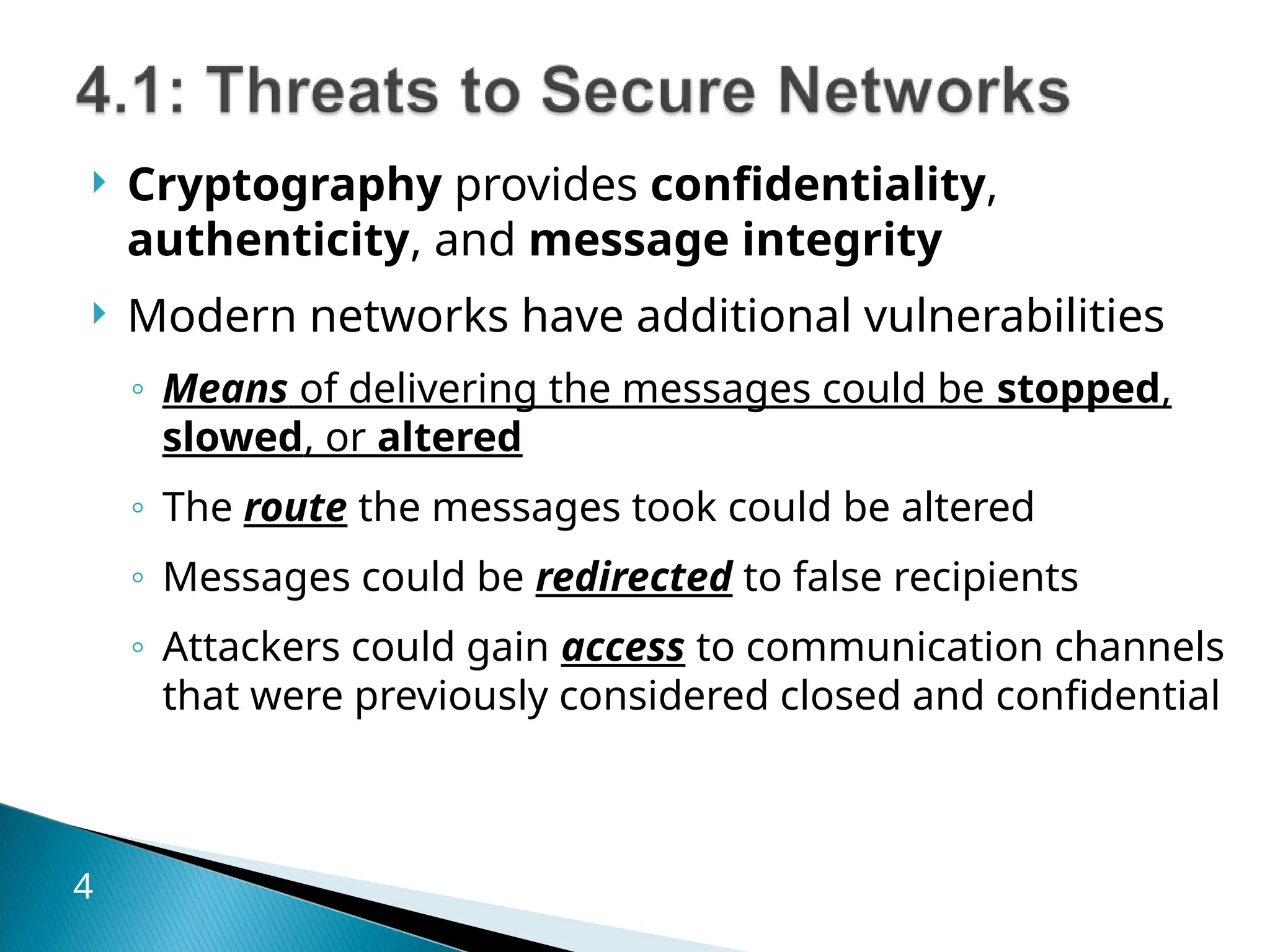
 Cryptography provides confidentiality,
authenticity, and message integrity
 Modern networks have additional vulnerabilities
◦ Means of delivering the messages could be stopped,
slowed, or altered
◦ The route the messages took could be altered
◦ Messages could be redirected to false recipients
◦ Attackers could gain access to communication channels
that were previously considered closed and confidential
4
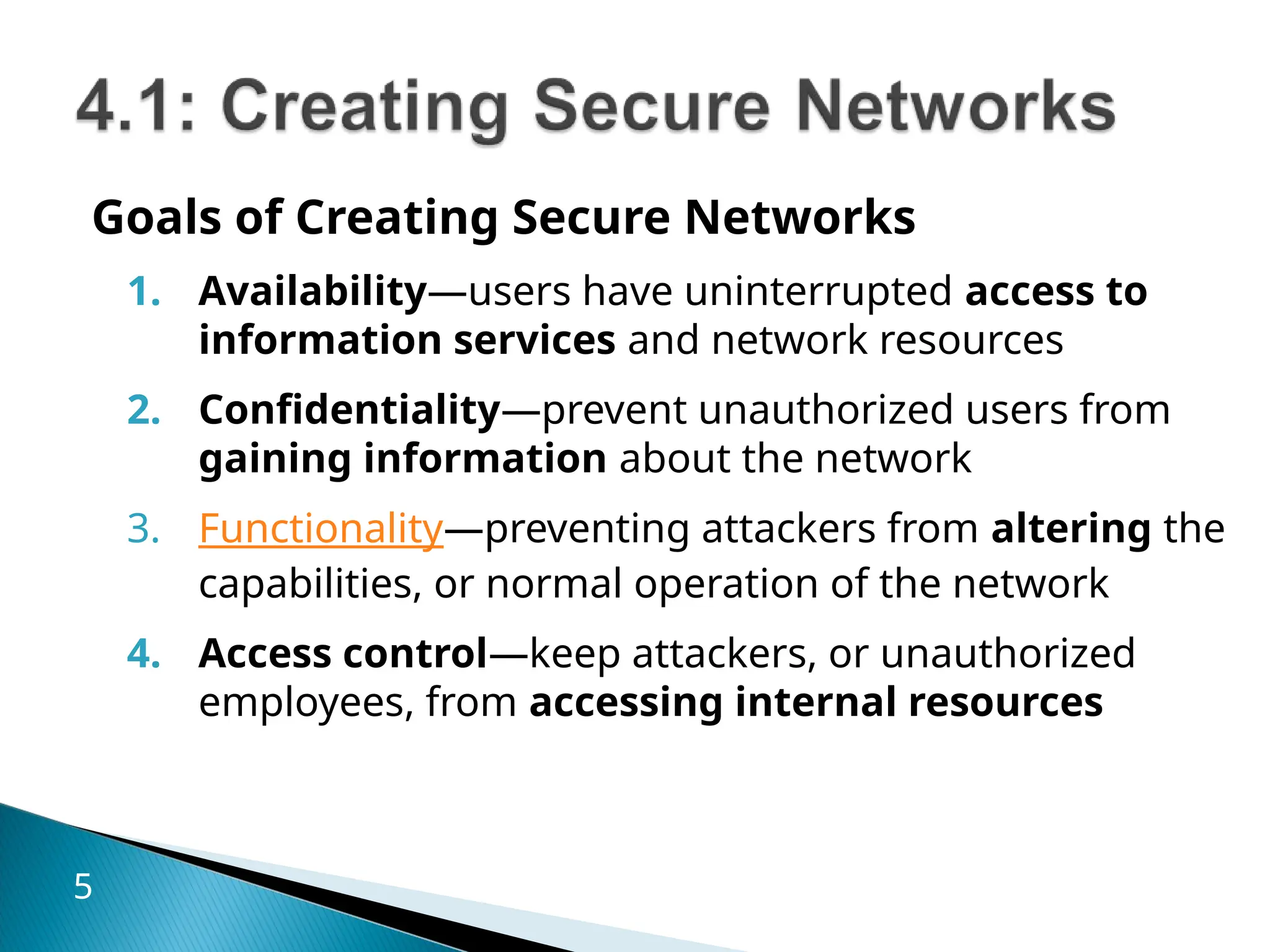
Goals of Creating Secure Networks
1. Availability—users have uninterrupted access to
information services and network resources
2. Confidentiality—prevent unauthorized users from
gaining information about the network
3. Functionality—preventing attackers from altering the
capabilities, or normal operation of the network
4. Access control—keep attackers, or unauthorized
employees, from accessing internal resources
5
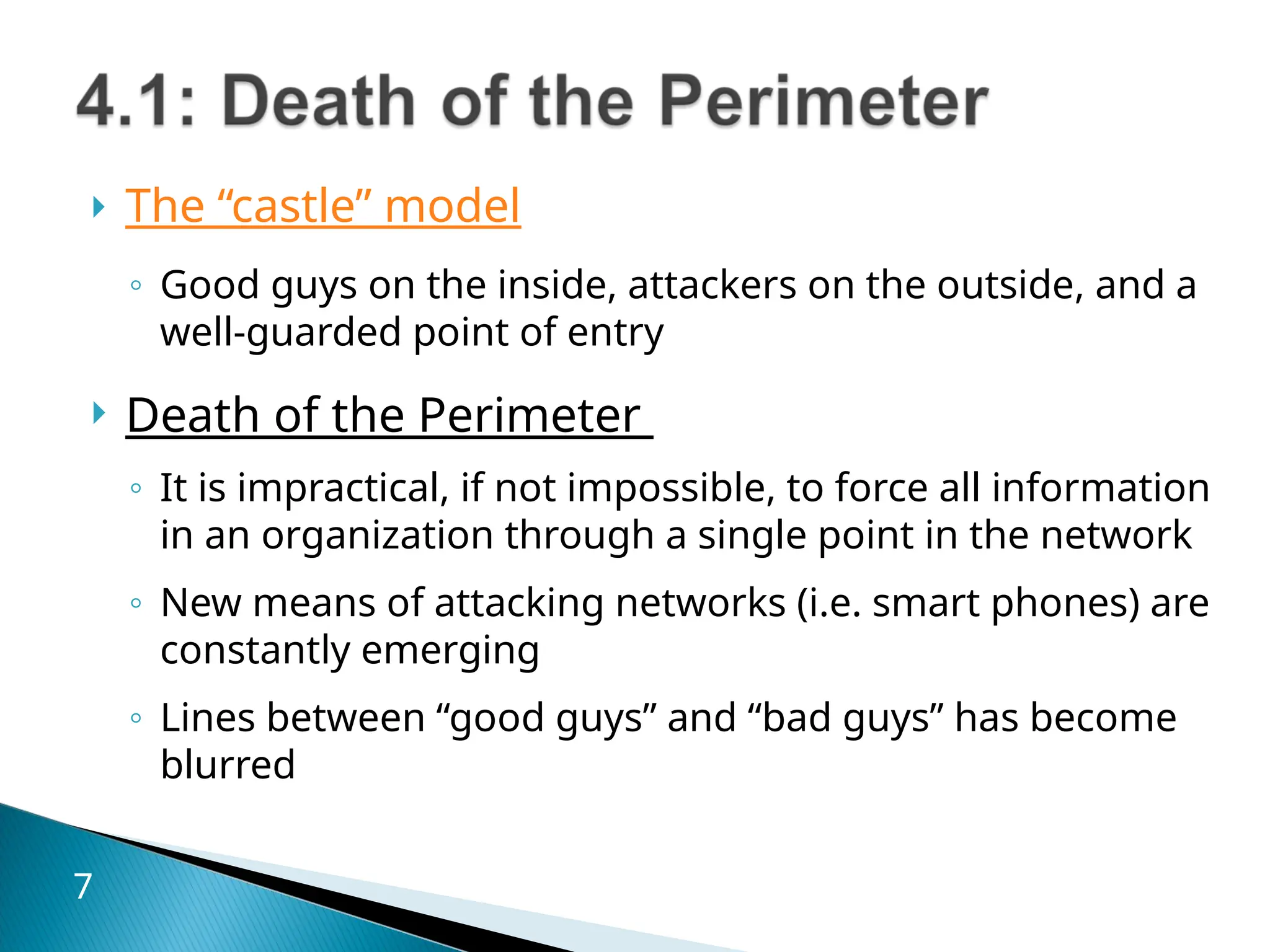
 The “castle” model
◦ Good guys on the inside, attackers on the outside, and a
well-guarded point of entry
 Death of the Perimeter
◦ It is impractical, if not impossible, to force all information
in an organization through a single point in the network
◦ New means of attacking networks (i.e. smart phones) are
constantly emerging
◦ Lines between “good guys” and “bad guys” has become
blurred
7
 The “city” model
◦ No distinct perimeter, and there are multiple ways
of entering the network
◦ Like a real city, who you are will determine which
buildings you will be able to access
◦ Greater need for:
 Internal intrusion detection
 Virtual LANs
 Central authentication servers
 Encrypted internal traffic
9
4.1 Introduction
4.1 Introduction
4.2 Denial-of-Service (DoS) Attacks
4.3 ARP Poisoning
4.3 ARP Poisoning
4.4 Access Control for Networks
4.5 Ethernet Security
4.6 Wireless Security
10
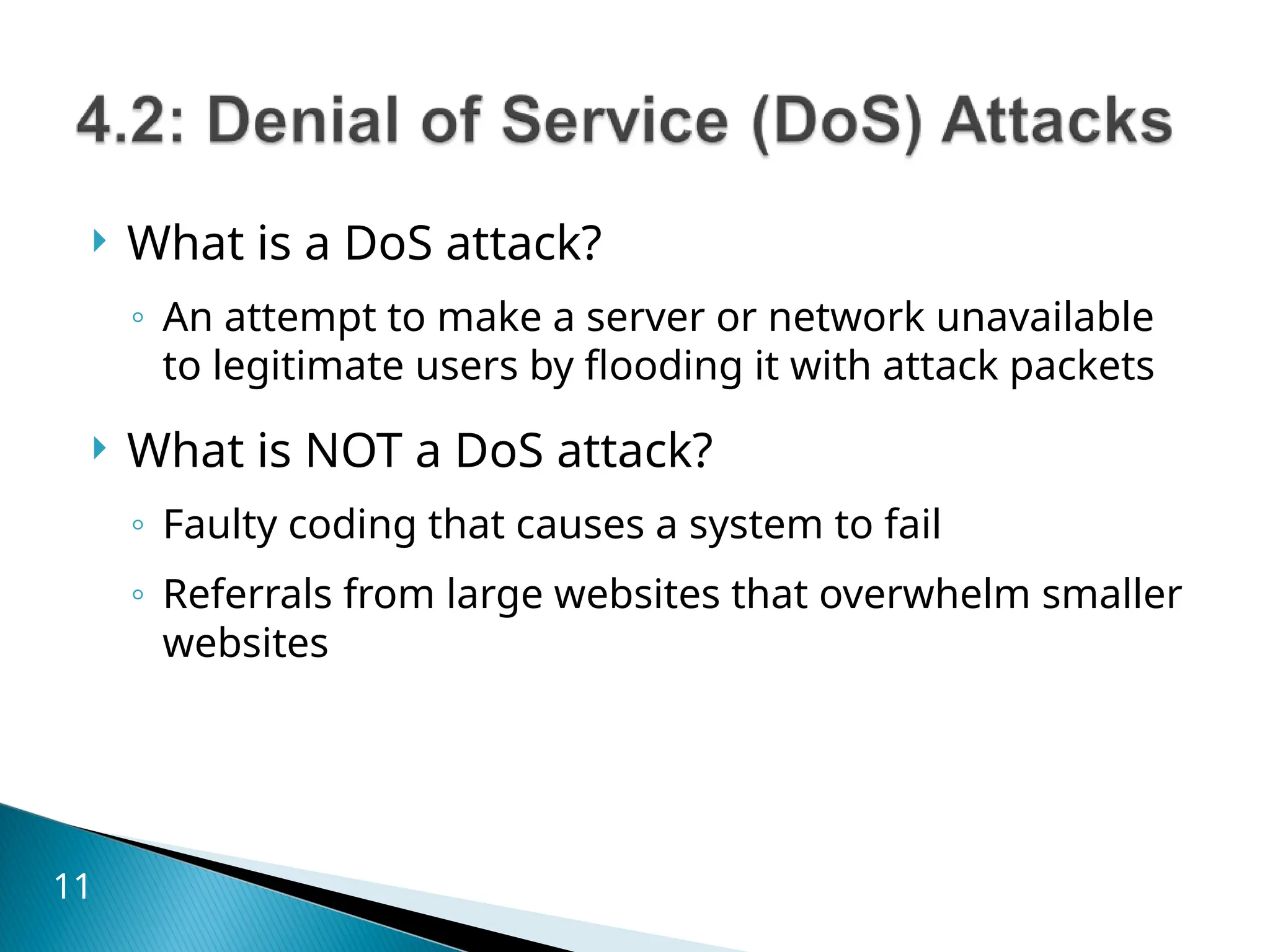
 What is a DoS attack?
◦ An attempt to make a server or network unavailable
to legitimate users by flooding it with attack packets
 What is NOT a DoS attack?
◦ Faulty coding that causes a system to fail
◦ Referrals from large websites that overwhelm smaller
websites
11
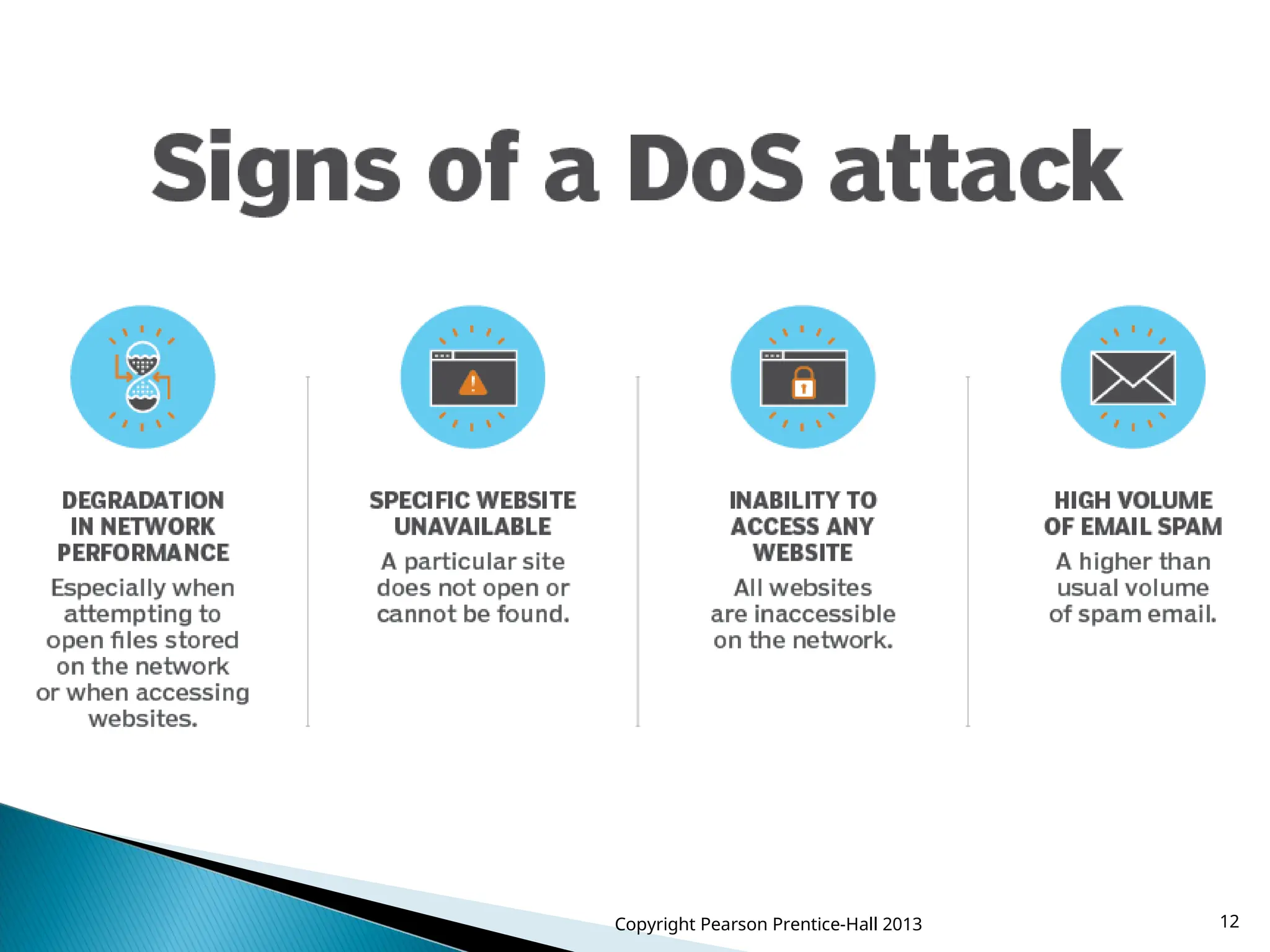
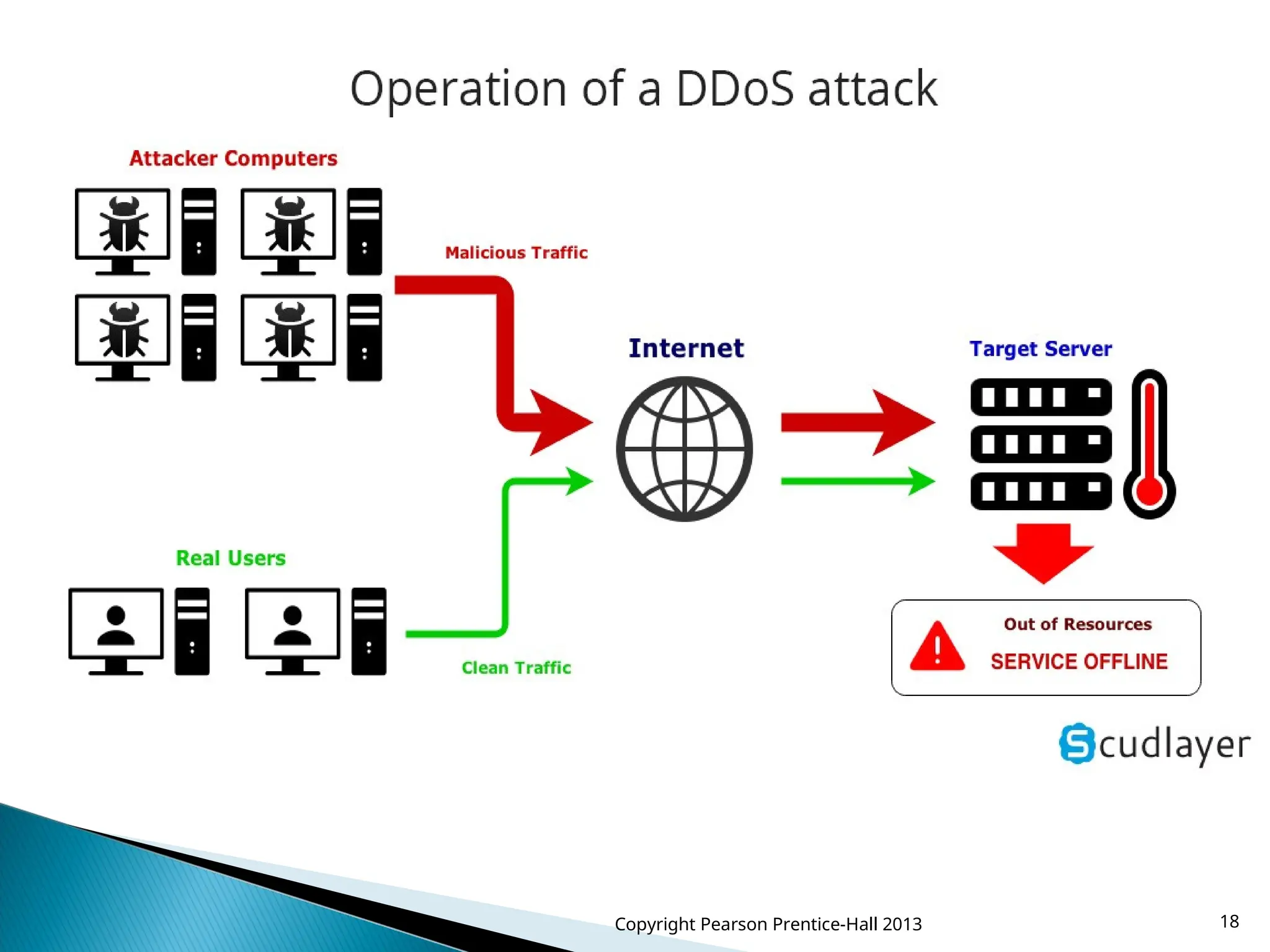
Copyright Pearson Prentice-Hall 2013 12
 Ultimate goal of DoS attacks is to cause harm
◦ Harm includes: losses related to online sales,
industry reputation, employee productivity,
customer loyalty, etc.
 The two primary means of causing harm via
DoS attacks include:
1.Stopping critical services
2.Slowly degrading services
13
 Direct DoS Attack
◦ An attacker tries to flood a victim with a stream of
packets directly from the attacker’s computer
 Indirect DoS Attack
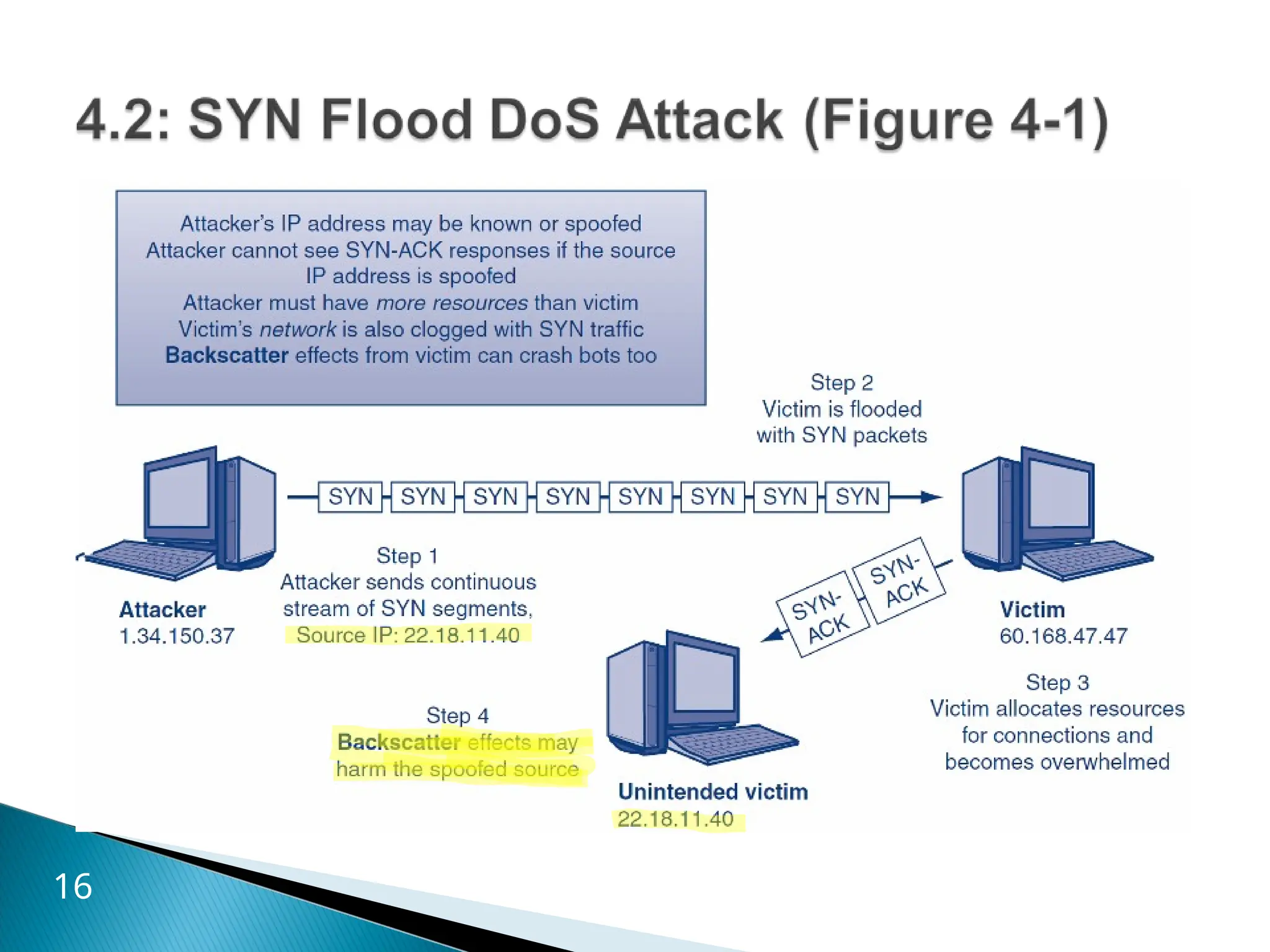
◦ The attacker’s IP address is spoofed (i.e., faked)
and the attack appears to come from another
computer
14
15
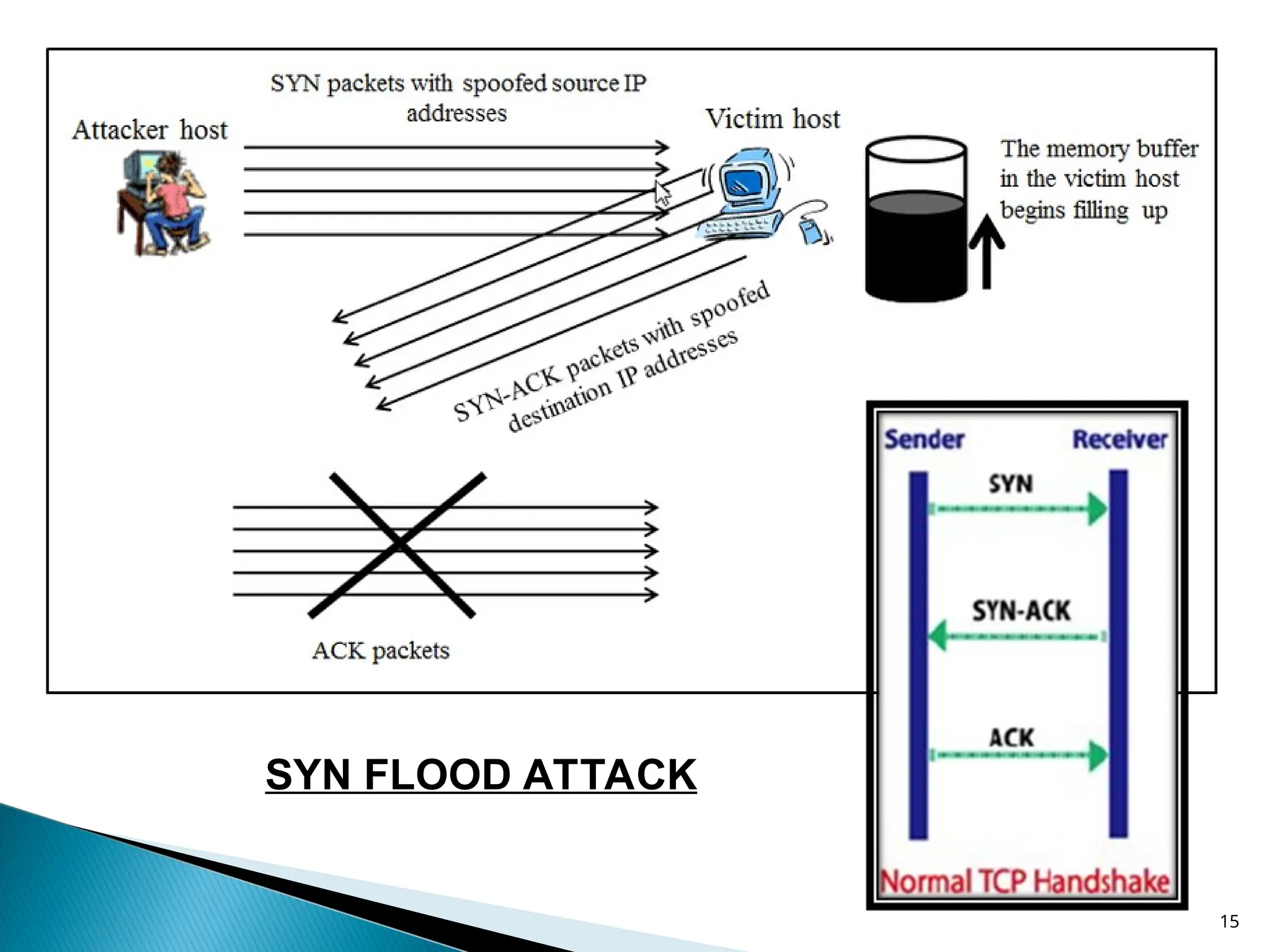
SYN FLOOD ATTACK
16
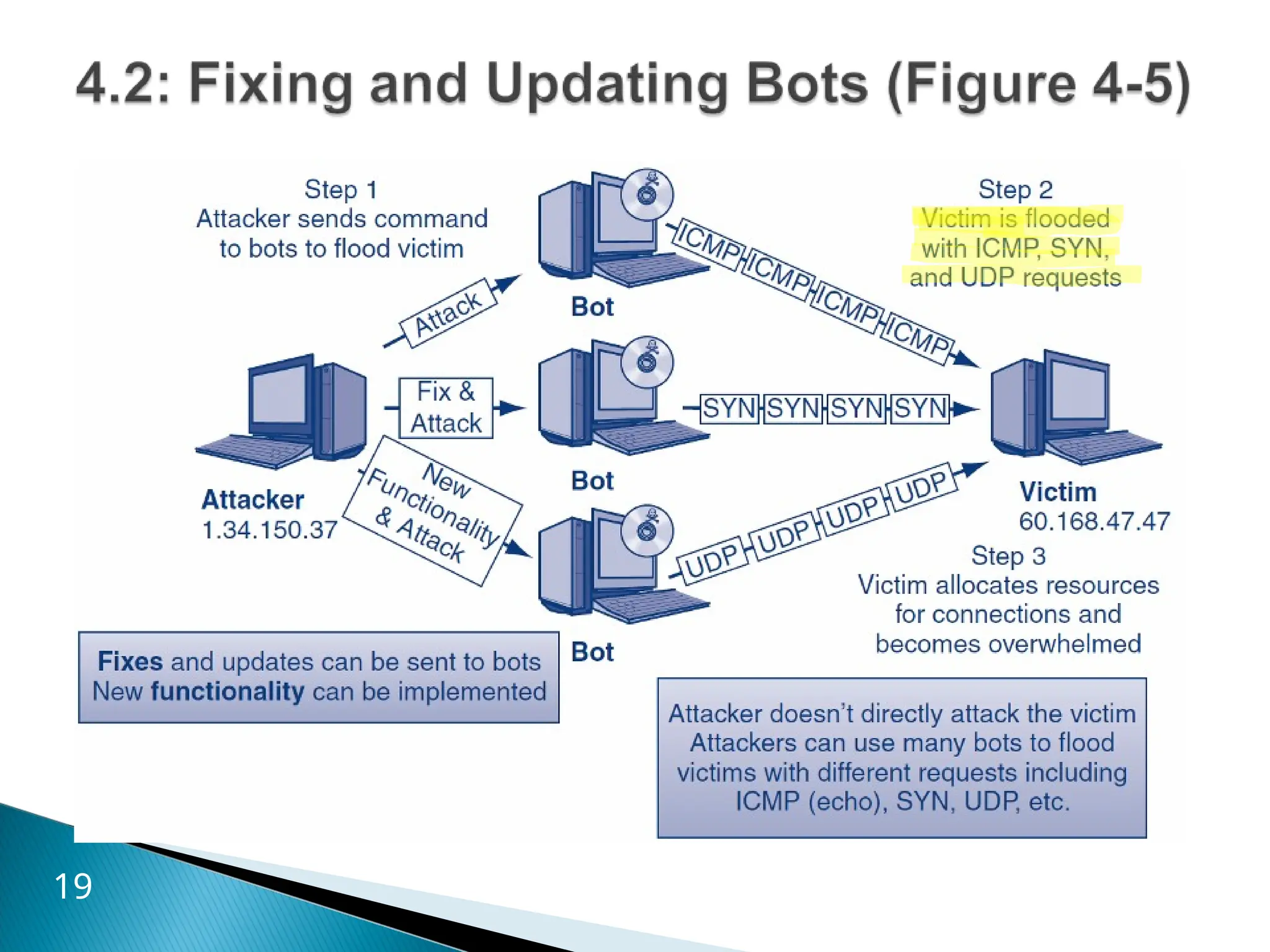
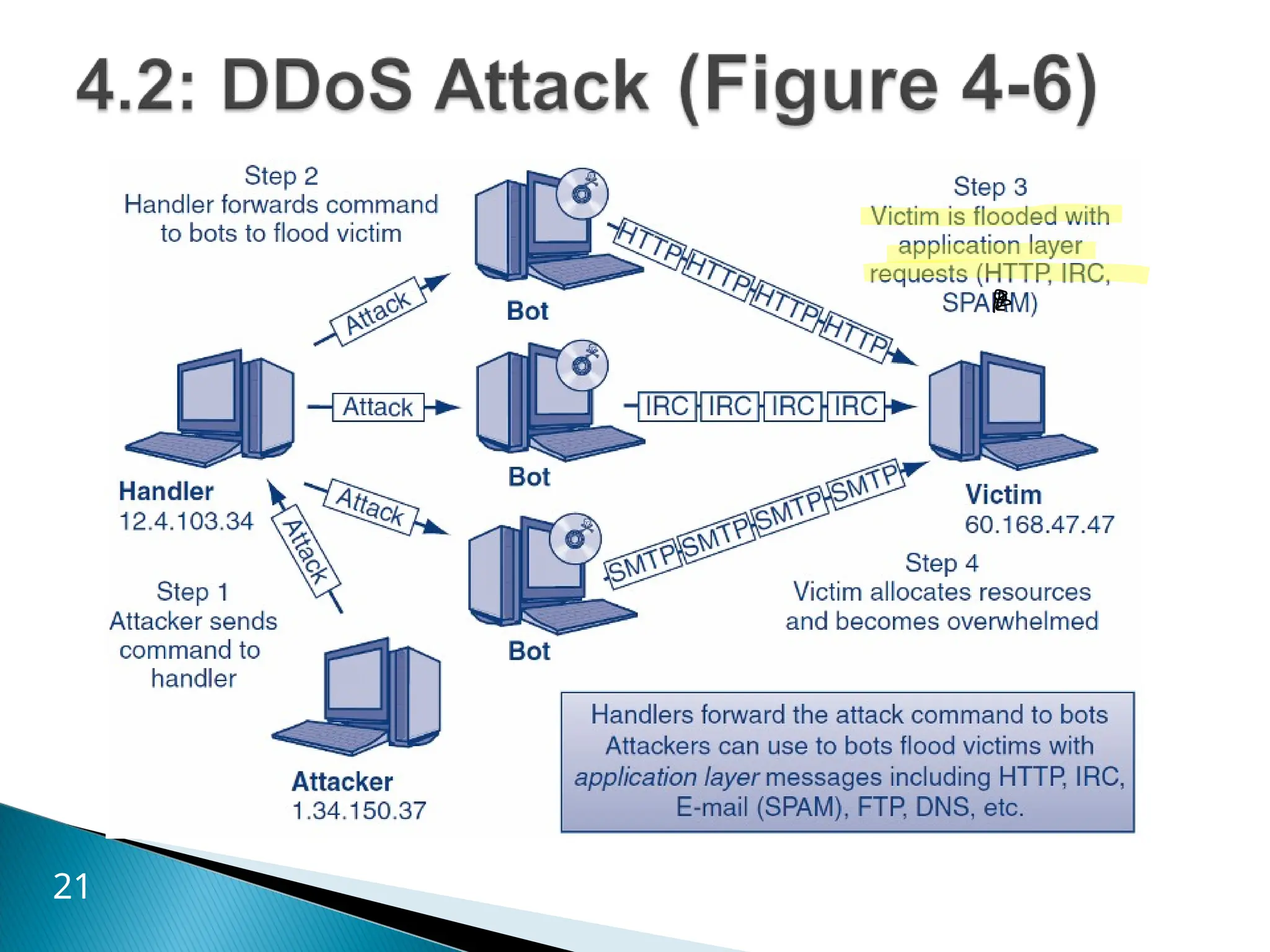
 Bots
◦ Updatable attack programs
◦ Botmaster can update the software to change the
type of attack the bot can do
 May sell or lease the botnet to other criminals
◦ Botmaster can update the bot to fix bugs
 Botmaster can control bots via a handler
◦ Handlers are an additional layer of compromised
hosts that are used to manage large groups of bots
17
Copyright Pearson Prentice-Hall 2013 18
19
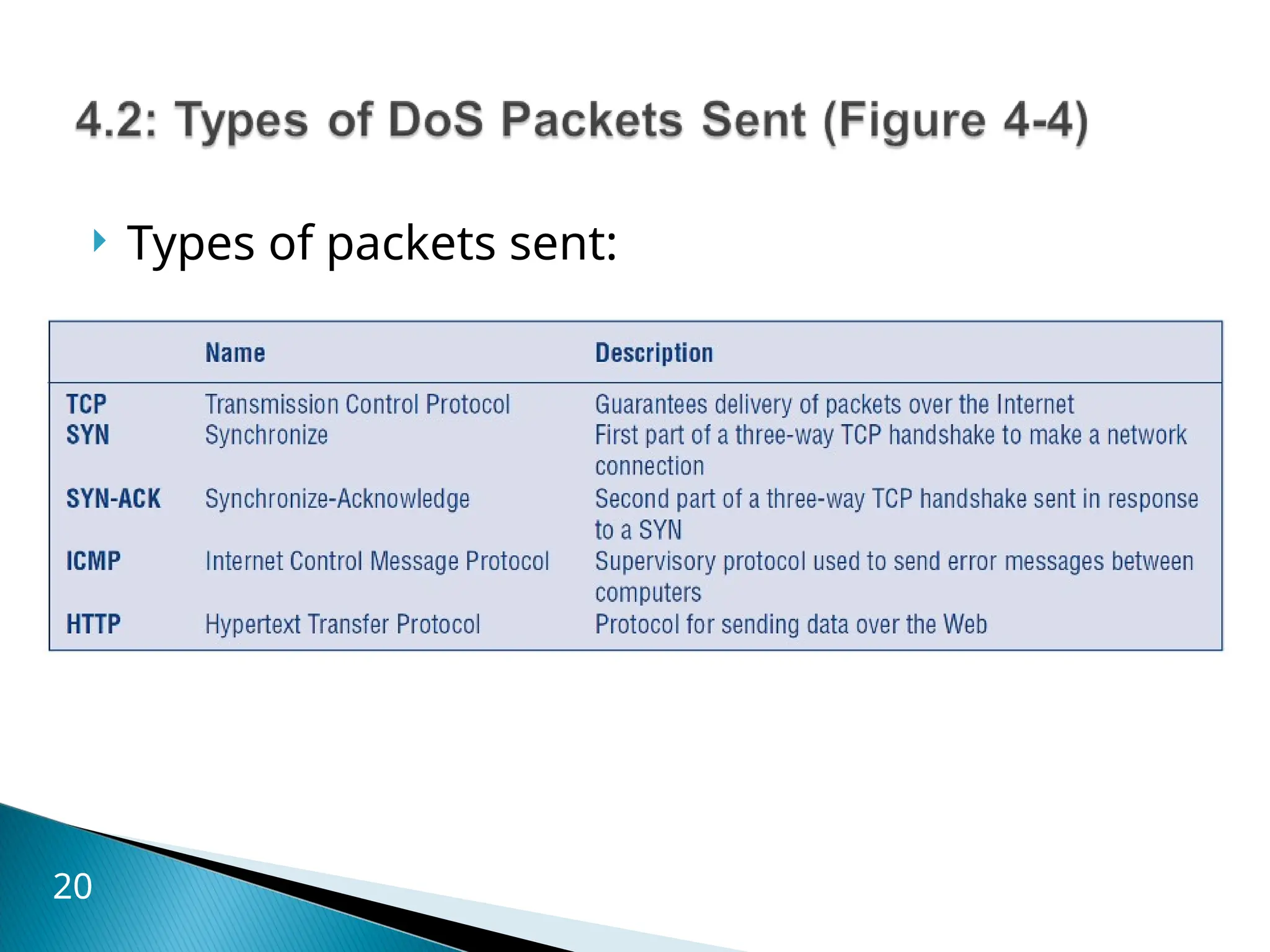
 Types of packets sent:
20
21
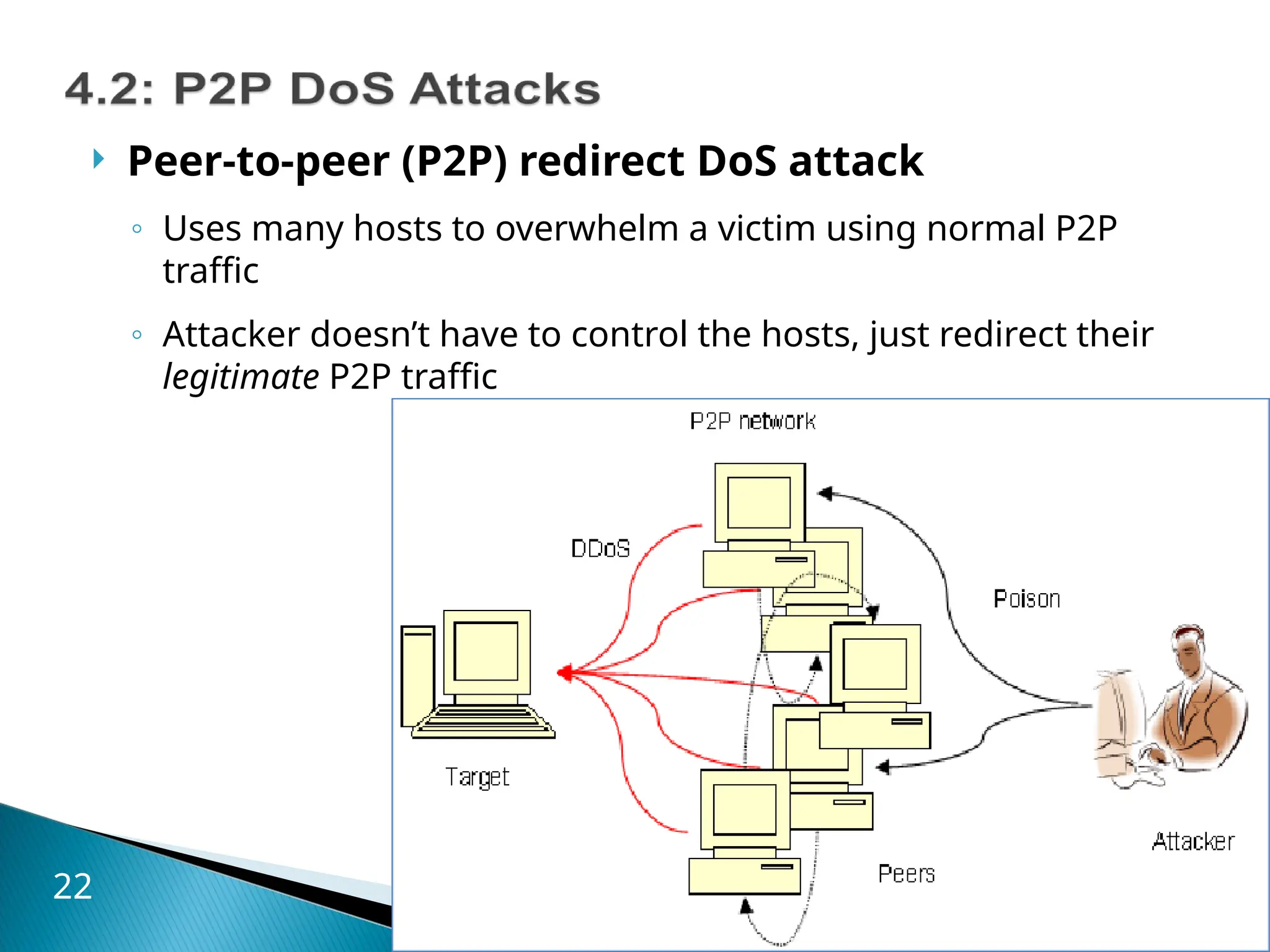
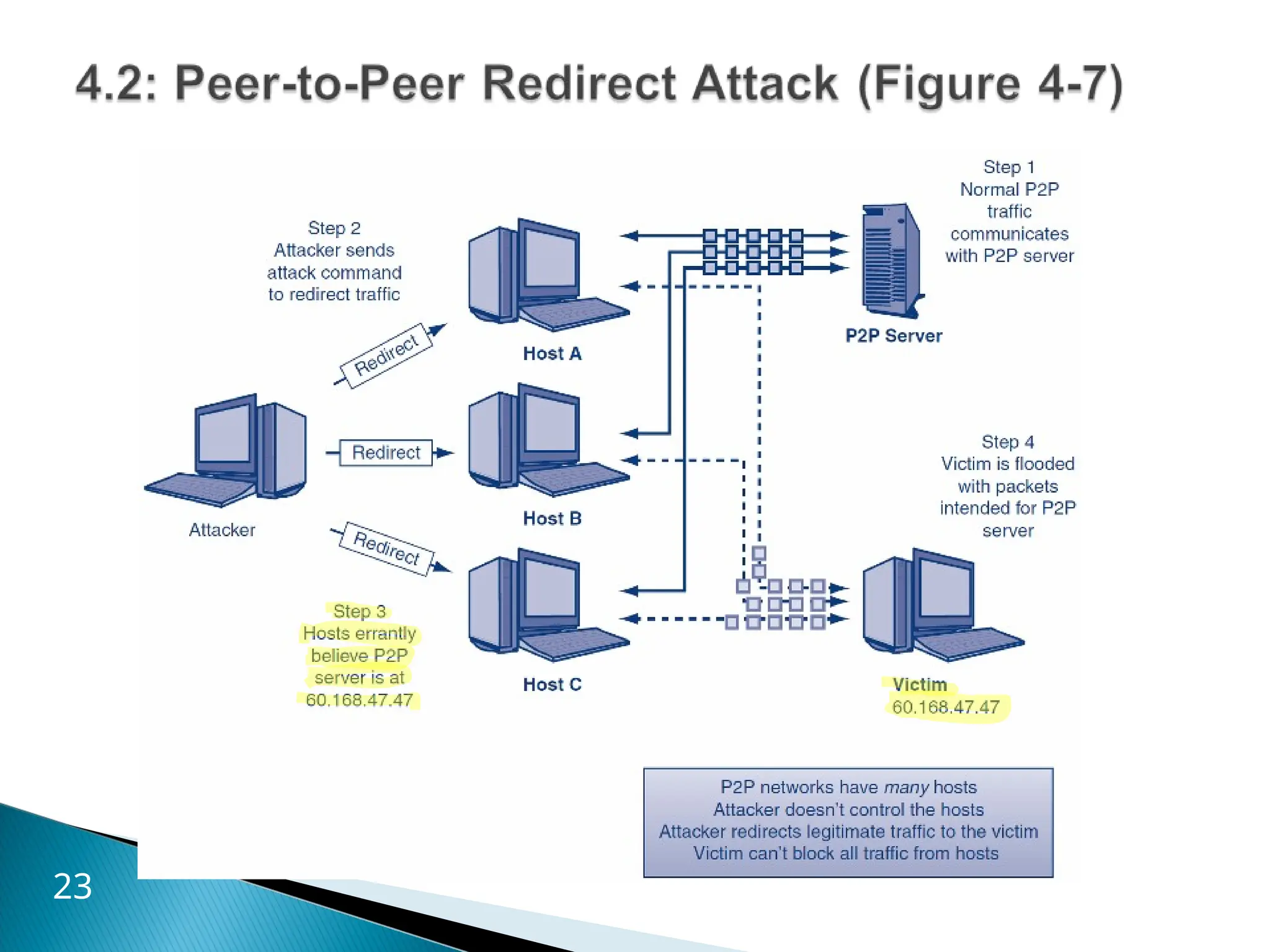
 Peer-to-peer (P2P) redirect DoS attack
◦ Uses many hosts to overwhelm a victim using normal P2P
traffic
◦ Attacker doesn’t have to control the hosts, just redirect their
legitimate P2P traffic
22
23
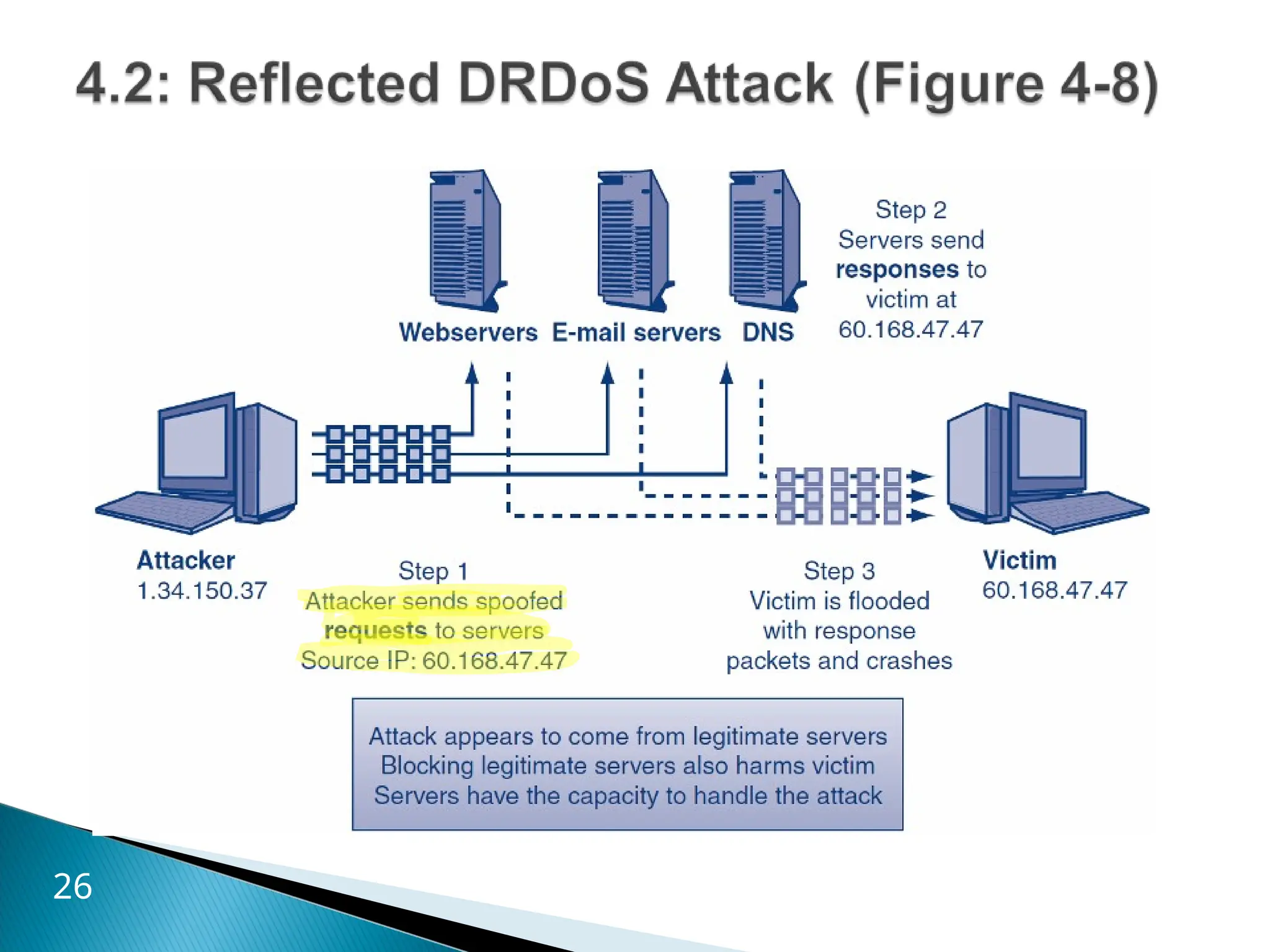
 Reflected DoS attack
◦ Responses from legitimate services flood a victim
◦ The attacker sends spoofed requests to existing
legitimate servers (Step 1)
◦ Servers then send all responses to the victim (Step 2)
◦ There is no redirection of traffic
24
Copyright Pearson Prentice-Hall 2013 25
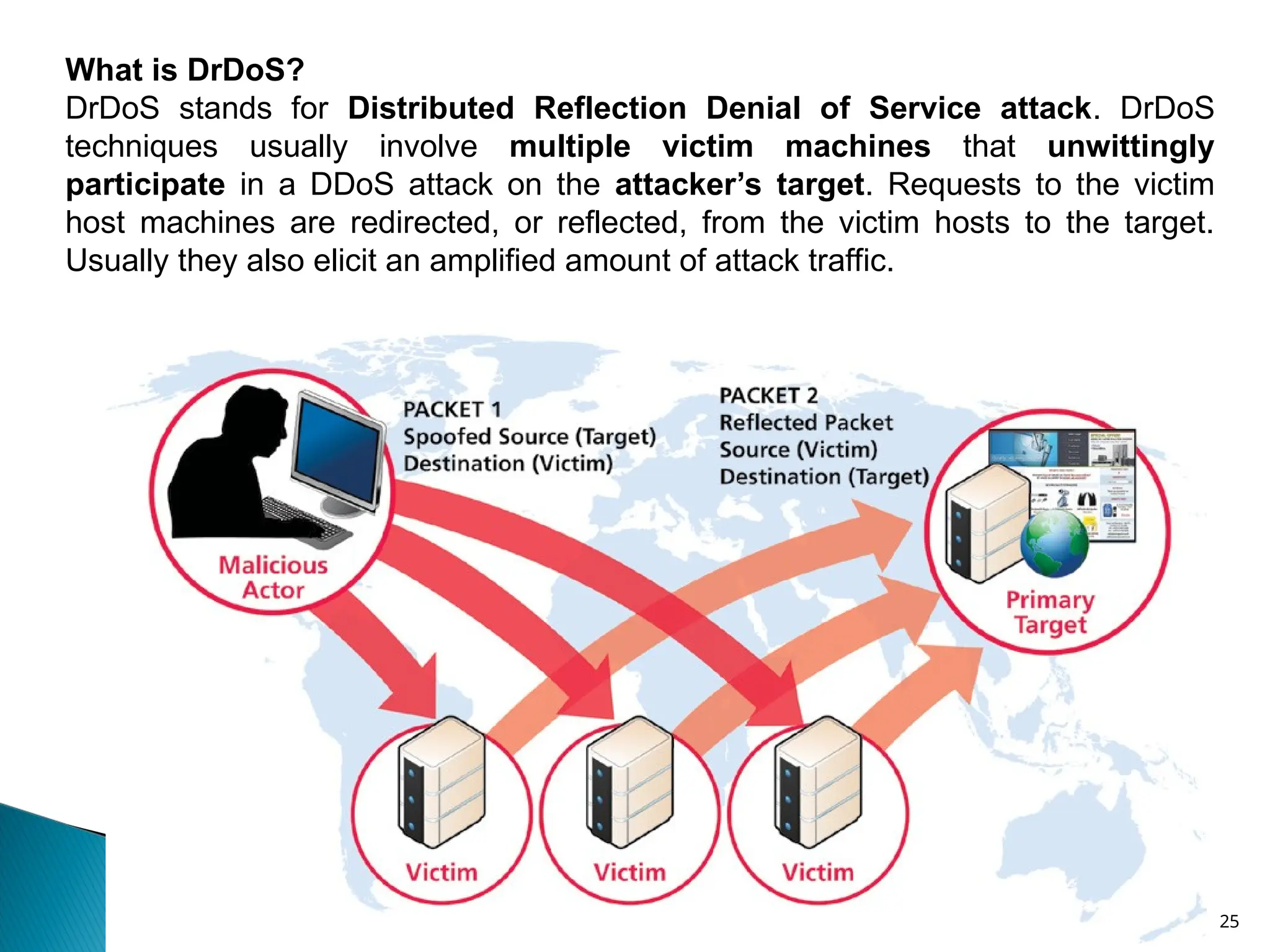
What is DrDoS?
DrDoS stands for Distributed Reflection Denial of Service attack. DrDoS
techniques usually involve multiple victim machines that unwittingly
participate in a DDoS attack on the attacker’s target. Requests to the victim
host machines are redirected, or reflected, from the victim hosts to the target.
Usually they also elicit an amplified amount of attack traffic.
26
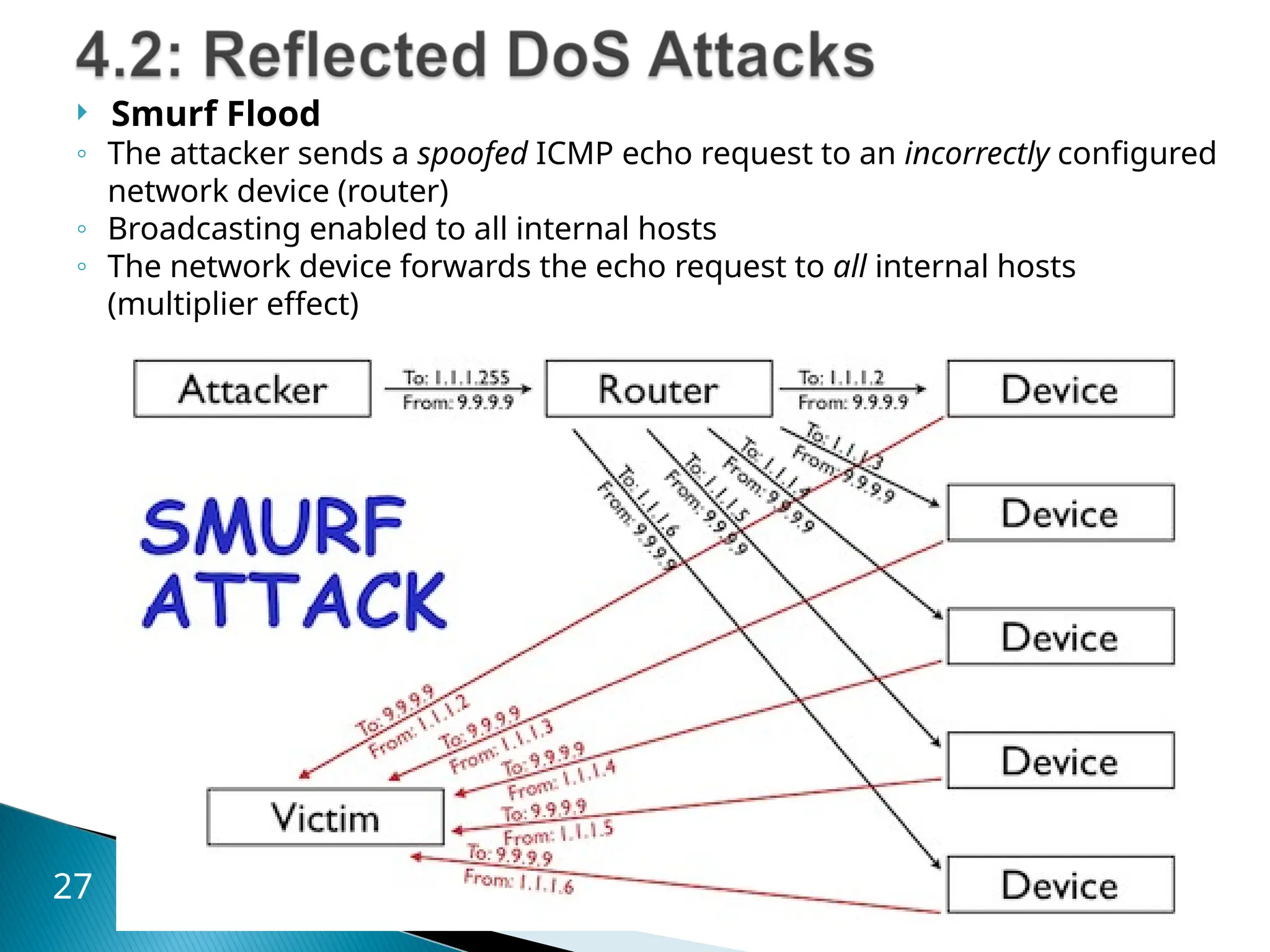
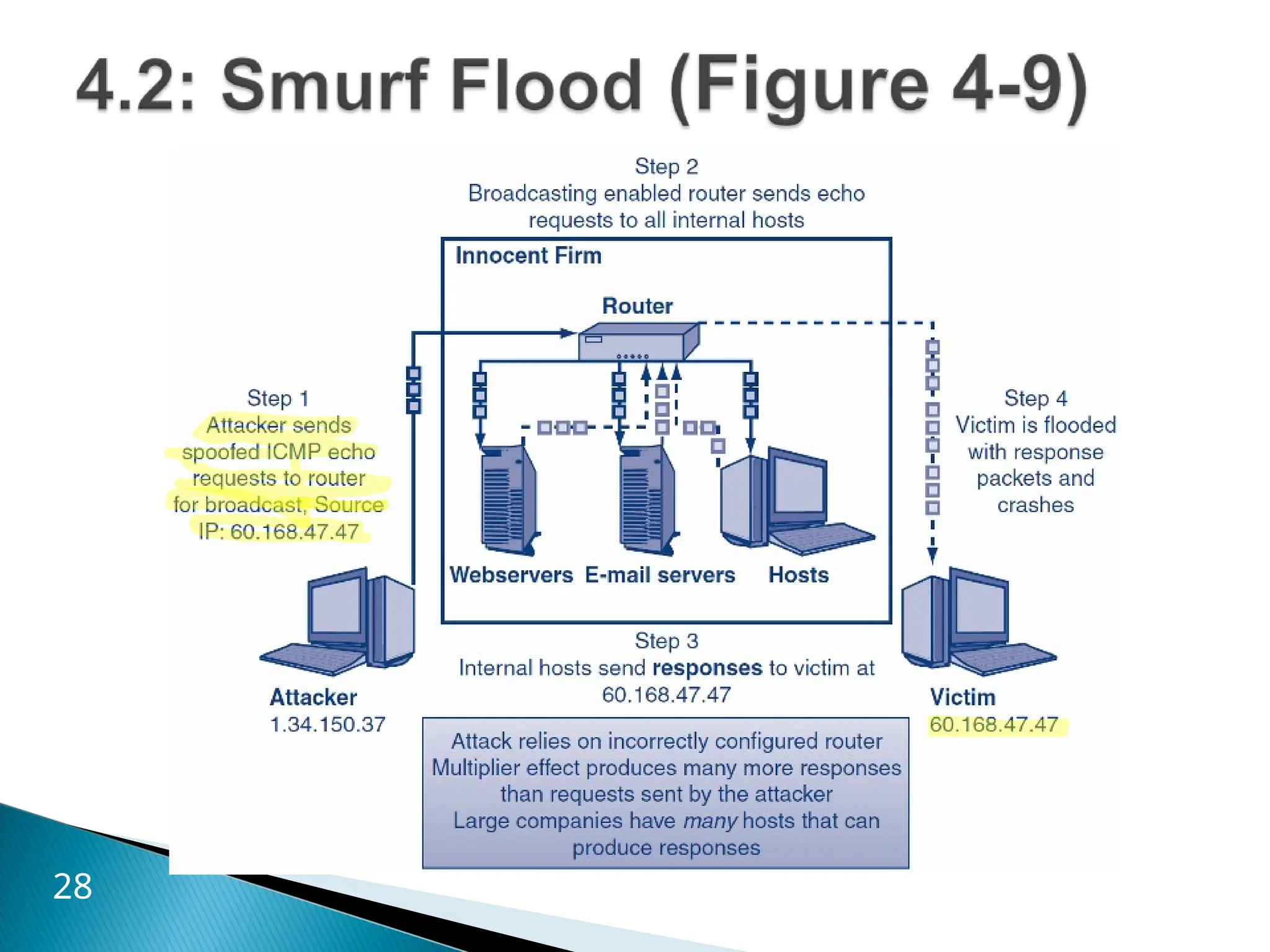
 Smurf Flood
◦ The attacker sends a spoofed ICMP echo request to an incorrectly configured
network device (router)
◦ Broadcasting enabled to all internal hosts
◦ The network device forwards the echo request to all internal hosts
(multiplier effect)
27
28
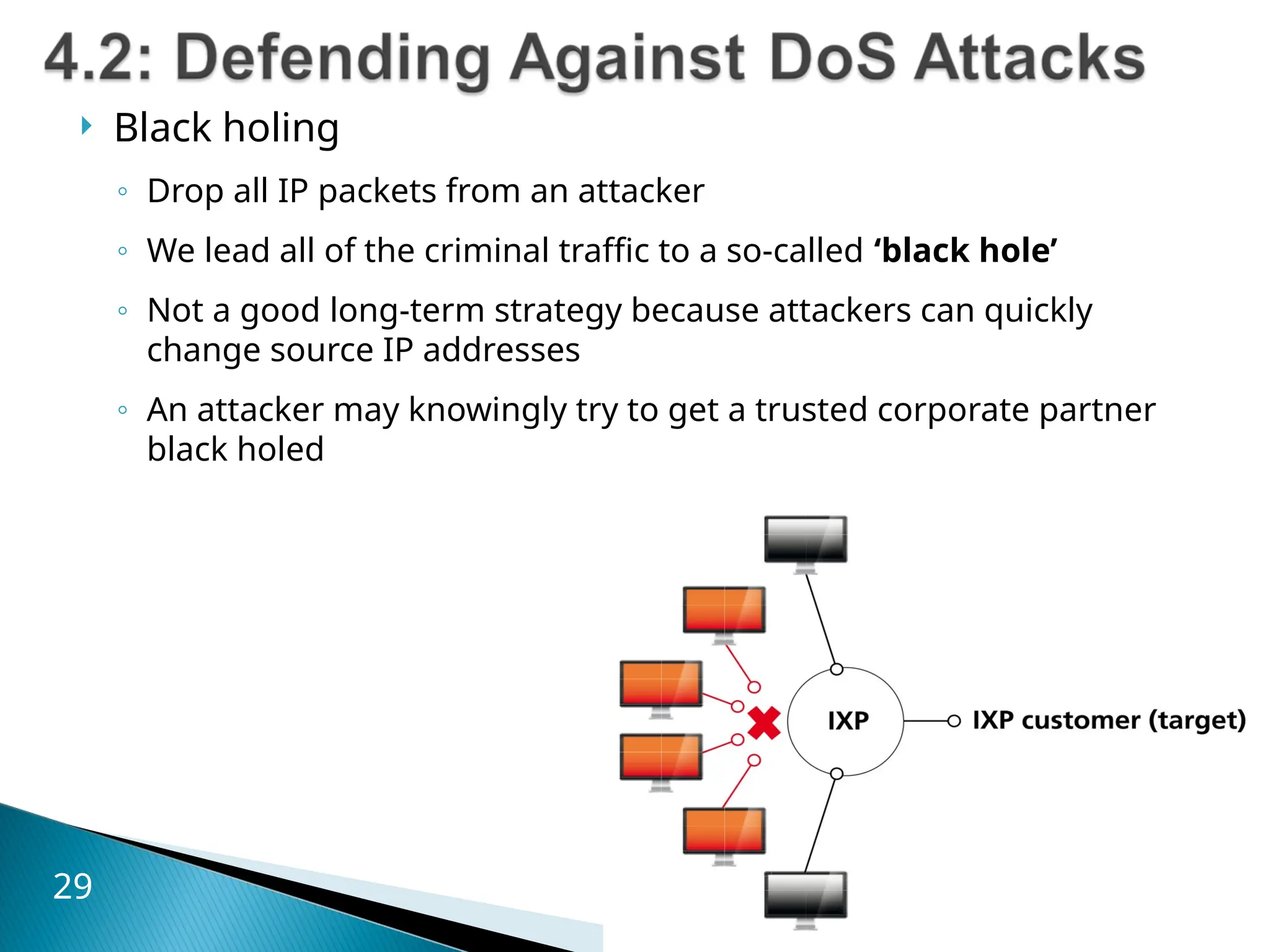
 Black holing
◦ Drop all IP packets from an attacker
◦ We lead all of the criminal traffic to a so-called ‘black hole’
◦ Not a good long-term strategy because attackers can quickly
change source IP addresses
◦ An attacker may knowingly try to get a trusted corporate partner
black holed
29
 Validating the handshake
◦ Whenever a SYN segment arrives, the firewall itself sends
back a SYN/ACK segment, without passing the SYN
segment on to the target server (false opening)
◦ When the firewall gets back a legitimate ACK the firewall
send the original SYN segment on to the intended server
 Rate limiting
◦ Used to reduce a certain type of traffic to a reasonable
amount
◦ Can frustrate attackers, and legitimate users
30
31
4.1 Introduction
4.1 Introduction
4.2 Denial-of-Service (DoS) Attacks
4.3 ARP Poisoning
4.3 ARP Poisoning
4.4 Access Control for Networks
4.5 Ethernet Security
4.6 Wireless Security
32
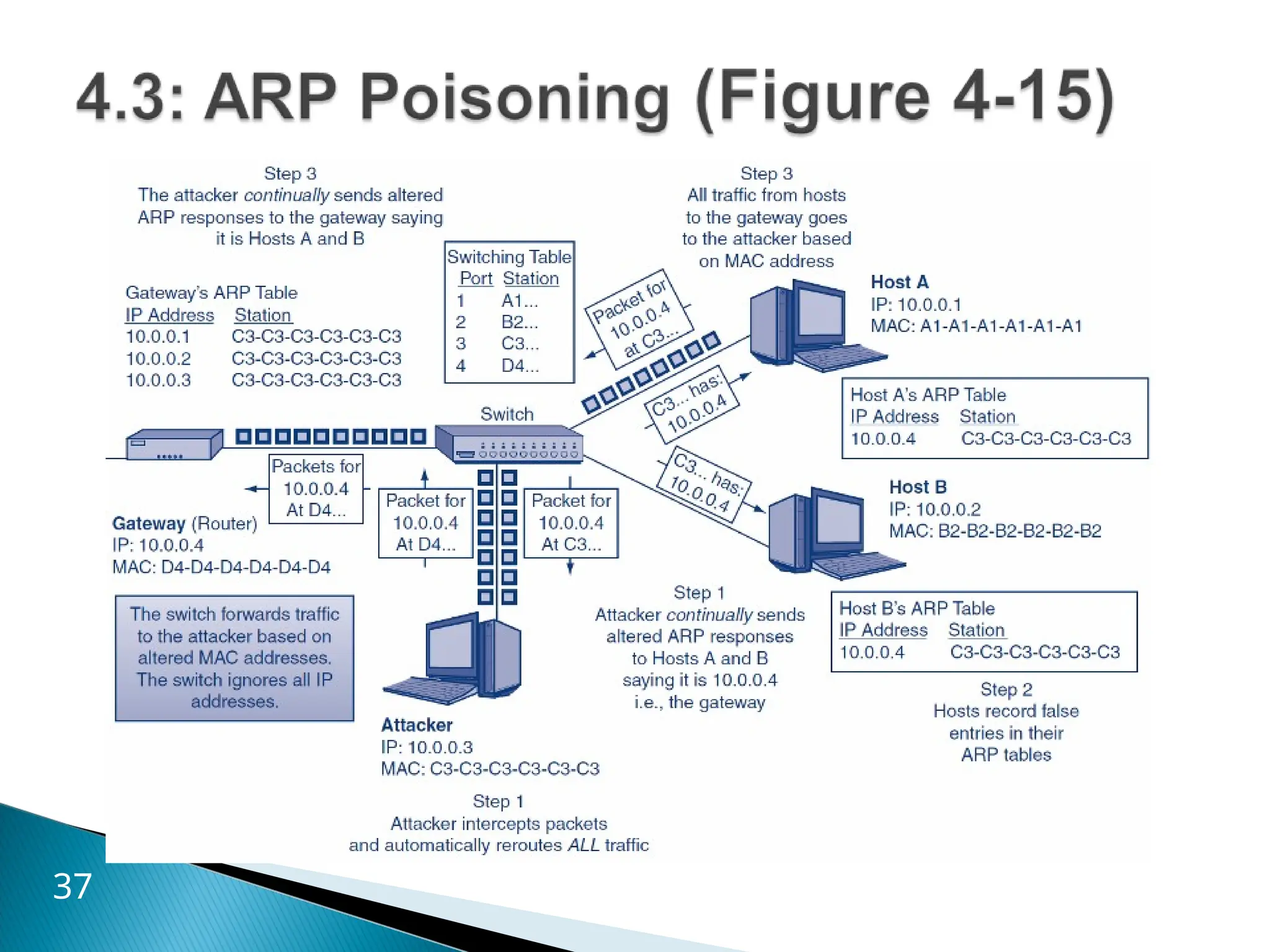
 ARP Poisoning
◦ Network attack that manipulates host ARP tables to
reroute local-area network (LAN) traffic
◦ Possible man-in-the-middle attack
◦ Requires an attacker to have a computer on the
local network
◦ An attack on both the functionality and
confidentiality of a network
33
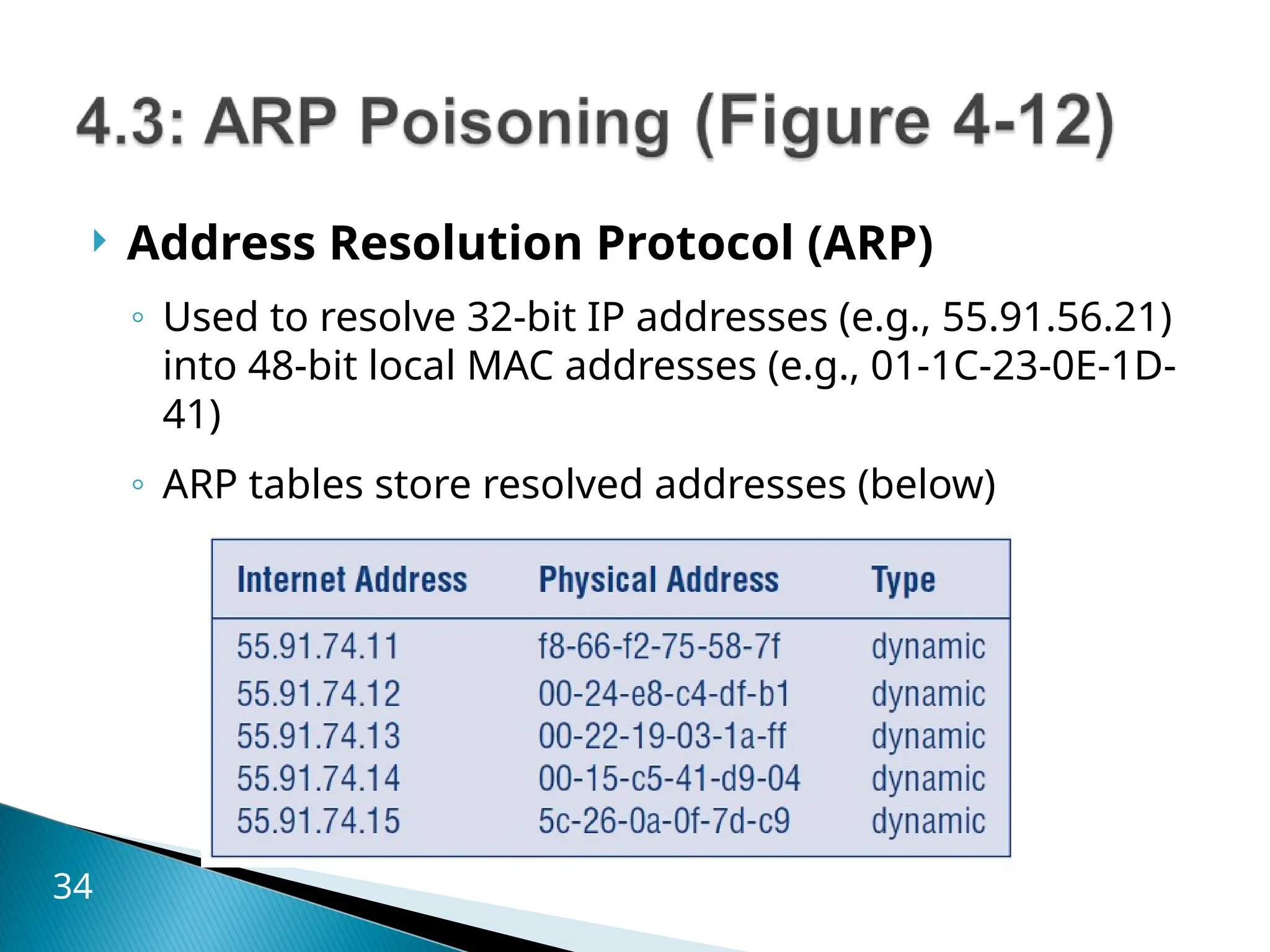
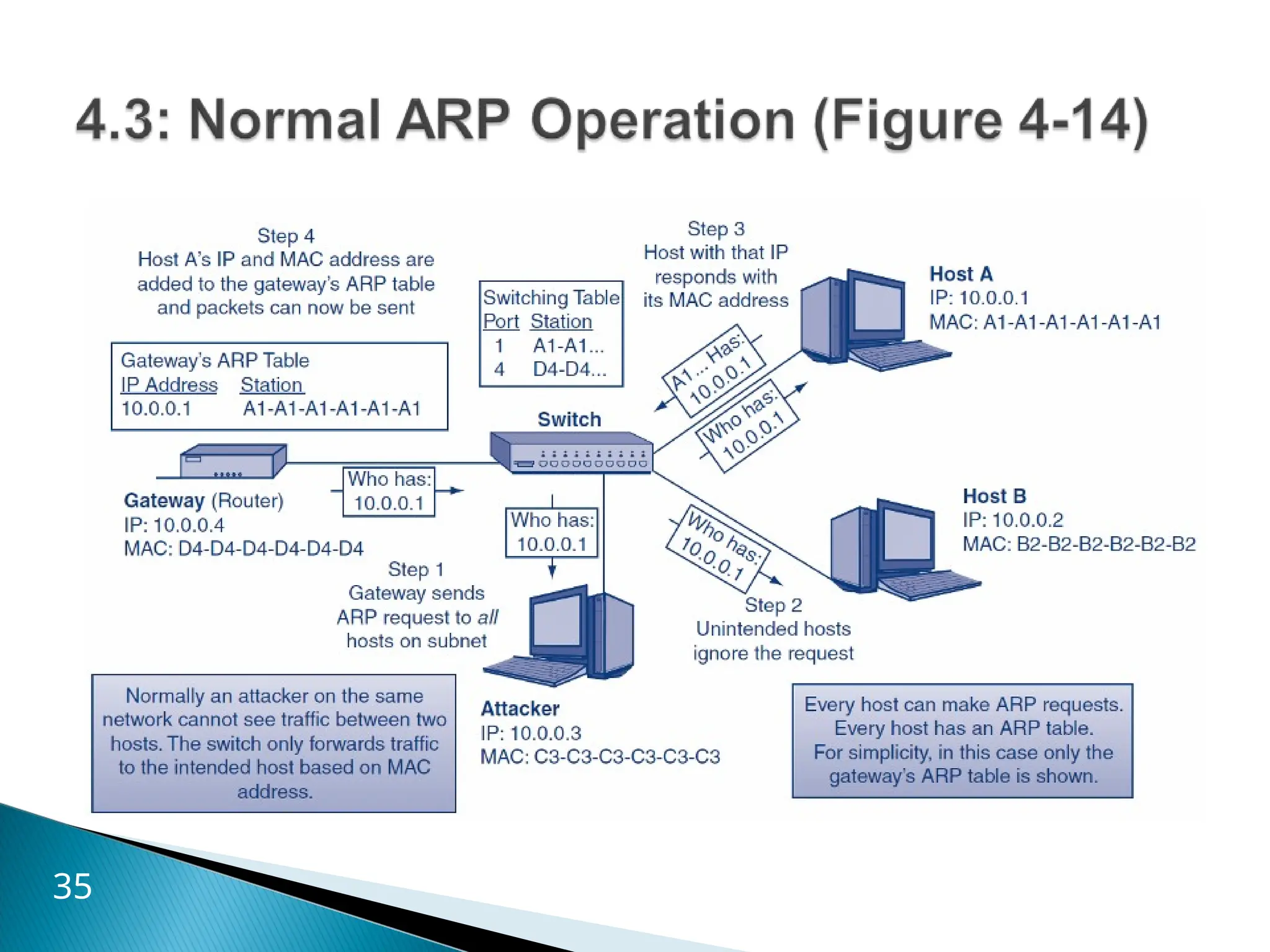
 Address Resolution Protocol (ARP)
◦ Used to resolve 32-bit IP addresses (e.g., 55.91.56.21)
into 48-bit local MAC addresses (e.g., 01-1C-23-0E-1D-
41)
◦ ARP tables store resolved addresses (below)
34
35
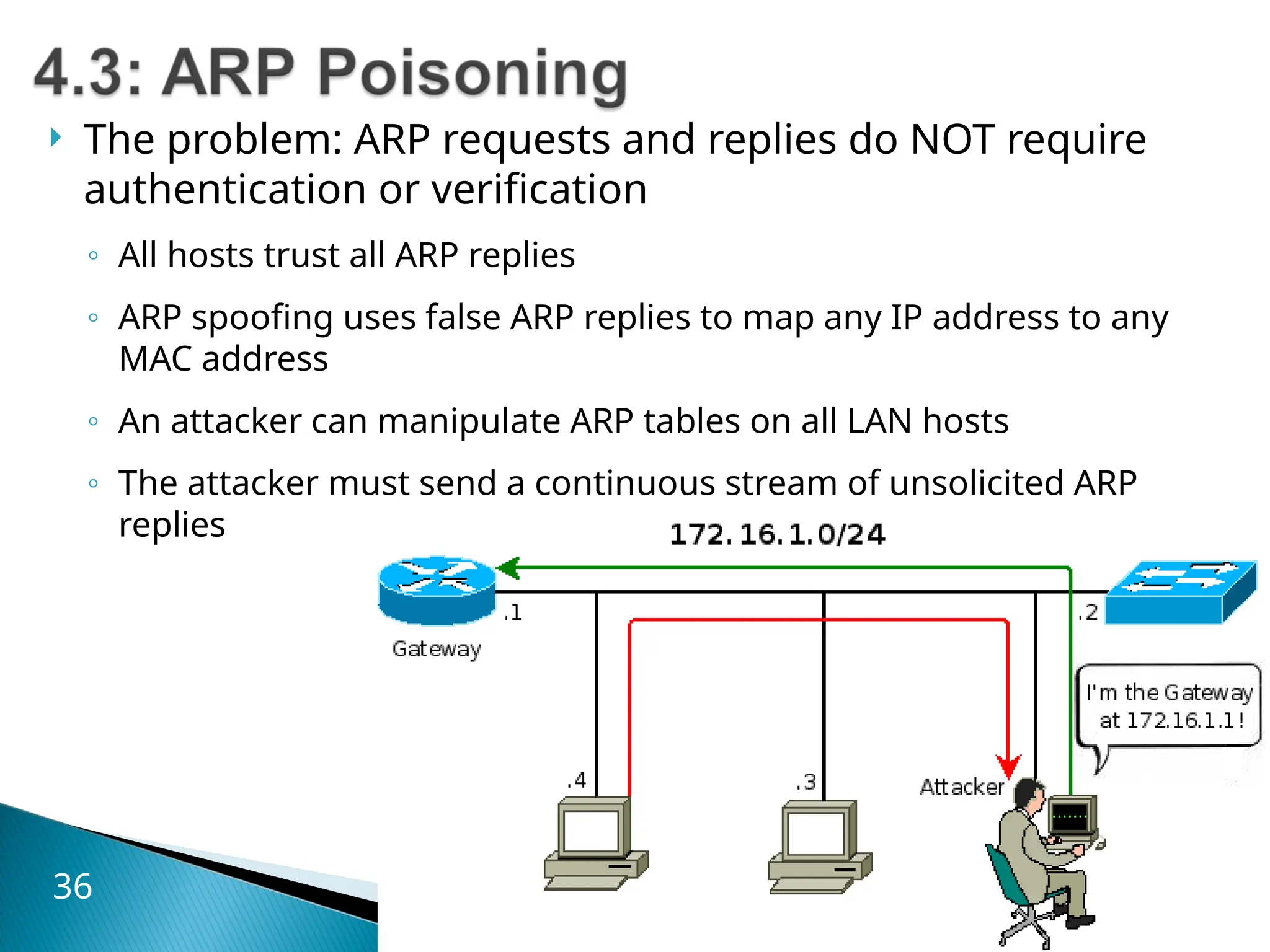
 The problem: ARP requests and replies do NOT require
authentication or verification
◦ All hosts trust all ARP replies
◦ ARP spoofing uses false ARP replies to map any IP address to any
MAC address
◦ An attacker can manipulate ARP tables on all LAN hosts
◦ The attacker must send a continuous stream of unsolicited ARP
replies
36
37
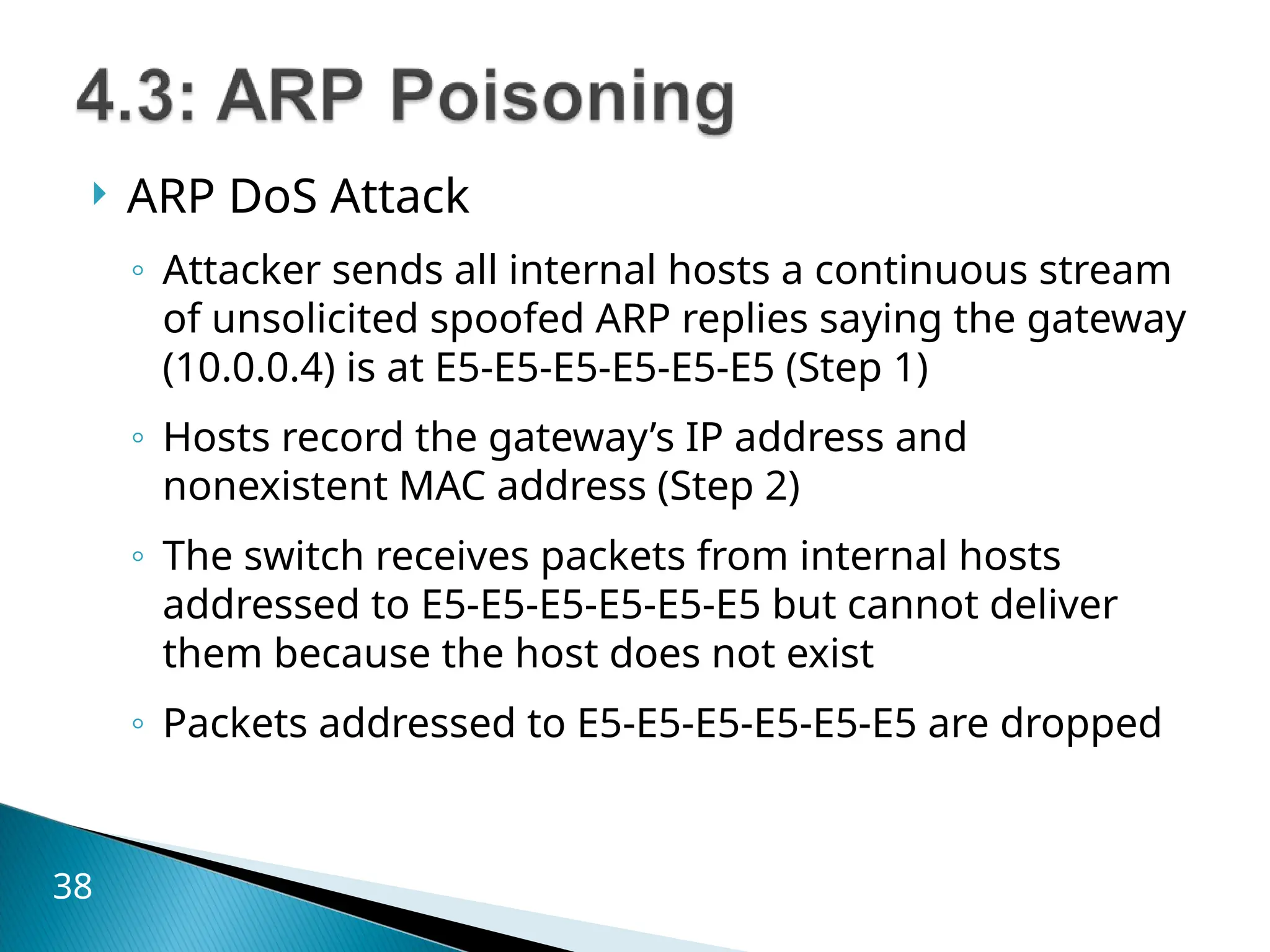
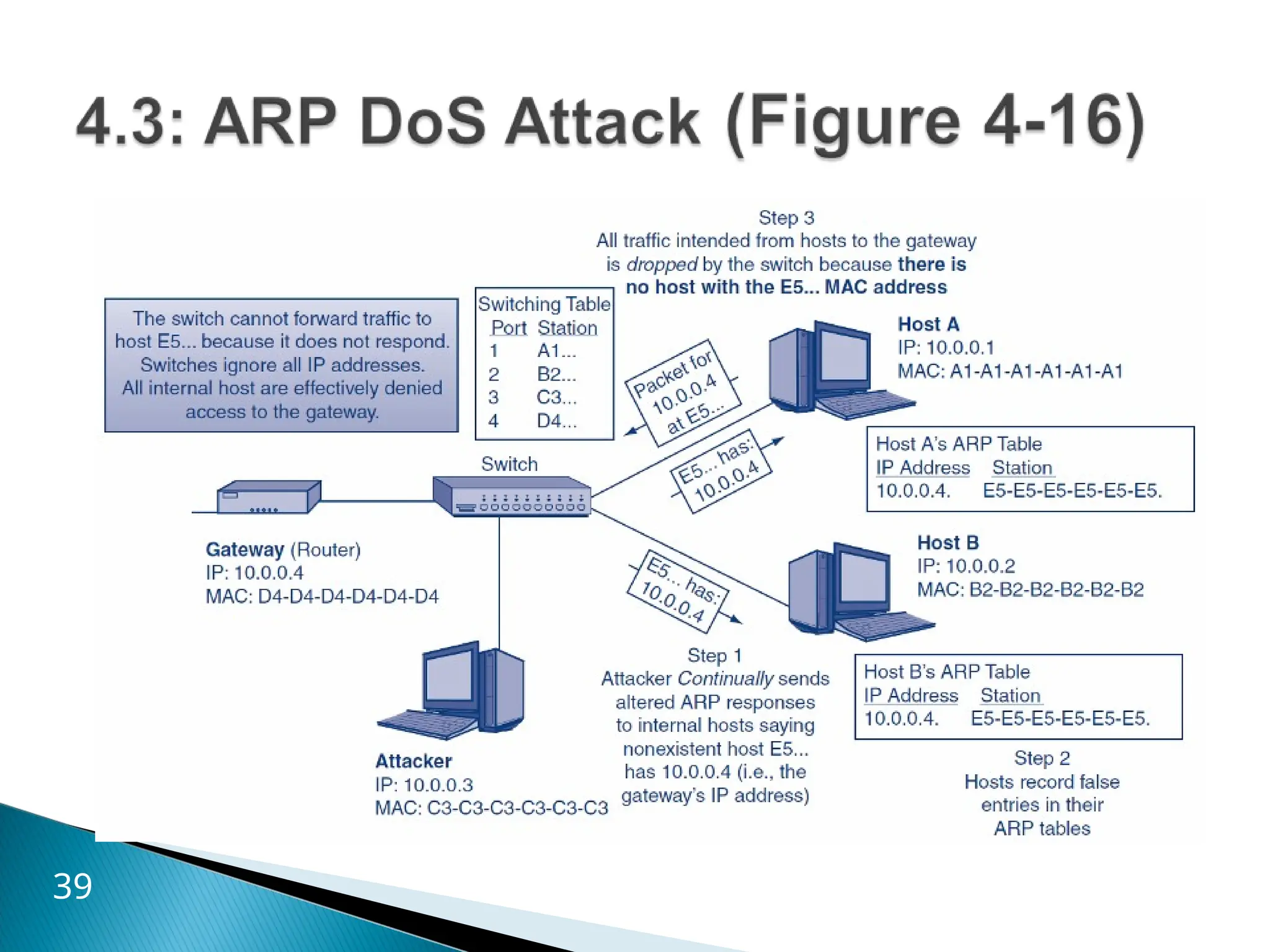
 ARP DoS Attack
◦ Attacker sends all internal hosts a continuous stream
of unsolicited spoofed ARP replies saying the gateway
(10.0.0.4) is at E5-E5-E5-E5-E5-E5 (Step 1)
◦ Hosts record the gateway’s IP address and
nonexistent MAC address (Step 2)
◦ The switch receives packets from internal hosts
addressed to E5-E5-E5-E5-E5-E5 but cannot deliver
them because the host does not exist
◦ Packets addressed to E5-E5-E5-E5-E5-E5 are dropped
38
39
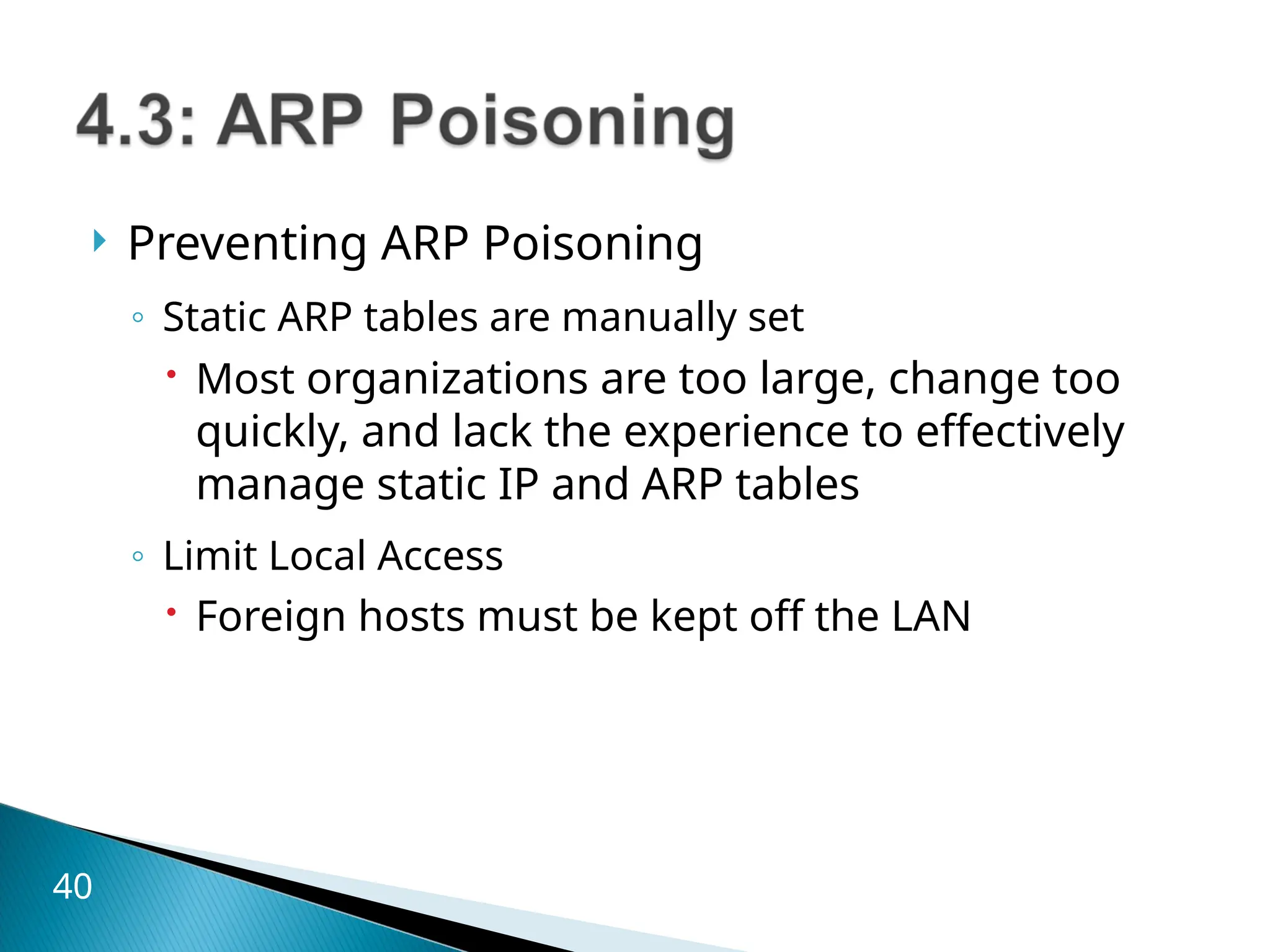
 Preventing ARP Poisoning
◦ Static ARP tables are manually set
 Most organizations are too large, change too
quickly, and lack the experience to effectively
manage static IP and ARP tables
◦ Limit Local Access
 Foreign hosts must be kept off the LAN
40
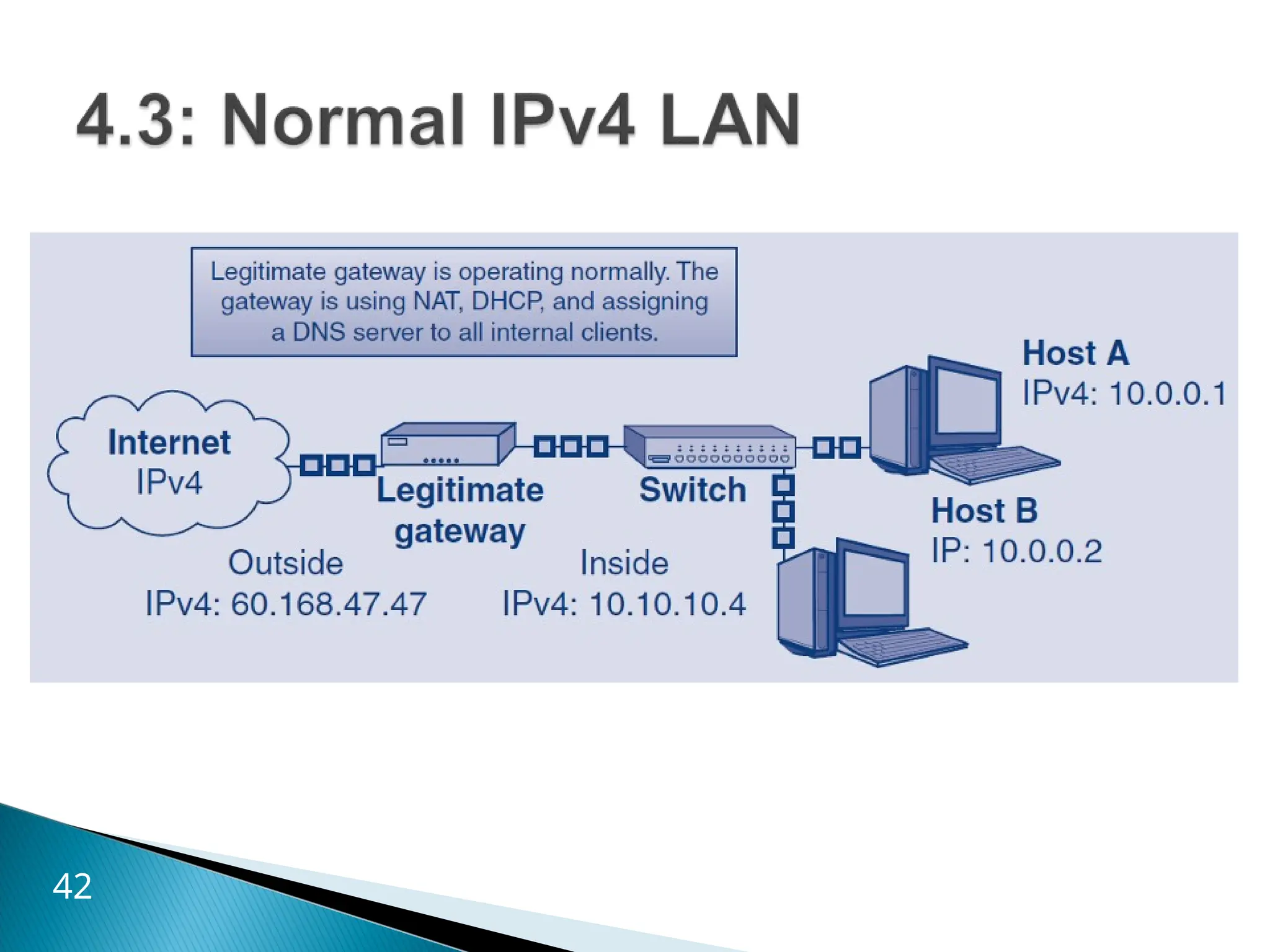
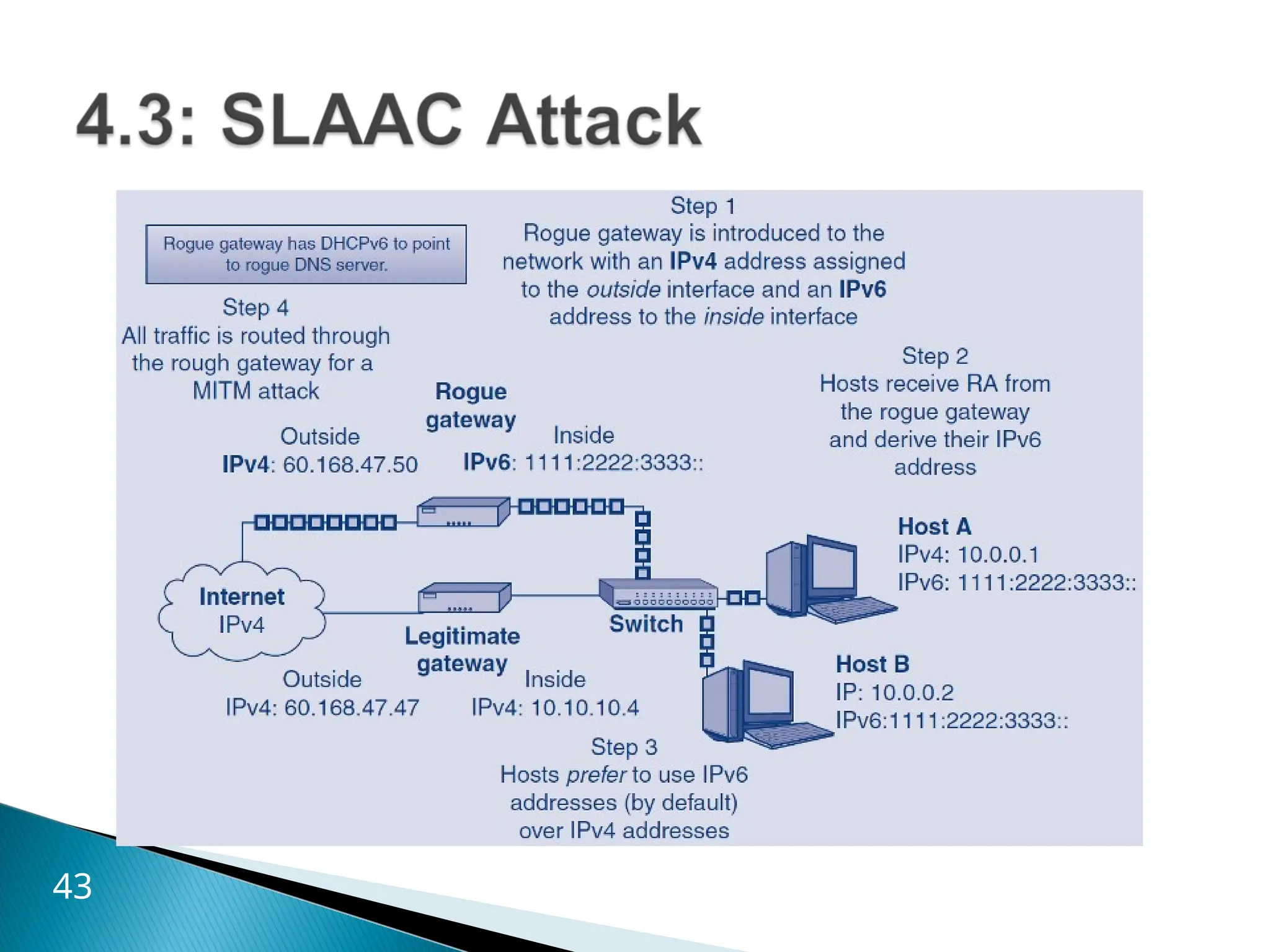
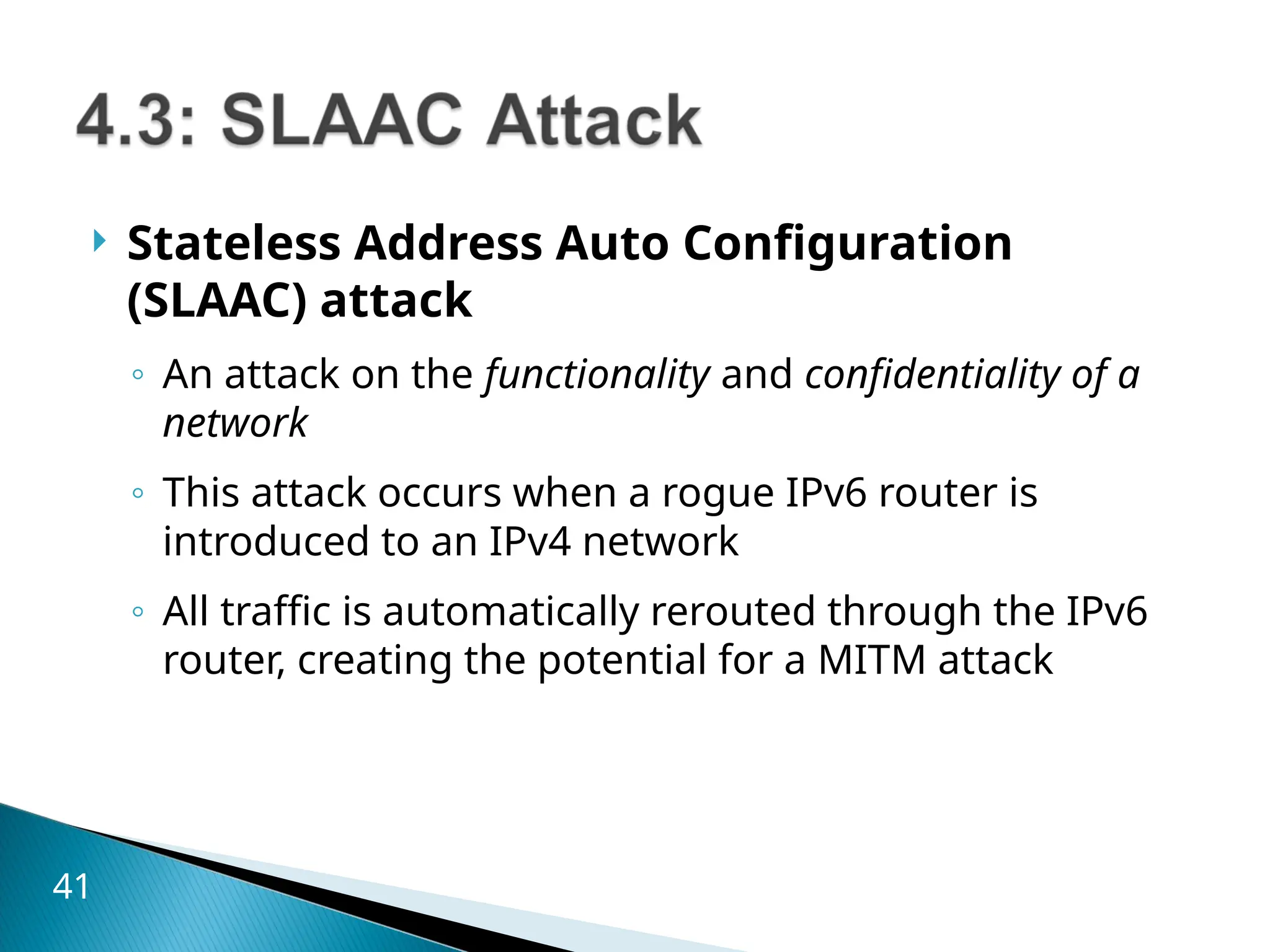
 Stateless Address Auto Configuration
(SLAAC) attack
◦ An attack on the functionality and confidentiality of a
network
◦ This attack occurs when a rogue IPv6 router is
introduced to an IPv4 network
◦ All traffic is automatically rerouted through the IPv6
router, creating the potential for a MITM attack
41
42
43
4.1 Introduction
4.1 Introduction
4.2 Denial-of-Service (DoS) Attacks
4.3 ARP Poisoning
4.3 ARP Poisoning
4.4 Access Control for Networks
4.5 Ethernet Security
4.6 Wireless Security
44
45
4.1 Introduction
4.1 Introduction
4.2 Denial-of-Service (DoS) Attacks
4.3 ARP Poisoning
4.3 ARP Poisoning
4.4 Access Control for Networks
4.5 Ethernet Security
4.6 Wireless Security
46
47
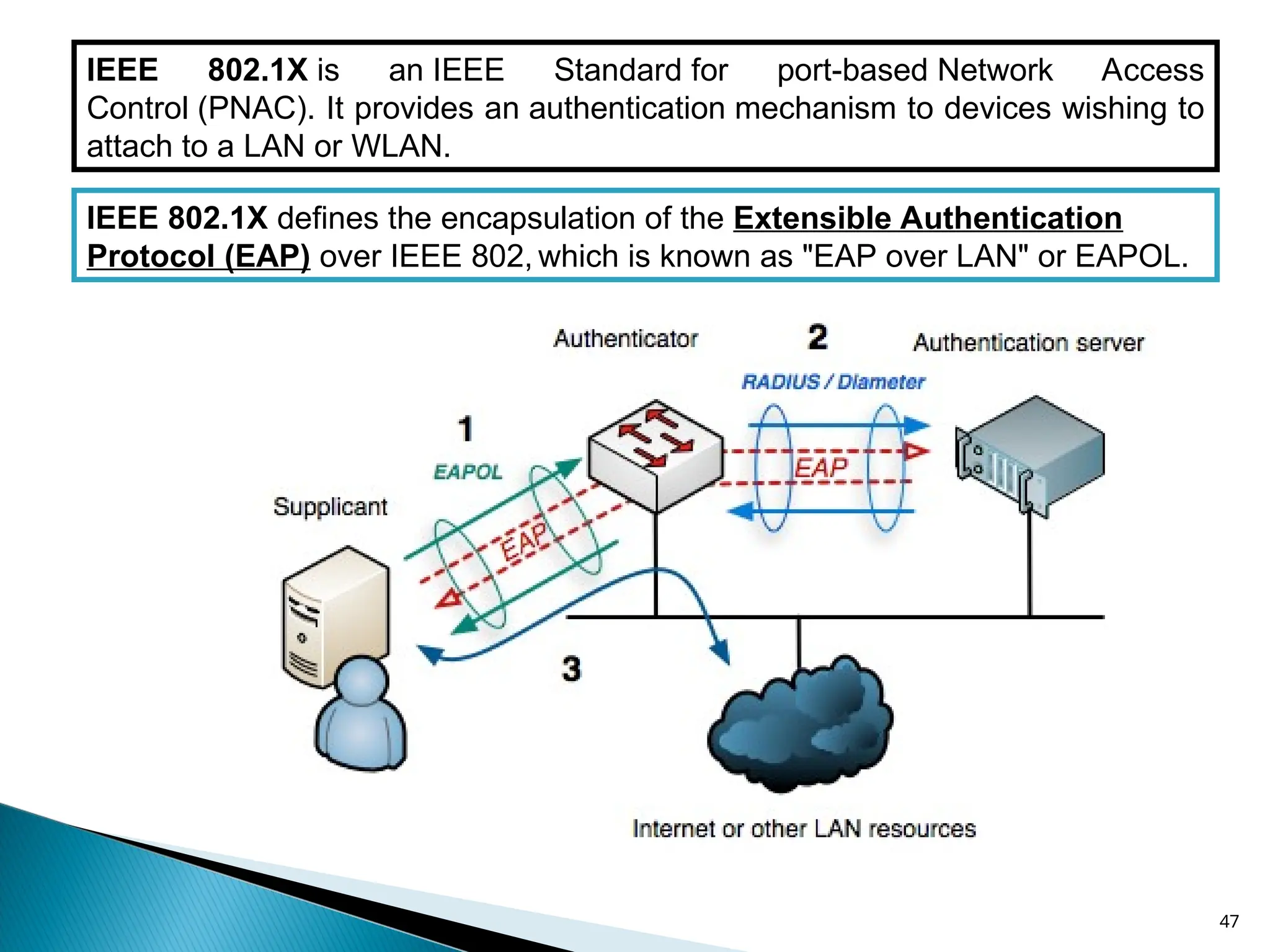
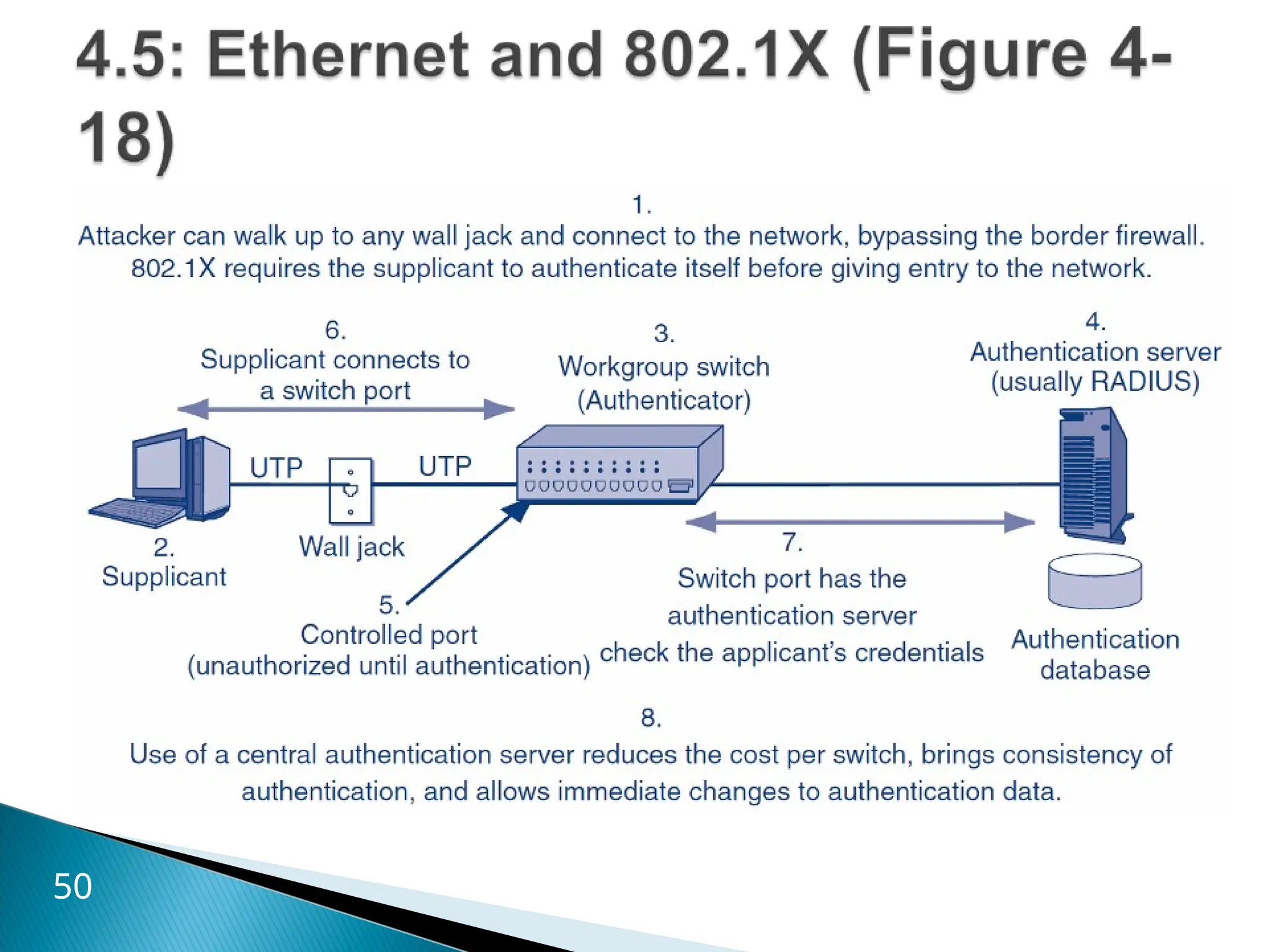
IEEE 802.1X is an IEEE Standard for port-based Network Access
Control (PNAC). It provides an authentication mechanism to devices wishing to
attach to a LAN or WLAN.
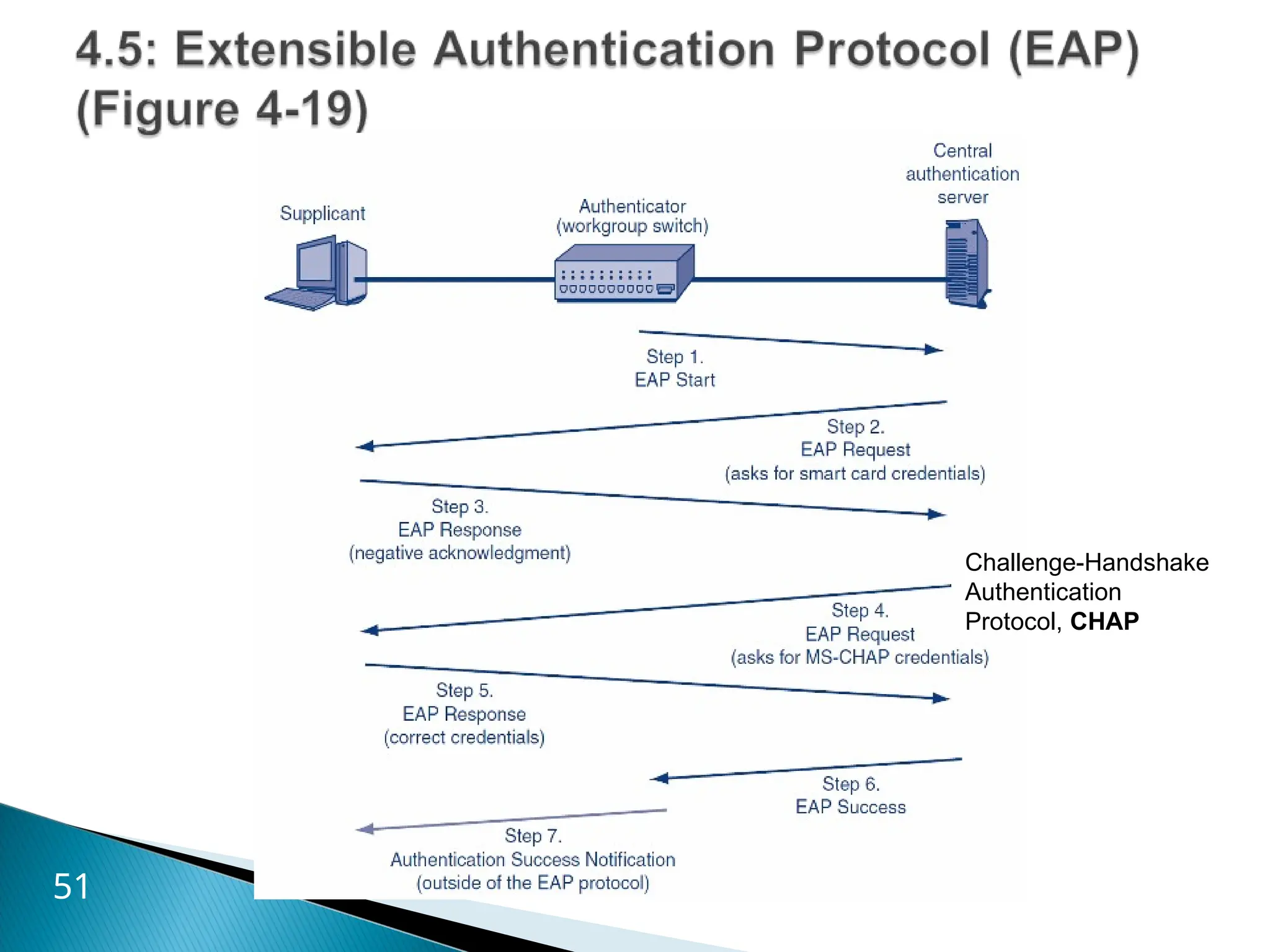
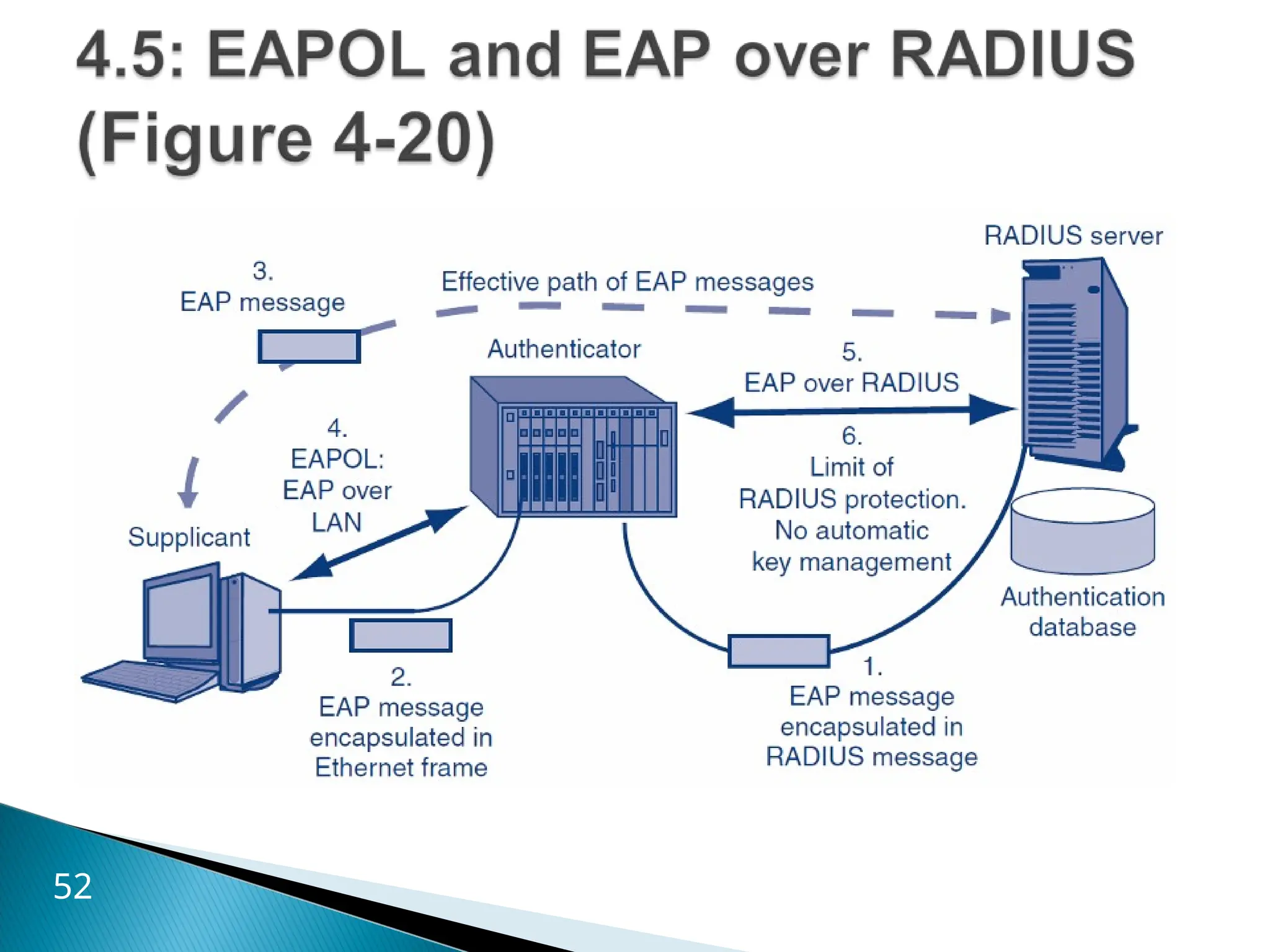
IEEE 802.1X defines the encapsulation of the Extensible Authentication
Protocol (EAP) over IEEE 802, which is known as "EAP over LAN" or EAPOL.
48
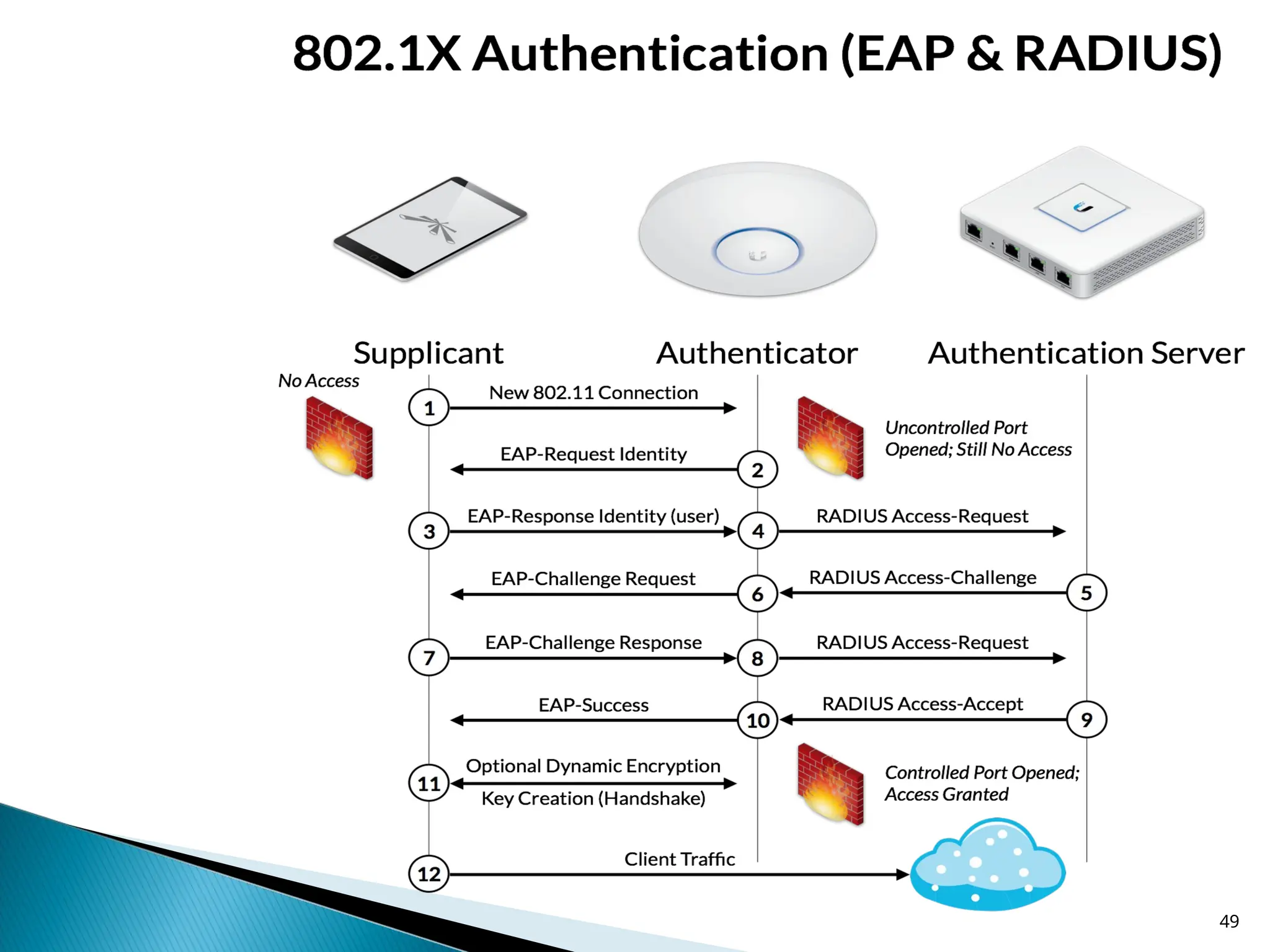
802.1X authentication involves three parties: a supplicant, an authenticator,
and an authentication server.
The supplicant is a client device (such as a laptop) that wishes to attach to
the LAN/WLAN. The term 'supplicant' is also used interchangeably to refer to
the software running on the client that provides credentials to the
authenticator.
The authenticator is a network device which provides a data link between
the client and the network and can allow or block network traffic between the
two, such as an Ethernet switch or wireless access point.
The authentication server is typically a trusted server that can receive
and respond to requests for network access, and can tell the authenticator if
the connection is to be allowed, and various settings that should apply to
that client's connection or setting. Authentication servers typically run
software supporting the RADIUS and EAP protocols.
49
50
51
Challenge-Handshake
Authentication
Protocol, CHAP
52
4.1 Introduction
4.1 Introduction
4.2 Denial-of-Service (DoS) Attacks
4.3 ARP Poisoning
4.3 ARP Poisoning
4.4 Access Control for Networks
4.5 Ethernet Security
4.6 Wireless Security
53

Lecture 4a DOS Secure Networks Denial of Service

  • 1.
  • 2.
     Describe thegoals of creating secure networks.  Explain how denial-of-service attacks work.  Explain how ARP poisoning works.  Know why access controls are important for networks.  Explain how to secure Ethernet networks.  Describe wireless (WLAN) security standards.  Describe potential attacks against wireless networks. 2
  • 3.
    4.1 Introduction 4.1 Introduction 4.2Denial-of-Service (DoS) Attacks 4.2 Denial-of-Service (DoS) Attacks 4.3 ARP Poisoning 4.3 ARP Poisoning 4.4 Access Control for Networks 4.4 Access Control for Networks 4.5 Ethernet Security 4.5 Ethernet Security 4.6 Wireless Security 4.6 Wireless Security 3
  • 4.
     Cryptography providesconfidentiality, authenticity, and message integrity  Modern networks have additional vulnerabilities ◦ Means of delivering the messages could be stopped, slowed, or altered ◦ The route the messages took could be altered ◦ Messages could be redirected to false recipients ◦ Attackers could gain access to communication channels that were previously considered closed and confidential 4
  • 5.
    Goals of CreatingSecure Networks 1. Availability—users have uninterrupted access to information services and network resources 2. Confidentiality—prevent unauthorized users from gaining information about the network 3. Functionality—preventing attackers from altering the capabilities, or normal operation of the network 4. Access control—keep attackers, or unauthorized employees, from accessing internal resources 5
  • 6.
     The “castle”model ◦ Good guys on the inside, attackers on the outside, and a well-guarded point of entry  Death of the Perimeter ◦ It is impractical, if not impossible, to force all information in an organization through a single point in the network ◦ New means of attacking networks (i.e. smart phones) are constantly emerging ◦ Lines between “good guys” and “bad guys” has become blurred 7
  • 7.
     The “city”model ◦ No distinct perimeter, and there are multiple ways of entering the network ◦ Like a real city, who you are will determine which buildings you will be able to access ◦ Greater need for:  Internal intrusion detection  Virtual LANs  Central authentication servers  Encrypted internal traffic 9
  • 8.
    4.1 Introduction 4.1 Introduction 4.2Denial-of-Service (DoS) Attacks 4.2 Denial-of-Service (DoS) Attacks 4.3 ARP Poisoning 4.3 ARP Poisoning 4.4 Access Control for Networks 4.4 Access Control for Networks 4.5 Ethernet Security 4.5 Ethernet Security 4.6 Wireless Security 4.6 Wireless Security 10
  • 9.
     What isa DoS attack? ◦ An attempt to make a server or network unavailable to legitimate users by flooding it with attack packets  What is NOT a DoS attack? ◦ Faulty coding that causes a system to fail ◦ Referrals from large websites that overwhelm smaller websites 11
  • 10.
  • 11.
     Ultimate goalof DoS attacks is to cause harm ◦ Harm includes: losses related to online sales, industry reputation, employee productivity, customer loyalty, etc.  The two primary means of causing harm via DoS attacks include: 1.Stopping critical services 2.Slowly degrading services 13
  • 12.
     Direct DoSAttack ◦ An attacker tries to flood a victim with a stream of packets directly from the attacker’s computer  Indirect DoS Attack ◦ The attacker’s IP address is spoofed (i.e., faked) and the attack appears to come from another computer 14
  • 13.
  • 14.
  • 15.
     Bots ◦ Updatableattack programs ◦ Botmaster can update the software to change the type of attack the bot can do  May sell or lease the botnet to other criminals ◦ Botmaster can update the bot to fix bugs  Botmaster can control bots via a handler ◦ Handlers are an additional layer of compromised hosts that are used to manage large groups of bots 17
  • 16.
  • 17.
  • 18.
     Types ofpackets sent: 20
  • 19.
  • 20.
     Peer-to-peer (P2P)redirect DoS attack ◦ Uses many hosts to overwhelm a victim using normal P2P traffic ◦ Attacker doesn’t have to control the hosts, just redirect their legitimate P2P traffic 22
  • 21.
  • 22.
     Reflected DoSattack ◦ Responses from legitimate services flood a victim ◦ The attacker sends spoofed requests to existing legitimate servers (Step 1) ◦ Servers then send all responses to the victim (Step 2) ◦ There is no redirection of traffic 24
  • 23.
    Copyright Pearson Prentice-Hall2013 25 What is DrDoS? DrDoS stands for Distributed Reflection Denial of Service attack. DrDoS techniques usually involve multiple victim machines that unwittingly participate in a DDoS attack on the attacker’s target. Requests to the victim host machines are redirected, or reflected, from the victim hosts to the target. Usually they also elicit an amplified amount of attack traffic.
  • 24.
  • 25.
     Smurf Flood ◦The attacker sends a spoofed ICMP echo request to an incorrectly configured network device (router) ◦ Broadcasting enabled to all internal hosts ◦ The network device forwards the echo request to all internal hosts (multiplier effect) 27
  • 26.
  • 27.
     Black holing ◦Drop all IP packets from an attacker ◦ We lead all of the criminal traffic to a so-called ‘black hole’ ◦ Not a good long-term strategy because attackers can quickly change source IP addresses ◦ An attacker may knowingly try to get a trusted corporate partner black holed 29
  • 28.
     Validating thehandshake ◦ Whenever a SYN segment arrives, the firewall itself sends back a SYN/ACK segment, without passing the SYN segment on to the target server (false opening) ◦ When the firewall gets back a legitimate ACK the firewall send the original SYN segment on to the intended server  Rate limiting ◦ Used to reduce a certain type of traffic to a reasonable amount ◦ Can frustrate attackers, and legitimate users 30
  • 29.
  • 30.
    4.1 Introduction 4.1 Introduction 4.2Denial-of-Service (DoS) Attacks 4.2 Denial-of-Service (DoS) Attacks 4.3 ARP Poisoning 4.3 ARP Poisoning 4.4 Access Control for Networks 4.4 Access Control for Networks 4.5 Ethernet Security 4.5 Ethernet Security 4.6 Wireless Security 4.6 Wireless Security 32
  • 31.
     ARP Poisoning ◦Network attack that manipulates host ARP tables to reroute local-area network (LAN) traffic ◦ Possible man-in-the-middle attack ◦ Requires an attacker to have a computer on the local network ◦ An attack on both the functionality and confidentiality of a network 33
  • 32.
     Address ResolutionProtocol (ARP) ◦ Used to resolve 32-bit IP addresses (e.g., 55.91.56.21) into 48-bit local MAC addresses (e.g., 01-1C-23-0E-1D- 41) ◦ ARP tables store resolved addresses (below) 34
  • 33.
  • 34.
     The problem:ARP requests and replies do NOT require authentication or verification ◦ All hosts trust all ARP replies ◦ ARP spoofing uses false ARP replies to map any IP address to any MAC address ◦ An attacker can manipulate ARP tables on all LAN hosts ◦ The attacker must send a continuous stream of unsolicited ARP replies 36
  • 35.
  • 36.
     ARP DoSAttack ◦ Attacker sends all internal hosts a continuous stream of unsolicited spoofed ARP replies saying the gateway (10.0.0.4) is at E5-E5-E5-E5-E5-E5 (Step 1) ◦ Hosts record the gateway’s IP address and nonexistent MAC address (Step 2) ◦ The switch receives packets from internal hosts addressed to E5-E5-E5-E5-E5-E5 but cannot deliver them because the host does not exist ◦ Packets addressed to E5-E5-E5-E5-E5-E5 are dropped 38
  • 37.
  • 38.
     Preventing ARPPoisoning ◦ Static ARP tables are manually set  Most organizations are too large, change too quickly, and lack the experience to effectively manage static IP and ARP tables ◦ Limit Local Access  Foreign hosts must be kept off the LAN 40
  • 39.
     Stateless AddressAuto Configuration (SLAAC) attack ◦ An attack on the functionality and confidentiality of a network ◦ This attack occurs when a rogue IPv6 router is introduced to an IPv4 network ◦ All traffic is automatically rerouted through the IPv6 router, creating the potential for a MITM attack 41
  • 40.
  • 41.
  • 42.
    4.1 Introduction 4.1 Introduction 4.2Denial-of-Service (DoS) Attacks 4.2 Denial-of-Service (DoS) Attacks 4.3 ARP Poisoning 4.3 ARP Poisoning 4.4 Access Control for Networks 4.4 Access Control for Networks 4.5 Ethernet Security 4.5 Ethernet Security 4.6 Wireless Security 4.6 Wireless Security 44
  • 43.
  • 44.
    4.1 Introduction 4.1 Introduction 4.2Denial-of-Service (DoS) Attacks 4.2 Denial-of-Service (DoS) Attacks 4.3 ARP Poisoning 4.3 ARP Poisoning 4.4 Access Control for Networks 4.4 Access Control for Networks 4.5 Ethernet Security 4.5 Ethernet Security 4.6 Wireless Security 4.6 Wireless Security 46
  • 45.
    47 IEEE 802.1X isan IEEE Standard for port-based Network Access Control (PNAC). It provides an authentication mechanism to devices wishing to attach to a LAN or WLAN. IEEE 802.1X defines the encapsulation of the Extensible Authentication Protocol (EAP) over IEEE 802, which is known as "EAP over LAN" or EAPOL.
  • 46.
    48 802.1X authentication involvesthree parties: a supplicant, an authenticator, and an authentication server. The supplicant is a client device (such as a laptop) that wishes to attach to the LAN/WLAN. The term 'supplicant' is also used interchangeably to refer to the software running on the client that provides credentials to the authenticator. The authenticator is a network device which provides a data link between the client and the network and can allow or block network traffic between the two, such as an Ethernet switch or wireless access point. The authentication server is typically a trusted server that can receive and respond to requests for network access, and can tell the authenticator if the connection is to be allowed, and various settings that should apply to that client's connection or setting. Authentication servers typically run software supporting the RADIUS and EAP protocols.
  • 47.
  • 48.
  • 49.
  • 50.
  • 51.
    4.1 Introduction 4.1 Introduction 4.2Denial-of-Service (DoS) Attacks 4.2 Denial-of-Service (DoS) Attacks 4.3 ARP Poisoning 4.3 ARP Poisoning 4.4 Access Control for Networks 4.4 Access Control for Networks 4.5 Ethernet Security 4.5 Ethernet Security 4.6 Wireless Security 4.6 Wireless Security 53