MODULE 2 , CHAPTER 1
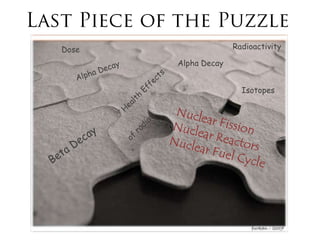
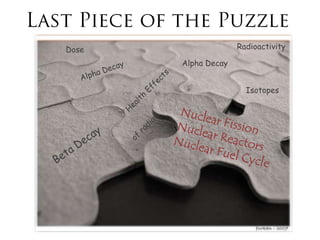
Dose                 Radioactivity

       Alpha Decay


                       Isotopes
But at the end of this module you will
     know a lot of fundamentals!
Nuclear Physics Is
All you need to know is..

1. Nuclear Physics is about
   probabilities (interaction).
2. Particle interactions can be
   understood in terms of simple
   billiard balls.
3. You have to think like a neutron
MODULE 2 , CHAPTER 2
Dose                 Radioactivity

       Alpha Decay


                       Isotopes
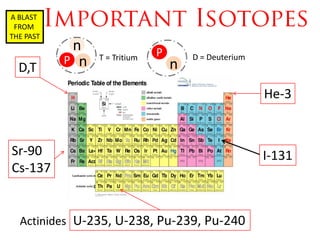
A BLAST
 FROM
THE PAST
            n                  P
           P n   T = Tritium           D = Deuterium
  D,T                              n
                                                       He-3


Sr-90                                                  I-131
Cs-137


  Actinides U-235, U-238, Pu-239, Pu-240
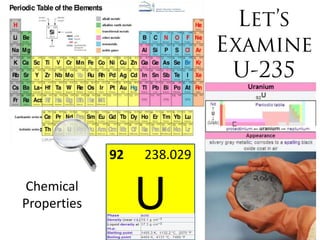
92   238.029

Chemical
Properties        U
Those were the chemical properties
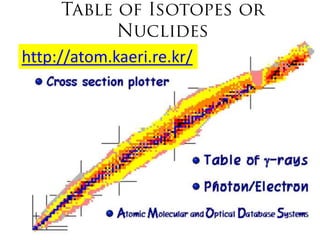
http://atom.kaeri.re.kr/
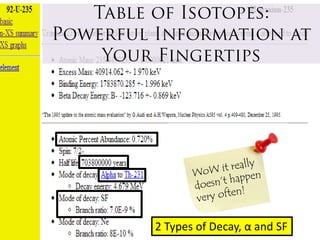
2 Types of Decay, α and SF
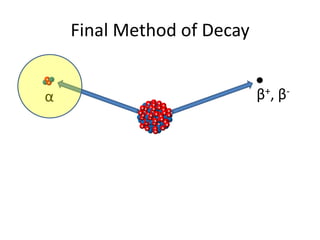
Final Method of Decay

+
 +


α                    + +
                  + + + +
                                β+, β-
              + ++ +++++ +
                +   +
                   +++ + +
             + + ++ +++++++ +
                  ++ +
               + + + ++++
              + + +++++++++ +
                   + + ++
                   + +
                + + ++ + +
              + + ++++ ++ +
                 + + ++++ +
              + + + ++ +
                   + ++ +
              + ++ + + + +
                      + +
                      +
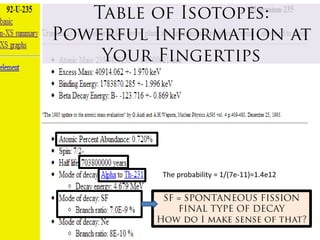
The probability = 1/(7e-11)=1.4e12
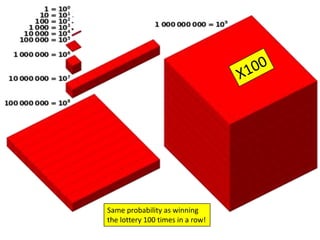
Same probability as winning
the lottery 100 times in a row!
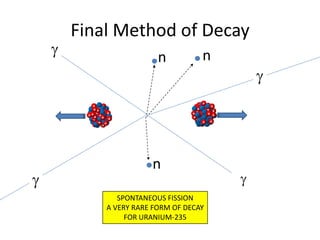
Final Method of Decay
                        n            n

                                        + +
     + ++                         ++ ++ ++ +
                                   ++ ++ +
     + + ++
       + +                           ++ +
                                      +
                                    ++ ++ +
                                 + +++++++ +
  + +++ ++ ++
      + ++ +
         +
         +                          +++ +++
                                   +++ +
       + ++ +
     ++ +
       + +
                                 + ++ + + +
                                   ++ +
                                    +
                                   ++ +
                                      ++ + +
                                       +
     + ++++
          +                           ++
                                       +


                      n
              SPONTANEOUS FISSION
           A VERY RARE FORM OF DECAY
                FOR URANIUM-235
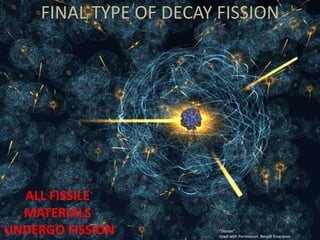
FINAL TYPE OF DECAY FISSION


  ALL FISSILE
  MATERIALS
UNDERGO FISSION          “Fission”
                         Used with Permission: Benoît Kloeckner
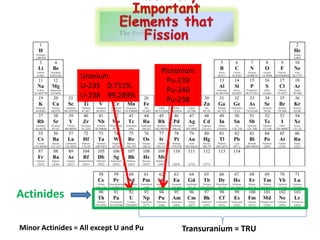
Plutonium
                  Uranium
                                          Pu-239
                  U-235 0.711%
                                          Pu-240
                  U-238 99.289%
                                          Pu-238


Actinides

Minor Actinides = All except U and Pu        Transuranium = TRU
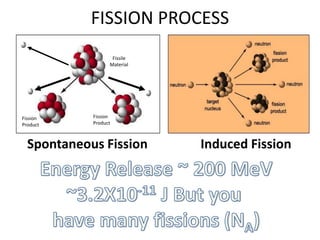
FISSION PROCESS
                   Fissile
                  Material


Fission     Fission
Product     Product


  Spontaneous Fission        Induced Fission
MODULE 2 , CHAPTER 2


• Actinides fission and some isotopes can
  sustain a chain reaction
• 2 types of fission – spontaneous and induced
  fission
• Can look up isotope characteristics
• A sustained chain reaction can be used for
  peaceful and non-peaceful purposes
MODULE 2 , CHAPTER 3
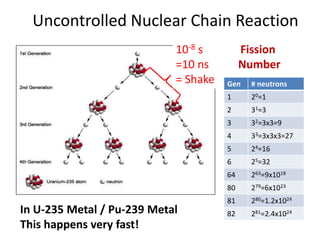
Uncontrolled Nuclear Chain Reaction
                            10-8 s         Fission
                            =10 ns         Number
                            = Shake   Gen    # neutrons
                                      1      20=1
                                      2      31=3
                                      3      32=3x3=9
                                      4      33=3x3x3=27
                                      5      24=16
                                      6      25=32
                                      64     263=9x10¹⁸
                                      80     279=6x10²³
                                      81     280=1.2x1024
In U-235 Metal / Pu-239 Metal         82     281=2.4x1024
This happens very fast!
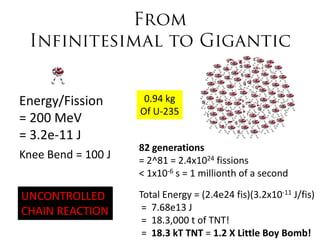
Energy/Fission       0.94 kg
                    Of U-235
= 200 MeV
= 3.2e-11 J
                    82 generations
Knee Bend = 100 J   = 2^81 = 2.4x1024 fissions
                    < 1x10⁻⁶ s = 1 millionth of a second

UNCONTROLLED        Total Energy = (2.4e24 fis)(3.2x10⁻¹¹ J/fis)
CHAIN REACTION       = 7.68e13 J
                     = 18.3,000 t of TNT!
                     = 18.3 kT TNT = 1.2 X Little Boy Bomb!
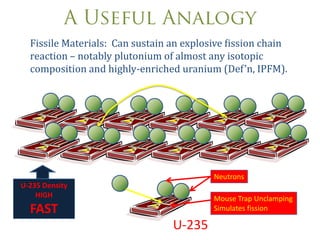
Fissile Materials: Can sustain an explosive fission chain
  reaction – notably plutonium of almost any isotopic
  composition and highly-enriched uranium (Def’n, IPFM).


                                          Neutrons
U-235 Density
    HIGH                                  Mouse Trap Unclamping
  FAST                                    Simulates fission

                                 U-235                            35
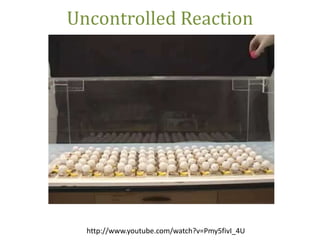
Uncontrolled Reaction


  http://www.youtube.com/watch?v=Pmy5fivI_4U   36
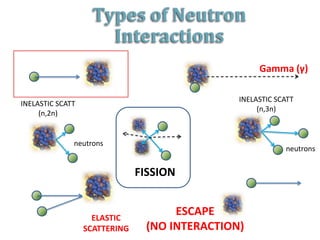
Types of Neutron
                      Interactions
                                                    Gamma (γ)

                                               INELASTIC SCATT
INELASTIC SCATT
                                                    (n,3n)
     (n,2n)


              neutrons
                                                           neutrons


                               FISSION


                    ELASTIC
                                     ESCAPE
                  SCATTERING    (NO INTERACTION)                 37
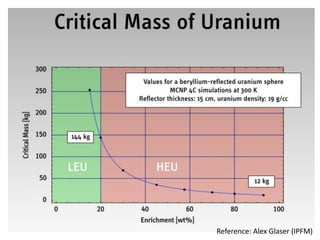
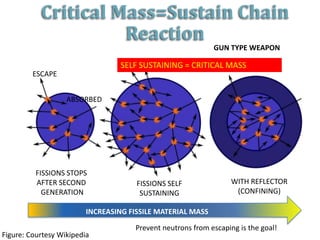
Critical Mass=Sustain Chain
                     Reaction
                                                            GUN TYPE WEAPON

                                  SELF SUSTAINING = CRITICAL MASS
         ESCAPE


                   ABSORBED


          FISSIONS STOPS
          AFTER SECOND                FISSIONS SELF               WITH REFLECTOR
            GENERATION                 SUSTAINING                  (CONFINING)

                         INCREASING FISSILE MATERIAL MASS

                                     Prevent neutrons from escaping is the goal!   38
Figure: Courtesy Wikipedia
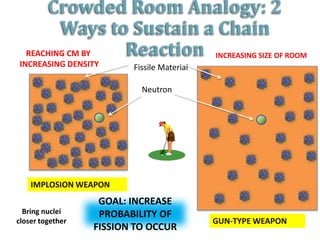
Crowded Room Analogy: 2
         Ways to Sustain a Chain
  REACHING CM BY Reaction INCREASING SIZE OF ROOM
INCREASING DENSITY       Fissile Material

                           Neutron


    IMPLOSION WEAPON
                   GOAL: INCREASE
  Bring nuclei     PROBABILITY OF
closer together                             GUN-TYPE WEAPON
                  FISSION TO OCCUR
Reference: Alex Glaser (IPFM)
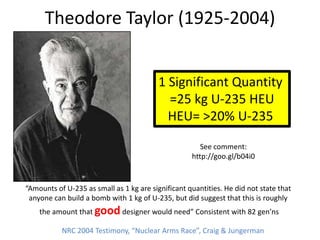
Theodore Taylor (1925-2004)


                                          1 Significant Quantity
                                            =25 kg U-235 HEU
                                            HEU= >20% U-235

                                                       See comment:
                                                    http://goo.gl/b04i0


“Amounts of U-235 as small as 1 kg are significant quantities. He did not state that
 anyone can build a bomb with 1 kg of U-235, but did suggest that this is roughly
    the amount that good designer would need” Consistent with 82 gen’ns

           NRC 2004 Testimony, “Nuclear Arms Race”, Craig & Jungerman
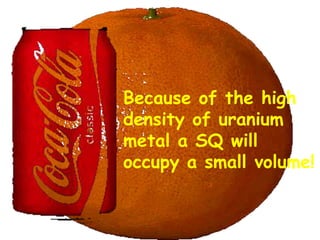
Because of the high
density of uranium
metal a SQ will
occupy a small volume!
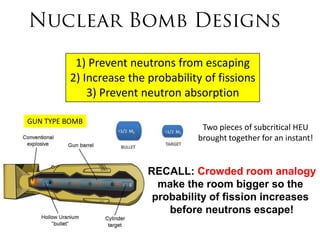
1) Prevent neutrons from escaping
          2) Increase the probability of fissions
              3) Prevent neutron absorption

GUN TYPE BOMB
                                     Two pieces of subcritical HEU
                                    brought together for an instant!


                          RECALL: Crowded room analogy
                            make the room bigger so the
                           probability of fission increases
                              before neutrons escape!
With modern weapons-grade uranium, the
background neutron rate is so low that
terrorists, if they had such material, would
have a good chance of setting off a high-
yield explosion simply by dropping one half
of the material onto the other half.Most
people seem unaware that if separate HEU
is at hand it's a trivial job to set off a
nuclear explosion . . . even a high school
kid could make a bomb in short order.
Luis Alvarez, Adventures of a Physicist (Basic Books, 1987), p. 125.
• Not very safe – 2 pieces that are
  subcritical but if inadvertently combined
  could cause an explosion.
• Must keep away from moderators
• Not very efficient – not very high yield
• Weapon of choice for non-state actors
  (terrorists)
• Barrier is getting the HEU in the first
  place!
• Uranium is mined but is only 0.711% U-235 and
  99.289% U-238.
• Need to remove the U-238 to increase the
  proportion of U-235 to U-238.
• Start with 7 U-235 and 993 U-238 marbles
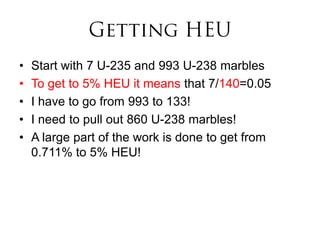
•   Start with 7 U-235 and 993 U-238 marbles
•   To get to 5% HEU it means that 7/140=0.05
•   I have to go from 993 to 133!
•   I need to pull out 860 U-238 marbles!
•   A large part of the work is done to get from
    0.711% to 5% HEU!
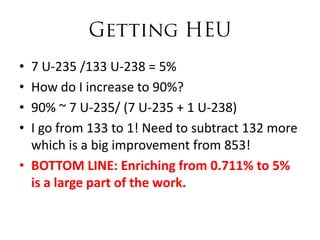
• 7 U-235 /133 U-238 = 5%
• How do I increase to 90%?
• 90% ~ 7 U-235/ (7 U-235 + 1 U-238)
• I go from 133 to 1! Need to subtract 132 more
  which is a big improvement from 853!
• BOTTOM LINE: Enriching from 0.711% to 5%
  is a large part of the work.
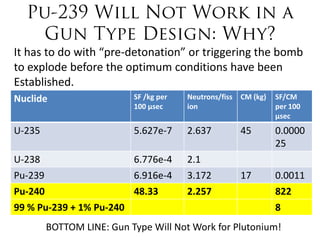
It has to do with “pre-detonation” or triggering the bomb
to explode before the optimum conditions have been
Established.
Nuclide                    SF /kg per   Neutrons/fiss   CM (kg)   SF/CM
                           100 μsec     ion                       per 100
                                                                  μsec
U-235                      5.627e-7     2.637           45        0.0000
                                                                  25
U-238                      6.776e-4     2.1
Pu-239                     6.916e-4     3.172           17        0.0011
Pu-240                     48.33        2.257                     822
99 % Pu-239 + 1% Pu-240                                           8
         BOTTOM LINE: Gun Type Will Not Work for Plutonium!
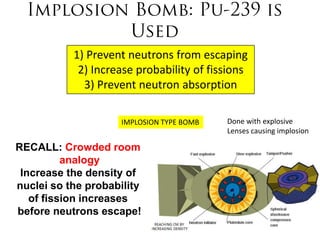
1) Prevent neutrons from escaping
            2) Increase probability of fissions
             3) Prevent neutron absorption

                     IMPLOSION TYPE BOMB   Done with explosive
                                           Lenses causing implosion

RECALL: Crowded room
          analogy
 Increase the density of
nuclei so the probability
   of fission increases
before neutrons escape!
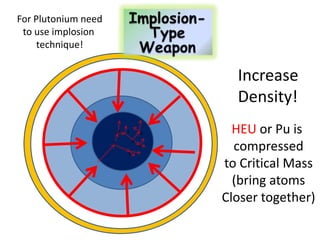
For Plutonium need
 to use implosion
     technique!


                                           Increase
                                           Density!
                         2   3       6     HEU or Pu is
                                 4
                     1

                             7
                                     5
                                           compressed
                                         to Critical Mass
                                           (bring atoms
                                         Closer together)
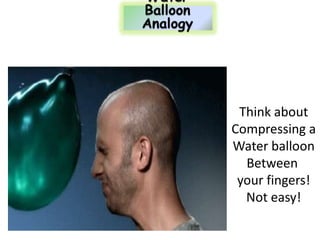
Think about
Compressing a
Water balloon
  Between
 your fingers!
  Not easy!
We can get HEU by enriching
 natural U what about Pu?
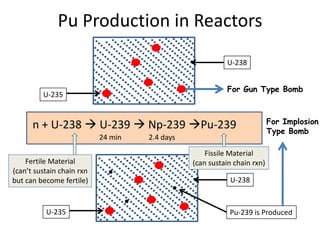
Pu Production in Reactors
                                                         U-238


                                                         For Gun Type Bomb
         U-235


                                                                         For Implosion
      n + U-238  U-239  Np-239 Pu-239                                 Type Bomb
                           24 min   2.4 days
                                                   Fissile Material
    Fertile Material                           (can sustain chain rxn)
(can’t sustain chain rxn
but can become fertile)                                   U-238


          U-235                                           Pu-239 is Produced
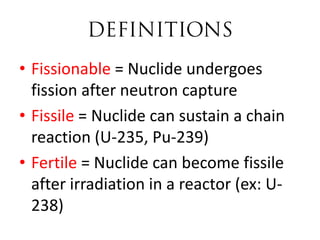
• Fissionable = Nuclide undergoes
  fission after neutron capture
• Fissile = Nuclide can sustain a chain
  reaction (U-235, Pu-239)
• Fertile = Nuclide can become fissile
  after irradiation in a reactor (ex: U-
  238)
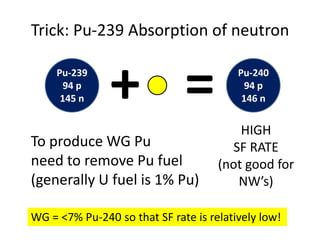
Trick: Pu-239 Absorption of neutron

     Pu-239
       94 p
      145 n    + =                       Pu-240
                                           94 p
                                          146 n


                                         HIGH
To produce WG Pu                        SF RATE
need to remove Pu fuel               (not good for
(generally U fuel is 1% Pu)              NW’s)

WG = <7% Pu-240 so that SF rate is relatively low!
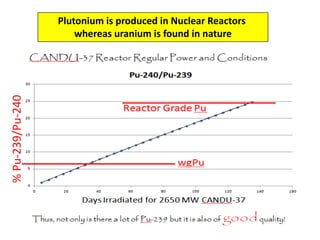
Plutonium Production in Nuclear Reactors
                    Plutonium is produced in Nuclear Reactors
                        whereas uranium is found in nature


                   Neutron activation on Pu-239 produces Pu-240 (bad for NW)
% Pu-239/Pu-240
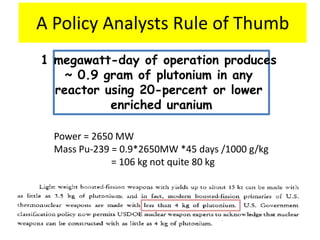
A Policy Analysts Rule of Thumb
1 megawatt-day of operation produces
    ~ 0.9 gram of plutonium in any
  reactor using 20-percent or lower
           enriched uranium

  Power = 2650 MW
  Mass Pu-239 = 0.9*2650MW *45 days /1000 g/kg
              = 106 kg not quite 80 kg
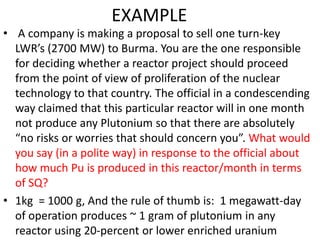
EXAMPLE
• A company is making a proposal to sell one turn-key
  LWR’s (2700 MW) to Burma. You are the one responsible
  for deciding whether a reactor project should proceed
  from the point of view of proliferation of the nuclear
  technology to that country. The official in a condescending
  way claimed that this particular reactor will in one month
  not produce any Plutonium so that there are absolutely
  “no risks or worries that should concern you”. What would
  you say (in a polite way) in response to the official about
  how much Pu is produced in this reactor/month in terms
  of SQ?
• 1kg = 1000 g, And the rule of thumb is: 1 megawatt-day
  of operation produces ~ 1 gram of plutonium in any
  reactor using 20-percent or lower enriched uranium 60
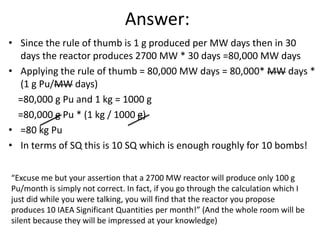
Answer:
• Since the rule of thumb is 1 g produced per MW days then in 30
  days the reactor produces 2700 MW * 30 days =80,000 MW days
• Applying the rule of thumb = 80,000 MW days = 80,000* MW days *
  (1 g Pu/MW days)
  =80,000 g Pu and 1 kg = 1000 g
  =80,000 g Pu * (1 kg / 1000 g)
• =80 kg Pu
• In terms of SQ this is 10 SQ which is enough roughly for 10 bombs!

“Excuse me but your assertion that a 2700 MW reactor will produce only 100 g
Pu/month is simply not correct. In fact, if you go through the calculation which I
just did while you were talking, you will find that the reactor you propose
produces 10 IAEA Significant Quantities per month!” (And the whole room will be
silent because they will be impressed at your knowledge)
                                                                               61
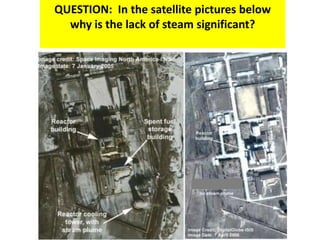
QUESTION: In the satellite pictures below
  why is the lack of steam significant?
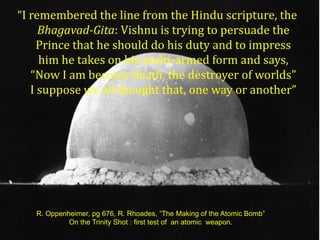
“I remembered the line from the Hindu scripture, the
     Bhagavad-Gita: Vishnu is trying to persuade the
     Prince that he should do his duty and to impress
     him he takes on his multi-armed form and says,
   “Now I am become death, the destroyer of worlds”
   I suppose we all thought that, one way or another”


   R. Oppenheimer, pg 676, R. Rhoades, “The Making of the Atomic Bomb”
            On the Trinity Shot : first test of an atomic weapon.
MODULE 2 , CHAPTER 3


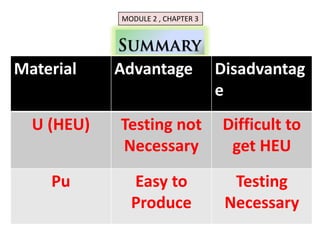
Material    Advantage              Disadvantag
                                   e
  U (HEU)   Testing not            Difficult to
            Necessary               get HEU

    Pu        Easy to                Testing
              Produce               Necessary
MODULE 2 , CHAPTER 4
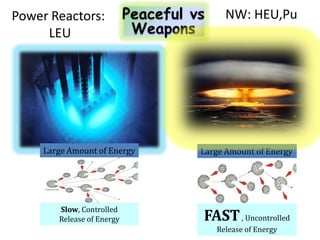
Power Reactors:                    NW: HEU,Pu
     LEU


     Large Amount of Energy   Large Amount of Energy


        Slow, Controlled
        Release of Energy     FAST , Uncontrolled
                                 Release of Energy
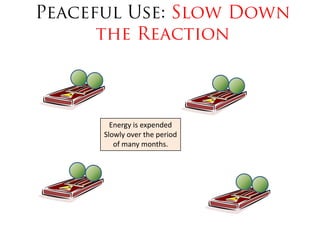
Energy is expended
Slowly over the period
   of many months.
Now the Details!
How Do You Get A Self-Sustaining
    Reaction : An Analogy
You have to think like a neutron
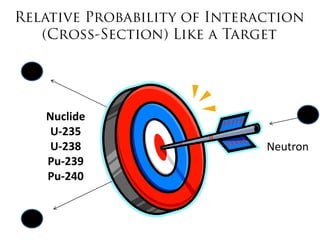
Nuclide
 U-235
 U-238    Neutron
Pu-239
Pu-240
• Neutron moving slow will easily fission
  U-235 but not U-238
• Neutron moving fast will easily fission
  U-238 but also U-235
• Neutron are produced through fission
  at high energy
• It is almost as if the neutron at low
  energy is completely different from a
  neutron travelling at high energies
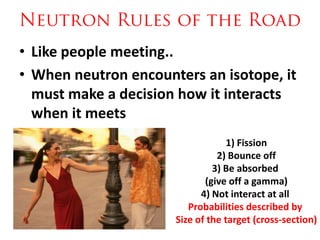
• Like people meeting..
• When neutron encounters an isotope, it
  must make a decision how it interacts
  when it meets
                                   1) Fission
                                2) Bounce off
                               3) Be absorbed
                             (give off a gamma)
                            4) Not interact at all
                         Probabilities described by
                      Size of the target (cross-section)
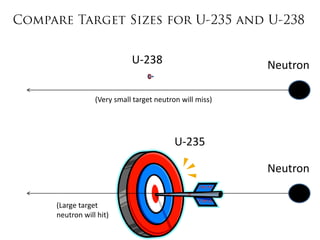
U-238                        Neutron

            (Very small target neutron will miss)


                                     U-235

                                                    Neutron

(Large target
neutron will hit)
• Neutrons can also do other things
  besides fission (bounce off, be
  absorbed, not interact)
• It all has to do with the size of the
  target which changes for different
  neutron energies
• You have to think like a neutron
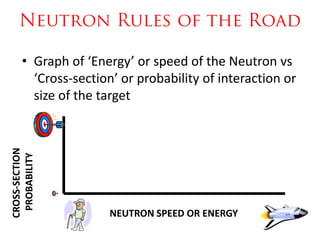
• Graph of ‘Energy’ or speed of the Neutron vs
       ‘Cross-section’ or probability of interaction or
       size of the target
CROSS-SECTION
 PROBABILITY


                    NEUTRON SPEED OR ENERGY
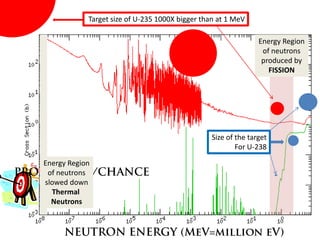
Target size of U-235 1000X bigger than at 1 MeV

                                                                Energy Region
                                                                 of neutrons
                                                                 produced by
                                                                   FISSION


                                                 Size of the target
                                                         For U-238

Energy Region
 of neutrons
slowed down
  Thermal
  Neutrons
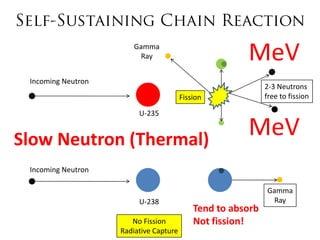
Gamma
                         Ray                           MeV
 Incoming Neutron
                                                             2-3 Neutrons
                                        Fission              free to fission

                         U-235


Slow Neutron (Thermal)
                                                       MeV
 Incoming Neutron

                                                             Gamma
                         U-238                                Ray
                                            Tend to absorb
                       No Fission           Not fission!
                    Radiative Capture
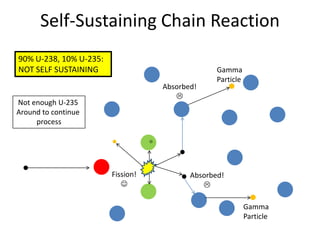
Self-Sustaining Chain Reaction
90% U-238, 10% U-235:
NOT SELF SUSTAINING                              Gamma
                                                 Particle
                                   Absorbed!
                                      
Not enough U-235
Around to continue
     process


                        Fission!          Absorbed!
                                            

                                                            Gamma
                                                            Particle
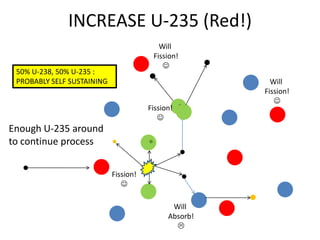
INCREASE U-235 (Red!)
                                          Will
                                        Fission!
                                           
 50% U-238, 50% U-235 :
 PROBABLY SELF SUSTAINING                                Will
                                                       Fission!
                                                          
                                       Fission!
                                          
Enough U-235 around
to continue process


                            Fission!
                               

                                              Will
                                             Absorb!
                                               
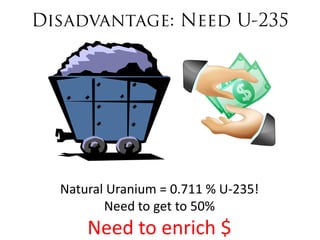
Natural Uranium = 0.711 % U-235!
       Need to get to 50%
    Need to enrich $
Neutrons from fission (MeV)
  Appear to require 50% U-235
and 50% U-238 – this is expensive!
THE TRICK: Slow the neutrons
   down! Moderate them!
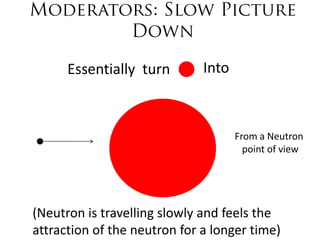
Essentially turn        Into


                                     From a Neutron
                                       point of view


(Neutron is travelling slowly and feels the
attraction of the neutron for a longer time)
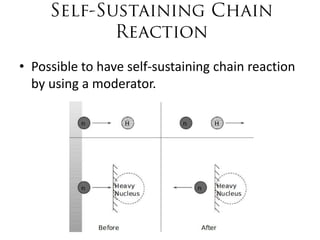
• Possible to have self-sustaining chain reaction
  by using a moderator.
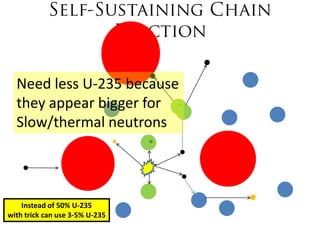
Need less U-235 because
  they appear bigger for
  Slow/thermal neutrons


    Instead of 50% U-235
with trick can use 3-5% U-235
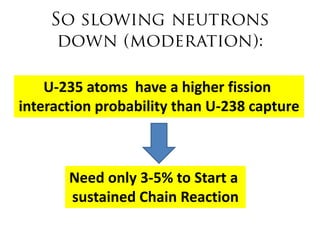
U-235 atoms have a higher fission
interaction probability than U-238 capture


       Need only 3-5% to Start a
       sustained Chain Reaction
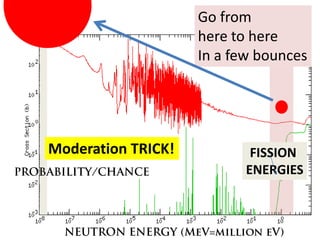
Go from
                    here to here
                    In a few bounces


Moderation TRICK!           FISSION
                           ENERGIES
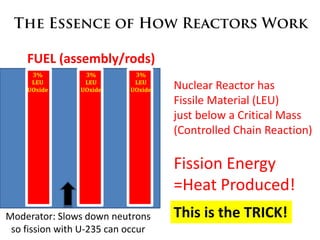
FUEL (assembly/rods)
     3%          3%         3%
     LEU         LEU        LEU
    UOxide      UOxide     UOxide   Nuclear Reactor has
                                    Fissile Material (LEU)
                                    just below a Critical Mass
                                    (Controlled Chain Reaction)

                                    Fission Energy
                                    =Heat Produced!
Moderator: Slows down neutrons      This is the TRICK!
 so fission with U-235 can occur
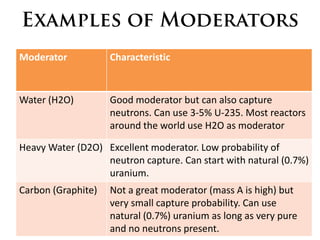
Moderator           Characteristic


Water (H2O)         Good moderator but can also capture
                    neutrons. Can use 3-5% U-235. Most reactors
                    around the world use H2O as moderator

Heavy Water (D2O) Excellent moderator. Low probability of
                  neutron capture. Can start with natural (0.7%)
                  uranium.
Carbon (Graphite)   Not a great moderator (mass A is high) but
                    very small capture probability. Can use
                    natural (0.7%) uranium as long as very pure
                    and no neutrons present.
AND
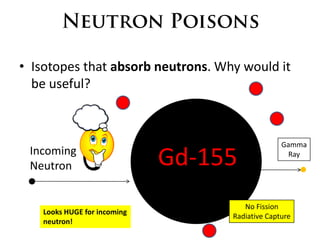
• Isotopes that absorb neutrons. Why would it
  be useful?


                                                 Gamma
 Incoming
 Neutron                     Gd-155               Ray


                                      No Fission
   Looks HUGE for incoming
                                   Radiative Capture
   neutron!
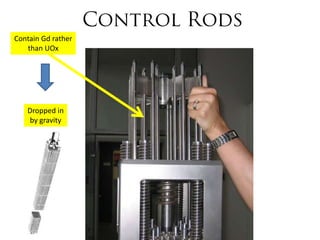
Contain Gd rather
   than UOx


   Dropped in
   by gravity
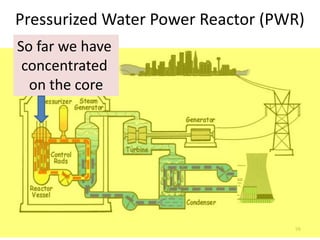
Pressurized Water Power Reactor (PWR)
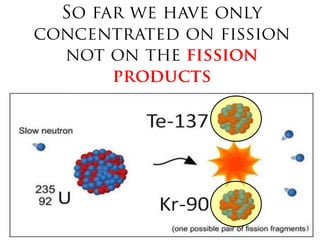
So far we have
 concentrated
  on the core


                                   98
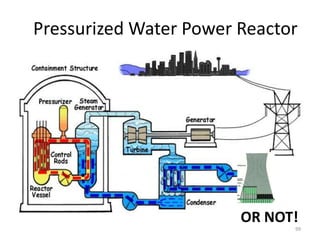
Pressurized Water Power Reactor


                        OR NOT!
                              99
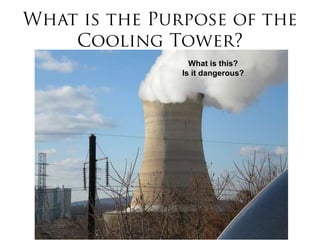
What is this?
Is it dangerous?
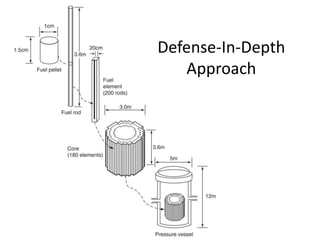
Defense-In-Depth
   Approach
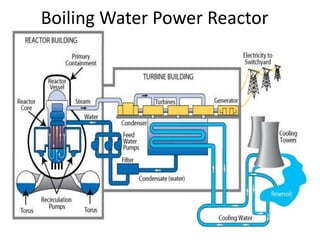
Boiling Water Power Reactor
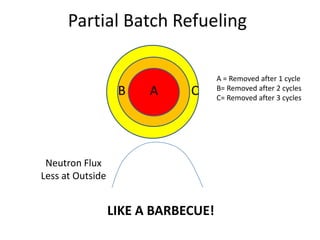
Partial Batch Refueling

                                     A = Removed after 1 cycle
                   B    A     C      B= Removed after 2 cycles
                                     C= Removed after 3 cycles


 Neutron Flux
Less at Outside


                  LIKE A BARBECUE!
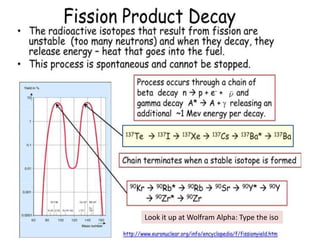
Look it up at Wolfram Alpha: Type the iso
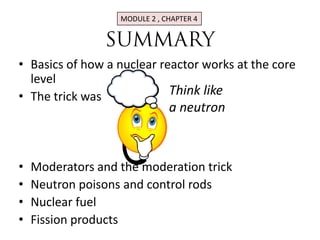
MODULE 2 , CHAPTER 4


• Basics of how a nuclear reactor works at the core
  level
• The trick was             Think like
                               a neutron


•   Moderators and the moderation trick
•   Neutron poisons and control rods
•   Nuclear fuel
•   Fission products
MODULE 2 , CHAPTER 5
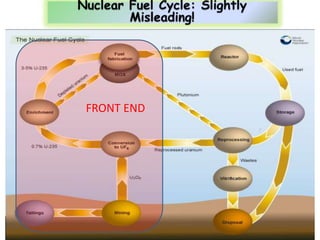
FRONT END
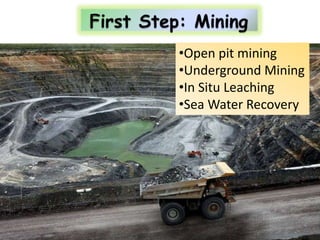
•Open pit mining
•Underground Mining
•In Situ Leaching
•Sea Water Recovery
Excavated uranium
ore milled (crushed)

processed into yellow
cake
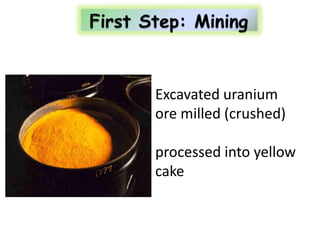
Excavated uranium
ore milled (crushed)

processed into yellow
cake
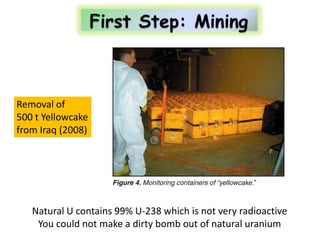
Removal of
500 t Yellowcake
from Iraq (2008)


   Natural U contains 99% U-238 which is not very radioactive
    You could not make a dirty bomb out of natural uranium
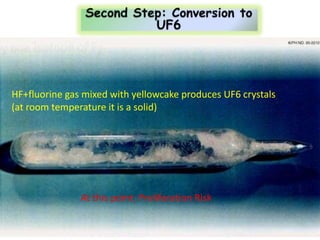
HF+fluorine gas mixed with yellowcake produces UF6 crystals
(at room temperature it is a solid)


               At this point: Proliferation Risk
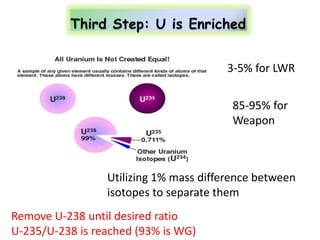
3-5% for LWR


                                        85-95% for
                                        Weapon


                 Utilizing 1% mass difference between
                 isotopes to separate them
Remove U-238 until desired ratio
U-235/U-238 is reached (93% is WG)
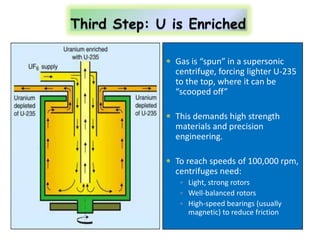
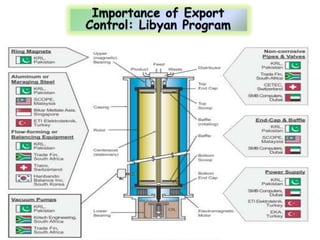
 Gas is “spun” in a supersonic
  centrifuge, forcing lighter U-235
  to the top, where it can be
  “scooped off”

 This demands high strength
  materials and precision
  engineering.

 To reach speeds of 100,000 rpm,
  centrifuges need:
    Light, strong rotors
    Well-balanced rotors
    High-speed bearings (usually
     magnetic) to reduce friction
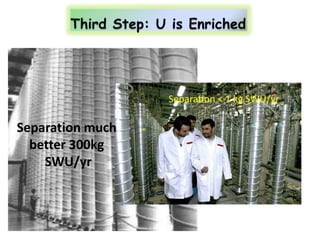
Separation < 1 kg SWU/yr

Separation much
  better 300kg
    SWU/yr
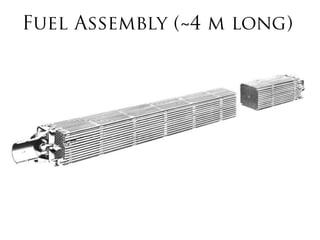
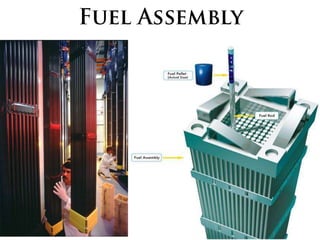
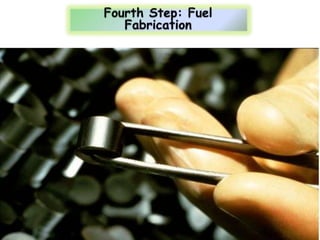
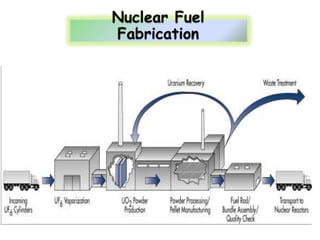
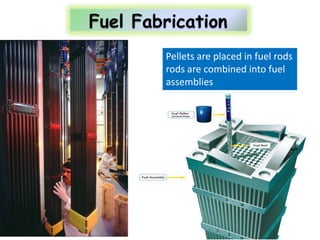
Pellets are placed in fuel rods
rods are combined into fuel
assemblies
Must be secured to prevent non-state
  actors from getting the material
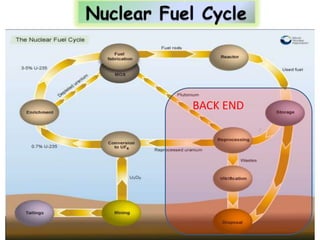
BACK END
1.E+07

            1.E+06

                                                                                                                                  PYRO Product
            1.E+05
                                                                                                                                  NOT IN PYRO
            1.E+04                                                                                                                Pu-Odd
                                                                                                                                  Pu-Even
            1.E+03
  Ci/MTHM


                                                                                                                                  Np-237
                                                                                                                                  Cs-137 + Sr-90
            1.E+02
                                                                                                                                  Fission Products Excluding

            1.E+01                                                                                                                Tc-99 + I-129
                                                                                                                                  TOTAL
            1.E+00                                                                                                                TOTAL LOW
                 1.E-02   1.E-01     1.E+00       1.E+01         1.E+02     1.E+03       1.E+04      1.E+05       1.E+06          Am
            1.E-01

            1.E-02

            1.E-03
                                                   Years After Discharge

: The radioactivity profile of SNF throughout time calculated by the author with ORNL’s Scale6 code system [SCALE6] for a Westinghouse 50 MWd/kg
HM and 4.5% enriched PWR fuel assembly. The dotted line indicates the time when the SNF cooled in reactor cooling ponds are moved to interim
storages such as dry casks. The actinides are generally represented by the thicker lines and thinner lines correspond to the actinides. Notice that
after the fission products (especially Cs-137 and Sr-90) decay the actinides, and Tc-99 and I-129 will start to dominate the profile. Notice also that
the pyroprocessing products will after several decades be at the level of hundreds of Ci and will be below the level that the IAEA considers self-
protective [Kang and von Hippel] since the fission products that would produce a self-protective dose are removed in pyroprocessing (see NOT IN
PYRO label).
Spent Fuel Problem
• Spent fuel remain radioactive for many years
• Very hot needs to be cooled down
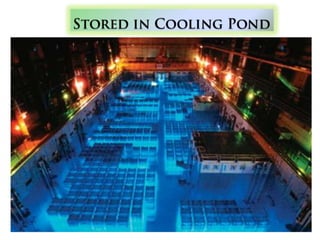
• Cooled in a spent fuel pond for 3-5 yrs
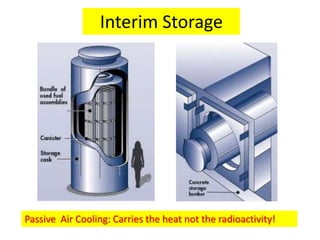
• Further cooling in dry casks
• Future: emplaced in geological repository or
  other measures
• So far no solution while we have 250k MT
  waste
Interim Storage


Passive Air Cooling: Carries the heat not the radioactivity!
• Closed fuel cycle – recycle plutonium produced in
  other fuel
• “Russian policy is to close the fuel cycle as far as
  possible and utilize recycled uranium, and
  eventually also to use plutonium in MOX fuel.
  However, its achievements in doing this have
  been limited - in 2011 only about 16% of used
  fuel was reprocessed.”
  (WNA see: http://goo.gl/Zrtvn)
• The United States does not reprocess fuel
  although does advocate research in this area
• Controversial because of use of plutonium
We need a permanent solution
MODULE 2 , CHAPTER 5


• Fuel cycle is complex
• Open cycle – no reprocessing
• Closed cycle – reprocess
• Vulnerabilities – After enrichment step if cycle
  is closed and plutonium is used
• Nations differ on policy for reprocessing (US
  does not reprocess, Russian Federation does)
• More detail on all of this in the next Module!

Vsf module 2 - aug 11

  • 1.
    MODULE 2 ,CHAPTER 1
  • 2.
    Dose Radioactivity Alpha Decay Isotopes
  • 8.
    But at theend of this module you will know a lot of fundamentals!
  • 9.
  • 10.
    All you needto know is.. 1. Nuclear Physics is about probabilities (interaction). 2. Particle interactions can be understood in terms of simple billiard balls. 3. You have to think like a neutron
  • 11.
    MODULE 2 ,CHAPTER 2
  • 13.
    Dose Radioactivity Alpha Decay Isotopes
  • 15.
    A BLAST FROM THEPAST n P P n T = Tritium D = Deuterium D,T n He-3 Sr-90 I-131 Cs-137 Actinides U-235, U-238, Pu-239, Pu-240
  • 16.
    92 238.029 Chemical Properties U
  • 17.
    Those were thechemical properties
  • 18.
    Those were thechemical properties
  • 19.
  • 20.
    2 Types ofDecay, α and SF
  • 21.
    Final Method ofDecay + + α + + + + + + β+, β- + ++ +++++ + + + +++ + + + + ++ +++++++ + ++ + + + + ++++ + + +++++++++ + + + ++ + + + + ++ + + + + ++++ ++ + + + ++++ + + + + ++ + + ++ + + ++ + + + + + + +
  • 22.
    The probability =1/(7e-11)=1.4e12
  • 23.
    Same probability aswinning the lottery 100 times in a row!
  • 24.
    Final Method ofDecay n n + + + ++ ++ ++ ++ + ++ ++ + + + ++ + + ++ + + ++ ++ + + +++++++ + + +++ ++ ++ + ++ + + + +++ +++ +++ + + ++ + ++ + + + + ++ + + + ++ + + ++ + ++ + + + + ++++ + ++ + n SPONTANEOUS FISSION A VERY RARE FORM OF DECAY FOR URANIUM-235
  • 25.
    FINAL TYPE OFDECAY FISSION ALL FISSILE MATERIALS UNDERGO FISSION “Fission” Used with Permission: Benoît Kloeckner
  • 26.
    Plutonium Uranium Pu-239 U-235 0.711% Pu-240 U-238 99.289% Pu-238 Actinides Minor Actinides = All except U and Pu Transuranium = TRU
  • 27.
    FISSION PROCESS Fissile Material Fission Fission Product Product Spontaneous Fission Induced Fission
  • 29.
    MODULE 2 ,CHAPTER 2 • Actinides fission and some isotopes can sustain a chain reaction • 2 types of fission – spontaneous and induced fission • Can look up isotope characteristics • A sustained chain reaction can be used for peaceful and non-peaceful purposes
  • 30.
    MODULE 2 ,CHAPTER 3
  • 32.
    Uncontrolled Nuclear ChainReaction 10-8 s Fission =10 ns Number = Shake Gen # neutrons 1 20=1 2 31=3 3 32=3x3=9 4 33=3x3x3=27 5 24=16 6 25=32 64 263=9x10¹⁸ 80 279=6x10²³ 81 280=1.2x1024 In U-235 Metal / Pu-239 Metal 82 281=2.4x1024 This happens very fast!
  • 33.
    Energy/Fission 0.94 kg Of U-235 = 200 MeV = 3.2e-11 J 82 generations Knee Bend = 100 J = 2^81 = 2.4x1024 fissions < 1x10⁻⁶ s = 1 millionth of a second UNCONTROLLED Total Energy = (2.4e24 fis)(3.2x10⁻¹¹ J/fis) CHAIN REACTION = 7.68e13 J = 18.3,000 t of TNT! = 18.3 kT TNT = 1.2 X Little Boy Bomb!
  • 34.
    Fissile Materials: Cansustain an explosive fission chain reaction – notably plutonium of almost any isotopic composition and highly-enriched uranium (Def’n, IPFM). Neutrons U-235 Density HIGH Mouse Trap Unclamping FAST Simulates fission U-235 35
  • 35.
    Uncontrolled Reaction http://www.youtube.com/watch?v=Pmy5fivI_4U 36
  • 36.
    Types of Neutron Interactions Gamma (γ) INELASTIC SCATT INELASTIC SCATT (n,3n) (n,2n) neutrons neutrons FISSION ELASTIC ESCAPE SCATTERING (NO INTERACTION) 37
  • 37.
    Critical Mass=Sustain Chain Reaction GUN TYPE WEAPON SELF SUSTAINING = CRITICAL MASS ESCAPE ABSORBED FISSIONS STOPS AFTER SECOND FISSIONS SELF WITH REFLECTOR GENERATION SUSTAINING (CONFINING) INCREASING FISSILE MATERIAL MASS Prevent neutrons from escaping is the goal! 38 Figure: Courtesy Wikipedia
  • 38.
    Crowded Room Analogy:2 Ways to Sustain a Chain REACHING CM BY Reaction INCREASING SIZE OF ROOM INCREASING DENSITY Fissile Material Neutron IMPLOSION WEAPON GOAL: INCREASE Bring nuclei PROBABILITY OF closer together GUN-TYPE WEAPON FISSION TO OCCUR
  • 39.
  • 40.
    Theodore Taylor (1925-2004) 1 Significant Quantity =25 kg U-235 HEU HEU= >20% U-235 See comment: http://goo.gl/b04i0 “Amounts of U-235 as small as 1 kg are significant quantities. He did not state that anyone can build a bomb with 1 kg of U-235, but did suggest that this is roughly the amount that good designer would need” Consistent with 82 gen’ns NRC 2004 Testimony, “Nuclear Arms Race”, Craig & Jungerman
  • 41.
    Because of thehigh density of uranium metal a SQ will occupy a small volume!
  • 42.
    1) Prevent neutronsfrom escaping 2) Increase the probability of fissions 3) Prevent neutron absorption GUN TYPE BOMB Two pieces of subcritical HEU brought together for an instant! RECALL: Crowded room analogy make the room bigger so the probability of fission increases before neutrons escape!
  • 43.
    With modern weapons-gradeuranium, the background neutron rate is so low that terrorists, if they had such material, would have a good chance of setting off a high- yield explosion simply by dropping one half of the material onto the other half.Most people seem unaware that if separate HEU is at hand it's a trivial job to set off a nuclear explosion . . . even a high school kid could make a bomb in short order. Luis Alvarez, Adventures of a Physicist (Basic Books, 1987), p. 125.
  • 44.
    • Not verysafe – 2 pieces that are subcritical but if inadvertently combined could cause an explosion. • Must keep away from moderators • Not very efficient – not very high yield • Weapon of choice for non-state actors (terrorists) • Barrier is getting the HEU in the first place!
  • 45.
    • Uranium ismined but is only 0.711% U-235 and 99.289% U-238. • Need to remove the U-238 to increase the proportion of U-235 to U-238. • Start with 7 U-235 and 993 U-238 marbles
  • 46.
    Start with 7 U-235 and 993 U-238 marbles • To get to 5% HEU it means that 7/140=0.05 • I have to go from 993 to 133! • I need to pull out 860 U-238 marbles! • A large part of the work is done to get from 0.711% to 5% HEU!
  • 47.
    • 7 U-235/133 U-238 = 5% • How do I increase to 90%? • 90% ~ 7 U-235/ (7 U-235 + 1 U-238) • I go from 133 to 1! Need to subtract 132 more which is a big improvement from 853! • BOTTOM LINE: Enriching from 0.711% to 5% is a large part of the work.
  • 48.
    It has todo with “pre-detonation” or triggering the bomb to explode before the optimum conditions have been Established. Nuclide SF /kg per Neutrons/fiss CM (kg) SF/CM 100 μsec ion per 100 μsec U-235 5.627e-7 2.637 45 0.0000 25 U-238 6.776e-4 2.1 Pu-239 6.916e-4 3.172 17 0.0011 Pu-240 48.33 2.257 822 99 % Pu-239 + 1% Pu-240 8 BOTTOM LINE: Gun Type Will Not Work for Plutonium!
  • 50.
    1) Prevent neutronsfrom escaping 2) Increase probability of fissions 3) Prevent neutron absorption IMPLOSION TYPE BOMB Done with explosive Lenses causing implosion RECALL: Crowded room analogy Increase the density of nuclei so the probability of fission increases before neutrons escape!
  • 51.
    For Plutonium need to use implosion technique! Increase Density! 2 3 6 HEU or Pu is 4 1 7 5 compressed to Critical Mass (bring atoms Closer together)
  • 52.
    Think about Compressing a Waterballoon Between your fingers! Not easy!
  • 53.
    We can getHEU by enriching natural U what about Pu?
  • 54.
    Pu Production inReactors U-238 For Gun Type Bomb U-235 For Implosion n + U-238  U-239  Np-239 Pu-239 Type Bomb 24 min 2.4 days Fissile Material Fertile Material (can sustain chain rxn) (can’t sustain chain rxn but can become fertile) U-238 U-235 Pu-239 is Produced
  • 55.
    • Fissionable =Nuclide undergoes fission after neutron capture • Fissile = Nuclide can sustain a chain reaction (U-235, Pu-239) • Fertile = Nuclide can become fissile after irradiation in a reactor (ex: U- 238)
  • 56.
    Trick: Pu-239 Absorptionof neutron Pu-239 94 p 145 n + = Pu-240 94 p 146 n HIGH To produce WG Pu SF RATE need to remove Pu fuel (not good for (generally U fuel is 1% Pu) NW’s) WG = <7% Pu-240 so that SF rate is relatively low!
  • 57.
    Plutonium Production inNuclear Reactors Plutonium is produced in Nuclear Reactors whereas uranium is found in nature Neutron activation on Pu-239 produces Pu-240 (bad for NW) % Pu-239/Pu-240
  • 58.
    A Policy AnalystsRule of Thumb 1 megawatt-day of operation produces ~ 0.9 gram of plutonium in any reactor using 20-percent or lower enriched uranium Power = 2650 MW Mass Pu-239 = 0.9*2650MW *45 days /1000 g/kg = 106 kg not quite 80 kg
  • 59.
    EXAMPLE • A companyis making a proposal to sell one turn-key LWR’s (2700 MW) to Burma. You are the one responsible for deciding whether a reactor project should proceed from the point of view of proliferation of the nuclear technology to that country. The official in a condescending way claimed that this particular reactor will in one month not produce any Plutonium so that there are absolutely “no risks or worries that should concern you”. What would you say (in a polite way) in response to the official about how much Pu is produced in this reactor/month in terms of SQ? • 1kg = 1000 g, And the rule of thumb is: 1 megawatt-day of operation produces ~ 1 gram of plutonium in any reactor using 20-percent or lower enriched uranium 60
  • 60.
    Answer: • Since therule of thumb is 1 g produced per MW days then in 30 days the reactor produces 2700 MW * 30 days =80,000 MW days • Applying the rule of thumb = 80,000 MW days = 80,000* MW days * (1 g Pu/MW days) =80,000 g Pu and 1 kg = 1000 g =80,000 g Pu * (1 kg / 1000 g) • =80 kg Pu • In terms of SQ this is 10 SQ which is enough roughly for 10 bombs! “Excuse me but your assertion that a 2700 MW reactor will produce only 100 g Pu/month is simply not correct. In fact, if you go through the calculation which I just did while you were talking, you will find that the reactor you propose produces 10 IAEA Significant Quantities per month!” (And the whole room will be silent because they will be impressed at your knowledge) 61
  • 61.
    QUESTION: In thesatellite pictures below why is the lack of steam significant?
  • 62.
    “I remembered theline from the Hindu scripture, the Bhagavad-Gita: Vishnu is trying to persuade the Prince that he should do his duty and to impress him he takes on his multi-armed form and says, “Now I am become death, the destroyer of worlds” I suppose we all thought that, one way or another” R. Oppenheimer, pg 676, R. Rhoades, “The Making of the Atomic Bomb” On the Trinity Shot : first test of an atomic weapon.
  • 63.
    MODULE 2 ,CHAPTER 3 Material Advantage Disadvantag e U (HEU) Testing not Difficult to Necessary get HEU Pu Easy to Testing Produce Necessary
  • 64.
    MODULE 2 ,CHAPTER 4
  • 66.
    Power Reactors: NW: HEU,Pu LEU Large Amount of Energy Large Amount of Energy Slow, Controlled Release of Energy FAST , Uncontrolled Release of Energy
  • 68.
    Energy is expended Slowlyover the period of many months.
  • 69.
    Now the Details! HowDo You Get A Self-Sustaining Reaction : An Analogy
  • 70.
    You have tothink like a neutron
  • 71.
    Nuclide U-235 U-238 Neutron Pu-239 Pu-240
  • 72.
    • Neutron movingslow will easily fission U-235 but not U-238 • Neutron moving fast will easily fission U-238 but also U-235 • Neutron are produced through fission at high energy • It is almost as if the neutron at low energy is completely different from a neutron travelling at high energies
  • 73.
    • Like peoplemeeting.. • When neutron encounters an isotope, it must make a decision how it interacts when it meets 1) Fission 2) Bounce off 3) Be absorbed (give off a gamma) 4) Not interact at all Probabilities described by Size of the target (cross-section)
  • 74.
    U-238 Neutron (Very small target neutron will miss) U-235 Neutron (Large target neutron will hit)
  • 75.
    • Neutrons canalso do other things besides fission (bounce off, be absorbed, not interact) • It all has to do with the size of the target which changes for different neutron energies • You have to think like a neutron
  • 76.
    • Graph of‘Energy’ or speed of the Neutron vs ‘Cross-section’ or probability of interaction or size of the target CROSS-SECTION PROBABILITY NEUTRON SPEED OR ENERGY
  • 77.
    Target size ofU-235 1000X bigger than at 1 MeV Energy Region of neutrons produced by FISSION Size of the target For U-238 Energy Region of neutrons slowed down Thermal Neutrons
  • 79.
    Gamma Ray MeV Incoming Neutron 2-3 Neutrons Fission free to fission U-235 Slow Neutron (Thermal) MeV Incoming Neutron Gamma U-238 Ray Tend to absorb No Fission Not fission! Radiative Capture
  • 80.
    Self-Sustaining Chain Reaction 90%U-238, 10% U-235: NOT SELF SUSTAINING Gamma Particle Absorbed!  Not enough U-235 Around to continue process Fission! Absorbed!   Gamma Particle
  • 81.
    INCREASE U-235 (Red!) Will Fission!  50% U-238, 50% U-235 : PROBABLY SELF SUSTAINING Will Fission!  Fission!  Enough U-235 around to continue process Fission!  Will Absorb! 
  • 82.
    Natural Uranium =0.711 % U-235! Need to get to 50% Need to enrich $
  • 83.
    Neutrons from fission(MeV) Appear to require 50% U-235 and 50% U-238 – this is expensive! THE TRICK: Slow the neutrons down! Moderate them!
  • 84.
    Essentially turn Into From a Neutron point of view (Neutron is travelling slowly and feels the attraction of the neutron for a longer time)
  • 86.
    • Possible tohave self-sustaining chain reaction by using a moderator.
  • 87.
    Need less U-235because they appear bigger for Slow/thermal neutrons Instead of 50% U-235 with trick can use 3-5% U-235
  • 88.
    U-235 atoms havea higher fission interaction probability than U-238 capture Need only 3-5% to Start a sustained Chain Reaction
  • 89.
    Go from here to here In a few bounces Moderation TRICK! FISSION ENERGIES
  • 90.
    FUEL (assembly/rods) 3% 3% 3% LEU LEU LEU UOxide UOxide UOxide Nuclear Reactor has Fissile Material (LEU) just below a Critical Mass (Controlled Chain Reaction) Fission Energy =Heat Produced! Moderator: Slows down neutrons This is the TRICK! so fission with U-235 can occur
  • 91.
    Moderator Characteristic Water (H2O) Good moderator but can also capture neutrons. Can use 3-5% U-235. Most reactors around the world use H2O as moderator Heavy Water (D2O) Excellent moderator. Low probability of neutron capture. Can start with natural (0.7%) uranium. Carbon (Graphite) Not a great moderator (mass A is high) but very small capture probability. Can use natural (0.7%) uranium as long as very pure and no neutrons present.
  • 92.
  • 95.
    • Isotopes thatabsorb neutrons. Why would it be useful? Gamma Incoming Neutron Gd-155 Ray No Fission Looks HUGE for incoming Radiative Capture neutron!
  • 96.
    Contain Gd rather than UOx Dropped in by gravity
  • 97.
    Pressurized Water PowerReactor (PWR) So far we have concentrated on the core 98
  • 98.
    Pressurized Water PowerReactor OR NOT! 99
  • 99.
    What is this? Isit dangerous?
  • 100.
  • 101.
  • 102.
    Partial Batch Refueling A = Removed after 1 cycle B A C B= Removed after 2 cycles C= Removed after 3 cycles Neutron Flux Less at Outside LIKE A BARBECUE!
  • 105.
    Look it upat Wolfram Alpha: Type the iso
  • 107.
    MODULE 2 ,CHAPTER 4 • Basics of how a nuclear reactor works at the core level • The trick was Think like a neutron • Moderators and the moderation trick • Neutron poisons and control rods • Nuclear fuel • Fission products
  • 108.
    MODULE 2 ,CHAPTER 5
  • 110.
  • 111.
    •Open pit mining •UndergroundMining •In Situ Leaching •Sea Water Recovery
  • 112.
    Excavated uranium ore milled(crushed) processed into yellow cake
  • 113.
    Excavated uranium ore milled(crushed) processed into yellow cake
  • 115.
    Removal of 500 tYellowcake from Iraq (2008) Natural U contains 99% U-238 which is not very radioactive You could not make a dirty bomb out of natural uranium
  • 116.
    HF+fluorine gas mixedwith yellowcake produces UF6 crystals (at room temperature it is a solid) At this point: Proliferation Risk
  • 117.
    3-5% for LWR 85-95% for Weapon Utilizing 1% mass difference between isotopes to separate them Remove U-238 until desired ratio U-235/U-238 is reached (93% is WG)
  • 118.
     Gas is“spun” in a supersonic centrifuge, forcing lighter U-235 to the top, where it can be “scooped off”  This demands high strength materials and precision engineering.  To reach speeds of 100,000 rpm, centrifuges need:  Light, strong rotors  Well-balanced rotors  High-speed bearings (usually magnetic) to reduce friction
  • 119.
    Separation < 1kg SWU/yr Separation much better 300kg SWU/yr
  • 123.
    Pellets are placedin fuel rods rods are combined into fuel assemblies
  • 124.
    Must be securedto prevent non-state actors from getting the material
  • 125.
  • 126.
    1.E+07 1.E+06 PYRO Product 1.E+05 NOT IN PYRO 1.E+04 Pu-Odd Pu-Even 1.E+03 Ci/MTHM Np-237 Cs-137 + Sr-90 1.E+02 Fission Products Excluding 1.E+01 Tc-99 + I-129 TOTAL 1.E+00 TOTAL LOW 1.E-02 1.E-01 1.E+00 1.E+01 1.E+02 1.E+03 1.E+04 1.E+05 1.E+06 Am 1.E-01 1.E-02 1.E-03 Years After Discharge : The radioactivity profile of SNF throughout time calculated by the author with ORNL’s Scale6 code system [SCALE6] for a Westinghouse 50 MWd/kg HM and 4.5% enriched PWR fuel assembly. The dotted line indicates the time when the SNF cooled in reactor cooling ponds are moved to interim storages such as dry casks. The actinides are generally represented by the thicker lines and thinner lines correspond to the actinides. Notice that after the fission products (especially Cs-137 and Sr-90) decay the actinides, and Tc-99 and I-129 will start to dominate the profile. Notice also that the pyroprocessing products will after several decades be at the level of hundreds of Ci and will be below the level that the IAEA considers self- protective [Kang and von Hippel] since the fission products that would produce a self-protective dose are removed in pyroprocessing (see NOT IN PYRO label).
  • 127.
    Spent Fuel Problem •Spent fuel remain radioactive for many years • Very hot needs to be cooled down • Cooled in a spent fuel pond for 3-5 yrs • Further cooling in dry casks • Future: emplaced in geological repository or other measures • So far no solution while we have 250k MT waste
  • 129.
    Interim Storage Passive AirCooling: Carries the heat not the radioactivity!
  • 130.
    • Closed fuelcycle – recycle plutonium produced in other fuel • “Russian policy is to close the fuel cycle as far as possible and utilize recycled uranium, and eventually also to use plutonium in MOX fuel. However, its achievements in doing this have been limited - in 2011 only about 16% of used fuel was reprocessed.” (WNA see: http://goo.gl/Zrtvn) • The United States does not reprocess fuel although does advocate research in this area • Controversial because of use of plutonium
  • 131.
    We need apermanent solution
  • 132.
    MODULE 2 ,CHAPTER 5 • Fuel cycle is complex • Open cycle – no reprocessing • Closed cycle – reprocess • Vulnerabilities – After enrichment step if cycle is closed and plutonium is used • Nations differ on policy for reprocessing (US does not reprocess, Russian Federation does) • More detail on all of this in the next Module!

Editor's Notes

  • #3 Explain fast and slow fission Know how fast and slow fission are appliedDemonstrate critical massDemonstrate power production by nuclear fissionDemonstrate the difference between fission and fusion reactionsRecognize that a mass greater than the critical mass is needed to produce an uncontrollable chain reaction.
  • #14 Explain fast and slow fission Know how fast and slow fission are appliedDemonstrate critical massDemonstrate power production by nuclear fissionDemonstrate the difference between fission and fusion reactionsRecognize that a mass greater than the critical mass is needed to produce an uncontrollable chain reaction.
  • #17 Credits:http://uk.ask.com/wiki/Uranium
  • #25 Wikipedia