PHYLOGENETIC RELATIONSHIPS AND
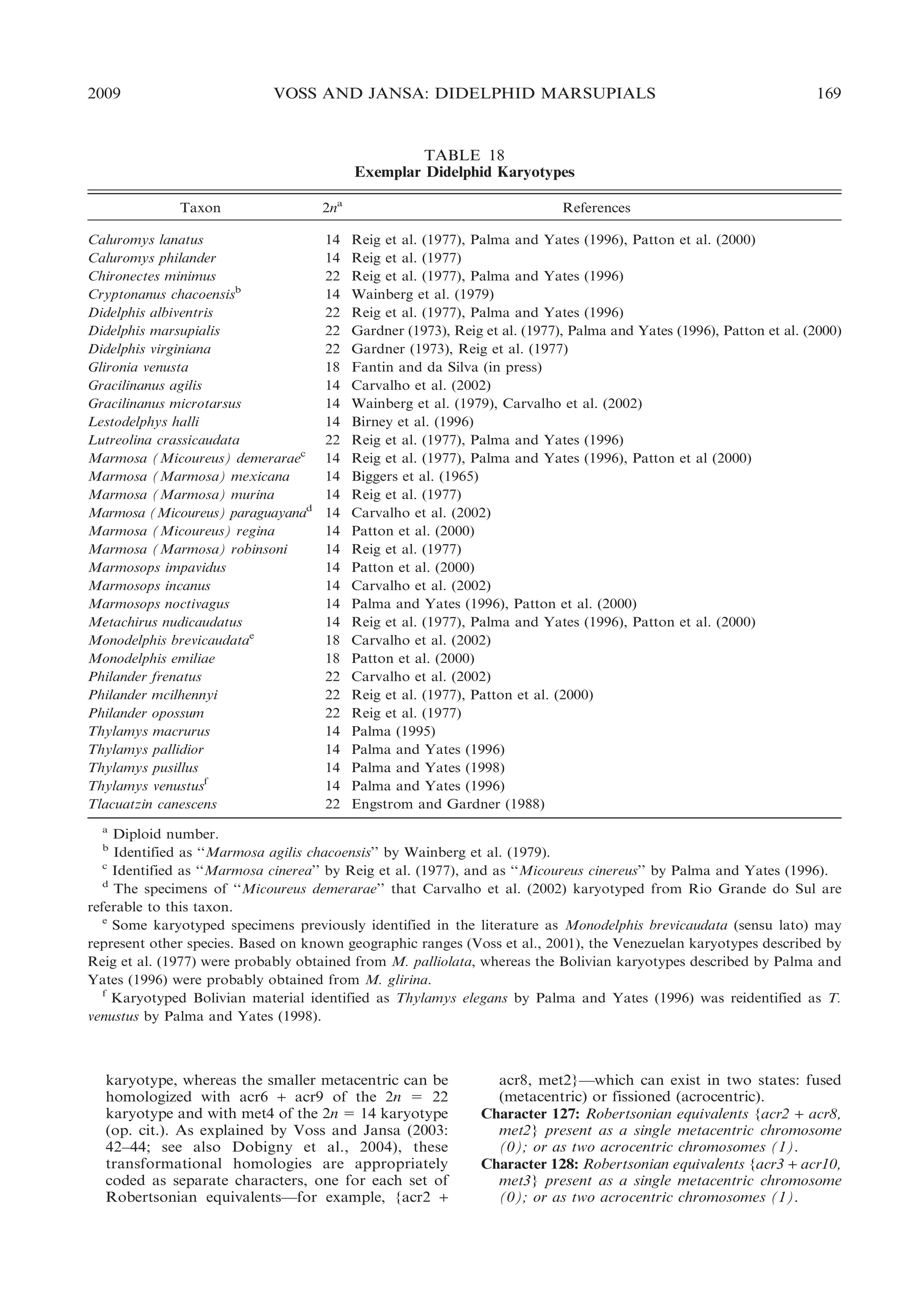
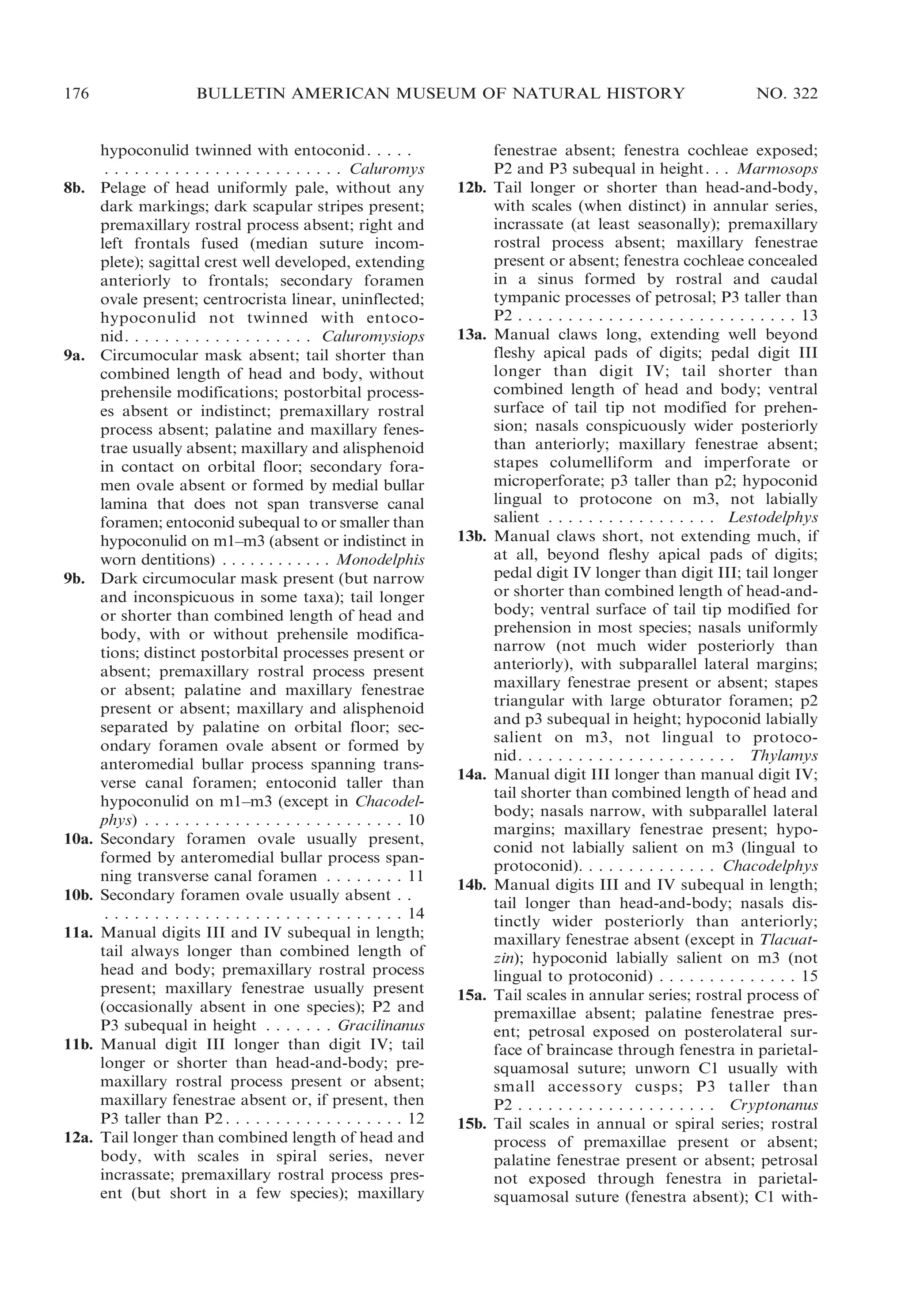
CLASSIFICATION OF DIDELPHID MARSUPIALS,
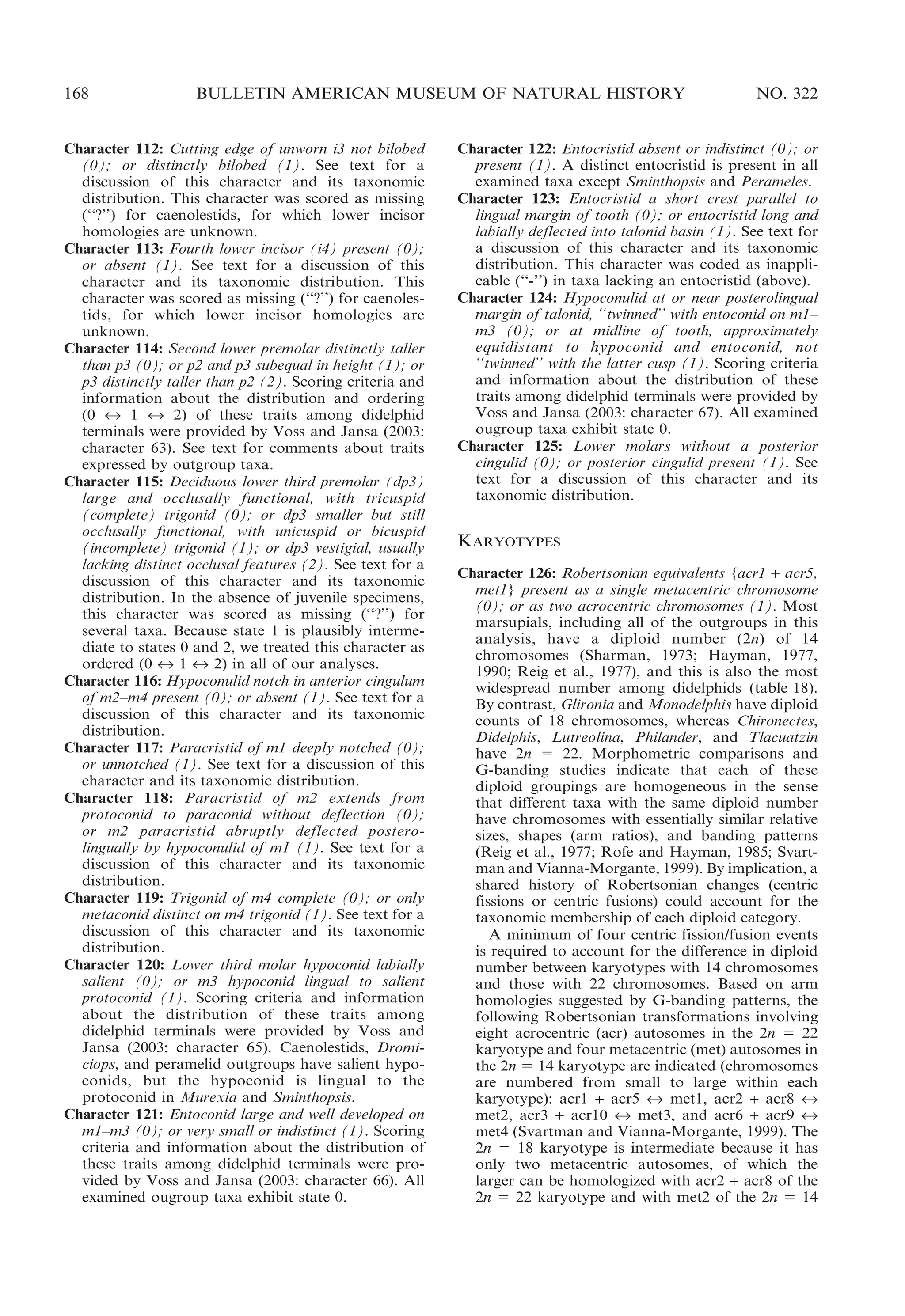
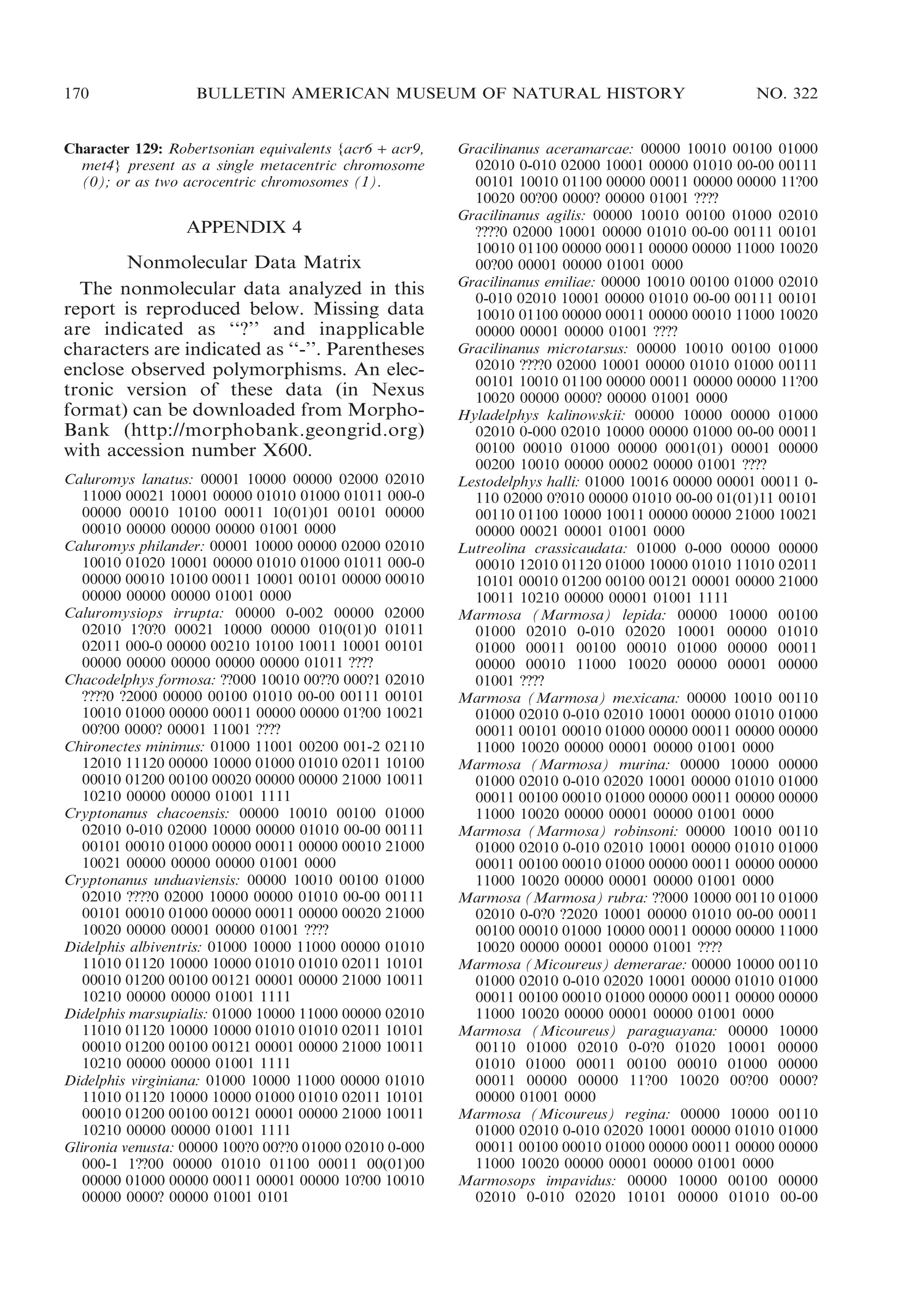
AN EXTANT RADIATION OF NEW WORLD
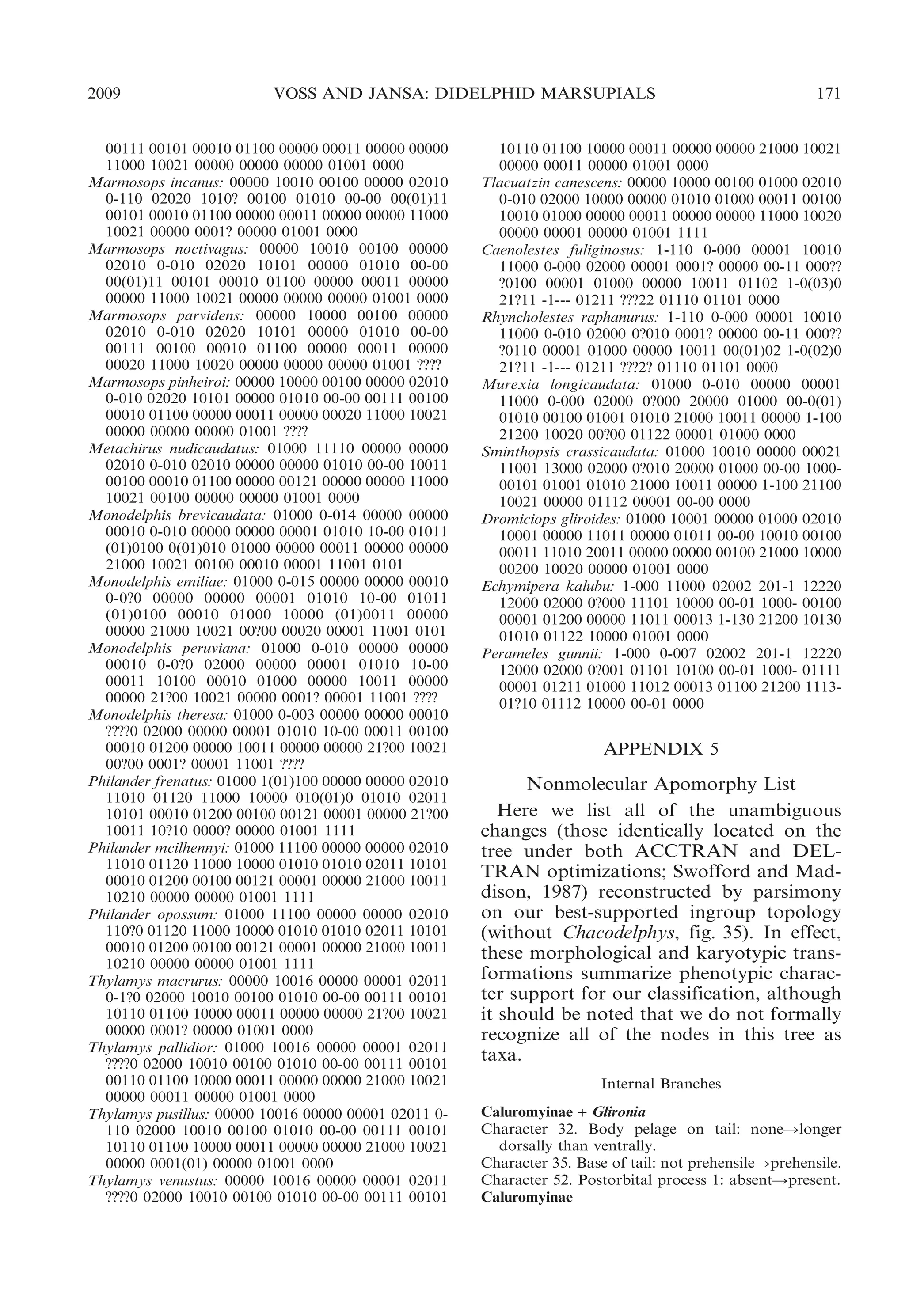
METATHERIAN MAMMALS

ROBERT S. VOSS
Department of Mammalogy
American Museum of Natural History
SHARON A. JANSA
Department of Ecology, Evolution, and Behavior; and
J.F. Bell Museum of Natural History
University of Minnesota

BULLETIN OF THE AMERICAN MUSEUM OF NATURAL HISTORY

Number 322, 177 pp., 54 figures, 18 tables
Issued June 30, 2009

Copyright

E American Museum of Natural History 2009

ISSN 0003-0090
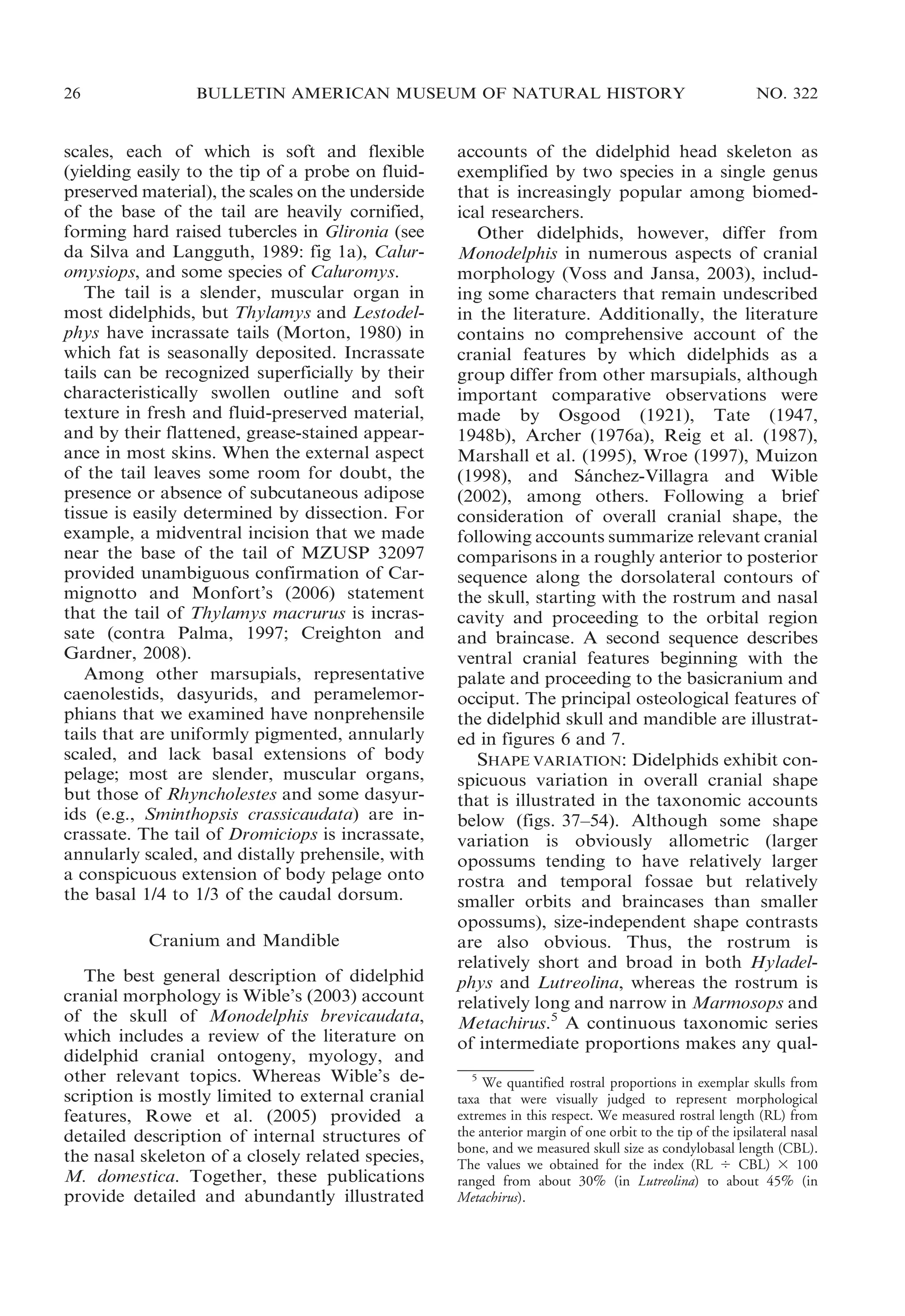
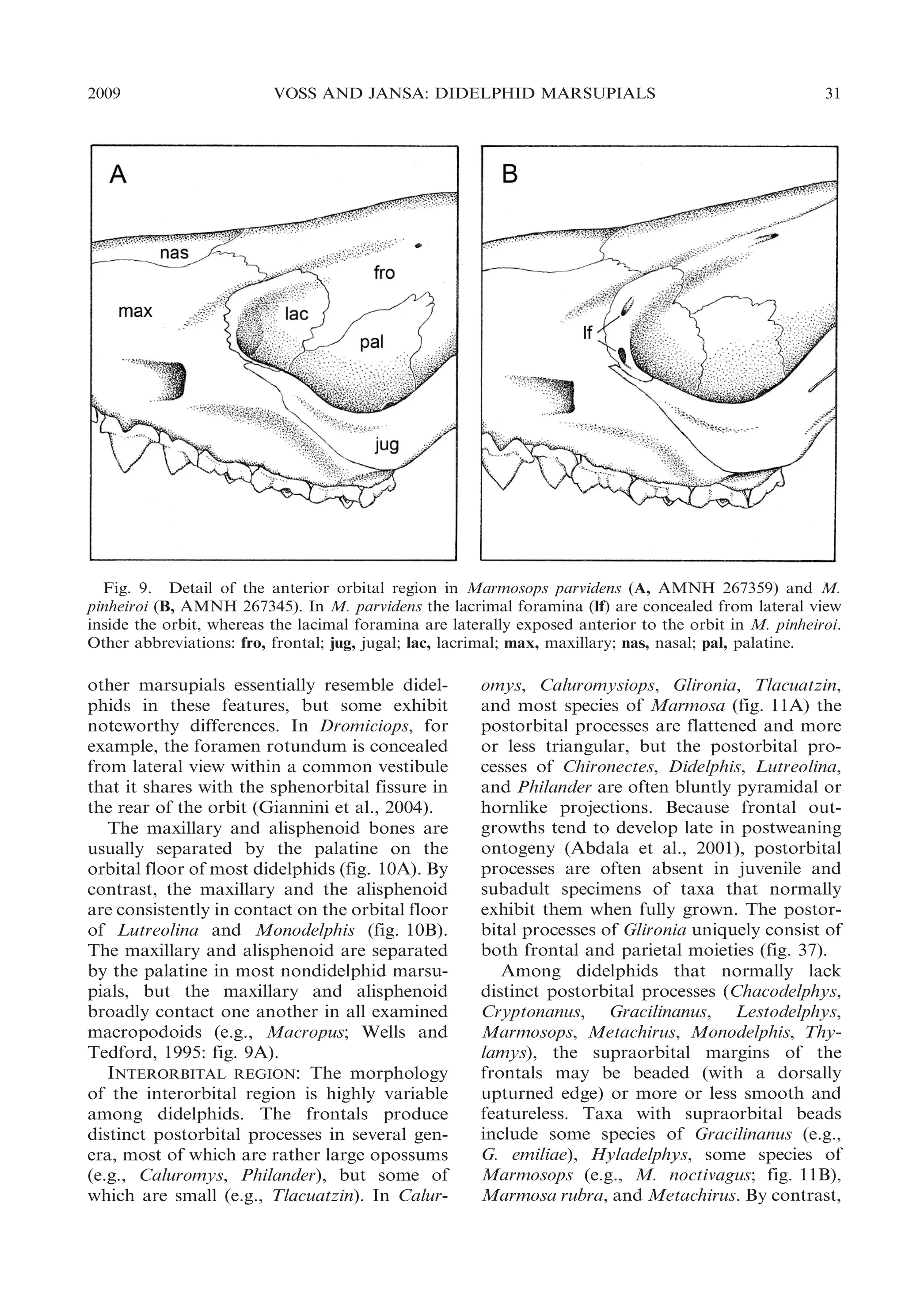
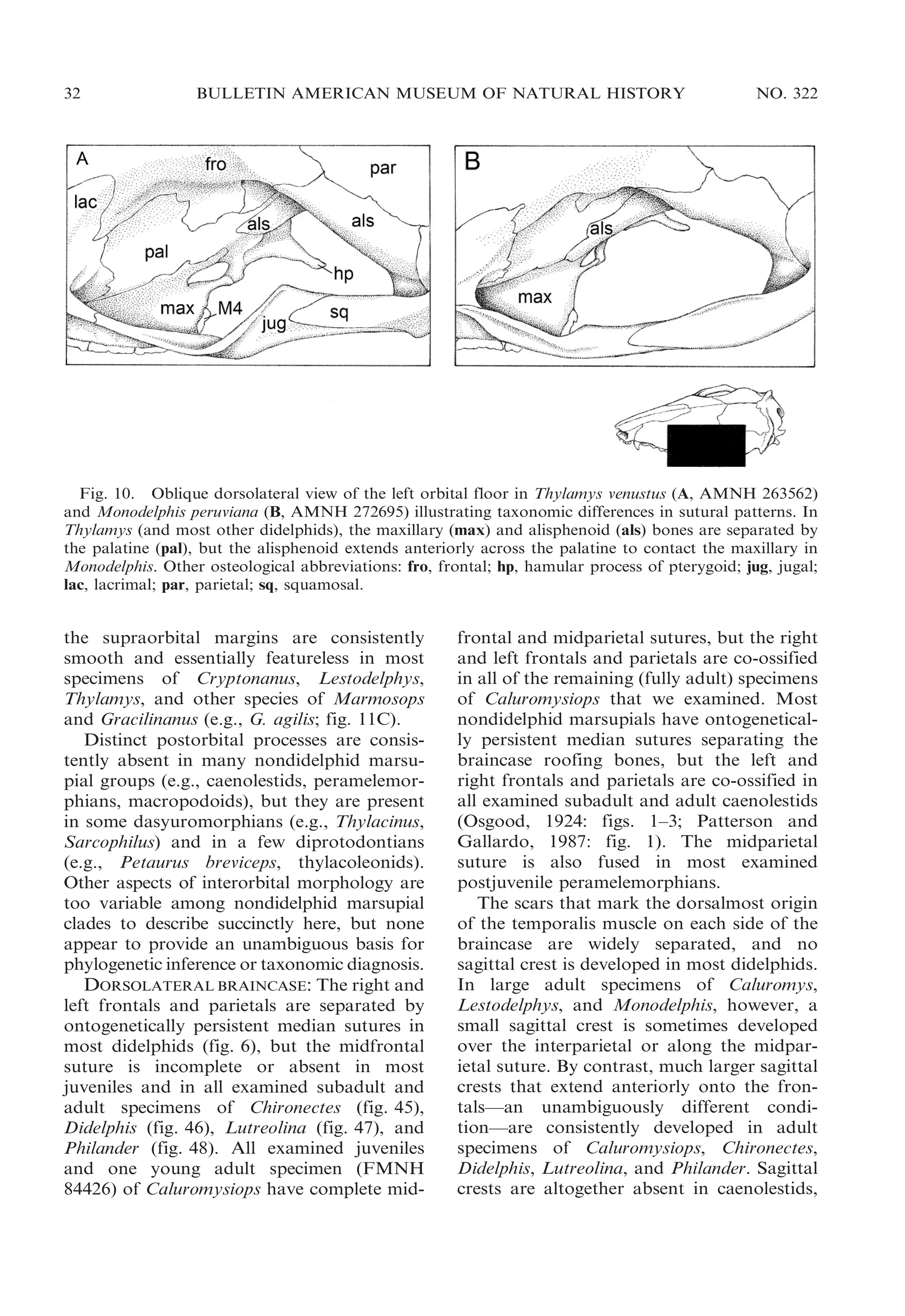
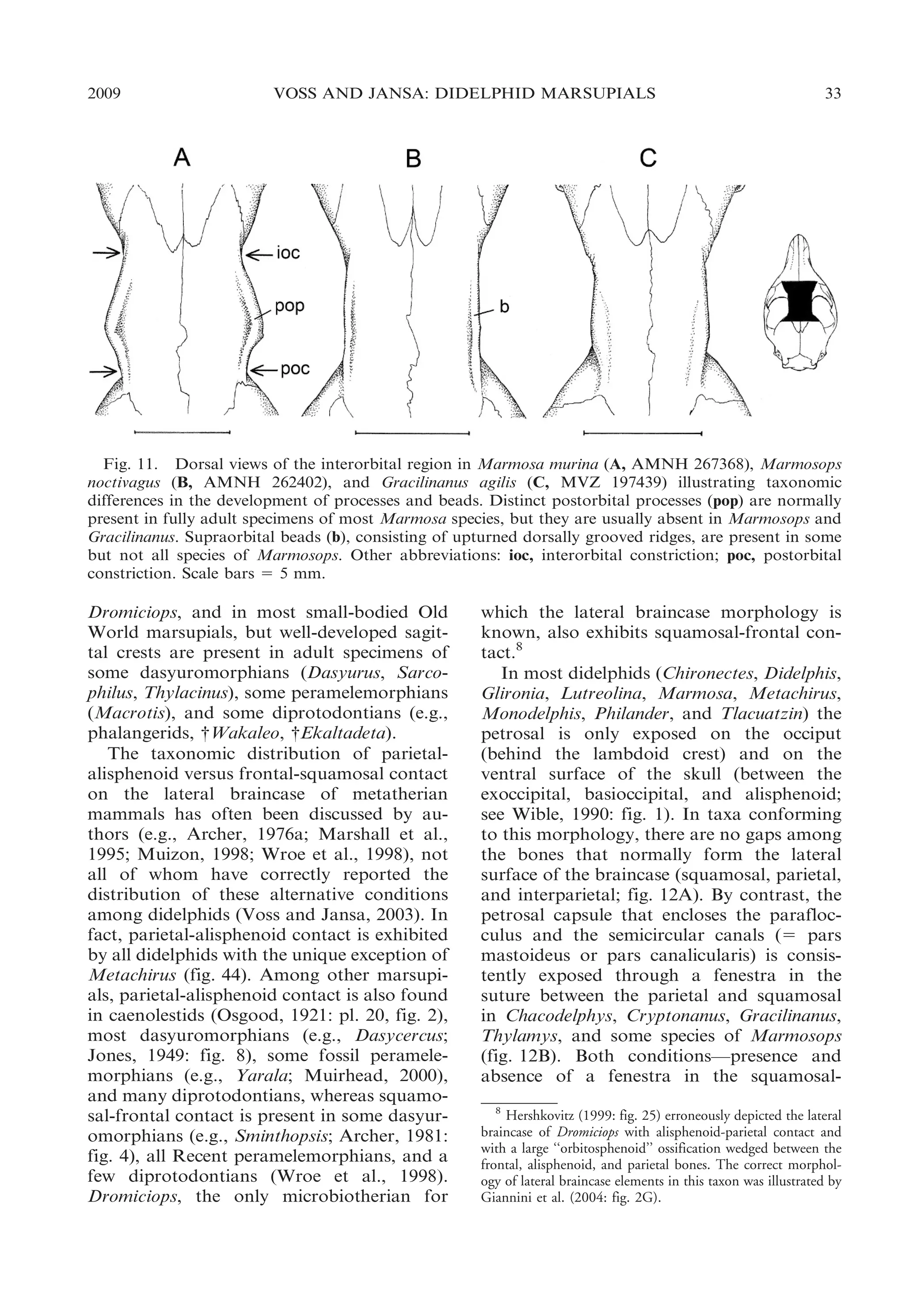
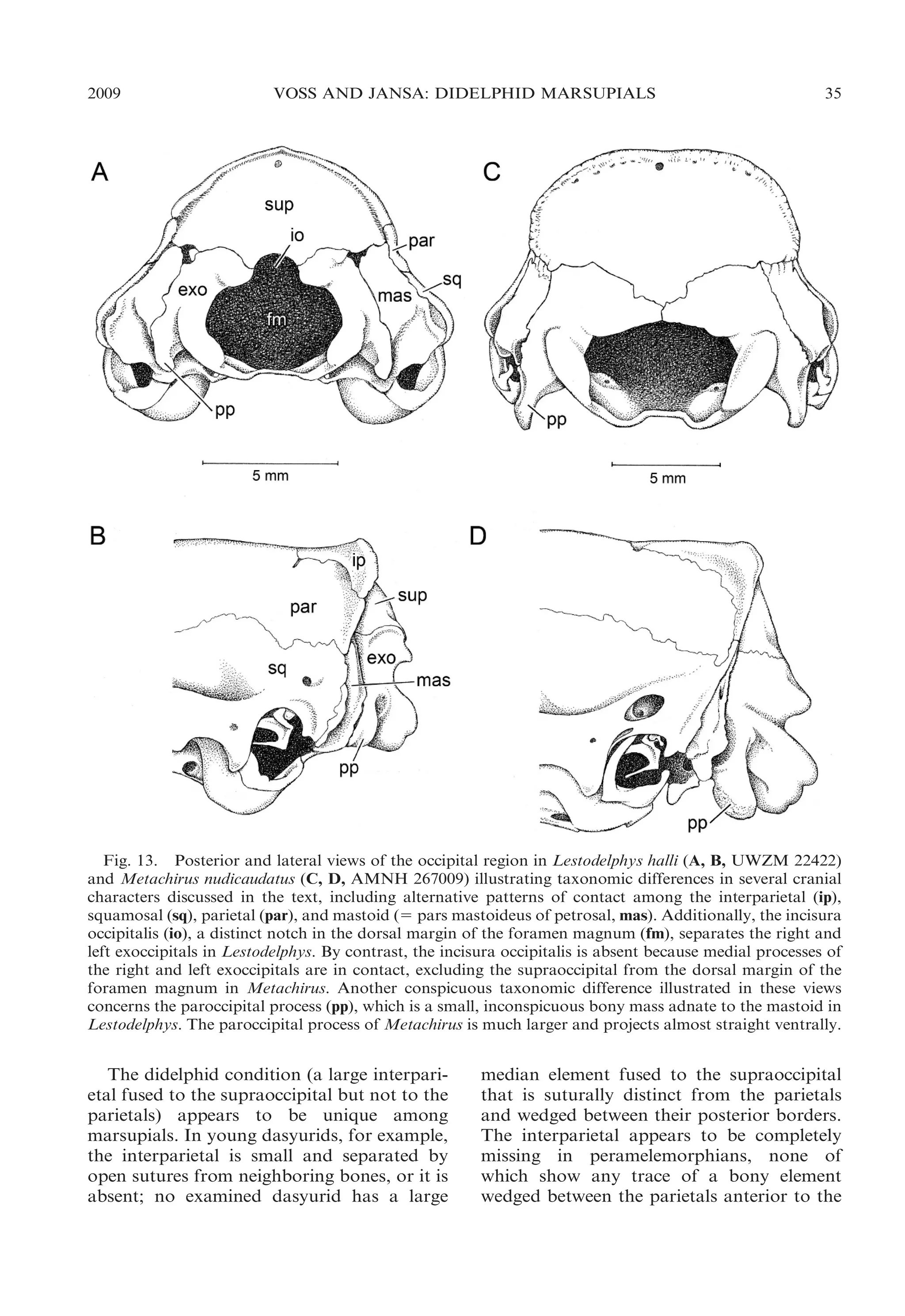
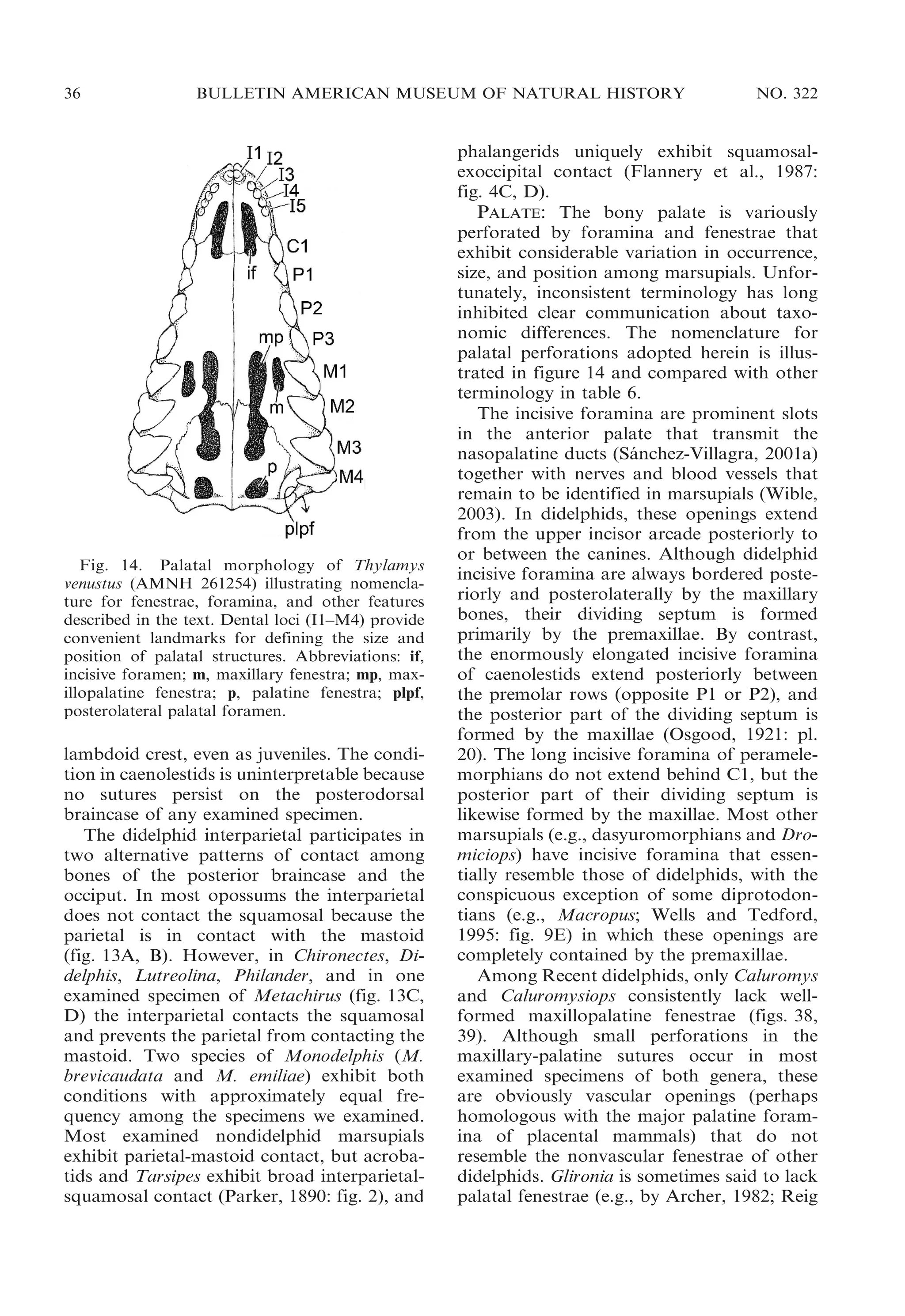
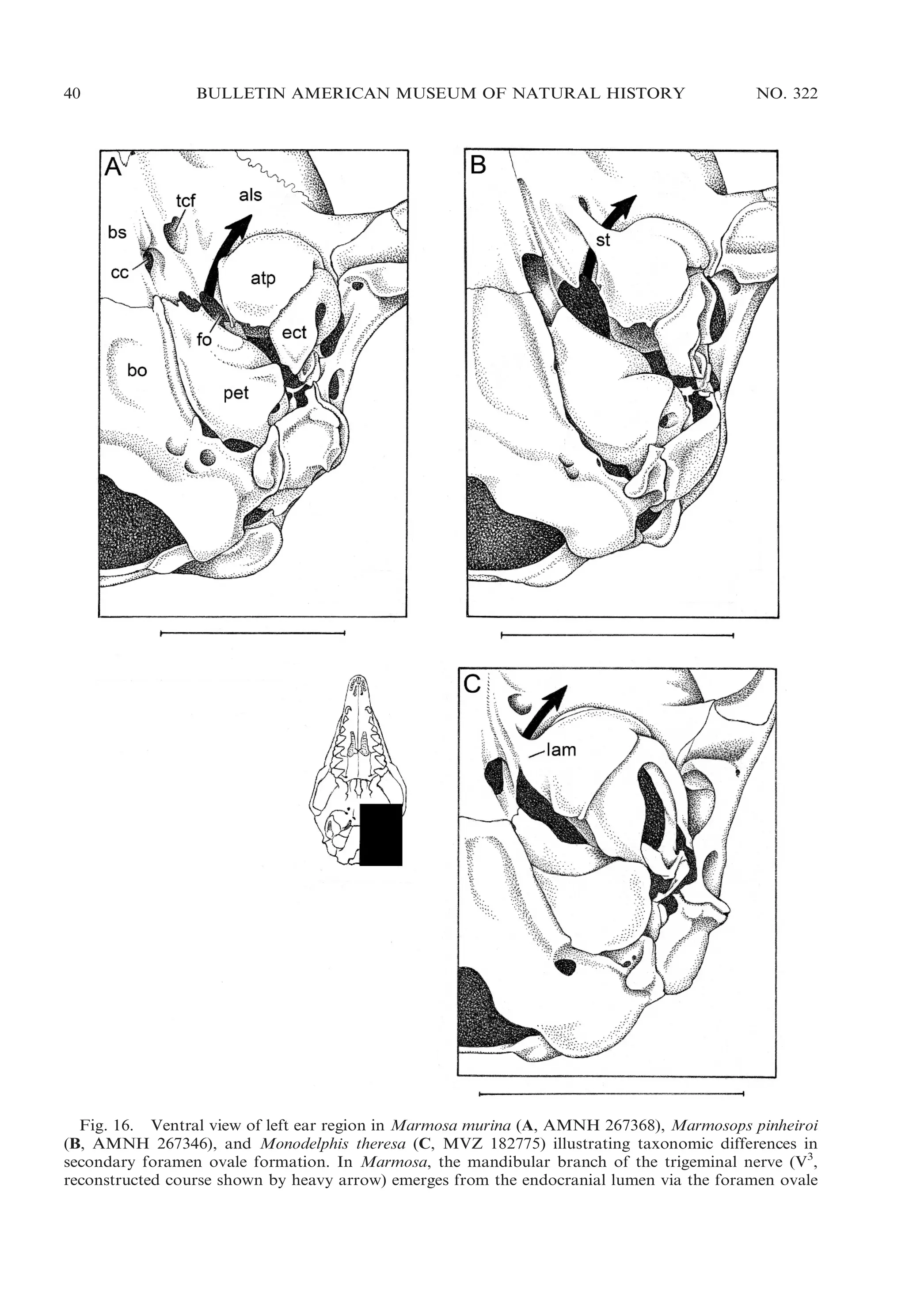
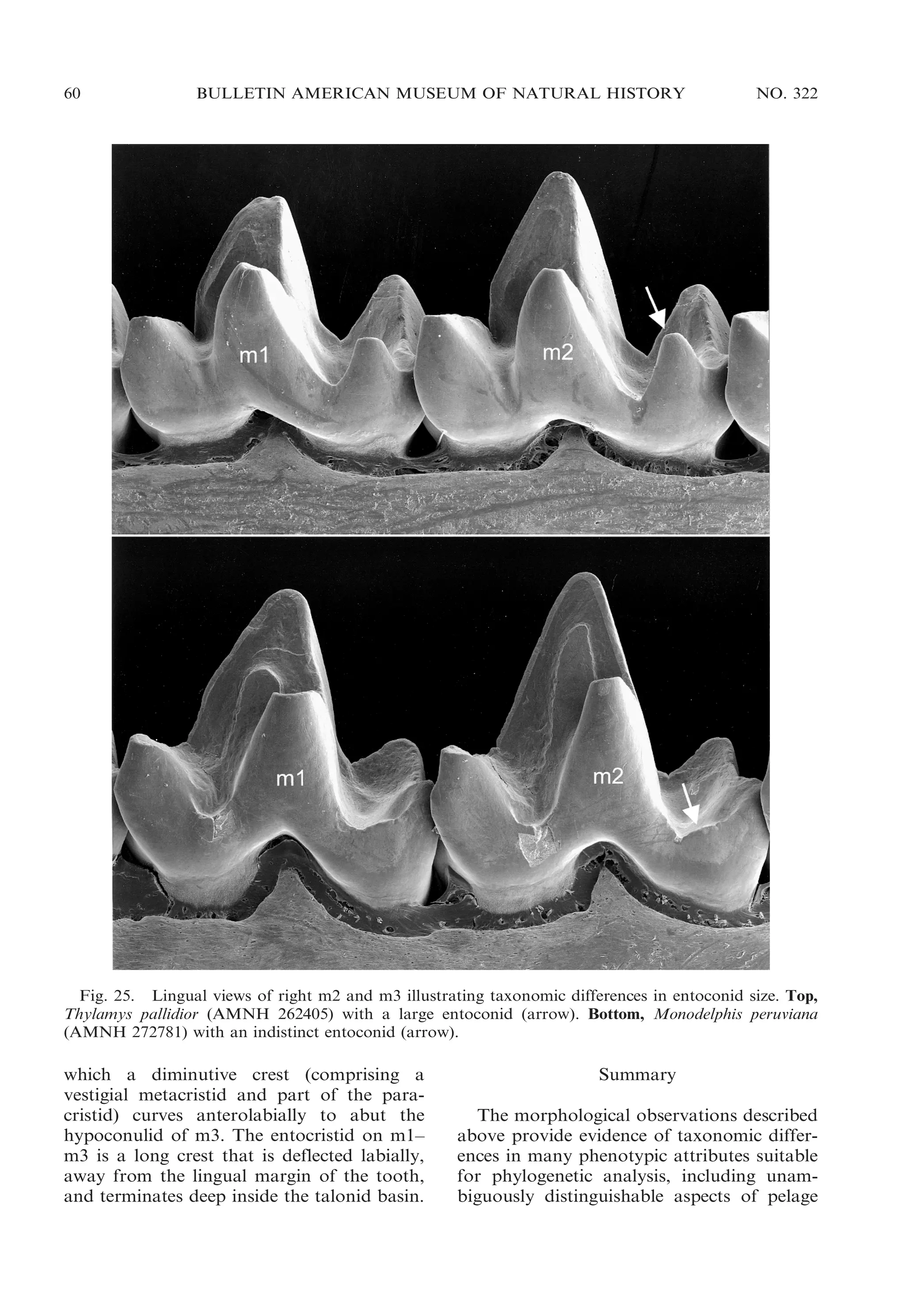
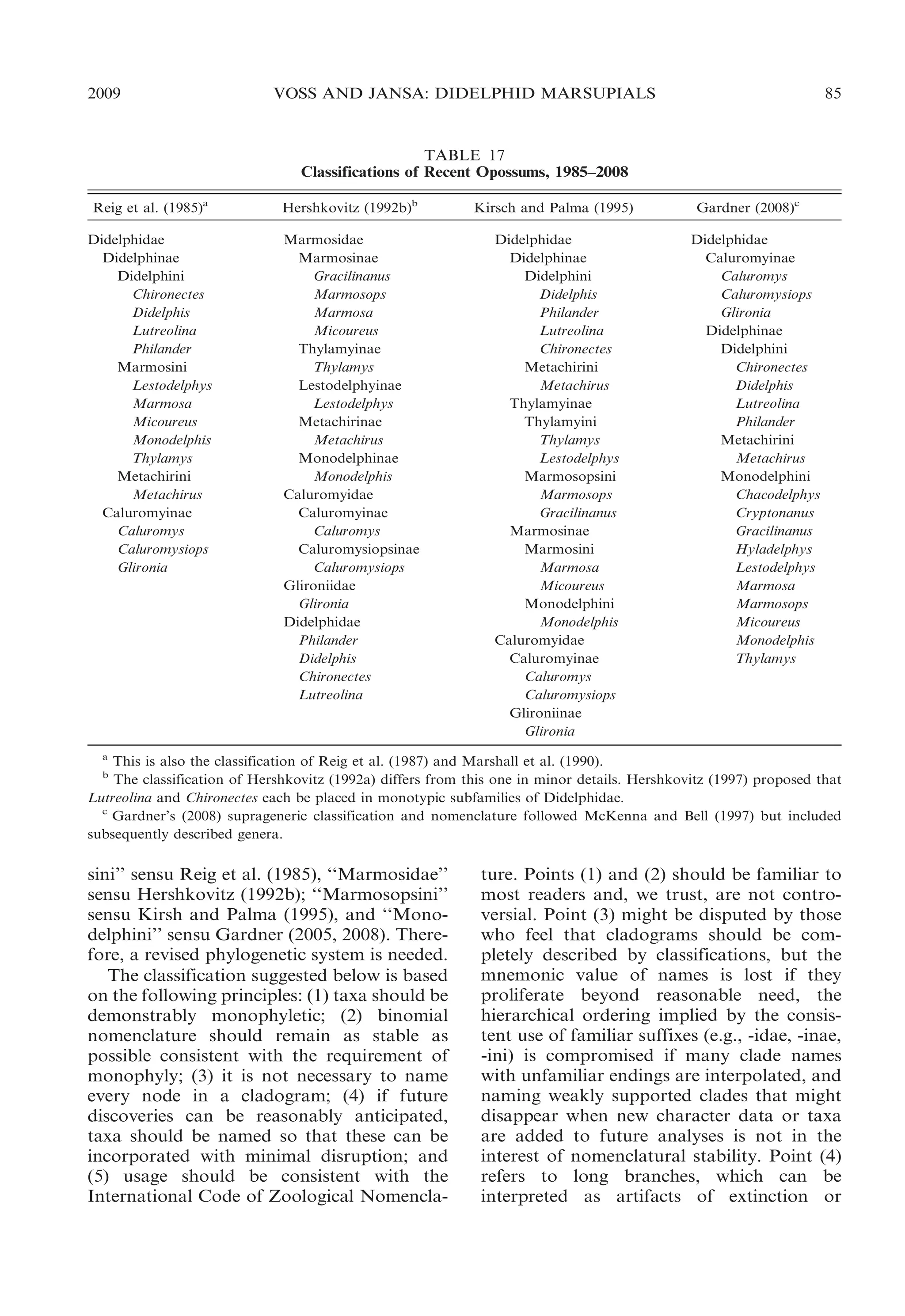
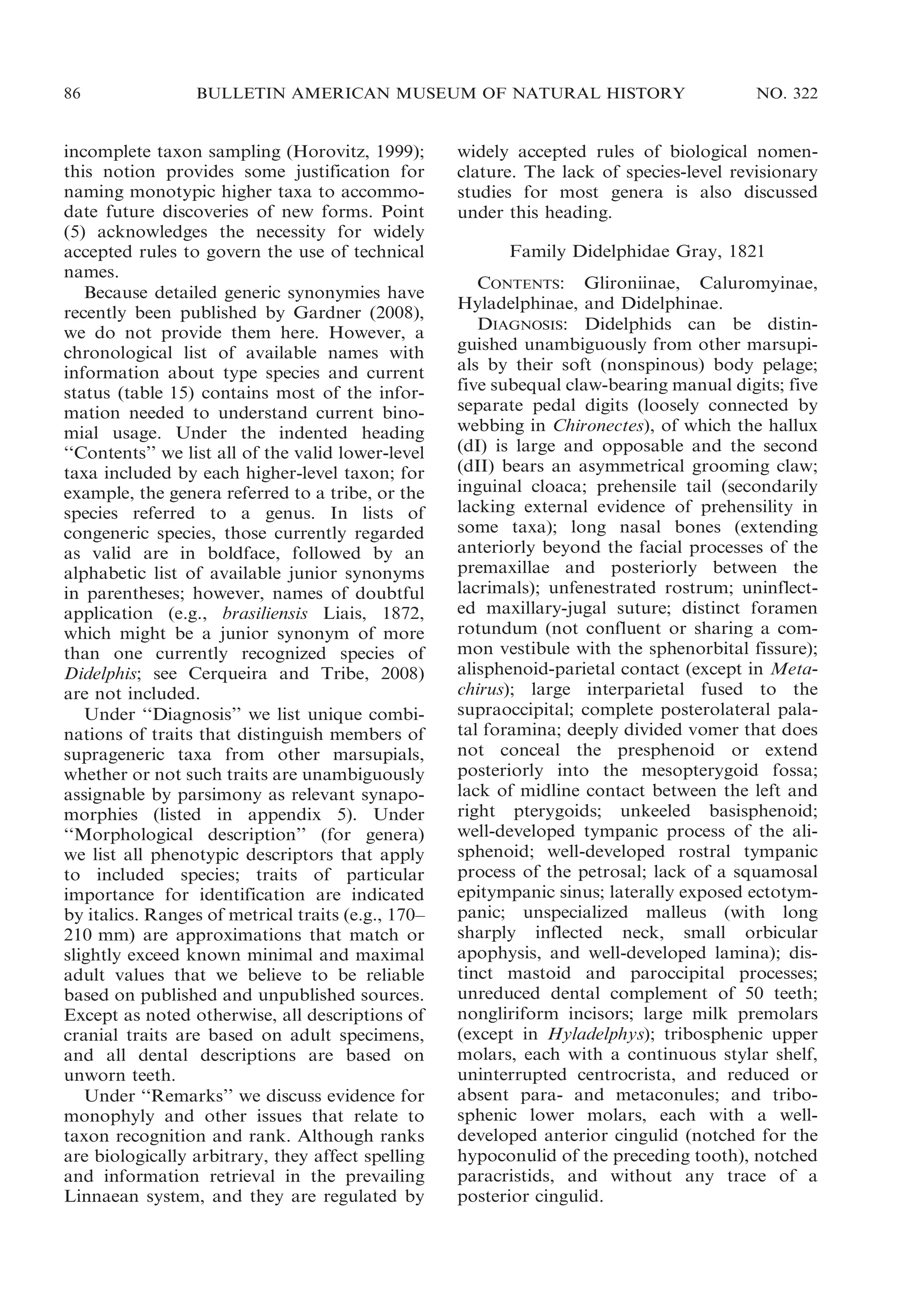
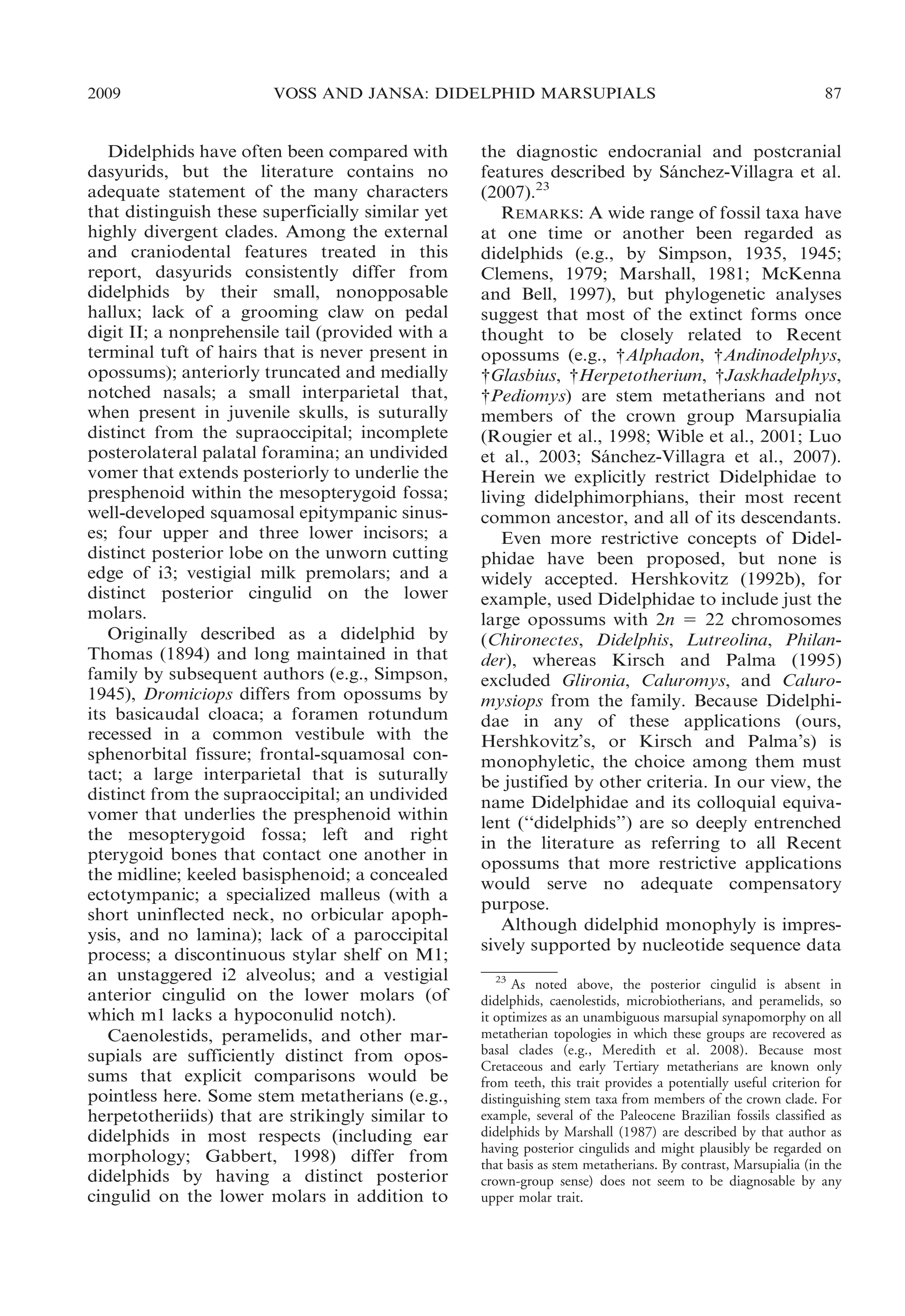
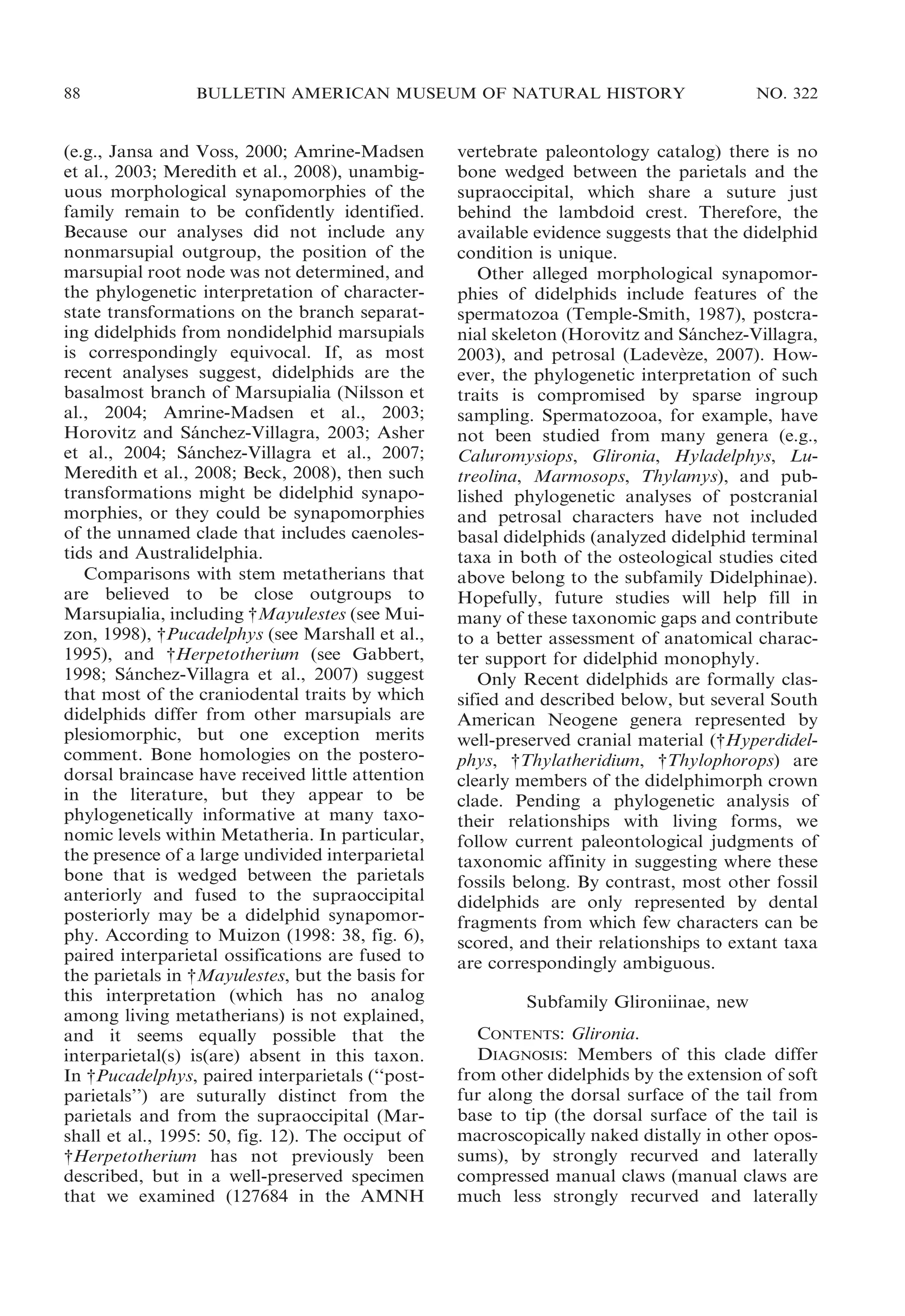
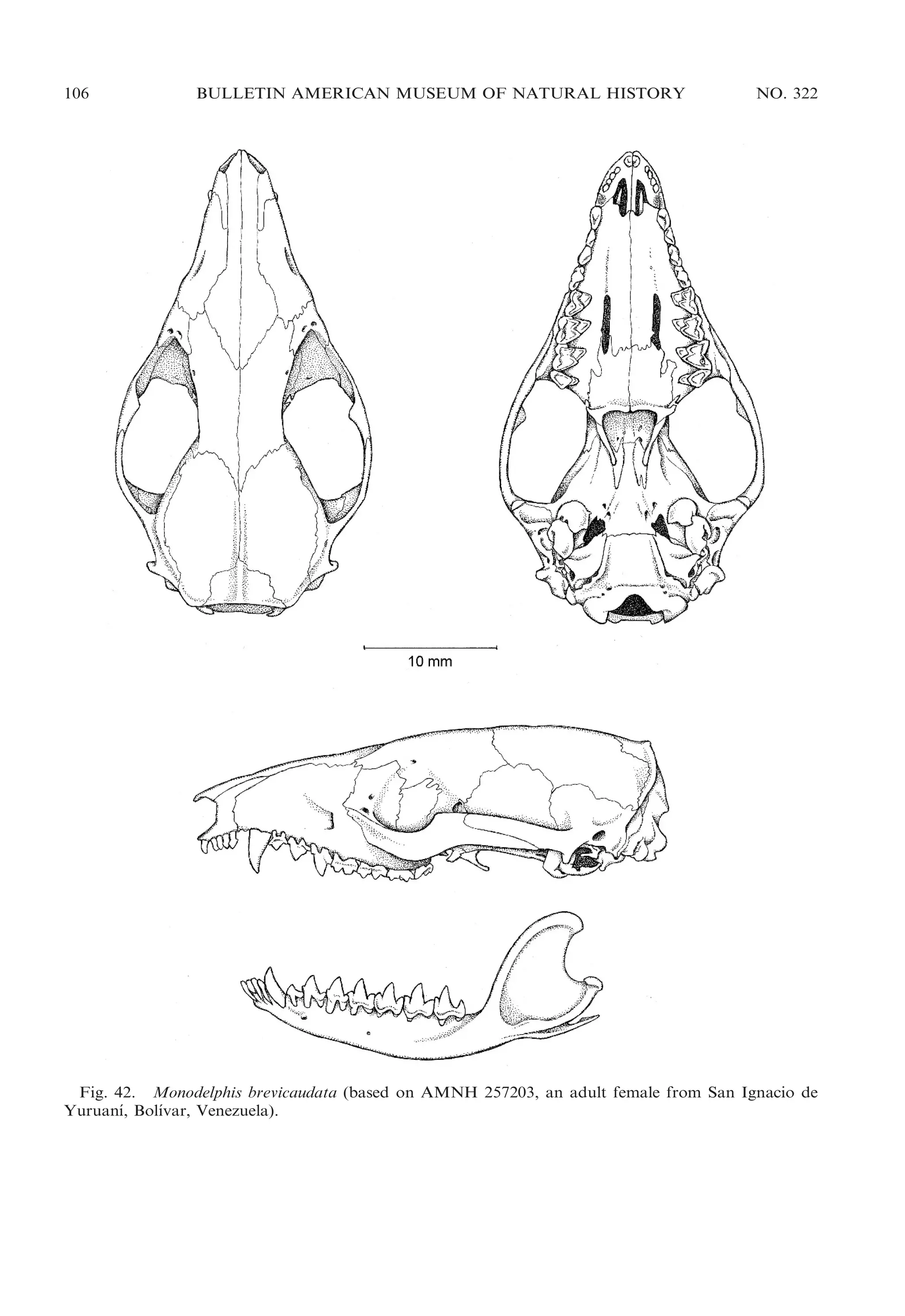
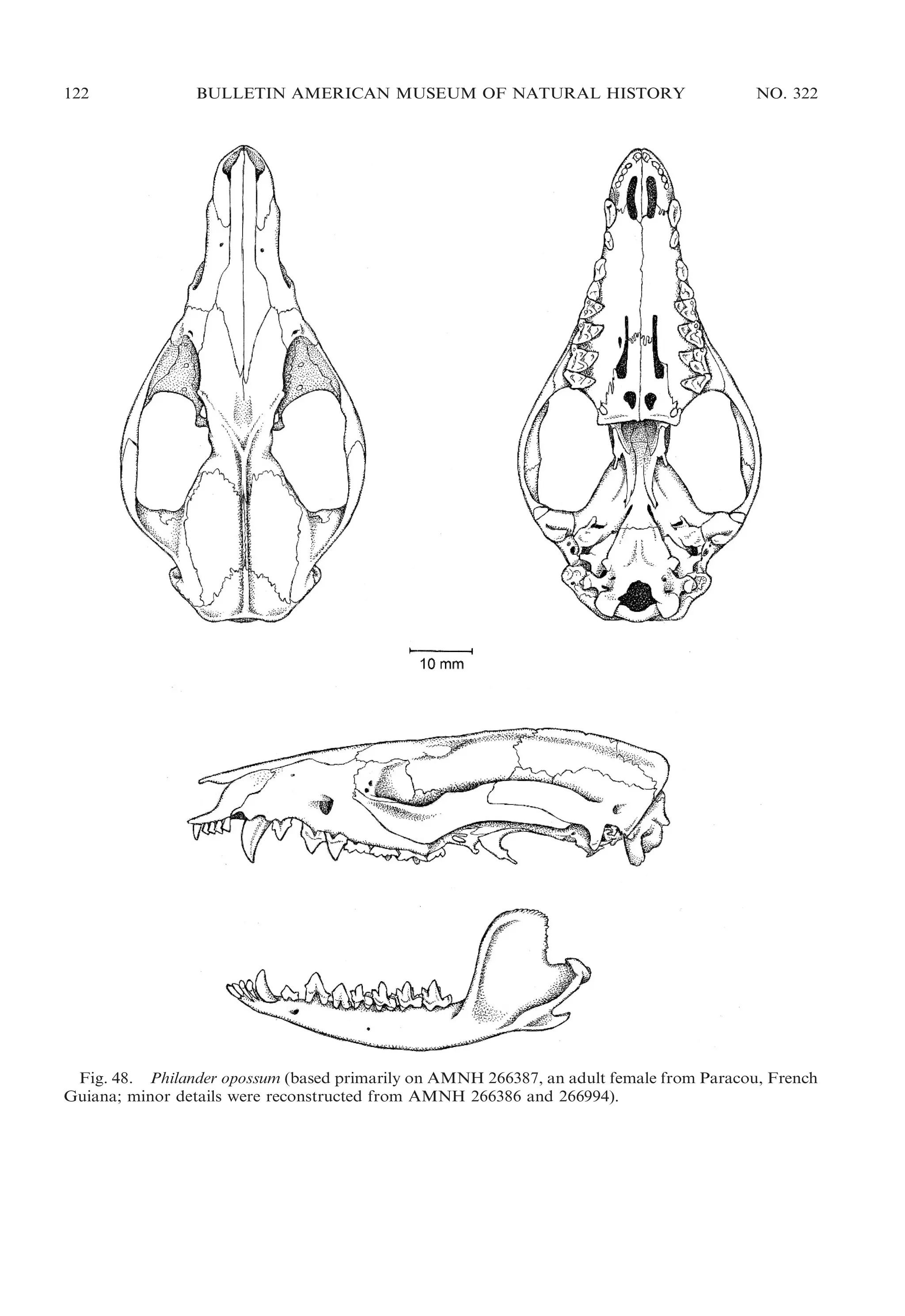
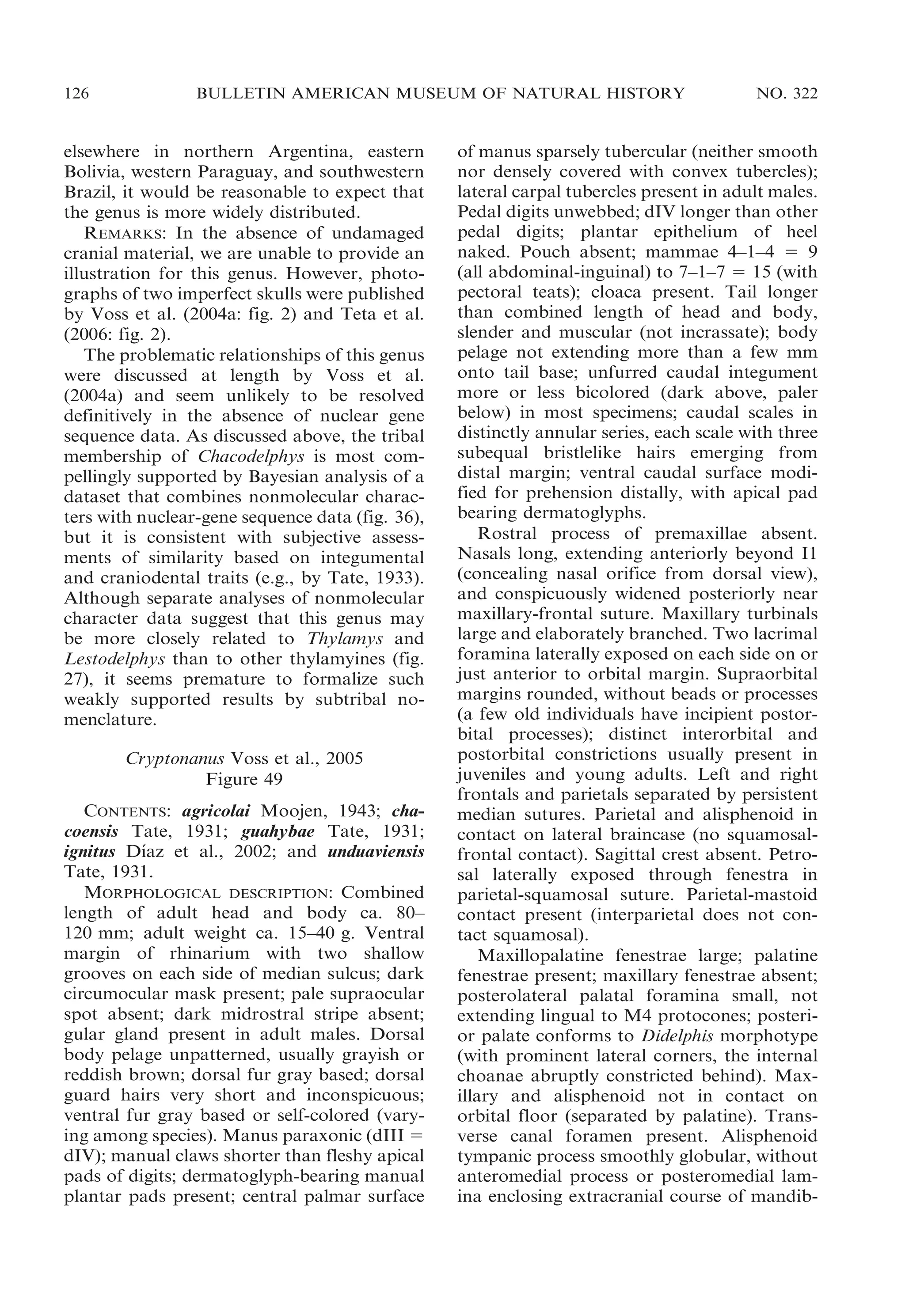
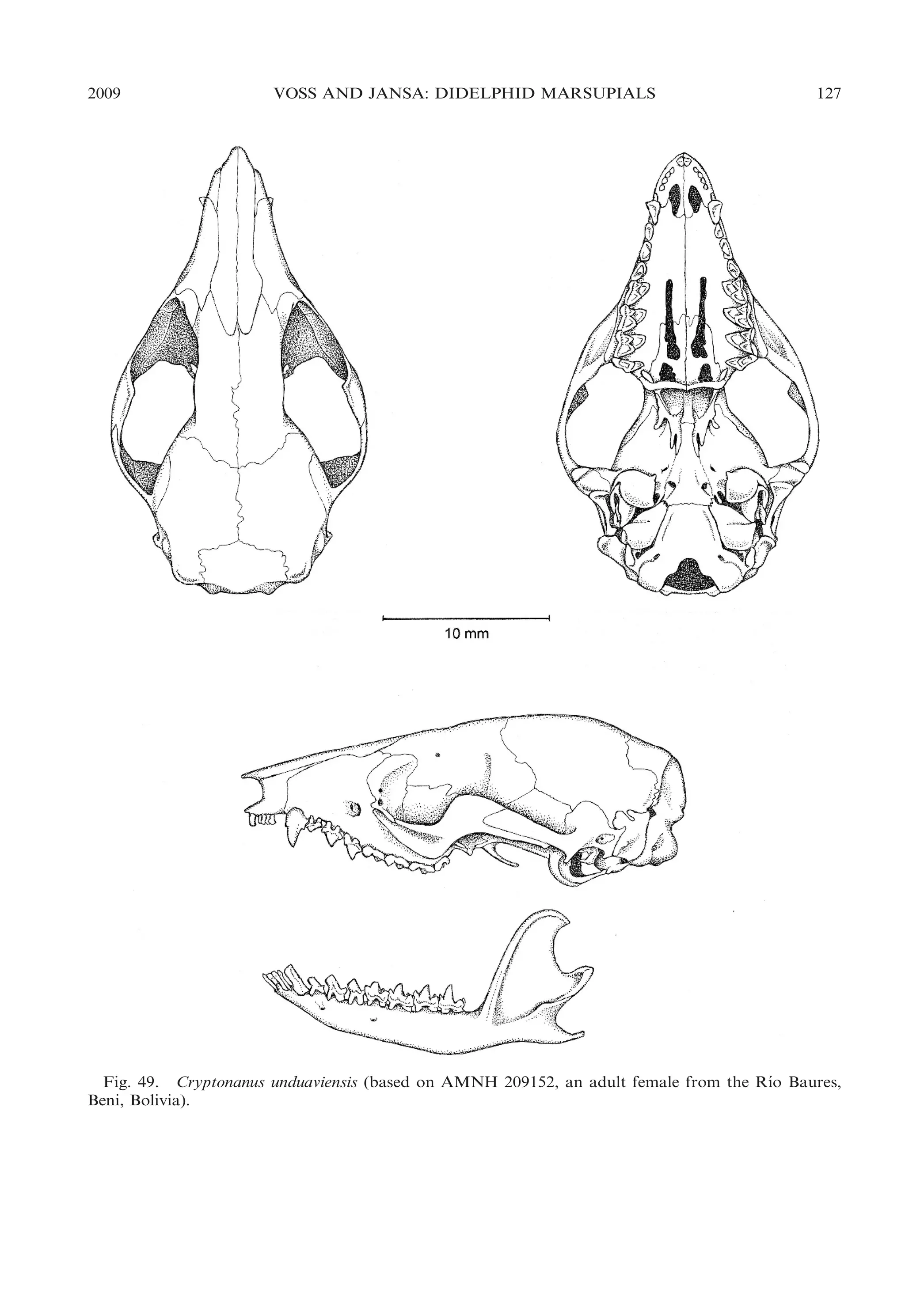
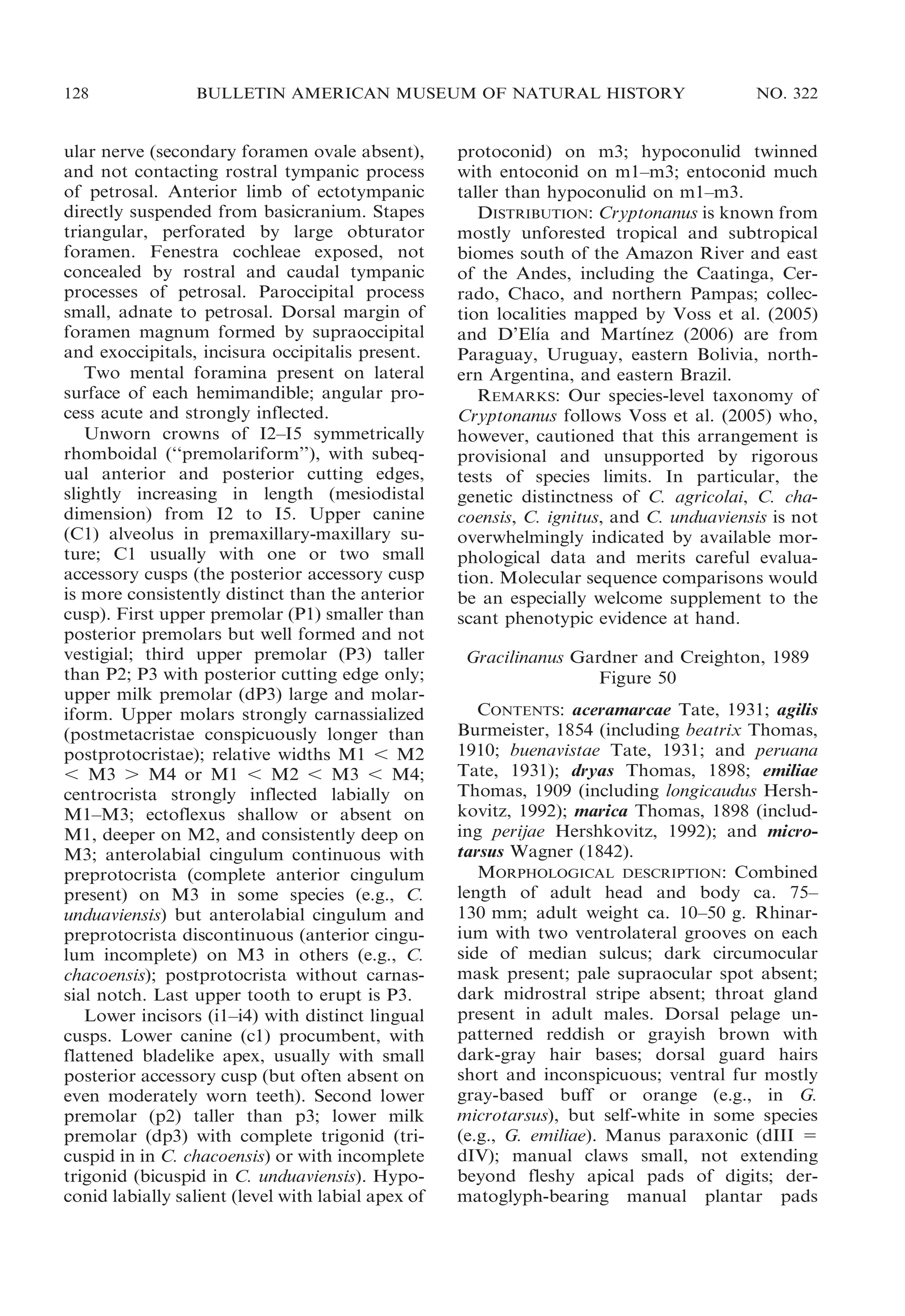
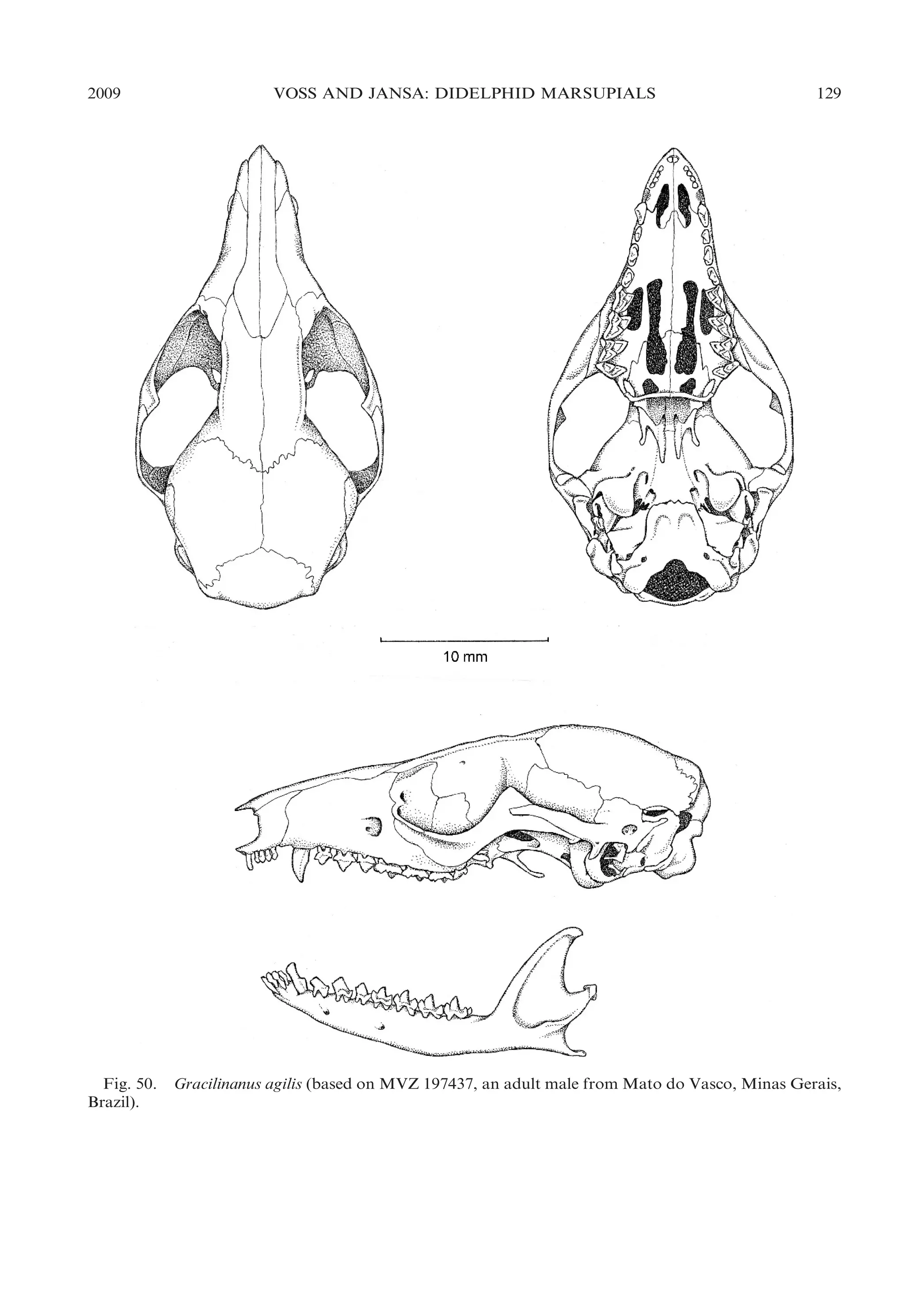
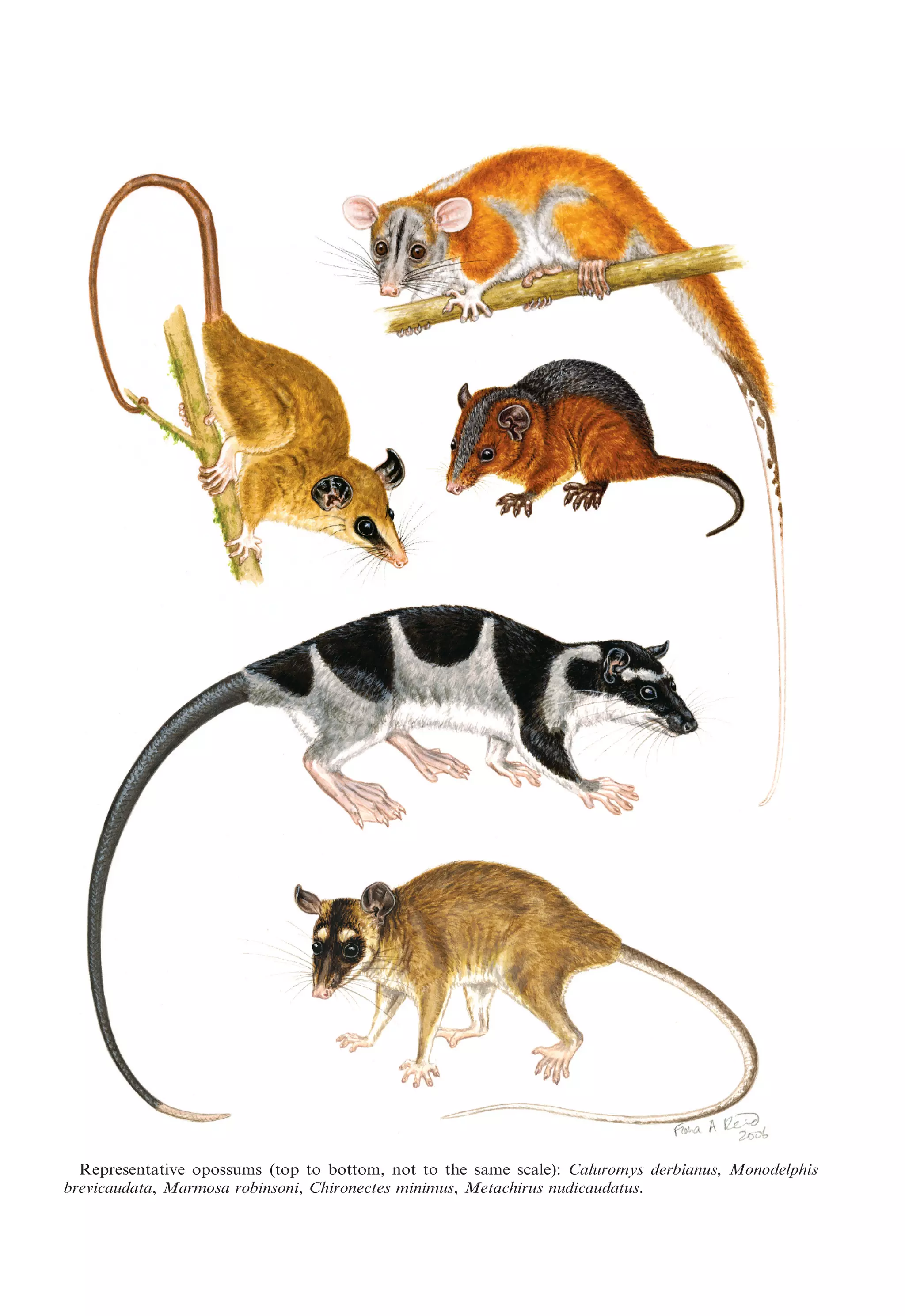
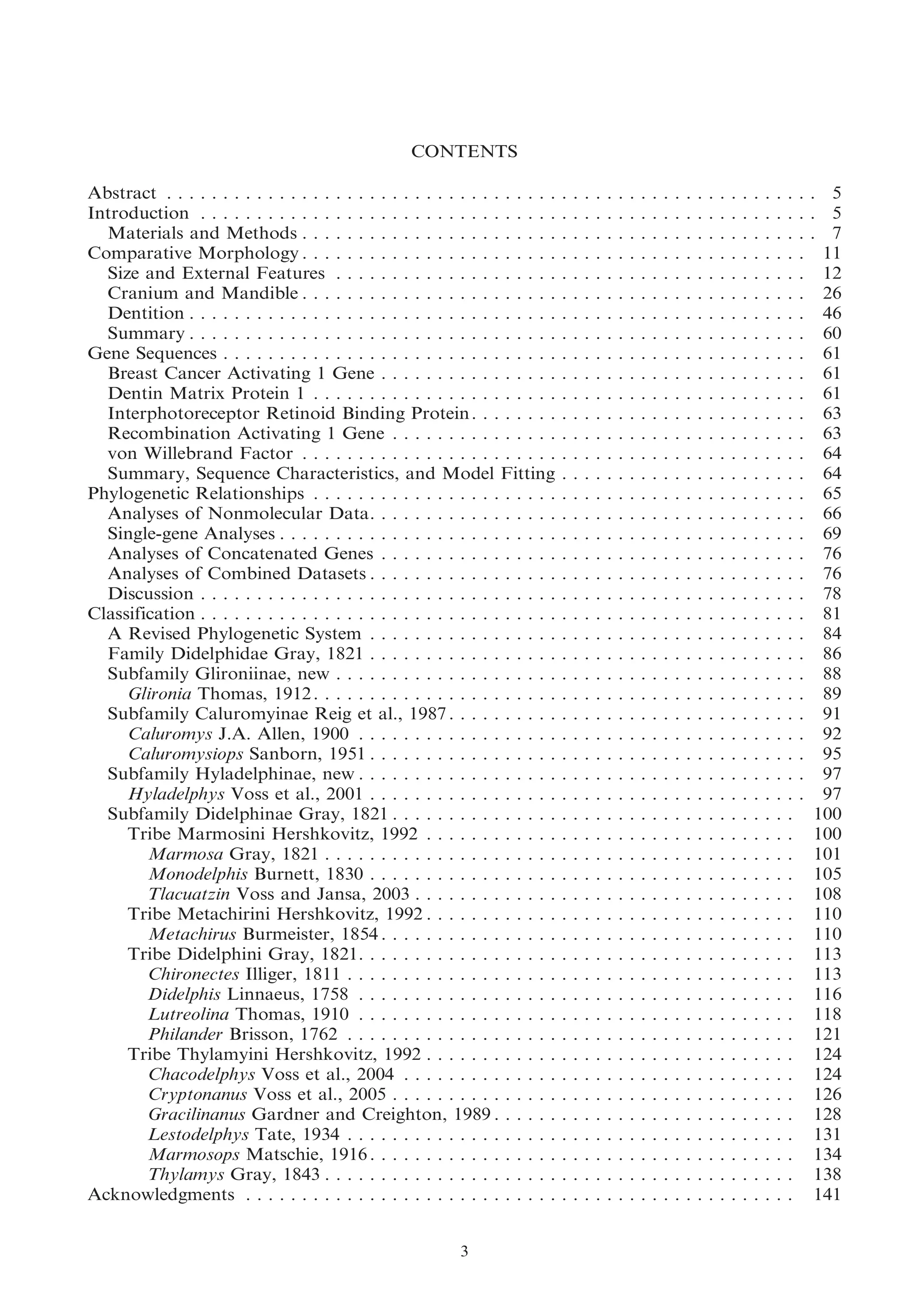
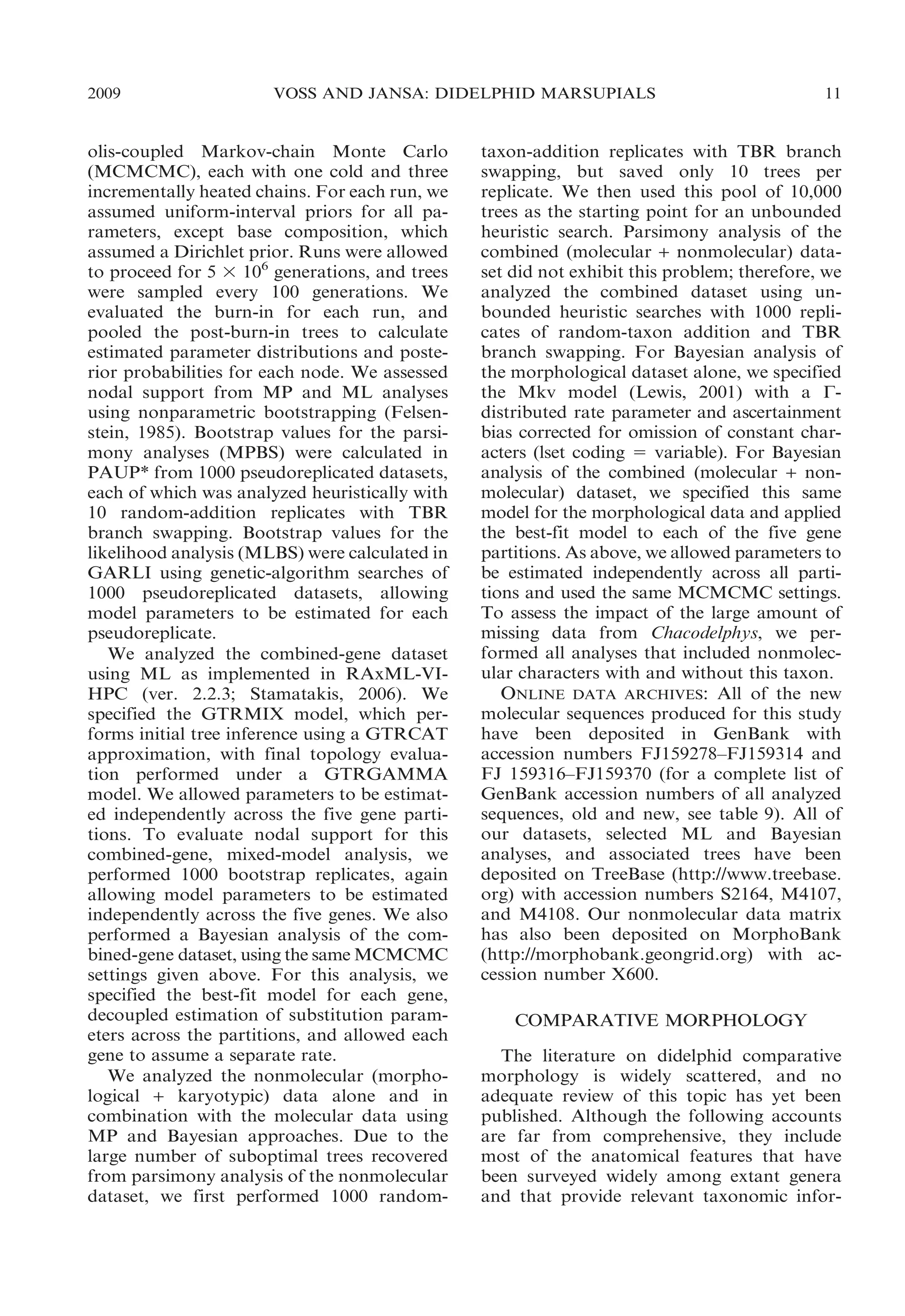
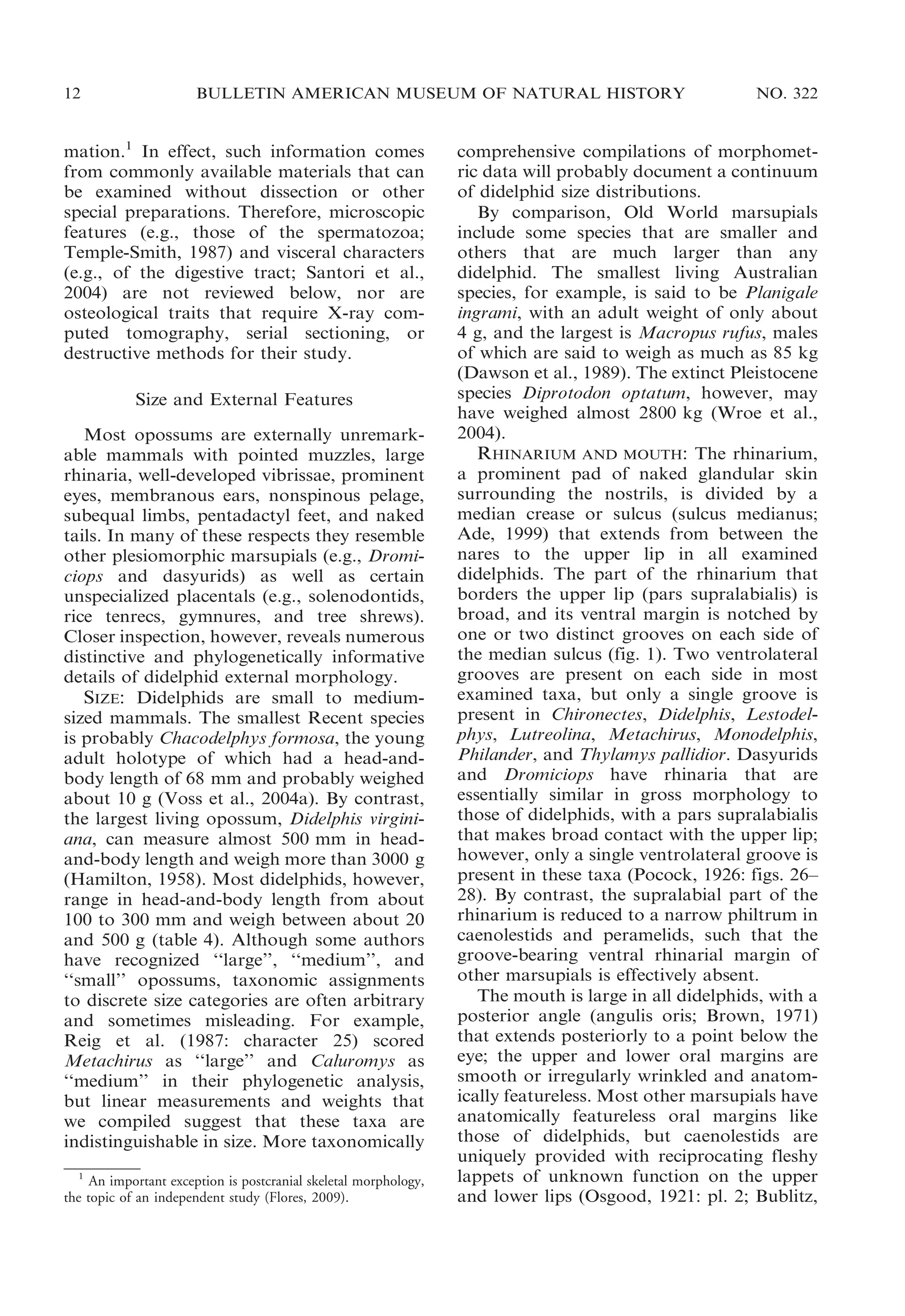
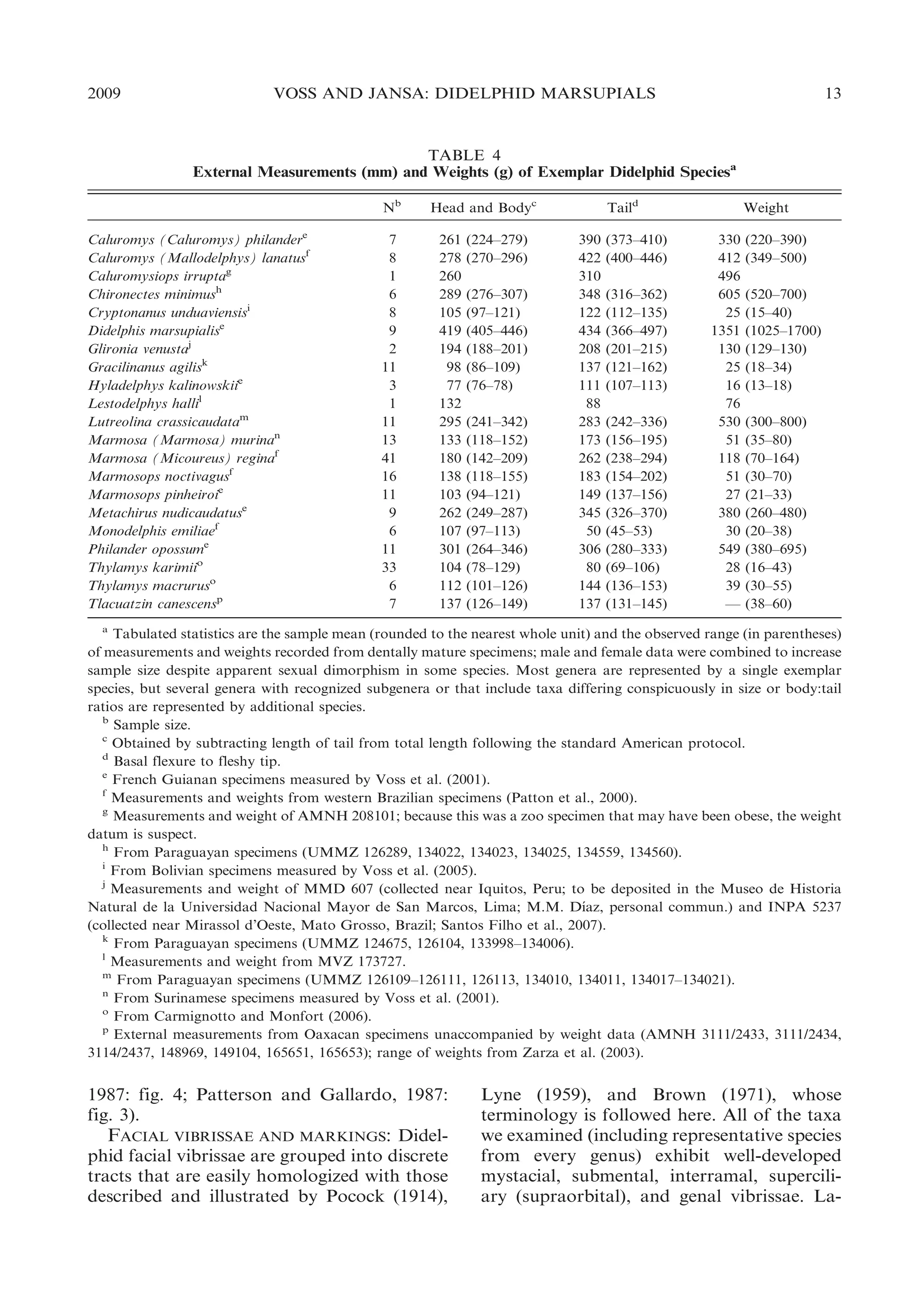
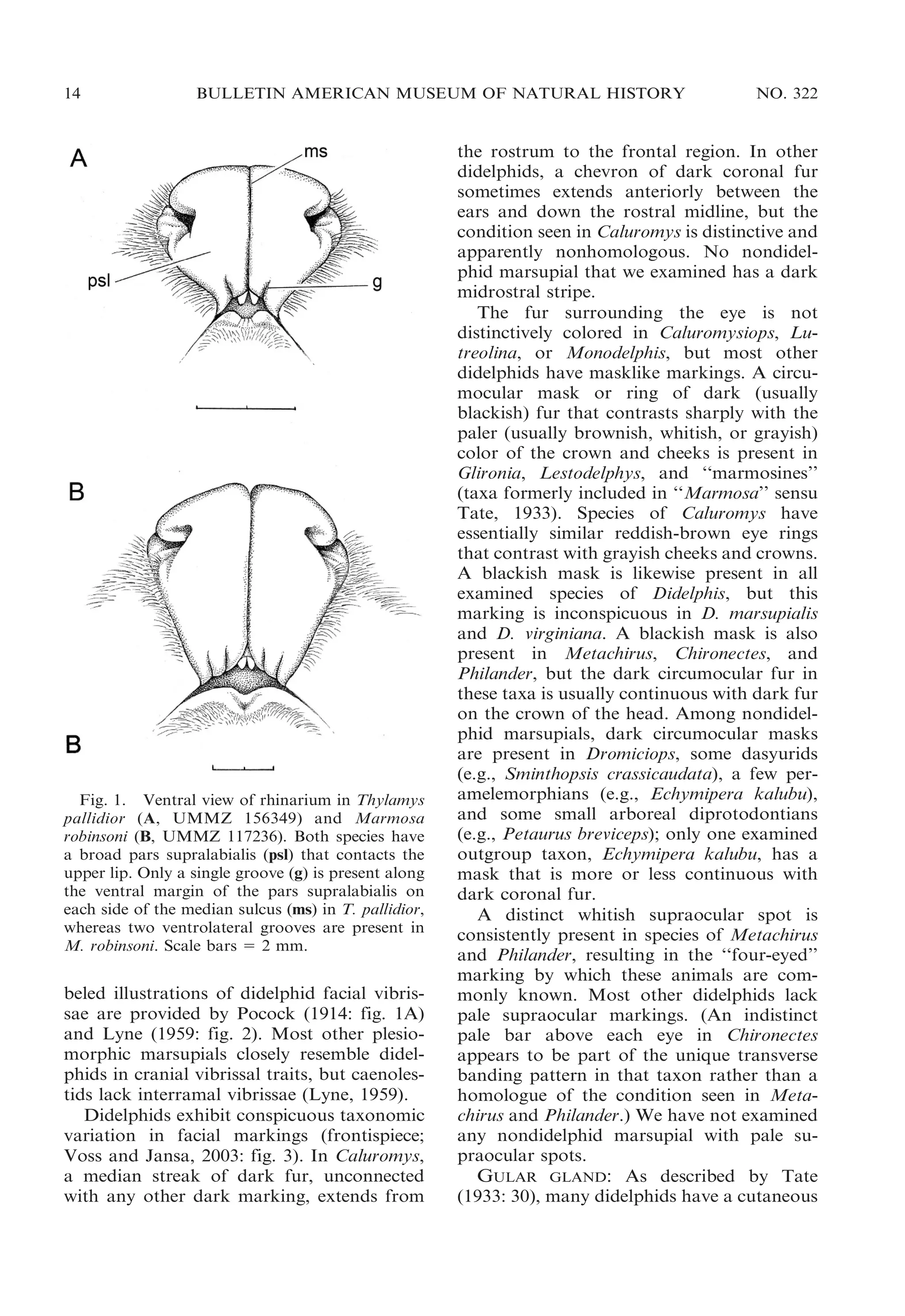
Representative opossums (top to bottom, not to the same scale): Caluromys derbianus, Monodelphis
brevicaudata, Marmosa robinsoni, Chironectes minimus, Metachirus nudicaudatus.
CONTENTS
Abstract . . . . . . . . . . . . . . . . . . . . . . . . . . . . . . . . . . .
Introduction . . . . . . . . . . . . . . . . . . . . . . . . . . . . . . . .
Materials and Methods . . . . . . . . . . . . . . . . . . . . . . .
Comparative Morphology . . . . . . . . . . . . . . . . . . . . . . .
Size and External Features . . . . . . . . . . . . . . . . . . . .
Cranium and Mandible . . . . . . . . . . . . . . . . . . . . . . .
Dentition . . . . . . . . . . . . . . . . . . . . . . . . . . . . . . . . .
Summary . . . . . . . . . . . . . . . . . . . . . . . . . . . . . . . . .
Gene Sequences . . . . . . . . . . . . . . . . . . . . . . . . . . . . . .
Breast Cancer Activating 1 Gene . . . . . . . . . . . . . . . .
Dentin Matrix Protein 1 . . . . . . . . . . . . . . . . . . . . . .
Interphotoreceptor Retinoid Binding Protein . . . . . . . .
Recombination Activating 1 Gene . . . . . . . . . . . . . . .
von Willebrand Factor . . . . . . . . . . . . . . . . . . . . . . .
Summary, Sequence Characteristics, and Model Fitting
Phylogenetic Relationships . . . . . . . . . . . . . . . . . . . . . .
Analyses of Nonmolecular Data. . . . . . . . . . . . . . . . .
Single-gene Analyses . . . . . . . . . . . . . . . . . . . . . . . . .
Analyses of Concatenated Genes . . . . . . . . . . . . . . . .
Analyses of Combined Datasets . . . . . . . . . . . . . . . . .
Discussion . . . . . . . . . . . . . . . . . . . . . . . . . . . . . . . .
Classification . . . . . . . . . . . . . . . . . . . . . . . . . . . . . . . .
A Revised Phylogenetic System . . . . . . . . . . . . . . . . .
Family Didelphidae Gray, 1821 . . . . . . . . . . . . . . . . .
Subfamily Glironiinae, new . . . . . . . . . . . . . . . . . . . .
Glironia Thomas, 1912 . . . . . . . . . . . . . . . . . . . . . .
Subfamily Caluromyinae Reig et al., 1987 . . . . . . . . . .
Caluromys J.A. Allen, 1900 . . . . . . . . . . . . . . . . . .
Caluromysiops Sanborn, 1951 . . . . . . . . . . . . . . . . .
Subfamily Hyladelphinae, new . . . . . . . . . . . . . . . . . .
Hyladelphys Voss et al., 2001 . . . . . . . . . . . . . . . . .
Subfamily Didelphinae Gray, 1821 . . . . . . . . . . . . . . .
Tribe Marmosini Hershkovitz, 1992 . . . . . . . . . . . .
Marmosa Gray, 1821 . . . . . . . . . . . . . . . . . . . . .
Monodelphis Burnett, 1830 . . . . . . . . . . . . . . . . .
Tlacuatzin Voss and Jansa, 2003 . . . . . . . . . . . . .
Tribe Metachirini Hershkovitz, 1992 . . . . . . . . . . . .
Metachirus Burmeister, 1854 . . . . . . . . . . . . . . . .
Tribe Didelphini Gray, 1821. . . . . . . . . . . . . . . . . .
Chironectes Illiger, 1811 . . . . . . . . . . . . . . . . . . .
Didelphis Linnaeus, 1758 . . . . . . . . . . . . . . . . . .
Lutreolina Thomas, 1910 . . . . . . . . . . . . . . . . . .
Philander Brisson, 1762 . . . . . . . . . . . . . . . . . . .
Tribe Thylamyini Hershkovitz, 1992 . . . . . . . . . . . .
Chacodelphys Voss et al., 2004 . . . . . . . . . . . . . .
Cryptonanus Voss et al., 2005 . . . . . . . . . . . . . . .
Gracilinanus Gardner and Creighton, 1989 . . . . . .
Lestodelphys Tate, 1934 . . . . . . . . . . . . . . . . . . .
Marmosops Matschie, 1916 . . . . . . . . . . . . . . . . .
Thylamys Gray, 1843 . . . . . . . . . . . . . . . . . . . . .
Acknowledgments . . . . . . . . . . . . . . . . . . . . . . . . . . . .
3

.
.
.
.
.
.
.
.
.
.
.
.
.
.
.
.
.
.
.
.
.
.
.
.
.
.
.
.
.
.
.
.
.
.
.
.
.
.
.
.
.
.
.
.
.
.
.
.
.
.
.

.
.
.
.
.
.
.
.
.
.
.
.
.
.
.
.
.
.
.
.
.
.
.
.
.
.
.
.
.
.
.
.
.
.
.
.
.
.
.
.
.
.
.
.
.
.
.
.
.
.
.

.
.
.
.
.
.
.
.
.
.
.
.
.
.
.
.
.
.
.
.
.
.
.
.
.
.
.
.
.
.
.
.
.
.
.
.
.
.
.
.
.
.
.
.
.
.
.
.
.
.
.

.
.
.
.
.
.
.
.
.
.
.
.
.
.
.
.
.
.
.
.
.
.
.
.
.
.
.
.
.
.
.
.
.
.
.
.
.
.
.
.
.
.
.
.
.
.
.
.
.
.
.

.
.
.
.
.
.
.
.
.
.
.
.
.
.
.
.
.
.
.
.
.
.
.
.
.
.
.
.
.
.
.
.
.
.
.
.
.
.
.
.
.
.
.
.
.
.
.
.
.
.
.

.
.
.
.
.
.
.
.
.
.
.
.
.
.
.
.
.
.
.
.
.
.
.
.
.
.
.
.
.
.
.
.
.
.
.
.
.
.
.
.
.
.
.
.
.
.
.
.
.
.
.

.
.
.
.
.
.
.
.
.
.
.
.
.
.
.
.
.
.
.
.
.
.
.
.
.
.
.
.
.
.
.
.
.
.
.
.
.
.
.
.
.
.
.
.
.
.
.
.
.
.
.

.
.
.
.
.
.
.
.
.
.
.
.
.
.
.
.
.
.
.
.
.
.
.
.
.
.
.
.
.
.
.
.
.
.
.
.
.
.
.
.
.
.
.
.
.
.
.
.
.
.
.

.
.
.
.
.
.
.
.
.
.
.
.
.
.
.
.
.
.
.
.
.
.
.
.
.
.
.
.
.
.
.
.
.
.
.
.
.
.
.
.
.
.
.
.
.
.
.
.
.
.
.

.
.
.
.
.
.
.
.
.
.
.
.
.
.
.
.
.
.
.
.
.
.
.
.
.
.
.
.
.
.
.
.
.
.
.
.
.
.
.
.
.
.
.
.
.
.
.
.
.
.
.

.
.
.
.
.
.
.
.
.
.
.
.
.
.
.
.
.
.
.
.
.
.
.
.
.
.
.
.
.
.
.
.
.
.
.
.
.
.
.
.
.
.
.
.
.
.
.
.
.
.
.

.
.
.
.
.
.
.
.
.
.
.
.
.
.
.
.
.
.
.
.
.
.
.
.
.
.
.
.
.
.
.
.
.
.
.
.
.
.
.
.
.
.
.
.
.
.
.
.
.
.
.

.
.
.
.
.
.
.
.
.
.
.
.
.
.
.
.
.
.
.
.
.
.
.
.
.
.
.
.
.
.
.
.
.
.
.
.
.
.
.
.
.
.
.
.
.
.
.
.
.
.
.

.
.
.
.
.
.
.
.
.
.
.
.
.
.
.
.
.
.
.
.
.
.
.
.
.
.
.
.
.
.
.
.
.
.
.
.
.
.
.
.
.
.
.
.
.
.
.
.
.
.
.

.
.
.
.
.
.
.
.
.
.
.
.
.
.
.
.
.
.
.
.
.
.
.
.
.
.
.
.
.
.
.
.
.
.
.
.
.
.
.
.
.
.
.
.
.
.
.
.
.
.
.

.
.
.
.
.
.
.
.
.
.
.
.
.
.
.
.
.
.
.
.
.
.
.
.
.
.
.
.
.
.
.
.
.
.
.
.
.
.
.
.
.
.
.
.
.
.
.
.
.
.
.

.
.
.
.
.
.
.
.
.
.
.
.
.
.
.
.
.
.
.
.
.
.
.
.
.
.
.
.
.
.
.
.
.
.
.
.
.
.
.
.
.
.
.
.
.
.
.
.
.
.
.

.
.
.
.
.
.
.
.
.
.
.
.
.
.
.
.
.
.
.
.
.
.
.
.
.
.
.
.
.
.
.
.
.
.
.
.
.
.
.
.
.
.
.
.
.
.
.
.
.
.
.

.
.
.
.
.
.
.
.
.
.
.
.
.
.
.
.
.
.
.
.
.
.
.
.
.
.
.
.
.
.
.
.
.
.
.
.
.
.
.
.
.
.
.
.
.
.
.
.
.
.
.

.
.
.
.
.
.
.
.
.
.
.
.
.
.
.
.
.
.
.
.
.
.
.
.
.
.
.
.
.
.
.
.
.
.
.
.
.
.
.
.
.
.
.
.
.
.
.
.
.
.
.

.
.
.
.
.
.
.
.
.
.
.
.
.
.
.
.
.
.
.
.
.
.
.
.
.
.
.
.
.
.
.
.
.
.
.
.
.
.
.
.
.
.
.
.
.
.
.
.
.
.
.

.. 5
.. 5
.. 7
. 11
. 12
. 26
. 46
. 60
. 61
. 61
. 61
. 63
. 63
. 64
. 64
. 65
. 66
. 69
. 76
. 76
. 78
. 81
. 84
. 86
. 88
. 89
. 91
. 92
. 95
. 97
. 97
100
100
101
105
108
110
110
113
113
116
118
121
124
124
126
128
131
134
138
141
4

BULLETIN AMERICAN MUSEUM OF NATURAL HISTORY

References . . . . . . . . . . . . . . . . . . . . . . . . . . . . . . .
Appendix 1: Morphological Specimens Examined . . .
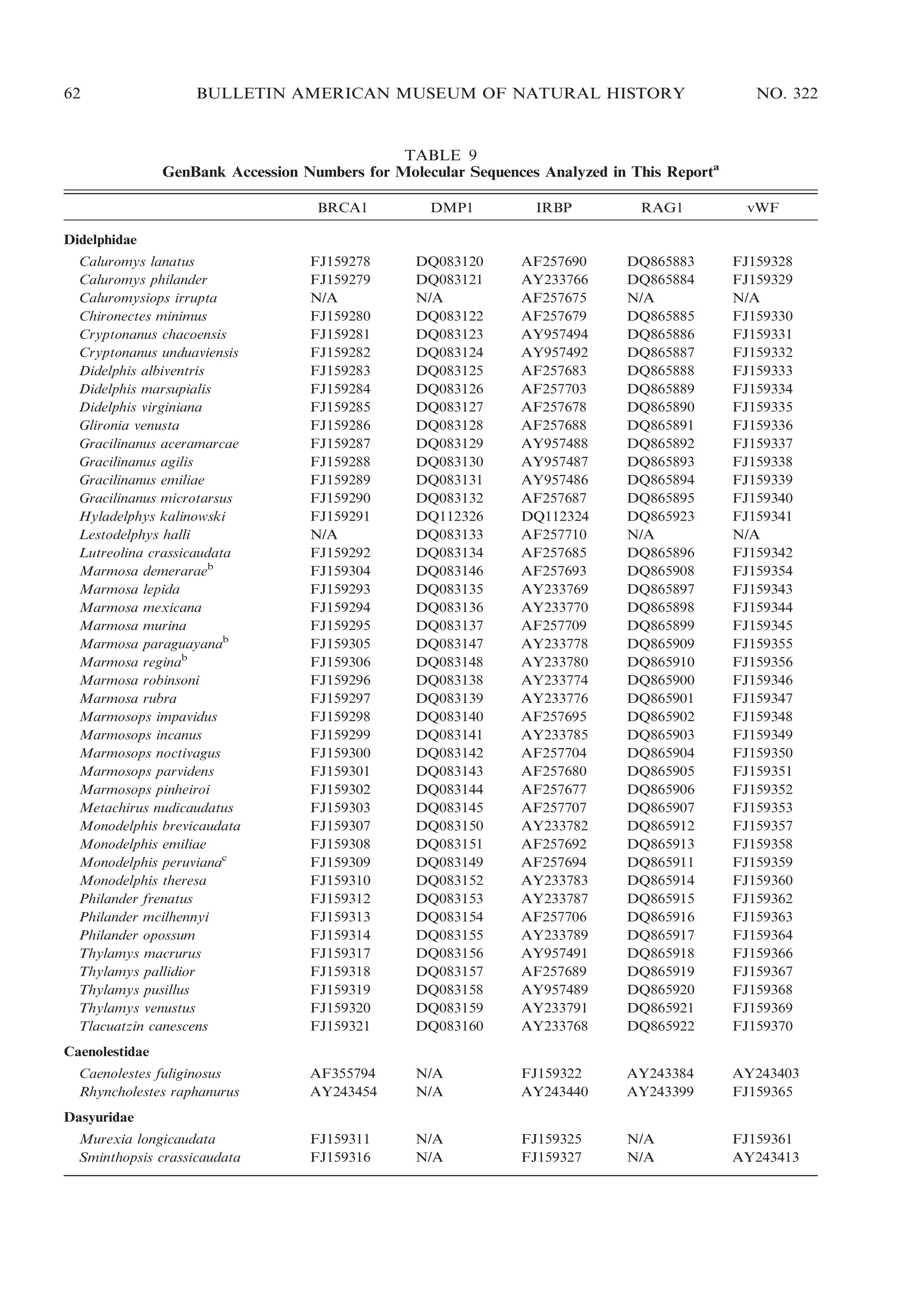
Appendix 2: Specimens Sequenced for Nuclear Genes
Appendix 3: Nonmolecular Character Descriptions . .
Appendix 4: Nonmolecular Data Matrix . . . . . . . . .
Appendix 5: Nonmolecular Apomorphy List . . . . . .
Appendix 6: Key to the Didelphid Genera . . . . . . . .

.
.
.
.
.
.
.

.
.
.
.
.
.
.

.
.
.
.
.
.
.

.
.
.
.
.
.
.

.
.
.
.
.
.
.

.
.
.
.
.
.
.

.
.
.
.
.
.
.

.
.
.
.
.
.
.

.
.
.
.
.
.
.

.
.
.
.
.
.
.

.
.
.
.
.
.
.

.
.
.
.
.
.
.

.
.
.
.
.
.
.

.
.
.
.
.
.
.

.
.
.
.
.
.
.

.
.
.
.
.
.
.

.
.
.
.
.
.
.

NO. 322

.
.
.
.
.
.
.

.
.
.
.
.
.
.

.
.
.
.
.
.
.

.
.
.
.
.
.
.

.
.
.
.
.
.
.

.
.
.
.
.
.
.

.
.
.
.
.
.
.

142
157
160
161
170
171
174
ABSTRACT
This report summarizes a decade of morphological and molecular research on the
phylogenetic relationships of didelphid marsupials (opossums), a substantially intact radiation
of New World metatherian mammals. We review the comparative morphology of Recent
opossums, emphasizing those anatomical systems from which taxonomically useful information
is available for the majority of living genera and species, namely the integument, cranium, and
dentition. Morphological similarities and differences among didelphids and other plesiomorphic
marsupials (caenolestids, microbiotheriids, dasyurids, and peramelids) are also described. These
observations, representing evolved differences in diverse functional-morphological systems,
together with karyotypic information gleaned from the literature, provide the basis for coding
129 phylogenetic characters that we scored for 44 ingroup and seven outgroup taxa.
Published information about the size, internal organization, chromosomal location, and
physiological properties of five nuclear genes (BRCA1, DMP1, IRBP, RAG1, vWF) sequenced
for this study suggest that these loci are unlinked, exist as single copies, are active in different
tissues, and encode protein products with widely divergent functions. All of the sequenced
fragments are long (.900 bp), free of ingroup alignment ambiguities, and translate to open
reading frame. Nucleotide data from a total of 7320 aligned sites were obtained from 43 ingroup
and seven outgroup taxa.
Separate parsimony, likelihood, and Bayesian analyses of these six data partitions
(morphology + karyotypes, five genes) resulted in highly congruent estimates of didelphid
phylogeny with few examples of conflict among strongly supported nodes. Analyses of
concatenated sequences and combined (nonmolecular + sequence) datasets effectively summarize
all of the common signal recovered from separate analyses: a completely resolved ingroup
phylogeny with high support statistics at most nodes. Remaining problems (not conclusively
resolved in this study) include the position of the ingroup root and the relationships of three
genera (Chacodelphys, Cryptonanus, Tlacuatzin) within their respective suprageneric clades.
The history of didelphid classification is reviewed, and all previous systems are found to
contain nonmonophyletic groups. A revised phylogenetic classification consistent with our
analytic results includes the following higher taxa: Glironiinae (for Glironia), Caluromyinae
(Caluromys and Caluromysiops), Hyladelphinae (Hyladelphys), Didelphinae (Marmosini,
Metachirini, Didelphini, and Thylamyini), Marmosini (Marmosa, Monodelphis, and Tlacuatzin),
Metachirini (Metachirus), Didelphini (Chironectes, Didelphis, Lutreolina, and Philander), and
Thylamyini (Chacodelphys, Cryptonanus, Gracilinanus, Lestodelphys, Marmosops, and Thylamys). The probable relationships of several Neogene fossil genera are also discussed. To
facilitate identifications, all Recent genera are redescribed, representative crania are illustrated,
and a key is provided.

INTRODUCTION

Asia and western North America (Rougier et
al., 1998; Luo et al., 2003; Kielan-Jaworowska et al., 2004), and other early metatherians are present in the Tertiary record of
Europe and Africa (Crochet, 1980; Kurz,
2007; Hooker et al., 2008). The metatherian
crown group Marsupialia, however, probably
evolved in South America and subsequently
dispersed across Antarctica to Australia and
New Guinea (Muizon et al., 1997; Springer et
al., 1997a; Rougier et al., 1998). Living
marsupials comprise seven major groups,
currently ranked as orders in the Linnaean
hierarchy, each of which is endemic to either
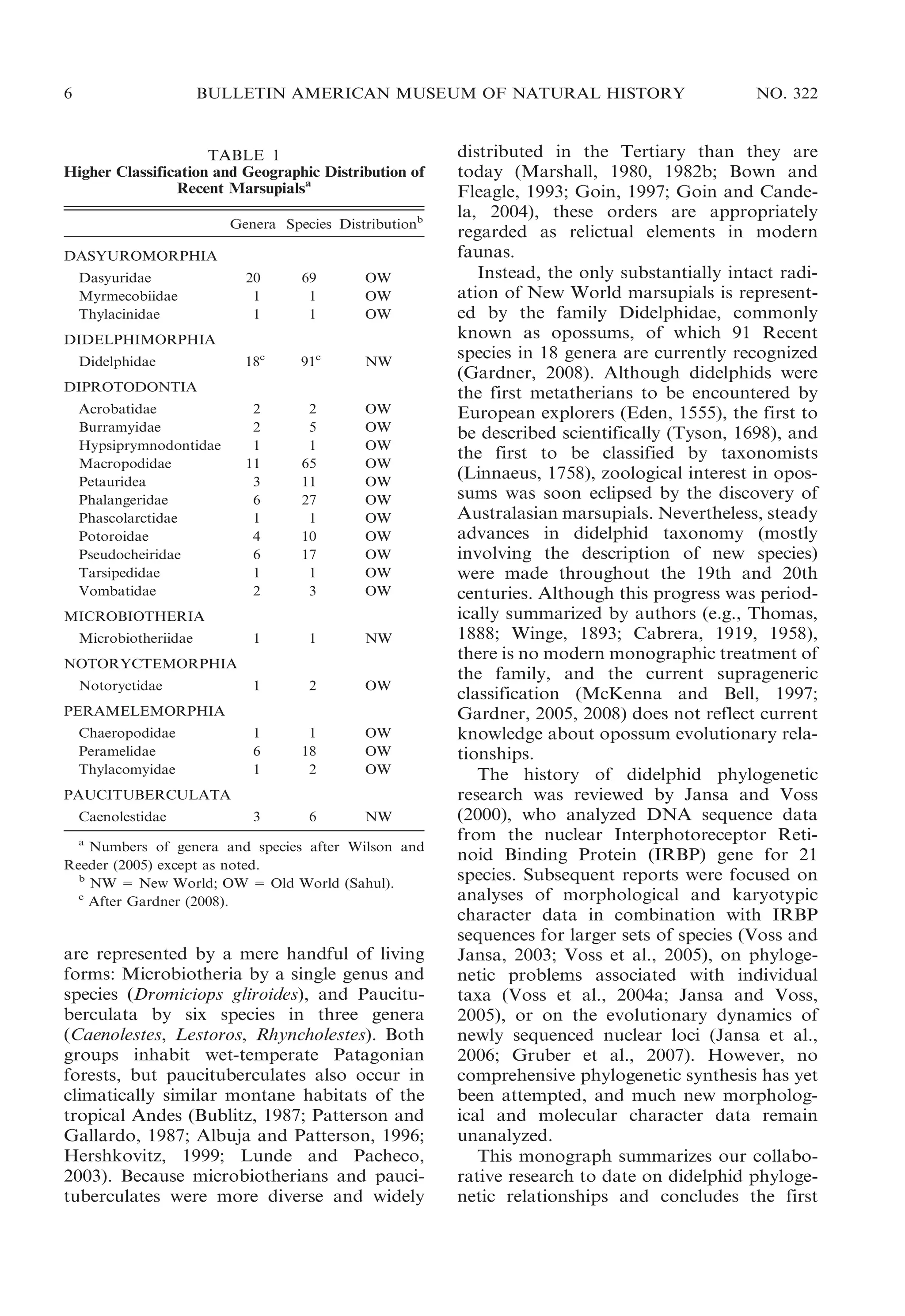
the New World or the Old World (table 1).
Although the extant New World marsupial
fauna consists of three orders, two of these

They affirme that there are trees of suche
byggenes, that xvi men ioyninge handes togyther
and standinge in coompasse, can scarsely embrase sum of them. Emonge these trees is fownde
that monstrous beaste with a snowte lyke a foxe,
a tayle lyke a marmasette, eares lyke a batte,
handes lyke a man, and feete lyke an ape, bearing
her whelpes abowte with her in an owtwarde
bellye much lyke vnto a greate bagge or purse. —
Richard Eden (1555), describing the first
European encounter with a marsupial, by Vicente Yanez Pinzon and his men on the coast of
´˜
´
Brazil in the year 1500

The oldest known metatherian mammals
occur in Cretaceous sediments of eastern
5
6

BULLETIN AMERICAN MUSEUM OF NATURAL HISTORY

TABLE 1
Higher Classification and Geographic Distribution of
Recent Marsupialsa
Genera Species Distributionb
DASYUROMORPHIA
Dasyuridae
Myrmecobiidae
Thylacinidae

20
1
1

69
1
1

OW
OW
OW

18c

91c

NW

2
2
1
11
3
6
1
4
6
1
2

2
5
1
65
11
27
1
10
17
1
3

OW
OW
OW
OW
OW
OW
OW
OW
OW
OW
OW

1

1

NW

1

2

OW

1
6
1

1
18
2

OW
OW
OW

3

6

NW

DIDELPHIMORPHIA
Didelphidae
DIPROTODONTIA
Acrobatidae
Burramyidae
Hypsiprymnodontidae
Macropodidae
Petauridea
Phalangeridae
Phascolarctidae
Potoroidae
Pseudocheiridae
Tarsipedidae
Vombatidae
MICROBIOTHERIA
Microbiotheriidae
NOTORYCTEMORPHIA
Notoryctidae
PERAMELEMORPHIA
Chaeropodidae
Peramelidae
Thylacomyidae
PAUCITUBERCULATA
Caenolestidae
a

Numbers of genera and species after Wilson and
Reeder (2005) except as noted.
b
NW 5 New World; OW 5 Old World (Sahul).
c
After Gardner (2008).

are represented by a mere handful of living
forms: Microbiotheria by a single genus and
species (Dromiciops gliroides), and Paucituberculata by six species in three genera
(Caenolestes, Lestoros, Rhyncholestes). Both
groups inhabit wet-temperate Patagonian
forests, but paucituberculates also occur in
climatically similar montane habitats of the
tropical Andes (Bublitz, 1987; Patterson and
Gallardo, 1987; Albuja and Patterson, 1996;
Hershkovitz, 1999; Lunde and Pacheco,
2003). Because microbiotherians and paucituberculates were more diverse and widely

NO. 322

distributed in the Tertiary than they are
today (Marshall, 1980, 1982b; Bown and
Fleagle, 1993; Goin, 1997; Goin and Candela, 2004), these orders are appropriately
regarded as relictual elements in modern
faunas.
Instead, the only substantially intact radiation of New World marsupials is represented by the family Didelphidae, commonly
known as opossums, of which 91 Recent
species in 18 genera are currently recognized
(Gardner, 2008). Although didelphids were
the first metatherians to be encountered by
European explorers (Eden, 1555), the first to
be described scientifically (Tyson, 1698), and
the first to be classified by taxonomists
(Linnaeus, 1758), zoological interest in opossums was soon eclipsed by the discovery of
Australasian marsupials. Nevertheless, steady
advances in didelphid taxonomy (mostly
involving the description of new species)
were made throughout the 19th and 20th
centuries. Although this progress was periodically summarized by authors (e.g., Thomas,
1888; Winge, 1893; Cabrera, 1919, 1958),
there is no modern monographic treatment of
the family, and the current suprageneric
classification (McKenna and Bell, 1997;
Gardner, 2005, 2008) does not reflect current
knowledge about opossum evolutionary relationships.
The history of didelphid phylogenetic
research was reviewed by Jansa and Voss
(2000), who analyzed DNA sequence data
from the nuclear Interphotoreceptor Retinoid Binding Protein (IRBP) gene for 21
species. Subsequent reports were focused on
analyses of morphological and karyotypic
character data in combination with IRBP
sequences for larger sets of species (Voss and
Jansa, 2003; Voss et al., 2005), on phylogenetic problems associated with individual
taxa (Voss et al., 2004a; Jansa and Voss,
2005), or on the evolutionary dynamics of
newly sequenced nuclear loci (Jansa et al.,
2006; Gruber et al., 2007). However, no
comprehensive phylogenetic synthesis has yet
been attempted, and much new morphological and molecular character data remain
unanalyzed.
This monograph summarizes our collaborative research to date on didelphid phylogenetic relationships and concludes the first
2009

VOSS AND JANSA: DIDELPHID MARSUPIALS

phase of our ongoing evolutionary study of
the family. Although we take this opportunity to review information that has previously been published elsewhere, many new
results are reported herein. Among these,
we describe morphological comparisons of
didelphids with other plesiomorphic (polyprotodont) marsupial clades; we describe and
illustrate integumental and craniodental
traits not previously discussed in the literature; we report new sequence data from the
Breast Cancer Activating 1 gene (BRCA1)
and the von Willebrand Factor gene (vWF);
we analyze didelphid phylogenetic relationships based on a new set of morphological
and karyotypic characters together with
sequence data from five protein-coding nuclear loci; we propose a new suprageneric
classification consistent with our analytic
results; and we provide morphological descriptions and cranial illustrations of all
currently recognized genera to facilitate
taxonomic identifications.
Materials and Methods

PHYLOGENETIC ASSUMPTIONS AND TAXON
SAMPLING: Our phylogenetic analyses are
based on the assumption of didelphid monophyly, which is strongly supported by a
variety of nuclear-gene sequence datasets
(e.g., Jansa and Voss, 2000; Amrine-Madsen
et al., 2003; Meredith et al., 2008). Our
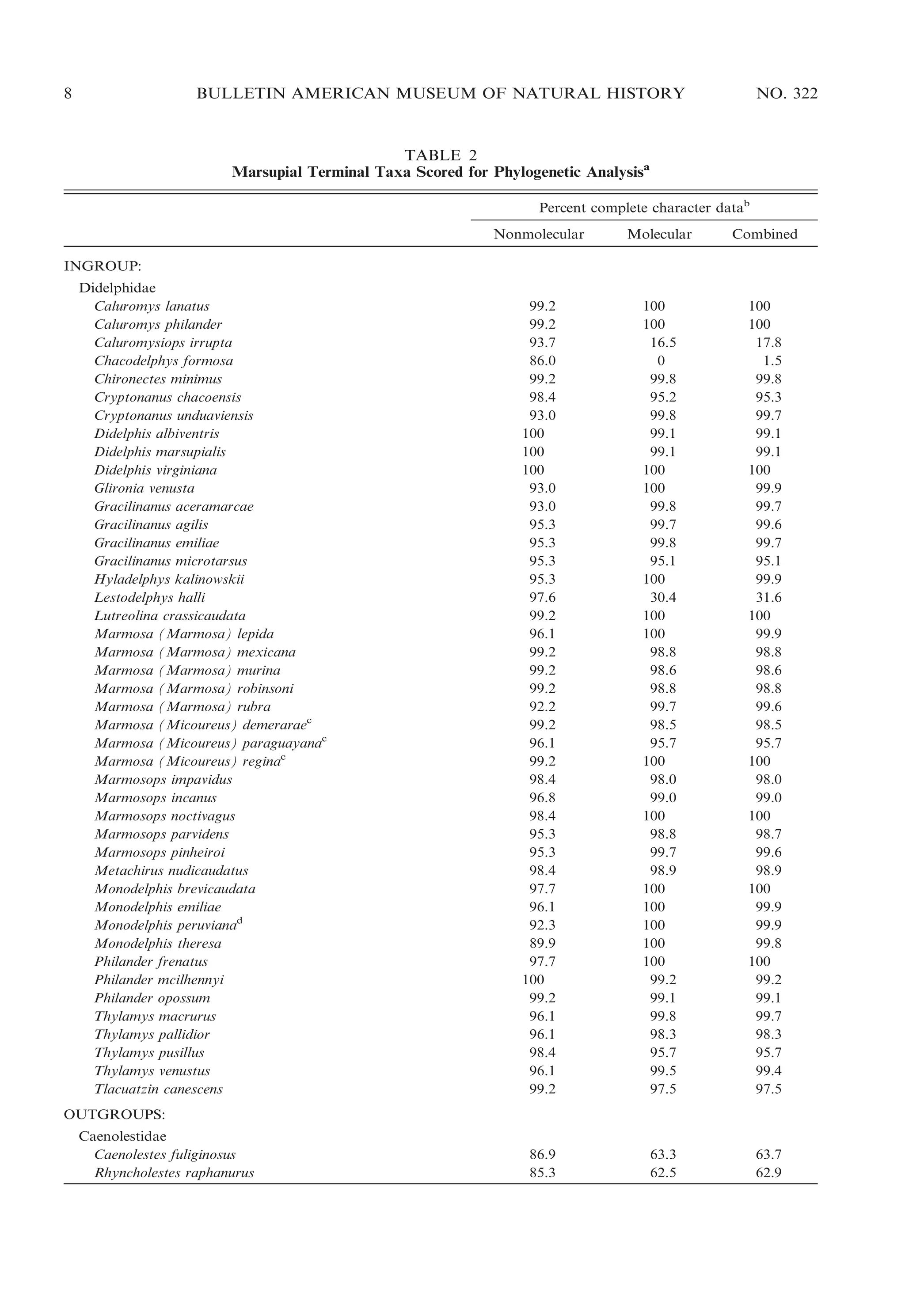
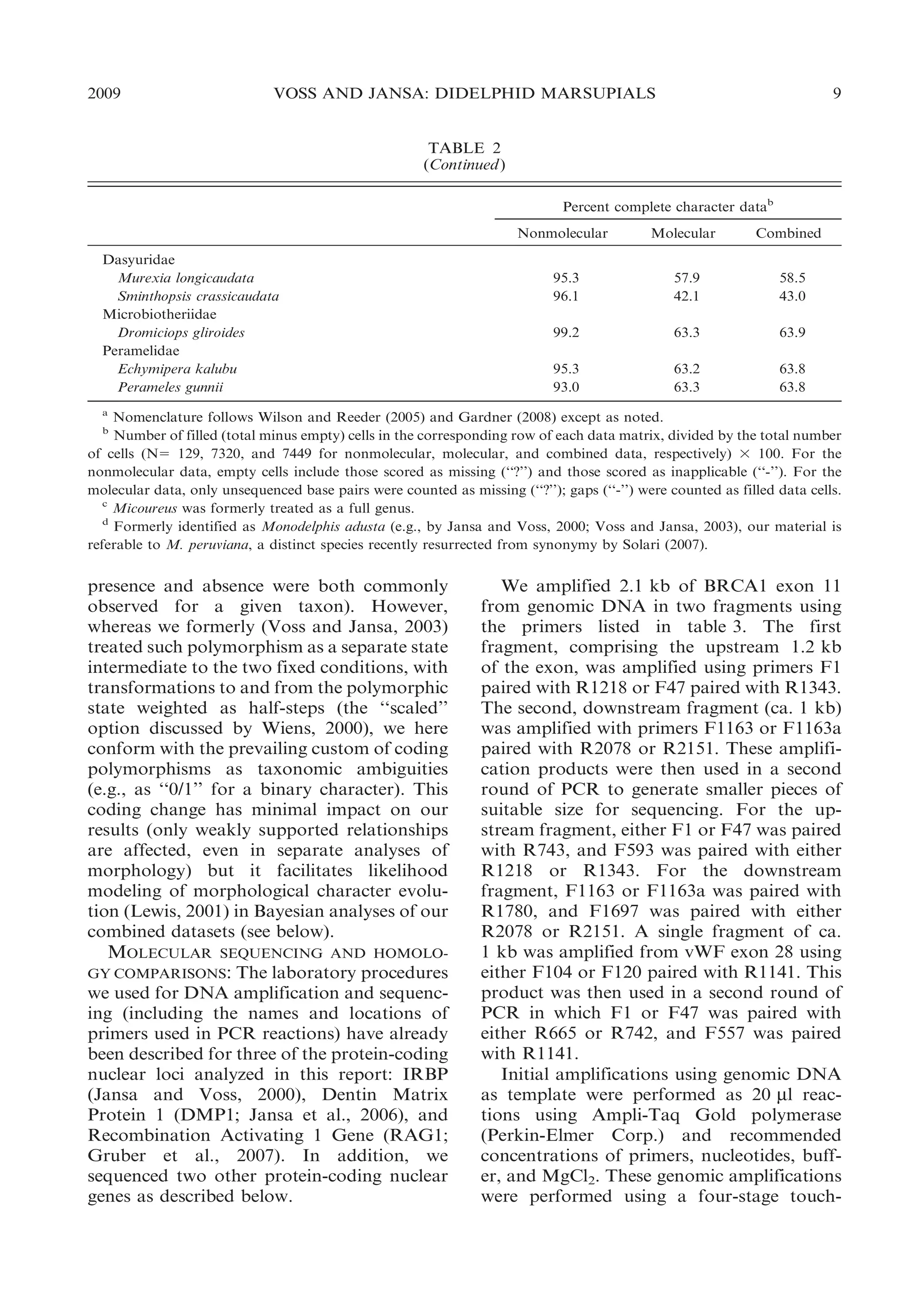
ingroup terminals (table 2) consist of 44
species representing every currently recognized didelphid genus and subgenus, including all of the species previously analyzed by
Jansa and Voss (2000, 2005), Voss and Jansa
(2003), Voss et al. (2004a, 2005), Jansa et al.
(2006), and Gruber et al. (2007). Altogether,
this is by far the most taxon-dense and
character-rich didelphid dataset ever analyzed.
The outgroups for this study include
representatives of every extant ordinal-level
clade that has ever been recovered within one
or two nodes of Didelphidae in previous
analyses of marsupial relationships, including
caenolestids (Paucituberculata), dasyurids
(Dasyuromorphia), Dromiciops (Microbiotheria), and peramelids (Peramelemorphia).
We did not include Notoryctes (Notoryctemorphia) or diprotodontians because these

7

taxa have never been considered close to
didelphids, and because their highly derived
morphologies raise many unresolved issues of
homology that are beyond the scope of this
study.
COMPARATIVE MORPHOLOGY: Our morphological comparisons are based on skins,
skulls, and fluid-preserved specimens (appendix 1), which we examined for discretely
varying traits that could be scored for most
of the terminal taxa in our analysis. Additionally, we summarize information about
other phenotypic characters that, although
not suitable for phylogenetic analysis due to
continuous variation (e.g., body size), provide taxonomically useful descriptors. Information about morphological character variation among nondidelphid marsupials is
largely based on our scoring of outgroup
terminal taxa, but we also include remarks on
the morphology of other Old World marsupials where these seem relevant or interesting.
To provide a maximally user-friendly
reference, our morphological observations
are summarized in two different formats.
First, we describe taxonomic comparisons
using normal (nontelegraphic) prose in the
body of the text. These accounts, organized
organ-system-by-organ system, are accompanied as necessary by illustrations of representative specimens. Second, we summarize
morphological descriptors taxon-by-taxon
using telegraphic prose in the generic accounts of our classification. Although largely
redundant with our data matrix (appendix 4),
these generic descriptions are easier to use for
taxonomic identifications, and they provide
an opportunity to summarize relevant observations that were not encoded as characters.
Formal character descriptions (in appendix 3) are accompanied by technical details
about coding procedures and ordering criteria. Our criteria for character choice were
described at length by Voss and Jansa (2003),
so they are not repeated here. The only
noteworthy methodological change in this
study concerns our coding of polymorphisms. As in our previous study, we ignored
rare variants (on the assumption that all
characters are polymorphic given sufficiently
large samples) and coded only those polymorphisms represented by nearly equal
frequencies of alternative states (e.g., when
8

BULLETIN AMERICAN MUSEUM OF NATURAL HISTORY

NO. 322

TABLE 2
Marsupial Terminal Taxa Scored for Phylogenetic Analysisa
Percent complete character datab
Nonmolecular

Molecular

Combined

99.2
99.2
93.7
86.0
99.2
98.4
93.0
100
100
100
93.0
93.0
95.3
95.3
95.3
95.3
97.6
99.2
96.1
99.2
99.2
99.2
92.2
99.2
96.1
99.2
98.4
96.8
98.4
95.3
95.3
98.4
97.7
96.1
92.3
89.9
97.7
100
99.2
96.1
96.1
98.4
96.1
99.2

100
100
16.5
0
99.8
95.2
99.8
99.1
99.1
100
100
99.8
99.7
99.8
95.1
100
30.4
100
100
98.8
98.6
98.8
99.7
98.5
95.7
100
98.0
99.0
100
98.8
99.7
98.9
100
100
100
100
100
99.2
99.1
99.8
98.3
95.7
99.5
97.5

100
100
17.8
1.5
99.8
95.3
99.7
99.1
99.1
100
99.9
99.7
99.6
99.7
95.1
99.9
31.6
100
99.9
98.8
98.6
98.8
99.6
98.5
95.7
100
98.0
99.0
100
98.7
99.6
98.9
100
99.9
99.9
99.8
100
99.2
99.1
99.7
98.3
95.7
99.4
97.5

86.9
85.3

63.3
62.5

63.7
62.9

INGROUP:
Didelphidae
Caluromys lanatus
Caluromys philander
Caluromysiops irrupta
Chacodelphys formosa
Chironectes minimus
Cryptonanus chacoensis
Cryptonanus unduaviensis
Didelphis albiventris
Didelphis marsupialis
Didelphis virginiana
Glironia venusta
Gracilinanus aceramarcae
Gracilinanus agilis
Gracilinanus emiliae
Gracilinanus microtarsus
Hyladelphys kalinowskii
Lestodelphys halli
Lutreolina crassicaudata
Marmosa (Marmosa) lepida
Marmosa (Marmosa) mexicana
Marmosa (Marmosa) murina
Marmosa (Marmosa) robinsoni
Marmosa (Marmosa) rubra
Marmosa (Micoureus) demeraraec
Marmosa (Micoureus) paraguayanac
Marmosa (Micoureus) reginac
Marmosops impavidus
Marmosops incanus
Marmosops noctivagus
Marmosops parvidens
Marmosops pinheiroi
Metachirus nudicaudatus
Monodelphis brevicaudata
Monodelphis emiliae
Monodelphis peruvianad
Monodelphis theresa
Philander frenatus
Philander mcilhennyi
Philander opossum
Thylamys macrurus
Thylamys pallidior
Thylamys pusillus
Thylamys venustus
Tlacuatzin canescens
OUTGROUPS:
Caenolestidae
Caenolestes fuliginosus
Rhyncholestes raphanurus
2009

VOSS AND JANSA: DIDELPHID MARSUPIALS

9

TABLE 2
(Continued )
Percent complete character datab
Nonmolecular
Dasyuridae
Murexia longicaudata
Sminthopsis crassicaudata
Microbiotheriidae
Dromiciops gliroides
Peramelidae
Echymipera kalubu
Perameles gunnii

Molecular

Combined

95.3
96.1

57.9
42.1

58.5
43.0

99.2

63.3

63.9

95.3
93.0

63.2
63.3

63.8
63.8

a

Nomenclature follows Wilson and Reeder (2005) and Gardner (2008) except as noted.
Number of filled (total minus empty) cells in the corresponding row of each data matrix, divided by the total number
of cells (N5 129, 7320, and 7449 for nonmolecular, molecular, and combined data, respectively) 3 100. For the
nonmolecular data, empty cells include those scored as missing (‘‘?’’) and those scored as inapplicable (‘‘-’’). For the
molecular data, only unsequenced base pairs were counted as missing (‘‘?’’); gaps (‘‘-’’) were counted as filled data cells.
c
Micoureus was formerly treated as a full genus.
d
Formerly identified as Monodelphis adusta (e.g., by Jansa and Voss, 2000; Voss and Jansa, 2003), our material is
referable to M. peruviana, a distinct species recently resurrected from synonymy by Solari (2007).
b

presence and absence were both commonly
observed for a given taxon). However,
whereas we formerly (Voss and Jansa, 2003)
treated such polymorphism as a separate state
intermediate to the two fixed conditions, with
transformations to and from the polymorphic
state weighted as half-steps (the ‘‘scaled’’
option discussed by Wiens, 2000), we here
conform with the prevailing custom of coding
polymorphisms as taxonomic ambiguities
(e.g., as ‘‘0/1’’ for a binary character). This
coding change has minimal impact on our
results (only weakly supported relationships
are affected, even in separate analyses of
morphology) but it facilitates likelihood
modeling of morphological character evolution (Lewis, 2001) in Bayesian analyses of our
combined datasets (see below).

MOLECULAR

SEQUENCING AND HOMOLO-

GY COMPARISONS:

The laboratory procedures
we used for DNA amplification and sequencing (including the names and locations of
primers used in PCR reactions) have already
been described for three of the protein-coding
nuclear loci analyzed in this report: IRBP
(Jansa and Voss, 2000), Dentin Matrix
Protein 1 (DMP1; Jansa et al., 2006), and
Recombination Activating 1 Gene (RAG1;
Gruber et al., 2007). In addition, we
sequenced two other protein-coding nuclear
genes as described below.

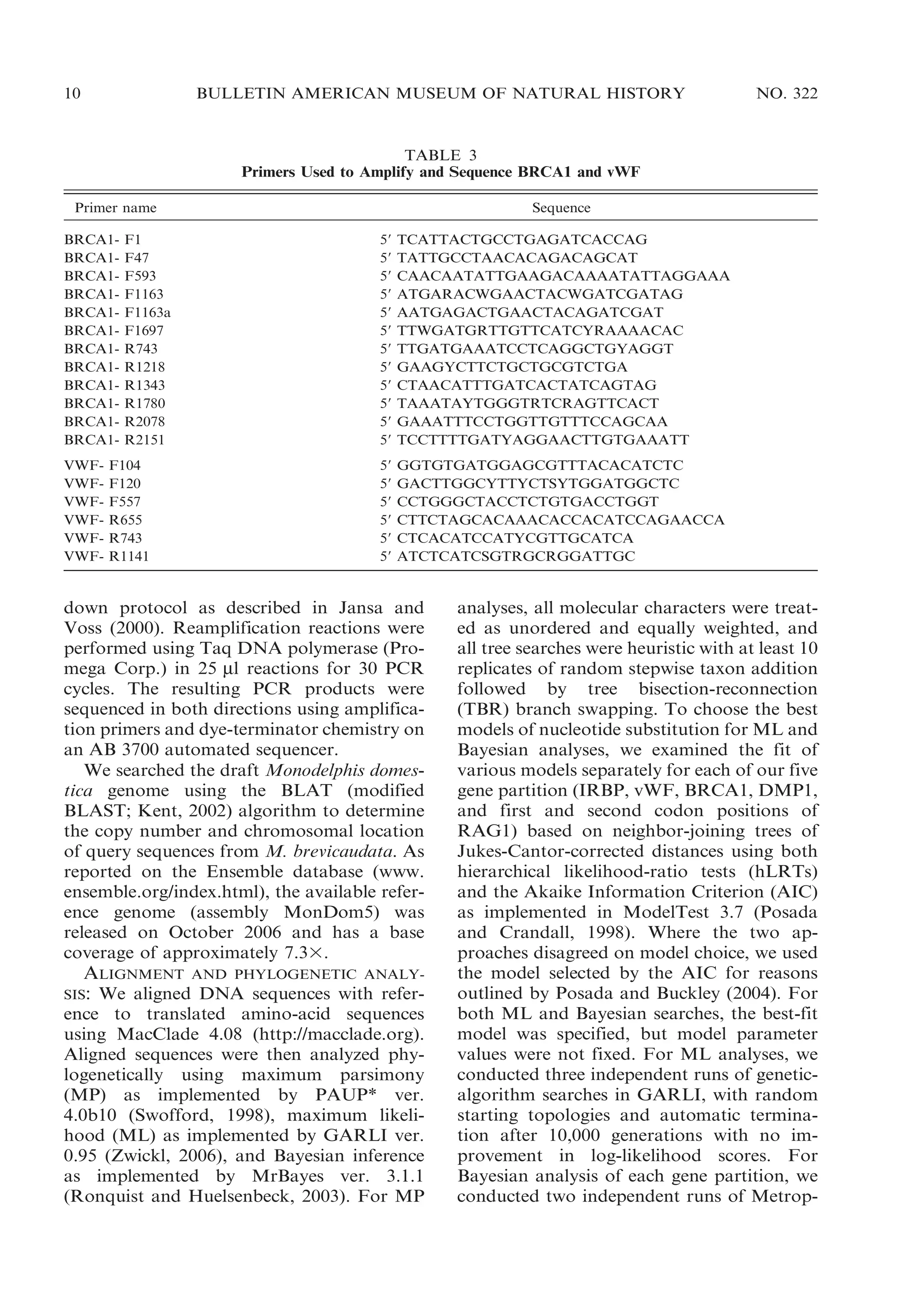
We amplified 2.1 kb of BRCA1 exon 11
from genomic DNA in two fragments using
the primers listed in table 3. The first
fragment, comprising the upstream 1.2 kb
of the exon, was amplified using primers F1
paired with R1218 or F47 paired with R1343.
The second, downstream fragment (ca. 1 kb)
was amplified with primers F1163 or F1163a
paired with R2078 or R2151. These amplification products were then used in a second
round of PCR to generate smaller pieces of
suitable size for sequencing. For the upstream fragment, either F1 or F47 was paired
with R743, and F593 was paired with either
R1218 or R1343. For the downstream
fragment, F1163 or F1163a was paired with
R1780, and F1697 was paired with either
R2078 or R2151. A single fragment of ca.
1 kb was amplified from vWF exon 28 using
either F104 or F120 paired with R1141. This
product was then used in a second round of
PCR in which F1 or F47 was paired with
either R665 or R742, and F557 was paired
with R1141.
Initial amplifications using genomic DNA
as template were performed as 20 ml reactions using Ampli-Taq Gold polymerase
(Perkin-Elmer Corp.) and recommended
concentrations of primers, nucleotides, buffer, and MgCl2. These genomic amplifications
were performed using a four-stage touch-
10

BULLETIN AMERICAN MUSEUM OF NATURAL HISTORY

NO. 322

TABLE 3
Primers Used to Amplify and Sequence BRCA1 and vWF
Primer name
BRCA1BRCA1BRCA1BRCA1BRCA1BRCA1BRCA1BRCA1BRCA1BRCA1BRCA1BRCA1VWFVWFVWFVWFVWFVWF-

F1
F47
F593
F1163
F1163a
F1697
R743
R1218
R1343
R1780
R2078
R2151

F104
F120
F557
R655
R743
R1141

Sequence
59
59
59
59
59
59
59
59
59
59
59
59

TCATTACTGCCTGAGATCACCAG
TATTGCCTAACACAGACAGCAT
CAACAATATTGAAGACAAAATATTAGGAAA
ATGARACWGAACTACWGATCGATAG
AATGAGACTGAACTACAGATCGAT
TTWGATGRTTGTTCATCYRAAAACAC
TTGATGAAATCCTCAGGCTGYAGGT
GAAGYCTTCTGCTGCGTCTGA
CTAACATTTGATCACTATCAGTAG
TAAATAYTGGGTRTCRAGTTCACT
GAAATTTCCTGGTTGTTTCCAGCAA
TCCTTTTGATYAGGAACTTGTGAAATT

59
59
59
59
59
59

GGTGTGATGGAGCGTTTACACATCTC
GACTTGGCYTTYCTSYTGGATGGCTC
CCTGGGCTACCTCTGTGACCTGGT
CTTCTAGCACAAACACCACATCCAGAACCA
CTCACATCCATYCGTTGCATCA
ATCTCATCSGTRGCRGGATTGC

down protocol as described in Jansa and
Voss (2000). Reamplification reactions were
performed using Taq DNA polymerase (Promega Corp.) in 25 ml reactions for 30 PCR
cycles. The resulting PCR products were
sequenced in both directions using amplification primers and dye-terminator chemistry on
an AB 3700 automated sequencer.
We searched the draft Monodelphis domestica genome using the BLAT (modified
BLAST; Kent, 2002) algorithm to determine
the copy number and chromosomal location
of query sequences from M. brevicaudata. As
reported on the Ensemble database (www.
ensemble.org/index.html), the available reference genome (assembly MonDom5) was
released on October 2006 and has a base
coverage of approximately 7.33.

ALIGNMENT AND PHYLOGENETIC ANALYWe aligned DNA sequences with reference to translated amino-acid sequences
using MacClade 4.08 (http://macclade.org).
Aligned sequences were then analyzed phylogenetically using maximum parsimony
(MP) as implemented by PAUP* ver.
4.0b10 (Swofford, 1998), maximum likelihood (ML) as implemented by GARLI ver.
0.95 (Zwickl, 2006), and Bayesian inference
as implemented by MrBayes ver. 3.1.1
(Ronquist and Huelsenbeck, 2003). For MP
SIS:

analyses, all molecular characters were treated as unordered and equally weighted, and
all tree searches were heuristic with at least 10
replicates of random stepwise taxon addition
followed by tree bisection-reconnection
(TBR) branch swapping. To choose the best
models of nucleotide substitution for ML and
Bayesian analyses, we examined the fit of
various models separately for each of our five
gene partition (IRBP, vWF, BRCA1, DMP1,
and first and second codon positions of
RAG1) based on neighbor-joining trees of
Jukes-Cantor-corrected distances using both
hierarchical likelihood-ratio tests (hLRTs)
and the Akaike Information Criterion (AIC)
as implemented in ModelTest 3.7 (Posada
and Crandall, 1998). Where the two approaches disagreed on model choice, we used
the model selected by the AIC for reasons
outlined by Posada and Buckley (2004). For
both ML and Bayesian searches, the best-fit
model was specified, but model parameter
values were not fixed. For ML analyses, we
conducted three independent runs of geneticalgorithm searches in GARLI, with random
starting topologies and automatic termination after 10,000 generations with no improvement in log-likelihood scores. For
Bayesian analysis of each gene partition, we
conducted two independent runs of Metrop-
2009

VOSS AND JANSA: DIDELPHID MARSUPIALS

olis-coupled Markov-chain Monte Carlo
(MCMCMC), each with one cold and three
incrementally heated chains. For each run, we
assumed uniform-interval priors for all parameters, except base composition, which
assumed a Dirichlet prior. Runs were allowed
to proceed for 5 3 106 generations, and trees
were sampled every 100 generations. We
evaluated the burn-in for each run, and
pooled the post-burn-in trees to calculate
estimated parameter distributions and posterior probabilities for each node. We assessed
nodal support from MP and ML analyses
using nonparametric bootstrapping (Felsenstein, 1985). Bootstrap values for the parsimony analyses (MPBS) were calculated in
PAUP* from 1000 pseudoreplicated datasets,
each of which was analyzed heuristically with
10 random-addition replicates with TBR
branch swapping. Bootstrap values for the
likelihood analysis (MLBS) were calculated in
GARLI using genetic-algorithm searches of
1000 pseudoreplicated datasets, allowing
model parameters to be estimated for each
pseudoreplicate.
We analyzed the combined-gene dataset
using ML as implemented in RAxML-VIHPC (ver. 2.2.3; Stamatakis, 2006). We
specified the GTRMIX model, which performs initial tree inference using a GTRCAT
approximation, with final topology evaluation performed under a GTRGAMMA
model. We allowed parameters to be estimated independently across the five gene partitions. To evaluate nodal support for this
combined-gene, mixed-model analysis, we
performed 1000 bootstrap replicates, again
allowing model parameters to be estimated
independently across the five genes. We also
performed a Bayesian analysis of the combined-gene dataset, using the same MCMCMC
settings given above. For this analysis, we
specified the best-fit model for each gene,
decoupled estimation of substitution parameters across the partitions, and allowed each
gene to assume a separate rate.
We analyzed the nonmolecular (morphological + karyotypic) data alone and in
combination with the molecular data using
MP and Bayesian approaches. Due to the
large number of suboptimal trees recovered
from parsimony analysis of the nonmolecular
dataset, we first performed 1000 random-

11

taxon-addition replicates with TBR branch
swapping, but saved only 10 trees per
replicate. We then used this pool of 10,000
trees as the starting point for an unbounded
heuristic search. Parsimony analysis of the
combined (molecular + nonmolecular) dataset did not exhibit this problem; therefore, we
analyzed the combined dataset using unbounded heuristic searches with 1000 replicates of random-taxon addition and TBR
branch swapping. For Bayesian analysis of
the morphological dataset alone, we specified
the Mkv model (Lewis, 2001) with a Cdistributed rate parameter and ascertainment
bias corrected for omission of constant characters (lset coding 5 variable). For Bayesian
analysis of the combined (molecular + nonmolecular) dataset, we specified this same
model for the morphological data and applied
the best-fit model to each of the five gene
partitions. As above, we allowed parameters to
be estimated independently across all partitions and used the same MCMCMC settings.
To assess the impact of the large amount of
missing data from Chacodelphys, we performed all analyses that included nonmolecular characters with and without this taxon.
ONLINE DATA ARCHIVES: All of the new
molecular sequences produced for this study
have been deposited in GenBank with
accession numbers FJ159278–FJ159314 and
FJ 159316–FJ159370 (for a complete list of
GenBank accession numbers of all analyzed
sequences, old and new, see table 9). All of
our datasets, selected ML and Bayesian
analyses, and associated trees have been
deposited on TreeBase (http://www.treebase.
org) with accession numbers S2164, M4107,
and M4108. Our nonmolecular data matrix
has also been deposited on MorphoBank
(http://morphobank.geongrid.org) with accession number X600.
COMPARATIVE MORPHOLOGY
The literature on didelphid comparative
morphology is widely scattered, and no
adequate review of this topic has yet been
published. Although the following accounts
are far from comprehensive, they include
most of the anatomical features that have
been surveyed widely among extant genera
and that provide relevant taxonomic infor-
12

BULLETIN AMERICAN MUSEUM OF NATURAL HISTORY

mation.1 In effect, such information comes
from commonly available materials that can
be examined without dissection or other
special preparations. Therefore, microscopic
features (e.g., those of the spermatozoa;
Temple-Smith, 1987) and visceral characters
(e.g., of the digestive tract; Santori et al.,
2004) are not reviewed below, nor are
osteological traits that require X-ray computed tomography, serial sectioning, or
destructive methods for their study.
Size and External Features
Most opossums are externally unremarkable mammals with pointed muzzles, large
rhinaria, well-developed vibrissae, prominent
eyes, membranous ears, nonspinous pelage,
subequal limbs, pentadactyl feet, and naked
tails. In many of these respects they resemble
other plesiomorphic marsupials (e.g., Dromiciops and dasyurids) as well as certain
unspecialized placentals (e.g., solenodontids,
rice tenrecs, gymnures, and tree shrews).
Closer inspection, however, reveals numerous
distinctive and phylogenetically informative
details of didelphid external morphology.
SIZE: Didelphids are small to mediumsized mammals. The smallest Recent species
is probably Chacodelphys formosa, the young
adult holotype of which had a head-andbody length of 68 mm and probably weighed
about 10 g (Voss et al., 2004a). By contrast,
the largest living opossum, Didelphis virginiana, can measure almost 500 mm in headand-body length and weigh more than 3000 g
(Hamilton, 1958). Most didelphids, however,
range in head-and-body length from about
100 to 300 mm and weigh between about 20
and 500 g (table 4). Although some authors
have recognized ‘‘large’’, ‘‘medium’’, and
‘‘small’’ opossums, taxonomic assignments
to discrete size categories are often arbitrary
and sometimes misleading. For example,
Reig et al. (1987: character 25) scored
Metachirus as ‘‘large’’ and Caluromys as
‘‘medium’’ in their phylogenetic analysis,
but linear measurements and weights that
we compiled suggest that these taxa are
indistinguishable in size. More taxonomically
1
An important exception is postcranial skeletal morphology,
the topic of an independent study (Flores, 2009).

NO. 322

comprehensive compilations of morphometric data will probably document a continuum
of didelphid size distributions.
By comparison, Old World marsupials
include some species that are smaller and
others that are much larger than any
didelphid. The smallest living Australian
species, for example, is said to be Planigale
ingrami, with an adult weight of only about
4 g, and the largest is Macropus rufus, males
of which are said to weigh as much as 85 kg
(Dawson et al., 1989). The extinct Pleistocene
species Diprotodon optatum, however, may
have weighed almost 2800 kg (Wroe et al.,
2004).
RHINARIUM AND MOUTH: The rhinarium,
a prominent pad of naked glandular skin
surrounding the nostrils, is divided by a
median crease or sulcus (sulcus medianus;
Ade, 1999) that extends from between the
nares to the upper lip in all examined
didelphids. The part of the rhinarium that
borders the upper lip (pars supralabialis) is
broad, and its ventral margin is notched by
one or two distinct grooves on each side of
the median sulcus (fig. 1). Two ventrolateral
grooves are present on each side in most
examined taxa, but only a single groove is
present in Chironectes, Didelphis, Lestodelphys, Lutreolina, Metachirus, Monodelphis,
Philander, and Thylamys pallidior. Dasyurids
and Dromiciops have rhinaria that are
essentially similar in gross morphology to
those of didelphids, with a pars supralabialis
that makes broad contact with the upper lip;
however, only a single ventrolateral groove is
present in these taxa (Pocock, 1926: figs. 26–
28). By contrast, the supralabial part of the
rhinarium is reduced to a narrow philtrum in
caenolestids and peramelids, such that the
groove-bearing ventral rhinarial margin of
other marsupials is effectively absent.
The mouth is large in all didelphids, with a
posterior angle (angulis oris; Brown, 1971)
that extends posteriorly to a point below the
eye; the upper and lower oral margins are
smooth or irregularly wrinkled and anatomically featureless. Most other marsupials have
anatomically featureless oral margins like
those of didelphids, but caenolestids are
uniquely provided with reciprocating fleshy
lappets of unknown function on the upper
and lower lips (Osgood, 1921: pl. 2; Bublitz,
2009

VOSS AND JANSA: DIDELPHID MARSUPIALS

13

TABLE 4
External Measurements (mm) and Weights (g) of Exemplar Didelphid Speciesa
Nb
e

Caluromys (Caluromys) philander
Caluromys (Mallodelphys) lanatusf
Caluromysiops irruptag
Chironectes minimush
Cryptonanus unduaviensisi
Didelphis marsupialise
Glironia venustaj
Gracilinanus agilisk
Hyladelphys kalinowskiie
Lestodelphys hallil
Lutreolina crassicaudatam
Marmosa (Marmosa) murinan
Marmosa (Micoureus) reginaf
Marmosops noctivagusf
Marmosops pinheiroie
Metachirus nudicaudatuse
Monodelphis emiliaef
Philander opossume
Thylamys karimiio
Thylamys macruruso
Tlacuatzin canescensp

7
8
1
6
8
9
2
11
3
1
11
13
41
16
11
9
6
11
33
6
7

Head and Bodyc
261
278
260
289
105
419
194
98
77
132
295
133
180
138
103
262
107
301
104
112
137

(224–279)
(270–296)
(276–307)
(97–121)
(405–446)
(188–201)
(86–109)
(76–78)
(241–342)
(118–152)
(142–209)
(118–155)
(94–121)
(249–287)
(97–113)
(264–346)
(78–129)
(101–126)
(126–149)

Taild
390
422
310
348
122
434
208
137
111
88
283
173
262
183
149
345
50
306
80
144
137

(373–410)
(400–446)
(316–362)
(112–135)
(366–497)
(201–215)
(121–162)
(107–113)
(242–336)
(156–195)
(238–294)
(154–202)
(137–156)
(326–370)
(45–53)
(280–333)
(69–106)
(136–153)
(131–145)

Weight
330
412
496
605
25
1351
130
25
16
76
530
51
118
51
27
380
30
549
28
39
—

(220–390)
(349–500)
(520–700)
(15–40)
(1025–1700)
(129–130)
(18–34)
(13–18)
(300–800)
(35–80)
(70–164)
(30–70)
(21–33)
(260–480)
(20–38)
(380–695)
(16–43)
(30–55)
(38–60)

a
Tabulated statistics are the sample mean (rounded to the nearest whole unit) and the observed range (in parentheses)
of measurements and weights recorded from dentally mature specimens; male and female data were combined to increase
sample size despite apparent sexual dimorphism in some species. Most genera are represented by a single exemplar
species, but several genera with recognized subgenera or that include taxa differing conspicuously in size or body:tail
ratios are represented by additional species.
b
Sample size.
c
Obtained by subtracting length of tail from total length following the standard American protocol.
d
Basal flexure to fleshy tip.
e
French Guianan specimens measured by Voss et al. (2001).
f
Measurements and weights from western Brazilian specimens (Patton et al., 2000).
g
Measurements and weight of AMNH 208101; because this was a zoo specimen that may have been obese, the weight
datum is suspect.
h
From Paraguayan specimens (UMMZ 126289, 134022, 134023, 134025, 134559, 134560).
i
From Bolivian specimens measured by Voss et al. (2005).
j
Measurements and weight of MMD 607 (collected near Iquitos, Peru; to be deposited in the Museo de Historia
´
Natural de la Universidad Nacional Mayor de San Marcos, Lima; M.M. Dıaz, personal commun.) and INPA 5237
(collected near Mirassol d’Oeste, Mato Grosso, Brazil; Santos Filho et al., 2007).
k
From Paraguayan specimens (UMMZ 124675, 126104, 133998–134006).
l
Measurements and weight from MVZ 173727.
m
From Paraguayan specimens (UMMZ 126109–126111, 126113, 134010, 134011, 134017–134021).
n
From Surinamese specimens measured by Voss et al. (2001).
o
From Carmignotto and Monfort (2006).
p
External measurements from Oaxacan specimens unaccompanied by weight data (AMNH 3111/2433, 3111/2434,
3114/2437, 148969, 149104, 165651, 165653); range of weights from Zarza et al. (2003).

1987: fig. 4; Patterson and Gallardo, 1987:
fig. 3).
FACIAL VIBRISSAE AND MARKINGS: Didelphid facial vibrissae are grouped into discrete
tracts that are easily homologized with those
described and illustrated by Pocock (1914),

Lyne (1959), and Brown (1971), whose
terminology is followed here. All of the taxa
we examined (including representative species
from every genus) exhibit well-developed
mystacial, submental, interramal, superciliary (supraorbital), and genal vibrissae. La-
14

BULLETIN AMERICAN MUSEUM OF NATURAL HISTORY

Fig. 1. Ventral view of rhinarium in Thylamys
pallidior (A, UMMZ 156349) and Marmosa
robinsoni (B, UMMZ 117236). Both species have
a broad pars supralabialis (psl) that contacts the
upper lip. Only a single groove (g) is present along
the ventral margin of the pars supralabialis on
each side of the median sulcus (ms) in T. pallidior,
whereas two ventrolateral grooves are present in
M. robinsoni. Scale bars 5 2 mm.

beled illustrations of didelphid facial vibrissae are provided by Pocock (1914: fig. 1A)
and Lyne (1959: fig. 2). Most other plesiomorphic marsupials closely resemble didelphids in cranial vibrissal traits, but caenolestids lack interramal vibrissae (Lyne, 1959).
Didelphids exhibit conspicuous taxonomic
variation in facial markings (frontispiece;
Voss and Jansa, 2003: fig. 3). In Caluromys,
a median streak of dark fur, unconnected
with any other dark marking, extends from

NO. 322

the rostrum to the frontal region. In other
didelphids, a chevron of dark coronal fur
sometimes extends anteriorly between the
ears and down the rostral midline, but the
condition seen in Caluromys is distinctive and
apparently nonhomologous. No nondidelphid marsupial that we examined has a dark
midrostral stripe.
The fur surrounding the eye is not
distinctively colored in Caluromysiops, Lutreolina, or Monodelphis, but most other
didelphids have masklike markings. A circumocular mask or ring of dark (usually
blackish) fur that contrasts sharply with the
paler (usually brownish, whitish, or grayish)
color of the crown and cheeks is present in
Glironia, Lestodelphys, and ‘‘marmosines’’
(taxa formerly included in ‘‘Marmosa’’ sensu
Tate, 1933). Species of Caluromys have
essentially similar reddish-brown eye rings
that contrast with grayish cheeks and crowns.
A blackish mask is likewise present in all
examined species of Didelphis, but this
marking is inconspicuous in D. marsupialis
and D. virginiana. A blackish mask is also
present in Metachirus, Chironectes, and
Philander, but the dark circumocular fur in
these taxa is usually continuous with dark fur
on the crown of the head. Among nondidelphid marsupials, dark circumocular masks
are present in Dromiciops, some dasyurids
(e.g., Sminthopsis crassicaudata), a few peramelemorphians (e.g., Echymipera kalubu),
and some small arboreal diprotodontians
(e.g., Petaurus breviceps); only one examined
outgroup taxon, Echymipera kalubu, has a
mask that is more or less continuous with
dark coronal fur.
A distinct whitish supraocular spot is
consistently present in species of Metachirus
and Philander, resulting in the ‘‘four-eyed’’
marking by which these animals are commonly known. Most other didelphids lack
pale supraocular markings. (An indistinct
pale bar above each eye in Chironectes
appears to be part of the unique transverse
banding pattern in that taxon rather than a
homologue of the condition seen in Metachirus and Philander.) We have not examined
any nondidelphid marsupial with pale supraocular spots.
GULAR GLAND: As described by Tate
(1933: 30), many didelphids have a cutaneous
2009

VOSS AND JANSA: DIDELPHID MARSUPIALS

gular (throat) gland, the presence of which is
indicated on dried skins and fluid-preserved
specimens by a bare median patch of skin;
often, but not invariably, the surrounding fur
is discolored. According to Barnes (1977:
390), this secretory region contains ‘‘hypertrophied apocrine sudoriferous glands and
sebaceous glands, both confined to the
thickened dermis.’’ External signs of glandular activity tend to be maximally developed in
fully mature males (loc. cit.).
No unambiguously glandular throat patch
was observed in any examined specimens of
Caluromys, Caluromysiops, Chironectes, Hyladelphys, Lutreolina, Philander, or Tlacuatzin. By contrast, fully adult male specimens
of Cryptonanus, Gracilinanus, Lestodelphys,
and Thylamys usually exhibit well-developed
gular glands. A gular gland is also present on
the young adult male holotype (and only
known skin) of Chacodelphys formosa. Other
didelphid genera (Marmosa, Marmosops, and
Monodelphis) include some species that consistently develop adult male gular glands and
others that just as consistently show no trace
of such organs (Voss and Jansa, 2003).
Although adult male Didelphis often have
discolored gular fur, no glandular skin is
macroscopically distinguishable. Because we
were not able to examine any fully adult male
specimens of Glironia, the occurrence of gular
glands in this taxon is unknown.
Gular (or sternal) glands that are macroscopically and histologically similar to those
of didelphids are present in most dasyurids
(Cooper et al., 2005), but other plesiomorphic outgroup taxa (e.g., caenolestids,
peramelids, Dromiciops) seem to lack all
external traces of glandular activity on the
throat or chest.
BODY PELAGE: All didelphids have one or
more tracts of postcranial vibrissae (Brown
and Yalden, 1973), including ulnar-carpal
vibrissae (at the wrist), medial antebrachial
vibrissae (at or near the middle of the
forearm), anconeal vibrissae (at the elbow),
and/or calcaneal vibrissae (on the ankle).
Lyne (1959) reported the occurrence of
postcranial vibrissae in several didelphid
species based on his examination of pouch
young, whose sensory hair follicles are easily
seen because they are not obscured by coat
hairs. Unfortunately, postcranial vibrissae

15

are much harder to observe on fully furred
adult specimens, the only material commonly
available for most species. We found ulnarcarpal and medial antebrachial vibrissae on
most examined didelphids, whereas anconeal
and calcaneal vibrissae were often inapparent.
All didelphids have soft (nonspinous) fur
consisting of two or more distinct types of
hairs whose density and morphology determine the appearance and texture of the coat.
Some taxa (e.g., Caluromys) have somewhat
woolly fur that does not lie flat or exhibit the
glossy highlights typically seen in the pelts of
many other taxa, but textural differences are
hard to define by objective criteria that can
be used for character-state definitions or
taxonomic diagnoses. The only structural
(nonpigmental) feature of didelphid body
pelage that seems useful in this context is
the presence of uniquely long, coarse guard
hairs that project conspicuously from the
underfur in species of Didelphis.
The dorsal body pelage of most didelphids
is uniformly colored and unpatterned, usually some shade of brownish or grayish, but
some taxa are distinctively marked (see
illustrations in Eisenberg, 1989; Redford
and Eisenberg, 1992; Perez-Hernandez et
´
´
al., 1994; Reid, 1997; Eisenberg and Redford,
1999). Blackish transverse bars connected
middorsally on a pale-grayish background,
for example, characterize Chironectes; dark
scapular stripes are unique to Caluromysiops;
three longitudinal stripes are present in
several species of Monodelphis (e.g., M.
theresa); a grayish middorsum contrasting
with reddish flanks is exhibited by other
species in that genus (e.g., M. brevicaudata);
and a grayish midbody contrasting with
reddish head and rump is seen in others
(e.g., M. emiliae). The subtle but consistently
diagnostic ‘‘tricolor’’ shading of Thylamys
and Lestodelphys was described by Tate
(1933: 209):
Instead of the usual bicolor system composed of
a dorsal color, paling a little on the sides, which
is replaced at a generally well-marked transition
line by a distinct ventral color, the elegans group
[5 Thylamys] displays three distinct shades,
separated from each other along each side by
two lines of transition. The additional lines are
subdorsal, running from a point at the center of
16

BULLETIN AMERICAN MUSEUM OF NATURAL HISTORY

the frons [forehead] past the inner edge of each
ear (not including it), and straight backward
through scapulae and hips, where they again
approach the median line of the body and
merge with the tail. This pair of lines encloses
the major part of the dorsal area of head and
body, the color of the area being very dark
brownish-gray or grayish fuscous. The fuscous
area is pointed at front, projecting forward
between the ears, and narrows again to a point
as it merges with the dark color of the upper
surface of the tail. The second [lateral] area,
light gray in color, frequently tinged with buffy
or yellowish, extends [on each side] between the
dark dorsal region and the edge of the belly
color at the normal transition line. Ventral color
either buffy, grayish, or snowy white.

The hair bases of the dorsal fur are heavily
pigmented, usually dark gray (or grayish), in
most didelphids, but species of Didelphis
uniquely exhibit white dorsal underfur.
The ventral pelage also exhibits noteworthy taxonomic variation among didelphids.
In some species the ventral fur is ‘‘graybased,’’ a descriptor that applies when the
individual hairs are grayish basally and
abruptly paler (usually whitish, yellowish,
or brownish) distally; the overall color of the
ventral fur then depends on the degree to
which the dark basal pigmentation shows
through the paler superficial hue. In other
species, the ventral fur is partially or entirely
‘‘self-colored,’’ a descriptor that applies when
the individual hairs have the same pigmentation (usually whitish) from root to tip.
Because marked differences in the patterning
of gray-based versus self-colored ventral pelage can occur among closely related (congeneric) species, such variation is often described
and illustrated in the revisionary taxonomic
literature (e.g., Patton et al., 2000: fig. 41).
However, the existence of numerous intermediate conditions spanning the entire range of
taxonomic variation in ventral color patterns
(e.g., from entirely gray-based to completely
self-white ventral fur) precludes meaningful
phylogenetic scoring of this character.
Whereas most of the pelage colors (and
color patterns) described above are preserved
on museum skins that have been protected in
dark cabinets from the bleaching effects of
light, other colors that can be striking in life
fade quickly after death. The ventral pelage

NO. 322

of live Monodelphis emiliae, for example, has
been described as ‘‘bright glowing violaceous
pink’’ (Emmons, 1997: 34), a lurid hue that is
not retained in any examined museum
specimens. What little is known about such
fugitive pigments (some of which fluoresce
under ultraviolet light) was summarized by
Pine et al. (1985).
Most other marsupials have unremarkable
body pelage that essentially resembles the
common didelphid condition as described
above, but postcranial vibrissae are reduced
or absent in a few clades (Lyne, 1959) and
peramelemorphians have stiff, dorsally grooved
guard hairs (illustrated in cross section by
Lyne and McMahon, 1951: figs. 51, 60) that
impart a distinctively harsh, spinous texture
to their fur. Most other marsupials also
resemble didelphids in having unpatterned
dorsal fur, although there are noteworthy
examples of apparently convergent markings
(e.g., those of Dromiciops somewhat resemble
Chironectes’; Marshall, 1978b) and some
strikingly divergent ones (e.g., the transverse
sacral barring seen in Perameles gunnii; Lyne,
1951: pl. 1B). All examined outgroup taxa
have dark dorsal underfur.
WRIST: The wrists of males and females
are morphologically similar and externally
featureless in most didelphids, but striking
sexual dimorphism is present in certain small
arboreal and scansorial forms (Lunde and
Schutt, 1999). Grossly enlarged glabrous
tubercles supported internally by carpal
ossifications are exhibited by large adult
males of Cryptonanus, Gracilinanus, Marmosops, Tlacuatzin, and some species of Marmosa. Two distinct kinds of tubercles can be
distinguished, consisting of lateral (‘‘ulnar’’)
tubercles supported internally by the pisiform, and medial (‘‘radial’’) tubercles supported by the prepollex (op. cit.). Although
some intraspecific variation in the development of carpal tubercles has been documented, most of it can be attributed to ontogeny:
tubercles are consistently present in the
largest adult male specimens of species in
which such structures occur, whereas they
may be lacking in some smaller (presumably
younger) conspecific males. Lunde and
Schutt (1999) plausibly suggest that these
structures function as clasping devices during
copulation.
2009

VOSS AND JANSA: DIDELPHID MARSUPIALS

17

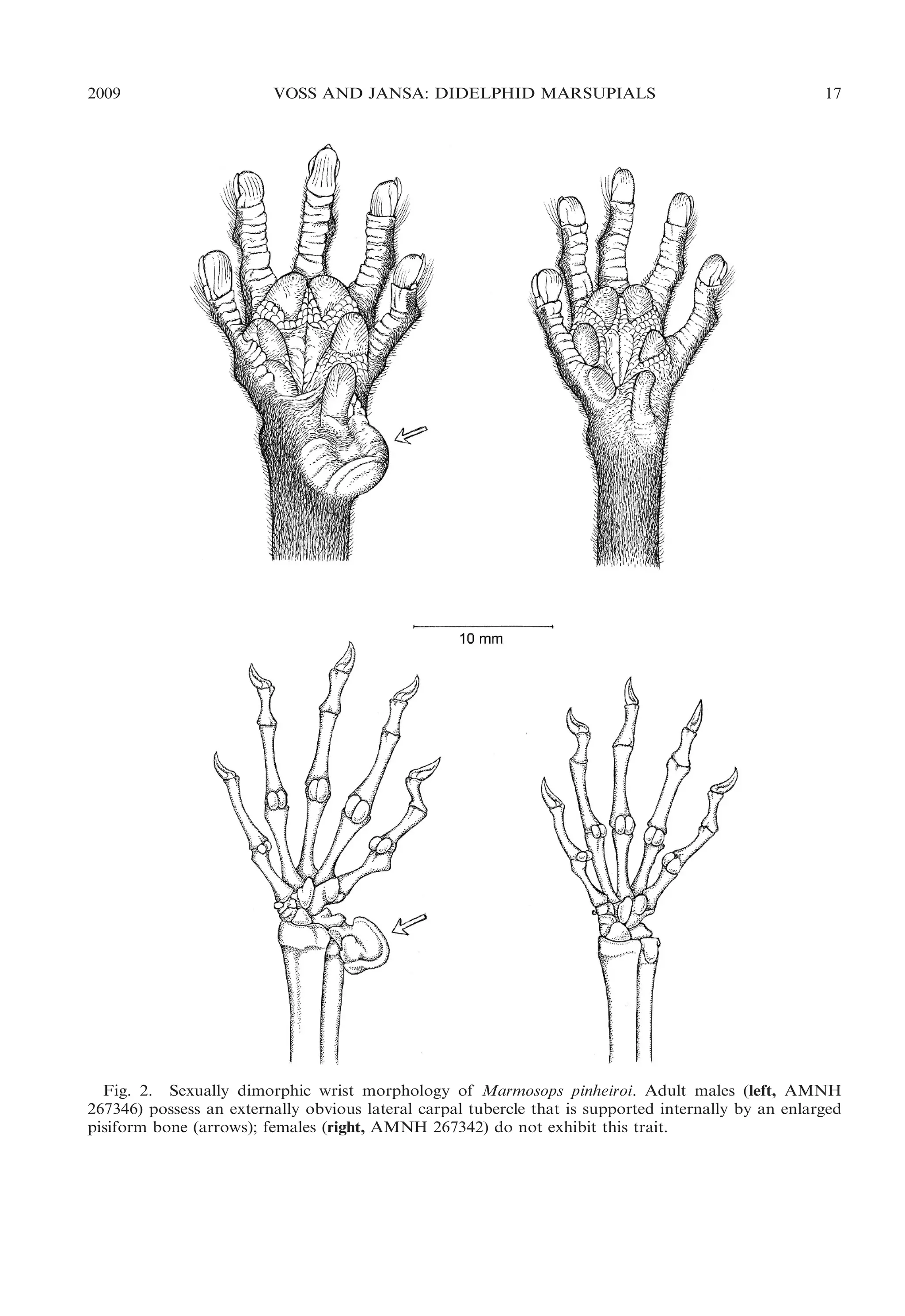
Fig. 2. Sexually dimorphic wrist morphology of Marmosops pinheiroi. Adult males (left, AMNH
267346) possess an externally obvious lateral carpal tubercle that is supported internally by an enlarged
pisiform bone (arrows); females (right, AMNH 267342) do not exhibit this trait.
18

BULLETIN AMERICAN MUSEUM OF NATURAL HISTORY

Lateral carpal tubercles (fig. 2) are more
widespread than medial carpal tubercles,
occurring in all taxa that exhibit any externally obvious sexual dimorphism in the wrist.
We found these structures to be consistently
present in large adult male specimens of
Cryptonanus, Gracilinanus, Marmosops, Tlacuatzin, and most species of Marmosa. In
addition, we observed medial carpal tubercles
(Lunde and Schutt, 1999: fig. 3) in Marmosa
demerarae, M. mexicana, M. paraguayana,
M. regina, M. robinsoni, and M. rubra. Other
didelphids appear to lack sexually dimorphic
carpal tubercles,2 but we were not able to
determine whether or not such structures are
present in Chacodelphys and Glironia because
no fully adult male specimens of either genus
are currently available for study.
The water opossum Chironectes has carpal
tubercles that, uniquely, are neither sexually
dimorphic nor ontogenetically variable. In
this taxon, juveniles and adults of both sexes
possess a large, fleshy process on the outside
of the wrist, resembling a sixth finger, that is
supported internally by the pisiform (Augustiny, 1942: fig. 16; Mondolfi and Medina,
1957: fig. 14; Oliver, 1976: fig. 1b).
No examined nondidelphid marsupial has
carpal tubercles of any kind.
MANUS: The didelphid hand is provided
with five well-developed clawed digits (fig. 3).
When the digits are flexed, their tips converge
toward the center of the palm, and it seems
likely that at least the arboreal and scansorial
forms—which tend to have relatively longer
fingers than terrestrial taxa (Lemelin, 1999;
Kirk et al., 2008)—are capable of manual
prehension. In most didelphids, the manual
digits are more or less evenly spaced, but in
some arboreal taxa (e.g., Caluromys, Caluromysiops, Marmosa) the gap between dII and
dIII is somewhat larger than the gaps
separating other pairs of adjacent fingers,
and it is possible that these taxa are
incipiently schizodactylous (sensu Haines,
2
´
Prochel and Sanchez-Villagra (2003) reported that adult
males of Monodelphis domestica, a species that lacks external
evidence of sexual dimorphism in the wrist, nevertheless have
significantly larger and more robust pisiforms than females. This
condition could obviously be interpreted as a state intermediate
to complete absence of sexual dimorphism in the wrist on the
one hand and the very marked dimorphism exhibited by species
with male carpal tubercles on the other.

NO. 322

1958). The pollex (dI) of Chironectes is set
off from the other manual digits by a wide
gap and appears to be pseudo-opposable
(sensu Napier, 1961); in fluid-preserved
specimens it is often folded across the palm
(Augustiny, 1942: fig. 16).
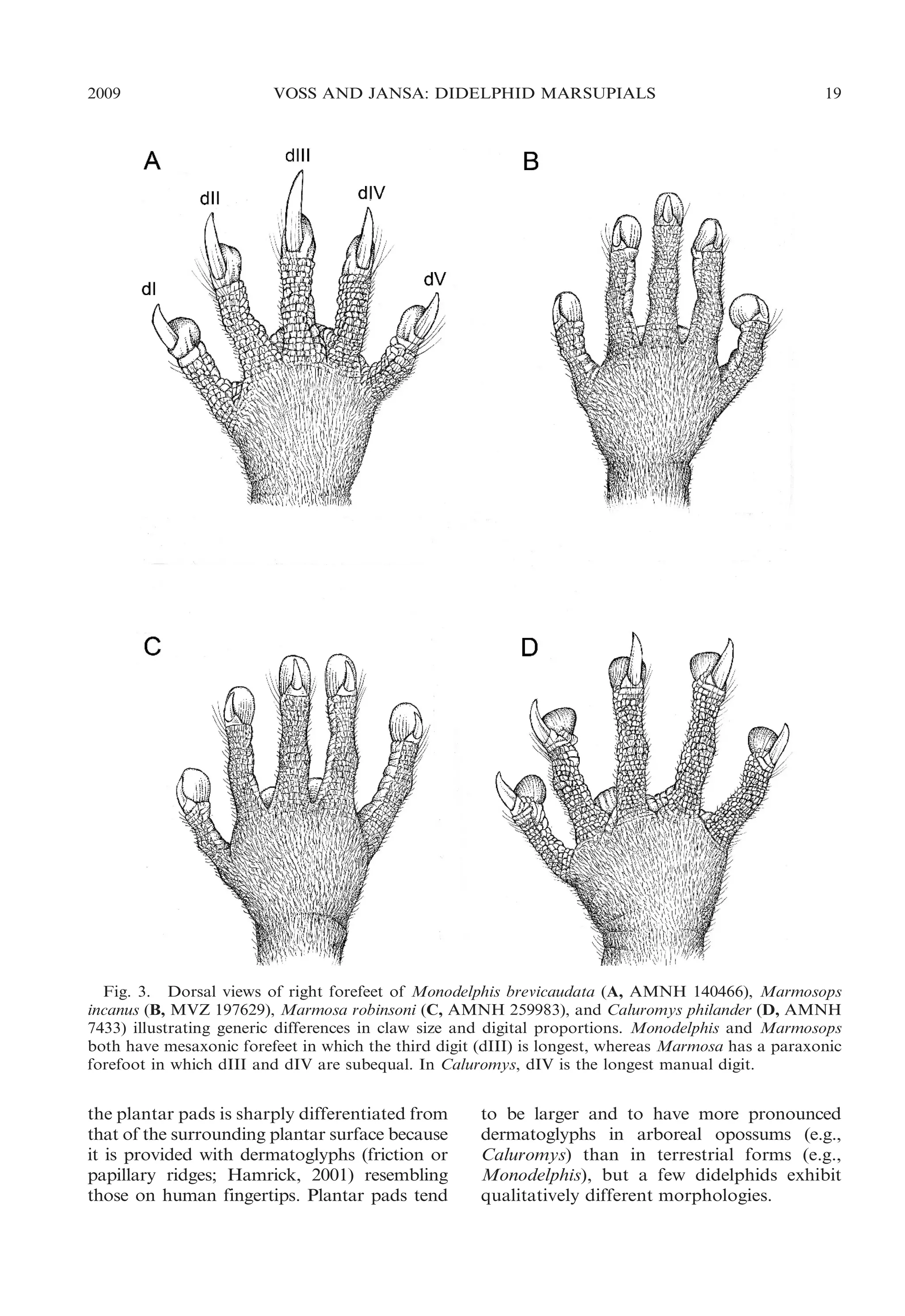
According to Tate (1947), the third and
fourth digits of the didelphid manus are
subequal and longer than the other fingers
(fig. 3C), proportions that correspond to the
paraxonic morphotype defined by Brown
and Yalden (1973). Not all didelphids have
paraxonic forefeet, however. Instead, many
have a mesaxonic manus in which dIII is
distinctly longer than the other fingers; taxa
that exhibit this condition include Chacodelphys, Chironectes, Didelphis, Lestodelphys,
Lutreolina, Marmosops (fig. 3B), Metachirus,
Monodelphis (fig. 3A), Philander, and Thylamys. Yet another alternative condition is seen
in Caluromys and Caluromysiops, in which
dIV is slightly but distinctly longer than dIII
(fig. 3D).
Many didelphids have small, weakly recurved manual claws that do not extend
much (if at all) beyond the fleshy apical pad
of each digit (fig. 3B, C), but some arboreal
taxa such as Caluromys (fig. 3D) and others
that are strictly terrestrial such as Monodelphis (fig. 3A) have large manual claws that
extend well beyond the apical pads. The large
manual claws of Glironia (not illustrated) are
unusually deep, laterally compressed, and
strongly recurved. Although illustrated taxonomic differences in claw length are striking,
intermediate morphologies observed among
other forms (e.g., Hyladelphys) make it
difficult to recognize discrete character states
for taxonomic analysis.
Like most other plantigrade mammals
(Whipple, 1904; Brown and Yalden, 1973),
didelphids usually have two well-developed
metacarpal pads (thenar, hypothenar) and
four interdigital pads on the hairless ventral
(plantar or volar) surface of the manus. These
six pads encircle a central palmar region that
is either smooth or sparsely tubercular (as in
most didelphids; see Hershkovitz, 1997: fig.
6A) or densely covered with small convex
tubercles (as in Chacodelphys, Lestodelphys,
and most species of Thylamys; see Carmignotto and Monfort, 2006: fig. 3C). In
almost all species, the epidermis that covers
2009

VOSS AND JANSA: DIDELPHID MARSUPIALS

19

Fig. 3. Dorsal views of right forefeet of Monodelphis brevicaudata (A, AMNH 140466), Marmosops
incanus (B, MVZ 197629), Marmosa robinsoni (C, AMNH 259983), and Caluromys philander (D, AMNH
7433) illustrating generic differences in claw size and digital proportions. Monodelphis and Marmosops
both have mesaxonic forefeet in which the third digit (dIII) is longest, whereas Marmosa has a paraxonic
forefoot in which dIII and dIV are subequal. In Caluromys, dIV is the longest manual digit.

the plantar pads is sharply differentiated from
that of the surrounding plantar surface because
it is provided with dermatoglyphs (friction or
papillary ridges; Hamrick, 2001) resembling
those on human fingertips. Plantar pads tend

to be larger and to have more pronounced
dermatoglyphs in arboreal opossums (e.g.,
Caluromys) than in terrestrial forms (e.g.,
Monodelphis), but a few didelphids exhibit
qualitatively different morphologies.
20

BULLETIN AMERICAN MUSEUM OF NATURAL HISTORY

The plantar pads of two Brazilian species
of Thylamys (illustrated by Carmignotto and
Monfort, 2006: figs. 3a, 3b) are fused
together and fill the entire palmar region
rather than encircling a central palmar
surface as in other didelphids. Additionally,
only the apices of the plantar pads are
provided with dermatoglyphs in T. velutinus,
whereas the pads of T. karimii lack dermatoglyphs completely. Instead, the plantar
pads are mostly (T. velutinus) or entirely (T.
karimii) covered with small convex tubercles
like those that occur on the center of the
palm in other species of Thylamys.
The ventral surface of the manus in the
water opossum uniquely lacks any trace of
plantar pads. Instead, the palm of Chironectes is essentially flat and densely covered
with microscopically dentate tubercles whose
fine structure was described and illustrated
by Brinkmann (1911) and Hamrick (2001).
Numerous smooth, hemisperical papillae
(not mentioned by Hamrick, 2001), however,
are scattered at regular intervals among the
dentate tubercles and presumably have a
different function (Brinkmann, 1911).
Among other plesiomorphic marsupials,
dasyurids and Dromiciops most closely resemble didelphids in manual morphology,
both taxa having five well-developed clawed
digits. However, whereas dIII and dIV are
subequal in Dromiciops, dIII is distinctly
longer than dIV in dasyurids. By contrast,
dI and dV are conspicuously reduced and
nail bearing in caenolestids (Osgood, 1921:
pl. 2, fig. 4), and the same digits are
vestigial—lacking claws or nails—in peramelemorphians (Lyne, 1951: fig. 11); of the
remaining manual digits, dIII is distinctly the
longest in both of these groups. Manual
plantar pads are indistinct or absent in all
examined peramelemorphians but they are
distinct in dasyurids, caenolestids, and Dromiciops. Whereas the plantar pads of Dromiciops and at least some dasyurids (e.g.,
Murexia) have dermatoglyphs, the plantar
pads of other dasyurids (e.g., Sminthopsis
crassicaudata) are tubercular, and those of
caenolestids are smooth. The central palmar
surface is essentially smooth (or irregularly
creased) in caenolestids and Dromiciops, but
it is densely tubercular in examined dasyurids
and peramelids.

NO. 322

Fig. 4. Plantar view of right hind foot of
Gracilinanus marica (redrawn from Boas, 1918: pl.
1, fig. 2). Pedal characters that distinguish
didelphids from most other marsupials include
eleuthrodactyly, a large opposable hallux (digit I),
a grooming claw (Putzkralle) on digit II, and
prominent dermatoglyph-bearing plantar pads.

PES: Most didelphids have an eleuthrodactylous hind foot with five well-developed
digits that are all separate and freely movable
(fig. 4). The only exception is Chironectes,
whose pedal digits are bound together by
webs of skin to form a paddlelike swimming
organ (illustrated by Augustiny, 1942: Mondolfi and Medina, 1957; Oliver, 1976; Hershkovitz, 1997). Although Bensley (1903), Tate
(1933), and Kirsch (1977b) suggested that
some didelphids exhibit incipient fusion of
dII and dIII, we have not observed any
specimen with a hind foot that even remotely
resembles the syndactylous condition seen in
peramelemorphians and diprotodontians.3
3
Weisbecker and Nilsson (2008) likewise concluded that
didelphids do not exhibit incipient syndactyly. The illustration
in Hall (1987: fig. 1n) that appears to show an incipiently
syndactylous foot in ‘‘Didelphis microtarsus’’ (5 Gracilinanus
microtarsus) is a grotesque cartoon that does not accurately
depict the pedal morphology of that species or any other
opossum (for an anatomically accurate illustration of the hind
foot of Gracilinanus, see fig. 4).
2009

VOSS AND JANSA: DIDELPHID MARSUPIALS

The didelphid hallux (dI) is well developed,
set off at a wide angle from the other pedal
digits, and fully opposable. As in other
marsupials, the hallux is claw- and nailless
in opossums. Although this digit tends to be
maximally developed in arboreal forms, it is
always long enough to contact the tips of the
other digits when they are flexed, even in
such strictly terrestrial taxa as Lestodelphys,
Lutreolina, and Monodelphis.
The remaining pedal digits bear welldeveloped claws that are laterally compressed
and dorsoventrally recurved like those of
most other plantigrade mammals (Brown
and Yalden, 1973). The claws on dIV and
dV are more or less symmetrically crescentic,
with an unguis that is equally extensive on
the axial and abaxial surfaces, and a subunguis that is only exposed ventrally. Digit
II, however, bears a strikingly asymmetrical
grooming claw (Putzkralle; Boas, 1918) with
an abaxially exposed subunguis and a rounded, spoon-shaped apex. The subunguis is
sometimes also exposed abaxially on the claw
of dIII, but the asymmetry is consistently less
than that of the second digital claw, and the
third claw never has a rounded tip.
In the strictly terrestrial opossums Lestodelphys, Lutreolina, and Monodelphis, the
third pedal digit is longer than the adjacent
second and fourth digits, and the hind foot is
therefore mesaxonic (sensu Brown and Yalden, 1973). By contrast, dII, dIII, and dIV
are subequal (none distinctly longer than the
others) in Didelphis albiventris and D. virginiana. Among all other examined didelphid
taxa (including Didelphis marsupialis), the
second, third, and fourth pedal digits progressively increase in length, such that dIV is
the longest toe opposing the hallux. It is
noteworthy that the relative lengths of pedal
digits do not strictly covary with those of the
manual digits, as they might be expected to
do if transformations of the pes and manus
were functionally or developmentally determined by the same factors. For example,
whereas dIV is the longest pedal digit in
Marmosops, dIII is the longest manual digit
in that genus.
In most didelphids (e.g., Philander; Hershkovitz, 1997: fig. 6B) the entire ventral
surface of the hind foot is macroscopically
naked from the apex of the heel to the tips of

21

the toes. Under high magnification, a fine
plantar pelage of very short hairs partially or
completely covers the heel in some taxa (e.g.,
Marmosops), but intermediate conditions in
other forms and variation among conspecific
individuals suggest that such microscopic
details are not a reliable basis for either
phylogenetic analysis or taxonomic diagnosis. By contrast, a morphologically distinctive
condition occurs in Lestodelphys and Thylamys (see Carmignotto and Monfort, 2006:
fig. 3), whose heels are entirely covered by
coarse (macroscopically visible) fur.
Most didelphids have six separate plantar
pads like many other plantigrade mammals
(Brown and Yalden, 1973), but several
patterns of taxonomic variation are noteworthy: (1) The position normally occupied by
the hypothenar (lateral tarsal) and fourth
interdigital pads in most didelphids is occupied by a single elongate pad in Caluromys,
Caluromysiops, and Glironia; although this
large structure is plausibly interpreted as the
result of fusion (hypothenar + interdigital 4),
this scenario is complicated by the occasional
presence (e.g., in AMNH 273038) of a small
proximal metatarsal pad that might be a
vestigial hypothenar. (2) The hypothenar is
absent or variably present but clearly vestigial in Monodelphis, Lutreolina, Philander,
and Didelphis. (3) The thenar (medial tarsal)
and first interdigital pads are often in contact
or indistinguishably fused among arboreal
taxa (e.g., Caluromys and Marmosa), but a
continuum of intermediate conditions precludes any unambiguous distinction between
these morphologies and the separate conditions seen in terrestrial forms (e.g., Monodelphis and Thylamys). (4) Interdigital 2 is
much larger than interdigital 3 in most
arboreal/scansorial forms (e.g., Marmosa,
Marmosops), but they are subequal in some
terrestrial taxa (e.g., Monodelphis and Lutreolina).
The pedal plantar pads of most didelphids
are provided with dermatoglyphs like those
of the manual plantar pads. However, the
dermatoglyph-bearing epithelium is much
reduced in Thylamys velutinus, and in T.
karimii the pedal plantar pads are entirely
tubercular (lacking dermatoglyphs completely; Carmignotto and Monfort, 2006: fig. 3).
As in so many other aspects of its appendic-
22

BULLETIN AMERICAN MUSEUM OF NATURAL HISTORY

ular morphology, Chironectes is unique
among didelphids in lacking any trace of
pedal plantar pads.
The eleuthrodactylous hind foot of Dromiciops resembles the common didelphid
morphotype in having a large opposable
hallux, a grooming claw on dII, dIV . dIII,
and dermatoglyph-bearing plantar pads
(Hershkovitz, 1999: fig. 21). By contrast, the
hind foot of peramelids is syndactylous (with
fused dII and dIII; Hall, 1987; Weisbecker
and Nilsson, 2008); the hallux is small and
effectively nonopposable in caenolestids (Osgood, 1921: pl. 2, fig. 3), dasyurids (Thomas,
1888: pl. 23, fig. 8), and peramelids (Lyne,
1951: fig. 12); dIII and dIV are subequal in
examined caenolestids and dasyurids, both of
which groups also lack a grooming claw on
dII; peramelids do not have distinct plantar
pads; the plantar pads of caenolestids are
smooth; and the plantar pads of some
dasyurids are tubercular. The plantar epithelium of the heel is macroscopically naked in
most of these outgroup taxa, but the underside of the heel is coarsely furred in some
dasyurids (e.g., Sminthopsis crassicaudata).
POUCH AND MAMMAE: Based on our firsthand examination of parous adult female
specimens, pouchlike enclosures for nursing
young are unequivocally present or absent
among didelphids. Although our sample sizes
were always small, we observed no intraspecific variation in this aspect of female
reproductive morphology, nor did we observe any intermediate condition between
absence and presence of a pouch. Despite
the fact that several distinctly different pouch
configurations can be recognized among
opossums, we provisionally recognize all
pouches as homologous in the absence of a
priori evidence to the contrary.
We found no trace of a pouch in suitable
material (fluid-preserved specimens and carefully prepared skins) of parous adult female
Cryptonanus, Glironia, Gracilinanus, Hyladelphys, Lestodelphys, Marmosa, Marmosops,
Metachirus, Monodelphis, Thylamys, and
Tlacuatzin. By contrast, well-developed
pouches were consistently found to be
present in suitably prepared parous adult
females of Caluromys, Chironectes, Didelphis,
and Philander. Although Lutreolina was
described as pouchless by Thomas (1888),

NO. 322

Cabrera (1919), and Marshall (1978a), two
fluid-preserved parous females that we examined (UMMZ 166634, USNM 536827)
had pouches exactly resembling the morphology illustrated and described by Krieg (1924:
fig. 11). Caluromysiops is said to have a
pouch (Izor and Pine, 1987; Reig et al., 1987),
but no explicit description or illustration of
the female reproductive anatomy of this
genus is available, nor were we able to
examine suitably preserved parous female
specimens. The presence or absence of a
pouch remains undocumented for many
opossums, notably Chacodelphys. Contradictory literature accounts of a pouch as present
or absent in Metachirus were discussed by
Voss and Jansa (2003).
The marsupium of Caluromys philander
uniquely consists of deep lateral skin folds
that enclose the nursing young and open in
the midline (resembling the morphology that
Tyndale-Biscoe and Renfree [1987: fig. 2.8]
incorrectly attributed to didelphids in general). In Caluromys lanatus, Didelphis, and
Philander, however, the lateral pockets are
joined posteriorly, forming a more extensive
enclosure that opens anteriorly (Enders,
1937: fig. 19). Yet another condition is
exhibited by Chironectes and Lutreolina, in
which the lateral pockets are connected
anteriorly, forming a marsupium that opens
posteriorly (Krieg, 1924: fig. 11A; Oliver,
1976: fig. 1B).
In all marsupials that possess a pouch the
mammae are contained within it, but the
mammae of pouchless taxa are variously
distributed (Tate, 1933: fig. 3). In most
pouchless didelphids (e.g., Glironia, Marmosa, Metachirus) the mammae are confined
to a more or less circular inguinal/abdominal
array that occupies the same anatomical
position as the pouch in taxa that possess a
marsupium. However, other pouchless opossums (e.g., Cryptonanus guahybae, Marmosops incanus) have bilaterally paired mammae
that extend anteriorly well beyond the pouch
region. Although most of these anterior teats
are not actually located on the upper chest,
they are usually referred to as ‘‘pectoral’’ or
‘‘thoracic’’ mammae (e.g., by Tate, 1933;
Reig et al., 1987).
Most didelphids have, in addition to
bilaterally paired mammae, an unpaired
2009

VOSS AND JANSA: DIDELPHID MARSUPIALS

median teat that occupies the ventral midline
approximately in the center of the circular
abdominal-inguinal array (fig. 5B). Mammary counts for didelphids are therefore usually
odd-numbered, an allegedly diagnostic attribute previously noted by Bresslau (1920),
Osgood (1921), and Tate (1933, 1947, 1948a).
The only exceptions that we have encountered are Caluromys lanatus, Glironia venusta,4 and Hyladelphys kalinowskii (fig. 5A),
examined females of which have four mammae in two abdominal-inguinal pairs with no
trace of a median teat. By convention,
didelphid mammary complements are summarized by formulae representing the rightside (R), median (M), left-side (L), and total
(T) teat counts in the format R–M–L 5 T.
Thus, the mammary complement of the
illustrated specimen of Marmosops parvidens
could be written as 4–1–4 5 9, whereas that
of Hyladelphys kalinowskii would be 2–0–2 5
4. Occasionally, lateral teats are unpaired,
resulting in even-numbered totals for taxa
that possess an unpaired median teat, but
such anomalies are easily distinguished by
formulae (e.g., 3–1–4 5 8 if the anteriormost
right teat of AMNH 267344 were really
missing in fig. 5B).
Among other plesiomorphic marsupials
that we examined, a marsupium is absent
only in caenolestids and some dasyurids (e.g.,
Murexia). The pouch of Dromiciops consists
of lateral skin folds opening medially (Hershkovitz, 1999: fig. 14), whereas the pouches of
other dasyurids are variously configured
(Woolley, 1974), and those of peramelids
open posteriorly. Most nondidelphid marsupials lack an unpaired median teat, and
therefore normally have even-numbered
mammary counts, but an unpaired median
teat is said to be present in Rhyncholestes
(e.g., by Osgood, 1924; Patterson and Gallardo, 1987).
CLOACA AND MALE GENITALIA: In most
didelphids the openings of the urogenital and
rectal ducts are inguinal, closely juxtaposed,
4
A parous adult female specimen with 2–0–2 5 4 mammae
´
was recently collected near Iquitos, Peru, by M. Monica Dıaz,
whose observations confirm Marshall’s (1978c) report of four teats
based on an old museum skin (FMNH 41440). The Iquitos
specimen (with field number MMD 607) will be deposited in the
Museo de Historia Natural de la Universidad Nacional Mayor de
´
San Marcos (M.M. Dıaz, personal commun.).

23

Fig. 5. Mammary morphology of adult female
specimens of Hyladelphys kalinowskii (A, AMNH
267339) and Marmosops parvidens (B, AMNH
267344). Only two pairs of inguinal-abdominal
teats are present in H. kalinowskii, which is
unusual among didelphids in lacking an unpaired
median teat; its mammary formula is 2–0–2 5 4.
By contrast, the illustrated specimen of M.
parvidens has four pairs of inguinal-abdominal
teats plus an unpaired median teat (4–1–4 5 9).
24

BULLETIN AMERICAN MUSEUM OF NATURAL HISTORY

and share a continuous mucosa. In life, both
openings are normally recessed in a common
sinus (cloaca), but this feature is obscured in
male specimens with everted genitalia. Chironectes uniquely lacks a cloaca because the
urogenital and rectal openings are widely
separated by furred inguinal skin (Nogueira
et al., 2004: fig. 1). Conflicting descriptions of
didelphid cloacal morphology by Hershkovitz (1992a, 1992b) were discussed and
refuted by Voss and Jansa (2003). All
examined nondidelphid marsupials have an
inguinal cloaca resembling the common
didelphid condition, with the conspicuous
exception of Dromiciops, in which the cloaca
is basicaudal (Hershkovitz, 1999: fig. 12).
Descriptions of didelphid male genitalia
(e.g., by Ribeiro and Nogueira, 1990; Martinelli and Nogueira, 1997; Nogueira et al.,
1999a, 1999b; Nogueira and Castro, 2003)
were recently reviewed and summarized by
Nogueira et al. (2004), who tabulated morphological comparisons among 18 species in
12 genera. All examined opossums have a
bifid penis (contra Hershkovitz, 1992b), but
didelphid male genitalia exhibit conspicuous
taxonomic variation in length, shape, disposition of the urethral grooves, presence/
absence of diverticula, and other details.
Unfortunately, the genitalic characters of
many species remain unstudied, and we were
unable to extend Nogueira et al.’s (2004)
observations for this report.
TAIL: Most didelphids have a tail that is
substantially longer than the combined
length of the head and body, but some taxa
are much shorter tailed (table 5). The known
range of relative tail length in the family is
bracketed on the one hand by Gracilinanus
emiliae, an arboreal species with a tail that
may be almost twice as long as the combined
length of its head and body (Voss et al., 2005:
table 2), and on the other by some terrestrial
forms (e.g., Monodelphis spp.) with a tail that
may be less than half as long as the head and
body. However, arboreal taxa are not always
longer tailed than terrestrial forms. Treedwelling Glironia venusta, for example, has a
tail that is subequal in length to its head and
body, whereas ground-dwelling Metachirus
nudicaudatus is much longer tailed.
Body pelage (soft fur composed of ordinary coat hairs that are not associated with

NO. 322

TABLE 5
Relative Tail Length of Exemplar Species from 18
Didelphid Genera
LT/HBLa
Caluromys (Caluromys) philander
Caluromys (Mallodelphys) lanatus
Caluromysiops irrupta
Chacodelphys formosa
Chironectes minimus
Cryptonanus unduaviensis
Didelphis marsupialis
Glironia venusta
Gracilinanus agilis
Hyladelphys kalinowskii
Lestodelphys halli
Lutreolina crassicaudata
Marmosa (Marmosa) murina
Marmosa (Micoureus) regina
Marmosops noctivagus
Marmosops pinheiroi
Metachirus nudicaudatus
Monodelphis emiliae
Philander opossum
Thylamys karimii
Thylamys macrurus
Tlacuatzin canescens

1.49
1.52
1.19
0.81b
1.20
1.16
1.04
1.07
1.40
1.44
0.67
0.96
1.30
1.46
1.33
1.45
1.32
0.47
1.01
0.77
1.29
1.00

a
Length of tail (LT) divided by length of head and
body (HBL), computed from mean values in table 4
except as noted.
b
From external measurements of the holotype (Voss et
al., 2004a).

epidermal scales) extends to a variable extent
onto didelphid tails. Body fur extends onto
the tail much farther dorsally than ventrally
in Glironia (see da Silva and Langguth, 1989:
fig. 1), Caluromysiops, and some species of
Caluromys and Monodelphis (see Voss et al.,
2001: fig. 29A). By contrast, body fur extends
onto the tail dorsally and ventrally to about
the same extent (from about one-sixth to
about one-third the length of that organ) in
Caluromys philander, Chironectes, Didelphis,
Lutreolina, Philander, and some species of
Marmosa (e.g., M. paraguayana). In most
other didelphids, however, body fur does not
extend more than a short distance, if at all,
onto the tail base.
The exposed skin of didelphid tails is
variously pigmented. Some species have
uniformly pigmented (concolored) tails that
are usually some shade of grayish or brownish, but pale markings are not uncommon.
2009

VOSS AND JANSA: DIDELPHID MARSUPIALS

Many species, for example, have parti-colored tails that are paler distally than basally.
In most taxa with pale tail tips, the basal color
is grayish or brownish and the transition is
either gradual (the basal color fading to
whitish distally; e.g., in Marmosops ocellatus)
or irregularly mottled (e.g., as in Caluromys
derbianus; frontispiece). However, in most
specimens of Chironectes (frontispiece), Didelphis, Lutreolina, and Philander, the tail is
blackish basally with an abruptly white tip.
Dorsoventrally bicolored tails (which are
grayish or brownish above and pale on the
underside) represent another widespread pattern of didelphid caudal marking that is
indistinct in some species but sharply defined
in others. Different patterns of caudal markings often distinguish closely related species
and can be used in combination with other
external traits to identify congeneric taxa in
the field (Voss et al., 2004b: table 4).
The epidermal scales that cover the unfurred nonprehensile surfaces of didelphid
tails differ taxonomically in shape and
arrangement (Tate, 1933: fig. 2). Square or
rectangular caudal scales in unambiguously
annular series occur in Chacodelphys, Cryptonanus, Thylamys, Tlacuatzin, and most
species of Gracilinanus. Although individual
cutaneous scales are indistinct in Lestodelphys and Monodelphis, the annular arrangement of caudal bristles in both taxa suggest
that they also conform to the Thylamys
pattern. By contrast, rhomboidal (diamondshaped) or hexagonal scales in spiral series
occur in Caluromys, Caluromysiops, Chironectes, Didelphis, Lutreolina, Marmosops,
Philander, and most species of Marmosa. A
few taxa, however, have caudal scales that
appear to be morphologically intermediate
between the annular and spiral morphotypes.
In these taxa (e.g., Hyladelphys, Metachirus,
Marmosa mexicana) the caudal scales are
arrayed in annular series over the vertebral
articulations and in more or less spiral series
elsewhere. Glironia cannot be assigned to any
of these caudal-scale patterns because the
dorsal and lateral surfaces of its tail are
covered by body fur and the entire ventral
surface is modified for prehension (da Silva
and Langguth, 1989: fig. 1).
Three stiff, bristlelike hairs emerge from
the posterior margin of each caudal scale in

25

most didelphids, but four or more hairs
usually emerge from each caudal scale in
Lutreolina and Philander. Although individual cutaneous scales are hard to distinguish in
Monodelphis, the caudal hairs of species that
we examined usually emerge from the skin in
triplets, so this genus appears to conform to
the widespread didelphid condition. The
number of hairs normally associated with
each caudal scale is impossible to assess in
Glironia (whose dorsal caudal surface is furry
and whose ventral caudal surface is modified
for prehension; see above and below) and
Lestodelphys (on which no discrete clustering
within rows of caudal hairs could be distinguished with confidence). The hairs that
emerge from the posterior margin of each
caudal scale are not grossly differentiated,
varying in length but subequal in thickness,
in most didelphids. However, in most species
of Marmosops the middle hair of each
caudal-scale triplet is conspicuously thicker
than the lateral hairs, and it is often more
darkly pigmented (Gardner and Creighton,
1989).
Although all didelphids are perhaps capable of caudal prehension to some extent,
external morphological features associated
with this behavior are variably developed in
the family. The unfurred caudal surfaces of
Chacodelphys, Chironectes, Lestodelphys, Lutreolina, Metachirus, and Monodelphis are
covered with unmodified scales from base to
tip (for illustrations of Chironectes and
Lutreolina, see Hershkovitz, 1997: fig. 7). In
taxa conforming to this morphology, the tail
tip is sometimes provided with a smooth
terminal button but never with a ventrally
expanded apical pad bearing dermatoglyphs.
The tails of all other didelphids are provided
with a distal prehensile surface that may be
smooth or covered by modified scales (conspicuously unlike those of the caudal dorsum) but is always transversely creased and
glabrous; in taxa conforming to this morphology, the tail tip is invariably provided
with a ventrally expanded pad bearing
dermatoglyphs (for illustrations of Didelphis
and Philander, see Hershkovitz, 1997: fig. 7).
Some taxa additionally exhibit caudal modifications for basal prehension. Whereas the
unfurred ventral surface of the tail base in
most didelphids is covered by smooth flat
26

BULLETIN AMERICAN MUSEUM OF NATURAL HISTORY

scales, each of which is soft and flexible
(yielding easily to the tip of a probe on fluidpreserved material), the scales on the underside
of the base of the tail are heavily cornified,
forming hard raised tubercles in Glironia (see
da Silva and Langguth, 1989: fig 1a), Caluromysiops, and some species of Caluromys.
The tail is a slender, muscular organ in
most didelphids, but Thylamys and Lestodelphys have incrassate tails (Morton, 1980) in
which fat is seasonally deposited. Incrassate
tails can be recognized superficially by their
characteristically swollen outline and soft
texture in fresh and fluid-preserved material,
and by their flattened, grease-stained appearance in most skins. When the external aspect
of the tail leaves some room for doubt, the
presence or absence of subcutaneous adipose
tissue is easily determined by dissection. For
example, a midventral incision that we made
near the base of the tail of MZUSP 32097
provided unambiguous confirmation of Carmignotto and Monfort’s (2006) statement
that the tail of Thylamys macrurus is incrassate (contra Palma, 1997; Creighton and
Gardner, 2008).
Among other marsupials, representative
caenolestids, dasyurids, and peramelemorphians that we examined have nonprehensile
tails that are uniformly pigmented, annularly
scaled, and lack basal extensions of body
pelage; most are slender, muscular organs,
but those of Rhyncholestes and some dasyurids (e.g., Sminthopsis crassicaudata) are incrassate. The tail of Dromiciops is incrassate,
annularly scaled, and distally prehensile, with
a conspicuous extension of body pelage onto
the basal 1/4 to 1/3 of the caudal dorsum.
Cranium and Mandible
The best general description of didelphid
cranial morphology is Wible’s (2003) account
of the skull of Monodelphis brevicaudata,
which includes a review of the literature on
didelphid cranial ontogeny, myology, and
other relevant topics. Whereas Wible’s description is mostly limited to external cranial
features, Rowe et al. (2005) provided a
detailed description of internal structures of
the nasal skeleton of a closely related species,
M. domestica. Together, these publications
provide detailed and abundantly illustrated

NO. 322

accounts of the didelphid head skeleton as
exemplified by two species in a single genus
that is increasingly popular among biomedical researchers.
Other didelphids, however, differ from
Monodelphis in numerous aspects of cranial
morphology (Voss and Jansa, 2003), including some characters that remain undescribed
in the literature. Additionally, the literature
contains no comprehensive account of the
cranial features by which didelphids as a
group differ from other marsupials, although
important comparative observations were
made by Osgood (1921), Tate (1947,
1948b), Archer (1976a), Reig et al. (1987),
Marshall et al. (1995), Wroe (1997), Muizon
(1998), and Sanchez-Villagra and Wible
´
(2002), among others. Following a brief
consideration of overall cranial shape, the
following accounts summarize relevant cranial
comparisons in a roughly anterior to posterior
sequence along the dorsolateral contours of
the skull, starting with the rostrum and nasal
cavity and proceeding to the orbital region
and braincase. A second sequence describes
ventral cranial features beginning with the
palate and proceeding to the basicranium and
occiput. The principal osteological features of
the didelphid skull and mandible are illustrated in figures 6 and 7.
SHAPE VARIATION: Didelphids exhibit conspicuous variation in overall cranial shape
that is illustrated in the taxonomic accounts
below (figs. 37–54). Although some shape
variation is obviously allometric (larger
opossums tending to have relatively larger
rostra and temporal fossae but relatively
smaller orbits and braincases than smaller
opossums), size-independent shape contrasts
are also obvious. Thus, the rostrum is
relatively short and broad in both Hyladelphys and Lutreolina, whereas the rostrum is
relatively long and narrow in Marmosops and
Metachirus.5 A continuous taxonomic series
of intermediate proportions makes any qual5
We quantified rostral proportions in exemplar skulls from
taxa that were visually judged to represent morphological
extremes in this respect. We measured rostral length (RL) from
the anterior margin of one orbit to the tip of the ipsilateral nasal
bone, and we measured skull size as condylobasal length (CBL).
The values we obtained for the index (RL 4 CBL) 3 100
ranged from about 30% (in Lutreolina) to about 45% (in
Metachirus).
2009

VOSS AND JANSA: DIDELPHID MARSUPIALS

27

Fig. 6. Dorsal and ventral cranial views of Marmosa murina showing principal osteological features
mentioned in the text. Abbreviations: als, alisphenoid; atp, alisphenoid tympanic process; bo, basioccipital;
bs, basisphenoid; cc, carotid canal; ect, ectotympanic; fm, foramen magnum; fpj, frontal process of jugal;
fro, frontal; gf, glenoid fossa; gpa, glenoid process of alisphenoid; ip, interparietal; jug, jugal; lac, lacrimal;
max, maxillary; mp, mastoid process (of petrosal); nas, nasal; occ, occipital condyle (of exoccipital); of,
orbital fossa; pal, palatine; par, parietal; pcf, paracanine fossa; pogp, postglenoid process (of squamosal);
pop, postorbital process; pre, premaxillary; prgp, preglenoid process (of jugal); pro, promontorium (of
petrosal); ps, presphenoid; pt, pterygoid; rtp, rostral tympanic process (of petrosal); sq, squamosal; tcf,
transverse canal foramen; tf, temporal fossa; za, zygomatic arch.

itative coding of such variation an arbitrary
exercise, but shape differences are visually
conspicuous and are sometimes useful for
diagnosing clades discovered by analyzing
other data. The nascent literature on didelphid cranial morphometrics is not large, but
it includes studies of intraspecific ontogenetic
variation (Abdala et al., 2001; Flores et al.,
2003), multivariate comparisons of conspecific species (e.g., Ventura et al., 1998, 2002;
Cerqueira and Lemos, 2000), analyses of
evolutionary rates (Lemos et al., 2001),
geometric modeling of taxonomic variation
(Astua de Moraes et al., 2000), and prelim´

inary attempts to explain shape differences in
´
functional terms (e.g., Medellın, 1991).
ROSTRUM: The premaxillae of many didelphids (Caluromysiops, Chacodelphys, Chironectes, Cryptonanus, Didelphis, Glironia,
Hyladelphys, Lestodelphys, Lutreolina, Metachirus, Monodelphis, Philander, Thylamys,
Tlacuatzin) are short, terminating abruptly
in front of the incisors, and often lack a
definitive suture between the left and right
elements (fig. 8B). By contrast, in other
didelphids the premaxillae are produced
anteriorly as a more or less acutely pointed
shelflike process that extends the bony
28

BULLETIN AMERICAN MUSEUM OF NATURAL HISTORY

NO. 322

Fig. 7. Left lateral cranial and mandibular views of Marmosa murina showing principal osteological
features mentioned in the text. Abbreviations: als, alisphenoid; ap, angular process; atp, alisphenoid
tympanic process; conp, condylar process; corp, coronoid process; ect, ectotympanic; exo, exoccipital; fpj,
frontal process of jugal; fr, foramen rotundum; fro, frontal; hpp, hamular process of pterygoid; iof,
infraorbital foramen; ip, interparietal; jug, jugal; lac, lacrimal; lc, lambdoid crest; lf, lacrimal foramina;
maf, masseteric fossa; max, maxillary; mef, mental foramina; nas, nasal; pal, palatine; par, parietal; pc, pars
cochlearis (of petrosal); pcf, paracanine fossa; pm, pars mastoideus (of petrosal); pop, postorbital process;
pre, premaxillary; rmf, retromolar fossa; sq, squamosal; ssf, subsquamosal foramen; sup, supraoccipital;
zps, zygomatic process of squamosal.

rostrum beyond I1 and contains a distinct
suture between the right and left bones
(fig. 8A). Taxa that exhibit a well-developed
premaxillary rostral process include Caluromys, Gracilinanus, Marmosa, and most
examined species of Marmosops. Aspects of
rostral process development that impact
phylogenetic character scoring, including
some discrepancies and ambiguities in the
published literature on didelphid premaxillary morphology, were previously discussed
by Voss and Jansa (2003: 22–23).
Didelphid nasal bones always extend
anteriorly beyond the vertically oriented
facial processes of the premaxillae to form a
well-defined median apex, and they always
extend posteriorly between the lacrimals.
Despite such consistency, taxonomic differences in nasal length can be defined with
respect to other anatomical landmarks. The
tips of the nasal bones are produced anteriorly beyond I1 in most opossums, and the

nasal orifice is consequently not visible from
a dorsal perspective (figs. 37–44, 49–54). In
Chironectes, Didelphis, Lutreolina, and Philander, however, the tips of the nasals do not
extend so far anteriorly, and the nasal orifice
is dorsally exposed (figs. 45–48).
The nasals are wider posteriorly than
anteriorly in most didelphids, but they are
not so wide posteriorly as to contact the
lacrimals (except as rare, often unilateral,
variants). The transition from the narrow
anterior part of each nasal to the broader
posterior part may be gradual or abrupt and
usually occurs at or near the maxillaryfrontal suture. By contrast with this widespread condition, a few taxa (Chacodelphys,
Thylamys, Marmosops incanus) have uniformly narrow nasals with subparallel lateral
margins (e.g., fig. 54). Due to the usual
absence of nasolacrimal contact, the maxillae
and frontals are normally in contact on both
sides of the rostrum.
2009

VOSS AND JANSA: DIDELPHID MARSUPIALS

Fig. 8. Ventral view of rostrum in Marmosa
rubra (A, MVZ 153280) and Monodelphis brevicaudata (B, AMNH 257203) illustrating taxonomic
differences in premaxillary morphology. A broad,
shelflike rostral process (rp) extends the suture
between right and left bones well anterior to the
incisors in M. rubra, but the premaxillae form only
narrow alveolar rims anterior to I1 in M. brevicaudata, where the left and right bones are separated
by a small tissue-filled gap (not a distinct suture).

Most of the lateral surface of the didelphid
rostrum is formed by the maxilla, which is
prominently perforated above P2 or P3 by the
infraorbital foramen. The foramen is notably
larger in Chironectes than in other didelphids,
presumably to accommodate the hypertrophied infraorbital nerve that conducts trigeminal sensory fibers from the well-developed
mystacial vibrissae of this semiaquatic taxon
(Sanchez-Villagra and Asher, 2002). Aside
´
from small nutrient foramina that may be
variably present or absent in some taxa, there
are no other lateral rostral openings in

29

didelphids; in particular, no fenestra is ever
present at or near the conjunction of the
maxillary, nasal, and frontal bones.
Other marsupials exhibit a wide range of
rostral morphologies. In all examined dasyuromorphians, for example, the nasals are
very short and do not extend anteriorly
beyond the facial processes of the premaxillae; rather than forming an acute apex, they
are notched medially, and the incisive foramina (in the floor of the nasal orifice) are
exposed to dorsal view (e.g., in Dasyurus;
Flores et al., 2006: fig. 4B). In Recent
peramelemorphians, the nasals do not extend
posteriorly between the lacrimals (Freedman,
1967: fig. 2), whereas Recent caenolestids
have a prominent fenestra on each side of the
rostrum at or near the conjunction of the
nasal, frontal, and maxillary bones (Thomas,
1895; Osgood, 1921: pl. 20, fig. 2). In a few
Old World marsupials (e.g., Lasiorhinus,
Tarsipes) the nasals contact the lacrimals
(separating the maxillae from the frontals),
whereas the premaxillae contact the frontals
(separating the nasals from both the lacrimals
and the maxillae) in dactylopsiline petaurids
(Tate, 1948a). By contrast, many other
marsupials (e.g., Dromiciops) essentially resemble didelphids in rostral morphology.
NASAL CAVITY: The complex morphology
of the bony turbinals inside the didelphid
nasal cavity is difficult to visualize without Xray computed tomography, which has only
been used to describe the endonasal skeleton
of Monodelphis domestica (see Rowe et al.,
2005). However, some turbinal structures are
accessible to direct inspection. The maxilloturbinals, for example, are thin, dorsally
scrolling sheets of bone that occupy the
lower part of the didelphid nasal fossa, where
they arise from the inner surface of the
maxilla on each side. In most didelphids, the
greater curvature of each maxilloturbinal
scroll throws off secondary lamellae, which
branch to form tertiary lamellae, some of
which branch again to form an elaborate
dendritic mass that fills much of the ventrolateral part of the nasal lumen. By contrast,
the maxilloturbinals are simple, slender,
unbranched (or sparsely ornamented) scrolls
in all examined species of Monodelphis.
The morphology of the nasal cavity
remains to be surveyed among other marsu-
30

BULLETIN AMERICAN MUSEUM OF NATURAL HISTORY

pials. However, some peramelemorphians
(e.g., Echymipera, Perameles) appear to have
simple (unbranched) maxilloturbinals, whereas the maxilloturbinals of examined dasyurids (e.g., Murexia, Sminthopsis) and Dromiciops closely resemble the elaborately dendritic condition seen in most didelphids. A
monographic study of marsupial endonasal
features based on high-resolution X-ray
computed tomography (Macrini and Voss,
in preparation) will doubtless provide additional points of comparison among didelphids and other marsupial clades.
ZYGOMATIC ARCH: The bones comprising
the zygomatic arch exhibit few variable
features among didelphids. The maxillaryjugal suture is always more or less straight or
irregularly crescentic, a frontal process of the
jugal is invariably present, and the jugalsquamosal suture is always deeply inflected
(typically ,- or ,- shaped). Likewise, a
faceted preglenoid process of the jugal and a
well-developed postglenoid process of the
squamosal are always present, and a distinct
glenoid (entoglenoid) process of the alisphenoid consistently forms part of the posterior
zygomatic root. Although the zygomatic arch
tends to be more gracile, to have a more
pronounced suborbital deflection, and to
have a more distinct frontal process in small
opossums (with relatively large eyes and
weakly developed masticatory muscles; e.g.,
Hyladelphys; fig. 40) than in large opossums
(with relatively smaller eyes but massive
masticatory muscles; e.g., Lutreolina; fig.
47), most didelphids exhibit intermediate
zygomatic morphologies.
Contrasting features of the zygomatic
region among other marsupial groups include: (1) the deeply inflected maxillary-jugal
suture of peramelemorphians, which divides
the jugal into distinct anterodorsal and
anteroventral processes flanking a well-developed nasolabial fossa (Filan, 1990); (2) the
absence of a frontal process of the jugal in
caenolestids and some peramelemorphians
(Osgood, 1921); (3) the absence of a faceted
preglenoid process of the jugal in several Old
World clades (e.g., Thylacinus and macropodoids); (4) the absence of a distinct
postglenoid process of the squamosal in
Hypsiprymnodon, Tarsipes, and vombatids;
and (5) the absence of a glenoid process of

NO. 322

the alisphenoid in Myrmecobius and many
diprotodontians.
ORBITAL MOSAIC: The anteriormost part
of the didelphid orbit is formed by the
lacrimal, which is always prominently exposed in lateral view. The lacrimal is
perforated by one or more lacrimal foramina
that are sometimes concealed within the orbit
(fig. 9A) but usually open laterally on or near
the orbital margin (fig. 9B). Most didelphids
normally have two lacrimal foramina on each
side, but Chironectes, Hyladelphys, and some
populations of Didelphis virginiana usually
have just one lacrimal foramen, and many
other didelphids that normally have two
lacrimal foramina occasionally have a single
foramen on one or both sides of the skull.
The orbital margin formed by the lacrimal is
smoothly rounded in all didelphids, none of
which exhibits lacrimal tubercles (e.g., like
those seen in macropodids; Wells and Tedford, 1995: fig. 9) or distinct crests (as in
Myrmecobius and some peramelemorphians).
Unlike the condition seen in some Old World
marsupials with maxillary-frontal contact on
the medial wall of the orbit (Flannery et al.,
1987: fig. 3), the didelphid lacrimal is always
in posteroventral contact with the palatine.6
The medial wall of the didelphid orbit is
perforated by several openings, including the
sphenopalatine foramen (always in the palatine bone), the ethmoid foramen (in the suture
between the orbitosphenoid and frontal), the
sphenorbital fissure (between the palatine,
orbitosphenoid, alisphenoid, presphenoid,
and sometimes the pterygoid), and the foramen rotundum (in the alisphenoid). The
configuration of these orbital perforations in
all examined taxa is essentially similar to that
illustrated for Monodelphis by Wible (2003:
fig. 4). In particular, the foramen rotundum is
always exposed to lateral view behind the
sphenorbital fissure, from which it is invariably separated by a bony partition.7 Many
6
Note that elements of the didelphid orbital mosaic are
incorrectly labeled in some published illustrations (e.g.,
Hershkovitz, 1992b [fig. 19], 1997 [fig. 12]), where the orbital
process of the palatine that contacts the lacrimal is misidentified
as the ‘‘sphenoid.’’
7
According to Novacek (1986, 1993), the foramen rotundum is confluent with the sphenorbital fissure in didelphids, but
these foramina are unambiguously separate openings in all of
the material examined by us and by Wible (2003).
2009

VOSS AND JANSA: DIDELPHID MARSUPIALS

31

Fig. 9. Detail of the anterior orbital region in Marmosops parvidens (A, AMNH 267359) and M.
pinheiroi (B, AMNH 267345). In M. parvidens the lacrimal foramina (lf) are concealed from lateral view
inside the orbit, whereas the lacimal foramina are laterally exposed anterior to the orbit in M. pinheiroi.
Other abbreviations: fro, frontal; jug, jugal; lac, lacrimal; max, maxillary; nas, nasal; pal, palatine.

other marsupials essentially resemble didelphids in these features, but some exhibit
noteworthy differences. In Dromiciops, for
example, the foramen rotundum is concealed
from lateral view within a common vestibule
that it shares with the sphenorbital fissure in
the rear of the orbit (Giannini et al., 2004).
The maxillary and alisphenoid bones are
usually separated by the palatine on the
orbital floor of most didelphids (fig. 10A). By
contrast, the maxillary and the alisphenoid
are consistently in contact on the orbital floor
of Lutreolina and Monodelphis (fig. 10B).
The maxillary and alisphenoid are separated
by the palatine in most nondidelphid marsupials, but the maxillary and alisphenoid
broadly contact one another in all examined
macropodoids (e.g., Macropus; Wells and
Tedford, 1995: fig. 9A).
INTERORBITAL REGION: The morphology
of the interorbital region is highly variable
among didelphids. The frontals produce
distinct postorbital processes in several genera, most of which are rather large opossums
(e.g., Caluromys, Philander), but some of
which are small (e.g., Tlacuatzin). In Calur-

omys, Caluromysiops, Glironia, Tlacuatzin,
and most species of Marmosa (fig. 11A) the
postorbital processes are flattened and more
or less triangular, but the postorbital processes of Chironectes, Didelphis, Lutreolina,
and Philander are often bluntly pyramidal or
hornlike projections. Because frontal outgrowths tend to develop late in postweaning
ontogeny (Abdala et al., 2001), postorbital
processes are often absent in juvenile and
subadult specimens of taxa that normally
exhibit them when fully grown. The postorbital processes of Glironia uniquely consist of
both frontal and parietal moieties (fig. 37).
Among didelphids that normally lack
distinct postorbital processes (Chacodelphys,
Cryptonanus, Gracilinanus, Lestodelphys,
Marmosops, Metachirus, Monodelphis, Thylamys), the supraorbital margins of the
frontals may be beaded (with a dorsally
upturned edge) or more or less smooth and
featureless. Taxa with supraorbital beads
include some species of Gracilinanus (e.g.,
G. emiliae), Hyladelphys, some species of
Marmosops (e.g., M. noctivagus; fig. 11B),
Marmosa rubra, and Metachirus. By contrast,
32

BULLETIN AMERICAN MUSEUM OF NATURAL HISTORY

NO. 322

Fig. 10. Oblique dorsolateral view of the left orbital floor in Thylamys venustus (A, AMNH 263562)
and Monodelphis peruviana (B, AMNH 272695) illustrating taxonomic differences in sutural patterns. In
Thylamys (and most other didelphids), the maxillary (max) and alisphenoid (als) bones are separated by
the palatine (pal), but the alisphenoid extends anteriorly across the palatine to contact the maxillary in
Monodelphis. Other osteological abbreviations: fro, frontal; hp, hamular process of pterygoid; jug, jugal;
lac, lacrimal; par, parietal; sq, squamosal.

the supraorbital margins are consistently
smooth and essentially featureless in most
specimens of Cryptonanus, Lestodelphys,
Thylamys, and other species of Marmosops
and Gracilinanus (e.g., G. agilis; fig. 11C).
Distinct postorbital processes are consistently absent in many nondidelphid marsupial groups (e.g., caenolestids, peramelemorphians, macropodoids), but they are present
in some dasyuromorphians (e.g., Thylacinus,
Sarcophilus) and in a few diprotodontians
(e.g., Petaurus breviceps, thylacoleonids).
Other aspects of interorbital morphology are
too variable among nondidelphid marsupial
clades to describe succinctly here, but none
appear to provide an unambiguous basis for
phylogenetic inference or taxonomic diagnosis.
DORSOLATERAL BRAINCASE: The right and
left frontals and parietals are separated by
ontogenetically persistent median sutures in
most didelphids (fig. 6), but the midfrontal
suture is incomplete or absent in most
juveniles and in all examined subadult and
adult specimens of Chironectes (fig. 45),
Didelphis (fig. 46), Lutreolina (fig. 47), and
Philander (fig. 48). All examined juveniles
and one young adult specimen (FMNH
84426) of Caluromysiops have complete mid-

frontal and midparietal sutures, but the right
and left frontals and parietals are co-ossified
in all of the remaining (fully adult) specimens
of Caluromysiops that we examined. Most
nondidelphid marsupials have ontogenetically persistent median sutures separating the
braincase roofing bones, but the left and
right frontals and parietals are co-ossified in
all examined subadult and adult caenolestids
(Osgood, 1924: figs. 1–3; Patterson and
Gallardo, 1987: fig. 1). The midparietal
suture is also fused in most examined
postjuvenile peramelemorphians.
The scars that mark the dorsalmost origin
of the temporalis muscle on each side of the
braincase are widely separated, and no
sagittal crest is developed in most didelphids.
In large adult specimens of Caluromys,
Lestodelphys, and Monodelphis, however, a
small sagittal crest is sometimes developed
over the interparietal or along the midparietal suture. By contrast, much larger sagittal
crests that extend anteriorly onto the frontals—an unambiguously different condition—are consistently developed in adult
specimens of Caluromysiops, Chironectes,
Didelphis, Lutreolina, and Philander. Sagittal
crests are altogether absent in caenolestids,
2009

VOSS AND JANSA: DIDELPHID MARSUPIALS

33

Fig. 11. Dorsal views of the interorbital region in Marmosa murina (A, AMNH 267368), Marmosops
noctivagus (B, AMNH 262402), and Gracilinanus agilis (C, MVZ 197439) illustrating taxonomic
differences in the development of processes and beads. Distinct postorbital processes (pop) are normally
present in fully adult specimens of most Marmosa species, but they are usually absent in Marmosops and
Gracilinanus. Supraorbital beads (b), consisting of upturned dorsally grooved ridges, are present in some
but not all species of Marmosops. Other abbreviations: ioc, interorbital constriction; poc, postorbital
constriction. Scale bars 5 5 mm.

Dromiciops, and in most small-bodied Old
World marsupials, but well-developed sagittal crests are present in adult specimens of
some dasyuromorphians (Dasyurus, Sarcophilus, Thylacinus), some peramelemorphians
(Macrotis), and some diprotodontians (e.g.,
phalangerids, {Wakaleo, {Ekaltadeta).
The taxonomic distribution of parietalalisphenoid versus frontal-squamosal contact
on the lateral braincase of metatherian
mammals has often been discussed by authors (e.g., Archer, 1976a; Marshall et al.,
1995; Muizon, 1998; Wroe et al., 1998), not
all of whom have correctly reported the
distribution of these alternative conditions
among didelphids (Voss and Jansa, 2003). In
fact, parietal-alisphenoid contact is exhibited
by all didelphids with the unique exception of
Metachirus (fig. 44). Among other marsupials, parietal-alisphenoid contact is also found
in caenolestids (Osgood, 1921: pl. 20, fig. 2),
most dasyuromorphians (e.g., Dasycercus;
Jones, 1949: fig. 8), some fossil peramelemorphians (e.g., Yarala; Muirhead, 2000),
and many diprotodontians, whereas squamosal-frontal contact is present in some dasyuromorphians (e.g., Sminthopsis; Archer, 1981:
fig. 4), all Recent peramelemorphians, and a
few diprotodontians (Wroe et al., 1998).
Dromiciops, the only microbiotherian for

which the lateral braincase morphology is
known, also exhibits squamosal-frontal contact.8
In most didelphids (Chironectes, Didelphis,
Glironia, Lutreolina, Marmosa, Metachirus,
Monodelphis, Philander, and Tlacuatzin) the
petrosal is only exposed on the occiput
(behind the lambdoid crest) and on the
ventral surface of the skull (between the
exoccipital, basioccipital, and alisphenoid;
see Wible, 1990: fig. 1). In taxa conforming
to this morphology, there are no gaps among
the bones that normally form the lateral
surface of the braincase (squamosal, parietal,
and interparietal; fig. 12A). By contrast, the
petrosal capsule that encloses the paraflocculus and the semicircular canals (5 pars
mastoideus or pars canalicularis) is consistently exposed through a fenestra in the
suture between the parietal and squamosal
in Chacodelphys, Cryptonanus, Gracilinanus,
Thylamys, and some species of Marmosops
(fig. 12B). Both conditions—presence and
absence of a fenestra in the squamosal8
Hershkovitz (1999: fig. 25) erroneously depicted the lateral
braincase of Dromiciops with alisphenoid-parietal contact and
with a large ‘‘orbitosphenoid’’ ossification wedged between the
frontal, alisphenoid, and parietal bones. The correct morphology of lateral braincase elements in this taxon was illustrated by
Giannini et al. (2004: fig. 2G).
34

BULLETIN AMERICAN MUSEUM OF NATURAL HISTORY

NO. 322

Fig. 12. Lateral view of posterior braincase in Marmosa murina (A, AMNH 272816) and Marmosops
impavidus (B, AMNH 272709), illustrating the presence of a fenestra (fen) that exposes the petrosal (pet)
between the parietal (par) and squamosal (sq) in Marmosops. The petrosal is not laterally exposed by a
fenestra in the parietal-squamosal suture of Marmosa. Other abbreviations: fc, fenestra cochleae; ssf,
subsquamosal foramen.

parietal suture—occur as balanced polymorphisms (neither state clearly predominating)
in Lestodelphys, Marmosops incanus, and M.
noctivagus. No nondidelphid marsupial that
we examined has a fenestrated squamosalparietal suture.
INTERPARIETAL: Although some authors
(e.g., Novacek, 1993) have stated that marsupials lack an interparietal bone, a large
interparietal is unequivocally present in
Dromiciops (see Giannini et al., 2004: fig.
3), many diprotodontians (e.g., Tarsipes;
Parker, 1890: fig. 2), and some dasyuromorphians (e.g., Myrmecobius). In these taxa, the
sutures that separate the interparietal from
adjacent bones (supraoccipital and parietals)
are clearly visible and ontogenetically persistent. In all of the taxa we examined with such
distinctly sutured interparietals, the interparietal-supraoccipital boundary coincides
closely with the transverse (lambdoid) crest
that marks the dorsalmost insertion of the
neck extensor musculature.
An interparietal is also unambiguously
present in didelphids, all of which exhibit a
large, unpaired, wedge-shaped or oblong
element between the left and right parietals
in the same position (anterior to the lamb-

doid crest) as the sutured interparietals of
other marsupials. The didelphid interparietal,
however, is fused with the supraoccipital in
all of the skulls we examined (including
postweaning juveniles assignable to Gardner’s [1973] age class 1), few of which show
any trace of a suture.9 Fortunately, developmental studies of didelphid pouch young are
available to prove the existence of a distinct
interparietal center of ossification. In Didelphis the interparietal first appears around day
8 postpartum (p) and fuses with the supraorbital by day 28p (Nesslinger, 1956), whereas in Monodelphis these events occur on days
3p and 8p, respectively (Clark and Smith,
1993). By contrast, the didelphid interparietal
never appears to fuse with the parietals, the
sutures between them persisting even in the
largest adult specimens we examined.
9
Vestiges of the interparietal-supraoccipital suture in juvenile
specimens of Monodelphis brevicaudata were described by Wible
(2003). What appears to be a well-defined suture between the
interparietal and supraoccipital of Didelphis albiventris in an
illustration published by Abdala et al. (2001: fig. 3) was
intended to represent the hypothetical boundary between bones
that were indistinguishably fused in all of the specimens
examined by the authors of that report (D.A. Flores, personal
commun.).
2009

VOSS AND JANSA: DIDELPHID MARSUPIALS

35

Fig. 13. Posterior and lateral views of the occipital region in Lestodelphys halli (A, B, UWZM 22422)
and Metachirus nudicaudatus (C, D, AMNH 267009) illustrating taxonomic differences in several cranial
characters discussed in the text, including alternative patterns of contact among the interparietal (ip),
squamosal (sq), parietal (par), and mastoid (5 pars mastoideus of petrosal, mas). Additionally, the incisura
occipitalis (io), a distinct notch in the dorsal margin of the foramen magnum (fm), separates the right and
left exoccipitals in Lestodelphys. By contrast, the incisura occipitalis is absent because medial processes of
the right and left exoccipitals are in contact, excluding the supraoccipital from the dorsal margin of the
foramen magnum in Metachirus. Another conspicuous taxonomic difference illustrated in these views
concerns the paroccipital process (pp), which is a small, inconspicuous bony mass adnate to the mastoid in
Lestodelphys. The paroccipital process of Metachirus is much larger and projects almost straight ventrally.

The didelphid condition (a large interparietal fused to the supraoccipital but not to the
parietals) appears to be unique among
marsupials. In young dasyurids, for example,
the interparietal is small and separated by
open sutures from neighboring bones, or it is
absent; no examined dasyurid has a large

median element fused to the supraoccipital
that is suturally distinct from the parietals
and wedged between their posterior borders.
The interparietal appears to be completely
missing in peramelemorphians, none of
which show any trace of a bony element
wedged between the parietals anterior to the
36

BULLETIN AMERICAN MUSEUM OF NATURAL HISTORY

Fig. 14. Palatal morphology of Thylamys
venustus (AMNH 261254) illustrating nomenclature for fenestrae, foramina, and other features
described in the text. Dental loci (I1–M4) provide
convenient landmarks for defining the size and
position of palatal structures. Abbreviations: if,
incisive foramen; m, maxillary fenestra; mp, maxillopalatine fenestra; p, palatine fenestra; plpf,
posterolateral palatal foramen.

lambdoid crest, even as juveniles. The condition in caenolestids is uninterpretable because
no sutures persist on the posterodorsal
braincase of any examined specimen.
The didelphid interparietal participates in
two alternative patterns of contact among
bones of the posterior braincase and the
occiput. In most opossums the interparietal
does not contact the squamosal because the
parietal is in contact with the mastoid
(fig. 13A, B). However, in Chironectes, Didelphis, Lutreolina, Philander, and in one
examined specimen of Metachirus (fig. 13C,
D) the interparietal contacts the squamosal
and prevents the parietal from contacting the
mastoid. Two species of Monodelphis (M.
brevicaudata and M. emiliae) exhibit both
conditions with approximately equal frequency among the specimens we examined.
Most examined nondidelphid marsupials
exhibit parietal-mastoid contact, but acrobatids and Tarsipes exhibit broad interparietalsquamosal contact (Parker, 1890: fig. 2), and

NO. 322

phalangerids uniquely exhibit squamosalexoccipital contact (Flannery et al., 1987:
fig. 4C, D).
PALATE: The bony palate is variously
perforated by foramina and fenestrae that
exhibit considerable variation in occurrence,
size, and position among marsupials. Unfortunately, inconsistent terminology has long
inhibited clear communication about taxonomic differences. The nomenclature for
palatal perforations adopted herein is illustrated in figure 14 and compared with other
terminology in table 6.
The incisive foramina are prominent slots
in the anterior palate that transmit the
nasopalatine ducts (Sanchez-Villagra, 2001a)
´
together with nerves and blood vessels that
remain to be identified in marsupials (Wible,
2003). In didelphids, these openings extend
from the upper incisor arcade posteriorly to
or between the canines. Although didelphid
incisive foramina are always bordered posteriorly and posterolaterally by the maxillary
bones, their dividing septum is formed
primarily by the premaxillae. By contrast,
the enormously elongated incisive foramina
of caenolestids extend posteriorly between
the premolar rows (opposite P1 or P2), and
the posterior part of the dividing septum is
formed by the maxillae (Osgood, 1921: pl.
20). The long incisive foramina of peramelemorphians do not extend behind C1, but the
posterior part of their dividing septum is
likewise formed by the maxillae. Most other
marsupials (e.g., dasyuromorphians and Dromiciops) have incisive foramina that essentially resemble those of didelphids, with the
conspicuous exception of some diprotodontians (e.g., Macropus; Wells and Tedford,
1995: fig. 9E) in which these openings are
completely contained by the premaxillae.
Among Recent didelphids, only Caluromys
and Caluromysiops consistently lack wellformed maxillopalatine fenestrae (figs. 38,
39). Although small perforations in the
maxillary-palatine sutures occur in most
examined specimens of both genera, these
are obviously vascular openings (perhaps
homologous with the major palatine foramina of placental mammals) that do not
resemble the nonvascular fenestrae of other
didelphids. Glironia is sometimes said to lack
palatal fenestrae (e.g., by Archer, 1982; Reig
2009

VOSS AND JANSA: DIDELPHID MARSUPIALS

37

TABLE 6
Terminology for Marsupial Palatal Foramina and Fenestrae
This report
incisive foramen

Other names
anterior palatal foramen (Tate, 1933), anterior palatine vacuity (Osgood, 1921),
palatine fissure (Rowe et al., 2005), premaxillary vacuity (Archer, 1976a, 1981)

maxillary fenestra

mesolateral fenestra (Creighton, 1984)

maxillopalatine fenestra

major palatine foramen (Wible, 2003), maxillary vacuity (Archer, 1976a, 1981),
maxillopalatine or mesolateral vacuity (Hershkovitz, 1992b, 1997), palatine
fenestra (Clemens et al., 1989), palatine foramen (Novacek, 1993), posterior
palatine vacuity (Osgood, 1921)

palatine fenestra

palatine vacuity (Archer, 1976a, 1981), posteromedial fenestra (Creighton, 1984),
posteromedial or palatine vacuity (Hershkovitz, 1992b, 1997)

posterolateral palatal foramen

lateral posterior palatal foramen (Tate, 1933), minor palatine foramen (Wible,
2003), palatine canal (Clemens et al., 1989), posterolateral fenestra (Creighton,
1984), postero-lateral foramen (Osgood, 1921), postero-lateral palatine foramen
(Archer, 1976a), postpalatine foramen (Marshall et al., 1995; Muizon, 1998)

et al., 1987), but distinct maxillopalatine
openings are present in most adult specimens
that we examined (e.g., INPA 2570; fig. 37).
When present, the left and right maxillopalatine fenestrae of didelphids are invariably
separated by a broad median septum, and
they never extend posteriorly behind the
molar rows. Maxillopalatine fenestrae are
very widely distributed among other marsupials, but they are absent in a few taxa (e.g.,
Myrmecobius, Dactylopsila, Phascolarctos).
Among nondidelphid marsupials that possess
these openings, the right and left fenestrae are
often confluent because no median septum is
developed (as in Rhyncholestes and Perameles
gunnii), or they may extend posteriorly well
behind the molar rows (as in acrobatids and
some burramyids).
Many didelphids have, in addition to
maxillopalatine fenestrae, separate openings
in the posterior palate that are entirely
contained within the palatine bones. Palatine
fenestrae are consistently present in adult
specimens of Cryptonanus, Didelphis, Gracilinanus, Lutreolina, Philander, Thylamys,
some species of Marmosa, and some species
of Marmosops (e.g., M. creightoni; fig. 52).
Presence is also the modal condition for other
taxa (e.g., Lestodelphys) in which individuals
without palatine perforations are uncommon
variants (Martin, 2005). By contrast, palatine
fenestrae are consistently absent in Caluromys, Caluromysiops, Chironectes, Glironia,
Hyladelphys, Metachirus, Monodelphis, some

species of Marmosops (e.g., M. pinheiroi;
fig. 53), and most species of Marmosa. The
single intact skull of Chacodelphys has
palatine fenestrae, but these are incompletely
separated from the maxillopalatine openings;
the normal morphology for this taxon
remains to be determined. Palatine vacuities
are less widely distributed than maxillopalatine openings among other marsupials, but
they occur in some dasyurids (e.g., Sminthopsis; Archer, 1981: fig. 5A), some peramelemorphians (e.g., Isoodon; Lyne and Mort,
1981: fig. 9), and a few diprotodontians (e.g.,
Phascolarctos, Vombatus).
Most didelphids with fenestrated palates
have only maxillopalatine or maxillopalatine
and palatine openings. A few species, however, have additional fenestrae that are
located in the maxillary bone between the
maxillopalatine fenestra and the toothrow (at
the level of M1 or M2) on each side of the
palate. Maxillary fenestrae are normally
present in Chacodelphys, Gracilinanus, many
species of Thylamys (e.g., T. pusillus), and in
Tlacuatzin canescens. Most other didelphids
lack maxillary vacuities except as rare (usually unilateral) variants. These palatal openings are not known to occur in nondidelphid
marsupials.
The posterolateral palatal foramen perforates the maxillary-palatine suture behind
M4 or posterolingual to M4 on each side of
the skull in most metatherians. According to
Archer (1976a), this foramen transmits the
38

BULLETIN AMERICAN MUSEUM OF NATURAL HISTORY

NO. 322

minor palatine artery from the maxillary
artery to the ventral surface of the palate. In
didelphids, caenolestids, Dromiciops, peramelemorphians, and stem metatherians, this
foramen is completely surrounded by bone,
but the foramen is incomplete or absent in
many dasyurids (e.g., Murexia and Sminthopsis) because the maxillary and palatine
processes that form the posterior border of
this opening in other taxa fail to ossify
(Wroe, 1997). In most didelphids the posterolateral palatal foramina are small and
located behind the fourth upper molar, but
these openings are conspicuously larger and
extend lingual to the protocone of M4 on
each side of the skull in Thylamys (fig. 54)
and most specimens of Lestodelphys (fig. 51).
Two alternative morphologies of the posterior palate can be recognized among didelphids. In Caluromys, Caluromysiops, and
Glironia, the posterior palate slopes ventrally
without any abrupt inflection, the caudal
palatal margin is usually broadly arched, and
prominent lateral corners are not developed;
behind the palate, the choanae are not
strongly constricted (fig.15A). By contrast,
the posterior palate of most other didelphids
is abruptly inflected ventrally, and the caudal
palatal margin is more or less straight with
prominent lateral corners; behind the palate,
the choanae are strongly constricted (fig.
15B). Most nondidelphid marsupials have
posterior palates that do not conform strictly
to either of these morphotypes, but they more
closely resemble those of Caluromys in
lacking well-developed lateral corners.

NASOPHARYNGEAL AND MESOPTERYGOID
The roof of the nasopharyngeal
passageway (or meatus; Rowe et al., 2005) is
formed by the vomer, the palatines, and the
presphenoid, of which only the palatines and
the presphenoid are usually exposed to
ventral view. Usually concealed inside the
nasopharyngeal passageway, the vomer is
deeply divided by the presphenoid into paired

REGION:

Fig. 15. Ventral midcranial view of Caluromys
philander (A, AMNH 267002) and Marmosa
demerarae (B, AMNH 266428) illustrating taxonomic differences in palatal morphology. In
caluromyines the posterior palate slopes gently
ventrally, and the palatal margin is arched
(concave posteriorly) without strongly projecting
lateral corners; the internal nares (or choanae, in)
are very broad. In didelphines, however, the
posterior palate is abruptly inflected ventrally

r
and the palatal margin is more or less straight with
projecting lateral corners (arrows in lower panel);
the internal nares are narrow. Other abbreviations:
als, alisphenoid; bs, basisphenoid; max, maxillary;
pal, palatine; ps, presphenoid; pt, pterygoid.
2009

VOSS AND JANSA: DIDELPHID MARSUPIALS

lateral processes that only occasionally extend posteriorly into the mesopterygoid fossa
to contact the pterygoids (e.g., in Caluromysiops; fig. 39). Most other marsupials, however, exhibit different configurations of the
nasopharyngeal roofing bones. In particular,
the vomer is undivided and extends caudally
to underlie the presphenoid (concealing most
or all of it from ventral view) in caenolestids,
dasyurids, peramelemorphians, and Dromiciops.
The left and right pterygoid bones are
widely separated by the presphenoid and the
basisphenoid in didelphids. In other marsupials, the vomer may also extend between the
left and right pterygoids, but in Dromiciops
the pterygoids are in midline contact, underlying the presphenoid and concealing its
suture with the basisphenoid from ventral
view; the conjoined pterygoids of Dromiciops
form a strong sagittal keel, which is continuous with that formed anteriorly by the
vomer and posteriorly by the basisphenoid.10
BASICRANIAL FORAMINA: A foramen that
transmits the venous transverse canal perforates the alisphenoid anterolateral to the
carotid canal in most didelphids (Sanchez´
Villagra, 2001b; Sanchez-Villagra and Wible,
´
2002). Caluromys and Caluromysiops, however, consistently lack a transverse canal
foramen (Archer, 1976a; Sanchez-Villagra
´
and Wible, 2002; Voss and Jansa, 2003).
According to Kirsch and Archer (1982:
character 24), the ‘‘transverse canal’’ is
absent in Metachirus nudicaudatus and Philander opossum, but most of the specimens we
examined of both taxa had a transverse canal
foramen on each side of the skull. The
transverse canal foramen is normally present
in most other marsupials (e.g., caenolestids,
dasyurids, peramelemorphians, and Dromiciops), although its reduction or absence in a
few taxa (e.g., Planigale, Tarsipes) has been
noted by authors (Archer, 1976a; Aplin,
1990; Sanchez-Villagra and Wible, 2002).
´
10
The obviously autapomorphic midventral basicranial keel
of Dromiciops is usually described as formed by the presphenoid
and the basisphenoid (e.g., by Hershkovitz, 1999; Giannini et
al., 2004), but the presphenoid does not participate in forming
this structure in any specimen that we examined. Note that the
presphenoid is incorrectly labeled as the vomer in some
illustrated ventral views of the didelphid skull (e.g., Novacek,
1993: fig. 9.4B).

39

The openings through which the mandibular division of the trigeminal nerve (V3) exits
the skull have been variously named by
systematists. Following Gaudin et al.
(1996), we use the term ‘‘foramen ovale’’ for
the primary orifice through which V3 exits
the endocranial lumen of the adult skull. In
most didelphids, the foramen ovale is bordered by the alisphenoid and the petrosal
(fig. 16A), but the foramen is sometimes
contained entirely within the alisphenoid,
and both conditions can be seen on opposite
sides of the same skull (Gaudin et al., 1996:
fig. 6). Because it is often difficult to
determine the position of this opening with
respect to relevant endocranial sutures, however, we did not score the position of the
foramen ovale per se. Instead, secondary
enclosures of V3 by outgrowths of the
alisphenoid tympanic process provide a more
accessible basis for taxonomic comparisons.
Two different (apparently nonhomologous)
conditions of secondary nerve enclosure
occur among didelphids.
In juveniles and adults of Gracilinanus,
Lestodelphys, Marmosops, Metachirus, and
Thylamys, the extracranial course of V3 is
enclosed by an alisphenoid process or strut
that arises from the anteromedial surface of
the bulla and extends anteriorly, medially,
and dorsally to span the transverse canal
foramen. In the smaller species with this
condition (e.g., Marmosops pinheiroi; fig.
16B) the extracranial course of V3 remains
unenclosed between this process and the
primary foramen ovale, but in larger species
(e.g., Marmosops noctivagus) a sheet of bone
produced from the posterior edge of the
process extends caudally to form a more or
less complete canal late in postnatal life.
An alternative pattern of secondary foramen and canal formation is seen in Caluromysiops, Chironectes, Didelphis, Lutreolina,
Philander, and some species of Monodelphis
(e.g., M. theresa). In these taxa, V3 is broadly
enclosed by an alisphenoid lamina (fig. 16C)
that extends along the posteromedial bullar
surface, but there is no anteromedial process
spanning the transverse canal foramen. Many
juvenile specimens of some taxa scored with
this condition (e.g., Didelphis) do not have a
fully enclosed secondary foramen and canal,
but they usually show some laminar devel-
40

BULLETIN AMERICAN MUSEUM OF NATURAL HISTORY

NO. 322

Fig. 16. Ventral view of left ear region in Marmosa murina (A, AMNH 267368), Marmosops pinheiroi
(B, AMNH 267346), and Monodelphis theresa (C, MVZ 182775) illustrating taxonomic differences in
secondary foramen ovale formation. In Marmosa, the mandibular branch of the trigeminal nerve (V3,
reconstructed course shown by heavy arrow) emerges from the endocranial lumen via the foramen ovale
2009

VOSS AND JANSA: DIDELPHID MARSUPIALS

opment; subadults and young adults show
progressively more complete enclosure; and
old adults (large specimens with heavily worn
teeth) usually have completely enclosed
foramina and canals (Abdala et al., 2001).
All other didelphid taxa (Caluromys, Chacodelphys, Cryptonanuns, Glironia, Hyladelphys,
Marmosa, Tlacuatzin, and most species of
Monodelphis) lack secondary enclosures of
the mandibular nerve except as rare (usually
unilateral) variants.
Although many nondidelphid marsupials
(e.g., caenolestids, Dromiciops, most dasyuromorphians) have only a primary foramen
ovale, secondary foramina ovales are also
widely distributed. Unfortunately, these traits
remain to be widely surveyed, and inconsistent terminology (discussed by Gaudin et al.,
1996) makes it difficult to interpret some
published descriptions of marsupial basicrania. Although other developmental mechanisms have obviously been responsible for
secondary enclosures of the mandibular
nerve in some taxa (e.g., Phascolarctos),
putative homologues of both didelphid patterns of secondary foramen formation can be
recognized among certain Old World marsupials. At least some specimens of Thylacinus,
for example, have a secondary foramen
formed by an anteromedial bullar strut that
spans the transverse canal foramen, whereas
the secondary foramen ovale of Recent
peramelemorphians (e.g., Echymipera, Perameles) is formed by a broad medial bullar
lamina.
EAR REGION: All didelphids have an
osteologically well-defined middle ear cavity
or hypotympanic sinus (sensu van der
Klaauw, 1931: 19). A cup-shaped tympanic
process (or ‘‘wing’’) of the alisphenoid
invariably forms the anterior part of the

41

floor of the middle ear, but this structure
exhibits significant taxonomic variation in
size. The alisphenoid tympanic process is
large and extends far enough posteriorly to
closely approximate or contact the rostral
tympanic process of the petrosal in Caluromys and Caluromysiops (see Reig et al.,
1987: fig. 44B, D). In other opossums, a
distinct gap separates the alisphenoid tympanic process from the rostral tympanic
process of the petrosal, such that at least
part of the floor of the middle ear is
membranous (e.g., in Marmosa and Monodelphis; Reig et al., 1987: fig. 41B, D). In
Lestodelphys and Thylamys a rather indistinct medial process of the ectotympanic
makes a small contribution to the floor of
the middle ear, partially filling in the gap
between the tympanic processes of the
alisphenoid and petrosal (Reig et al., 1987:
fig. 42B, D). The roof of the hypotympanic
sinus in all Recent didelphids is almost
exclusively formed by the alisphenoid, with
the petrosal making only a small, often
negligible, contribution. The didelphid squamosal does not participate in forming any
part of the floor or roof of the middle ear
cavity.
Caenolestids, dasyurids, peramelemorphians, and Dromiciops resemble didelphids in
that the alisphenoid forms most of the
anterior part of the floor of the middle ear.
However, whereas caenolestids and some
peramelemorphians (e.g., Echymipera) have
a small alisphenoid tympanic process that
does not contact the rostral tympanic process
of the petrosal, the alisphenoid tympanic
process is large and broadly contacts the
petrosal in dasyurids, Dromiciops, and other
peramelemorphians (e.g., Perameles). The
hypotympanic sinus roof of dasyurids and

r
(fo), which is bordered by the alisphenoid (als) and the petrosal (pet); the extracranial course of the nerve is
unenclosed in this taxon. In Marmosops, however, the extracranial course of V3 is partially enclosed by a
bony strut (st) that extends from the anteromedial surface of the alisphenoid tympanic process (atp) across
the transverse canal foramen (tcf); the nerve then emerges from a so-called secondary foramen ovale.
Another kind of secondary enclosure is seen in Monodelphis, where the nerve emerges from a secondary
foramen ovale formed by a medial lamina (lam) of the alisphenoid tympanic process. Other abbreviations:
bs, basisphenoid; bo, basioccipital; cc, carotid canal; ect, ectotympanic. Scale bars 5 5 mm.
42

BULLETIN AMERICAN MUSEUM OF NATURAL HISTORY

Dromiciops is almost exclusively formed by
the alisphenoid (as in didelphids), but a
broad petrosal shelf forms part of the sinus
roof in caenolestids and some peramelemorphians. Diprotodontians exhibit a very wide
range of bullar morphologies (reviewed by
Aplin, 1990), many of which include substantial squamosal participation.
The epitympanic recess of didelphids is a
shallow concavity in the ventral surface of
the petrosal pars canalicularis that encloses
the mallear-incudal articulation (Wible, 2003:
fig. 7D).11 Although this morphology is
widespread among other marsupials, a few
(e.g., Macrotis, Perameles) have an enormously inflated epitympanic recess that
vaults high above the ossicles, leaving the
mallear-incudal joint effectively unenclosed
by bone.
The promontorium of the petrosal pars
cochlearis is not marked by any vascular
grooves in didelphids. Instead, the most
conspicuous feature of this otherwise
smooth, bulbous structure is the rostral
tympanic process (sensu MacPhee, 1981;
Wible, 1990). The rostral tympanic process
is small, more or less conical, and perhaps
serves only to anchor the posterior (ventral)
limb of the ectotympanic annulus in some
opossums (e.g., Glironia), but it is anteroposteriorly expanded, dorsally concave, and
substantially contributes to the ventral enclosure of the middle ear in others (e.g.,
Marmosa; Reig et al., 1987: figs. 38–42). In
Caluromys and Caluromysiops, the rostral
tympanic process extends along the entire
length of the promontorium from the fenestra cochleae to the anterior pole (Sanchez´
Villagra and Wible, 2002). The rostral
tympanic process of caenolestids and most
peramelemorphians is small and more or less
conical, but dasyurids, some peramelemorphians (e.g., Macrotis), and Dromiciops have
an anteroposteriorly extensive and dorsally
11
Because the illustrations in Wible (1990) are so useful in
other respects, it is important to note that the epitympanic
recess is mislabeled in two views of the tympanic surface of the
petrosal of Didelphis virginiana. As noted by Muizon (1998:
90), the concavity so labeled in Wible’s figure 4A and 4C is
really the posterior part of the hypotympanic sinus roof; the true
epitympanic recess is a smaller depression posterolateral to the
hypotympanic sinus roof and separated from it by a low ridge,
the petrosal crest.

NO. 322

concave process that forms a substantial part
of the bullar floor in these taxa.
In most didelphids, the fenestra cochleae is
exposed in lateral or ventrolateral view as
illustrated for Didelphis by Wible (1990: fig.
1). In others (e.g., Caluromys, Caluromysiops,
Lestodelphys, Marmosa rubra, Monodelphis
emiliae, and Thylamys), the fenestra cochleae
is concealed within a chamber or sinus
formed by a laminar outgrowth of the pars
canalicularis that approximates or contacts
the rostral tympanic process of the pars
cochlearis. This lamina, which appears to be
homologous with the caudal tympanic process of MacPhee (1981), is invariably fused
posteroventrally with the paroccipital process
of the exoccipital, which also throws forward
a small ‘‘tympanic’’ outgrowth. The resulting
auditory chamber—corresponding to the
‘‘periotic hypotympanic sinus’’ of Archer
(1976a) and the ‘‘post-promontorial tympanic sinus’’ of Wible (1990)—is always small
and uninflated in opossums.
The fenestra cochleae is also exposed in
caenolestids and some peramelemorphians
(e.g., Echymipera), in which tympanic processes of the petrosal are either small or
absent. In other peramelemorphians (e.g.,
Perameles) and in dasyurids, however, the
fenestra cochleae is concealed within a
postpromontorial sinus formed by the seamless fusion of the rostral and caudal tympanic
processes; in these forms (as in Caluromys
and other didelphids with similar petrosal
features), the sinus is small and uninflated.
The fenestra cochleae of Dromiciops is
enclosed in an inflated (bubblelike) postpromontorial sinus that, although strikingly
unlike the smaller sinuses of other plesiomorphic marsupials, is also assumed to have
resulted from fusion of caudal and rostral
tympanic processes (Sanchez-Villagra and
´
Wible, 2002: fig. 11).
No other bone (besides the alisphenoid,
ectotympanic, and petrosal) participates in
auditory sinus formation among Recent
didelphids, which have only one or two
hypotympanic cavities as described above.
Caenolestids and Dromiciops are similar to
didelphids in this respect, but Recent dasyuromorphians and some peramelemorphians
(e.g., Macrotis and Perameles) have a welldeveloped epitympanic sinus formed by the
2009

VOSS AND JANSA: DIDELPHID MARSUPIALS

43

Fig. 17. Oblique ventrolateral view of left ear region in Marmosops impavidus (A, MUSM 13284) and
Philander mcilhennyi (B, MUSM 13299) illustrating taxonomic differences in ectotympanic suspension.
Whereas the ectotympanic (ect) is suspended from the skull by attachments both to the petrosal (pet) and
to the malleus (mal) in Marmosops, the ectotympanic of Philander is suspended only from the malleus
(there is no attachment to the petrosal). Other abbreviations: atp, alisphenoid tympanic process; pro,
promontorium (of petrosal); rtp, rostral tympanic process (of petrosal); sq, squamosal.

squamosal. This structure is a cup-shaped
cavity that, in all skulls retaining vestiges of
auditory soft tissues, appears to be covered
by the membrana Shrapnelli (pars flaccida of
the tympanic membrane). Archer (1976a:
304) remarked that, ‘‘[i]n some didelphids
(e.g., Metachirus) there is a depression in the
squamosal which is clearly the homologue of
this sinus,’’ but nothing resembling the
squamosal epitympanic sinus of dasyurids
occurs in any living opossum.
ECTOTYMPANIC AND OSSICLES: Although
didelphids were described by van der Klaauw
(1931: 26) as having a completely free
ectotympanic, two distinct patterns of ectotympanic attachment can be recognized in
the family. In most didelphids the anterior
limb (or crus) of the ectotympanic annulus is
directly connected to the skull near the point

where the squamosal, alisphenoid, and petrosal are juxtaposed behind the postglenoid
process. Where the connection can be seen
clearly (dried remnants of soft tissues frequently obscure this feature), the actual
attachment seems to be to the petrosal (fig.
17A). In six genera (Caluromys, Caluromysiops, Chironectes, Didelphis, Lutreolina, and
Philander), however, the anterior limb of the
ectotympanic is not directly attached to the
skull, and the suspension is indirect, via the
anterior (tympanic) process of the malleus
(fig. 17B). In all didelphids with an indirect
dorsal connection between the ectotympanic
and the skull, the tympanic annulus is more
or less ringlike because the posterior (ventral)
limb is not expanded to form part of the floor
of the middle ear cavity. By contrast, in some
taxa with direct ectotympanic suspension, the
44

BULLETIN AMERICAN MUSEUM OF NATURAL HISTORY

posterior limb tends to be dorsoventrally
flattened and laterally expanded, forming
part of the floor of the external ear canal to
a greater or lesser extent.12 The anterior and
posterior limbs of the didelphid ectotympanic
are always widely separated by a broad
posterodorsal gap, the incisura tympanica.
Caenolestids, dasyurids, most peramelemorphians, and Dromiciops essentially resemble didelphids in most aspects of ectotympanic morphology. The anterior limb is
suspended loosely but directly from the
basicranium, and it is separated from the
posterior limb by a broad posterodorsal
incisura tympanica. However, whereas the
ectotympanic annulus in didelphids, caenolestids, dasyurids, and peramelemorphians is
prominently exposed on the lateral aspect of
the bulla, the ectotympanic is uniquely
concealed from lateral view within the
auditory bulla of Dromiciops (see Segall,
1969a: fig. 3, 1969b: fig. 4). The ectotympanics of Recent diprotodontians differ strikingly from those of didelphids and other
marsupials, principally by forming tubelike
extensions of the ear canal, by ankylosis or
fusion with neighboring bones, and by dorsal
migration and narrowing or closure of the
incisura tympanica (Aplin, 1990).
The outermost auditory ossicles of didelphids conform to a pattern that is widespread
among other plesiomorphic marsupials. In
particular, the malleus invariably has a long,
sharply inflected neck, a small orbicular
apophysis, a well-developed lamina, and a
manubrium that is approximately parallel to
the anterior (tympanic or gracile) process; the
body of the incus is distinctly differentiated
from the long and short processes of that
bone (Segall, 1969b: figs. 7, 9; Henson, 1974:
fig. 20A). Although taxonomic differences in

12
We were previously incorrect in describing the expansion
of the posterior limb of the ectotympanic as ‘‘medial’’ in taxa
with direct suspension (Voss and Jansa, 2003: 30). As noted by
Wible (2003: 165), the expansion of the posterior limb of the
ectotympanic in Monodelphis is lateral to the sulcus tympanicus,
and therefore contributes to the floor of the external ear canal
(acoustic meatus) rather than to the bullar floor. This is also true
of most other didelphids with direct ectotympanic suspension.
Only in Chacodelphys, Cryptonanus, Gracilinanus, Lestodelphys,
Thylamys, and some species of Marmosa does the ectotympanic
also make a small bullar contribution.

NO. 322

certain details of didelphid mallear and
incudal structure were noted by Sanchez´
Villagra et al. (2002) and Schmelzle et al.
(2005), we did not attempt the requisite
dissections to assess the phylogenetic distribution of the features they described. The
didelphid stapes, however, exhibits striking
morphological variation that can be determined without dissection.
Despite some intraspecific variation noted
by Gaudin et al. (1996), most didelphids
normally exhibit one or the other of two
different stapedial morphotypes defined by
Novacek and Wyss (1986). Most didelphids
(e.g., Philander; Novacek and Wyss, 1986:
fig. 5F) have a more or less triangular or
stirrup-shaped, bicrurate stapes that is perforated by a large stapedial (obturator or
intercrural) foramen. Other didelphids have
a columelliform (or columnar) stapes that is
imperforate (or microperforate: with a foramen whose maximum diameter is less than
the width of a surrounding crus; Gaudin et
al., 1996). Taxa with columelliform stapes
include Caluromysiops, Lestodelphys, and
several species of Monodelphis (e.g., M.
peruviana, M. theresa).
The ossicular morphology of nondidelphid
marsupials exhibits significant taxonomic
variation. Whereas the mallei of caenolestids,
dasyurids, and peramelemorphians essentially resemble those of didelphids in the features
described above, the malleus of Dromiciops
has a short, uninflected neck, no lamina, and
a manubrium that forms an open angle with
the anterior process (Segall, 1969a, 1969b).
The stapes of Dromiciops is bicrurate (with a
large foramen, like didelphids), but the stapes
of caenolestids, dasyurids, and peramelemorphians are columelliform and imperforate
(Novacek and Wyss, 1986; Schmelzle et al.,
2005). Notoryctes and phalangeriform diprotodontians have ossicles that are strikingly
unlike those of didelphids and other plesiomorphic marsupials (Segall, 1970; Sanchez´
Villagra and Nummela, 2001).
OCCIPUT: Fusion of the supraoccipital
with the interparietal is common to all
didelphids and occurs very early in postnatal
life as has already been discussed, so the
dorsal part of the lambdoid crest is not
associated with any visible sutures, nor does
it develop sesamoids for the insertion of
2009

VOSS AND JANSA: DIDELPHID MARSUPIALS

nuchal muscles (as in peramelemorphians, see
below). The crest itself is only weakly
developed in juveniles and in adult specimens
of the smaller forms, but it is prominent in
fully adult specimens of all of the larger
opossums. The mastoid (pars mastoideus of
the petrosal) is always prominently exposed
on the lateral occiput, where it is bordered by
the supraoccipital, exoccipital, squamosal,
and sometimes the parietal. All didelphids
have a well-developed mastoid process at the
ventrolateral corner of the occiput that is
sometimes provided with a sesamoid.
The dorsal margin of the foramen magnum is formed by the exoccipitals and the
supraoccipital in most didelphids (fig. 13A).
In taxa that conform to this morphology, the
foramen has a distinct middorsal emargination, the incisura occipitalis, that separates
the left and right exoccipitals. By contrast,
medial processes of the left and right
exoccipitals are joined at the midline above
the foramen magnum—excluding the supraoccipital from the dorsal margin of the
foramen and occluding the incisura (fig.
13C)—in adult specimens of Didelphis, Lutreolina, Metachirus, and Philander. Juvenile
(and some subadult) specimens of these
genera, however, resemble other didelphids
in their occipital morphology, such that both
conditions (presence and absence of a supraoccipital margin) can be observed in ontogenetic series of conspecific skulls (Abdala et
al., 2001: fig. 3). The medial processes of the
exoccipitals are closely approximated in
Chironectes, but in all of the specimens we
examined the supraoccipital still forms part
of the dorsal margin of the foramen magnum
(contra Sanchez-Villagra and Wible, 2002),
´
and the incisura occipitalis persists as a
narrow middorsal notch.
The paroccipital process of the exoccipital is
inconspicuous in most didelphids, consisting
of a low, rounded or subtriangular bony mass
for muscle attachment that is broadly adnate
to the petrosal; the indistinct apex of the
process in taxa that conform to this widespread condition is directed posteroventrally
(fig. 13A, B). By contrast, in Chironectes,
Didelphis, Lutreolina, Metachirus, and Philander the paroccipital process is much larger,
more erect, and points almost straight ventrally
in most examined specimens (fig. 13C, D).

45

Among other plesiomorphic marsupials,
dasyurids are essentially similar to didelphids
in most occipital features, but mastoid
processes are indistinct in caenolestids, and
Dromiciops lacks paroccipital processes. Peramelemorphians differ from all other marsupials in having unique osseous structures that
are sutured between the parietals and the
supraoccipital on each side of the skull.
Commonly illustrated but seldom labeled or
described by authors, these are the lambdoid
sesamoids of Filan (1990), who hypothesized
that they function as force multipliers for M.
rectus capitis dorsalis and other head extensors. Another occipital feature that might be
unique to peramelemorphians is a sesamoid
that is probably associated with the origin of
the posterior belly of the digastric; this small
bone occupies the apex of the paroccipital
process in some peramelemorphians (e.g.,
Perameles), but it attaches to the otherwise
smooth ventrolateral corner of the exoccipital in taxa that lack a paroccipital process
(e.g., Microperoryctes).
MANDIBLE: The didelphid mandible consists of an anteroposteriorly elongate horizontal ramus that contains the dental alveoli,
an ascending ramus with well-developed
coronoid and condylar processes, and a
posteroventral angular process. The mandibular symphysis is never fused, and the
retromolar space (between m4 and the base
of the coronoid process) is either imperforate
or pierced by tiny nutrient foramina of
inconstant number and position. The masseteric fossa (a prominent concavity for the
insertion of the eponymous muscle on the
posterolateral surface of the jaw) is always
imperforate, and its posteroventral border is
defined by a distinct shelf. The articular
condyle is transversely elongate and more or
less semicylindrical. Although substantial variation in mandibular shape is apparent from
the drawings that accompany our systematic
accounts (figs. 37–54), other features are more
readily characterized for taxonomic diagnoses
and phylogenetic inference.
Most didelphids have two mental foramina that perforate the lateral surface of the
horizontal ramus, of which the more anterior
is usually larger and located below p1 or p2,
and the more posterior is usually smaller and
located below p3 or m1. Chironectes, howev-
46

BULLETIN AMERICAN MUSEUM OF NATURAL HISTORY

er, has only a single mental foramen, which is
very large and occupies the same position as
the anterior foramen in those taxa with two
lateral mandibular perforations.
Alternative states of the form and orientation of the marsupial angular process were
defined by Sanchez-Villagra and Smith
´
(1997), but we are unable to consistently
recognize the distinction between the ‘‘rodlike’’ and ‘‘intermediate’’ conditions they
scored for didelphid exemplars. Instead, the
common didelphid condition seems more
appropriately characterized as ‘‘acute and
strongly inflected’’ (Voss and Jansa, 2003:
34). Caluromys and Caluromysiops are the
only didelphids with bluntly rounded and
weakly inflected mandibular angles.
Most other plesiomorphic marsupials have
mandibles that grossly resemble the common
didelphid morphotype, but Dromiciops has
only one mental foramen and some peramelemorphians (e.g., Perameles gunnii) often
have three mental foramina. Additionally,
Caenolestes has a small foramen in the
retromolar space that Sanchez-Villagra et
´
al. (2000) called the retrodental canal (after
Hoffstetter and Villaroel, 1974), and it has a
small masseteric foramen near the ventral
margin of the masseteric fossa (Osgood,
1921), the lumen of which communicates
with that of the much larger mandibular
foramen on the medial surface of the jaw.
Dentition
All didelphids normally have 50 teeth that
most authors now recognize as including I1–
5, C1, P1–3, and M1–4 in the upper dentition
and i1–4, c1, p1–3, and m1–4 in the lower
dentition. As in other metatherians, only the
third upper and lower premolars have
deciduous precursors (Flower, 1867; Luckett,
1993; Luo et al., 2004; van Nievelt and Smith,
2005a, 2005b). Despite this prevailing consensus, marsupial tooth homologies have
long been controversial, with the result that
several alternative systems have been used to
identify didelphid dental loci (table 7).
As far as we have been able to determine
without dissections or X-rays (i.e., from
external inspection of teeth in situ, and from
the alveoli of specimens with loose teeth), all
didelphids have single-rooted incisors and

NO. 322

canines, double-rooted premolars and lower
molars, and three-rooted upper molars; apparently, dP3 always has three roots and dp3 has
two. Most of the following remarks therefore
concern crown morphologies, which afford
greater scope for taxonomic comparisons.
UPPER INCISORS: The didelphid first upper
incisor (I1) is a more or less styliform,
somewhat procumbent, hypsodont tooth that
is conspicuously unlike I2–I5, from which it
is always separated by a small diastema.
Although taxonomic variation among opossums in I1 hypsodonty and diastema formation has been suggested by authors (e.g.,
Takahashi, 1974; Archer, 1976b; Creighton,
1984; Wroe et al., 2000), diagnostically useful
differences are more easily recognized among
the posterior teeth of this series.
The crowns of I2–I5 in most didelphids are
approximately symmetrical, labiolingually
compressed rhomboids with subequal anterior (mesial) and posterior (distal) cutting edges
that converge to form a sharp central apex;
usually, a distinct anterior angle (mesiostyle)
and a posterior angle (distostyle) can be seen
on unworn teeth (fig. 18A). This is the
morphology that Takahashi (1974: 414)
termed ‘‘premolariform’’, as exemplified by
Monodelphis, Marmosa, and Metachirus in
her study. In many taxa with posterior upper
incisors of this type, the tooth crowns increase
in length (anteroposterior or mesiodistal
dimension) from front to back, such that I2
appears visibly smaller than I5 in labial view.
This tendency is very pronounced in some
taxa with premolariform incisors (e.g., Marmosops, Metachirus) but seems to grade
imperceptibly (via intermediate morphologies) to the essentially uniform toothrows of
other taxa (e.g., Lestodelphys, Tlacuatzin) in
which I2 and I5 are subequal in crown length.
An alternative morphology, in which the
crowns of I2–I5 are conspicuously asymmetrical, with much longer anterior (mesial) than
posterior (distal) cutting edges, occurs in
Caluromys, Caluromysiops, Didelphis, Glironia, Hyladelphys, Lutreolina, and Philander.
On unworn teeth of these taxa, the anterior
angle (mesiostyle) is more frequently distinct
than is the posterior angle (distostyle), which
is often entirely lacking on I5 (fig. 18B). This
is the morphology that Takahashi (1974)
labeled ‘‘incisiform,’’ which she recorded for
2009

VOSS AND JANSA: DIDELPHID MARSUPIALS

47

TABLE 7
Alternative Hypotheses of Marsupial Tooth Homologies
This studya
P1
P2
dP3
P3
M1
M2
M3
M4
i1
i2
i3
i4
p1
p2
dp3
p3
m1
m2
m3
m4

Thomas (1887)b

Archer (1984)c

Hershkovitz (1992b)d

Luckett (1993)e

Goin (1997)f

P1
P3
dP4
P4
M1
M2
M3
M4
i1
i2
i3
—
p1
p3
dp4
p4
m1
m2
m3
m4

P1
P2
M1
P3
M2
M3
M4
M5
i1
i2
i3
—
p1
p2
m1
p3
m2
m3
m4
m5

P1
P2
M1
P3
M2
M3
M4
M5
i2
i3
i4
i5
p1
p2
m1
p3
m2
m3
m4
m5

dP1
dP2
dP3
P3
M1
M2
M3
M4
i1
i2
i3
i4
dp1
dp2
dp3
p3
m1
m2
m3
m4

P1
P2
M0
P3
M1
M2
M3
M4
i2
i3
i4
i5
p1
p2
m0
p3
m1
m2
m3
m4

a

The system adopted here was used by Tate (1933) and is currently followed by most metatherian researchers (e.g.,
Marshall et al., 1995; Rougier et al., 1998; Wroe et al., 2000; Voss and Jansa, 2003). Note that there is no substantive
inconsistency in the literature regarding the identification of I1–I5, C1, or c1. In order to focus these comparisons on real
differences in assumptions about dental homologies, semantically equivalent notations used by authors (e.g., I2 for i2,
pm3 for P3) have been modified as necessary to conform with our usage.
b
Also Thomas (1888), who assumed that marsupials primitively had four premolars, of which the second was lost.
c
Based on the assumption that the replaced teeth are M1/m1 (Archer, 1978), this is the nomenclature followed
throughout most of the marsupial literature for the next 10 years (e.g., Reig et al., 1987).
d
Based on the assumption that marsupials primitively had five lower incisors, of which the first was lost (Hershkovitz,
1982). Note that whereas Hershkovitz (1992b) accepted Archer’s (1984) system of postcanine homologies, Hershkovitz
(1997, 1999) did not.
e
The only difference between Luckett’s (1993) notation and ours concerns his designation of the anterior premolars as
first-generation (formerly deciduous) teeth. Although we do not dispute his interpretation of the developmental data at
hand, we think it confusing to use deciduous notation for unreplaced teeth.
f
Goin’s (1997) system was based on Hershkovitz’s (1982) theory that the ancestral first lower incisor of marsupials is
missing in living taxa, and on Archer’s (1978) conjecture that replaced teeth in the upper and lower dentition are molars;
by designating these as M0/m0, Goin intended to preserved traditional notation for the permanent molariform teeth.

Chironectes in addition to Caluromys and
other taxa in her study. However, the unworn
juvenile dentitions of Chironectes that we
examined have approximately symmetrical,
rhomboidal crowns. There is a tendency
(more marked in Glironia than in other
genera of this category) for I2–I5 to decrease
in crown length from front to back, such that
I2 is sometimes visibly larger than I5 in labial
view. Aspects of didelphid upper incisor
morphology reported by authors whose observations we have not been able to replicate were
discussed by Voss and Jansa (2003: 35).

Most peramelemorphians and Dromiciops
resemble didelphids in having five upper
incisors, but I5 is missing in dasyurids,
caenolestids, Echymipera, and Rhynchomeles.13 The first upper incisor is styliform
13
Following Thomas (1887), we assume that upper teeth are
lost from (or added to) the posterior (distal) end of the incisor
row. Although there appears to be no developmental data to
support this notion, we observed that I5 is small and occupies a
separate alveolus from I2–I4 (whose alveoli are usually at least
partially confluent) in some taxa with five upper incisors (e.g.,
Glironia, Hyladelphys), and that the loss of such a tooth would
simply enlarge an already existing diastema between the incisors
and C1 rather than opening a fresh gap in the dental arcade.
48

BULLETIN AMERICAN MUSEUM OF NATURAL HISTORY

Fig. 18. Unworn premaxillary dentitions of
Marmosops pinheiroi (A, AMNH 267341) and
Lutreolina crassicaudata (B, AMNH 210422)
illustrating taxonomic differences in the shape of
the incisor crowns. In Marmosops and many other
small didelphines, the crowns of I2–I4 are symmetrically rhomboidal, with subequal anterior
(mesial) and posterior (distal) cutting edges that
converge to form a sharp central apex; a distinct
posterior corner (distostyle) is always present on
I5. By contrast, in Lutreolina (and certain other
taxa), the crowns of I2–I4 are conspicuously
asymmetrical, with longer anterior than posterior
cutting edges; a distinct distostyle is usually absent
on I5. Scale bars 5 1 mm.

in most of these taxa, but I1 is a laterally
compressed, distinctly chisellike tooth in
caenolestids, and it is a labiolingually compressed, flat-crowned tooth in peramelemorphians. The unworn posterior incisors have
approximately rhomboidal crowns with subequal anterior and posterior cutting edges
that converge to a sharp apex in most
dasyurids and in Dromiciops, but I2–4 in
caenolestids have strikingly asymmetrical
crowns (appropriately described as ‘‘hatchet-shaped’’ by Osgood, 1921: 117), the
posterior margins of which are deeply

NO. 322

notched in Rhyncholestes (see Osgood, 1924:
figs. 3b, c; Bublitz, 1987: fig. 13). In
peramelemorphians, I2–4 are flat crowned
(like I1), but I5 (when present) is caniniform.
All of the upper incisors are single rooted in
dasyurids, caenolestids, Dromiciops, and
many peramelemorphians, but I5 is double
rooted in Perameles gunnii.
UPPER CANINE: The didelphid upper canine (C1) is invariably separated from the
posteriormost upper incisor by a wide
diastema that may or may not contain a
distinct paracanine fossa for the reception of
the lower canine. In most didelphids, C1
occupies the premaxillary-maxillary suture,
despite the fact that the maxilla always
extends anterolaterally beyond this tooth,
sometimes reaching the alveolus of I5;
therefore, the premaxilla only contacts the
C1 alveolus medially (fig. 14). In Caluromys
and Caluromysiops, however, the upper
canine alveolus is entirely contained within
the maxilla (figs. 38, 39).
The upper canine is a simple unicuspid
tooth in most didelphids, but some species
(e.g., Gracilinanus emiliae; Voss et al., 2001:
fig. 12A) have a small posterior accessory
cusp, and others (e.g., Marmosops pinheiroi;
fig. 53) have both anterior and posterior
accessory cusps. Some care is needed in
determining canine crown morphology, however, because accessory cusps are sometimes
obliterated by wear (as inferred from their
absence in old adults of species that uniformly exhibit such structures as juveniles and
subadults). Alternatively, a false posterior
accessory cusp is sometimes formed when the
trailing edge of C1 is notched by occlusion
with p1. Unlike other teeth whose size does
not increase ontogenetically after the crown
is fully erupted, didelphid canines often
appear much larger in older adults than in
younger animals because the root is continuously extruded from the alveolus throughout life.
Most other marsupials have single-rooted
unicuspid upper canines like those of didelphids, but accessory cusps are present in
some peramelids (e.g., Echymipera) and
dasyurids (e.g., Antechinomys; Archer,
1976b). Additionally, the canine is double
rooted and provided with accessory cusps in
female Caenolestes and Rhyncholestes and in
2009

VOSS AND JANSA: DIDELPHID MARSUPIALS

Fig. 19. Lateral views of left C1–P3 in Hyladelphys kalinowskii (A, AMNH 267338), Gracilinanus agilis (B, AMNH 134005), and Thylamys
pusillus (C, AMNH 275445) illustrating taxonomic
differences in the relative heights of P2 and P3
(toothrows are not drawn to the same scale).

both sexes of Lestoros, whereas male Caenolestes and Rhyncholestes have single-rooted
unicuspid teeth (Osgood, 1924; Bublitz,
1987). The position of C1 with respect to
the maxillary-premaxillary suture has not
been widely surveyed in Marsupialia, but
the upper canine alveolus is entirely contained by the maxilla in Dromiciops, some
peramelemorphians (e.g., Echymipera, Perameles), and some dasyuromorphians (Murexia, Sminthopsis). In several diprotodontian
clades, C1 is absent.
UPPER PREMOLARS: The didelphid first
upper premolar (P1) is usually in contact
with or very close to C1, but a diastema is
often present between P1 and P2. The gap

49

between P1 and P2 tends to be individually
and ontogenetically variable, however, and a
continuous range of intermediates exist
between taxa in which it is usually absent
(e.g., Lestodelphys; fig. 51) and those in
which it is normally present (e.g., Philander;
fig. 48). By contrast, no diastema is ever
present between P2 and P3, the crowns of
which are in contact or closely approximated
in all examined opossum dentitions.
Although consistently smaller than the
posterior premolars, P1 in most didelphids
is at least half the height or width of P2,
which it essentially resembles in having a
large, laterally compressed, more or less
triangular central cusp that is usually flanked
by smaller anterior and posterior accessory
cusps. By contrast, P1 is a much smaller
(apparently vestigial) tooth that lacks distinct
occlusal features in Caluromys (fig. 38) and
Caluromysiops (fig. 39). In a few specimens
of the latter genus (e.g., AMNH 244364), P1
is missing.
The second and third upper premolars are
always large and well-developed teeth. Each
is surrounded by a broad basal cingulum in
Caluromys and Caluromysiops, but the basal
cingulum of P2 and/or P3 is often incomplete
or indistinct in other didelphids. The second
upper premolar is distinctly taller than P3 in
Caluromys, Caluromysiops, and Hyladelphys
(fig. 19A), but P3 is distinctly taller than P2
in Chironectes, Cryptonanus, Didelphis, Lestodelphys, Lutreolina, Monodelphis, Philander, and Thylamys (fig. 19C). By contrast, P2
and P3 are about the same height in
Chacodelphys,14 Glironia, Gracilinanus (fig.
19B), Marmosa, Marmosops, and Metachirus.
When unworn, P3 is provided with sharp
anterior and posterior cutting edges—each of
which extends from the cingulum to the apex
of the tooth—in Caluromys, Caluromysiops,
Glironia, and Hyladelphys. In all other
didelphids, however, the anterior margin of
14
Although we (Voss et al., 2004a) previously reported that
P2 is taller than P3 in Chacodelphys based on our examination of
the holotype of C. formosa (USNM 236330), subsequently
collected material (Teta et al., 2006) includes five individuals in
which P2 and P3 are subequal in height. We reexamined
USNM 236330 and concluded that, although the crown of P3
was completely exposed above the alveolus, it had not yet
attained its definitive adult position in the toothrow of this
young adult specimen.
50

BULLETIN AMERICAN MUSEUM OF NATURAL HISTORY

the tooth is rounded, and only the posterior
cutting edge is well developed. Small anterior
blades are variably present near the base of
P3 in Chironectes and Philander, but the apex
of the tooth is always rounded anteriorly as
in the other taxa with single-bladed P3s.
Most other plesiomorphic marsupials have
three upper premolars, but some dasyurids
(e.g., Dasyurus) have only two. In addition to
the usual diastema between P1 and P2, some
adult dasyurids (e.g., Murexia) and all adult
peramelemorphians have a diastema between
P2 and P3. The third upper premolar (P3) is
taller than P2 in caenolestids, Dromiciops,
and some dasyurids (e.g., Murexia, Sminthopsis), but P2 is taller than P3 in other dasyurids
(e.g., Myoictis). An anterior cutting edge is
apparently absent from P3 in all nondidelphid
marsupials.
UPPER MILK PREMOLAR: Although the
deciduous upper premolar (dP3) of didelphids has consistently been described as large
and molariform (Flower, 1867; Thomas,
1888; Bensley, 1903; Tate, 1948b; Archer,
1976b), there is noteworthy taxonomic variation in the morphology of this tooth. In
most opossums dP3 is, indeed, a sizable
tooth: its crown area ranges from about 42%
to 96% of the crown area of M1, the tooth
immediately behind it (Voss et al., 2001: table
5). An obviously functional element of the
upper toothrow, dP3 occludes with both the
deciduous lower premolar (dp3) and with m1.
Hyladelphys, however, has a very small upper
milk premolar (,10% of the crown area of
M1; op. cit.) that appears to be functionally
vestigial because it does not occlude with any
lower tooth.
Although molariform, the didelphid upper
milk premolar does not always match the
teeth behind it in all occlusal details. In most
specimens, the paracone of dP3 is located on
the labial margin of the crown, and the stylar
shelf is correspondingly incomplete, whereas
the paracone is lingual to a continuous stylar
shelf on all didelphid molars (see below).
Among those didelphids whose milk premolars we examined, only Caluromys has a dP3
in which the paracone is usually lingual to a
continuous stylar shelf.
The morphology of milk premolars remains to be widely surveyed in Marsupialia,
but of those taxa that we examined, only

NO. 322

Dromiciops has a large, molariform dP3
resembling the common didelphid condition
(Marshall, 1982b: fig. 17; Hershkovitz, 1999:
fig. 32). By contrast, dP3 is much smaller,
more or less vestigial, and structurally
simplified in caenolestids, dasyurids, and
peramelemorphians (Tate, 1948a; Archer,
1976b; Luckett and Hong, 2000).
UPPER MOLARS: Didelphid upper molars
conform to the basic tribosphenic bauplan
(Simpson, 1936) in having three principal
cusps—paracone, protocone, and metacone—connected by the usual crests in a
more or less triangular array (fig. 20). A
broad stylar shelf and an anterolabial cingulum are invariably present; the centrocrista
(postparacrista + premetacrista) and the
ectoloph (preparacrista + centrocrista +
postmetacrista) are uninterupted by gaps;
the para- and metaconules are indistinct or
absent;15 and there is no posterolingual talon.
In addition, most didelphids have several
(usually five or six) small cusps on the stylar
shelf, for which most authors employ alphabetical labels (after Bensley, 1906; Simpson,
1929; Clemens, 1966). Of these, stylar cusp B
(labial to the paracone) is more consistently
recognizable than the others, but a stylar
cusp in the D position (labial to the
metacone) is often subequal to it in size.
Didelphids differ conspicuously in the
relative width (transverse or labial-lingual
dimension) of successive molars within toothrows. In some taxa, the anterior molars tend
to be wide in proportion to more posterior
teeth, but in others the posterior molars are
relatively wider (fig. 21). The ratio obtained
by dividing the width of M4 by the width of
M1 (M4/M1; table 8) conveniently indexes
this size-independent shape variation and
ranges from a minimal value of 0.83 (in
15
The literature is inconsistent on this point, with some
authors claiming to have observed significant taxonomic
variation among Recent didelphids in the occurrence of conules
(see Voss and Jansa, 2003: appendix 4). Indeed, careful
examination of unworn teeth usually reveals a tiny enameled
chevron on the postprotocrista that is presumably homologous
with the metaconule of stem metatherians; corresponding
structures on the preprotocrista, presumably vestigial paraconules, are much less frequently observed. The fact that conules
have been scored as present and absent in the same taxon (e.g.,
Didelphis) by different authors (e.g., Reig et al. [1987] versus
Wroe et al. [2000]) sufficiently illustrates the ambiguous
interpretation of such indistinct features.
2009

VOSS AND JANSA: DIDELPHID MARSUPIALS

51

Fig. 20. Occlusal views of left upper and right lower didelphid molars illustrating features of crown
morphology discussed in the text. Abbreviations: acid, anterior cingulid; alci, anterolabial cingulum; ecf,
ectoflexus; encd, entoconid; encrd, entocristid; hycd, hypoconid; hycld, hypoconulid; hycld.n., hypoconulid
notch; mec, metacone; mecd, metaconid; mecrd, metacristid; pac, paracone; pacd, paraconid; pacrd,
paracristid; pomecr, postmetacrista; popacr, postparacrista; poprcr, postprotocrista; prc, protocone; prcd,
protoconid; prmecr, premetacrista; prpacr, preparacrista; prprcr, preprotocrista; stB, stylar cusp B; stD,
stylar cusp D.

Caluromysiops) to a maximal value of 1.76 (in
Lutreolina). Morphometric comparisons of
dental measurements (Voss and Jansa, 2003:
fig. 12) and visual inspections of toothrows
suggest that this index is correlated with a
pattern of molar occlusal transformation that
has been described in the literature as
‘‘carnassialization’’ (Reig and Simpson,
1972: 534) or as ‘‘an emphasis on postvallum-prevalid shear’’ (Muizon and LangeBadre, 1997). These tendencies are redun´
dantly described by numerous dental ratios
that have been coded as independent characters in previous phylogenetic studies (for an
extended discussion, see Voss and Jansa,
2003).
In effect, didelphids with relatively wide
anterior molars have dentitions that can be
described as not or only weakly carnassialized, whereas those with relatively wide
posterior molars have strongly carnassialized
teeth. Although the endpoints of this morphocline are strikingly different, the essentially continuous distribution of intermediate
morphologies renders any attempt to make
qualitative distinctions based on molar proportions an arbitrary exercise. We therefore
employ ‘‘not carnassialized,’’ ‘‘weakly carnassialized,’’ ‘‘moderately carnassialized,’’
and ‘‘strongly carnassialized’’ as heuristic

descriptors of a visually compelling but
phylogenetically intractable aspect of didelphid dental variation.16
The ectoflexus is a V-shaped labial indentation of the stylar shelf that is either present
or absent on tribosphenic marsupial molars.
Among didelphids, Caluromys and Caluromysiops are the only taxa that lack any trace
of an ectoflexus (e.g., figs. 21A, B). In most
other opossums, a distinct ectoflexus is
present on M3, on M2 and M3, or (rarely)
on M1–M3. When ectoflexi are present on
multiple teeth, they invariably increase in
depth from anterior to posterior.
The shape of the centrocrista (postparacrista + premetacrista) and the descriptive
nomenclature associated with its alternative
states have been a source of some confusion
among marsupial researchers. Traditionally,
taxa with a ‘-shaped (labially inflected)
centrocrista have been described as ‘‘dilambdodont’’ because the ectoloph (preparacrista
+ centrocrista + postmetacrista) is then Wshaped (like two inverted lambdas), whereas
taxa with a straight (uninflected) centrocrista
16
We were not so circumspect in earlier phylogenetic
analyses, where computed ratios were used to define qualitative
states (e.g., Voss and Jansa, 2003: character 57), but measurements from additional taxa (including outgroups not analyzed by
us in 2003) have blurred distinctions that once seemed clear.
52

BULLETIN AMERICAN MUSEUM OF NATURAL HISTORY

Fig. 21. Occlusal views of left upper molar
rows illustrating taxonomic differences in relative
widths of teeth (not drawn to the same scale). A,
Caluromysiops irrupta (FMNH 84426); B, Caluromys philander (AMNH 267334); C, Glironia
venusta (AMNH 71395); D, Marmosa regina
(MVZ 190333); E, Marmosops impavidus (MUSM
13284); F, Lestodelphys halli (MMNH 15708).

have usually been called ‘‘predilambdodont’’
(e.g., by Reig et al., 1987). Unfortunately,
neither descriptor applies unambiguously to
some didelphids (Goin, 1997), and certain
taxa have been coded with contradictory

NO. 322

character states in different phylogenetic
datasets (e.g., Didelphis; see Reig et al.,
1987 [character 1]; Wroe et al., 2000 [character 10]; Wible et al., 2001 [character 31]). Our
observations agree with Johanson’s (1996),
that the shape (linearity versus labial inflection) of this crest is correlated with its
occlusal relief (apical height above the trigon
basin), and we recognize an intermediate
condition for taxa that do not conform with
either traditionally recognized morphotype.
Among didelphids, only Caluromysiops
has a truly linear centrocrista on M1–M3.
In this taxon, the apex of the centrocrista is
essentially level with the floor of the trigon
basin, clearly conforming to the predilambdodont condition defined by Johanson
(1996). By contrast, the centrocrista is
strongly inflected labially (buccally)—and
therefore distinctly ‘-shaped—in Chacodelphys, Cryptonanus, Gracilinanus, Lestodelphys, Marmosa, Marmosops, Metachirus,
Monodelphis, Thylamys, and Tlacuatzin. The
apex of the crest is elevated well above the
trigon floor in these taxa, which are unambiguously dilambdodont sensu Johanson
(1996). The intermediate condition occurs in
the seven remaining genera (Caluromys,
Chironectes, Didelphis, Glironia, Hyladelphys,
Lutreolina, Philander) in which the centrocrista has a weak labial inflection with a
slightly elevated apex; these taxa can appropriately be described as weakly dilambdodont.
In many didelphids—Caluromys, Caluromysiops, Glironia, Gracilinanus, Hyladelphys,
Marmosa, Tlacuatzin, and some species of
Cryptonanus and Marmosops—the preprotocrista passes labially around the base of the
paracone to join with the anterolabial cingulum. This results in the formation of a
continuous shelf along the anterior margin
of the tooth (fig. 21A–D), and taxa possessing this feature are sometimes said to have a
‘‘complete’’ anterior cingulum (Archer,
1976b: 3) or to exhibit ‘‘double rank prevallum-postvallid shearing’’ (Cifelli, 1993:
213). In the alternative morphology—exhibited by Chacodelphys, Chironectes, Didelphis,
Lestodelphys, Lutreolina, Metachirus, Monodelphis, Philander, Thylamys, and other
species of Cryptonanus and Marmosops—the
preprotocrista extends only to a point at or
2009

VOSS AND JANSA: DIDELPHID MARSUPIALS

53

TABLE 8
Upper Molar Measurements and Proportionsa
Widths (mm)c
N
Caluromys lanatus
Caluromys philander
Caluromysiops irrupta
Chacodelphys formosa
Chironectes minimus
Cryptonanus chacoensis
Cryptonanus unduaviensis
Didelphis albiventris
Didelphis marsupialis
Didelphis virginiana
Glironia venusta
Gracilinanus aceramarcae
Gracilinanus agilis
Gracilinanus emiliae
Gracilinanus microtarsus
Hyladelphys kalinowskii
Lestodelphys halli
Lutreolina crassicaudata
Marmosa (Marmosa) lepida
Marmosa (Marmosa) mexicana
Marmosa (Marmosa) murina
Marmosa (Marmosa) robinsoni
Marmosa (Marmosa) rubra
Marmosa (Micoureus) demerarae
Marmosa (Micoureus) paraguayana
Marmosa (Micoureus) regina
Marmosops impavidus
Marmosops incanus
Marmosops noctivagus
Marmosops parvidens
Marmosops pinheiroi
Metachirus nudicaudatus
Monodelphis brevicaudata
Monodelphis emiliae
Monodelphis peruviana
Monodelphis theresa
Philander frenatus
Philander mcilhennyi
Philander opossum
Thylamys macrurus
Thylamys pallidior
Thylamys pusillus
Thylamys venustus
Tlacuatzin canescens

5
5
5
2
5
4
5
1
3
5
4
4
5
3
4
5
5
4
5
5
5
5
5
5
3
5
5
4
5
5
5
5
5
5
5
2
3
3
4
5
5
5
5
5

b

M1

M2

M3

M4

Ratio
(M4/M1)

2.87
2.52
2.99
1.23
4.04
1.30
1.39
4.04
4.73
4.59
1.92
1.20
1.28
1.14
1.30
0.96
1.80
2.76
1.33
1.44
1.46
1.71
1.61
1.98
2.11
2.18
1.58
1.74
1.83
1.34
1.33
2.84
2.08
1.85
1.57
1.36
2.77
3.53
3.18
1.55
1.31
1.34
1.37
1.54

3.09
2.84
3.21
1.64
4.69
1.71
1.79
5.01
5.50
5.50
2.36
1.51
1.66
1.49
1.66
1.14
2.40
3.36
1.69
1.82
1.78
2.10
2.05
2.51
2.65
2.77
2.00
2.18
2.31
1.67
1.68
3.29
2.46
2.21
1.87
1.67
3.32
4.15
3.74
2.05
1.74
1.72
1.78
1.98

3.01
2.90
3.06
1.84
5.33
1.89
2.01
5.60
6.04
6.54
2.56
1.64
1.87
1.67
1.84
1.26
2.73
4.15
1.90
2.08
2.08
2.36
2.33
2.82
3.01
3.12
2.30
2.42
2.67
1.91
1.92
3.69
2.64
2.34
2.05
1.84
3.92
4.71
4.30
2.32
2.04
1.96
2.00
2.28

2.44
2.37
2.48
1.88
5.34
1.85
2.02
5.47
6.02
6.99
2.47
1.69
1.89
1.65
1.86
1.21
2.97
4.85
1.96
2.26
2.18
2.53
2.57
2.81
3.06
3.17
2.46
2.69
2.82
1.90
2.04
3.62
2.90
2.57
2.15
2.11
4.17
4.99
4.55
2.37
2.12
2.05
2.10
2.33

0.85
0.94
0.83
1.53
1.32
1.42
1.45
1.35
1.27
1.52
1.29
1.41
1.48
1.45
1.43
1.26
1.65
1.76
1.47
1.57
1.49
1.48
1.60
1.42
1.45
1.45
1.56
1.55
1.54
1.42
1.53
1.27
1.39
1.39
1.37
1.55
1.51
1.41
1.43
1.53
1.62
1.53
1.53
1.51

a
Teeth were measured with digital calipers while viewed under low magnification to ensure that the caliper jaws were
consistently placed.
b
Sample size.
c
Molar width was measured from the stylar shelf (at or near the ‘‘A’’ position) to the lingual apex of the protocone.
Tabulated values are sample means.
54

BULLETIN AMERICAN MUSEUM OF NATURAL HISTORY

near the base of the paracone; the anterolabial cingulum does not converge toward the
preprotocrista in these taxa, but passes
obliquely dorsally such that the two crests
are discontinuous on the anterior surface of
the tooth crown (fig. 21E, F). Voss and Jansa
(2003: 39) discussed several inconsistencies in
the published literature concerning the distribution of these traits among didelphids.
The postprotocrista also exhibits noteworthy variation among didelphids. In most
genera, this crest decreases in height and
width as it passes posterolabially around the
base of the metacone before merging with the
posterior surface of the tooth crown, leaving
a distinct groove or gap in the posterior wall
of the trigon basin. By contrast, the postprotocrista connects directly with the base of
the metacone, such that the posterior wall of
the trigon basin has no gap or groove, in
Chironectes, Didelphis, Lutreolina, and Philander; instead, the unworn postprotocrista
of these taxa exhibits a distinct carnassial
notch near the base of the metacone.
Dasyurids and Dromiciops have tribosphenic upper molars that differ from those of
didelphids in only minor details. Indeed,
some dasyurids and didelphids are indistinguishable in published matrices of upper
molar characters (e.g., Archer, 1976b: table
1), although there is a tendency for stylar
cusp D to be larger than stylar cusp B when
both structures are present in the former
group (Wroe, 1997), and a few dasyurids
(e.g., Sarcophilus) are conspicuously divergent in other upper molar traits. The upper
molars of Dromiciops differ from those of
most didelphids by having a linear centrocrista, indistinct stylar cusps, and a stylar
shelf that is conspicuously reduced in width
labial to the paracone on M1.17
17
These distinctive features are not apparent in some
published illustrations of the dentition of Dromiciops, notably
Marshall’s (1982b) figure 16b, where an occlusal view of the
upper teeth of FMNH 22671 shows ‘-shaped centrocristae and
an unreduced stylar shelf on M1. However, in another
illustration (based on FMNH 22673; op. cit.: fig. 17b), M1
is correctly shown with a reduced stylar shelf labial to the
paracone, and with a linear centrocrista. We borrowed FMNH
22671 to determine whether this specimen is unusual in any
way and found that it is not: the paracone of M1 is almost on
the labial margin of the tooth, and the centrocristae of M1–M3
are linear; therefore, Marshall’s figure 16b is inaccurate.

NO. 322

The upper molars of Recent peramelemorphians differ from those of didelphids in
several respects, most notably by having a
discontinuous centrocrista: instead of forming a ‘-shaped (labially inflected) crest with
an apex that is lingual to the stylar shelf, the
postparacrista and the premetacrista of
modern peramelemorphians terminate on
the labial margin of the tooth, where they
are separated by a small gap (Muirhead and
Filan [1995] referred to this trait as the result
of the centrocrista ‘‘breaching’’ the ectoloph).
Additionally, all modern peramelemophians
have a large posterolingual cusp on M1–M3;
in most genera (e.g., Echymipera, Perameles)
this is a hypertrophied metaconule, but in
Macrotis it is the metacone (Archer, 1976b).
Another peramelemorphian trait is that the
preparacrista of M1 is a tall crest that passes
posterolabially to a large stylar cusp at or
near the C position (Archer, 1976b). The
anterolabial cingulum is present in some
peramelemorphians (e.g., Echymipera) but
not in others (e.g., Perameles).
On caenolestid molars the principal labial
cusps are hypertrophied stylar elements in the
B and D positions (Osgood, 1921; Marshall,
1987; Goin and Candela, 2004; Goin et al.,
2007). In both Caenolestes and Rhyncholestes, the paracone is absent (or indistinguishably fused with stylar cusp B). The
metacone is also absent in Rhyncholestes but,
although fused to the lingual aspect of stylar
cusp D, the metacone is still clearly recognizable in Caenolestes. Given this interpretation of caenolestid cusp homologies, it
follows that a low crest along the labial base
of the tooth crowns in both genera is a
neomorphic cingulum rather than a vestigial
stylar shelf. The first two caenolestid upper
molars also have a well-developed posterolingual cusp that has been interpreted either
as a hypertrophied metaconule (Marshall,
1987; Goin and Candela, 2004; Goin et al.,
2007) or as a neomorphic outgrowth of the
postprotocingulum (Hunter and Jernvall,
1995). Another distinctive trait of the upper
molars of Recent caenolestids is the complete
absence of an anterolabial cingulum.
UPPER DENTAL ERUPTION SEQUENCES: As
described by Tribe (1990), P3 is the last upper
tooth to erupt in most didelphids. By
contrast, P3 erupts before M4, which is the
2009

VOSS AND JANSA: DIDELPHID MARSUPIALS

last upper tooth to emerge in Chironectes,
Didelphis, Lutreolina, and Philander. In a few
didelphids (e.g., Metachirus nudicaudatus,
Monodelphis brevicaudata), M4 and P3 appear to erupt simultaneously. Molar eruption
sequences have not been widely surveyed
among other marsupials, but P3 seems to be
the last upper tooth to erupt in most
nondidelphid clades, with the exception of
Dromiciops and caenolestids, in which M4 is
usually last (Hershkovitz, 1999; Luckett and
Hong, 2000).
LOWER INCISORS: The four lower incisors
of didelphids are subequal in size and
essentially similar in coronal shape, but the
alveolus of i2 is always ‘‘staggered’’ (displaced lingually and dorsally relative to the
alveoli of i1, i3, and i4), and the root of this
tooth is correspondingly supported by a
prominent labial buttress of alveolar bone
(Hershkovitz, 1982, 1995). The unworn lower
incisor crowns of most didelphids have a
distinct lingual cusp or heel (fig. 22, top) that
is indistinct or absent in Chironectes, Didelphis, Lutreolina (fig. 22, bottom), and Philander. This character has the same taxonomic distribution among didelphids as
Takahashi’s (1974) distinction between the
‘‘subrectangular’’ teeth of Chironectes, Didelphis, Lutreolina, and Philander on the one
hand, and the ‘‘suboval’’ lower incisors of
Caluromys, Marmosa, Metachirus, and
Monodelphis on the other, but we are unable
to appreciate the basis for her shape descriptors. No didelphid has a lobed or indented
cutting edge on any of the lower incisor
crowns.
Among other marsupials, Dromiciops resembles didelphids in having four lower
incisors, whereas dasyurids and peramelemorphians have only three. The missing
tooth in dasyurids and peramelemorphians
is presumably i4, because there is only one
tooth behind staggered-and-buttressed i2,
and because it seems more likely that teeth
should be lost from the end of the incisor
series than from intermediate loci. In all of
these polyprotodont groups, the lower incisors are short-crowned nonprocumbent teeth
that differ from those of didelphids in only
minor details.
The unworn lower incisors of most dasyurids (e.g., Murexia, Sminthopsis) have a

55

distinct lingual cusp or heel, but this structure
is lacking in at least some of the larger
carnivorous forms (e.g., Dasyurus). A distinctive feature of unworn i3 in dasyurids is
the consistent presence of a small posterior
lobe on the cutting edge of the tooth.18 As
implied by Bensley (1903: 113), this structure
appears to be homologous with the much
larger posterior lobe of i3 seen in peramelemorphians. All peramelemorphian lower
incisors lack a lingual cusp or heel, but i1
and i2 are otherwise unremarkable in this
group. The lower incisor dentition of Dromiciops is similar to that of didelphids except
for the fact that i2 is neither staggered nor
buttressed in microbiotherians (Hershkovitz,
1999: figs. 5A, 29E).
The anteriormost lower incisor of caenolestids is a long-crowned procumbent (gliriform) tooth that most authors (e.g., Ride,
1962; Marshall, 1980; Sanchez-Villagra,
´
2001b) assume to be either i1 or i2. Whichever it is, at least two of the four singlerooted unicuspids that normally occur between the gliriform tooth and the anteriormost undisputed premolar must also be
incisors.19 None of the lower incisors of
Caenolestes or Rhyncholestes has a staggered
alveolus.
LOWER CANINE: The lower canine is an
erect unicuspid tooth that is conspicuously
differentiated from the incisors and premolars in all of the larger didelphids (Caluromys,
Caluromysiops, Chironectes, Didelphis, Lutreolina, Philander), and in some of the
smaller forms as well (Glironia, Hyladelphys,
18
This is the ‘‘posterobuccal’’ lobe of Archer (1976b: 6) who
stated that it is present in only a few dasyurids. However, it is
immediately recognizable in juvenile specimens of all the
dasyurids we examined. Ontogenetically persistent in some taxa,
it is soon obliterated with wear in others and may be
indistinguishable in adults.
19
Like others who have pondered caenolestid antemolar
tooth homologies (e.g., Thomas, 1895; Ride, 1962; Marshall,
1980), we assume that no more than one lower canine and three
lower premolars are normally present. Because the presence of
two lower premolars (each with two roots; Osgood, 1921) is
undisputed, only one of the problematic unicuspids could
belong to this series. Hershkovitz (1982) implied that none of
the lower incisor alveoli of caenolestids are staggered, but he
later (Hershkovitz, 1995) stated that Recent caenolestids have a
staggered i2 (‘‘i3’’). In all of the specimens of Caenolestes and
Rhyncholestes that we examined, however, the four unicuspids
behind the gliriform tooth have colinear alveoli; there is no
suggestion of lingual displacement at the second locus.
56

BULLETIN AMERICAN MUSEUM OF NATURAL HISTORY

NO. 322

Fig. 22. Lingual views of lower incisors. Top, Metachirus nudicaudatus (AMNH 266452) with distinct
posterior accessory cusps on i1–i4. Bottom, Lutreolina crassicaudata (AMNH 210424) without distinct
posterior accessory cusps on i1–i4.

Lestodelphys, Monodelphis, Tlacuatzin). In all
of these taxa, the unworn crown of c1 tapers
to a sharp apical point (fig. 23A). By
contrast, the lower canine is procumbent
and tends to become premolariform in other

small didelphids. Premolarization of c1 includes the development of a flattened anterior blade (rather than a sharp tip) and a
posterior cingulum that sometimes produces
a distinct accessory cusp. Whereas these
2009

VOSS AND JANSA: DIDELPHID MARSUPIALS

Fig. 23. Labial views of unworn anterior
mandibular dentitions illustrating taxonomic differences in lower canine (c1) morphology. A,
Lestodelphys halli (MMNH 17171) with erect,
acutely pointed, and simple c1. B, Marmosa
mexicana (AMNH 17136) with semiprocumbent
and flat-crowned but simple c1. C, Marmosops
pinheiroi (AMNH 267342) with fully premolariform c1 (procumbent and flat crowned with
posterior accessory cusp).

57

tendencies are minimally indicated on the
unworn teeth of Chacodelphys and Metachirus (which are flattened along their anterior margin but have no posterior cingulum),
they are increasingly apparent in Cryptonanus, Gracilinanus, Marmosa (fig. 23B), and
Thylamys. Premolarization of the lower
canine is maximally developed in the smaller
species of Marmosops (e.g., M. parvidens and
M. pinheiroi), where c1 and p1–3 form a
series of four strikingly similar teeth (fig.
23C). Generally speaking, taxa with welldeveloped accessory cusps on the upper
canine also have a well-developed posterior
accessory cusp on c1, so variation in these
occluding teeth is at least partially correlated.
Large dasyurids (e.g., Dasyurus) have erect,
unicuspid lower canines, but many small
dasyurids (e.g., Sminthopsis) have procumbent, premolariform teeth. The lower canines
are small and blunt in peramelemorphians. In
Dromiciops, c1 is procumbent and more or
less premolariform (Marshall, 1982b: fig. 14).
LOWER PREMOLARS: Didelphid lower premolars are unremarkable teeth, each having a
single dominant cusp and a well-developed
distal cingulum that often produces a posterior accessory cusp. Small diastemata are
sometimes present between p1 and c1,
between p1 and p2, and (rarely) between p2
and p3. The lower first premolar (p1) is
vestigial and occlusally featureless in Caluromys and Caluromysiops, but it is well
developed in all of the other genera.
The second lower premolar is distinctly
taller than p3 in most didelphids, but p2 and
p3 are subequal in Marmosops incanus and
most examined species of Monodelphis and
Thylamys. In Lestodelphys and in certain
other species of Monodelphis (e.g., M. emiliae), however, p3 is distinctly taller than p2.
Most other plesiomorphic marsupials have
three lower premolars that are essentially
similar to those of didelphids, although some
dasyurids (e.g., Dasyurus) have only two.
Among the taxa we examined, p3 is taller
than p2 in caenolestids, Dromiciops (see
Marshall, 1982b: fig. 14), some dasyurids
(e.g., Murexia), and some peramelemorphians (e.g., Echymipera), but p2 and p3 are
subequal in height or p2 is the taller tooth in
other dasyurids (e.g., Sminthopsis) and peramelemorphians (e.g., Macrotis).
58

BULLETIN AMERICAN MUSEUM OF NATURAL HISTORY

NO. 322

Fig. 24. Occlusal views of right dp3 and m1 illustrating taxonomic differences in trigonid morphology
of the deciduous tooth. Top, Marmosops impavidus (MUSM 13286) with a complete (tricuspid) dp3
trigonid. Bottom, Marmosa murina (MUSM 15297) with an incomplete (bicuspid) dp3 trigonid.

LOWER MILK PREMOLAR: Taxonomically
significant variation among didelphids in the
size and shape of dp3 was reported by Voss et
al. (2001: table 5). Many didelphids (Caluromys lanatus, Caluromysiops, Chironectes,
Cryptonanus chacoensis, Didelphis, Lutreolina, Marmosops, Metachirus, Monodelphis
emiliae, Philander) have a fully molariform
dp3 in which the trigonid is represented by its
normal complement of three cusps (paraconid, protoconid, metaconid) in a more or less
triangular configuration (fig. 24, top). A fully
molariform dp3 is also the modal condition
for Monodelphis brevicaudata, in which seven
of nine specimens examined with intact milk
dentitions had complete trigonids. By contrast, dp3 is only partially molariform in
Cryptonanus unduaviensis, Gracilinanus agilis,
Lestodelphys, Marmosa, and Thylamys,
which have incomplete, blade-like trigonids
bearing only one or two distinct cusps
(fig. 24, bottom). Although just the protoco-

nid of dp3 is usually distinct in our material
of Caluromys philander, the trigonid of this
taxon is triangular in occlusal outline and
more closely resembles the fully molariform
condition than the blade-like uni- or bicuspid
alternative. Among other plesiomorphic marsupials that we examined, only Dromiciops
has a large and fully molariform dp3,
whereas dasyurids and peramelemorphians
have small, structurally simplified and obviously vestigial lower milk premolars.
LOWER MOLARS: Didelphid lower molars
conform to the usual tribosphenic pattern
and are readily described using standard
nomenclature (fig. 20). The trigonid moiety
of each tooth invariably consists of three
distinct cusps (paraconid, protoconid, and
metaconid) that are connected by two tall
and deeply notched crests (paracristid and
metacristid); three additional cusps (hypoconid, entoconid, and hypoconulid) surround
the talonid basin. A well-developed anterior
2009

VOSS AND JANSA: DIDELPHID MARSUPIALS

cingulid (precingulid) is always present, but a
posterior cingulid (postcingulid) is just as
consistently absent.20 The anterior cingulid
never extends all the way to the base of the
paraconid because it abuts on the hypoconulid of the preceding tooth (dp3 in the case of
m1), resulting in a prominent concavity in the
anterolingual occlusal outline (the ‘‘hypoconulid notch’’ of Archer, 1976b). The entocristid is a short crest that approximately
parallels the lingual margin of the tooth.
Didelphid lower molars exhibit taxonomic
shape variation that is correlated with
carnassialization as previously described for
the upper teeth. Thus, taxa with uncarnassialized molars have relatively small trigonids
and large talonids, whereas opossums with
highly carnassialized molars have relatively
large trigonids and small talonids. Trigonid
enlargement is invariably accompanied by an
increase in occlusal relief, the protoconid and
metacristid in particular tending to become
very tall in the most carnassialized forms
(e.g., Lestodelphys and Lutreolina). The width
gradient previously noted for the upper
molars is also seen in the lowers, m2 being
the widest tooth in uncarnassialized dentitions whereas m3 or m4 is widest in
progressively more carnassialized forms. As
for the upper teeth, the highly divergent
endpoints of this conspicuous gradient of
dental shape variation are connected by an
almost continuous taxonomic series of morphological intermediates.
Only a few lower molar traits that vary
among didelphids seem useful for the purposes of taxon diagnoses and phylogenetic
analysis. Among these, the labial prominence
of the hypoconid tends to vary along the
toothrow, so we standardized comparisons at
the third molar locus. In most opossums, the
hypoconid is labially salient (projecting
beyond the protoconid or level with it) on
m3, but the hypoconid is lingual to the
protoconid in Chacodelphys, Lestodelphys,
Lutreolina, and Monodelphis.
Most didelphids have a well-developed
entoconid that is about as tall as the
20
A posterior cingulid (‘‘postcingulum’’) was illustrated by
Goin and Candela (2004: fig. 2B) on a diagram representing the
occlusal features of a ‘‘didelphimorphian opossum,’’ but no
living didelphimorphian has such a structure.

59

hypoconid and much exceeds the adjacent
hypoconulid in height and breadth on m1–m3
(fig. 25, top). In Chacodelphys and Monodelphis, however, the entoconid is very small,
never more than subequal to the hypoconulid,
and often smaller than that cusp (fig. 25,
bottom); it becomes indistinct or is obliterated by wear in most adult specimens. Discrepant observations in the literature about
didelphid entoconid size variation were discussed by Voss and Jansa (2003).
In most didelphids, the hypoconulid is
much closer to the entoconid than it is to the
hypoconid, and is said to be ‘‘twinned’’ with
the former cusp. Although twinning of the
hypoconulid and entoconid is often stated (or
implied) to be universally present among
tribosphenic marsupials (e.g., by Clemens,
1979; Kielan-Jaworowska et al., 2004), it is
not. The hypoconulid and entoconid are not
closely approximated in Caluromysiops, and
in some specimens (e.g., FMNH 121522) the
hypoconulid is at the center of the posterior
talonid margin, equidistant to the hypoconid
and the entoconid.
Most other plesiomorphic marsupials have
lower molars that resemble those of didelphids
in common tribosphenic features, but several
differences are noteworthy. Dasyurids, for
example, have a well-developed posterior
cingulid on m1–m3, the anterior cingulid of
peramelemorphian lower molars lacks a hypoconulid notch, the anterior cingulid is
vestigial in Dromiciops (which lacks a hypoconulid notch on m1), and an entocristid is
absent in some dasyurids (e.g., Sminthopsis)
and peramelemorphians (e.g., Perameles).
As they are in so many other character
complexes, caenolestids are the most divergent basal marsupials in lower molar morphology. In both Caenolestes and Rhyncholestes the paracristid is unnotched and
decreases gradually in height from the apex
of the protoconid to the anterolingual corner
of the tooth; the paraconid is therefore
indistinct. Whereas the paracristid runs in
an uninterrupted arc from the protoconid to
the anterolingual corner of the tooth on m1,
the paracristid on m2 and m3 abuts the
hypoconulid of the preceding tooth (m1 and
m2, respectively), at which point it is abruptly
deflected posterolingually. The only distinct
trigonid cusp on m4 is the metaconid, from
60

BULLETIN AMERICAN MUSEUM OF NATURAL HISTORY

NO. 322

Fig. 25. Lingual views of right m2 and m3 illustrating taxonomic differences in entoconid size. Top,
Thylamys pallidior (AMNH 262405) with a large entoconid (arrow). Bottom, Monodelphis peruviana
(AMNH 272781) with an indistinct entoconid (arrow).

which a diminutive crest (comprising a
vestigial metacristid and part of the paracristid) curves anterolabially to abut the
hypoconulid of m3. The entocristid on m1–
m3 is a long crest that is deflected labially,
away from the lingual margin of the tooth,
and terminates deep inside the talonid basin.

Summary
The morphological observations described
above provide evidence of taxonomic differences in many phenotypic attributes suitable
for phylogenetic analysis, including unambiguously distinguishable aspects of pelage
2009

VOSS AND JANSA: DIDELPHID MARSUPIALS

color and structure; sexually dimorphic skin
glands and carpal tubercles; manual and
pedal digital proportions; the presence, absence, and morphology of cutaneous shelters
for nursing young; caudal modifications for
prehensility and fat storage; the sizes and
shapes of cranial bones and bony processes;
the presence, absence, and ontogenetic persistence of cranial sutures; the number and
occurrence of cranial foramina and fenestrae;
auditory morphology; and the sizes, shapes
and eruption sequences of teeth. Because the
relevant literature on mammalian functional
morphology is too extensive to review
effectively in this report, we can only assert
that such taxonomic differences are likely to
reflect adaptations for such diverse functions
as concealment, locomotion, reproduction,
sense perception, and food reduction. Anatomical trait variation (together with published information about karyotypic differences that are not reviewed above) is formally
described as qualitative characters in appendix 3, where we also explain the criteria used
to score individual specimens and discuss the
justification for ordering multistate transformation series. The resulting data are summarized in appendix 4.
GENE SEQUENCES
Of the many genes that have been
sequenced to date from one or more didelphid marsupials (including the entire genome
of Monodelphis domestica; Mikkelsen et al.,
2007), only a few have been sequenced from
enough taxa to be useful for phylogenetic
inference. Below we summarize information
about five protein-coding nuclear loci from
which long (.900 bp) nucleotide sequences
have now been obtained from numerous
species representing almost all of the currently recognized genera (table 9). The following
accounts describe the size, internal organization, and chromosomal location of each gene,
as well as the tissues in which it is known to
be active and the physiological activity of its
translated protein product. We also provide a
brief synopsis of previous analyses based on
each gene in mammalian phylogenetic research before describing the sequence characteristics of the fragments we amplified from
didelphids and other marsupials.

61

Breast Cancer Activating 1 Gene
The human BRCA1 gene consists of 22
coding exons distributed over ca. 100 kb of
genomic DNA on the long arm of chromosome 17 (Miki et al., 1994). The gene is
expressed in numerous tissues, but it is
especially active in epithelial cells undergoing
high levels of proliferation and differentiation (Miki et al., 1994; Casey, 1997). BRCA1
is a tumor suppressor gene whose unmutated
product is a large (1863 amino acids) nuclearcytoplasmic-shuttling phosphoprotein of unknown structure but with apparently essential roles in transcriptional regulation and
DNA repair, among other intracellular func´
tions (Rodrıguez and Henderson, 2000;
Dimitrov et al., 2001; Venkitaraman, 2001).
Nucleotide sequence data from BRCA1
exon 11 have been analyzed in several
mammalian phylogenetic studies, usually in
concatenated datasets with other genes (e.g.,
Adkins et al., 2001; Madsen et al., 2001;
Delsuc et al., 2002; Douady et al., 2002;
Raterman et al., 2006). Homology comparisons of the 2163 bp fragment that we
amplified and sequenced for this study are
consistent with the presence of a single fulllength copy in Monodelphis domestica, where
the gene appears to be located on chromosome 2. BRCA1 sequence data are available
from 48 terminals in our analyses, including
41 didelphids (Caluromysiops and Lestodelphys were not sequenced) and all 7 nondidelphid outgroups. All of the marsupial
sequences that we obtained and others that
we downloaded from GenBank translate to
open reading frame. Twenty independent
insertion-deletion events (indels) ranging in
length from 3 to 39 bp were required to align
didelphid BRCA1 sequences; of these, 9 were
unique to single taxa and 11 were shared by
two or more taxa.
Dentin Matrix Protein 1
The human DMP1 gene (originally known
as AG1; George et al., 1993) consists of six
exons spanning about 14 kb of genomic
DNA on the long arm of chromosome 4
(Hirst et al., 1997). DMP1 is an acidic
calcium-binding secreted phosphoprotein of
about 513 amino acids, most of which are
62

BULLETIN AMERICAN MUSEUM OF NATURAL HISTORY

NO. 322

TABLE 9
GenBank Accession Numbers for Molecular Sequences Analyzed in This Reporta
BRCA1

DMP1

IRBP

RAG1

vWF

FJ159278
FJ159279
N/A
FJ159280
FJ159281
FJ159282
FJ159283
FJ159284
FJ159285
FJ159286
FJ159287
FJ159288
FJ159289
FJ159290
FJ159291
N/A
FJ159292
FJ159304
FJ159293
FJ159294
FJ159295
FJ159305
FJ159306
FJ159296
FJ159297
FJ159298
FJ159299
FJ159300
FJ159301
FJ159302
FJ159303
FJ159307
FJ159308
FJ159309
FJ159310
FJ159312
FJ159313
FJ159314
FJ159317
FJ159318
FJ159319
FJ159320
FJ159321

DQ083120
DQ083121
N/A
DQ083122
DQ083123
DQ083124
DQ083125
DQ083126
DQ083127
DQ083128
DQ083129
DQ083130
DQ083131
DQ083132
DQ112326
DQ083133
DQ083134
DQ083146
DQ083135
DQ083136
DQ083137
DQ083147
DQ083148
DQ083138
DQ083139
DQ083140
DQ083141
DQ083142
DQ083143
DQ083144
DQ083145
DQ083150
DQ083151
DQ083149
DQ083152
DQ083153
DQ083154
DQ083155
DQ083156
DQ083157
DQ083158
DQ083159
DQ083160

AF257690
AY233766
AF257675
AF257679
AY957494
AY957492
AF257683
AF257703
AF257678
AF257688
AY957488
AY957487
AY957486
AF257687
DQ112324
AF257710
AF257685
AF257693
AY233769
AY233770
AF257709
AY233778
AY233780
AY233774
AY233776
AF257695
AY233785
AF257704
AF257680
AF257677
AF257707
AY233782
AF257692
AF257694
AY233783
AY233787
AF257706
AY233789
AY957491
AF257689
AY957489
AY233791
AY233768

DQ865883
DQ865884
N/A
DQ865885
DQ865886
DQ865887
DQ865888
DQ865889
DQ865890
DQ865891
DQ865892
DQ865893
DQ865894
DQ865895
DQ865923
N/A
DQ865896
DQ865908
DQ865897
DQ865898
DQ865899
DQ865909
DQ865910
DQ865900
DQ865901
DQ865902
DQ865903
DQ865904
DQ865905
DQ865906
DQ865907
DQ865912
DQ865913
DQ865911
DQ865914
DQ865915
DQ865916
DQ865917
DQ865918
DQ865919
DQ865920
DQ865921
DQ865922

FJ159328
FJ159329
N/A
FJ159330
FJ159331
FJ159332
FJ159333
FJ159334
FJ159335
FJ159336
FJ159337
FJ159338
FJ159339
FJ159340
FJ159341
N/A
FJ159342
FJ159354
FJ159343
FJ159344
FJ159345
FJ159355
FJ159356
FJ159346
FJ159347
FJ159348
FJ159349
FJ159350
FJ159351
FJ159352
FJ159353
FJ159357
FJ159358
FJ159359
FJ159360
FJ159362
FJ159363
FJ159364
FJ159366
FJ159367
FJ159368
FJ159369
FJ159370

AF355794
AY243454

N/A
N/A

FJ159322
AY243440

AY243384
AY243399

AY243403
FJ159365

FJ159311
FJ159316

N/A
N/A

FJ159325
FJ159327

N/A
N/A

FJ159361
AY243413

Didelphidae
Caluromys lanatus
Caluromys philander
Caluromysiops irrupta
Chironectes minimus
Cryptonanus chacoensis
Cryptonanus unduaviensis
Didelphis albiventris
Didelphis marsupialis
Didelphis virginiana
Glironia venusta
Gracilinanus aceramarcae
Gracilinanus agilis
Gracilinanus emiliae
Gracilinanus microtarsus
Hyladelphys kalinowski
Lestodelphys halli
Lutreolina crassicaudata
Marmosa demeraraeb
Marmosa lepida
Marmosa mexicana
Marmosa murina
Marmosa paraguayanab
Marmosa reginab
Marmosa robinsoni
Marmosa rubra
Marmosops impavidus
Marmosops incanus
Marmosops noctivagus
Marmosops parvidens
Marmosops pinheiroi
Metachirus nudicaudatus
Monodelphis brevicaudata
Monodelphis emiliae
Monodelphis peruvianac
Monodelphis theresa
Philander frenatus
Philander mcilhennyi
Philander opossum
Thylamys macrurus
Thylamys pallidior
Thylamys pusillus
Thylamys venustus
Tlacuatzin canescens
Caenolestidae
Caenolestes fuliginosus
Rhyncholestes raphanurus
Dasyuridae
Murexia longicaudata
Sminthopsis crassicaudata
2009

VOSS AND JANSA: DIDELPHID MARSUPIALS

63

TABLE 9
(Continued )
BRCA1

DMP1

IRBP

RAG1

vWF

Microbiotheriidae
Dromiciops gliroides

AY243446

N/A

FJ159323

AY243389

AY243407

AF355796
AY243450

N/A
N/A

FJ159324
FJ159326

AY243386
AY243394

AY243405
AY243411

Peramelidae
Echymipera kalubu
Perameles gunnii
a
b
c

See table 2 for taxonomic conventions. N/A 5 not available (see text).
As Micoureus in GenBank.
Formerly Monodelphis adusta.

encoded by exon 6 (Hirst et al., 1997). The
protein is assumed to have some role in tissue
mineralization based on its chemical properties and presence in the extracellular matrix
of dentine and bone (Butler and Ritchie,
1995; Feng et al., 2003). However, mRNA
transcripts and the protein itself have also
been detected in a wide range of soft tissues,
where the gene presumably has other functions (Terasawa et al., 2004).
Nucleotide sequence data from DMP1
exon 6 have been analyzed in several previous
studies of mammalian intraordinal relationships (e.g., Van Den Bussche et al., 2003;
Reeder and Bradley, 2004; Jansa et al., 2006).
Homology comparisons of the 1176 bp fragment that we amplified and sequenced for
this study are consistent with the presence of
a single full-length copy in Monodelphis
domestica, where the gene appears to be
located on chromosome 5. We obtained
DMP1 sequences from 42 didelphids (none
is available from Caluromysiops). Fourteen
indels ranging in length from 3 to 18 bp are
required to align didelphid DMP1 sequences,
including 6 that are unique to single taxa and
8 that are shared by two or more taxa.
Unfortunately, didelphid DMP1 sequences
cannot be aligned unambiguously with sequences from nondidelphid marsupials, so no
outgroups are available to root phylogenetic
analyses of this gene (Jansa and Voss, 2005;
Jansa et al., 2006).

of genomic DNA on the long arm of
chromosome 10 (Liou et al., 1989; Fong et
al., 1990; Pepperberg et al., 1993). The gene
product is a large (1230 amino acids) secreted
glycolipoprotein that is primarily found in the
extracellular matrix between the retinal pigment epithelium (RPE) and the neural retina
of the eye; the protein apparently functions as
a two-way carrier of retinoid between the rod
photoreceptors and the RPE, and therefore
plays a critical role in visual pigment regeneration (Pepperberg et al., 1993).
Nucleotide sequences from IRBP exon 1
were among the first molecular character data
to provide convincing support for mammalian superordinal relationships (Stanhope et
al., 1992, 1996; Springer et al., 1997b), and
they have also been analyzed in several
subsequent studies focused on lower-level
relationships (e.g., Jansa and Voss, 2000;
Mercer and Roth, 2003; Weksler, 2003; Jansa
and Weksler, 2004). The 1158 bp fragment
that we amplified and sequenced from didelphids is homologous with a single full-length
copy in Monodelphis domestica, where the
gene is apparently located on chromosome 1.
IRBP sequences are available from 43 didelphid terminal taxa (including Caluromysiops
and Lestodelphys) and 7 nondidelphid outgroups. No indels are required to align
didelphid IRBP sequences, all of which
translate to open reading frame (Jansa and
Voss, 2000, 2005; Voss and Jansa, 2003).

Interphotoreceptor Retinoid Binding Protein

Recombination Activating 1 Gene

The human IRBP gene (also known as the
Retinol Binding Protein 3 gene, RBP3)
consists of four exons spanning about 9.5 kb

The human RAG1 gene contains a single
uninterrupted exon of 3.1 kb located on the
short arm of chromosome 11 adjacent to the
64

BULLETIN AMERICAN MUSEUM OF NATURAL HISTORY

RAG2 locus; the gene product is a large
DNA-binding protein of 1043 amino acids
(Schatz et al., 1989; Oettinger et al., 1990,
1992). Recombination activating genes are
expressed only in the nucleus of developing B
and T lymphocytes, where the RAG1 and
RAG2 proteins act synergistically to make
double-stranded breaks at specific recognition sequences, initiating recombination of
variable (V), diversity (D), and joining (J)
gene segments; completion of the V(D)J
rearrangement process yields functional immunoglobulin and T-cell receptor proteins,
an essential step in the development of a
mature immune system (Gellert, 2002).
Nucleotide sequence data from RAG1
have previously been analyzed in several
vertebrate phylogenetic studies (e.g., Groth
and Barrowclough, 1999; Barker et al., 2002;
Baker et al., 2004; Gruber et al., 2007). The
2790 bp fragment that we amplified and
sequenced for this study is homologous with
a single full-length copy in Monodelphis
domestica, where the gene is apparently
located on chromosome 5. Although RAG1
occupies the same chromosome as DMP1,
the considerable distance that separates these
loci (.2 3 108 bp) suggests that they belong
to different linkage groups. We obtained fulllength RAG1 sequences from 41 didelphids
(excluding Caluromysiops and Lestodelphys),
and we downloaded shorter (543 bp) outgroup sequences from Genbank. Ingroup and
outgroup sequences all translate to open
reading frame. Only two indels (of 6 bp each)
were required to align didelphid RAG1
sequences; one indel is unique to Metachirus
nudicaudatus, whereas the other is shared by
Marmosops parvidens and M. pinheiroi.
von Willebrand Factor
The human vWF gene consists of 52 exons
spanning 178 kb of genomic DNA on the
short arm of chromosome 12 (Mancuso et
al., 1989). The gene is normally active only in
vascular endothelium and in bone-marrow
megakaryocytes (Ruggieri and Zimmerman,
1987). The mature (post-translationally processed) gene product is a large (2050 amino
acids) glycoprotein that is assembled into
multimers of various sizes; these multimers
are either secreted into the plasma or into the

NO. 322

subendothelial matrix (by endothelial cells),
or they are packaged into the m granules of
platelets (by megakaryocytes). Multimeric
vWF mediates adhesion of platelets to
exposed subendothelium following vascular
injury, and it serves as the plasma chaperone
of blood factor VIII, an important regulatory
protein in the coagulatory cascade (Ruggieri
and Zimmerman, 1987; Ginsburg and Bowie,
1992; Sadler, 1998).
Nucleotide sequence data from exon 28 of
the von Willebrand factor gene have been
analyzed in many previous mammalian
phylogenetic studies (e.g., Porter et al.,
1996; Huchon et al., 1999; Neumann et al.,
2006). The 963 bp fragment that we amplified and sequenced for this study is homologous with a single full-length copy in
Monodelphis domestica, where the gene is
apparently located on chromosome 8. We
obtained vWF sequences from 41 didelphids
(excluding Caluromysiops and Lestodelphys)
and seven outgroup taxa, all of which
translate to open reading frame. Only three
indels (two of 3 bp and one of 6 bp) are
required to align didelphid vWF sequences;
all three indels are unique to single taxa.
Summary, Sequence Characteristics, and
Model Fitting
Available information suggests that the
five nuclear genes sequenced for this study
exist as single full-length copies in the only
didelphid genome currently available for
inspection, that they are unlinked (on separate chromosomes or very widely separated),
that they are active in different tissues, and
that their translated protein products have
widely differing functions (table 10). Therefore, it is reasonable to expect that taxonomic
patterns of nucleotide substitution at these
loci provide substantially independent evidence of phylogenetic relationships. Additionally, the coding sequences we obtained
appear to be fully functional (all translate to
open reading frame), and none exhibits
alignment ambiguities among our ingroup
taxa. Other sequence characteristics that
might affect the utility of these genes for
phylogenetic analysis are considered below.
Base-compositional heterogeneity, as indicated by significant taxonomic variation in
2009

VOSS AND JANSA: DIDELPHID MARSUPIALS

65

TABLE 10
Biological Properties of Genetic Loci Sequenced for This Studya
Gene
Locationb
BRCA1
DMP1
IRBP
RAG1
vWF
a
b

chr
chr
chr
chr
chr

2
5
1
5
8

Protein product
Active in

Location

Primary function

many tissues
dentine & bone
retina
developing B & T lymphocytes
endothelium & megakaryocytes

nucleus & cytoplasm
extracellular
extracellular
nucleus
extracellular

tumor suppression
mineralization
photoreception
immune response
blood clotting

As indicated primarily by research on humans and other placental taxa (see references cited in text).
Chromosome number in Monodelphis domestica genome.

GC (versus AT) content, is now widely
recognized as a potential problem for phylogenetic inference (see literature reviewed by
Gruber et al., 2007). Of the five genes
analyzed herein, BRCA1 and DMP1 exhibit
the lowest overall GC content (fig. 26). For
BRCA1, GC content at all codon positions is
remarkably consistent across taxa. However,
GC content at third codon positions (GC3) of
DMP1 is substantially higher in two taxa
(Hyladelphys and Tlacuatzin) than it is in
other didelphids (Jansa and Voss, 2005). As
reported elsewhere, third codon positions of
RAG1 are so highly variable in GC content
among didelphids that plausible phylogenetic
results cannot be recovered from datasets
that include these positions (Gruber et al.,
2007); therefore, only first and second codon
positions of RAG1 are analyzed below. The
GC content of vWF is most similar to that of
RAG1, but vWF does not exhibit the
exceptionally high taxonomic variation in
GC3 seen in the latter gene. Compared to the
other loci, IRBP has relatively high GC
content at all codon positions, with one
taxon (Cryptonanus chacoensis) exhibiting
elevated GC content at first and second
codon positions.
Additional sequence characteristics can be
effectively summarized in the context of
model fitting (Posada and Crandall, 1998).
The best-fitting model of nucleotide substitution for each gene is either a general-timereversible (GTR) model or a modification
thereof (TVMef) that assumes equal base
frequencies and equal transition rates (table 11). In addition, the best-fitting model for
each gene includes among-site rate heterogeneity as approximated by a gamma distribu-

tion (C), and a proportion of invariant sites
(pinv) applies to three genes. Fitted basecompositional parameters (pA, pC, pG, pT)
for GTR-modeled loci are relatively even for
IRBP, slightly skewed towards A for the
RAG1 partition, strongly skewed towards A
for BRCA1, and strongly biased towards A
and G for DMP1. All five genes exhibit
higher rates of transitions than transversions;
in addition, first and second positions of
RAG1 exhibit a relatively high rate of A-to-C
transversions. The degree of among-site rate
heterogeneity was lowest for BRCA1 (a
51.48), and highest for the RAG1 partition
(a 5 0.41).
PHYLOGENETIC RELATIONSHIPS
The six data partitions recognized herein
(nonmolecular characters plus nucleotide
sequences from five loci) were analyzed
separately and in combination to explore
relevant patterns of support for monophyletic groups. To assess the sensitivity of our
results to missing data and to different
analytic methods, we conducted MP and
Bayesian analyses of the nonmolecular data
with and without Chacodelphys (4 analyses);
MP, ML, and Bayesian analyses of each
single-gene dataset (15 analyses); MP, ML,
and Bayesian analyses of a concatenatedgene dataset (3 analyses); and MP, ML, and
Bayesian analyses of a combined (nonmolecular + molecular) dataset with and without
Chacodelphys (6 analyses). Given the complexity of these results (a total of 28 separate
analyses), the following accounts are focused
on issues of generic monophyly and on
higher-level (intergeneric) relationships among
66

BULLETIN AMERICAN MUSEUM OF NATURAL HISTORY

NO. 322

Fig. 26. Scatterplot of percent GC content among didelphid sequences at first and second codon
positions versus percent GC content at third codon positions for the five genes included in this study.

didelphid terminal taxa.21 To simplify comparisons of support values among the many
(.1000) ingroup nodes recovered by these
analyses, we restrict our attention to bootstrap frequencies (from MP and ML analyses)
and Bayesian posterior probabilities, both of
which have respectable statistical pedigrees
(Felsenstein, 1985; Efron et al., 1996; Huelsenbeck et al., 2002) despite their imperfect

21
Marsupial interordinal relationships and relationships
among congeneric didelphid species will be treated in
subsequent reports.

relationship to type I error rates (Erixon et al.,
2003; Alfaro and Holder, 2006).
Analyses of Nonmolecular Data
Despite the large amount of missing data
from Chacodelphys (table 2), including this
taxon in a parsimony analysis of our
nonmolecular (morphological + karyotypic)
characters resulted in fewer equally parsimonious trees (with a correspondingly betterresolved strict consensus) than we obtained
from a parsimony analysis with Chacodelphys
excluded (table 12). Among other notewor-
2009

VOSS AND JANSA: DIDELPHID MARSUPIALS

67

TABLE 11
Results of Maximum-likelihood Model Fitting with Single-gene Datasets
BRCA1

vWF

DMP1

IRBP

RAG1a

Model
Parameter estimates:
pA
pC
pG
pT
rAC
rAG
rAT
rCG
rCT
a
pinv

GTR + C

TVMef + I + C

GTR + I + C

GTR + C

GTR + I + C

0.37
0.19
0.21
0.23
0.91
4.75
0.76
1.05
5.52
1.48
0.00

0.25
0.25
0.25
0.25
2.03
7.01
1.26
1.07
7.01
0.83
0.19

0.25
0.26
0.27
0.22
1.96
5.88
1.46
1.13
7.43
0.81
0.32

0.37
0.18
0.26
0.18
1.12
2.64
0.39
0.77
6.74
0.69
0.00

0.31
0.23
0.24
0.22
3.03
4.59
0.77
1.73
7.22
0.41
0.52

Ln-likelihoodb

215078.42

26648.62

26817.82

25943.66

26343.58

a
b

First and second codon positions only.
Of best tree.

thy features of this topology (fig. 27), didelphid monophyly is only weakly supported, as
are most patterns of intergeneric relationships. In fact, only six genera and intergeneric
clades are strongly supported (with bootstrap
values .75%) by parsimony analysis of these
data: (1) a group containing Lestodelphys and
Thylamys; (2) a group that includes Caluromys and Caluromysiops; (3) the genus
Didelphis; (4) a group that includes Lutreolina, Philander, and Didelphis; (5) a group
that includes the latter three genera plus
Chironectes; and (6) the genus Monodelphis.

However, several other groups (e.g., the
genus Thylamys, the genus Marmosops, the
genus Caluromys, the genus Philander, and
Philander + Didelphis) receive moderate
bootstrap support.
Bayesian analysis of these nonmolecular
data (implementing the Mkv model of Lewis,
2001) provides strong support (posterior
probabilities .95%) for most of the same
clades that are strongly supported by parsimony, with the notable exception of (4)
among those listed above. In addition, there
is strong Bayesian support for the monophy-

TABLE 12
Results of Parsimony Analyses of Datasets with Nonmolecular Characters
Nonmolecular dataa

Combined datab

w/ Chacodelphys
Ingroup taxa
Outgroup taxa
Total characters
Informative characters
Minimum-length trees
Length of best trees
Consistency Index
Retention Index
Resolved nodes (%)c
a
b
c

w/o Chacodelphys

w/ Chacodelphys

w/o Chacodelphys

44
7
129
114
1068
362
0.508
0.788
37 (77.1)

43
7
129
114
21,803
356
0.517
0.793
27 (57.4)

44
7
7449
2073
12
5960
0.638
0.777
44 (91.7)

43
7
7449
2073
12
5954
0.639
0.777
43 (91.5)

Morphological and karyotypic characters.
Nonmolecular data plus concatenated sequences from five loci.
In strict consensus of minimum-length trees.
68

BULLETIN AMERICAN MUSEUM OF NATURAL HISTORY

NO. 322

Fig. 27. The strict consensus of 1068 minimum-length trees resulting from parsimony analysis of the
nonmolecular (morphological + karyotypic) dataset with Chacodelphys included. Divided circles at each
resolved node indicate support from parsimony bootstrap and Bayesian analyses. For parsimony
bootstrap analysis (MP), white indicates bootstrap frequencies #50%, grey indicates bootstrap frequencies
between 50% and 75%, and black indicates bootstrap frequencies $75%. For the Bayesian analysis (BPP),
white indicates posterior probabilities ,0.95, whereas black indicates posterior probabilities $0.95.
2009

VOSS AND JANSA: DIDELPHID MARSUPIALS

ly of Marmosops (only moderately supported
by parsimony). However, Bayesian support is
weak for several nodes with moderate parsimony bootstrap support, including the genus
Thylamys, the genus Caluromys, and the
genus Philander.
Most of the obvious differences between
these results and our previously published
analyses of didelphid morphological character data are attributable to rooting. Whereas
we previously (Voss and Jansa, 2003; Voss et
al., 2004a; Jansa and Voss, 2005) rooted our
estimates of didelphine relationships using
Caluromys, Caluromysiops, and Glironia as
outgroups, these analyses are rooted using
nondidelphid marsupial outgroups. Considered as an undirected network, the ingroup
topology of figure 27 is almost identical to
that obtained by Jansa and Voss (2005: fig.
1C) for the same set of didelphid terminal
taxa.
Single-gene Analyses
Maximum-likelihood topologies with superimposed summaries of nodal statistics
from three analyses (MP, ML, and Bayesian)
of each single-gene dataset (figs. 28–32)
illustrate similarities and differences in clade
support among the five loci we sequenced.
Because our analytic results for IRBP and
DMP1 have already been published (Jansa
and Voss, 2005), only summary comments
are warranted here. Briefly, the monophyly
of all genera represented by two or more
terminal taxa is strongly supported by both
of these genes (figs. 28, 29) with the exception
of Gracilinanus (weakly to moderately supported by IRBP, not recovered as monophyletic by DMP1), Thylamys (only weakly
supported by Bayesian analysis of DMP1),
and Didelphis (inconsistently recovered as
monophyletic by analyses of IRBP). On the
assumption that the DMP1 tree (lacking
outgroup terminals) is appropriately rooted
within a node or two of Glironia, several
patterns of intergeneric relationships are also
supported by both genes, including the nested
clades (Metachirus (Chironectes (Lutreolina
(Didelphis + Philander)))); a group that
includes Lestodelphys and Thylamys; a group
that includes Cryptonanus, Gracilinanus, and
Lestodelphys + Thylamys; a group that

69

includes the latter four genera plus Marmosops; and a group that includes Marmosa,
Monodelphis, and Tlacuatzin. As reported
elsewhere (Jansa and Voss, 2005), there are
no examples of hard incongruence to be
found in comparing analytic results between
IRBP and DMP1 because all conflicting
nodes (e.g., those resolving the position of
Hyladelphys) have weak support from one or
both genes.
Analyses of first and second codon positions of RAG1 (fig. 30) support the monophyly of most polytypic didelphid genera
(except Caluromys, Didelphis, and Philander),
but some genera recovered as monophyletic
groups (e.g., Thylamys, Marmosops, and
Monodelphis) do not receive consistently
strong support. Many of the same intergeneric relationships supported by IRBP and
DMP1 were also recovered, notably including the branching patterns among Metachirus, Chironectes, Lutreolina, and Philander
+ Didelphis. Additionally, Marmosops was
recovered as the sister group to a clade that
includes Cryptonanus, Gracilinanus, and Thylamys. Unfortunately, the uncertain position
of the root (probably an artifact of incomplete outgroup sequences; see above) is
reflected in the lack of strong support for
any basal relationships in this topology.
Analyses of sequence data from BRCA1
produced the most compelling single-gene
estimate of didelphid relationships recovered
to date, with strikingly consistent high nodal
support values and an almost completely
resolved consensus topology (fig. 31).
Among other salient features, every polytypic
opossum genus with the exception of Didelphis was recovered with strong support, as
were almost all of the higher-level clades
recovered with strong support by any analysis of other single-gene datasets (the only
exceptions are groups that include Lestodelphys and Caluromysiops, taxa from which
BRCA1 sequences are not available). Three
of these merit particular attention. One is
‘‘clade H’’ of Jansa and Voss (2000), which
unites the Thylamys cluster with Metachirus
and the large opossums with 22 chromosomes (Chironectes, Lutreolina, Philander,
and Didelphis). Another is the subfamily
Didelphinae of traditional usage (excluding
Hyladelphys, Caluromys, and Glironia), and
70

BULLETIN AMERICAN MUSEUM OF NATURAL HISTORY

NO. 322

Fig. 28. The tree resulting from maximum-likelihood analysis of the IRBP dataset under its best-fitting
model (GTR + I + C, ln-likelihood 5 26817.82; table 11). Support statistics from a parsimony bootstrap
analysis, a maximum-likelihood bootstrap analysis, and a Bayesian analysis are indicated at each resolved
node. For the parsimony and maximum-likelihood analyses (MP and ML, respectively), white indicates
bootstrap frequencies #50%, grey indicates bootstrap frequencies between 50% and 75%, and black
indicates bootstrap frequencies $75%. For the Bayesian analysis (BPP), white indicates posterior
probabilities ,0.95, whereas black indicates posterior probabilities $0.95.
2009

VOSS AND JANSA: DIDELPHID MARSUPIALS

71

Fig. 29. The tree resulting from maximum-likelihood analysis of the DMP1 dataset under its bestfitting model (GTR + C, ln-likelihood 5 –5943.66; table 11). Four of the five deletion events that optimize
as synapomorphies on this topology are indicated with vertical gray bars; the fifth (not shown) is shared by
Marmosa regina, M. paraguayana, M. demerarae, M. murina, and M. lepida, but this clade is subtended by
a zero-length branch. Because alignable DMP1 sequences are not available from outgroup taxa (see text),
this tree is rooted with Glironia. Conventions for indicating nodal support are described in the caption to
figure 28. The broken arrow indicates the alternative position of Tlacuatzin recovered by ML bootstrap
analysis (the position for this taxon recovered by ML analysis of the original data was not supported
by bootstrapping).
72

BULLETIN AMERICAN MUSEUM OF NATURAL HISTORY

NO. 322

Fig. 30. The tree resulting from maximum-likelihood analysis of first and second codon positions of
RAG1 under its best-fitting model (GTR + I + C, ln-likelihood 5 26343.58; table 11). The single
synapomorphic deletion event in this gene is indicated with a vertical gray bar. Conventions for indicating
nodal support are described in the caption to figure 28. Asterisks indicate nodes resolved by ML analysis
of the original data that lack bootstrap support.
2009

VOSS AND JANSA: DIDELPHID MARSUPIALS

73

Fig. 31. The tree resulting from maximum-likelihood analysis of the BRCA1 dataset under its bestfitting model (GTR + C, ln-likelihood 5 215078.42; table 11). Vertical bars indicate unique and
unreversed synapomorphic insertions (black) or deletions (gray) in this gene. Conventions for indicating
nodal support are described in the caption to figure 28. The broken arrow indicates the alternative position
of Glironia recovered by parsimony analysis.

the third is Hyladelphys + Didelphinae. A
novel result (uniquely recovered with strong
support by BRCA1 but not strongly contradicted by any other gene) is the sister-group
relationship between Marmosa and Tlacuatzin. In effect, the only relevant intergeneric

nodes not convincingly resolved by BRCA1
are the one that clusters Cryptonanus with
Gracilinanus (recovered with only weak to
moderate support by MP, ML, and Bayesian
analyses) and the position of the ingroup
root. The latter was placed between Glironia
74

BULLETIN AMERICAN MUSEUM OF NATURAL HISTORY

NO. 322

Fig. 32. The tree resulting from maximum-likelihood analysis of the vWF dataset under its best-fitting
model (TVMef + I + C, ln-likelihood 5 26648.62; table 11). Conventions for indicating nodal support are
described in the caption to figure 28. The broken arrow indicates the alternative position of Marmosa
rubra supported by Bayesian analysis.
2009

VOSS AND JANSA: DIDELPHID MARSUPIALS

75

TABLE 13
Results of Parsimony Analyses of Six Molecular Datasets
BRCA1
Ingroup taxa
Outgroup taxa
Aligned sites
Variable sitesb
% variable sitesb
Informative sitesb
Minimum-length trees
Length of best trees
Consistency Index
Retention Index
Resolved nodes (%)
a
b
c

41
7
2163
753
34.8
443
8
2297
0.67
0.80
43 (92.5)

vWF
41
7
963
324
33.6
202
60
967
0.60
0.75
40 (87.0)

IRBP
43
7
1158
267
23.1
161
121
947
0.64
0.77
38 (79.2)

DMP1
42
0
1176
444
37.8
246
30
735
0.72
0.81
34 (85.0)

RAG1a
41
5
1860
315
16.9
210
717
584
0.66
0.80
15 (34.1)

Concatenated
43
7
7320
2103
28.7
1262
8
5583
0.65
0.78
45 (92.8)

First and second codon positions only.
Among ingroup taxa.
Among ingroup taxa in strict consensus of minimum-length trees.

and Caluromys with moderate support from
MP, but it was placed between Caluromys +
Glironia and other didelphids with weak
support in ML and Bayesian analyses.
Analyses of sequence data from vWF
(fig. 32) strongly support the monophyly of
all polytypic didelphid genera except Didelphis and Philander. In addition, they strongly
support some of the same intergeneric clades
common to our other single-gene results,
including (Chironectes (Lutreolina (Philander
+ Didelphis))); a group that includes Thylamys, Gracilinanus, and Cryptonanus; and
another that includes Marmosa, Monodelphis, and Tlacuatzin. A novel result—not
strongly supported by any other gene and
strongly contradicted by our RAG1 results—
is a sister-group relationship between Gracilinanus and Thylamys. No other intergeneric
clades are consistently strongly supported by
parsimony, likelihood, or Bayesian analyses
of vWF sequence data; indeed, most are
weakly supported by two or more analyses.
In summary, most didelphid genera were
recovered as monophyletic groups with
strong nodal support values from most genes
(table 14). Support statistics suggest that the
most problematic genera are Didelphis (recovered as monophyletic with strong support
only by analyses of DMP1), Philander
(inconsistently recovered as monophyletic
by analyses of RAG1 and vWF), and
Gracilinanus (not recovered as monophyletic

by analyses of DMP1). Although Caluromys
was not recovered as monophyletic by
analyses of RAG1 sequences, this result is
plausibly attributable to the unstable position
of the ingroup root.
Several patterns of intergeneric relationships were also consistently recovered, usually with strong support. These include the
nested clades (Chironectes (Lutreolina (Didelphis + Philander))) and a group comprised of
Thylamys, Gracilinanus, and Cryptonanus. In
addition, both loci (IRBP, DMP1) from
which sequence data were available for
Lestodelphys support a sister-group relationship between that genus and Thylamys.
Lastly, all of the recovered single-gene trees
are consistent with our assumption of didelphid monophyly.
With a single exception, no pattern of
intergeneric relationships strongly supported
by any analysis of these genes was strongly
contradicted by another. Examples of relationships strongly supported by some analyses and not strongly contradicted by any
other include the sister-group relationship of
Marmosops to Thylamys + Gracilinanus +
Cryptonanus; the sister-group relationship of
Metachirus to the large opossums with 22
chromosomes; a group that includes Marmosa, Monodelphis, and Tlacuatzin; the
group Marmosa + Tlacuatzin; the subfamily
Didelphinae; and the clade Hyladelphys +
Didelphinae. In effect, the only example of
76

BULLETIN AMERICAN MUSEUM OF NATURAL HISTORY

NO. 322

TABLE 14
Support for Generic Monophyly from Single-gene Datasetsa
IRBP
Caluromys
Cryptonanus
Didelphis
Gracilinanus
Marmosa
Marmosops
Monodelphis
Philander
Thylamys

DMP1

RAG1

BRCA1

vWF

**
**
NR
R
**
**
**
**
**

**
**
**
NR
**
**
**
**
*

NR
**
NR
**
**
*
*
NR
*

**
**
NR
**
**
**
**
**
**

**
**
NR
**
**
**
**
NR
**

a
Key: ** 5 strong support from all analyses (MP, ML, Bayesian); * 5 strong support from at least one analysis; R 5
recovered without strong support; NR 5 not recovered.

hard incongruence among patterns of intergeneric relationships supported individually
by these loci concerns the relationships of
Cryptonanus. This obviously problematic
taxon was recovered with strong nodal
support either as the sister group of Gracilinanus emiliae (in all analyses of DMP1), or as
the sister group of Gracilinanus (in all analyses
of RAG1), or as the sister group of Thylamys
+ Gracilinanus (in all analyses of vWF).
Analyses of Concatenated Genes
Maximum parsimony, maximum likelihood, and Bayesian analyses of concatenated
sequence data from all five genes (7320 bp)
resulted in well-resolved and strikingly similar trees with high support values at most
nodes (fig. 33). Among other analytic similarities, all polytypic genera were recovered
as monophyletic groups, as were all of the
higher-level clades common to two or more
of the single-gene analyses discussed above.
However, three intergeneric nodes remain
weakly or inconsistently supported.
The first of these concerns the position of
the ingroup root. Whereas maximum parsimony weakly supports placing the root
between Glironia and other didelphids (which
were recovered as a monophyletic group with
a bootstrap frequency of 74%), maximum
likelihood places the root between (Glironia
(Caluromys + Caluromysiops)) and Hyladelphys + Didelphinae; however, likelihood
bootstrap support for the former group is
weak (,50%). Bayesian posterior probabilities for three alternative placements of the

ingroup root (fig. 34A, B, C) suggest that the
parsimony and likelihood solutions are almost equiprobable but slightly favor the
latter.
The second equivocal node concerns the
relationships of Marmosa, Tlacuatzin, and
Monodelphis. Although Marmosa and Tlacuatzin were recovered as sister taxa, support
for this clade was uniformly weak. Bayesian
posterior probabilities for all possible resolutions of this node (fig. 34D, E, F), however,
suggest a somewhat clearer ranking than was
obtained for alternative placements of the
ingroup root.
The third problematic issue concerns
relationships among Gracilinanus, Cryptonanus, and Thylamys + Lestodelphys. Here,
parsimony provides moderate bootstrap support (58%) for grouping Gracilinanus with
Cryptonanus as does likelihood (70%). Although Bayesian support for Gracilinanus +
Cryptonanus is weak, posterior probabilities
clearly favor this clade over other phylogenetic alternatives (fig. 34G, H, I).
Analyses of Combined Datasets
Maximum parsimony and Bayesian analyses of the combined (nonmolecular +
molecular) data without Chacodelphys recover the same higher-level topologies that were
obtained from analyses of the concatenatedgene data, with only a few noteworthy
changes in nodal support (fig. 35). For
example, parsimony bootstrap support for
the monophyly of Didelphis increases slightly
when nonmolecular character data are added
2009

VOSS AND JANSA: DIDELPHID MARSUPIALS

77

Fig. 33. The tree resulting from a mixed-model maximum-likelihood analysis of the concatenated (fivegene) dataset. Conventions for indicating nodal support are described in the caption to figure 28. The
broken arrow indicates the alternative position of Glironia recovered by parsimony analysis.
78

BULLETIN AMERICAN MUSEUM OF NATURAL HISTORY

NO. 322

Fig. 34. Alternative resolutions for three patterns of intergeneric relationships that exhibit nodal
posterior probabilities ,0.95 in the Bayesian analysis of the concatenated five-gene dataset (see fig. 33). A,
B, C, alternative relationships among Glironia, Hyladelphys + Didelphinae, and Caluromys +
Caluromysiops; D, E, F, alternative relationships among Tlacuatzin, Marmosa, and Monodelphis; G, H,
I, alternative relationships among Cryptonanus, Thylamys + Lestodelphys, and Gracilinanus. Black and
grey circles at nodes indicate posterior probabilities $0.95 or ,0.95, respectively. Branch lengths are
shown at the same scale across all trees.

(from 80% to 93%), as does the Bayesian
posterior probability for placing the ingroup
root between (Glironia (Caluromys + Caluromysiops)) and other didelphids (from 0.51 to
0.87). Similarly, adding nonmolecular characters marginally improves the Bayesian
posterior probability for Marmosa + Tlacuatzin (from 0.63 to 0.83).
By contrast, including Chacodelphys in a
combined-data parsimony analysis dramatically erodes bootstrap support for five
intergeneric nodes (fig. 36). In fact, the strict
consensus of 12 minimum-length trees (not
shown) places Chacodelphys as the sister
group of Monodelphis with weak (MPBS 5
49%) support. Bayesian analysis, however,
strongly supports the membership of Chacodelphys in a clade that also includes Gracilinanus, Cryptonanus, and Thylamys + Lestodelphys, and posterior probabilities for other

nodes are substantially unaffected by taxon
addition.
Discussion
Analyses of our combined dataset (excluding Chacodelphys; fig. 35) effectively summarize all of the shared phylogenetic signal that
we have found to date in morphology,
karyotypes, and five unlinked protein-coding
nuclear genes. Additional support is provided
by 16 parsimony-informative indels (figs. 29,
30, 31) that were not coded as phylogenetic
characters but which optimize as synapomorphies on this topology. Lastly, this tree is
congruent with the results of independent
phylogenetic analyses based on sequence data
from intron 1 of the nuclear transthyretin
(TTR) gene and the mitochondrial 12S
rDNA gene (Steiner et al., 2005). To the best
2009

VOSS AND JANSA: DIDELPHID MARSUPIALS

79

Fig. 35. The 50% majority-rule consensus of post-burnin trees resulting from a mixed-model Bayesian
analysis of the combined (nonmolecular + molecular) dataset without Chacodelphys. Conventions for
indicating nodal support are described in the caption to figure 28. The broken arrow indicates the
alternative position of Glironia recovered by parsimony analysis.
80

BULLETIN AMERICAN MUSEUM OF NATURAL HISTORY

NO. 322

Fig. 36. The 50% majority-rule consensus of post-burnin trees resulting from a mixed-model Bayesian
analysis of the combined (nonmolecular + molecular) dataset including Chacodelphys. Conventions for
indicating nodal support are described in the caption to figure 28. The broken arrow indicates the
alternative position of Glironia recovered by parsimony analysis.
2009

VOSS AND JANSA: DIDELPHID MARSUPIALS

of our knowledge, no strongly conflicting
valid results have been obtained in any other
published phylogenetic analysis of molecular
or morphological character data.22 Although
this tree is fully resolved with high support
values at most nodes, several outstanding
problems merit comment.
As we have previously noted elsewhere,
Chacodelphys exhibits conflicting patterns of
derived morphological similarities with Thylamys + Lestodelphys on the one hand and
with Monodelphis on the other (Voss et al.,
2004a). Weak parsimony support for nodes
along the phylogenetic path between Thylamys + Lestodelphys and Monodelphis in the
combined-data analysis that includes Chacodelphys (fig. 36) presumably reflects such
character conflict, although it is noteworthy
that Bayesian support for the same nodes is
unaffected by taxon addition. Although we
are convinced that Chacodelphys is closely
related to Lestodelphys and Thylamys by a
host of phenotypic resemblances too indefinite to code as characters but too numerous
to ignore, a compelling analytic solution to
this vexing problem is unlikely to be forthcoming until at least some of the missing
molecular data for Chacodelphys can be
obtained from fresh material.
However, even substantial amounts of
sequence data are clearly not enough to
resolve other phylogenetic uncertainties. Indeed, it is not a little frustrating that, with
.7000 bp of protein-coding nuclear sequence
in hand, the relationships of Glironia, Cryptonanus, and Tlacuatzin should still be
problematic. Glironia is of special concern,
because the two plausible phylogenetic resolutions for this genus (fig. 34A, B) determine
the root of the didelphid radiation. The
alternative phylogenetic resolutions of Cryptonanus and Tlacuatzin within their respective
groups do not seem like comparably weighty
issues, but each could affect ecobehavioral
character optimizations of significant evolu22
DNA-DNA hybridization results showing Gracilinanus
nested within Marmosops (Kirsch and Palma, 1995; Kirsch et al.,
1997) were based on taxonomic misidentifications (Voss and
Jansa, 2003: 57). Analyses of 12S gene sequences by Palma and
Spotorno (1999) recovered Metachirus and Marmosops as sister
taxa, but this grouping was not found in subsequent analyses of
12S sequence data (Steiner et al., 2005) for reasons that remain
unexplained.

81

tionary interest. Phenotypically, Cryptonanus
is certainly more similar to Gracilinanus than
it is to Thylamys or Lestodelphys, whereas
Tlacuatzin is undeniably more similar to
Marmosa than it is to Monodelphis. The
positions of these genera in our combineddata trees are therefore plausible despite the
absence of compelling parsimony or Bayesian
support.
Although it might seem best to wait until
these few remaining issues are convincingly
resolved before proposing a formal classification, there is no guarantee that additional
data will soon be forthcoming or useful. In
the meantime, other relationships that are
strongly supported by our results merit
nomenclatural recognition, and the contents
of some taxa currently recognized as valid
need to be revised on the basis of our analytic
results. As documented below, no previous
classification is consistent with what is now
confidently known about didelphid phylogenetic relationships.
CLASSIFICATION
Most essays on marsupial classification
(e.g., Simpson, 1945; Kirsch, 1977a; Marshall, 1981; Aplin and Archer, 1987; Archer
and Kirsch, 2006) are uninformative about
the historical development of opossum systematics. To be sure, the chronological and
bibliographic details of didelphid taxonomy are
of limited interest, so the following paragraphs
mention only a few milestones on the long road
to the currently accepted classification. Because
most of the technical information about how
and why names were formerly applied to taxa
was recently summarized by Gardner (2008),
this brief narrative is primarily intended to
serve as an introduction to the revised phylogenetic system that we propose.
Linnaeus (1758) described only five species
of marsupials, all of which were didelphids.
Although the four Linnaean species currently
recognized as valid (marsupialis, philander,
opossum, and murina) are now referred to
different genera, the great Swede placed all of
them in the genus Didelphis. New generic
names for opossums proliferated over subsequent decades of the 18th and 19th centuries
(table 15), but no consistent binomial usage
had emerged prior to Thomas’s (1888) land-
82

BULLETIN AMERICAN MUSEUM OF NATURAL HISTORY

NO. 322

TABLE 15
Chronological List of Available Generic Names for Recent Didelphids
(Boldface indicates taxa recognized as valid genera in this report.)
Type speciesa
Didelphis Linnaeus, 1758
Philander Brisson, 1762
Chironectes Illiger, 1811
Memina G. Fischer, 1814
Opossum Schmid, 1818
Sarigua Muirhead, 1819
Marmosa Gray, 1821
Monodelphis Burnett, 1830
Asagis Gloger, 1841
Micoureus Lesson, 1842
Peramys Lesson, 1842
Thylamys Gray, 1843
Grymaeomys Burmeister, 1854
Metachirus Burmeister, 1854
Microdelphys Burmeister, 1856
Cuica Liais, 1872
Gamba Liais, 1872
Caluromys J.A. Allen, 1900
Lutreolina Thomas, 1910
Glironia Thomas, 1912
Leucodidelphis Ihering, 1914
Marmosops Matschie, 1916
Metachirops Matschie, 1916
Monodelphiops Matschie, 1916
Holothylax Cabrera, 1919
Minuania Cabrera, 1919
Mallodelphys Thomas, 1920
Lestodelphys Tate, 1934
Caluromysiops Sanborn, 1951
Stegomarmosa Pine, 1972

Current status (if not valid)
b

Didelphis marsupialis Linnaeus, 1758
Didelphis opossum Linnaeus, 1758c
Lutra minima Zimmerman, 1780d
Lutra minima Zimmermann, 1780d
Didelphis marsupialis Linnaeus, 1758e
Didelphis marsupialis Linnaeus, 1758f
Didelphis murina Linnaeus, 1758d
Didelphis brachyuros Schreber, 1777g
Didelphis murina Linnaeus, 1758b
Didelphis cinerea Temminck, 1824b
Didelphis brachyuros Schreber, 1777b
Didelphis elegans Waterhouse, 1839d
Didelphis murina Linnaeus, 1758b
Didelphis nudicaudata E. Geoffroy, 1803h
Didelphis tristriata Olfers, 1818b
Didelphis murina Linnaeus, 1758i
Didelphis palmata Daudin, 1799i
Didelphis philander Linnaeus, 1758i
Didelphis crassicaudata Desmarest, 1804d
Glironia venusta Thomas, 1912j
Didelphis paraguayensis J.A. Allen, 1902j
Didelphis incana Lund, 1840j
Didelphis quica Temminck, 1824j
Microdelphys sorex Hensel, 1872j
Didelphis opossum Linnaeus, 1758j
Didelphis dimidiata Wagner, 1847j
Didelphis laniger Desmarest, 1820j
Notodelphys halli Thomas, 1921j
Caluromysiops irrupta Sanborn, 1851j
Marmosa (Stegomarmosa) andersoni Pine,
1972d
Gracilinanus Gardner & Creighton, 1989 Didelphis microtarsus Wagner, 1842j
Grayium Kretzoi & Kretzoi, 2000
Didelphis murina Linnaeus, 1758k
Hyladelphys Voss et al., 2001
Gracilinanus kalinowskii Hershkovitz, 1992j
Tlacuatzin Voss & Jansa, 2003
Didelphis (Micoureus) canescens J.A. Allen,
1893j
Chacodelphys Voss et al., 2004
Marmosa formosa Shamel, 1930j
Cryptonanus Voss et al., 2005
Marmosa agilis chacoensis Tate, 1931j

synonym of Chironectes Illiger, 1811
synonym of Didelphis Linnaeus, 1758

synonym of Marmosa Gray, 1821
subgenus of Marmosa Gray, 1821
synonym of Monodelphis Burnett, 1830
synonym of Marmosa Gray, 1821
synonym of Monodelphis Burnett, 1830
synonym of Marmosa Gray, 1821
synonym of Chironectes Illiger, 1811

synonym of Didelphis Linnaeus, 1758
synonym of Philander Brisson, 1762
synonym of Monodelphis Burnett, 1830
synonym of Philander Brisson, 1762
synonym of Monodelphis Burnett, 1830
subgenus of Caluromys J.A. Allen, 1900

synonym of Marmosa Gray, 1821

synonym of Marmosa Gray, 1821

a
For simplicity we have emended all nomenclaturally irrelevant mistakes made by authors, such as incorrect spellings
(e.g., ‘‘Didelphys’’ for Didelphis) and misattributed authorship and dates for nominal species otherwise eligible for type
fixation (ICZN, 1999: Article 67).
b
Subsequently designated by Thomas (1888) who, however, sometimes used senior synonyms to denote originally
included nominal species (e.g., brevicaudata Erxleben for brachyuros Schreber as the type species of Peramys Lesson).
c
By plenary action of the International Commission on Zoological Nomenclature (ICZN, 1998).
d
By monotypy.
e
Subsequently designated by Brown (2004).
f
Subsequently designated by Cerqueira and Tribe (2008).
g
Subsequently designated by Matschie (1916).
h
Subsequently designated by Thomas (1888); see Hershkovitz (1976).
i
Subsequently designated by Hershkovitz (1949), but authorship and dates misattributed by him are emended herein.
j
By original designation.
k
Grayium was proposed as a replacement name for Marmosa Gray, 1821, on the mistaken assumption that the latter
was preoccupied by Marmosa Rafinesque, 1815, a nomen nudum (Creighton and Gardner, 2008b).
2009

VOSS AND JANSA: DIDELPHID MARSUPIALS

83

TABLE 16
Classifications of Recent Opossums, 1888–1958a
Thomas (1888)
Didelphidae
Didelphis
Didelphisb
Metachirusb
Philanderb
Micoureusb
Peramysb
Chironectes

Matschie (1916)
Didelphidae
Didelphis
Didelphisb
Metachiropsb
Metachirusb
Peramysb
Micoureusb
Caluromysb
Marmosab
Grymaeomysb
Marmosopsb
Thylamysb
Dromiciopsb
Glironiab
Monodelphisb
Monodelphiopsb
Microdelphysb
[Chironectes]

Cabrera (1919)

Simpson (1945)

Cabrera (1958)

Didelphidae
Dromiciops
Glironia
Philander
Marmosa
Marmosab
Thylamysb
Peramys
Minuania
Lutreolina
Metachirus
Holothylax
Didelphis
Chironectes

Didelphidae
Philander
Monodelphis
Dromiciops
Glironia
Notodelphisc
Marmosa
Metachirops
Metachirus
Lutreolina
Didelphis
Chironectes

Didelphidae
Caluromys
Caluromysiops
Glironia
Dromiciops
Monodelphis
Monodelphisb
Minuaniab
Lestodelphys
Marmosa
Marmosab
Thylamysb
Philander
Metachirus
Lutreolina
Didelphis
Chironectes

a
Incorrect spellings (e.g., ‘‘Didelphys’’ for Didelphis; Thomas, 1888) have been changed to conform with current usage
throughout, but the sequence of names in each classification has been preserved as originally published. Note that some
names (e.g., Philander) were used by early taxonomists for species that are now placed in other genera (see text).
b
Ranked as subgenera.
c
Not an available name. Notodelphys Thomas, 1921, originally proposed for the taxon now known as Lestodelphys, is
preoccupied by Notodelphys Allman, 1847, a copepod (Tate, 1934).

mark catalog of the marsupials in the British
Museum of Natural History.
By comparison with Old World marsupials, didelphids appeared to Thomas (1888:
315) to be ‘‘an exceedingly homogeneous
[family], its members presenting a very small
range of differentiation.’’ Accordingly, he
recognized only Didelphis and Chironectes as
full genera, but several other taxa were ranked
as subgenera of Didelphis (table 16). These
included Metachirus (containing species now
referred to Metachirus, Philander, and Lutreolina), Philander (for Caluromys), Micoureus (containing species now referred to
Marmosa, Marmosops, Thylamys, and Gracilinanus), and Peramys (for Monodelphis).
Although knowledge of didelphid diversity
increased rapidly in the years following
Thomas’s classification, Matschie (1916) persisted in referring all nonaquatic opossums to
the genus Didelphis. However, Matschie
recognized more subgenera of Didelphis than
Thomas did, resurrecting old names or
describing new ones to suit his needs.
Dromiciops (described as a didelphid by

Thomas, 1894) was also included. Matschie’s
taxonomy is noteworthy for his early recognition that the so-called ‘‘murine’’ opossums
(pouchless mouse- and rat-sized species with
circumocular masks and long tails) that
Thomas (1888) had lumped together in
Micoureus actually represent several distinct
groups, and for treating those groups as
coordinate taxa.
Cabrera’s (1919) classification was not the
first to reject Linnaeus’s inclusive concept of
Didelphis, but it was influential in establishing modern binomial usage. His taxonomy
included 11 genera, only one of which
contained subgenera. Like Thomas (1888)
and Matschie (1916), Cabrera made no use of
subfamilies, tribes, or other suprageneric
categories to indicate relationships among
living opossums. Unlike Matschie, Cabrera
grouped all of the ‘‘murine’’ opossums
together, using Marmosa as the name for
the taxon that Thomas called Micoureus.
Simpson (1945) recognized several subfamilies of didelphids, but he placed all of the
living opossums (plus Dromiciops) in the
84

BULLETIN AMERICAN MUSEUM OF NATURAL HISTORY

subfamily Didelphinae, and he did not use
tribal nomenclature to indicate relationships
among them. In effect, his treatment of
Recent didelphids amounted to no more
than an alphabetic list of generic names,
conveying even less information about inferred relationships than the classifications of
his predecessors.
Cabrera’s (1958) checklist of South American mammals was one of the last attempts to
classify Recent opossum diversity by traditional (prephylogenetic) criteria, and it remained more or less unchallenged until the
advent of molecular systematics in the mid1970s. Despite the fact that at least some
contemporaneous researchers (e.g., Reig,
1955) recognized suprageneric groups among
living opossumlike marsupials, Cabrera did
not. Instead, only his taxonomic sequence
and his use of subgenera for Monodelphis and
Marmosa hint at inferred patterns of relationships. Most of the generic names that
Cabrera recognized as valid are still used in
the same sense today, with the conspicuous
exception of Marmosa: whereas the nominotypical subgenus contained (in addition to
Marmosa sensu stricto) species now referred
to Marmosops, the subgenus Thylamys contained (in addition to Thylamys sensu stricto)
species now referred to Chacodelphys, Cryptonanus, and Gracilinanus.
Reig et al. (1985) provided the first classification of opossumlike marsupials based on
an explicitly phylogenetic analysis (subsequently published by Reig et al., 1987), and
their classification was also the first to
incorporate results from molecular and cytogenetic research (Kirsch, 1977b; Reig et al.,
1977). Not surprisingly, this classification
(table 17) departed from its predecessors in
several respects. Among them, Dromiciops was
once and for all removed to a separate family,
‘‘caluromyines’’ and didelphines were distinguished as separate subfamilies, and several
tribes of the latter were recognized: all of the
large opossums with a diploid number (2n) of
22 chromosomes were referred to the Didelphini, all of the smaller taxa with 2n 5 14–18
chromosomes were referred to the Marmosini
(thus implying a close relationship between
Monodelphis and the ‘‘murine’’ opossums),
and a monotypic tribe was created for
Metachirus.

NO. 322

The classification proposed by Hershkovitz (1992b) was not supported by any
phylogenetic analysis, nor were phylogenetic
criteria cited to support any of its novel
features, including the recognition of four
groups of Recent opossums as separate
families (Marmosidae, Caluromyidae, Glironiidae, Didelphidae). Taxonomic rank aside,
these taxa represent significant departures
from previous classifications by grouping
Metachirus with Monodelphis and the ‘‘murine’’ opossums, by the absence of any formal
relationship between this group (Marmosidae) and the large opossums with 22 chromosomes (Didelphidae), and by the separation of Glironia on the one hand from
Caluromys and Caluromysiops on the other.
Also unlike other classifications, four ‘‘murine’’ genera (Gracilinanus, Marmosops, Marmosa, Micoureus) were associated in a single
taxon (Marmosinae) that excluded Thylamys
and Lestodelphys.
Kirsch and Palma (1995) formalized the
results of their DNA-DNA hybridization
experiments in a classification that, for the
first time, associated Metachirus (as a monotypic tribe) with the large 2n 5 22 opossums
(Didelphini), associated Monodelphis with
Marmosa and Micoureus, and recognized
the other ‘‘murine’’ opossums (Gracilinanus,
Lestodelphys, Marmosops, Thylamys) as
forming a separate clade. All of these taxa
were referred to the family Didelphidae,
whereas Glironia, Caluromys, and Caluromysiops were referred to the Caluromyidae.
McKenna and Bell’s (1997) classification
of Recent opossums followed Reig et al.
(1985), but they used the name Monodelphini
for the group that those authors called
Marmosini. This was the system subsequently adopted by Gardner (2005, 2008) who
lumped all of the old ‘‘murine’’ genera
together with several new taxa in the tribe
Monodelphini. No subordinate taxa (within
Monodelphini) were recognized by these
authors to indicate relationships among the
many genera assigned to this group.
A Revised Phylogenetic System
As reviewed above, all previous classifications of Recent opossums contain nonmonophyletic groups. Examples include ‘‘Marmo-
2009

VOSS AND JANSA: DIDELPHID MARSUPIALS

85

TABLE 17
Classifications of Recent Opossums, 1985–2008
Reig et al. (1985)a

Hershkovitz (1992b)b

Kirsch and Palma (1995)

Didelphidae
Didelphinae
Didelphini
Chironectes
Didelphis
Lutreolina
Philander
Marmosini
Lestodelphys
Marmosa
Micoureus
Monodelphis
Thylamys
Metachirini
Metachirus
Caluromyinae
Caluromys
Caluromysiops
Glironia

Marmosidae
Marmosinae
Gracilinanus
Marmosops
Marmosa
Micoureus
Thylamyinae
Thylamys
Lestodelphyinae
Lestodelphys
Metachirinae
Metachirus
Monodelphinae
Monodelphis
Caluromyidae
Caluromyinae
Caluromys
Caluromysiopsinae
Caluromysiops
Glironiidae
Glironia
Didelphidae
Philander
Didelphis
Chironectes
Lutreolina

Didelphidae
Didelphinae
Didelphini
Didelphis
Philander
Lutreolina
Chironectes
Metachirini
Metachirus
Thylamyinae
Thylamyini
Thylamys
Lestodelphys
Marmosopsini
Marmosops
Gracilinanus
Marmosinae
Marmosini
Marmosa
Micoureus
Monodelphini
Monodelphis
Caluromyidae
Caluromyinae
Caluromys
Caluromysiops
Glironiinae
Glironia

Gardner (2008)c
Didelphidae
Caluromyinae
Caluromys
Caluromysiops
Glironia
Didelphinae
Didelphini
Chironectes
Didelphis
Lutreolina
Philander
Metachirini
Metachirus
Monodelphini
Chacodelphys
Cryptonanus
Gracilinanus
Hyladelphys
Lestodelphys
Marmosa
Marmosops
Micoureus
Monodelphis
Thylamys

a

This is also the classification of Reig et al. (1987) and Marshall et al. (1990).
The classification of Hershkovitz (1992a) differs from this one in minor details. Hershkovitz (1997) proposed that
Lutreolina and Chironectes each be placed in monotypic subfamilies of Didelphidae.
c
Gardner’s (2008) suprageneric classification and nomenclature followed McKenna and Bell (1997) but included
subsequently described genera.
b

sini’’ sensu Reig et al. (1985), ‘‘Marmosidae’’
sensu Hershkovitz (1992b); ‘‘Marmosopsini’’
sensu Kirsh and Palma (1995), and ‘‘Monodelphini’’ sensu Gardner (2005, 2008). Therefore, a revised phylogenetic system is needed.
The classification suggested below is based
on the following principles: (1) taxa should be
demonstrably monophyletic; (2) binomial
nomenclature should remain as stable as
possible consistent with the requirement of
monophyly; (3) it is not necessary to name
every node in a cladogram; (4) if future
discoveries can be reasonably anticipated,
taxa should be named so that these can be
incorporated with minimal disruption; and
(5) usage should be consistent with the
International Code of Zoological Nomencla-

ture. Points (1) and (2) should be familiar to
most readers and, we trust, are not controversial. Point (3) might be disputed by those
who feel that cladograms should be completely described by classifications, but the
mnemonic value of names is lost if they
proliferate beyond reasonable need, the
hierarchical ordering implied by the consistent use of familiar suffixes (e.g., -idae, -inae,
-ini) is compromised if many clade names
with unfamiliar endings are interpolated, and
naming weakly supported clades that might
disappear when new character data or taxa
are added to future analyses is not in the
interest of nomenclatural stability. Point (4)
refers to long branches, which can be
interpreted as artifacts of extinction or
86

BULLETIN AMERICAN MUSEUM OF NATURAL HISTORY

incomplete taxon sampling (Horovitz, 1999);
this notion provides some justification for
naming monotypic higher taxa to accommodate future discoveries of new forms. Point
(5) acknowledges the necessity for widely
accepted rules to govern the use of technical
names.
Because detailed generic synonymies have
recently been published by Gardner (2008),
we do not provide them here. However, a
chronological list of available names with
information about type species and current
status (table 15) contains most of the information needed to understand current binomial usage. Under the indented heading
‘‘Contents’’ we list all of the valid lower-level
taxa included by each higher-level taxon; for
example, the genera referred to a tribe, or the
species referred to a genus. In lists of
congeneric species, those currently regarded
as valid are in boldface, followed by an
alphabetic list of available junior synonyms
in parentheses; however, names of doubtful
application (e.g., brasiliensis Liais, 1872,
which might be a junior synonym of more
than one currently recognized species of
Didelphis; see Cerqueira and Tribe, 2008)
are not included.
Under ‘‘Diagnosis’’ we list unique combinations of traits that distinguish members of
suprageneric taxa from other marsupials,
whether or not such traits are unambiguously
assignable by parsimony as relevant synapomorphies (listed in appendix 5). Under
‘‘Morphological description’’ (for genera)
we list all phenotypic descriptors that apply
to included species; traits of particular
importance for identification are indicated
by italics. Ranges of metrical traits (e.g., 170–
210 mm) are approximations that match or
slightly exceed known minimal and maximal
adult values that we believe to be reliable
based on published and unpublished sources.
Except as noted otherwise, all descriptions of
cranial traits are based on adult specimens,
and all dental descriptions are based on
unworn teeth.
Under ‘‘Remarks’’ we discuss evidence for
monophyly and other issues that relate to
taxon recognition and rank. Although ranks
are biologically arbitrary, they affect spelling
and information retrieval in the prevailing
Linnaean system, and they are regulated by

NO. 322

widely accepted rules of biological nomenclature. The lack of species-level revisionary
studies for most genera is also discussed
under this heading.
Family Didelphidae Gray, 1821
CONTENTS: Glironiinae, Caluromyinae,
Hyladelphinae, and Didelphinae.
DIAGNOSIS: Didelphids can be distinguished unambiguously from other marsupials by their soft (nonspinous) body pelage;
five subequal claw-bearing manual digits; five
separate pedal digits (loosely connected by
webbing in Chironectes), of which the hallux
(dI) is large and opposable and the second
(dII) bears an asymmetrical grooming claw;
inguinal cloaca; prehensile tail (secondarily
lacking external evidence of prehensility in
some taxa); long nasal bones (extending
anteriorly beyond the facial processes of the
premaxillae and posteriorly between the
lacrimals); unfenestrated rostrum; uninflected maxillary-jugal suture; distinct foramen
rotundum (not confluent or sharing a common vestibule with the sphenorbital fissure);
alisphenoid-parietal contact (except in Metachirus); large interparietal fused to the
supraoccipital; complete posterolateral palatal foramina; deeply divided vomer that does
not conceal the presphenoid or extend
posteriorly into the mesopterygoid fossa;
lack of midline contact between the left and
right pterygoids; unkeeled basisphenoid;
well-developed tympanic process of the alisphenoid; well-developed rostral tympanic
process of the petrosal; lack of a squamosal
epitympanic sinus; laterally exposed ectotympanic; unspecialized malleus (with long
sharply inflected neck, small orbicular
apophysis, and well-developed lamina); distinct mastoid and paroccipital processes;
unreduced dental complement of 50 teeth;
nongliriform incisors; large milk premolars
(except in Hyladelphys); tribosphenic upper
molars, each with a continuous stylar shelf,
uninterrupted centrocrista, and reduced or
absent para- and metaconules; and tribosphenic lower molars, each with a welldeveloped anterior cingulid (notched for the
hypoconulid of the preceding tooth), notched
paracristids, and without any trace of a
posterior cingulid.
2009

VOSS AND JANSA: DIDELPHID MARSUPIALS

Didelphids have often been compared with
dasyurids, but the literature contains no
adequate statement of the many characters
that distinguish these superficially similar yet
highly divergent clades. Among the external
and craniodental features treated in this
report, dasyurids consistently differ from
didelphids by their small, nonopposable
hallux; lack of a grooming claw on pedal
digit II; a nonprehensile tail (provided with a
terminal tuft of hairs that is never present in
opossums); anteriorly truncated and medially
notched nasals; a small interparietal that,
when present in juvenile skulls, is suturally
distinct from the supraoccipital; incomplete
posterolateral palatal foramina; an undivided
vomer that extends posteriorly to underlie the
presphenoid within the mesopterygoid fossa;
well-developed squamosal epitympanic sinuses; four upper and three lower incisors; a
distinct posterior lobe on the unworn cutting
edge of i3; vestigial milk premolars; and a
distinct posterior cingulid on the lower
molars.
Originally described as a didelphid by
Thomas (1894) and long maintained in that
family by subsequent authors (e.g., Simpson,
1945), Dromiciops differs from opossums by
its basicaudal cloaca; a foramen rotundum
recessed in a common vestibule with the
sphenorbital fissure; frontal-squamosal contact; a large interparietal that is suturally
distinct from the supraoccipital; an undivided
vomer that underlies the presphenoid within
the mesopterygoid fossa; left and right
pterygoid bones that contact one another in
the midline; keeled basisphenoid; a concealed
ectotympanic; a specialized malleus (with a
short uninflected neck, no orbicular apophysis, and no lamina); lack of a paroccipital
process; a discontinuous stylar shelf on M1;
an unstaggered i2 alveolus; and a vestigial
anterior cingulid on the lower molars (of
which m1 lacks a hypoconulid notch).
Caenolestids, peramelids, and other marsupials are sufficiently distinct from opossums that explicit comparisons would be
pointless here. Some stem metatherians (e.g.,
herpetotheriids) that are strikingly similar to
didelphids in most respects (including ear
morphology; Gabbert, 1998) differ from
didelphids by having a distinct posterior
cingulid on the lower molars in addition to

87

the diagnostic endocranial and postcranial
features described by Sanchez-Villagra et al.
´
(2007).23
REMARKS: A wide range of fossil taxa have
at one time or another been regarded as
didelphids (e.g., by Simpson, 1935, 1945;
Clemens, 1979; Marshall, 1981; McKenna
and Bell, 1997), but phylogenetic analyses
suggest that most of the extinct forms once
thought to be closely related to Recent
opossums (e.g., {Alphadon, {Andinodelphys,
{Glasbius, {Herpetotherium, {Jaskhadelphys,
{Pediomys) are stem metatherians and not
members of the crown group Marsupialia
(Rougier et al., 1998; Wible et al., 2001; Luo
et al., 2003; Sanchez-Villagra et al., 2007).
´
Herein we explicitly restrict Didelphidae to
living didelphimorphians, their most recent
common ancestor, and all of its descendants.
Even more restrictive concepts of Didelphidae have been proposed, but none is
widely accepted. Hershkovitz (1992b), for
example, used Didelphidae to include just the
large opossums with 2n 5 22 chromosomes
(Chironectes, Didelphis, Lutreolina, Philander), whereas Kirsch and Palma (1995)
excluded Glironia, Caluromys, and Caluromysiops from the family. Because Didelphidae in any of these applications (ours,
Hershkovitz’s, or Kirsch and Palma’s) is
monophyletic, the choice among them must
be justified by other criteria. In our view, the
name Didelphidae and its colloquial equivalent (‘‘didelphids’’) are so deeply entrenched
in the literature as referring to all Recent
opossums that more restrictive applications
would serve no adequate compensatory
purpose.
Although didelphid monophyly is impressively supported by nucleotide sequence data
23
As noted above, the posterior cingulid is absent in
didelphids, caenolestids, microbiotherians, and peramelids, so
it optimizes as an unambiguous marsupial synapomorphy on all
metatherian topologies in which these groups are recovered as
basal clades (e.g., Meredith et al. 2008). Because most
Cretaceous and early Tertiary metatherians are known only
from teeth, this trait provides a potentially useful criterion for
distinguishing stem taxa from members of the crown clade. For
example, several of the Paleocene Brazilian fossils classified as
didelphids by Marshall (1987) are described by that author as
having posterior cingulids and might plausibly be regarded on
that basis as stem metatherians. By contrast, Marsupialia (in the
crown-group sense) does not seem to be diagnosable by any
upper molar trait.
88

BULLETIN AMERICAN MUSEUM OF NATURAL HISTORY

(e.g., Jansa and Voss, 2000; Amrine-Madsen
et al., 2003; Meredith et al., 2008), unambiguous morphological synapomorphies of the
family remain to be confidently identified.
Because our analyses did not include any
nonmarsupial outgroup, the position of the
marsupial root node was not determined, and
the phylogenetic interpretation of characterstate transformations on the branch separating didelphids from nondidelphid marsupials
is correspondingly equivocal. If, as most
recent analyses suggest, didelphids are the
basalmost branch of Marsupialia (Nilsson et
al., 2004; Amrine-Madsen et al., 2003;
Horovitz and Sanchez-Villagra, 2003; Asher
´
et al., 2004; Sanchez-Villagra et al., 2007;
´
Meredith et al., 2008; Beck, 2008), then such
transformations might be didelphid synapomorphies, or they could be synapomorphies
of the unnamed clade that includes caenolestids and Australidelphia.
Comparisons with stem metatherians that
are believed to be close outgroups to
Marsupialia, including {Mayulestes (see Muizon, 1998), {Pucadelphys (see Marshall et al.,
1995), and {Herpetotherium (see Gabbert,
1998; Sanchez-Villagra et al., 2007) suggest
´
that most of the craniodental traits by which
didelphids differ from other marsupials are
plesiomorphic, but one exception merits
comment. Bone homologies on the posterodorsal braincase have received little attention
in the literature, but they appear to be
phylogenetically informative at many taxonomic levels within Metatheria. In particular,
the presence of a large undivided interparietal
bone that is wedged between the parietals
anteriorly and fused to the supraoccipital
posteriorly may be a didelphid synapomorphy. According to Muizon (1998: 38, fig. 6),
paired interparietal ossifications are fused to
the parietals in {Mayulestes, but the basis for
this interpretation (which has no analog
among living metatherians) is not explained,
and it seems equally possible that the
interparietal(s) is(are) absent in this taxon.
In {Pucadelphys, paired interparietals (‘‘postparietals’’) are suturally distinct from the
parietals and from the supraoccipital (Marshall et al., 1995: 50, fig. 12). The occiput of
{Herpetotherium has not previously been
described, but in a well-preserved specimen
that we examined (127684 in the AMNH

NO. 322

vertebrate paleontology catalog) there is no
bone wedged between the parietals and the
supraoccipital, which share a suture just
behind the lambdoid crest. Therefore, the
available evidence suggests that the didelphid
condition is unique.
Other alleged morphological synapomorphies of didelphids include features of the
spermatozoa (Temple-Smith, 1987), postcranial skeleton (Horovitz and Sanchez-Villagra,
´
2003), and petrosal (Ladeveze, 2007). How`
ever, the phylogenetic interpretation of such
traits is compromised by sparse ingroup
sampling. Spermatozooa, for example, have
not been studied from many genera (e.g.,
Caluromysiops, Glironia, Hyladelphys, Lutreolina, Marmosops, Thylamys), and published phylogenetic analyses of postcranial
and petrosal characters have not included
basal didelphids (analyzed didelphid terminal
taxa in both of the osteological studies cited
above belong to the subfamily Didelphinae).
Hopefully, future studies will help fill in
many of these taxonomic gaps and contribute
to a better assessment of anatomical character support for didelphid monophyly.
Only Recent didelphids are formally classified and described below, but several South
American Neogene genera represented by
well-preserved cranial material ({Hyperdidelphys, {Thylatheridium, {Thylophorops) are
clearly members of the didelphimorph crown
clade. Pending a phylogenetic analysis of
their relationships with living forms, we
follow current paleontological judgments of
taxonomic affinity in suggesting where these
fossils belong. By contrast, most other fossil
didelphids are only represented by dental
fragments from which few characters can be
scored, and their relationships to extant taxa
are correspondingly ambiguous.
Subfamily Glironiinae, new
CONTENTS: Glironia.
DIAGNOSIS: Members of this clade differ
from other didelphids by the extension of soft
fur along the dorsal surface of the tail from
base to tip (the dorsal surface of the tail is
macroscopically naked distally in other opossums), by strongly recurved and laterally
compressed manual claws (manual claws are
much less strongly recurved and laterally
2009

VOSS AND JANSA: DIDELPHID MARSUPIALS

compressed in other opossums), and by
postorbital processes that are formed by the
frontals and parietals (postorbital processes
are absent or are formed only by the frontals
in other opossums).
REMARKS: The name Glironiidae as used
by Hershkovitz (1992a, 1992b, 1999) was a
nomen nudum because it was not accompanied by a statement of diagnostic characters
(ICZN, 1999: Article 13). To our knowledge,
no family-group name based on Glironia is
technically available from any other publication.
Glironia Thomas, 1912
Figure 37
CONTENTS: venusta Thomas, 1912 (including aequatorialis Anthony, 1926; and criniger
Anthony, 1926).
MORPHOLOGICAL DESCRIPTION: Combined
length of adult head and body probably ca.
170–210 mm; adult weight probably ca. 100–
200 g (measurements from the only two adult
specimens known to have been measured by
the American method and accompanied by
weight data are in table 4). Rhinarium with
two ventrolateral grooves on each side of
median sulcus; dark circumocular mask
present; pale supraocular spot absent; dark
midrostral stripe absent; throat gland unknown (no suitably preserved adult male
specimens have been examined for this
feature). Dorsal body pelage unpatterned,
brownish; dorsal underfur gray; dorsal guard
hairs short and inconspicuous; ventral fur
grayish or gray-based whitish, with or
without self-whitish pectoral markings. Manus paraxonic (dIII 5 dIV); manual claws
strongly recurved, laterally compressed, and
much longer than fleshy apical pads of digits;
dermatoglyph-bearing manual plantar pads
present; central palmar epithelium smooth;
carpal tubercles absent. Pes unwebbed; dIV
longer than other pedal digits; plantar surface
of heel naked. Pouch absent; mammae 2–0–2
5 4, all abdominal/inguinal; cloaca present.
Tail about as long as combined length of
head and body or a little longer, slender and
muscular (not incrassate), and densely furred
from base to tip except along ventral midline;
naked ventral caudal surface modified for

89

prehension with raised tubercles near base and
apical pad bearing dermatoglyphs.
Premaxillary rostral process absent. Nasals
long, extending anteriorly beyond I1 (concealing nasal orifice from dorsal view), and
conspicuously widened posteriorly near maxillary-frontal suture. Maxillary turbinals
elaborately branched. Lacrimal foramina
concealed within anterior orbital margin or
exposed laterally, usually two on each side.
Orbits very large; supraorbital crests well
developed; flattened triangular postorbital
processes present, formed by both frontal
and parietal bones. Left and right frontals
and parietals separated by persistent median
sutures. Parietal contacts alisphenoid on
lateral braincase (no frontal-squamosal contact). Sagittal crest absent. Petrosal not
laterally exposed through fenestra in parietal-squamosal suture (fenestra absent). Parietal-mastoid contact present (interparietal
does not contact squamosal).
Maxillopalatine fenestrae usually present,
but small; palatine fenestrae absent; maxillary fenestrae absent; posterolateral palatal
foramina small, not extending anteriorly
between M4 protocones; posterior palatal
morphology Caluromys-like (without prominent lateral corners, the choanae not constricted behind). Maxillary and alisphenoid not in
contact on floor of orbit (separated by
palatine). Transverse canal foramen present.
Alisphenoid tympanic process smoothly globular, without anteromedial process or posteromedial lamina enclosing extracranial course of
mandibular nerve (secondary foramen ovale
absent), and not in contact with rostral
tympanic process of petrosal. Anterior limb
of ectotympanic suspended directly from
basicranium. Stapes triangular with large
obturator foramen. Fenestra cochleae exposed,
not concealed by rostral and caudal tympanic
processes of petrosal. Paroccipital process
small, adnate to petrosal. Dorsal margin of
foramen magnum bordered by exoccipitals
and supraoccipital, incisura occipitalis present.
Two mental foramina present on lateral
surface of each hemimandible; angular process acute and strongly inflected.
Unworn crowns of I2–I5 asymmetrical
(‘‘incisiform’’), with longer anterior than
posterior cutting edges; I5 separated from
I4 by small diastema in some specimens (e.g.,
90

BULLETIN AMERICAN MUSEUM OF NATURAL HISTORY

NO. 322

Fig. 37. Glironia venusta (based primarily on INPA 2570, a subadult male from the Rio Urucu,
´
Amazonas, Brazil). Because p3 is incompletely erupted on INPA 2570, the morphology and adult position
of this tooth was reconstructed from other specimens. The postorbital processes become more pronounced
with age.
2009

VOSS AND JANSA: DIDELPHID MARSUPIALS

INPA 2570) but not others (e.g., FMNH
41440). Upper canine (C1) alveolus in premaxillary-maxillary suture; C1 simple, without accessory cusps. First upper premolar
(P1) present, smaller than more posterior
premolars but well formed and not vestigial;
second and third upper premolars (P2 and
P3) subequal in height; P3 with both anterior
and posterior cutting edges. Molars weakly
carnassialized (postmetacristae longer than
postprotocristae); relative widths M1 , M2
, M3 . M4; centrocrista weakly inflected
labially on M1–M3; ectoflexus absent or
indistinct on M1 and M2, distinct but usually
shallow on M3; anterolabial cingulum continuous with preprotocrista (complete anterior cingulum present) on M3; postprotocrista without carnassial notch. Last upper
tooth to erupt is P3.
Lower incisors (i1–i4) with distinct lingual
cusps. Lower canine (c1) erect, acutely
pointed, and simple (without a posterior
accessory cusp). Second lower premolar (p2)
taller than p3; morphology of lower milk
premolar (dp3) unknown (no juvenile specimens examined). Hypoconid labially salient
on m3; hypoconulids twinned with entoconids on m1–m3; entoconids much taller than
hypoconulids on m1–m3.
DISTRIBUTION: Glironia is currently known
from fewer than two dozen specimens collected at widely scattered localities between
300 and 1000 m above sea level in Brazil
(Amazonas, Mato Grosso, Para, Rodonia),
´
ˆ
eastern Ecuador, eastern Peru, and eastern
´
Bolivia (Dıaz and Willig, 2004; Santos-Filho
et al., 2007; Barkley, 2008). Although the
genus probably also occurs in southeastern
Colombia, no specimens are known to have
´
been collected there (Dıaz and Willig, 2004).
Most records accompanied by definite habitat information are from primary or secondary Amazonian rainforest, but a single
specimen was recently reported from the
upper Paraguay Basin (Santos-Filho et al.,
2007), and several Bolivian records are from
dry forest (Tarifa and Anderson, 1997;
Emmons, 1998).
REMARKS: Only the type species of Glironia is currently recognized as valid, but it
seems probable that additional taxa are
represented among the material now preserved in museum collections.

91

Subfamily Caluromyinae Reig et al., 1987
CONTENTS: Caluromys and Caluromysiops.
DIAGNOSIS: Caluromyines can be distinguished from other confamilial taxa by their
long fourth manual digit (dIII is the longest
manual digit, or dIII and dIV are subequal in
all other didelphids); a completely ossified
palate (maxillopalatine and sometimes additional palatal fenestrae are consistently present in most other didelphids); lack of a
transverse canal foramen (transverse canal
foramina are almost invariably present in all
other didelphids); an alisphenoid tympanic
process that contacts or closely approximates
the rostral tympanic process of the petrosal
(the alisphenoid tympanic process and the
rostral tympanic process of the petrosal are
widely separated in other didelphids); an
indirectly suspended anterior limb of the
ectotympanic (the anterior limb of the
ectotympanic is directly suspended from the
skull in most other didelphids); a fenestra
cochleae that is concealed in a sinus formed
by the rostral and caudal tympanic processes
of the petrosal (the fenestra cochleae is
exposed in most other didelphids); a blunt
and weakly inflected angular process (the
mandibular angle is acute and strongly
inflected in all other didelphids); an upper
canine alveolus that is completely contained
by the maxilla (C1 occupies the premaxillarymaxillary suture in all other didelphids); a
vestigial or absent first upper premolar (P1 is
present and nonvestigial in all other didelphids); a tall second upper premolar that much
exceeds P3 in height (P2 is either subequal to
or smaller than P3 in most other didelphids);
and lack of an ectoflexus on all of the upper
molars (a distinct ectoflexus is present, at least
on M3, in all other didelphids).
REMARKS: Caluromyine monophyly is
strongly supported by morphological characters (appendix 5) and IRBP gene sequences
(fig. 28), and this clade is recovered with
strong support in analyses of concatenated
genes (fig. 33) and total evidence (nonmolecular + molecular characters; figs. 35, 36)
despite the overall incompleteness of our
data from Caluromysiops (table 2). Two
deletions at the DMP1 locus that currently
optimize as synapomorphies of Caluromys
(fig. 29) might prove to be caluromyine
92

BULLETIN AMERICAN MUSEUM OF NATURAL HISTORY

synapomorphies when this gene is eventually
sequenced for Caluromysiops. Although most
recent authors (e.g., Reig et al., 1985, 1987;
Kirsch and Palma, 1995; McKenna and Bell,
1997; Gardner, 2005, 2008) have included
Glironia in the Caluromyinae (or Caluromyidae), that genus appears to represent an
ancient lineage of basal didelphids that may
not be closely related to Caluromys +
Caluromysiops (see Jansa and Voss, 2000;
this report, above). The authorship of familygroup names based on Caluromys is often
attributed to Kirsch (1977b), but no such
name in that work fulfills the technical
criteria for nomenclatural availability (ICZN,
1999: Article 13). Apparently, the first
explicit statement of characters purported to
differentiate this taxon from other opossums
appeared in Reig et al. (1987: 72).
Caluromys J.A. Allen, 1900
Figure 38
CONTENTS: derbianus Waterhouse, 1841
(including antioquiae Matschie, 1917; aztecus
Thomas, 1913; canus Matschie, 1917; centralis Hollister, 1914; fervidus Thomas, 1913;
guayanus Thomas, 1899; nauticus Thomas,
1913; pallidus Thomas, 1899; pictus Thomas,
1913; pulcher Matschie, 1917; pyrrhus Thomas, 1901; and senex Thomas, 1913); lanatus
Olfers, 1818 (including bartletti Matschie,
1917; cahyensis Matschie, 1917; cicur Bangs,
1898; hemiurus Miranda-Ribeiro, 1936; jivaro
Thomas, 1913; juninensis Matschie, 1917;
lanigera Desmarest, 1820; meridensis Matschie,
1917; modesta Miranda-Ribeiro, 1936; nattereri Matschie, 1917; ochropus Wagner, 1842;
ornatus Tschudi, 1845; and vitalinus MirandaRibeiro, 1936); and philander Linnaeus, 1758
(including affinis Wagner, 1842; cajopolin
Muller, 1776; cayopollin Schreber, 1777;
¨
cayopollin Kerr, 1792; dichurus Wagner,
1842; flavescens Brongniart, 1792; leucurus
Thomas, 1904; trinitatis Thomas, 1894; and
venezuelae Thomas, 1903).
These taxa are currently allocated to two
subgenera, Caluromys J.A. Allen, 1900 (containing only C. philander), and Mallodelphys
Thomas, 1920 (containing C. derbianus and
C. lanatus), that can be distinguished unambiguously by the traits noted below.

NO. 322

MORPHOLOGICAL DESCRIPTION: Combined
length of adult head and body ca. 210–
300 mm; adult weight ca. 190–500 g. Rhinarium with two ventrolateral grooves on each
side of median sulcus; dark circumocular
mask present; pale supraocular spot absent;
dark midrostral stripe present; throat gland
absent. Dorsal pelage unpatterned, grayish or
reddish brown, or indistinctly mottled with
same colors; dorsal underfur grayish; dorsal
guard hairs short and inconspicuous; ventral
fur gray based or self-colored. Manual digit
IV longer than other manual digits; manual
claws longer than fleshy apical pads of digits;
dermatoglyph-bearing manual plantar pads
present; central palmar epithelium smooth or
sparsely tuberculate; carpal tubercles absent.
Pedal digits unwebbed; pedal digit IV longer
than other pedal digits; plantar surface of
heel naked. Pouch present, consisting of
separate lateral skin folds opening medially
(subgenus Caluromys) or a deep pocket
opening anteriorly (subgenus Mallodelphys);
known mammary formulae apparently 2–0–2
5 4 (in C. lanatus) and 3–1–3 5 7 (in C.
philander); cloaca present. Tail much longer
than combined length of head and body,
slender and muscular (not incrassate); body
fur extends onto tail base to the same extent
dorsally as ventrally (subgenus Caluromys) or
much further dorsally than ventrally (subgenus Mallodelphys); naked caudal integument
dark (grayish or brownish) basally and whitish
distally with mottled transition; caudal scales
in spiral series, each scale with three subequal
bristlelike hairs emerging from distal margin
(the central hair of each caudal-scale triplet
longer than the lateral hairs but not grossly
swollen or petiolate); naked ventral caudal
surface modified for prehension, with raised
tubercles near base (Mallodelphys only) and
apical pad bearing dermatoglyphs.
Premaxillary rostral process present. Nasals long, extending anteriorly above I1
(concealing nasal orifice from dorsal view),
and conspicuously widened posteriorly near
maxillary-frontal suture. Maxillary turbinals
elaborately branched. Lacrimal foramina
exposed to lateral view at or near anterior
orbital margin, usually two on each side.
Large, flattened, triangular postorbital processes of frontals present. Left and right
frontals and parietals separated by persistent
2009

Fig. 38.

VOSS AND JANSA: DIDELPHID MARSUPIALS

93

Caluromys philander (based on AMNH 266409, an adult male from Paracou, French Guiana).

median sutures. Parietal and alisphenoid in
contact on lateral braincase (no frontalsquamosal contact). Sagittal crest weakly
developed on interparietal and/or along
midparietal suture (not extending anteriorly

to frontals) in some large adult specimens.
Petrosal not laterally exposed through fenestra in parietal-squamosal suture (fenestra
absent). Parietal-mastoid contact present
(interparietal does not contact squamosal).
94

BULLETIN AMERICAN MUSEUM OF NATURAL HISTORY

Maxillopalatine fenestrae usually absent
(small fenestrae, never extending anteriorly
beyond M1 or posteriorly beyond M2, are
uni- or bilaterally present in occasional
specimens); palatine and maxillary fenestrae
absent; posterolateral palatal foramina small,
not extending anteriorly between M4 protocones; posterior palate gently sloping ventrally, usually with arched caudal margin and
without prominent posterolateral corners
(the choanae unconstricted behind). Maxillary and alisphenoid not in contact on floor
of orbit (separated by palatine). Transverse
canal foramen absent. Alisphenoid tympanic
process more or less conical (acutely pointed
ventrally), usually without posteromedial
lamina enclosing extracranial course of mandibular nerve (secondary foramen ovale
absent),24 and contacting or closely approximating rostral tympanic process of petrosal.
Anterior limb of ectotympanic indirectly
suspended from basicranium (by malleus).
Stapes triangular with large obturator foramen (in subgenus Caluromys) or subtriangular with small but patent foramen (in
subgenus Mallodelphys). Fenestra cochleae
concealed in sinus formed by rostral and
caudal tympanic processes of petrosal. Paroccipital process small, rounded and subtriangular, adnate to petrosal. Dorsal margin
of foramen magnum bordered by supraoccipital and exoccipitals, incisura occipitalis
present.
Two mental foramina usually present on
lateral surface of each hemimandible; angular
process blunt and weakly inflected.
Unworn crowns of I2–I5 asymmetrical
(‘‘incisiform’’), with much longer anterior
than posterior cutting edges. Upper canine
(C1) alveolus contained entirely in maxillary
bone; C1 simple, without accessory cusps.
First upper premolar (P1) minute, vestigial,
and lacking any consistent occlusal features;
second upper premolar (P2) much taller than
P3; P3 with both anterior and posterior
cutting edges; upper milk premolar (dP3)
large and molariform. Molars not carnassialized (postprotocristae and postmetacristae
are subequal in subgenus Mallodelphys) or
weakly carnassialized (postmetacristae are
24
We examined one old adult male (MVZ 190249) with a
secondary foramen ovale formed by a posteromedial lamina.

NO. 322

slightly longer than postprotocristae in subgenus Caluromys); relative widths usually M1
, M2 . M3 . M4 (subgenus Mallodelphys)
or M1 , M2 , M3 . M4 (subgenus
Caluromys); centrocrista weakly inflected
labially on M1–M3; ectoflexus consistently
absent on all upper molars; anterolabial
cingulum continuous with preprotocrista
(complete anterior cingulum present) on
M3; postprotocrista without carnassial
notch. Last upper tooth to erupt is P3.
Lower incisors (i1–i4) with distinct lingual
cusps. Lower canine (c1) erect, acutely
pointed, and simple (without a posterior
accessory cusp). Second upper premolar
(p2) much taller than p3; lower milk premolar (dp3) trigonid with or without paraconid
(when present, the paraconid is small and
often indistinct). Hypoconid labially salient
on m3; hypoconulid twinned with entoconid
on m1–m3; entoconid much taller than
hypoconulid on m1–m3.
DISTRIBUTION: Caluromys occurs from the
Mexican state of Veracruz southward
throughout most of the forested regions of
Central and South America (including Trinidad) to eastern Bolivia, eastern Paraguay,
and northeastern Argentina (Hall, 1981;
Gardner, 2008). Most specimens of C. lanatus
and C. philander (e.g., those reported by
Handley, 1976; Anderson, 1997) are from
lowland or lower montane rainforest; however, C. philander has also been observed in
dry forest (Emmons, 1998), and C. derbianus
ranges from sea level to over 2000 m and
occurs in both rainforest and dry forest
(Handley, 1966; Bucher and Hoffmann,
1980; Sanchez et al., 2004).
´
`
REMARKS: Generic monophyly (vis-a-vis
Caluromysiops) is supported by IRBP sequence data (fig. 28), by the presence of a
distinct midrostral stripe, and by the presence
of a small but distinct rostral process of the
premaxillae (the latter two traits optimize as
unambiguous generic synapomorphies; appendix 5).
The genus Caluromys has never been
revised, and there is substantial divergence
in morphology and/or cytochrome b sequences among some allegedly conspecific populations (Voss et al., 2001; Patton and Costa,
2003). Indeed, no revisionary study has
documented the conspecific status of the
2009

VOSS AND JANSA: DIDELPHID MARSUPIALS

many subjective synonyms listed above for
either C. philander or C. lanatus. It is an open
question as to whether the subgenera Caluromys and Mallodelphys will prove to be
reciprocally monophyletic or not in future
phylogenetic analyses based on denser taxon
sampling.
Caluromysiops Sanborn, 1951
Figure 39
CONTENTS: irrupta Sanborn, 1951.
MORPHOLOGICAL DESCRIPTION: Combined
length of adult head and body probably ca.
250–300 mm (Izor and Pine, 1987); adult
weight probably ca. 300–500 g. Rhinarium
with two ventrolateral grooves on each side
of median sulcus; fur of head uniformly pale,
without any marking (dark circumocular
mask, supraocular spots, and midrostral
stripes absent); throat gland absent. Dorsal
pelage pale overall but prominently marked by
paired blackish stripes extending from forelimbs to shoulders and thence posteriorly as
narrowing parallel bands to rump; dorsal
underfur dark (apparently grayish but discolored with age in all examined specimens);
dorsal guard hairs short; ventral fur variously colored (gray-based buffy in some
specimens, self-buffy in others). Manual
digit IV longer than other manual digits;
manual claws longer than fleshy apical pads
of digits; dermatoglyph-bearing manual
plantar pads present; central palmar epithelium smooth; carpal tubercles absent. Pedal
digits unwebbed; dIV longer than other
pedal digits; plantar surface of heel usually
naked. Pouch said to be present (Izor and
Pine, 1987) but morphological details unknown; mammary formula unknown; cloaca present. Tail longer than combined
length of head and body, slender and
muscular (not incrassate); densely covered
with body fur from base almost to tip except
along ventral midline and posterolaterally;
posterolateral caudal scales in spiral series,
each scale with three subequal bristlelike hairs
emerging from distal margin; naked ventral
surface modified for prehension with raised
tubercles near base, and apical pad bearing
dermatoglyphs.
Premaxillary rostral process absent. Nasals
long, extending anteriorly above I1 (conceal-

95

ing nasal orifice from dorsal view), and
conspicuously widened posteriorly near maxillary-frontal suture. Maxillary turbinals
elaborately branched. One or two lacrimal
foramina exposed on each side on or near
anterior orbital margin. Large flattened,
triangular postorbital processes of frontals
present, continuous with supraorbital crests.
Left and right frontals and parietals coossified in most adult specimens (median
sutures incomplete or obliterated). Parietal
and alisphenoid in contact on lateral braincase (no frontal-squamosal contact). Sagittal
crest present, prominently developed on parietals and extending onto frontals in most adult
specimens. Petrosal not laterally exposed
through fenestra in parietal-squamosal suture
(fenestra absent). Parietal-mastoid contact
present (interparietal does not contact squamosal).
Maxillopalatine, palatine, and maxillary
fenestrae absent (palate completely ossified);
posterolateral palatal foramina small, not
extending anteriorly between M4 protocones;
posterior palatal morphology conforms to
Caluromys morphotype (without strongly
developed lateral corners, the choanae unconstricted behind). Maxillary and alisphenoid widely separated by palatine on floor of
orbit. Transverse canal foramen absent.
Alisphenoid tympanic process smoothly
globular, apparently always with posteromedial lamina enclosing extracranial course of
mandibular nerve (secondary foramen ovale
present), and extending posteriorly to contact
or closely approximate rostral tympanic
process of petrosal. Anterior limb of ectotympanic indirectly suspended from basicranium (by malleus). Stapes usually columellar
and imperforate (rarely microperforate). Fenestra cochleae usually concealed in sinus
formed by rostral and caudal tympanic
processes of petrosal (but not in USNM
397626, possibly due to pathology or postmortem damage). Paroccipital process small,
adnate to petrosal. Dorsal margin of foramen
magnum bordered by supraoccipital and
exoccipitals, incisura occipitalis present.
Two mental foramina usually present on
lateral surface of each hemimandible; angular
process obtuse, weakly inflected.
Unworn crowns of I2–I5 asymmetrical
(‘‘incisiform’’), with longer anterior than
96

BULLETIN AMERICAN MUSEUM OF NATURAL HISTORY

NO. 322

Fig. 39. Caluromysiops irrupta (a composite illustration based on several imperfect adult specimens,
mostly from zoos: AMNH 208101, 244364; USNM 397626; FMNH 84426).
2009

VOSS AND JANSA: DIDELPHID MARSUPIALS

posterior cutting edges. Upper canine (C1)
alveolus contained entirely within maxillary
bone; C1 simple (without accessory cusps),
and very large in adult specimens. First upper
premolar (P1) absent or minute and vestigial;
second upper premolar (P2) much taller than
P3; P3 with both anterior and posterior
cutting edges; upper milk premolar (dP3)
large and molariform. Molars not carnassialized (postmetacristae subequal to postprotocristae); relative widths M1 , M2 . M3 .
M4; centrocrista straight (uninflected) on
M1–M3; ectoflexus absent on all upper
molars; anterolabial cingulum continuous
with preprotocrista (complete anterior cingulum present) on M3; postprotocrista without
carnassial notch. Last upper tooth to erupt
is P3.
Lower incisors (i1–i4) with distinct lingual
cusps. Lower canine (c1) erect, acutely
pointed, and simple (without a posterior
accessory cusp). Second lower premolar (p2)
much taller than p3; lower milk premolar
(dp3) large and nonvestigial, but paraconid
not well developed (trigonid incomplete).
Hypoconid labially salient on m3; hypoconulid not twinned with entoconid on any lower
molar; entoconid much taller than hypoconulid on m1–m3.
DISTRIBUTION: Caluromysiops is currently
known from just seven localities in the
rainforested Amazonian lowlands of southeastern Colombia, eastern Peru and western
Brazil (Emmons, 2008).
REMARKS: Various authors (e.g., Cabrera,
1958; Simpson, 1972; Izor and Pine, 1987)
have questioned whether it is useful to
separate Caluromysiops from Caluromys,
but none explicitly considered the suite of
trenchant morphological characters that distinguish these taxa. Among other features,
Caluromysiops differs from Caluromys by its
lack of a circumocular mask and dark
midrostral stripe, presence of dark scapular
stripes, shorter tail (table 5), absence of a
premaxillary rostral process, co-ossified frontals, presence of a well-developed sagittal
crest, presence of a secondary foramen ovale,
globular (versus conical) alisphenoid bullae,
columelliform stapes, linear centrocrista, and
untwinned hypoconulid. Although there is no
cladistic problem with combining these taxa
under a single generic name, maintaining

97

current binomial usage is likewise unobjectionable and serves to separate the monophyletic cluster of species currently known as
Caluromys from its long-branched sister
taxon.
Subfamily Hyladelphinae, new
CONTENTS: Hyladelphys.
DIAGNOSIS: Members of this clade uniquely differ from other didelphids by their
vestigial milk dentition (dP3/dp3 are large,
more or less molariform teeth in other
opossums; Voss et al., 2001: table 5).
Additional contrasts among hyladelphines
and members of other didelphid subfamilies
were tabulated by Jansa and Voss (2005:
table 2).
REMARKS: Given the phylogenetic results
at hand, a monotypic suprageneric taxon for
Hyladelphys could either be ranked as a
subfamily (as it is here) or as a tribe (if the
genus were referred to the Didelphinae).
Although the issue of rank is not biologically
meaningful, the former option serves to
emphasize the intermediate position of this
odd little opossum between basal didelphids
(Glironia and caluromyines) and the speciose
radiation of lineages that are more closely
related to Didelphis. The branch leading to
Hyladelphys is very long in most molecular
reconstructions of didelphid anagenesis (e.g.,
fig. 33), suggesting an ancient history of
independent evolution accompanied by extinction of transitional forms; the same
conclusion is suggested by its uniquely
reduced milk dentition and by characters of
the postcranial skeleton (Flores, 2009). In
effect, excluding Hyladelphys from Didelphinae simplifies the diagnosis of the latter clade
and provides a new higher taxon to accommodate fossil relatives of the former, should
any be discovered.
Hyladelphys Voss et al., 2001
Figure 40
CONTENTS: kalinowskii Hershkovitz, 1992.
MORPHOLOGICAL DESCRIPTION: Combined
adult length of head and body ca. 75–95 mm;
adult weight ca. 10–20 g. Rhinarium with
two ventrolateral grooves on each side of
median sulcus; dark circumocular mask
98

Fig. 40.
Guiana).

BULLETIN AMERICAN MUSEUM OF NATURAL HISTORY

NO. 322

Hyladelphys kalinowskii (based on AMNH 267338, an adult male from Paracou, French
2009

VOSS AND JANSA: DIDELPHID MARSUPIALS

present, extending posteriorly from mystacial
region to base of ear on each side of face; pale
supraocular spot absent; dark midrostral
stripe absent; throat gland absent. Dorsal
pelage unpatterned reddish-brown with darkgray hair bases; dorsal guard hairs short and
inconspicuous; ventral fur self-white. Manus
paraxonic (dIII 5 dIV); manual claws
relatively large, strongly recurved, and slightly longer than fleshy apical pads of digits;
dermatoglyph-bearing manual plantar pads
present; central palmar epithelium smooth or
sparsely tubercular; carpal tubercles absent.
Pedal digits unwebbed; dIV longer than other
pedal digits; plantar surface of heel naked.
Pouch absent; mammae 2–0–2 5 4, all
abdominal-inguinal; cloaca present. Tail
much longer than combined length of head
and body, slender and muscular (not incrassate), and apparently naked (without a
conspicuously furred base); caudal scales in
both annular and spiral series, each scale with
three subequal bristle-like hairs emerging
from distal margin; ventral caudal surface
modified for prehension distally, with apical
pad bearing dermatoglyphs.
Premaxillary rostral process absent. Nasals
long, extending anteriorly above I1 (concealing most of nasal orifice from dorsal view),
and conspicuously widened posteriorly near
maxillary-frontal suture. Maxillary turbinals
elaborately branched. Lacrimal foramina
exposed laterally on or near anterior orbital
margin, one or two on each side. Orbits very
large; interorbital region strongly convergent
anteriorly, with beaded dorsolateral margins;
postorbital processes absent. Left and right
frontals and parietals separated by persistent
median sutures. Parietal and alisphenoid in
contact on lateral braincase (no frontalsquamosal contact). Sagittal crest absent.
Petrosal not exposed laterally through fenestra in parietal-squamosal suture (fenestra
absent). Parietal-mastoid contact present
(interparietal does not contact squamosal).
Maxillopalatine fenestrae present; palatine
and maxillary fenestrae absent; posterolateral
palatal foramina small, not extending anteriorly between M4 protocones. Posterior palatal morphology more Didelphis-like than
Caluromys-like (with moderately well-developed posterolateral corners, the internal
choanae distinctly constricted behind). Max-

99

illary and alisphenoid bones not in contact
on floor of orbit (widely separated by
palatine). Transverse canal foramen present.
Alisphenoid tympanic process smoothly
globular, without anteromedial process or
posteromedial lamina (secondary foramen
ovale absent), and not in contact with rostral
tympanic process of petrosal. Anterior limb
of ectotympanic suspended directly from
basicranium. Stapes triangular with large
obturator foramen. Fenestra cochleae exposed, not concealed by rostral and caudal
tympanic processes of petrosal. Paroccipital
process small and adnate to petrosal. Dorsal
margin of foramen magnum bordered by
supraoccipital and exoccipitals, incisura occipitalis present.
One or two mental foramina present on
lateral surface of each hemimandible; angular
process acute and strongly inflected.
Unworn crowns of I2–I5 asymmetrical
(‘‘incisiform’’), with much longer anterior
than posterior cutting edges. Upper canine
(C1) alveolus in premaxillary-maxillary suture; C1 simple, without accessory cusps.
First upper premolar (P1) smaller than
posterior premolars but well formed and
not vestigial; second upper premolar (P2)
much taller than P3; P3 with both anterior
and posterior cutting edges; milk premolar
(dP3) very small, vestigial, and lacking
distinct occlusal features. Upper molars not
strongly carnassialized (postmetacristae only
slightly longer than postprotocristae); relative
widths M1 , M2 , M3 . M4; centrocrista
weakly inflected labially on M1–M3; ectoflexus indistinct on M1, shallow on M2,
distinct on M3; anterolabial cingulum continuous with preprotocrista (complete anterior cingulum present) on M3; postprotocrista without carnassial notch. Last upper
tooth to erupt is P3.
Lower incisors (i1–i4) with distinct lingual
cusps. Lower canine (c1) erect, acutely
pointed, and simple (without a posterior
accessory cusp). Second lower premolar (p2)
taller than p3; lower milk premolar (dp3)
small, vestigial, and lacking distinct occlusal
features. Hypoconid labially salient on m3;
hypoconulid twinned with entoconid on m1–
m3; entoconid taller than hypoconulid on
m1–m3.
100

BULLETIN AMERICAN MUSEUM OF NATURAL HISTORY

DISTRIBUTION: Currently known from fewer than a dozen specimens, Hyladelphys has
been reported from just nine localities in
the rainforested lowlands of eastern Peru,
central Amazonian Brazil, southern Guyana,
and French Guiana (Astua, 2007). Extrapo´
lating from these scanty data is obviously
problematic, but it would not be surprising
to find this elusive taxon anywhere in
Amazonia.
REMARKS: High levels of molecular divergence between sequenced specimens of Hyladelphys from French Guiana and Peru,
together with geographic variation in morphological characters, suggest that additional
species remain to be described in this genus
(Jansa and Voss, 2005).
Subfamily Didelphinae Gray, 1821
CONTENTS: Marmosini, Metachirini, Didelphini, and Thylamyini.
DIAGNOSIS: Members of this clade uniquely differ from other didelphids by lacking an
anterior cutting edge on P3 (the third upper
premolar is double bladed in all basal
didelphids). In addition, Didelphinae differs
from Glironiinae by having a caudal dorsum
that is macroscopically naked, at least near
the tip; an unpaired median teat; welldeveloped posterolateral palatal corners;
and postorbital processes that (when present)
are formed only by the frontals. Didelphinae
additionally differs from Caluromyinae by
having a shorter fourth manual digit (dIII is
subequal to or longer than dIV), an incompletely ossified palate (maxillopalatine and
sometimes other fenestrae are invariably
present), transverse canal foramina, a wide
gap between the alisphenoid tympanic process and the rostral tympanic process of the
petrosal, an acute and strongly inflected
mandibular angle, an upper canine alveolus
that lies within the premaxillary-maxillary
suture, a nonvestigial P1, a larger P3 (subequal to or taller than P2), and a distinct
ectoflexus on M3. Didelphinae additionally
differs from Hyladelphinae by having an
unpaired median teat, nonvestigial milk
teeth, and a larger P3 (subequal to or taller
than P2).
REMARKS: The monophyly of Didelphinae
is strongly supported by all analyses of

NO. 322

BRCA1 sequences (fig. 31), concatenated
sequence data from five genes (fig. 33), and
combined (nonmolecular + molecular) data
when Chacodelphys is excluded (fig. 35).
Subfamilial monophyly is also supported by
a uniquely shared insertion (not coded for
phylogenetic analysis) at the BRCA1 locus
(fig. 31). However, only two morphological
traits optimize as unambiguous synapomorphies of Didelphinae: an unpaired median
teat and a strongly labially inflected centrocrista (subsequently reversed in Didelphini;
appendix 5). In addition to genera referred to
the tribes named above, the genus {Hyperdidelphys (here unassigned to tribe) clearly
belongs to this subfamily based on characters
described and illustrated by Goin and Pardinas (1996) and others subsequently scored for
˜
phylogenetic analysis by D.A. Flores and the
senior author.
Tribe Marmosini Hershkovitz, 1992
CONTENTS: Marmosa, Monodelphis, {Thylatheridium, and Tlacuatzin.
DIAGNOSIS: Marmosines can be distinguished from other members of the subfamily
Didelphinae by lacking a pouch (present in
all Didelphini), by lacking an anteromedial
bullar process spanning the transverse canal
foramen (present in Metachirini and most
Thylamyini), by lacking a fenestra in the
squamosal-parietal suture (present in most
Thylamyini), and by having the supraoccipital form part of the dorsal margin of the
foramen magnum (absent in adult Metachirini and most adult Didelphini).
REMARKS: The monophyly of Marmosini
as construed herein is strongly supported by
all analyses of BRCA1 (fig. 31), vWF
(fig. 32), concatenated sequence data from
five genes (fig. 33), and our combined (nonmolecular + molecular) dataset excluding
Chacodelphys (fig. 35). However, no morphological trait optimizes as an unambiguous
synapomorphy of this molecularly robust
clade. Instead, all of the diagnostic features
listed above appear to be plesiomorphic
within the subfamily Didelphinae.
Although the name Marmosini was used
by Reig et al. (1985, 1987) it was not
accompanied by an explicit statement of
taxonomically differentiating characters. To
2009

VOSS AND JANSA: DIDELPHID MARSUPIALS

the best of our knowledge, the first familygroup name based on Marmosa is technically
available from Hershkovitz (1992b). An
alternative name for this clade is Monodelphini, which McKenna and Bell (1997)
attributed to Talice et al. (1961). However,
Talice et al. did not mention any characters
purported to differentiate Monodelphini
from other didelphids, so their name is
unavailable (ICZN, 1999: Article 13). To
the best of our knowledge, the first familygroup name based on Monodelphis is also
available from Hershkovitz (1992b). As first
revisors in the sense of the Code (ICZN,
1999: Article 24), we select Marmosini
Hershkovitz, 1992, to have precedence over
Monodelphini Hershkovitz, 1992.
Our reluctance to recognize any subtribal
distinction between Marmosa and Monodelphis is based on the uncertain position of
Tlacuatzin, which is not convincingly resolved despite the large amount of data at
hand (.2000 parsimony-informative characters; table 12). In the event that a sister-group
relationship between Marmosa and Tlacuatzin (weakly indicated by supermatrix analyses; figs. 33–36) were strongly supported by
some future dataset, it would then make
sense to recognize one subtribe (e.g., Marmosina) for those taxa and another (Monodelphina) for Monodelphis and {Thylatheridium. Although it seems indisputable that
Monodelphis and {Thylatheridium are closely
related (Goin and Rey, 1997), we note that
this hypothesis has yet to be tested analytically, nor is it certainly known whether
or not these taxa are reciprocally monophyletic.25
Marmosa Gray, 1821
Figure 41
CONTENTS: We recognize two subgenera,
Marmosa Gray, 1821, and Micoureus Lesson,
1842 (see Remarks, below).
The subgenus Marmosa contains andersoni
Pine, 1972; lepida Thomas, 1888 (including
25
In fact, it has been suggested that they are not: ‘‘Considero
´
que Thylatheridium es un genero derivado, en el Plioceno
inferior, de una de las especies de Monodelphis que, ante
´
´
posibilidades ecologicas favorables, acelero su ritmo evolutivo,
´
´
´
´
apartandose rapidamente de sus congeneres de evolucion lenta
…’’ (Reig, 1958: 90).

101

grandis Tate, 1931); mexicana Merriam, 1897
(including mayensis Osgood, 1913; savannarum Goldman, 1917; and zeledoni Goldman, 1917); murina Linnaeus, 1758 (including
bombascarae Anthony, 1922; chloe Thomas,
1907; dorsigera Linnaeus, 1758; duidae Tate,
1931; guianensis Kerr, 1792; klagesi J.A.
Allen, 1900; macrotarsus Wagner, 1842;
madeirensis Cabrera,. 1913; maranii Thomas,
1924; meridionalis Miranda-Ribeiro, 1936;
moreirae Miranda-Ribeiro, 1936; muscula
Cabanis, 1848; parata Thomas, 1911; roraimae Tate, 1931; tobagi Thomas, 1911; and
waterhousei Tomes, 1860); quichua Thomas,
1899 (including musicola Osgood, 1913);
robinsoni Bangs, 1898 (including casta Thomas, 1911; chapmani J.A. Allen, 1900; fulviventer Bangs, 1901; grenadae Thomas, 1911;
isthmica Goldman, 1912; luridavolta Goodwin, 1961; mimetra Thomas, 1921; mitis
Bangs, 1898; nesaea Thomas, 1911; pallidiventris Osgood, 1912; ruatanica Goldman,
1911; and simonsi Thomas, 1899); rubra Tate,
1931; tyleriana Tate, 1931 (including phelpsi
Tate, 1939); and xerophila Handley and
Gordon, 1979.
The subgenus Micoureus contains alstoni
J.A. Allen, 1900 (including nicaraguae Thomas, 1905); constantiae Thomas, 1904 (including budini Thomas, 1920); demerarae Thomas, 1905 (including areniticola Tate, 1931;
domina Thomas, 1920; esmeraldae Tate,
1931; limae Thomas, 1920; and meridae Tate,
1931); paraguayana Tate, 1931 (including
cinerea Temminck, 1824 [preoccupied]);
phaea Thomas, 1899 (including perplexa
Anthony, 1922); and regina Thomas, 1898
(including germana Thomas, 1904; mapiriensis Tate, 1931; parda Tate, 1931; rapposa
Thomas, 1899; and rutteri Thomas, 1924).
MORPHOLOGICAL DESCRIPTION: Combined
length of adult head and body ca. 100–
210 mm; adult weight ca. 20–170 g. Rhinarium with two ventrolateral grooves on each
side of median sulcus; dark circumocular
mask present; pale supraocular spot absent;
dark midrostral stripe absent; throat gland
absent in some species (e.g., M. murina) but
present in adult males of other species (e.g.,
M. mexicana). Dorsal pelage unpatterned,
superficially brownish, reddish, or grayish,
but dorsal hair bases always dark gray;
dorsal guard hairs short and inconspicuous;
102

BULLETIN AMERICAN MUSEUM OF NATURAL HISTORY

NO. 322

Fig. 41. Marmosa murina (based on AMNH 267368, an adult of unknown sex from Paracou, French
Guiana). The inset shows the morphology of the unworn lower canine (with flattened apical blade; based
on AMNH 266416, a young adult female from the same locality).
2009

VOSS AND JANSA: DIDELPHID MARSUPIALS

ventral fur superficially whitish, yellowish, or
orange, wholly or partly gray based (apparently never completely self-colored). Manus
paraxonic (dIII 5 dIV); manual claws about
as long as or slightly longer than fleshy apical
pads of digits; dermatoglyph-bearing manual
plantar pads present; central palmar epithelium smooth or sparsely covered with flattened tubercles (never densely tuberculate);
carpal tubercles completely absent in some
species (e.g., M. murina), or only lateral
carpal tubercles present in adult males (e.g.,
in M. lepida), or both medial and lateral
carpal tubercles present in adult males (e.g.,
in M. robinsoni). Pedal digits unwebbed; dIV
longer than other pedal digits; plantar surface
of heel macroscopically naked, but all or part
of heel covered with microscopic hairs in
some species (e.g., M. rubra). Pouch absent;
mammae 3–1–3 5 7 (e.g., in M. lepida) to 7–
1–7 5 15 (in M. mexicana), all abdominalinguinal; cloaca present. Tail always substantially longer than combined length of head
and body; slender and muscular (not incrassate); without a conspicuously furred base in
some species (e.g., M. murina) or tail base
conspicuously furred to about the same
extent dorsally as ventrally (e.g., in M.
paraguayana); naked caudal integument unicolored (all dark) in most species but mottled
distally with white spots and/or white tipped
in others (e.g., M. paraguayana); caudal
scales in spiral series (e.g., in M. murina) or
in both spiral and annular series (e.g., in M.
mexicana), each scale usually with three
subequal bristlelike hairs emerging from
distal margin; ventral caudal surface always
modified for prehension distally, with apical
pad bearing dermatoglyphs.
Premaxillary rostral process present in most
species (absent in M. xerophila). Nasals long,
extending anteriorly beyond I1 (concealing
nasal orifice in dorsal view), and conspicuously widened posteriorly near maxillaryfrontal suture. Maxillary turbinals elaborately branched. Lacrimal foramina usually two
on each side, exposed to lateral view on or
near anterior orbital margin. Supraorbital
margins with distinct beads or prominent
crests; flattened, triangular postorbital processes usually present in fully mature adults
but substantially larger in some species than
in others (absent or indistinct in M. rubra).

103

Left and right frontals and parietals separated by persistent median sutures. Parietal and
alisphenoid in contact on lateral braincase
(no frontal-squamosal contact). Sagittal crest
never developed. Petrosal usually not exposed laterally through fenestra in parietalsquamosal suture (fenestra absent).26 Parietalmastoid contact present (interparietal does
not contact squamosal).
Maxillopalatine fenestrae present; palatine
fenestrae absent in most species (but consistently present in some; e.g., M. mexicana);
maxillary fenestrae absent; posterolateral
palatal foramina small, never extending
anteriorly between M4 protocones; posterior
palatal morphology conforms to Didelphis
morphotype (with well-developed lateral corners, the choanae constricted behind). Maxillary and alisphenoid not in contact on floor
of orbit (separated by palatine). Transverse
canal foramen present. Alisphenoid tympanic
process smoothly globular, without anteromedial process or posteromedial lamina
enclosing the maxillary nerve (secondary
foramen ovale usually absent),27 and not in
contact with rostral tympanic process of
petrosal. Anterior limb of ectotympanic
suspended directly from basicranium. Stapes
usually triangular, with large obturator
foramen (microperforate and imperforate
stapes occur as rare variants in several
species). Fenestra cochleae exposed in most
species, but fenestra concealed in sinus
formed by caudal and rostral tympanic
processes of petrosal in M. rubra. Paroccipital process small, rounded, adnate to petrosal. Dorsal margin of foramen magnum
bordered by supraoccipital and exoccipitals,
incisura occipitalis present.
Two mental foramina usually present on
lateral surface of each hemimandible (one
foramen or three foramina occur as rare,
26
We observed a fenestra between the squamosal and parietal
on just two skulls, both of which are examples of Marmosa
lepida. This trait occurs bilaterally on MNHN 1998-306 (from
French Guiana) and unilaterally on MVZ 155245 (from Peru).
All of the other six specimens of M. lepida that we examined for
this character resemble other Marmosa spp. in lacking these
openings.
27
Two out of 12 examined specimens of Marmosa regina
have secondary foramina ovales formed by posteromedial bullar
laminae: this trait occurs bilaterally on MVZ 190326 and
unilaterally on MVZ 190328.
104

BULLETIN AMERICAN MUSEUM OF NATURAL HISTORY

usually unilateral variants in some species);
angular process acute and strongly inflected.
Unworn crowns of I2–I5 symmetrically
rhomboidal (‘‘premolariform’’), with subequal anterior and posterior cutting edges, and
increasing in length (mesiodistal dimension)
from I2 to I5. Upper canine (C1) alveolus in
premaxillary-maxillary suture; C1 simple
(without accessory cusps in most species) or
with posterior accessory cusp only (in M.
lepida). First upper premolar (P1) smaller
than posterior premolars but well formed and
not vestigial; second and third upper premolars (P2 and P3) subequal in height; P3 with
posterior cutting edge only; upper milk
premolar (dP3) large and molariform. Molars moderately carnassialized (postmetacristae are visibly longer than postprotocristae);
relative widths usually M1 , M2 , M3 ,
M4; centrocrista strongly inflected labially on
M1–M3; ectoflexus indistinct or absent on
M1, shallow but usually distinct on M2, and
consistently deep on M3; anterolabial cingulum continuous with preprotocrista (complete anterior cingulum present) on M3. Last
upper tooth to erupt is P3.
Lower incisors (i1–i4) with distinct lingual
cusps. Unworn lower canine (c1) usually
semiprocumbent, with flattened bladelike apex,
with or without distinct posterior accessory
cusp. Second lower premolar (p2) taller than
p3; lower milk premolar (dp3) trigonid
incomplete (bicuspid). Hypoconid labially
salient on m3; hypoconulid twinned with
entoconid on m1–m3; entoconid much taller
than hypoconulid on m1–m3.
DISTRIBUTION: Species of Marmosa collectively range from the Mexican state of
Tamaulipas southward throughout most of
Central and tropical South America to
Bolivia, Paraguay, and northern Argentina
(Hall, 1981; Creighton and Gardner, 2008b;
Gardner and Creighton, 2008b). Although
most species inhabit lowland rainforests, a
few are restricted to dry habitats (e.g., M.
xerophila; Handley and Gordon, 1979) and
some species of the subgenus Micoureus
occur in montane rainforest at elevations in
excess of 2000 m (e.g., M. mapiriensis sensu
Tate, 1933: 76).
REMARKS: The monophyly of Marmosa
(including Micoureus) is supported by sequence data from five genes analyzed sepa-

NO. 322

rately (figs. 28–32), in tandem (fig. 33), and
in combination with nonmolecular characters
(figs. 35, 36); generic monophyly is also
supported by a uniquely shared insertion at
the BRCA1 locus (fig. 31). Only a single
morphological character, the possession of a
rostral process of the premaxillae, optimizes
as an unambiguous generic synapomorphy
(appendix 5), but even this weak phenotypic
evidence is compromised by the absence of a
rostral process in M. xerophila, a species that
we did not score for this study.
No published phylogenetic analysis supports the reciprocal monophyly of Marmosa
and Micoureus, both of which have been
treated as valid genera by recent authors
(e.g., Gardner, 2005; Creighton and Gardner,
2008b; Gardner and Creighton, 2008b).
Instead, species of Micoureus have consistently been recovered as nested within a
paraphyletic group of Marmosa species
(Kirsch and Palma, 1995; Voss and Jansa,
2003; Jansa and Voss, 2005; Steiner et al.,
2005; Jansa et al., 2006; Gruber et al., 2007).
Obviously, there are several alternative taxonomic solutions to this problem.
One solution would be to treat Micoureus
as a junior synonym of Marmosa without
recognizing any subgenera of the latter.
Another would be to recognize Micoureus
as a subgenus of Marmosa and to name new
subgenera for other monophyletic clusters of
Marmosa species. A third would be to
recognize Micoureus as a genus and to
describe new genera as needed to make
Marmosa monophyletic. Unfortunately, the
first option would result in the loss of a useful
name (Micoureus, see below), whereas the
second and third options are not currently
workable because many species of Marmosa
have not been included in any phylogenetic
analysis, and their relationships are correspondingly obscure. Our interim solution is
to move the currently intractable problem of
paraphyly from the generic to the subgeneric
level. Although taxonomic rank is biologically arbitrary, it affects binomial usage,
which should be conformable with phylogenetic relationships insofar as these are
known. In effect, because the use of generic
names is obligatory under the current Linnaean system, it is crucial that genera be
monophyletic.
2009

VOSS AND JANSA: DIDELPHID MARSUPIALS

The monophyly of Micoureus has been
supported in every sequencing study to date
that has included two or more exemplar
species (e.g., Patton et al., 1996; Voss and
Jansa, 2003; this study), and it may often be
appropriate to indicate this fact in contradistinction to the paraphyly of the subgenus
Marmosa. Where appropriate, this can be
achieved using double quotes for the latter, as
for the species Marmosa (‘‘Marmosa’’) lepida
as contrasted with Marmosa (Micoureus)
demerarae. Predictably, the subgeneric classification of Marmosa will be refined as
future studies based on denser taxon sampling yield increasingly resolved estimates of
relationships within this speciose group.
Most of the species herein referred to
Marmosa have not been revised since Tate
(1933), and some currently recognized synonymies are the result of uncritical lumping
by subsequent authors (e.g., Hershkovitz,
1951; Cabrera, 1958). Recent analyses of
both mtDNA sequence data (e.g., by Patton
et al., 2000; Patton and Costa, 2003) and
morphological characters (Rossi, 2005) suggest that several nominal taxa currently listed
as synonyms (e.g., of M. demerarae, M.
murina, and M. robinsoni) are probably valid
species. Therefore, significant changes to the
species-level taxonomy of Marmosa should
be expected soon.
Monodelphis Burnett, 1830
Figure 42
CONTENTS: adusta Thomas, 1897 (including melanops Goldman, 1912); americana
Muller, 1776 (including brasiliensis Erxleben,
¨
1777; brasiliensis Daudin, 1802; trilineata
Lund, 1840; and tristriata Illiger, 1815);
brevicaudata Erxleben, 1777 (including brachyuros Schreber, 1777; dorsalis J.A. Allen,
1904; hunteri Waterhouse, 1841; orinoci
Thomas, 1899; sebae Gray, 1827; surinamensis Zimmermann, 1780; touan Bechstein,
1800; touan Shaw, 1800; touan Daudin,
1802; and tricolor E. Geoffroy, 1803); dimidiata Wagner, 1847 (including fosteri Thomas, 1924); domestica Wagner, 1842 (including
concolor Gervais, 1856); emiliae Thomas,
1912; glirina Wagner, 1842; handleyi Solari,
2007; iheringi Thomas, 1888; kunsi Pine,
1975; maraxina Thomas, 1923; osgoodi

105

Doutt, 1938; palliolata Osgood, 1914; peruviana Osgood, 1913; reigi Lew and Perez´
Hernandez, 2004; ronaldi Solari, 2004; rubida
´
Thomas, 1899; scalops Thomas, 1888; sorex
Hensel, 1872 (including henseli Thomas,
1888; itatiayae Miranda-Ribeiro, 1936; lundi
Matschie, 1916; and paulensis Vieira, 1950);
theresa Thomas, 1921; umbristriatus Miranda-Ribeiro, 1936; and unistriatus Wagner,
1842.
MORPHOLOGICAL DESCRIPTION: Combined
length of adult head and body ca. 70–
200 mm; adult weight ca. 15–150 g. Rhinarium with one ventrolateral groove on each side
of median sulcus; dark circumocular mask
absent; pale supraocular spot absent; dark
midrostral stripe absent; throat gland present
in adult males of most species but possibly
absent in some (e.g., M. theresa). Dorsal
pelage coloration highly variable, but dorsal
hair bases always dark gray; dorsal guard
hairs short and inconspicuous; ventral fur
self-colored or gray based, highly variable in
surface pigmentation. Manus mesaxonic (dIII
. dIV); manual claws very long, extending
well beyond fleshy apical pads of digits;
dermatoglyph-bearing manual plantar pads
present, but pads small and dermatoglyphs
sometimes indistinct; central palmar epithelium smooth or sparsely tuberculate; carpal
tubercles absent in both sexes. Pedal digits
unwebbed; pedal digit III longer than digit IV;
plantar surface of heel naked. Pouch absent;
mammae 4–1–4 5 9 (all abdominal-inguinal;
e.g., in M. brevicaudata) to 13–1–13 5 27
(including pectoral teats; e.g., in M. sorex);
cloaca present. Tail much shorter than combined length of head and body; thick but
muscular, not incrassate; tail conspicuously
furred at base to about the same extent
dorsally as ventrally (e.g., in M. emiliae), or
caudal fur extends farther dorsally than
ventrally (e.g., M. brevicaudata), or tail base
unfurred (e.g., M. peruviana); unfurred caudal
surfaces covered with macroscopic bristlelike
hairs, not naked-appearing; caudal scales often
inapparent but always in annular series;
relationship between caudal scales and hairs
usually obscure, but subequal hairs usually
arranged in triplets; ventral caudal surface not
modified for prehension.
Premaxillary rostral process absent. Nasals
long, extending anteriorly beyond I1 (con-
106

BULLETIN AMERICAN MUSEUM OF NATURAL HISTORY

NO. 322

Fig. 42. Monodelphis brevicaudata (based on AMNH 257203, an adult female from San Ignacio de
´
´
Yuruanı, Bolıvar, Venezuela).
2009

VOSS AND JANSA: DIDELPHID MARSUPIALS

cealing nasal orifice from dorsal view), and
conspicuously widened posteriorly near maxillary-frontal suture. Maxillary turbinals
(viewed through the nasal orifice) simple or
sparsely ornamented scrolls, not elaborately
branched. Lacrimal foramina (usually two on
each side) prominently exposed on orbital
margin or on face anterior to orbit. Orbits
small, interorbital region more or less parallel
sided (usually without conspicuous constrictions); supraorbital margins smoothly rounded, without beads or distinct postorbital
processes (but blunt, indistinct processes
occasionally developed in large specimens of
some species; e.g., M. emiliae). Parietal and
alisphenoid in contact on lateral braincase
(no frontal-squamosal contact). Sagittal crest
absent (e.g., in M. theresa) or small (usually
not extending to frontals; e.g., in M. brevicaudata). Petrosal not exposed laterally
through fenestra in parietal-squamosal suture
(fenestra absent). Parietal-mastoid contact
usually present (interparietal seldom contacts
squamosal).
Maxillopalatine fenestrae present; palatine
fenestrae usually absent; maxillary fenestrae
absent; posterolateral palatal foramina small,
not extending anteriorly between M4 protocones; posterior palatal morphology conforms to Didelphis morphotype (with moderately well-developed lateral corners, the
choanae somewhat constricted behind).
Maxillary and alisphenoid in contact on floor
of orbit (not separated by palatine). Transverse canal foramen present. Alisphenoid
tympanic process smoothly globular; posteromedial lamina forming secondary foramen ovale present in some species (e.g., M.
theresa) or lamina and secondary foramen
ovale absent (e.g., in M. brevicaudata).
Anterior limb of ectotympanic suspended
directly from basicranium. Stapes triangular
with large obturator foramen (e.g., in M.
brevicaudata), or columellar and microperforate or imperforate (e.g., in M. peruviana).
Fenestra cochleae exposed in most species,
but fenestra concealed in sinus formed by
rostral and caudal tympanic processes of
petrosal in M. emiliae. Paroccipital process
small, rounded, and adnate to petrosal.
Dorsal margin of foramen magnum bordered
by supraoccipital and exoccipitals, incisura
occipitalis present.

107

Two mental foramina present on lateral
surface of each hemimandible; angular process acute and strongly inflected.
Unworn crowns of I2–I5 symmetrically
rhomboidal (‘‘premolariform’’), with subequal anterior and posterior cutting edges,
and usually increasing in length (mesiodistal
dimension) from I2 to I5. Upper canine (C1)
alveolus in premaxillary-maxillary suture; C1
usually simple (without accessory cusps), but
small posterior accessory cusp sometimes
present (e.g., in M. peruviana). First upper
premolar (P1) smaller than posterior premolars but well formed and not vestigial; third
upper premolar (P3) taller than P2; P3 with
posterior cutting edge only; upper milk
premolar (dP3) large and molariform. Molars highly carnassialized (postmetacristae
much longer than postprotocristae); relative
widths consistently M1 , M2 , M3 , M4;
centrocrista strongly inflected labially on M1–
M3; ectoflexus shallow on M1, deeper on M2,
and consistently deep on M3; anterolabial
cingulum and preprotocrista discontinuous
(anterior cingulum incomplete) on M3. Last
upper tooth to erupt is P3 in some species (e.g.,
M. peruviana), or P3 and M4 erupt simultaneously (e.g., in M. brevicaudata).
Lower incisors (i1–i4) with distinct lingual
cusps. Second lower premolar (p2) subequal
in height to p3 (e.g., in M. brevicaudata), or p3
taller than p2 (e.g., in M. emiliae); lower milk
premolar (dp3) trigonid usually complete
(tricuspid). Hypoconid lingual to protoconid
(not labially salient) on m3; hypoconulid
twinned with entoconid on m1–m3; entoconid
subequal to or smaller than hypoconulid on
m1–m3.
DISTRIBUTION: Species of Monodelphis
occur in lowland and montane rain forests
and dry forests from eastern Panama
throughout most of tropical and subtropical
South America to about 37uS in eastern
Argentina (see range maps in Pine and
Handley, 2008); recorded elevations range
from sea level to at least 2500 m (on the
eastern slopes of the tropical Andes). The
apparent absence of Monodelphis from the
trans-Andean lowlands of western South
America is noteworthy, but this is possibly
an artifact of inadequate collecting; a representative of the M. adusta complex is
rumored to occur along the Pacific littoral
108

BULLETIN AMERICAN MUSEUM OF NATURAL HISTORY

of Colombia and northern Ecuador (Solari,
2007), but no specimen-based records have
yet been published from that region.
REMARKS: The monophyly of Monodelphis
vis-a-vis other Recent didelphids is convinc`
ingly supported by 10 nonmolecular characters (appendix 5); by a uniquely shared and
unreversed deletion at the BRCA1 locus
(fig. 31); and by sequence data from five
genes analyzed separately (figs. 28–32), together (fig. 33), and in combination with
morphology and karyotypes (figs. 35, 36).
Tlacuatzin Voss and Jansa, 2003
Figure 43
CONTENTS: canescens J.A. Allen, 1893
(including gaumeri Osgood, 1913; insularis
Merriam, 1908; oaxacae Merriam, 1897; and
sinaloae J.A. Allen, 1898).
MORPHOLOGICAL DESCRIPTION: Combined
length of adult head and body ca. 110–
160 mm; adult weight ca. 30–70 g. Rhinarium with two ventrolateral grooves on each
side of median sulcus; dark circumocular
mask present; pale supraocular spot absent;
dark midrostral stripe absent; throat gland
absent. Dorsal pelage unpatterned, usually
pale gray or grayish brown; dorsal underfur
gray; dorsal guard hairs short and inconspicuous; ventral fur self-whitish, -cream, or
-buffy. Manus paraxonic (dIII 5 dIV);
manual claws about as long as fleshy apical
pads of digits; dermatoglyph-bearing manual
plantar pads present; central palmar epithelium sparsely tuberculate; adult males with
well-developed lateral carpal tubercles but
not medial carpal tubercles. Pedal digits
unwebbed; dIV longer than other pedal
digits; plantar surface of heel naked. Pouch
absent; mammae 4–1–4 5 9 or 5–1–5 5 11,
all abdominal-inguinal; cloaca present. Tail
about as long as combined length of head and
body, slender and muscular (not incrassate);
body pelage present on basal 1/10 or less of
tail; naked caudal integument uniformly
grayish or faintly bicolored (darker dorsally
than ventrally), occasionally parti-colored
(with a whitish tip); caudal scales in annular
series, each scale with three subequal bristlelike hairs emerging from distal margin; ventral
caudal surface modified for prehension distally, with apical pad bearing dermatoglyphs.

NO. 322

Premaxillary rostral process absent. Nasals
long, extending anteriorly beyond I1 (concealing nasal orifice from dorsal view), and
usually widened posteriorly near maxillaryfrontal suture. Maxillary turbinals elaborately branched. Lacrimal foramina visible in
lateral view at or near anterior orbital
margin, usually two on each side. Flattened,
triangular postorbital processes well developed in fully adult specimens. Left and right
frontals and parietals separated by persistent
median sutures. Parietal and alisphenoid in
contact on lateral braincase (no frontalsquamosal contact. Sagittal crest absent.
Petrosal not exposed laterally through fenestra in parietal-squamosal suture (fenestra
absent). Parietal-mastoid contact present
(interparietal does not contact squamosal).
Maxillopalatine fenestrae present; palatine
fenestrae absent; maxillary fenestrae present,
usually opposite M2, sometimes partially
confluent with maxillopalatine openings; posterolateral palatal foramina small, not extending anteriorly between M4 protocones;
posterior palatal morphology conforms to
Didelphis morphotype (with well-developed
lateral corners, the choanae constricted behind). Maxillary and alisphenoid not in
contact on floor of orbit (separated by
palatine). Transverse canal foramen present.
Alisphenoid tympanic process smoothly
globular, without anteromedial process or
posteromedial lamina enclosing extracranial
course of mandibular nerve (secondary foramen ovale absent), and not in contact with
rostral tympanic process of squamosal. Anterior limb of ectotympanic directly suspended from basicranium. Stapes usually subtriangular and microperforate or imperforate
(rarely triangular with a large obturator
foramen). Fenestra cochleae exposed, not
concealed by rostral and caudal tympanic
processes of petrosal. Paroccipital process of
exoccipital small, rounded, adnate to petrosal. Dorsal margin of foramen magnum
bordered by supraoccipital and exoccipitals,
incisura occipitalis present.
Two mental foramina present on lateral
surface of each hemimandible; angular process acute and strongly inflected.
Unworn crowns of I2–I5 symmetrically
rhomboidal (‘‘premolariform’’), with subequal anterior and posterior cutting edges,
2009

VOSS AND JANSA: DIDELPHID MARSUPIALS

109

Fig. 43. Tlacuatzin canescens (based on primarily on USNM 511261, an adult female from Rancho
Sapotito, Nayarit, Mexico; some dental details were reconstructed from USNM 125659, an adult male
from Los Reyes, Michoacan, Mexico).
110

BULLETIN AMERICAN MUSEUM OF NATURAL HISTORY

and subequal in length (mesiodistal dimension) from I2 to I5. Upper canine (C1)
alveolus in premaxillary-maxillary suture;
C1 simple, without accessory cusps. First
upper premolar (P1) present, smaller than
posterior premolars but well formed and not
vestigial; second and third upper premolars
(P2 and P3) subequal in height; P3 with
posterior cutting edge only; upper milk
premolar (dP3) large and molariform. Molars moderately carnassialized (postmetacristae longer than postprotocristae); relative
widths usually M1 , M2 , M3 , M4;
centrocrista strongly inflected labially on
M1–M3; ectoflexus usually absent on M1,
shallow on M2, deep and distinct on M3;
anterolabial cingulum continuous with preprotocrista (complete anterior cingulum present) on M3; postprotocrista without carnassial notch. Last upper tooth to erupt is P3.
Lower incisors (i1–i4) with distinct lingual
cusps. Lower canine (c1) erect, acutely
pointed, and simple (without a posterior
accessory cusp). Second lower premolar (p2)
taller than p3; lower milk premolar (dp3)
with incomplete (usually bicuspid) trigonid.
Hypoconid labially salient on m3; hypoconulid twinned with entoconid on m1–m3;
entoconid taller than hypoconulid on m1–
m2, usually subequal in height to hypoconulid on m3.
DISTRIBUTION: Tlacuatzin is apparently
endemic to Mexico, where it occurs in
tropical dry forests from Sonora southward
(principally along the Pacific littoral and
adjacent slopes of the coastal cordilleras) to
Oaxaca and Chiapas; isolated populations
also occur in the northern part of the
´
Yucatan Peninsula and on the Tres Marıas
Islands (Hall, 1981; Wilson, 1991; Reid, 1997;
Zarza et al., 2003).
Tribe Metachirini Hershkovitz, 1992
CONTENTS: Metachirus.
DIAGNOSIS: Metachirini is uniquely distinguished from other members of the subfamily
Didelphinae (indeed, from all other didelphids) by contact between the frontal and
squamosal on the lateral surface of the
braincase.
REMARKS: Although Metachirus could
logically be referred to the Didelphini, a

NO. 322

new name would then be needed for the clade
now awkwardly referred to in the literature
as the ‘‘large 2n 5 22 opossums’’ (Chironectes, Didelphis, Lutreolina, Philander). Because many morphological characters unambiguously diagnose the latter group, whereas
only a few diagnose the group that includes
the large 2n 5 22 opossums plus Metachirus
(see appendix 5), the present arrangement
seems preferable. Additionally, because the
branch leading to Metachirus is a long one
(e.g., in fig. 33), we expect that fossils will
eventually be found to occupy it, and that
such discoveries will minimally disrupt the
suprageneric nomenclature if a tribe is
already available to accommodate them.
The name Metachirini was credited by
Gardner and Dagosto (2008) to Reig et al.
(1985), but no family-group name based on
Metachirus fulfills the technical criteria for
availability (ICZN, 1999: Article 13) prior to
Hershkovitz (1992b), who effectively diagnosed Metachirinae in a key. By the Principle
of Coordination (ICZN, 1999: Article 36),
Metachirini is available with the same
authorship and date.
Metachirus Burmeister, 1854
Figure 44
CONTENTS: nudicaudatus E. Geoffroy, 1803
(including antioquiae J.A. Allen, 1916; colombianus J.A. Allen, 1900; bolivianus J.A. Allen,
1901; dentaneus Goldman, 1912; imbutus
Thomas, 1923; infuscus Thomas, 1923; modestus Thomas, 1923; myosuros Temminck,
1824; personatus Miranda-Ribeiro, 1936;
phaeurus Thomas, 1901; and tschudii J.A.
Allen, 1900).
MORPHOLOGICAL DESCRIPTION: Combined
length of adult head and body ca. 250–
300 mm; adult weight ca. 250–500 g. Rhinarium with one ventrolateral groove on each
side of median sulcus; dark circumocular
mask present, continuous with dark coronal
fur; pale supraocular spot present; dark
midrostral stripe absent; throat gland present
in adult males. Dorsal pelage unpatterned,
usually some shade of grayish or reddish
brown; dorsal underfur gray; dorsal guard
hairs short and inconspicuous; ventral fur
self-whitish, -cream, or -buffy. Manus mesaxonic (dIII . dIV); manual claws shorter
2009

Fig. 44.
Guiana).

VOSS AND JANSA: DIDELPHID MARSUPIALS

111

Metachirus nudicaudatus (based on AMNH 267009, an adult male from Paracou, French

than fleshy apical pads of digits; dermatoglyph-bearing manual plantar pads present;
central palmar epithelium smooth or sparsely
tuberculate; carpal tubercles absent. Pedal

digits unwebbed; dIV longer than other pedal
digits; plantar surface of heel naked. Pouch
absent; mammae 4–1–4 5 9, all abdominalinguinal; cloaca present. Tail longer than
112

BULLETIN AMERICAN MUSEUM OF NATURAL HISTORY

combined length of head and body, slender
and muscular (not incrassate), unfurred
except at base; naked caudal integument
bicolored basally (brownish or grayish dorsally, paler ventrally), gradually becoming all
pale distally; caudal scales in both annular
and spiral series (neither pattern predominating), each scale with three subequal bristlelike
hairs emerging from distal margin; ventral
caudal surface not externally modified for
prehension.
Premaxillary rostral process absent. Nasals
long, extending anteriorly above or beyond
I1 (concealing nasal orifice from dorsal view),
and conspicuously widened posteriorly near
maxillary-frontal suture. Maxillary turbinals
elaborately branched. Two lacrimal foramina
laterally exposed on each side on or just
anterior to orbital margin. Interorbital region
very broad, with distinctly beaded supraorbital
margins; postorbital processes absent. Left
and right frontals and parietals separated by
persistent median sutures. Frontal and squamosal in contact on lateral braincase (no
parietal-alisphenoid contact). Sagittal crest
absent or weakly developed just anterior to
occiput. Petrosal not exposed laterally
through fenestra in parietal-squamosal suture
(fenestra absent). Parietal-mastoid contact
normally present (interparietal usually does
not contact squamosal).
Maxillopalatine fenestrae present; palatine
and maxillary fenestrae absent; posterolateral
palatal foramina small, not extending anteriorly between M4 protocones; posterior palatal morphology conforms to Didelphis
morphotype (with well-developed lateral corners, the choanae constricted behind). Maxillary and alisphenoid usually not in contact
on floor of orbit (separated by palatine in
most examined specimens). Transverse canal
foramen present. Alisphenoid tympanic process laterally compressed (not globular), with
anteromedial process enclosing extracranial
course of mandibular nerve (secondary foramen ovale present), and not in contact with
rostral tympanic process of petrosal. Anterior limb of ectotympanic suspended directly
from basicranium. Stapes triangular with
large obturator foramen. Fenestra cochleae
usually exposed, not or incompletely concealed by rostral and caudal tympanic
processes of petrosal. Paroccipital process

NO. 322

large, erect, projecting ventrally (not adnate
to petrosal). Dorsal margin of foramen
magnum bordered by exoccipitals only,
incisura occipitalis absent.
Two mental foramina present on lateral
surface of each hemimandible; angular process acute and strongly inflected.
Unworn crowns of I2–I5 symmetrically
rhomboidal (‘‘premolariform’’), with subequal anterior and posterior cutting edges,
and increasing in length (mesiodistal dimension) from I2 to I5. Upper canine (C1)
alveolus in premaxillary-maxillary suture;
C1 simple, without accessory cusps. First
upper premolar (P1) smaller than posterior
premolars but well formed and not vestigial;
second and third upper premolars (P2 and
P3) subequal in height; P3 with posterior
cutting edge only; upper milk premolar (dP3)
large and molariform. Molars highly carnassialized (postmetacristae much longer than
postprotocristae); relative widths M1 , M2
, M3 . M4 or M1 , M2 , M3 , M4;
centrocrista strongly inflected labially on
M1–M3; ectoflexus usually shallow on M1
and M2 but distinct on M3; anterolabial
cingulum and preprotocrista usually discontinuous (anterior cingulum usually incomplete)28 on M3; postprotocrista without
carnassial notch. Third upper premolar (P3)
and M4 erupt simultaneously.
Lower incisors (i1–i4) with distinct lingual
cusps. Lower canine (c1) procumbent, with
flattened bladelike anterior margin, but
usually without a distinct posterior accessory
cusp. Second lower premolar (p2) taller than
p3; lower milk premolar (dp3) trigonid
complete (tricuspid). Hypoconid labially salient on m3; hypoconulid twinned with
entoconid on m1–m3; entoconid much taller
than hypoconulid on m1–m3.
DISTRIBUTION: Metachirus is widely distributed in humid lowland and lower montane forests (usually below 2000 m) from
´
Chiapas, Mexico (Medellın et al., 1992) to
northern Argentina (Flores et al., 2007).
Published distribution maps (e.g., Reid,
28
Because this character is normally quite constant within
species, it is noteworthy that one specimen from Paracou,
French Guiana (AMNH 266451), has a complete anterior
cingulum whereas others from the same locality (e.g., AMNH
267362) have an incomplete anterior cingulum.
2009

VOSS AND JANSA: DIDELPHID MARSUPIALS

1997; Gardner and Dagosto, 2008) indicate
several range disjunctions, but some of these
may be artifacts of inadequate collecting
effort in suitable habitats.
REMARKS: Although only a single species
of Metachirus is currently regarded as valid,
recent mtDNA sequencing studies have
revealed deep molecular divergence (.10%
at the mitochondrial cytochrome b locus;
Patton et al., 2000; Patton and Costa, 2003)
among supposedly conspecific geographic
populations, and it seems likely that several
of the names currently listed as junior synonyms of M. nudicaudatus will be resurrected as
valid species by future revisionary studies.
Tribe Didelphini Gray, 1821
CONTENTS: Chironectes, Didelphis, Lutreolina, Philander, and {Thylophorops.
DIAGNOSIS: Members of the tribe Didelphini differ from all other members of the
subfamily Didelphinae by their possession of
a well-developed pouch, black-and-white
marked tail, nasal tips that do not extend
above I1, co-ossified frontals, well-developed
sagittal crest, ectotympanic suspension via the
malleus only, delayed eruption of M4, and
lower incisors without a distinct lingual cusp.
REMARKS: The monophyly of Didelphini is
strongly supported by most phylogenetic
analyses published to date (e.g., Kirsch and
Palma, 1995; Kirsch et al., 1997; Jansa and
Voss, 2000, 2005; Voss and Jansa, 2003, this
report; Steiner et al., 2005; Jansa et al., 2006;
Gruber et al., 2007). The only exceptions
appear to be primitive parsimony (‘‘Wagner’’)
trees, unaccompanied by support statistics,
that were based largely on dental characters
(e.g., Reig et al., 1987: figs. 64–67). All of the
diagnostic morphological features listed
above, together with several other craniodental and karyotypic traits, optimize as unambiguous tribal synapomorphies (appendix 5).
The monophyly of Didelphini is additionally
supported by a uniquely shared deletion at the
DMP1 locus (fig. 29), and by two uniquely
shared deletions at the BRCA1 locus (fig. 31).
Chironectes Illiger, 1811
Figure 45
CONTENTS: minimus Zimmermann, 1780
(including argyrodytes Dickey, 1928; bres-

113

slaui Pohle, 1927; cayennensis Turton, 1800;
guianensis Kerr, 1792; gujanensis Link, 1795;
langsdorffi Boitard, 1845; palmata Daudin,
1802; panamensis Goldman, 1914; paraguensis Kerr, 1792; sarcovienna Shaw, 1800;
variegatus Olfers, 1818; and yapock Desmarest, 1820).
MORPHOLOGICAL DESCRIPTION: Combined
length of adult head and body ca. 250–
320 mm; adult weight ca. 510–790 g. Rhinarium with one ventrolateral groove on each
side of median sulcus; dark circumocular
mask present, continuous with dark coronal
fur (the whole top of the head except for an
indistinct pale bar over each eye is blackish);
pale supraocular spot absent; dark midrostral
stripe absent; throat gland absent. Dorsal
pelage pale silvery gray with blackish transverse bars connected by blackish middorsal
stripe (when fresh; old museum skins become
brownish or reddish with age); dorsal underfur pale gray; dorsal guard hairs short;
ventral fur self-white. Manus mesaxonic (dIII
.dIV); manual claws shorter than fleshy
apical pads of digits; dermatoglyph-bearing
manual plantar pads absent (plantar epithelium uniformly and very densely covered with
minutely denticulate tubercles among which
are scattered at regular intervals many
smooth, hemispherical papillae); large, fleshy
carpal tubercle supported internally by pisiform present in both sexes. Pedal digits
webbed from base to terminal phalanges; dIV
longer than other pedal digits; plantar surface
of heel naked. Pouch present, opening
posteriorly; mammae 2–1–2 5 5; cloaca
absent (urogenital and rectal openings widely
separated by furred skin). Tail longer than
combined length of head and body, thick and
muscular (not incrassate); body fur extends
onto basal one-sixth or less of tail, to about
the same extent dorsally as ventrally; naked
caudal integument (beyond furry base) blackish with abruptly whitish tip (rarely all
blackish); caudal scales in spiral series, each
dorsal scale usually with three subequal
bristlelike hairs emerging from distal margin
(ventral scales often have 4–5 hairs each);
ventral caudal surface not externally modified for prehension.
Premaxillary rostral process absent. Nasals
short, not extending anteriorly above I1
(exposing nasal orifice in dorsal view), and
114

Fig. 45.
Brazil).

BULLETIN AMERICAN MUSEUM OF NATURAL HISTORY

NO. 322

Chironectes minimus (based on AMNH 96759, an adult male from Ilha do Taiuna, Para,
´
2009

VOSS AND JANSA: DIDELPHID MARSUPIALS

conspicuously widened posteriorly near maxillary-frontal suture. Maxillary turbinals
elaborately branched. One lacrimal foramen
usually present on each side just outside
anterior orbital margin. Blunt, hornlike
postorbital frontal processes present in
adults. Right and left frontals co-ossified,
midfrontal suture incomplete or absent; left
and right parietals separated by persistent
midparietal suture. Parietal and alisphenoid
in contact on lateral braincase (no frontalsquamosal contact). Sagittal crest present,
well developed on parietals, and extending
anteriorly onto frontals. Petrosal not laterally
exposed through fenestra in parietal-squamosal suture (fenestra absent). Parietal-mastoid contact absent (interparietal narrowly
contacts squamosal).
Maxillopalatine fenestrae present; palatine
and maxillary fenestrae absent; posterolateral
palatal foramina not extending anteriorly
between M4 protocones; posterior palatal
morphology conforms to Didelphis morphotype (with well-developed lateral corners, the
choanae constricted behind). Maxillary and
alisphenoid usually not in contact on floor of
orbit (uni- or bilateral contacts were observed
as rare variants). Transverse canal foramen
present. Alisphenoid tympanic process small
and uninflated, usually with medial lamina
enclosing extracranial course of mandibular
nerve (secondary foramen ovale usually
present), and not in contact with rostral
tympanic process of petrosal. Anterior limb
of ectotympanic suspended indirectly from
basicranium (by malleus). Stapes triangular,
with large obturator foramen. Fenestra
cochleae exposed, not concealed by rostral
and caudal tympanic processes of petrosal.
Paroccipital process large and erect, not
adnate to petrosal. Dorsal margin of foramen
magnum bordered by supraoccipital and
exoccipitals, incisura occipitalis present but
narrow.
One mental foramen present on lateral
surface of each hemimandible; angular process
acute and strongly inflected.
Unworn crowns of I2–I5 symmetrically
rhomboidal (‘‘premolariform’’), with subequal anterior and posterior cutting edges,
and subequal in length (mesiodistal dimension) from I2 to I5. Upper canine (C1)
alveolus in premaxillary-maxillary suture;

115

C1 simple, without accessory cusps. First
upper premolar (P1) smaller than posterior
premolars but well formed and not vestigial;
third upper premolar (P3) taller than P2; P3
with posterior cutting edge only; upper milk
premolar (dP3) large and molariform. Upper
molars highly carnassialized (postmetacristae
much longer than postprotocristae); relative
widths M1 , M2 , M3 . M4 or M1 , M2
, M3 , M4; centrocrista only weakly
inflected labially on M1–M3; ectoflexus
shallow but distinct on M1 and M2, deepest
on M3; anterolabial cingulum and preprotocrista discontinuous (anterior cingulum
incomplete) on M3; postprotocrista with
carnassial notch. Last upper tooth to erupt
is M4.
Lower incisors (i1–i4) without distinct
lingual cusps. Lower canine (c1) erect,
acutely pointed, and simple (without a
posterior accessory cusp). Second lower
premolar (p2) taller than p3; lower milk
premolar (dp3) large and molariform with a
complete (tricuspid) trigonid; hypoconid labially salient on m3; hypoconulid twinned
with entoconid on m1–m3; entoconid much
taller than hypoconulid on m1–m3.
DISTRIBUTION: Chironectes occurs along
streams in moist lowland and lower montane
forests (the highest elevational record appears to be about 1900 m; Handley, 1976)
from the Mexican state of Oaxaca throughout most of Central America and tropical
South America to northeastern Argentina
(Misiones) and Uruguay (Gonzalez and
´
Fregueiro, 1998). As mapped by Marshall
(1978d), the geographic range of this genus is
strikingly disjunct, but collecting localities
subsequently reported by Anderson (1997),
Linares (1998), and Brown (2004) have closed
many distributional gaps. As mapped by
Stein and Patton (2008a), Chironectes appears to be absent from central Amazonia,
but an unvouchered record from the lower
Tapajos (George et al., 1988) suggests that
this hiatus may be an artifact of inadequate
collecting. Although water opossums are
known to inhabit gallery-forested streams in
the Cerrado (Mares et al., 1989), there are no
published records from the Caatinga and
Chaco.
REMARKS: Given the very broad geographic distribution of this unrevised genus, it
116

BULLETIN AMERICAN MUSEUM OF NATURAL HISTORY

seems probable that at least some of the
many putative synonyms of Chironectes
minimus will be found to represent valid taxa
in future analyses of morphological and/or
molecular data.
Didelphis Linnaeus, 1758
Figure 46
CONTENTS: albiventris Lund, 1840 (including bonariensis Marelli, 1930; dennleri Marelli, 1930; lechei Ihering, 1892; leucotis
Wagner, 1847; paraguayensis J.A. Allen,
1902; poecilotis Wagner, 1842; and poecilonota Schinz, 1844); aurita Wied-Neuweid,
1826 (including koseritzi Ihering, 1892; longipilis Miranda-Ribeiro, 1935; and melanoidis
Miranda-Ribeiro, 1935); imperfecta Mondolfi and Perez-Hernandez, 1984; marsupialis
´
´
Linnaeus, 1758 (including battyi Thomas,
1902; cancrivora Gmelin, 1788; caucae J.A.
Allen, 1900; colombica J.A. Allen, 1900;
etensis J.A. Allen, 1902; insularis J.A. Allen,
1902; karkinophaga Zimmermann, 1780; particeps Goldman, 1917; richmondi J.A. Allen,
1901; and tabascensis J.A. Allen, 1901);
pernigra J.A. Allen, 1900 (including andina
J.A. Allen, 1902; and meridensis J.A. Allen,
1902); and virginiana Kerr, 1792 (including
boreoamericana J.A. Allen, 1902; breviceps
Bennett, 1833; californica Bennett, 1833;
cozumelae Merriam, 1901; illinensium Link,
1795; pigra Bangs, 1898; pilosissima Link,
1795; pruinosa Wagner, 1843; texensis J.A.
Allen, 1901; woapink Barton, 1806; and
yucatanensis J.A. Allen, 1901).
MORPHOLOGICAL DESCRIPTION: Combined
length of adult head and body 310–495 mm;
adult weight 600–5100 g. Rhinarium with
one ventrolateral groove on each side of
median sulcus; dark circumocular mask
indistinct in some species (D. aurita, D.
marsupialis, D. virginiana) but distinct in
others (D. albiventris, D. imperfecta, D.
pernigra); pale supraocular spot absent; dark
midrostral stripe absent; throat gland absent.
Dorsal pelage unpatterned; dorsal underfur
white; dorsal guard hairs long, coarse and
conspicuous, giving the pelage a distinctively
shaggy appearance; ventral fur pale (usually
whitish) tipped with black. Manus mesaxonic
(dIII . dIV); manual claws usually longer
than fleshy apical pads of digits; dermato-

NO. 322

glyph-bearing manual plantar pads present;
central palmar epithelium smooth or sparsely
tuberculate; carpal tubercles absent. Pedal
digits unwebbed; dIV slightly longer than
other pedal digits in some species (e.g., D.
marsupialis) or dII, dIII, and dIV subequal
(e.g., in D. albiventris and D. virginiana);
plantar surface of heel naked. Pouch well
developed, opening anteriorly; mammae normally 3–1–3 5 7 to 6–1–6 5 13 or more29;
cloaca present. Tail slightly longer than
combined length of head and body, slender
and muscular (not incrassate); basal 1/6 to
1/4 densely furred (covered with body pelage);
naked caudal integument blackish proximally
and abruptly whitish distally; caudal scales in
spiral series, each scale usually with three
subequal bristlelike hairs emerging from
distal margin; ventral caudal surface variably
modified for prehension distally (prehensile
modifications are more strongly developed in
D. auritus and D. marsupialis than in the other
species), but dermatoglyph-bearing apical
pad consistently present.
Premaxillary rostral process absent. Nasals
short, not produced anteriorly above I1
(exposing nasal orifice in dorsal view), and
conspicuously widened posteriorly near maxillary-frontal suture. Maxillary turbinals
elaborately branched. Lacrimal foramina
one or two on each side, exposed laterally
on orbital margin or on face just anterior to
orbit. Postorbital processes bluntly pyramidal, maximally developed in old adults. Left
and right frontals co-ossified (midfrontal
suture incomplete or absent), but left and
right parietals separated by persistent midparietal suture. Parietal and alisphenoid in
contact on lateral braincase (no frontalsquamosal contact). Sagittal crest large, well
developed, and extending onto frontals.
Petrosal not exposed laterally through fenestra in squamosal-parietal suture (fenestra
absent). Parietal-mastoid contact absent (interparietal narrowly contacts squamosal).
Maxillopalatine and palatine fenestrae
present; maxillary fenestrae absent; posterolateral palatal foramina not extending anteriorly lingual to M4 protocones; posterior
29
Occasional records of Didelphis virginiana with up to 17
pouch young (cited by Hamilton, 1958) suggest that teat counts
in this species may sometimes exceed 6–1–6 5 13.
2009

Fig. 46.

VOSS AND JANSA: DIDELPHID MARSUPIALS

117

Didelphis marsupialis (based on AMNH 266459, an adult male from Paracou, French Guiana).

palate with prominent lateral corners, the
choanae abruptly constricted behind. Maxillary and alisphenoid not in contact (separated by palatine) on floor of orbit. Transverse

canal foramen present. Alisphenoid tympanic
process small and uninflated, usually with
posteromedial lamina enclosing extracranial
course of mandibular nerve (secondary fora-
118

BULLETIN AMERICAN MUSEUM OF NATURAL HISTORY

men ovale usually present), and not in
contact with rostral tympanic process of
petrosal. Anterior limb of ectotympanic
suspended indirectly from basicranium (by
malleus). Stapes usually triangular with large
obturator foramen but sometimes columellar
and imperforate (varies within species). Fenestra cochleae exposed, not concealed by
rostral and caudal tympanic processes of
petrosal. Paroccipital process large, erect (not
adnate to petrosal) and projecting ventrally.
Dorsal margin of foramen magnum bordered
by exoccipitals only, incisura occipitalis
absent.
Two mental foramina usually present on
lateral surface of each hemimandible (one
foramen is present unilaterally in a single
examined specimen of D. albiventris); mandibular angular process acute and strongly
inflected medially.
Unworn crowns of I2–I5 asymmetrical
(‘‘incisiform’’), with much longer anterior
than posterior cutting edges. Upper canine
(C1) alveolus in premaxillary-maxillary suture; C1 simple, without accessory cusps.
First upper premolar (P1) smaller than
posterior premolars, but well-formed and
not vestigial; third upper premolar (P3) taller
than second (P2); P3 with posterior cutting
edge only; upper milk premolar (dP3) large
and molariform. Molars highly carnassialized
(postmetacristae conspicuously longer than
postprotocristae); relative widths M1 , M2
, M3 . M4 or M3 , M4; centrocrista only
weakly inflected labially on M1–M3; ectoflexus shallow, indistinct, or absent on M1
and M2, but consistently deep and distinct on
M3; anterolabial cingulum and preprotocrista discontinuous (anterior cingulum
incomplete) on M3; postprotocrista with
carnassial notch. Last upper tooth to erupt
is M4.
Lower incisors (i1–i4) without distinct
lingual cusps. Second lower premolar (p2)
much taller than p3; lower milk premolar
(dp3) with complete (tricuspid) trigonid.
Hypoconid labially salient on m3; hypoconulid twinned with entoconid on m1–m3;
entoconid much taller than hypoconulid on
m1–m3.
DISTRIBUTION: Didelphis is a quintessentially eurytopic genus that ranges from
southern Canada throughout most of North

NO. 322

America (except the Rockies, the northern
Great Plains, the Great Basin, the arid
southwest, north-central Mexico, and Baja
California; Hall, 1981), all of Central America, and most of South America (to about
40uS latitude in central Argentina; Flores et
al., 2007). South American collection records
(mapped by Cerqueira and Tribe, 2008)
represent almost every non-desert tropical
and subtropical biome on the continent.
REMARKS: Despite contradictory or ambiguous phylogenetic results from most
sequenced loci analyzed separately (table 14),
the monophyly of Didelphis is strongly
supported by parsimony and Bayesian analyses of morphology (fig. 27), a concatenated
five-gene dataset (fig. 33), and combined
(nonmolecular + molecular) supermatrices
(figs. 35, 36). Revisionary studies of the
genus Didelphis in its modern sense were
initiated by Allen (1901, 1902) and continued
by Krumbiegel (1941), Gardner (1973), Cerqueira (1985), and Lemos and Cerqueira
(2002). Useful summaries of morphological
characters that distinguish Didelphis species
in local faunas are provided by Mondolfi and
Perez-Hernandez (1984), Catzeflis et al.
´
´
(1997), Cerqueira and Lemos (2000), Flores
and Abdala (2001), and Ventura et al. (2002).
Analyses of mitochondrial DNA sequence
variation within and among South American
species were reported by Patton et al. (2000)
and Patton and Costa (2003).
Lutreolina Thomas, 1910
Figure 47
CONTENTS: crassicaudata Desmarest, 1804
(including crassicaudis Olfers, 1818; bonaria
Thomas, 1923; ferruginea Larranaga, 1923;
˜
lutrilla Thomas, 1923; macroura Desmoulins,
1824; paranalis Thomas, 1923; travassosi
Mirando-Ribeiro, 1936; and turneri Gunther,
¨
1879).
MORPHOLOGICAL DESCRIPTION: Combined
length of adult head and body ca. 240–
345 mm; adult weight ca. 300–800 g). Rhinarium with one ventrolateral groove on
each side of median sulcus; head entirely pale
and unmarked (dark circumocular mask, pale
supraocular spots, and dark midrostral stripe
absent); throat gland absent. Dorsal pelage
unpatterned, usually some shade of yellowish
2009

VOSS AND JANSA: DIDELPHID MARSUPIALS

119

Fig. 47. Lutreolina crassicaudata (based AMNH 254513, an adult female from Punta Lara, Buenos
Aires, Argentina).
120

BULLETIN AMERICAN MUSEUM OF NATURAL HISTORY

brown with grayish hair bases; dorsal guard
hairs short and inconspicuous; ventral fur
gray based or self-buffy. Manus mesaxonic
(dIII . dIV); manual claws much longer than
fleshy apical pads of digits; dermatoglyphbearing manual plantar pads present; central
palmar epithelium more or less smooth;
carpal tubercles absent. Pedal digits unwebbed; dIII longer than other pedal digits;
plantar surface of heel naked. Pouch present,
opening posteriorly; mammae 4–1–4 5 9 to
5–1–5 5 11; cloaca present. Tail usually
slightly shorter than combined length of head
and body, thicker than in other large opossums but muscular, not incrassate; furred to
about the same extent dorsally and ventrally
for basal one-third to one-half; naked caudal
integument blackish proximally but abruptly
whitish near tail tip; caudal scales in spiral
series, each scale usually with four or five
subequal bristlelike hairs emerging from
distal margin; ventral caudal surface not
externally modified for prehension.
Premaxillary rostral process absent. Nasals
short, not extending anteriorly above I1
(exposing nasal orifice in dorsal view), and
widened posteriorly near maxillary-frontal
suture. Maxillary turbinals elaborately
branched. Lacrimal foramina two on each
side, exposed laterally on orbital margin or
on face just anterior to orbit. Short, blunt,
hornlike postorbital processes usually present
in large adult specimens. Left and right
frontals co-ossified (midfrontal suture incomplete or absent), but left and right parietals
separated by persistent midparietal suture.
Parietal and alisphenoid in contact on lateral
braincase (no frontal-squamosal contact).
Sagittal crest present, well developed on
parietals and extending anteriorly onto frontals. Petrosal not laterally exposed through
fenestra in squamosal-parietal suture (fenestra absent). Parietal-mastoid contact absent
(interparietal narrowly contacts squamosal).
Maxillopalatine and palatine fenestrae
present; maxillary fenestrae absent; posterolateral palatal foramina not extending anteriorly between M4 protocones; posterior
palatal morphology conforming to Didelphis
morphotype (with well-developed lateral corners, the choanae abruptly constricted behind). Maxillary and alisphenoid in contact
(overlying palatine) on floor of orbit. Trans-

NO. 322

verse canal foramen present. Alisphenoid
tympanic process small and usually rounded
(somewhat more inflated than in Chironectes
or Didelphis), with broad lamina enclosing
extracranial course of mandibular nerve
(secondary foramen ovale present), and not
in contact with rostral tympanic process of
petrosal. Anterior limb of ectotympanic
suspended indirectly from braincase (by
malleus). Stapes triangular with large obturator foramen; fenestra cochleae exposed
(not enclosed by bony laminae). Paroccipital
process large, erect, directed posteroventrally. Dorsal margin of foramen magnum
bordered by exoccipitals only, incisura occipitalis absent.
Two mental foramina present on lateral
surface of each hemimandible; angular process acute and strongly inflected.
Unworn crowns of I2–I5 asymmetrical
(‘‘incisiform’’), with much longer anterior
than posterior cutting edges. Upper canine
(C1) alveolus in premaxillary-maxillary suture; C1 simple, without accessory cusps.
First upper premolar (P1) smaller than
posterior premolars but well formed and
not vestigial; third upper premolar (P3) taller
than P2; P3 with posterior cutting edge only;
upper milk premolar (dP3) large and molariform. Upper molars highly carnassialized
(postmetacristae conspicuously longer than
postprotocristae); relative widths M1 , M2
, M3 , M4; centrocrista only weakly
inflected labially on M1–M3; ectoflexus
usually distinct only on M3; anterolabial
cingulum and preprotocrista discontinuous
(anterior cingulum incomplete) on M3; postprotocrista with carnassial notch. Last upper
tooth to erupt is M4.
Lower incisors (i1–i4) without distinct
lingual cusps. Lower canine (c1) erect,
acutely pointed, and simple (without a
posterior accessory cusp). Second lower
premolar (p2) taller than p3; lower milk
premolar (dp3) large and molariform with
complete (tricuspid) trigonid. Hypoconid lingual to protoconid (not labially salient) on m3;
hypoconulid twinned with entoconid on m1–
m3; entoconid taller than hypoconulid on m1
and m2, but sometimes subequal in height to
hypoconulid on m3.
DISTRIBUTION: The known distribution of
Lutreolina consists of two disjunct regions of
2009

VOSS AND JANSA: DIDELPHID MARSUPIALS

nonforest vegetation in South America (Stein
and Patton, 2008b). Specimens traditionally
referred to the subspecies L. crassicaudata
turneri are from widely scattered localities in
the savanna lowlands (below 900 m) in
eastern Colombia and central Venezuela,
and from the isolated but adjacent savannas
of southern Venezuela and northern Guyana
(Voss, 1991: 91); although specimens of this
form are currently unknown from Surinam
and French Guiana, they could be expected
to occur in the as yet poorly surveyed coastal
savannas of either (or both) countries and in
the adjacent Brazilian state of Amapa.
´
Southern South American specimens (representing several nominal taxa in addition to
the nominotypical subspecies L. c. crassicaudata) are much more commonly collected in a
wide range of tropical, subtropical, and
temperate habitats in Paraguay, Uruguay,
eastern Bolivia, southern Brazil, and northern Argentina (Flores et al., 2007; Stein and
Patton, 2008b).
REMARKS: Although several morphologically diagnosed subspecies of Lutreolina have
been treated as valid by authors (e.g.,
Thomas, 1923; Ximenez, 1967; Graipel et
´
al., 1996; Stein and Patton, 2008b), no
published analysis of molecular variation
has tested the implicit assumption that only
a single species occurs across the vast range
of South American landscapes from which
specimens have been collected.
Philander Brisson, 1762
Figure 48
CONTENTS: andersoni Osgood, 1913 (including nigratus Thomas, 1923); deltae Lew
et al., 2006; frenatus Olfers, 1818 (including
azaricus Thomas, 1923; quica Temminck,
1824; and superciliaris Olfers, 1818); mcilhennyi Gardner and Patton, 1972; mondolfii Lew
et al., 2006; olrogi Flores et al., 2008; and
opossum Linnaeus, 1758 (including canus
Osgood, 1913; crucialis Thomas, 1923; fuscogriseus J.A. Allen, 1900; grisescens J.A. Allen,
1901; melantho Thomas, 1923; melanurus
Thomas, 1899; pallidus J.A. Allen, 1901;
and virginianus Tiedemann, 1808).
MORPHOLOGICAL DESCRIPTION: Combined
length of adult head and body ca. 250–
350 mm; adult weight ca. 280–700 g. Rhinar-

121

ium with one ventrolateral groove on each
side of median sulcus; dark circumocular
mask present, usually continuous with dark
coronal fur (the coronal fur is not dark in
some examined specimens of P. frenatus);
pale supraocular spot present; dark midrostral
stripe absent; throat gland absent. Dorsal
pelage unpatterned grayish or blackish, or
with grayish flanks and black middorsal
stripe; dorsal underfur gray; dorsal guard
hairs usually short (longer middorsally than
along flanks in P. mcilhennyi); ventral fur
variously pigmented, usually gray-based
buffy or cream, or entirely grayish (variable
within and among examined taxa). Manus
mesaxonic (dIII . dIV); manual claws about
as long as fleshy apical pads of digits;
dermatoglyph-bearing manual plantar pads
present; central palmar epithelium smooth or
sparsely tuberculate; carpal tubercles absent.
Pedal digits unwebbed; dIV longer than other
pedal digits; plantar surface of heel naked.
Pouch present, opening anteriorly; mammae
usually 2–1–2 5 5 or 3–1–3 5 7; cloaca
present. Tail longer than combined length of
head and body, slender and muscular (not
incrassate); furred dorsally and ventrally to
about the same extent for basal one-fifth;
naked caudal integument blackish proximally
and abruptly whitish distally; caudal scales
in spiral series, each scale with 4–6 bristlelike hairs emerging from distal margin;
ventral caudal surface modified for prehension distally, with apical pad bearing dermatoglyphs.
Premaxillary rostral process absent. Nasals
short, not extending anteriorly above I1
(exposing nasal orifice in dorsal view), and
widened posteriorly near maxillary-frontal
suture. Maxillary turbinals elaborately
branched. Lacrimal foramina usually two
on each side, exposed laterally on orbital
margin or on face just anterior to orbit.
Interorbital region smoothly rounded, without supraorbital beads or crests; short, blunt,
hornlike postorbital processes usually present
in large adult specimens. Left and right
frontals co-ossified (midfrontal suture incomplete or absent), but left and right parietals
separated by persistent midparietal suture.
Parietal and alisphenoid in contact on lateral
braincase (no frontal-squamosal contact).
Sagittal crest present, well developed on
122

BULLETIN AMERICAN MUSEUM OF NATURAL HISTORY

NO. 322

Fig. 48. Philander opossum (based primarily on AMNH 266387, an adult female from Paracou, French
Guiana; minor details were reconstructed from AMNH 266386 and 266994).
2009

VOSS AND JANSA: DIDELPHID MARSUPIALS

parietals and extending anteriorly onto frontals. Petrosal not exposed laterally through
fenestra in squamosal-parietal suture (fenestra absent). Parietal-mastoid contact absent
(interparietal narrowly contacts squamosal).
Maxillopalatine and palatine fenestrae
present; maxillary fenestrae absent; posterolateral palatal foramina small, not extending
anteriorly between M4 protocones; posterior
palatal morphology conforming to Didelphis
morphotype (with prominent lateral corners,
the choanae constricted behind). Maxillary
and alisphenoid usually separated by palatine
on floor of orbit (maxillary-alisphenoid
contact occurs unilaterally or bilaterally in a
few specimens). Transverse canal foramen
usually present. Alisphenoid tympanic process small and uninflated, usually with broad
lamina enclosing extracranial course of mandibular nerve (secondary foramen ovale
present), and not contacting rostral tympanic
process of petrosal. Anterior limb of ectotympanic indirectly suspended from basicranium (by malleus). Stapes usually triangular
with large obturator foramen. Fenestra
cochleae exposed (not concealed by rostral
and caudal tympanic processes of petrosal).
Paroccipital process large, erect, directed
posteroventrally. Dorsal margin of foramen
magnum bordered by exoccipitals only,
incisura occipitalis absent.
Two mental foramina present on lateral
surface of each hemimandible; angular process acute and strongly inflected.
Unworn crowns of I2–I5 asymmetrical
(‘‘incisiform’’), with much longer anterior
than posterior cutting edges. Upper canine
(C1) alveolus in premaxillary-maxillary suture; C1 simple, without accessory cusps.
First upper premolar (P1) smaller than
posterior premolars but well-formed and
not vestigial; third upper premolar (P3) taller
than P2; P3 with posterior cutting edge only;
upper milk premolar (dP3) large and molariform. Molars highly carnassialized (postmetacristae conspicuously longer than postprotocristae; relative widths M1 , M2 , M3 ,
M4; centrocrista only weakly inflected labially on M1–M3; ectoflexus usually distinct
only on M3; anterolabial cingulum and
preprotocrista discontinuous (anterior cingulum incomplete) on M3; postprotocrista with

123

carnassial notch. Last upper tooth to erupt
is M4.
Lower incisors (i1–i4) without distinct
lingual cusps. Lower canine (c1) erect,
acutely pointed, and simple (without a
posterior accessory cusp). Second lower
premolar (p2) much taller than p3; lower
milk premolar (dp3) large and molariform
with complete (tricuspid) trigonid. Hypoconid labially salient on m3; hypoconulid
twinned with entoconid on m1–m3; entoconid much taller than hypoconulid on m1–m3.
DISTRIBUTION: Species of Philander occur
in lowland and lower montane moist forests
(to 1600 m; Reid, 1997) from the Mexican
state of Tamaulipas southward throughout
most of Central America (Hall, 1981) and
tropical South America (Patton and da Silva,
2008) to northern Argentina (Chaco, Formosa, and Misiones; Flores et al., 2007).
Collecting localities mapped by Anderson
(1997), Linares (1998), and Brown (2004)
suggest that Philander is largely absent from
intervening arid, semiarid, or treeless landscapes (e.g., the Chaco, Cerrado, Caatinga,
and Llanos), with a few exceptions that may
have been taken in gallery forests.
REMARKS: Although inconsistently supported by our separate nuclear-gene analyses
(table 14) and by Patton et al.’s (1996)
analyses of sequence data from the mitochondrial cytochrome b locus, the monophyly of Philander is moderately well supported
by nonmolecular characters (fig. 27) and it is
strongly supported by our analyses of concatenated genes and combined datasets
(figs. 33, 35, 36). The current species-level
classification given above largely follows
Patton and da Silva (1997), who analyzed
mtDNA haplotype diversity among 42 Central and South American specimens that they
interpreted as representing six valid taxa
(andersoni, canus, frenatus, fuscogriseus, mcilhennyi, opossum); three unsequenced taxa
(azarica, melanurus, pallidus) were also recognized as valid on the basis of morphological traits. Whereas andersoni, frenatus, and
mcilhennyi were recovered as monophyletic
haplotype groups that Patton and da Silva
recognized as monotypic species, their concept of opossum included several subspecies
(azarica, canus, fuscogriseus, melanurus, pallida) and was not recovered as a clade. Based
124

BULLETIN AMERICAN MUSEUM OF NATURAL HISTORY

on their phylogenetic analysis (op. cit.:
fig. 2), it would be logical to recognize
fuscogriseus and canus as valid species, but
the authors reasonably cautioned against
facile taxonomic decisions based on the
results of analyzing a single maternally
inherited gene. Indeed, the genus clearly
requires a more comprehensive revisionary
treatment, with particular attention devoted
to obtaining analyzable character data from
hitherto unrepresented taxa (notably azarica,
crucialis, grisescens, melanurus, and pallidus).
Our placement of azarica in the synonymy of
P. frenatus uncritically follows Gardner
(2005), who also allocated nominal taxa not
treated by Patton and da Silva (1997) to the
synonymy of P. opossum. Although an
alternative species-level classification of Philander proposed by Hershkovitz (1997) was
not based on any explicit analysis of specimen data, it raised several issues not adequately treated by other authors and drew
attention to the possible existence of undescribed taxa. New species described by Lew et
al. (2006) and Flores et al. (2008) contribute
additional taxonomic complexities and underscore the need for critical revisionary
work on this difficult genus.
The tiresome nomenclatural controversy
regarding the use of Philander Tiedemann,
1808, versus Metachirops Matschie, 1916, as
the correct generic name for the gray foureyed opossums (Pine, 1973; Hershkovitz,
1976; Gardner, 1981) was made moot by a
recent ruling of the International Commission on Zoological Nomenclature (ICZN,
1998) that definitively established the availability of Philander from Brisson (1762).
Tribe Thylamyini Hershkovitz, 1992
CONTENTS: Chacodelphys, Cryptonanus,
Gracilinanus, Lestodelphys, Marmosops, and
Thylamys.
DIAGNOSIS: Members of the tribe Thylamyini differ from all other didelphids by
having a fenestra in the parietal-squamosal
suture through which the petrosal is visible
on the lateral surface of the braincase.
Additionally, most thylamyines (Chacodelphys and Cryptonanus are exceptions) differ
from otherwise similar marmosines by having
a secondary foramen ovale formed by an

NO. 322

anteromedial bullar process that spans the
transverse canal foramen.
REMARKS: The monophyly of Thylamyini
(without Chacodelphys, from which sequence
data are unavailable) is strongly supported
by parsimony, likelihood, and Bayesian
analyses of IRBP (fig. 28) and BRCA1
(fig. 31); by likelihood and Bayesian analyses
of DMP1 (fig. 29); and by Bayesian analysis
of RAG1 (fig. 30). It is also strongly
supported by all analyses of a concatenated
five-gene dataset (fig. 33), and by Bayesian
analysis of a combined (nonmolecular +
molecular) dataset that includes Chacodelphys. The presence of a fenestra in the
parietal-squamosal suture (appendix 5) and
a uniquely derived insertion at the BRCA1
locus (fig. 31) both optimize as thylamyine
synapomorphies.
Apparently, the earliest family-group
name based on Thylamys is technically
available from Hershkovitz (1992b), who
erroneously attributed authorship of Thylamyinae to Reig et al. (1987).
Chacodelphys Voss et al., 2004
CONTENTS: formosa Shamel, 1930 (including muscula Shamel, 1930).
MORPHOLOGICAL DESCRIPTION: Combined
length of adult head and body 68 mm
(external measurements are only available
from the young adult holotype); adult weight
unknown but probably ca. 10 g. Rhinarial
morphology unknown (no fluid-preserved
specimens have been examined); dark circumocular mask present but narrow and
inconspicuous; pale supraocular spot absent;
dark midrostral stripe absent; gular gland
present. Dorsal fur unpatterned, brownish,
somewhat darker middorsally than along
flanks, but pelage not distinctly tricolored;
dorsal underfur gray based; dorsal guard
hairs short and inconspicuous; ventral fur
gray-based buffy. Manus mesaxonic (dIII .
dIV); manual claws shorter than fleshy apical
pads of digits; manual plantar pads present,
but presence/absence of dermatoglyphs unknown; central palmar surface of manus
densely covered with small convex tubercles;
occurrence of carpal tubercles unknown.
Pedal digits unwebbed; dIV slightly longer
than other pedal digits; plantar surface of
2009

VOSS AND JANSA: DIDELPHID MARSUPIALS

heel naked. Mammary formula, morphology
of pouch (if any), and presence/absence of
cloaca unknown. Tail shorter than combined
length of head and body, slender and
muscular (not incrassate); body pelage not
extending onto tail base; tail densely covered
with short hairs and distinctly bicolored
(dark above, pale below); caudal scales
arranged in annular series, each scale with
three subequal bristlelike hairs emerging
from distal margin; ventral caudal surface
not externally modified for prehension.
Rostral process of premaxillae absent.
Nasals long, extending anteriorly beyond I1
(concealing nasal orifice from dorsal view),
with subparallel lateral margins (not widened
posteriorly). Maxillary turbinals large and
elaborately branched. Two lacrimal foramina
laterally exposed on each side just anterior
to orbital margin. Supraorbital margins
smoothly rounded, without beads or processes; strongly marked interorbital and postorbital constrictions present. Right and left
frontals and parietals separated by persistent
median sutures. Parietal and alisphenoid
bones in contact (no squamosal-frontal
contact). Sagittal crest absent. Petrosal exposed laterally though fenestra in parietalsquamosal suture. Parietal-mastoid contact
present (interparietal does not contact squamosal).
Maxillopalatine fenestrae present and very
large; palatine fenestrae present but incompletely separated from maxillopalatine openings; maxillary fenestrae very small but
bilaterally present near M1/M2 commissure;
posterolateral palatal foramina small, not
extending lingual to M4 protocones; posterior palate conforms to Didelphis morphotype
(with prominent lateral corners, the internal
choanae abruptly constricted behind). Maxillary and alisphenoid not in contact on
orbital floor (separated by palatine). Transverse canal foramen present. Alisphenoid
tympanic process probably smoothly globular (broken in both examined specimens),
without anteromedial process or posteromedial lamina enclosing extracranial course of
mandibular nerve (secondary foramen ovale
absent), and probably not contacting rostral
tympanic process of petrosal. Anterior limb
of ectotympanic directly suspended from
basicranium. Stapes triangular, perforated

125

by large obturator foramen. Fenestra cochleae exposed, not concealed by rostral and
caudal tympanic processes of petrosal. Paroccipital process small, adnate to petrosal.
Dorsal margin of foramen magnum formed
by supraoccipital and exoccipitals, incisura
occipitalis present.
Two mental foramina present on lateral
surface of each hemimandible; angular process acute and strongly inflected.
Unworn crowns of I2–I5 symmetrically
rhomboidal (‘‘premolariform’’), with subequal anterior and posterior cutting edges, and
increasing in length (mesiodistal dimension)
from I2 to I5. Upper canine (C1) alveolus in
premaxillary-maxillary suture; C1 simple,
without accessory cusps. First upper premolar (P1) smaller than posterior premolars but
well formed and not vestigial; second and
third upper premolars (P2 and P3) subequal
in height (see footnote 14, above); P3 with
posterior cutting edge only; upper milk
premolar (dP3) morphology unknown (no
juvenile specimens examined). Upper molars
highly carnassialized (postmetacristae conspicuously longer than postprotocristae);
relative widths M1 , M2 , M3 , M4;
centrocrista strongly inflected labially on
M1–M3; ectoflexus absent on M1, very
shallow on M2, distinct only on M3; anterolabial cingulum and preprotocrista discontinuous (anterior cingulum incomplete)
on M3; postprotocrista without carnassial notch. Last upper tooth to erupt is probably P3.
Lower incisors (i1–i4) with distinct lingual
cusps. Lower canine (c1) semiprocumbent,
with flattened bladelike apex, but simple
(without a distinct posterior accessory cusp).
Second lower premolar (p2) taller than p3;
lower milk premolar (dp3) morphology
unknown (no juvenile specimens examined).
Hypoconid lingual to protoconid (not labially
salient) on m3; hypoconulid twinned with
entoconid on m1–m3; entoconid very small,
subequal in height to hypoconulid on m1–m3.
DISTRIBUTION: Chacodelphys is currently
known from just five localities in the
Argentinian provinces of Chaco and Formosa (between 25–27u S latitude and 58–60u
W longitude; Teta et al., 2006). However,
because the humid savanna habitats that
occur at these sites resemble those found
126

BULLETIN AMERICAN MUSEUM OF NATURAL HISTORY

elsewhere in northern Argentina, eastern
Bolivia, western Paraguay, and southwestern
Brazil, it would be reasonable to expect that
the genus is more widely distributed.
REMARKS: In the absence of undamaged
cranial material, we are unable to provide an
illustration for this genus. However, photographs of two imperfect skulls were published
by Voss et al. (2004a: fig. 2) and Teta et al.
(2006: fig. 2).
The problematic relationships of this genus
were discussed at length by Voss et al.
(2004a) and seem unlikely to be resolved
definitively in the absence of nuclear gene
sequence data. As discussed above, the tribal
membership of Chacodelphys is most compellingly supported by Bayesian analysis of a
dataset that combines nonmolecular characters with nuclear-gene sequence data (fig. 36),
but it is consistent with subjective assessments of similarity based on integumental
and craniodental traits (e.g., by Tate, 1933).
Although separate analyses of nonmolecular
character data suggest that this genus may
be more closely related to Thylamys and
Lestodelphys than to other thylamyines (fig.
27), it seems premature to formalize such
weakly supported results by subtribal nomenclature.
Cryptonanus Voss et al., 2005
Figure 49
CONTENTS: agricolai Moojen, 1943; chacoensis Tate, 1931; guahybae Tate, 1931;
´
ignitus Dıaz et al., 2002; and unduaviensis
Tate, 1931.
MORPHOLOGICAL DESCRIPTION: Combined
length of adult head and body ca. 80–
120 mm; adult weight ca. 15–40 g. Ventral
margin of rhinarium with two shallow
grooves on each side of median sulcus; dark
circumocular mask present; pale supraocular
spot absent; dark midrostral stripe absent;
gular gland present in adult males. Dorsal
body pelage unpatterned, usually grayish or
reddish brown; dorsal fur gray based; dorsal
guard hairs very short and inconspicuous;
ventral fur gray based or self-colored (varying among species). Manus paraxonic (dIII 5
dIV); manual claws shorter than fleshy apical
pads of digits; dermatoglyph-bearing manual
plantar pads present; central palmar surface

NO. 322

of manus sparsely tubercular (neither smooth
nor densely covered with convex tubercles);
lateral carpal tubercles present in adult males.
Pedal digits unwebbed; dIV longer than other
pedal digits; plantar epithelium of heel
naked. Pouch absent; mammae 4–1–4 5 9
(all abdominal-inguinal) to 7–1–7 5 15 (with
pectoral teats); cloaca present. Tail longer
than combined length of head and body,
slender and muscular (not incrassate); body
pelage not extending more than a few mm
onto tail base; unfurred caudal integument
more or less bicolored (dark above, paler
below) in most specimens; caudal scales in
distinctly annular series, each scale with three
subequal bristlelike hairs emerging from
distal margin; ventral caudal surface modified for prehension distally, with apical pad
bearing dermatoglyphs.
Rostral process of premaxillae absent.
Nasals long, extending anteriorly beyond I1
(concealing nasal orifice from dorsal view),
and conspicuously widened posteriorly near
maxillary-frontal suture. Maxillary turbinals
large and elaborately branched. Two lacrimal
foramina laterally exposed on each side on or
just anterior to orbital margin. Supraorbital
margins rounded, without beads or processes
(a few old individuals have incipient postorbital processes); distinct interorbital and
postorbital constrictions usually present in
juveniles and young adults. Left and right
frontals and parietals separated by persistent
median sutures. Parietal and alisphenoid in
contact on lateral braincase (no squamosalfrontal contact). Sagittal crest absent. Petrosal laterally exposed through fenestra in
parietal-squamosal suture. Parietal-mastoid
contact present (interparietal does not contact squamosal).
Maxillopalatine fenestrae large; palatine
fenestrae present; maxillary fenestrae absent;
posterolateral palatal foramina small, not
extending lingual to M4 protocones; posterior palate conforms to Didelphis morphotype
(with prominent lateral corners, the internal
choanae abruptly constricted behind). Maxillary and alisphenoid not in contact on
orbital floor (separated by palatine). Transverse canal foramen present. Alisphenoid
tympanic process smoothly globular, without
anteromedial process or posteromedial lamina enclosing extracranial course of mandib-
2009

VOSS AND JANSA: DIDELPHID MARSUPIALS

127

´
Fig. 49. Cryptonanus unduaviensis (based on AMNH 209152, an adult female from the Rıo Baures,
Beni, Bolivia).
128

BULLETIN AMERICAN MUSEUM OF NATURAL HISTORY

ular nerve (secondary foramen ovale absent),
and not contacting rostral tympanic process
of petrosal. Anterior limb of ectotympanic
directly suspended from basicranium. Stapes
triangular, perforated by large obturator
foramen. Fenestra cochleae exposed, not
concealed by rostral and caudal tympanic
processes of petrosal. Paroccipital process
small, adnate to petrosal. Dorsal margin of
foramen magnum formed by supraoccipital
and exoccipitals, incisura occipitalis present.
Two mental foramina present on lateral
surface of each hemimandible; angular process acute and strongly inflected.
Unworn crowns of I2–I5 symmetrically
rhomboidal (‘‘premolariform’’), with subequal anterior and posterior cutting edges,
slightly increasing in length (mesiodistal
dimension) from I2 to I5. Upper canine
(C1) alveolus in premaxillary-maxillary suture; C1 usually with one or two small
accessory cusps (the posterior accessory cusp
is more consistently distinct than the anterior
cusp). First upper premolar (P1) smaller than
posterior premolars but well formed and not
vestigial; third upper premolar (P3) taller
than P2; P3 with posterior cutting edge only;
upper milk premolar (dP3) large and molariform. Upper molars strongly carnassialized
(postmetacristae conspicuously longer than
postprotocristae); relative widths M1 , M2
, M3 . M4 or M1 , M2 , M3 , M4;
centrocrista strongly inflected labially on
M1–M3; ectoflexus shallow or absent on
M1, deeper on M2, and consistently deep on
M3; anterolabial cingulum continuous with
preprotocrista (complete anterior cingulum
present) on M3 in some species (e.g., C.
unduaviensis) but anterolabial cingulum and
preprotocrista discontinuous (anterior cingulum incomplete) on M3 in others (e.g., C.
chacoensis); postprotocrista without carnassial notch. Last upper tooth to erupt is P3.
Lower incisors (i1–i4) with distinct lingual
cusps. Lower canine (c1) procumbent, with
flattened bladelike apex, usually with small
posterior accessory cusp (but often absent on
even moderately worn teeth). Second lower
premolar (p2) taller than p3; lower milk
premolar (dp3) with complete trigonid (tricuspid in in C. chacoensis) or with incomplete
trigonid (bicuspid in C. unduaviensis). Hypoconid labially salient (level with labial apex of

NO. 322

protoconid) on m3; hypoconulid twinned
with entoconid on m1–m3; entoconid much
taller than hypoconulid on m1–m3.
DISTRIBUTION: Cryptonanus is known from
mostly unforested tropical and subtropical
biomes south of the Amazon River and east
of the Andes, including the Caatinga, Cerrado, Chaco, and northern Pampas; collection localities mapped by Voss et al. (2005)
´
´
and D’Elıa and Martınez (2006) are from
Paraguay, Uruguay, eastern Bolivia, northern Argentina, and eastern Brazil.
REMARKS: Our species-level taxonomy of
Cryptonanus follows Voss et al. (2005) who,
however, cautioned that this arrangement is
provisional and unsupported by rigorous
tests of species limits. In particular, the
genetic distinctness of C. agricolai, C. chacoensis, C. ignitus, and C. unduaviensis is not
overwhelmingly indicated by available morphological data and merits careful evaluation. Molecular sequence comparisons would
be an especially welcome supplement to the
scant phenotypic evidence at hand.
Gracilinanus Gardner and Creighton, 1989
Figure 50
CONTENTS: aceramarcae Tate, 1931; agilis
Burmeister, 1854 (including beatrix Thomas,
1910; buenavistae Tate, 1931; and peruana
Tate, 1931); dryas Thomas, 1898; emiliae
Thomas, 1909 (including longicaudus Hershkovitz, 1992); marica Thomas, 1898 (including perijae Hershkovitz, 1992); and microtarsus Wagner (1842).
MORPHOLOGICAL DESCRIPTION: Combined
length of adult head and body ca. 75–
130 mm; adult weight ca. 10–50 g. Rhinarium with two ventrolateral grooves on each
side of median sulcus; dark circumocular
mask present; pale supraocular spot absent;
dark midrostral stripe absent; throat gland
present in adult males. Dorsal pelage unpatterned reddish or grayish brown with
dark-gray hair bases; dorsal guard hairs
short and inconspicuous; ventral fur mostly
gray-based buff or orange (e.g., in G.
microtarsus), but self-white in some species
(e.g., G. emiliae). Manus paraxonic (dIII 5
dIV); manual claws small, not extending
beyond fleshy apical pads of digits; dermatoglyph-bearing manual plantar pads
2009

Fig. 50.
Brazil).

VOSS AND JANSA: DIDELPHID MARSUPIALS

129

Gracilinanus agilis (based on MVZ 197437, an adult male from Mato do Vasco, Minas Gerais,
130

BULLETIN AMERICAN MUSEUM OF NATURAL HISTORY

present; central palmar epithelium smooth or
sparsely tuberculate; lateral carpal tubercles
present in fully adult males, but medial carpal
tubercles absent in both sexes. Pedal digits
unwebbed; dIV longer than other pedal
digits; plantar surface of heel naked. Pouch
absent; mammary formula (unknown for
most species) 3–1–3 5 7 to 4–1–4 5 9; cloaca
present. Tail much longer than combined
length of head and body, slender and
muscular (not incrassate), and macroscopically naked (furred only near base); naked
caudal integument usually unicolored (dark)
but sometimes indistinctly bicolored (dark
above, paler below) at base; caudal scales in
annular series (most species) or annular and
spiral series (G. emiliae), each scale with three
subequal bristlelike hairs emerging from
distal margin; ventral caudal surface modified for prehension distally (with naked
median groove and apical pad bearing
dermatoglyphs).
Premaxillary rostral process present. Nasals long, extending anteriorly beyond I1
(concealing nasal orifice from dorsal view),
and conspicuously widened posteriorly near
maxillary-frontal suture. Maxillary turbinals
elaborately branched. Two lacrimal foramina
present on each side but usually inconspicuous in lateral view (partially concealed within
anterior orbital margin). Interorbital region
more or less parallel-sided, without welldeveloped constrictions; supraorbital margins smoothly rounded in most species (e.g.,
G. dryas) or with well-developed beads (in G.
emiliae); postorbital processes usually absent
except in large adult specimens of G. microtarsus. Left and right frontals and parietals
separated by persistent median sutures.
Parietal and alisphenoid in contact on lateral
braincase (no squamosal-frontal contact).
Sagittal crest absent. Petrosal laterally exposed through fenestra in parietal-squamosal
suture. Parietal-mastoid contact present (interparietal does not contact squamosal).
Maxillopalatine fenestrae present; palatine
fenestrae present; maxillary fenestrae present
in most species (but very small and occasionally absent uni- or bilaterally in G. emiliae);
posterolateral palatal foramina small, not
extending lingual to M4 protocones; posterior palatal morphology conforms to Didelphis
morphotype (with well-developed lateral cor-

NO. 322

ners, the choanae constricted behind). Maxillary and alisphenoid not in contact on floor
of orbit (separated by palatine). Transverse
canal foramen present. Alisphenoid tympanic
process flask shaped or globular (not laterally
compressed and without a well-developed
ventral process), almost always with anteromedial strut enclosing extracranial course of
mandibular nerve (secondary foramen ovale
usually present), and not contacting rostral
tympanic process of petrosal. Anterior limb
of ectotympanic directly suspended from
basicranium. Stapes triangular, with large
obturator foramen. Fenestra cochleae usually
exposed (partially concealed by caudal tympanic process of petrosal in some specimens
of G. aceramarcae and G. microtarsus).
Paroccipital process small, rounded, and
adnate to petrosal. Dorsal margin of foramen
magnum bordered by exoccipitals and supraoccipital, incisura occipitalis present.
Two mental foramina present on lateral
surface of each hemimandible; angular process acute and strongly inflected.
Unworn crowns of I2–I5 symmetrically
rhomboidal (‘‘premolariform’’), with subequal anterior and posterior cutting edges,
increasing in length (mesiodistal dimension)
from I2 to I5 (e.g., in G. microtarsus), or I2–
I5 crowns subequal in length (e.g., in G.
emiliae). Upper canine (C1) alveolus in
premaxillary-maxillary suture; C1 simple,
without accessory cusps except in G. emiliae
(which consistently has a posterior accessory
cusp). First upper premolar (P1) smaller than
posterior premolars but well-formed and not
vestigial; second and third upper premolars
(P2 and P3) subequal in height; P3 with
posterior cutting edge only; upper milk
premolar (dP3) large and molariform. Molars carnassialized (postmetacristae longer
than postprotocristae); relative widths M1
, M2 , M3 . M4 or M1 , M2 , M3 ,
M4; centrocrista strongly inflected labially on
M1–M3; ectoflexus indistinct or absent on
M1 and M2 but consistently distinct on M3;
anterolabial cingulum continuous with preprotocrista (complete anterior cingulum
present) on M3; postprotocrista without
carnassial notch. Last upper tooth to erupt
is P3.
Lower incisors (i1–i4) with distinct lingual
cusps. Second lower premolar (p2) taller than
2009

VOSS AND JANSA: DIDELPHID MARSUPIALS

p3; lower milk premolar (dp3) trigonid
incomplete (unicuspid in the few specimens
we were able to score for this trait).
Hypoconid labially salient on m3; hypoconulid twinned with entoconid on m1–m3;
entoconid taller than hypoconulid on m1–m3.
DISTRIBUTION: Species of Gracilinanus
occur in tropical and subtropical moist
forests in lowland and montane landscapes
(to at least 3350 m; Voss et al., 2004b: table
12) from northern Venezuela to Bolivia,
Paraguay, southeastern Brazil, northeastern
´
Argentina, and northern Uruguay (D’Elıa
´
and Martınez, 2006; Teta et al., 2007;
Creighton and Gardner, 2008a). Apparently,
only one Argentinian record and two Uruguayan records of Gracilinanus are valid,
the remaining published localities for this
genus from both countries having been based
on specimens of Cryptonanus (see Voss et al.,
´
´
2005; D’Elıa and Martınez, 2006; Teta et al.,
2007). Gracilinanus is said not to occur in
central Amazonia (Patton and Costa, 2003),
but the species to be expected there (G.
emiliae) is difficult to collect and this
distributional hiatus is perhaps an artifact
of inadequate faunal sampling.30
REMARKS: The contents of this genus have
changed significantly in the years since it was
first described by Gardner and Creighton
(1989), principally by removal of distantly
related forms to new genera (see Voss et al.,
2005: table 1). With the exception of Gracilinanus microtarsus and G. agilis, species of
this genus are not common in museum
collections, and geographic distributions remain poorly documented. In addition, current species concepts will doubtless change as
more information becomes available. For
example, molecular data (summarized by
Costa et al., 2003) suggest the presence of
an undescribed, morphologically cryptic species among the material currently identified
as G. microtarsus; the geographic distribution
of material currently identified as G. emiliae
is improbably broad; and some specimens
from northern Colombia and eastern Peru do
30
All of the central Amazonian records of Gracilinanus
emiliae mapped by Hershkovitz (1992b: fig. 1) and Brown
(2004: fig. 20) are either based on misidentified material or
specimens that have yet to be examined for reliably diagnostic
traits (Voss et al., 2001: 29–30).

131

not resemble any currently recognized taxa.
Therefore, the species-level diversity of Gracilinanus seems certain to increase with future
revisionary research.
The monophyly of Gracilinanus in its
currently restricted sense is strongly supported by parsimony, likelihood, and Bayesian
analyses of RAG1 (fig. 30), BRCA1 (fig. 31),
vWF (fig. 32), concatenated sequence data
from five genes (fig. 33), and combined
datasets that include both nonmolecular
and molecular characters (figs. 35, 36); it is
also moderately supported by parsimony and
likelihood analyses of IRBP (fig. 28). We
have no plausible explanation as to why
analyses of DMP1 strongly support the
conflicting hypothesis that G. emiliae is the
sister taxon of Cryptonanus (fig. 29). Although Gracilinanus is recovered as a clade
by parsimony analysis of nonmolecular data
(fig. 27), only two morphological traits optimize as unambiguous generic synapomorphies (appendix 5).
Lestodelphys Tate, 1934
Figure 51
CONTENTS: halli Thomas, 1921.
MORPHOLOGICAL DESCRIPTION: Combined
length of adult head and body probably ca.
120–160 mm; adult weight probably ca. 60–
100 g (very few reliably measured specimens
accompanied by weights are available). Rhinarium with one ventrolateral groove on each
side of median sulcus; dark circumocular
mask present; pale supraocular spot absent;
dark midrostral stripe absent; throat gland
present in adult males. Dorsal pelage tricolored (distinctly darker middorsally than on
flanks); dorsal underfur dark gray; dorsal
guard hairs short and inconspicuous; ventral
fur self-white from chin to anus. Manus
mesaxonic (dIII . dIV); manual claws much
longer than fleshy apical pads of digits;
dermatoglyph-bearing manual plantar pads
present; central palmar epithelium densely
tuberculate; carpal tubercles absent. Pedal
digits unwebbed; dIII longer than other pedal
digits; plantar surface of heel coarsely furred.
Pouch absent; mammae 8–1–8 5 17 or 9–1–9
5 19, of which the anteriormost teats are
‘‘pectoral’’; cloaca present. Tail shorter than
combined length of head and body, incrassate,
132

BULLETIN AMERICAN MUSEUM OF NATURAL HISTORY

NO. 322

´
Fig. 51. Lestodelphys halli (based on UWZM 22422, an adult male from Clemente Onelli, Rıo Negro,
Argentina; and MVZ 173727, an adult male from Lihuel-Calel, La Pampa, Argentina).
2009

VOSS AND JANSA: DIDELPHID MARSUPIALS

and unfurred except at base; caudal integument bicolored (dark above, distinctly paler
below); tail scales difficult to distinguish but
apparently in annular series; caudal hairs all
subequal in length and thickness; ventral
caudal surface not modified for prehension.
Premaxillary rostral process absent. Nasals
long, extending anterior to I1 (concealing
nasal orifice in dorsal view), and conspicuously widened posteriorly near premaxillarymaxillary suture. Maxillary turbinals elaborately branched. Two lacrimal foramina
present on each side, exposed in lateral view
anterior to orbital margin. Supraorbital
margins smoothly rounded, without beads
or crests; postorbital frontal processes usually absent (indistinct processes are occasionally developed in old adult males). Left and
right frontals and parietals separated by
persistent median sutures. Parietal and alisphenoid bones in contact on lateral surface
of braincase (no frontal-squamosal contact).
Sagittal crest usually absent but weakly
developed along midparietal suture (not
extending anteriorly to frontals) in some
large specimens.31 Petrosal exposed through
fenestra in parietal-squamosal suture in some
individuals but not in others. Parietal-mastoid contact present (interparietal does not
contact squamosal).
Maxillopalatine fenestrae present but
sometimes quite small; palatine fenestrae
variable but usually present (Martin, 2005:
fig. 2); maxillary fenestrae absent; posterolateral palatal foramina very long, usually
extending anteriorly lingual to M4 protocones;
posterior palatal morphology conforms to
Didelphis morphotype (with strongly produced posterolateral corners, the choanae
constricted behind). Maxillary and alisphenoid not in contact (separated by palatine) on
floor of orbit. Transverse canal foramen
present. Alisphenoid tympanic process
smoothly globular, with well-developed anteromedial process enclosing extracranial
course of mandibular nerve (secondary foramen ovale present), and not contacting
rostral tympanic process of petrosal. Anterior limb of ectotympanic directly suspended
from basicranium. Stapes usually columelli31
Among the specimens we examined, a small sagittal crest is
best developed in UWZM 22422.

133

form and microperforate or imperforate.
Fenestra cochleae concealed in sinus formed
by rostral and caudal tympanic processes of
petrosal. Paroccipital process small, rounded,
and adnate to petrosal. Dorsal margin of
foramen magnum bordered by supraoccipital
and exoccipitals, incisura occipitalis present.
Two mental foramina usually present on
lateral surface of each hemimandible (three
foramina are present unilaterally on two
specimens examined); angular process acute
and strongly inflected.
Unworn crowns of I2–I5 symmetrically
rhomboidal (‘‘premolariform’’), with subequal anterior and posterior cutting edges,
slightly increasing in length (mesiodistal
dimension) from I2 to I5. Upper canine
(C1) alveolus in premaxillary-maxillary suture; C1 simple, without accessory cusps.
First upper premolar (P1) smaller than
posterior premolars but well formed and
not vestigial; third upper premolar (P3) taller
than P2; P3 with posterior cutting edge only;
upper milk premolar (dP3) large and molariform. Molars strongly carnassialized (postmetacristae much longer than postprotocrista); relative widths M1 , M2 , M3 ,
M4; centrocrista strongly inflected labially on
M1–M3; ectoflexus shallow or absent on M1,
consistently present and distinct on M2,
consistently deep on M3; anterolabial cingulum and preprotocrista discontinuous (anterior cingulum incomplete) on M3; postprotocrista without carnassial notch. Last upper
tooth to erupt is P3.
Lower incisors (i1–i4) with distinct lingual
cusps. Lower canine (c1) erect, acutely
pointed, and simple (without a posterior
accessory cusp). Third lower premolar (p3)
taller than p2; lower milk premolar (dp3)
large, but trigonid incomplete (uni- or
bicuspid). Hypoconid lingual to protoconid
(not labially salient) on m3; hypoconulid
twinned with entoconid on m1–m3; entoconid taller than hypoconulid on m1–m3.
DISTRIBUTION: Most known specimens of
Lestodelphys have been collected in semidesert shrubland and steppe habitats in Patagonian Argentina between 41u and 47uS latitude, but there are two outlying records from
the Monte desert (between 32u and 38uS) that
may represent a relictual population (Sauthier et al., 2007); all reported elevations
134

BULLETIN AMERICAN MUSEUM OF NATURAL HISTORY

associated with collected specimens are less
than 1000 m above sea level (Birney et al.,
1996; Martin, 2003). As noted by Flores et al.
(2007), the distribution of Lestodelphys extends further south than that of any other
living marsupial.
Marmosops Matschie, 1916
Figures 52, 53
CONTENTS: bishopi Pine, 1981; cracens
Handley and Gordon, 1979; creightoni Voss
et al., 2004; fuscatus Thomas, 1896 (including
carri J.A. Allen and Chapman, 1897; and
perfuscus Thomas, 1924); handleyi Pine, 1981;
impavidus Tschudi, 1845 (including caucae
Thomas, 1900; celicae Anthony, 1922; madescens Osgood, 1913; oroensis Anthony,
1922; sobrinus Thomas, 1913; and ucayalensis
Tate, 1931); incanus Lund, 1840 (including
bahiensis Tate, 1931; and scapulatus Burmeister, 1856); invictus Goldman, 1912;
juninensis Tate, 1931; neblina Gardner, 1990;
noctivagus Tschudi, 1844 (including albiventris Tate, 1931; collega Thomas, 1920; dorothea Thomas, 1911; keaysi J.A. Allen, 1900;
leucastrus Thomas, 1927; lugendus Thomas,
1927; neglectus Osgood, 1915; politus Cabrera, 1913; purui Miller, 1913; stollei Miranda-Ribeiro, 1936; and yungasensis Tate,
1931); ocellatus Tate, 1931; parvidens Tate,
1931; paulensis Tate, 1931; and pinheiroi Pine,
1981 (including woodalli Pine, 1981).
MORPHOLOGICAL DESCRIPTION: Combined
length of adult head and body ca. 90–
195 mm; adult weight ca. 20–140 g. Rhinarium with two ventrolateral grooves on each
side of median sulcus; dark circumocular
mask present; pale supraocular spot absent;
dark midrostral stripe absent; throat gland
consistently present in adult males of some
species (e.g., M. incanus, M. noctivagus) but
apparently absent in others (e.g., M. impavidus, M. parvidens). Dorsal pelage unpatterned, usually some shade of dull grayish
brown, but distinctly reddish or grayish in
some species; dorsal hair bases always dark
gray; dorsal guard hairs short and inconspicuous; ventral fur self-colored (whitish, buffy,
or brown) or entirely or partially gray based.
Manus mesaxonic (dIII . dIV); manual
claws small, shorter than fleshy apical pads
of digits; dermatoglyph-bearing manual plan-

NO. 322

tar pads present; central palmar epithelium
smooth or sparsely tuberculate; lateral carpal
tubercles externally conspicuous on wrists of
large adult males; medial carpal tubercles
absent in both sexes. Pedal digits unwebbed;
dIV longer than other pedal digits; plantar
surface of heel macroscopically naked (a
microscopic pelage of very short hairs, not
coarse fur, is usually present). Pouch absent;
mammae varying among examined species
from 3–1–3 5 7 to 7–1–7 5 15, anteriormost
pairs ‘‘pectoral’’ when mammae $11; cloaca
present. Tail longer than combined length of
head and body, slender and muscular (not
incrassate), and macroscopically naked
(without a conspicuously furred base); naked
caudal integument uniformly dark (usually
grayish), bicolored (dark above, pale below),
or parti-colored (dark distally, paler distally);
caudal scales in spiral series, each scale with
three bristlelike hairs emerging from caudal
margin; median hair of each caudal-scale
triplet usually much thicker and darker than
lateral hairs; ventral caudal surface modified
for prehension distally (with naked median
groove and apical pad bearing dermatoglyphs).
Premaxillary rostral process long and well
developed in some species (e.g., M. parvidens,
M. pinheiroi) but short in others (e.g., M.
noctivagus) and apparently absent in some
(M. incanus). Nasals long, extending anteriorly beyond I1 (concealing nasal orifice in
dorsal view), and conspicuously widened
posteriorly near maxillary-frontal suture except in M. incanus (which has narrow, more
or less parallel-sided nasals). Maxillary turbinals (viewed through nasal orifice) elaborately branched. Lacrimal foramina, usually
two on each side, concealed from lateral view
inside orbit (e.g., in M. parvidens) or exposed
on orbital margin (e.g., in M. pinheiroi).
Interorbital region without abrupt constrictions; supraorbital margins rounded in some
species (e.g., M. parvidens), beaded in others
(e.g., M. noctivagus); postorbital processes
usually absent except in old males of some
species (e.g., M. impavidus32). Left and right
frontals and parietals separated by persistent
median sutures. Parietal and alisphenoid in
32
Postorbital processes in this species are best developed in
AMNH 272760.
2009

VOSS AND JANSA: DIDELPHID MARSUPIALS

135

Fig. 52. Marmosops creightoni (based on CBF 6552 and UMMZ 155999, adult males from the valley of
´
the Rıo Zongo, La Paz, Bolivia).
136

BULLETIN AMERICAN MUSEUM OF NATURAL HISTORY

NO. 322

Fig. 53. Marmosops pinheiroi (based on AMNH 267345, a young adult male from Paracou, French
Guiana), a small species that differs from M. creightoni (fig. 52) in several trenchant craniodental features
including laterally exposed lacrimal foramina, absence of palatine vacuities, and presence of accessory
cusps on C1.
2009

VOSS AND JANSA: DIDELPHID MARSUPIALS

contact on lateral braincase (no frontalsquamosal contact). Sagittal crest absent.
Petrosal consistently exposed laterally through
fenestra in parietal-squamosal suture in most
species (fenestra polymorphically absent in
M. incanus and M. noctivagus). Parietalmastoid contact present (interparietal does
not contact squamosal).
Maxillopalatine fenestrae present; palatine
fenestrae present in some species (e.g., M.
creightoni; fig. 52), but absent in others (e.g.,
M. pinheiroi; fig. 53); maxillary fenestrae
absent; posterolateral palatal foramina small,
not extending anteriorly lingual to M4
protocones; posterior palatal morphology
conforms to Didelphis morphotype (with
prominent lateral corners, the choanae constricted behind). Maxillary and alisphenoid
not in contact on floor of orbit (separated by
palatine). Transverse canal foramen present.
Alisphenoid tympanic process small, often
bluntly conical or laterally compressed (never
smoothly globular), always with a welldeveloped anteromedial process enclosing
the extracranial course of mandibular nerve
(secondary foramen ovale present), and not
contacting rostral tympanic process of petrosal. Anterior limb of ectotympanic directly
suspended from basicranium. Stapes triangular, with large obturator foramen. Fenestra
cochleae exposed, not concealed by rostral
and caudal tympanic processes of petrosal.
Paroccipital process small, rounded, and
adnate to petrosal. Dorsal margin of foramen
magnum bordered by supraoccipital and
exoccipitals, incisura occipitalis present.
Two mental foramina usually present on
lateral surface of each hemimandible; angular
process acute and strongly inflected.
Unworn crowns of I2–I5 symmetrically
rhomboidal (‘‘premolariform’’), with subequal anterior and posterior cutting edges,
increasing in length (mesiodistal dimension)
from I2 to I5. Upper canine (C1) alveolus in
premaxillary-maxillary suture; C1 without
accessory cusps in some species (e.g., M.
creightoni; fig. 52), or with posterior accessory cusp (e.g., M. juninensis), or with anterior
and posterior accessory cusps (e.g., M.
pinheiroi; fig 53). First upper premolar (P1)
smaller than posterior premolars but well
formed and not vestigial; second and third
upper premolars (P2 and P3) subequal in

137

height; P3 with posterior cutting edge only;
upper milk premolar (dP3) large and molariform. Molars strongly carnassialized (postmetacristae much longer than postprotocristae); relative widths usually M1 , M2 , M3
, M4; centrocrista strongly inflected labially
on M1–M3; ectoflexus shallow or indistinct
on M1, shallow but usually distinct on M2,
and consistently deep on M3; anterolabial
cingulum and preprotocrista discontinuous
(anterior cingulum incomplete) on M3 in
some species (e.g., M. noctivagus) but anterolabial cingulum continuous with preprotocrista (anterior cingulum complete) in
others (e.g., M. parvidens); postprotocrista
without carnassial notch. Last upper tooth to
erupt is P3.
Lower incisors (i1–i4) with distinct lingual
cusps. Second lower premolar (p2) subequal
in height to p3 in some species (e.g., M.
incanus) but distinctly taller than p3 in others
(e.g., M. impavidus); lower milk premolar
(dp3) trigonid complete. Hypoconid labially
salient on m3; hypoconulid twinned with
entoconid on m1–m3; entoconid usually
taller than hypoconulid on m1–m3.
DISTRIBUTION: Species of Marmosops occur in tropical lowland and montane moist
forests from central Panama southward
along the Andes and throughout Amazonia
to eastern Bolivia and southeastern Brazil
(see maps in Gardner and Creighton, 2008a).
The genus is apparently unknown from
Paraguay, Argentina, and Uruguay. See
Mustrangi and Patton (1997) for verified
specimen records based on modern revisionary research in southeastern Brazil, Patton et
al. (2000) for the same in western Amazonia,
Voss et al. (2001) for northeastern Amazonia,
and Voss et al. (2004b) for Bolivia. Many
other published geographic data purporting
to represent records of Marmosops species
(e.g., Anderson, 1997; Brown, 2004) are
based on misidentified material (Voss et al.,
2004b).
REMARKS: The monophyly of Marmosops
is uniformly strongly supported by parsimony, likelihood, and Bayesian analyses of
IRBP (fig. 28), DMP1 (fig. 29), BRCA1
(fig. 31), vWF (fig. 32), and concatenated
sequence data from five genes (fig. 33). The
genus is also recovered with strong support
by parsimony and Bayesian analyses of
138

BULLETIN AMERICAN MUSEUM OF NATURAL HISTORY

combined datasets that include nonmolecular
and molecular characters (figs. 35, 36), and
by Bayesian analyses of nonmolecular characters (fig. 27) and RAG1 sequences (fig. 30).
Spirally arranged caudal scales, the petiolate
morphology of the central hair in each
caudal-scale triplet, the presence of a rostral
process of the premaxillae, and unique
deletions at the DMP1 and BRCA1 loci
optimize as unambiguous generic synapomorphies (appendix 5; figs. 29, 31). As noted
elsewhere, Kirsch and Palma’s (1995) suggestion that Marmosops is paraphyletic was
based on misidentified voucher material
(Voss and Jansa, 2003: 57).
Discrepancies between our species-level
synonymies for Marmosops and those in
Gardner (2005) are explained by Voss et al.
(2004b). Few of the currently recognized
species have received critical revisionary
attention, and it seems likely that several
widespread taxa (e.g., M. fuscatus, M. noctivagus, and M. impavidus) will prove to be
composite. For regional revisions of Marmosops see Mustrangi and Patton (1997), Patton
et al. (2000), and Voss et al. (2001, 2004b).
Thylamys Gray, 1843
Figure 54
CONTENTS: cinderella Thomas, 1902 (including sponsorius Thomas, 1921); elegans
Waterhouse, 1839 (including coquimbensis
Tate, 1931; and soricinus Philippi, 1894);
karimii Petter, 1968; macrurus Olfers, 1818
(including griseus Desmarest, 1827); pallidior
Thomas, 1902; pusillus Desmarest, 1804
(including bruchi Thomas, 1921; citellus
Thomas, 1912; nanus Olfers, 1818; and verax
Thomas, 1921); tatei Handley, 1957; velutinus
Wagner, 1842 (including pimelurus Reinhardt, 1851); and venustus Thomas, 1902
(including janetta Thomas, 1926).
MORPHOLOGICAL DESCRIPTION: Combined
length of adult head and body ca. 75–
140 mm; adult weight ca. 10–65 g. Rhinarium with two ventrolateral grooves on each
side of median sulcus in most examined
species (but T. pallidior has only a single
ventrolateral groove on each side); dark
circumocular mask present; pale supraocular
spot absent; dark midrostral stripe absent;
throat gland present in fully adult males, and

NO. 322

apparently also in adult females of some
species (Carmignotto and Monfort, 2006).
Dorsal pelage usually grayish and distinctly
darker middorally than laterally (‘‘tricolored’’), but dorsal fur brownish and without
conspicuous patterning in T. karimii and T.
velutinus (Carmignotto and Monfort, 2006);
dorsal hair bases dark gray; dorsal guard
hairs short and inconspicuous; ventral fur
self-white in some species (e.g., T. pusillus),
wholly or partly gray-based whitish or
yellowish in others (e.g., T. venustus). Manus
mesaxonic (dIII . dIV); manual claws about
as long as fleshy apical pads in most species
(but claws extend well beyond apical pads in
T. karimii and T. velutinus; Carmignotto and
Monfort, 2006); dermatoglyph-bearing manual plantar pads present in most species;
central palmar epithelium densely covered
with small convex tubercles; carpal tubercles
absent in both sexes. Pedal digits unwebbed;
dIV longer than other pedal digits; plantar
surface of heel coarsely furred. Pouch absent;
mammae varying among species from 4–1–4
5 9 (in T. karimii; Carmignotto and Monfort, 2006) to 7–1–7 5 15 (in T. elegans; Tate,
1933), including ‘‘pectoral’’ teats (when the
total number of mammae $ 11); cloaca
present. Tail longer than combined length
of head and body in most species (except in
T. karimii and T. velutinus; Carmignotto and
Monfort, 2006); apparently always incrassate
(but quantity of stored fat may vary seasonally); furred only at base (to about the same
extent dorsally as ventrally); unfurred caudal
integument bicolored (dark above, pale
below) in most species and parti-colored in
some (T. macrurus has an all-white tail tip);
tail scales in annular series, each scale with
three subequal bristlelike hairs emerging
from distal margin; ventral caudal surface
modified for prehension distally (with naked
median groove and apical pad bearing
dermatoglyphs) in most species, but ventral
prehensile surface reduced or absent in T.
karimii and T. velutinus (Carmignotto and
Monfort, 2006).
Premaxillary rostral process absent. Nasals
long, extending anteriorly above or beyond
I1 (concealing nasal orifice in dorsal view),
and uniformly narrow (with subparallel lateral
margins) in most specimens. Maxillary turbinals elaborately branched. Two lacrimal
2009

VOSS AND JANSA: DIDELPHID MARSUPIALS

139

Fig. 54. Thylamys pusillus (based on AMNH 275442, an adult female, and 275445, an adult male, both
´
from Estancia Bolıvar, Tarija, Bolivia).
140

BULLETIN AMERICAN MUSEUM OF NATURAL HISTORY

foramina present on each side, exposed to
lateral view on anterior orbital margin in
most species, but usually concealed inside
orbit in others (e.g., T. tatei). Interorbital
and postorbital constrictions often distinct;
supraorbital margins rounded in some species (e.g., T. pallidior), squared or beaded in
others; postorbital processes usually absent
or indistinct but occasionally present in old
adults of some species (e.g., T. macrurus).
Left and right frontals and parietals separated by persistent median sutures. Parietal and
alisphenoid in contact on lateral braincase
(no frontal-squamosal contact). Sagittal crest
absent. Petrosal almost always exposed
laterally through fenestra in parietal-squamosal suture. Parietal-mastoid contact present (interparietal does not contact squamosal).
Maxillopalatine fenestrae present; palatine
fenestrae present; maxillary fenestrae present
in some species (e.g., T. pusillus) but absent in
others (e.g., T. pallidior); posterolateral palatal foramina very large, extending anteriorly
between M4 protocones; posterior palatal
morphology conforms to Didelphis morphotype (with prominent lateral corners, the
choanae constricted behind). Maxillary and
alisphenoid not in contact on floor of orbit
(separated by palatine). Transverse canal
foramen present. Alisphenoid tympanic process smoothly globular, with anteromedial
process enclosing extracranial course of
mandibular nerve (secondary foramen ovale
present), and not contacting rostral tympanic
process of petrosal. Anterior limb of ectotympanic directly suspended from basicranium. Stapes triangular, with large obturator
foramen. Fenestra cochleae concealed in sinus
formed by rostral and caudal tympanic processes of petrosal. Paroccipital process small,
rounded, adnate to petrosal. Dorsal margin
of foramen magnum bordered by supraoccipital and exoccipitals, incisura occipitalis
present.
Two mental foramina present on lateral
surface of each hemimandible; angular process acute and strongly inflected.
Unworn crowns of I2–I5 symmetrically
rhomboidal (‘‘premolariform’’), with subequal anterior and posterior cutting edges,
increasing in length (mesiodistal dimension)
from I2 to I5. Upper canine (C1) alveolus in

NO. 322

premaxillary-maxillary suture; C1 without
accessory cusps in all examined species (but
see Carmignotto and Monfort, 2006).33 First
upper premolar (P1) smaller than posterior
premolars but well formed and not vestigial;
third upper premolar (P3) taller than P2; P3
with posterior cutting edge only; upper milk
premolar (dP3) large, molariform, and nonvestigial. Molars strongly carnassialized
(postmetacristae much longer than postprotocristae); relative widths usually M1 , M2
, M3 , M4; centrocrista strongly inflected
labially on M1–M3; ectoflexus absent or
indistinct on M1, usually present but shallow
on M2, consistently deep and distinct on M3;
anterolabial cingulum and preprotocrista
discontinuous (anterior cingulum incomplete) on M3; postprotocrista without carnassial notch. Last upper tooth to erupt is P3.
Lower incisors (i1–i4) with distinct lingual
cusps. Second and third upper premolars (p2
and p3) subequal in height; lower milk
premolar (dp3) trigonid usually incomplete
(bicuspid). Hypoconid labially salient on m3;
hypoconulid twinned with entoconid on m1–
m3; entoconid much taller than hypoconulid
on m1–m3.
DISTRIBUTION: Species of Thylamys collectively range from north-central Peru (Ancash) southward along the Andes and Pacific
coastal lowlands to central Chile; in the
unforested landscapes south of Amazonia,
the genus extends eastward across Bolivia
(Anderson, 1997), Paraguay, and Argentina
(Flores et al., 2007) to Uruguay (Gonzalez et
´
al., 2000) and eastern Brazil (Bahia, Pernam´
buco, and Piauı; Carmignotto and Monfort,
2006). Recorded elevations range from near
sea level to at least 3800 m (Solari, 2003).
REMARKS: The monophyly of Thylamys is
strongly supported by parsimony, likelihood,
and Bayesian analyses of IRBP (fig. 28),
BRCA1 (fig. 31), vWF (fig. 32), and concatenated sequence data from five genes
(fig. 33). Strong support for this clade is also
33
Although several Brazilian species of Thylamys were scored
as polymorphic for presence of posterior accessory canine cusps
by Carmignotto and Monfort (2006: table 4), the increasing
frequencies that they observed in older age classes suggest that
C1 in these taxa is notched by occlusion with p1 in their
material, and that the structure in question is not homologous
with the posterior accessory cusp scored from specimens with
unworn dentitions by Voss and Jansa (2003: character 53).
2009

VOSS AND JANSA: DIDELPHID MARSUPIALS

provided by parsimony and likelihood analyses of DMP1 (fig. 29) and by parsimony
and Bayesian analyses of RAG1 (fig. 30) and
combined datasets that include both nonmolecular and molecular characters (figs. 35,
36). The monophyly of Thylamys is also
recovered with moderate support by parsimony analysis of nonmolecular characters
(fig. 27), but only one morphological trait
(uniformly narrow nasals; see appendix 5)
optimizes as an unambiguous generic synapomorphy.
We tentatively recognize bruchi as a
synonym of Thylamys pusillus following Voss
et al. (in press), who explain why the former
name does not belong in the synonymy of T.
pallidior (contra Creighton and Gardner,
2008c), and we refer sponsorius to the
synonymy of T. cinderella following Braun
et al., (2005). The names pulchellus Cabrera,
1934, and fenestrae Marelli, 1932, might be
synonyms of T. pusillus and T. pallidior,
respectively, but we have not seen the
holotypes and published information about
these nominal taxa is insufficient to support
any definite conclusions about them. Many
other species-level issues in this genus remain
problematic despite much recent taxonomic
work (e.g., Palma et al., 2002; Solari, 2003;
Braun et al., 2005; Carmignotto and Monfort,
2006).
ACKNOWLEDGMENTS
This protracted research project would
have been impossible without the generosity
and patience of many colleagues who loaned
us irreplaceable material, tolerated numerous
requests for loan extensions, and hosted our
visits to their institutional collections (abbreviated as in appendix 1). Among those whose
assistance in these respects we have acknowledged in previous reports, we remain especially grateful to Paula Jenkins (BMNH);
Bruce Patterson and Bill Stanley (FMNH);
Jim Patton and Eileen Lacey (MVZ); Mark
Engstrom and Burton Lim (ROM); Phil
Myers (UMMZ); and Mike Carleton, Al
Gardner, and Linda Gordon (USNM). Important tissue samples contributed by Robert
´
Baker, Francois Catzeflis, Guillermo D’Elıa,
¸
Louise Emmons, Chris Hice, the late John
Kirsch, and Maria N.F. da Silva also merit

141

fresh acknowledgment here. Nondidelphid
marsupial sequences newly reported herein
were obtained from samples contributed by
Steve Donnellan (SAM), Milton Gallardo
(Universidad Austral de Chile), and the late
´
´
Terry Yates (MSB). Monica Dıaz and Lucıa
´
Luna provided important new morphometric
data for table 4.
The illustrations that accompany our text
are the work of two uniquely talented artists.
Pat Wynne (who drew figures 1–21, 23, and
37–54) has worked on this project off and on
for almost as long as we have, and is now
without doubt the most accomplished illustrator of opossum morphology to be found
anywhere. (Indeed, she is responsible for the
discovery of several osteological characters
that had escaped our notice until she drew
them.) Pat worked patiently with us on
multiple drafts of each figure to get the
details right, and we are grateful for the skill,
professionalism, and unfailing good humor
that she invariably brought to this job. Fiona
Reid, peerless illustrator of Neotropical rainforest mammals, likewise tolerated many nitpicking revisions of her preliminary sketches
before rendering the brilliantly finished final
product. We thank Michael Goulding for
sending us David Schleser’s photograph of
Marmosa murina (reproduced on the cover),
and we thank Nature’s Images Inc. for
permission to use it.
As always, we are grateful to the support
staff of the Department of Mammalogy for
their expert assistance at every stage of this
project, especially Pat Brunauer (who helped
find many obscure references in our library),
Neil Duncan (osteological preparator extraordinaire), and Eileen Westwig (who
managed countless loans and kept the
paperwork in order). Museum travel and
other related expenses were supported from
the department’s Taxonomic Mammalogy
Fund (endowed by the late Karl F. Koopman). Lastly, RSV acknowledges the prodigious energies of his curatorial forbears at the
AMNH (especially George Tate and Syd
Anderson) who amassed the morphological
collections on which this project was largely
based.
DNA sequencing work for this project
began at the Monell Molecular Laboratory
of the AMNH, where SAJ was supported by
142

BULLETIN AMERICAN MUSEUM OF NATURAL HISTORY

a Kalbfleisch postdoctoral research grant and
by the Lewis B. and Dorothy Cullman
Program for Molecular Systematic Studies.
Subsequent lab work was carried out at the
Laboratory of Molecular Systematics of the
National Museum of Natural History (where
SAJ was supported by a Smithsonian Institution Scholarly Studies grant) and at the
University of Minnesota (with partial support from NSF grant DEB-0211952). Christina Schmidt and James Wisker (both supported by NSF-REU supplement DEB0322253) helped sequence BRCA1 and vWF
for this project.
Useful comments on earlier drafts of this
manuscript were provided by Robin Beck, Al
Gardner, Francisco Goin, Marcelo Sanchez´
Villagra, and Jim Patton. Tom Giarla tested
an early draft of our key (appendix 6) and
helpfully pointed out several errors and
ambiguities. We thank these colleagues for
their efforts, but hasten to add that any
remaining errors are our responsibility alone.
REFERENCES
Abdala, F., D.A. Flores, and N.P. Giannini. 2001.
Postweaning ontogeny of the skull of Didelphis
albiventris. Journal of Mammalogy 82: 190–200.
Ade, M. 1999. External morphology and evolution
of the rhinarium of Lagomorpha. Mitteilungen
aus dem Museum fur Naturkunde in Berlin
¨
zoologische Reihe 75: 191–216.
Adkins, R.M., E.L. Gelke, D. Rowe, and R.L.
Honeycutt. 2001. Molecular phylogeny and
divergence time estimates for major rodent
groups: evidence from multiple genes. Molecular Biology and Evolution 18: 777–791.
Albuja, V.L., and B.D. Patterson. 1996. A new
species of northern shrew-opossum (Paucituberculata: Caenolestidae) from the Cordillera del
Condor, Ecuador. Journal of Mammalogy 77:
´
41–53.
Alfaro, M.E., and M.T. Holder. 2006. The
posterior and the prior in Bayesian phylogenetics. Annual Review of Ecology, Evolution,
and Systematics 37: 19–42.
Allen, J.A. 1901. A preliminary study of the North
American opossums of the genus Didelphis.
Bulletin of the American Museum of Natural
History 14: 149–195.
Allen, J.A. 1902. A preliminary study of the South
American opossums of the genus Didelphis.
Bulletin of the American Museum of Natural
History 16: 249–279.

NO. 322

Amrine-Madsen, H., M. Scally, M. Westerman,
M.J. Stanhope, C. Krajewski, and M.S. Springer. 2003. Nuclear gene sequences provide
evidence for the monophyly of australidelphian
marsupials. Molecular Phylogenetics and Evolution 28: 186–196.
Anderson, S. 1997. Mammals of Bolivia, taxonomy and distribution. Bulletin of the American
Museum of Natural History 231: 1–652.
Aplin, K.P. 1990. Basicranial regions of diprotodontian marsupials: anatomy, ontogeny, and
phylogeny. Unpublished Ph.D. dissertation,
University of New South Wales: Sydney.
Aplin, K.P., and M. Archer. 1987. Recent
advances in marsupial systematics with a new
syncretic classification. In M. Archer (editor),
Possums and opossums: studies in evolution.
Vol. 1, xv–lxxii. Sydney: Surrey Beatty.
Archer, M. 1976a. The basicranial region of
marsupicarnivores (Marsupialia), interrelationships of carnivorous marsupials, and affinities
of the insectivorous marsupial peramelids.
Zoological Journal of the Linnaean Society 59:
217–322 + 21 pls.
Archer, M. 1976b. The dasyurid dentition and its
relationships to that of didelphids, thylacinids,
borhyaenids (Marsupicarnivora), and peramelids (Peramelina: Marsupialia). Australian Journal of Zoology (suppl. ser.) 39: 1–34.
Archer, M. 1978. The nature of the molarpremolar boundary in marsupials and a reinterpretation of the homology of marsupial cheekteeth. Memoirs of the Queensland Museum 18:
157–64.
Archer, M. 1981. Results of the Archbold Expeditions. No. 104. Systematic revision of the
marsupial dasyurid genus Sminthopsis Thomas.
Bulletin of the American Museum of Natural
History 168: 61–224.
Archer, M. 1982. A review of Miocene thylacinids
(Thylacinidae, Marsupialia), the phylogenetic
position of the Thylacinidae and the problem of
apriorisms in character analysis. In M. Archer
(editor), Carnivorous marsupials. Vol. 2, 445–
476. Mosman, NSW: Royal Society of New
South Wales.
Archer, M. 1984. Origins and early radiations of
marsupials. In M. Archer and G. Clayton
(editors), Vertebrate zoogeography and evolution in Australasia, 477–515. Carlisle, WA:
Hesperian Press.
Archer, M., and J. Kirsch. 2006. The evolution
and classification of marsupials. In P.J. Armati,
C.R. Dickman, and I.D. Hume (editors),
Marsupials, 1–21. Cambridge: Cambridge University Press.
Asher, R.J., I. Horovitz, and M.R. Sanchez´
Villagra. 2004. First combined cladistic analysis
2009

VOSS AND JANSA: DIDELPHID MARSUPIALS

of marsupial mammal interrelationships. Molecular Phylogenetics and Evolution 33: 240–250.
Astua, D. 2007 (‘‘2006’’). Range extension and
´
first Brazilian record of the rare Hyladelphys
kalinowskii (Hershkovitz, 1992) (Didelphimorphia, Didelphidae). Mammalia 2006: 174–176.
Astua de Moraes, D., E. Hingst-Zaher, L.F.
´
Marcus, and R. Cerqueira. 2000. A geometricmorphometric analysis of cranial and mandibular shape variation of didelphid marsupials.
Hystrix 10: 115–130.
Augustiny, G. 1942. Die Schwimmanpassung von
Chironectes. Zeitschrift fur Morphologie und
¨
¨
Okologie der Tiere 39: 276–319.
Baker, M.L., J.P. Wares, G.A. Harrison, and R.D.
Miller. 2004. Relationships among the families
and orders of marsupials and the major
mammalian lineages based on recombination
activating gene-1. Journal of Mammalian Evolution 11: 1–16.
Barker, F.K., G.F. Barrowclough, and J.G. Groth.
2002. A phylogenetic hypothesis for passerine
birds: taxonomic and biogeographic implications of an analysis of nuclear DNA sequence
data. Proceedings of the Royal Society of
London B 269: 295–308.
Barkley, L.J. 2008. Genus Glironia O. Thomas,
1912. In A.L. Gardner (editor), Mammals of
South America. Vol. 1. Marsupials, xenarthrans, shrews, and bats, 12–14. Chicago:
University of Chicago Press.
Barnes, R.D. 1977. The special anatomy of
Marmosa robinsoni. In D. Hunsaker (editor),
The biology of marsupials, 387–413. New York:
Academic Press.
Beck, R.M.D. 2008. A dated phylogeny of
marsupials using a molecular supermatrix and
multiple fossil constraints. Journal of Mammalogy 89: 175–189.
Bensley, B.A. 1903. On the evolution of the
Australian Marsupialia; with remarks on the
relationships of marsupials in general. Transactions of the Linnaean Society of London (2nd.
Series, Zoology) 9: 83–217 + pls. 5–7.
Bensley, B.A. 1906. The homologies of the stylar
cusps in the upper molars of the Didelphyidae.
University of Toronto Studies (Biological Series) 5: 149–159.
Biggers, J.D., H.I. Fritz, W.C.D. Hare, and R.A.
McFeeley. 1965. Chromosomes of American
marsupials. Science 148: 1602–1603.
Birney, E.C., J.A. Monjeau, C.J. Phillips, R.S.
Sikes, and I. Kim. 1996. Lestodelphys halli: new
information on a poorly known Argentine
´
marsupial. Mastozoologıa Neotropical 3: 171–
181.
Boas, J.E.V. 1918. Zur Kenntnis des Hinterfusses
der Marsupialier. Kongelige Danske Videnska-

143

bernes Selskaber Biologiske Meddelelser 1(8):
1–23 + 2 pls.
Bown, T.M., and J.G. Fleagle. 1993. Systematics,
biostratigraphy, and dental evolution of the
Palaeothentidae, later Oligocene to early-middle
Miocene (Deseadan–Santacrucian) caenolestoid
marsupials of South America. Paleontological
Society Memoir 29: i–v + 1–76.
Braun, J.K., R.A. Van Den Bussche, P.K. Morton,
and M.A. Mares. 2005. Phylogenetic and
biogeographic relationships of mouse opossums
Thylamys (Didelphimorphia, Didelphidae) in
southern South America. Journal of Mammalogy 86: 147–159.
Bresslau, E. 1920. The mammary apparatus of the
Mammalia in the light of ontogenesis and
phylogenesis. London: Methuen.
Brinkmann, A. 1911. Om Hudens Bygning paa
Haand og Fod hos Chironectes variegatus.
Videnskabelige Meddelelser den naturhistoriske
Forening i København 1910: 1–17, 1 pl.
Brisson, M.J. 1762. Regnum Animale in classes IX
distributum, sive synopsis methodica … (2nd
ed.). Lugduni Batavorum [Leiden]: Theodorum
Haak.
Brown, B.E. 2004. Atlas of New World marsupials. Fieldiana Zoology (New Series) 102: i–vii,
1–308.
Brown, J.C. 1971. The description of mammals. 1.
The external characters of the head. Mammal
Review 1: 151–168.
Brown, J.C., and D.W. Yalden. 1973. The
description of mammals. 2. Limbs and locomotion of terrestrial mammals. Mammal Review 3:
107–134.
Bublitz, J. 1987. Untersuchungen zur Systematik
der rezenten Caenolestidae Trouessart, 1898:
unter Verwendung craniometerischer Methoden. Bonner zoologische Monographien 23:
1–96.
Bucher, J.E., and R.S. Hoffmann. 1980. Caluromys derbianus. Mammalian Species 140: 1–4.
Butler, W.T., and H. Ritchie. 1995. The nature and
functional significance of dentin extracellular
matrix proteins. International Journal of Developmental Biology 39: 169–179.
Cabrera, A. 1919. Genera mammalium: Monotremata, Marsupialia. Madrid: Museo Nacional
de Ciencias Naturales.
Cabrera, A. 1958 (‘‘1957’’). Catalogo de los
´
´
mamıferos de America del Sur [part 1]. Revista
´
del Museo Argentino de Ciencias Naturales
‘‘Bernardino Rivadavia’’ (Ciencias Zoologicas)
´
4(1): i–iv, 1–307.
Carmignotto, A.P., and T. Monfort. 2006. Taxonomy and distribution of the Brazilian species
of Thylamys (Didelphimorphia: Didelphidae).
Mammalia 2006: 126–144.
144

BULLETIN AMERICAN MUSEUM OF NATURAL HISTORY

Carvalho, B.A., L.F.B. Oliveira, A.P. Nunes, and
M.S. Mattevi. 2002. Karyotypes of nineteen
marsupial species from Brazil. Journal of
Mammalogy 83: 58–70.
Casey, G. 1997. The BRCA1 and BRCA2 breast
cancer genes. Current Opinion in Oncology 9:
88–93.
Catzeflis, F., C. Richard-Hansen, C. FournierChambrillon, A. Lavergne, and J.-C. Vie. 1997.
´
Biometrie, reproduction, et sympatrie chez
´
Didelphis marsupialis et D. albiventris en Guyane
francaise (Didelphidae: Marsupialia). Mamma¸
lia 61: 231–243.
Cerqueira, R. 1985. The distribution of Didelphis
in South America (Polyprotodontia, Didelphidae). Journal of Biogeography 12: 135–145.
Cerqueira, R., and B. Lemos. 2000. Morphometric
differentiation between Neotropical black-eared
opossums, Didelphis marsupialis and D. aurita
(Didelphimorphia, Didelphidae). Mammalia 64:
319–327.
Cerqueira, R., and C.J. Tribe. 2008 (‘‘2007’’).
Genus Didelphis Linnaeus, 1758. In A.L. Gardner (editor), Mammals of South America.
Vol. 1. Marsupials, xenarthrans, shrews, and
bats, 17–25. Chicago: Chicago University Press.
Cifelli, R.L. 1993. Theria of metatherian-eutherian
grade and the origin of marsupials. In F.S. Szalay,
M.J. Novacek, and M.C. McKenna (editors),
Mammal phylogeny: Mesozoic differentiation,
multituberculates, monotremes, early therians,
and marsupials, 205–215. New York: Springer.
Clark, C.T., and K.K. Smith. 1993. Cranial
osteogenesis in Monodelphis domestica (Didelphidae) and Macropus eugenii (Macropodidae).
Journal of Morphology 215: 119–149.
Clemens, W.A., Jr. 1966. Fossil mammals of the
type Lance Formation, Wyoming. Part 2.
Marsupialia. University of California Publications in Geological Sciences 62: i–vi, 1–122.
Clemens, W.A., Jr. 1979. Marsupialia. In J.A.
Lillegraven, Z. Kielan-Jaworowska, and W.A.
Clemens (editors), Mesozoic mammals, the first
two-thirds of mammalian history, 192–220.
Berkeley: University of California Press.
Clemens, W.A., Jr, B.J. Richardson, and P.R.
Baverstock. 1989. Biogeography and phylogeny
of the Metatheria. In D.W. Walton and B.J.
Richardson (editors), Fauna of Australia.
Vol. 1B. Mammalia, 527–548. Canberra: Australian Government Publishing Service.
Cooper, N.K., P.C. Withers, and T. Stewart. 2005.
Description of sternal glands in Western Australian Sminthopsis and Ningaui (Marsupialia:
Dasyuridae). Journal of the Royal Society of
Western Australia 88: 45–49.
Costa, L.P., Y.L.R. Leite, and J.L. Patton. 2003.
Phylogeography and systematic notes on two

NO. 322

species of gracile mouse opossums, genus
Gracilinanus (Marsupialia, Didelphidae). Proceedings of the Biological Society of Washington 116: 275–292.
Creighton, G.K. 1984. Systematic studies on
opossums (Didelphidae) and rodents (Cricetidae). Ph.D. dissertation, University of Michigan. Ann Arbor, MI: University Microfilms.
Creighton, G.K., and A.L. Gardner. 2008a
(‘‘2007’’). Genus Gracilinanus Gardner and
Creighton, 1989. In A.L. Gardner (editor),
Mammals of South America. Vol. 1. Marsupials, xenarthrans, shrews, and bats, 43–50.
Chicago: Chicago University Press.
Creighton, G.K., and A.L. Gardner. 2008b
(‘‘2007’’). Genus Marmosa Gray, 1821. In A.L.
Gardner (editor), Mammals of South America.
Vol. 1. Marsupials, xenarthrans, shrews, and
bats, 51–61. Chicago: Chicago University Press.
Creighton, G.K., and A.L. Gardner. 2008c (‘‘2007’’).
Genus Thylamys Gray, 1843. In A.L. Gardner
(editor), Mammals of South America. Vol. 1.
Marsupials, xenarthrans, shrews, and bats,
107–117. Chicago: Chicago University Press.
Crochet, J.-Y. 1980. Les marsupiaux du Tertiaire
´
d’Europe. Paris: Editions de la Fondation
Singer-Polignac.
da Silva, M.N.F., and A. Langguth. 1989. A new
record of Glironia venusta from the lower
Amazon, Brazil. Journal of Mammalogy 70:
873–875.
Dawson, T.J., E. Finch, and L. Freedman., et al.
1989. Morphology and physiology of the
Metatheria. In D.W. Walton and B.J. Richardson (editors), Fauna of Australia. Vol. 1B:
Mammalia, 451–504. Canberra: Australian
Government Publishing Service.
´
´
D’Elıa, G., and J.A. Martınez. 2006. Registros
uruguayos de Gracilinanus Gardner y Creighton,
1989, y Cryptonanus Voss, Lunde, y Jansa, 2005
(Didelphimorphia, Didelphidae). Mastozoolo´
gıa Neotropical 13: 245–249.
Delsuc, F., M. Scally, and O. Madsen., et al. 2002.
Molecular phylogeny of living xenarthrans and
the impact of character and taxon sampling on
the placental tree rooting. Molecular Biology
and Evolution 19: 1656–1671.
´
Dıaz, M., and M. Willig. 2004. Nuevos registros de
Glironia venusta y Didelphis albiventris (Didel´
phimorphia) para Peru. Mastozoologıa Neo´
tropical 11: 185–192.
Dimitrov, S.D., E. Matouskova, and J. Forjet.
ˇ
´
2001. Expression of BRCA1, NBR1, and NBR2
genes in human breast cancer cells. Folia
Biologica (Praha) 47: 120–127.
Dobigny, G., J.-F. Ducroz, T.J. Robinson, and V.
Volobouev. 2004. Cytogenetics and cladistics.
Systematic Biology 53: 470–484.
2009

VOSS AND JANSA: DIDELPHID MARSUPIALS

Douady, C.J., P.I. Chatelier, and O. Madsen., et
al. 2002. Molecular phylogenetic evidence confirming the Eulipotyphla concept and in support
of hedgehogs as the sister group to shrews.
Molecular Phylogenetics and Evolution 25:
200–209.
Eden, R. 1555. The Decades of the newe worlde or
west India, conteynyng the navigations and
conquests of the Spanyardes, with the particular
description of the moste ryche and large landes
and Ilandes lately founde in the west Ocean
perteynyng to the inheritaunce of the kinges of
Spayne [etc.]. Londini: In aedibus Guilhelmi
Powell. [Reprinted and edited by Edward Arber
(1885) in ‘‘The first three English books on
America’’ (Edinburgh: Turnbull and Spears).]
Efron, B., E. Halloran, and S. Holmes. 1996.
Bootstrap confidence levels for phylogenetic
trees. Proceedings of the National Academy of
Sciences of the United States of America 93:
7085–7090.
Eisenberg, J.F. 1989. Mammals of the Neotropics.
Vol. 1. Panama, Colombia, Venezuela, Guyana,
Suriname, French Guiana. Chicago: University
of Chicago Press.
Eisenberg, J.F., and K.H. Redford. 1999. Mammals
of the Neotropics. Vol. 3. Ecuador, Peru, Bolivia,
Brazil. Chicago: Chicago University Press.
Emmons, L.H. 1997. Neotropical rainforest mammals: a field guide. 2nd ed. Chicago: Chicago
University Press.
Emmons, L.H. 1998. Mammal fauna of Parque
Nacional Noel Kempff Mercado. In T.J. Killeen
and T.S. Schulenberg (editors), A biological
assessment of Parque Nacional Noel Kempff
Mercado, Bolivia. (RAP Working Papers 10),
129–135. Washington, DC: Conservation International.
Emmons, L.H. 2008. Genus Caluromysiops Sanborn, 1951. In A.L. Gardner (editor), Mammals
of South America. Vol. 1. Marsupials, xenarthrans, shrews, and bats, 11–12. Chicago:
Chicago University Press.
Enders, R.K. 1937. Panniculus carnosus and
formation of the pouch in didelphids. Journal
of Morphology 61: 1–26.
Engstrom, M.D., and A.L. Gardner. 1988. Karyotype of Marmosa canescens (Marsupialia:
Didelphidae): a mouse opossum with 22 chromosomes. Southwestern Naturalist 33: 231–233.
Erixon, P., B. Svennblad, T. Britton, and B.
Oxelman. 2003. Reliability of Bayesian posterior probabilities and bootstrap frequencies in
phylogenetics. Systematic Biology 52: 665–673.
Fantin, C., and M.N.F. da Silva. In press.
Karyotype of the bushy-tailed opossum Glironia
venusta (Didelphidae, Didelphimorphia) from

145

the western Brazilian Amazon. Journal of
Mammalogy.
Felsenstein, J. 1985. Confidence limits on phylogenies: an approach using the bootstrap. Evolution 39: 783–791.
Feng, J.Q., H. Huang, and Y. Lu., et al. 2003. The
dentin matrix Protein 1 (DMP1) is specifically
expressed in minerallized, but not soft, tissues
during development. Journal of Dental Research 82: 776–780.
Filan, S.L. 1990. Myology of the head and neck of
the bandicoot (Marsupialia: Peramelemorphia).
Australian Journal of Zoology 38: 617–634.
Flannery, T., M. Archer, and G. Maynes. 1987.
The phylogenetic relationships of living phalangerids (Phalangeroidea: Marsupialia) with a
suggested new taxonomy. In M. Archer (editor),
Possums and opossums: studies in evolution.
Vol. 2, 477–506. Sydney: Surrey Beatty.
Flores, D.A. 2009. Phylogenetic analyses of
postcranial skeletal morphology in didelphid
marsupials. Bulletin of the American Museum
of Natural History 320: 1–81.
Flores, D.A., and F. Abdala. 2001. Diferencias
morfologicas de craneo y denticion en Didelphis
´
´
´
albiventris y D. marsupialis (Didelphimorphia:
Didelphidae) de Argentina y Bolivia. Comunicacoes do Museu de Ciencias e Tecnologia da
¸˜
ˆ
PUCRS (Serie Zoologia) 14: 101–110.
´
´
Flores, D.A., R.M. Barquez, and M.M. Dıaz.
2008. A new species of Philander Brisson, 1762
(Didelphimorphia, Didelphidae). Mammalian
Biology 73: 14–24.
´
Flores, D.A., M.M. Dıaz, and R.M. Barquez.
2007. Systematics and distribution of marsupials
in Argentina: a review. University of California
Publications in Zoology 134: 579–669.
Flores, D.A., N.P. Giannini, and F. Abdala. 2003.
Cranial ontogeny of Lutreolina crassicaudata
(Didelphidae): a comparison with Didelphis
albiventris. Acta Theriologica 48: 1–9.
Flores, D.A., N.P. Giannini, and F. Abdala. 2006.
Comparative postnatal ontogeny of the skull in
the Australidelphian metatherian Dasyurus albopunctatus (Marsupialia: Dasyuromorphia:
Dasyuridae). Journal of Morphology 267:
426–440.
Flower, W.H. 1867. On the development and
succession of the teeth in the Marsupialia.
Philosophical Transactions of the Royal Society
of London 157: 631–641 + pls. 29, 30.
Fong, S.-L., W.-B. Fong, T.A. Morris, K.M.
Kedzie, and C.D.B. Bridges. 1990. Characterization and comparative structural features of
the gene for human interstitial retinol-binding
protein. Journal of Biological Chemistry 265:
3648–3653.
146

BULLETIN AMERICAN MUSEUM OF NATURAL HISTORY

Freedman, L. 1967. Skull and tooth variation in
the genus Perameles. Part 1. Anatomical features. Records of the Australian Museum 27:
147–65, pls. 16–23.
Gabbert, S.L. 1998. Basicranial anatomy of
Herpetotherium (Marsupialia: Didelphimorphia) from the Eocene of Wyoming. American
Museum Novitates 3235: 1–13.
Gardner, A.L. 1973. The systematics of the genus
Didelphis (Marsupialia: Didelphidae) in North
and Middle America. Special Publications of the
Museum Texas Tech University 4: 1–81.
Gardner, A.L. 1981. Mammals of Surinam [review]. Journal of Mammalogy 62: 445–448.
Gardner, A.L. 2005. Order Didelphimorphia. In
D.E. Wilson and D.M. Reeder (editors), Mammal species of the world: a taxonomic and
geographic reference. 3rd ed.: 3–18. Baltimore:
Johns Hopkins University Press.
Gardner, A.L. (editor). 2008 (‘‘2007’’). Mammals
of South America. Vol. 1. Marsupials, xenarthrans, shrews, and bats. Chicago: Chicago
University Press.
Gardner, A.L., and G.K. Creighton. 1989. A new
generic name for Tate’s microtarsus group of
South American mouse opossums (Marsupialia:
Didelphidae). Proceedings of the Biological
Society of Washington 102: 3–7.
Gardner, A.L., and G.K. Creighton. 2008a
(‘‘2007’’). Genus Marmosops Matschie, 1916.
In A.L. Gardner (editor), Mammals of South
America. Vol. 1. Marsupials, xenarthrans, shrews,
and bats, 61–74. Chicago: Chicago University
Press.
Gardner, A.L., and G.K. Creighton. 2008b (‘‘2007’’).
Genus Micoureus Lesson, 1842. In A.L. Gardner
(editor), Mammals of South America. Vol. 1.
Marsupials, xenarthrans, shrews, and bats, 74–82.
Chicago: Chicago University Press.
Gardner, A.L., and M. Dagosto. 2008 (‘‘2007’’).
Tribe Metachirini Reig, Kirsch, and Marshall,
1985. In A.L. Gardner (editor), Mammals of
South America. Vol. 1. Marsupials, xenarthrans, shrews, and bats, 35–39. Chicago:
Chicago University Press.
Gaudin, T.J., J.R. Wible, J.A. Hopson, and W.D.
Turnbull. 1996. Reexamination of the evidence
for the Cohort Epitheria (Mammalia, Eutheria).
Journal of Mammalian Evolution 3: 31–79.
Gellert, M. 2002. V(D)J recombination: RAG
proteins, repair factors, and regulation. Annual
Review of Biochemistry 71: 101–132.
George, A., B. Sabsay, P.A.L. Simonian, and A.
Veis. 1993. Characterization of a novel dentin
matrix acidic phosphoprotein. Journal of Biological Chemistry 268: 12624–12630.
George, T.K., S.A. Marques, M. de Vivo, L.C.
Branch, N. Gomes, and R. Rodrigues. 1988.

NO. 322

´
Levantamento de mamıferos do Parna–Tapajos.
´
Brasil Florestal 63: 33–41.
Giannini, N.P., F. Abdala, and D.A. Flores. 2004.
Comparative postnatal ontogeny of the skull in
Dromiciops gliroides (Marsupialia: Microbiotheria). American Museum Novitates 3460:
1–17.
Ginsburg, D., and E.J.W. Bowie. 1992. Molecular
genetics of von Willebrand disease. Blood 79:
2507–2519.
Goin, F.J. 1997. New clues for understanding
Neogene marsupial radiations. In R.F. Kay,
R.H. Maddeen, R.L. Cifelli, and J.J. Flynn
(editors), Vertebrate paleontology in the Neotropics: the Miocene fauna of La Venta,
Colombia, 187–206. Washington, DC: Smithsonian Institution Press.
Goin, F.J., and A.M. Candela. 2004. New
Paleogene marsupials from the Amazon basin
of eastern Peru. Natural History Museum of
Los Angeles County Science Series 40: 15–60.
Goin, F.J., and U.F.J. Pardinas. 1996. Revision de
˜
´
las especies del genero Hyperdidelphys Ame´
ghino, 1904 (Mammalia, Marsupialia, Didelphidae). Su significacion, filogenetica, estratogra´
´
´
fica, y adaptativa en el Neogeno del Cono Sur
sudamericano. Estudios Geolologicos 52: 327–
´
359.
Goin, F.J., and P. Rey. 1997. Sobre las afinidades
de Monodelphis Burnett, 1830 (Mammalia:
Marsupialia: Didelphidae: Marmosinae). Neotropica 43: 93–98.
Goin, F.J., M.R. Sanchez-Villagra, A. Abello, and
´
R.F. Kay. 2007. A new generalized paucituberculatan marsupial from the Oligocene of Bolivia
and the origin of ‘shrew-like’ opossums. Paleontology 50: 1267–1276.
Gonzalez, E.M., and G. Fregueiro. 1998. Primer
´
registro de Chironectes minimus para Uruguay
(Mammalia, Didelphidae). Comunicaciones Zoologicas del Museo de Historia Natural de
´
Montevideo 12(192): 1–8.
Gonzalez, E.M., A.M. Saralegui, and G. Fre´
gueiro. 2000. The genus Thylamys Gray, 1843,
in Uruguay (Didelphimorphia, Didelphidae).
´
Boletın de la Sociedad Zoologica del Uruguay
´
12: 44–45.
Graipel, M., P.R.M. Miller, and A. Ximenez.
´
1996. Contribucao a identificao e distribuicao
¸˜ `
¸˜
¸˜
das subespecies de Lutreolina crassicaudata
´
(Desmarest) (Marsupialia, Mammalia). Revista
Brasileira de Biologia 13: 781–790.
Groth, J.G., and G.F. Barrowclough. 1999. Basal
divergences in birds and the phylogenetic utility
of the nuclear RAG-1 gene. Molecular Phylogenetics and Evolution 12: 115–123.
Gruber, K.F., R.S. Voss, and S.A. Jansa. 2007.
Base-compositional heterogeneity in the RAG1
2009

VOSS AND JANSA: DIDELPHID MARSUPIALS

locus among didelphid marsupials: implications
for phylogenetic inference and the evolution of
GC content. Systematic Biology 56: 1–14.
Haines, R.W. 1958. Arboreal or terrestrial ancestry of placental mammals. Quarterly Review of
Biology 33: 1–23.
Hall, E.R. 1981. The mammals of North America.
2nd ed. New York: Wiley, 2 vols.
Hall, L.S. 1987. Syndactyly in marsupials—problems and prophecies. In M. Archer (editor),
Possums and opossums: studies in evolution.
Vol. 1, 245–255. Chipping Norton, NSW: Surrey Beatty.
Hamilton, W.J., Jr. 1958. Life history and
economic relations of the opossum (Didelphis
marsupialis virginiana) in New York State.
Cornell University Agricultural Experiment
Station Memoir 354: 1–48.
Hamrick, M.W. 2001. Morphological diversity in
digital skin microstructure of didelphid marsupials. Journal of Anatomy 198: 683–688.
Handley, C.O., Jr. 1966. Checklist of the mammals
of Panama. In: R.L. Wenzel and V.J. Tipton
(editors), Ectoparasites of Panama, 753–795.
Chicago: Field Museum of Natural History.
Handley, C.O., Jr. 1976. Mammals of the Smithsonian Venezuelan Project. Brigham Young
University Science Bulletin Biological Series
20(5): 1–89, fig. 1.
Handley, C.O., Jr., and L.K. Gordon. 1979. New
species of mammals from northern South
America: mouse opossums, genus Marmosa. In
J.F. Eisenberg (editor), Vertebrate ecology in
the northern Neotropics, 65–72. Washington,
DC: Smithsonian Institution Press.
Hayman, D.L. 1977. Chromosome number—
constancy and variation. In B. Stonehouse and
D. Gilmore (editors), The biology of marsupials, 27–48. London: Macmillan.
Hayman, D.L. 1990. Marsupial cytogenetics.
Australian Journal of Zoology 27: 339–349.
Henson, O.W. 1974. Comparative anatomy of the
middle ear. In W.D. Keidel and W.D. Neff
(editors), Auditory system, anatomy, physiology
(ear): handbook of sensory physiology. Vol. 5/1,
39–110. Berlin: Springer.
Hershkovitz, P. 1949. Generic names of the foureyed pouch opossum and the woolly opossum
(Didelphidae). Proceedings of the Biological
Society of Washington 62: 11–12.
Hershkovitz, P. 1951. Mammals from British
Honduras, Mexico, Jamaica, and Haiti. Fieldiana Zoology 31: 547–569.
Hershkovitz, P. 1976. Comments on generic names
of four-eyed opossums (family Didelphidae).
Proceedings of the Biological Society of Washington 89: 295–304.

147

Hershkovitz, P. 1982. The staggered marsupial
´
lower third incisor (I3). Geobios (Lyon) Memoire Special 6: 191–200.
´
Hershkovitz, P. 1992a. Ankle bones: the Chilean
opossum Dromiciops gliroides Thomas, and
marsupial phylogeny. Bonner Zoologische Beitrage 43: 181–213.
¨
Hershkovitz, P. 1992b. The South American
gracile mouse opossums, genus Gracilinanus
Gardner and Creighton, 1989 (Marmosidae,
Marsupialia): a taxonomic review with notes
on general morphology and relationships.
Fieldiana Zoology (New Series) 39: i–vi, 1–56.
Hershkovitz, P. 1995. The staggered marsupial
third lower incisor: hallmark of cohort Didelphimorphia, and description of a new genus and
species with staggered i3 from the Albian
(Lower Cretaceous) of Texas. Bonner zoologische Beitrage 45: 153–169.
Hershkovitz, P. 1997. Composition of the family
Didelphidae Gray, 1821 (Didelphoidea: Marsupialia), with a review of the morphology and
behavior of the included four-eyed pouched
opossums of the genus Philander Tiedemann,
1808. Fieldiana Zoology (New Series) 86: 1–103.
Hershkovitz, P. 1999. Dromiciops gliroides Thomas, 1894, last of the Microbiotheria (Marsupialia), with a review of the family Microbiotheriidae. Fieldiana Zoology (New Series) 93: 1–60.
Hirst, K.L., D. Simmons, and J. Feng., et al. 1997.
Elucidation of the sequence and the genomic
organization of the human dentin matrix acidic
phosphoprotein 1 (DMP1) gene: exclusion of
the locus from a causative role in the pathogenesis of dentinogenesis imperfecta type II. Genomics 42: 38–45.
Hoffstetter, R., and C. Villarroel. 1974. Decou´
verte d’un marsupial microtragulide (5 argyr´
olagide) dans le Pliocene de l’Altiplano bolivien.
´
`
Comptes Rendus de l’Academie des Sciences
´
278: 1947–1950.
Hooker, J.J., M.R. Sanchez-Villagra, F.J. Goin,
´
E.L. Simons, Y. Attia, and E.R. Seiffert. 2008.
The origins of Afro-Arabian ‘didelphimorph’
marsupials. Paleontology 51: 635–648.
Horovitz, I. 1999. A phylogenetic study of living
and fossil platyrrhines. American Museum
Novitates 3269: 1–40.
Horovitz, I., and M.R. Sanchez-Villagra. 2003. A
´
morphological analysis of marsupial mammal
higher-level phylogenetic relationships. Cladistics 19: 181–212.
Huchon, D., F.M. Catzeflis, and E.J. Douzery.
1999. Molecular evolution of the nuclear von
Willebrand factor gene in mammals and the
phylogeny of rodents. Molecular Biology and
Evolution 16: 577–589.
148

BULLETIN AMERICAN MUSEUM OF NATURAL HISTORY

Huelsenbeck, J.P., B. Larget, R.E. Miller, and F.
Ronquist. 2002. Potential applications and
pitfalls of Bayesian inference of phylogeny.
Systematic Biology 51: 673–688.
Hunter, J.P., and J. Jernvall. 1995. The hypocone
as a key innovation in mammalian evolution.
Proceedings of the National Academy of
Sciences of the United States of America 92:
10718–10722.
ICZN. 1998. Opinion 1894. Regnum animals. ed.
2 (M.J. Brisson, 1762): rejected for nomenclatural purposes, with the conservation of the
mammalian generic names Philander (Marsupialia), Pteropus (Chiroptera), Glis, Cuniculus and
Hydrochoerus (Rodentia), Meles, Lutra and
Hyaena (Carnivora), Tapirus (Perissodactyla),
Tragulus and Giraffa (Artiodactyla). Bulletin of
Zoological Nomenclature 55: 64–71.
ICZN. 1999. International code of zoological
nomenclature. 4th ed. London: International
Trust for Zoological Nomenclature.
Izor, R.J., and R.H. Pine. 1987. Notes on the
black-shouldered opossum, Caluromysiops irrupta. Fieldiana Zoology (New Series) 39:
117–124.
Jansa, S.A., J.F. Forsman, and R.S. Voss. 2006.
Different patterns of selection on the nuclear
genes IRBP and DMP-1 affect the efficiency but
not the outcome of phylogeny estimation for
didelphid marsupials. Molecular Phylogenetics
and Evolution 38: 363–380.
Jansa, S.A., and R.S. Voss. 2000. Phylogenetic
studies on didelphid marsupials I. Introduction
and preliminary results from nuclear IRBP gene
sequences. Journal of Mammalian Evolution 7:
43–77.
Jansa, S.A., and R.S. Voss. 2005. Phylogenetic
relationships of the marsupial genus Hyladelphys based on nuclear gene sequences and
morphology. Journal of Mammalogy 86: 853–
865.
Jansa, S.A., and M. Weksler. 2004. Phylogeny of
muroid rodents: relationships within and among
major lineages as determined by IRBP gene
sequences. Molecular Phylogenetics and Evolution 31: 256–276.
Johanson, Z. 1996. Revision of the Late Cretaceous North American marsupial genus Alphadon. Palaeontographica 242: 127–184 + 12 pls.
Jones, F.W. 1949. The study of a generalized
marsupial (Dasycercus cristicauda Krefft).
Transactions of the Zoological Society of
London 26: 409–501.
Kent, W.J. 2002. BLAT—the BLAST-like alignment tool. Genome Research 4: 656–664.
Kielan-Jaworowska, Z., R.L. Cifelli, and Z.-X.
Luo. 2004. Mammals from the age of dinosaurs.
New York: Columbia University Press.

NO. 322

Kirk, E.C., P. Lemelin, M.W. Hamrick, D.M.
Boyer, and J.I. Bloch. 2008. Intrinsic hand
proportions of euarchontans and other mammals: implications for the locomotor behavior
of plesiadapiforms. Journal of Human Evolution 55: 1–22.
Kirsch, J.A.W. 1977a. The classification of marsupials. In D. Hunsaker, II (editor), The biology
of marsupials, 1–50. New York: Academic Press.
Kirsch, J.A.W. 1977b. The comparative serology
of Marsupialia, and a classification of marsupials. Australian Journal of Zoology (suppl. ser.)
52: 1–152.
Kirsch, J.A.W., and M. Archer. 1982. Polythetic
cladistics, or, when parsimony’s not enough: the
relationships of carnivorous marsupials. In M.
Archer (editor), Carnivorous marsupials. Vol. 2,
595–620. Mosman, NSW: Royal Society of New
South Wales.
Kirsch, J.A.W., F.-J. Lapointe, and M.S. Springer.
1997. DNA-hybridization studies of marsupials
and their implications for metatherian classification. Australian Journal of Zoology 45:
211–280.
Kirsch, J.A.W., and R.E. Palma. 1995. DNA/
DNA hybridization studies of carnivorous
marsupials. V. A further estimate of relationships among opossums (Marsupialia: Didelphidae). Mammalia 59: 403–425.
Krieg, H. 1924. Beobachtungen an argentinischen
Beutelratten. Zeitschrift fur Morphologie und
¨
¨
Okologie der Tiere 1: 637–659.
Krumbiegel, I. 1941. Die Saugetiere der Sudamer¨
¨
ika-Expeditionen Prof. Dr. Kriegs. Zoologischer
Anzeiger 134: 29–53.
Kurz, C. 2007. The opossum-like marsupials
(Didelphimorphia and Peradectia, Marsupialia,
Mammalia) from the Eocene of Messel and
Geiseltal—ecomorphology, diversity, and palaeogeography. Kaupia 15: 3–65.
Ladeveze, S. 2007. Petrosal bones of metatherian
`
´
mammals from the Late Palaeocene of Itaboraı
(Brazil), and a cladistic analysis of petrosal
features in metatherians. Zoological Journal of
the Linnean Society 150: 85–115.
Lemelin, P. 1999. Morphological correlates of
substrate use in didelphid marsupials: implications for primate origins. Journal of Zoology
(London) 247: 165–175.
Lemos, B., and R. Cerqueira. 2002. Morphological
differentiation in the white-eared opossum
group (Didelphidae: Didelphis). Journal of
Mammalogy 83: 354–369.
Lemos, B., G. Marroig, and R. Cerqueira. 2001.
Evolutionary rates and stabilizing selection in
large-bodied opossum skulls (Didelphimorphia:
Didelphidae). Journal of Zoology (London)
255: 181–189.
2009

VOSS AND JANSA: DIDELPHID MARSUPIALS

Lew, D., R. Perez-Hernandez, and J. Ventura.
´
´
2006. Two new species of Philander (Didelphimorphia, Didelphidae) from northern South
America. Journal of Mammalogy 87: 224–237.
Lewis, P.O. 2001. A likelihood approach to
estimating phylogeny from discrete morphological character data. Systematic Biology 50: 913–
925.
´
Linares, O.J. 1998. Mamıferos de Venezuela.
Caracas: Sociedad Conservacionista Audubon
de Venezuela.
Linnaeus, C. 1758. Systema naturae per regna tria
naturae, secundum classes, ordines, genera,
species, cum characteribus, differentiis, synonymis, locis. 10th ed. Vol. 1. Stockholm: Laurentii
Salvii.
Liou, G.I., D.-P. Ma, and Y.-W. Yang., et al.
1989. Human interstitial retinoid-binding protein. Journal of Biological Chemistry, 8200–8206.
Luckett, W.P. 1993. An ontogenetic assessment of
dental homologies in therian mammals. In F.S.
Szalay, M.J. Novacek, and M.C. McKenna
(editors), Mammal phylogeny: Mesozoic differentiation, multituberculates, monotremes, early
therians, and marsupials, 182–204. New York:
Springer.
Luckett, W.P., and N. Hong. 2000. Ontogenetic
evidence for dental homologies and premolar
replacement in fossil and extant caenolestids
(Marsupialia). Journal of Mammalian Evolution 7: 109–127.
Lunde, D.P., and V. Pacheco. 2003. Shrew
opossums (Paucituberculata: Caenolestes) from
the Huancabamba region of east Andean Peru.
Mammal Study 28: 145–148.
Lunde, D.P., and W.A. Schutt, Jr. 1999. The
peculiar carpal tubercles of male Marmosops
parvidens and Marmosa robinsoni (Didelphidae:
Didelphinae). Mammalia 63: 495–504.
Luo, Z.-X., Q. Ji, J.R. Wible, and C.-X. Yuan.
2003. An Early Cretaceous tribosphenic mammal and metatherian evolution. Science 302:
1934–1940.
Luo, Z.-X., Z. Kielan-Jaworowska, and R.L.
Cifelli. 2004. Evolution of dental replacement
in mammals. Bulletin of the Carnegie Museum
of Natural History 36: 159–175.
Lyne, A.G. 1951. Notes on the external characters
of the barred bandicoot (Perameles gunnii
Gray), with special reference to the pouch
young. Proceedings of the Zoological Society
of London 121: 587–598.
Lyne, A.G. 1959. The systematic and adaptive
significance of the vibrissae in the Marsupialia.
Proceedings of the Zoological Society of London 133: 79–132.
Lyne, A.G., and T.S. McMahon. 1951. Observations on the surface structure of the hairs of

149

Tasmanian monotremes and marsupials. Papers
and Proceedings of the Royal Society of
Tasmania 1950: 71–84.
Lyne, A.G., and P.A. Mort. 1981. A comparison
of skull morphology in the marsupial bandicoot
genus Isoodon: its taxonomic implications and
notes on a new species, Isoodon arnhemensis.
Australian Mammalogy 4: 107–133.
MacPhee, R.D.E. 1981. Auditory region of primates and eutherian insectivores: morphology,
ontogeny, and character analysis. Contributions
to Primatology 18: 1–282.
Madsen, O., M. Scally, and C.J. Douady., et al.
2001. Parallel adaptive radiations in two major
clades of placental mammals. Nature 409:
610–614.
Mancuso, D.J., E.A. Tuley, and L.A. Westfield., et
al. 1989. Structure of the gene for human von
Willebrand factor. Journal of Biological Chemistry 264: 19514–19527.
Mares, M.A., J.K. Braun, and D. Gettinger. 1989.
Observations on the distribution and ecology of
the mammals of the cerrado grasslands of
central Brazil. Annals of the Carnegie Museum
58: 1–60.
Marshall, L.G. 1977. Lestodelphys halli. Mammalian Species 81: 1–3.
Marshall, L.G. 1978a. Lutreolina crassicaudata.
Mammalian Species 91: 1–4.
Marshall, L.G. 1978b. Dromiciops australis. Mammalian Species 99: 1–5.
Marshall, L.G. 1978c. Glironia venusta. Mammalian Species 107: 1–3.
Marshall, L.G. 1978d. Chironectes minimus. Mammalian Species 109: 1–6.
Marshall, L.G. 1980. Systematics of the South
American marsupial family Caenolestidae.
Fieldiana Geology (New Series) 5: i–viii, 1–145.
Marshall, L.G. 1981. The families and genera of
Marsupialia. Fieldiana Geology (New Series) 8:
i–vi, 1–65.
Marshall, L.G. 1982b. Systematics of the South
American marsupial family Microbiotheriidae.
Fieldiana Geology (New Series) 10: i–viii, 1–75.
Marshall, L.G. 1987. Systematics of Itaboraian
(Middle Paleocene) age ‘‘opossum-like’’ marsupials from the limestone quarry at Sao Jose de
˜
´
´
Itaboraı, Brazil. In M. Archer (editor), Possums
and opossums: studies in evolution. Vol. 1,
91–160. Chipping Norton, NSW: Surrey Beatty.
Marshall, L.G., J.A. Case, and M.O. Woodburne.
1990. Phylogenetic relationships of the families
of marsupials. Current Mammalogy 2: 433–505.
Marshall, L.G., C. de Muizon, and D. SigogneauRussell. 1995. Pucadelphys andinus (Marsupialia, Mammalia) from the early Paleocene of
Bolivia. Memoires du Museum National d’His´
´
toire Naturelle 165: 1–164.
150

BULLETIN AMERICAN MUSEUM OF NATURAL HISTORY

Martin, G.M. 2003. Nuevas localidades para
marsupiales patagonicos (Didelphimorphia y
´
Microbiotheria) en el noroeste de la provincia
´
del Chubut, Argentina. Mastozoologıa Neotropical 10: 148–153.
Martin, G.M. 2005. Intraspecific variation in
Lestodelphys halli (Marsupialia: Didelphimorphia). Journal of Mammalogy 86: 793–802.
Martinelli, P.M., and J.C. Nogueira. 1997. Penis
morphology as a distinctive character of the
murine opossum group (Marsupialia Didelphidae): a preliminary report. Mammalia 61:
161–166.
Matschie, P. 1916. Bemerkungen uber die Gattung
¨
Didelphis L. Sitzungsberichte der Gesellschaft
Naturforschender Freunde zu Berlin 1916:
259–272.
McKenna, M.C., and S.K. Bell. 1997. Classification of mammals above the species level. New
York: Columbia University Press.
´
´
Medellın, R.A. 1991. Ecomorfologıa del craneo de
´
cinco didelfidos: tendencias, divergencias, e
´
´
implicaciones. Anales del Instituto de Biologıa
de la Universidad Nacional Autonoma de
´
´
Mexico (Serie Zoologıa) 62: 269–286.
´
´
Medellın, R.A., G. Cancino Z., A. Clemente M.,
and R.O. Guerrero V. 1992. Noteworthy
records of three mammals from Mexico. Southwestern Naturalist 37: 427–429.
Mercer, J.M., and V.L. Roth. 2003. The effects of
Cenozoic global change on squirrel phylogeny.
Science 299: 1568–1572.
Meredith, R.W., M. Westerman, J.A. Case, and
M.S. Springer. 2008. A phylogeny and timescale
for marsupial evolution based on sequences for
five nuclear genes. Journal of Mammalian
Evolution 15: 1–36.
Miki, Y., J. Swensen, and D. Shattuck-Eidens., et
al. 1994. A strong candidate for the breast and
ovarian cancer susceptibility gene BRCA1.
Science 266: 66–71.
Mikkelsen, T.S., M.J. Wakefield, B. Aken, and
C.T. Amemiya., et al. 2007. Genome of the
marsupial Monodelphis domestica reveals innovation in non-coding sequences. Nature 447:
167–178.
Mondolfi, E., and G. Medina P. 1957. Contribucion al conocimiento del ‘‘perrito de agua’’
´
(Chironectes minimus Zimmermann). Memorias
de la Sociedad de Ciencias Naturales La Salle
17: 141–155.
Mondolfi, E., and R. Perez-Hernandez. 1984. Una
´
´
nueva subespecie de zarigueya del grupo Didel¨
phis albiventris (Mammalia-Marsupialia). Acta
´
Cientıfica Venezolana 35: 407–413.
Morton, S.R. 1980. Ecological correlates of caudal
fat storage in small mammals. Australian
Mammalogy 3: 81–86.

NO. 322

Muirhead, J. 2000. Yaraloidea (Marsupialia,
Peramelemorphia), a new superfamily of marsupial and a description and analysis of the
cranium of the Miocene Yarala burchfieldi.
Journal of Paleontology 74: 512–523.
Muirhead, J., and S.L. Filan. 1995. Yarala
burchfieldi, a plesiomorphic bandicoot (Marsupialia, Peramelemorphia) from Oligo-Miocene
deposits of Riversleigh, northwestern Queensland. Journal of Paleontology 69: 127–134.
Muizon, C. de. 1998. Mayulestes ferox, a borhyaenoid (Metatheria, Mammalia) from the early
Palaeocene of Bolivia: phylogenetic and palaeobiological implications. Geodiversitas 20: 19–
142.
Muizon, C. de., R.L. Cifelli, and R.C. Paz. 1997.
The origin of the dog-like borhyaenoid marsupials of South America. Nature 389: 486–489.
Muizon, C. de., and B. Lange-Badre. 1997.
´
Carnivorous dental adaptations in tribosphenic
mammals and phylogenetic reconstruction.
Lethaia 30: 353–366.
Mustrangi, M.A., and J.L. Patton. 1997. Phylogeography and systematics of the slender mouse
opossum Marmosops (Marsupialia, Didelphidae). University of California Publications in
Zoology 130: 1–86.
Napier, J.R. 1961. Prehensility and opposability in
the hands of primates. Zoological Society of
London Symposium 5: 115–132.
Nesslinger, C.L. 1956. Ossification centers and
skeletal development in the postnatal Virginia
opossum. Journal of Mammalogy 37: 382–394.
Neumann, J., Michaux, and V. Lebedev., et al.
2006. Molecular phylogeny of the Cricetinae
subfamily based on the mitochondrial cytochrome b and 12S rRna genes and the nuclear
vWF gene. Molecular Phylogenetics and Evolution 39: 135–148.
Nilsson, M.A., U. Arnason, P.B.S. Spencer, and
A. Janke. 2004. Marsupial relationships and a
timeline for marsupial radiation in South
Gondwana. Gene 340: 189–196.
Nogueira, J.C., and A.C.S. Castro. 2003. In M.E.
Jones, C.R. Dickman, and M. Archer (editors),
Predators with pouches: the biology of carnivorous marsupials, 183–204. Melbourne: CSIRO
Press.
Nogueira, J.C., A.C.S. Castro, E.V.C. Camara,
ˆ
and B.G.O. Camara. 2004. Morphology of the
ˆ
male genital system of Chironectes minimus and
comparison to other didelphid marsupials.
Journal of Mammalogy 85: 834–841.
Nogueira, J.C., M.N.F. da Silva, and B.G.O.
Camara. 1999a. Morphology of the male genital
system of the bushy-tailed opossum Glironia
venusta Thomas, 1912 (Didelphimorphia, Didelphidae). Mammalia 63: 231–236.
2009

VOSS AND JANSA: DIDELPHID MARSUPIALS

Nogueira, J.C., P.M. Martinelli, S.F. Costa, G.A.
Carvalho, and B.G.O. Camara. 1999b. The
penis morphology of Didelphis, Lutreolina,
Metachirus, and Caluromys (Marsupialia, Didelphidae). Mammalia 63: 79–92.
Novacek, M.J. 1986. The skull of leptictid
insectivorans and the higher-level classification
of eutherian mammals. Bulletin of the American
Museum of Natural History 183: 1–112.
Novacek, M.J. 1993. Patterns of diversity in the
mammalian skull. In J. Hanken and B.K. Hall
(editors), The skull. Vol. 2, 438–545. Chicago:
University of Chicago Press.
Novacek, M.J., and A. Wyss. 1986. Origin and
transformation of the mammalian stapes. In
K.M. Flanagan and J.A. Lillegraven (editors),
Vertebrates: phylogeny, and philosophy. (University of Wyoming Contributions to Geology
Special Paper 3), 35–53. Laramie: University of
Wyoming.
Oettinger, M.A., D.G. Schatz, C. Gorka, and D.
Baltimore. 1990. RAG-1 and RAG-2, adjacent
genes that synergistically activate V(D)J recombination. Science 248: 1517–1523.
Oettinger, M.A., B. Stanger, and D.G. Schatz., et
al. 1992. The recombination activating genes,
RAG1 and RAG2, are on chromosome 11p in
humans and chromosome 2p in mice. Immunogenetics 35: 97–101.
Oliver, L.R. 1976. The management of yapoks
(Chironectes minimus) at Jersey Zoo, with
observations on their behavior. Jersey Wildlife
Preservation Trust 13: 32–36.
Osgood, W.H. 1921. A monographic study of the
American marsupial Caenolestes, with a description of the brain of Caenolestes by C. Judson
Herrick. Field Museum of Natural History
Zoological Series 14: frontispiece, 1–162, pls.
1–22.
Osgood, W.H. 1924. Review of living caenolestids
with description of a new genus from Chile.
Field Museum of Natural History Publication
207(Zoological Series 14): 163–172, pl. 23.
Palma, E. 1995. The karyotypes of two South
American mouse opossums of the genus Thylamys (Marsupialia: Didelphidae), from the Andes, and eastern Paraguay. Proceedings of the
Biological Society of Washington 108: 1–5.
Palma, E. 1997. Thylamys elegans. Mammalian
Species 572: 1–4.
Palma, R.E., E. Rivera-Milla, T.L. Yates, P.A.
Marquet, and A.P. Meynard. 2002. Phylogenetic and biogeographic relationships of the mouse
opossum Thylamys (Didelphimorphia, Didelphidae) in southern South America. Molecular
Phylogenetics and Evolution 25: 245–253.
Palma, R.E., and A.E. Spotorno. 1999. Molecular
systematics of marsupials based on the rRNA

151

12S mitochondrial gene: the phylogeny of
Didelphimorphia and of the living fossil microbiotheriid Dromiciops gliroides. Molecular Phylogenetics and Evolution 13: 525–535.
Palma, R.E., and T.L. Yates. 1996. The chromosomes of Bolivian didelphid marsupials. Occasional Papers of the Museum Texas Tech
University 162: 1–20.
Palma, R.E., and T.L. Yates. 1998. Phylogeny of
southern South American mouse opossums
(Thylamys, Didelphidae) based on allozyme
and chromosomal data. Zeitschrift fur Sauge¨
¨
tierkunde 63: 1–15.
Parker, W.K. 1890. On the skull of Tarsipes
rostratus. Studies from the Museum of Zoology
in University College (Dundee) 1: 79–83 + 1 pl.
Patterson, B., and R. Pascual. 1972. The fossil
mammal fauna of South America. In A. Keast,
F.C. Erk, and B. Glass (editors), Evolution,
mammals, and southern continents, 247–309.
Albany: State University of New York Press.
Patterson, B.D., and M.H. Gallardo. 1987.
Rhyncholestes raphanurus. Mammalian Species
286: 1–5.
Patton, J.L., and L.P. Costa. 2003. Molecular
phylogeography and species limits in rainforest
didelphid marsupials of South America. In M.E.
Jones, C.R. Dickman, and M. Archer (editors),
Predators with pouches: the biology of carnivorous marsupials, 63–81. Melbourne: CSIRO
Press.
Patton, J.L., and M.N.F. da Silva. 1997. Definition of species of pouched four-eyed opossums
(Didelphidae, Philander). Journal of Mammalogy 78: 90–102.
Patton, J.L., and M.N.F. da Silva. 2008 (‘‘2007’’).
Genus Philander Brisson, 1762. In A.L. Gardner
(editor), Mammals of South America. Vol. 1.
Marsupials, xenarthrans, shrews, and bats,
27–35. Chicago: Chicago University Press.
Patton, J.L., M.N.F. da Silva, and J.R. Malcolm.
2000. Mammals of the Rio Jurua and the
´
evolutionary and ecological diversification of
Amazonia. Bulletin of the American Museum of
Natural History 244: 1–306.
Patton, J.L., S.F. dos Reis, and M.N.F. da Silva.
1996. Relationships among didelphid marsupials based on sequence variation in the mitochondrial cytochrome b gene. Journal of Mammalian Evolution 3: 3–29.
Pepperberg, D.R., T.-I.L. Okajima, and B. Wiggert, et al. 1993. Interphotoreceptor retinoidbinding protein (IRBP): molecular biology and
physiological role in the visual cycle of rhodopsin. Molecular Neurobiology 7: 61–85.
Perez-Hernandez, R., P. Soriano, and D. Lew.
´
´
1994. Marsupiales de Venezuela. Caracas: Cuadernos Lagoven.
152

BULLETIN AMERICAN MUSEUM OF NATURAL HISTORY

Pine, R.H. 1973. Anatomical and nomenclatural
notes on opossums. Proceedings of the Biological Society of Washington 86: 391–402.
Pine, R.H., and C.O. Handley, Jr. 2008 (‘‘2007’’).
Genus Monodelphis Burnett, 1830. In A.L.
Gardner (editor), Mammals of South America.
Vol. 1. Marsupials, xenarthrans, shrews, and
bats, 82–107. Chicago: Chicago University
Press.
Pine, R.H., J.E. Rice, J.E. Bucher, D.H. Tank, Jr.,
and A.M. Greenhall. 1985. Labile pigments and
fluorescent pelage in didelphid marsupials.
Mammalia 49: 249–256.
Pocock, R.I. 1914. On the facial vibrissae of
Mammalia. Proceedings of the Zoological
Society of London 1914: 889–912.
Pocock, R.I. 1926. The external characters of
Thylacinus, Sarcophilus, and some related marsupials. Proceedings of the Zoological Society of
London 1926: 1037–1084.
Porter, C.A., M. Goodman, and M.J. Stanhope.
1996. Evidence on mammalian phylogeny from
sequences of exon 28 of the von Willebrand
factor gene. Molecular Phylogenetics and Evolution 5: 89–101.
Posada, D., and T. Buckley. 2004. Model selection
and model averaging in phylogenetics: advantages of Akaike Information Criterion and
Bayesian approaches over likelihood ratio tests.
Systematic Biology 53: 793–808.
Posada, D., and K.A. Crandall. 1998. ModelTest:
testing the model of DNA substitution. Bioinformatics 14: 817–818.
Prochel, J., and M. Sanchez-Villagra. 2003. Carpal
´
ontogeny in Monodelphis domestica and Caluromys philander (Marsupialia). Zoology 106:
73–84.
Raterman, D., R.W. Meridith, L.A. Ruedas, and
M.S. Springer. 2006. Phylogenetic relationships
of the cuscuses and brushtail possums (Marsupialia: Phalangeridae) using the nuclear gene
BRCA1. Australian Journal of Zoology 54:
353–361.
Redford, K.H., and J.F. Eisenberg. 1992. Mammals of the Neotropics. Vol. 2. Chile, Argentina, Uruguay, Paraguay. Chicago: Chicago
University Press.
Reeder, S.A., and R.D. Bradley. 2004. Molecular
systematics of neotomine-peromyscine rodents
based on the dentin matrix protein 1 gene.
Journal of Mammalogy 85: 1194–1200.
Reid, F.A. 1997. A field guide to the mammals of
Central America and southeast Mexico. New
York: Oxford University Press.
Reig, O.A. 1955. Noticia preliminar sobre la
presencia de microbiotherinos vivientes en la
fauna sudamericana. Investigaciones Zoologicas
´
Chilenas 2: 121–130.

NO. 322

Reig, O.A. 1958. Comunicacion preliminar sobre
´
nuevas especies del genero Thylatheridium Reig
´
(Mammalia, Didelphidae). Neotropica 4: 89–95.
Reig, O.A., A.L. Gardner, N.O. Bianchi, and J.L.
Patton. 1977. The chromosomes of the Didelphidae (Marsupialia) and their evolutionary
significance. Biological Journal of the Linnaean
Society of London 9: 91–216.
Reig, O.A., J.A.W. Kirsch, and L.G. Marshall.
1985. New conclusions on the relationships of
the opossum-like marsupials, with an annotated
classification of the Didelphimorphia. Ameghiniana 21: 335–343.
Reig, O.A., J.A.W. Kirsch, and L.G. Marshall.
1987. Systematic relationships of the living and
Neocenozoic American ‘‘opossum-like’’ marsupials (suborder Didelphimorphia), with comments on the classification of these and of the
Cretaceous and Paleogene New World and
European metatherians. In M. Archer (editor),
Possums and opossums: studies in evolution.
Vol. 1, 1–89. Sydney: Surrey Beatty.
Reig, O.A., and G.G. Simpson. 1972. Sparassocynus (Marsupialia, Didelphidae), a peculiar
mammal from the late Cenozoic of Argentina.
Journal of Zoology (London) 167: 511–539.
Ribeiro, M.G., and J.C. Nogueira. 1990. The penis
morphology of the four-eyed opossum Philander opossum. Anatomischer Anzeiger 171:
65–72.
Ride, W.D.L. 1962. On the evolution of Australian
marsupials. In: G.E. Leeper (editor), The
evolution of living organisms, 281–306. Melbourne: Melbourne University Press.
´
Rodrıguez, J.A., and B.R. Henderson. 2000.
Identification of a functional nuclear export
sequence in BRCA1. Journal of Biological
Chemistry 275: 38589–38596.
Rofe, R., and D. Hayman. 1985. G-banding
evidence for a conserved complement in the
Marsupialia. Cytogenetics and Cell Genetics 39:
40–50.
Ronquist, F., and J.P. Huelsenbeck. 2003.
MrBayes 3: Bayesian phylogenetic inference
under mixed models. Bioinformatics 19: 1572–
1574.
Rossi, R.V. 2005. Revisao taxonomica de Mar˜
ˆ
mosa Gray, 1821 (Didelphimorphia, Didelphidae). Unpublished Ph.D. dissertation, Universidade de Sao Paulo. 2 vols.
˜
Rougier, G.W., J.R. Wible, and M.J. Novacek.
1998. Implications of Deltatheridium specimens
for early marsupial history. Nature 396:
459–463. [Data matrix and character descriptions were published electronically as supplementary information at www.nature.com. The
first paper publication of this information
appeared as appendix 1 of Wible et al. (2001).]
2009

VOSS AND JANSA: DIDELPHID MARSUPIALS

Rowe, T.B., T.P. Eiting, T.E. Macrini, and R.A.
Ketcham. 2005. Organization of the olfactory
and respiratory skeleton in the nose of the gray
short-tailed opossum Monodelphis domestica.
Journal of Mammalian Evolution 12: 303–336.
Ruggieri, Z.M., and T.S. Zimmerman. 1987. Von
Willebrand factor and von Willebrand disease.
Blood 70: 895–904.
Sadler, J.E. 1998. Biochemistry and genetics of von
Willebrand factor. Annual Review of Biochemistry 67: 395–424.
Sanchez, F., P. Sanchez-Palomino, and A. Cadena.
´
´
´
2004. Inventario de mamıferos en un bosque de
los Andes centrales de Colombia. Caldasia 26:
291–309.
Sanchez-Villagra, M.R. 2001a. Ontogenetic and
´
phylogenetic transformations of the vomeronasal complex and nasal floor elements in marsupial mammals. Zoological Journal of the
Linnean Society 131: 459–479.
Sanchez-Villagra, M.R. 2001b. The phylogenetic
´
relationships of argyrolagid marsupials. Zoological Journal of the Linnean Society 131:
481–496.
Sanchez-Villagra, M.R., and R.J. Asher. 2002.
´
Cranio-sensory adaptations in small faunivorous semiaquatic mammals, with special reference to olfaction and the trigeminal system.
Mammalia 66: 93–109.
Sanchez-Villagra, M.R., S. Gemballa, S. Num´
mela, K.T. Smith, and W. Maier. 2002. Ontogenetic and phylogenetic transformations of the
ear ossicles in marsupial mammals. Journal of
Morphology 251: 219–238.
Sanchez-Villagra, M.R., R.F. Kay, and F. Anaya´
Daza. 2000. Cranial anatomy and paleobiology
of the Miocene marsupial Hondalagus altiplanensis and a phylogeny of argyrolagids. Palaeontology 43: 287–301.
Sanchez-Villagra, M.R., S. Ladeveze, and I.
´
`
Horovitz., et al. 2007. Exceptionally preserved
North American Paleogene metatherians: adaptations and discovery of a major gap in the
opossum fossil record. Biology Letters 3: 318–
322.
Sanchez-Villagra, M.R., and S. Nummela. 2001.
´
Bullate stapedes in some phalangeriform marsupials. Mammalian biology 66: 174–177.
Sanchez-Villagra, M.R., and K.K. Smith. 1997.
´
Diversity and evolution of the marsupial mandibular angular process. Journal of Mammalian
Evolution 4: 119–144.
Sanchez-Villagra, M.R., and J.R. Wible. 2002.
´
Patterns of evolutionary transformations in the
petrosal bone and some basicranial features in
marsupial mammals, with special reference to
didelphids. Journal of Zoological Systematics
and Evolutionary Research 40: 26–45.

153

Santori, R.T., D. Astua de Moraes, and R.
´
Cerqueira. 2004. Comparative gross morphology of the digestive tract in ten Didelphidae
marsupial species. Mammalia 68: 27–36.
Santos-Filho, M., M.N.F. da Silva, B.A. Costa,
C.G. Bantel, C.L.G. Vieira, D.J. Silva, and
A.M.R. Franco. 2007. New records of Glironia
venusta Thomas, 1912 (Mammalia, Didelphidae) from the Amazon and Paraguay basins,
´
Brazil. Mastozoologıa Neotropical 14: 103–105.
Sauthier, D.E.U., M. Carrera, and U.F.J. Pardinas. 2007. Mammalia, Marsupialia, Didelphi˜
dae, Lestodelphys halli: new records, distribution
extension and filling gaps. Check List 3:
137–140.
Schatz, D.G., M.A. Oettinger, and D. Baltimore.
1989. The V(D)J recombination activating gene,
RAG-1. Cell 59: 1035–1048.
Schmelzle, T., S. Nummela, and M.R. Sanchez´
Villagra. 2005. Phylogenetic transformations of
the ear ossicles in marsupial mammals, with
special reference to diprotodontians: a character
analysis. Annals of the Carnegie Museum 74:
189–200.
Segall, W. 1969a. The middle ear region of
Dromiciops. Acta Anatomica 72: 489–501.
Segall, W. 1969b. The auditory ossicles (malleus,
incus) and their relationships to the tympanic: in
marsupials. Acta Anatomica 73: 176–191.
Segall, W. 1970. Morphological parallelisms of the
bulla and auditory ossicles in some insectivores
and marsupials. Fieldiana Zoology 51: 169–205.
Sharman, G.B. 1973. The chromosomes of nonEutherian mammals. In A.B. Chiarelli and E.
Capanna (editors), Cytotaxonomy and vertebrate evolution, 485–530. London: Academic
Press.
Simpson, G.G. 1929. American Mesozoic Mammalia. Memoirs of the Peabody Museum 3(1):
i–xv, 1–171, 32 pls.
Simpson, G.G. 1935. Note on the classification of
Recent and fossil opossums. Journal of Mammalogy 16: 134–137.
Simpson, G.G. 1936. Studies of the earliest
mammalian dentitions. Dental Cosmos (August–September), 1–24.
Simpson, G.G. 1945. The principles of classification and a classification of mammals. Bulletin of
the American Museum of Natural History 85:
i–xvi, 1–350.
Simpson, G.G. 1972. Didelphidae from the Chapadmalal formation in the Museo Municipal de
Ciencias Naturales of Mar del Plata. Publicaciones del Museo Municipal de Ciencias Naturales Mar del Plata 2: 1–40.
Solari, S. 2003. Diversity and distribution of
Thylamys (Didelphidae) in South America, with
emphasis on species from the western side of the
154

BULLETIN AMERICAN MUSEUM OF NATURAL HISTORY

Andes. In: M.E. Jones, C.R. Dickman, and M.
Archer (editors), Predators with pouches: the
biology of carnivorous marsupials, 82–101.
Melbourne: CSIRO Press.
Solari, S. 2007. New species of Monodelphis
(Didelphimorphia: Didelphidae) from Peru,
with notes on M. adusta. Journal of Mammalogy 88: 319–329.
Springer, M.S., J.A.W. Kirsch, and J.A. Case.
1997a. The chronicle of marsupial evolution. In:
T.J. Givnish and K.J. Sytsma (editors), Molecular evolution and adaptive radiation, 129–161.
Cambridge: Cambridge University Press.
Springer, M.S., A. Burk, J.R. Kavanagh, V.G.
Waddell, and M.J. Stanhope. 1997b. The
Interphotoreceptor Retinoid Binding Protein
gene in therian mammals: implications for
higher-level relationships and evidence for loss
of function in the marsupial mole. Proceedings
of the National Academy of Science of the
United States of America 94: 13754–13759.
Stamatakis, A. 2006. RAxML-VI-HPC: maximum
likelihood-based phylogenetic analyses with
thousands of taxa and mixed models. Bioinformatics 22: 2688–2690.
Stanhope, M.J., J. Czelusniak, J.-S. Si, J. Nickerson, and M. Goodman. 1992. A molecular
perspective on mammalian evolution from the
gene encoding Interphotoreceptor Retinoid
Binding Protein, with convincing evidence for
bat monophyly. Molecular Phylogenetics and
Evolution 1: 148–160.
Stanhope, M.J., M.R. Smith, V.G. Waddell, C.A.
Porter, M.S. Shivji, and M. Goodman. 1996.
Mammalian evolution and the interphotoreceptor retinoid binding protein (IRBP) gene:
convincing evidence for several superordinal
clades. Journal of Molecular Evolution 43:
83–92.
Stein, B.R., and J.L. Patton. 2008a (‘‘2007’’).
Genus Chironectes Illiger, 1811. In A.L. Gardner (editor), Mammals of South America.
Vol. 1. Marsupials, xenarthrans, shrews, and
bats, 14–17. Chicago: Chicago University Press.
Stein, B.R., and J.L. Patton. 2008b (‘‘2007’’).
Genus Lutreolina O. Thomas, 1910. In A.L.
Gardner (editor), Mammals of South America.
Vol. 1. Marsupials, xenarthrans, shrews, and
bats, 25–27. Chicago: Chicago University Press.
Steiner, C., M. Tilak, E.J.P. Douzery, and F.M.
Catzeflis. 2005. New DNA data from a transthyretin nuclear intron suggest an Oligocene to
Miocene diversification of living South American opossums (Marsupialia: Didelphidae). Molecular Phylogenetics and Evolution 35: 363–
379.
Svartman, M., and A.M. Vianna-Morgante. 1999.
Comparative genome analysis in American

NO. 322

marsupials: chromosome banding and in-situ
hybridization. Chromosome Research 7: 267–
275.
Swofford, D.L. 1998. PAUP*: phylogenetic analysis using parsimony, beta version 4.0b10.
Sunderland, MA: Sinauer Associates.
Swofford, D.L., and W.P. Madison. 1987. Reconstructing ancestral character states under
Wagner parsimony. Mathematical Biosciences
87: 199–229.
Takahashi, F. 1974. Variacao morfologica de
¸˜
´
´
incisivos em didelfıdeos (Marsupialia, Didelphinae). Anais Academia Brasileira de Ciencias 46:
413–416.
Talice, R.V., S.L. de Mosera, and T. Machado.
1961 (‘‘1960’’). Observaciones sobre Monodelphis dimidiata. Actas y Trabajos del Primer
´
Congreso Sudamericano de Zoologıa. Tomo 4:
149–156.
Tarifa, T., and S. Anderson. 1997. Two additional
records of Glironia venusta Thomas, 1912
(Marsupialia, Didelphidae) for Bolivia. Mammalia 61: 111–113.
Tate, G.H.H. 1933. A systematic revision of the
marsupial genus Marmosa with a discussion of
the adaptive radiation of the murine opossums
(Marmosa). Bulletin of the American Museum
of Natural History 66: 1–250 + 26 pls.
Tate, G.H.H. 1934. New generic names for two
South American marsupials. Journal of Mammalogy 15: 154 pp.
Tate, G.H.H. 1947. Results of the Archbold
Expeditions. No. 56. On the anatomy and
classification of the Dasyuridae (Marsupialia).
Bulletin of the American Museum of Natural
History 88: 97–156.
Tate, G.H.H. 1948a. Results of the Archbold
Expeditions. No. 59. Studies on the anatomy
and phylogeny of the Macropodidae (Marsupialia). Bulletin of the American Museum of
Natural History 91: 233–352.
Tate, G.H.H. 1948b. Results of the Archibold
Expeditions. No. 60. Studies in the Peramelidae
(Marsupialia). Bulletin of the American Museum Natural History 92: 313–346.
Temple-Smith, P. 1987. Sperm structure and
marsupial phylogeny. In M. Archer (editor),
Possums and opossums: studies in evolution
Vol. 1, 171–194. Sydney: Surrey Beatty.
Terasawa, M., R. Shimokawa, and T. Terashima.,
et al. 2004. Expression of dentin matrix protein
1 (DMP1) in nonmineralized tissues. Journal of
Bone and Mineral Metabolism 22: 430–438.
Teta, P., E. Muschetto, S. Maidana, C. Bellomo,
and P. Padula. 2007. Gracilinanus microtarsus
(Didelphimorphia, Didelphidae) en la provincia
´
de Misiones, Argentina. Mastozoologıa Neotropical 14: 113–115.
2009

VOSS AND JANSA: DIDELPHID MARSUPIALS

´
Teta, P., U.F.J. Pardinas, and G. D’Elıa. 2006.
˜
Rediscovery of Chacodelphys: a South American
marsupial genus previously known from a single
specimen. Mammalian Biology 71: 309–314.
Thomas, O. 1887. On the homologies and succession of the teeth in the Dasyuridae, with an
attempt to trace the history of the evolution of
mammalian teeth in general. Philosophical
Transactions of the Royal Society of London
178B: 443–462.
Thomas, O. 1888. Catalogue of the Marsupialia
and Monotremata in the collection of the British
Museum (Natural History). London: Trustees
of the British Museum (Natural History).
Thomas, O. 1894. On Micoureus griseus Desm.,
with the description of a new genus and species
of Didelphyidae. Annals and Magazine of
Natural History (ser. 6) 14: 184–188.
Thomas, O. 1895. On Caenolestes, a still existing
survivor of the Epanorthidae of Ameghino, and
the representative of a new family of Recent
marsupials. Proceedings of the Zoological Society of London 1895: 870–878, pl. 50.
Thomas, O. 1923. The geographical races of
Lutreolina crassicaudata. Annals and Magazine
of Natural History (ser. 9) 11: 583–585.
Thotakura, S.R., N. Karthikeyan, T. Smith, K.
Liu, and A. George. 1999. Cloning and characterization of rat dentin matrix protein 1 (DMP1)
gene and its 59-upstream region. Journal of
Biological Chemistry 275: 10272–10277.
Tribe, C.J. 1990. Dental age classes in Marmosa
incana and other didelphoids. Journal of Mammalogy 71: 566–569.
Tyndale-Biscoe, H., and M. Renfree. 1987. Reproductive physiology of marsupials. Cambridge: Cambridge University Press.
Tyson, E. 1698. Carigueya, seu marsupiale americanum. Or, the anatomy of an opossum,
dissected at Gresham College by Edw. Tyson,
M.D. Fellow of the College of Physicians, and
of the Royal Society, and Reader of Anatomy at
the Chyrurgeons-Hall in London. Philosophical
Transactions 20: 105–164.
Van Den Bussche, R.A., S.A. Reeder, E.W.
Hansen, and S.R. Hoofer. 2003. Utility of the
dentin matrix protein 1 (DMP1) gene for
resolving mammalian intraordinal phylogenetic
relationships. Molecular Phylogenetics and Evolution 26: 89–101.
van der Klaauw, C.J. 1931. The auditory bulla in
some fossil mammals, with an introduction to
this region of the skull. Bulletin of the American
Museum of Natural History 62: 1–352.
van Nievelt, A.F.H., and K.K. Smith. 2005a.
Tooth eruption in Monodelphis domestica and
its significance for phylogeny and natural
history. Journal of Mammalogy 86: 333–341.

155

van Nievelt, A.F.H., and K.K. Smith. 2005b. To
replace or not to replace: the significance of
reduced functional tooth replacement in marsupial and placental mammals. Paleobiology 31:
324–346.
Venkitaraman, A.R. 2001. Functions of BRCA1
and BRCA2 in the biological response to DNA
damage. Journal of Cell Science 114: 3591–3598.
Ventura, J., R. Perez-Hernandez, and M.J. Lopez´
´
´
Fuster. 1998. Morphometric assessment of the
Monodelphis brevicaudata group (Didelphimorphia: Didelphidae) in Venezuela. Journal of
Mammalogy 79: 104–117.
Ventura, J., M. Salazar, R. Perez-Hernandez, and
´
´
M.J. Lopez-Fuster. 2002. Morphometrics of the
´
genus Didelphis (Didelphimorphia: Didelphidae) in Venezuela. Journal of Mammalogy 83:
1087–1096.
Voss, R.S. 1991. An introduction to the Neotropical muroid rodent genus Zygodontomys. Bulletin of the American Museum of Natural History
210: 1–113.
Voss, R.S., A.L. Gardner, and S.A. Jansa. 2004a. On
the relationships of ‘‘Marmosa’’ formosa Shamel,
1930 (Marsupialia: Didelphidae), a phylogenetic
puzzle from the Chaco of northern Argentina.
American Museum Novitates 3442: 1–18.
Voss, R.S., and S.A. Jansa. 2003. Phylogenetic
studies on didelphid marsupials II. Nonmolecular
data and new IRBP sequences: separate and
combined analyses of didelphine relationships
with denser taxon sampling. Bulletin of the
American Museum of Natural History 276: 1–82.
Voss, R.S., D.P. Lunde, and S.A. Jansa. 2005. On
the contents of Gracilinanus Gardner and
Creighton, 1989, with the description of a
previously unrecognized clade of small didelphid marsupials. American Museum Novitates
3482: 1–34.
Voss, R.S., D.P. Lunde, and N.B. Simmons. 2001.
The mammals of Paracou, French Guiana: a
Neotropical rainforest fauna. Part 1. Nonvolant
species. Bulletin of the American Museum of
Natural History 263: 1–236.
Voss, R.S., P. Myers, F. Catzeflis, A.P. Carmignotto, and J. Barreiro. In press. The six
opossums of Felix de Azara: identification,
´
taxonomic history, neotype designations, and
nomenclatural recommendations. Bulletin of the
American Museum of Natural History.
Voss, R.S., E. Yensen, and T. Tarifa. 2004b. An
introduction to Marmosops (Marsupialia: Didelphidae), with the description of a new species
from Bolivia and notes on the taxonomy and
distribution of other Bolivian congeners. American Museum Novitates 3466: 1–40.
Wainberg, R.L., T. Gentile de Fronza, and J.G.
´
Garcıa. 1979. Cromosomas marsupiales del
156

BULLETIN AMERICAN MUSEUM OF NATURAL HISTORY

genero Marmosa: M. pusilla bruchi, M. agilis
´
chacoensis, y M. microtarsus (Marsupialia:
Didelphidae). Physis 38: 33–38.
Weisbecker, V., and M. Nilsson. 2008. Integration,
heterochrony, and adaptation in pedal digits of
syndactylous marsupials. BMC Evolutionary
Biology 8: 14 pp. [no pagination; published
online only], doi:10.1186/1471-2148-8-160.
Weksler, M. 2003. Phylogeny of Neotropical
oryzomyine rodents (Muridae: Sigmodontinae)
based on the nuclear IRBP exon. Molecular
Phylogenetics and Evolution 29: 331–349.
Wells, R.T., and R.H. Tedford. 1995. Sthenurus
(Macropodidae: Marsupialia) from the Pleistocene of Lake Callabonna, South Australia.
Bulletin of the American Museum of Natural
History 225: 1–111.
Whipple, I.L. 1904. The ventral surface of the
mammalian chiridium, with special reference to
the conditions found in man. Zeitschrift fur
¨
Morphologie und Anthropologie 7: 261–368.
Wible, J.R. 1990. Petrosals of Late Cretaceous
marsupials from North America and a cladistic
analysis of the petrosal in therian mammals.
Journal of Vertebrate Paleontology 10: 183–205.
Wible, J.R. 2003. On the cranial osteology of the
short-tailed opossum Monodelphis brevicaudata
(Didelphidae, Marsupialia). Annals of the Carnegie Museum 72: 137–202.
Wible, J.R., G.W. Rougier, M.J. Novacek, and
M.C. McKenna. 2001. Earliest eutherian ear
region: a petrosal referred to Prokennalestes
from the Early Cretaceous of Mongolia. American Museum Novitates 3322: 1–44.
Wiens, J.J. 2000. Coding morphological variation
within species and higher taxa for phylogenetic
analysis. In J.J. Wiens (editor), Phylogenetic
analysis of morphological data, 115–145. Washington, DC: Smithsonian Institution Press.
´
Wilson, D.E. 1991. Mammals of the Tres Marıas
Islands. Bulletin of the American Museum of
Natural History 206: 214–250.
Wilson, D.R. and D.M. Reeder (editor). 2005.
Mammal species of the world. 3rd ed. Baltimore: Johns Hopkins University Press, 2 vols.

NO. 322

Winge, H. 1893. Jordfundne og nulevende Pungdyr (Marsupialia) fra Lagoa Santa, Minas
Geraes, Brasilien. E Museo Lundii 2(2): 1–132,
pls. 1–4.
Woolley, P. 1974. The pouch of Planigale subtilissima and other dasyurid marsupials. Journal
of the Royal Society of Western Australia 57:
11–15.
Wroe, S. 1997. A reexamination of proposed
morphology-based synapomorphies for the
families of Dasyuromorphia (Marsupialia). I.
Dasyuridae. Journal of Mammalian Evolution
4: 19–52.
Wroe, S., J. Brammall, and B.N. Cooke. 1998. The
skull of Ekaltadeta ima (Marsupialia, Hypsoprymnodontidae?): an analysis of some marsupial cranial features and a re-investigation of
propleopine phylogeny, with notes on the
inference of carnivory in mammals. Journal of
Paleontology 72: 738–751.
Wroe, S., M. Crowther, J. Dortch, and J. Chong.
2004. The size of the largest marsupial and why
it matters. Proceedings of the Royal Society of
London B (suppl.) 271: S34–S36.
Wroe, S., M. Ebach, S. Ahyong, C. de Muizon,
and J. Muirhead. 2000. Cladistic analysis of
dasyuromorphian (Marsupialia) phylogeny using cranial and dental characters. Journal of
Mammalogy 81: 1008–1024.
Wroe, S., and A. Musser. 2001. The skull of
Nimbacinus dicksoni (Thylacinidae: Marsupialia). Australian Journal of Zoology 49: 487–514.
Ximenez, A. 1967. Contribucion al conocimiento
´
´
de Lutreolina crassicaudata (Desmarest, 1804) y
sus formas geograficas. Comunicaciones Zool´
ogicas del Museo de Historia Natural de
´
Montevideo 9(112): 1–7.
Zarza, H., G. Ceballos, and M.A. Steele. 2003.
Marmosa canescens. Mammalian Species 725:
1–4.
Zwickl, D.J. 2006. Genetic algorithm approaches
for the phylogenetic analysis of large biological
sequence datasets under the maximum likelihood criterion. Unpublished Ph.D. dissertation,
University of Texas at Austin.
2009

VOSS AND JANSA: DIDELPHID MARSUPIALS

APPENDIX 1

Morphological Specimens Examined
The specimens from which morphological character data were scored for phylogenetic analysis are listed below. These include
the skins, skulls, and fluid-preserved material previously examined by Voss and Jansa
(2003), Voss et al. (2004a, 2005), and Jansa
and Voss (2005), together with additional
material newly examined for this report.
Except as noted, all examined specimens
(including vouchers for sequenced tissues;
see appendix 2) are preserved in collections
identified by the following institutional
acronyms: AMNH, American Museum of
Natural History (New York); AMS, Australian Museum (Sydney); ANWC, Australian National Wildlife Collection (Canberra); BMNH, Natural History Museum
(London); CM, Carnegie Museum of Natural History (Pittsburgh); CNP, Centro
Nacional Patagonico (Puerto Madryn);
´
FMNH, Field Museum of Natural History
(Chicago); INPA, Instituto Nacional de
Pesquizas da Amazonia (Manaus); KU,
ˆ
University of Kansas Museum of Natural
History (Lawrence); MCZ, Museum of
Comparative Zoology at Harvard University (Cambridge); MMNH, Bell Museum of
Natural History (University of Minnesota,
St. Paul); MNHN, Museum National d’His´
toire Naturelle (Paris); MUSM, Museo de
Historia Natural de la Universidad Nacional Mayor de San Marcos (Lima); MVZ,
Museum of Vertebrate Zoology (University
of California, Berkeley); ROM, Royal
Ontario Museum (Toronto); SAM, South
Australian Museum (Adelaide); TTU, Museum of Texas Tech University (Lubbock);
UMMZ, University of Michigan Museum
of Zoology (Ann Arbor); UMSNH, Universidad Michoacana de San Nicolas de
Hidalgo (Morelia); USNM, National Museum of Natural History (Washington, DC);
UWZM, University of Wisconsin Zoological Museum (Madison); V-, voucher collection of F. Catzeflis, Universite de Montpel´
lier (Montpellier).
Caenolestidae
Caenolestes fuliginosus—Skins: UMMZ 155572,
155580. Adult skulls: FMNH 70847; UMMZ

157

127107–127109, 127156, 155575, 155581. Subadult
skulls: FMNH 70858, 70859, 92299. Juvenile
skulls: none. Fluid specimens: AMNH 248261,
248271.
Rhyncholestes raphanurus—Skins: FMNH 50071,
124002. Adult skulls: FMNH 127468, 127474,
129824, 129827, 129828, 129834, 135035. Subadult
skulls: none. Juvenile skulls: none. Fluid specimens:
FMNH 129825.
Dasyuridae
Murexia longicaudata—Skins: AMNH 105022,
108558. Adult skulls: AMNH 101971–101973,
108554, 108555, 108557, 108558. Subadult skulls:
none. Juvenile skulls: AMNH 101970. Fluid
specimens: AMNH 196649.
Sminthopsis crassicaudata—Skins: none. Adult skulls:
SAM 8254, 19819, 12332, 12333. Subadult skulls:
SAM 8441. Juvenile skulls: SAM 11536. Fluid
specimens: AMNH 160413 (parous female),
160416.
Didelphidae
Caluromys lanatus—Skins: MUSM 15290, 15291;
MVZ 190248, 190249. Adult skulls: AMNH
230001, 273038, 273059; MVZ 190249, 190251.
Subadult skulls: MUSM 15291. Juvenile skulls:
AMNH 75913; MUSM 15290; MVZ 190248. Fluid
specimens: AMNH 273038, 273059; MVZ 191185
(parous female).
Caluromys philander—Skins: AMNH 266408, 266409,
267001. Adult skulls: AMNH 266409, 267002,
267335–267337. Subadult skulls: AMNH 266408,
267332. Juvenile skulls: AMNH 96629, 96652,
267330, 267333, 267334. Fluid specimens: AMNH
266402 (parous female), 266408.
Caluromysiops irrupta—Skins: AMNH 208101;
FMNH 68336; USNM 396061, 397626. Adult
skulls: AMNH 208101, 244364; FMNH 60698,
84426; USNM 396061, 397626. Subadult skulls:
none. Juvenile skulls: FMNH 68336, 121522. Fluid
specimens: FMNH 60154, 60398.
Chacodelphys formosa—Skins: USNM 236330. Adult
skulls: CNP 639, USNM 236330, plus several
uncataloged cranial fragments recovered from owl
pellets. Subadult skulls: none. Juvenile skulls: none.
Fluid specimens: none.
Chironectes minimus—Skins: AMNH 164494, 264571,
264572, 266477, 266478. Adult skulls: AMNH
33027, 37483, 47190, 62365, 72020, 96759, 96760,
97319, 129704, 164494, 182939, 212909, 264572.
Subadult skulls: AMNH 34197. Juvenile skulls:
AMNH 16072, 126979, 127563, 128994, 264573,
266478. Fluid specimens: AMNH 24411, 150033,
266479; UMMZ 134560 (parous female).
Cryptonanus chacoensis—Skins: AMNH 167851,
UMMZ 126105, USNM 236329. Adult skulls:
UMMZ 126105, 134552, 137143; USNM 236329.
Subadult skulls: AMNH 167851. Juvenile skulls:
BMNH 11.11.19.23. Fluid specimens: UMMZ
134552 (parous adult female).
Cryptonanus unduaviensis—Skins: AMNH 209150,
209153, 209154; FMNH 114658, 114665. Adult
skulls: AMNH 209150, 209152–209155; FMNH
114658. Subadult skulls: AMNH 262401, FMNH
114664. Juvenile skulls: FMNH 114667. Fluid
specimens: AMNH 247754, MSB 70752.
158

BULLETIN AMERICAN MUSEUM OF NATURAL HISTORY

Didelphis albiventris—Skins: AMNH 66779, 132897,
132898, 132906, 248304, 248305. Adult skulls:
AMNH 132905, 132942, 248303, 248304. Subadult
skulls: AMNH 66779, 132929. Juvenile skulls:
AMNH 132894, 238007. Fluid specimens: AMNH
202706; UMMZ 134565–134567.
Didelphis marsupialis—Skins: AMNH 209177,
247654, 266457, 266462. Adult skulls: AMNH
266457, 266459, 266468, 266471, 266474. Subadult
skulls: AMNH 266460, 266472. Juvenile skulls:
AMNH 266464, 266466, 266470, 266473, 266475,
267367. Fluid specimens: AMNH 210445, 272836.
Didelphis virginiana—Skins: AMNH 90322, 139915,
146632, 180141, 180142. Adult skulls: AMNH
217749, 217762, 217772, 217775, 217786, 219223,
219224, 219231, 219234, 219235. Subadult skulls:
AMNH 217750, 217782, 219868. Juvenile skulls:
AMNH 217780, 217790, 219869, 219878, 240517.
Fluid specimens: UMMZ 103462 (parous female),
110758, 114837 (parous female).
Glironia venusta—Skins: AMNH 71394, 71395;
FMNH 41440. Adult skulls: AMNH 71394,
71395; FMNH 41440. Subadult skulls: INPA
2570. Juvenile skulls: none. Fluid specimens: INPA
2570.
Gracilinanus aceramarcae—Skins: AMNH 72568,
LSU 17897, MVZ 171411. Adult skulls: AMNH
72568, LSU 17897, MVZ 171411, UMMZ 156004,
156005. Subadult skulls: none. Juvenile skulls:
none. Fluid specimens: UMMZ 156004, 156005.
Gracilinanus agilis—Skins: MVZ 197437–197441.
Adult skulls: MVZ 197437–197441. Subadult
skulls: none. Juvenile skulls: AMNH 133224. Fluid
specimens: MVZ 197649, 197651, 197652, 197655.
Gracilinanus emiliae—Skins: AMNH 203363, BMNH
9.3.9.10. Adult skulls: AMNH 203363, MUSM
15292, ROM 35466. Subadult skulls: AMNH
267006. Juvenile skulls: ROM 33807, USNM
385066. Fluid specimens: AMNH 267006, MUSM
15292 (parous adult female), ROM 35465 (parous
adult female).
Gracilinanus microtarsus—Skins: FMNH 92958,
94294, 94295; MVZ 182055, 197436. Adult skulls:
FMNH 94294, 94295; MVZ 197436. Subadult
skulls: FMNH 92958; MVZ 182055–182057. Juvenile skulls: none. Fluid specimens: MVZ 182054.
Hyladelphys kalinowskii—Skins: FMNH 89991. Adult
skulls: AMNH 267003, 267338, 267339; FMNH
65754, 89991; ROM 34271. Subadult skulls: none.
Juvenile skulls: MUSM 11031, and an uncataloged
specimen (field number V-1791) to be deposited at
the MNHN. Fluid specimens: AMNH 267338,
267339 (parous adult female).
Lestodelphys halli—Skins: BMNH 28.12.11.207;
MMNH 15708, 17171; MVZ 173727; UWZM
22422. Adult skulls: BMNH 28.12.11.207; MVZ
160109, 171069, 171070, 179180, 179182, 173727;
UWZM 22422. Subadult skulls: MMNH 15708.
Juvenile skulls: MMNH 17171; MVZ 17193. Fluid
specimens: none.
Lutreolina crassicaudata—Skins: AMNH 133249,
133250, 143886. Adult skulls: AMNH 133249,
139825, 210420, 254512, 254513. Subadult skulls:
AMNH 133255, 210419. Juvenile skulls: AMNH
210421, 210423, 210424. Fluid specimens: AMNH

NO. 322

202727, 235546; UMMZ 166634 (parous female);
USNM 536827 (parous female).
Marmosa (Marmosa) lepida—Skins: AMNH 67279,
182937; MNHN 1998.306; MVZ 154750. Adult
skulls: AMNH 78001, 98656, 273186; KU 135118;
MNHN 1998.306; MVZ 154750, 155245; USNM
461468. Subadult skulls: MNHN 1982.653; MVZ
154752. Juvenile skulls: FMNH 140824. Fluid
specimens: AMNH 273186; KU 135118; MVZ
155245.
Marmosa (Marmosa) mexicana—Skins: AMNH
12454/10763, 243700; ROM 95795, 96090, 99776.
Adult skulls: AMNH 189209, 189484, 265851;
ROM 96090, 99608. Subadult skulls: AMNH
17136, 213754. Juvenile skulls: AMNH 189483,
189485. Fluid specimens: AMNH 265851 (parous
female).
Marmosa (Marmosa) murina—Skins: AMNH
273178; MUSM 15296. Adult skulls: AMNH
272816, 273062, 273063, 273140, 273178, 273188;
MUSM 15293. Subadult skulls: AMNH 272870;
MUSM 13283, 15294. Juvenile skulls: MUSM
15295, 15297. Fluid specimens: AMNH 268214,
272816, 273063, 273140; MUSM 15293.
Marmosa (Marmosa) robinsoni—Skins: AMNH
36725, 36728, 37890, 147759. Adult skulls: USNM
456812, 456815, 456821, 456826, 456833. Subadult
skulls: USNM 456825. Juvenile skulls: USNM
456813, 456814, 456817, 456820, 456848. Fluid
specimens: UMMZ 117236, 117237.
Marmosa (Marmosa) rubra—Skins: AMNH 71950,
71952, 71974; MVZ 153280, 153282, 153283,
154765. Adult skulls: MVZ 153280, 153282,
153283, 154765. Subadult skulls: none. Juvenile
skulls: AMNH 68128, 68129; MVZ 154759. Fluid
specimens: none.
Marmosa (Micoureus) demerarae—Skins: AMNH
266427, 266428, 267370, 267818. Adult skulls:
AMNH 266427, 266428, 266431, 266432, 267370,
267371. Subadult skulls: AMNH 266433, 267369.
Juvenile skulls: AMNH 266429, 266430, 266434.
Fluid specimens: AMNH 266427, 266428, 266432
(parous female).
Marmosa (Micoureus) paraguayana—Skins: MVZ
182063, 182064; UMMZ 165664. Adult skulls:
MVZ 182063–182065; UMMZ 165664. Subadult
skulls: none. Juvenile skulls: none. Fluid specimens:
MVZ 182065; UMMZ 134551.
Marmosa (Micoureus) regina—Skins: AMNH
273164; MUSM 11063, 15316; MVZ 190323,
190332. Adult skulls: MVZ 190323, 190325,
190331, 190332. Subadult skulls: MVZ 190333.
Juvenile skulls: MVZ 190324, 190328. Fluid
specimens: MVZ 191201 (parous female).
Marmosops impavidus—Skins: AMNH 272760;
MUSM 15298, 15299. Adult skulls: AMNH
272709, 272760, 273151; MUSM 13284, 15299,
15300. Subadult skulls: AMNH 273050. Juvenile
skulls: MUSM 13285, 13286, 15306, 15307. Fluid
specimens: AMNH 272709 (parous female),
273151; MUSM 13284, 15300.
Marmosops incanus—Skins: MVZ 182061, 182768,
182769; UMMZ 165662, 165663. Adult skulls:
MVZ 182061, 182768–182770; UMMZ 165662,
165663. Subadult skulls: UMMZ 165661. Juvenile
2009

VOSS AND JANSA: DIDELPHID MARSUPIALS

skulls: none. Fluid specimens: MVZ 182771,
197629.
Marmosops noctivagus—Skins: AMNH 272775,
273131; MUSM 15305. Adult skulls: AMNH
272775, 272782, 272809, 273051; MUSM 13288.
Subadult skulls: MUSM 15301, 15303. Juvenile
skulls: AMNH 272704, 272715; MUSM 13289–
13292. Fluid specimens: AMNH 272782 (parous
female), 272809, 273034, 273051 (parous female);
MUSM 13288.
Marmosops parvidens—Skins: AMNH 266426,
267817. Adult skulls: AMNH 266421, 267344,
267347, 267353, 267359, 267361. Subadult skulls:
AMNH 266422, 266425, 267817. Juvenile skulls:
AMNH 266426, 267350, 267355. Fluid specimens:
AMNH 267344 (parous female), 267348, 267353,
267359, 267361.
Marmosops pinheiroi—Skins: AMNH 266423,
267007, 267352. Adult skulls: AMNH 267340,
267342, 267345, 267346, 267349, 267352, 267357.
Subadult skulls: AMNH 267007, 267356. Juvenile
skulls: AMNH 266424, 267008, 267351, 267354.
Fluid specimens: AMNH 267342 (parous female),
267345, 267346, 267356 (parous female), 267357.
Metachirus nudicaudatus—Skins: AMNH 266450,
267009, 267010. Adult skulls: AMNH 266435–
266437, 266440, 266449, 266450, 267009, 267010.
Subadult skulls: AMNH 266439, 267362. Juvenile
skulls: AMNH 266451–266453, 267364. Fluid
specimens: AMNH 255815, 261283, 261285;
USNM 461138, 577756 (parous female).
Monodelphis brevicaudata—Skins: AMNH 36317,
48133, 75830, 75831. Adult skulls: AMNH
257203; USNM 393438, 393439, 393441, 461435,
578009. Subadult skulls: AMNH 268061; USNM
393426, 393431. Juvenile skulls: AMNH 16953,
267744; USNM 392046, 392049, 393429, 393432,
393434, 393440, 393442, 543303, 568009. Fluid
specimens: AMNH 140465, 140466, 244469.
Monodelphis emiliae—Skins: AMNH 268221; MUSM
13298; MVZ 190334; USNM 461883, 461884.
Adult skulls: AMNH 268221; MUSM 13298;
MVZ 190334; USNM 461883, 461884, 579574.
Subadult skulls: MVZ 190335. Juvenile skulls:
AMNH 95816. Fluid specimens: AMNH 95816;
USNM 579574.
Monodelphis peruviana—Skins: AMNH 272695;
MUSM 13297; USNM 582782, 588019. Adult
skulls: AMNH 272695; MUSM 7157, 11654,
13297; USNM 582782, 588019. Subadult skulls:
AMNH 272781. Juvenile skulls: none. Fluid
specimens: AMNH 272781; MUSM 15318.
Monodelphis theresa—Skins: FMNH 25738; MVZ
182775. Adult skulls: FMNH 25739; MVZ 182775,
182776. Subadult skulls: none. Juvenile skulls:
none. Fluid specimens: FMNH 25739; MVZ
182776.
Philander frenatus—Skins: MVZ 182066, 182067,
183246, 183247. Adult skulls: MVZ 182066,
182067, 183246. Subadult skulls: none. Juvenile
skulls: none. Fluid specimens: MVZ 182068 (parous female).
Philander mcilhennyi—Skins: AMNH 272818, 273054,
273089; MUSM 13299. Adult skulls: AMNH
272818, 273040, 273054, 273055, 273089; MUSM

159

13299. Subadult skulls: MVZ 190336, 190338.
Juvenile skulls: AMNH 273039; MUSM 15319–
15321, 15323. Fluid specimens: MUSM 15319;
MVZ 191202 (parous female), 191203 (parous
female).
Philander opossum—Skins: AMNH 266995, 266996,
266998, 267014. Adult skulls: AMNH 266379,
266381, 266386, 266387, 267014, 267328. Subadult
skulls: AMNH 266389, 266994. Juvenile skulls:
AMNH 266394, 266395, 266398, 266400, 266997.
Fluid specimens: AMNH 266380, 266390.
Thylamys macrurus—Skins: MSB 70700, MZUSP
32094–32096, UMMZ 125243. Adult skulls:
BMNH 3.4.7.21, MSB 70700, MZUSP 32094–
32096, UMMZ 125243. Subadult skulls: BMNH
99.11.17.1. Juvenile skulls: none. Fluid specimens:
MZUSP 32097.
Thylamys pallidior—Skins: AMNH 262406–262408;
FMNH 54255, 162495. Adult skulls: AMNH
262406–262408; FMNH 54255, 162495. Subadult
skulls: AMNH 262405. Juvenile skulls: FMNH
51004–51006. Fluid specimens: UMMZ 156015.
Thylamys pusillus—Skins: AMNH 275440, 275442;
MSB 67016. Adult skulls: AMNH 246444, 246448,
275440, 275442, 275445, 275446; MSB 67016,
87105. Subadult skulls: AMNH 246449; UMMZ
155837, 155840. Juvenile skulls: AMNH 246452;
UMMZ 155838, 155839, 155841. Fluid specimens:
UMMZ 156026, 156029, 156030, 156032 (parous
adult female).
Thylamys venustus—Skins: AMNH 263558, 263562;
FMNH 162505. Adult skulls: AMNH 263558,
263561, 263562; FMNH 162505. Subadult skulls:
AMNH 262400, 263555, 263557. Juvenile skulls:
AMNH 263559, 263560. Fluid specimens: AMNH
261250, 261251.
Tlacuatzin canescens—Skins: AMNH 24896, 149104,
172128, 185769. Adult skulls: AMNH 24894,
148969, 148970; USNM 70767, 73320, 125659,
125925. Subadult skulls: AMNH 185770, 213753;
USNM 37134, 70241, 96754, 508354. Juvenile
skulls: AMNH 145237; USNM 70239, 70242.
Fluid specimens: AMNH 144638, 165653; USNM
9514.
Microbiotheriidae
Dromiciops gliroides—Skins: AMNH 92147, 97746;
FMNH 127450. Adult skulls: FMNH 50075,
127440, 127453, 127460, 127464, 129804, 129807.
Subadult skulls: FMNH 127437, 127438, 127447.
Juvenile skulls: FMNH 22673, 22675, 127445,
127465. Fluid specimens: AMNH 238022; FMNH
127439 (parous female), 127456.
Peramelidae
Echymipera kalubu—Skins: AMNH 190970, 190976,
221664. Adult skulls: AMNH 190970, 190973,
190984, 190986, 192168, 236834. Subadult skulls:
AMNH 221663. Juvenile skulls: AMNH 190977,
190978, 221654, 221662. Fluid specimens: AMNH
152838, 192693, 192694.
Perameles gunnii—Skins: none. Adult skulls: MVZ
127059, 127070–127073, 127099, 127100, 132246,
132248. Subadult skulls: none. Juvenile skulls:
MVZ 127060. Fluid specimens: MVZ 127057
(parous female), 127062.
160

BULLETIN AMERICAN MUSEUM OF NATURAL HISTORY

APPENDIX 2

Specimens Sequenced for Nuclear Genes
Nuclear gene sequences were obtained
from the following specimens, listed alphabetically by family, genus, and species. The
institutional catalog number of each voucher
specimen is listed first (in parentheses),
followed by a tissue identifier (if any, in
square brackets). See appendix 1 for institutional abbreviations.
Caenolestidae
´
Caenolestes fuliginosus: Ecuador, Bolıvar, 4 km E
Cruz de Lizo (MSB 70587 [NK 27708]).
Rhyncholestes raphanurus: Chile, Osorno, La Picada
(Universidad Austral de Chile, unvouchered [LG
420]).
Dasyuridae
Murexia longicaudata: Papua New Guinea, Morobe,
Mt. Missim (ANWC M29669 [‘‘female 3’’]); Papua
New Guinea, Southern Highlands Province, Bobole (AMS M18453 [ABTC 45110]).
Sminthopsis crassicaudata: Australia, New South
Wales, Remington Station (ANWC M16816);
Australia, South Australia, Ngarkat Conservation
Park (SAM M20207 [ABTC 27560]).
Didelphidae
Caluromys lanatus: Ecuador, Napo, Parque Nacional
´
Yasunı (ROM 104570).
Caluromys philander: French Guiana, Les Nouragues
(V-823 [T-1754], V-960 [T-2020]).
Caluromysiops irrupta: New York Zoological Society
(AMNH 244364).
Chironectes minimus: Guyana, Barima-Waini, Waikerebi (ROM 98855 [FN 31677]).
Cryptonanus chacoensis: Paraguay, Caazapa, Estancia
´
Dos Marias (uncataloged specimen returned to
Paraguay [GD 521]).
Cryptonanus unduaviensis: Bolivia, Pando, Independencia (AMNH 262401 [NK 14234]); Bolivia,
Santa Cruz, Santiago de Chiquitos (AMNH
260032 [NK 12313]).
Didelphis albiventris: Paraguay, Canendiyu, 13.3 km
N Curuguaty (UMMZ 134041 [GKC 783]); Paraguay, Presidente Hayes, 24 km NW Villa Hayes
(UMMZ 134058 [GKC 816]).
´
Didelphis marsupialis: Peru, Loreto, Rıo Galvez
´
(AMNH 272836 [RSV 2357], MUSM 13282 [RSV
2273]).
Didelphis virginiana: Mexico, Yucatan, 1.5 km N
´
Labna (ROM 96483 [FN 30300]).
Glironia venusta: Brazil, Amazonas, alto Rio Urucu
(INPA 2570 [MNFS 75]).
Gracilinanus aceramarcae: Peru, Cusco, Cordillera
Vilcabamba (MUSM 13002 [LHE 1342]).
Gracilinanus agilis: Brazil, Minas Gerais, Mata do
Vasco, 12 km W Nova Ponte (MVZ 197438 [LPC
363], MVZ 197439 [LPC 364]).
´
Gracilinanus emiliae: Peru, Loreto, Rıo Ga lvez,
´
Nuevo San Juan (MUSM 15292 [DWF 413]).

NO. 322

Gracilinanus microtarsus: Brazil, Sao Paulo, Fazenda
˜
Intervales (MVZ 182055 [MAM 38], MVZ 182056
[MAM 49]).
Hyladelphys kalinowskii: French Guiana, Route de
Kaw, 30 km SE Cayenne (MNHN, uncataloged
[T4385]).
´
Lestodelphys halli: Argentina, Rıo Negro, 10 km by
road E Clementi Onelli (UWZ 22422 [Kirsch lab
extract 775]).
Lutreolina crassicaudata: Paraguay, Misiones, 2 km
NE Ayolas (UMMZ 134018 [GKC 848], UMMZ
134019 [GKC 849]).
Marmosa (Marmosa) lepida: Guyana, Potaro-Siparuni, Iwokrama Reserve (ROM 107034 [F 38809]);
´
Peru, Amazonas, Huampami on Rıo Cenepa
(MVZ 155245 [FC 4928, JLP7844]).
Marmosa (Marmosa) mexicana: Guatemala, El Peten, Biotopo Cerro Cahui, El Ramate (ROM 99608
´
´
[FN 32277]); Guatemala, El Progresso, Rıo Uyus,
´
5 km E San Cristobal, Acasaguascatlan (ROM
´
´
99776 [FN 34135]).
´
Marmosa (Marmosa) murina: Peru, Loreto, Rıo
Galvez (AMNH 272816 [RSV 2303], AMNH
´
272870 [RSV 2413]); Surinam, Para, Zanderij
(CM 68346 [TK 17359], 68353 [TK 17387]).
Marmosa (Marmosa) robinsoni: Panama, Darien,
´
Cana (TTU 39117 [TK 22552], 39118 [TK 22555]).
Marmosa (Marmosa) rubra: Peru, Amazonas, 0.5 mi
´
W Huampami on Rıo Cenepa (MVZ 153280 [JLP
6930]).
´
Marmosa (Micoureus) demerarae: Peru, Loreto, Rıo
Galvez (AMNH 272667 [RSV 2029], MUSM
´
13294 [RSV 2085]).
Marmosa (Micoureus) paraguayana: Brazil, Sa o
˜
Paulo, Fazenda Intervales, Capao Bonito (MVZ
˜
182064 [MAM 46], 182065 [MAM 47]).
Marmosa (Micoureus) regina: Brazil, Amazonas,
Igarape Nova Empresa, left bank Rio Jurua
´
´
(MVZ 190323 [JLP 15435]); Brazil, Acre, Igarape
´
Porongaba, right bank Rio Jurua (MVZ 190332
´
[MNFS 1232]).
´
Marmosops impavidus: Peru, Loreto, Rıo Galvez
´
(AMNH 272760 [RSV 2202], MUSM 13284 [RSV
2114]).
Marmosops incanus: Brazil, Minas Gerais, Estacao
¸˜
Biologica de Caratinga, Fazenda Montes Claros,
´
54 km E Caratinga (MVZ 182768 [MAM 201],
182769 [MAM 202]).
Marmosops noctivagus: Ecuador, Napo, Parque Na´
cional Yasunı (ROM 105316 [F 37644]); Peru,
´
Loreto, Rıo Galvez (AMNH 272775 [RSV 2225],
´
AMNH 272782 [RSV 2242], AMNH 272809 [RSV
2294], MUSM 13289 [RSV 2224], MUSM 13292
[RSV 2131]).
Marmosops parvidens: Guyana, Upper Takutu-Upper
Essequibo, Karanambo (ROM 97938 [FN 33439]).
Marmosops pinheiroi: Guyana, Potaro-Siparuni,
Iwokrama Reserve (ROM 108920 [F 43900]).
´
Metachirus nudicaudatus: Peru, Loreto, Rıo Galvez
´
(AMNH 272780 [RSV 2236], MUSM 13293 [RSV
2329]).
Monodelphis brevicaudata: Surinam, Saramacca, Raleigh Falls (CM 63511 [TK 10244]); Surinam,
Nickerie, Kayserberg Airstrip (CM 68359 [TK
17069]).
2009

VOSS AND JANSA: DIDELPHID MARSUPIALS

´
Monodelphis emiliae: Peru, Loreto, Rıo Ga lvez
´
(MUSM 13298 [RSV 2083]).
Monodelphis peruvianus (5 M. ‘‘adusta’’ of previous
´
reports; see Solari, 2007): Peru, Loreto, Rıo Galvez
´
(AMNH 272695 [RSV 2086]).
Monodelphis theresa: Brazil, Sao Paulo, Ilha de
˜
Sebastia o, Parque Estadual Ilhabela (MVZ
˜
182776 [MAM 160]).
Philander frenatus: Brazil, Sa o Paulo, Fazenda
˜
Intervales, Capao Bonito (MVZ 182066 [MAM
˜
41], 182067 [MAM 64]).
´
Philander mcilhennyi: Peru, Loreto, Rıo Ga lvez
´
(AMNH 272818 [RSV 2310], MUSM 13299 [RSV
2153]).
Philander opossum: Surinam, Para, Zanderij (CM
68365 [TK 17015]); Surinam, Suriname, Plantation
Clevia, 8 km NE Paramaribo (CM 76743 [TK
17524]).
Thylamys macrurus: Paraguay, Concepcion, 7 km NE
´
Concepcion (MSB 70700 [NK 27536).
´
Thylamys pallidior: Bolivia, Tarija, roadside above
Cieneguillas (FMNH 162495 [NBH 76-97]).
´
Thylamys pusillus: Bolivia, Tarija, Estancia Bolıvar
(MSB 67016 [NK 25139]).
Thylamys venustus: Bolivia, Tarija, Chuquiaca
(FMNH 162505 [BDP 3345]); Bolivia, Tarija, ca.
10 km by road W Narvaez (FMNH 162507 [BDP
´
3309]).
Tlacuatzin canescens: Mexico, Jalisco, 6 km SE
Chamela (TTU 37700 [TK 11826]); Mexico,
Michoacan, 1 km E Playa Azul (UMSNH 2993
[TK 45085]).
Microbiotheriidae
Dromiciops gliroides: Argentina, Neuquen, near Estancia Paso Coihue (MVZ 184914 [JLP 16545]).
Peramelidae
Echymipera kalubu: Papua New Guinea, Western
Highlands, Trauna Valley (MVZ 138476 [FC 868]).
Perameles gunni: Australia, Tasmania, Ridgley (SAM,
unvouchered [ABTC 66105]).

APPENDIX 3

Nonmolecular Character Descriptions
EXTERNAL MORPHOLOGY
Character 1: Pars supralabialis of rhinarium broad (0);
or reduced to a narrow philtrum (1). See text for a
discussion of this character and its taxonomic
distribution.
Character 2: Rhinarium with two ventrolateral grooves
flanking the median sulcus (0); or with a single
ventrolateral groove on each side (1). Information
about the distribution of these traits among
didelphid terminal taxa was summarized by Voss
and Jansa (2003: character 1). See text for
comments about traits expressed by outgroup taxa.
This character was scored as inapplicable (‘‘-’’) for
taxa with a very narrow pars supralabialis (see
above).
Character 3: Reciprocating lateral fleshy outgrowths of
upper and lower oral margins absent (0); or present

161

(1). See text for a discussion of this character and
its taxonomic distribution.
Character 4: Interramal vibrissae present (0); or absent
(1). See text for a discussion of this character and
its taxonomic distribution.
Character 5: Dark midrostral stripe absent (0); or
present (1). Scoring criteria and information about
the distribution of these traits among didelphid
terminal taxa were provided by Voss and Jansa
(2003: character 2). See text for comments about
traits expressed by outgroup taxa.
Character 6: Fur surrounding eye not distinctively
colored (0); or eye surrounded by mask of dark fur
(1). Scoring criteria and information about the
distribution of these traits among didelphid terminal taxa were provided by Voss and Jansa (2003:
character 3). See text for comments about traits
expressed by outgroup taxa.
Character 7: Circumocular mask contrasts with coloration of cheeks and crown (0); or dark fur around
eye continuous with dark coronal fur (1). This
character was modified from Voss and Jansa’s
(2003) character 4 by eliminating an intermediate
condition for polymorphism, which was recoded as
0/1 for this analysis. See text for comments about
traits expressed by outgroup taxa.
Character 8: Conspicuous pale spot above each eye
absent (0); or present (1). Scoring criteria and
information about the distribution of these traits
among didelphid terminal taxa were provided by
Voss and Jansa (2003: character 5). See text for
comments about traits expressed by outgroup taxa.
Character 9: Gular gland absent (0); or present (1).
Scoring criteria and information about the distribution of these traits among didelphid terminal
taxa were provided by Voss and Jansa (2003:
character 6). See text for comments about traits
expressed by outgroup taxa.
Character 10: Dorsal body pelage more or less
uniformly colored, unpatterned (0); or marked by
dark transverse bars connected middorsally (1); or
marked by paired scapular stripes (2); or marked by
one median and two lateral stripes (3); or grayish
middorsum contrasting with reddish or yellowish
flanks (4); or grayish midbody (including flanks)
contrasting with reddish head and rump (5); or
‘‘tricolored’’ (6); or with transverse sacral bars (7).
Scoring criteria and information about the distribution of states 0–6 among didelphid terminal taxa
were provided by Voss and Jansa (2003: character
7). See text for comments about traits expressed by
outgroup taxa. In the absence of any compelling
evidence for intermediacy among these alternative
conditions, this character was treated as unordered
in all of our analyses.
Character 11: Dorsal underfur dark (0); or white (1).
Scoring criteria and information about the distribution of these traits among didelphid terminal
taxa were provided by Voss and Jansa (2003:
character 8). See text for comments about traits
expressed by outgroup taxa.
Character 12: Dorsal pelage hairs not grossly dissimilar
in length or coarseness (0); or dorsal pelage with
guard hairs conspicuously longer and coarser than
underfur (1); or dorsal pelage with stiff, dorsally
162

BULLETIN AMERICAN MUSEUM OF NATURAL HISTORY

grooved guard hairs (2). Scoring criteria and
information about the distribution of states 0 and
1 among didelphid terminal taxa were provided by
Voss and Jansa (2003: character 9). See text for
comments about traits expressed by outgroup taxa.
In the absence of any compelling evidence for
intermediacy among these alternative conditions,
this character was treated as unordered in all of our
analyses.
Character 13: Externally conspicuous lateral carpal
tubercles absent in both sexes (0); or large adult
males with a prominent lateral carpal tubercle
supported internally by the pisiform (1); or both
sexes with a finger-like fleshy tubercle supported
internally by the pisiform (2). This character is
modified from Voss and Jansa’s (2003: character
12) interpretation of pisiform-supported tubercular
structures by including a third state for the unique
condition seen in Chironectes. See text for comments about traits expressed by outgroup taxa. In
the absence of any compelling evidence for
intermediacy among these alternative conditions,
this character was treated as unordered in all of our
analyses.
Character 14: Externally conspicuous medial carpal
tubercles absent in both sexes (0); or large adult
males with a prominent medial tubercle supported
internally by the prepollex (1). Scoring criteria and
information about the distribution of these traits
among didelphid terminal taxa were provided by
Voss and Jansa (2003: character 13). See text for
comments about traits expressed by outgroup taxa.
Character 15: First manual digit (dI) large and clawbearing (0); or small and nail-bearing (1); or
vestigial and lacking an unguis entirely (2). See text
for a discussion of this character and its taxonomic
distribution. Because state 1 can be plausibly
interpreted as intermediate to states 0 and 2 in
each case, both characters were treated as ordered
(0 « 1 « 2) in all of our analyses.
Character 16: Fifth manual digit (dV) large and clawbearing (0); or small and nail-bearing (1); or
vestigial and without an unguis of any kind (2). See
text for a discussion of this character and its
taxonomic distribution. Although functional reduction in manual digits I and V covary among
marsupials and might be coded together as a single
character on the assumption that the transformations in question are developmentally or functionally dependent, dI and dV exhibit independent
patterns of variation among placental mammals,
suggesting that such changes are not necessarily
linked. (All rodents, for example, have a reduced
and clawless dI, whereas dV is typically large and
claw-bearing.) Because state 1 can be plausibly
interpreted as intermediate to states 0 and 2 in
each case, both characters were treated as ordered
(0 « 1 « 2) in all of our analyses.
Character 17: Manual digit III longer than other
manual digits (0); or dIII and dIV subequal and
longer than other manual digits (1); or dIV longer
than other manual digits (2). Scoring criteria and
information about the distribution and ordering
(0 « 1 « 2) of these traits among didelphid
terminal taxa were provided by Voss and Jansa

NO. 322

(2003: character 10). See text for comments about
traits expressed by outgroup taxa.
Character 18: Manus with well-developed plantar pads
(0); or manus without distinct plantar pads (1). See
text for a discussion of this character and its
taxonomic distribution.
Character 19: Plantar pads of manus provided with
dermatoglyphs (0); or manual plantar pads smooth
(1); or plantar pads tuberculate (2). See text for a
discussion of this character and its taxonomic
distribution. This character was scored as inapplicable (‘‘-’’) for taxa lacking plantar pads (Chironectes and peramelids, see text). In the absence of
any compelling evidence for intermediacy among
these alternative conditions, this character was
treated as unordered in all of our analyses.
Character 20: Central palmar surface of manus smooth,
or sparsely provided with large flattened tubercles
(0); or densely covered with small convex tubercles
(1); or entire plantar surface of manus sandpapery,
covered with microscopically dentate tubercles (2).
Scoring criteria and information about the distribution of these unordered traits among didelphid
terminal taxa were provided by Voss and Jansa
(2003: character 11). See text for comments about
traits expressed by outgroup taxa.
Character 21: Hallux large and opposable (0); or very
small and effectively nonopposable (1). See text for
a discussion of this character and its taxonomic
distribution.
Character 22: Pedal digit III distinctly longer than digit
IV (0); or pedal digits III and IV subequal (1); or
pedal IV distinctly longer than III (2). Scoring
criteria and information about the distribution
and ordering (0 « 1 « 2) of these traits among
didelphid terminal taxa were provided by Voss and
Jansa (2003: character 14). See text for comments
about traits expressed by outgroup taxa.
Character 23: Pedal digits free (0); or all pedal digits
bound together by extensive fleshy webs (1); or
pedal digits II and III fused (2). This character
differs from Voss and Jansa’s (2003) character 15
by including a separate state for the syndactylous
hind feet of peramelids. In the absence of any
compelling evidence for intermediacy among these
alternative conditions, we treated this character as
unordered in all of our analyses.
Character 24: Claws on pedal digits II–V all alike (0);
or claw on pedal digit II asymmetrically modified for
grooming (1); or claws of pedal digits II and III
asymmetrically and reciprocally modified for grooming (2). See text for a discussion of this character
and its taxonomic distribution. Although state 2 is
said to be correlated with syndactyly (Hall, 1987),
some syndactylous marsupials (e.g., Phascolarctos,
Vombatus) do not have grooming claws (Putzkrallen) on dII and dIII, an observation that implies
some degree of independence between claw function and digital fusion. In the absence of any
compelling evidence for intermediacy among these
alternative conditions, we treated this character as
unordered in all of our analyses.
Character 25: Plantar epithelium of tarsus macroscopically naked (0); or densely covered with coarse fur
(1). Scoring criteria and information about the
2009

VOSS AND JANSA: DIDELPHID MARSUPIALS

distribution of these traits among didelphid terminal taxa were provided by Voss and Jansa (2003:
character 16). See text for comments about traits
expressed by outgroup taxa.
Character 26: Pouch absent (0); or present (1).
Scoring criteria and information about the distribution of these traits among didelphid terminal
taxa were provided by Voss and Jansa (2003:
character 17). See text for comments about traits
expressed by outgroup taxa.
Character 27: Pouch consists of separate lateral
skin folds opening medially (0); or lateral folds
connected posteriorly, pouch opening anteriorly (1);
or lateral folds connected anteriorly, pouch opening
posteriorly (2); or folds connected anteriorly and
posteriorly, pouch opening by a central orifice (3).
Scoring criteria and information about the
distribution of states 0–2 among didelphid terminal taxa were provided by Voss and Jansa
(2003: character 18). See text for comments
about traits expressed by outgroup taxa. In
the absence of any compelling evidence for
intermediacy among these alternative conditions,
we treated this character as unordered in all of our
analyses.
Character 28: Mammae all abdominal/inguinal, more
or less confined to pouch region (0); or extending
anteriorly beyond pouch region to thoracic region
(1). Scoring criteria and information about the
distribution of these traits among didelphid terminal taxa were provided by Voss and Jansa (2003:
character 19). See text for comments about traits
expressed by outgroup taxa.
Character 29: Unpaired median teat absent (0); or
present (1). See text for a discussion of this
character and its taxonomic distribution. Our
scoring of Rhyncholestes was based on literature
cited in the text. In the absence of suitably
preserved parous female specimens or relevant
published descriptions of mammary counts, we
scored 11 didelphid terminals as missing (‘‘?’’) for
this character.
Character 30: Urogenital and rectal openings are
inguinal (0); or basicaudal (1). See text for a
discussion of this character and its taxonomic
distribution.
Character 31: Urogenital and rectal openings closely
juxtaposed, and sharing a common mucosa (0); or
urogenital and rectal openings widely separated
by furred skin (1). Scoring criteria and information about the distribution of these traits
among didelphid terminal taxa were provided
by Voss and Jansa (2003: character 20). See text
for comments about traits expressed by outgroup
taxa.
Character 32: Body pelage extends onto tail conspicuously farther dorsally than ventrally (0); or body
pelage extends onto dorsal and ventral surfaces of
tail to about the same extent (1); or body pelage
does not extend appreciably onto tail (2). Scoring
criteria and information about the distribution of
these traits among didelphid terminal taxa were
provided by Voss and Jansa (2003: character 21).
See text for comments about traits expressed by
outgroup taxa. In the absence of any compelling

163

evidence for intermediacy among these alternative
conditions, this character was treated as unordered
in all of our analyses.
Character 33: Caudal integument uniformly pigmented or indistinctly or irregularly marked (0);
or blackish basally and abruptly whitish distally (1).
Scoring criteria and information about the distribution of these traits among didelphid terminal
taxa were provided by Voss and Jansa (2003:
character 22). No examined outgroup taxon
exhibits state 1.
Character 34: Tail scales in predominantly annular
series (0); or in annular and spiral series (1); or in
predominantly spiral series (2). Scoring criteria and
information about the distribution and ordering
(0 « 1 « 2) of these traits among didelphid
terminal taxa were provided by Voss and Jansa
(2003: character 23). All examined outgroup taxa
have annular caudal scale rows.
Character 35: Unfurred ventral surface of tail base
covered with smooth scales (0); or provided with
raised tubercles (1). Scoring criteria and information about the distribution of these traits among
didelphid terminal taxa were provided by Voss and
Jansa (2003: character 24). No examined outgroup
taxon has raised tubercles on the ventral surface of
the tail base.
Character 36: Ventral surface of tail tip covered by
unmodified hair-bearing scales (0); or ventral
surface of tail tip modified for prehension (1).
Scoring criteria and information about the distribution of these traits among didelphid terminal
taxa were provided by Voss and Jansa (2003:
character 25). See text for comments about traits
expressed by outgroup taxa.
Character 37: Caudal scales bearing three hairs
each (0); or more than three hairs each (1). Scoring
criteria and information about the distribution of
these traits among didelphid terminal taxa were
provided by Voss and Jansa (2003: character
26). Despite the fact that annular scale rows
could be distinguished in all examined outgroup taxa, individual scales were seldom clearly
distinguishable within rows, so the number of
hairs per scale could not be counted. The
exceptions were Caenolestes (which usually has
three hairs per scale; state 0) and Dromiciops
(which usually has four or more hairs per scale;
state 1).
Character 38: Tail hairs emerging from each scale not
grossly differentiated, varying in length but subequal
in thickness (0); or central hair much thicker than
lateral hairs (1). Scoring criteria and information
about the distribution of these traits among
didelphid terminal taxa were provided by Voss
and Jansa (2003: character 27). Adjacent caudal
hairs were similar in gross morphology (state 0) in
all examined outgroups.
Character 39: Tail not incrassate (0); or incrassate
(1). Scoring criteria and information about the
distribution of these traits among didelphid terminal taxa were provided by Voss and Jansa (2003:
character 28). See text for comments about traits
expressed by outgroup taxa.
164

BULLETIN AMERICAN MUSEUM OF NATURAL HISTORY

CRANIUM AND MANDIBLE
Character 40: Premaxillae not produced anteriorly
beyond alveolar margin of I1 (0); or forming a
distinct, shelf-like rostral process anterior to I1 (1).
Scoring criteria and information about the distribution of these traits among didelphid terminal
taxa were provided by Voss and Jansa (2003:
character 29). Among our outgroups, only Caenolestes, Dromiciops, and Perameles exhibit state 1.
Character 41: Nasals produced anteriorly above or
beyond I1, obscuring nasal orifice in dorsal view (0);
or nasals posterior to I1, exposing nasal orifice
dorsally (1); or nasals posterior to premaxillary
facial processes, exposing incisive foramina in dorsal
view (2). Scoring criteria and information about
the distribution of states 0 and 1 among didelphid
terminal taxa were provided by Voss and Jansa
(2003: character 32). See text for comments about
traits expressed by outgroup taxa. Because state 1
is obviously intermediate to states 0 and 2, this
character was treated as ordered (0 « 1 « 2) in all
of our analyses.
Character 42: Nasals extend posteriorly between
lacrimals (0); or truncated anterior to lacrimals
(1). Among the taxa examined for this study,
nasals that are truncated anterior to the lacrimals
(state 1) are peculiar to peramelemorphians (see
text).
Character 43: Nasals conspicuously wider posteriorly
than anteriorly (0); or nasals uniformly narrow,
their lateral margins subparallel (1). Scoring
criteria and information about the distribution of
these traits among didelphid terminals were provided by Voss and Jansa (2003: character 33).
Among our outgroups, only Echymipera and
Perameles exhibit state 1.
Character 44: Antorbital fenestra between nasal,
frontal, and maxillary bones on each side of rostrum
absent (0); or present (1). See text for a discussion
of this character and its taxonomic distribution.
Character 45: Maxilloturbinals large and elaborately
branched (0); or small and unbranched (1). Scoring
criteria and information about the distribution of
these traits among didelphid terminals were provided by Voss and Jansa (2003: character 31). See
text for comments about traits expressed by outgroup taxa.
Character 46: Maxillary-jugal suture straight, crescentic, or irregular (0); or suture deeply bifid, dividing
jugal into dorsal and ventral processes flanking
antorbital fossa (1). See text for a discussion of
this character and its taxonomic distribution.
Character 47: Distinct frontal process of jugal absent
(0); or present (1). See text for a discussion of this
character and its taxonomic distribution.
Character 48: Lacrimal margin of orbit smoothly
rounded (0); or forming a distinct crest (1). See
text for a discussion of this character and its
taxonomic distribution.
Character 49: One lacrimal foramen usually present
(0); or two lacrimal foramina usually present (1).
See text for a discussion of this character and its
taxonomic distribution.

NO. 322

Character 50: Foramen rotundum laterally exposed
behind sphenorbital fissure (0); or foramen rotundum concealed from lateral view, partly or wholly
confluent with sphenorbital fissure in rear of orbit
(1). See text for a discussion of this character and
its taxonomic distribution.
Character 51: Maxillary and alisphenoid separate (0);
or in contact on orbital floor (1). Scoring criteria
and information about the distribution of these
traits among didelphid terminals were provided by
Voss and Jansa (2003: character 43). See text for
comments about traits expressed by outgroup taxa.
Character 52: Postorbital processes absent or indistinct
(0); or present (1). This character was modified
from Voss and Jansa’s (2003) character 34 by
eliminating our former distinction between ‘‘flattened’’ and ‘‘not flattened’’ postorbital processes,
which are not consistently distinguishable among
nondidelphid marsupials. See text for comments
about traits expressed by outgroup taxa.
Character 53: Postorbital processes formed by frontals
only (0); or by frontals and parietals (1). In the
context of this study, state 1 is an autapomorphy of
Glironia (see text).
Character 54: Left and right frontals separated by
ontogenetically persistent median suture (0); or left
and right frontals partially or completely co-ossified
in adults (1). See text for a discussion of this
character and its taxonomic distribution.
Character 55: Left and right parietals separated by
ontogenetically persistent median suture (0); or left
and right parietals partially or completely co-ossified
in adults (1). See text for a discussion of this
character and its taxonomic distribution.
Character 56: Parietal and alisphenoid in contact on
lateral aspect of braincase (0); or frontal and
squamosal in contact (1). Scoring criteria and
information about the distribution of these traits
among didelphid terminals were provided by Voss
and Jansa (2003: character 36). See text for
comments about traits expressed by outgroup taxa.
Character 57: Scars of M. temporalis origin on
braincase not joined middorsally to form sagittal
crest (0); or sagittal crest small, not extending to
frontals (1); or sagittal crest large and extending to
frontals (2). Descriptions of character states and
an account of their taxonomic distribution among
didelphid terminals were provided by Voss and
Jansa (2003: character 35), but an intermediate
state between absence of a sagittal crest and
presence of a large crest extending to the frontals
is recognized here. See text for comments about
traits expressed by outgroup taxa. Because state 1
is obviously intermediate to states 0 and 2, this
character was treated as ordered (0 « 1 « 2) in all
of our analyses.
Character 58: Fenestra in squamosal-parietal suture
absent (0); or present (1). This character is
modified from its original formulation (Voss and
Jansa, 2003: character 37) by eliminating an
intermediate state for polymorphisms, which were
recoded as 0/1 for this analysis. See text for
comments about traits expressed by outgroup
taxa.
2009

VOSS AND JANSA: DIDELPHID MARSUPIALS

Character 59: Interparietal absent (0); or present (1).
See text for a discussion of this character and its
taxonomic distribution.
Character 60: Interparietal and supraoccipital separated by an open suture, at least in juvenile specimens
(0); or interparietal-supraoccipital suture fused in
juveniles and adults (1). See text for a discussion of
this character, which was scored as inapplicable
(‘‘-’’) for taxa lacking an interparietal, and as missing (‘‘?’’) for taxa in which it is not known whether
an interparietal is present or absent (see above).
Character 61: Parietal-mastoid contact present (0); or
absent (1). See text for a discussion of this
character and its taxonomic distribution.
Character 62: ‘‘Accessory’’ fenestrae absent (0); or
present (1). These nonvascular openings (first
apparently named by Lyne and Mort, 1981: 124)
perforate the maxillary palate at the level of P1
and/or P2, occupying a position in between the
incisive foramina and the maxillopalatine fenestrae.
In the context of this study, state 1 is an
autapomorphy of Perameles.
Character 63: Maxillopalatine fenestrae absent (0); or
present (1). This character was modified from its
original formulation (Voss and Jansa, 2003:
character 38) by eliminating an intermediate state
for polymorphism, which was recoded as 0/1 for
this analysis. See text for comments about traits
expressed by outgroup taxa.
Character 64: Left and right maxillopalatine fenestrae
separated by a median septum (0); or confluent,
septum absent (1). See text for a discussion of this
character and its taxonomic distribution.
Character 65: Palatine fenestrae absent (0); or present
(1). Scoring criteria and information about the
distribution of these traits among didelphid terminals were provided by Voss and Jansa (2003:
character 39). See text for comments about traits
expressed by outgroup taxa.
Character 66: Maxillary fenestrae absent (0); or
present (1). Scoring criteria and information about
the distribution of these traits among didelphid
terminals were provided by Voss and Jansa (2003:
character 40). See text for comments about traits
expressed by outgroup taxa.
Character 67: Posterolateral palatal foramina present,
with complete bony margins (0); or absent, bony
margins incomplete, represented by open notches in
posterolateral palate (1). See text for a discussion
of this character and its taxonomic distribution.
Character 68: Posterolateral palatal foramina posterior
to fourth molars (0); or extending lingual to M4
protocones (1). Scoring criteria and information
about the distribution of these traits among
didelphid terminals were provided by Voss and
Jansa (2003: character 41). See text for comments
about traits expressed by outgroup taxa. Although
posterolateral palatal foramina are coded as absent
in dasyurids, their position behind the M4 protocones in those taxa is indicated by the open notches
mentioned in the preceding character description.
Character 69: Posterior palate without distinct lateral
corners, the choanae unconstricted behind (0); or
posterior palate with distinct lateral corners, choanae
constricted (1). Descriptions of the states of this

165

character have been slightly reworded from their
original phrasing in Voss and Jansa (2003: character 42), where the distribution of these traits was
described for didelphid terminals. See text for
comments about traits expressed by outgroup taxa.
Character 70: Presphenoid exposed in roof of nasopharyngeal orifice above posterior palatal margin (0);
or presphenoid concealed by vomer above posterior
palatal margin (1). See text for a discussion of this
character and its taxonomic distribution.
Character 71: Left and right pterygoids separate (0);
or in midline contact and forming a sagittal keel (1).
See text for a discussion of this character and its
taxonomic distribution.
Character 72: Transverse canal foramen absent (0); or
present (1). Scoring criteria and information about
the distribution of these traits among didelphid
terminals were provided by Voss and Jansa (2003:
character 44). See text for comments about traits
expressed by outgroup taxa.
Character 73: Extracranial course of mandibular nerve
not enclosed by bone (0); or consistently enclosed by
anteromedial strut of alisphenoid bulla (1); or
usually enclosed by posteromedial bullar lamina
(2). Scoring criteria and information about the
distribution of these traits among didelphid terminals were provided by Voss and Jansa (2003:
character 45). See text for comments about traits
expressed by outgroup taxa. In the absence of any
compelling evidence for intermediacy among these
alternative conditions, this character was treated as
unordered in all of our analyses.
Character 74: Alisphenoid tympanic process and rostral
tympanic process of petrosal separated by a distinct
gap (0); or in contact (1). See text for a discussion
of this character and its taxonomic distribution.
Character 75: Epitympanic recess small, snugly enclosing the mallear-incudal joint (0); or inflated, arching
high above mallear-incudal joint (1). See text for a
discussion of this character and its taxonomic
distribution.
Character 76: Rostral and caudal tympanic processes of
petrosal separated by a distinct gap (0); or in
contact and separated by a suture (1); or indistinguishably fused (2). States 0 and 1 of this character
represent the same pattern of ingroup variation
that Voss and Jansa (2003: character 47) described
in terms of concealment of the fenestra cochleae.
See text for comments about traits expressed by
outgroup taxa. Because state 1 is plausibly
intermediate to states 0 and 2, this character was
treated as ordered (0 « 1 « 2) in all of our
analyses.
Character 77: Squamosal epitympanic sinus absent (0);
or present (1). See text for a discussion of this
character and its taxonomic distribution.
Character 78: Anterior limb of ectotympanic directly
attached to skull (0); or indirectly attached via
malleus (1). Scoring criteria and information about
the distribution of these traits among didelphid
terminals were provided by Voss and Jansa (2003:
character 46). See text for comments about traits
expressed by outgroup taxa.
Character 79: Ectotympanic laterally exposed (0); or
concealed from lateral view inside bulla (1). See text
166

BULLETIN AMERICAN MUSEUM OF NATURAL HISTORY

for a discussion of this character and its taxonomic
distribution.
Character 80: Malleus with long and sharply inflected
neck, well-developed lamina, and manubrium parallel
to anterior process (0); or with short and uninflected
neck, no lamina, and manubrium not parallel to
anterior process (1). See text for a discussion of this
character and its taxonomic distribution.
Character 81: Stapes triangular and bicrurate, perforated by a large foramen (0); or stapes columelliform and microperforate or imperforate (1). See
text for a discussion of this character and its
taxonomic distribution. Although Schmelzle et al.
(2005: character 12) scored Didelphis marsupialis as
having a columelliform stapes, most of the
specimens of D. marsupialis that we examined have
a triangular stapes with a large foramen.
Character 82: Lambdoid sesamoids absent (0); or
present (1). See text for a discussion of this
character and its taxonomic distribution.
Character 83: Dorsal margin of foramen magnum
formed by exoccipitals and supraoccipital, incisura
occipitalis present (0); or by exoccipitals only,
incisura occipitalis absent (1). Scoring criteria and
information about the distribution of these traits
among didelphid terminals were provided by Voss
and Jansa (2003: character 49). See text for
explanation of reworded state descriptions and
for comments about traits expressed by outgroup
taxa.
Character 84: Paroccipital process absent (0); small
and broadly adnate to the petrosal (1); or large,
erect and usually directed ventrally (2). This
character differs from Voss and Jansa’s (2003)
character 48 by including a new state (0) for
absence of the paroccipital process in Dromiciops.
See text for comments about traits expressed by
other outgroup taxa. Because state 1 is plausibly
intermediate to states 0 and 2, this character was
treated as ordered (0 « 1 « 2) in all of our
analyses.
Character 85: Mandible usually with one mental
foramen (0); or with two mental foramina (1); or
with three mental foramina (2). This character
differs from Voss and Jansa’s (2003) character 50
by including a new state for the three mental
foramina of Perameles gunni. See Jansa and Voss
(2005) for a discussion of polymorphism in
Hyladelphys, and the text of this report for
information about outgroup variation. Because
state 1 is plausibly intermediate to states 0 and 2,
this character was treated as ordered (0 « 1 « 2)
in all of our analyses.
Character 86: Angular process acute and strongly
inflected (0); or obtuse and weakly inflected (1).
Scoring criteria and information about the distribution of these traits among didelphid terminals
were provided by Voss and Jansa (2003: character
51). See text for explanation of reworded state
descriptions and for comments about traits expressed by outgroup taxa.
Character 87: Retromolar fossa imperforate (0); or
pierced by retrodental canal (1). See text for a
discussion of this character and its taxonomic
distribution.

NO. 322

Character 88: Masseteric foramen absent (0); or
present (1). See text for a discussion of this
character and its taxonomic distribution.

UPPER DENTITION
Character 89: First upper incisor styliform or
chisellike (0); or I1 mesiodistally expanded and
flat-crowned (1). See text for a discussion of this
character and its taxonomic distribution.
Character 90: Second through fourth upper incisors
with approximately symmetrical, rhomboidal crowns
bearing subequal anterior and posterior cutting edges
(0); or I2–I4 conspicuously asymmetrical, with
much longer anterior than posterior cutting edges
(1); or I2–I4 hatchet-shaped (2); or I2–I4 flatcrowned (3). See text for a discussion of this
character and its taxonomic distribution. In the
absence of any compelling evidence for intermediacy among these alternative conditions, this character was treated as unordered in all of our
analyses.
Character 91: Fifth upper incisor present (0); or I5
absent (1). See text for a discussion of this
character and its taxonomic distribution.
Character 92: Fifth upper incisor similar to I4 (0); or
I5 caniniform and double-rooted (1). See text for a
discussion of this character and its taxonomic
distribution. This character was scored as inapplicable (‘‘-’’) for taxa lacking I5.
Character 93: Upper canine alveolus occupies premaxillary-maxillary suture (0); or C1 alveolus contained
entirely in maxillary bone (1). This character is
rephrased from Voss and Jansa (2003: character
30), who misleadingly described the same taxonomic variation in terms of the presence or absence
of a premaxillary palatal process. See text for
comments about traits expressed by outgroup taxa.
Character 94: Upper canine simple, without distinct
accessory cusps (0); or with distinct posterior
accessory cusp (1); or with distinct anterior and
posterior accessory cusps (2); or with distinct
anterior accessory cusp (3). This character is
restructured from Voss and Jansa’s (2003) character 53, which treated states 0, 1, and 2 as stages of
an ordered transformation series. The discovery of
another condition (state 3) among the outgroup
taxa of this study introduced another hypothetically intermediate condition between the absence of
any accessory cusps and the presence of both
anterior and posterior accessory cusps. Although
this could be accommodated by a step matrix, we
have also observed dentitions with indistinct
anterior and posterior accessory cusps, suggesting
that transitions between states 0 and 2 need not
involve states 1 or 3 as intermediate stages.
Therefore, we now treat this character as unordered. We scored sexual dimorphism in canine
morphology in caenolestids as polymorphisms (0/3
for Caenolestes, 0/2 for Rhyncholestes; see text).
Character 95: First upper premolar (P1) large, at least
one-half the height or width of P2 (0); or vestigial,
less than one-third the height or width of P2, or
absent (1). Scoring criteria and information about
2009

VOSS AND JANSA: DIDELPHID MARSUPIALS

the distribution of these traits among didelphid
terminals were provided by Voss and Jansa (2003:
character 54). See text for comments about traits
expressed by outgroup taxa.
Character 96: P2 distinctly taller than P3 (0); or P2
and P3 subequal in height (1); or P3 distinctly taller
than P2 (2). Scoring criteria and information
about the distribution and ordering (0 « 1 « 2)
of these traits among didelphid terminals were
provided by Voss and Jansa (2003: character 55).
See text for comments about traits expressed by
outgroup taxa.
Character 97: Third upper premolar (P3) with welldeveloped anterior and posterior cutting edges (0);
or only posterior cutting edge well developed (1).
Scoring criteria and information about the distribution of these traits among didelphid terminals
were provided by Voss and Jansa (2003: character
56). See text for comments about traits expressed
by outgroup taxa.
Character 98: Deciduous third premolar (dP3) large
and molariform, occluding with dp3 and m1 (0); or
smaller, lacking a distinct protocone, and occluding
only with m1 (1); or very small, nonoccluding, and
structurally simplified (2). See text for a discussion of this character and its taxonomic distribution. Because state 1 is plausibly intermediate to
states 0 and 2, we treated this character as ordered
(0 « 1 « 2) in all of our analyses.
Character 99: Stylar shelf present (0); or absent (1).
See text for a discussion of this character and its
taxonomic distribution.
Character 100: Neomorphic labial cingulum absent (0);
or present (1). See text for a discussion of this
character and its taxonomic distribution.
Character 101: Upper molars without a distinct
ectoflexus on any tooth (0); or distinct ectoflexus
present on one or more teeth (1). Scoring criteria
and information about the distribution of these
traits among didelphid terminals were provided by
Voss and Jansa (2003: character 59). See text for
comments about traits expressed by outgroup taxa.
This character was coded as inapplicable (‘‘-’’) for
taxa lacking a stylar shelf (see above).
Character 102: Anterolabial cingulum present (0); or
absent (1). See text for a discussion of this
character and its taxonomic distribution.
Character 103: Preparacrista of M1 passes anterolabially or labially to stylar shelf (0); or M1
preparacrista passes posterolabially to stylar shelf
(1). See text for a discussion of this character and
its taxonomic distribution.
Character 104: Centrocrista of M1–M3 linear, its apex
almost level with floor of trigon basin (0); or weakly
‘-shaped, its apex distinctly elevated above floor of
trigon basin (1); or strongly ‘-shaped, its apex high
above floor of trigon basin (2); or discontinuous (3).
Scoring criteria and information about the distribution of traits 0–2 among didelphid terminals
were provided by Voss and Jansa (2003: character
58). Only peramelemorphian outgroups exhibit
state 3 (see text). Although Wroe et al. (2000)
and Wroe and Musser (2001) analyzed the shape of
the centrocista and whether or not it is discontinuous as separate characters, the obvious interme-

167

diacy of states 1 and 2 with respect to 0 and 3
suggest that these traits be scored as elements of a
single ordered transformation series (0 « 1 « 2 «
3). This character was scored as inapplicable (‘‘-’’)
for caenolestids, which lack postparacristae and
premetacristae due to fusion of the paracone and
metacone with stylar cusps B and D, respectively
(see text).
Character 105: Preprotocrista and anterolabial cingulum joined to form a continuous shelf along anterior
margin of M3 (0); or crista and cingulum separate,
not forming a continuous shelf (1). Scoring criteria
and information about the distribution of these
traits among didelphid terminals were provided by
Voss and Jansa (2003: character 60). Murexia,
Dromiciops, and Echymipera exhibit state 0,
whereas Sminthopsis exhibits state 1. This character
was scored as inapplicable (‘‘-’’) for caenolestids
and Perameles, which lack an anterolabial cingulum.
Character 106: Postprotocrista unnotched (0); or with
a distinct carnassial notch (1). See text for a
discussion of this character and its taxonomic
distribution among didelphid terminals. No examined outgroup taxon has a similarly notched
postprotocrista.
Character 107: Upper molar posterolingual cusp absent
(0); or present (1). See text for a discussion of this
character and its taxonomic distribution.
Character 108: Third premolar is last upper tooth to
erupt (0); or M4 and P3 erupt simultaneously (1);
or M4 is last upper tooth to erupt (2). Scoring
criteria and information about the distribution and
ordering (0 « 1 « 2) of these traits among
didelphid terminal taxa were provided by Voss and
Jansa (2003: character 61). Suitable subadult
specimens were not available to determine eruption
sequences for several species, for which this
character was coded as missing (‘‘?’’). Our scoring
of Rhyncholestes was based on Luckett and Hong’s
(2000) observation of a subadult specimen that we
did not examine.

LOWER DENTITION
Character 109: Lower incisors with distinct lingual
cusp (0); or lower incisors without distinct lingual
cusps (1). Scoring criteria and information about
the distribution of these traits among didelphid
terminals were provided by Voss and Jansa (2003:
character 62). See text for comments about traits
expressed by outgroup taxa.
Character 110: Anteriormost lower incisor small and
short-crowned (0); or large, long-crowned, and
conspicuously procumbent (1). See text for a
discussion of this character and its taxonomic
distribution.
Character 111: Second lower incisor (i2) with staggered alveolus (0); or I2 alveolus not staggered (1).
See text for a discussion of this character and its
taxonomic distribution. This character was scored
as missing (‘‘?’’) for caenolestids, for which lower
incisor homologies are unknown.
168

BULLETIN AMERICAN MUSEUM OF NATURAL HISTORY

Character 112: Cutting edge of unworn i3 not bilobed
(0); or distinctly bilobed (1). See text for a
discussion of this character and its taxonomic
distribution. This character was scored as missing
(‘‘?’’) for caenolestids, for which lower incisor
homologies are unknown.
Character 113: Fourth lower incisor (i4) present (0);
or absent (1). See text for a discussion of this
character and its taxonomic distribution. This
character was scored as missing (‘‘?’’) for caenolestids, for which lower incisor homologies are
unknown.
Character 114: Second lower premolar distinctly taller
than p3 (0); or p2 and p3 subequal in height (1); or
p3 distinctly taller than p2 (2). Scoring criteria and
information about the distribution and ordering
(0 « 1 « 2) of these traits among didelphid
terminals were provided by Voss and Jansa (2003:
character 63). See text for comments about traits
expressed by outgroup taxa.
Character 115: Deciduous lower third premolar (dp3)
large and occlusally functional, with tricuspid
(complete) trigonid (0); or dp3 smaller but still
occlusally functional, with unicuspid or bicuspid
(incomplete) trigonid (1); or dp3 vestigial, usually
lacking distinct occlusal features (2). See text for a
discussion of this character and its taxonomic
distribution. In the absence of juvenile specimens,
this character was scored as missing (‘‘?’’) for
several taxa. Because state 1 is plausibly intermediate to states 0 and 2, we treated this character as
ordered (0 « 1 « 2) in all of our analyses.
Character 116: Hypoconulid notch in anterior cingulum
of m2–m4 present (0); or absent (1). See text for a
discussion of this character and its taxonomic
distribution.
Character 117: Paracristid of m1 deeply notched (0);
or unnotched (1). See text for a discussion of this
character and its taxonomic distribution.
Character 118: Paracristid of m2 extends from
protoconid to paraconid without deflection (0);
or m2 paracristid abruptly deflected posterolingually by hypoconulid of m1 (1). See text for a
discussion of this character and its taxonomic
distribution.
Character 119: Trigonid of m4 complete (0); or only
metaconid distinct on m4 trigonid (1). See text for a
discussion of this character and its taxonomic
distribution.
Character 120: Lower third molar hypoconid labially
salient (0); or m3 hypoconid lingual to salient
protoconid (1). Scoring criteria and information
about the distribution of these traits among
didelphid terminals were provided by Voss and
Jansa (2003: character 65). Caenolestids, Dromiciops, and peramelid outgroups have salient hypoconids, but the hypoconid is lingual to the
protoconid in Murexia and Sminthopsis.
Character 121: Entoconid large and well developed on
m1–m3 (0); or very small or indistinct (1). Scoring
criteria and information about the distribution of
these traits among didelphid terminals were provided by Voss and Jansa (2003: character 66). All
examined ougroup taxa exhibit state 0.

NO. 322

Character 122: Entocristid absent or indistinct (0); or
present (1). A distinct entocristid is present in all
examined taxa except Sminthopsis and Perameles.
Character 123: Entocristid a short crest parallel to
lingual margin of tooth (0); or entocristid long and
labially deflected into talonid basin (1). See text for
a discussion of this character and its taxonomic
distribution. This character was coded as inapplicable (‘‘-’’) in taxa lacking an entocristid (above).
Character 124: Hypoconulid at or near posterolingual
margin of talonid, ‘‘twinned’’ with entoconid on m1–
m3 (0); or at midline of tooth, approximately
equidistant to hypoconid and entoconid, not
‘‘twinned’’ with the latter cusp (1). Scoring criteria
and information about the distribution of these
traits among didelphid terminals were provided by
Voss and Jansa (2003: character 67). All examined
ougroup taxa exhibit state 0.
Character 125: Lower molars without a posterior
cingulid (0); or posterior cingulid present (1). See
text for a discussion of this character and its
taxonomic distribution.

KARYOTYPES
Character 126: Robertsonian equivalents {acr1 + acr5,
met1} present as a single metacentric chromosome
(0); or as two acrocentric chromosomes (1). Most
marsupials, including all of the outgroups in this
analysis, have a diploid number (2n) of 14
chromosomes (Sharman, 1973; Hayman, 1977,
1990; Reig et al., 1977), and this is also the most
widespread number among didelphids (table 18).
By contrast, Glironia and Monodelphis have diploid
counts of 18 chromosomes, whereas Chironectes,
Didelphis, Lutreolina, Philander, and Tlacuatzin
have 2n 5 22. Morphometric comparisons and
G-banding studies indicate that each of these
diploid groupings are homogeneous in the sense
that different taxa with the same diploid number
have chromosomes with essentially similar relative
sizes, shapes (arm ratios), and banding patterns
(Reig et al., 1977; Rofe and Hayman, 1985; Svartman and Vianna-Morgante, 1999). By implication, a
shared history of Robertsonian changes (centric
fissions or centric fusions) could account for the
taxonomic membership of each diploid category.
A minimum of four centric fission/fusion events
is required to account for the difference in diploid
number between karyotypes with 14 chromosomes
and those with 22 chromosomes. Based on arm
homologies suggested by G-banding patterns, the
following Robertsonian transformations involving
eight acrocentric (acr) autosomes in the 2n 5 22
karyotype and four metacentric (met) autosomes in
the 2n 5 14 karyotype are indicated (chromosomes
are numbered from small to large within each
karyotype): acr1 + acr5 « met1, acr2 + acr8 «
met2, acr3 + acr10 « met3, and acr6 + acr9 «
met4 (Svartman and Vianna-Morgante, 1999). The
2n 5 18 karyotype is intermediate because it has
only two metacentric autosomes, of which the
larger can be homologized with acr2 + acr8 of the
2n 5 22 karyotype and with met2 of the 2n 5 14
2009

VOSS AND JANSA: DIDELPHID MARSUPIALS

169

TABLE 18
Exemplar Didelphid Karyotypes
Taxon

2na

References

Caluromys lanatus
Caluromys philander
Chironectes minimus
Cryptonanus chacoensisb
Didelphis albiventris
Didelphis marsupialis
Didelphis virginiana
Glironia venusta
Gracilinanus agilis
Gracilinanus microtarsus
Lestodelphys halli
Lutreolina crassicaudata
Marmosa (Micoureus) demeraraec
Marmosa (Marmosa) mexicana
Marmosa (Marmosa) murina
Marmosa (Micoureus) paraguayanad
Marmosa (Micoureus) regina
Marmosa (Marmosa) robinsoni
Marmosops impavidus
Marmosops incanus
Marmosops noctivagus
Metachirus nudicaudatus
Monodelphis brevicaudatae
Monodelphis emiliae
Philander frenatus
Philander mcilhennyi
Philander opossum
Thylamys macrurus
Thylamys pallidior
Thylamys pusillus
Thylamys venustusf
Tlacuatzin canescens

14
14
22
14
22
22
22
18
14
14
14
22
14
14
14
14
14
14
14
14
14
14
18
18
22
22
22
14
14
14
14
22

Reig et al. (1977), Palma and Yates (1996), Patton et al. (2000)
Reig et al. (1977)
Reig et al. (1977), Palma and Yates (1996)
Wainberg et al. (1979)
Reig et al. (1977), Palma and Yates (1996)
Gardner (1973), Reig et al. (1977), Palma and Yates (1996), Patton et al. (2000)
Gardner (1973), Reig et al. (1977)
Fantin and da Silva (in press)
Carvalho et al. (2002)
Wainberg et al. (1979), Carvalho et al. (2002)
Birney et al. (1996)
Reig et al. (1977), Palma and Yates (1996)
Reig et al. (1977), Palma and Yates (1996), Patton et al (2000)
Biggers et al. (1965)
Reig et al. (1977)
Carvalho et al. (2002)
Patton et al. (2000)
Reig et al. (1977)
Patton et al. (2000)
Carvalho et al. (2002)
Palma and Yates (1996), Patton et al. (2000)
Reig et al. (1977), Palma and Yates (1996), Patton et al. (2000)
Carvalho et al. (2002)
Patton et al. (2000)
Carvalho et al. (2002)
Reig et al. (1977), Patton et al. (2000)
Reig et al. (1977)
Palma (1995)
Palma and Yates (1996)
Palma and Yates (1998)
Palma and Yates (1996)
Engstrom and Gardner (1988)

a

Diploid number.
Identified as ‘‘Marmosa agilis chacoensis’’ by Wainberg et al. (1979).
c
Identified as ‘‘Marmosa cinerea’’ by Reig et al. (1977), and as ‘‘Micoureus cinereus’’ by Palma and Yates (1996).
d
The specimens of ‘‘Micoureus demerarae’’ that Carvalho et al. (2002) karyotyped from Rio Grande do Sul are
referable to this taxon.
e
Some karyotyped specimens previously identified in the literature as Monodelphis brevicaudata (sensu lato) may
represent other species. Based on known geographic ranges (Voss et al., 2001), the Venezuelan karyotypes described by
Reig et al. (1977) were probably obtained from M. palliolata, whereas the Bolivian karyotypes described by Palma and
Yates (1996) were probably obtained from M. glirina.
f
Karyotyped Bolivian material identified as Thylamys elegans by Palma and Yates (1996) was reidentified as T.
venustus by Palma and Yates (1998).
b

karyotype, whereas the smaller metacentric can be
homologized with acr6 + acr9 of the 2n 5 22
karyotype and with met4 of the 2n 5 14 karyotype
(op. cit.). As explained by Voss and Jansa (2003:
42–44; see also Dobigny et al., 2004), these
transformational homologies are appropriately
coded as separate characters, one for each set of
Robertsonian equivalents—for example, {acr2 +

acr8, met2}—which can exist in two states: fused
(metacentric) or fissioned (acrocentric).
Character 127: Robertsonian equivalents {acr2 + acr8,
met2} present as a single metacentric chromosome
(0); or as two acrocentric chromosomes (1).
Character 128: Robertsonian equivalents {acr3 + acr10,
met3} present as a single metacentric chromosome
(0); or as two acrocentric chromosomes (1).
170

BULLETIN AMERICAN MUSEUM OF NATURAL HISTORY

Character 129: Robertsonian equivalents {acr6 + acr9,
met4} present as a single metacentric chromosome
(0); or as two acrocentric chromosomes (1).

APPENDIX 4

Nonmolecular Data Matrix
The nonmolecular data analyzed in this
report is reproduced below. Missing data
are indicated as ‘‘?’’ and inapplicable
characters are indicated as ‘‘-’’. Parentheses
enclose observed polymorphisms. An electronic version of these data (in Nexus
format) can be downloaded from MorphoBank (http://morphobank.geongrid.org)
with accession number X600.
Caluromys lanatus: 00001 10000 00000 02000 02010
11000 00021 10001 00000 01010 01000 01011 000-0
00000 00010 10100 00011 10(01)01 00101 00000
00010 00000 00000 00000 01001 0000
Caluromys philander: 00001 10000 00000 02000 02010
10010 01020 10001 00000 01010 01000 01011 000-0
00000 00010 10100 00011 10001 00101 00000 00010
00000 00000 00000 01001 0000
Caluromysiops irrupta: 00000 0-002 00000 02000
02010 1?0?0 00021 10000 00000 010(01)0 01011
02011 000-0 00000 00210 10100 10011 10001 00101
00000 00000 00000 00000 00000 01011 ????
Chacodelphys formosa: ??000 10010 00??0 000?1 02010
????0 ?2000 00000 00100 01010 00-00 00111 00101
10010 01000 00000 00011 00000 00000 01?00 10021
00?00 0000? 00001 11001 ????
Chironectes minimus: 01000 11001 00200 001-2 02110
12010 11120 00000 10000 01000 01010 02011 10100
00010 01200 00100 00020 00000 00000 21000 10011
10210 00000 00000 01001 1111
Cryptonanus chacoensis: 00000 10010 00100 01000
02010 0-010 02000 10000 00000 01010 00-00 00111
00101 00010 01000 00000 00011 00000 00010 21000
10021 00000 00000 00000 01001 0000
Cryptonanus unduaviensis: 00000 10010 00100 01000
02010 ????0 02000 10000 00000 01010 00-00 00111
00101 00010 01000 00000 00011 00000 00020 21000
10020 00000 00001 00000 01001 ????
Didelphis albiventris: 01000 10000 11000 00000 01010
11010 01120 10000 10000 01010 01010 02011 10101
00010 01200 00100 00121 00001 00000 21000 10011
10210 00000 00000 01001 1111
Didelphis marsupialis: 01000 10000 11000 00000 02010
11010 01120 10000 10000 01010 01010 02011 10101
00010 01200 00100 00121 00001 00000 21000 10011
10210 00000 00000 01001 1111
Didelphis virginiana: 01000 10000 11000 00000 01010
11010 01120 10000 10000 01000 01010 02011 10101
00010 01200 00100 00121 00001 00000 21000 10011
10210 00000 00000 01001 1111
Glironia venusta: 00000 100?0 00??0 01000 02010 0-000
000-1 1??00 00000 01010 01100 00011 00(01)00
00000 01000 00000 00011 00001 00000 10?00 10010
00000 0000? 00000 01001 0101

NO. 322

Gracilinanus aceramarcae: 00000 10010 00100 01000
02010 0-010 02000 10001 00000 01010 00-00 00111
00101 10010 01100 00000 00011 00000 00000 11?00
10020 00?00 0000? 00000 01001 ????
Gracilinanus agilis: 00000 10010 00100 01000 02010
????0 02000 10001 00000 01010 00-00 00111 00101
10010 01100 00000 00011 00000 00000 11000 10020
00?00 00001 00000 01001 0000
Gracilinanus emiliae: 00000 10010 00100 01000 02010
0-010 02010 10001 00000 01010 00-00 00111 00101
10010 01100 00000 00011 00000 00010 11000 10020
00000 00001 00000 01001 ????
Gracilinanus microtarsus: 00000 10010 00100 01000
02010 ????0 02000 10001 00000 01010 01000 00111
00101 10010 01100 00000 00011 00000 00000 11?00
10020 00000 0000? 00000 01001 0000
Hyladelphys kalinowskii: 00000 10000 00000 01000
02010 0-000 02010 10000 00000 01000 00-00 00011
00100 00010 01000 00000 0001(01) 00001 00000
00200 10010 00000 00002 00000 01001 ????
Lestodelphys halli: 01000 10016 00000 00001 00011 0110 02000 0?010 00000 01010 00-00 01(01)11 00101
00110 01100 10000 10011 00000 00000 21000 10021
00000 00021 00001 01001 0000
Lutreolina crassicaudata: 01000 0-000 00000 00000
00010 12010 01120 01000 10000 01010 11010 02011
10101 00010 01200 00100 00121 00001 00000 21000
10011 10210 00000 00001 01001 1111
Marmosa (Marmosa) lepida: 00000 10000 00100
01000 02010 0-010 02020 10001 00000 01010
01000 00011 00100 00010 01000 00000 00011
00000 00010 11000 10020 00000 00001 00000
01001 ????
Marmosa (Marmosa) mexicana: 00000 10010 00110
01000 02010 0-010 02010 10001 00000 01010 01000
00011 00101 00010 01000 00000 00011 00000 00000
11000 10020 00000 00001 00000 01001 0000
Marmosa (Marmosa) murina: 00000 10000 00000
01000 02010 0-010 02020 10001 00000 01010 01000
00011 00100 00010 01000 00000 00011 00000 00000
11000 10020 00000 00001 00000 01001 0000
Marmosa (Marmosa) robinsoni: 00000 10010 00110
01000 02010 0-010 02010 10001 00000 01010 01000
00011 00100 00010 01000 00000 00011 00000 00000
11000 10020 00000 00001 00000 01001 0000
Marmosa (Marmosa) rubra: ??000 10000 00110 01000
02010 0-0?0 ?2020 10001 00000 01010 00-00 00011
00100 00010 01000 10000 00011 00000 00000 11000
10020 00000 00001 00000 01001 ????
Marmosa (Micoureus) demerarae: 00000 10000 00110
01000 02010 0-010 02020 10001 00000 01010 01000
00011 00100 00010 01000 00000 00011 00000 00000
11000 10020 00000 00001 00000 01001 0000
Marmosa (Micoureus) paraguayana: 00000 10000
00110 01000 02010 0-0?0 01020 10001 00000
01010 01000 00011 00100 00010 01000 00000
00011 00000 00000 11?00 10020 00?00 0000?
00000 01001 0000
Marmosa (Micoureus) regina: 00000 10000 00110
01000 02010 0-010 02020 10001 00000 01010 01000
00011 00100 00010 01000 00000 00011 00000 00000
11000 10020 00000 00001 00000 01001 0000
Marmosops impavidus: 00000 10000 00100 00000
02010 0-010 02020 10101 00000 01010 00-00
2009

VOSS AND JANSA: DIDELPHID MARSUPIALS

00111 00101 00010 01100 00000 00011 00000 00000
11000 10021 00000 00000 00000 01001 0000
Marmosops incanus: 00000 10010 00100 00000 02010
0-110 02020 1010? 00100 01010 00-00 00(01)11
00101 00010 01100 00000 00011 00000 00000 11000
10021 00000 0001? 00000 01001 0000
Marmosops noctivagus: 00000 10010 00100 00000
02010 0-010 02020 10101 00000 01010 00-00
00(01)11 00101 00010 01100 00000 00011 00000
00000 11000 10021 00000 00000 00000 01001 0000
Marmosops parvidens: 00000 10000 00100 00000
02010 0-010 02020 10101 00000 01010 00-00
00111 00100 00010 01100 00000 00011 00000
00020 11000 10020 00000 00000 00000 01001 ????
Marmosops pinheiroi: 00000 10000 00100 00000 02010
0-010 02020 10101 00000 01010 00-00 00111 00100
00010 01100 00000 00011 00000 00020 11000 10021
00000 00000 00000 01001 ????
Metachirus nudicaudatus: 01000 11110 00000 00000
02010 0-010 02010 00000 00000 01010 00-00 10011
00100 00010 01100 00000 00121 00000 00000 11000
10021 00100 00000 00000 01001 0000
Monodelphis brevicaudata: 01000 0-014 00000 00000
00010 0-010 00000 00000 00001 01010 10-00 01011
(01)0100 0(01)010 01000 00000 00011 00000 00000
21000 10021 00100 00010 00001 11001 0101
Monodelphis emiliae: 01000 0-015 00000 00000 00010
0-0?0 00000 00000 00001 01010 10-00 01011
(01)0100 00010 01000 10000 (01)0011 00000
00000 21000 10021 00?00 00020 00001 11001 0101
Monodelphis peruviana: 01000 0-010 00000 00000
00010 0-0?0 02000 00000 00001 01010 10-00
00011 10100 00010 01000 00000 10011 00000
00000 21?00 10021 00000 0001? 00001 11001 ????
Monodelphis theresa: 01000 0-003 00000 00000 00010
????0 02000 00000 00001 01010 10-00 00011 00100
00010 01200 00000 10011 00000 00000 21?00 10021
00?00 0001? 00001 11001 ????
Philander frenatus: 01000 1(01)100 00000 00000 02010
11010 01120 11000 10000 010(01)0 01010 02011
10101 00010 01200 00100 00121 00001 00000 21?00
10011 10?10 0000? 00000 01001 1111
Philander mcilhennyi: 01000 11100 00000 00000 02010
11010 01120 11000 10000 01010 01010 02011 10101
00010 01200 00100 00121 00001 00000 21000 10011
10210 00000 00000 01001 1111
Philander opossum: 01000 11100 00000 00000 02010
110?0 01120 11000 10000 01010 01010 02011 10101
00010 01200 00100 00121 00001 00000 21000 10011
10210 00000 00000 01001 1111
Thylamys macrurus: 00000 10016 00000 00001 02011
0-1?0 02000 10010 00100 01010 00-00 00111 00101
10110 01100 10000 00011 00000 00000 21?00 10021
00000 0001? 00000 01001 0000
Thylamys pallidior: 01000 10016 00000 00001 02011
????0 02000 10010 00100 01010 00-00 00111 00101
00110 01100 10000 00011 00000 00000 21000 10021
00000 00011 00000 01001 0000
Thylamys pusillus: 00000 10016 00000 00001 02011 0110 02000 10010 00100 01010 00-00 00111 00101
10110 01100 10000 00011 00000 00000 21000 10021
00000 0001(01) 00000 01001 0000
Thylamys venustus: 00000 10016 00000 00001 02011
????0 02000 10010 00100 01010 00-00 00111 00101

171

10110 01100 10000 00011 00000 00000 21000 10021
00000 00011 00000 01001 0000
Tlacuatzin canescens: 00000 10000 00100 01000 02010
0-010 02000 10000 00000 01010 01000 00011 00100
10010 01000 00000 00011 00000 00000 11000 10020
00000 00001 00000 01001 1111
Caenolestes fuliginosus: 1-110 0-000 00001 10010
11000 0-000 02000 00001 0001? 00000 00-11 000??
?0100 00001 01000 00000 10011 01102 1-0(03)0
21?11 -1--- 01211 ???22 01110 01101 0000
Rhyncholestes raphanurus: 1-110 0-000 00001 10010
11000 0-010 02000 0?010 0001? 00000 00-11 000??
?0110 00001 01000 00000 10011 00(01)02 1-0(02)0
21?11 -1--- 01211 ???2? 01110 01101 0000
Murexia longicaudata: 01000 0-010 00000 00001
11000 0-000 02000 0?000 20000 01000 00-0(01)
01010 00100 01001 01010 21000 10011 00000 1-100
21200 10020 00?00 01122 00001 01000 0000
Sminthopsis crassicaudata: 01000 10010 00000 00021
11001 13000 02000 0?010 20000 01000 00-00 100000101 01001 01010 21000 10011 00000 1-100 21100
10021 00000 01112 00001 00-00 0000
Dromiciops gliroides: 01000 10001 00000 01000 02010
10001 00000 11011 00000 01011 00-00 10010 00100
00011 11010 20011 00000 00000 00100 21000 10000
00200 10020 00000 01001 0000
Echymipera kalubu: 1-000 11000 02002 201-1 12220
12000 02000 0?000 11101 10000 00-01 1000- 00100
00001 01200 00000 11011 00013 1-130 21200 10130
01010 01122 10000 01001 0000
Perameles gunnii: 1-000 0-007 02002 201-1 12220
12000 02000 0?001 01101 10100 00-01 1000- 01111
00001 01211 01000 11012 00013 01100 21200 111301?10 01112 10000 00-01 0000

APPENDIX 5

Nonmolecular Apomorphy List
Here we list all of the unambiguous
changes (those identically located on the
tree under both ACCTRAN and DELTRAN optimizations; Swofford and Maddison, 1987) reconstructed by parsimony
on our best-supported ingroup topology
(without Chacodelphys, fig. 35). In effect,
these morphological and karyotypic transformations summarize phenotypic character support for our classification, although
it should be noted that we do not formally
recognize all of the nodes in this tree as
taxa.
Internal Branches
Caluromyinae + Glironia
Character 32. Body pelage on tail: noneRlonger
dorsally than ventrally.
Character 35. Base of tail: not prehensileRprehensile.
Character 52. Postorbital process 1: absentRpresent.
Caluromyinae
172

BULLETIN AMERICAN MUSEUM OF NATURAL HISTORY

Character 17. Manual digits III and IV: III 5 IVRIV
longest.
Character 26. Pouch 1: absentRpresent.
Character 57. Sagittal crest: absentRsmall.
Character 72. Transverse canal foramen: presentRabsent.
Character 74. Alisphenoid tympanic process: no
contact with RTPRcontacts RTP.
Character 76. RTP-CTP contact: absent (gap)Rsutured.
Character 78. Ectotympanic suspension: from skullR
from malleus only.
Character 86. Angular process: acute-strongly inflectedRobtuse-weakly inflected.
Character 93. C1 alveolus: in premaxillary-maxillary
sutureRin maxillary only.
Character 95. P1 size: largeRvestigial or absent.
Character 96. Height P2, P3: subequalRP2 taller.
Character 101. Ectoflexus on M1–M3: presentRabsent.
Caluromys
Character 5. Midrostral stripe: absentRpresent.
Character 40. Rostral process of premaxillae: absentRpresent.
Hyladelphinae + Didelphinae
Character 69. Posterolateral palatal corners: absent or
indistinctRpresent.
Didelphinae
Character 29. Unpaired median teat: absentRpresent.
Character 104. Centrocrista: weakly ‘-shapedR
strongly ‘-shaped.
Didelphini + Metachirini + Thylamyini
Character 73. Secondary foramen ovale: absentR
formed by anteromedial strut.
Didelphini + Metachirini
Character 2. Rhinarium: with 2 groovesRwith 1 groove.
Character 7. Mask: like MarmosaRlike Metachirus.
Character 36. Tail tip: prehensileRnot prehensile.
Character 84. Paroccipital process: small, adnate to
petrosalRlarge and erect.
Character 108. Upper molar eruption: P3 lastRM4
and P3 together.
Didelphini
Character 26. Pouch: absentRpresent.
Character 32. Body pelage on tail: noneRsubequal.
Character 33. Caudal coloration: uniform or variableRblack-and-white.
Character 34. Caudal scales: intermediateRspiral.
Character 41. Nasal tips: above or anterior to
I1Rposterior to I1.
Character 52. Postorbital processes: absentRpresent.
Character 54. Frontals: separateRfused.
Character 57. Sagittal crest: absentRlarge.
Character 61. Parietal-mastoid contact: presentRabsent.
Character 73. Secondary foramen ovale: formed by
anteromedial strutRformed by lamina.
Character 78. Ectotympanic suspension: from skullR
from malleus only.
Character 96. Height P2, P3: subequalRP3 taller.
Character 104. Centrocrista: strongly ‘-shapedR
weakly ‘-shaped.
Character 106. Postprotocrista: unnotchedRnotched.
Character 108. Upper molar eruption: M4 and P3
togetherRM4 last.

NO. 322

Character 109. Lower incisors: with lingual cuspR
without lingual cusp.
Character 126. RES {a1+ a5, m1}: metacentricRacrocentric.
Character 127. RES {a2+a8, m2}: metacentricRacrocentric.
Character 128. RES {a3+a10, m3}: metacentricRacrocentric.
Character 129. RES {a6+a9, m4}: metacentricRacrocentric.
Didelphis + Philander + Lutreolina
Character 65. Palatine fenestrae: absentRpresent.
Character 90. Shape I2-I4 crowns: symmetrical
rhomboidsRasymmetrical.
Didelphis + Philander
Character 27. Pouch: opens posteriorlyRopens anteriorly.
Character 36. Tail tip: not prehensileRprehensile.
Didelphis
Character 7. Mask: like MetachirusRlike Marmosa.
Character 11. Dorsal underfur: darkRwhite.
Character 12. Dorsal guard hairs: shortRlong.
Didelphis albiventris + D. marsupialis
No unambiguous changes.
Philander
Character 8. Spot above eye: absentRpresent.
Philander mcilhennyi + Philander opossum
No unambiguous changes.
Thylamyini
Character 58. Fenestra in parietal-squamosal suture:
absentRpresent.
Cryptonanus + Gracilinanus + Lestodelphys + Thylamys
Character 34. Caudal scales: intermediateRannular.
Cryptonanus + Gracilinanus
Character 17. Manual digits III and IV: III longestRIII 5 IV.
Cryptonanus
Character 73. Secondary foramen ovale: formed by
anteromedial strutRabsent.
Gracilinanus
Character 40. Rostral process of premaxillae: absentRpresent.
Character 66. Maxillary fenestrae: absentRpresent.
Gracilinanus aceramarcae + G. microtarsus + G. agilis
No unambiguous changes.
Gracilinanus aceramarcae + G. microtarsus
No unambiguous changes.
Lestodelphys + Thylamys
Character 10. Dorsal fur markings: unpatternedRtricolored.
Character 20. Central palmar surface: smoothRdensely tubercular.
Character 25. Ventral tarsal surface: nakedRfurred.
Character 28. Mammary position: abdominal-inguinalRpectoral.
Character 39. Tail incrassate: noRyes.
Character 68. Posterolateral palatal foramina: behind
M4 protoconesRlingual to M4 protocones.
Character 76. RTP-CTP contact: absent (gap)Rsutured.
Character 114. Height p2, p3: p2 tallerRsubequal.
Thylamys
Character 43. Nasal width: wider posteriorlyR
uniformly narrow.
2009

VOSS AND JANSA: DIDELPHID MARSUPIALS

Thylamys macrurus + T. pusillus + T. pallidior (branch 22)
No unambiguous changes
Thylamys macrurus + T. pusillus
No unambiguous changes
Marmosops
Character 34. Caudal scales: intermediateRspiral.
Character 38. Caudal hairs: all hairs alikeRmiddle
hair thickest.
Character 40. Rostral process of premaxillae: absentRpresent.
Marmosops impavidus + M. noctivagus + M. incanus
No unambiguous changes.
Marmosops impavidus + M. noctivagus
No unambiguous changes.
Marmosops parvidens + M. pinheiroi
Character 94. Upper canine: simpleRanterior and
posterior accessory cusps present.
Marmosini
No unambiguous changes.
Marmosa + Tlacuatzin
Character 13. Lateral carpal tubercles: absentR
present in adult males.
Character 52. Postorbital process: absentRpresent.
Marmosa
Character 40. Rostral process of premaxillae: absentRpresent.
Marmosa lepida + M. murina + subgenus Micoureus
No unambiguous changes.
Marmosa murina + subgenus Micoureus
No unambiguous changes.
Subgenus Micoureus
Character 14. Medial carpal tubercles: absentR
present in adult males.
Marmosa demerarae + M. paraguayana
No unambiguous changes.
Marmosa mexicana + M. robinsoni + M. rubra
Character 14. Medial carpal tubercles: absentR
present in adult males.
Marmosa mexicana + M. robinsoni
Character 9. Gular gland: absentRpresent.
Monodelphis
Character 2. Rhinarium: with 2 groovesRwith 1 groove.
Character 6. Mask: presentRabsent.
Character 22. Pedal digits III and IV: IV longestRIII
longest.
Character 36. Tail tip: prehensileRnot prehensile.
Character 45. Maxilloturbinals: elaborately branchedRsimple scrolls.
Character 51. Maxillary and alisphenoid: separateRin
contact.
Character 96. Height P2, P3: subequalRP3 taller.
Character 114. Height p2, p3: p2 tallerRsubequal.
Character 120. m3 hypoconid position: labially
salientRlingual to protoconid.
Character 121. Entoconid size: taller than hypoconulidRsmall or indistinct.
Monodelphis brevicaudata + M. theresa + M. emiliae
No unambiguous changes.
Monodelphis brevicaudata + M. theresa
No unambiguous changes.
Terminal Branches
Caluromys lanatus:
No unambiguous changes.

173

Caluromys philander:
Character 29. Unpaired median teat: absentRpresent.
Character 32. Body pelage on tail: longer dorsallyR
subequal.
Character 35. Base of tail: with ventral tuberclesR
smooth ventrally.
Caluromysiops irrupta:
Character 6. Mask: presentRabsent.
Character 10. Dorsal fur markings: unpatternedR
scapular stripes.
Character 54. Frontals: separateRfused.
Character 55. Parietals: separateRfused.
Character 57. Sagittal crest: smallRlarge.
Character 73. Secondary foramen ovale: absentR
formed by lamina.
Character 81. Stapes: bicrurateRcolumelliform.
Character 104. Centrocrista: weakly ‘-shapedR
linear.
Character 124. Hypoconulid: twinned with entoconidRin midline.
Glironia venusta:
Character 53. Postorbital processes: frontal onlyR
frontal and parietal.
Character 127. RES {a2+a8, m2}: metacentricRacrocentric.
Character 129. RES {a6+a9, m4}: metacentricRacrocentric.
Chironectes minimus:
Character 10. Dorsal fur markings: unpatternedRlike
Chironectes.
Character 13. Lateral carpal tubercles: absentR
present in both sexes.
Character 18. Manual plantar pads: presentRabsent.
Character 20. Central palmar surface: smoothRsandpapery.
Character 23. Pedal morphology: eleuthrodactylousRwebbed.
Character 31. Cloaca: presentRabsent.
Character 49. Lacrimal foramina: twoRone.
Character 85. Mental foramina: twoRone.
Didelphis albiventris:
No unambiguous changes.
Didelphis marsupialis:
No unambiguous changes.
Didelphis virginiana:
Character 49. Lacrimal foramina: twoRone.
Philander frenatus:
No unambiguous changes.
Philander mcilhennyi:
No unambiguous changes.
Philander opossum:
No unambiguous changes.
Lutreolina crassicaudata:
Character 6. Mask: presentRabsent.
Character 22. Pedal digits III and IV: subequal or IV
longestRIII longest.
Character 51. Maxillary and alisphenoid: separateRin
contact.
Character 120. m3 hypoconid position: labially
salientRlingual to protoconid.
Metachirus nudicaudatus:
Character 8. Spot above eye: absentRpresent.
Character 56. Parietal and alisphenoid: in contactRseparated.
Cryptonanus chacoensis:
174

BULLETIN AMERICAN MUSEUM OF NATURAL HISTORY

Character 115. dp3 trigonid: uni- or bicuspidRtricuspid.
Cryptonanus unduaviensis:
No unambiguous changes.
Gracilinanus aceramarcae:
No unambiguous changes.
Gracilinanus microtarsus:
Character 52. Postorbital process: absentRpresent.
Gracilinanus agilis:
No unambiguous changes.
Gracilinanus emiliae:
Character 34. Caudal scales: annularRintermediate.
Lestodelphys halli:
Character 2. Rhinarium: with 2 groovesRwith 1
groove.
Character 22. Pedal digits III and IV: IV longestRIII
longest.
Character 36. Tail tip: prehensileRnot prehensile.
Character 57. Sagittal crest: absentRsmall.
Character 81. Stapes: bicrurateRcolumelliform.
Character 114. Height p2, p3: subequalRp3 taller.
Character 120. m3 hypoconid position: labially
salientRlingual to protoconid.
Thylamys macrurus:
No unambiguous changes.
Thylamys pusillus:
No unambiguous changes.
Thylamys pallidior:
Character 2. Rhinarium: with 2 groovesRwith 1 groove.
Thylamys venustus:
No unambiguous changes.
Marmosops impavidus:
No unambiguous changes.
Marmosops noctivagus:
No unambiguous changes.
Marmosops incanus:
Character 28. Mammary position: abdominal-inguinalRpectoral.
Character 43. Nasal width: wider posteriorlyR
uniformly narrow.
Character 114. Height p2, p3: p2 tallerRsubequal.
Marmosops parvidens:
Character 105. Preprotocrista: stops at paraconeRmeets anterolabial cingulum.
Marmosops pinheiroi:
No unambiguous changes.
Marmosa lepida:
Character 94. Upper canine: simpleRposterior accessory cusp present.
Marmosa murina:
Character 13. Lateral carpal tubercles: present in
adult malesRabsent.
Marmosa demerarae:
No unambiguous changes.
Marmosa paraguayana:
Character 32. Body pelage on tail: noneRsubequal.
Marmosa regina:
No unambiguous changes.
Marmosa mexicana:
Character 65. Palatine fenestrae: absentRpresent.
Marmosa robinsoni:
No unambiguous changes.
Marmosa rubra:
Character 52. Postorbital process: presentRabsent.

NO. 322

Character 76. RTP-CTP contact: absent (gap)Rsutured.
Tlacuatzin canescens:
Character 66. Maxillary fenestrae: absentRpresent.
Character 126. RES {a1+ a5, m1}: metacentricRacrocentric.
Character 128. RES {a3+a10, m3}: metacentricRacrocentric.
Monodelphis brevicaudata:
No unambiguous changes.
Monodelphis theresa:
Character 9. Gular gland: presentRabsent.
Character 73. Secondary foramen ovale: absentR
formed by lamina.
Monodelphis emiliae:
Character 76. RTP-CTP contact: absent (gap)Rsutured.
Character 114. Height p2, p3: subequalRp3 taller.
Monodelphis peruviana:
Character 61. Parietal-mastoid contact: presentRabsent
Hyladelphys kalinowskii:
Character 96. Height P2, P3: subequalRP2 taller.
Character 98. Upper milk premolar: large & molariformRvestigial.

APPENDIX 6

Key to the Didelphid Genera
This key is intended for use on adult
specimens (with completely erupted permanent dentitions). Juveniles (with dP3/
dp3) and subadults (lacking dP3/dp3, but
with incompletely erupted third premolars
and/or fourth molars) may not key out
accurately if they lack traits seen in
conspecific adults (e.g., large size, postorbital processes, secondary foramina ovales,
contact between left and right exoccipitals;
Abdala et al., 2001). Although the following couplets are based, insofar as possible,
on characters with unambiguously distinguishable alternative states, key results
should always be checked by comparing
specimens character-by-character against
generic descriptions and cranial illustrations (figs. 37–54). Couplet 10, the only
step in our key based on a single character,
is obviously problematic if an atypical
specimen is in hand. Users would be well
advised, if an unsatisfactory result is
obtained at any subsequent step, to follow
the alternative sequence on the hypothesis
that the species in question is polymorphic.
External and craniodental measurements
used to index size in this key are defined
and abbreviated as follows: Head-and-
2009

VOSS AND JANSA: DIDELPHID MARSUPIALS

Body Length (HBL) is obtained by subtracting length of tail from total length
(Hall, 1981); Condylo-Basal Length (CBL)
is measured from the occipital condyles to
the anteriormost point of the premaxillae
(Voss et al., 2004b: fig. 2); and Length of
Molars (LM) is measured from the anteriormost labial margin of M1 to the
posteriormost point on M4 (Voss et al.,
2004b: fig. 2).
1a. Plantar surface of manus without distinct
plantar pads; finger-like fleshy process on
lateral surface of wrist (resembling a sixth
finger) present in both sexes; hind foot
conspicuously webbed; dorsal pelage gray
boldly marked by transverse bars of black
fur; single lacrimal foramen usually present
on each side; each hemimandible usually with
a single mental foramen . . . . . . Chironectes
1b. Plantar surface of manus with distinct plantar
pads; no finger-like fleshy process on wrist;
hind foot not webbed; dorsal pelage variously
pigmented, sometimes with contrasting longitudinal stripes, but never boldly marked
with transverse blackish bars on a gray
background; two lacrimal foramina usually
present on each side; each hemimandible
usually with two mental foramina. . . . . . 2
2a. Dorsal surface of tail covered by long, soft fur
from base to tip; postorbital processes present, formed by frontals and parietals . . . .
. . . . . . . . . . . . . . . . . . . . . . . . . . . . Glironia
2b. Dorsal surface of tail macroscopically naked
for at least one or two centimeters from tip;
postorbital processes absent or, if present,
formed only by frontals . . . . . . . . . . . . . 3
3a. Large (HBL .245 mm, weight .260 g, CBL
.55 mm, LM .11 mm); with or without
pale supraocular spots; manual digit III
longer than manual digit IV; dorsal margin
of foramen magnum formed by right and left
exoccipitals only (incisura occipitalis absent). . . . . . . . . . . . . . . . . . . . . . . . . . . 4
3b. Size small or large; never with pale supraocular spots; manual digit III longer than,
subequal to, or shorter than digit IV; dorsal
margin of foramen magnum formed by
supraoccipital in addition to exoccipitals
(incisura occipitalis present) . . . . . . . . . . 7
4a. Pale supraocular spots present; naked skin of
tail brownish or grayish basally, fading to
whitish distally; postorbital processes absent;
right and left frontals separated by persistent
median suture; sagittal crest absent; palatine
fenestrae absent; secondary foramen ovale
present, formed by anteromedial bullar pro-

4b.

5a.
5b.
6a.

6b.

7a.

7b.

8a.

175

cess spanning transverse canal foramen;
frontal contacts squamosal (no alisphenoidparietal contact) . . . . . . . . . . . Metachirus
Pale supraocular spots present or absent;
naked skin of tail blackish basally, becoming
abruptly whitish distally (occasional specimens have all-black tails); postorbital processes usually present; right and left frontals
fused (median suture incomplete); sagittal
crest well developed, extending to frontals;
palatine fenestrae present; secondary foramen
ovale usually present, but formed by medial
lamina that does not span the transverse
canal foramen; alisphenoid contacts parietal
(no frontal-squamosal contact) . . . . . . . . 5
Pale supraocular spots present . . . Philander
Pale supraocular spots absent . . . . . . . . . 6
Dorsal pelage grayish or blackish (never
brownish); dorsal underfur white; dorsal guard
hairs very long (pelage has a shaggy appearance); maxillary and alisphenoid separated by
palatine on orbital floor. . . . . . . . . Didelphis
Dorsal pelage brownish or yellowish-brown;
dorsal underfur gray; dorsal guard hairs
short; maxillary and alisphenoid in contact
on orbital floor . . . . . . . . . . . . . Lutreolina
Manual digit IV slightly longer than digit III;
postorbital processes well developed; palate
not perforated by any large fenestrae; transverse canal foramen absent; alisphenoid
tympanic process contacts or closely approximates rostral tympanic process of petrosal;
ectotympanic annulus suspended from malleus; C1 alveolus contained in maxilla; P1
vestigial or absent; width of M4 less than
width of M1 . . . . . . . . . . . . . . . . . . . . . 8
Length of manual digit IV subequal to or less
than length of digit III; postorbital processes
present or absent; palate perforated by at
least one set of paired fenestrae; transverse
canal foramen present (sometimes small and
hard to see on incompletely cleaned skulls);
alisphenoid tympanic process and rostral
tympanic process of petrosal separated by
wide gap; ectotympanic suspended directly
from basicranium; P1 smaller than posterior
premolars, but well-formed and nonvestigial;
C1 alveolus in premaxillary-maxillary suture;
width of M4 greater than width of M1. . . 9
Circumocular mask and dark midrostral
stripe present; dorsal body pelage without
dark scapular markings; premaxillary rostral
process present; right and left frontals separated by persistent median suture; sagittal
crest absent (or weakly developed over
interparietal); secondary foramen ovale absent; centrocrista weakly inflected labially;
176

8b.

9a.

9b.

10a.

10b.
11a.

11b.

12a.

BULLETIN AMERICAN MUSEUM OF NATURAL HISTORY

hypoconulid twinned with entoconid. . . . .
. . . . . . . . . . . . . . . . . . . . . . . . Caluromys
Pelage of head uniformly pale, without any
dark markings; dark scapular stripes present;
premaxillary rostral process absent; right and
left frontals fused (median suture incomplete); sagittal crest well developed, extending
anteriorly to frontals; secondary foramen
ovale present; centrocrista linear, uninflected;
hypoconulid not twinned with entoconid. . . . . . . . . . . . . . . . . . . Caluromysiops
Circumocular mask absent; tail shorter than
combined length of head and body, without
prehensile modifications; postorbital processes absent or indistinct; premaxillary rostral
process absent; palatine and maxillary fenestrae usually absent; maxillary and alisphenoid
in contact on orbital floor; secondary foramen ovale absent or formed by medial bullar
lamina that does not span transverse canal
foramen; entoconid subequal to or smaller than
hypoconulid on m1–m3 (absent or indistinct in
worn dentitions) . . . . . . . . . . . . Monodelphis
Dark circumocular mask present (but narrow
and inconspicuous in some taxa); tail longer
or shorter than combined length of head and
body, with or without prehensile modifications; distinct postorbital processes present or
absent; premaxillary rostral process present
or absent; palatine and maxillary fenestrae
present or absent; maxillary and alisphenoid
separated by palatine on orbital floor; secondary foramen ovale absent or formed by
anteromedial bullar process spanning transverse canal foramen; entoconid taller than
hypoconulid on m1–m3 (except in Chacodelphys) . . . . . . . . . . . . . . . . . . . . . . . . . . 10
Secondary foramen ovale usually present,
formed by anteromedial bullar process spanning transverse canal foramen . . . . . . . . 11
Secondary foramen ovale usually absent . .
. . . . . . . . . . . . . . . . . . . . . . . . . . . . . . 14
Manual digits III and IV subequal in length;
tail always longer than combined length of
head and body; premaxillary rostral process
present; maxillary fenestrae usually present
(occasionally absent in one species); P2 and
P3 subequal in height . . . . . . . Gracilinanus
Manual digit III longer than digit IV; tail
longer or shorter than head-and-body; premaxillary rostral process present or absent;
maxillary fenestrae absent or, if present, then
P3 taller than P2 . . . . . . . . . . . . . . . . . . 12
Tail longer than combined length of head and
body, with scales in spiral series, never
incrassate; premaxillary rostral process present (but short in a few species); maxillary

12b.

13a.

13b.

14a.

14b.

15a.

15b.

NO. 322

fenestrae absent; fenestra cochleae exposed;
P2 and P3 subequal in height. . . Marmosops
Tail longer or shorter than head-and-body,
with scales (when distinct) in annular series,
incrassate (at least seasonally); premaxillary
rostral process absent; maxillary fenestrae
present or absent; fenestra cochleae concealed
in a sinus formed by rostral and caudal
tympanic processes of petrosal; P3 taller than
P2 . . . . . . . . . . . . . . . . . . . . . . . . . . . . 13
Manual claws long, extending well beyond
fleshy apical pads of digits; pedal digit III
longer than digit IV; tail shorter than
combined length of head and body; ventral
surface of tail tip not modified for prehension; nasals conspicuously wider posteriorly
than anteriorly; maxillary fenestrae absent;
stapes columelliform and imperforate or
microperforate; p3 taller than p2; hypoconid
lingual to protocone on m3, not labially
salient . . . . . . . . . . . . . . . . . Lestodelphys
Manual claws short, not extending much, if
at all, beyond fleshy apical pads of digits;
pedal digit IV longer than digit III; tail longer
or shorter than combined length of head-andbody; ventral surface of tail tip modified for
prehension in most species; nasals uniformly
narrow (not much wider posteriorly than
anteriorly), with subparallel lateral margins;
maxillary fenestrae present or absent; stapes
triangular with large obturator foramen; p2
and p3 subequal in height; hypoconid labially
salient on m3, not lingual to protoconid. . . . . . . . . . . . . . . . . . . . . . Thylamys
Manual digit III longer than manual digit IV;
tail shorter than combined length of head and
body; nasals narrow, with subparallel lateral
margins; maxillary fenestrae present; hypoconid not labially salient on m3 (lingual to
protoconid). . . . . . . . . . . . . . Chacodelphys
Manual digits III and IV subequal in length;
tail longer than head-and-body; nasals distinctly wider posteriorly than anteriorly;
maxillary fenestrae absent (except in Tlacuatzin); hypoconid labially salient on m3 (not
lingual to protoconid) . . . . . . . . . . . . . . 15
Tail scales in annular series; rostral process of
premaxillae absent; palatine fenestrae present; petrosal exposed on posterolateral surface of braincase through fenestra in parietalsquamosal suture; unworn C1 usually with
small accessory cusps; P3 taller than
P2 . . . . . . . . . . . . . . . . . . . . Cryptonanus
Tail scales in annual or spiral series; rostral
process of premaxillae present or absent;
palatine fenestrae present or absent; petrosal
not exposed through fenestra in parietalsquamosal suture (fenestra absent); C1 with-
2009

VOSS AND JANSA: DIDELPHID MARSUPIALS

out accessory cusps; P2 and P3 subequal in
height or P2 taller than P3 . . . . . . . . . . . 16
16a. Very small (HBL ,95 mm; weight ,20 g;
CBL ,25 mm; LM ,5 mm); mammae 2–0–
254; rostral process of premaxillae absent;
postorbital processes absent; palatine fenestrae absent; unworn crowns of I2–I5 asymmetrical (incisiform), with much longer anterior than posterior cutting edges; P2 much
taller than P3; lower canine (c1) an erect,
recurved-conical tooth, not premolarized . . .
. . . . . . . . . . . . . . . . . . . . . . . . . Hyladelphys
16b. Larger; mammae 3–1–357 to 7–1–7515;
rostral process of premaxillae present or
absent; postorbital processes usually present
(indistinct in some young adults but absent in
adults of at least one species); palatine
fenestrae present or absent; unworn crowns
of I2–I5 symmetrically rhomboidal, with

177

subequal anterior and posterior cutting edges;
P2 and P3 subequal in height; unworn c1
usually procumbent and somewhat premolariform . . . . . . . . . . . . . . . . . . . . . . . . 17
17a. Caudal scales in spiral series, at least in part
(the caudal scale arrangement in some species
is partly spiral and partly annular); rostral
process of premaxillae usually present; maxillary fenestrae absent; crown of I2 visibly
shorter (mesiodistal dimension) than crown
of I5; unworn c1 procumbent and more or
less premolariform. . . . . . . . . . . . Marmosa
17b. Caudal scales in unambiguously annular
series; rostral process of premaxillae absent;
maxillary fenestrae present (sometimes confluent with maxillopalatine openings); crowns
of I2–I5 subequal in length; c1 erect and
recurved-conical, not premolarized . . . . . .
. . . . . . . . . . . . . . . . . . . . . . . . Tlacuatzin

Voss & jansa 2009

  • 1.
    PHYLOGENETIC RELATIONSHIPS AND CLASSIFICATIONOF DIDELPHID MARSUPIALS, AN EXTANT RADIATION OF NEW WORLD METATHERIAN MAMMALS ROBERT S. VOSS Department of Mammalogy American Museum of Natural History SHARON A. JANSA Department of Ecology, Evolution, and Behavior; and J.F. Bell Museum of Natural History University of Minnesota BULLETIN OF THE AMERICAN MUSEUM OF NATURAL HISTORY Number 322, 177 pp., 54 figures, 18 tables Issued June 30, 2009 Copyright E American Museum of Natural History 2009 ISSN 0003-0090
  • 2.
    Representative opossums (topto bottom, not to the same scale): Caluromys derbianus, Monodelphis brevicaudata, Marmosa robinsoni, Chironectes minimus, Metachirus nudicaudatus.
  • 3.
    CONTENTS Abstract . .. . . . . . . . . . . . . . . . . . . . . . . . . . . . . . . . . Introduction . . . . . . . . . . . . . . . . . . . . . . . . . . . . . . . . Materials and Methods . . . . . . . . . . . . . . . . . . . . . . . Comparative Morphology . . . . . . . . . . . . . . . . . . . . . . . Size and External Features . . . . . . . . . . . . . . . . . . . . Cranium and Mandible . . . . . . . . . . . . . . . . . . . . . . . Dentition . . . . . . . . . . . . . . . . . . . . . . . . . . . . . . . . . Summary . . . . . . . . . . . . . . . . . . . . . . . . . . . . . . . . . Gene Sequences . . . . . . . . . . . . . . . . . . . . . . . . . . . . . . Breast Cancer Activating 1 Gene . . . . . . . . . . . . . . . . Dentin Matrix Protein 1 . . . . . . . . . . . . . . . . . . . . . . Interphotoreceptor Retinoid Binding Protein . . . . . . . . Recombination Activating 1 Gene . . . . . . . . . . . . . . . von Willebrand Factor . . . . . . . . . . . . . . . . . . . . . . . Summary, Sequence Characteristics, and Model Fitting Phylogenetic Relationships . . . . . . . . . . . . . . . . . . . . . . Analyses of Nonmolecular Data. . . . . . . . . . . . . . . . . Single-gene Analyses . . . . . . . . . . . . . . . . . . . . . . . . . Analyses of Concatenated Genes . . . . . . . . . . . . . . . . Analyses of Combined Datasets . . . . . . . . . . . . . . . . . Discussion . . . . . . . . . . . . . . . . . . . . . . . . . . . . . . . . Classification . . . . . . . . . . . . . . . . . . . . . . . . . . . . . . . . A Revised Phylogenetic System . . . . . . . . . . . . . . . . . Family Didelphidae Gray, 1821 . . . . . . . . . . . . . . . . . Subfamily Glironiinae, new . . . . . . . . . . . . . . . . . . . . Glironia Thomas, 1912 . . . . . . . . . . . . . . . . . . . . . . Subfamily Caluromyinae Reig et al., 1987 . . . . . . . . . . Caluromys J.A. Allen, 1900 . . . . . . . . . . . . . . . . . . Caluromysiops Sanborn, 1951 . . . . . . . . . . . . . . . . . Subfamily Hyladelphinae, new . . . . . . . . . . . . . . . . . . Hyladelphys Voss et al., 2001 . . . . . . . . . . . . . . . . . Subfamily Didelphinae Gray, 1821 . . . . . . . . . . . . . . . Tribe Marmosini Hershkovitz, 1992 . . . . . . . . . . . . Marmosa Gray, 1821 . . . . . . . . . . . . . . . . . . . . . Monodelphis Burnett, 1830 . . . . . . . . . . . . . . . . . Tlacuatzin Voss and Jansa, 2003 . . . . . . . . . . . . . Tribe Metachirini Hershkovitz, 1992 . . . . . . . . . . . . Metachirus Burmeister, 1854 . . . . . . . . . . . . . . . . Tribe Didelphini Gray, 1821. . . . . . . . . . . . . . . . . . Chironectes Illiger, 1811 . . . . . . . . . . . . . . . . . . . Didelphis Linnaeus, 1758 . . . . . . . . . . . . . . . . . . Lutreolina Thomas, 1910 . . . . . . . . . . . . . . . . . . Philander Brisson, 1762 . . . . . . . . . . . . . . . . . . . Tribe Thylamyini Hershkovitz, 1992 . . . . . . . . . . . . Chacodelphys Voss et al., 2004 . . . . . . . . . . . . . . Cryptonanus Voss et al., 2005 . . . . . . . . . . . . . . . Gracilinanus Gardner and Creighton, 1989 . . . . . . Lestodelphys Tate, 1934 . . . . . . . . . . . . . . . . . . . Marmosops Matschie, 1916 . . . . . . . . . . . . . . . . . Thylamys Gray, 1843 . . . . . . . . . . . . . . . . . . . . . Acknowledgments . . . . . . . . . . . . . . . . . . . . . . . . . . . . 3 . . . . . . . . . . . . . . . . . . . . . . . . . . . . . . . . . . . . . . . . . . . . . . . . . . . . . . . . . . . . . . . . . . . . . . . . . . . . . . . . . . . . . . . . . . . . . . . . . . . . . . . . . . . . . . . . . . . . . . . . . . . . . . . . . . . . . . . . . . . . . . . . . . . . . . . . . . . . . . . . . . . . . . . . . . . . . . . . . . . . . . . . . . . . . . . . . . . . . . . . . . . . . . . . . . . . . . . . . . . . . . . . . . . . . . . . . . . . . . . . . . . . . . . . . . . . . . . . . . . . . . . . . . . . . . . . . . . . . . . . . . . . . . . . . . . . . . . . . . . . . . . . . . . . . . . . . . . . . . . . . . . . . . . . . . . . . . . . . . . . . . . . . . . . . . . . . . . . . . . . . . . . . . . . . . . . . . . . . . . . . . . . . . . . . . . . . . . . . . . . . . . . . . . . . . . . . . . . . . . . . . . . . . . . . . . . . . . . . . . . . . . . . . . . . . . . . . . . . . . . . . . . . . . . . . . . . . . . . . . . . . . . . . . . . . . . . . . . . . . . . . . . . . . . . . . . . . . . . . . . . . . . . . . . . . . . . . . . . . . . . . . . . . . . . . . . . . . . . . . . . . . . . . . . . . . . . . . . . . . . . . . . . . . . . . . . . . . . . . . . . . . . . . . . . . . . . . . . . . . . . . . . . . . . . . . . . . . . . . . . . . . . . . . . . . . . . . . . . . . . . . . . . . . . . . . . . . . . . . . . . . . . . . . . . . . . . . . . . . . . . . . . . . . . . . . . . . . . . . . . . . . . . . . . . . . . . . . . . . . . . . . . . . . . . . . . . . . . . . . . . . . . . . . . . . . . . . . . . . . . . . . . . . . . . . . . . . . . . . . . . . . . . . . . . . . . . . . . . . . . . . . . . . . . . . . . . . . . . . . . . . . . . . . . . . . . . . . . . . . . . . . . . . . . . . . . . . . . . . . . . . . . . . . . . . . . . . . . . . . . . . . . . . . . . . . . . . . . . . . . . . . . . . . . . . . . . . . . . . . . . . . . . . . . . . . . . . . . . . . . . . . . . . . . . . . . . . . . . . . . . . . . . . . . . . . . . . . . . . . . . . . . . . . . . . . . . . . . . . . . . . . . . . . . . . . . . . . . . . . . . . . . . . . . . . . . . . . . . . . . . . . . . . . . . . . .. 5 .. 5 .. 7 . 11 . 12 . 26 . 46 . 60 . 61 . 61 . 61 . 63 . 63 . 64 . 64 . 65 . 66 . 69 . 76 . 76 . 78 . 81 . 84 . 86 . 88 . 89 . 91 . 92 . 95 . 97 . 97 100 100 101 105 108 110 110 113 113 116 118 121 124 124 126 128 131 134 138 141
  • 4.
    4 BULLETIN AMERICAN MUSEUMOF NATURAL HISTORY References . . . . . . . . . . . . . . . . . . . . . . . . . . . . . . . Appendix 1: Morphological Specimens Examined . . . Appendix 2: Specimens Sequenced for Nuclear Genes Appendix 3: Nonmolecular Character Descriptions . . Appendix 4: Nonmolecular Data Matrix . . . . . . . . . Appendix 5: Nonmolecular Apomorphy List . . . . . . Appendix 6: Key to the Didelphid Genera . . . . . . . . . . . . . . . . . . . . . . . . . . . . . . . . . . . . . . . . . . . . . . . . . . . . . . . . . . . . . . . . . . . . . . . . . . . . . . . . . . . . . . . . . . . . . . . . . . . . . . . . . . . . . . . . . . . . . . . . . . . . . . . NO. 322 . . . . . . . . . . . . . . . . . . . . . . . . . . . . . . . . . . . . . . . . . . . . . . . . . 142 157 160 161 170 171 174
  • 5.
    ABSTRACT This report summarizesa decade of morphological and molecular research on the phylogenetic relationships of didelphid marsupials (opossums), a substantially intact radiation of New World metatherian mammals. We review the comparative morphology of Recent opossums, emphasizing those anatomical systems from which taxonomically useful information is available for the majority of living genera and species, namely the integument, cranium, and dentition. Morphological similarities and differences among didelphids and other plesiomorphic marsupials (caenolestids, microbiotheriids, dasyurids, and peramelids) are also described. These observations, representing evolved differences in diverse functional-morphological systems, together with karyotypic information gleaned from the literature, provide the basis for coding 129 phylogenetic characters that we scored for 44 ingroup and seven outgroup taxa. Published information about the size, internal organization, chromosomal location, and physiological properties of five nuclear genes (BRCA1, DMP1, IRBP, RAG1, vWF) sequenced for this study suggest that these loci are unlinked, exist as single copies, are active in different tissues, and encode protein products with widely divergent functions. All of the sequenced fragments are long (.900 bp), free of ingroup alignment ambiguities, and translate to open reading frame. Nucleotide data from a total of 7320 aligned sites were obtained from 43 ingroup and seven outgroup taxa. Separate parsimony, likelihood, and Bayesian analyses of these six data partitions (morphology + karyotypes, five genes) resulted in highly congruent estimates of didelphid phylogeny with few examples of conflict among strongly supported nodes. Analyses of concatenated sequences and combined (nonmolecular + sequence) datasets effectively summarize all of the common signal recovered from separate analyses: a completely resolved ingroup phylogeny with high support statistics at most nodes. Remaining problems (not conclusively resolved in this study) include the position of the ingroup root and the relationships of three genera (Chacodelphys, Cryptonanus, Tlacuatzin) within their respective suprageneric clades. The history of didelphid classification is reviewed, and all previous systems are found to contain nonmonophyletic groups. A revised phylogenetic classification consistent with our analytic results includes the following higher taxa: Glironiinae (for Glironia), Caluromyinae (Caluromys and Caluromysiops), Hyladelphinae (Hyladelphys), Didelphinae (Marmosini, Metachirini, Didelphini, and Thylamyini), Marmosini (Marmosa, Monodelphis, and Tlacuatzin), Metachirini (Metachirus), Didelphini (Chironectes, Didelphis, Lutreolina, and Philander), and Thylamyini (Chacodelphys, Cryptonanus, Gracilinanus, Lestodelphys, Marmosops, and Thylamys). The probable relationships of several Neogene fossil genera are also discussed. To facilitate identifications, all Recent genera are redescribed, representative crania are illustrated, and a key is provided. INTRODUCTION Asia and western North America (Rougier et al., 1998; Luo et al., 2003; Kielan-Jaworowska et al., 2004), and other early metatherians are present in the Tertiary record of Europe and Africa (Crochet, 1980; Kurz, 2007; Hooker et al., 2008). The metatherian crown group Marsupialia, however, probably evolved in South America and subsequently dispersed across Antarctica to Australia and New Guinea (Muizon et al., 1997; Springer et al., 1997a; Rougier et al., 1998). Living marsupials comprise seven major groups, currently ranked as orders in the Linnaean hierarchy, each of which is endemic to either the New World or the Old World (table 1). Although the extant New World marsupial fauna consists of three orders, two of these They affirme that there are trees of suche byggenes, that xvi men ioyninge handes togyther and standinge in coompasse, can scarsely embrase sum of them. Emonge these trees is fownde that monstrous beaste with a snowte lyke a foxe, a tayle lyke a marmasette, eares lyke a batte, handes lyke a man, and feete lyke an ape, bearing her whelpes abowte with her in an owtwarde bellye much lyke vnto a greate bagge or purse. — Richard Eden (1555), describing the first European encounter with a marsupial, by Vicente Yanez Pinzon and his men on the coast of ´˜ ´ Brazil in the year 1500 The oldest known metatherian mammals occur in Cretaceous sediments of eastern 5
  • 6.
    6 BULLETIN AMERICAN MUSEUMOF NATURAL HISTORY TABLE 1 Higher Classification and Geographic Distribution of Recent Marsupialsa Genera Species Distributionb DASYUROMORPHIA Dasyuridae Myrmecobiidae Thylacinidae 20 1 1 69 1 1 OW OW OW 18c 91c NW 2 2 1 11 3 6 1 4 6 1 2 2 5 1 65 11 27 1 10 17 1 3 OW OW OW OW OW OW OW OW OW OW OW 1 1 NW 1 2 OW 1 6 1 1 18 2 OW OW OW 3 6 NW DIDELPHIMORPHIA Didelphidae DIPROTODONTIA Acrobatidae Burramyidae Hypsiprymnodontidae Macropodidae Petauridea Phalangeridae Phascolarctidae Potoroidae Pseudocheiridae Tarsipedidae Vombatidae MICROBIOTHERIA Microbiotheriidae NOTORYCTEMORPHIA Notoryctidae PERAMELEMORPHIA Chaeropodidae Peramelidae Thylacomyidae PAUCITUBERCULATA Caenolestidae a Numbers of genera and species after Wilson and Reeder (2005) except as noted. b NW 5 New World; OW 5 Old World (Sahul). c After Gardner (2008). are represented by a mere handful of living forms: Microbiotheria by a single genus and species (Dromiciops gliroides), and Paucituberculata by six species in three genera (Caenolestes, Lestoros, Rhyncholestes). Both groups inhabit wet-temperate Patagonian forests, but paucituberculates also occur in climatically similar montane habitats of the tropical Andes (Bublitz, 1987; Patterson and Gallardo, 1987; Albuja and Patterson, 1996; Hershkovitz, 1999; Lunde and Pacheco, 2003). Because microbiotherians and paucituberculates were more diverse and widely NO. 322 distributed in the Tertiary than they are today (Marshall, 1980, 1982b; Bown and Fleagle, 1993; Goin, 1997; Goin and Candela, 2004), these orders are appropriately regarded as relictual elements in modern faunas. Instead, the only substantially intact radiation of New World marsupials is represented by the family Didelphidae, commonly known as opossums, of which 91 Recent species in 18 genera are currently recognized (Gardner, 2008). Although didelphids were the first metatherians to be encountered by European explorers (Eden, 1555), the first to be described scientifically (Tyson, 1698), and the first to be classified by taxonomists (Linnaeus, 1758), zoological interest in opossums was soon eclipsed by the discovery of Australasian marsupials. Nevertheless, steady advances in didelphid taxonomy (mostly involving the description of new species) were made throughout the 19th and 20th centuries. Although this progress was periodically summarized by authors (e.g., Thomas, 1888; Winge, 1893; Cabrera, 1919, 1958), there is no modern monographic treatment of the family, and the current suprageneric classification (McKenna and Bell, 1997; Gardner, 2005, 2008) does not reflect current knowledge about opossum evolutionary relationships. The history of didelphid phylogenetic research was reviewed by Jansa and Voss (2000), who analyzed DNA sequence data from the nuclear Interphotoreceptor Retinoid Binding Protein (IRBP) gene for 21 species. Subsequent reports were focused on analyses of morphological and karyotypic character data in combination with IRBP sequences for larger sets of species (Voss and Jansa, 2003; Voss et al., 2005), on phylogenetic problems associated with individual taxa (Voss et al., 2004a; Jansa and Voss, 2005), or on the evolutionary dynamics of newly sequenced nuclear loci (Jansa et al., 2006; Gruber et al., 2007). However, no comprehensive phylogenetic synthesis has yet been attempted, and much new morphological and molecular character data remain unanalyzed. This monograph summarizes our collaborative research to date on didelphid phylogenetic relationships and concludes the first
  • 7.
    2009 VOSS AND JANSA:DIDELPHID MARSUPIALS phase of our ongoing evolutionary study of the family. Although we take this opportunity to review information that has previously been published elsewhere, many new results are reported herein. Among these, we describe morphological comparisons of didelphids with other plesiomorphic (polyprotodont) marsupial clades; we describe and illustrate integumental and craniodental traits not previously discussed in the literature; we report new sequence data from the Breast Cancer Activating 1 gene (BRCA1) and the von Willebrand Factor gene (vWF); we analyze didelphid phylogenetic relationships based on a new set of morphological and karyotypic characters together with sequence data from five protein-coding nuclear loci; we propose a new suprageneric classification consistent with our analytic results; and we provide morphological descriptions and cranial illustrations of all currently recognized genera to facilitate taxonomic identifications. Materials and Methods PHYLOGENETIC ASSUMPTIONS AND TAXON SAMPLING: Our phylogenetic analyses are based on the assumption of didelphid monophyly, which is strongly supported by a variety of nuclear-gene sequence datasets (e.g., Jansa and Voss, 2000; Amrine-Madsen et al., 2003; Meredith et al., 2008). Our ingroup terminals (table 2) consist of 44 species representing every currently recognized didelphid genus and subgenus, including all of the species previously analyzed by Jansa and Voss (2000, 2005), Voss and Jansa (2003), Voss et al. (2004a, 2005), Jansa et al. (2006), and Gruber et al. (2007). Altogether, this is by far the most taxon-dense and character-rich didelphid dataset ever analyzed. The outgroups for this study include representatives of every extant ordinal-level clade that has ever been recovered within one or two nodes of Didelphidae in previous analyses of marsupial relationships, including caenolestids (Paucituberculata), dasyurids (Dasyuromorphia), Dromiciops (Microbiotheria), and peramelids (Peramelemorphia). We did not include Notoryctes (Notoryctemorphia) or diprotodontians because these 7 taxa have never been considered close to didelphids, and because their highly derived morphologies raise many unresolved issues of homology that are beyond the scope of this study. COMPARATIVE MORPHOLOGY: Our morphological comparisons are based on skins, skulls, and fluid-preserved specimens (appendix 1), which we examined for discretely varying traits that could be scored for most of the terminal taxa in our analysis. Additionally, we summarize information about other phenotypic characters that, although not suitable for phylogenetic analysis due to continuous variation (e.g., body size), provide taxonomically useful descriptors. Information about morphological character variation among nondidelphid marsupials is largely based on our scoring of outgroup terminal taxa, but we also include remarks on the morphology of other Old World marsupials where these seem relevant or interesting. To provide a maximally user-friendly reference, our morphological observations are summarized in two different formats. First, we describe taxonomic comparisons using normal (nontelegraphic) prose in the body of the text. These accounts, organized organ-system-by-organ system, are accompanied as necessary by illustrations of representative specimens. Second, we summarize morphological descriptors taxon-by-taxon using telegraphic prose in the generic accounts of our classification. Although largely redundant with our data matrix (appendix 4), these generic descriptions are easier to use for taxonomic identifications, and they provide an opportunity to summarize relevant observations that were not encoded as characters. Formal character descriptions (in appendix 3) are accompanied by technical details about coding procedures and ordering criteria. Our criteria for character choice were described at length by Voss and Jansa (2003), so they are not repeated here. The only noteworthy methodological change in this study concerns our coding of polymorphisms. As in our previous study, we ignored rare variants (on the assumption that all characters are polymorphic given sufficiently large samples) and coded only those polymorphisms represented by nearly equal frequencies of alternative states (e.g., when
  • 8.
    8 BULLETIN AMERICAN MUSEUMOF NATURAL HISTORY NO. 322 TABLE 2 Marsupial Terminal Taxa Scored for Phylogenetic Analysisa Percent complete character datab Nonmolecular Molecular Combined 99.2 99.2 93.7 86.0 99.2 98.4 93.0 100 100 100 93.0 93.0 95.3 95.3 95.3 95.3 97.6 99.2 96.1 99.2 99.2 99.2 92.2 99.2 96.1 99.2 98.4 96.8 98.4 95.3 95.3 98.4 97.7 96.1 92.3 89.9 97.7 100 99.2 96.1 96.1 98.4 96.1 99.2 100 100 16.5 0 99.8 95.2 99.8 99.1 99.1 100 100 99.8 99.7 99.8 95.1 100 30.4 100 100 98.8 98.6 98.8 99.7 98.5 95.7 100 98.0 99.0 100 98.8 99.7 98.9 100 100 100 100 100 99.2 99.1 99.8 98.3 95.7 99.5 97.5 100 100 17.8 1.5 99.8 95.3 99.7 99.1 99.1 100 99.9 99.7 99.6 99.7 95.1 99.9 31.6 100 99.9 98.8 98.6 98.8 99.6 98.5 95.7 100 98.0 99.0 100 98.7 99.6 98.9 100 99.9 99.9 99.8 100 99.2 99.1 99.7 98.3 95.7 99.4 97.5 86.9 85.3 63.3 62.5 63.7 62.9 INGROUP: Didelphidae Caluromys lanatus Caluromys philander Caluromysiops irrupta Chacodelphys formosa Chironectes minimus Cryptonanus chacoensis Cryptonanus unduaviensis Didelphis albiventris Didelphis marsupialis Didelphis virginiana Glironia venusta Gracilinanus aceramarcae Gracilinanus agilis Gracilinanus emiliae Gracilinanus microtarsus Hyladelphys kalinowskii Lestodelphys halli Lutreolina crassicaudata Marmosa (Marmosa) lepida Marmosa (Marmosa) mexicana Marmosa (Marmosa) murina Marmosa (Marmosa) robinsoni Marmosa (Marmosa) rubra Marmosa (Micoureus) demeraraec Marmosa (Micoureus) paraguayanac Marmosa (Micoureus) reginac Marmosops impavidus Marmosops incanus Marmosops noctivagus Marmosops parvidens Marmosops pinheiroi Metachirus nudicaudatus Monodelphis brevicaudata Monodelphis emiliae Monodelphis peruvianad Monodelphis theresa Philander frenatus Philander mcilhennyi Philander opossum Thylamys macrurus Thylamys pallidior Thylamys pusillus Thylamys venustus Tlacuatzin canescens OUTGROUPS: Caenolestidae Caenolestes fuliginosus Rhyncholestes raphanurus
  • 9.
    2009 VOSS AND JANSA:DIDELPHID MARSUPIALS 9 TABLE 2 (Continued ) Percent complete character datab Nonmolecular Dasyuridae Murexia longicaudata Sminthopsis crassicaudata Microbiotheriidae Dromiciops gliroides Peramelidae Echymipera kalubu Perameles gunnii Molecular Combined 95.3 96.1 57.9 42.1 58.5 43.0 99.2 63.3 63.9 95.3 93.0 63.2 63.3 63.8 63.8 a Nomenclature follows Wilson and Reeder (2005) and Gardner (2008) except as noted. Number of filled (total minus empty) cells in the corresponding row of each data matrix, divided by the total number of cells (N5 129, 7320, and 7449 for nonmolecular, molecular, and combined data, respectively) 3 100. For the nonmolecular data, empty cells include those scored as missing (‘‘?’’) and those scored as inapplicable (‘‘-’’). For the molecular data, only unsequenced base pairs were counted as missing (‘‘?’’); gaps (‘‘-’’) were counted as filled data cells. c Micoureus was formerly treated as a full genus. d Formerly identified as Monodelphis adusta (e.g., by Jansa and Voss, 2000; Voss and Jansa, 2003), our material is referable to M. peruviana, a distinct species recently resurrected from synonymy by Solari (2007). b presence and absence were both commonly observed for a given taxon). However, whereas we formerly (Voss and Jansa, 2003) treated such polymorphism as a separate state intermediate to the two fixed conditions, with transformations to and from the polymorphic state weighted as half-steps (the ‘‘scaled’’ option discussed by Wiens, 2000), we here conform with the prevailing custom of coding polymorphisms as taxonomic ambiguities (e.g., as ‘‘0/1’’ for a binary character). This coding change has minimal impact on our results (only weakly supported relationships are affected, even in separate analyses of morphology) but it facilitates likelihood modeling of morphological character evolution (Lewis, 2001) in Bayesian analyses of our combined datasets (see below). MOLECULAR SEQUENCING AND HOMOLO- GY COMPARISONS: The laboratory procedures we used for DNA amplification and sequencing (including the names and locations of primers used in PCR reactions) have already been described for three of the protein-coding nuclear loci analyzed in this report: IRBP (Jansa and Voss, 2000), Dentin Matrix Protein 1 (DMP1; Jansa et al., 2006), and Recombination Activating 1 Gene (RAG1; Gruber et al., 2007). In addition, we sequenced two other protein-coding nuclear genes as described below. We amplified 2.1 kb of BRCA1 exon 11 from genomic DNA in two fragments using the primers listed in table 3. The first fragment, comprising the upstream 1.2 kb of the exon, was amplified using primers F1 paired with R1218 or F47 paired with R1343. The second, downstream fragment (ca. 1 kb) was amplified with primers F1163 or F1163a paired with R2078 or R2151. These amplification products were then used in a second round of PCR to generate smaller pieces of suitable size for sequencing. For the upstream fragment, either F1 or F47 was paired with R743, and F593 was paired with either R1218 or R1343. For the downstream fragment, F1163 or F1163a was paired with R1780, and F1697 was paired with either R2078 or R2151. A single fragment of ca. 1 kb was amplified from vWF exon 28 using either F104 or F120 paired with R1141. This product was then used in a second round of PCR in which F1 or F47 was paired with either R665 or R742, and F557 was paired with R1141. Initial amplifications using genomic DNA as template were performed as 20 ml reactions using Ampli-Taq Gold polymerase (Perkin-Elmer Corp.) and recommended concentrations of primers, nucleotides, buffer, and MgCl2. These genomic amplifications were performed using a four-stage touch-
  • 10.
    10 BULLETIN AMERICAN MUSEUMOF NATURAL HISTORY NO. 322 TABLE 3 Primers Used to Amplify and Sequence BRCA1 and vWF Primer name BRCA1BRCA1BRCA1BRCA1BRCA1BRCA1BRCA1BRCA1BRCA1BRCA1BRCA1BRCA1VWFVWFVWFVWFVWFVWF- F1 F47 F593 F1163 F1163a F1697 R743 R1218 R1343 R1780 R2078 R2151 F104 F120 F557 R655 R743 R1141 Sequence 59 59 59 59 59 59 59 59 59 59 59 59 TCATTACTGCCTGAGATCACCAG TATTGCCTAACACAGACAGCAT CAACAATATTGAAGACAAAATATTAGGAAA ATGARACWGAACTACWGATCGATAG AATGAGACTGAACTACAGATCGAT TTWGATGRTTGTTCATCYRAAAACAC TTGATGAAATCCTCAGGCTGYAGGT GAAGYCTTCTGCTGCGTCTGA CTAACATTTGATCACTATCAGTAG TAAATAYTGGGTRTCRAGTTCACT GAAATTTCCTGGTTGTTTCCAGCAA TCCTTTTGATYAGGAACTTGTGAAATT 59 59 59 59 59 59 GGTGTGATGGAGCGTTTACACATCTC GACTTGGCYTTYCTSYTGGATGGCTC CCTGGGCTACCTCTGTGACCTGGT CTTCTAGCACAAACACCACATCCAGAACCA CTCACATCCATYCGTTGCATCA ATCTCATCSGTRGCRGGATTGC down protocol as described in Jansa and Voss (2000). Reamplification reactions were performed using Taq DNA polymerase (Promega Corp.) in 25 ml reactions for 30 PCR cycles. The resulting PCR products were sequenced in both directions using amplification primers and dye-terminator chemistry on an AB 3700 automated sequencer. We searched the draft Monodelphis domestica genome using the BLAT (modified BLAST; Kent, 2002) algorithm to determine the copy number and chromosomal location of query sequences from M. brevicaudata. As reported on the Ensemble database (www. ensemble.org/index.html), the available reference genome (assembly MonDom5) was released on October 2006 and has a base coverage of approximately 7.33. ALIGNMENT AND PHYLOGENETIC ANALYWe aligned DNA sequences with reference to translated amino-acid sequences using MacClade 4.08 (http://macclade.org). Aligned sequences were then analyzed phylogenetically using maximum parsimony (MP) as implemented by PAUP* ver. 4.0b10 (Swofford, 1998), maximum likelihood (ML) as implemented by GARLI ver. 0.95 (Zwickl, 2006), and Bayesian inference as implemented by MrBayes ver. 3.1.1 (Ronquist and Huelsenbeck, 2003). For MP SIS: analyses, all molecular characters were treated as unordered and equally weighted, and all tree searches were heuristic with at least 10 replicates of random stepwise taxon addition followed by tree bisection-reconnection (TBR) branch swapping. To choose the best models of nucleotide substitution for ML and Bayesian analyses, we examined the fit of various models separately for each of our five gene partition (IRBP, vWF, BRCA1, DMP1, and first and second codon positions of RAG1) based on neighbor-joining trees of Jukes-Cantor-corrected distances using both hierarchical likelihood-ratio tests (hLRTs) and the Akaike Information Criterion (AIC) as implemented in ModelTest 3.7 (Posada and Crandall, 1998). Where the two approaches disagreed on model choice, we used the model selected by the AIC for reasons outlined by Posada and Buckley (2004). For both ML and Bayesian searches, the best-fit model was specified, but model parameter values were not fixed. For ML analyses, we conducted three independent runs of geneticalgorithm searches in GARLI, with random starting topologies and automatic termination after 10,000 generations with no improvement in log-likelihood scores. For Bayesian analysis of each gene partition, we conducted two independent runs of Metrop-
  • 11.
    2009 VOSS AND JANSA:DIDELPHID MARSUPIALS olis-coupled Markov-chain Monte Carlo (MCMCMC), each with one cold and three incrementally heated chains. For each run, we assumed uniform-interval priors for all parameters, except base composition, which assumed a Dirichlet prior. Runs were allowed to proceed for 5 3 106 generations, and trees were sampled every 100 generations. We evaluated the burn-in for each run, and pooled the post-burn-in trees to calculate estimated parameter distributions and posterior probabilities for each node. We assessed nodal support from MP and ML analyses using nonparametric bootstrapping (Felsenstein, 1985). Bootstrap values for the parsimony analyses (MPBS) were calculated in PAUP* from 1000 pseudoreplicated datasets, each of which was analyzed heuristically with 10 random-addition replicates with TBR branch swapping. Bootstrap values for the likelihood analysis (MLBS) were calculated in GARLI using genetic-algorithm searches of 1000 pseudoreplicated datasets, allowing model parameters to be estimated for each pseudoreplicate. We analyzed the combined-gene dataset using ML as implemented in RAxML-VIHPC (ver. 2.2.3; Stamatakis, 2006). We specified the GTRMIX model, which performs initial tree inference using a GTRCAT approximation, with final topology evaluation performed under a GTRGAMMA model. We allowed parameters to be estimated independently across the five gene partitions. To evaluate nodal support for this combined-gene, mixed-model analysis, we performed 1000 bootstrap replicates, again allowing model parameters to be estimated independently across the five genes. We also performed a Bayesian analysis of the combined-gene dataset, using the same MCMCMC settings given above. For this analysis, we specified the best-fit model for each gene, decoupled estimation of substitution parameters across the partitions, and allowed each gene to assume a separate rate. We analyzed the nonmolecular (morphological + karyotypic) data alone and in combination with the molecular data using MP and Bayesian approaches. Due to the large number of suboptimal trees recovered from parsimony analysis of the nonmolecular dataset, we first performed 1000 random- 11 taxon-addition replicates with TBR branch swapping, but saved only 10 trees per replicate. We then used this pool of 10,000 trees as the starting point for an unbounded heuristic search. Parsimony analysis of the combined (molecular + nonmolecular) dataset did not exhibit this problem; therefore, we analyzed the combined dataset using unbounded heuristic searches with 1000 replicates of random-taxon addition and TBR branch swapping. For Bayesian analysis of the morphological dataset alone, we specified the Mkv model (Lewis, 2001) with a Cdistributed rate parameter and ascertainment bias corrected for omission of constant characters (lset coding 5 variable). For Bayesian analysis of the combined (molecular + nonmolecular) dataset, we specified this same model for the morphological data and applied the best-fit model to each of the five gene partitions. As above, we allowed parameters to be estimated independently across all partitions and used the same MCMCMC settings. To assess the impact of the large amount of missing data from Chacodelphys, we performed all analyses that included nonmolecular characters with and without this taxon. ONLINE DATA ARCHIVES: All of the new molecular sequences produced for this study have been deposited in GenBank with accession numbers FJ159278–FJ159314 and FJ 159316–FJ159370 (for a complete list of GenBank accession numbers of all analyzed sequences, old and new, see table 9). All of our datasets, selected ML and Bayesian analyses, and associated trees have been deposited on TreeBase (http://www.treebase. org) with accession numbers S2164, M4107, and M4108. Our nonmolecular data matrix has also been deposited on MorphoBank (http://morphobank.geongrid.org) with accession number X600. COMPARATIVE MORPHOLOGY The literature on didelphid comparative morphology is widely scattered, and no adequate review of this topic has yet been published. Although the following accounts are far from comprehensive, they include most of the anatomical features that have been surveyed widely among extant genera and that provide relevant taxonomic infor-
  • 12.
    12 BULLETIN AMERICAN MUSEUMOF NATURAL HISTORY mation.1 In effect, such information comes from commonly available materials that can be examined without dissection or other special preparations. Therefore, microscopic features (e.g., those of the spermatozoa; Temple-Smith, 1987) and visceral characters (e.g., of the digestive tract; Santori et al., 2004) are not reviewed below, nor are osteological traits that require X-ray computed tomography, serial sectioning, or destructive methods for their study. Size and External Features Most opossums are externally unremarkable mammals with pointed muzzles, large rhinaria, well-developed vibrissae, prominent eyes, membranous ears, nonspinous pelage, subequal limbs, pentadactyl feet, and naked tails. In many of these respects they resemble other plesiomorphic marsupials (e.g., Dromiciops and dasyurids) as well as certain unspecialized placentals (e.g., solenodontids, rice tenrecs, gymnures, and tree shrews). Closer inspection, however, reveals numerous distinctive and phylogenetically informative details of didelphid external morphology. SIZE: Didelphids are small to mediumsized mammals. The smallest Recent species is probably Chacodelphys formosa, the young adult holotype of which had a head-andbody length of 68 mm and probably weighed about 10 g (Voss et al., 2004a). By contrast, the largest living opossum, Didelphis virginiana, can measure almost 500 mm in headand-body length and weigh more than 3000 g (Hamilton, 1958). Most didelphids, however, range in head-and-body length from about 100 to 300 mm and weigh between about 20 and 500 g (table 4). Although some authors have recognized ‘‘large’’, ‘‘medium’’, and ‘‘small’’ opossums, taxonomic assignments to discrete size categories are often arbitrary and sometimes misleading. For example, Reig et al. (1987: character 25) scored Metachirus as ‘‘large’’ and Caluromys as ‘‘medium’’ in their phylogenetic analysis, but linear measurements and weights that we compiled suggest that these taxa are indistinguishable in size. More taxonomically 1 An important exception is postcranial skeletal morphology, the topic of an independent study (Flores, 2009). NO. 322 comprehensive compilations of morphometric data will probably document a continuum of didelphid size distributions. By comparison, Old World marsupials include some species that are smaller and others that are much larger than any didelphid. The smallest living Australian species, for example, is said to be Planigale ingrami, with an adult weight of only about 4 g, and the largest is Macropus rufus, males of which are said to weigh as much as 85 kg (Dawson et al., 1989). The extinct Pleistocene species Diprotodon optatum, however, may have weighed almost 2800 kg (Wroe et al., 2004). RHINARIUM AND MOUTH: The rhinarium, a prominent pad of naked glandular skin surrounding the nostrils, is divided by a median crease or sulcus (sulcus medianus; Ade, 1999) that extends from between the nares to the upper lip in all examined didelphids. The part of the rhinarium that borders the upper lip (pars supralabialis) is broad, and its ventral margin is notched by one or two distinct grooves on each side of the median sulcus (fig. 1). Two ventrolateral grooves are present on each side in most examined taxa, but only a single groove is present in Chironectes, Didelphis, Lestodelphys, Lutreolina, Metachirus, Monodelphis, Philander, and Thylamys pallidior. Dasyurids and Dromiciops have rhinaria that are essentially similar in gross morphology to those of didelphids, with a pars supralabialis that makes broad contact with the upper lip; however, only a single ventrolateral groove is present in these taxa (Pocock, 1926: figs. 26– 28). By contrast, the supralabial part of the rhinarium is reduced to a narrow philtrum in caenolestids and peramelids, such that the groove-bearing ventral rhinarial margin of other marsupials is effectively absent. The mouth is large in all didelphids, with a posterior angle (angulis oris; Brown, 1971) that extends posteriorly to a point below the eye; the upper and lower oral margins are smooth or irregularly wrinkled and anatomically featureless. Most other marsupials have anatomically featureless oral margins like those of didelphids, but caenolestids are uniquely provided with reciprocating fleshy lappets of unknown function on the upper and lower lips (Osgood, 1921: pl. 2; Bublitz,
  • 13.
    2009 VOSS AND JANSA:DIDELPHID MARSUPIALS 13 TABLE 4 External Measurements (mm) and Weights (g) of Exemplar Didelphid Speciesa Nb e Caluromys (Caluromys) philander Caluromys (Mallodelphys) lanatusf Caluromysiops irruptag Chironectes minimush Cryptonanus unduaviensisi Didelphis marsupialise Glironia venustaj Gracilinanus agilisk Hyladelphys kalinowskiie Lestodelphys hallil Lutreolina crassicaudatam Marmosa (Marmosa) murinan Marmosa (Micoureus) reginaf Marmosops noctivagusf Marmosops pinheiroie Metachirus nudicaudatuse Monodelphis emiliaef Philander opossume Thylamys karimiio Thylamys macruruso Tlacuatzin canescensp 7 8 1 6 8 9 2 11 3 1 11 13 41 16 11 9 6 11 33 6 7 Head and Bodyc 261 278 260 289 105 419 194 98 77 132 295 133 180 138 103 262 107 301 104 112 137 (224–279) (270–296) (276–307) (97–121) (405–446) (188–201) (86–109) (76–78) (241–342) (118–152) (142–209) (118–155) (94–121) (249–287) (97–113) (264–346) (78–129) (101–126) (126–149) Taild 390 422 310 348 122 434 208 137 111 88 283 173 262 183 149 345 50 306 80 144 137 (373–410) (400–446) (316–362) (112–135) (366–497) (201–215) (121–162) (107–113) (242–336) (156–195) (238–294) (154–202) (137–156) (326–370) (45–53) (280–333) (69–106) (136–153) (131–145) Weight 330 412 496 605 25 1351 130 25 16 76 530 51 118 51 27 380 30 549 28 39 — (220–390) (349–500) (520–700) (15–40) (1025–1700) (129–130) (18–34) (13–18) (300–800) (35–80) (70–164) (30–70) (21–33) (260–480) (20–38) (380–695) (16–43) (30–55) (38–60) a Tabulated statistics are the sample mean (rounded to the nearest whole unit) and the observed range (in parentheses) of measurements and weights recorded from dentally mature specimens; male and female data were combined to increase sample size despite apparent sexual dimorphism in some species. Most genera are represented by a single exemplar species, but several genera with recognized subgenera or that include taxa differing conspicuously in size or body:tail ratios are represented by additional species. b Sample size. c Obtained by subtracting length of tail from total length following the standard American protocol. d Basal flexure to fleshy tip. e French Guianan specimens measured by Voss et al. (2001). f Measurements and weights from western Brazilian specimens (Patton et al., 2000). g Measurements and weight of AMNH 208101; because this was a zoo specimen that may have been obese, the weight datum is suspect. h From Paraguayan specimens (UMMZ 126289, 134022, 134023, 134025, 134559, 134560). i From Bolivian specimens measured by Voss et al. (2005). j Measurements and weight of MMD 607 (collected near Iquitos, Peru; to be deposited in the Museo de Historia ´ Natural de la Universidad Nacional Mayor de San Marcos, Lima; M.M. Dıaz, personal commun.) and INPA 5237 (collected near Mirassol d’Oeste, Mato Grosso, Brazil; Santos Filho et al., 2007). k From Paraguayan specimens (UMMZ 124675, 126104, 133998–134006). l Measurements and weight from MVZ 173727. m From Paraguayan specimens (UMMZ 126109–126111, 126113, 134010, 134011, 134017–134021). n From Surinamese specimens measured by Voss et al. (2001). o From Carmignotto and Monfort (2006). p External measurements from Oaxacan specimens unaccompanied by weight data (AMNH 3111/2433, 3111/2434, 3114/2437, 148969, 149104, 165651, 165653); range of weights from Zarza et al. (2003). 1987: fig. 4; Patterson and Gallardo, 1987: fig. 3). FACIAL VIBRISSAE AND MARKINGS: Didelphid facial vibrissae are grouped into discrete tracts that are easily homologized with those described and illustrated by Pocock (1914), Lyne (1959), and Brown (1971), whose terminology is followed here. All of the taxa we examined (including representative species from every genus) exhibit well-developed mystacial, submental, interramal, superciliary (supraorbital), and genal vibrissae. La-
  • 14.
    14 BULLETIN AMERICAN MUSEUMOF NATURAL HISTORY Fig. 1. Ventral view of rhinarium in Thylamys pallidior (A, UMMZ 156349) and Marmosa robinsoni (B, UMMZ 117236). Both species have a broad pars supralabialis (psl) that contacts the upper lip. Only a single groove (g) is present along the ventral margin of the pars supralabialis on each side of the median sulcus (ms) in T. pallidior, whereas two ventrolateral grooves are present in M. robinsoni. Scale bars 5 2 mm. beled illustrations of didelphid facial vibrissae are provided by Pocock (1914: fig. 1A) and Lyne (1959: fig. 2). Most other plesiomorphic marsupials closely resemble didelphids in cranial vibrissal traits, but caenolestids lack interramal vibrissae (Lyne, 1959). Didelphids exhibit conspicuous taxonomic variation in facial markings (frontispiece; Voss and Jansa, 2003: fig. 3). In Caluromys, a median streak of dark fur, unconnected with any other dark marking, extends from NO. 322 the rostrum to the frontal region. In other didelphids, a chevron of dark coronal fur sometimes extends anteriorly between the ears and down the rostral midline, but the condition seen in Caluromys is distinctive and apparently nonhomologous. No nondidelphid marsupial that we examined has a dark midrostral stripe. The fur surrounding the eye is not distinctively colored in Caluromysiops, Lutreolina, or Monodelphis, but most other didelphids have masklike markings. A circumocular mask or ring of dark (usually blackish) fur that contrasts sharply with the paler (usually brownish, whitish, or grayish) color of the crown and cheeks is present in Glironia, Lestodelphys, and ‘‘marmosines’’ (taxa formerly included in ‘‘Marmosa’’ sensu Tate, 1933). Species of Caluromys have essentially similar reddish-brown eye rings that contrast with grayish cheeks and crowns. A blackish mask is likewise present in all examined species of Didelphis, but this marking is inconspicuous in D. marsupialis and D. virginiana. A blackish mask is also present in Metachirus, Chironectes, and Philander, but the dark circumocular fur in these taxa is usually continuous with dark fur on the crown of the head. Among nondidelphid marsupials, dark circumocular masks are present in Dromiciops, some dasyurids (e.g., Sminthopsis crassicaudata), a few peramelemorphians (e.g., Echymipera kalubu), and some small arboreal diprotodontians (e.g., Petaurus breviceps); only one examined outgroup taxon, Echymipera kalubu, has a mask that is more or less continuous with dark coronal fur. A distinct whitish supraocular spot is consistently present in species of Metachirus and Philander, resulting in the ‘‘four-eyed’’ marking by which these animals are commonly known. Most other didelphids lack pale supraocular markings. (An indistinct pale bar above each eye in Chironectes appears to be part of the unique transverse banding pattern in that taxon rather than a homologue of the condition seen in Metachirus and Philander.) We have not examined any nondidelphid marsupial with pale supraocular spots. GULAR GLAND: As described by Tate (1933: 30), many didelphids have a cutaneous
  • 15.
    2009 VOSS AND JANSA:DIDELPHID MARSUPIALS gular (throat) gland, the presence of which is indicated on dried skins and fluid-preserved specimens by a bare median patch of skin; often, but not invariably, the surrounding fur is discolored. According to Barnes (1977: 390), this secretory region contains ‘‘hypertrophied apocrine sudoriferous glands and sebaceous glands, both confined to the thickened dermis.’’ External signs of glandular activity tend to be maximally developed in fully mature males (loc. cit.). No unambiguously glandular throat patch was observed in any examined specimens of Caluromys, Caluromysiops, Chironectes, Hyladelphys, Lutreolina, Philander, or Tlacuatzin. By contrast, fully adult male specimens of Cryptonanus, Gracilinanus, Lestodelphys, and Thylamys usually exhibit well-developed gular glands. A gular gland is also present on the young adult male holotype (and only known skin) of Chacodelphys formosa. Other didelphid genera (Marmosa, Marmosops, and Monodelphis) include some species that consistently develop adult male gular glands and others that just as consistently show no trace of such organs (Voss and Jansa, 2003). Although adult male Didelphis often have discolored gular fur, no glandular skin is macroscopically distinguishable. Because we were not able to examine any fully adult male specimens of Glironia, the occurrence of gular glands in this taxon is unknown. Gular (or sternal) glands that are macroscopically and histologically similar to those of didelphids are present in most dasyurids (Cooper et al., 2005), but other plesiomorphic outgroup taxa (e.g., caenolestids, peramelids, Dromiciops) seem to lack all external traces of glandular activity on the throat or chest. BODY PELAGE: All didelphids have one or more tracts of postcranial vibrissae (Brown and Yalden, 1973), including ulnar-carpal vibrissae (at the wrist), medial antebrachial vibrissae (at or near the middle of the forearm), anconeal vibrissae (at the elbow), and/or calcaneal vibrissae (on the ankle). Lyne (1959) reported the occurrence of postcranial vibrissae in several didelphid species based on his examination of pouch young, whose sensory hair follicles are easily seen because they are not obscured by coat hairs. Unfortunately, postcranial vibrissae 15 are much harder to observe on fully furred adult specimens, the only material commonly available for most species. We found ulnarcarpal and medial antebrachial vibrissae on most examined didelphids, whereas anconeal and calcaneal vibrissae were often inapparent. All didelphids have soft (nonspinous) fur consisting of two or more distinct types of hairs whose density and morphology determine the appearance and texture of the coat. Some taxa (e.g., Caluromys) have somewhat woolly fur that does not lie flat or exhibit the glossy highlights typically seen in the pelts of many other taxa, but textural differences are hard to define by objective criteria that can be used for character-state definitions or taxonomic diagnoses. The only structural (nonpigmental) feature of didelphid body pelage that seems useful in this context is the presence of uniquely long, coarse guard hairs that project conspicuously from the underfur in species of Didelphis. The dorsal body pelage of most didelphids is uniformly colored and unpatterned, usually some shade of brownish or grayish, but some taxa are distinctively marked (see illustrations in Eisenberg, 1989; Redford and Eisenberg, 1992; Perez-Hernandez et ´ ´ al., 1994; Reid, 1997; Eisenberg and Redford, 1999). Blackish transverse bars connected middorsally on a pale-grayish background, for example, characterize Chironectes; dark scapular stripes are unique to Caluromysiops; three longitudinal stripes are present in several species of Monodelphis (e.g., M. theresa); a grayish middorsum contrasting with reddish flanks is exhibited by other species in that genus (e.g., M. brevicaudata); and a grayish midbody contrasting with reddish head and rump is seen in others (e.g., M. emiliae). The subtle but consistently diagnostic ‘‘tricolor’’ shading of Thylamys and Lestodelphys was described by Tate (1933: 209): Instead of the usual bicolor system composed of a dorsal color, paling a little on the sides, which is replaced at a generally well-marked transition line by a distinct ventral color, the elegans group [5 Thylamys] displays three distinct shades, separated from each other along each side by two lines of transition. The additional lines are subdorsal, running from a point at the center of
  • 16.
    16 BULLETIN AMERICAN MUSEUMOF NATURAL HISTORY the frons [forehead] past the inner edge of each ear (not including it), and straight backward through scapulae and hips, where they again approach the median line of the body and merge with the tail. This pair of lines encloses the major part of the dorsal area of head and body, the color of the area being very dark brownish-gray or grayish fuscous. The fuscous area is pointed at front, projecting forward between the ears, and narrows again to a point as it merges with the dark color of the upper surface of the tail. The second [lateral] area, light gray in color, frequently tinged with buffy or yellowish, extends [on each side] between the dark dorsal region and the edge of the belly color at the normal transition line. Ventral color either buffy, grayish, or snowy white. The hair bases of the dorsal fur are heavily pigmented, usually dark gray (or grayish), in most didelphids, but species of Didelphis uniquely exhibit white dorsal underfur. The ventral pelage also exhibits noteworthy taxonomic variation among didelphids. In some species the ventral fur is ‘‘graybased,’’ a descriptor that applies when the individual hairs are grayish basally and abruptly paler (usually whitish, yellowish, or brownish) distally; the overall color of the ventral fur then depends on the degree to which the dark basal pigmentation shows through the paler superficial hue. In other species, the ventral fur is partially or entirely ‘‘self-colored,’’ a descriptor that applies when the individual hairs have the same pigmentation (usually whitish) from root to tip. Because marked differences in the patterning of gray-based versus self-colored ventral pelage can occur among closely related (congeneric) species, such variation is often described and illustrated in the revisionary taxonomic literature (e.g., Patton et al., 2000: fig. 41). However, the existence of numerous intermediate conditions spanning the entire range of taxonomic variation in ventral color patterns (e.g., from entirely gray-based to completely self-white ventral fur) precludes meaningful phylogenetic scoring of this character. Whereas most of the pelage colors (and color patterns) described above are preserved on museum skins that have been protected in dark cabinets from the bleaching effects of light, other colors that can be striking in life fade quickly after death. The ventral pelage NO. 322 of live Monodelphis emiliae, for example, has been described as ‘‘bright glowing violaceous pink’’ (Emmons, 1997: 34), a lurid hue that is not retained in any examined museum specimens. What little is known about such fugitive pigments (some of which fluoresce under ultraviolet light) was summarized by Pine et al. (1985). Most other marsupials have unremarkable body pelage that essentially resembles the common didelphid condition as described above, but postcranial vibrissae are reduced or absent in a few clades (Lyne, 1959) and peramelemorphians have stiff, dorsally grooved guard hairs (illustrated in cross section by Lyne and McMahon, 1951: figs. 51, 60) that impart a distinctively harsh, spinous texture to their fur. Most other marsupials also resemble didelphids in having unpatterned dorsal fur, although there are noteworthy examples of apparently convergent markings (e.g., those of Dromiciops somewhat resemble Chironectes’; Marshall, 1978b) and some strikingly divergent ones (e.g., the transverse sacral barring seen in Perameles gunnii; Lyne, 1951: pl. 1B). All examined outgroup taxa have dark dorsal underfur. WRIST: The wrists of males and females are morphologically similar and externally featureless in most didelphids, but striking sexual dimorphism is present in certain small arboreal and scansorial forms (Lunde and Schutt, 1999). Grossly enlarged glabrous tubercles supported internally by carpal ossifications are exhibited by large adult males of Cryptonanus, Gracilinanus, Marmosops, Tlacuatzin, and some species of Marmosa. Two distinct kinds of tubercles can be distinguished, consisting of lateral (‘‘ulnar’’) tubercles supported internally by the pisiform, and medial (‘‘radial’’) tubercles supported by the prepollex (op. cit.). Although some intraspecific variation in the development of carpal tubercles has been documented, most of it can be attributed to ontogeny: tubercles are consistently present in the largest adult male specimens of species in which such structures occur, whereas they may be lacking in some smaller (presumably younger) conspecific males. Lunde and Schutt (1999) plausibly suggest that these structures function as clasping devices during copulation.
  • 17.
    2009 VOSS AND JANSA:DIDELPHID MARSUPIALS 17 Fig. 2. Sexually dimorphic wrist morphology of Marmosops pinheiroi. Adult males (left, AMNH 267346) possess an externally obvious lateral carpal tubercle that is supported internally by an enlarged pisiform bone (arrows); females (right, AMNH 267342) do not exhibit this trait.
  • 18.
    18 BULLETIN AMERICAN MUSEUMOF NATURAL HISTORY Lateral carpal tubercles (fig. 2) are more widespread than medial carpal tubercles, occurring in all taxa that exhibit any externally obvious sexual dimorphism in the wrist. We found these structures to be consistently present in large adult male specimens of Cryptonanus, Gracilinanus, Marmosops, Tlacuatzin, and most species of Marmosa. In addition, we observed medial carpal tubercles (Lunde and Schutt, 1999: fig. 3) in Marmosa demerarae, M. mexicana, M. paraguayana, M. regina, M. robinsoni, and M. rubra. Other didelphids appear to lack sexually dimorphic carpal tubercles,2 but we were not able to determine whether or not such structures are present in Chacodelphys and Glironia because no fully adult male specimens of either genus are currently available for study. The water opossum Chironectes has carpal tubercles that, uniquely, are neither sexually dimorphic nor ontogenetically variable. In this taxon, juveniles and adults of both sexes possess a large, fleshy process on the outside of the wrist, resembling a sixth finger, that is supported internally by the pisiform (Augustiny, 1942: fig. 16; Mondolfi and Medina, 1957: fig. 14; Oliver, 1976: fig. 1b). No examined nondidelphid marsupial has carpal tubercles of any kind. MANUS: The didelphid hand is provided with five well-developed clawed digits (fig. 3). When the digits are flexed, their tips converge toward the center of the palm, and it seems likely that at least the arboreal and scansorial forms—which tend to have relatively longer fingers than terrestrial taxa (Lemelin, 1999; Kirk et al., 2008)—are capable of manual prehension. In most didelphids, the manual digits are more or less evenly spaced, but in some arboreal taxa (e.g., Caluromys, Caluromysiops, Marmosa) the gap between dII and dIII is somewhat larger than the gaps separating other pairs of adjacent fingers, and it is possible that these taxa are incipiently schizodactylous (sensu Haines, 2 ´ Prochel and Sanchez-Villagra (2003) reported that adult males of Monodelphis domestica, a species that lacks external evidence of sexual dimorphism in the wrist, nevertheless have significantly larger and more robust pisiforms than females. This condition could obviously be interpreted as a state intermediate to complete absence of sexual dimorphism in the wrist on the one hand and the very marked dimorphism exhibited by species with male carpal tubercles on the other. NO. 322 1958). The pollex (dI) of Chironectes is set off from the other manual digits by a wide gap and appears to be pseudo-opposable (sensu Napier, 1961); in fluid-preserved specimens it is often folded across the palm (Augustiny, 1942: fig. 16). According to Tate (1947), the third and fourth digits of the didelphid manus are subequal and longer than the other fingers (fig. 3C), proportions that correspond to the paraxonic morphotype defined by Brown and Yalden (1973). Not all didelphids have paraxonic forefeet, however. Instead, many have a mesaxonic manus in which dIII is distinctly longer than the other fingers; taxa that exhibit this condition include Chacodelphys, Chironectes, Didelphis, Lestodelphys, Lutreolina, Marmosops (fig. 3B), Metachirus, Monodelphis (fig. 3A), Philander, and Thylamys. Yet another alternative condition is seen in Caluromys and Caluromysiops, in which dIV is slightly but distinctly longer than dIII (fig. 3D). Many didelphids have small, weakly recurved manual claws that do not extend much (if at all) beyond the fleshy apical pad of each digit (fig. 3B, C), but some arboreal taxa such as Caluromys (fig. 3D) and others that are strictly terrestrial such as Monodelphis (fig. 3A) have large manual claws that extend well beyond the apical pads. The large manual claws of Glironia (not illustrated) are unusually deep, laterally compressed, and strongly recurved. Although illustrated taxonomic differences in claw length are striking, intermediate morphologies observed among other forms (e.g., Hyladelphys) make it difficult to recognize discrete character states for taxonomic analysis. Like most other plantigrade mammals (Whipple, 1904; Brown and Yalden, 1973), didelphids usually have two well-developed metacarpal pads (thenar, hypothenar) and four interdigital pads on the hairless ventral (plantar or volar) surface of the manus. These six pads encircle a central palmar region that is either smooth or sparsely tubercular (as in most didelphids; see Hershkovitz, 1997: fig. 6A) or densely covered with small convex tubercles (as in Chacodelphys, Lestodelphys, and most species of Thylamys; see Carmignotto and Monfort, 2006: fig. 3C). In almost all species, the epidermis that covers
  • 19.
    2009 VOSS AND JANSA:DIDELPHID MARSUPIALS 19 Fig. 3. Dorsal views of right forefeet of Monodelphis brevicaudata (A, AMNH 140466), Marmosops incanus (B, MVZ 197629), Marmosa robinsoni (C, AMNH 259983), and Caluromys philander (D, AMNH 7433) illustrating generic differences in claw size and digital proportions. Monodelphis and Marmosops both have mesaxonic forefeet in which the third digit (dIII) is longest, whereas Marmosa has a paraxonic forefoot in which dIII and dIV are subequal. In Caluromys, dIV is the longest manual digit. the plantar pads is sharply differentiated from that of the surrounding plantar surface because it is provided with dermatoglyphs (friction or papillary ridges; Hamrick, 2001) resembling those on human fingertips. Plantar pads tend to be larger and to have more pronounced dermatoglyphs in arboreal opossums (e.g., Caluromys) than in terrestrial forms (e.g., Monodelphis), but a few didelphids exhibit qualitatively different morphologies.
  • 20.
    20 BULLETIN AMERICAN MUSEUMOF NATURAL HISTORY The plantar pads of two Brazilian species of Thylamys (illustrated by Carmignotto and Monfort, 2006: figs. 3a, 3b) are fused together and fill the entire palmar region rather than encircling a central palmar surface as in other didelphids. Additionally, only the apices of the plantar pads are provided with dermatoglyphs in T. velutinus, whereas the pads of T. karimii lack dermatoglyphs completely. Instead, the plantar pads are mostly (T. velutinus) or entirely (T. karimii) covered with small convex tubercles like those that occur on the center of the palm in other species of Thylamys. The ventral surface of the manus in the water opossum uniquely lacks any trace of plantar pads. Instead, the palm of Chironectes is essentially flat and densely covered with microscopically dentate tubercles whose fine structure was described and illustrated by Brinkmann (1911) and Hamrick (2001). Numerous smooth, hemisperical papillae (not mentioned by Hamrick, 2001), however, are scattered at regular intervals among the dentate tubercles and presumably have a different function (Brinkmann, 1911). Among other plesiomorphic marsupials, dasyurids and Dromiciops most closely resemble didelphids in manual morphology, both taxa having five well-developed clawed digits. However, whereas dIII and dIV are subequal in Dromiciops, dIII is distinctly longer than dIV in dasyurids. By contrast, dI and dV are conspicuously reduced and nail bearing in caenolestids (Osgood, 1921: pl. 2, fig. 4), and the same digits are vestigial—lacking claws or nails—in peramelemorphians (Lyne, 1951: fig. 11); of the remaining manual digits, dIII is distinctly the longest in both of these groups. Manual plantar pads are indistinct or absent in all examined peramelemorphians but they are distinct in dasyurids, caenolestids, and Dromiciops. Whereas the plantar pads of Dromiciops and at least some dasyurids (e.g., Murexia) have dermatoglyphs, the plantar pads of other dasyurids (e.g., Sminthopsis crassicaudata) are tubercular, and those of caenolestids are smooth. The central palmar surface is essentially smooth (or irregularly creased) in caenolestids and Dromiciops, but it is densely tubercular in examined dasyurids and peramelids. NO. 322 Fig. 4. Plantar view of right hind foot of Gracilinanus marica (redrawn from Boas, 1918: pl. 1, fig. 2). Pedal characters that distinguish didelphids from most other marsupials include eleuthrodactyly, a large opposable hallux (digit I), a grooming claw (Putzkralle) on digit II, and prominent dermatoglyph-bearing plantar pads. PES: Most didelphids have an eleuthrodactylous hind foot with five well-developed digits that are all separate and freely movable (fig. 4). The only exception is Chironectes, whose pedal digits are bound together by webs of skin to form a paddlelike swimming organ (illustrated by Augustiny, 1942: Mondolfi and Medina, 1957; Oliver, 1976; Hershkovitz, 1997). Although Bensley (1903), Tate (1933), and Kirsch (1977b) suggested that some didelphids exhibit incipient fusion of dII and dIII, we have not observed any specimen with a hind foot that even remotely resembles the syndactylous condition seen in peramelemorphians and diprotodontians.3 3 Weisbecker and Nilsson (2008) likewise concluded that didelphids do not exhibit incipient syndactyly. The illustration in Hall (1987: fig. 1n) that appears to show an incipiently syndactylous foot in ‘‘Didelphis microtarsus’’ (5 Gracilinanus microtarsus) is a grotesque cartoon that does not accurately depict the pedal morphology of that species or any other opossum (for an anatomically accurate illustration of the hind foot of Gracilinanus, see fig. 4).
  • 21.
    2009 VOSS AND JANSA:DIDELPHID MARSUPIALS The didelphid hallux (dI) is well developed, set off at a wide angle from the other pedal digits, and fully opposable. As in other marsupials, the hallux is claw- and nailless in opossums. Although this digit tends to be maximally developed in arboreal forms, it is always long enough to contact the tips of the other digits when they are flexed, even in such strictly terrestrial taxa as Lestodelphys, Lutreolina, and Monodelphis. The remaining pedal digits bear welldeveloped claws that are laterally compressed and dorsoventrally recurved like those of most other plantigrade mammals (Brown and Yalden, 1973). The claws on dIV and dV are more or less symmetrically crescentic, with an unguis that is equally extensive on the axial and abaxial surfaces, and a subunguis that is only exposed ventrally. Digit II, however, bears a strikingly asymmetrical grooming claw (Putzkralle; Boas, 1918) with an abaxially exposed subunguis and a rounded, spoon-shaped apex. The subunguis is sometimes also exposed abaxially on the claw of dIII, but the asymmetry is consistently less than that of the second digital claw, and the third claw never has a rounded tip. In the strictly terrestrial opossums Lestodelphys, Lutreolina, and Monodelphis, the third pedal digit is longer than the adjacent second and fourth digits, and the hind foot is therefore mesaxonic (sensu Brown and Yalden, 1973). By contrast, dII, dIII, and dIV are subequal (none distinctly longer than the others) in Didelphis albiventris and D. virginiana. Among all other examined didelphid taxa (including Didelphis marsupialis), the second, third, and fourth pedal digits progressively increase in length, such that dIV is the longest toe opposing the hallux. It is noteworthy that the relative lengths of pedal digits do not strictly covary with those of the manual digits, as they might be expected to do if transformations of the pes and manus were functionally or developmentally determined by the same factors. For example, whereas dIV is the longest pedal digit in Marmosops, dIII is the longest manual digit in that genus. In most didelphids (e.g., Philander; Hershkovitz, 1997: fig. 6B) the entire ventral surface of the hind foot is macroscopically naked from the apex of the heel to the tips of 21 the toes. Under high magnification, a fine plantar pelage of very short hairs partially or completely covers the heel in some taxa (e.g., Marmosops), but intermediate conditions in other forms and variation among conspecific individuals suggest that such microscopic details are not a reliable basis for either phylogenetic analysis or taxonomic diagnosis. By contrast, a morphologically distinctive condition occurs in Lestodelphys and Thylamys (see Carmignotto and Monfort, 2006: fig. 3), whose heels are entirely covered by coarse (macroscopically visible) fur. Most didelphids have six separate plantar pads like many other plantigrade mammals (Brown and Yalden, 1973), but several patterns of taxonomic variation are noteworthy: (1) The position normally occupied by the hypothenar (lateral tarsal) and fourth interdigital pads in most didelphids is occupied by a single elongate pad in Caluromys, Caluromysiops, and Glironia; although this large structure is plausibly interpreted as the result of fusion (hypothenar + interdigital 4), this scenario is complicated by the occasional presence (e.g., in AMNH 273038) of a small proximal metatarsal pad that might be a vestigial hypothenar. (2) The hypothenar is absent or variably present but clearly vestigial in Monodelphis, Lutreolina, Philander, and Didelphis. (3) The thenar (medial tarsal) and first interdigital pads are often in contact or indistinguishably fused among arboreal taxa (e.g., Caluromys and Marmosa), but a continuum of intermediate conditions precludes any unambiguous distinction between these morphologies and the separate conditions seen in terrestrial forms (e.g., Monodelphis and Thylamys). (4) Interdigital 2 is much larger than interdigital 3 in most arboreal/scansorial forms (e.g., Marmosa, Marmosops), but they are subequal in some terrestrial taxa (e.g., Monodelphis and Lutreolina). The pedal plantar pads of most didelphids are provided with dermatoglyphs like those of the manual plantar pads. However, the dermatoglyph-bearing epithelium is much reduced in Thylamys velutinus, and in T. karimii the pedal plantar pads are entirely tubercular (lacking dermatoglyphs completely; Carmignotto and Monfort, 2006: fig. 3). As in so many other aspects of its appendic-
  • 22.
    22 BULLETIN AMERICAN MUSEUMOF NATURAL HISTORY ular morphology, Chironectes is unique among didelphids in lacking any trace of pedal plantar pads. The eleuthrodactylous hind foot of Dromiciops resembles the common didelphid morphotype in having a large opposable hallux, a grooming claw on dII, dIV . dIII, and dermatoglyph-bearing plantar pads (Hershkovitz, 1999: fig. 21). By contrast, the hind foot of peramelids is syndactylous (with fused dII and dIII; Hall, 1987; Weisbecker and Nilsson, 2008); the hallux is small and effectively nonopposable in caenolestids (Osgood, 1921: pl. 2, fig. 3), dasyurids (Thomas, 1888: pl. 23, fig. 8), and peramelids (Lyne, 1951: fig. 12); dIII and dIV are subequal in examined caenolestids and dasyurids, both of which groups also lack a grooming claw on dII; peramelids do not have distinct plantar pads; the plantar pads of caenolestids are smooth; and the plantar pads of some dasyurids are tubercular. The plantar epithelium of the heel is macroscopically naked in most of these outgroup taxa, but the underside of the heel is coarsely furred in some dasyurids (e.g., Sminthopsis crassicaudata). POUCH AND MAMMAE: Based on our firsthand examination of parous adult female specimens, pouchlike enclosures for nursing young are unequivocally present or absent among didelphids. Although our sample sizes were always small, we observed no intraspecific variation in this aspect of female reproductive morphology, nor did we observe any intermediate condition between absence and presence of a pouch. Despite the fact that several distinctly different pouch configurations can be recognized among opossums, we provisionally recognize all pouches as homologous in the absence of a priori evidence to the contrary. We found no trace of a pouch in suitable material (fluid-preserved specimens and carefully prepared skins) of parous adult female Cryptonanus, Glironia, Gracilinanus, Hyladelphys, Lestodelphys, Marmosa, Marmosops, Metachirus, Monodelphis, Thylamys, and Tlacuatzin. By contrast, well-developed pouches were consistently found to be present in suitably prepared parous adult females of Caluromys, Chironectes, Didelphis, and Philander. Although Lutreolina was described as pouchless by Thomas (1888), NO. 322 Cabrera (1919), and Marshall (1978a), two fluid-preserved parous females that we examined (UMMZ 166634, USNM 536827) had pouches exactly resembling the morphology illustrated and described by Krieg (1924: fig. 11). Caluromysiops is said to have a pouch (Izor and Pine, 1987; Reig et al., 1987), but no explicit description or illustration of the female reproductive anatomy of this genus is available, nor were we able to examine suitably preserved parous female specimens. The presence or absence of a pouch remains undocumented for many opossums, notably Chacodelphys. Contradictory literature accounts of a pouch as present or absent in Metachirus were discussed by Voss and Jansa (2003). The marsupium of Caluromys philander uniquely consists of deep lateral skin folds that enclose the nursing young and open in the midline (resembling the morphology that Tyndale-Biscoe and Renfree [1987: fig. 2.8] incorrectly attributed to didelphids in general). In Caluromys lanatus, Didelphis, and Philander, however, the lateral pockets are joined posteriorly, forming a more extensive enclosure that opens anteriorly (Enders, 1937: fig. 19). Yet another condition is exhibited by Chironectes and Lutreolina, in which the lateral pockets are connected anteriorly, forming a marsupium that opens posteriorly (Krieg, 1924: fig. 11A; Oliver, 1976: fig. 1B). In all marsupials that possess a pouch the mammae are contained within it, but the mammae of pouchless taxa are variously distributed (Tate, 1933: fig. 3). In most pouchless didelphids (e.g., Glironia, Marmosa, Metachirus) the mammae are confined to a more or less circular inguinal/abdominal array that occupies the same anatomical position as the pouch in taxa that possess a marsupium. However, other pouchless opossums (e.g., Cryptonanus guahybae, Marmosops incanus) have bilaterally paired mammae that extend anteriorly well beyond the pouch region. Although most of these anterior teats are not actually located on the upper chest, they are usually referred to as ‘‘pectoral’’ or ‘‘thoracic’’ mammae (e.g., by Tate, 1933; Reig et al., 1987). Most didelphids have, in addition to bilaterally paired mammae, an unpaired
  • 23.
    2009 VOSS AND JANSA:DIDELPHID MARSUPIALS median teat that occupies the ventral midline approximately in the center of the circular abdominal-inguinal array (fig. 5B). Mammary counts for didelphids are therefore usually odd-numbered, an allegedly diagnostic attribute previously noted by Bresslau (1920), Osgood (1921), and Tate (1933, 1947, 1948a). The only exceptions that we have encountered are Caluromys lanatus, Glironia venusta,4 and Hyladelphys kalinowskii (fig. 5A), examined females of which have four mammae in two abdominal-inguinal pairs with no trace of a median teat. By convention, didelphid mammary complements are summarized by formulae representing the rightside (R), median (M), left-side (L), and total (T) teat counts in the format R–M–L 5 T. Thus, the mammary complement of the illustrated specimen of Marmosops parvidens could be written as 4–1–4 5 9, whereas that of Hyladelphys kalinowskii would be 2–0–2 5 4. Occasionally, lateral teats are unpaired, resulting in even-numbered totals for taxa that possess an unpaired median teat, but such anomalies are easily distinguished by formulae (e.g., 3–1–4 5 8 if the anteriormost right teat of AMNH 267344 were really missing in fig. 5B). Among other plesiomorphic marsupials that we examined, a marsupium is absent only in caenolestids and some dasyurids (e.g., Murexia). The pouch of Dromiciops consists of lateral skin folds opening medially (Hershkovitz, 1999: fig. 14), whereas the pouches of other dasyurids are variously configured (Woolley, 1974), and those of peramelids open posteriorly. Most nondidelphid marsupials lack an unpaired median teat, and therefore normally have even-numbered mammary counts, but an unpaired median teat is said to be present in Rhyncholestes (e.g., by Osgood, 1924; Patterson and Gallardo, 1987). CLOACA AND MALE GENITALIA: In most didelphids the openings of the urogenital and rectal ducts are inguinal, closely juxtaposed, 4 A parous adult female specimen with 2–0–2 5 4 mammae ´ was recently collected near Iquitos, Peru, by M. Monica Dıaz, whose observations confirm Marshall’s (1978c) report of four teats based on an old museum skin (FMNH 41440). The Iquitos specimen (with field number MMD 607) will be deposited in the Museo de Historia Natural de la Universidad Nacional Mayor de ´ San Marcos (M.M. Dıaz, personal commun.). 23 Fig. 5. Mammary morphology of adult female specimens of Hyladelphys kalinowskii (A, AMNH 267339) and Marmosops parvidens (B, AMNH 267344). Only two pairs of inguinal-abdominal teats are present in H. kalinowskii, which is unusual among didelphids in lacking an unpaired median teat; its mammary formula is 2–0–2 5 4. By contrast, the illustrated specimen of M. parvidens has four pairs of inguinal-abdominal teats plus an unpaired median teat (4–1–4 5 9).
  • 24.
    24 BULLETIN AMERICAN MUSEUMOF NATURAL HISTORY and share a continuous mucosa. In life, both openings are normally recessed in a common sinus (cloaca), but this feature is obscured in male specimens with everted genitalia. Chironectes uniquely lacks a cloaca because the urogenital and rectal openings are widely separated by furred inguinal skin (Nogueira et al., 2004: fig. 1). Conflicting descriptions of didelphid cloacal morphology by Hershkovitz (1992a, 1992b) were discussed and refuted by Voss and Jansa (2003). All examined nondidelphid marsupials have an inguinal cloaca resembling the common didelphid condition, with the conspicuous exception of Dromiciops, in which the cloaca is basicaudal (Hershkovitz, 1999: fig. 12). Descriptions of didelphid male genitalia (e.g., by Ribeiro and Nogueira, 1990; Martinelli and Nogueira, 1997; Nogueira et al., 1999a, 1999b; Nogueira and Castro, 2003) were recently reviewed and summarized by Nogueira et al. (2004), who tabulated morphological comparisons among 18 species in 12 genera. All examined opossums have a bifid penis (contra Hershkovitz, 1992b), but didelphid male genitalia exhibit conspicuous taxonomic variation in length, shape, disposition of the urethral grooves, presence/ absence of diverticula, and other details. Unfortunately, the genitalic characters of many species remain unstudied, and we were unable to extend Nogueira et al.’s (2004) observations for this report. TAIL: Most didelphids have a tail that is substantially longer than the combined length of the head and body, but some taxa are much shorter tailed (table 5). The known range of relative tail length in the family is bracketed on the one hand by Gracilinanus emiliae, an arboreal species with a tail that may be almost twice as long as the combined length of its head and body (Voss et al., 2005: table 2), and on the other by some terrestrial forms (e.g., Monodelphis spp.) with a tail that may be less than half as long as the head and body. However, arboreal taxa are not always longer tailed than terrestrial forms. Treedwelling Glironia venusta, for example, has a tail that is subequal in length to its head and body, whereas ground-dwelling Metachirus nudicaudatus is much longer tailed. Body pelage (soft fur composed of ordinary coat hairs that are not associated with NO. 322 TABLE 5 Relative Tail Length of Exemplar Species from 18 Didelphid Genera LT/HBLa Caluromys (Caluromys) philander Caluromys (Mallodelphys) lanatus Caluromysiops irrupta Chacodelphys formosa Chironectes minimus Cryptonanus unduaviensis Didelphis marsupialis Glironia venusta Gracilinanus agilis Hyladelphys kalinowskii Lestodelphys halli Lutreolina crassicaudata Marmosa (Marmosa) murina Marmosa (Micoureus) regina Marmosops noctivagus Marmosops pinheiroi Metachirus nudicaudatus Monodelphis emiliae Philander opossum Thylamys karimii Thylamys macrurus Tlacuatzin canescens 1.49 1.52 1.19 0.81b 1.20 1.16 1.04 1.07 1.40 1.44 0.67 0.96 1.30 1.46 1.33 1.45 1.32 0.47 1.01 0.77 1.29 1.00 a Length of tail (LT) divided by length of head and body (HBL), computed from mean values in table 4 except as noted. b From external measurements of the holotype (Voss et al., 2004a). epidermal scales) extends to a variable extent onto didelphid tails. Body fur extends onto the tail much farther dorsally than ventrally in Glironia (see da Silva and Langguth, 1989: fig. 1), Caluromysiops, and some species of Caluromys and Monodelphis (see Voss et al., 2001: fig. 29A). By contrast, body fur extends onto the tail dorsally and ventrally to about the same extent (from about one-sixth to about one-third the length of that organ) in Caluromys philander, Chironectes, Didelphis, Lutreolina, Philander, and some species of Marmosa (e.g., M. paraguayana). In most other didelphids, however, body fur does not extend more than a short distance, if at all, onto the tail base. The exposed skin of didelphid tails is variously pigmented. Some species have uniformly pigmented (concolored) tails that are usually some shade of grayish or brownish, but pale markings are not uncommon.
  • 25.
    2009 VOSS AND JANSA:DIDELPHID MARSUPIALS Many species, for example, have parti-colored tails that are paler distally than basally. In most taxa with pale tail tips, the basal color is grayish or brownish and the transition is either gradual (the basal color fading to whitish distally; e.g., in Marmosops ocellatus) or irregularly mottled (e.g., as in Caluromys derbianus; frontispiece). However, in most specimens of Chironectes (frontispiece), Didelphis, Lutreolina, and Philander, the tail is blackish basally with an abruptly white tip. Dorsoventrally bicolored tails (which are grayish or brownish above and pale on the underside) represent another widespread pattern of didelphid caudal marking that is indistinct in some species but sharply defined in others. Different patterns of caudal markings often distinguish closely related species and can be used in combination with other external traits to identify congeneric taxa in the field (Voss et al., 2004b: table 4). The epidermal scales that cover the unfurred nonprehensile surfaces of didelphid tails differ taxonomically in shape and arrangement (Tate, 1933: fig. 2). Square or rectangular caudal scales in unambiguously annular series occur in Chacodelphys, Cryptonanus, Thylamys, Tlacuatzin, and most species of Gracilinanus. Although individual cutaneous scales are indistinct in Lestodelphys and Monodelphis, the annular arrangement of caudal bristles in both taxa suggest that they also conform to the Thylamys pattern. By contrast, rhomboidal (diamondshaped) or hexagonal scales in spiral series occur in Caluromys, Caluromysiops, Chironectes, Didelphis, Lutreolina, Marmosops, Philander, and most species of Marmosa. A few taxa, however, have caudal scales that appear to be morphologically intermediate between the annular and spiral morphotypes. In these taxa (e.g., Hyladelphys, Metachirus, Marmosa mexicana) the caudal scales are arrayed in annular series over the vertebral articulations and in more or less spiral series elsewhere. Glironia cannot be assigned to any of these caudal-scale patterns because the dorsal and lateral surfaces of its tail are covered by body fur and the entire ventral surface is modified for prehension (da Silva and Langguth, 1989: fig. 1). Three stiff, bristlelike hairs emerge from the posterior margin of each caudal scale in 25 most didelphids, but four or more hairs usually emerge from each caudal scale in Lutreolina and Philander. Although individual cutaneous scales are hard to distinguish in Monodelphis, the caudal hairs of species that we examined usually emerge from the skin in triplets, so this genus appears to conform to the widespread didelphid condition. The number of hairs normally associated with each caudal scale is impossible to assess in Glironia (whose dorsal caudal surface is furry and whose ventral caudal surface is modified for prehension; see above and below) and Lestodelphys (on which no discrete clustering within rows of caudal hairs could be distinguished with confidence). The hairs that emerge from the posterior margin of each caudal scale are not grossly differentiated, varying in length but subequal in thickness, in most didelphids. However, in most species of Marmosops the middle hair of each caudal-scale triplet is conspicuously thicker than the lateral hairs, and it is often more darkly pigmented (Gardner and Creighton, 1989). Although all didelphids are perhaps capable of caudal prehension to some extent, external morphological features associated with this behavior are variably developed in the family. The unfurred caudal surfaces of Chacodelphys, Chironectes, Lestodelphys, Lutreolina, Metachirus, and Monodelphis are covered with unmodified scales from base to tip (for illustrations of Chironectes and Lutreolina, see Hershkovitz, 1997: fig. 7). In taxa conforming to this morphology, the tail tip is sometimes provided with a smooth terminal button but never with a ventrally expanded apical pad bearing dermatoglyphs. The tails of all other didelphids are provided with a distal prehensile surface that may be smooth or covered by modified scales (conspicuously unlike those of the caudal dorsum) but is always transversely creased and glabrous; in taxa conforming to this morphology, the tail tip is invariably provided with a ventrally expanded pad bearing dermatoglyphs (for illustrations of Didelphis and Philander, see Hershkovitz, 1997: fig. 7). Some taxa additionally exhibit caudal modifications for basal prehension. Whereas the unfurred ventral surface of the tail base in most didelphids is covered by smooth flat
  • 26.
    26 BULLETIN AMERICAN MUSEUMOF NATURAL HISTORY scales, each of which is soft and flexible (yielding easily to the tip of a probe on fluidpreserved material), the scales on the underside of the base of the tail are heavily cornified, forming hard raised tubercles in Glironia (see da Silva and Langguth, 1989: fig 1a), Caluromysiops, and some species of Caluromys. The tail is a slender, muscular organ in most didelphids, but Thylamys and Lestodelphys have incrassate tails (Morton, 1980) in which fat is seasonally deposited. Incrassate tails can be recognized superficially by their characteristically swollen outline and soft texture in fresh and fluid-preserved material, and by their flattened, grease-stained appearance in most skins. When the external aspect of the tail leaves some room for doubt, the presence or absence of subcutaneous adipose tissue is easily determined by dissection. For example, a midventral incision that we made near the base of the tail of MZUSP 32097 provided unambiguous confirmation of Carmignotto and Monfort’s (2006) statement that the tail of Thylamys macrurus is incrassate (contra Palma, 1997; Creighton and Gardner, 2008). Among other marsupials, representative caenolestids, dasyurids, and peramelemorphians that we examined have nonprehensile tails that are uniformly pigmented, annularly scaled, and lack basal extensions of body pelage; most are slender, muscular organs, but those of Rhyncholestes and some dasyurids (e.g., Sminthopsis crassicaudata) are incrassate. The tail of Dromiciops is incrassate, annularly scaled, and distally prehensile, with a conspicuous extension of body pelage onto the basal 1/4 to 1/3 of the caudal dorsum. Cranium and Mandible The best general description of didelphid cranial morphology is Wible’s (2003) account of the skull of Monodelphis brevicaudata, which includes a review of the literature on didelphid cranial ontogeny, myology, and other relevant topics. Whereas Wible’s description is mostly limited to external cranial features, Rowe et al. (2005) provided a detailed description of internal structures of the nasal skeleton of a closely related species, M. domestica. Together, these publications provide detailed and abundantly illustrated NO. 322 accounts of the didelphid head skeleton as exemplified by two species in a single genus that is increasingly popular among biomedical researchers. Other didelphids, however, differ from Monodelphis in numerous aspects of cranial morphology (Voss and Jansa, 2003), including some characters that remain undescribed in the literature. Additionally, the literature contains no comprehensive account of the cranial features by which didelphids as a group differ from other marsupials, although important comparative observations were made by Osgood (1921), Tate (1947, 1948b), Archer (1976a), Reig et al. (1987), Marshall et al. (1995), Wroe (1997), Muizon (1998), and Sanchez-Villagra and Wible ´ (2002), among others. Following a brief consideration of overall cranial shape, the following accounts summarize relevant cranial comparisons in a roughly anterior to posterior sequence along the dorsolateral contours of the skull, starting with the rostrum and nasal cavity and proceeding to the orbital region and braincase. A second sequence describes ventral cranial features beginning with the palate and proceeding to the basicranium and occiput. The principal osteological features of the didelphid skull and mandible are illustrated in figures 6 and 7. SHAPE VARIATION: Didelphids exhibit conspicuous variation in overall cranial shape that is illustrated in the taxonomic accounts below (figs. 37–54). Although some shape variation is obviously allometric (larger opossums tending to have relatively larger rostra and temporal fossae but relatively smaller orbits and braincases than smaller opossums), size-independent shape contrasts are also obvious. Thus, the rostrum is relatively short and broad in both Hyladelphys and Lutreolina, whereas the rostrum is relatively long and narrow in Marmosops and Metachirus.5 A continuous taxonomic series of intermediate proportions makes any qual5 We quantified rostral proportions in exemplar skulls from taxa that were visually judged to represent morphological extremes in this respect. We measured rostral length (RL) from the anterior margin of one orbit to the tip of the ipsilateral nasal bone, and we measured skull size as condylobasal length (CBL). The values we obtained for the index (RL 4 CBL) 3 100 ranged from about 30% (in Lutreolina) to about 45% (in Metachirus).
  • 27.
    2009 VOSS AND JANSA:DIDELPHID MARSUPIALS 27 Fig. 6. Dorsal and ventral cranial views of Marmosa murina showing principal osteological features mentioned in the text. Abbreviations: als, alisphenoid; atp, alisphenoid tympanic process; bo, basioccipital; bs, basisphenoid; cc, carotid canal; ect, ectotympanic; fm, foramen magnum; fpj, frontal process of jugal; fro, frontal; gf, glenoid fossa; gpa, glenoid process of alisphenoid; ip, interparietal; jug, jugal; lac, lacrimal; max, maxillary; mp, mastoid process (of petrosal); nas, nasal; occ, occipital condyle (of exoccipital); of, orbital fossa; pal, palatine; par, parietal; pcf, paracanine fossa; pogp, postglenoid process (of squamosal); pop, postorbital process; pre, premaxillary; prgp, preglenoid process (of jugal); pro, promontorium (of petrosal); ps, presphenoid; pt, pterygoid; rtp, rostral tympanic process (of petrosal); sq, squamosal; tcf, transverse canal foramen; tf, temporal fossa; za, zygomatic arch. itative coding of such variation an arbitrary exercise, but shape differences are visually conspicuous and are sometimes useful for diagnosing clades discovered by analyzing other data. The nascent literature on didelphid cranial morphometrics is not large, but it includes studies of intraspecific ontogenetic variation (Abdala et al., 2001; Flores et al., 2003), multivariate comparisons of conspecific species (e.g., Ventura et al., 1998, 2002; Cerqueira and Lemos, 2000), analyses of evolutionary rates (Lemos et al., 2001), geometric modeling of taxonomic variation (Astua de Moraes et al., 2000), and prelim´ inary attempts to explain shape differences in ´ functional terms (e.g., Medellın, 1991). ROSTRUM: The premaxillae of many didelphids (Caluromysiops, Chacodelphys, Chironectes, Cryptonanus, Didelphis, Glironia, Hyladelphys, Lestodelphys, Lutreolina, Metachirus, Monodelphis, Philander, Thylamys, Tlacuatzin) are short, terminating abruptly in front of the incisors, and often lack a definitive suture between the left and right elements (fig. 8B). By contrast, in other didelphids the premaxillae are produced anteriorly as a more or less acutely pointed shelflike process that extends the bony
  • 28.
    28 BULLETIN AMERICAN MUSEUMOF NATURAL HISTORY NO. 322 Fig. 7. Left lateral cranial and mandibular views of Marmosa murina showing principal osteological features mentioned in the text. Abbreviations: als, alisphenoid; ap, angular process; atp, alisphenoid tympanic process; conp, condylar process; corp, coronoid process; ect, ectotympanic; exo, exoccipital; fpj, frontal process of jugal; fr, foramen rotundum; fro, frontal; hpp, hamular process of pterygoid; iof, infraorbital foramen; ip, interparietal; jug, jugal; lac, lacrimal; lc, lambdoid crest; lf, lacrimal foramina; maf, masseteric fossa; max, maxillary; mef, mental foramina; nas, nasal; pal, palatine; par, parietal; pc, pars cochlearis (of petrosal); pcf, paracanine fossa; pm, pars mastoideus (of petrosal); pop, postorbital process; pre, premaxillary; rmf, retromolar fossa; sq, squamosal; ssf, subsquamosal foramen; sup, supraoccipital; zps, zygomatic process of squamosal. rostrum beyond I1 and contains a distinct suture between the right and left bones (fig. 8A). Taxa that exhibit a well-developed premaxillary rostral process include Caluromys, Gracilinanus, Marmosa, and most examined species of Marmosops. Aspects of rostral process development that impact phylogenetic character scoring, including some discrepancies and ambiguities in the published literature on didelphid premaxillary morphology, were previously discussed by Voss and Jansa (2003: 22–23). Didelphid nasal bones always extend anteriorly beyond the vertically oriented facial processes of the premaxillae to form a well-defined median apex, and they always extend posteriorly between the lacrimals. Despite such consistency, taxonomic differences in nasal length can be defined with respect to other anatomical landmarks. The tips of the nasal bones are produced anteriorly beyond I1 in most opossums, and the nasal orifice is consequently not visible from a dorsal perspective (figs. 37–44, 49–54). In Chironectes, Didelphis, Lutreolina, and Philander, however, the tips of the nasals do not extend so far anteriorly, and the nasal orifice is dorsally exposed (figs. 45–48). The nasals are wider posteriorly than anteriorly in most didelphids, but they are not so wide posteriorly as to contact the lacrimals (except as rare, often unilateral, variants). The transition from the narrow anterior part of each nasal to the broader posterior part may be gradual or abrupt and usually occurs at or near the maxillaryfrontal suture. By contrast with this widespread condition, a few taxa (Chacodelphys, Thylamys, Marmosops incanus) have uniformly narrow nasals with subparallel lateral margins (e.g., fig. 54). Due to the usual absence of nasolacrimal contact, the maxillae and frontals are normally in contact on both sides of the rostrum.
  • 29.
    2009 VOSS AND JANSA:DIDELPHID MARSUPIALS Fig. 8. Ventral view of rostrum in Marmosa rubra (A, MVZ 153280) and Monodelphis brevicaudata (B, AMNH 257203) illustrating taxonomic differences in premaxillary morphology. A broad, shelflike rostral process (rp) extends the suture between right and left bones well anterior to the incisors in M. rubra, but the premaxillae form only narrow alveolar rims anterior to I1 in M. brevicaudata, where the left and right bones are separated by a small tissue-filled gap (not a distinct suture). Most of the lateral surface of the didelphid rostrum is formed by the maxilla, which is prominently perforated above P2 or P3 by the infraorbital foramen. The foramen is notably larger in Chironectes than in other didelphids, presumably to accommodate the hypertrophied infraorbital nerve that conducts trigeminal sensory fibers from the well-developed mystacial vibrissae of this semiaquatic taxon (Sanchez-Villagra and Asher, 2002). Aside ´ from small nutrient foramina that may be variably present or absent in some taxa, there are no other lateral rostral openings in 29 didelphids; in particular, no fenestra is ever present at or near the conjunction of the maxillary, nasal, and frontal bones. Other marsupials exhibit a wide range of rostral morphologies. In all examined dasyuromorphians, for example, the nasals are very short and do not extend anteriorly beyond the facial processes of the premaxillae; rather than forming an acute apex, they are notched medially, and the incisive foramina (in the floor of the nasal orifice) are exposed to dorsal view (e.g., in Dasyurus; Flores et al., 2006: fig. 4B). In Recent peramelemorphians, the nasals do not extend posteriorly between the lacrimals (Freedman, 1967: fig. 2), whereas Recent caenolestids have a prominent fenestra on each side of the rostrum at or near the conjunction of the nasal, frontal, and maxillary bones (Thomas, 1895; Osgood, 1921: pl. 20, fig. 2). In a few Old World marsupials (e.g., Lasiorhinus, Tarsipes) the nasals contact the lacrimals (separating the maxillae from the frontals), whereas the premaxillae contact the frontals (separating the nasals from both the lacrimals and the maxillae) in dactylopsiline petaurids (Tate, 1948a). By contrast, many other marsupials (e.g., Dromiciops) essentially resemble didelphids in rostral morphology. NASAL CAVITY: The complex morphology of the bony turbinals inside the didelphid nasal cavity is difficult to visualize without Xray computed tomography, which has only been used to describe the endonasal skeleton of Monodelphis domestica (see Rowe et al., 2005). However, some turbinal structures are accessible to direct inspection. The maxilloturbinals, for example, are thin, dorsally scrolling sheets of bone that occupy the lower part of the didelphid nasal fossa, where they arise from the inner surface of the maxilla on each side. In most didelphids, the greater curvature of each maxilloturbinal scroll throws off secondary lamellae, which branch to form tertiary lamellae, some of which branch again to form an elaborate dendritic mass that fills much of the ventrolateral part of the nasal lumen. By contrast, the maxilloturbinals are simple, slender, unbranched (or sparsely ornamented) scrolls in all examined species of Monodelphis. The morphology of the nasal cavity remains to be surveyed among other marsu-
  • 30.
    30 BULLETIN AMERICAN MUSEUMOF NATURAL HISTORY pials. However, some peramelemorphians (e.g., Echymipera, Perameles) appear to have simple (unbranched) maxilloturbinals, whereas the maxilloturbinals of examined dasyurids (e.g., Murexia, Sminthopsis) and Dromiciops closely resemble the elaborately dendritic condition seen in most didelphids. A monographic study of marsupial endonasal features based on high-resolution X-ray computed tomography (Macrini and Voss, in preparation) will doubtless provide additional points of comparison among didelphids and other marsupial clades. ZYGOMATIC ARCH: The bones comprising the zygomatic arch exhibit few variable features among didelphids. The maxillaryjugal suture is always more or less straight or irregularly crescentic, a frontal process of the jugal is invariably present, and the jugalsquamosal suture is always deeply inflected (typically ,- or ,- shaped). Likewise, a faceted preglenoid process of the jugal and a well-developed postglenoid process of the squamosal are always present, and a distinct glenoid (entoglenoid) process of the alisphenoid consistently forms part of the posterior zygomatic root. Although the zygomatic arch tends to be more gracile, to have a more pronounced suborbital deflection, and to have a more distinct frontal process in small opossums (with relatively large eyes and weakly developed masticatory muscles; e.g., Hyladelphys; fig. 40) than in large opossums (with relatively smaller eyes but massive masticatory muscles; e.g., Lutreolina; fig. 47), most didelphids exhibit intermediate zygomatic morphologies. Contrasting features of the zygomatic region among other marsupial groups include: (1) the deeply inflected maxillary-jugal suture of peramelemorphians, which divides the jugal into distinct anterodorsal and anteroventral processes flanking a well-developed nasolabial fossa (Filan, 1990); (2) the absence of a frontal process of the jugal in caenolestids and some peramelemorphians (Osgood, 1921); (3) the absence of a faceted preglenoid process of the jugal in several Old World clades (e.g., Thylacinus and macropodoids); (4) the absence of a distinct postglenoid process of the squamosal in Hypsiprymnodon, Tarsipes, and vombatids; and (5) the absence of a glenoid process of NO. 322 the alisphenoid in Myrmecobius and many diprotodontians. ORBITAL MOSAIC: The anteriormost part of the didelphid orbit is formed by the lacrimal, which is always prominently exposed in lateral view. The lacrimal is perforated by one or more lacrimal foramina that are sometimes concealed within the orbit (fig. 9A) but usually open laterally on or near the orbital margin (fig. 9B). Most didelphids normally have two lacrimal foramina on each side, but Chironectes, Hyladelphys, and some populations of Didelphis virginiana usually have just one lacrimal foramen, and many other didelphids that normally have two lacrimal foramina occasionally have a single foramen on one or both sides of the skull. The orbital margin formed by the lacrimal is smoothly rounded in all didelphids, none of which exhibits lacrimal tubercles (e.g., like those seen in macropodids; Wells and Tedford, 1995: fig. 9) or distinct crests (as in Myrmecobius and some peramelemorphians). Unlike the condition seen in some Old World marsupials with maxillary-frontal contact on the medial wall of the orbit (Flannery et al., 1987: fig. 3), the didelphid lacrimal is always in posteroventral contact with the palatine.6 The medial wall of the didelphid orbit is perforated by several openings, including the sphenopalatine foramen (always in the palatine bone), the ethmoid foramen (in the suture between the orbitosphenoid and frontal), the sphenorbital fissure (between the palatine, orbitosphenoid, alisphenoid, presphenoid, and sometimes the pterygoid), and the foramen rotundum (in the alisphenoid). The configuration of these orbital perforations in all examined taxa is essentially similar to that illustrated for Monodelphis by Wible (2003: fig. 4). In particular, the foramen rotundum is always exposed to lateral view behind the sphenorbital fissure, from which it is invariably separated by a bony partition.7 Many 6 Note that elements of the didelphid orbital mosaic are incorrectly labeled in some published illustrations (e.g., Hershkovitz, 1992b [fig. 19], 1997 [fig. 12]), where the orbital process of the palatine that contacts the lacrimal is misidentified as the ‘‘sphenoid.’’ 7 According to Novacek (1986, 1993), the foramen rotundum is confluent with the sphenorbital fissure in didelphids, but these foramina are unambiguously separate openings in all of the material examined by us and by Wible (2003).
  • 31.
    2009 VOSS AND JANSA:DIDELPHID MARSUPIALS 31 Fig. 9. Detail of the anterior orbital region in Marmosops parvidens (A, AMNH 267359) and M. pinheiroi (B, AMNH 267345). In M. parvidens the lacrimal foramina (lf) are concealed from lateral view inside the orbit, whereas the lacimal foramina are laterally exposed anterior to the orbit in M. pinheiroi. Other abbreviations: fro, frontal; jug, jugal; lac, lacrimal; max, maxillary; nas, nasal; pal, palatine. other marsupials essentially resemble didelphids in these features, but some exhibit noteworthy differences. In Dromiciops, for example, the foramen rotundum is concealed from lateral view within a common vestibule that it shares with the sphenorbital fissure in the rear of the orbit (Giannini et al., 2004). The maxillary and alisphenoid bones are usually separated by the palatine on the orbital floor of most didelphids (fig. 10A). By contrast, the maxillary and the alisphenoid are consistently in contact on the orbital floor of Lutreolina and Monodelphis (fig. 10B). The maxillary and alisphenoid are separated by the palatine in most nondidelphid marsupials, but the maxillary and alisphenoid broadly contact one another in all examined macropodoids (e.g., Macropus; Wells and Tedford, 1995: fig. 9A). INTERORBITAL REGION: The morphology of the interorbital region is highly variable among didelphids. The frontals produce distinct postorbital processes in several genera, most of which are rather large opossums (e.g., Caluromys, Philander), but some of which are small (e.g., Tlacuatzin). In Calur- omys, Caluromysiops, Glironia, Tlacuatzin, and most species of Marmosa (fig. 11A) the postorbital processes are flattened and more or less triangular, but the postorbital processes of Chironectes, Didelphis, Lutreolina, and Philander are often bluntly pyramidal or hornlike projections. Because frontal outgrowths tend to develop late in postweaning ontogeny (Abdala et al., 2001), postorbital processes are often absent in juvenile and subadult specimens of taxa that normally exhibit them when fully grown. The postorbital processes of Glironia uniquely consist of both frontal and parietal moieties (fig. 37). Among didelphids that normally lack distinct postorbital processes (Chacodelphys, Cryptonanus, Gracilinanus, Lestodelphys, Marmosops, Metachirus, Monodelphis, Thylamys), the supraorbital margins of the frontals may be beaded (with a dorsally upturned edge) or more or less smooth and featureless. Taxa with supraorbital beads include some species of Gracilinanus (e.g., G. emiliae), Hyladelphys, some species of Marmosops (e.g., M. noctivagus; fig. 11B), Marmosa rubra, and Metachirus. By contrast,
  • 32.
    32 BULLETIN AMERICAN MUSEUMOF NATURAL HISTORY NO. 322 Fig. 10. Oblique dorsolateral view of the left orbital floor in Thylamys venustus (A, AMNH 263562) and Monodelphis peruviana (B, AMNH 272695) illustrating taxonomic differences in sutural patterns. In Thylamys (and most other didelphids), the maxillary (max) and alisphenoid (als) bones are separated by the palatine (pal), but the alisphenoid extends anteriorly across the palatine to contact the maxillary in Monodelphis. Other osteological abbreviations: fro, frontal; hp, hamular process of pterygoid; jug, jugal; lac, lacrimal; par, parietal; sq, squamosal. the supraorbital margins are consistently smooth and essentially featureless in most specimens of Cryptonanus, Lestodelphys, Thylamys, and other species of Marmosops and Gracilinanus (e.g., G. agilis; fig. 11C). Distinct postorbital processes are consistently absent in many nondidelphid marsupial groups (e.g., caenolestids, peramelemorphians, macropodoids), but they are present in some dasyuromorphians (e.g., Thylacinus, Sarcophilus) and in a few diprotodontians (e.g., Petaurus breviceps, thylacoleonids). Other aspects of interorbital morphology are too variable among nondidelphid marsupial clades to describe succinctly here, but none appear to provide an unambiguous basis for phylogenetic inference or taxonomic diagnosis. DORSOLATERAL BRAINCASE: The right and left frontals and parietals are separated by ontogenetically persistent median sutures in most didelphids (fig. 6), but the midfrontal suture is incomplete or absent in most juveniles and in all examined subadult and adult specimens of Chironectes (fig. 45), Didelphis (fig. 46), Lutreolina (fig. 47), and Philander (fig. 48). All examined juveniles and one young adult specimen (FMNH 84426) of Caluromysiops have complete mid- frontal and midparietal sutures, but the right and left frontals and parietals are co-ossified in all of the remaining (fully adult) specimens of Caluromysiops that we examined. Most nondidelphid marsupials have ontogenetically persistent median sutures separating the braincase roofing bones, but the left and right frontals and parietals are co-ossified in all examined subadult and adult caenolestids (Osgood, 1924: figs. 1–3; Patterson and Gallardo, 1987: fig. 1). The midparietal suture is also fused in most examined postjuvenile peramelemorphians. The scars that mark the dorsalmost origin of the temporalis muscle on each side of the braincase are widely separated, and no sagittal crest is developed in most didelphids. In large adult specimens of Caluromys, Lestodelphys, and Monodelphis, however, a small sagittal crest is sometimes developed over the interparietal or along the midparietal suture. By contrast, much larger sagittal crests that extend anteriorly onto the frontals—an unambiguously different condition—are consistently developed in adult specimens of Caluromysiops, Chironectes, Didelphis, Lutreolina, and Philander. Sagittal crests are altogether absent in caenolestids,
  • 33.
    2009 VOSS AND JANSA:DIDELPHID MARSUPIALS 33 Fig. 11. Dorsal views of the interorbital region in Marmosa murina (A, AMNH 267368), Marmosops noctivagus (B, AMNH 262402), and Gracilinanus agilis (C, MVZ 197439) illustrating taxonomic differences in the development of processes and beads. Distinct postorbital processes (pop) are normally present in fully adult specimens of most Marmosa species, but they are usually absent in Marmosops and Gracilinanus. Supraorbital beads (b), consisting of upturned dorsally grooved ridges, are present in some but not all species of Marmosops. Other abbreviations: ioc, interorbital constriction; poc, postorbital constriction. Scale bars 5 5 mm. Dromiciops, and in most small-bodied Old World marsupials, but well-developed sagittal crests are present in adult specimens of some dasyuromorphians (Dasyurus, Sarcophilus, Thylacinus), some peramelemorphians (Macrotis), and some diprotodontians (e.g., phalangerids, {Wakaleo, {Ekaltadeta). The taxonomic distribution of parietalalisphenoid versus frontal-squamosal contact on the lateral braincase of metatherian mammals has often been discussed by authors (e.g., Archer, 1976a; Marshall et al., 1995; Muizon, 1998; Wroe et al., 1998), not all of whom have correctly reported the distribution of these alternative conditions among didelphids (Voss and Jansa, 2003). In fact, parietal-alisphenoid contact is exhibited by all didelphids with the unique exception of Metachirus (fig. 44). Among other marsupials, parietal-alisphenoid contact is also found in caenolestids (Osgood, 1921: pl. 20, fig. 2), most dasyuromorphians (e.g., Dasycercus; Jones, 1949: fig. 8), some fossil peramelemorphians (e.g., Yarala; Muirhead, 2000), and many diprotodontians, whereas squamosal-frontal contact is present in some dasyuromorphians (e.g., Sminthopsis; Archer, 1981: fig. 4), all Recent peramelemorphians, and a few diprotodontians (Wroe et al., 1998). Dromiciops, the only microbiotherian for which the lateral braincase morphology is known, also exhibits squamosal-frontal contact.8 In most didelphids (Chironectes, Didelphis, Glironia, Lutreolina, Marmosa, Metachirus, Monodelphis, Philander, and Tlacuatzin) the petrosal is only exposed on the occiput (behind the lambdoid crest) and on the ventral surface of the skull (between the exoccipital, basioccipital, and alisphenoid; see Wible, 1990: fig. 1). In taxa conforming to this morphology, there are no gaps among the bones that normally form the lateral surface of the braincase (squamosal, parietal, and interparietal; fig. 12A). By contrast, the petrosal capsule that encloses the paraflocculus and the semicircular canals (5 pars mastoideus or pars canalicularis) is consistently exposed through a fenestra in the suture between the parietal and squamosal in Chacodelphys, Cryptonanus, Gracilinanus, Thylamys, and some species of Marmosops (fig. 12B). Both conditions—presence and absence of a fenestra in the squamosal8 Hershkovitz (1999: fig. 25) erroneously depicted the lateral braincase of Dromiciops with alisphenoid-parietal contact and with a large ‘‘orbitosphenoid’’ ossification wedged between the frontal, alisphenoid, and parietal bones. The correct morphology of lateral braincase elements in this taxon was illustrated by Giannini et al. (2004: fig. 2G).
  • 34.
    34 BULLETIN AMERICAN MUSEUMOF NATURAL HISTORY NO. 322 Fig. 12. Lateral view of posterior braincase in Marmosa murina (A, AMNH 272816) and Marmosops impavidus (B, AMNH 272709), illustrating the presence of a fenestra (fen) that exposes the petrosal (pet) between the parietal (par) and squamosal (sq) in Marmosops. The petrosal is not laterally exposed by a fenestra in the parietal-squamosal suture of Marmosa. Other abbreviations: fc, fenestra cochleae; ssf, subsquamosal foramen. parietal suture—occur as balanced polymorphisms (neither state clearly predominating) in Lestodelphys, Marmosops incanus, and M. noctivagus. No nondidelphid marsupial that we examined has a fenestrated squamosalparietal suture. INTERPARIETAL: Although some authors (e.g., Novacek, 1993) have stated that marsupials lack an interparietal bone, a large interparietal is unequivocally present in Dromiciops (see Giannini et al., 2004: fig. 3), many diprotodontians (e.g., Tarsipes; Parker, 1890: fig. 2), and some dasyuromorphians (e.g., Myrmecobius). In these taxa, the sutures that separate the interparietal from adjacent bones (supraoccipital and parietals) are clearly visible and ontogenetically persistent. In all of the taxa we examined with such distinctly sutured interparietals, the interparietal-supraoccipital boundary coincides closely with the transverse (lambdoid) crest that marks the dorsalmost insertion of the neck extensor musculature. An interparietal is also unambiguously present in didelphids, all of which exhibit a large, unpaired, wedge-shaped or oblong element between the left and right parietals in the same position (anterior to the lamb- doid crest) as the sutured interparietals of other marsupials. The didelphid interparietal, however, is fused with the supraoccipital in all of the skulls we examined (including postweaning juveniles assignable to Gardner’s [1973] age class 1), few of which show any trace of a suture.9 Fortunately, developmental studies of didelphid pouch young are available to prove the existence of a distinct interparietal center of ossification. In Didelphis the interparietal first appears around day 8 postpartum (p) and fuses with the supraorbital by day 28p (Nesslinger, 1956), whereas in Monodelphis these events occur on days 3p and 8p, respectively (Clark and Smith, 1993). By contrast, the didelphid interparietal never appears to fuse with the parietals, the sutures between them persisting even in the largest adult specimens we examined. 9 Vestiges of the interparietal-supraoccipital suture in juvenile specimens of Monodelphis brevicaudata were described by Wible (2003). What appears to be a well-defined suture between the interparietal and supraoccipital of Didelphis albiventris in an illustration published by Abdala et al. (2001: fig. 3) was intended to represent the hypothetical boundary between bones that were indistinguishably fused in all of the specimens examined by the authors of that report (D.A. Flores, personal commun.).
  • 35.
    2009 VOSS AND JANSA:DIDELPHID MARSUPIALS 35 Fig. 13. Posterior and lateral views of the occipital region in Lestodelphys halli (A, B, UWZM 22422) and Metachirus nudicaudatus (C, D, AMNH 267009) illustrating taxonomic differences in several cranial characters discussed in the text, including alternative patterns of contact among the interparietal (ip), squamosal (sq), parietal (par), and mastoid (5 pars mastoideus of petrosal, mas). Additionally, the incisura occipitalis (io), a distinct notch in the dorsal margin of the foramen magnum (fm), separates the right and left exoccipitals in Lestodelphys. By contrast, the incisura occipitalis is absent because medial processes of the right and left exoccipitals are in contact, excluding the supraoccipital from the dorsal margin of the foramen magnum in Metachirus. Another conspicuous taxonomic difference illustrated in these views concerns the paroccipital process (pp), which is a small, inconspicuous bony mass adnate to the mastoid in Lestodelphys. The paroccipital process of Metachirus is much larger and projects almost straight ventrally. The didelphid condition (a large interparietal fused to the supraoccipital but not to the parietals) appears to be unique among marsupials. In young dasyurids, for example, the interparietal is small and separated by open sutures from neighboring bones, or it is absent; no examined dasyurid has a large median element fused to the supraoccipital that is suturally distinct from the parietals and wedged between their posterior borders. The interparietal appears to be completely missing in peramelemorphians, none of which show any trace of a bony element wedged between the parietals anterior to the
  • 36.
    36 BULLETIN AMERICAN MUSEUMOF NATURAL HISTORY Fig. 14. Palatal morphology of Thylamys venustus (AMNH 261254) illustrating nomenclature for fenestrae, foramina, and other features described in the text. Dental loci (I1–M4) provide convenient landmarks for defining the size and position of palatal structures. Abbreviations: if, incisive foramen; m, maxillary fenestra; mp, maxillopalatine fenestra; p, palatine fenestra; plpf, posterolateral palatal foramen. lambdoid crest, even as juveniles. The condition in caenolestids is uninterpretable because no sutures persist on the posterodorsal braincase of any examined specimen. The didelphid interparietal participates in two alternative patterns of contact among bones of the posterior braincase and the occiput. In most opossums the interparietal does not contact the squamosal because the parietal is in contact with the mastoid (fig. 13A, B). However, in Chironectes, Didelphis, Lutreolina, Philander, and in one examined specimen of Metachirus (fig. 13C, D) the interparietal contacts the squamosal and prevents the parietal from contacting the mastoid. Two species of Monodelphis (M. brevicaudata and M. emiliae) exhibit both conditions with approximately equal frequency among the specimens we examined. Most examined nondidelphid marsupials exhibit parietal-mastoid contact, but acrobatids and Tarsipes exhibit broad interparietalsquamosal contact (Parker, 1890: fig. 2), and NO. 322 phalangerids uniquely exhibit squamosalexoccipital contact (Flannery et al., 1987: fig. 4C, D). PALATE: The bony palate is variously perforated by foramina and fenestrae that exhibit considerable variation in occurrence, size, and position among marsupials. Unfortunately, inconsistent terminology has long inhibited clear communication about taxonomic differences. The nomenclature for palatal perforations adopted herein is illustrated in figure 14 and compared with other terminology in table 6. The incisive foramina are prominent slots in the anterior palate that transmit the nasopalatine ducts (Sanchez-Villagra, 2001a) ´ together with nerves and blood vessels that remain to be identified in marsupials (Wible, 2003). In didelphids, these openings extend from the upper incisor arcade posteriorly to or between the canines. Although didelphid incisive foramina are always bordered posteriorly and posterolaterally by the maxillary bones, their dividing septum is formed primarily by the premaxillae. By contrast, the enormously elongated incisive foramina of caenolestids extend posteriorly between the premolar rows (opposite P1 or P2), and the posterior part of the dividing septum is formed by the maxillae (Osgood, 1921: pl. 20). The long incisive foramina of peramelemorphians do not extend behind C1, but the posterior part of their dividing septum is likewise formed by the maxillae. Most other marsupials (e.g., dasyuromorphians and Dromiciops) have incisive foramina that essentially resemble those of didelphids, with the conspicuous exception of some diprotodontians (e.g., Macropus; Wells and Tedford, 1995: fig. 9E) in which these openings are completely contained by the premaxillae. Among Recent didelphids, only Caluromys and Caluromysiops consistently lack wellformed maxillopalatine fenestrae (figs. 38, 39). Although small perforations in the maxillary-palatine sutures occur in most examined specimens of both genera, these are obviously vascular openings (perhaps homologous with the major palatine foramina of placental mammals) that do not resemble the nonvascular fenestrae of other didelphids. Glironia is sometimes said to lack palatal fenestrae (e.g., by Archer, 1982; Reig
  • 37.
    2009 VOSS AND JANSA:DIDELPHID MARSUPIALS 37 TABLE 6 Terminology for Marsupial Palatal Foramina and Fenestrae This report incisive foramen Other names anterior palatal foramen (Tate, 1933), anterior palatine vacuity (Osgood, 1921), palatine fissure (Rowe et al., 2005), premaxillary vacuity (Archer, 1976a, 1981) maxillary fenestra mesolateral fenestra (Creighton, 1984) maxillopalatine fenestra major palatine foramen (Wible, 2003), maxillary vacuity (Archer, 1976a, 1981), maxillopalatine or mesolateral vacuity (Hershkovitz, 1992b, 1997), palatine fenestra (Clemens et al., 1989), palatine foramen (Novacek, 1993), posterior palatine vacuity (Osgood, 1921) palatine fenestra palatine vacuity (Archer, 1976a, 1981), posteromedial fenestra (Creighton, 1984), posteromedial or palatine vacuity (Hershkovitz, 1992b, 1997) posterolateral palatal foramen lateral posterior palatal foramen (Tate, 1933), minor palatine foramen (Wible, 2003), palatine canal (Clemens et al., 1989), posterolateral fenestra (Creighton, 1984), postero-lateral foramen (Osgood, 1921), postero-lateral palatine foramen (Archer, 1976a), postpalatine foramen (Marshall et al., 1995; Muizon, 1998) et al., 1987), but distinct maxillopalatine openings are present in most adult specimens that we examined (e.g., INPA 2570; fig. 37). When present, the left and right maxillopalatine fenestrae of didelphids are invariably separated by a broad median septum, and they never extend posteriorly behind the molar rows. Maxillopalatine fenestrae are very widely distributed among other marsupials, but they are absent in a few taxa (e.g., Myrmecobius, Dactylopsila, Phascolarctos). Among nondidelphid marsupials that possess these openings, the right and left fenestrae are often confluent because no median septum is developed (as in Rhyncholestes and Perameles gunnii), or they may extend posteriorly well behind the molar rows (as in acrobatids and some burramyids). Many didelphids have, in addition to maxillopalatine fenestrae, separate openings in the posterior palate that are entirely contained within the palatine bones. Palatine fenestrae are consistently present in adult specimens of Cryptonanus, Didelphis, Gracilinanus, Lutreolina, Philander, Thylamys, some species of Marmosa, and some species of Marmosops (e.g., M. creightoni; fig. 52). Presence is also the modal condition for other taxa (e.g., Lestodelphys) in which individuals without palatine perforations are uncommon variants (Martin, 2005). By contrast, palatine fenestrae are consistently absent in Caluromys, Caluromysiops, Chironectes, Glironia, Hyladelphys, Metachirus, Monodelphis, some species of Marmosops (e.g., M. pinheiroi; fig. 53), and most species of Marmosa. The single intact skull of Chacodelphys has palatine fenestrae, but these are incompletely separated from the maxillopalatine openings; the normal morphology for this taxon remains to be determined. Palatine vacuities are less widely distributed than maxillopalatine openings among other marsupials, but they occur in some dasyurids (e.g., Sminthopsis; Archer, 1981: fig. 5A), some peramelemorphians (e.g., Isoodon; Lyne and Mort, 1981: fig. 9), and a few diprotodontians (e.g., Phascolarctos, Vombatus). Most didelphids with fenestrated palates have only maxillopalatine or maxillopalatine and palatine openings. A few species, however, have additional fenestrae that are located in the maxillary bone between the maxillopalatine fenestra and the toothrow (at the level of M1 or M2) on each side of the palate. Maxillary fenestrae are normally present in Chacodelphys, Gracilinanus, many species of Thylamys (e.g., T. pusillus), and in Tlacuatzin canescens. Most other didelphids lack maxillary vacuities except as rare (usually unilateral) variants. These palatal openings are not known to occur in nondidelphid marsupials. The posterolateral palatal foramen perforates the maxillary-palatine suture behind M4 or posterolingual to M4 on each side of the skull in most metatherians. According to Archer (1976a), this foramen transmits the
  • 38.
    38 BULLETIN AMERICAN MUSEUMOF NATURAL HISTORY NO. 322 minor palatine artery from the maxillary artery to the ventral surface of the palate. In didelphids, caenolestids, Dromiciops, peramelemorphians, and stem metatherians, this foramen is completely surrounded by bone, but the foramen is incomplete or absent in many dasyurids (e.g., Murexia and Sminthopsis) because the maxillary and palatine processes that form the posterior border of this opening in other taxa fail to ossify (Wroe, 1997). In most didelphids the posterolateral palatal foramina are small and located behind the fourth upper molar, but these openings are conspicuously larger and extend lingual to the protocone of M4 on each side of the skull in Thylamys (fig. 54) and most specimens of Lestodelphys (fig. 51). Two alternative morphologies of the posterior palate can be recognized among didelphids. In Caluromys, Caluromysiops, and Glironia, the posterior palate slopes ventrally without any abrupt inflection, the caudal palatal margin is usually broadly arched, and prominent lateral corners are not developed; behind the palate, the choanae are not strongly constricted (fig.15A). By contrast, the posterior palate of most other didelphids is abruptly inflected ventrally, and the caudal palatal margin is more or less straight with prominent lateral corners; behind the palate, the choanae are strongly constricted (fig. 15B). Most nondidelphid marsupials have posterior palates that do not conform strictly to either of these morphotypes, but they more closely resemble those of Caluromys in lacking well-developed lateral corners. NASOPHARYNGEAL AND MESOPTERYGOID The roof of the nasopharyngeal passageway (or meatus; Rowe et al., 2005) is formed by the vomer, the palatines, and the presphenoid, of which only the palatines and the presphenoid are usually exposed to ventral view. Usually concealed inside the nasopharyngeal passageway, the vomer is deeply divided by the presphenoid into paired REGION: Fig. 15. Ventral midcranial view of Caluromys philander (A, AMNH 267002) and Marmosa demerarae (B, AMNH 266428) illustrating taxonomic differences in palatal morphology. In caluromyines the posterior palate slopes gently ventrally, and the palatal margin is arched (concave posteriorly) without strongly projecting lateral corners; the internal nares (or choanae, in) are very broad. In didelphines, however, the posterior palate is abruptly inflected ventrally r and the palatal margin is more or less straight with projecting lateral corners (arrows in lower panel); the internal nares are narrow. Other abbreviations: als, alisphenoid; bs, basisphenoid; max, maxillary; pal, palatine; ps, presphenoid; pt, pterygoid.
  • 39.
    2009 VOSS AND JANSA:DIDELPHID MARSUPIALS lateral processes that only occasionally extend posteriorly into the mesopterygoid fossa to contact the pterygoids (e.g., in Caluromysiops; fig. 39). Most other marsupials, however, exhibit different configurations of the nasopharyngeal roofing bones. In particular, the vomer is undivided and extends caudally to underlie the presphenoid (concealing most or all of it from ventral view) in caenolestids, dasyurids, peramelemorphians, and Dromiciops. The left and right pterygoid bones are widely separated by the presphenoid and the basisphenoid in didelphids. In other marsupials, the vomer may also extend between the left and right pterygoids, but in Dromiciops the pterygoids are in midline contact, underlying the presphenoid and concealing its suture with the basisphenoid from ventral view; the conjoined pterygoids of Dromiciops form a strong sagittal keel, which is continuous with that formed anteriorly by the vomer and posteriorly by the basisphenoid.10 BASICRANIAL FORAMINA: A foramen that transmits the venous transverse canal perforates the alisphenoid anterolateral to the carotid canal in most didelphids (Sanchez´ Villagra, 2001b; Sanchez-Villagra and Wible, ´ 2002). Caluromys and Caluromysiops, however, consistently lack a transverse canal foramen (Archer, 1976a; Sanchez-Villagra ´ and Wible, 2002; Voss and Jansa, 2003). According to Kirsch and Archer (1982: character 24), the ‘‘transverse canal’’ is absent in Metachirus nudicaudatus and Philander opossum, but most of the specimens we examined of both taxa had a transverse canal foramen on each side of the skull. The transverse canal foramen is normally present in most other marsupials (e.g., caenolestids, dasyurids, peramelemorphians, and Dromiciops), although its reduction or absence in a few taxa (e.g., Planigale, Tarsipes) has been noted by authors (Archer, 1976a; Aplin, 1990; Sanchez-Villagra and Wible, 2002). ´ 10 The obviously autapomorphic midventral basicranial keel of Dromiciops is usually described as formed by the presphenoid and the basisphenoid (e.g., by Hershkovitz, 1999; Giannini et al., 2004), but the presphenoid does not participate in forming this structure in any specimen that we examined. Note that the presphenoid is incorrectly labeled as the vomer in some illustrated ventral views of the didelphid skull (e.g., Novacek, 1993: fig. 9.4B). 39 The openings through which the mandibular division of the trigeminal nerve (V3) exits the skull have been variously named by systematists. Following Gaudin et al. (1996), we use the term ‘‘foramen ovale’’ for the primary orifice through which V3 exits the endocranial lumen of the adult skull. In most didelphids, the foramen ovale is bordered by the alisphenoid and the petrosal (fig. 16A), but the foramen is sometimes contained entirely within the alisphenoid, and both conditions can be seen on opposite sides of the same skull (Gaudin et al., 1996: fig. 6). Because it is often difficult to determine the position of this opening with respect to relevant endocranial sutures, however, we did not score the position of the foramen ovale per se. Instead, secondary enclosures of V3 by outgrowths of the alisphenoid tympanic process provide a more accessible basis for taxonomic comparisons. Two different (apparently nonhomologous) conditions of secondary nerve enclosure occur among didelphids. In juveniles and adults of Gracilinanus, Lestodelphys, Marmosops, Metachirus, and Thylamys, the extracranial course of V3 is enclosed by an alisphenoid process or strut that arises from the anteromedial surface of the bulla and extends anteriorly, medially, and dorsally to span the transverse canal foramen. In the smaller species with this condition (e.g., Marmosops pinheiroi; fig. 16B) the extracranial course of V3 remains unenclosed between this process and the primary foramen ovale, but in larger species (e.g., Marmosops noctivagus) a sheet of bone produced from the posterior edge of the process extends caudally to form a more or less complete canal late in postnatal life. An alternative pattern of secondary foramen and canal formation is seen in Caluromysiops, Chironectes, Didelphis, Lutreolina, Philander, and some species of Monodelphis (e.g., M. theresa). In these taxa, V3 is broadly enclosed by an alisphenoid lamina (fig. 16C) that extends along the posteromedial bullar surface, but there is no anteromedial process spanning the transverse canal foramen. Many juvenile specimens of some taxa scored with this condition (e.g., Didelphis) do not have a fully enclosed secondary foramen and canal, but they usually show some laminar devel-
  • 40.
    40 BULLETIN AMERICAN MUSEUMOF NATURAL HISTORY NO. 322 Fig. 16. Ventral view of left ear region in Marmosa murina (A, AMNH 267368), Marmosops pinheiroi (B, AMNH 267346), and Monodelphis theresa (C, MVZ 182775) illustrating taxonomic differences in secondary foramen ovale formation. In Marmosa, the mandibular branch of the trigeminal nerve (V3, reconstructed course shown by heavy arrow) emerges from the endocranial lumen via the foramen ovale
  • 41.
    2009 VOSS AND JANSA:DIDELPHID MARSUPIALS opment; subadults and young adults show progressively more complete enclosure; and old adults (large specimens with heavily worn teeth) usually have completely enclosed foramina and canals (Abdala et al., 2001). All other didelphid taxa (Caluromys, Chacodelphys, Cryptonanuns, Glironia, Hyladelphys, Marmosa, Tlacuatzin, and most species of Monodelphis) lack secondary enclosures of the mandibular nerve except as rare (usually unilateral) variants. Although many nondidelphid marsupials (e.g., caenolestids, Dromiciops, most dasyuromorphians) have only a primary foramen ovale, secondary foramina ovales are also widely distributed. Unfortunately, these traits remain to be widely surveyed, and inconsistent terminology (discussed by Gaudin et al., 1996) makes it difficult to interpret some published descriptions of marsupial basicrania. Although other developmental mechanisms have obviously been responsible for secondary enclosures of the mandibular nerve in some taxa (e.g., Phascolarctos), putative homologues of both didelphid patterns of secondary foramen formation can be recognized among certain Old World marsupials. At least some specimens of Thylacinus, for example, have a secondary foramen formed by an anteromedial bullar strut that spans the transverse canal foramen, whereas the secondary foramen ovale of Recent peramelemorphians (e.g., Echymipera, Perameles) is formed by a broad medial bullar lamina. EAR REGION: All didelphids have an osteologically well-defined middle ear cavity or hypotympanic sinus (sensu van der Klaauw, 1931: 19). A cup-shaped tympanic process (or ‘‘wing’’) of the alisphenoid invariably forms the anterior part of the 41 floor of the middle ear, but this structure exhibits significant taxonomic variation in size. The alisphenoid tympanic process is large and extends far enough posteriorly to closely approximate or contact the rostral tympanic process of the petrosal in Caluromys and Caluromysiops (see Reig et al., 1987: fig. 44B, D). In other opossums, a distinct gap separates the alisphenoid tympanic process from the rostral tympanic process of the petrosal, such that at least part of the floor of the middle ear is membranous (e.g., in Marmosa and Monodelphis; Reig et al., 1987: fig. 41B, D). In Lestodelphys and Thylamys a rather indistinct medial process of the ectotympanic makes a small contribution to the floor of the middle ear, partially filling in the gap between the tympanic processes of the alisphenoid and petrosal (Reig et al., 1987: fig. 42B, D). The roof of the hypotympanic sinus in all Recent didelphids is almost exclusively formed by the alisphenoid, with the petrosal making only a small, often negligible, contribution. The didelphid squamosal does not participate in forming any part of the floor or roof of the middle ear cavity. Caenolestids, dasyurids, peramelemorphians, and Dromiciops resemble didelphids in that the alisphenoid forms most of the anterior part of the floor of the middle ear. However, whereas caenolestids and some peramelemorphians (e.g., Echymipera) have a small alisphenoid tympanic process that does not contact the rostral tympanic process of the petrosal, the alisphenoid tympanic process is large and broadly contacts the petrosal in dasyurids, Dromiciops, and other peramelemorphians (e.g., Perameles). The hypotympanic sinus roof of dasyurids and r (fo), which is bordered by the alisphenoid (als) and the petrosal (pet); the extracranial course of the nerve is unenclosed in this taxon. In Marmosops, however, the extracranial course of V3 is partially enclosed by a bony strut (st) that extends from the anteromedial surface of the alisphenoid tympanic process (atp) across the transverse canal foramen (tcf); the nerve then emerges from a so-called secondary foramen ovale. Another kind of secondary enclosure is seen in Monodelphis, where the nerve emerges from a secondary foramen ovale formed by a medial lamina (lam) of the alisphenoid tympanic process. Other abbreviations: bs, basisphenoid; bo, basioccipital; cc, carotid canal; ect, ectotympanic. Scale bars 5 5 mm.
  • 42.
    42 BULLETIN AMERICAN MUSEUMOF NATURAL HISTORY Dromiciops is almost exclusively formed by the alisphenoid (as in didelphids), but a broad petrosal shelf forms part of the sinus roof in caenolestids and some peramelemorphians. Diprotodontians exhibit a very wide range of bullar morphologies (reviewed by Aplin, 1990), many of which include substantial squamosal participation. The epitympanic recess of didelphids is a shallow concavity in the ventral surface of the petrosal pars canalicularis that encloses the mallear-incudal articulation (Wible, 2003: fig. 7D).11 Although this morphology is widespread among other marsupials, a few (e.g., Macrotis, Perameles) have an enormously inflated epitympanic recess that vaults high above the ossicles, leaving the mallear-incudal joint effectively unenclosed by bone. The promontorium of the petrosal pars cochlearis is not marked by any vascular grooves in didelphids. Instead, the most conspicuous feature of this otherwise smooth, bulbous structure is the rostral tympanic process (sensu MacPhee, 1981; Wible, 1990). The rostral tympanic process is small, more or less conical, and perhaps serves only to anchor the posterior (ventral) limb of the ectotympanic annulus in some opossums (e.g., Glironia), but it is anteroposteriorly expanded, dorsally concave, and substantially contributes to the ventral enclosure of the middle ear in others (e.g., Marmosa; Reig et al., 1987: figs. 38–42). In Caluromys and Caluromysiops, the rostral tympanic process extends along the entire length of the promontorium from the fenestra cochleae to the anterior pole (Sanchez´ Villagra and Wible, 2002). The rostral tympanic process of caenolestids and most peramelemorphians is small and more or less conical, but dasyurids, some peramelemorphians (e.g., Macrotis), and Dromiciops have an anteroposteriorly extensive and dorsally 11 Because the illustrations in Wible (1990) are so useful in other respects, it is important to note that the epitympanic recess is mislabeled in two views of the tympanic surface of the petrosal of Didelphis virginiana. As noted by Muizon (1998: 90), the concavity so labeled in Wible’s figure 4A and 4C is really the posterior part of the hypotympanic sinus roof; the true epitympanic recess is a smaller depression posterolateral to the hypotympanic sinus roof and separated from it by a low ridge, the petrosal crest. NO. 322 concave process that forms a substantial part of the bullar floor in these taxa. In most didelphids, the fenestra cochleae is exposed in lateral or ventrolateral view as illustrated for Didelphis by Wible (1990: fig. 1). In others (e.g., Caluromys, Caluromysiops, Lestodelphys, Marmosa rubra, Monodelphis emiliae, and Thylamys), the fenestra cochleae is concealed within a chamber or sinus formed by a laminar outgrowth of the pars canalicularis that approximates or contacts the rostral tympanic process of the pars cochlearis. This lamina, which appears to be homologous with the caudal tympanic process of MacPhee (1981), is invariably fused posteroventrally with the paroccipital process of the exoccipital, which also throws forward a small ‘‘tympanic’’ outgrowth. The resulting auditory chamber—corresponding to the ‘‘periotic hypotympanic sinus’’ of Archer (1976a) and the ‘‘post-promontorial tympanic sinus’’ of Wible (1990)—is always small and uninflated in opossums. The fenestra cochleae is also exposed in caenolestids and some peramelemorphians (e.g., Echymipera), in which tympanic processes of the petrosal are either small or absent. In other peramelemorphians (e.g., Perameles) and in dasyurids, however, the fenestra cochleae is concealed within a postpromontorial sinus formed by the seamless fusion of the rostral and caudal tympanic processes; in these forms (as in Caluromys and other didelphids with similar petrosal features), the sinus is small and uninflated. The fenestra cochleae of Dromiciops is enclosed in an inflated (bubblelike) postpromontorial sinus that, although strikingly unlike the smaller sinuses of other plesiomorphic marsupials, is also assumed to have resulted from fusion of caudal and rostral tympanic processes (Sanchez-Villagra and ´ Wible, 2002: fig. 11). No other bone (besides the alisphenoid, ectotympanic, and petrosal) participates in auditory sinus formation among Recent didelphids, which have only one or two hypotympanic cavities as described above. Caenolestids and Dromiciops are similar to didelphids in this respect, but Recent dasyuromorphians and some peramelemorphians (e.g., Macrotis and Perameles) have a welldeveloped epitympanic sinus formed by the
  • 43.
    2009 VOSS AND JANSA:DIDELPHID MARSUPIALS 43 Fig. 17. Oblique ventrolateral view of left ear region in Marmosops impavidus (A, MUSM 13284) and Philander mcilhennyi (B, MUSM 13299) illustrating taxonomic differences in ectotympanic suspension. Whereas the ectotympanic (ect) is suspended from the skull by attachments both to the petrosal (pet) and to the malleus (mal) in Marmosops, the ectotympanic of Philander is suspended only from the malleus (there is no attachment to the petrosal). Other abbreviations: atp, alisphenoid tympanic process; pro, promontorium (of petrosal); rtp, rostral tympanic process (of petrosal); sq, squamosal. squamosal. This structure is a cup-shaped cavity that, in all skulls retaining vestiges of auditory soft tissues, appears to be covered by the membrana Shrapnelli (pars flaccida of the tympanic membrane). Archer (1976a: 304) remarked that, ‘‘[i]n some didelphids (e.g., Metachirus) there is a depression in the squamosal which is clearly the homologue of this sinus,’’ but nothing resembling the squamosal epitympanic sinus of dasyurids occurs in any living opossum. ECTOTYMPANIC AND OSSICLES: Although didelphids were described by van der Klaauw (1931: 26) as having a completely free ectotympanic, two distinct patterns of ectotympanic attachment can be recognized in the family. In most didelphids the anterior limb (or crus) of the ectotympanic annulus is directly connected to the skull near the point where the squamosal, alisphenoid, and petrosal are juxtaposed behind the postglenoid process. Where the connection can be seen clearly (dried remnants of soft tissues frequently obscure this feature), the actual attachment seems to be to the petrosal (fig. 17A). In six genera (Caluromys, Caluromysiops, Chironectes, Didelphis, Lutreolina, and Philander), however, the anterior limb of the ectotympanic is not directly attached to the skull, and the suspension is indirect, via the anterior (tympanic) process of the malleus (fig. 17B). In all didelphids with an indirect dorsal connection between the ectotympanic and the skull, the tympanic annulus is more or less ringlike because the posterior (ventral) limb is not expanded to form part of the floor of the middle ear cavity. By contrast, in some taxa with direct ectotympanic suspension, the
  • 44.
    44 BULLETIN AMERICAN MUSEUMOF NATURAL HISTORY posterior limb tends to be dorsoventrally flattened and laterally expanded, forming part of the floor of the external ear canal to a greater or lesser extent.12 The anterior and posterior limbs of the didelphid ectotympanic are always widely separated by a broad posterodorsal gap, the incisura tympanica. Caenolestids, dasyurids, most peramelemorphians, and Dromiciops essentially resemble didelphids in most aspects of ectotympanic morphology. The anterior limb is suspended loosely but directly from the basicranium, and it is separated from the posterior limb by a broad posterodorsal incisura tympanica. However, whereas the ectotympanic annulus in didelphids, caenolestids, dasyurids, and peramelemorphians is prominently exposed on the lateral aspect of the bulla, the ectotympanic is uniquely concealed from lateral view within the auditory bulla of Dromiciops (see Segall, 1969a: fig. 3, 1969b: fig. 4). The ectotympanics of Recent diprotodontians differ strikingly from those of didelphids and other marsupials, principally by forming tubelike extensions of the ear canal, by ankylosis or fusion with neighboring bones, and by dorsal migration and narrowing or closure of the incisura tympanica (Aplin, 1990). The outermost auditory ossicles of didelphids conform to a pattern that is widespread among other plesiomorphic marsupials. In particular, the malleus invariably has a long, sharply inflected neck, a small orbicular apophysis, a well-developed lamina, and a manubrium that is approximately parallel to the anterior (tympanic or gracile) process; the body of the incus is distinctly differentiated from the long and short processes of that bone (Segall, 1969b: figs. 7, 9; Henson, 1974: fig. 20A). Although taxonomic differences in 12 We were previously incorrect in describing the expansion of the posterior limb of the ectotympanic as ‘‘medial’’ in taxa with direct suspension (Voss and Jansa, 2003: 30). As noted by Wible (2003: 165), the expansion of the posterior limb of the ectotympanic in Monodelphis is lateral to the sulcus tympanicus, and therefore contributes to the floor of the external ear canal (acoustic meatus) rather than to the bullar floor. This is also true of most other didelphids with direct ectotympanic suspension. Only in Chacodelphys, Cryptonanus, Gracilinanus, Lestodelphys, Thylamys, and some species of Marmosa does the ectotympanic also make a small bullar contribution. NO. 322 certain details of didelphid mallear and incudal structure were noted by Sanchez´ Villagra et al. (2002) and Schmelzle et al. (2005), we did not attempt the requisite dissections to assess the phylogenetic distribution of the features they described. The didelphid stapes, however, exhibits striking morphological variation that can be determined without dissection. Despite some intraspecific variation noted by Gaudin et al. (1996), most didelphids normally exhibit one or the other of two different stapedial morphotypes defined by Novacek and Wyss (1986). Most didelphids (e.g., Philander; Novacek and Wyss, 1986: fig. 5F) have a more or less triangular or stirrup-shaped, bicrurate stapes that is perforated by a large stapedial (obturator or intercrural) foramen. Other didelphids have a columelliform (or columnar) stapes that is imperforate (or microperforate: with a foramen whose maximum diameter is less than the width of a surrounding crus; Gaudin et al., 1996). Taxa with columelliform stapes include Caluromysiops, Lestodelphys, and several species of Monodelphis (e.g., M. peruviana, M. theresa). The ossicular morphology of nondidelphid marsupials exhibits significant taxonomic variation. Whereas the mallei of caenolestids, dasyurids, and peramelemorphians essentially resemble those of didelphids in the features described above, the malleus of Dromiciops has a short, uninflected neck, no lamina, and a manubrium that forms an open angle with the anterior process (Segall, 1969a, 1969b). The stapes of Dromiciops is bicrurate (with a large foramen, like didelphids), but the stapes of caenolestids, dasyurids, and peramelemorphians are columelliform and imperforate (Novacek and Wyss, 1986; Schmelzle et al., 2005). Notoryctes and phalangeriform diprotodontians have ossicles that are strikingly unlike those of didelphids and other plesiomorphic marsupials (Segall, 1970; Sanchez´ Villagra and Nummela, 2001). OCCIPUT: Fusion of the supraoccipital with the interparietal is common to all didelphids and occurs very early in postnatal life as has already been discussed, so the dorsal part of the lambdoid crest is not associated with any visible sutures, nor does it develop sesamoids for the insertion of
  • 45.
    2009 VOSS AND JANSA:DIDELPHID MARSUPIALS nuchal muscles (as in peramelemorphians, see below). The crest itself is only weakly developed in juveniles and in adult specimens of the smaller forms, but it is prominent in fully adult specimens of all of the larger opossums. The mastoid (pars mastoideus of the petrosal) is always prominently exposed on the lateral occiput, where it is bordered by the supraoccipital, exoccipital, squamosal, and sometimes the parietal. All didelphids have a well-developed mastoid process at the ventrolateral corner of the occiput that is sometimes provided with a sesamoid. The dorsal margin of the foramen magnum is formed by the exoccipitals and the supraoccipital in most didelphids (fig. 13A). In taxa that conform to this morphology, the foramen has a distinct middorsal emargination, the incisura occipitalis, that separates the left and right exoccipitals. By contrast, medial processes of the left and right exoccipitals are joined at the midline above the foramen magnum—excluding the supraoccipital from the dorsal margin of the foramen and occluding the incisura (fig. 13C)—in adult specimens of Didelphis, Lutreolina, Metachirus, and Philander. Juvenile (and some subadult) specimens of these genera, however, resemble other didelphids in their occipital morphology, such that both conditions (presence and absence of a supraoccipital margin) can be observed in ontogenetic series of conspecific skulls (Abdala et al., 2001: fig. 3). The medial processes of the exoccipitals are closely approximated in Chironectes, but in all of the specimens we examined the supraoccipital still forms part of the dorsal margin of the foramen magnum (contra Sanchez-Villagra and Wible, 2002), ´ and the incisura occipitalis persists as a narrow middorsal notch. The paroccipital process of the exoccipital is inconspicuous in most didelphids, consisting of a low, rounded or subtriangular bony mass for muscle attachment that is broadly adnate to the petrosal; the indistinct apex of the process in taxa that conform to this widespread condition is directed posteroventrally (fig. 13A, B). By contrast, in Chironectes, Didelphis, Lutreolina, Metachirus, and Philander the paroccipital process is much larger, more erect, and points almost straight ventrally in most examined specimens (fig. 13C, D). 45 Among other plesiomorphic marsupials, dasyurids are essentially similar to didelphids in most occipital features, but mastoid processes are indistinct in caenolestids, and Dromiciops lacks paroccipital processes. Peramelemorphians differ from all other marsupials in having unique osseous structures that are sutured between the parietals and the supraoccipital on each side of the skull. Commonly illustrated but seldom labeled or described by authors, these are the lambdoid sesamoids of Filan (1990), who hypothesized that they function as force multipliers for M. rectus capitis dorsalis and other head extensors. Another occipital feature that might be unique to peramelemorphians is a sesamoid that is probably associated with the origin of the posterior belly of the digastric; this small bone occupies the apex of the paroccipital process in some peramelemorphians (e.g., Perameles), but it attaches to the otherwise smooth ventrolateral corner of the exoccipital in taxa that lack a paroccipital process (e.g., Microperoryctes). MANDIBLE: The didelphid mandible consists of an anteroposteriorly elongate horizontal ramus that contains the dental alveoli, an ascending ramus with well-developed coronoid and condylar processes, and a posteroventral angular process. The mandibular symphysis is never fused, and the retromolar space (between m4 and the base of the coronoid process) is either imperforate or pierced by tiny nutrient foramina of inconstant number and position. The masseteric fossa (a prominent concavity for the insertion of the eponymous muscle on the posterolateral surface of the jaw) is always imperforate, and its posteroventral border is defined by a distinct shelf. The articular condyle is transversely elongate and more or less semicylindrical. Although substantial variation in mandibular shape is apparent from the drawings that accompany our systematic accounts (figs. 37–54), other features are more readily characterized for taxonomic diagnoses and phylogenetic inference. Most didelphids have two mental foramina that perforate the lateral surface of the horizontal ramus, of which the more anterior is usually larger and located below p1 or p2, and the more posterior is usually smaller and located below p3 or m1. Chironectes, howev-
  • 46.
    46 BULLETIN AMERICAN MUSEUMOF NATURAL HISTORY er, has only a single mental foramen, which is very large and occupies the same position as the anterior foramen in those taxa with two lateral mandibular perforations. Alternative states of the form and orientation of the marsupial angular process were defined by Sanchez-Villagra and Smith ´ (1997), but we are unable to consistently recognize the distinction between the ‘‘rodlike’’ and ‘‘intermediate’’ conditions they scored for didelphid exemplars. Instead, the common didelphid condition seems more appropriately characterized as ‘‘acute and strongly inflected’’ (Voss and Jansa, 2003: 34). Caluromys and Caluromysiops are the only didelphids with bluntly rounded and weakly inflected mandibular angles. Most other plesiomorphic marsupials have mandibles that grossly resemble the common didelphid morphotype, but Dromiciops has only one mental foramen and some peramelemorphians (e.g., Perameles gunnii) often have three mental foramina. Additionally, Caenolestes has a small foramen in the retromolar space that Sanchez-Villagra et ´ al. (2000) called the retrodental canal (after Hoffstetter and Villaroel, 1974), and it has a small masseteric foramen near the ventral margin of the masseteric fossa (Osgood, 1921), the lumen of which communicates with that of the much larger mandibular foramen on the medial surface of the jaw. Dentition All didelphids normally have 50 teeth that most authors now recognize as including I1– 5, C1, P1–3, and M1–4 in the upper dentition and i1–4, c1, p1–3, and m1–4 in the lower dentition. As in other metatherians, only the third upper and lower premolars have deciduous precursors (Flower, 1867; Luckett, 1993; Luo et al., 2004; van Nievelt and Smith, 2005a, 2005b). Despite this prevailing consensus, marsupial tooth homologies have long been controversial, with the result that several alternative systems have been used to identify didelphid dental loci (table 7). As far as we have been able to determine without dissections or X-rays (i.e., from external inspection of teeth in situ, and from the alveoli of specimens with loose teeth), all didelphids have single-rooted incisors and NO. 322 canines, double-rooted premolars and lower molars, and three-rooted upper molars; apparently, dP3 always has three roots and dp3 has two. Most of the following remarks therefore concern crown morphologies, which afford greater scope for taxonomic comparisons. UPPER INCISORS: The didelphid first upper incisor (I1) is a more or less styliform, somewhat procumbent, hypsodont tooth that is conspicuously unlike I2–I5, from which it is always separated by a small diastema. Although taxonomic variation among opossums in I1 hypsodonty and diastema formation has been suggested by authors (e.g., Takahashi, 1974; Archer, 1976b; Creighton, 1984; Wroe et al., 2000), diagnostically useful differences are more easily recognized among the posterior teeth of this series. The crowns of I2–I5 in most didelphids are approximately symmetrical, labiolingually compressed rhomboids with subequal anterior (mesial) and posterior (distal) cutting edges that converge to form a sharp central apex; usually, a distinct anterior angle (mesiostyle) and a posterior angle (distostyle) can be seen on unworn teeth (fig. 18A). This is the morphology that Takahashi (1974: 414) termed ‘‘premolariform’’, as exemplified by Monodelphis, Marmosa, and Metachirus in her study. In many taxa with posterior upper incisors of this type, the tooth crowns increase in length (anteroposterior or mesiodistal dimension) from front to back, such that I2 appears visibly smaller than I5 in labial view. This tendency is very pronounced in some taxa with premolariform incisors (e.g., Marmosops, Metachirus) but seems to grade imperceptibly (via intermediate morphologies) to the essentially uniform toothrows of other taxa (e.g., Lestodelphys, Tlacuatzin) in which I2 and I5 are subequal in crown length. An alternative morphology, in which the crowns of I2–I5 are conspicuously asymmetrical, with much longer anterior (mesial) than posterior (distal) cutting edges, occurs in Caluromys, Caluromysiops, Didelphis, Glironia, Hyladelphys, Lutreolina, and Philander. On unworn teeth of these taxa, the anterior angle (mesiostyle) is more frequently distinct than is the posterior angle (distostyle), which is often entirely lacking on I5 (fig. 18B). This is the morphology that Takahashi (1974) labeled ‘‘incisiform,’’ which she recorded for
  • 47.
    2009 VOSS AND JANSA:DIDELPHID MARSUPIALS 47 TABLE 7 Alternative Hypotheses of Marsupial Tooth Homologies This studya P1 P2 dP3 P3 M1 M2 M3 M4 i1 i2 i3 i4 p1 p2 dp3 p3 m1 m2 m3 m4 Thomas (1887)b Archer (1984)c Hershkovitz (1992b)d Luckett (1993)e Goin (1997)f P1 P3 dP4 P4 M1 M2 M3 M4 i1 i2 i3 — p1 p3 dp4 p4 m1 m2 m3 m4 P1 P2 M1 P3 M2 M3 M4 M5 i1 i2 i3 — p1 p2 m1 p3 m2 m3 m4 m5 P1 P2 M1 P3 M2 M3 M4 M5 i2 i3 i4 i5 p1 p2 m1 p3 m2 m3 m4 m5 dP1 dP2 dP3 P3 M1 M2 M3 M4 i1 i2 i3 i4 dp1 dp2 dp3 p3 m1 m2 m3 m4 P1 P2 M0 P3 M1 M2 M3 M4 i2 i3 i4 i5 p1 p2 m0 p3 m1 m2 m3 m4 a The system adopted here was used by Tate (1933) and is currently followed by most metatherian researchers (e.g., Marshall et al., 1995; Rougier et al., 1998; Wroe et al., 2000; Voss and Jansa, 2003). Note that there is no substantive inconsistency in the literature regarding the identification of I1–I5, C1, or c1. In order to focus these comparisons on real differences in assumptions about dental homologies, semantically equivalent notations used by authors (e.g., I2 for i2, pm3 for P3) have been modified as necessary to conform with our usage. b Also Thomas (1888), who assumed that marsupials primitively had four premolars, of which the second was lost. c Based on the assumption that the replaced teeth are M1/m1 (Archer, 1978), this is the nomenclature followed throughout most of the marsupial literature for the next 10 years (e.g., Reig et al., 1987). d Based on the assumption that marsupials primitively had five lower incisors, of which the first was lost (Hershkovitz, 1982). Note that whereas Hershkovitz (1992b) accepted Archer’s (1984) system of postcanine homologies, Hershkovitz (1997, 1999) did not. e The only difference between Luckett’s (1993) notation and ours concerns his designation of the anterior premolars as first-generation (formerly deciduous) teeth. Although we do not dispute his interpretation of the developmental data at hand, we think it confusing to use deciduous notation for unreplaced teeth. f Goin’s (1997) system was based on Hershkovitz’s (1982) theory that the ancestral first lower incisor of marsupials is missing in living taxa, and on Archer’s (1978) conjecture that replaced teeth in the upper and lower dentition are molars; by designating these as M0/m0, Goin intended to preserved traditional notation for the permanent molariform teeth. Chironectes in addition to Caluromys and other taxa in her study. However, the unworn juvenile dentitions of Chironectes that we examined have approximately symmetrical, rhomboidal crowns. There is a tendency (more marked in Glironia than in other genera of this category) for I2–I5 to decrease in crown length from front to back, such that I2 is sometimes visibly larger than I5 in labial view. Aspects of didelphid upper incisor morphology reported by authors whose observations we have not been able to replicate were discussed by Voss and Jansa (2003: 35). Most peramelemorphians and Dromiciops resemble didelphids in having five upper incisors, but I5 is missing in dasyurids, caenolestids, Echymipera, and Rhynchomeles.13 The first upper incisor is styliform 13 Following Thomas (1887), we assume that upper teeth are lost from (or added to) the posterior (distal) end of the incisor row. Although there appears to be no developmental data to support this notion, we observed that I5 is small and occupies a separate alveolus from I2–I4 (whose alveoli are usually at least partially confluent) in some taxa with five upper incisors (e.g., Glironia, Hyladelphys), and that the loss of such a tooth would simply enlarge an already existing diastema between the incisors and C1 rather than opening a fresh gap in the dental arcade.
  • 48.
    48 BULLETIN AMERICAN MUSEUMOF NATURAL HISTORY Fig. 18. Unworn premaxillary dentitions of Marmosops pinheiroi (A, AMNH 267341) and Lutreolina crassicaudata (B, AMNH 210422) illustrating taxonomic differences in the shape of the incisor crowns. In Marmosops and many other small didelphines, the crowns of I2–I4 are symmetrically rhomboidal, with subequal anterior (mesial) and posterior (distal) cutting edges that converge to form a sharp central apex; a distinct posterior corner (distostyle) is always present on I5. By contrast, in Lutreolina (and certain other taxa), the crowns of I2–I4 are conspicuously asymmetrical, with longer anterior than posterior cutting edges; a distinct distostyle is usually absent on I5. Scale bars 5 1 mm. in most of these taxa, but I1 is a laterally compressed, distinctly chisellike tooth in caenolestids, and it is a labiolingually compressed, flat-crowned tooth in peramelemorphians. The unworn posterior incisors have approximately rhomboidal crowns with subequal anterior and posterior cutting edges that converge to a sharp apex in most dasyurids and in Dromiciops, but I2–4 in caenolestids have strikingly asymmetrical crowns (appropriately described as ‘‘hatchet-shaped’’ by Osgood, 1921: 117), the posterior margins of which are deeply NO. 322 notched in Rhyncholestes (see Osgood, 1924: figs. 3b, c; Bublitz, 1987: fig. 13). In peramelemorphians, I2–4 are flat crowned (like I1), but I5 (when present) is caniniform. All of the upper incisors are single rooted in dasyurids, caenolestids, Dromiciops, and many peramelemorphians, but I5 is double rooted in Perameles gunnii. UPPER CANINE: The didelphid upper canine (C1) is invariably separated from the posteriormost upper incisor by a wide diastema that may or may not contain a distinct paracanine fossa for the reception of the lower canine. In most didelphids, C1 occupies the premaxillary-maxillary suture, despite the fact that the maxilla always extends anterolaterally beyond this tooth, sometimes reaching the alveolus of I5; therefore, the premaxilla only contacts the C1 alveolus medially (fig. 14). In Caluromys and Caluromysiops, however, the upper canine alveolus is entirely contained within the maxilla (figs. 38, 39). The upper canine is a simple unicuspid tooth in most didelphids, but some species (e.g., Gracilinanus emiliae; Voss et al., 2001: fig. 12A) have a small posterior accessory cusp, and others (e.g., Marmosops pinheiroi; fig. 53) have both anterior and posterior accessory cusps. Some care is needed in determining canine crown morphology, however, because accessory cusps are sometimes obliterated by wear (as inferred from their absence in old adults of species that uniformly exhibit such structures as juveniles and subadults). Alternatively, a false posterior accessory cusp is sometimes formed when the trailing edge of C1 is notched by occlusion with p1. Unlike other teeth whose size does not increase ontogenetically after the crown is fully erupted, didelphid canines often appear much larger in older adults than in younger animals because the root is continuously extruded from the alveolus throughout life. Most other marsupials have single-rooted unicuspid upper canines like those of didelphids, but accessory cusps are present in some peramelids (e.g., Echymipera) and dasyurids (e.g., Antechinomys; Archer, 1976b). Additionally, the canine is double rooted and provided with accessory cusps in female Caenolestes and Rhyncholestes and in
  • 49.
    2009 VOSS AND JANSA:DIDELPHID MARSUPIALS Fig. 19. Lateral views of left C1–P3 in Hyladelphys kalinowskii (A, AMNH 267338), Gracilinanus agilis (B, AMNH 134005), and Thylamys pusillus (C, AMNH 275445) illustrating taxonomic differences in the relative heights of P2 and P3 (toothrows are not drawn to the same scale). both sexes of Lestoros, whereas male Caenolestes and Rhyncholestes have single-rooted unicuspid teeth (Osgood, 1924; Bublitz, 1987). The position of C1 with respect to the maxillary-premaxillary suture has not been widely surveyed in Marsupialia, but the upper canine alveolus is entirely contained by the maxilla in Dromiciops, some peramelemorphians (e.g., Echymipera, Perameles), and some dasyuromorphians (Murexia, Sminthopsis). In several diprotodontian clades, C1 is absent. UPPER PREMOLARS: The didelphid first upper premolar (P1) is usually in contact with or very close to C1, but a diastema is often present between P1 and P2. The gap 49 between P1 and P2 tends to be individually and ontogenetically variable, however, and a continuous range of intermediates exist between taxa in which it is usually absent (e.g., Lestodelphys; fig. 51) and those in which it is normally present (e.g., Philander; fig. 48). By contrast, no diastema is ever present between P2 and P3, the crowns of which are in contact or closely approximated in all examined opossum dentitions. Although consistently smaller than the posterior premolars, P1 in most didelphids is at least half the height or width of P2, which it essentially resembles in having a large, laterally compressed, more or less triangular central cusp that is usually flanked by smaller anterior and posterior accessory cusps. By contrast, P1 is a much smaller (apparently vestigial) tooth that lacks distinct occlusal features in Caluromys (fig. 38) and Caluromysiops (fig. 39). In a few specimens of the latter genus (e.g., AMNH 244364), P1 is missing. The second and third upper premolars are always large and well-developed teeth. Each is surrounded by a broad basal cingulum in Caluromys and Caluromysiops, but the basal cingulum of P2 and/or P3 is often incomplete or indistinct in other didelphids. The second upper premolar is distinctly taller than P3 in Caluromys, Caluromysiops, and Hyladelphys (fig. 19A), but P3 is distinctly taller than P2 in Chironectes, Cryptonanus, Didelphis, Lestodelphys, Lutreolina, Monodelphis, Philander, and Thylamys (fig. 19C). By contrast, P2 and P3 are about the same height in Chacodelphys,14 Glironia, Gracilinanus (fig. 19B), Marmosa, Marmosops, and Metachirus. When unworn, P3 is provided with sharp anterior and posterior cutting edges—each of which extends from the cingulum to the apex of the tooth—in Caluromys, Caluromysiops, Glironia, and Hyladelphys. In all other didelphids, however, the anterior margin of 14 Although we (Voss et al., 2004a) previously reported that P2 is taller than P3 in Chacodelphys based on our examination of the holotype of C. formosa (USNM 236330), subsequently collected material (Teta et al., 2006) includes five individuals in which P2 and P3 are subequal in height. We reexamined USNM 236330 and concluded that, although the crown of P3 was completely exposed above the alveolus, it had not yet attained its definitive adult position in the toothrow of this young adult specimen.
  • 50.
    50 BULLETIN AMERICAN MUSEUMOF NATURAL HISTORY the tooth is rounded, and only the posterior cutting edge is well developed. Small anterior blades are variably present near the base of P3 in Chironectes and Philander, but the apex of the tooth is always rounded anteriorly as in the other taxa with single-bladed P3s. Most other plesiomorphic marsupials have three upper premolars, but some dasyurids (e.g., Dasyurus) have only two. In addition to the usual diastema between P1 and P2, some adult dasyurids (e.g., Murexia) and all adult peramelemorphians have a diastema between P2 and P3. The third upper premolar (P3) is taller than P2 in caenolestids, Dromiciops, and some dasyurids (e.g., Murexia, Sminthopsis), but P2 is taller than P3 in other dasyurids (e.g., Myoictis). An anterior cutting edge is apparently absent from P3 in all nondidelphid marsupials. UPPER MILK PREMOLAR: Although the deciduous upper premolar (dP3) of didelphids has consistently been described as large and molariform (Flower, 1867; Thomas, 1888; Bensley, 1903; Tate, 1948b; Archer, 1976b), there is noteworthy taxonomic variation in the morphology of this tooth. In most opossums dP3 is, indeed, a sizable tooth: its crown area ranges from about 42% to 96% of the crown area of M1, the tooth immediately behind it (Voss et al., 2001: table 5). An obviously functional element of the upper toothrow, dP3 occludes with both the deciduous lower premolar (dp3) and with m1. Hyladelphys, however, has a very small upper milk premolar (,10% of the crown area of M1; op. cit.) that appears to be functionally vestigial because it does not occlude with any lower tooth. Although molariform, the didelphid upper milk premolar does not always match the teeth behind it in all occlusal details. In most specimens, the paracone of dP3 is located on the labial margin of the crown, and the stylar shelf is correspondingly incomplete, whereas the paracone is lingual to a continuous stylar shelf on all didelphid molars (see below). Among those didelphids whose milk premolars we examined, only Caluromys has a dP3 in which the paracone is usually lingual to a continuous stylar shelf. The morphology of milk premolars remains to be widely surveyed in Marsupialia, but of those taxa that we examined, only NO. 322 Dromiciops has a large, molariform dP3 resembling the common didelphid condition (Marshall, 1982b: fig. 17; Hershkovitz, 1999: fig. 32). By contrast, dP3 is much smaller, more or less vestigial, and structurally simplified in caenolestids, dasyurids, and peramelemorphians (Tate, 1948a; Archer, 1976b; Luckett and Hong, 2000). UPPER MOLARS: Didelphid upper molars conform to the basic tribosphenic bauplan (Simpson, 1936) in having three principal cusps—paracone, protocone, and metacone—connected by the usual crests in a more or less triangular array (fig. 20). A broad stylar shelf and an anterolabial cingulum are invariably present; the centrocrista (postparacrista + premetacrista) and the ectoloph (preparacrista + centrocrista + postmetacrista) are uninterupted by gaps; the para- and metaconules are indistinct or absent;15 and there is no posterolingual talon. In addition, most didelphids have several (usually five or six) small cusps on the stylar shelf, for which most authors employ alphabetical labels (after Bensley, 1906; Simpson, 1929; Clemens, 1966). Of these, stylar cusp B (labial to the paracone) is more consistently recognizable than the others, but a stylar cusp in the D position (labial to the metacone) is often subequal to it in size. Didelphids differ conspicuously in the relative width (transverse or labial-lingual dimension) of successive molars within toothrows. In some taxa, the anterior molars tend to be wide in proportion to more posterior teeth, but in others the posterior molars are relatively wider (fig. 21). The ratio obtained by dividing the width of M4 by the width of M1 (M4/M1; table 8) conveniently indexes this size-independent shape variation and ranges from a minimal value of 0.83 (in 15 The literature is inconsistent on this point, with some authors claiming to have observed significant taxonomic variation among Recent didelphids in the occurrence of conules (see Voss and Jansa, 2003: appendix 4). Indeed, careful examination of unworn teeth usually reveals a tiny enameled chevron on the postprotocrista that is presumably homologous with the metaconule of stem metatherians; corresponding structures on the preprotocrista, presumably vestigial paraconules, are much less frequently observed. The fact that conules have been scored as present and absent in the same taxon (e.g., Didelphis) by different authors (e.g., Reig et al. [1987] versus Wroe et al. [2000]) sufficiently illustrates the ambiguous interpretation of such indistinct features.
  • 51.
    2009 VOSS AND JANSA:DIDELPHID MARSUPIALS 51 Fig. 20. Occlusal views of left upper and right lower didelphid molars illustrating features of crown morphology discussed in the text. Abbreviations: acid, anterior cingulid; alci, anterolabial cingulum; ecf, ectoflexus; encd, entoconid; encrd, entocristid; hycd, hypoconid; hycld, hypoconulid; hycld.n., hypoconulid notch; mec, metacone; mecd, metaconid; mecrd, metacristid; pac, paracone; pacd, paraconid; pacrd, paracristid; pomecr, postmetacrista; popacr, postparacrista; poprcr, postprotocrista; prc, protocone; prcd, protoconid; prmecr, premetacrista; prpacr, preparacrista; prprcr, preprotocrista; stB, stylar cusp B; stD, stylar cusp D. Caluromysiops) to a maximal value of 1.76 (in Lutreolina). Morphometric comparisons of dental measurements (Voss and Jansa, 2003: fig. 12) and visual inspections of toothrows suggest that this index is correlated with a pattern of molar occlusal transformation that has been described in the literature as ‘‘carnassialization’’ (Reig and Simpson, 1972: 534) or as ‘‘an emphasis on postvallum-prevalid shear’’ (Muizon and LangeBadre, 1997). These tendencies are redun´ dantly described by numerous dental ratios that have been coded as independent characters in previous phylogenetic studies (for an extended discussion, see Voss and Jansa, 2003). In effect, didelphids with relatively wide anterior molars have dentitions that can be described as not or only weakly carnassialized, whereas those with relatively wide posterior molars have strongly carnassialized teeth. Although the endpoints of this morphocline are strikingly different, the essentially continuous distribution of intermediate morphologies renders any attempt to make qualitative distinctions based on molar proportions an arbitrary exercise. We therefore employ ‘‘not carnassialized,’’ ‘‘weakly carnassialized,’’ ‘‘moderately carnassialized,’’ and ‘‘strongly carnassialized’’ as heuristic descriptors of a visually compelling but phylogenetically intractable aspect of didelphid dental variation.16 The ectoflexus is a V-shaped labial indentation of the stylar shelf that is either present or absent on tribosphenic marsupial molars. Among didelphids, Caluromys and Caluromysiops are the only taxa that lack any trace of an ectoflexus (e.g., figs. 21A, B). In most other opossums, a distinct ectoflexus is present on M3, on M2 and M3, or (rarely) on M1–M3. When ectoflexi are present on multiple teeth, they invariably increase in depth from anterior to posterior. The shape of the centrocrista (postparacrista + premetacrista) and the descriptive nomenclature associated with its alternative states have been a source of some confusion among marsupial researchers. Traditionally, taxa with a ‘-shaped (labially inflected) centrocrista have been described as ‘‘dilambdodont’’ because the ectoloph (preparacrista + centrocrista + postmetacrista) is then Wshaped (like two inverted lambdas), whereas taxa with a straight (uninflected) centrocrista 16 We were not so circumspect in earlier phylogenetic analyses, where computed ratios were used to define qualitative states (e.g., Voss and Jansa, 2003: character 57), but measurements from additional taxa (including outgroups not analyzed by us in 2003) have blurred distinctions that once seemed clear.
  • 52.
    52 BULLETIN AMERICAN MUSEUMOF NATURAL HISTORY Fig. 21. Occlusal views of left upper molar rows illustrating taxonomic differences in relative widths of teeth (not drawn to the same scale). A, Caluromysiops irrupta (FMNH 84426); B, Caluromys philander (AMNH 267334); C, Glironia venusta (AMNH 71395); D, Marmosa regina (MVZ 190333); E, Marmosops impavidus (MUSM 13284); F, Lestodelphys halli (MMNH 15708). have usually been called ‘‘predilambdodont’’ (e.g., by Reig et al., 1987). Unfortunately, neither descriptor applies unambiguously to some didelphids (Goin, 1997), and certain taxa have been coded with contradictory NO. 322 character states in different phylogenetic datasets (e.g., Didelphis; see Reig et al., 1987 [character 1]; Wroe et al., 2000 [character 10]; Wible et al., 2001 [character 31]). Our observations agree with Johanson’s (1996), that the shape (linearity versus labial inflection) of this crest is correlated with its occlusal relief (apical height above the trigon basin), and we recognize an intermediate condition for taxa that do not conform with either traditionally recognized morphotype. Among didelphids, only Caluromysiops has a truly linear centrocrista on M1–M3. In this taxon, the apex of the centrocrista is essentially level with the floor of the trigon basin, clearly conforming to the predilambdodont condition defined by Johanson (1996). By contrast, the centrocrista is strongly inflected labially (buccally)—and therefore distinctly ‘-shaped—in Chacodelphys, Cryptonanus, Gracilinanus, Lestodelphys, Marmosa, Marmosops, Metachirus, Monodelphis, Thylamys, and Tlacuatzin. The apex of the crest is elevated well above the trigon floor in these taxa, which are unambiguously dilambdodont sensu Johanson (1996). The intermediate condition occurs in the seven remaining genera (Caluromys, Chironectes, Didelphis, Glironia, Hyladelphys, Lutreolina, Philander) in which the centrocrista has a weak labial inflection with a slightly elevated apex; these taxa can appropriately be described as weakly dilambdodont. In many didelphids—Caluromys, Caluromysiops, Glironia, Gracilinanus, Hyladelphys, Marmosa, Tlacuatzin, and some species of Cryptonanus and Marmosops—the preprotocrista passes labially around the base of the paracone to join with the anterolabial cingulum. This results in the formation of a continuous shelf along the anterior margin of the tooth (fig. 21A–D), and taxa possessing this feature are sometimes said to have a ‘‘complete’’ anterior cingulum (Archer, 1976b: 3) or to exhibit ‘‘double rank prevallum-postvallid shearing’’ (Cifelli, 1993: 213). In the alternative morphology—exhibited by Chacodelphys, Chironectes, Didelphis, Lestodelphys, Lutreolina, Metachirus, Monodelphis, Philander, Thylamys, and other species of Cryptonanus and Marmosops—the preprotocrista extends only to a point at or
  • 53.
    2009 VOSS AND JANSA:DIDELPHID MARSUPIALS 53 TABLE 8 Upper Molar Measurements and Proportionsa Widths (mm)c N Caluromys lanatus Caluromys philander Caluromysiops irrupta Chacodelphys formosa Chironectes minimus Cryptonanus chacoensis Cryptonanus unduaviensis Didelphis albiventris Didelphis marsupialis Didelphis virginiana Glironia venusta Gracilinanus aceramarcae Gracilinanus agilis Gracilinanus emiliae Gracilinanus microtarsus Hyladelphys kalinowskii Lestodelphys halli Lutreolina crassicaudata Marmosa (Marmosa) lepida Marmosa (Marmosa) mexicana Marmosa (Marmosa) murina Marmosa (Marmosa) robinsoni Marmosa (Marmosa) rubra Marmosa (Micoureus) demerarae Marmosa (Micoureus) paraguayana Marmosa (Micoureus) regina Marmosops impavidus Marmosops incanus Marmosops noctivagus Marmosops parvidens Marmosops pinheiroi Metachirus nudicaudatus Monodelphis brevicaudata Monodelphis emiliae Monodelphis peruviana Monodelphis theresa Philander frenatus Philander mcilhennyi Philander opossum Thylamys macrurus Thylamys pallidior Thylamys pusillus Thylamys venustus Tlacuatzin canescens 5 5 5 2 5 4 5 1 3 5 4 4 5 3 4 5 5 4 5 5 5 5 5 5 3 5 5 4 5 5 5 5 5 5 5 2 3 3 4 5 5 5 5 5 b M1 M2 M3 M4 Ratio (M4/M1) 2.87 2.52 2.99 1.23 4.04 1.30 1.39 4.04 4.73 4.59 1.92 1.20 1.28 1.14 1.30 0.96 1.80 2.76 1.33 1.44 1.46 1.71 1.61 1.98 2.11 2.18 1.58 1.74 1.83 1.34 1.33 2.84 2.08 1.85 1.57 1.36 2.77 3.53 3.18 1.55 1.31 1.34 1.37 1.54 3.09 2.84 3.21 1.64 4.69 1.71 1.79 5.01 5.50 5.50 2.36 1.51 1.66 1.49 1.66 1.14 2.40 3.36 1.69 1.82 1.78 2.10 2.05 2.51 2.65 2.77 2.00 2.18 2.31 1.67 1.68 3.29 2.46 2.21 1.87 1.67 3.32 4.15 3.74 2.05 1.74 1.72 1.78 1.98 3.01 2.90 3.06 1.84 5.33 1.89 2.01 5.60 6.04 6.54 2.56 1.64 1.87 1.67 1.84 1.26 2.73 4.15 1.90 2.08 2.08 2.36 2.33 2.82 3.01 3.12 2.30 2.42 2.67 1.91 1.92 3.69 2.64 2.34 2.05 1.84 3.92 4.71 4.30 2.32 2.04 1.96 2.00 2.28 2.44 2.37 2.48 1.88 5.34 1.85 2.02 5.47 6.02 6.99 2.47 1.69 1.89 1.65 1.86 1.21 2.97 4.85 1.96 2.26 2.18 2.53 2.57 2.81 3.06 3.17 2.46 2.69 2.82 1.90 2.04 3.62 2.90 2.57 2.15 2.11 4.17 4.99 4.55 2.37 2.12 2.05 2.10 2.33 0.85 0.94 0.83 1.53 1.32 1.42 1.45 1.35 1.27 1.52 1.29 1.41 1.48 1.45 1.43 1.26 1.65 1.76 1.47 1.57 1.49 1.48 1.60 1.42 1.45 1.45 1.56 1.55 1.54 1.42 1.53 1.27 1.39 1.39 1.37 1.55 1.51 1.41 1.43 1.53 1.62 1.53 1.53 1.51 a Teeth were measured with digital calipers while viewed under low magnification to ensure that the caliper jaws were consistently placed. b Sample size. c Molar width was measured from the stylar shelf (at or near the ‘‘A’’ position) to the lingual apex of the protocone. Tabulated values are sample means.
  • 54.
    54 BULLETIN AMERICAN MUSEUMOF NATURAL HISTORY near the base of the paracone; the anterolabial cingulum does not converge toward the preprotocrista in these taxa, but passes obliquely dorsally such that the two crests are discontinuous on the anterior surface of the tooth crown (fig. 21E, F). Voss and Jansa (2003: 39) discussed several inconsistencies in the published literature concerning the distribution of these traits among didelphids. The postprotocrista also exhibits noteworthy variation among didelphids. In most genera, this crest decreases in height and width as it passes posterolabially around the base of the metacone before merging with the posterior surface of the tooth crown, leaving a distinct groove or gap in the posterior wall of the trigon basin. By contrast, the postprotocrista connects directly with the base of the metacone, such that the posterior wall of the trigon basin has no gap or groove, in Chironectes, Didelphis, Lutreolina, and Philander; instead, the unworn postprotocrista of these taxa exhibits a distinct carnassial notch near the base of the metacone. Dasyurids and Dromiciops have tribosphenic upper molars that differ from those of didelphids in only minor details. Indeed, some dasyurids and didelphids are indistinguishable in published matrices of upper molar characters (e.g., Archer, 1976b: table 1), although there is a tendency for stylar cusp D to be larger than stylar cusp B when both structures are present in the former group (Wroe, 1997), and a few dasyurids (e.g., Sarcophilus) are conspicuously divergent in other upper molar traits. The upper molars of Dromiciops differ from those of most didelphids by having a linear centrocrista, indistinct stylar cusps, and a stylar shelf that is conspicuously reduced in width labial to the paracone on M1.17 17 These distinctive features are not apparent in some published illustrations of the dentition of Dromiciops, notably Marshall’s (1982b) figure 16b, where an occlusal view of the upper teeth of FMNH 22671 shows ‘-shaped centrocristae and an unreduced stylar shelf on M1. However, in another illustration (based on FMNH 22673; op. cit.: fig. 17b), M1 is correctly shown with a reduced stylar shelf labial to the paracone, and with a linear centrocrista. We borrowed FMNH 22671 to determine whether this specimen is unusual in any way and found that it is not: the paracone of M1 is almost on the labial margin of the tooth, and the centrocristae of M1–M3 are linear; therefore, Marshall’s figure 16b is inaccurate. NO. 322 The upper molars of Recent peramelemorphians differ from those of didelphids in several respects, most notably by having a discontinuous centrocrista: instead of forming a ‘-shaped (labially inflected) crest with an apex that is lingual to the stylar shelf, the postparacrista and the premetacrista of modern peramelemorphians terminate on the labial margin of the tooth, where they are separated by a small gap (Muirhead and Filan [1995] referred to this trait as the result of the centrocrista ‘‘breaching’’ the ectoloph). Additionally, all modern peramelemophians have a large posterolingual cusp on M1–M3; in most genera (e.g., Echymipera, Perameles) this is a hypertrophied metaconule, but in Macrotis it is the metacone (Archer, 1976b). Another peramelemorphian trait is that the preparacrista of M1 is a tall crest that passes posterolabially to a large stylar cusp at or near the C position (Archer, 1976b). The anterolabial cingulum is present in some peramelemorphians (e.g., Echymipera) but not in others (e.g., Perameles). On caenolestid molars the principal labial cusps are hypertrophied stylar elements in the B and D positions (Osgood, 1921; Marshall, 1987; Goin and Candela, 2004; Goin et al., 2007). In both Caenolestes and Rhyncholestes, the paracone is absent (or indistinguishably fused with stylar cusp B). The metacone is also absent in Rhyncholestes but, although fused to the lingual aspect of stylar cusp D, the metacone is still clearly recognizable in Caenolestes. Given this interpretation of caenolestid cusp homologies, it follows that a low crest along the labial base of the tooth crowns in both genera is a neomorphic cingulum rather than a vestigial stylar shelf. The first two caenolestid upper molars also have a well-developed posterolingual cusp that has been interpreted either as a hypertrophied metaconule (Marshall, 1987; Goin and Candela, 2004; Goin et al., 2007) or as a neomorphic outgrowth of the postprotocingulum (Hunter and Jernvall, 1995). Another distinctive trait of the upper molars of Recent caenolestids is the complete absence of an anterolabial cingulum. UPPER DENTAL ERUPTION SEQUENCES: As described by Tribe (1990), P3 is the last upper tooth to erupt in most didelphids. By contrast, P3 erupts before M4, which is the
  • 55.
    2009 VOSS AND JANSA:DIDELPHID MARSUPIALS last upper tooth to emerge in Chironectes, Didelphis, Lutreolina, and Philander. In a few didelphids (e.g., Metachirus nudicaudatus, Monodelphis brevicaudata), M4 and P3 appear to erupt simultaneously. Molar eruption sequences have not been widely surveyed among other marsupials, but P3 seems to be the last upper tooth to erupt in most nondidelphid clades, with the exception of Dromiciops and caenolestids, in which M4 is usually last (Hershkovitz, 1999; Luckett and Hong, 2000). LOWER INCISORS: The four lower incisors of didelphids are subequal in size and essentially similar in coronal shape, but the alveolus of i2 is always ‘‘staggered’’ (displaced lingually and dorsally relative to the alveoli of i1, i3, and i4), and the root of this tooth is correspondingly supported by a prominent labial buttress of alveolar bone (Hershkovitz, 1982, 1995). The unworn lower incisor crowns of most didelphids have a distinct lingual cusp or heel (fig. 22, top) that is indistinct or absent in Chironectes, Didelphis, Lutreolina (fig. 22, bottom), and Philander. This character has the same taxonomic distribution among didelphids as Takahashi’s (1974) distinction between the ‘‘subrectangular’’ teeth of Chironectes, Didelphis, Lutreolina, and Philander on the one hand, and the ‘‘suboval’’ lower incisors of Caluromys, Marmosa, Metachirus, and Monodelphis on the other, but we are unable to appreciate the basis for her shape descriptors. No didelphid has a lobed or indented cutting edge on any of the lower incisor crowns. Among other marsupials, Dromiciops resembles didelphids in having four lower incisors, whereas dasyurids and peramelemorphians have only three. The missing tooth in dasyurids and peramelemorphians is presumably i4, because there is only one tooth behind staggered-and-buttressed i2, and because it seems more likely that teeth should be lost from the end of the incisor series than from intermediate loci. In all of these polyprotodont groups, the lower incisors are short-crowned nonprocumbent teeth that differ from those of didelphids in only minor details. The unworn lower incisors of most dasyurids (e.g., Murexia, Sminthopsis) have a 55 distinct lingual cusp or heel, but this structure is lacking in at least some of the larger carnivorous forms (e.g., Dasyurus). A distinctive feature of unworn i3 in dasyurids is the consistent presence of a small posterior lobe on the cutting edge of the tooth.18 As implied by Bensley (1903: 113), this structure appears to be homologous with the much larger posterior lobe of i3 seen in peramelemorphians. All peramelemorphian lower incisors lack a lingual cusp or heel, but i1 and i2 are otherwise unremarkable in this group. The lower incisor dentition of Dromiciops is similar to that of didelphids except for the fact that i2 is neither staggered nor buttressed in microbiotherians (Hershkovitz, 1999: figs. 5A, 29E). The anteriormost lower incisor of caenolestids is a long-crowned procumbent (gliriform) tooth that most authors (e.g., Ride, 1962; Marshall, 1980; Sanchez-Villagra, ´ 2001b) assume to be either i1 or i2. Whichever it is, at least two of the four singlerooted unicuspids that normally occur between the gliriform tooth and the anteriormost undisputed premolar must also be incisors.19 None of the lower incisors of Caenolestes or Rhyncholestes has a staggered alveolus. LOWER CANINE: The lower canine is an erect unicuspid tooth that is conspicuously differentiated from the incisors and premolars in all of the larger didelphids (Caluromys, Caluromysiops, Chironectes, Didelphis, Lutreolina, Philander), and in some of the smaller forms as well (Glironia, Hyladelphys, 18 This is the ‘‘posterobuccal’’ lobe of Archer (1976b: 6) who stated that it is present in only a few dasyurids. However, it is immediately recognizable in juvenile specimens of all the dasyurids we examined. Ontogenetically persistent in some taxa, it is soon obliterated with wear in others and may be indistinguishable in adults. 19 Like others who have pondered caenolestid antemolar tooth homologies (e.g., Thomas, 1895; Ride, 1962; Marshall, 1980), we assume that no more than one lower canine and three lower premolars are normally present. Because the presence of two lower premolars (each with two roots; Osgood, 1921) is undisputed, only one of the problematic unicuspids could belong to this series. Hershkovitz (1982) implied that none of the lower incisor alveoli of caenolestids are staggered, but he later (Hershkovitz, 1995) stated that Recent caenolestids have a staggered i2 (‘‘i3’’). In all of the specimens of Caenolestes and Rhyncholestes that we examined, however, the four unicuspids behind the gliriform tooth have colinear alveoli; there is no suggestion of lingual displacement at the second locus.
  • 56.
    56 BULLETIN AMERICAN MUSEUMOF NATURAL HISTORY NO. 322 Fig. 22. Lingual views of lower incisors. Top, Metachirus nudicaudatus (AMNH 266452) with distinct posterior accessory cusps on i1–i4. Bottom, Lutreolina crassicaudata (AMNH 210424) without distinct posterior accessory cusps on i1–i4. Lestodelphys, Monodelphis, Tlacuatzin). In all of these taxa, the unworn crown of c1 tapers to a sharp apical point (fig. 23A). By contrast, the lower canine is procumbent and tends to become premolariform in other small didelphids. Premolarization of c1 includes the development of a flattened anterior blade (rather than a sharp tip) and a posterior cingulum that sometimes produces a distinct accessory cusp. Whereas these
  • 57.
    2009 VOSS AND JANSA:DIDELPHID MARSUPIALS Fig. 23. Labial views of unworn anterior mandibular dentitions illustrating taxonomic differences in lower canine (c1) morphology. A, Lestodelphys halli (MMNH 17171) with erect, acutely pointed, and simple c1. B, Marmosa mexicana (AMNH 17136) with semiprocumbent and flat-crowned but simple c1. C, Marmosops pinheiroi (AMNH 267342) with fully premolariform c1 (procumbent and flat crowned with posterior accessory cusp). 57 tendencies are minimally indicated on the unworn teeth of Chacodelphys and Metachirus (which are flattened along their anterior margin but have no posterior cingulum), they are increasingly apparent in Cryptonanus, Gracilinanus, Marmosa (fig. 23B), and Thylamys. Premolarization of the lower canine is maximally developed in the smaller species of Marmosops (e.g., M. parvidens and M. pinheiroi), where c1 and p1–3 form a series of four strikingly similar teeth (fig. 23C). Generally speaking, taxa with welldeveloped accessory cusps on the upper canine also have a well-developed posterior accessory cusp on c1, so variation in these occluding teeth is at least partially correlated. Large dasyurids (e.g., Dasyurus) have erect, unicuspid lower canines, but many small dasyurids (e.g., Sminthopsis) have procumbent, premolariform teeth. The lower canines are small and blunt in peramelemorphians. In Dromiciops, c1 is procumbent and more or less premolariform (Marshall, 1982b: fig. 14). LOWER PREMOLARS: Didelphid lower premolars are unremarkable teeth, each having a single dominant cusp and a well-developed distal cingulum that often produces a posterior accessory cusp. Small diastemata are sometimes present between p1 and c1, between p1 and p2, and (rarely) between p2 and p3. The lower first premolar (p1) is vestigial and occlusally featureless in Caluromys and Caluromysiops, but it is well developed in all of the other genera. The second lower premolar is distinctly taller than p3 in most didelphids, but p2 and p3 are subequal in Marmosops incanus and most examined species of Monodelphis and Thylamys. In Lestodelphys and in certain other species of Monodelphis (e.g., M. emiliae), however, p3 is distinctly taller than p2. Most other plesiomorphic marsupials have three lower premolars that are essentially similar to those of didelphids, although some dasyurids (e.g., Dasyurus) have only two. Among the taxa we examined, p3 is taller than p2 in caenolestids, Dromiciops (see Marshall, 1982b: fig. 14), some dasyurids (e.g., Murexia), and some peramelemorphians (e.g., Echymipera), but p2 and p3 are subequal in height or p2 is the taller tooth in other dasyurids (e.g., Sminthopsis) and peramelemorphians (e.g., Macrotis).
  • 58.
    58 BULLETIN AMERICAN MUSEUMOF NATURAL HISTORY NO. 322 Fig. 24. Occlusal views of right dp3 and m1 illustrating taxonomic differences in trigonid morphology of the deciduous tooth. Top, Marmosops impavidus (MUSM 13286) with a complete (tricuspid) dp3 trigonid. Bottom, Marmosa murina (MUSM 15297) with an incomplete (bicuspid) dp3 trigonid. LOWER MILK PREMOLAR: Taxonomically significant variation among didelphids in the size and shape of dp3 was reported by Voss et al. (2001: table 5). Many didelphids (Caluromys lanatus, Caluromysiops, Chironectes, Cryptonanus chacoensis, Didelphis, Lutreolina, Marmosops, Metachirus, Monodelphis emiliae, Philander) have a fully molariform dp3 in which the trigonid is represented by its normal complement of three cusps (paraconid, protoconid, metaconid) in a more or less triangular configuration (fig. 24, top). A fully molariform dp3 is also the modal condition for Monodelphis brevicaudata, in which seven of nine specimens examined with intact milk dentitions had complete trigonids. By contrast, dp3 is only partially molariform in Cryptonanus unduaviensis, Gracilinanus agilis, Lestodelphys, Marmosa, and Thylamys, which have incomplete, blade-like trigonids bearing only one or two distinct cusps (fig. 24, bottom). Although just the protoco- nid of dp3 is usually distinct in our material of Caluromys philander, the trigonid of this taxon is triangular in occlusal outline and more closely resembles the fully molariform condition than the blade-like uni- or bicuspid alternative. Among other plesiomorphic marsupials that we examined, only Dromiciops has a large and fully molariform dp3, whereas dasyurids and peramelemorphians have small, structurally simplified and obviously vestigial lower milk premolars. LOWER MOLARS: Didelphid lower molars conform to the usual tribosphenic pattern and are readily described using standard nomenclature (fig. 20). The trigonid moiety of each tooth invariably consists of three distinct cusps (paraconid, protoconid, and metaconid) that are connected by two tall and deeply notched crests (paracristid and metacristid); three additional cusps (hypoconid, entoconid, and hypoconulid) surround the talonid basin. A well-developed anterior
  • 59.
    2009 VOSS AND JANSA:DIDELPHID MARSUPIALS cingulid (precingulid) is always present, but a posterior cingulid (postcingulid) is just as consistently absent.20 The anterior cingulid never extends all the way to the base of the paraconid because it abuts on the hypoconulid of the preceding tooth (dp3 in the case of m1), resulting in a prominent concavity in the anterolingual occlusal outline (the ‘‘hypoconulid notch’’ of Archer, 1976b). The entocristid is a short crest that approximately parallels the lingual margin of the tooth. Didelphid lower molars exhibit taxonomic shape variation that is correlated with carnassialization as previously described for the upper teeth. Thus, taxa with uncarnassialized molars have relatively small trigonids and large talonids, whereas opossums with highly carnassialized molars have relatively large trigonids and small talonids. Trigonid enlargement is invariably accompanied by an increase in occlusal relief, the protoconid and metacristid in particular tending to become very tall in the most carnassialized forms (e.g., Lestodelphys and Lutreolina). The width gradient previously noted for the upper molars is also seen in the lowers, m2 being the widest tooth in uncarnassialized dentitions whereas m3 or m4 is widest in progressively more carnassialized forms. As for the upper teeth, the highly divergent endpoints of this conspicuous gradient of dental shape variation are connected by an almost continuous taxonomic series of morphological intermediates. Only a few lower molar traits that vary among didelphids seem useful for the purposes of taxon diagnoses and phylogenetic analysis. Among these, the labial prominence of the hypoconid tends to vary along the toothrow, so we standardized comparisons at the third molar locus. In most opossums, the hypoconid is labially salient (projecting beyond the protoconid or level with it) on m3, but the hypoconid is lingual to the protoconid in Chacodelphys, Lestodelphys, Lutreolina, and Monodelphis. Most didelphids have a well-developed entoconid that is about as tall as the 20 A posterior cingulid (‘‘postcingulum’’) was illustrated by Goin and Candela (2004: fig. 2B) on a diagram representing the occlusal features of a ‘‘didelphimorphian opossum,’’ but no living didelphimorphian has such a structure. 59 hypoconid and much exceeds the adjacent hypoconulid in height and breadth on m1–m3 (fig. 25, top). In Chacodelphys and Monodelphis, however, the entoconid is very small, never more than subequal to the hypoconulid, and often smaller than that cusp (fig. 25, bottom); it becomes indistinct or is obliterated by wear in most adult specimens. Discrepant observations in the literature about didelphid entoconid size variation were discussed by Voss and Jansa (2003). In most didelphids, the hypoconulid is much closer to the entoconid than it is to the hypoconid, and is said to be ‘‘twinned’’ with the former cusp. Although twinning of the hypoconulid and entoconid is often stated (or implied) to be universally present among tribosphenic marsupials (e.g., by Clemens, 1979; Kielan-Jaworowska et al., 2004), it is not. The hypoconulid and entoconid are not closely approximated in Caluromysiops, and in some specimens (e.g., FMNH 121522) the hypoconulid is at the center of the posterior talonid margin, equidistant to the hypoconid and the entoconid. Most other plesiomorphic marsupials have lower molars that resemble those of didelphids in common tribosphenic features, but several differences are noteworthy. Dasyurids, for example, have a well-developed posterior cingulid on m1–m3, the anterior cingulid of peramelemorphian lower molars lacks a hypoconulid notch, the anterior cingulid is vestigial in Dromiciops (which lacks a hypoconulid notch on m1), and an entocristid is absent in some dasyurids (e.g., Sminthopsis) and peramelemorphians (e.g., Perameles). As they are in so many other character complexes, caenolestids are the most divergent basal marsupials in lower molar morphology. In both Caenolestes and Rhyncholestes the paracristid is unnotched and decreases gradually in height from the apex of the protoconid to the anterolingual corner of the tooth; the paraconid is therefore indistinct. Whereas the paracristid runs in an uninterrupted arc from the protoconid to the anterolingual corner of the tooth on m1, the paracristid on m2 and m3 abuts the hypoconulid of the preceding tooth (m1 and m2, respectively), at which point it is abruptly deflected posterolingually. The only distinct trigonid cusp on m4 is the metaconid, from
  • 60.
    60 BULLETIN AMERICAN MUSEUMOF NATURAL HISTORY NO. 322 Fig. 25. Lingual views of right m2 and m3 illustrating taxonomic differences in entoconid size. Top, Thylamys pallidior (AMNH 262405) with a large entoconid (arrow). Bottom, Monodelphis peruviana (AMNH 272781) with an indistinct entoconid (arrow). which a diminutive crest (comprising a vestigial metacristid and part of the paracristid) curves anterolabially to abut the hypoconulid of m3. The entocristid on m1– m3 is a long crest that is deflected labially, away from the lingual margin of the tooth, and terminates deep inside the talonid basin. Summary The morphological observations described above provide evidence of taxonomic differences in many phenotypic attributes suitable for phylogenetic analysis, including unambiguously distinguishable aspects of pelage
  • 61.
    2009 VOSS AND JANSA:DIDELPHID MARSUPIALS color and structure; sexually dimorphic skin glands and carpal tubercles; manual and pedal digital proportions; the presence, absence, and morphology of cutaneous shelters for nursing young; caudal modifications for prehensility and fat storage; the sizes and shapes of cranial bones and bony processes; the presence, absence, and ontogenetic persistence of cranial sutures; the number and occurrence of cranial foramina and fenestrae; auditory morphology; and the sizes, shapes and eruption sequences of teeth. Because the relevant literature on mammalian functional morphology is too extensive to review effectively in this report, we can only assert that such taxonomic differences are likely to reflect adaptations for such diverse functions as concealment, locomotion, reproduction, sense perception, and food reduction. Anatomical trait variation (together with published information about karyotypic differences that are not reviewed above) is formally described as qualitative characters in appendix 3, where we also explain the criteria used to score individual specimens and discuss the justification for ordering multistate transformation series. The resulting data are summarized in appendix 4. GENE SEQUENCES Of the many genes that have been sequenced to date from one or more didelphid marsupials (including the entire genome of Monodelphis domestica; Mikkelsen et al., 2007), only a few have been sequenced from enough taxa to be useful for phylogenetic inference. Below we summarize information about five protein-coding nuclear loci from which long (.900 bp) nucleotide sequences have now been obtained from numerous species representing almost all of the currently recognized genera (table 9). The following accounts describe the size, internal organization, and chromosomal location of each gene, as well as the tissues in which it is known to be active and the physiological activity of its translated protein product. We also provide a brief synopsis of previous analyses based on each gene in mammalian phylogenetic research before describing the sequence characteristics of the fragments we amplified from didelphids and other marsupials. 61 Breast Cancer Activating 1 Gene The human BRCA1 gene consists of 22 coding exons distributed over ca. 100 kb of genomic DNA on the long arm of chromosome 17 (Miki et al., 1994). The gene is expressed in numerous tissues, but it is especially active in epithelial cells undergoing high levels of proliferation and differentiation (Miki et al., 1994; Casey, 1997). BRCA1 is a tumor suppressor gene whose unmutated product is a large (1863 amino acids) nuclearcytoplasmic-shuttling phosphoprotein of unknown structure but with apparently essential roles in transcriptional regulation and DNA repair, among other intracellular func´ tions (Rodrıguez and Henderson, 2000; Dimitrov et al., 2001; Venkitaraman, 2001). Nucleotide sequence data from BRCA1 exon 11 have been analyzed in several mammalian phylogenetic studies, usually in concatenated datasets with other genes (e.g., Adkins et al., 2001; Madsen et al., 2001; Delsuc et al., 2002; Douady et al., 2002; Raterman et al., 2006). Homology comparisons of the 2163 bp fragment that we amplified and sequenced for this study are consistent with the presence of a single fulllength copy in Monodelphis domestica, where the gene appears to be located on chromosome 2. BRCA1 sequence data are available from 48 terminals in our analyses, including 41 didelphids (Caluromysiops and Lestodelphys were not sequenced) and all 7 nondidelphid outgroups. All of the marsupial sequences that we obtained and others that we downloaded from GenBank translate to open reading frame. Twenty independent insertion-deletion events (indels) ranging in length from 3 to 39 bp were required to align didelphid BRCA1 sequences; of these, 9 were unique to single taxa and 11 were shared by two or more taxa. Dentin Matrix Protein 1 The human DMP1 gene (originally known as AG1; George et al., 1993) consists of six exons spanning about 14 kb of genomic DNA on the long arm of chromosome 4 (Hirst et al., 1997). DMP1 is an acidic calcium-binding secreted phosphoprotein of about 513 amino acids, most of which are
  • 62.
    62 BULLETIN AMERICAN MUSEUMOF NATURAL HISTORY NO. 322 TABLE 9 GenBank Accession Numbers for Molecular Sequences Analyzed in This Reporta BRCA1 DMP1 IRBP RAG1 vWF FJ159278 FJ159279 N/A FJ159280 FJ159281 FJ159282 FJ159283 FJ159284 FJ159285 FJ159286 FJ159287 FJ159288 FJ159289 FJ159290 FJ159291 N/A FJ159292 FJ159304 FJ159293 FJ159294 FJ159295 FJ159305 FJ159306 FJ159296 FJ159297 FJ159298 FJ159299 FJ159300 FJ159301 FJ159302 FJ159303 FJ159307 FJ159308 FJ159309 FJ159310 FJ159312 FJ159313 FJ159314 FJ159317 FJ159318 FJ159319 FJ159320 FJ159321 DQ083120 DQ083121 N/A DQ083122 DQ083123 DQ083124 DQ083125 DQ083126 DQ083127 DQ083128 DQ083129 DQ083130 DQ083131 DQ083132 DQ112326 DQ083133 DQ083134 DQ083146 DQ083135 DQ083136 DQ083137 DQ083147 DQ083148 DQ083138 DQ083139 DQ083140 DQ083141 DQ083142 DQ083143 DQ083144 DQ083145 DQ083150 DQ083151 DQ083149 DQ083152 DQ083153 DQ083154 DQ083155 DQ083156 DQ083157 DQ083158 DQ083159 DQ083160 AF257690 AY233766 AF257675 AF257679 AY957494 AY957492 AF257683 AF257703 AF257678 AF257688 AY957488 AY957487 AY957486 AF257687 DQ112324 AF257710 AF257685 AF257693 AY233769 AY233770 AF257709 AY233778 AY233780 AY233774 AY233776 AF257695 AY233785 AF257704 AF257680 AF257677 AF257707 AY233782 AF257692 AF257694 AY233783 AY233787 AF257706 AY233789 AY957491 AF257689 AY957489 AY233791 AY233768 DQ865883 DQ865884 N/A DQ865885 DQ865886 DQ865887 DQ865888 DQ865889 DQ865890 DQ865891 DQ865892 DQ865893 DQ865894 DQ865895 DQ865923 N/A DQ865896 DQ865908 DQ865897 DQ865898 DQ865899 DQ865909 DQ865910 DQ865900 DQ865901 DQ865902 DQ865903 DQ865904 DQ865905 DQ865906 DQ865907 DQ865912 DQ865913 DQ865911 DQ865914 DQ865915 DQ865916 DQ865917 DQ865918 DQ865919 DQ865920 DQ865921 DQ865922 FJ159328 FJ159329 N/A FJ159330 FJ159331 FJ159332 FJ159333 FJ159334 FJ159335 FJ159336 FJ159337 FJ159338 FJ159339 FJ159340 FJ159341 N/A FJ159342 FJ159354 FJ159343 FJ159344 FJ159345 FJ159355 FJ159356 FJ159346 FJ159347 FJ159348 FJ159349 FJ159350 FJ159351 FJ159352 FJ159353 FJ159357 FJ159358 FJ159359 FJ159360 FJ159362 FJ159363 FJ159364 FJ159366 FJ159367 FJ159368 FJ159369 FJ159370 AF355794 AY243454 N/A N/A FJ159322 AY243440 AY243384 AY243399 AY243403 FJ159365 FJ159311 FJ159316 N/A N/A FJ159325 FJ159327 N/A N/A FJ159361 AY243413 Didelphidae Caluromys lanatus Caluromys philander Caluromysiops irrupta Chironectes minimus Cryptonanus chacoensis Cryptonanus unduaviensis Didelphis albiventris Didelphis marsupialis Didelphis virginiana Glironia venusta Gracilinanus aceramarcae Gracilinanus agilis Gracilinanus emiliae Gracilinanus microtarsus Hyladelphys kalinowski Lestodelphys halli Lutreolina crassicaudata Marmosa demeraraeb Marmosa lepida Marmosa mexicana Marmosa murina Marmosa paraguayanab Marmosa reginab Marmosa robinsoni Marmosa rubra Marmosops impavidus Marmosops incanus Marmosops noctivagus Marmosops parvidens Marmosops pinheiroi Metachirus nudicaudatus Monodelphis brevicaudata Monodelphis emiliae Monodelphis peruvianac Monodelphis theresa Philander frenatus Philander mcilhennyi Philander opossum Thylamys macrurus Thylamys pallidior Thylamys pusillus Thylamys venustus Tlacuatzin canescens Caenolestidae Caenolestes fuliginosus Rhyncholestes raphanurus Dasyuridae Murexia longicaudata Sminthopsis crassicaudata
  • 63.
    2009 VOSS AND JANSA:DIDELPHID MARSUPIALS 63 TABLE 9 (Continued ) BRCA1 DMP1 IRBP RAG1 vWF Microbiotheriidae Dromiciops gliroides AY243446 N/A FJ159323 AY243389 AY243407 AF355796 AY243450 N/A N/A FJ159324 FJ159326 AY243386 AY243394 AY243405 AY243411 Peramelidae Echymipera kalubu Perameles gunnii a b c See table 2 for taxonomic conventions. N/A 5 not available (see text). As Micoureus in GenBank. Formerly Monodelphis adusta. encoded by exon 6 (Hirst et al., 1997). The protein is assumed to have some role in tissue mineralization based on its chemical properties and presence in the extracellular matrix of dentine and bone (Butler and Ritchie, 1995; Feng et al., 2003). However, mRNA transcripts and the protein itself have also been detected in a wide range of soft tissues, where the gene presumably has other functions (Terasawa et al., 2004). Nucleotide sequence data from DMP1 exon 6 have been analyzed in several previous studies of mammalian intraordinal relationships (e.g., Van Den Bussche et al., 2003; Reeder and Bradley, 2004; Jansa et al., 2006). Homology comparisons of the 1176 bp fragment that we amplified and sequenced for this study are consistent with the presence of a single full-length copy in Monodelphis domestica, where the gene appears to be located on chromosome 5. We obtained DMP1 sequences from 42 didelphids (none is available from Caluromysiops). Fourteen indels ranging in length from 3 to 18 bp are required to align didelphid DMP1 sequences, including 6 that are unique to single taxa and 8 that are shared by two or more taxa. Unfortunately, didelphid DMP1 sequences cannot be aligned unambiguously with sequences from nondidelphid marsupials, so no outgroups are available to root phylogenetic analyses of this gene (Jansa and Voss, 2005; Jansa et al., 2006). of genomic DNA on the long arm of chromosome 10 (Liou et al., 1989; Fong et al., 1990; Pepperberg et al., 1993). The gene product is a large (1230 amino acids) secreted glycolipoprotein that is primarily found in the extracellular matrix between the retinal pigment epithelium (RPE) and the neural retina of the eye; the protein apparently functions as a two-way carrier of retinoid between the rod photoreceptors and the RPE, and therefore plays a critical role in visual pigment regeneration (Pepperberg et al., 1993). Nucleotide sequences from IRBP exon 1 were among the first molecular character data to provide convincing support for mammalian superordinal relationships (Stanhope et al., 1992, 1996; Springer et al., 1997b), and they have also been analyzed in several subsequent studies focused on lower-level relationships (e.g., Jansa and Voss, 2000; Mercer and Roth, 2003; Weksler, 2003; Jansa and Weksler, 2004). The 1158 bp fragment that we amplified and sequenced from didelphids is homologous with a single full-length copy in Monodelphis domestica, where the gene is apparently located on chromosome 1. IRBP sequences are available from 43 didelphid terminal taxa (including Caluromysiops and Lestodelphys) and 7 nondidelphid outgroups. No indels are required to align didelphid IRBP sequences, all of which translate to open reading frame (Jansa and Voss, 2000, 2005; Voss and Jansa, 2003). Interphotoreceptor Retinoid Binding Protein Recombination Activating 1 Gene The human IRBP gene (also known as the Retinol Binding Protein 3 gene, RBP3) consists of four exons spanning about 9.5 kb The human RAG1 gene contains a single uninterrupted exon of 3.1 kb located on the short arm of chromosome 11 adjacent to the
  • 64.
    64 BULLETIN AMERICAN MUSEUMOF NATURAL HISTORY RAG2 locus; the gene product is a large DNA-binding protein of 1043 amino acids (Schatz et al., 1989; Oettinger et al., 1990, 1992). Recombination activating genes are expressed only in the nucleus of developing B and T lymphocytes, where the RAG1 and RAG2 proteins act synergistically to make double-stranded breaks at specific recognition sequences, initiating recombination of variable (V), diversity (D), and joining (J) gene segments; completion of the V(D)J rearrangement process yields functional immunoglobulin and T-cell receptor proteins, an essential step in the development of a mature immune system (Gellert, 2002). Nucleotide sequence data from RAG1 have previously been analyzed in several vertebrate phylogenetic studies (e.g., Groth and Barrowclough, 1999; Barker et al., 2002; Baker et al., 2004; Gruber et al., 2007). The 2790 bp fragment that we amplified and sequenced for this study is homologous with a single full-length copy in Monodelphis domestica, where the gene is apparently located on chromosome 5. Although RAG1 occupies the same chromosome as DMP1, the considerable distance that separates these loci (.2 3 108 bp) suggests that they belong to different linkage groups. We obtained fulllength RAG1 sequences from 41 didelphids (excluding Caluromysiops and Lestodelphys), and we downloaded shorter (543 bp) outgroup sequences from Genbank. Ingroup and outgroup sequences all translate to open reading frame. Only two indels (of 6 bp each) were required to align didelphid RAG1 sequences; one indel is unique to Metachirus nudicaudatus, whereas the other is shared by Marmosops parvidens and M. pinheiroi. von Willebrand Factor The human vWF gene consists of 52 exons spanning 178 kb of genomic DNA on the short arm of chromosome 12 (Mancuso et al., 1989). The gene is normally active only in vascular endothelium and in bone-marrow megakaryocytes (Ruggieri and Zimmerman, 1987). The mature (post-translationally processed) gene product is a large (2050 amino acids) glycoprotein that is assembled into multimers of various sizes; these multimers are either secreted into the plasma or into the NO. 322 subendothelial matrix (by endothelial cells), or they are packaged into the m granules of platelets (by megakaryocytes). Multimeric vWF mediates adhesion of platelets to exposed subendothelium following vascular injury, and it serves as the plasma chaperone of blood factor VIII, an important regulatory protein in the coagulatory cascade (Ruggieri and Zimmerman, 1987; Ginsburg and Bowie, 1992; Sadler, 1998). Nucleotide sequence data from exon 28 of the von Willebrand factor gene have been analyzed in many previous mammalian phylogenetic studies (e.g., Porter et al., 1996; Huchon et al., 1999; Neumann et al., 2006). The 963 bp fragment that we amplified and sequenced for this study is homologous with a single full-length copy in Monodelphis domestica, where the gene is apparently located on chromosome 8. We obtained vWF sequences from 41 didelphids (excluding Caluromysiops and Lestodelphys) and seven outgroup taxa, all of which translate to open reading frame. Only three indels (two of 3 bp and one of 6 bp) are required to align didelphid vWF sequences; all three indels are unique to single taxa. Summary, Sequence Characteristics, and Model Fitting Available information suggests that the five nuclear genes sequenced for this study exist as single full-length copies in the only didelphid genome currently available for inspection, that they are unlinked (on separate chromosomes or very widely separated), that they are active in different tissues, and that their translated protein products have widely differing functions (table 10). Therefore, it is reasonable to expect that taxonomic patterns of nucleotide substitution at these loci provide substantially independent evidence of phylogenetic relationships. Additionally, the coding sequences we obtained appear to be fully functional (all translate to open reading frame), and none exhibits alignment ambiguities among our ingroup taxa. Other sequence characteristics that might affect the utility of these genes for phylogenetic analysis are considered below. Base-compositional heterogeneity, as indicated by significant taxonomic variation in
  • 65.
    2009 VOSS AND JANSA:DIDELPHID MARSUPIALS 65 TABLE 10 Biological Properties of Genetic Loci Sequenced for This Studya Gene Locationb BRCA1 DMP1 IRBP RAG1 vWF a b chr chr chr chr chr 2 5 1 5 8 Protein product Active in Location Primary function many tissues dentine & bone retina developing B & T lymphocytes endothelium & megakaryocytes nucleus & cytoplasm extracellular extracellular nucleus extracellular tumor suppression mineralization photoreception immune response blood clotting As indicated primarily by research on humans and other placental taxa (see references cited in text). Chromosome number in Monodelphis domestica genome. GC (versus AT) content, is now widely recognized as a potential problem for phylogenetic inference (see literature reviewed by Gruber et al., 2007). Of the five genes analyzed herein, BRCA1 and DMP1 exhibit the lowest overall GC content (fig. 26). For BRCA1, GC content at all codon positions is remarkably consistent across taxa. However, GC content at third codon positions (GC3) of DMP1 is substantially higher in two taxa (Hyladelphys and Tlacuatzin) than it is in other didelphids (Jansa and Voss, 2005). As reported elsewhere, third codon positions of RAG1 are so highly variable in GC content among didelphids that plausible phylogenetic results cannot be recovered from datasets that include these positions (Gruber et al., 2007); therefore, only first and second codon positions of RAG1 are analyzed below. The GC content of vWF is most similar to that of RAG1, but vWF does not exhibit the exceptionally high taxonomic variation in GC3 seen in the latter gene. Compared to the other loci, IRBP has relatively high GC content at all codon positions, with one taxon (Cryptonanus chacoensis) exhibiting elevated GC content at first and second codon positions. Additional sequence characteristics can be effectively summarized in the context of model fitting (Posada and Crandall, 1998). The best-fitting model of nucleotide substitution for each gene is either a general-timereversible (GTR) model or a modification thereof (TVMef) that assumes equal base frequencies and equal transition rates (table 11). In addition, the best-fitting model for each gene includes among-site rate heterogeneity as approximated by a gamma distribu- tion (C), and a proportion of invariant sites (pinv) applies to three genes. Fitted basecompositional parameters (pA, pC, pG, pT) for GTR-modeled loci are relatively even for IRBP, slightly skewed towards A for the RAG1 partition, strongly skewed towards A for BRCA1, and strongly biased towards A and G for DMP1. All five genes exhibit higher rates of transitions than transversions; in addition, first and second positions of RAG1 exhibit a relatively high rate of A-to-C transversions. The degree of among-site rate heterogeneity was lowest for BRCA1 (a 51.48), and highest for the RAG1 partition (a 5 0.41). PHYLOGENETIC RELATIONSHIPS The six data partitions recognized herein (nonmolecular characters plus nucleotide sequences from five loci) were analyzed separately and in combination to explore relevant patterns of support for monophyletic groups. To assess the sensitivity of our results to missing data and to different analytic methods, we conducted MP and Bayesian analyses of the nonmolecular data with and without Chacodelphys (4 analyses); MP, ML, and Bayesian analyses of each single-gene dataset (15 analyses); MP, ML, and Bayesian analyses of a concatenatedgene dataset (3 analyses); and MP, ML, and Bayesian analyses of a combined (nonmolecular + molecular) dataset with and without Chacodelphys (6 analyses). Given the complexity of these results (a total of 28 separate analyses), the following accounts are focused on issues of generic monophyly and on higher-level (intergeneric) relationships among
  • 66.
    66 BULLETIN AMERICAN MUSEUMOF NATURAL HISTORY NO. 322 Fig. 26. Scatterplot of percent GC content among didelphid sequences at first and second codon positions versus percent GC content at third codon positions for the five genes included in this study. didelphid terminal taxa.21 To simplify comparisons of support values among the many (.1000) ingroup nodes recovered by these analyses, we restrict our attention to bootstrap frequencies (from MP and ML analyses) and Bayesian posterior probabilities, both of which have respectable statistical pedigrees (Felsenstein, 1985; Efron et al., 1996; Huelsenbeck et al., 2002) despite their imperfect 21 Marsupial interordinal relationships and relationships among congeneric didelphid species will be treated in subsequent reports. relationship to type I error rates (Erixon et al., 2003; Alfaro and Holder, 2006). Analyses of Nonmolecular Data Despite the large amount of missing data from Chacodelphys (table 2), including this taxon in a parsimony analysis of our nonmolecular (morphological + karyotypic) characters resulted in fewer equally parsimonious trees (with a correspondingly betterresolved strict consensus) than we obtained from a parsimony analysis with Chacodelphys excluded (table 12). Among other notewor-
  • 67.
    2009 VOSS AND JANSA:DIDELPHID MARSUPIALS 67 TABLE 11 Results of Maximum-likelihood Model Fitting with Single-gene Datasets BRCA1 vWF DMP1 IRBP RAG1a Model Parameter estimates: pA pC pG pT rAC rAG rAT rCG rCT a pinv GTR + C TVMef + I + C GTR + I + C GTR + C GTR + I + C 0.37 0.19 0.21 0.23 0.91 4.75 0.76 1.05 5.52 1.48 0.00 0.25 0.25 0.25 0.25 2.03 7.01 1.26 1.07 7.01 0.83 0.19 0.25 0.26 0.27 0.22 1.96 5.88 1.46 1.13 7.43 0.81 0.32 0.37 0.18 0.26 0.18 1.12 2.64 0.39 0.77 6.74 0.69 0.00 0.31 0.23 0.24 0.22 3.03 4.59 0.77 1.73 7.22 0.41 0.52 Ln-likelihoodb 215078.42 26648.62 26817.82 25943.66 26343.58 a b First and second codon positions only. Of best tree. thy features of this topology (fig. 27), didelphid monophyly is only weakly supported, as are most patterns of intergeneric relationships. In fact, only six genera and intergeneric clades are strongly supported (with bootstrap values .75%) by parsimony analysis of these data: (1) a group containing Lestodelphys and Thylamys; (2) a group that includes Caluromys and Caluromysiops; (3) the genus Didelphis; (4) a group that includes Lutreolina, Philander, and Didelphis; (5) a group that includes the latter three genera plus Chironectes; and (6) the genus Monodelphis. However, several other groups (e.g., the genus Thylamys, the genus Marmosops, the genus Caluromys, the genus Philander, and Philander + Didelphis) receive moderate bootstrap support. Bayesian analysis of these nonmolecular data (implementing the Mkv model of Lewis, 2001) provides strong support (posterior probabilities .95%) for most of the same clades that are strongly supported by parsimony, with the notable exception of (4) among those listed above. In addition, there is strong Bayesian support for the monophy- TABLE 12 Results of Parsimony Analyses of Datasets with Nonmolecular Characters Nonmolecular dataa Combined datab w/ Chacodelphys Ingroup taxa Outgroup taxa Total characters Informative characters Minimum-length trees Length of best trees Consistency Index Retention Index Resolved nodes (%)c a b c w/o Chacodelphys w/ Chacodelphys w/o Chacodelphys 44 7 129 114 1068 362 0.508 0.788 37 (77.1) 43 7 129 114 21,803 356 0.517 0.793 27 (57.4) 44 7 7449 2073 12 5960 0.638 0.777 44 (91.7) 43 7 7449 2073 12 5954 0.639 0.777 43 (91.5) Morphological and karyotypic characters. Nonmolecular data plus concatenated sequences from five loci. In strict consensus of minimum-length trees.
  • 68.
    68 BULLETIN AMERICAN MUSEUMOF NATURAL HISTORY NO. 322 Fig. 27. The strict consensus of 1068 minimum-length trees resulting from parsimony analysis of the nonmolecular (morphological + karyotypic) dataset with Chacodelphys included. Divided circles at each resolved node indicate support from parsimony bootstrap and Bayesian analyses. For parsimony bootstrap analysis (MP), white indicates bootstrap frequencies #50%, grey indicates bootstrap frequencies between 50% and 75%, and black indicates bootstrap frequencies $75%. For the Bayesian analysis (BPP), white indicates posterior probabilities ,0.95, whereas black indicates posterior probabilities $0.95.
  • 69.
    2009 VOSS AND JANSA:DIDELPHID MARSUPIALS ly of Marmosops (only moderately supported by parsimony). However, Bayesian support is weak for several nodes with moderate parsimony bootstrap support, including the genus Thylamys, the genus Caluromys, and the genus Philander. Most of the obvious differences between these results and our previously published analyses of didelphid morphological character data are attributable to rooting. Whereas we previously (Voss and Jansa, 2003; Voss et al., 2004a; Jansa and Voss, 2005) rooted our estimates of didelphine relationships using Caluromys, Caluromysiops, and Glironia as outgroups, these analyses are rooted using nondidelphid marsupial outgroups. Considered as an undirected network, the ingroup topology of figure 27 is almost identical to that obtained by Jansa and Voss (2005: fig. 1C) for the same set of didelphid terminal taxa. Single-gene Analyses Maximum-likelihood topologies with superimposed summaries of nodal statistics from three analyses (MP, ML, and Bayesian) of each single-gene dataset (figs. 28–32) illustrate similarities and differences in clade support among the five loci we sequenced. Because our analytic results for IRBP and DMP1 have already been published (Jansa and Voss, 2005), only summary comments are warranted here. Briefly, the monophyly of all genera represented by two or more terminal taxa is strongly supported by both of these genes (figs. 28, 29) with the exception of Gracilinanus (weakly to moderately supported by IRBP, not recovered as monophyletic by DMP1), Thylamys (only weakly supported by Bayesian analysis of DMP1), and Didelphis (inconsistently recovered as monophyletic by analyses of IRBP). On the assumption that the DMP1 tree (lacking outgroup terminals) is appropriately rooted within a node or two of Glironia, several patterns of intergeneric relationships are also supported by both genes, including the nested clades (Metachirus (Chironectes (Lutreolina (Didelphis + Philander)))); a group that includes Lestodelphys and Thylamys; a group that includes Cryptonanus, Gracilinanus, and Lestodelphys + Thylamys; a group that 69 includes the latter four genera plus Marmosops; and a group that includes Marmosa, Monodelphis, and Tlacuatzin. As reported elsewhere (Jansa and Voss, 2005), there are no examples of hard incongruence to be found in comparing analytic results between IRBP and DMP1 because all conflicting nodes (e.g., those resolving the position of Hyladelphys) have weak support from one or both genes. Analyses of first and second codon positions of RAG1 (fig. 30) support the monophyly of most polytypic didelphid genera (except Caluromys, Didelphis, and Philander), but some genera recovered as monophyletic groups (e.g., Thylamys, Marmosops, and Monodelphis) do not receive consistently strong support. Many of the same intergeneric relationships supported by IRBP and DMP1 were also recovered, notably including the branching patterns among Metachirus, Chironectes, Lutreolina, and Philander + Didelphis. Additionally, Marmosops was recovered as the sister group to a clade that includes Cryptonanus, Gracilinanus, and Thylamys. Unfortunately, the uncertain position of the root (probably an artifact of incomplete outgroup sequences; see above) is reflected in the lack of strong support for any basal relationships in this topology. Analyses of sequence data from BRCA1 produced the most compelling single-gene estimate of didelphid relationships recovered to date, with strikingly consistent high nodal support values and an almost completely resolved consensus topology (fig. 31). Among other salient features, every polytypic opossum genus with the exception of Didelphis was recovered with strong support, as were almost all of the higher-level clades recovered with strong support by any analysis of other single-gene datasets (the only exceptions are groups that include Lestodelphys and Caluromysiops, taxa from which BRCA1 sequences are not available). Three of these merit particular attention. One is ‘‘clade H’’ of Jansa and Voss (2000), which unites the Thylamys cluster with Metachirus and the large opossums with 22 chromosomes (Chironectes, Lutreolina, Philander, and Didelphis). Another is the subfamily Didelphinae of traditional usage (excluding Hyladelphys, Caluromys, and Glironia), and
  • 70.
    70 BULLETIN AMERICAN MUSEUMOF NATURAL HISTORY NO. 322 Fig. 28. The tree resulting from maximum-likelihood analysis of the IRBP dataset under its best-fitting model (GTR + I + C, ln-likelihood 5 26817.82; table 11). Support statistics from a parsimony bootstrap analysis, a maximum-likelihood bootstrap analysis, and a Bayesian analysis are indicated at each resolved node. For the parsimony and maximum-likelihood analyses (MP and ML, respectively), white indicates bootstrap frequencies #50%, grey indicates bootstrap frequencies between 50% and 75%, and black indicates bootstrap frequencies $75%. For the Bayesian analysis (BPP), white indicates posterior probabilities ,0.95, whereas black indicates posterior probabilities $0.95.
  • 71.
    2009 VOSS AND JANSA:DIDELPHID MARSUPIALS 71 Fig. 29. The tree resulting from maximum-likelihood analysis of the DMP1 dataset under its bestfitting model (GTR + C, ln-likelihood 5 –5943.66; table 11). Four of the five deletion events that optimize as synapomorphies on this topology are indicated with vertical gray bars; the fifth (not shown) is shared by Marmosa regina, M. paraguayana, M. demerarae, M. murina, and M. lepida, but this clade is subtended by a zero-length branch. Because alignable DMP1 sequences are not available from outgroup taxa (see text), this tree is rooted with Glironia. Conventions for indicating nodal support are described in the caption to figure 28. The broken arrow indicates the alternative position of Tlacuatzin recovered by ML bootstrap analysis (the position for this taxon recovered by ML analysis of the original data was not supported by bootstrapping).
  • 72.
    72 BULLETIN AMERICAN MUSEUMOF NATURAL HISTORY NO. 322 Fig. 30. The tree resulting from maximum-likelihood analysis of first and second codon positions of RAG1 under its best-fitting model (GTR + I + C, ln-likelihood 5 26343.58; table 11). The single synapomorphic deletion event in this gene is indicated with a vertical gray bar. Conventions for indicating nodal support are described in the caption to figure 28. Asterisks indicate nodes resolved by ML analysis of the original data that lack bootstrap support.
  • 73.
    2009 VOSS AND JANSA:DIDELPHID MARSUPIALS 73 Fig. 31. The tree resulting from maximum-likelihood analysis of the BRCA1 dataset under its bestfitting model (GTR + C, ln-likelihood 5 215078.42; table 11). Vertical bars indicate unique and unreversed synapomorphic insertions (black) or deletions (gray) in this gene. Conventions for indicating nodal support are described in the caption to figure 28. The broken arrow indicates the alternative position of Glironia recovered by parsimony analysis. the third is Hyladelphys + Didelphinae. A novel result (uniquely recovered with strong support by BRCA1 but not strongly contradicted by any other gene) is the sister-group relationship between Marmosa and Tlacuatzin. In effect, the only relevant intergeneric nodes not convincingly resolved by BRCA1 are the one that clusters Cryptonanus with Gracilinanus (recovered with only weak to moderate support by MP, ML, and Bayesian analyses) and the position of the ingroup root. The latter was placed between Glironia
  • 74.
    74 BULLETIN AMERICAN MUSEUMOF NATURAL HISTORY NO. 322 Fig. 32. The tree resulting from maximum-likelihood analysis of the vWF dataset under its best-fitting model (TVMef + I + C, ln-likelihood 5 26648.62; table 11). Conventions for indicating nodal support are described in the caption to figure 28. The broken arrow indicates the alternative position of Marmosa rubra supported by Bayesian analysis.
  • 75.
    2009 VOSS AND JANSA:DIDELPHID MARSUPIALS 75 TABLE 13 Results of Parsimony Analyses of Six Molecular Datasets BRCA1 Ingroup taxa Outgroup taxa Aligned sites Variable sitesb % variable sitesb Informative sitesb Minimum-length trees Length of best trees Consistency Index Retention Index Resolved nodes (%) a b c 41 7 2163 753 34.8 443 8 2297 0.67 0.80 43 (92.5) vWF 41 7 963 324 33.6 202 60 967 0.60 0.75 40 (87.0) IRBP 43 7 1158 267 23.1 161 121 947 0.64 0.77 38 (79.2) DMP1 42 0 1176 444 37.8 246 30 735 0.72 0.81 34 (85.0) RAG1a 41 5 1860 315 16.9 210 717 584 0.66 0.80 15 (34.1) Concatenated 43 7 7320 2103 28.7 1262 8 5583 0.65 0.78 45 (92.8) First and second codon positions only. Among ingroup taxa. Among ingroup taxa in strict consensus of minimum-length trees. and Caluromys with moderate support from MP, but it was placed between Caluromys + Glironia and other didelphids with weak support in ML and Bayesian analyses. Analyses of sequence data from vWF (fig. 32) strongly support the monophyly of all polytypic didelphid genera except Didelphis and Philander. In addition, they strongly support some of the same intergeneric clades common to our other single-gene results, including (Chironectes (Lutreolina (Philander + Didelphis))); a group that includes Thylamys, Gracilinanus, and Cryptonanus; and another that includes Marmosa, Monodelphis, and Tlacuatzin. A novel result—not strongly supported by any other gene and strongly contradicted by our RAG1 results— is a sister-group relationship between Gracilinanus and Thylamys. No other intergeneric clades are consistently strongly supported by parsimony, likelihood, or Bayesian analyses of vWF sequence data; indeed, most are weakly supported by two or more analyses. In summary, most didelphid genera were recovered as monophyletic groups with strong nodal support values from most genes (table 14). Support statistics suggest that the most problematic genera are Didelphis (recovered as monophyletic with strong support only by analyses of DMP1), Philander (inconsistently recovered as monophyletic by analyses of RAG1 and vWF), and Gracilinanus (not recovered as monophyletic by analyses of DMP1). Although Caluromys was not recovered as monophyletic by analyses of RAG1 sequences, this result is plausibly attributable to the unstable position of the ingroup root. Several patterns of intergeneric relationships were also consistently recovered, usually with strong support. These include the nested clades (Chironectes (Lutreolina (Didelphis + Philander))) and a group comprised of Thylamys, Gracilinanus, and Cryptonanus. In addition, both loci (IRBP, DMP1) from which sequence data were available for Lestodelphys support a sister-group relationship between that genus and Thylamys. Lastly, all of the recovered single-gene trees are consistent with our assumption of didelphid monophyly. With a single exception, no pattern of intergeneric relationships strongly supported by any analysis of these genes was strongly contradicted by another. Examples of relationships strongly supported by some analyses and not strongly contradicted by any other include the sister-group relationship of Marmosops to Thylamys + Gracilinanus + Cryptonanus; the sister-group relationship of Metachirus to the large opossums with 22 chromosomes; a group that includes Marmosa, Monodelphis, and Tlacuatzin; the group Marmosa + Tlacuatzin; the subfamily Didelphinae; and the clade Hyladelphys + Didelphinae. In effect, the only example of
  • 76.
    76 BULLETIN AMERICAN MUSEUMOF NATURAL HISTORY NO. 322 TABLE 14 Support for Generic Monophyly from Single-gene Datasetsa IRBP Caluromys Cryptonanus Didelphis Gracilinanus Marmosa Marmosops Monodelphis Philander Thylamys DMP1 RAG1 BRCA1 vWF ** ** NR R ** ** ** ** ** ** ** ** NR ** ** ** ** * NR ** NR ** ** * * NR * ** ** NR ** ** ** ** ** ** ** ** NR ** ** ** ** NR ** a Key: ** 5 strong support from all analyses (MP, ML, Bayesian); * 5 strong support from at least one analysis; R 5 recovered without strong support; NR 5 not recovered. hard incongruence among patterns of intergeneric relationships supported individually by these loci concerns the relationships of Cryptonanus. This obviously problematic taxon was recovered with strong nodal support either as the sister group of Gracilinanus emiliae (in all analyses of DMP1), or as the sister group of Gracilinanus (in all analyses of RAG1), or as the sister group of Thylamys + Gracilinanus (in all analyses of vWF). Analyses of Concatenated Genes Maximum parsimony, maximum likelihood, and Bayesian analyses of concatenated sequence data from all five genes (7320 bp) resulted in well-resolved and strikingly similar trees with high support values at most nodes (fig. 33). Among other analytic similarities, all polytypic genera were recovered as monophyletic groups, as were all of the higher-level clades common to two or more of the single-gene analyses discussed above. However, three intergeneric nodes remain weakly or inconsistently supported. The first of these concerns the position of the ingroup root. Whereas maximum parsimony weakly supports placing the root between Glironia and other didelphids (which were recovered as a monophyletic group with a bootstrap frequency of 74%), maximum likelihood places the root between (Glironia (Caluromys + Caluromysiops)) and Hyladelphys + Didelphinae; however, likelihood bootstrap support for the former group is weak (,50%). Bayesian posterior probabilities for three alternative placements of the ingroup root (fig. 34A, B, C) suggest that the parsimony and likelihood solutions are almost equiprobable but slightly favor the latter. The second equivocal node concerns the relationships of Marmosa, Tlacuatzin, and Monodelphis. Although Marmosa and Tlacuatzin were recovered as sister taxa, support for this clade was uniformly weak. Bayesian posterior probabilities for all possible resolutions of this node (fig. 34D, E, F), however, suggest a somewhat clearer ranking than was obtained for alternative placements of the ingroup root. The third problematic issue concerns relationships among Gracilinanus, Cryptonanus, and Thylamys + Lestodelphys. Here, parsimony provides moderate bootstrap support (58%) for grouping Gracilinanus with Cryptonanus as does likelihood (70%). Although Bayesian support for Gracilinanus + Cryptonanus is weak, posterior probabilities clearly favor this clade over other phylogenetic alternatives (fig. 34G, H, I). Analyses of Combined Datasets Maximum parsimony and Bayesian analyses of the combined (nonmolecular + molecular) data without Chacodelphys recover the same higher-level topologies that were obtained from analyses of the concatenatedgene data, with only a few noteworthy changes in nodal support (fig. 35). For example, parsimony bootstrap support for the monophyly of Didelphis increases slightly when nonmolecular character data are added
  • 77.
    2009 VOSS AND JANSA:DIDELPHID MARSUPIALS 77 Fig. 33. The tree resulting from a mixed-model maximum-likelihood analysis of the concatenated (fivegene) dataset. Conventions for indicating nodal support are described in the caption to figure 28. The broken arrow indicates the alternative position of Glironia recovered by parsimony analysis.
  • 78.
    78 BULLETIN AMERICAN MUSEUMOF NATURAL HISTORY NO. 322 Fig. 34. Alternative resolutions for three patterns of intergeneric relationships that exhibit nodal posterior probabilities ,0.95 in the Bayesian analysis of the concatenated five-gene dataset (see fig. 33). A, B, C, alternative relationships among Glironia, Hyladelphys + Didelphinae, and Caluromys + Caluromysiops; D, E, F, alternative relationships among Tlacuatzin, Marmosa, and Monodelphis; G, H, I, alternative relationships among Cryptonanus, Thylamys + Lestodelphys, and Gracilinanus. Black and grey circles at nodes indicate posterior probabilities $0.95 or ,0.95, respectively. Branch lengths are shown at the same scale across all trees. (from 80% to 93%), as does the Bayesian posterior probability for placing the ingroup root between (Glironia (Caluromys + Caluromysiops)) and other didelphids (from 0.51 to 0.87). Similarly, adding nonmolecular characters marginally improves the Bayesian posterior probability for Marmosa + Tlacuatzin (from 0.63 to 0.83). By contrast, including Chacodelphys in a combined-data parsimony analysis dramatically erodes bootstrap support for five intergeneric nodes (fig. 36). In fact, the strict consensus of 12 minimum-length trees (not shown) places Chacodelphys as the sister group of Monodelphis with weak (MPBS 5 49%) support. Bayesian analysis, however, strongly supports the membership of Chacodelphys in a clade that also includes Gracilinanus, Cryptonanus, and Thylamys + Lestodelphys, and posterior probabilities for other nodes are substantially unaffected by taxon addition. Discussion Analyses of our combined dataset (excluding Chacodelphys; fig. 35) effectively summarize all of the shared phylogenetic signal that we have found to date in morphology, karyotypes, and five unlinked protein-coding nuclear genes. Additional support is provided by 16 parsimony-informative indels (figs. 29, 30, 31) that were not coded as phylogenetic characters but which optimize as synapomorphies on this topology. Lastly, this tree is congruent with the results of independent phylogenetic analyses based on sequence data from intron 1 of the nuclear transthyretin (TTR) gene and the mitochondrial 12S rDNA gene (Steiner et al., 2005). To the best
  • 79.
    2009 VOSS AND JANSA:DIDELPHID MARSUPIALS 79 Fig. 35. The 50% majority-rule consensus of post-burnin trees resulting from a mixed-model Bayesian analysis of the combined (nonmolecular + molecular) dataset without Chacodelphys. Conventions for indicating nodal support are described in the caption to figure 28. The broken arrow indicates the alternative position of Glironia recovered by parsimony analysis.
  • 80.
    80 BULLETIN AMERICAN MUSEUMOF NATURAL HISTORY NO. 322 Fig. 36. The 50% majority-rule consensus of post-burnin trees resulting from a mixed-model Bayesian analysis of the combined (nonmolecular + molecular) dataset including Chacodelphys. Conventions for indicating nodal support are described in the caption to figure 28. The broken arrow indicates the alternative position of Glironia recovered by parsimony analysis.
  • 81.
    2009 VOSS AND JANSA:DIDELPHID MARSUPIALS of our knowledge, no strongly conflicting valid results have been obtained in any other published phylogenetic analysis of molecular or morphological character data.22 Although this tree is fully resolved with high support values at most nodes, several outstanding problems merit comment. As we have previously noted elsewhere, Chacodelphys exhibits conflicting patterns of derived morphological similarities with Thylamys + Lestodelphys on the one hand and with Monodelphis on the other (Voss et al., 2004a). Weak parsimony support for nodes along the phylogenetic path between Thylamys + Lestodelphys and Monodelphis in the combined-data analysis that includes Chacodelphys (fig. 36) presumably reflects such character conflict, although it is noteworthy that Bayesian support for the same nodes is unaffected by taxon addition. Although we are convinced that Chacodelphys is closely related to Lestodelphys and Thylamys by a host of phenotypic resemblances too indefinite to code as characters but too numerous to ignore, a compelling analytic solution to this vexing problem is unlikely to be forthcoming until at least some of the missing molecular data for Chacodelphys can be obtained from fresh material. However, even substantial amounts of sequence data are clearly not enough to resolve other phylogenetic uncertainties. Indeed, it is not a little frustrating that, with .7000 bp of protein-coding nuclear sequence in hand, the relationships of Glironia, Cryptonanus, and Tlacuatzin should still be problematic. Glironia is of special concern, because the two plausible phylogenetic resolutions for this genus (fig. 34A, B) determine the root of the didelphid radiation. The alternative phylogenetic resolutions of Cryptonanus and Tlacuatzin within their respective groups do not seem like comparably weighty issues, but each could affect ecobehavioral character optimizations of significant evolu22 DNA-DNA hybridization results showing Gracilinanus nested within Marmosops (Kirsch and Palma, 1995; Kirsch et al., 1997) were based on taxonomic misidentifications (Voss and Jansa, 2003: 57). Analyses of 12S gene sequences by Palma and Spotorno (1999) recovered Metachirus and Marmosops as sister taxa, but this grouping was not found in subsequent analyses of 12S sequence data (Steiner et al., 2005) for reasons that remain unexplained. 81 tionary interest. Phenotypically, Cryptonanus is certainly more similar to Gracilinanus than it is to Thylamys or Lestodelphys, whereas Tlacuatzin is undeniably more similar to Marmosa than it is to Monodelphis. The positions of these genera in our combineddata trees are therefore plausible despite the absence of compelling parsimony or Bayesian support. Although it might seem best to wait until these few remaining issues are convincingly resolved before proposing a formal classification, there is no guarantee that additional data will soon be forthcoming or useful. In the meantime, other relationships that are strongly supported by our results merit nomenclatural recognition, and the contents of some taxa currently recognized as valid need to be revised on the basis of our analytic results. As documented below, no previous classification is consistent with what is now confidently known about didelphid phylogenetic relationships. CLASSIFICATION Most essays on marsupial classification (e.g., Simpson, 1945; Kirsch, 1977a; Marshall, 1981; Aplin and Archer, 1987; Archer and Kirsch, 2006) are uninformative about the historical development of opossum systematics. To be sure, the chronological and bibliographic details of didelphid taxonomy are of limited interest, so the following paragraphs mention only a few milestones on the long road to the currently accepted classification. Because most of the technical information about how and why names were formerly applied to taxa was recently summarized by Gardner (2008), this brief narrative is primarily intended to serve as an introduction to the revised phylogenetic system that we propose. Linnaeus (1758) described only five species of marsupials, all of which were didelphids. Although the four Linnaean species currently recognized as valid (marsupialis, philander, opossum, and murina) are now referred to different genera, the great Swede placed all of them in the genus Didelphis. New generic names for opossums proliferated over subsequent decades of the 18th and 19th centuries (table 15), but no consistent binomial usage had emerged prior to Thomas’s (1888) land-
  • 82.
    82 BULLETIN AMERICAN MUSEUMOF NATURAL HISTORY NO. 322 TABLE 15 Chronological List of Available Generic Names for Recent Didelphids (Boldface indicates taxa recognized as valid genera in this report.) Type speciesa Didelphis Linnaeus, 1758 Philander Brisson, 1762 Chironectes Illiger, 1811 Memina G. Fischer, 1814 Opossum Schmid, 1818 Sarigua Muirhead, 1819 Marmosa Gray, 1821 Monodelphis Burnett, 1830 Asagis Gloger, 1841 Micoureus Lesson, 1842 Peramys Lesson, 1842 Thylamys Gray, 1843 Grymaeomys Burmeister, 1854 Metachirus Burmeister, 1854 Microdelphys Burmeister, 1856 Cuica Liais, 1872 Gamba Liais, 1872 Caluromys J.A. Allen, 1900 Lutreolina Thomas, 1910 Glironia Thomas, 1912 Leucodidelphis Ihering, 1914 Marmosops Matschie, 1916 Metachirops Matschie, 1916 Monodelphiops Matschie, 1916 Holothylax Cabrera, 1919 Minuania Cabrera, 1919 Mallodelphys Thomas, 1920 Lestodelphys Tate, 1934 Caluromysiops Sanborn, 1951 Stegomarmosa Pine, 1972 Current status (if not valid) b Didelphis marsupialis Linnaeus, 1758 Didelphis opossum Linnaeus, 1758c Lutra minima Zimmerman, 1780d Lutra minima Zimmermann, 1780d Didelphis marsupialis Linnaeus, 1758e Didelphis marsupialis Linnaeus, 1758f Didelphis murina Linnaeus, 1758d Didelphis brachyuros Schreber, 1777g Didelphis murina Linnaeus, 1758b Didelphis cinerea Temminck, 1824b Didelphis brachyuros Schreber, 1777b Didelphis elegans Waterhouse, 1839d Didelphis murina Linnaeus, 1758b Didelphis nudicaudata E. Geoffroy, 1803h Didelphis tristriata Olfers, 1818b Didelphis murina Linnaeus, 1758i Didelphis palmata Daudin, 1799i Didelphis philander Linnaeus, 1758i Didelphis crassicaudata Desmarest, 1804d Glironia venusta Thomas, 1912j Didelphis paraguayensis J.A. Allen, 1902j Didelphis incana Lund, 1840j Didelphis quica Temminck, 1824j Microdelphys sorex Hensel, 1872j Didelphis opossum Linnaeus, 1758j Didelphis dimidiata Wagner, 1847j Didelphis laniger Desmarest, 1820j Notodelphys halli Thomas, 1921j Caluromysiops irrupta Sanborn, 1851j Marmosa (Stegomarmosa) andersoni Pine, 1972d Gracilinanus Gardner & Creighton, 1989 Didelphis microtarsus Wagner, 1842j Grayium Kretzoi & Kretzoi, 2000 Didelphis murina Linnaeus, 1758k Hyladelphys Voss et al., 2001 Gracilinanus kalinowskii Hershkovitz, 1992j Tlacuatzin Voss & Jansa, 2003 Didelphis (Micoureus) canescens J.A. Allen, 1893j Chacodelphys Voss et al., 2004 Marmosa formosa Shamel, 1930j Cryptonanus Voss et al., 2005 Marmosa agilis chacoensis Tate, 1931j synonym of Chironectes Illiger, 1811 synonym of Didelphis Linnaeus, 1758 synonym of Didelphis Linnaeus, 1758 synonym of Marmosa Gray, 1821 subgenus of Marmosa Gray, 1821 synonym of Monodelphis Burnett, 1830 synonym of Marmosa Gray, 1821 synonym of Monodelphis Burnett, 1830 synonym of Marmosa Gray, 1821 synonym of Chironectes Illiger, 1811 synonym of Didelphis Linnaeus, 1758 synonym of Philander Brisson, 1762 synonym of Monodelphis Burnett, 1830 synonym of Philander Brisson, 1762 synonym of Monodelphis Burnett, 1830 subgenus of Caluromys J.A. Allen, 1900 synonym of Marmosa Gray, 1821 synonym of Marmosa Gray, 1821 a For simplicity we have emended all nomenclaturally irrelevant mistakes made by authors, such as incorrect spellings (e.g., ‘‘Didelphys’’ for Didelphis) and misattributed authorship and dates for nominal species otherwise eligible for type fixation (ICZN, 1999: Article 67). b Subsequently designated by Thomas (1888) who, however, sometimes used senior synonyms to denote originally included nominal species (e.g., brevicaudata Erxleben for brachyuros Schreber as the type species of Peramys Lesson). c By plenary action of the International Commission on Zoological Nomenclature (ICZN, 1998). d By monotypy. e Subsequently designated by Brown (2004). f Subsequently designated by Cerqueira and Tribe (2008). g Subsequently designated by Matschie (1916). h Subsequently designated by Thomas (1888); see Hershkovitz (1976). i Subsequently designated by Hershkovitz (1949), but authorship and dates misattributed by him are emended herein. j By original designation. k Grayium was proposed as a replacement name for Marmosa Gray, 1821, on the mistaken assumption that the latter was preoccupied by Marmosa Rafinesque, 1815, a nomen nudum (Creighton and Gardner, 2008b).
  • 83.
    2009 VOSS AND JANSA:DIDELPHID MARSUPIALS 83 TABLE 16 Classifications of Recent Opossums, 1888–1958a Thomas (1888) Didelphidae Didelphis Didelphisb Metachirusb Philanderb Micoureusb Peramysb Chironectes Matschie (1916) Didelphidae Didelphis Didelphisb Metachiropsb Metachirusb Peramysb Micoureusb Caluromysb Marmosab Grymaeomysb Marmosopsb Thylamysb Dromiciopsb Glironiab Monodelphisb Monodelphiopsb Microdelphysb [Chironectes] Cabrera (1919) Simpson (1945) Cabrera (1958) Didelphidae Dromiciops Glironia Philander Marmosa Marmosab Thylamysb Peramys Minuania Lutreolina Metachirus Holothylax Didelphis Chironectes Didelphidae Philander Monodelphis Dromiciops Glironia Notodelphisc Marmosa Metachirops Metachirus Lutreolina Didelphis Chironectes Didelphidae Caluromys Caluromysiops Glironia Dromiciops Monodelphis Monodelphisb Minuaniab Lestodelphys Marmosa Marmosab Thylamysb Philander Metachirus Lutreolina Didelphis Chironectes a Incorrect spellings (e.g., ‘‘Didelphys’’ for Didelphis; Thomas, 1888) have been changed to conform with current usage throughout, but the sequence of names in each classification has been preserved as originally published. Note that some names (e.g., Philander) were used by early taxonomists for species that are now placed in other genera (see text). b Ranked as subgenera. c Not an available name. Notodelphys Thomas, 1921, originally proposed for the taxon now known as Lestodelphys, is preoccupied by Notodelphys Allman, 1847, a copepod (Tate, 1934). mark catalog of the marsupials in the British Museum of Natural History. By comparison with Old World marsupials, didelphids appeared to Thomas (1888: 315) to be ‘‘an exceedingly homogeneous [family], its members presenting a very small range of differentiation.’’ Accordingly, he recognized only Didelphis and Chironectes as full genera, but several other taxa were ranked as subgenera of Didelphis (table 16). These included Metachirus (containing species now referred to Metachirus, Philander, and Lutreolina), Philander (for Caluromys), Micoureus (containing species now referred to Marmosa, Marmosops, Thylamys, and Gracilinanus), and Peramys (for Monodelphis). Although knowledge of didelphid diversity increased rapidly in the years following Thomas’s classification, Matschie (1916) persisted in referring all nonaquatic opossums to the genus Didelphis. However, Matschie recognized more subgenera of Didelphis than Thomas did, resurrecting old names or describing new ones to suit his needs. Dromiciops (described as a didelphid by Thomas, 1894) was also included. Matschie’s taxonomy is noteworthy for his early recognition that the so-called ‘‘murine’’ opossums (pouchless mouse- and rat-sized species with circumocular masks and long tails) that Thomas (1888) had lumped together in Micoureus actually represent several distinct groups, and for treating those groups as coordinate taxa. Cabrera’s (1919) classification was not the first to reject Linnaeus’s inclusive concept of Didelphis, but it was influential in establishing modern binomial usage. His taxonomy included 11 genera, only one of which contained subgenera. Like Thomas (1888) and Matschie (1916), Cabrera made no use of subfamilies, tribes, or other suprageneric categories to indicate relationships among living opossums. Unlike Matschie, Cabrera grouped all of the ‘‘murine’’ opossums together, using Marmosa as the name for the taxon that Thomas called Micoureus. Simpson (1945) recognized several subfamilies of didelphids, but he placed all of the living opossums (plus Dromiciops) in the
  • 84.
    84 BULLETIN AMERICAN MUSEUMOF NATURAL HISTORY subfamily Didelphinae, and he did not use tribal nomenclature to indicate relationships among them. In effect, his treatment of Recent didelphids amounted to no more than an alphabetic list of generic names, conveying even less information about inferred relationships than the classifications of his predecessors. Cabrera’s (1958) checklist of South American mammals was one of the last attempts to classify Recent opossum diversity by traditional (prephylogenetic) criteria, and it remained more or less unchallenged until the advent of molecular systematics in the mid1970s. Despite the fact that at least some contemporaneous researchers (e.g., Reig, 1955) recognized suprageneric groups among living opossumlike marsupials, Cabrera did not. Instead, only his taxonomic sequence and his use of subgenera for Monodelphis and Marmosa hint at inferred patterns of relationships. Most of the generic names that Cabrera recognized as valid are still used in the same sense today, with the conspicuous exception of Marmosa: whereas the nominotypical subgenus contained (in addition to Marmosa sensu stricto) species now referred to Marmosops, the subgenus Thylamys contained (in addition to Thylamys sensu stricto) species now referred to Chacodelphys, Cryptonanus, and Gracilinanus. Reig et al. (1985) provided the first classification of opossumlike marsupials based on an explicitly phylogenetic analysis (subsequently published by Reig et al., 1987), and their classification was also the first to incorporate results from molecular and cytogenetic research (Kirsch, 1977b; Reig et al., 1977). Not surprisingly, this classification (table 17) departed from its predecessors in several respects. Among them, Dromiciops was once and for all removed to a separate family, ‘‘caluromyines’’ and didelphines were distinguished as separate subfamilies, and several tribes of the latter were recognized: all of the large opossums with a diploid number (2n) of 22 chromosomes were referred to the Didelphini, all of the smaller taxa with 2n 5 14–18 chromosomes were referred to the Marmosini (thus implying a close relationship between Monodelphis and the ‘‘murine’’ opossums), and a monotypic tribe was created for Metachirus. NO. 322 The classification proposed by Hershkovitz (1992b) was not supported by any phylogenetic analysis, nor were phylogenetic criteria cited to support any of its novel features, including the recognition of four groups of Recent opossums as separate families (Marmosidae, Caluromyidae, Glironiidae, Didelphidae). Taxonomic rank aside, these taxa represent significant departures from previous classifications by grouping Metachirus with Monodelphis and the ‘‘murine’’ opossums, by the absence of any formal relationship between this group (Marmosidae) and the large opossums with 22 chromosomes (Didelphidae), and by the separation of Glironia on the one hand from Caluromys and Caluromysiops on the other. Also unlike other classifications, four ‘‘murine’’ genera (Gracilinanus, Marmosops, Marmosa, Micoureus) were associated in a single taxon (Marmosinae) that excluded Thylamys and Lestodelphys. Kirsch and Palma (1995) formalized the results of their DNA-DNA hybridization experiments in a classification that, for the first time, associated Metachirus (as a monotypic tribe) with the large 2n 5 22 opossums (Didelphini), associated Monodelphis with Marmosa and Micoureus, and recognized the other ‘‘murine’’ opossums (Gracilinanus, Lestodelphys, Marmosops, Thylamys) as forming a separate clade. All of these taxa were referred to the family Didelphidae, whereas Glironia, Caluromys, and Caluromysiops were referred to the Caluromyidae. McKenna and Bell’s (1997) classification of Recent opossums followed Reig et al. (1985), but they used the name Monodelphini for the group that those authors called Marmosini. This was the system subsequently adopted by Gardner (2005, 2008) who lumped all of the old ‘‘murine’’ genera together with several new taxa in the tribe Monodelphini. No subordinate taxa (within Monodelphini) were recognized by these authors to indicate relationships among the many genera assigned to this group. A Revised Phylogenetic System As reviewed above, all previous classifications of Recent opossums contain nonmonophyletic groups. Examples include ‘‘Marmo-
  • 85.
    2009 VOSS AND JANSA:DIDELPHID MARSUPIALS 85 TABLE 17 Classifications of Recent Opossums, 1985–2008 Reig et al. (1985)a Hershkovitz (1992b)b Kirsch and Palma (1995) Didelphidae Didelphinae Didelphini Chironectes Didelphis Lutreolina Philander Marmosini Lestodelphys Marmosa Micoureus Monodelphis Thylamys Metachirini Metachirus Caluromyinae Caluromys Caluromysiops Glironia Marmosidae Marmosinae Gracilinanus Marmosops Marmosa Micoureus Thylamyinae Thylamys Lestodelphyinae Lestodelphys Metachirinae Metachirus Monodelphinae Monodelphis Caluromyidae Caluromyinae Caluromys Caluromysiopsinae Caluromysiops Glironiidae Glironia Didelphidae Philander Didelphis Chironectes Lutreolina Didelphidae Didelphinae Didelphini Didelphis Philander Lutreolina Chironectes Metachirini Metachirus Thylamyinae Thylamyini Thylamys Lestodelphys Marmosopsini Marmosops Gracilinanus Marmosinae Marmosini Marmosa Micoureus Monodelphini Monodelphis Caluromyidae Caluromyinae Caluromys Caluromysiops Glironiinae Glironia Gardner (2008)c Didelphidae Caluromyinae Caluromys Caluromysiops Glironia Didelphinae Didelphini Chironectes Didelphis Lutreolina Philander Metachirini Metachirus Monodelphini Chacodelphys Cryptonanus Gracilinanus Hyladelphys Lestodelphys Marmosa Marmosops Micoureus Monodelphis Thylamys a This is also the classification of Reig et al. (1987) and Marshall et al. (1990). The classification of Hershkovitz (1992a) differs from this one in minor details. Hershkovitz (1997) proposed that Lutreolina and Chironectes each be placed in monotypic subfamilies of Didelphidae. c Gardner’s (2008) suprageneric classification and nomenclature followed McKenna and Bell (1997) but included subsequently described genera. b sini’’ sensu Reig et al. (1985), ‘‘Marmosidae’’ sensu Hershkovitz (1992b); ‘‘Marmosopsini’’ sensu Kirsh and Palma (1995), and ‘‘Monodelphini’’ sensu Gardner (2005, 2008). Therefore, a revised phylogenetic system is needed. The classification suggested below is based on the following principles: (1) taxa should be demonstrably monophyletic; (2) binomial nomenclature should remain as stable as possible consistent with the requirement of monophyly; (3) it is not necessary to name every node in a cladogram; (4) if future discoveries can be reasonably anticipated, taxa should be named so that these can be incorporated with minimal disruption; and (5) usage should be consistent with the International Code of Zoological Nomencla- ture. Points (1) and (2) should be familiar to most readers and, we trust, are not controversial. Point (3) might be disputed by those who feel that cladograms should be completely described by classifications, but the mnemonic value of names is lost if they proliferate beyond reasonable need, the hierarchical ordering implied by the consistent use of familiar suffixes (e.g., -idae, -inae, -ini) is compromised if many clade names with unfamiliar endings are interpolated, and naming weakly supported clades that might disappear when new character data or taxa are added to future analyses is not in the interest of nomenclatural stability. Point (4) refers to long branches, which can be interpreted as artifacts of extinction or
  • 86.
    86 BULLETIN AMERICAN MUSEUMOF NATURAL HISTORY incomplete taxon sampling (Horovitz, 1999); this notion provides some justification for naming monotypic higher taxa to accommodate future discoveries of new forms. Point (5) acknowledges the necessity for widely accepted rules to govern the use of technical names. Because detailed generic synonymies have recently been published by Gardner (2008), we do not provide them here. However, a chronological list of available names with information about type species and current status (table 15) contains most of the information needed to understand current binomial usage. Under the indented heading ‘‘Contents’’ we list all of the valid lower-level taxa included by each higher-level taxon; for example, the genera referred to a tribe, or the species referred to a genus. In lists of congeneric species, those currently regarded as valid are in boldface, followed by an alphabetic list of available junior synonyms in parentheses; however, names of doubtful application (e.g., brasiliensis Liais, 1872, which might be a junior synonym of more than one currently recognized species of Didelphis; see Cerqueira and Tribe, 2008) are not included. Under ‘‘Diagnosis’’ we list unique combinations of traits that distinguish members of suprageneric taxa from other marsupials, whether or not such traits are unambiguously assignable by parsimony as relevant synapomorphies (listed in appendix 5). Under ‘‘Morphological description’’ (for genera) we list all phenotypic descriptors that apply to included species; traits of particular importance for identification are indicated by italics. Ranges of metrical traits (e.g., 170– 210 mm) are approximations that match or slightly exceed known minimal and maximal adult values that we believe to be reliable based on published and unpublished sources. Except as noted otherwise, all descriptions of cranial traits are based on adult specimens, and all dental descriptions are based on unworn teeth. Under ‘‘Remarks’’ we discuss evidence for monophyly and other issues that relate to taxon recognition and rank. Although ranks are biologically arbitrary, they affect spelling and information retrieval in the prevailing Linnaean system, and they are regulated by NO. 322 widely accepted rules of biological nomenclature. The lack of species-level revisionary studies for most genera is also discussed under this heading. Family Didelphidae Gray, 1821 CONTENTS: Glironiinae, Caluromyinae, Hyladelphinae, and Didelphinae. DIAGNOSIS: Didelphids can be distinguished unambiguously from other marsupials by their soft (nonspinous) body pelage; five subequal claw-bearing manual digits; five separate pedal digits (loosely connected by webbing in Chironectes), of which the hallux (dI) is large and opposable and the second (dII) bears an asymmetrical grooming claw; inguinal cloaca; prehensile tail (secondarily lacking external evidence of prehensility in some taxa); long nasal bones (extending anteriorly beyond the facial processes of the premaxillae and posteriorly between the lacrimals); unfenestrated rostrum; uninflected maxillary-jugal suture; distinct foramen rotundum (not confluent or sharing a common vestibule with the sphenorbital fissure); alisphenoid-parietal contact (except in Metachirus); large interparietal fused to the supraoccipital; complete posterolateral palatal foramina; deeply divided vomer that does not conceal the presphenoid or extend posteriorly into the mesopterygoid fossa; lack of midline contact between the left and right pterygoids; unkeeled basisphenoid; well-developed tympanic process of the alisphenoid; well-developed rostral tympanic process of the petrosal; lack of a squamosal epitympanic sinus; laterally exposed ectotympanic; unspecialized malleus (with long sharply inflected neck, small orbicular apophysis, and well-developed lamina); distinct mastoid and paroccipital processes; unreduced dental complement of 50 teeth; nongliriform incisors; large milk premolars (except in Hyladelphys); tribosphenic upper molars, each with a continuous stylar shelf, uninterrupted centrocrista, and reduced or absent para- and metaconules; and tribosphenic lower molars, each with a welldeveloped anterior cingulid (notched for the hypoconulid of the preceding tooth), notched paracristids, and without any trace of a posterior cingulid.
  • 87.
    2009 VOSS AND JANSA:DIDELPHID MARSUPIALS Didelphids have often been compared with dasyurids, but the literature contains no adequate statement of the many characters that distinguish these superficially similar yet highly divergent clades. Among the external and craniodental features treated in this report, dasyurids consistently differ from didelphids by their small, nonopposable hallux; lack of a grooming claw on pedal digit II; a nonprehensile tail (provided with a terminal tuft of hairs that is never present in opossums); anteriorly truncated and medially notched nasals; a small interparietal that, when present in juvenile skulls, is suturally distinct from the supraoccipital; incomplete posterolateral palatal foramina; an undivided vomer that extends posteriorly to underlie the presphenoid within the mesopterygoid fossa; well-developed squamosal epitympanic sinuses; four upper and three lower incisors; a distinct posterior lobe on the unworn cutting edge of i3; vestigial milk premolars; and a distinct posterior cingulid on the lower molars. Originally described as a didelphid by Thomas (1894) and long maintained in that family by subsequent authors (e.g., Simpson, 1945), Dromiciops differs from opossums by its basicaudal cloaca; a foramen rotundum recessed in a common vestibule with the sphenorbital fissure; frontal-squamosal contact; a large interparietal that is suturally distinct from the supraoccipital; an undivided vomer that underlies the presphenoid within the mesopterygoid fossa; left and right pterygoid bones that contact one another in the midline; keeled basisphenoid; a concealed ectotympanic; a specialized malleus (with a short uninflected neck, no orbicular apophysis, and no lamina); lack of a paroccipital process; a discontinuous stylar shelf on M1; an unstaggered i2 alveolus; and a vestigial anterior cingulid on the lower molars (of which m1 lacks a hypoconulid notch). Caenolestids, peramelids, and other marsupials are sufficiently distinct from opossums that explicit comparisons would be pointless here. Some stem metatherians (e.g., herpetotheriids) that are strikingly similar to didelphids in most respects (including ear morphology; Gabbert, 1998) differ from didelphids by having a distinct posterior cingulid on the lower molars in addition to 87 the diagnostic endocranial and postcranial features described by Sanchez-Villagra et al. ´ (2007).23 REMARKS: A wide range of fossil taxa have at one time or another been regarded as didelphids (e.g., by Simpson, 1935, 1945; Clemens, 1979; Marshall, 1981; McKenna and Bell, 1997), but phylogenetic analyses suggest that most of the extinct forms once thought to be closely related to Recent opossums (e.g., {Alphadon, {Andinodelphys, {Glasbius, {Herpetotherium, {Jaskhadelphys, {Pediomys) are stem metatherians and not members of the crown group Marsupialia (Rougier et al., 1998; Wible et al., 2001; Luo et al., 2003; Sanchez-Villagra et al., 2007). ´ Herein we explicitly restrict Didelphidae to living didelphimorphians, their most recent common ancestor, and all of its descendants. Even more restrictive concepts of Didelphidae have been proposed, but none is widely accepted. Hershkovitz (1992b), for example, used Didelphidae to include just the large opossums with 2n 5 22 chromosomes (Chironectes, Didelphis, Lutreolina, Philander), whereas Kirsch and Palma (1995) excluded Glironia, Caluromys, and Caluromysiops from the family. Because Didelphidae in any of these applications (ours, Hershkovitz’s, or Kirsch and Palma’s) is monophyletic, the choice among them must be justified by other criteria. In our view, the name Didelphidae and its colloquial equivalent (‘‘didelphids’’) are so deeply entrenched in the literature as referring to all Recent opossums that more restrictive applications would serve no adequate compensatory purpose. Although didelphid monophyly is impressively supported by nucleotide sequence data 23 As noted above, the posterior cingulid is absent in didelphids, caenolestids, microbiotherians, and peramelids, so it optimizes as an unambiguous marsupial synapomorphy on all metatherian topologies in which these groups are recovered as basal clades (e.g., Meredith et al. 2008). Because most Cretaceous and early Tertiary metatherians are known only from teeth, this trait provides a potentially useful criterion for distinguishing stem taxa from members of the crown clade. For example, several of the Paleocene Brazilian fossils classified as didelphids by Marshall (1987) are described by that author as having posterior cingulids and might plausibly be regarded on that basis as stem metatherians. By contrast, Marsupialia (in the crown-group sense) does not seem to be diagnosable by any upper molar trait.
  • 88.
    88 BULLETIN AMERICAN MUSEUMOF NATURAL HISTORY (e.g., Jansa and Voss, 2000; Amrine-Madsen et al., 2003; Meredith et al., 2008), unambiguous morphological synapomorphies of the family remain to be confidently identified. Because our analyses did not include any nonmarsupial outgroup, the position of the marsupial root node was not determined, and the phylogenetic interpretation of characterstate transformations on the branch separating didelphids from nondidelphid marsupials is correspondingly equivocal. If, as most recent analyses suggest, didelphids are the basalmost branch of Marsupialia (Nilsson et al., 2004; Amrine-Madsen et al., 2003; Horovitz and Sanchez-Villagra, 2003; Asher ´ et al., 2004; Sanchez-Villagra et al., 2007; ´ Meredith et al., 2008; Beck, 2008), then such transformations might be didelphid synapomorphies, or they could be synapomorphies of the unnamed clade that includes caenolestids and Australidelphia. Comparisons with stem metatherians that are believed to be close outgroups to Marsupialia, including {Mayulestes (see Muizon, 1998), {Pucadelphys (see Marshall et al., 1995), and {Herpetotherium (see Gabbert, 1998; Sanchez-Villagra et al., 2007) suggest ´ that most of the craniodental traits by which didelphids differ from other marsupials are plesiomorphic, but one exception merits comment. Bone homologies on the posterodorsal braincase have received little attention in the literature, but they appear to be phylogenetically informative at many taxonomic levels within Metatheria. In particular, the presence of a large undivided interparietal bone that is wedged between the parietals anteriorly and fused to the supraoccipital posteriorly may be a didelphid synapomorphy. According to Muizon (1998: 38, fig. 6), paired interparietal ossifications are fused to the parietals in {Mayulestes, but the basis for this interpretation (which has no analog among living metatherians) is not explained, and it seems equally possible that the interparietal(s) is(are) absent in this taxon. In {Pucadelphys, paired interparietals (‘‘postparietals’’) are suturally distinct from the parietals and from the supraoccipital (Marshall et al., 1995: 50, fig. 12). The occiput of {Herpetotherium has not previously been described, but in a well-preserved specimen that we examined (127684 in the AMNH NO. 322 vertebrate paleontology catalog) there is no bone wedged between the parietals and the supraoccipital, which share a suture just behind the lambdoid crest. Therefore, the available evidence suggests that the didelphid condition is unique. Other alleged morphological synapomorphies of didelphids include features of the spermatozoa (Temple-Smith, 1987), postcranial skeleton (Horovitz and Sanchez-Villagra, ´ 2003), and petrosal (Ladeveze, 2007). How` ever, the phylogenetic interpretation of such traits is compromised by sparse ingroup sampling. Spermatozooa, for example, have not been studied from many genera (e.g., Caluromysiops, Glironia, Hyladelphys, Lutreolina, Marmosops, Thylamys), and published phylogenetic analyses of postcranial and petrosal characters have not included basal didelphids (analyzed didelphid terminal taxa in both of the osteological studies cited above belong to the subfamily Didelphinae). Hopefully, future studies will help fill in many of these taxonomic gaps and contribute to a better assessment of anatomical character support for didelphid monophyly. Only Recent didelphids are formally classified and described below, but several South American Neogene genera represented by well-preserved cranial material ({Hyperdidelphys, {Thylatheridium, {Thylophorops) are clearly members of the didelphimorph crown clade. Pending a phylogenetic analysis of their relationships with living forms, we follow current paleontological judgments of taxonomic affinity in suggesting where these fossils belong. By contrast, most other fossil didelphids are only represented by dental fragments from which few characters can be scored, and their relationships to extant taxa are correspondingly ambiguous. Subfamily Glironiinae, new CONTENTS: Glironia. DIAGNOSIS: Members of this clade differ from other didelphids by the extension of soft fur along the dorsal surface of the tail from base to tip (the dorsal surface of the tail is macroscopically naked distally in other opossums), by strongly recurved and laterally compressed manual claws (manual claws are much less strongly recurved and laterally
  • 89.
    2009 VOSS AND JANSA:DIDELPHID MARSUPIALS compressed in other opossums), and by postorbital processes that are formed by the frontals and parietals (postorbital processes are absent or are formed only by the frontals in other opossums). REMARKS: The name Glironiidae as used by Hershkovitz (1992a, 1992b, 1999) was a nomen nudum because it was not accompanied by a statement of diagnostic characters (ICZN, 1999: Article 13). To our knowledge, no family-group name based on Glironia is technically available from any other publication. Glironia Thomas, 1912 Figure 37 CONTENTS: venusta Thomas, 1912 (including aequatorialis Anthony, 1926; and criniger Anthony, 1926). MORPHOLOGICAL DESCRIPTION: Combined length of adult head and body probably ca. 170–210 mm; adult weight probably ca. 100– 200 g (measurements from the only two adult specimens known to have been measured by the American method and accompanied by weight data are in table 4). Rhinarium with two ventrolateral grooves on each side of median sulcus; dark circumocular mask present; pale supraocular spot absent; dark midrostral stripe absent; throat gland unknown (no suitably preserved adult male specimens have been examined for this feature). Dorsal body pelage unpatterned, brownish; dorsal underfur gray; dorsal guard hairs short and inconspicuous; ventral fur grayish or gray-based whitish, with or without self-whitish pectoral markings. Manus paraxonic (dIII 5 dIV); manual claws strongly recurved, laterally compressed, and much longer than fleshy apical pads of digits; dermatoglyph-bearing manual plantar pads present; central palmar epithelium smooth; carpal tubercles absent. Pes unwebbed; dIV longer than other pedal digits; plantar surface of heel naked. Pouch absent; mammae 2–0–2 5 4, all abdominal/inguinal; cloaca present. Tail about as long as combined length of head and body or a little longer, slender and muscular (not incrassate), and densely furred from base to tip except along ventral midline; naked ventral caudal surface modified for 89 prehension with raised tubercles near base and apical pad bearing dermatoglyphs. Premaxillary rostral process absent. Nasals long, extending anteriorly beyond I1 (concealing nasal orifice from dorsal view), and conspicuously widened posteriorly near maxillary-frontal suture. Maxillary turbinals elaborately branched. Lacrimal foramina concealed within anterior orbital margin or exposed laterally, usually two on each side. Orbits very large; supraorbital crests well developed; flattened triangular postorbital processes present, formed by both frontal and parietal bones. Left and right frontals and parietals separated by persistent median sutures. Parietal contacts alisphenoid on lateral braincase (no frontal-squamosal contact). Sagittal crest absent. Petrosal not laterally exposed through fenestra in parietal-squamosal suture (fenestra absent). Parietal-mastoid contact present (interparietal does not contact squamosal). Maxillopalatine fenestrae usually present, but small; palatine fenestrae absent; maxillary fenestrae absent; posterolateral palatal foramina small, not extending anteriorly between M4 protocones; posterior palatal morphology Caluromys-like (without prominent lateral corners, the choanae not constricted behind). Maxillary and alisphenoid not in contact on floor of orbit (separated by palatine). Transverse canal foramen present. Alisphenoid tympanic process smoothly globular, without anteromedial process or posteromedial lamina enclosing extracranial course of mandibular nerve (secondary foramen ovale absent), and not in contact with rostral tympanic process of petrosal. Anterior limb of ectotympanic suspended directly from basicranium. Stapes triangular with large obturator foramen. Fenestra cochleae exposed, not concealed by rostral and caudal tympanic processes of petrosal. Paroccipital process small, adnate to petrosal. Dorsal margin of foramen magnum bordered by exoccipitals and supraoccipital, incisura occipitalis present. Two mental foramina present on lateral surface of each hemimandible; angular process acute and strongly inflected. Unworn crowns of I2–I5 asymmetrical (‘‘incisiform’’), with longer anterior than posterior cutting edges; I5 separated from I4 by small diastema in some specimens (e.g.,
  • 90.
    90 BULLETIN AMERICAN MUSEUMOF NATURAL HISTORY NO. 322 Fig. 37. Glironia venusta (based primarily on INPA 2570, a subadult male from the Rio Urucu, ´ Amazonas, Brazil). Because p3 is incompletely erupted on INPA 2570, the morphology and adult position of this tooth was reconstructed from other specimens. The postorbital processes become more pronounced with age.
  • 91.
    2009 VOSS AND JANSA:DIDELPHID MARSUPIALS INPA 2570) but not others (e.g., FMNH 41440). Upper canine (C1) alveolus in premaxillary-maxillary suture; C1 simple, without accessory cusps. First upper premolar (P1) present, smaller than more posterior premolars but well formed and not vestigial; second and third upper premolars (P2 and P3) subequal in height; P3 with both anterior and posterior cutting edges. Molars weakly carnassialized (postmetacristae longer than postprotocristae); relative widths M1 , M2 , M3 . M4; centrocrista weakly inflected labially on M1–M3; ectoflexus absent or indistinct on M1 and M2, distinct but usually shallow on M3; anterolabial cingulum continuous with preprotocrista (complete anterior cingulum present) on M3; postprotocrista without carnassial notch. Last upper tooth to erupt is P3. Lower incisors (i1–i4) with distinct lingual cusps. Lower canine (c1) erect, acutely pointed, and simple (without a posterior accessory cusp). Second lower premolar (p2) taller than p3; morphology of lower milk premolar (dp3) unknown (no juvenile specimens examined). Hypoconid labially salient on m3; hypoconulids twinned with entoconids on m1–m3; entoconids much taller than hypoconulids on m1–m3. DISTRIBUTION: Glironia is currently known from fewer than two dozen specimens collected at widely scattered localities between 300 and 1000 m above sea level in Brazil (Amazonas, Mato Grosso, Para, Rodonia), ´ ˆ eastern Ecuador, eastern Peru, and eastern ´ Bolivia (Dıaz and Willig, 2004; Santos-Filho et al., 2007; Barkley, 2008). Although the genus probably also occurs in southeastern Colombia, no specimens are known to have ´ been collected there (Dıaz and Willig, 2004). Most records accompanied by definite habitat information are from primary or secondary Amazonian rainforest, but a single specimen was recently reported from the upper Paraguay Basin (Santos-Filho et al., 2007), and several Bolivian records are from dry forest (Tarifa and Anderson, 1997; Emmons, 1998). REMARKS: Only the type species of Glironia is currently recognized as valid, but it seems probable that additional taxa are represented among the material now preserved in museum collections. 91 Subfamily Caluromyinae Reig et al., 1987 CONTENTS: Caluromys and Caluromysiops. DIAGNOSIS: Caluromyines can be distinguished from other confamilial taxa by their long fourth manual digit (dIII is the longest manual digit, or dIII and dIV are subequal in all other didelphids); a completely ossified palate (maxillopalatine and sometimes additional palatal fenestrae are consistently present in most other didelphids); lack of a transverse canal foramen (transverse canal foramina are almost invariably present in all other didelphids); an alisphenoid tympanic process that contacts or closely approximates the rostral tympanic process of the petrosal (the alisphenoid tympanic process and the rostral tympanic process of the petrosal are widely separated in other didelphids); an indirectly suspended anterior limb of the ectotympanic (the anterior limb of the ectotympanic is directly suspended from the skull in most other didelphids); a fenestra cochleae that is concealed in a sinus formed by the rostral and caudal tympanic processes of the petrosal (the fenestra cochleae is exposed in most other didelphids); a blunt and weakly inflected angular process (the mandibular angle is acute and strongly inflected in all other didelphids); an upper canine alveolus that is completely contained by the maxilla (C1 occupies the premaxillarymaxillary suture in all other didelphids); a vestigial or absent first upper premolar (P1 is present and nonvestigial in all other didelphids); a tall second upper premolar that much exceeds P3 in height (P2 is either subequal to or smaller than P3 in most other didelphids); and lack of an ectoflexus on all of the upper molars (a distinct ectoflexus is present, at least on M3, in all other didelphids). REMARKS: Caluromyine monophyly is strongly supported by morphological characters (appendix 5) and IRBP gene sequences (fig. 28), and this clade is recovered with strong support in analyses of concatenated genes (fig. 33) and total evidence (nonmolecular + molecular characters; figs. 35, 36) despite the overall incompleteness of our data from Caluromysiops (table 2). Two deletions at the DMP1 locus that currently optimize as synapomorphies of Caluromys (fig. 29) might prove to be caluromyine
  • 92.
    92 BULLETIN AMERICAN MUSEUMOF NATURAL HISTORY synapomorphies when this gene is eventually sequenced for Caluromysiops. Although most recent authors (e.g., Reig et al., 1985, 1987; Kirsch and Palma, 1995; McKenna and Bell, 1997; Gardner, 2005, 2008) have included Glironia in the Caluromyinae (or Caluromyidae), that genus appears to represent an ancient lineage of basal didelphids that may not be closely related to Caluromys + Caluromysiops (see Jansa and Voss, 2000; this report, above). The authorship of familygroup names based on Caluromys is often attributed to Kirsch (1977b), but no such name in that work fulfills the technical criteria for nomenclatural availability (ICZN, 1999: Article 13). Apparently, the first explicit statement of characters purported to differentiate this taxon from other opossums appeared in Reig et al. (1987: 72). Caluromys J.A. Allen, 1900 Figure 38 CONTENTS: derbianus Waterhouse, 1841 (including antioquiae Matschie, 1917; aztecus Thomas, 1913; canus Matschie, 1917; centralis Hollister, 1914; fervidus Thomas, 1913; guayanus Thomas, 1899; nauticus Thomas, 1913; pallidus Thomas, 1899; pictus Thomas, 1913; pulcher Matschie, 1917; pyrrhus Thomas, 1901; and senex Thomas, 1913); lanatus Olfers, 1818 (including bartletti Matschie, 1917; cahyensis Matschie, 1917; cicur Bangs, 1898; hemiurus Miranda-Ribeiro, 1936; jivaro Thomas, 1913; juninensis Matschie, 1917; lanigera Desmarest, 1820; meridensis Matschie, 1917; modesta Miranda-Ribeiro, 1936; nattereri Matschie, 1917; ochropus Wagner, 1842; ornatus Tschudi, 1845; and vitalinus MirandaRibeiro, 1936); and philander Linnaeus, 1758 (including affinis Wagner, 1842; cajopolin Muller, 1776; cayopollin Schreber, 1777; ¨ cayopollin Kerr, 1792; dichurus Wagner, 1842; flavescens Brongniart, 1792; leucurus Thomas, 1904; trinitatis Thomas, 1894; and venezuelae Thomas, 1903). These taxa are currently allocated to two subgenera, Caluromys J.A. Allen, 1900 (containing only C. philander), and Mallodelphys Thomas, 1920 (containing C. derbianus and C. lanatus), that can be distinguished unambiguously by the traits noted below. NO. 322 MORPHOLOGICAL DESCRIPTION: Combined length of adult head and body ca. 210– 300 mm; adult weight ca. 190–500 g. Rhinarium with two ventrolateral grooves on each side of median sulcus; dark circumocular mask present; pale supraocular spot absent; dark midrostral stripe present; throat gland absent. Dorsal pelage unpatterned, grayish or reddish brown, or indistinctly mottled with same colors; dorsal underfur grayish; dorsal guard hairs short and inconspicuous; ventral fur gray based or self-colored. Manual digit IV longer than other manual digits; manual claws longer than fleshy apical pads of digits; dermatoglyph-bearing manual plantar pads present; central palmar epithelium smooth or sparsely tuberculate; carpal tubercles absent. Pedal digits unwebbed; pedal digit IV longer than other pedal digits; plantar surface of heel naked. Pouch present, consisting of separate lateral skin folds opening medially (subgenus Caluromys) or a deep pocket opening anteriorly (subgenus Mallodelphys); known mammary formulae apparently 2–0–2 5 4 (in C. lanatus) and 3–1–3 5 7 (in C. philander); cloaca present. Tail much longer than combined length of head and body, slender and muscular (not incrassate); body fur extends onto tail base to the same extent dorsally as ventrally (subgenus Caluromys) or much further dorsally than ventrally (subgenus Mallodelphys); naked caudal integument dark (grayish or brownish) basally and whitish distally with mottled transition; caudal scales in spiral series, each scale with three subequal bristlelike hairs emerging from distal margin (the central hair of each caudal-scale triplet longer than the lateral hairs but not grossly swollen or petiolate); naked ventral caudal surface modified for prehension, with raised tubercles near base (Mallodelphys only) and apical pad bearing dermatoglyphs. Premaxillary rostral process present. Nasals long, extending anteriorly above I1 (concealing nasal orifice from dorsal view), and conspicuously widened posteriorly near maxillary-frontal suture. Maxillary turbinals elaborately branched. Lacrimal foramina exposed to lateral view at or near anterior orbital margin, usually two on each side. Large, flattened, triangular postorbital processes of frontals present. Left and right frontals and parietals separated by persistent
  • 93.
    2009 Fig. 38. VOSS ANDJANSA: DIDELPHID MARSUPIALS 93 Caluromys philander (based on AMNH 266409, an adult male from Paracou, French Guiana). median sutures. Parietal and alisphenoid in contact on lateral braincase (no frontalsquamosal contact). Sagittal crest weakly developed on interparietal and/or along midparietal suture (not extending anteriorly to frontals) in some large adult specimens. Petrosal not laterally exposed through fenestra in parietal-squamosal suture (fenestra absent). Parietal-mastoid contact present (interparietal does not contact squamosal).
  • 94.
    94 BULLETIN AMERICAN MUSEUMOF NATURAL HISTORY Maxillopalatine fenestrae usually absent (small fenestrae, never extending anteriorly beyond M1 or posteriorly beyond M2, are uni- or bilaterally present in occasional specimens); palatine and maxillary fenestrae absent; posterolateral palatal foramina small, not extending anteriorly between M4 protocones; posterior palate gently sloping ventrally, usually with arched caudal margin and without prominent posterolateral corners (the choanae unconstricted behind). Maxillary and alisphenoid not in contact on floor of orbit (separated by palatine). Transverse canal foramen absent. Alisphenoid tympanic process more or less conical (acutely pointed ventrally), usually without posteromedial lamina enclosing extracranial course of mandibular nerve (secondary foramen ovale absent),24 and contacting or closely approximating rostral tympanic process of petrosal. Anterior limb of ectotympanic indirectly suspended from basicranium (by malleus). Stapes triangular with large obturator foramen (in subgenus Caluromys) or subtriangular with small but patent foramen (in subgenus Mallodelphys). Fenestra cochleae concealed in sinus formed by rostral and caudal tympanic processes of petrosal. Paroccipital process small, rounded and subtriangular, adnate to petrosal. Dorsal margin of foramen magnum bordered by supraoccipital and exoccipitals, incisura occipitalis present. Two mental foramina usually present on lateral surface of each hemimandible; angular process blunt and weakly inflected. Unworn crowns of I2–I5 asymmetrical (‘‘incisiform’’), with much longer anterior than posterior cutting edges. Upper canine (C1) alveolus contained entirely in maxillary bone; C1 simple, without accessory cusps. First upper premolar (P1) minute, vestigial, and lacking any consistent occlusal features; second upper premolar (P2) much taller than P3; P3 with both anterior and posterior cutting edges; upper milk premolar (dP3) large and molariform. Molars not carnassialized (postprotocristae and postmetacristae are subequal in subgenus Mallodelphys) or weakly carnassialized (postmetacristae are 24 We examined one old adult male (MVZ 190249) with a secondary foramen ovale formed by a posteromedial lamina. NO. 322 slightly longer than postprotocristae in subgenus Caluromys); relative widths usually M1 , M2 . M3 . M4 (subgenus Mallodelphys) or M1 , M2 , M3 . M4 (subgenus Caluromys); centrocrista weakly inflected labially on M1–M3; ectoflexus consistently absent on all upper molars; anterolabial cingulum continuous with preprotocrista (complete anterior cingulum present) on M3; postprotocrista without carnassial notch. Last upper tooth to erupt is P3. Lower incisors (i1–i4) with distinct lingual cusps. Lower canine (c1) erect, acutely pointed, and simple (without a posterior accessory cusp). Second upper premolar (p2) much taller than p3; lower milk premolar (dp3) trigonid with or without paraconid (when present, the paraconid is small and often indistinct). Hypoconid labially salient on m3; hypoconulid twinned with entoconid on m1–m3; entoconid much taller than hypoconulid on m1–m3. DISTRIBUTION: Caluromys occurs from the Mexican state of Veracruz southward throughout most of the forested regions of Central and South America (including Trinidad) to eastern Bolivia, eastern Paraguay, and northeastern Argentina (Hall, 1981; Gardner, 2008). Most specimens of C. lanatus and C. philander (e.g., those reported by Handley, 1976; Anderson, 1997) are from lowland or lower montane rainforest; however, C. philander has also been observed in dry forest (Emmons, 1998), and C. derbianus ranges from sea level to over 2000 m and occurs in both rainforest and dry forest (Handley, 1966; Bucher and Hoffmann, 1980; Sanchez et al., 2004). ´ ` REMARKS: Generic monophyly (vis-a-vis Caluromysiops) is supported by IRBP sequence data (fig. 28), by the presence of a distinct midrostral stripe, and by the presence of a small but distinct rostral process of the premaxillae (the latter two traits optimize as unambiguous generic synapomorphies; appendix 5). The genus Caluromys has never been revised, and there is substantial divergence in morphology and/or cytochrome b sequences among some allegedly conspecific populations (Voss et al., 2001; Patton and Costa, 2003). Indeed, no revisionary study has documented the conspecific status of the
  • 95.
    2009 VOSS AND JANSA:DIDELPHID MARSUPIALS many subjective synonyms listed above for either C. philander or C. lanatus. It is an open question as to whether the subgenera Caluromys and Mallodelphys will prove to be reciprocally monophyletic or not in future phylogenetic analyses based on denser taxon sampling. Caluromysiops Sanborn, 1951 Figure 39 CONTENTS: irrupta Sanborn, 1951. MORPHOLOGICAL DESCRIPTION: Combined length of adult head and body probably ca. 250–300 mm (Izor and Pine, 1987); adult weight probably ca. 300–500 g. Rhinarium with two ventrolateral grooves on each side of median sulcus; fur of head uniformly pale, without any marking (dark circumocular mask, supraocular spots, and midrostral stripes absent); throat gland absent. Dorsal pelage pale overall but prominently marked by paired blackish stripes extending from forelimbs to shoulders and thence posteriorly as narrowing parallel bands to rump; dorsal underfur dark (apparently grayish but discolored with age in all examined specimens); dorsal guard hairs short; ventral fur variously colored (gray-based buffy in some specimens, self-buffy in others). Manual digit IV longer than other manual digits; manual claws longer than fleshy apical pads of digits; dermatoglyph-bearing manual plantar pads present; central palmar epithelium smooth; carpal tubercles absent. Pedal digits unwebbed; dIV longer than other pedal digits; plantar surface of heel usually naked. Pouch said to be present (Izor and Pine, 1987) but morphological details unknown; mammary formula unknown; cloaca present. Tail longer than combined length of head and body, slender and muscular (not incrassate); densely covered with body fur from base almost to tip except along ventral midline and posterolaterally; posterolateral caudal scales in spiral series, each scale with three subequal bristlelike hairs emerging from distal margin; naked ventral surface modified for prehension with raised tubercles near base, and apical pad bearing dermatoglyphs. Premaxillary rostral process absent. Nasals long, extending anteriorly above I1 (conceal- 95 ing nasal orifice from dorsal view), and conspicuously widened posteriorly near maxillary-frontal suture. Maxillary turbinals elaborately branched. One or two lacrimal foramina exposed on each side on or near anterior orbital margin. Large flattened, triangular postorbital processes of frontals present, continuous with supraorbital crests. Left and right frontals and parietals coossified in most adult specimens (median sutures incomplete or obliterated). Parietal and alisphenoid in contact on lateral braincase (no frontal-squamosal contact). Sagittal crest present, prominently developed on parietals and extending onto frontals in most adult specimens. Petrosal not laterally exposed through fenestra in parietal-squamosal suture (fenestra absent). Parietal-mastoid contact present (interparietal does not contact squamosal). Maxillopalatine, palatine, and maxillary fenestrae absent (palate completely ossified); posterolateral palatal foramina small, not extending anteriorly between M4 protocones; posterior palatal morphology conforms to Caluromys morphotype (without strongly developed lateral corners, the choanae unconstricted behind). Maxillary and alisphenoid widely separated by palatine on floor of orbit. Transverse canal foramen absent. Alisphenoid tympanic process smoothly globular, apparently always with posteromedial lamina enclosing extracranial course of mandibular nerve (secondary foramen ovale present), and extending posteriorly to contact or closely approximate rostral tympanic process of petrosal. Anterior limb of ectotympanic indirectly suspended from basicranium (by malleus). Stapes usually columellar and imperforate (rarely microperforate). Fenestra cochleae usually concealed in sinus formed by rostral and caudal tympanic processes of petrosal (but not in USNM 397626, possibly due to pathology or postmortem damage). Paroccipital process small, adnate to petrosal. Dorsal margin of foramen magnum bordered by supraoccipital and exoccipitals, incisura occipitalis present. Two mental foramina usually present on lateral surface of each hemimandible; angular process obtuse, weakly inflected. Unworn crowns of I2–I5 asymmetrical (‘‘incisiform’’), with longer anterior than
  • 96.
    96 BULLETIN AMERICAN MUSEUMOF NATURAL HISTORY NO. 322 Fig. 39. Caluromysiops irrupta (a composite illustration based on several imperfect adult specimens, mostly from zoos: AMNH 208101, 244364; USNM 397626; FMNH 84426).
  • 97.
    2009 VOSS AND JANSA:DIDELPHID MARSUPIALS posterior cutting edges. Upper canine (C1) alveolus contained entirely within maxillary bone; C1 simple (without accessory cusps), and very large in adult specimens. First upper premolar (P1) absent or minute and vestigial; second upper premolar (P2) much taller than P3; P3 with both anterior and posterior cutting edges; upper milk premolar (dP3) large and molariform. Molars not carnassialized (postmetacristae subequal to postprotocristae); relative widths M1 , M2 . M3 . M4; centrocrista straight (uninflected) on M1–M3; ectoflexus absent on all upper molars; anterolabial cingulum continuous with preprotocrista (complete anterior cingulum present) on M3; postprotocrista without carnassial notch. Last upper tooth to erupt is P3. Lower incisors (i1–i4) with distinct lingual cusps. Lower canine (c1) erect, acutely pointed, and simple (without a posterior accessory cusp). Second lower premolar (p2) much taller than p3; lower milk premolar (dp3) large and nonvestigial, but paraconid not well developed (trigonid incomplete). Hypoconid labially salient on m3; hypoconulid not twinned with entoconid on any lower molar; entoconid much taller than hypoconulid on m1–m3. DISTRIBUTION: Caluromysiops is currently known from just seven localities in the rainforested Amazonian lowlands of southeastern Colombia, eastern Peru and western Brazil (Emmons, 2008). REMARKS: Various authors (e.g., Cabrera, 1958; Simpson, 1972; Izor and Pine, 1987) have questioned whether it is useful to separate Caluromysiops from Caluromys, but none explicitly considered the suite of trenchant morphological characters that distinguish these taxa. Among other features, Caluromysiops differs from Caluromys by its lack of a circumocular mask and dark midrostral stripe, presence of dark scapular stripes, shorter tail (table 5), absence of a premaxillary rostral process, co-ossified frontals, presence of a well-developed sagittal crest, presence of a secondary foramen ovale, globular (versus conical) alisphenoid bullae, columelliform stapes, linear centrocrista, and untwinned hypoconulid. Although there is no cladistic problem with combining these taxa under a single generic name, maintaining 97 current binomial usage is likewise unobjectionable and serves to separate the monophyletic cluster of species currently known as Caluromys from its long-branched sister taxon. Subfamily Hyladelphinae, new CONTENTS: Hyladelphys. DIAGNOSIS: Members of this clade uniquely differ from other didelphids by their vestigial milk dentition (dP3/dp3 are large, more or less molariform teeth in other opossums; Voss et al., 2001: table 5). Additional contrasts among hyladelphines and members of other didelphid subfamilies were tabulated by Jansa and Voss (2005: table 2). REMARKS: Given the phylogenetic results at hand, a monotypic suprageneric taxon for Hyladelphys could either be ranked as a subfamily (as it is here) or as a tribe (if the genus were referred to the Didelphinae). Although the issue of rank is not biologically meaningful, the former option serves to emphasize the intermediate position of this odd little opossum between basal didelphids (Glironia and caluromyines) and the speciose radiation of lineages that are more closely related to Didelphis. The branch leading to Hyladelphys is very long in most molecular reconstructions of didelphid anagenesis (e.g., fig. 33), suggesting an ancient history of independent evolution accompanied by extinction of transitional forms; the same conclusion is suggested by its uniquely reduced milk dentition and by characters of the postcranial skeleton (Flores, 2009). In effect, excluding Hyladelphys from Didelphinae simplifies the diagnosis of the latter clade and provides a new higher taxon to accommodate fossil relatives of the former, should any be discovered. Hyladelphys Voss et al., 2001 Figure 40 CONTENTS: kalinowskii Hershkovitz, 1992. MORPHOLOGICAL DESCRIPTION: Combined adult length of head and body ca. 75–95 mm; adult weight ca. 10–20 g. Rhinarium with two ventrolateral grooves on each side of median sulcus; dark circumocular mask
  • 98.
    98 Fig. 40. Guiana). BULLETIN AMERICANMUSEUM OF NATURAL HISTORY NO. 322 Hyladelphys kalinowskii (based on AMNH 267338, an adult male from Paracou, French
  • 99.
    2009 VOSS AND JANSA:DIDELPHID MARSUPIALS present, extending posteriorly from mystacial region to base of ear on each side of face; pale supraocular spot absent; dark midrostral stripe absent; throat gland absent. Dorsal pelage unpatterned reddish-brown with darkgray hair bases; dorsal guard hairs short and inconspicuous; ventral fur self-white. Manus paraxonic (dIII 5 dIV); manual claws relatively large, strongly recurved, and slightly longer than fleshy apical pads of digits; dermatoglyph-bearing manual plantar pads present; central palmar epithelium smooth or sparsely tubercular; carpal tubercles absent. Pedal digits unwebbed; dIV longer than other pedal digits; plantar surface of heel naked. Pouch absent; mammae 2–0–2 5 4, all abdominal-inguinal; cloaca present. Tail much longer than combined length of head and body, slender and muscular (not incrassate), and apparently naked (without a conspicuously furred base); caudal scales in both annular and spiral series, each scale with three subequal bristle-like hairs emerging from distal margin; ventral caudal surface modified for prehension distally, with apical pad bearing dermatoglyphs. Premaxillary rostral process absent. Nasals long, extending anteriorly above I1 (concealing most of nasal orifice from dorsal view), and conspicuously widened posteriorly near maxillary-frontal suture. Maxillary turbinals elaborately branched. Lacrimal foramina exposed laterally on or near anterior orbital margin, one or two on each side. Orbits very large; interorbital region strongly convergent anteriorly, with beaded dorsolateral margins; postorbital processes absent. Left and right frontals and parietals separated by persistent median sutures. Parietal and alisphenoid in contact on lateral braincase (no frontalsquamosal contact). Sagittal crest absent. Petrosal not exposed laterally through fenestra in parietal-squamosal suture (fenestra absent). Parietal-mastoid contact present (interparietal does not contact squamosal). Maxillopalatine fenestrae present; palatine and maxillary fenestrae absent; posterolateral palatal foramina small, not extending anteriorly between M4 protocones. Posterior palatal morphology more Didelphis-like than Caluromys-like (with moderately well-developed posterolateral corners, the internal choanae distinctly constricted behind). Max- 99 illary and alisphenoid bones not in contact on floor of orbit (widely separated by palatine). Transverse canal foramen present. Alisphenoid tympanic process smoothly globular, without anteromedial process or posteromedial lamina (secondary foramen ovale absent), and not in contact with rostral tympanic process of petrosal. Anterior limb of ectotympanic suspended directly from basicranium. Stapes triangular with large obturator foramen. Fenestra cochleae exposed, not concealed by rostral and caudal tympanic processes of petrosal. Paroccipital process small and adnate to petrosal. Dorsal margin of foramen magnum bordered by supraoccipital and exoccipitals, incisura occipitalis present. One or two mental foramina present on lateral surface of each hemimandible; angular process acute and strongly inflected. Unworn crowns of I2–I5 asymmetrical (‘‘incisiform’’), with much longer anterior than posterior cutting edges. Upper canine (C1) alveolus in premaxillary-maxillary suture; C1 simple, without accessory cusps. First upper premolar (P1) smaller than posterior premolars but well formed and not vestigial; second upper premolar (P2) much taller than P3; P3 with both anterior and posterior cutting edges; milk premolar (dP3) very small, vestigial, and lacking distinct occlusal features. Upper molars not strongly carnassialized (postmetacristae only slightly longer than postprotocristae); relative widths M1 , M2 , M3 . M4; centrocrista weakly inflected labially on M1–M3; ectoflexus indistinct on M1, shallow on M2, distinct on M3; anterolabial cingulum continuous with preprotocrista (complete anterior cingulum present) on M3; postprotocrista without carnassial notch. Last upper tooth to erupt is P3. Lower incisors (i1–i4) with distinct lingual cusps. Lower canine (c1) erect, acutely pointed, and simple (without a posterior accessory cusp). Second lower premolar (p2) taller than p3; lower milk premolar (dp3) small, vestigial, and lacking distinct occlusal features. Hypoconid labially salient on m3; hypoconulid twinned with entoconid on m1– m3; entoconid taller than hypoconulid on m1–m3.
  • 100.
    100 BULLETIN AMERICAN MUSEUMOF NATURAL HISTORY DISTRIBUTION: Currently known from fewer than a dozen specimens, Hyladelphys has been reported from just nine localities in the rainforested lowlands of eastern Peru, central Amazonian Brazil, southern Guyana, and French Guiana (Astua, 2007). Extrapo´ lating from these scanty data is obviously problematic, but it would not be surprising to find this elusive taxon anywhere in Amazonia. REMARKS: High levels of molecular divergence between sequenced specimens of Hyladelphys from French Guiana and Peru, together with geographic variation in morphological characters, suggest that additional species remain to be described in this genus (Jansa and Voss, 2005). Subfamily Didelphinae Gray, 1821 CONTENTS: Marmosini, Metachirini, Didelphini, and Thylamyini. DIAGNOSIS: Members of this clade uniquely differ from other didelphids by lacking an anterior cutting edge on P3 (the third upper premolar is double bladed in all basal didelphids). In addition, Didelphinae differs from Glironiinae by having a caudal dorsum that is macroscopically naked, at least near the tip; an unpaired median teat; welldeveloped posterolateral palatal corners; and postorbital processes that (when present) are formed only by the frontals. Didelphinae additionally differs from Caluromyinae by having a shorter fourth manual digit (dIII is subequal to or longer than dIV), an incompletely ossified palate (maxillopalatine and sometimes other fenestrae are invariably present), transverse canal foramina, a wide gap between the alisphenoid tympanic process and the rostral tympanic process of the petrosal, an acute and strongly inflected mandibular angle, an upper canine alveolus that lies within the premaxillary-maxillary suture, a nonvestigial P1, a larger P3 (subequal to or taller than P2), and a distinct ectoflexus on M3. Didelphinae additionally differs from Hyladelphinae by having an unpaired median teat, nonvestigial milk teeth, and a larger P3 (subequal to or taller than P2). REMARKS: The monophyly of Didelphinae is strongly supported by all analyses of NO. 322 BRCA1 sequences (fig. 31), concatenated sequence data from five genes (fig. 33), and combined (nonmolecular + molecular) data when Chacodelphys is excluded (fig. 35). Subfamilial monophyly is also supported by a uniquely shared insertion (not coded for phylogenetic analysis) at the BRCA1 locus (fig. 31). However, only two morphological traits optimize as unambiguous synapomorphies of Didelphinae: an unpaired median teat and a strongly labially inflected centrocrista (subsequently reversed in Didelphini; appendix 5). In addition to genera referred to the tribes named above, the genus {Hyperdidelphys (here unassigned to tribe) clearly belongs to this subfamily based on characters described and illustrated by Goin and Pardinas (1996) and others subsequently scored for ˜ phylogenetic analysis by D.A. Flores and the senior author. Tribe Marmosini Hershkovitz, 1992 CONTENTS: Marmosa, Monodelphis, {Thylatheridium, and Tlacuatzin. DIAGNOSIS: Marmosines can be distinguished from other members of the subfamily Didelphinae by lacking a pouch (present in all Didelphini), by lacking an anteromedial bullar process spanning the transverse canal foramen (present in Metachirini and most Thylamyini), by lacking a fenestra in the squamosal-parietal suture (present in most Thylamyini), and by having the supraoccipital form part of the dorsal margin of the foramen magnum (absent in adult Metachirini and most adult Didelphini). REMARKS: The monophyly of Marmosini as construed herein is strongly supported by all analyses of BRCA1 (fig. 31), vWF (fig. 32), concatenated sequence data from five genes (fig. 33), and our combined (nonmolecular + molecular) dataset excluding Chacodelphys (fig. 35). However, no morphological trait optimizes as an unambiguous synapomorphy of this molecularly robust clade. Instead, all of the diagnostic features listed above appear to be plesiomorphic within the subfamily Didelphinae. Although the name Marmosini was used by Reig et al. (1985, 1987) it was not accompanied by an explicit statement of taxonomically differentiating characters. To
  • 101.
    2009 VOSS AND JANSA:DIDELPHID MARSUPIALS the best of our knowledge, the first familygroup name based on Marmosa is technically available from Hershkovitz (1992b). An alternative name for this clade is Monodelphini, which McKenna and Bell (1997) attributed to Talice et al. (1961). However, Talice et al. did not mention any characters purported to differentiate Monodelphini from other didelphids, so their name is unavailable (ICZN, 1999: Article 13). To the best of our knowledge, the first familygroup name based on Monodelphis is also available from Hershkovitz (1992b). As first revisors in the sense of the Code (ICZN, 1999: Article 24), we select Marmosini Hershkovitz, 1992, to have precedence over Monodelphini Hershkovitz, 1992. Our reluctance to recognize any subtribal distinction between Marmosa and Monodelphis is based on the uncertain position of Tlacuatzin, which is not convincingly resolved despite the large amount of data at hand (.2000 parsimony-informative characters; table 12). In the event that a sister-group relationship between Marmosa and Tlacuatzin (weakly indicated by supermatrix analyses; figs. 33–36) were strongly supported by some future dataset, it would then make sense to recognize one subtribe (e.g., Marmosina) for those taxa and another (Monodelphina) for Monodelphis and {Thylatheridium. Although it seems indisputable that Monodelphis and {Thylatheridium are closely related (Goin and Rey, 1997), we note that this hypothesis has yet to be tested analytically, nor is it certainly known whether or not these taxa are reciprocally monophyletic.25 Marmosa Gray, 1821 Figure 41 CONTENTS: We recognize two subgenera, Marmosa Gray, 1821, and Micoureus Lesson, 1842 (see Remarks, below). The subgenus Marmosa contains andersoni Pine, 1972; lepida Thomas, 1888 (including 25 In fact, it has been suggested that they are not: ‘‘Considero ´ que Thylatheridium es un genero derivado, en el Plioceno inferior, de una de las especies de Monodelphis que, ante ´ ´ posibilidades ecologicas favorables, acelero su ritmo evolutivo, ´ ´ ´ ´ apartandose rapidamente de sus congeneres de evolucion lenta …’’ (Reig, 1958: 90). 101 grandis Tate, 1931); mexicana Merriam, 1897 (including mayensis Osgood, 1913; savannarum Goldman, 1917; and zeledoni Goldman, 1917); murina Linnaeus, 1758 (including bombascarae Anthony, 1922; chloe Thomas, 1907; dorsigera Linnaeus, 1758; duidae Tate, 1931; guianensis Kerr, 1792; klagesi J.A. Allen, 1900; macrotarsus Wagner, 1842; madeirensis Cabrera,. 1913; maranii Thomas, 1924; meridionalis Miranda-Ribeiro, 1936; moreirae Miranda-Ribeiro, 1936; muscula Cabanis, 1848; parata Thomas, 1911; roraimae Tate, 1931; tobagi Thomas, 1911; and waterhousei Tomes, 1860); quichua Thomas, 1899 (including musicola Osgood, 1913); robinsoni Bangs, 1898 (including casta Thomas, 1911; chapmani J.A. Allen, 1900; fulviventer Bangs, 1901; grenadae Thomas, 1911; isthmica Goldman, 1912; luridavolta Goodwin, 1961; mimetra Thomas, 1921; mitis Bangs, 1898; nesaea Thomas, 1911; pallidiventris Osgood, 1912; ruatanica Goldman, 1911; and simonsi Thomas, 1899); rubra Tate, 1931; tyleriana Tate, 1931 (including phelpsi Tate, 1939); and xerophila Handley and Gordon, 1979. The subgenus Micoureus contains alstoni J.A. Allen, 1900 (including nicaraguae Thomas, 1905); constantiae Thomas, 1904 (including budini Thomas, 1920); demerarae Thomas, 1905 (including areniticola Tate, 1931; domina Thomas, 1920; esmeraldae Tate, 1931; limae Thomas, 1920; and meridae Tate, 1931); paraguayana Tate, 1931 (including cinerea Temminck, 1824 [preoccupied]); phaea Thomas, 1899 (including perplexa Anthony, 1922); and regina Thomas, 1898 (including germana Thomas, 1904; mapiriensis Tate, 1931; parda Tate, 1931; rapposa Thomas, 1899; and rutteri Thomas, 1924). MORPHOLOGICAL DESCRIPTION: Combined length of adult head and body ca. 100– 210 mm; adult weight ca. 20–170 g. Rhinarium with two ventrolateral grooves on each side of median sulcus; dark circumocular mask present; pale supraocular spot absent; dark midrostral stripe absent; throat gland absent in some species (e.g., M. murina) but present in adult males of other species (e.g., M. mexicana). Dorsal pelage unpatterned, superficially brownish, reddish, or grayish, but dorsal hair bases always dark gray; dorsal guard hairs short and inconspicuous;
  • 102.
    102 BULLETIN AMERICAN MUSEUMOF NATURAL HISTORY NO. 322 Fig. 41. Marmosa murina (based on AMNH 267368, an adult of unknown sex from Paracou, French Guiana). The inset shows the morphology of the unworn lower canine (with flattened apical blade; based on AMNH 266416, a young adult female from the same locality).
  • 103.
    2009 VOSS AND JANSA:DIDELPHID MARSUPIALS ventral fur superficially whitish, yellowish, or orange, wholly or partly gray based (apparently never completely self-colored). Manus paraxonic (dIII 5 dIV); manual claws about as long as or slightly longer than fleshy apical pads of digits; dermatoglyph-bearing manual plantar pads present; central palmar epithelium smooth or sparsely covered with flattened tubercles (never densely tuberculate); carpal tubercles completely absent in some species (e.g., M. murina), or only lateral carpal tubercles present in adult males (e.g., in M. lepida), or both medial and lateral carpal tubercles present in adult males (e.g., in M. robinsoni). Pedal digits unwebbed; dIV longer than other pedal digits; plantar surface of heel macroscopically naked, but all or part of heel covered with microscopic hairs in some species (e.g., M. rubra). Pouch absent; mammae 3–1–3 5 7 (e.g., in M. lepida) to 7– 1–7 5 15 (in M. mexicana), all abdominalinguinal; cloaca present. Tail always substantially longer than combined length of head and body; slender and muscular (not incrassate); without a conspicuously furred base in some species (e.g., M. murina) or tail base conspicuously furred to about the same extent dorsally as ventrally (e.g., in M. paraguayana); naked caudal integument unicolored (all dark) in most species but mottled distally with white spots and/or white tipped in others (e.g., M. paraguayana); caudal scales in spiral series (e.g., in M. murina) or in both spiral and annular series (e.g., in M. mexicana), each scale usually with three subequal bristlelike hairs emerging from distal margin; ventral caudal surface always modified for prehension distally, with apical pad bearing dermatoglyphs. Premaxillary rostral process present in most species (absent in M. xerophila). Nasals long, extending anteriorly beyond I1 (concealing nasal orifice in dorsal view), and conspicuously widened posteriorly near maxillaryfrontal suture. Maxillary turbinals elaborately branched. Lacrimal foramina usually two on each side, exposed to lateral view on or near anterior orbital margin. Supraorbital margins with distinct beads or prominent crests; flattened, triangular postorbital processes usually present in fully mature adults but substantially larger in some species than in others (absent or indistinct in M. rubra). 103 Left and right frontals and parietals separated by persistent median sutures. Parietal and alisphenoid in contact on lateral braincase (no frontal-squamosal contact). Sagittal crest never developed. Petrosal usually not exposed laterally through fenestra in parietalsquamosal suture (fenestra absent).26 Parietalmastoid contact present (interparietal does not contact squamosal). Maxillopalatine fenestrae present; palatine fenestrae absent in most species (but consistently present in some; e.g., M. mexicana); maxillary fenestrae absent; posterolateral palatal foramina small, never extending anteriorly between M4 protocones; posterior palatal morphology conforms to Didelphis morphotype (with well-developed lateral corners, the choanae constricted behind). Maxillary and alisphenoid not in contact on floor of orbit (separated by palatine). Transverse canal foramen present. Alisphenoid tympanic process smoothly globular, without anteromedial process or posteromedial lamina enclosing the maxillary nerve (secondary foramen ovale usually absent),27 and not in contact with rostral tympanic process of petrosal. Anterior limb of ectotympanic suspended directly from basicranium. Stapes usually triangular, with large obturator foramen (microperforate and imperforate stapes occur as rare variants in several species). Fenestra cochleae exposed in most species, but fenestra concealed in sinus formed by caudal and rostral tympanic processes of petrosal in M. rubra. Paroccipital process small, rounded, adnate to petrosal. Dorsal margin of foramen magnum bordered by supraoccipital and exoccipitals, incisura occipitalis present. Two mental foramina usually present on lateral surface of each hemimandible (one foramen or three foramina occur as rare, 26 We observed a fenestra between the squamosal and parietal on just two skulls, both of which are examples of Marmosa lepida. This trait occurs bilaterally on MNHN 1998-306 (from French Guiana) and unilaterally on MVZ 155245 (from Peru). All of the other six specimens of M. lepida that we examined for this character resemble other Marmosa spp. in lacking these openings. 27 Two out of 12 examined specimens of Marmosa regina have secondary foramina ovales formed by posteromedial bullar laminae: this trait occurs bilaterally on MVZ 190326 and unilaterally on MVZ 190328.
  • 104.
    104 BULLETIN AMERICAN MUSEUMOF NATURAL HISTORY usually unilateral variants in some species); angular process acute and strongly inflected. Unworn crowns of I2–I5 symmetrically rhomboidal (‘‘premolariform’’), with subequal anterior and posterior cutting edges, and increasing in length (mesiodistal dimension) from I2 to I5. Upper canine (C1) alveolus in premaxillary-maxillary suture; C1 simple (without accessory cusps in most species) or with posterior accessory cusp only (in M. lepida). First upper premolar (P1) smaller than posterior premolars but well formed and not vestigial; second and third upper premolars (P2 and P3) subequal in height; P3 with posterior cutting edge only; upper milk premolar (dP3) large and molariform. Molars moderately carnassialized (postmetacristae are visibly longer than postprotocristae); relative widths usually M1 , M2 , M3 , M4; centrocrista strongly inflected labially on M1–M3; ectoflexus indistinct or absent on M1, shallow but usually distinct on M2, and consistently deep on M3; anterolabial cingulum continuous with preprotocrista (complete anterior cingulum present) on M3. Last upper tooth to erupt is P3. Lower incisors (i1–i4) with distinct lingual cusps. Unworn lower canine (c1) usually semiprocumbent, with flattened bladelike apex, with or without distinct posterior accessory cusp. Second lower premolar (p2) taller than p3; lower milk premolar (dp3) trigonid incomplete (bicuspid). Hypoconid labially salient on m3; hypoconulid twinned with entoconid on m1–m3; entoconid much taller than hypoconulid on m1–m3. DISTRIBUTION: Species of Marmosa collectively range from the Mexican state of Tamaulipas southward throughout most of Central and tropical South America to Bolivia, Paraguay, and northern Argentina (Hall, 1981; Creighton and Gardner, 2008b; Gardner and Creighton, 2008b). Although most species inhabit lowland rainforests, a few are restricted to dry habitats (e.g., M. xerophila; Handley and Gordon, 1979) and some species of the subgenus Micoureus occur in montane rainforest at elevations in excess of 2000 m (e.g., M. mapiriensis sensu Tate, 1933: 76). REMARKS: The monophyly of Marmosa (including Micoureus) is supported by sequence data from five genes analyzed sepa- NO. 322 rately (figs. 28–32), in tandem (fig. 33), and in combination with nonmolecular characters (figs. 35, 36); generic monophyly is also supported by a uniquely shared insertion at the BRCA1 locus (fig. 31). Only a single morphological character, the possession of a rostral process of the premaxillae, optimizes as an unambiguous generic synapomorphy (appendix 5), but even this weak phenotypic evidence is compromised by the absence of a rostral process in M. xerophila, a species that we did not score for this study. No published phylogenetic analysis supports the reciprocal monophyly of Marmosa and Micoureus, both of which have been treated as valid genera by recent authors (e.g., Gardner, 2005; Creighton and Gardner, 2008b; Gardner and Creighton, 2008b). Instead, species of Micoureus have consistently been recovered as nested within a paraphyletic group of Marmosa species (Kirsch and Palma, 1995; Voss and Jansa, 2003; Jansa and Voss, 2005; Steiner et al., 2005; Jansa et al., 2006; Gruber et al., 2007). Obviously, there are several alternative taxonomic solutions to this problem. One solution would be to treat Micoureus as a junior synonym of Marmosa without recognizing any subgenera of the latter. Another would be to recognize Micoureus as a subgenus of Marmosa and to name new subgenera for other monophyletic clusters of Marmosa species. A third would be to recognize Micoureus as a genus and to describe new genera as needed to make Marmosa monophyletic. Unfortunately, the first option would result in the loss of a useful name (Micoureus, see below), whereas the second and third options are not currently workable because many species of Marmosa have not been included in any phylogenetic analysis, and their relationships are correspondingly obscure. Our interim solution is to move the currently intractable problem of paraphyly from the generic to the subgeneric level. Although taxonomic rank is biologically arbitrary, it affects binomial usage, which should be conformable with phylogenetic relationships insofar as these are known. In effect, because the use of generic names is obligatory under the current Linnaean system, it is crucial that genera be monophyletic.
  • 105.
    2009 VOSS AND JANSA:DIDELPHID MARSUPIALS The monophyly of Micoureus has been supported in every sequencing study to date that has included two or more exemplar species (e.g., Patton et al., 1996; Voss and Jansa, 2003; this study), and it may often be appropriate to indicate this fact in contradistinction to the paraphyly of the subgenus Marmosa. Where appropriate, this can be achieved using double quotes for the latter, as for the species Marmosa (‘‘Marmosa’’) lepida as contrasted with Marmosa (Micoureus) demerarae. Predictably, the subgeneric classification of Marmosa will be refined as future studies based on denser taxon sampling yield increasingly resolved estimates of relationships within this speciose group. Most of the species herein referred to Marmosa have not been revised since Tate (1933), and some currently recognized synonymies are the result of uncritical lumping by subsequent authors (e.g., Hershkovitz, 1951; Cabrera, 1958). Recent analyses of both mtDNA sequence data (e.g., by Patton et al., 2000; Patton and Costa, 2003) and morphological characters (Rossi, 2005) suggest that several nominal taxa currently listed as synonyms (e.g., of M. demerarae, M. murina, and M. robinsoni) are probably valid species. Therefore, significant changes to the species-level taxonomy of Marmosa should be expected soon. Monodelphis Burnett, 1830 Figure 42 CONTENTS: adusta Thomas, 1897 (including melanops Goldman, 1912); americana Muller, 1776 (including brasiliensis Erxleben, ¨ 1777; brasiliensis Daudin, 1802; trilineata Lund, 1840; and tristriata Illiger, 1815); brevicaudata Erxleben, 1777 (including brachyuros Schreber, 1777; dorsalis J.A. Allen, 1904; hunteri Waterhouse, 1841; orinoci Thomas, 1899; sebae Gray, 1827; surinamensis Zimmermann, 1780; touan Bechstein, 1800; touan Shaw, 1800; touan Daudin, 1802; and tricolor E. Geoffroy, 1803); dimidiata Wagner, 1847 (including fosteri Thomas, 1924); domestica Wagner, 1842 (including concolor Gervais, 1856); emiliae Thomas, 1912; glirina Wagner, 1842; handleyi Solari, 2007; iheringi Thomas, 1888; kunsi Pine, 1975; maraxina Thomas, 1923; osgoodi 105 Doutt, 1938; palliolata Osgood, 1914; peruviana Osgood, 1913; reigi Lew and Perez´ Hernandez, 2004; ronaldi Solari, 2004; rubida ´ Thomas, 1899; scalops Thomas, 1888; sorex Hensel, 1872 (including henseli Thomas, 1888; itatiayae Miranda-Ribeiro, 1936; lundi Matschie, 1916; and paulensis Vieira, 1950); theresa Thomas, 1921; umbristriatus Miranda-Ribeiro, 1936; and unistriatus Wagner, 1842. MORPHOLOGICAL DESCRIPTION: Combined length of adult head and body ca. 70– 200 mm; adult weight ca. 15–150 g. Rhinarium with one ventrolateral groove on each side of median sulcus; dark circumocular mask absent; pale supraocular spot absent; dark midrostral stripe absent; throat gland present in adult males of most species but possibly absent in some (e.g., M. theresa). Dorsal pelage coloration highly variable, but dorsal hair bases always dark gray; dorsal guard hairs short and inconspicuous; ventral fur self-colored or gray based, highly variable in surface pigmentation. Manus mesaxonic (dIII . dIV); manual claws very long, extending well beyond fleshy apical pads of digits; dermatoglyph-bearing manual plantar pads present, but pads small and dermatoglyphs sometimes indistinct; central palmar epithelium smooth or sparsely tuberculate; carpal tubercles absent in both sexes. Pedal digits unwebbed; pedal digit III longer than digit IV; plantar surface of heel naked. Pouch absent; mammae 4–1–4 5 9 (all abdominal-inguinal; e.g., in M. brevicaudata) to 13–1–13 5 27 (including pectoral teats; e.g., in M. sorex); cloaca present. Tail much shorter than combined length of head and body; thick but muscular, not incrassate; tail conspicuously furred at base to about the same extent dorsally as ventrally (e.g., in M. emiliae), or caudal fur extends farther dorsally than ventrally (e.g., M. brevicaudata), or tail base unfurred (e.g., M. peruviana); unfurred caudal surfaces covered with macroscopic bristlelike hairs, not naked-appearing; caudal scales often inapparent but always in annular series; relationship between caudal scales and hairs usually obscure, but subequal hairs usually arranged in triplets; ventral caudal surface not modified for prehension. Premaxillary rostral process absent. Nasals long, extending anteriorly beyond I1 (con-
  • 106.
    106 BULLETIN AMERICAN MUSEUMOF NATURAL HISTORY NO. 322 Fig. 42. Monodelphis brevicaudata (based on AMNH 257203, an adult female from San Ignacio de ´ ´ Yuruanı, Bolıvar, Venezuela).
  • 107.
    2009 VOSS AND JANSA:DIDELPHID MARSUPIALS cealing nasal orifice from dorsal view), and conspicuously widened posteriorly near maxillary-frontal suture. Maxillary turbinals (viewed through the nasal orifice) simple or sparsely ornamented scrolls, not elaborately branched. Lacrimal foramina (usually two on each side) prominently exposed on orbital margin or on face anterior to orbit. Orbits small, interorbital region more or less parallel sided (usually without conspicuous constrictions); supraorbital margins smoothly rounded, without beads or distinct postorbital processes (but blunt, indistinct processes occasionally developed in large specimens of some species; e.g., M. emiliae). Parietal and alisphenoid in contact on lateral braincase (no frontal-squamosal contact). Sagittal crest absent (e.g., in M. theresa) or small (usually not extending to frontals; e.g., in M. brevicaudata). Petrosal not exposed laterally through fenestra in parietal-squamosal suture (fenestra absent). Parietal-mastoid contact usually present (interparietal seldom contacts squamosal). Maxillopalatine fenestrae present; palatine fenestrae usually absent; maxillary fenestrae absent; posterolateral palatal foramina small, not extending anteriorly between M4 protocones; posterior palatal morphology conforms to Didelphis morphotype (with moderately well-developed lateral corners, the choanae somewhat constricted behind). Maxillary and alisphenoid in contact on floor of orbit (not separated by palatine). Transverse canal foramen present. Alisphenoid tympanic process smoothly globular; posteromedial lamina forming secondary foramen ovale present in some species (e.g., M. theresa) or lamina and secondary foramen ovale absent (e.g., in M. brevicaudata). Anterior limb of ectotympanic suspended directly from basicranium. Stapes triangular with large obturator foramen (e.g., in M. brevicaudata), or columellar and microperforate or imperforate (e.g., in M. peruviana). Fenestra cochleae exposed in most species, but fenestra concealed in sinus formed by rostral and caudal tympanic processes of petrosal in M. emiliae. Paroccipital process small, rounded, and adnate to petrosal. Dorsal margin of foramen magnum bordered by supraoccipital and exoccipitals, incisura occipitalis present. 107 Two mental foramina present on lateral surface of each hemimandible; angular process acute and strongly inflected. Unworn crowns of I2–I5 symmetrically rhomboidal (‘‘premolariform’’), with subequal anterior and posterior cutting edges, and usually increasing in length (mesiodistal dimension) from I2 to I5. Upper canine (C1) alveolus in premaxillary-maxillary suture; C1 usually simple (without accessory cusps), but small posterior accessory cusp sometimes present (e.g., in M. peruviana). First upper premolar (P1) smaller than posterior premolars but well formed and not vestigial; third upper premolar (P3) taller than P2; P3 with posterior cutting edge only; upper milk premolar (dP3) large and molariform. Molars highly carnassialized (postmetacristae much longer than postprotocristae); relative widths consistently M1 , M2 , M3 , M4; centrocrista strongly inflected labially on M1– M3; ectoflexus shallow on M1, deeper on M2, and consistently deep on M3; anterolabial cingulum and preprotocrista discontinuous (anterior cingulum incomplete) on M3. Last upper tooth to erupt is P3 in some species (e.g., M. peruviana), or P3 and M4 erupt simultaneously (e.g., in M. brevicaudata). Lower incisors (i1–i4) with distinct lingual cusps. Second lower premolar (p2) subequal in height to p3 (e.g., in M. brevicaudata), or p3 taller than p2 (e.g., in M. emiliae); lower milk premolar (dp3) trigonid usually complete (tricuspid). Hypoconid lingual to protoconid (not labially salient) on m3; hypoconulid twinned with entoconid on m1–m3; entoconid subequal to or smaller than hypoconulid on m1–m3. DISTRIBUTION: Species of Monodelphis occur in lowland and montane rain forests and dry forests from eastern Panama throughout most of tropical and subtropical South America to about 37uS in eastern Argentina (see range maps in Pine and Handley, 2008); recorded elevations range from sea level to at least 2500 m (on the eastern slopes of the tropical Andes). The apparent absence of Monodelphis from the trans-Andean lowlands of western South America is noteworthy, but this is possibly an artifact of inadequate collecting; a representative of the M. adusta complex is rumored to occur along the Pacific littoral
  • 108.
    108 BULLETIN AMERICAN MUSEUMOF NATURAL HISTORY of Colombia and northern Ecuador (Solari, 2007), but no specimen-based records have yet been published from that region. REMARKS: The monophyly of Monodelphis vis-a-vis other Recent didelphids is convinc` ingly supported by 10 nonmolecular characters (appendix 5); by a uniquely shared and unreversed deletion at the BRCA1 locus (fig. 31); and by sequence data from five genes analyzed separately (figs. 28–32), together (fig. 33), and in combination with morphology and karyotypes (figs. 35, 36). Tlacuatzin Voss and Jansa, 2003 Figure 43 CONTENTS: canescens J.A. Allen, 1893 (including gaumeri Osgood, 1913; insularis Merriam, 1908; oaxacae Merriam, 1897; and sinaloae J.A. Allen, 1898). MORPHOLOGICAL DESCRIPTION: Combined length of adult head and body ca. 110– 160 mm; adult weight ca. 30–70 g. Rhinarium with two ventrolateral grooves on each side of median sulcus; dark circumocular mask present; pale supraocular spot absent; dark midrostral stripe absent; throat gland absent. Dorsal pelage unpatterned, usually pale gray or grayish brown; dorsal underfur gray; dorsal guard hairs short and inconspicuous; ventral fur self-whitish, -cream, or -buffy. Manus paraxonic (dIII 5 dIV); manual claws about as long as fleshy apical pads of digits; dermatoglyph-bearing manual plantar pads present; central palmar epithelium sparsely tuberculate; adult males with well-developed lateral carpal tubercles but not medial carpal tubercles. Pedal digits unwebbed; dIV longer than other pedal digits; plantar surface of heel naked. Pouch absent; mammae 4–1–4 5 9 or 5–1–5 5 11, all abdominal-inguinal; cloaca present. Tail about as long as combined length of head and body, slender and muscular (not incrassate); body pelage present on basal 1/10 or less of tail; naked caudal integument uniformly grayish or faintly bicolored (darker dorsally than ventrally), occasionally parti-colored (with a whitish tip); caudal scales in annular series, each scale with three subequal bristlelike hairs emerging from distal margin; ventral caudal surface modified for prehension distally, with apical pad bearing dermatoglyphs. NO. 322 Premaxillary rostral process absent. Nasals long, extending anteriorly beyond I1 (concealing nasal orifice from dorsal view), and usually widened posteriorly near maxillaryfrontal suture. Maxillary turbinals elaborately branched. Lacrimal foramina visible in lateral view at or near anterior orbital margin, usually two on each side. Flattened, triangular postorbital processes well developed in fully adult specimens. Left and right frontals and parietals separated by persistent median sutures. Parietal and alisphenoid in contact on lateral braincase (no frontalsquamosal contact. Sagittal crest absent. Petrosal not exposed laterally through fenestra in parietal-squamosal suture (fenestra absent). Parietal-mastoid contact present (interparietal does not contact squamosal). Maxillopalatine fenestrae present; palatine fenestrae absent; maxillary fenestrae present, usually opposite M2, sometimes partially confluent with maxillopalatine openings; posterolateral palatal foramina small, not extending anteriorly between M4 protocones; posterior palatal morphology conforms to Didelphis morphotype (with well-developed lateral corners, the choanae constricted behind). Maxillary and alisphenoid not in contact on floor of orbit (separated by palatine). Transverse canal foramen present. Alisphenoid tympanic process smoothly globular, without anteromedial process or posteromedial lamina enclosing extracranial course of mandibular nerve (secondary foramen ovale absent), and not in contact with rostral tympanic process of squamosal. Anterior limb of ectotympanic directly suspended from basicranium. Stapes usually subtriangular and microperforate or imperforate (rarely triangular with a large obturator foramen). Fenestra cochleae exposed, not concealed by rostral and caudal tympanic processes of petrosal. Paroccipital process of exoccipital small, rounded, adnate to petrosal. Dorsal margin of foramen magnum bordered by supraoccipital and exoccipitals, incisura occipitalis present. Two mental foramina present on lateral surface of each hemimandible; angular process acute and strongly inflected. Unworn crowns of I2–I5 symmetrically rhomboidal (‘‘premolariform’’), with subequal anterior and posterior cutting edges,
  • 109.
    2009 VOSS AND JANSA:DIDELPHID MARSUPIALS 109 Fig. 43. Tlacuatzin canescens (based on primarily on USNM 511261, an adult female from Rancho Sapotito, Nayarit, Mexico; some dental details were reconstructed from USNM 125659, an adult male from Los Reyes, Michoacan, Mexico).
  • 110.
    110 BULLETIN AMERICAN MUSEUMOF NATURAL HISTORY and subequal in length (mesiodistal dimension) from I2 to I5. Upper canine (C1) alveolus in premaxillary-maxillary suture; C1 simple, without accessory cusps. First upper premolar (P1) present, smaller than posterior premolars but well formed and not vestigial; second and third upper premolars (P2 and P3) subequal in height; P3 with posterior cutting edge only; upper milk premolar (dP3) large and molariform. Molars moderately carnassialized (postmetacristae longer than postprotocristae); relative widths usually M1 , M2 , M3 , M4; centrocrista strongly inflected labially on M1–M3; ectoflexus usually absent on M1, shallow on M2, deep and distinct on M3; anterolabial cingulum continuous with preprotocrista (complete anterior cingulum present) on M3; postprotocrista without carnassial notch. Last upper tooth to erupt is P3. Lower incisors (i1–i4) with distinct lingual cusps. Lower canine (c1) erect, acutely pointed, and simple (without a posterior accessory cusp). Second lower premolar (p2) taller than p3; lower milk premolar (dp3) with incomplete (usually bicuspid) trigonid. Hypoconid labially salient on m3; hypoconulid twinned with entoconid on m1–m3; entoconid taller than hypoconulid on m1– m2, usually subequal in height to hypoconulid on m3. DISTRIBUTION: Tlacuatzin is apparently endemic to Mexico, where it occurs in tropical dry forests from Sonora southward (principally along the Pacific littoral and adjacent slopes of the coastal cordilleras) to Oaxaca and Chiapas; isolated populations also occur in the northern part of the ´ Yucatan Peninsula and on the Tres Marıas Islands (Hall, 1981; Wilson, 1991; Reid, 1997; Zarza et al., 2003). Tribe Metachirini Hershkovitz, 1992 CONTENTS: Metachirus. DIAGNOSIS: Metachirini is uniquely distinguished from other members of the subfamily Didelphinae (indeed, from all other didelphids) by contact between the frontal and squamosal on the lateral surface of the braincase. REMARKS: Although Metachirus could logically be referred to the Didelphini, a NO. 322 new name would then be needed for the clade now awkwardly referred to in the literature as the ‘‘large 2n 5 22 opossums’’ (Chironectes, Didelphis, Lutreolina, Philander). Because many morphological characters unambiguously diagnose the latter group, whereas only a few diagnose the group that includes the large 2n 5 22 opossums plus Metachirus (see appendix 5), the present arrangement seems preferable. Additionally, because the branch leading to Metachirus is a long one (e.g., in fig. 33), we expect that fossils will eventually be found to occupy it, and that such discoveries will minimally disrupt the suprageneric nomenclature if a tribe is already available to accommodate them. The name Metachirini was credited by Gardner and Dagosto (2008) to Reig et al. (1985), but no family-group name based on Metachirus fulfills the technical criteria for availability (ICZN, 1999: Article 13) prior to Hershkovitz (1992b), who effectively diagnosed Metachirinae in a key. By the Principle of Coordination (ICZN, 1999: Article 36), Metachirini is available with the same authorship and date. Metachirus Burmeister, 1854 Figure 44 CONTENTS: nudicaudatus E. Geoffroy, 1803 (including antioquiae J.A. Allen, 1916; colombianus J.A. Allen, 1900; bolivianus J.A. Allen, 1901; dentaneus Goldman, 1912; imbutus Thomas, 1923; infuscus Thomas, 1923; modestus Thomas, 1923; myosuros Temminck, 1824; personatus Miranda-Ribeiro, 1936; phaeurus Thomas, 1901; and tschudii J.A. Allen, 1900). MORPHOLOGICAL DESCRIPTION: Combined length of adult head and body ca. 250– 300 mm; adult weight ca. 250–500 g. Rhinarium with one ventrolateral groove on each side of median sulcus; dark circumocular mask present, continuous with dark coronal fur; pale supraocular spot present; dark midrostral stripe absent; throat gland present in adult males. Dorsal pelage unpatterned, usually some shade of grayish or reddish brown; dorsal underfur gray; dorsal guard hairs short and inconspicuous; ventral fur self-whitish, -cream, or -buffy. Manus mesaxonic (dIII . dIV); manual claws shorter
  • 111.
    2009 Fig. 44. Guiana). VOSS ANDJANSA: DIDELPHID MARSUPIALS 111 Metachirus nudicaudatus (based on AMNH 267009, an adult male from Paracou, French than fleshy apical pads of digits; dermatoglyph-bearing manual plantar pads present; central palmar epithelium smooth or sparsely tuberculate; carpal tubercles absent. Pedal digits unwebbed; dIV longer than other pedal digits; plantar surface of heel naked. Pouch absent; mammae 4–1–4 5 9, all abdominalinguinal; cloaca present. Tail longer than
  • 112.
    112 BULLETIN AMERICAN MUSEUMOF NATURAL HISTORY combined length of head and body, slender and muscular (not incrassate), unfurred except at base; naked caudal integument bicolored basally (brownish or grayish dorsally, paler ventrally), gradually becoming all pale distally; caudal scales in both annular and spiral series (neither pattern predominating), each scale with three subequal bristlelike hairs emerging from distal margin; ventral caudal surface not externally modified for prehension. Premaxillary rostral process absent. Nasals long, extending anteriorly above or beyond I1 (concealing nasal orifice from dorsal view), and conspicuously widened posteriorly near maxillary-frontal suture. Maxillary turbinals elaborately branched. Two lacrimal foramina laterally exposed on each side on or just anterior to orbital margin. Interorbital region very broad, with distinctly beaded supraorbital margins; postorbital processes absent. Left and right frontals and parietals separated by persistent median sutures. Frontal and squamosal in contact on lateral braincase (no parietal-alisphenoid contact). Sagittal crest absent or weakly developed just anterior to occiput. Petrosal not exposed laterally through fenestra in parietal-squamosal suture (fenestra absent). Parietal-mastoid contact normally present (interparietal usually does not contact squamosal). Maxillopalatine fenestrae present; palatine and maxillary fenestrae absent; posterolateral palatal foramina small, not extending anteriorly between M4 protocones; posterior palatal morphology conforms to Didelphis morphotype (with well-developed lateral corners, the choanae constricted behind). Maxillary and alisphenoid usually not in contact on floor of orbit (separated by palatine in most examined specimens). Transverse canal foramen present. Alisphenoid tympanic process laterally compressed (not globular), with anteromedial process enclosing extracranial course of mandibular nerve (secondary foramen ovale present), and not in contact with rostral tympanic process of petrosal. Anterior limb of ectotympanic suspended directly from basicranium. Stapes triangular with large obturator foramen. Fenestra cochleae usually exposed, not or incompletely concealed by rostral and caudal tympanic processes of petrosal. Paroccipital process NO. 322 large, erect, projecting ventrally (not adnate to petrosal). Dorsal margin of foramen magnum bordered by exoccipitals only, incisura occipitalis absent. Two mental foramina present on lateral surface of each hemimandible; angular process acute and strongly inflected. Unworn crowns of I2–I5 symmetrically rhomboidal (‘‘premolariform’’), with subequal anterior and posterior cutting edges, and increasing in length (mesiodistal dimension) from I2 to I5. Upper canine (C1) alveolus in premaxillary-maxillary suture; C1 simple, without accessory cusps. First upper premolar (P1) smaller than posterior premolars but well formed and not vestigial; second and third upper premolars (P2 and P3) subequal in height; P3 with posterior cutting edge only; upper milk premolar (dP3) large and molariform. Molars highly carnassialized (postmetacristae much longer than postprotocristae); relative widths M1 , M2 , M3 . M4 or M1 , M2 , M3 , M4; centrocrista strongly inflected labially on M1–M3; ectoflexus usually shallow on M1 and M2 but distinct on M3; anterolabial cingulum and preprotocrista usually discontinuous (anterior cingulum usually incomplete)28 on M3; postprotocrista without carnassial notch. Third upper premolar (P3) and M4 erupt simultaneously. Lower incisors (i1–i4) with distinct lingual cusps. Lower canine (c1) procumbent, with flattened bladelike anterior margin, but usually without a distinct posterior accessory cusp. Second lower premolar (p2) taller than p3; lower milk premolar (dp3) trigonid complete (tricuspid). Hypoconid labially salient on m3; hypoconulid twinned with entoconid on m1–m3; entoconid much taller than hypoconulid on m1–m3. DISTRIBUTION: Metachirus is widely distributed in humid lowland and lower montane forests (usually below 2000 m) from ´ Chiapas, Mexico (Medellın et al., 1992) to northern Argentina (Flores et al., 2007). Published distribution maps (e.g., Reid, 28 Because this character is normally quite constant within species, it is noteworthy that one specimen from Paracou, French Guiana (AMNH 266451), has a complete anterior cingulum whereas others from the same locality (e.g., AMNH 267362) have an incomplete anterior cingulum.
  • 113.
    2009 VOSS AND JANSA:DIDELPHID MARSUPIALS 1997; Gardner and Dagosto, 2008) indicate several range disjunctions, but some of these may be artifacts of inadequate collecting effort in suitable habitats. REMARKS: Although only a single species of Metachirus is currently regarded as valid, recent mtDNA sequencing studies have revealed deep molecular divergence (.10% at the mitochondrial cytochrome b locus; Patton et al., 2000; Patton and Costa, 2003) among supposedly conspecific geographic populations, and it seems likely that several of the names currently listed as junior synonyms of M. nudicaudatus will be resurrected as valid species by future revisionary studies. Tribe Didelphini Gray, 1821 CONTENTS: Chironectes, Didelphis, Lutreolina, Philander, and {Thylophorops. DIAGNOSIS: Members of the tribe Didelphini differ from all other members of the subfamily Didelphinae by their possession of a well-developed pouch, black-and-white marked tail, nasal tips that do not extend above I1, co-ossified frontals, well-developed sagittal crest, ectotympanic suspension via the malleus only, delayed eruption of M4, and lower incisors without a distinct lingual cusp. REMARKS: The monophyly of Didelphini is strongly supported by most phylogenetic analyses published to date (e.g., Kirsch and Palma, 1995; Kirsch et al., 1997; Jansa and Voss, 2000, 2005; Voss and Jansa, 2003, this report; Steiner et al., 2005; Jansa et al., 2006; Gruber et al., 2007). The only exceptions appear to be primitive parsimony (‘‘Wagner’’) trees, unaccompanied by support statistics, that were based largely on dental characters (e.g., Reig et al., 1987: figs. 64–67). All of the diagnostic morphological features listed above, together with several other craniodental and karyotypic traits, optimize as unambiguous tribal synapomorphies (appendix 5). The monophyly of Didelphini is additionally supported by a uniquely shared deletion at the DMP1 locus (fig. 29), and by two uniquely shared deletions at the BRCA1 locus (fig. 31). Chironectes Illiger, 1811 Figure 45 CONTENTS: minimus Zimmermann, 1780 (including argyrodytes Dickey, 1928; bres- 113 slaui Pohle, 1927; cayennensis Turton, 1800; guianensis Kerr, 1792; gujanensis Link, 1795; langsdorffi Boitard, 1845; palmata Daudin, 1802; panamensis Goldman, 1914; paraguensis Kerr, 1792; sarcovienna Shaw, 1800; variegatus Olfers, 1818; and yapock Desmarest, 1820). MORPHOLOGICAL DESCRIPTION: Combined length of adult head and body ca. 250– 320 mm; adult weight ca. 510–790 g. Rhinarium with one ventrolateral groove on each side of median sulcus; dark circumocular mask present, continuous with dark coronal fur (the whole top of the head except for an indistinct pale bar over each eye is blackish); pale supraocular spot absent; dark midrostral stripe absent; throat gland absent. Dorsal pelage pale silvery gray with blackish transverse bars connected by blackish middorsal stripe (when fresh; old museum skins become brownish or reddish with age); dorsal underfur pale gray; dorsal guard hairs short; ventral fur self-white. Manus mesaxonic (dIII .dIV); manual claws shorter than fleshy apical pads of digits; dermatoglyph-bearing manual plantar pads absent (plantar epithelium uniformly and very densely covered with minutely denticulate tubercles among which are scattered at regular intervals many smooth, hemispherical papillae); large, fleshy carpal tubercle supported internally by pisiform present in both sexes. Pedal digits webbed from base to terminal phalanges; dIV longer than other pedal digits; plantar surface of heel naked. Pouch present, opening posteriorly; mammae 2–1–2 5 5; cloaca absent (urogenital and rectal openings widely separated by furred skin). Tail longer than combined length of head and body, thick and muscular (not incrassate); body fur extends onto basal one-sixth or less of tail, to about the same extent dorsally as ventrally; naked caudal integument (beyond furry base) blackish with abruptly whitish tip (rarely all blackish); caudal scales in spiral series, each dorsal scale usually with three subequal bristlelike hairs emerging from distal margin (ventral scales often have 4–5 hairs each); ventral caudal surface not externally modified for prehension. Premaxillary rostral process absent. Nasals short, not extending anteriorly above I1 (exposing nasal orifice in dorsal view), and
  • 114.
    114 Fig. 45. Brazil). BULLETIN AMERICANMUSEUM OF NATURAL HISTORY NO. 322 Chironectes minimus (based on AMNH 96759, an adult male from Ilha do Taiuna, Para, ´
  • 115.
    2009 VOSS AND JANSA:DIDELPHID MARSUPIALS conspicuously widened posteriorly near maxillary-frontal suture. Maxillary turbinals elaborately branched. One lacrimal foramen usually present on each side just outside anterior orbital margin. Blunt, hornlike postorbital frontal processes present in adults. Right and left frontals co-ossified, midfrontal suture incomplete or absent; left and right parietals separated by persistent midparietal suture. Parietal and alisphenoid in contact on lateral braincase (no frontalsquamosal contact). Sagittal crest present, well developed on parietals, and extending anteriorly onto frontals. Petrosal not laterally exposed through fenestra in parietal-squamosal suture (fenestra absent). Parietal-mastoid contact absent (interparietal narrowly contacts squamosal). Maxillopalatine fenestrae present; palatine and maxillary fenestrae absent; posterolateral palatal foramina not extending anteriorly between M4 protocones; posterior palatal morphology conforms to Didelphis morphotype (with well-developed lateral corners, the choanae constricted behind). Maxillary and alisphenoid usually not in contact on floor of orbit (uni- or bilateral contacts were observed as rare variants). Transverse canal foramen present. Alisphenoid tympanic process small and uninflated, usually with medial lamina enclosing extracranial course of mandibular nerve (secondary foramen ovale usually present), and not in contact with rostral tympanic process of petrosal. Anterior limb of ectotympanic suspended indirectly from basicranium (by malleus). Stapes triangular, with large obturator foramen. Fenestra cochleae exposed, not concealed by rostral and caudal tympanic processes of petrosal. Paroccipital process large and erect, not adnate to petrosal. Dorsal margin of foramen magnum bordered by supraoccipital and exoccipitals, incisura occipitalis present but narrow. One mental foramen present on lateral surface of each hemimandible; angular process acute and strongly inflected. Unworn crowns of I2–I5 symmetrically rhomboidal (‘‘premolariform’’), with subequal anterior and posterior cutting edges, and subequal in length (mesiodistal dimension) from I2 to I5. Upper canine (C1) alveolus in premaxillary-maxillary suture; 115 C1 simple, without accessory cusps. First upper premolar (P1) smaller than posterior premolars but well formed and not vestigial; third upper premolar (P3) taller than P2; P3 with posterior cutting edge only; upper milk premolar (dP3) large and molariform. Upper molars highly carnassialized (postmetacristae much longer than postprotocristae); relative widths M1 , M2 , M3 . M4 or M1 , M2 , M3 , M4; centrocrista only weakly inflected labially on M1–M3; ectoflexus shallow but distinct on M1 and M2, deepest on M3; anterolabial cingulum and preprotocrista discontinuous (anterior cingulum incomplete) on M3; postprotocrista with carnassial notch. Last upper tooth to erupt is M4. Lower incisors (i1–i4) without distinct lingual cusps. Lower canine (c1) erect, acutely pointed, and simple (without a posterior accessory cusp). Second lower premolar (p2) taller than p3; lower milk premolar (dp3) large and molariform with a complete (tricuspid) trigonid; hypoconid labially salient on m3; hypoconulid twinned with entoconid on m1–m3; entoconid much taller than hypoconulid on m1–m3. DISTRIBUTION: Chironectes occurs along streams in moist lowland and lower montane forests (the highest elevational record appears to be about 1900 m; Handley, 1976) from the Mexican state of Oaxaca throughout most of Central America and tropical South America to northeastern Argentina (Misiones) and Uruguay (Gonzalez and ´ Fregueiro, 1998). As mapped by Marshall (1978d), the geographic range of this genus is strikingly disjunct, but collecting localities subsequently reported by Anderson (1997), Linares (1998), and Brown (2004) have closed many distributional gaps. As mapped by Stein and Patton (2008a), Chironectes appears to be absent from central Amazonia, but an unvouchered record from the lower Tapajos (George et al., 1988) suggests that this hiatus may be an artifact of inadequate collecting. Although water opossums are known to inhabit gallery-forested streams in the Cerrado (Mares et al., 1989), there are no published records from the Caatinga and Chaco. REMARKS: Given the very broad geographic distribution of this unrevised genus, it
  • 116.
    116 BULLETIN AMERICAN MUSEUMOF NATURAL HISTORY seems probable that at least some of the many putative synonyms of Chironectes minimus will be found to represent valid taxa in future analyses of morphological and/or molecular data. Didelphis Linnaeus, 1758 Figure 46 CONTENTS: albiventris Lund, 1840 (including bonariensis Marelli, 1930; dennleri Marelli, 1930; lechei Ihering, 1892; leucotis Wagner, 1847; paraguayensis J.A. Allen, 1902; poecilotis Wagner, 1842; and poecilonota Schinz, 1844); aurita Wied-Neuweid, 1826 (including koseritzi Ihering, 1892; longipilis Miranda-Ribeiro, 1935; and melanoidis Miranda-Ribeiro, 1935); imperfecta Mondolfi and Perez-Hernandez, 1984; marsupialis ´ ´ Linnaeus, 1758 (including battyi Thomas, 1902; cancrivora Gmelin, 1788; caucae J.A. Allen, 1900; colombica J.A. Allen, 1900; etensis J.A. Allen, 1902; insularis J.A. Allen, 1902; karkinophaga Zimmermann, 1780; particeps Goldman, 1917; richmondi J.A. Allen, 1901; and tabascensis J.A. Allen, 1901); pernigra J.A. Allen, 1900 (including andina J.A. Allen, 1902; and meridensis J.A. Allen, 1902); and virginiana Kerr, 1792 (including boreoamericana J.A. Allen, 1902; breviceps Bennett, 1833; californica Bennett, 1833; cozumelae Merriam, 1901; illinensium Link, 1795; pigra Bangs, 1898; pilosissima Link, 1795; pruinosa Wagner, 1843; texensis J.A. Allen, 1901; woapink Barton, 1806; and yucatanensis J.A. Allen, 1901). MORPHOLOGICAL DESCRIPTION: Combined length of adult head and body 310–495 mm; adult weight 600–5100 g. Rhinarium with one ventrolateral groove on each side of median sulcus; dark circumocular mask indistinct in some species (D. aurita, D. marsupialis, D. virginiana) but distinct in others (D. albiventris, D. imperfecta, D. pernigra); pale supraocular spot absent; dark midrostral stripe absent; throat gland absent. Dorsal pelage unpatterned; dorsal underfur white; dorsal guard hairs long, coarse and conspicuous, giving the pelage a distinctively shaggy appearance; ventral fur pale (usually whitish) tipped with black. Manus mesaxonic (dIII . dIV); manual claws usually longer than fleshy apical pads of digits; dermato- NO. 322 glyph-bearing manual plantar pads present; central palmar epithelium smooth or sparsely tuberculate; carpal tubercles absent. Pedal digits unwebbed; dIV slightly longer than other pedal digits in some species (e.g., D. marsupialis) or dII, dIII, and dIV subequal (e.g., in D. albiventris and D. virginiana); plantar surface of heel naked. Pouch well developed, opening anteriorly; mammae normally 3–1–3 5 7 to 6–1–6 5 13 or more29; cloaca present. Tail slightly longer than combined length of head and body, slender and muscular (not incrassate); basal 1/6 to 1/4 densely furred (covered with body pelage); naked caudal integument blackish proximally and abruptly whitish distally; caudal scales in spiral series, each scale usually with three subequal bristlelike hairs emerging from distal margin; ventral caudal surface variably modified for prehension distally (prehensile modifications are more strongly developed in D. auritus and D. marsupialis than in the other species), but dermatoglyph-bearing apical pad consistently present. Premaxillary rostral process absent. Nasals short, not produced anteriorly above I1 (exposing nasal orifice in dorsal view), and conspicuously widened posteriorly near maxillary-frontal suture. Maxillary turbinals elaborately branched. Lacrimal foramina one or two on each side, exposed laterally on orbital margin or on face just anterior to orbit. Postorbital processes bluntly pyramidal, maximally developed in old adults. Left and right frontals co-ossified (midfrontal suture incomplete or absent), but left and right parietals separated by persistent midparietal suture. Parietal and alisphenoid in contact on lateral braincase (no frontalsquamosal contact). Sagittal crest large, well developed, and extending onto frontals. Petrosal not exposed laterally through fenestra in squamosal-parietal suture (fenestra absent). Parietal-mastoid contact absent (interparietal narrowly contacts squamosal). Maxillopalatine and palatine fenestrae present; maxillary fenestrae absent; posterolateral palatal foramina not extending anteriorly lingual to M4 protocones; posterior 29 Occasional records of Didelphis virginiana with up to 17 pouch young (cited by Hamilton, 1958) suggest that teat counts in this species may sometimes exceed 6–1–6 5 13.
  • 117.
    2009 Fig. 46. VOSS ANDJANSA: DIDELPHID MARSUPIALS 117 Didelphis marsupialis (based on AMNH 266459, an adult male from Paracou, French Guiana). palate with prominent lateral corners, the choanae abruptly constricted behind. Maxillary and alisphenoid not in contact (separated by palatine) on floor of orbit. Transverse canal foramen present. Alisphenoid tympanic process small and uninflated, usually with posteromedial lamina enclosing extracranial course of mandibular nerve (secondary fora-
  • 118.
    118 BULLETIN AMERICAN MUSEUMOF NATURAL HISTORY men ovale usually present), and not in contact with rostral tympanic process of petrosal. Anterior limb of ectotympanic suspended indirectly from basicranium (by malleus). Stapes usually triangular with large obturator foramen but sometimes columellar and imperforate (varies within species). Fenestra cochleae exposed, not concealed by rostral and caudal tympanic processes of petrosal. Paroccipital process large, erect (not adnate to petrosal) and projecting ventrally. Dorsal margin of foramen magnum bordered by exoccipitals only, incisura occipitalis absent. Two mental foramina usually present on lateral surface of each hemimandible (one foramen is present unilaterally in a single examined specimen of D. albiventris); mandibular angular process acute and strongly inflected medially. Unworn crowns of I2–I5 asymmetrical (‘‘incisiform’’), with much longer anterior than posterior cutting edges. Upper canine (C1) alveolus in premaxillary-maxillary suture; C1 simple, without accessory cusps. First upper premolar (P1) smaller than posterior premolars, but well-formed and not vestigial; third upper premolar (P3) taller than second (P2); P3 with posterior cutting edge only; upper milk premolar (dP3) large and molariform. Molars highly carnassialized (postmetacristae conspicuously longer than postprotocristae); relative widths M1 , M2 , M3 . M4 or M3 , M4; centrocrista only weakly inflected labially on M1–M3; ectoflexus shallow, indistinct, or absent on M1 and M2, but consistently deep and distinct on M3; anterolabial cingulum and preprotocrista discontinuous (anterior cingulum incomplete) on M3; postprotocrista with carnassial notch. Last upper tooth to erupt is M4. Lower incisors (i1–i4) without distinct lingual cusps. Second lower premolar (p2) much taller than p3; lower milk premolar (dp3) with complete (tricuspid) trigonid. Hypoconid labially salient on m3; hypoconulid twinned with entoconid on m1–m3; entoconid much taller than hypoconulid on m1–m3. DISTRIBUTION: Didelphis is a quintessentially eurytopic genus that ranges from southern Canada throughout most of North NO. 322 America (except the Rockies, the northern Great Plains, the Great Basin, the arid southwest, north-central Mexico, and Baja California; Hall, 1981), all of Central America, and most of South America (to about 40uS latitude in central Argentina; Flores et al., 2007). South American collection records (mapped by Cerqueira and Tribe, 2008) represent almost every non-desert tropical and subtropical biome on the continent. REMARKS: Despite contradictory or ambiguous phylogenetic results from most sequenced loci analyzed separately (table 14), the monophyly of Didelphis is strongly supported by parsimony and Bayesian analyses of morphology (fig. 27), a concatenated five-gene dataset (fig. 33), and combined (nonmolecular + molecular) supermatrices (figs. 35, 36). Revisionary studies of the genus Didelphis in its modern sense were initiated by Allen (1901, 1902) and continued by Krumbiegel (1941), Gardner (1973), Cerqueira (1985), and Lemos and Cerqueira (2002). Useful summaries of morphological characters that distinguish Didelphis species in local faunas are provided by Mondolfi and Perez-Hernandez (1984), Catzeflis et al. ´ ´ (1997), Cerqueira and Lemos (2000), Flores and Abdala (2001), and Ventura et al. (2002). Analyses of mitochondrial DNA sequence variation within and among South American species were reported by Patton et al. (2000) and Patton and Costa (2003). Lutreolina Thomas, 1910 Figure 47 CONTENTS: crassicaudata Desmarest, 1804 (including crassicaudis Olfers, 1818; bonaria Thomas, 1923; ferruginea Larranaga, 1923; ˜ lutrilla Thomas, 1923; macroura Desmoulins, 1824; paranalis Thomas, 1923; travassosi Mirando-Ribeiro, 1936; and turneri Gunther, ¨ 1879). MORPHOLOGICAL DESCRIPTION: Combined length of adult head and body ca. 240– 345 mm; adult weight ca. 300–800 g). Rhinarium with one ventrolateral groove on each side of median sulcus; head entirely pale and unmarked (dark circumocular mask, pale supraocular spots, and dark midrostral stripe absent); throat gland absent. Dorsal pelage unpatterned, usually some shade of yellowish
  • 119.
    2009 VOSS AND JANSA:DIDELPHID MARSUPIALS 119 Fig. 47. Lutreolina crassicaudata (based AMNH 254513, an adult female from Punta Lara, Buenos Aires, Argentina).
  • 120.
    120 BULLETIN AMERICAN MUSEUMOF NATURAL HISTORY brown with grayish hair bases; dorsal guard hairs short and inconspicuous; ventral fur gray based or self-buffy. Manus mesaxonic (dIII . dIV); manual claws much longer than fleshy apical pads of digits; dermatoglyphbearing manual plantar pads present; central palmar epithelium more or less smooth; carpal tubercles absent. Pedal digits unwebbed; dIII longer than other pedal digits; plantar surface of heel naked. Pouch present, opening posteriorly; mammae 4–1–4 5 9 to 5–1–5 5 11; cloaca present. Tail usually slightly shorter than combined length of head and body, thicker than in other large opossums but muscular, not incrassate; furred to about the same extent dorsally and ventrally for basal one-third to one-half; naked caudal integument blackish proximally but abruptly whitish near tail tip; caudal scales in spiral series, each scale usually with four or five subequal bristlelike hairs emerging from distal margin; ventral caudal surface not externally modified for prehension. Premaxillary rostral process absent. Nasals short, not extending anteriorly above I1 (exposing nasal orifice in dorsal view), and widened posteriorly near maxillary-frontal suture. Maxillary turbinals elaborately branched. Lacrimal foramina two on each side, exposed laterally on orbital margin or on face just anterior to orbit. Short, blunt, hornlike postorbital processes usually present in large adult specimens. Left and right frontals co-ossified (midfrontal suture incomplete or absent), but left and right parietals separated by persistent midparietal suture. Parietal and alisphenoid in contact on lateral braincase (no frontal-squamosal contact). Sagittal crest present, well developed on parietals and extending anteriorly onto frontals. Petrosal not laterally exposed through fenestra in squamosal-parietal suture (fenestra absent). Parietal-mastoid contact absent (interparietal narrowly contacts squamosal). Maxillopalatine and palatine fenestrae present; maxillary fenestrae absent; posterolateral palatal foramina not extending anteriorly between M4 protocones; posterior palatal morphology conforming to Didelphis morphotype (with well-developed lateral corners, the choanae abruptly constricted behind). Maxillary and alisphenoid in contact (overlying palatine) on floor of orbit. Trans- NO. 322 verse canal foramen present. Alisphenoid tympanic process small and usually rounded (somewhat more inflated than in Chironectes or Didelphis), with broad lamina enclosing extracranial course of mandibular nerve (secondary foramen ovale present), and not in contact with rostral tympanic process of petrosal. Anterior limb of ectotympanic suspended indirectly from braincase (by malleus). Stapes triangular with large obturator foramen; fenestra cochleae exposed (not enclosed by bony laminae). Paroccipital process large, erect, directed posteroventrally. Dorsal margin of foramen magnum bordered by exoccipitals only, incisura occipitalis absent. Two mental foramina present on lateral surface of each hemimandible; angular process acute and strongly inflected. Unworn crowns of I2–I5 asymmetrical (‘‘incisiform’’), with much longer anterior than posterior cutting edges. Upper canine (C1) alveolus in premaxillary-maxillary suture; C1 simple, without accessory cusps. First upper premolar (P1) smaller than posterior premolars but well formed and not vestigial; third upper premolar (P3) taller than P2; P3 with posterior cutting edge only; upper milk premolar (dP3) large and molariform. Upper molars highly carnassialized (postmetacristae conspicuously longer than postprotocristae); relative widths M1 , M2 , M3 , M4; centrocrista only weakly inflected labially on M1–M3; ectoflexus usually distinct only on M3; anterolabial cingulum and preprotocrista discontinuous (anterior cingulum incomplete) on M3; postprotocrista with carnassial notch. Last upper tooth to erupt is M4. Lower incisors (i1–i4) without distinct lingual cusps. Lower canine (c1) erect, acutely pointed, and simple (without a posterior accessory cusp). Second lower premolar (p2) taller than p3; lower milk premolar (dp3) large and molariform with complete (tricuspid) trigonid. Hypoconid lingual to protoconid (not labially salient) on m3; hypoconulid twinned with entoconid on m1– m3; entoconid taller than hypoconulid on m1 and m2, but sometimes subequal in height to hypoconulid on m3. DISTRIBUTION: The known distribution of Lutreolina consists of two disjunct regions of
  • 121.
    2009 VOSS AND JANSA:DIDELPHID MARSUPIALS nonforest vegetation in South America (Stein and Patton, 2008b). Specimens traditionally referred to the subspecies L. crassicaudata turneri are from widely scattered localities in the savanna lowlands (below 900 m) in eastern Colombia and central Venezuela, and from the isolated but adjacent savannas of southern Venezuela and northern Guyana (Voss, 1991: 91); although specimens of this form are currently unknown from Surinam and French Guiana, they could be expected to occur in the as yet poorly surveyed coastal savannas of either (or both) countries and in the adjacent Brazilian state of Amapa. ´ Southern South American specimens (representing several nominal taxa in addition to the nominotypical subspecies L. c. crassicaudata) are much more commonly collected in a wide range of tropical, subtropical, and temperate habitats in Paraguay, Uruguay, eastern Bolivia, southern Brazil, and northern Argentina (Flores et al., 2007; Stein and Patton, 2008b). REMARKS: Although several morphologically diagnosed subspecies of Lutreolina have been treated as valid by authors (e.g., Thomas, 1923; Ximenez, 1967; Graipel et ´ al., 1996; Stein and Patton, 2008b), no published analysis of molecular variation has tested the implicit assumption that only a single species occurs across the vast range of South American landscapes from which specimens have been collected. Philander Brisson, 1762 Figure 48 CONTENTS: andersoni Osgood, 1913 (including nigratus Thomas, 1923); deltae Lew et al., 2006; frenatus Olfers, 1818 (including azaricus Thomas, 1923; quica Temminck, 1824; and superciliaris Olfers, 1818); mcilhennyi Gardner and Patton, 1972; mondolfii Lew et al., 2006; olrogi Flores et al., 2008; and opossum Linnaeus, 1758 (including canus Osgood, 1913; crucialis Thomas, 1923; fuscogriseus J.A. Allen, 1900; grisescens J.A. Allen, 1901; melantho Thomas, 1923; melanurus Thomas, 1899; pallidus J.A. Allen, 1901; and virginianus Tiedemann, 1808). MORPHOLOGICAL DESCRIPTION: Combined length of adult head and body ca. 250– 350 mm; adult weight ca. 280–700 g. Rhinar- 121 ium with one ventrolateral groove on each side of median sulcus; dark circumocular mask present, usually continuous with dark coronal fur (the coronal fur is not dark in some examined specimens of P. frenatus); pale supraocular spot present; dark midrostral stripe absent; throat gland absent. Dorsal pelage unpatterned grayish or blackish, or with grayish flanks and black middorsal stripe; dorsal underfur gray; dorsal guard hairs usually short (longer middorsally than along flanks in P. mcilhennyi); ventral fur variously pigmented, usually gray-based buffy or cream, or entirely grayish (variable within and among examined taxa). Manus mesaxonic (dIII . dIV); manual claws about as long as fleshy apical pads of digits; dermatoglyph-bearing manual plantar pads present; central palmar epithelium smooth or sparsely tuberculate; carpal tubercles absent. Pedal digits unwebbed; dIV longer than other pedal digits; plantar surface of heel naked. Pouch present, opening anteriorly; mammae usually 2–1–2 5 5 or 3–1–3 5 7; cloaca present. Tail longer than combined length of head and body, slender and muscular (not incrassate); furred dorsally and ventrally to about the same extent for basal one-fifth; naked caudal integument blackish proximally and abruptly whitish distally; caudal scales in spiral series, each scale with 4–6 bristlelike hairs emerging from distal margin; ventral caudal surface modified for prehension distally, with apical pad bearing dermatoglyphs. Premaxillary rostral process absent. Nasals short, not extending anteriorly above I1 (exposing nasal orifice in dorsal view), and widened posteriorly near maxillary-frontal suture. Maxillary turbinals elaborately branched. Lacrimal foramina usually two on each side, exposed laterally on orbital margin or on face just anterior to orbit. Interorbital region smoothly rounded, without supraorbital beads or crests; short, blunt, hornlike postorbital processes usually present in large adult specimens. Left and right frontals co-ossified (midfrontal suture incomplete or absent), but left and right parietals separated by persistent midparietal suture. Parietal and alisphenoid in contact on lateral braincase (no frontal-squamosal contact). Sagittal crest present, well developed on
  • 122.
    122 BULLETIN AMERICAN MUSEUMOF NATURAL HISTORY NO. 322 Fig. 48. Philander opossum (based primarily on AMNH 266387, an adult female from Paracou, French Guiana; minor details were reconstructed from AMNH 266386 and 266994).
  • 123.
    2009 VOSS AND JANSA:DIDELPHID MARSUPIALS parietals and extending anteriorly onto frontals. Petrosal not exposed laterally through fenestra in squamosal-parietal suture (fenestra absent). Parietal-mastoid contact absent (interparietal narrowly contacts squamosal). Maxillopalatine and palatine fenestrae present; maxillary fenestrae absent; posterolateral palatal foramina small, not extending anteriorly between M4 protocones; posterior palatal morphology conforming to Didelphis morphotype (with prominent lateral corners, the choanae constricted behind). Maxillary and alisphenoid usually separated by palatine on floor of orbit (maxillary-alisphenoid contact occurs unilaterally or bilaterally in a few specimens). Transverse canal foramen usually present. Alisphenoid tympanic process small and uninflated, usually with broad lamina enclosing extracranial course of mandibular nerve (secondary foramen ovale present), and not contacting rostral tympanic process of petrosal. Anterior limb of ectotympanic indirectly suspended from basicranium (by malleus). Stapes usually triangular with large obturator foramen. Fenestra cochleae exposed (not concealed by rostral and caudal tympanic processes of petrosal). Paroccipital process large, erect, directed posteroventrally. Dorsal margin of foramen magnum bordered by exoccipitals only, incisura occipitalis absent. Two mental foramina present on lateral surface of each hemimandible; angular process acute and strongly inflected. Unworn crowns of I2–I5 asymmetrical (‘‘incisiform’’), with much longer anterior than posterior cutting edges. Upper canine (C1) alveolus in premaxillary-maxillary suture; C1 simple, without accessory cusps. First upper premolar (P1) smaller than posterior premolars but well-formed and not vestigial; third upper premolar (P3) taller than P2; P3 with posterior cutting edge only; upper milk premolar (dP3) large and molariform. Molars highly carnassialized (postmetacristae conspicuously longer than postprotocristae; relative widths M1 , M2 , M3 , M4; centrocrista only weakly inflected labially on M1–M3; ectoflexus usually distinct only on M3; anterolabial cingulum and preprotocrista discontinuous (anterior cingulum incomplete) on M3; postprotocrista with 123 carnassial notch. Last upper tooth to erupt is M4. Lower incisors (i1–i4) without distinct lingual cusps. Lower canine (c1) erect, acutely pointed, and simple (without a posterior accessory cusp). Second lower premolar (p2) much taller than p3; lower milk premolar (dp3) large and molariform with complete (tricuspid) trigonid. Hypoconid labially salient on m3; hypoconulid twinned with entoconid on m1–m3; entoconid much taller than hypoconulid on m1–m3. DISTRIBUTION: Species of Philander occur in lowland and lower montane moist forests (to 1600 m; Reid, 1997) from the Mexican state of Tamaulipas southward throughout most of Central America (Hall, 1981) and tropical South America (Patton and da Silva, 2008) to northern Argentina (Chaco, Formosa, and Misiones; Flores et al., 2007). Collecting localities mapped by Anderson (1997), Linares (1998), and Brown (2004) suggest that Philander is largely absent from intervening arid, semiarid, or treeless landscapes (e.g., the Chaco, Cerrado, Caatinga, and Llanos), with a few exceptions that may have been taken in gallery forests. REMARKS: Although inconsistently supported by our separate nuclear-gene analyses (table 14) and by Patton et al.’s (1996) analyses of sequence data from the mitochondrial cytochrome b locus, the monophyly of Philander is moderately well supported by nonmolecular characters (fig. 27) and it is strongly supported by our analyses of concatenated genes and combined datasets (figs. 33, 35, 36). The current species-level classification given above largely follows Patton and da Silva (1997), who analyzed mtDNA haplotype diversity among 42 Central and South American specimens that they interpreted as representing six valid taxa (andersoni, canus, frenatus, fuscogriseus, mcilhennyi, opossum); three unsequenced taxa (azarica, melanurus, pallidus) were also recognized as valid on the basis of morphological traits. Whereas andersoni, frenatus, and mcilhennyi were recovered as monophyletic haplotype groups that Patton and da Silva recognized as monotypic species, their concept of opossum included several subspecies (azarica, canus, fuscogriseus, melanurus, pallida) and was not recovered as a clade. Based
  • 124.
    124 BULLETIN AMERICAN MUSEUMOF NATURAL HISTORY on their phylogenetic analysis (op. cit.: fig. 2), it would be logical to recognize fuscogriseus and canus as valid species, but the authors reasonably cautioned against facile taxonomic decisions based on the results of analyzing a single maternally inherited gene. Indeed, the genus clearly requires a more comprehensive revisionary treatment, with particular attention devoted to obtaining analyzable character data from hitherto unrepresented taxa (notably azarica, crucialis, grisescens, melanurus, and pallidus). Our placement of azarica in the synonymy of P. frenatus uncritically follows Gardner (2005), who also allocated nominal taxa not treated by Patton and da Silva (1997) to the synonymy of P. opossum. Although an alternative species-level classification of Philander proposed by Hershkovitz (1997) was not based on any explicit analysis of specimen data, it raised several issues not adequately treated by other authors and drew attention to the possible existence of undescribed taxa. New species described by Lew et al. (2006) and Flores et al. (2008) contribute additional taxonomic complexities and underscore the need for critical revisionary work on this difficult genus. The tiresome nomenclatural controversy regarding the use of Philander Tiedemann, 1808, versus Metachirops Matschie, 1916, as the correct generic name for the gray foureyed opossums (Pine, 1973; Hershkovitz, 1976; Gardner, 1981) was made moot by a recent ruling of the International Commission on Zoological Nomenclature (ICZN, 1998) that definitively established the availability of Philander from Brisson (1762). Tribe Thylamyini Hershkovitz, 1992 CONTENTS: Chacodelphys, Cryptonanus, Gracilinanus, Lestodelphys, Marmosops, and Thylamys. DIAGNOSIS: Members of the tribe Thylamyini differ from all other didelphids by having a fenestra in the parietal-squamosal suture through which the petrosal is visible on the lateral surface of the braincase. Additionally, most thylamyines (Chacodelphys and Cryptonanus are exceptions) differ from otherwise similar marmosines by having a secondary foramen ovale formed by an NO. 322 anteromedial bullar process that spans the transverse canal foramen. REMARKS: The monophyly of Thylamyini (without Chacodelphys, from which sequence data are unavailable) is strongly supported by parsimony, likelihood, and Bayesian analyses of IRBP (fig. 28) and BRCA1 (fig. 31); by likelihood and Bayesian analyses of DMP1 (fig. 29); and by Bayesian analysis of RAG1 (fig. 30). It is also strongly supported by all analyses of a concatenated five-gene dataset (fig. 33), and by Bayesian analysis of a combined (nonmolecular + molecular) dataset that includes Chacodelphys. The presence of a fenestra in the parietal-squamosal suture (appendix 5) and a uniquely derived insertion at the BRCA1 locus (fig. 31) both optimize as thylamyine synapomorphies. Apparently, the earliest family-group name based on Thylamys is technically available from Hershkovitz (1992b), who erroneously attributed authorship of Thylamyinae to Reig et al. (1987). Chacodelphys Voss et al., 2004 CONTENTS: formosa Shamel, 1930 (including muscula Shamel, 1930). MORPHOLOGICAL DESCRIPTION: Combined length of adult head and body 68 mm (external measurements are only available from the young adult holotype); adult weight unknown but probably ca. 10 g. Rhinarial morphology unknown (no fluid-preserved specimens have been examined); dark circumocular mask present but narrow and inconspicuous; pale supraocular spot absent; dark midrostral stripe absent; gular gland present. Dorsal fur unpatterned, brownish, somewhat darker middorsally than along flanks, but pelage not distinctly tricolored; dorsal underfur gray based; dorsal guard hairs short and inconspicuous; ventral fur gray-based buffy. Manus mesaxonic (dIII . dIV); manual claws shorter than fleshy apical pads of digits; manual plantar pads present, but presence/absence of dermatoglyphs unknown; central palmar surface of manus densely covered with small convex tubercles; occurrence of carpal tubercles unknown. Pedal digits unwebbed; dIV slightly longer than other pedal digits; plantar surface of
  • 125.
    2009 VOSS AND JANSA:DIDELPHID MARSUPIALS heel naked. Mammary formula, morphology of pouch (if any), and presence/absence of cloaca unknown. Tail shorter than combined length of head and body, slender and muscular (not incrassate); body pelage not extending onto tail base; tail densely covered with short hairs and distinctly bicolored (dark above, pale below); caudal scales arranged in annular series, each scale with three subequal bristlelike hairs emerging from distal margin; ventral caudal surface not externally modified for prehension. Rostral process of premaxillae absent. Nasals long, extending anteriorly beyond I1 (concealing nasal orifice from dorsal view), with subparallel lateral margins (not widened posteriorly). Maxillary turbinals large and elaborately branched. Two lacrimal foramina laterally exposed on each side just anterior to orbital margin. Supraorbital margins smoothly rounded, without beads or processes; strongly marked interorbital and postorbital constrictions present. Right and left frontals and parietals separated by persistent median sutures. Parietal and alisphenoid bones in contact (no squamosal-frontal contact). Sagittal crest absent. Petrosal exposed laterally though fenestra in parietalsquamosal suture. Parietal-mastoid contact present (interparietal does not contact squamosal). Maxillopalatine fenestrae present and very large; palatine fenestrae present but incompletely separated from maxillopalatine openings; maxillary fenestrae very small but bilaterally present near M1/M2 commissure; posterolateral palatal foramina small, not extending lingual to M4 protocones; posterior palate conforms to Didelphis morphotype (with prominent lateral corners, the internal choanae abruptly constricted behind). Maxillary and alisphenoid not in contact on orbital floor (separated by palatine). Transverse canal foramen present. Alisphenoid tympanic process probably smoothly globular (broken in both examined specimens), without anteromedial process or posteromedial lamina enclosing extracranial course of mandibular nerve (secondary foramen ovale absent), and probably not contacting rostral tympanic process of petrosal. Anterior limb of ectotympanic directly suspended from basicranium. Stapes triangular, perforated 125 by large obturator foramen. Fenestra cochleae exposed, not concealed by rostral and caudal tympanic processes of petrosal. Paroccipital process small, adnate to petrosal. Dorsal margin of foramen magnum formed by supraoccipital and exoccipitals, incisura occipitalis present. Two mental foramina present on lateral surface of each hemimandible; angular process acute and strongly inflected. Unworn crowns of I2–I5 symmetrically rhomboidal (‘‘premolariform’’), with subequal anterior and posterior cutting edges, and increasing in length (mesiodistal dimension) from I2 to I5. Upper canine (C1) alveolus in premaxillary-maxillary suture; C1 simple, without accessory cusps. First upper premolar (P1) smaller than posterior premolars but well formed and not vestigial; second and third upper premolars (P2 and P3) subequal in height (see footnote 14, above); P3 with posterior cutting edge only; upper milk premolar (dP3) morphology unknown (no juvenile specimens examined). Upper molars highly carnassialized (postmetacristae conspicuously longer than postprotocristae); relative widths M1 , M2 , M3 , M4; centrocrista strongly inflected labially on M1–M3; ectoflexus absent on M1, very shallow on M2, distinct only on M3; anterolabial cingulum and preprotocrista discontinuous (anterior cingulum incomplete) on M3; postprotocrista without carnassial notch. Last upper tooth to erupt is probably P3. Lower incisors (i1–i4) with distinct lingual cusps. Lower canine (c1) semiprocumbent, with flattened bladelike apex, but simple (without a distinct posterior accessory cusp). Second lower premolar (p2) taller than p3; lower milk premolar (dp3) morphology unknown (no juvenile specimens examined). Hypoconid lingual to protoconid (not labially salient) on m3; hypoconulid twinned with entoconid on m1–m3; entoconid very small, subequal in height to hypoconulid on m1–m3. DISTRIBUTION: Chacodelphys is currently known from just five localities in the Argentinian provinces of Chaco and Formosa (between 25–27u S latitude and 58–60u W longitude; Teta et al., 2006). However, because the humid savanna habitats that occur at these sites resemble those found
  • 126.
    126 BULLETIN AMERICAN MUSEUMOF NATURAL HISTORY elsewhere in northern Argentina, eastern Bolivia, western Paraguay, and southwestern Brazil, it would be reasonable to expect that the genus is more widely distributed. REMARKS: In the absence of undamaged cranial material, we are unable to provide an illustration for this genus. However, photographs of two imperfect skulls were published by Voss et al. (2004a: fig. 2) and Teta et al. (2006: fig. 2). The problematic relationships of this genus were discussed at length by Voss et al. (2004a) and seem unlikely to be resolved definitively in the absence of nuclear gene sequence data. As discussed above, the tribal membership of Chacodelphys is most compellingly supported by Bayesian analysis of a dataset that combines nonmolecular characters with nuclear-gene sequence data (fig. 36), but it is consistent with subjective assessments of similarity based on integumental and craniodental traits (e.g., by Tate, 1933). Although separate analyses of nonmolecular character data suggest that this genus may be more closely related to Thylamys and Lestodelphys than to other thylamyines (fig. 27), it seems premature to formalize such weakly supported results by subtribal nomenclature. Cryptonanus Voss et al., 2005 Figure 49 CONTENTS: agricolai Moojen, 1943; chacoensis Tate, 1931; guahybae Tate, 1931; ´ ignitus Dıaz et al., 2002; and unduaviensis Tate, 1931. MORPHOLOGICAL DESCRIPTION: Combined length of adult head and body ca. 80– 120 mm; adult weight ca. 15–40 g. Ventral margin of rhinarium with two shallow grooves on each side of median sulcus; dark circumocular mask present; pale supraocular spot absent; dark midrostral stripe absent; gular gland present in adult males. Dorsal body pelage unpatterned, usually grayish or reddish brown; dorsal fur gray based; dorsal guard hairs very short and inconspicuous; ventral fur gray based or self-colored (varying among species). Manus paraxonic (dIII 5 dIV); manual claws shorter than fleshy apical pads of digits; dermatoglyph-bearing manual plantar pads present; central palmar surface NO. 322 of manus sparsely tubercular (neither smooth nor densely covered with convex tubercles); lateral carpal tubercles present in adult males. Pedal digits unwebbed; dIV longer than other pedal digits; plantar epithelium of heel naked. Pouch absent; mammae 4–1–4 5 9 (all abdominal-inguinal) to 7–1–7 5 15 (with pectoral teats); cloaca present. Tail longer than combined length of head and body, slender and muscular (not incrassate); body pelage not extending more than a few mm onto tail base; unfurred caudal integument more or less bicolored (dark above, paler below) in most specimens; caudal scales in distinctly annular series, each scale with three subequal bristlelike hairs emerging from distal margin; ventral caudal surface modified for prehension distally, with apical pad bearing dermatoglyphs. Rostral process of premaxillae absent. Nasals long, extending anteriorly beyond I1 (concealing nasal orifice from dorsal view), and conspicuously widened posteriorly near maxillary-frontal suture. Maxillary turbinals large and elaborately branched. Two lacrimal foramina laterally exposed on each side on or just anterior to orbital margin. Supraorbital margins rounded, without beads or processes (a few old individuals have incipient postorbital processes); distinct interorbital and postorbital constrictions usually present in juveniles and young adults. Left and right frontals and parietals separated by persistent median sutures. Parietal and alisphenoid in contact on lateral braincase (no squamosalfrontal contact). Sagittal crest absent. Petrosal laterally exposed through fenestra in parietal-squamosal suture. Parietal-mastoid contact present (interparietal does not contact squamosal). Maxillopalatine fenestrae large; palatine fenestrae present; maxillary fenestrae absent; posterolateral palatal foramina small, not extending lingual to M4 protocones; posterior palate conforms to Didelphis morphotype (with prominent lateral corners, the internal choanae abruptly constricted behind). Maxillary and alisphenoid not in contact on orbital floor (separated by palatine). Transverse canal foramen present. Alisphenoid tympanic process smoothly globular, without anteromedial process or posteromedial lamina enclosing extracranial course of mandib-
  • 127.
    2009 VOSS AND JANSA:DIDELPHID MARSUPIALS 127 ´ Fig. 49. Cryptonanus unduaviensis (based on AMNH 209152, an adult female from the Rıo Baures, Beni, Bolivia).
  • 128.
    128 BULLETIN AMERICAN MUSEUMOF NATURAL HISTORY ular nerve (secondary foramen ovale absent), and not contacting rostral tympanic process of petrosal. Anterior limb of ectotympanic directly suspended from basicranium. Stapes triangular, perforated by large obturator foramen. Fenestra cochleae exposed, not concealed by rostral and caudal tympanic processes of petrosal. Paroccipital process small, adnate to petrosal. Dorsal margin of foramen magnum formed by supraoccipital and exoccipitals, incisura occipitalis present. Two mental foramina present on lateral surface of each hemimandible; angular process acute and strongly inflected. Unworn crowns of I2–I5 symmetrically rhomboidal (‘‘premolariform’’), with subequal anterior and posterior cutting edges, slightly increasing in length (mesiodistal dimension) from I2 to I5. Upper canine (C1) alveolus in premaxillary-maxillary suture; C1 usually with one or two small accessory cusps (the posterior accessory cusp is more consistently distinct than the anterior cusp). First upper premolar (P1) smaller than posterior premolars but well formed and not vestigial; third upper premolar (P3) taller than P2; P3 with posterior cutting edge only; upper milk premolar (dP3) large and molariform. Upper molars strongly carnassialized (postmetacristae conspicuously longer than postprotocristae); relative widths M1 , M2 , M3 . M4 or M1 , M2 , M3 , M4; centrocrista strongly inflected labially on M1–M3; ectoflexus shallow or absent on M1, deeper on M2, and consistently deep on M3; anterolabial cingulum continuous with preprotocrista (complete anterior cingulum present) on M3 in some species (e.g., C. unduaviensis) but anterolabial cingulum and preprotocrista discontinuous (anterior cingulum incomplete) on M3 in others (e.g., C. chacoensis); postprotocrista without carnassial notch. Last upper tooth to erupt is P3. Lower incisors (i1–i4) with distinct lingual cusps. Lower canine (c1) procumbent, with flattened bladelike apex, usually with small posterior accessory cusp (but often absent on even moderately worn teeth). Second lower premolar (p2) taller than p3; lower milk premolar (dp3) with complete trigonid (tricuspid in in C. chacoensis) or with incomplete trigonid (bicuspid in C. unduaviensis). Hypoconid labially salient (level with labial apex of NO. 322 protoconid) on m3; hypoconulid twinned with entoconid on m1–m3; entoconid much taller than hypoconulid on m1–m3. DISTRIBUTION: Cryptonanus is known from mostly unforested tropical and subtropical biomes south of the Amazon River and east of the Andes, including the Caatinga, Cerrado, Chaco, and northern Pampas; collection localities mapped by Voss et al. (2005) ´ ´ and D’Elıa and Martınez (2006) are from Paraguay, Uruguay, eastern Bolivia, northern Argentina, and eastern Brazil. REMARKS: Our species-level taxonomy of Cryptonanus follows Voss et al. (2005) who, however, cautioned that this arrangement is provisional and unsupported by rigorous tests of species limits. In particular, the genetic distinctness of C. agricolai, C. chacoensis, C. ignitus, and C. unduaviensis is not overwhelmingly indicated by available morphological data and merits careful evaluation. Molecular sequence comparisons would be an especially welcome supplement to the scant phenotypic evidence at hand. Gracilinanus Gardner and Creighton, 1989 Figure 50 CONTENTS: aceramarcae Tate, 1931; agilis Burmeister, 1854 (including beatrix Thomas, 1910; buenavistae Tate, 1931; and peruana Tate, 1931); dryas Thomas, 1898; emiliae Thomas, 1909 (including longicaudus Hershkovitz, 1992); marica Thomas, 1898 (including perijae Hershkovitz, 1992); and microtarsus Wagner (1842). MORPHOLOGICAL DESCRIPTION: Combined length of adult head and body ca. 75– 130 mm; adult weight ca. 10–50 g. Rhinarium with two ventrolateral grooves on each side of median sulcus; dark circumocular mask present; pale supraocular spot absent; dark midrostral stripe absent; throat gland present in adult males. Dorsal pelage unpatterned reddish or grayish brown with dark-gray hair bases; dorsal guard hairs short and inconspicuous; ventral fur mostly gray-based buff or orange (e.g., in G. microtarsus), but self-white in some species (e.g., G. emiliae). Manus paraxonic (dIII 5 dIV); manual claws small, not extending beyond fleshy apical pads of digits; dermatoglyph-bearing manual plantar pads
  • 129.
    2009 Fig. 50. Brazil). VOSS ANDJANSA: DIDELPHID MARSUPIALS 129 Gracilinanus agilis (based on MVZ 197437, an adult male from Mato do Vasco, Minas Gerais,
  • 130.
    130 BULLETIN AMERICAN MUSEUMOF NATURAL HISTORY present; central palmar epithelium smooth or sparsely tuberculate; lateral carpal tubercles present in fully adult males, but medial carpal tubercles absent in both sexes. Pedal digits unwebbed; dIV longer than other pedal digits; plantar surface of heel naked. Pouch absent; mammary formula (unknown for most species) 3–1–3 5 7 to 4–1–4 5 9; cloaca present. Tail much longer than combined length of head and body, slender and muscular (not incrassate), and macroscopically naked (furred only near base); naked caudal integument usually unicolored (dark) but sometimes indistinctly bicolored (dark above, paler below) at base; caudal scales in annular series (most species) or annular and spiral series (G. emiliae), each scale with three subequal bristlelike hairs emerging from distal margin; ventral caudal surface modified for prehension distally (with naked median groove and apical pad bearing dermatoglyphs). Premaxillary rostral process present. Nasals long, extending anteriorly beyond I1 (concealing nasal orifice from dorsal view), and conspicuously widened posteriorly near maxillary-frontal suture. Maxillary turbinals elaborately branched. Two lacrimal foramina present on each side but usually inconspicuous in lateral view (partially concealed within anterior orbital margin). Interorbital region more or less parallel-sided, without welldeveloped constrictions; supraorbital margins smoothly rounded in most species (e.g., G. dryas) or with well-developed beads (in G. emiliae); postorbital processes usually absent except in large adult specimens of G. microtarsus. Left and right frontals and parietals separated by persistent median sutures. Parietal and alisphenoid in contact on lateral braincase (no squamosal-frontal contact). Sagittal crest absent. Petrosal laterally exposed through fenestra in parietal-squamosal suture. Parietal-mastoid contact present (interparietal does not contact squamosal). Maxillopalatine fenestrae present; palatine fenestrae present; maxillary fenestrae present in most species (but very small and occasionally absent uni- or bilaterally in G. emiliae); posterolateral palatal foramina small, not extending lingual to M4 protocones; posterior palatal morphology conforms to Didelphis morphotype (with well-developed lateral cor- NO. 322 ners, the choanae constricted behind). Maxillary and alisphenoid not in contact on floor of orbit (separated by palatine). Transverse canal foramen present. Alisphenoid tympanic process flask shaped or globular (not laterally compressed and without a well-developed ventral process), almost always with anteromedial strut enclosing extracranial course of mandibular nerve (secondary foramen ovale usually present), and not contacting rostral tympanic process of petrosal. Anterior limb of ectotympanic directly suspended from basicranium. Stapes triangular, with large obturator foramen. Fenestra cochleae usually exposed (partially concealed by caudal tympanic process of petrosal in some specimens of G. aceramarcae and G. microtarsus). Paroccipital process small, rounded, and adnate to petrosal. Dorsal margin of foramen magnum bordered by exoccipitals and supraoccipital, incisura occipitalis present. Two mental foramina present on lateral surface of each hemimandible; angular process acute and strongly inflected. Unworn crowns of I2–I5 symmetrically rhomboidal (‘‘premolariform’’), with subequal anterior and posterior cutting edges, increasing in length (mesiodistal dimension) from I2 to I5 (e.g., in G. microtarsus), or I2– I5 crowns subequal in length (e.g., in G. emiliae). Upper canine (C1) alveolus in premaxillary-maxillary suture; C1 simple, without accessory cusps except in G. emiliae (which consistently has a posterior accessory cusp). First upper premolar (P1) smaller than posterior premolars but well-formed and not vestigial; second and third upper premolars (P2 and P3) subequal in height; P3 with posterior cutting edge only; upper milk premolar (dP3) large and molariform. Molars carnassialized (postmetacristae longer than postprotocristae); relative widths M1 , M2 , M3 . M4 or M1 , M2 , M3 , M4; centrocrista strongly inflected labially on M1–M3; ectoflexus indistinct or absent on M1 and M2 but consistently distinct on M3; anterolabial cingulum continuous with preprotocrista (complete anterior cingulum present) on M3; postprotocrista without carnassial notch. Last upper tooth to erupt is P3. Lower incisors (i1–i4) with distinct lingual cusps. Second lower premolar (p2) taller than
  • 131.
    2009 VOSS AND JANSA:DIDELPHID MARSUPIALS p3; lower milk premolar (dp3) trigonid incomplete (unicuspid in the few specimens we were able to score for this trait). Hypoconid labially salient on m3; hypoconulid twinned with entoconid on m1–m3; entoconid taller than hypoconulid on m1–m3. DISTRIBUTION: Species of Gracilinanus occur in tropical and subtropical moist forests in lowland and montane landscapes (to at least 3350 m; Voss et al., 2004b: table 12) from northern Venezuela to Bolivia, Paraguay, southeastern Brazil, northeastern ´ Argentina, and northern Uruguay (D’Elıa ´ and Martınez, 2006; Teta et al., 2007; Creighton and Gardner, 2008a). Apparently, only one Argentinian record and two Uruguayan records of Gracilinanus are valid, the remaining published localities for this genus from both countries having been based on specimens of Cryptonanus (see Voss et al., ´ ´ 2005; D’Elıa and Martınez, 2006; Teta et al., 2007). Gracilinanus is said not to occur in central Amazonia (Patton and Costa, 2003), but the species to be expected there (G. emiliae) is difficult to collect and this distributional hiatus is perhaps an artifact of inadequate faunal sampling.30 REMARKS: The contents of this genus have changed significantly in the years since it was first described by Gardner and Creighton (1989), principally by removal of distantly related forms to new genera (see Voss et al., 2005: table 1). With the exception of Gracilinanus microtarsus and G. agilis, species of this genus are not common in museum collections, and geographic distributions remain poorly documented. In addition, current species concepts will doubtless change as more information becomes available. For example, molecular data (summarized by Costa et al., 2003) suggest the presence of an undescribed, morphologically cryptic species among the material currently identified as G. microtarsus; the geographic distribution of material currently identified as G. emiliae is improbably broad; and some specimens from northern Colombia and eastern Peru do 30 All of the central Amazonian records of Gracilinanus emiliae mapped by Hershkovitz (1992b: fig. 1) and Brown (2004: fig. 20) are either based on misidentified material or specimens that have yet to be examined for reliably diagnostic traits (Voss et al., 2001: 29–30). 131 not resemble any currently recognized taxa. Therefore, the species-level diversity of Gracilinanus seems certain to increase with future revisionary research. The monophyly of Gracilinanus in its currently restricted sense is strongly supported by parsimony, likelihood, and Bayesian analyses of RAG1 (fig. 30), BRCA1 (fig. 31), vWF (fig. 32), concatenated sequence data from five genes (fig. 33), and combined datasets that include both nonmolecular and molecular characters (figs. 35, 36); it is also moderately supported by parsimony and likelihood analyses of IRBP (fig. 28). We have no plausible explanation as to why analyses of DMP1 strongly support the conflicting hypothesis that G. emiliae is the sister taxon of Cryptonanus (fig. 29). Although Gracilinanus is recovered as a clade by parsimony analysis of nonmolecular data (fig. 27), only two morphological traits optimize as unambiguous generic synapomorphies (appendix 5). Lestodelphys Tate, 1934 Figure 51 CONTENTS: halli Thomas, 1921. MORPHOLOGICAL DESCRIPTION: Combined length of adult head and body probably ca. 120–160 mm; adult weight probably ca. 60– 100 g (very few reliably measured specimens accompanied by weights are available). Rhinarium with one ventrolateral groove on each side of median sulcus; dark circumocular mask present; pale supraocular spot absent; dark midrostral stripe absent; throat gland present in adult males. Dorsal pelage tricolored (distinctly darker middorsally than on flanks); dorsal underfur dark gray; dorsal guard hairs short and inconspicuous; ventral fur self-white from chin to anus. Manus mesaxonic (dIII . dIV); manual claws much longer than fleshy apical pads of digits; dermatoglyph-bearing manual plantar pads present; central palmar epithelium densely tuberculate; carpal tubercles absent. Pedal digits unwebbed; dIII longer than other pedal digits; plantar surface of heel coarsely furred. Pouch absent; mammae 8–1–8 5 17 or 9–1–9 5 19, of which the anteriormost teats are ‘‘pectoral’’; cloaca present. Tail shorter than combined length of head and body, incrassate,
  • 132.
    132 BULLETIN AMERICAN MUSEUMOF NATURAL HISTORY NO. 322 ´ Fig. 51. Lestodelphys halli (based on UWZM 22422, an adult male from Clemente Onelli, Rıo Negro, Argentina; and MVZ 173727, an adult male from Lihuel-Calel, La Pampa, Argentina).
  • 133.
    2009 VOSS AND JANSA:DIDELPHID MARSUPIALS and unfurred except at base; caudal integument bicolored (dark above, distinctly paler below); tail scales difficult to distinguish but apparently in annular series; caudal hairs all subequal in length and thickness; ventral caudal surface not modified for prehension. Premaxillary rostral process absent. Nasals long, extending anterior to I1 (concealing nasal orifice in dorsal view), and conspicuously widened posteriorly near premaxillarymaxillary suture. Maxillary turbinals elaborately branched. Two lacrimal foramina present on each side, exposed in lateral view anterior to orbital margin. Supraorbital margins smoothly rounded, without beads or crests; postorbital frontal processes usually absent (indistinct processes are occasionally developed in old adult males). Left and right frontals and parietals separated by persistent median sutures. Parietal and alisphenoid bones in contact on lateral surface of braincase (no frontal-squamosal contact). Sagittal crest usually absent but weakly developed along midparietal suture (not extending anteriorly to frontals) in some large specimens.31 Petrosal exposed through fenestra in parietal-squamosal suture in some individuals but not in others. Parietal-mastoid contact present (interparietal does not contact squamosal). Maxillopalatine fenestrae present but sometimes quite small; palatine fenestrae variable but usually present (Martin, 2005: fig. 2); maxillary fenestrae absent; posterolateral palatal foramina very long, usually extending anteriorly lingual to M4 protocones; posterior palatal morphology conforms to Didelphis morphotype (with strongly produced posterolateral corners, the choanae constricted behind). Maxillary and alisphenoid not in contact (separated by palatine) on floor of orbit. Transverse canal foramen present. Alisphenoid tympanic process smoothly globular, with well-developed anteromedial process enclosing extracranial course of mandibular nerve (secondary foramen ovale present), and not contacting rostral tympanic process of petrosal. Anterior limb of ectotympanic directly suspended from basicranium. Stapes usually columelli31 Among the specimens we examined, a small sagittal crest is best developed in UWZM 22422. 133 form and microperforate or imperforate. Fenestra cochleae concealed in sinus formed by rostral and caudal tympanic processes of petrosal. Paroccipital process small, rounded, and adnate to petrosal. Dorsal margin of foramen magnum bordered by supraoccipital and exoccipitals, incisura occipitalis present. Two mental foramina usually present on lateral surface of each hemimandible (three foramina are present unilaterally on two specimens examined); angular process acute and strongly inflected. Unworn crowns of I2–I5 symmetrically rhomboidal (‘‘premolariform’’), with subequal anterior and posterior cutting edges, slightly increasing in length (mesiodistal dimension) from I2 to I5. Upper canine (C1) alveolus in premaxillary-maxillary suture; C1 simple, without accessory cusps. First upper premolar (P1) smaller than posterior premolars but well formed and not vestigial; third upper premolar (P3) taller than P2; P3 with posterior cutting edge only; upper milk premolar (dP3) large and molariform. Molars strongly carnassialized (postmetacristae much longer than postprotocrista); relative widths M1 , M2 , M3 , M4; centrocrista strongly inflected labially on M1–M3; ectoflexus shallow or absent on M1, consistently present and distinct on M2, consistently deep on M3; anterolabial cingulum and preprotocrista discontinuous (anterior cingulum incomplete) on M3; postprotocrista without carnassial notch. Last upper tooth to erupt is P3. Lower incisors (i1–i4) with distinct lingual cusps. Lower canine (c1) erect, acutely pointed, and simple (without a posterior accessory cusp). Third lower premolar (p3) taller than p2; lower milk premolar (dp3) large, but trigonid incomplete (uni- or bicuspid). Hypoconid lingual to protoconid (not labially salient) on m3; hypoconulid twinned with entoconid on m1–m3; entoconid taller than hypoconulid on m1–m3. DISTRIBUTION: Most known specimens of Lestodelphys have been collected in semidesert shrubland and steppe habitats in Patagonian Argentina between 41u and 47uS latitude, but there are two outlying records from the Monte desert (between 32u and 38uS) that may represent a relictual population (Sauthier et al., 2007); all reported elevations
  • 134.
    134 BULLETIN AMERICAN MUSEUMOF NATURAL HISTORY associated with collected specimens are less than 1000 m above sea level (Birney et al., 1996; Martin, 2003). As noted by Flores et al. (2007), the distribution of Lestodelphys extends further south than that of any other living marsupial. Marmosops Matschie, 1916 Figures 52, 53 CONTENTS: bishopi Pine, 1981; cracens Handley and Gordon, 1979; creightoni Voss et al., 2004; fuscatus Thomas, 1896 (including carri J.A. Allen and Chapman, 1897; and perfuscus Thomas, 1924); handleyi Pine, 1981; impavidus Tschudi, 1845 (including caucae Thomas, 1900; celicae Anthony, 1922; madescens Osgood, 1913; oroensis Anthony, 1922; sobrinus Thomas, 1913; and ucayalensis Tate, 1931); incanus Lund, 1840 (including bahiensis Tate, 1931; and scapulatus Burmeister, 1856); invictus Goldman, 1912; juninensis Tate, 1931; neblina Gardner, 1990; noctivagus Tschudi, 1844 (including albiventris Tate, 1931; collega Thomas, 1920; dorothea Thomas, 1911; keaysi J.A. Allen, 1900; leucastrus Thomas, 1927; lugendus Thomas, 1927; neglectus Osgood, 1915; politus Cabrera, 1913; purui Miller, 1913; stollei Miranda-Ribeiro, 1936; and yungasensis Tate, 1931); ocellatus Tate, 1931; parvidens Tate, 1931; paulensis Tate, 1931; and pinheiroi Pine, 1981 (including woodalli Pine, 1981). MORPHOLOGICAL DESCRIPTION: Combined length of adult head and body ca. 90– 195 mm; adult weight ca. 20–140 g. Rhinarium with two ventrolateral grooves on each side of median sulcus; dark circumocular mask present; pale supraocular spot absent; dark midrostral stripe absent; throat gland consistently present in adult males of some species (e.g., M. incanus, M. noctivagus) but apparently absent in others (e.g., M. impavidus, M. parvidens). Dorsal pelage unpatterned, usually some shade of dull grayish brown, but distinctly reddish or grayish in some species; dorsal hair bases always dark gray; dorsal guard hairs short and inconspicuous; ventral fur self-colored (whitish, buffy, or brown) or entirely or partially gray based. Manus mesaxonic (dIII . dIV); manual claws small, shorter than fleshy apical pads of digits; dermatoglyph-bearing manual plan- NO. 322 tar pads present; central palmar epithelium smooth or sparsely tuberculate; lateral carpal tubercles externally conspicuous on wrists of large adult males; medial carpal tubercles absent in both sexes. Pedal digits unwebbed; dIV longer than other pedal digits; plantar surface of heel macroscopically naked (a microscopic pelage of very short hairs, not coarse fur, is usually present). Pouch absent; mammae varying among examined species from 3–1–3 5 7 to 7–1–7 5 15, anteriormost pairs ‘‘pectoral’’ when mammae $11; cloaca present. Tail longer than combined length of head and body, slender and muscular (not incrassate), and macroscopically naked (without a conspicuously furred base); naked caudal integument uniformly dark (usually grayish), bicolored (dark above, pale below), or parti-colored (dark distally, paler distally); caudal scales in spiral series, each scale with three bristlelike hairs emerging from caudal margin; median hair of each caudal-scale triplet usually much thicker and darker than lateral hairs; ventral caudal surface modified for prehension distally (with naked median groove and apical pad bearing dermatoglyphs). Premaxillary rostral process long and well developed in some species (e.g., M. parvidens, M. pinheiroi) but short in others (e.g., M. noctivagus) and apparently absent in some (M. incanus). Nasals long, extending anteriorly beyond I1 (concealing nasal orifice in dorsal view), and conspicuously widened posteriorly near maxillary-frontal suture except in M. incanus (which has narrow, more or less parallel-sided nasals). Maxillary turbinals (viewed through nasal orifice) elaborately branched. Lacrimal foramina, usually two on each side, concealed from lateral view inside orbit (e.g., in M. parvidens) or exposed on orbital margin (e.g., in M. pinheiroi). Interorbital region without abrupt constrictions; supraorbital margins rounded in some species (e.g., M. parvidens), beaded in others (e.g., M. noctivagus); postorbital processes usually absent except in old males of some species (e.g., M. impavidus32). Left and right frontals and parietals separated by persistent median sutures. Parietal and alisphenoid in 32 Postorbital processes in this species are best developed in AMNH 272760.
  • 135.
    2009 VOSS AND JANSA:DIDELPHID MARSUPIALS 135 Fig. 52. Marmosops creightoni (based on CBF 6552 and UMMZ 155999, adult males from the valley of ´ the Rıo Zongo, La Paz, Bolivia).
  • 136.
    136 BULLETIN AMERICAN MUSEUMOF NATURAL HISTORY NO. 322 Fig. 53. Marmosops pinheiroi (based on AMNH 267345, a young adult male from Paracou, French Guiana), a small species that differs from M. creightoni (fig. 52) in several trenchant craniodental features including laterally exposed lacrimal foramina, absence of palatine vacuities, and presence of accessory cusps on C1.
  • 137.
    2009 VOSS AND JANSA:DIDELPHID MARSUPIALS contact on lateral braincase (no frontalsquamosal contact). Sagittal crest absent. Petrosal consistently exposed laterally through fenestra in parietal-squamosal suture in most species (fenestra polymorphically absent in M. incanus and M. noctivagus). Parietalmastoid contact present (interparietal does not contact squamosal). Maxillopalatine fenestrae present; palatine fenestrae present in some species (e.g., M. creightoni; fig. 52), but absent in others (e.g., M. pinheiroi; fig. 53); maxillary fenestrae absent; posterolateral palatal foramina small, not extending anteriorly lingual to M4 protocones; posterior palatal morphology conforms to Didelphis morphotype (with prominent lateral corners, the choanae constricted behind). Maxillary and alisphenoid not in contact on floor of orbit (separated by palatine). Transverse canal foramen present. Alisphenoid tympanic process small, often bluntly conical or laterally compressed (never smoothly globular), always with a welldeveloped anteromedial process enclosing the extracranial course of mandibular nerve (secondary foramen ovale present), and not contacting rostral tympanic process of petrosal. Anterior limb of ectotympanic directly suspended from basicranium. Stapes triangular, with large obturator foramen. Fenestra cochleae exposed, not concealed by rostral and caudal tympanic processes of petrosal. Paroccipital process small, rounded, and adnate to petrosal. Dorsal margin of foramen magnum bordered by supraoccipital and exoccipitals, incisura occipitalis present. Two mental foramina usually present on lateral surface of each hemimandible; angular process acute and strongly inflected. Unworn crowns of I2–I5 symmetrically rhomboidal (‘‘premolariform’’), with subequal anterior and posterior cutting edges, increasing in length (mesiodistal dimension) from I2 to I5. Upper canine (C1) alveolus in premaxillary-maxillary suture; C1 without accessory cusps in some species (e.g., M. creightoni; fig. 52), or with posterior accessory cusp (e.g., M. juninensis), or with anterior and posterior accessory cusps (e.g., M. pinheiroi; fig 53). First upper premolar (P1) smaller than posterior premolars but well formed and not vestigial; second and third upper premolars (P2 and P3) subequal in 137 height; P3 with posterior cutting edge only; upper milk premolar (dP3) large and molariform. Molars strongly carnassialized (postmetacristae much longer than postprotocristae); relative widths usually M1 , M2 , M3 , M4; centrocrista strongly inflected labially on M1–M3; ectoflexus shallow or indistinct on M1, shallow but usually distinct on M2, and consistently deep on M3; anterolabial cingulum and preprotocrista discontinuous (anterior cingulum incomplete) on M3 in some species (e.g., M. noctivagus) but anterolabial cingulum continuous with preprotocrista (anterior cingulum complete) in others (e.g., M. parvidens); postprotocrista without carnassial notch. Last upper tooth to erupt is P3. Lower incisors (i1–i4) with distinct lingual cusps. Second lower premolar (p2) subequal in height to p3 in some species (e.g., M. incanus) but distinctly taller than p3 in others (e.g., M. impavidus); lower milk premolar (dp3) trigonid complete. Hypoconid labially salient on m3; hypoconulid twinned with entoconid on m1–m3; entoconid usually taller than hypoconulid on m1–m3. DISTRIBUTION: Species of Marmosops occur in tropical lowland and montane moist forests from central Panama southward along the Andes and throughout Amazonia to eastern Bolivia and southeastern Brazil (see maps in Gardner and Creighton, 2008a). The genus is apparently unknown from Paraguay, Argentina, and Uruguay. See Mustrangi and Patton (1997) for verified specimen records based on modern revisionary research in southeastern Brazil, Patton et al. (2000) for the same in western Amazonia, Voss et al. (2001) for northeastern Amazonia, and Voss et al. (2004b) for Bolivia. Many other published geographic data purporting to represent records of Marmosops species (e.g., Anderson, 1997; Brown, 2004) are based on misidentified material (Voss et al., 2004b). REMARKS: The monophyly of Marmosops is uniformly strongly supported by parsimony, likelihood, and Bayesian analyses of IRBP (fig. 28), DMP1 (fig. 29), BRCA1 (fig. 31), vWF (fig. 32), and concatenated sequence data from five genes (fig. 33). The genus is also recovered with strong support by parsimony and Bayesian analyses of
  • 138.
    138 BULLETIN AMERICAN MUSEUMOF NATURAL HISTORY combined datasets that include nonmolecular and molecular characters (figs. 35, 36), and by Bayesian analyses of nonmolecular characters (fig. 27) and RAG1 sequences (fig. 30). Spirally arranged caudal scales, the petiolate morphology of the central hair in each caudal-scale triplet, the presence of a rostral process of the premaxillae, and unique deletions at the DMP1 and BRCA1 loci optimize as unambiguous generic synapomorphies (appendix 5; figs. 29, 31). As noted elsewhere, Kirsch and Palma’s (1995) suggestion that Marmosops is paraphyletic was based on misidentified voucher material (Voss and Jansa, 2003: 57). Discrepancies between our species-level synonymies for Marmosops and those in Gardner (2005) are explained by Voss et al. (2004b). Few of the currently recognized species have received critical revisionary attention, and it seems likely that several widespread taxa (e.g., M. fuscatus, M. noctivagus, and M. impavidus) will prove to be composite. For regional revisions of Marmosops see Mustrangi and Patton (1997), Patton et al. (2000), and Voss et al. (2001, 2004b). Thylamys Gray, 1843 Figure 54 CONTENTS: cinderella Thomas, 1902 (including sponsorius Thomas, 1921); elegans Waterhouse, 1839 (including coquimbensis Tate, 1931; and soricinus Philippi, 1894); karimii Petter, 1968; macrurus Olfers, 1818 (including griseus Desmarest, 1827); pallidior Thomas, 1902; pusillus Desmarest, 1804 (including bruchi Thomas, 1921; citellus Thomas, 1912; nanus Olfers, 1818; and verax Thomas, 1921); tatei Handley, 1957; velutinus Wagner, 1842 (including pimelurus Reinhardt, 1851); and venustus Thomas, 1902 (including janetta Thomas, 1926). MORPHOLOGICAL DESCRIPTION: Combined length of adult head and body ca. 75– 140 mm; adult weight ca. 10–65 g. Rhinarium with two ventrolateral grooves on each side of median sulcus in most examined species (but T. pallidior has only a single ventrolateral groove on each side); dark circumocular mask present; pale supraocular spot absent; dark midrostral stripe absent; throat gland present in fully adult males, and NO. 322 apparently also in adult females of some species (Carmignotto and Monfort, 2006). Dorsal pelage usually grayish and distinctly darker middorally than laterally (‘‘tricolored’’), but dorsal fur brownish and without conspicuous patterning in T. karimii and T. velutinus (Carmignotto and Monfort, 2006); dorsal hair bases dark gray; dorsal guard hairs short and inconspicuous; ventral fur self-white in some species (e.g., T. pusillus), wholly or partly gray-based whitish or yellowish in others (e.g., T. venustus). Manus mesaxonic (dIII . dIV); manual claws about as long as fleshy apical pads in most species (but claws extend well beyond apical pads in T. karimii and T. velutinus; Carmignotto and Monfort, 2006); dermatoglyph-bearing manual plantar pads present in most species; central palmar epithelium densely covered with small convex tubercles; carpal tubercles absent in both sexes. Pedal digits unwebbed; dIV longer than other pedal digits; plantar surface of heel coarsely furred. Pouch absent; mammae varying among species from 4–1–4 5 9 (in T. karimii; Carmignotto and Monfort, 2006) to 7–1–7 5 15 (in T. elegans; Tate, 1933), including ‘‘pectoral’’ teats (when the total number of mammae $ 11); cloaca present. Tail longer than combined length of head and body in most species (except in T. karimii and T. velutinus; Carmignotto and Monfort, 2006); apparently always incrassate (but quantity of stored fat may vary seasonally); furred only at base (to about the same extent dorsally as ventrally); unfurred caudal integument bicolored (dark above, pale below) in most species and parti-colored in some (T. macrurus has an all-white tail tip); tail scales in annular series, each scale with three subequal bristlelike hairs emerging from distal margin; ventral caudal surface modified for prehension distally (with naked median groove and apical pad bearing dermatoglyphs) in most species, but ventral prehensile surface reduced or absent in T. karimii and T. velutinus (Carmignotto and Monfort, 2006). Premaxillary rostral process absent. Nasals long, extending anteriorly above or beyond I1 (concealing nasal orifice in dorsal view), and uniformly narrow (with subparallel lateral margins) in most specimens. Maxillary turbinals elaborately branched. Two lacrimal
  • 139.
    2009 VOSS AND JANSA:DIDELPHID MARSUPIALS 139 Fig. 54. Thylamys pusillus (based on AMNH 275442, an adult female, and 275445, an adult male, both ´ from Estancia Bolıvar, Tarija, Bolivia).
  • 140.
    140 BULLETIN AMERICAN MUSEUMOF NATURAL HISTORY foramina present on each side, exposed to lateral view on anterior orbital margin in most species, but usually concealed inside orbit in others (e.g., T. tatei). Interorbital and postorbital constrictions often distinct; supraorbital margins rounded in some species (e.g., T. pallidior), squared or beaded in others; postorbital processes usually absent or indistinct but occasionally present in old adults of some species (e.g., T. macrurus). Left and right frontals and parietals separated by persistent median sutures. Parietal and alisphenoid in contact on lateral braincase (no frontal-squamosal contact). Sagittal crest absent. Petrosal almost always exposed laterally through fenestra in parietal-squamosal suture. Parietal-mastoid contact present (interparietal does not contact squamosal). Maxillopalatine fenestrae present; palatine fenestrae present; maxillary fenestrae present in some species (e.g., T. pusillus) but absent in others (e.g., T. pallidior); posterolateral palatal foramina very large, extending anteriorly between M4 protocones; posterior palatal morphology conforms to Didelphis morphotype (with prominent lateral corners, the choanae constricted behind). Maxillary and alisphenoid not in contact on floor of orbit (separated by palatine). Transverse canal foramen present. Alisphenoid tympanic process smoothly globular, with anteromedial process enclosing extracranial course of mandibular nerve (secondary foramen ovale present), and not contacting rostral tympanic process of petrosal. Anterior limb of ectotympanic directly suspended from basicranium. Stapes triangular, with large obturator foramen. Fenestra cochleae concealed in sinus formed by rostral and caudal tympanic processes of petrosal. Paroccipital process small, rounded, adnate to petrosal. Dorsal margin of foramen magnum bordered by supraoccipital and exoccipitals, incisura occipitalis present. Two mental foramina present on lateral surface of each hemimandible; angular process acute and strongly inflected. Unworn crowns of I2–I5 symmetrically rhomboidal (‘‘premolariform’’), with subequal anterior and posterior cutting edges, increasing in length (mesiodistal dimension) from I2 to I5. Upper canine (C1) alveolus in NO. 322 premaxillary-maxillary suture; C1 without accessory cusps in all examined species (but see Carmignotto and Monfort, 2006).33 First upper premolar (P1) smaller than posterior premolars but well formed and not vestigial; third upper premolar (P3) taller than P2; P3 with posterior cutting edge only; upper milk premolar (dP3) large, molariform, and nonvestigial. Molars strongly carnassialized (postmetacristae much longer than postprotocristae); relative widths usually M1 , M2 , M3 , M4; centrocrista strongly inflected labially on M1–M3; ectoflexus absent or indistinct on M1, usually present but shallow on M2, consistently deep and distinct on M3; anterolabial cingulum and preprotocrista discontinuous (anterior cingulum incomplete) on M3; postprotocrista without carnassial notch. Last upper tooth to erupt is P3. Lower incisors (i1–i4) with distinct lingual cusps. Second and third upper premolars (p2 and p3) subequal in height; lower milk premolar (dp3) trigonid usually incomplete (bicuspid). Hypoconid labially salient on m3; hypoconulid twinned with entoconid on m1– m3; entoconid much taller than hypoconulid on m1–m3. DISTRIBUTION: Species of Thylamys collectively range from north-central Peru (Ancash) southward along the Andes and Pacific coastal lowlands to central Chile; in the unforested landscapes south of Amazonia, the genus extends eastward across Bolivia (Anderson, 1997), Paraguay, and Argentina (Flores et al., 2007) to Uruguay (Gonzalez et ´ al., 2000) and eastern Brazil (Bahia, Pernam´ buco, and Piauı; Carmignotto and Monfort, 2006). Recorded elevations range from near sea level to at least 3800 m (Solari, 2003). REMARKS: The monophyly of Thylamys is strongly supported by parsimony, likelihood, and Bayesian analyses of IRBP (fig. 28), BRCA1 (fig. 31), vWF (fig. 32), and concatenated sequence data from five genes (fig. 33). Strong support for this clade is also 33 Although several Brazilian species of Thylamys were scored as polymorphic for presence of posterior accessory canine cusps by Carmignotto and Monfort (2006: table 4), the increasing frequencies that they observed in older age classes suggest that C1 in these taxa is notched by occlusion with p1 in their material, and that the structure in question is not homologous with the posterior accessory cusp scored from specimens with unworn dentitions by Voss and Jansa (2003: character 53).
  • 141.
    2009 VOSS AND JANSA:DIDELPHID MARSUPIALS provided by parsimony and likelihood analyses of DMP1 (fig. 29) and by parsimony and Bayesian analyses of RAG1 (fig. 30) and combined datasets that include both nonmolecular and molecular characters (figs. 35, 36). The monophyly of Thylamys is also recovered with moderate support by parsimony analysis of nonmolecular characters (fig. 27), but only one morphological trait (uniformly narrow nasals; see appendix 5) optimizes as an unambiguous generic synapomorphy. We tentatively recognize bruchi as a synonym of Thylamys pusillus following Voss et al. (in press), who explain why the former name does not belong in the synonymy of T. pallidior (contra Creighton and Gardner, 2008c), and we refer sponsorius to the synonymy of T. cinderella following Braun et al., (2005). The names pulchellus Cabrera, 1934, and fenestrae Marelli, 1932, might be synonyms of T. pusillus and T. pallidior, respectively, but we have not seen the holotypes and published information about these nominal taxa is insufficient to support any definite conclusions about them. Many other species-level issues in this genus remain problematic despite much recent taxonomic work (e.g., Palma et al., 2002; Solari, 2003; Braun et al., 2005; Carmignotto and Monfort, 2006). ACKNOWLEDGMENTS This protracted research project would have been impossible without the generosity and patience of many colleagues who loaned us irreplaceable material, tolerated numerous requests for loan extensions, and hosted our visits to their institutional collections (abbreviated as in appendix 1). Among those whose assistance in these respects we have acknowledged in previous reports, we remain especially grateful to Paula Jenkins (BMNH); Bruce Patterson and Bill Stanley (FMNH); Jim Patton and Eileen Lacey (MVZ); Mark Engstrom and Burton Lim (ROM); Phil Myers (UMMZ); and Mike Carleton, Al Gardner, and Linda Gordon (USNM). Important tissue samples contributed by Robert ´ Baker, Francois Catzeflis, Guillermo D’Elıa, ¸ Louise Emmons, Chris Hice, the late John Kirsch, and Maria N.F. da Silva also merit 141 fresh acknowledgment here. Nondidelphid marsupial sequences newly reported herein were obtained from samples contributed by Steve Donnellan (SAM), Milton Gallardo (Universidad Austral de Chile), and the late ´ ´ Terry Yates (MSB). Monica Dıaz and Lucıa ´ Luna provided important new morphometric data for table 4. The illustrations that accompany our text are the work of two uniquely talented artists. Pat Wynne (who drew figures 1–21, 23, and 37–54) has worked on this project off and on for almost as long as we have, and is now without doubt the most accomplished illustrator of opossum morphology to be found anywhere. (Indeed, she is responsible for the discovery of several osteological characters that had escaped our notice until she drew them.) Pat worked patiently with us on multiple drafts of each figure to get the details right, and we are grateful for the skill, professionalism, and unfailing good humor that she invariably brought to this job. Fiona Reid, peerless illustrator of Neotropical rainforest mammals, likewise tolerated many nitpicking revisions of her preliminary sketches before rendering the brilliantly finished final product. We thank Michael Goulding for sending us David Schleser’s photograph of Marmosa murina (reproduced on the cover), and we thank Nature’s Images Inc. for permission to use it. As always, we are grateful to the support staff of the Department of Mammalogy for their expert assistance at every stage of this project, especially Pat Brunauer (who helped find many obscure references in our library), Neil Duncan (osteological preparator extraordinaire), and Eileen Westwig (who managed countless loans and kept the paperwork in order). Museum travel and other related expenses were supported from the department’s Taxonomic Mammalogy Fund (endowed by the late Karl F. Koopman). Lastly, RSV acknowledges the prodigious energies of his curatorial forbears at the AMNH (especially George Tate and Syd Anderson) who amassed the morphological collections on which this project was largely based. DNA sequencing work for this project began at the Monell Molecular Laboratory of the AMNH, where SAJ was supported by
  • 142.
    142 BULLETIN AMERICAN MUSEUMOF NATURAL HISTORY a Kalbfleisch postdoctoral research grant and by the Lewis B. and Dorothy Cullman Program for Molecular Systematic Studies. Subsequent lab work was carried out at the Laboratory of Molecular Systematics of the National Museum of Natural History (where SAJ was supported by a Smithsonian Institution Scholarly Studies grant) and at the University of Minnesota (with partial support from NSF grant DEB-0211952). Christina Schmidt and James Wisker (both supported by NSF-REU supplement DEB0322253) helped sequence BRCA1 and vWF for this project. Useful comments on earlier drafts of this manuscript were provided by Robin Beck, Al Gardner, Francisco Goin, Marcelo Sanchez´ Villagra, and Jim Patton. Tom Giarla tested an early draft of our key (appendix 6) and helpfully pointed out several errors and ambiguities. We thank these colleagues for their efforts, but hasten to add that any remaining errors are our responsibility alone. REFERENCES Abdala, F., D.A. Flores, and N.P. Giannini. 2001. Postweaning ontogeny of the skull of Didelphis albiventris. Journal of Mammalogy 82: 190–200. Ade, M. 1999. External morphology and evolution of the rhinarium of Lagomorpha. Mitteilungen aus dem Museum fur Naturkunde in Berlin ¨ zoologische Reihe 75: 191–216. Adkins, R.M., E.L. Gelke, D. Rowe, and R.L. Honeycutt. 2001. Molecular phylogeny and divergence time estimates for major rodent groups: evidence from multiple genes. Molecular Biology and Evolution 18: 777–791. Albuja, V.L., and B.D. Patterson. 1996. A new species of northern shrew-opossum (Paucituberculata: Caenolestidae) from the Cordillera del Condor, Ecuador. Journal of Mammalogy 77: ´ 41–53. Alfaro, M.E., and M.T. Holder. 2006. The posterior and the prior in Bayesian phylogenetics. Annual Review of Ecology, Evolution, and Systematics 37: 19–42. Allen, J.A. 1901. A preliminary study of the North American opossums of the genus Didelphis. Bulletin of the American Museum of Natural History 14: 149–195. Allen, J.A. 1902. A preliminary study of the South American opossums of the genus Didelphis. Bulletin of the American Museum of Natural History 16: 249–279. NO. 322 Amrine-Madsen, H., M. Scally, M. Westerman, M.J. Stanhope, C. Krajewski, and M.S. Springer. 2003. Nuclear gene sequences provide evidence for the monophyly of australidelphian marsupials. Molecular Phylogenetics and Evolution 28: 186–196. Anderson, S. 1997. Mammals of Bolivia, taxonomy and distribution. Bulletin of the American Museum of Natural History 231: 1–652. Aplin, K.P. 1990. Basicranial regions of diprotodontian marsupials: anatomy, ontogeny, and phylogeny. Unpublished Ph.D. dissertation, University of New South Wales: Sydney. Aplin, K.P., and M. Archer. 1987. Recent advances in marsupial systematics with a new syncretic classification. In M. Archer (editor), Possums and opossums: studies in evolution. Vol. 1, xv–lxxii. Sydney: Surrey Beatty. Archer, M. 1976a. The basicranial region of marsupicarnivores (Marsupialia), interrelationships of carnivorous marsupials, and affinities of the insectivorous marsupial peramelids. Zoological Journal of the Linnaean Society 59: 217–322 + 21 pls. Archer, M. 1976b. The dasyurid dentition and its relationships to that of didelphids, thylacinids, borhyaenids (Marsupicarnivora), and peramelids (Peramelina: Marsupialia). Australian Journal of Zoology (suppl. ser.) 39: 1–34. Archer, M. 1978. The nature of the molarpremolar boundary in marsupials and a reinterpretation of the homology of marsupial cheekteeth. Memoirs of the Queensland Museum 18: 157–64. Archer, M. 1981. Results of the Archbold Expeditions. No. 104. Systematic revision of the marsupial dasyurid genus Sminthopsis Thomas. Bulletin of the American Museum of Natural History 168: 61–224. Archer, M. 1982. A review of Miocene thylacinids (Thylacinidae, Marsupialia), the phylogenetic position of the Thylacinidae and the problem of apriorisms in character analysis. In M. Archer (editor), Carnivorous marsupials. Vol. 2, 445– 476. Mosman, NSW: Royal Society of New South Wales. Archer, M. 1984. Origins and early radiations of marsupials. In M. Archer and G. Clayton (editors), Vertebrate zoogeography and evolution in Australasia, 477–515. Carlisle, WA: Hesperian Press. Archer, M., and J. Kirsch. 2006. The evolution and classification of marsupials. In P.J. Armati, C.R. Dickman, and I.D. Hume (editors), Marsupials, 1–21. Cambridge: Cambridge University Press. Asher, R.J., I. Horovitz, and M.R. Sanchez´ Villagra. 2004. First combined cladistic analysis
  • 143.
    2009 VOSS AND JANSA:DIDELPHID MARSUPIALS of marsupial mammal interrelationships. Molecular Phylogenetics and Evolution 33: 240–250. Astua, D. 2007 (‘‘2006’’). Range extension and ´ first Brazilian record of the rare Hyladelphys kalinowskii (Hershkovitz, 1992) (Didelphimorphia, Didelphidae). Mammalia 2006: 174–176. Astua de Moraes, D., E. Hingst-Zaher, L.F. ´ Marcus, and R. Cerqueira. 2000. A geometricmorphometric analysis of cranial and mandibular shape variation of didelphid marsupials. Hystrix 10: 115–130. Augustiny, G. 1942. Die Schwimmanpassung von Chironectes. Zeitschrift fur Morphologie und ¨ ¨ Okologie der Tiere 39: 276–319. Baker, M.L., J.P. Wares, G.A. Harrison, and R.D. Miller. 2004. Relationships among the families and orders of marsupials and the major mammalian lineages based on recombination activating gene-1. Journal of Mammalian Evolution 11: 1–16. Barker, F.K., G.F. Barrowclough, and J.G. Groth. 2002. A phylogenetic hypothesis for passerine birds: taxonomic and biogeographic implications of an analysis of nuclear DNA sequence data. Proceedings of the Royal Society of London B 269: 295–308. Barkley, L.J. 2008. Genus Glironia O. Thomas, 1912. In A.L. Gardner (editor), Mammals of South America. Vol. 1. Marsupials, xenarthrans, shrews, and bats, 12–14. Chicago: University of Chicago Press. Barnes, R.D. 1977. The special anatomy of Marmosa robinsoni. In D. Hunsaker (editor), The biology of marsupials, 387–413. New York: Academic Press. Beck, R.M.D. 2008. A dated phylogeny of marsupials using a molecular supermatrix and multiple fossil constraints. Journal of Mammalogy 89: 175–189. Bensley, B.A. 1903. On the evolution of the Australian Marsupialia; with remarks on the relationships of marsupials in general. Transactions of the Linnaean Society of London (2nd. Series, Zoology) 9: 83–217 + pls. 5–7. Bensley, B.A. 1906. The homologies of the stylar cusps in the upper molars of the Didelphyidae. University of Toronto Studies (Biological Series) 5: 149–159. Biggers, J.D., H.I. Fritz, W.C.D. Hare, and R.A. McFeeley. 1965. Chromosomes of American marsupials. Science 148: 1602–1603. Birney, E.C., J.A. Monjeau, C.J. Phillips, R.S. Sikes, and I. Kim. 1996. Lestodelphys halli: new information on a poorly known Argentine ´ marsupial. Mastozoologıa Neotropical 3: 171– 181. Boas, J.E.V. 1918. Zur Kenntnis des Hinterfusses der Marsupialier. Kongelige Danske Videnska- 143 bernes Selskaber Biologiske Meddelelser 1(8): 1–23 + 2 pls. Bown, T.M., and J.G. Fleagle. 1993. Systematics, biostratigraphy, and dental evolution of the Palaeothentidae, later Oligocene to early-middle Miocene (Deseadan–Santacrucian) caenolestoid marsupials of South America. Paleontological Society Memoir 29: i–v + 1–76. Braun, J.K., R.A. Van Den Bussche, P.K. Morton, and M.A. Mares. 2005. Phylogenetic and biogeographic relationships of mouse opossums Thylamys (Didelphimorphia, Didelphidae) in southern South America. Journal of Mammalogy 86: 147–159. Bresslau, E. 1920. The mammary apparatus of the Mammalia in the light of ontogenesis and phylogenesis. London: Methuen. Brinkmann, A. 1911. Om Hudens Bygning paa Haand og Fod hos Chironectes variegatus. Videnskabelige Meddelelser den naturhistoriske Forening i København 1910: 1–17, 1 pl. Brisson, M.J. 1762. Regnum Animale in classes IX distributum, sive synopsis methodica … (2nd ed.). Lugduni Batavorum [Leiden]: Theodorum Haak. Brown, B.E. 2004. Atlas of New World marsupials. Fieldiana Zoology (New Series) 102: i–vii, 1–308. Brown, J.C. 1971. The description of mammals. 1. The external characters of the head. Mammal Review 1: 151–168. Brown, J.C., and D.W. Yalden. 1973. The description of mammals. 2. Limbs and locomotion of terrestrial mammals. Mammal Review 3: 107–134. Bublitz, J. 1987. Untersuchungen zur Systematik der rezenten Caenolestidae Trouessart, 1898: unter Verwendung craniometerischer Methoden. Bonner zoologische Monographien 23: 1–96. Bucher, J.E., and R.S. Hoffmann. 1980. Caluromys derbianus. Mammalian Species 140: 1–4. Butler, W.T., and H. Ritchie. 1995. The nature and functional significance of dentin extracellular matrix proteins. International Journal of Developmental Biology 39: 169–179. Cabrera, A. 1919. Genera mammalium: Monotremata, Marsupialia. Madrid: Museo Nacional de Ciencias Naturales. Cabrera, A. 1958 (‘‘1957’’). Catalogo de los ´ ´ mamıferos de America del Sur [part 1]. Revista ´ del Museo Argentino de Ciencias Naturales ‘‘Bernardino Rivadavia’’ (Ciencias Zoologicas) ´ 4(1): i–iv, 1–307. Carmignotto, A.P., and T. Monfort. 2006. Taxonomy and distribution of the Brazilian species of Thylamys (Didelphimorphia: Didelphidae). Mammalia 2006: 126–144.
  • 144.
    144 BULLETIN AMERICAN MUSEUMOF NATURAL HISTORY Carvalho, B.A., L.F.B. Oliveira, A.P. Nunes, and M.S. Mattevi. 2002. Karyotypes of nineteen marsupial species from Brazil. Journal of Mammalogy 83: 58–70. Casey, G. 1997. The BRCA1 and BRCA2 breast cancer genes. Current Opinion in Oncology 9: 88–93. Catzeflis, F., C. Richard-Hansen, C. FournierChambrillon, A. Lavergne, and J.-C. Vie. 1997. ´ Biometrie, reproduction, et sympatrie chez ´ Didelphis marsupialis et D. albiventris en Guyane francaise (Didelphidae: Marsupialia). Mamma¸ lia 61: 231–243. Cerqueira, R. 1985. The distribution of Didelphis in South America (Polyprotodontia, Didelphidae). Journal of Biogeography 12: 135–145. Cerqueira, R., and B. Lemos. 2000. Morphometric differentiation between Neotropical black-eared opossums, Didelphis marsupialis and D. aurita (Didelphimorphia, Didelphidae). Mammalia 64: 319–327. Cerqueira, R., and C.J. Tribe. 2008 (‘‘2007’’). Genus Didelphis Linnaeus, 1758. In A.L. Gardner (editor), Mammals of South America. Vol. 1. Marsupials, xenarthrans, shrews, and bats, 17–25. Chicago: Chicago University Press. Cifelli, R.L. 1993. Theria of metatherian-eutherian grade and the origin of marsupials. In F.S. Szalay, M.J. Novacek, and M.C. McKenna (editors), Mammal phylogeny: Mesozoic differentiation, multituberculates, monotremes, early therians, and marsupials, 205–215. New York: Springer. Clark, C.T., and K.K. Smith. 1993. Cranial osteogenesis in Monodelphis domestica (Didelphidae) and Macropus eugenii (Macropodidae). Journal of Morphology 215: 119–149. Clemens, W.A., Jr. 1966. Fossil mammals of the type Lance Formation, Wyoming. Part 2. Marsupialia. University of California Publications in Geological Sciences 62: i–vi, 1–122. Clemens, W.A., Jr. 1979. Marsupialia. In J.A. Lillegraven, Z. Kielan-Jaworowska, and W.A. Clemens (editors), Mesozoic mammals, the first two-thirds of mammalian history, 192–220. Berkeley: University of California Press. Clemens, W.A., Jr, B.J. Richardson, and P.R. Baverstock. 1989. Biogeography and phylogeny of the Metatheria. In D.W. Walton and B.J. Richardson (editors), Fauna of Australia. Vol. 1B. Mammalia, 527–548. Canberra: Australian Government Publishing Service. Cooper, N.K., P.C. Withers, and T. Stewart. 2005. Description of sternal glands in Western Australian Sminthopsis and Ningaui (Marsupialia: Dasyuridae). Journal of the Royal Society of Western Australia 88: 45–49. Costa, L.P., Y.L.R. Leite, and J.L. Patton. 2003. Phylogeography and systematic notes on two NO. 322 species of gracile mouse opossums, genus Gracilinanus (Marsupialia, Didelphidae). Proceedings of the Biological Society of Washington 116: 275–292. Creighton, G.K. 1984. Systematic studies on opossums (Didelphidae) and rodents (Cricetidae). Ph.D. dissertation, University of Michigan. Ann Arbor, MI: University Microfilms. Creighton, G.K., and A.L. Gardner. 2008a (‘‘2007’’). Genus Gracilinanus Gardner and Creighton, 1989. In A.L. Gardner (editor), Mammals of South America. Vol. 1. Marsupials, xenarthrans, shrews, and bats, 43–50. Chicago: Chicago University Press. Creighton, G.K., and A.L. Gardner. 2008b (‘‘2007’’). Genus Marmosa Gray, 1821. In A.L. Gardner (editor), Mammals of South America. Vol. 1. Marsupials, xenarthrans, shrews, and bats, 51–61. Chicago: Chicago University Press. Creighton, G.K., and A.L. Gardner. 2008c (‘‘2007’’). Genus Thylamys Gray, 1843. In A.L. Gardner (editor), Mammals of South America. Vol. 1. Marsupials, xenarthrans, shrews, and bats, 107–117. Chicago: Chicago University Press. Crochet, J.-Y. 1980. Les marsupiaux du Tertiaire ´ d’Europe. Paris: Editions de la Fondation Singer-Polignac. da Silva, M.N.F., and A. Langguth. 1989. A new record of Glironia venusta from the lower Amazon, Brazil. Journal of Mammalogy 70: 873–875. Dawson, T.J., E. Finch, and L. Freedman., et al. 1989. Morphology and physiology of the Metatheria. In D.W. Walton and B.J. Richardson (editors), Fauna of Australia. Vol. 1B: Mammalia, 451–504. Canberra: Australian Government Publishing Service. ´ ´ D’Elıa, G., and J.A. Martınez. 2006. Registros uruguayos de Gracilinanus Gardner y Creighton, 1989, y Cryptonanus Voss, Lunde, y Jansa, 2005 (Didelphimorphia, Didelphidae). Mastozoolo´ gıa Neotropical 13: 245–249. Delsuc, F., M. Scally, and O. Madsen., et al. 2002. Molecular phylogeny of living xenarthrans and the impact of character and taxon sampling on the placental tree rooting. Molecular Biology and Evolution 19: 1656–1671. ´ Dıaz, M., and M. Willig. 2004. Nuevos registros de Glironia venusta y Didelphis albiventris (Didel´ phimorphia) para Peru. Mastozoologıa Neo´ tropical 11: 185–192. Dimitrov, S.D., E. Matouskova, and J. Forjet. ˇ ´ 2001. Expression of BRCA1, NBR1, and NBR2 genes in human breast cancer cells. Folia Biologica (Praha) 47: 120–127. Dobigny, G., J.-F. Ducroz, T.J. Robinson, and V. Volobouev. 2004. Cytogenetics and cladistics. Systematic Biology 53: 470–484.
  • 145.
    2009 VOSS AND JANSA:DIDELPHID MARSUPIALS Douady, C.J., P.I. Chatelier, and O. Madsen., et al. 2002. Molecular phylogenetic evidence confirming the Eulipotyphla concept and in support of hedgehogs as the sister group to shrews. Molecular Phylogenetics and Evolution 25: 200–209. Eden, R. 1555. The Decades of the newe worlde or west India, conteynyng the navigations and conquests of the Spanyardes, with the particular description of the moste ryche and large landes and Ilandes lately founde in the west Ocean perteynyng to the inheritaunce of the kinges of Spayne [etc.]. Londini: In aedibus Guilhelmi Powell. [Reprinted and edited by Edward Arber (1885) in ‘‘The first three English books on America’’ (Edinburgh: Turnbull and Spears).] Efron, B., E. Halloran, and S. Holmes. 1996. Bootstrap confidence levels for phylogenetic trees. Proceedings of the National Academy of Sciences of the United States of America 93: 7085–7090. Eisenberg, J.F. 1989. Mammals of the Neotropics. Vol. 1. Panama, Colombia, Venezuela, Guyana, Suriname, French Guiana. Chicago: University of Chicago Press. Eisenberg, J.F., and K.H. Redford. 1999. Mammals of the Neotropics. Vol. 3. Ecuador, Peru, Bolivia, Brazil. Chicago: Chicago University Press. Emmons, L.H. 1997. Neotropical rainforest mammals: a field guide. 2nd ed. Chicago: Chicago University Press. Emmons, L.H. 1998. Mammal fauna of Parque Nacional Noel Kempff Mercado. In T.J. Killeen and T.S. Schulenberg (editors), A biological assessment of Parque Nacional Noel Kempff Mercado, Bolivia. (RAP Working Papers 10), 129–135. Washington, DC: Conservation International. Emmons, L.H. 2008. Genus Caluromysiops Sanborn, 1951. In A.L. Gardner (editor), Mammals of South America. Vol. 1. Marsupials, xenarthrans, shrews, and bats, 11–12. Chicago: Chicago University Press. Enders, R.K. 1937. Panniculus carnosus and formation of the pouch in didelphids. Journal of Morphology 61: 1–26. Engstrom, M.D., and A.L. Gardner. 1988. Karyotype of Marmosa canescens (Marsupialia: Didelphidae): a mouse opossum with 22 chromosomes. Southwestern Naturalist 33: 231–233. Erixon, P., B. Svennblad, T. Britton, and B. Oxelman. 2003. Reliability of Bayesian posterior probabilities and bootstrap frequencies in phylogenetics. Systematic Biology 52: 665–673. Fantin, C., and M.N.F. da Silva. In press. Karyotype of the bushy-tailed opossum Glironia venusta (Didelphidae, Didelphimorphia) from 145 the western Brazilian Amazon. Journal of Mammalogy. Felsenstein, J. 1985. Confidence limits on phylogenies: an approach using the bootstrap. Evolution 39: 783–791. Feng, J.Q., H. Huang, and Y. Lu., et al. 2003. The dentin matrix Protein 1 (DMP1) is specifically expressed in minerallized, but not soft, tissues during development. Journal of Dental Research 82: 776–780. Filan, S.L. 1990. Myology of the head and neck of the bandicoot (Marsupialia: Peramelemorphia). Australian Journal of Zoology 38: 617–634. Flannery, T., M. Archer, and G. Maynes. 1987. The phylogenetic relationships of living phalangerids (Phalangeroidea: Marsupialia) with a suggested new taxonomy. In M. Archer (editor), Possums and opossums: studies in evolution. Vol. 2, 477–506. Sydney: Surrey Beatty. Flores, D.A. 2009. Phylogenetic analyses of postcranial skeletal morphology in didelphid marsupials. Bulletin of the American Museum of Natural History 320: 1–81. Flores, D.A., and F. Abdala. 2001. Diferencias morfologicas de craneo y denticion en Didelphis ´ ´ ´ albiventris y D. marsupialis (Didelphimorphia: Didelphidae) de Argentina y Bolivia. Comunicacoes do Museu de Ciencias e Tecnologia da ¸˜ ˆ PUCRS (Serie Zoologia) 14: 101–110. ´ ´ Flores, D.A., R.M. Barquez, and M.M. Dıaz. 2008. A new species of Philander Brisson, 1762 (Didelphimorphia, Didelphidae). Mammalian Biology 73: 14–24. ´ Flores, D.A., M.M. Dıaz, and R.M. Barquez. 2007. Systematics and distribution of marsupials in Argentina: a review. University of California Publications in Zoology 134: 579–669. Flores, D.A., N.P. Giannini, and F. Abdala. 2003. Cranial ontogeny of Lutreolina crassicaudata (Didelphidae): a comparison with Didelphis albiventris. Acta Theriologica 48: 1–9. Flores, D.A., N.P. Giannini, and F. Abdala. 2006. Comparative postnatal ontogeny of the skull in the Australidelphian metatherian Dasyurus albopunctatus (Marsupialia: Dasyuromorphia: Dasyuridae). Journal of Morphology 267: 426–440. Flower, W.H. 1867. On the development and succession of the teeth in the Marsupialia. Philosophical Transactions of the Royal Society of London 157: 631–641 + pls. 29, 30. Fong, S.-L., W.-B. Fong, T.A. Morris, K.M. Kedzie, and C.D.B. Bridges. 1990. Characterization and comparative structural features of the gene for human interstitial retinol-binding protein. Journal of Biological Chemistry 265: 3648–3653.
  • 146.
    146 BULLETIN AMERICAN MUSEUMOF NATURAL HISTORY Freedman, L. 1967. Skull and tooth variation in the genus Perameles. Part 1. Anatomical features. Records of the Australian Museum 27: 147–65, pls. 16–23. Gabbert, S.L. 1998. Basicranial anatomy of Herpetotherium (Marsupialia: Didelphimorphia) from the Eocene of Wyoming. American Museum Novitates 3235: 1–13. Gardner, A.L. 1973. The systematics of the genus Didelphis (Marsupialia: Didelphidae) in North and Middle America. Special Publications of the Museum Texas Tech University 4: 1–81. Gardner, A.L. 1981. Mammals of Surinam [review]. Journal of Mammalogy 62: 445–448. Gardner, A.L. 2005. Order Didelphimorphia. In D.E. Wilson and D.M. Reeder (editors), Mammal species of the world: a taxonomic and geographic reference. 3rd ed.: 3–18. Baltimore: Johns Hopkins University Press. Gardner, A.L. (editor). 2008 (‘‘2007’’). Mammals of South America. Vol. 1. Marsupials, xenarthrans, shrews, and bats. Chicago: Chicago University Press. Gardner, A.L., and G.K. Creighton. 1989. A new generic name for Tate’s microtarsus group of South American mouse opossums (Marsupialia: Didelphidae). Proceedings of the Biological Society of Washington 102: 3–7. Gardner, A.L., and G.K. Creighton. 2008a (‘‘2007’’). Genus Marmosops Matschie, 1916. In A.L. Gardner (editor), Mammals of South America. Vol. 1. Marsupials, xenarthrans, shrews, and bats, 61–74. Chicago: Chicago University Press. Gardner, A.L., and G.K. Creighton. 2008b (‘‘2007’’). Genus Micoureus Lesson, 1842. In A.L. Gardner (editor), Mammals of South America. Vol. 1. Marsupials, xenarthrans, shrews, and bats, 74–82. Chicago: Chicago University Press. Gardner, A.L., and M. Dagosto. 2008 (‘‘2007’’). Tribe Metachirini Reig, Kirsch, and Marshall, 1985. In A.L. Gardner (editor), Mammals of South America. Vol. 1. Marsupials, xenarthrans, shrews, and bats, 35–39. Chicago: Chicago University Press. Gaudin, T.J., J.R. Wible, J.A. Hopson, and W.D. Turnbull. 1996. Reexamination of the evidence for the Cohort Epitheria (Mammalia, Eutheria). Journal of Mammalian Evolution 3: 31–79. Gellert, M. 2002. V(D)J recombination: RAG proteins, repair factors, and regulation. Annual Review of Biochemistry 71: 101–132. George, A., B. Sabsay, P.A.L. Simonian, and A. Veis. 1993. Characterization of a novel dentin matrix acidic phosphoprotein. Journal of Biological Chemistry 268: 12624–12630. George, T.K., S.A. Marques, M. de Vivo, L.C. Branch, N. Gomes, and R. Rodrigues. 1988. NO. 322 ´ Levantamento de mamıferos do Parna–Tapajos. ´ Brasil Florestal 63: 33–41. Giannini, N.P., F. Abdala, and D.A. Flores. 2004. Comparative postnatal ontogeny of the skull in Dromiciops gliroides (Marsupialia: Microbiotheria). American Museum Novitates 3460: 1–17. Ginsburg, D., and E.J.W. Bowie. 1992. Molecular genetics of von Willebrand disease. Blood 79: 2507–2519. Goin, F.J. 1997. New clues for understanding Neogene marsupial radiations. In R.F. Kay, R.H. Maddeen, R.L. Cifelli, and J.J. Flynn (editors), Vertebrate paleontology in the Neotropics: the Miocene fauna of La Venta, Colombia, 187–206. Washington, DC: Smithsonian Institution Press. Goin, F.J., and A.M. Candela. 2004. New Paleogene marsupials from the Amazon basin of eastern Peru. Natural History Museum of Los Angeles County Science Series 40: 15–60. Goin, F.J., and U.F.J. Pardinas. 1996. Revision de ˜ ´ las especies del genero Hyperdidelphys Ame´ ghino, 1904 (Mammalia, Marsupialia, Didelphidae). Su significacion, filogenetica, estratogra´ ´ ´ fica, y adaptativa en el Neogeno del Cono Sur sudamericano. Estudios Geolologicos 52: 327– ´ 359. Goin, F.J., and P. Rey. 1997. Sobre las afinidades de Monodelphis Burnett, 1830 (Mammalia: Marsupialia: Didelphidae: Marmosinae). Neotropica 43: 93–98. Goin, F.J., M.R. Sanchez-Villagra, A. Abello, and ´ R.F. Kay. 2007. A new generalized paucituberculatan marsupial from the Oligocene of Bolivia and the origin of ‘shrew-like’ opossums. Paleontology 50: 1267–1276. Gonzalez, E.M., and G. Fregueiro. 1998. Primer ´ registro de Chironectes minimus para Uruguay (Mammalia, Didelphidae). Comunicaciones Zoologicas del Museo de Historia Natural de ´ Montevideo 12(192): 1–8. Gonzalez, E.M., A.M. Saralegui, and G. Fre´ gueiro. 2000. The genus Thylamys Gray, 1843, in Uruguay (Didelphimorphia, Didelphidae). ´ Boletın de la Sociedad Zoologica del Uruguay ´ 12: 44–45. Graipel, M., P.R.M. Miller, and A. Ximenez. ´ 1996. Contribucao a identificao e distribuicao ¸˜ ` ¸˜ ¸˜ das subespecies de Lutreolina crassicaudata ´ (Desmarest) (Marsupialia, Mammalia). Revista Brasileira de Biologia 13: 781–790. Groth, J.G., and G.F. Barrowclough. 1999. Basal divergences in birds and the phylogenetic utility of the nuclear RAG-1 gene. Molecular Phylogenetics and Evolution 12: 115–123. Gruber, K.F., R.S. Voss, and S.A. Jansa. 2007. Base-compositional heterogeneity in the RAG1
  • 147.
    2009 VOSS AND JANSA:DIDELPHID MARSUPIALS locus among didelphid marsupials: implications for phylogenetic inference and the evolution of GC content. Systematic Biology 56: 1–14. Haines, R.W. 1958. Arboreal or terrestrial ancestry of placental mammals. Quarterly Review of Biology 33: 1–23. Hall, E.R. 1981. The mammals of North America. 2nd ed. New York: Wiley, 2 vols. Hall, L.S. 1987. Syndactyly in marsupials—problems and prophecies. In M. Archer (editor), Possums and opossums: studies in evolution. Vol. 1, 245–255. Chipping Norton, NSW: Surrey Beatty. Hamilton, W.J., Jr. 1958. Life history and economic relations of the opossum (Didelphis marsupialis virginiana) in New York State. Cornell University Agricultural Experiment Station Memoir 354: 1–48. Hamrick, M.W. 2001. Morphological diversity in digital skin microstructure of didelphid marsupials. Journal of Anatomy 198: 683–688. Handley, C.O., Jr. 1966. Checklist of the mammals of Panama. In: R.L. Wenzel and V.J. Tipton (editors), Ectoparasites of Panama, 753–795. Chicago: Field Museum of Natural History. Handley, C.O., Jr. 1976. Mammals of the Smithsonian Venezuelan Project. Brigham Young University Science Bulletin Biological Series 20(5): 1–89, fig. 1. Handley, C.O., Jr., and L.K. Gordon. 1979. New species of mammals from northern South America: mouse opossums, genus Marmosa. In J.F. Eisenberg (editor), Vertebrate ecology in the northern Neotropics, 65–72. Washington, DC: Smithsonian Institution Press. Hayman, D.L. 1977. Chromosome number— constancy and variation. In B. Stonehouse and D. Gilmore (editors), The biology of marsupials, 27–48. London: Macmillan. Hayman, D.L. 1990. Marsupial cytogenetics. Australian Journal of Zoology 27: 339–349. Henson, O.W. 1974. Comparative anatomy of the middle ear. In W.D. Keidel and W.D. Neff (editors), Auditory system, anatomy, physiology (ear): handbook of sensory physiology. Vol. 5/1, 39–110. Berlin: Springer. Hershkovitz, P. 1949. Generic names of the foureyed pouch opossum and the woolly opossum (Didelphidae). Proceedings of the Biological Society of Washington 62: 11–12. Hershkovitz, P. 1951. Mammals from British Honduras, Mexico, Jamaica, and Haiti. Fieldiana Zoology 31: 547–569. Hershkovitz, P. 1976. Comments on generic names of four-eyed opossums (family Didelphidae). Proceedings of the Biological Society of Washington 89: 295–304. 147 Hershkovitz, P. 1982. The staggered marsupial ´ lower third incisor (I3). Geobios (Lyon) Memoire Special 6: 191–200. ´ Hershkovitz, P. 1992a. Ankle bones: the Chilean opossum Dromiciops gliroides Thomas, and marsupial phylogeny. Bonner Zoologische Beitrage 43: 181–213. ¨ Hershkovitz, P. 1992b. The South American gracile mouse opossums, genus Gracilinanus Gardner and Creighton, 1989 (Marmosidae, Marsupialia): a taxonomic review with notes on general morphology and relationships. Fieldiana Zoology (New Series) 39: i–vi, 1–56. Hershkovitz, P. 1995. The staggered marsupial third lower incisor: hallmark of cohort Didelphimorphia, and description of a new genus and species with staggered i3 from the Albian (Lower Cretaceous) of Texas. Bonner zoologische Beitrage 45: 153–169. Hershkovitz, P. 1997. Composition of the family Didelphidae Gray, 1821 (Didelphoidea: Marsupialia), with a review of the morphology and behavior of the included four-eyed pouched opossums of the genus Philander Tiedemann, 1808. Fieldiana Zoology (New Series) 86: 1–103. Hershkovitz, P. 1999. Dromiciops gliroides Thomas, 1894, last of the Microbiotheria (Marsupialia), with a review of the family Microbiotheriidae. Fieldiana Zoology (New Series) 93: 1–60. Hirst, K.L., D. Simmons, and J. Feng., et al. 1997. Elucidation of the sequence and the genomic organization of the human dentin matrix acidic phosphoprotein 1 (DMP1) gene: exclusion of the locus from a causative role in the pathogenesis of dentinogenesis imperfecta type II. Genomics 42: 38–45. Hoffstetter, R., and C. Villarroel. 1974. Decou´ verte d’un marsupial microtragulide (5 argyr´ olagide) dans le Pliocene de l’Altiplano bolivien. ´ ` Comptes Rendus de l’Academie des Sciences ´ 278: 1947–1950. Hooker, J.J., M.R. Sanchez-Villagra, F.J. Goin, ´ E.L. Simons, Y. Attia, and E.R. Seiffert. 2008. The origins of Afro-Arabian ‘didelphimorph’ marsupials. Paleontology 51: 635–648. Horovitz, I. 1999. A phylogenetic study of living and fossil platyrrhines. American Museum Novitates 3269: 1–40. Horovitz, I., and M.R. Sanchez-Villagra. 2003. A ´ morphological analysis of marsupial mammal higher-level phylogenetic relationships. Cladistics 19: 181–212. Huchon, D., F.M. Catzeflis, and E.J. Douzery. 1999. Molecular evolution of the nuclear von Willebrand factor gene in mammals and the phylogeny of rodents. Molecular Biology and Evolution 16: 577–589.
  • 148.
    148 BULLETIN AMERICAN MUSEUMOF NATURAL HISTORY Huelsenbeck, J.P., B. Larget, R.E. Miller, and F. Ronquist. 2002. Potential applications and pitfalls of Bayesian inference of phylogeny. Systematic Biology 51: 673–688. Hunter, J.P., and J. Jernvall. 1995. The hypocone as a key innovation in mammalian evolution. Proceedings of the National Academy of Sciences of the United States of America 92: 10718–10722. ICZN. 1998. Opinion 1894. Regnum animals. ed. 2 (M.J. Brisson, 1762): rejected for nomenclatural purposes, with the conservation of the mammalian generic names Philander (Marsupialia), Pteropus (Chiroptera), Glis, Cuniculus and Hydrochoerus (Rodentia), Meles, Lutra and Hyaena (Carnivora), Tapirus (Perissodactyla), Tragulus and Giraffa (Artiodactyla). Bulletin of Zoological Nomenclature 55: 64–71. ICZN. 1999. International code of zoological nomenclature. 4th ed. London: International Trust for Zoological Nomenclature. Izor, R.J., and R.H. Pine. 1987. Notes on the black-shouldered opossum, Caluromysiops irrupta. Fieldiana Zoology (New Series) 39: 117–124. Jansa, S.A., J.F. Forsman, and R.S. Voss. 2006. Different patterns of selection on the nuclear genes IRBP and DMP-1 affect the efficiency but not the outcome of phylogeny estimation for didelphid marsupials. Molecular Phylogenetics and Evolution 38: 363–380. Jansa, S.A., and R.S. Voss. 2000. Phylogenetic studies on didelphid marsupials I. Introduction and preliminary results from nuclear IRBP gene sequences. Journal of Mammalian Evolution 7: 43–77. Jansa, S.A., and R.S. Voss. 2005. Phylogenetic relationships of the marsupial genus Hyladelphys based on nuclear gene sequences and morphology. Journal of Mammalogy 86: 853– 865. Jansa, S.A., and M. Weksler. 2004. Phylogeny of muroid rodents: relationships within and among major lineages as determined by IRBP gene sequences. Molecular Phylogenetics and Evolution 31: 256–276. Johanson, Z. 1996. Revision of the Late Cretaceous North American marsupial genus Alphadon. Palaeontographica 242: 127–184 + 12 pls. Jones, F.W. 1949. The study of a generalized marsupial (Dasycercus cristicauda Krefft). Transactions of the Zoological Society of London 26: 409–501. Kent, W.J. 2002. BLAT—the BLAST-like alignment tool. Genome Research 4: 656–664. Kielan-Jaworowska, Z., R.L. Cifelli, and Z.-X. Luo. 2004. Mammals from the age of dinosaurs. New York: Columbia University Press. NO. 322 Kirk, E.C., P. Lemelin, M.W. Hamrick, D.M. Boyer, and J.I. Bloch. 2008. Intrinsic hand proportions of euarchontans and other mammals: implications for the locomotor behavior of plesiadapiforms. Journal of Human Evolution 55: 1–22. Kirsch, J.A.W. 1977a. The classification of marsupials. In D. Hunsaker, II (editor), The biology of marsupials, 1–50. New York: Academic Press. Kirsch, J.A.W. 1977b. The comparative serology of Marsupialia, and a classification of marsupials. Australian Journal of Zoology (suppl. ser.) 52: 1–152. Kirsch, J.A.W., and M. Archer. 1982. Polythetic cladistics, or, when parsimony’s not enough: the relationships of carnivorous marsupials. In M. Archer (editor), Carnivorous marsupials. Vol. 2, 595–620. Mosman, NSW: Royal Society of New South Wales. Kirsch, J.A.W., F.-J. Lapointe, and M.S. Springer. 1997. DNA-hybridization studies of marsupials and their implications for metatherian classification. Australian Journal of Zoology 45: 211–280. Kirsch, J.A.W., and R.E. Palma. 1995. DNA/ DNA hybridization studies of carnivorous marsupials. V. A further estimate of relationships among opossums (Marsupialia: Didelphidae). Mammalia 59: 403–425. Krieg, H. 1924. Beobachtungen an argentinischen Beutelratten. Zeitschrift fur Morphologie und ¨ ¨ Okologie der Tiere 1: 637–659. Krumbiegel, I. 1941. Die Saugetiere der Sudamer¨ ¨ ika-Expeditionen Prof. Dr. Kriegs. Zoologischer Anzeiger 134: 29–53. Kurz, C. 2007. The opossum-like marsupials (Didelphimorphia and Peradectia, Marsupialia, Mammalia) from the Eocene of Messel and Geiseltal—ecomorphology, diversity, and palaeogeography. Kaupia 15: 3–65. Ladeveze, S. 2007. Petrosal bones of metatherian ` ´ mammals from the Late Palaeocene of Itaboraı (Brazil), and a cladistic analysis of petrosal features in metatherians. Zoological Journal of the Linnean Society 150: 85–115. Lemelin, P. 1999. Morphological correlates of substrate use in didelphid marsupials: implications for primate origins. Journal of Zoology (London) 247: 165–175. Lemos, B., and R. Cerqueira. 2002. Morphological differentiation in the white-eared opossum group (Didelphidae: Didelphis). Journal of Mammalogy 83: 354–369. Lemos, B., G. Marroig, and R. Cerqueira. 2001. Evolutionary rates and stabilizing selection in large-bodied opossum skulls (Didelphimorphia: Didelphidae). Journal of Zoology (London) 255: 181–189.
  • 149.
    2009 VOSS AND JANSA:DIDELPHID MARSUPIALS Lew, D., R. Perez-Hernandez, and J. Ventura. ´ ´ 2006. Two new species of Philander (Didelphimorphia, Didelphidae) from northern South America. Journal of Mammalogy 87: 224–237. Lewis, P.O. 2001. A likelihood approach to estimating phylogeny from discrete morphological character data. Systematic Biology 50: 913– 925. ´ Linares, O.J. 1998. Mamıferos de Venezuela. Caracas: Sociedad Conservacionista Audubon de Venezuela. Linnaeus, C. 1758. Systema naturae per regna tria naturae, secundum classes, ordines, genera, species, cum characteribus, differentiis, synonymis, locis. 10th ed. Vol. 1. Stockholm: Laurentii Salvii. Liou, G.I., D.-P. Ma, and Y.-W. Yang., et al. 1989. Human interstitial retinoid-binding protein. Journal of Biological Chemistry, 8200–8206. Luckett, W.P. 1993. An ontogenetic assessment of dental homologies in therian mammals. In F.S. Szalay, M.J. Novacek, and M.C. McKenna (editors), Mammal phylogeny: Mesozoic differentiation, multituberculates, monotremes, early therians, and marsupials, 182–204. New York: Springer. Luckett, W.P., and N. Hong. 2000. Ontogenetic evidence for dental homologies and premolar replacement in fossil and extant caenolestids (Marsupialia). Journal of Mammalian Evolution 7: 109–127. Lunde, D.P., and V. Pacheco. 2003. Shrew opossums (Paucituberculata: Caenolestes) from the Huancabamba region of east Andean Peru. Mammal Study 28: 145–148. Lunde, D.P., and W.A. Schutt, Jr. 1999. The peculiar carpal tubercles of male Marmosops parvidens and Marmosa robinsoni (Didelphidae: Didelphinae). Mammalia 63: 495–504. Luo, Z.-X., Q. Ji, J.R. Wible, and C.-X. Yuan. 2003. An Early Cretaceous tribosphenic mammal and metatherian evolution. Science 302: 1934–1940. Luo, Z.-X., Z. Kielan-Jaworowska, and R.L. Cifelli. 2004. Evolution of dental replacement in mammals. Bulletin of the Carnegie Museum of Natural History 36: 159–175. Lyne, A.G. 1951. Notes on the external characters of the barred bandicoot (Perameles gunnii Gray), with special reference to the pouch young. Proceedings of the Zoological Society of London 121: 587–598. Lyne, A.G. 1959. The systematic and adaptive significance of the vibrissae in the Marsupialia. Proceedings of the Zoological Society of London 133: 79–132. Lyne, A.G., and T.S. McMahon. 1951. Observations on the surface structure of the hairs of 149 Tasmanian monotremes and marsupials. Papers and Proceedings of the Royal Society of Tasmania 1950: 71–84. Lyne, A.G., and P.A. Mort. 1981. A comparison of skull morphology in the marsupial bandicoot genus Isoodon: its taxonomic implications and notes on a new species, Isoodon arnhemensis. Australian Mammalogy 4: 107–133. MacPhee, R.D.E. 1981. Auditory region of primates and eutherian insectivores: morphology, ontogeny, and character analysis. Contributions to Primatology 18: 1–282. Madsen, O., M. Scally, and C.J. Douady., et al. 2001. Parallel adaptive radiations in two major clades of placental mammals. Nature 409: 610–614. Mancuso, D.J., E.A. Tuley, and L.A. Westfield., et al. 1989. Structure of the gene for human von Willebrand factor. Journal of Biological Chemistry 264: 19514–19527. Mares, M.A., J.K. Braun, and D. Gettinger. 1989. Observations on the distribution and ecology of the mammals of the cerrado grasslands of central Brazil. Annals of the Carnegie Museum 58: 1–60. Marshall, L.G. 1977. Lestodelphys halli. Mammalian Species 81: 1–3. Marshall, L.G. 1978a. Lutreolina crassicaudata. Mammalian Species 91: 1–4. Marshall, L.G. 1978b. Dromiciops australis. Mammalian Species 99: 1–5. Marshall, L.G. 1978c. Glironia venusta. Mammalian Species 107: 1–3. Marshall, L.G. 1978d. Chironectes minimus. Mammalian Species 109: 1–6. Marshall, L.G. 1980. Systematics of the South American marsupial family Caenolestidae. Fieldiana Geology (New Series) 5: i–viii, 1–145. Marshall, L.G. 1981. The families and genera of Marsupialia. Fieldiana Geology (New Series) 8: i–vi, 1–65. Marshall, L.G. 1982b. Systematics of the South American marsupial family Microbiotheriidae. Fieldiana Geology (New Series) 10: i–viii, 1–75. Marshall, L.G. 1987. Systematics of Itaboraian (Middle Paleocene) age ‘‘opossum-like’’ marsupials from the limestone quarry at Sao Jose de ˜ ´ ´ Itaboraı, Brazil. In M. Archer (editor), Possums and opossums: studies in evolution. Vol. 1, 91–160. Chipping Norton, NSW: Surrey Beatty. Marshall, L.G., J.A. Case, and M.O. Woodburne. 1990. Phylogenetic relationships of the families of marsupials. Current Mammalogy 2: 433–505. Marshall, L.G., C. de Muizon, and D. SigogneauRussell. 1995. Pucadelphys andinus (Marsupialia, Mammalia) from the early Paleocene of Bolivia. Memoires du Museum National d’His´ ´ toire Naturelle 165: 1–164.
  • 150.
    150 BULLETIN AMERICAN MUSEUMOF NATURAL HISTORY Martin, G.M. 2003. Nuevas localidades para marsupiales patagonicos (Didelphimorphia y ´ Microbiotheria) en el noroeste de la provincia ´ del Chubut, Argentina. Mastozoologıa Neotropical 10: 148–153. Martin, G.M. 2005. Intraspecific variation in Lestodelphys halli (Marsupialia: Didelphimorphia). Journal of Mammalogy 86: 793–802. Martinelli, P.M., and J.C. Nogueira. 1997. Penis morphology as a distinctive character of the murine opossum group (Marsupialia Didelphidae): a preliminary report. Mammalia 61: 161–166. Matschie, P. 1916. Bemerkungen uber die Gattung ¨ Didelphis L. Sitzungsberichte der Gesellschaft Naturforschender Freunde zu Berlin 1916: 259–272. McKenna, M.C., and S.K. Bell. 1997. Classification of mammals above the species level. New York: Columbia University Press. ´ ´ Medellın, R.A. 1991. Ecomorfologıa del craneo de ´ cinco didelfidos: tendencias, divergencias, e ´ ´ implicaciones. Anales del Instituto de Biologıa de la Universidad Nacional Autonoma de ´ ´ Mexico (Serie Zoologıa) 62: 269–286. ´ ´ Medellın, R.A., G. Cancino Z., A. Clemente M., and R.O. Guerrero V. 1992. Noteworthy records of three mammals from Mexico. Southwestern Naturalist 37: 427–429. Mercer, J.M., and V.L. Roth. 2003. The effects of Cenozoic global change on squirrel phylogeny. Science 299: 1568–1572. Meredith, R.W., M. Westerman, J.A. Case, and M.S. Springer. 2008. A phylogeny and timescale for marsupial evolution based on sequences for five nuclear genes. Journal of Mammalian Evolution 15: 1–36. Miki, Y., J. Swensen, and D. Shattuck-Eidens., et al. 1994. A strong candidate for the breast and ovarian cancer susceptibility gene BRCA1. Science 266: 66–71. Mikkelsen, T.S., M.J. Wakefield, B. Aken, and C.T. Amemiya., et al. 2007. Genome of the marsupial Monodelphis domestica reveals innovation in non-coding sequences. Nature 447: 167–178. Mondolfi, E., and G. Medina P. 1957. Contribucion al conocimiento del ‘‘perrito de agua’’ ´ (Chironectes minimus Zimmermann). Memorias de la Sociedad de Ciencias Naturales La Salle 17: 141–155. Mondolfi, E., and R. Perez-Hernandez. 1984. Una ´ ´ nueva subespecie de zarigueya del grupo Didel¨ phis albiventris (Mammalia-Marsupialia). Acta ´ Cientıfica Venezolana 35: 407–413. Morton, S.R. 1980. Ecological correlates of caudal fat storage in small mammals. Australian Mammalogy 3: 81–86. NO. 322 Muirhead, J. 2000. Yaraloidea (Marsupialia, Peramelemorphia), a new superfamily of marsupial and a description and analysis of the cranium of the Miocene Yarala burchfieldi. Journal of Paleontology 74: 512–523. Muirhead, J., and S.L. Filan. 1995. Yarala burchfieldi, a plesiomorphic bandicoot (Marsupialia, Peramelemorphia) from Oligo-Miocene deposits of Riversleigh, northwestern Queensland. Journal of Paleontology 69: 127–134. Muizon, C. de. 1998. Mayulestes ferox, a borhyaenoid (Metatheria, Mammalia) from the early Palaeocene of Bolivia: phylogenetic and palaeobiological implications. Geodiversitas 20: 19– 142. Muizon, C. de., R.L. Cifelli, and R.C. Paz. 1997. The origin of the dog-like borhyaenoid marsupials of South America. Nature 389: 486–489. Muizon, C. de., and B. Lange-Badre. 1997. ´ Carnivorous dental adaptations in tribosphenic mammals and phylogenetic reconstruction. Lethaia 30: 353–366. Mustrangi, M.A., and J.L. Patton. 1997. Phylogeography and systematics of the slender mouse opossum Marmosops (Marsupialia, Didelphidae). University of California Publications in Zoology 130: 1–86. Napier, J.R. 1961. Prehensility and opposability in the hands of primates. Zoological Society of London Symposium 5: 115–132. Nesslinger, C.L. 1956. Ossification centers and skeletal development in the postnatal Virginia opossum. Journal of Mammalogy 37: 382–394. Neumann, J., Michaux, and V. Lebedev., et al. 2006. Molecular phylogeny of the Cricetinae subfamily based on the mitochondrial cytochrome b and 12S rRna genes and the nuclear vWF gene. Molecular Phylogenetics and Evolution 39: 135–148. Nilsson, M.A., U. Arnason, P.B.S. Spencer, and A. Janke. 2004. Marsupial relationships and a timeline for marsupial radiation in South Gondwana. Gene 340: 189–196. Nogueira, J.C., and A.C.S. Castro. 2003. In M.E. Jones, C.R. Dickman, and M. Archer (editors), Predators with pouches: the biology of carnivorous marsupials, 183–204. Melbourne: CSIRO Press. Nogueira, J.C., A.C.S. Castro, E.V.C. Camara, ˆ and B.G.O. Camara. 2004. Morphology of the ˆ male genital system of Chironectes minimus and comparison to other didelphid marsupials. Journal of Mammalogy 85: 834–841. Nogueira, J.C., M.N.F. da Silva, and B.G.O. Camara. 1999a. Morphology of the male genital system of the bushy-tailed opossum Glironia venusta Thomas, 1912 (Didelphimorphia, Didelphidae). Mammalia 63: 231–236.
  • 151.
    2009 VOSS AND JANSA:DIDELPHID MARSUPIALS Nogueira, J.C., P.M. Martinelli, S.F. Costa, G.A. Carvalho, and B.G.O. Camara. 1999b. The penis morphology of Didelphis, Lutreolina, Metachirus, and Caluromys (Marsupialia, Didelphidae). Mammalia 63: 79–92. Novacek, M.J. 1986. The skull of leptictid insectivorans and the higher-level classification of eutherian mammals. Bulletin of the American Museum of Natural History 183: 1–112. Novacek, M.J. 1993. Patterns of diversity in the mammalian skull. In J. Hanken and B.K. Hall (editors), The skull. Vol. 2, 438–545. Chicago: University of Chicago Press. Novacek, M.J., and A. Wyss. 1986. Origin and transformation of the mammalian stapes. In K.M. Flanagan and J.A. Lillegraven (editors), Vertebrates: phylogeny, and philosophy. (University of Wyoming Contributions to Geology Special Paper 3), 35–53. Laramie: University of Wyoming. Oettinger, M.A., D.G. Schatz, C. Gorka, and D. Baltimore. 1990. RAG-1 and RAG-2, adjacent genes that synergistically activate V(D)J recombination. Science 248: 1517–1523. Oettinger, M.A., B. Stanger, and D.G. Schatz., et al. 1992. The recombination activating genes, RAG1 and RAG2, are on chromosome 11p in humans and chromosome 2p in mice. Immunogenetics 35: 97–101. Oliver, L.R. 1976. The management of yapoks (Chironectes minimus) at Jersey Zoo, with observations on their behavior. Jersey Wildlife Preservation Trust 13: 32–36. Osgood, W.H. 1921. A monographic study of the American marsupial Caenolestes, with a description of the brain of Caenolestes by C. Judson Herrick. Field Museum of Natural History Zoological Series 14: frontispiece, 1–162, pls. 1–22. Osgood, W.H. 1924. Review of living caenolestids with description of a new genus from Chile. Field Museum of Natural History Publication 207(Zoological Series 14): 163–172, pl. 23. Palma, E. 1995. The karyotypes of two South American mouse opossums of the genus Thylamys (Marsupialia: Didelphidae), from the Andes, and eastern Paraguay. Proceedings of the Biological Society of Washington 108: 1–5. Palma, E. 1997. Thylamys elegans. Mammalian Species 572: 1–4. Palma, R.E., E. Rivera-Milla, T.L. Yates, P.A. Marquet, and A.P. Meynard. 2002. Phylogenetic and biogeographic relationships of the mouse opossum Thylamys (Didelphimorphia, Didelphidae) in southern South America. Molecular Phylogenetics and Evolution 25: 245–253. Palma, R.E., and A.E. Spotorno. 1999. Molecular systematics of marsupials based on the rRNA 151 12S mitochondrial gene: the phylogeny of Didelphimorphia and of the living fossil microbiotheriid Dromiciops gliroides. Molecular Phylogenetics and Evolution 13: 525–535. Palma, R.E., and T.L. Yates. 1996. The chromosomes of Bolivian didelphid marsupials. Occasional Papers of the Museum Texas Tech University 162: 1–20. Palma, R.E., and T.L. Yates. 1998. Phylogeny of southern South American mouse opossums (Thylamys, Didelphidae) based on allozyme and chromosomal data. Zeitschrift fur Sauge¨ ¨ tierkunde 63: 1–15. Parker, W.K. 1890. On the skull of Tarsipes rostratus. Studies from the Museum of Zoology in University College (Dundee) 1: 79–83 + 1 pl. Patterson, B., and R. Pascual. 1972. The fossil mammal fauna of South America. In A. Keast, F.C. Erk, and B. Glass (editors), Evolution, mammals, and southern continents, 247–309. Albany: State University of New York Press. Patterson, B.D., and M.H. Gallardo. 1987. Rhyncholestes raphanurus. Mammalian Species 286: 1–5. Patton, J.L., and L.P. Costa. 2003. Molecular phylogeography and species limits in rainforest didelphid marsupials of South America. In M.E. Jones, C.R. Dickman, and M. Archer (editors), Predators with pouches: the biology of carnivorous marsupials, 63–81. Melbourne: CSIRO Press. Patton, J.L., and M.N.F. da Silva. 1997. Definition of species of pouched four-eyed opossums (Didelphidae, Philander). Journal of Mammalogy 78: 90–102. Patton, J.L., and M.N.F. da Silva. 2008 (‘‘2007’’). Genus Philander Brisson, 1762. In A.L. Gardner (editor), Mammals of South America. Vol. 1. Marsupials, xenarthrans, shrews, and bats, 27–35. Chicago: Chicago University Press. Patton, J.L., M.N.F. da Silva, and J.R. Malcolm. 2000. Mammals of the Rio Jurua and the ´ evolutionary and ecological diversification of Amazonia. Bulletin of the American Museum of Natural History 244: 1–306. Patton, J.L., S.F. dos Reis, and M.N.F. da Silva. 1996. Relationships among didelphid marsupials based on sequence variation in the mitochondrial cytochrome b gene. Journal of Mammalian Evolution 3: 3–29. Pepperberg, D.R., T.-I.L. Okajima, and B. Wiggert, et al. 1993. Interphotoreceptor retinoidbinding protein (IRBP): molecular biology and physiological role in the visual cycle of rhodopsin. Molecular Neurobiology 7: 61–85. Perez-Hernandez, R., P. Soriano, and D. Lew. ´ ´ 1994. Marsupiales de Venezuela. Caracas: Cuadernos Lagoven.
  • 152.
    152 BULLETIN AMERICAN MUSEUMOF NATURAL HISTORY Pine, R.H. 1973. Anatomical and nomenclatural notes on opossums. Proceedings of the Biological Society of Washington 86: 391–402. Pine, R.H., and C.O. Handley, Jr. 2008 (‘‘2007’’). Genus Monodelphis Burnett, 1830. In A.L. Gardner (editor), Mammals of South America. Vol. 1. Marsupials, xenarthrans, shrews, and bats, 82–107. Chicago: Chicago University Press. Pine, R.H., J.E. Rice, J.E. Bucher, D.H. Tank, Jr., and A.M. Greenhall. 1985. Labile pigments and fluorescent pelage in didelphid marsupials. Mammalia 49: 249–256. Pocock, R.I. 1914. On the facial vibrissae of Mammalia. Proceedings of the Zoological Society of London 1914: 889–912. Pocock, R.I. 1926. The external characters of Thylacinus, Sarcophilus, and some related marsupials. Proceedings of the Zoological Society of London 1926: 1037–1084. Porter, C.A., M. Goodman, and M.J. Stanhope. 1996. Evidence on mammalian phylogeny from sequences of exon 28 of the von Willebrand factor gene. Molecular Phylogenetics and Evolution 5: 89–101. Posada, D., and T. Buckley. 2004. Model selection and model averaging in phylogenetics: advantages of Akaike Information Criterion and Bayesian approaches over likelihood ratio tests. Systematic Biology 53: 793–808. Posada, D., and K.A. Crandall. 1998. ModelTest: testing the model of DNA substitution. Bioinformatics 14: 817–818. Prochel, J., and M. Sanchez-Villagra. 2003. Carpal ´ ontogeny in Monodelphis domestica and Caluromys philander (Marsupialia). Zoology 106: 73–84. Raterman, D., R.W. Meridith, L.A. Ruedas, and M.S. Springer. 2006. Phylogenetic relationships of the cuscuses and brushtail possums (Marsupialia: Phalangeridae) using the nuclear gene BRCA1. Australian Journal of Zoology 54: 353–361. Redford, K.H., and J.F. Eisenberg. 1992. Mammals of the Neotropics. Vol. 2. Chile, Argentina, Uruguay, Paraguay. Chicago: Chicago University Press. Reeder, S.A., and R.D. Bradley. 2004. Molecular systematics of neotomine-peromyscine rodents based on the dentin matrix protein 1 gene. Journal of Mammalogy 85: 1194–1200. Reid, F.A. 1997. A field guide to the mammals of Central America and southeast Mexico. New York: Oxford University Press. Reig, O.A. 1955. Noticia preliminar sobre la presencia de microbiotherinos vivientes en la fauna sudamericana. Investigaciones Zoologicas ´ Chilenas 2: 121–130. NO. 322 Reig, O.A. 1958. Comunicacion preliminar sobre ´ nuevas especies del genero Thylatheridium Reig ´ (Mammalia, Didelphidae). Neotropica 4: 89–95. Reig, O.A., A.L. Gardner, N.O. Bianchi, and J.L. Patton. 1977. The chromosomes of the Didelphidae (Marsupialia) and their evolutionary significance. Biological Journal of the Linnaean Society of London 9: 91–216. Reig, O.A., J.A.W. Kirsch, and L.G. Marshall. 1985. New conclusions on the relationships of the opossum-like marsupials, with an annotated classification of the Didelphimorphia. Ameghiniana 21: 335–343. Reig, O.A., J.A.W. Kirsch, and L.G. Marshall. 1987. Systematic relationships of the living and Neocenozoic American ‘‘opossum-like’’ marsupials (suborder Didelphimorphia), with comments on the classification of these and of the Cretaceous and Paleogene New World and European metatherians. In M. Archer (editor), Possums and opossums: studies in evolution. Vol. 1, 1–89. Sydney: Surrey Beatty. Reig, O.A., and G.G. Simpson. 1972. Sparassocynus (Marsupialia, Didelphidae), a peculiar mammal from the late Cenozoic of Argentina. Journal of Zoology (London) 167: 511–539. Ribeiro, M.G., and J.C. Nogueira. 1990. The penis morphology of the four-eyed opossum Philander opossum. Anatomischer Anzeiger 171: 65–72. Ride, W.D.L. 1962. On the evolution of Australian marsupials. In: G.E. Leeper (editor), The evolution of living organisms, 281–306. Melbourne: Melbourne University Press. ´ Rodrıguez, J.A., and B.R. Henderson. 2000. Identification of a functional nuclear export sequence in BRCA1. Journal of Biological Chemistry 275: 38589–38596. Rofe, R., and D. Hayman. 1985. G-banding evidence for a conserved complement in the Marsupialia. Cytogenetics and Cell Genetics 39: 40–50. Ronquist, F., and J.P. Huelsenbeck. 2003. MrBayes 3: Bayesian phylogenetic inference under mixed models. Bioinformatics 19: 1572– 1574. Rossi, R.V. 2005. Revisao taxonomica de Mar˜ ˆ mosa Gray, 1821 (Didelphimorphia, Didelphidae). Unpublished Ph.D. dissertation, Universidade de Sao Paulo. 2 vols. ˜ Rougier, G.W., J.R. Wible, and M.J. Novacek. 1998. Implications of Deltatheridium specimens for early marsupial history. Nature 396: 459–463. [Data matrix and character descriptions were published electronically as supplementary information at www.nature.com. The first paper publication of this information appeared as appendix 1 of Wible et al. (2001).]
  • 153.
    2009 VOSS AND JANSA:DIDELPHID MARSUPIALS Rowe, T.B., T.P. Eiting, T.E. Macrini, and R.A. Ketcham. 2005. Organization of the olfactory and respiratory skeleton in the nose of the gray short-tailed opossum Monodelphis domestica. Journal of Mammalian Evolution 12: 303–336. Ruggieri, Z.M., and T.S. Zimmerman. 1987. Von Willebrand factor and von Willebrand disease. Blood 70: 895–904. Sadler, J.E. 1998. Biochemistry and genetics of von Willebrand factor. Annual Review of Biochemistry 67: 395–424. Sanchez, F., P. Sanchez-Palomino, and A. Cadena. ´ ´ ´ 2004. Inventario de mamıferos en un bosque de los Andes centrales de Colombia. Caldasia 26: 291–309. Sanchez-Villagra, M.R. 2001a. Ontogenetic and ´ phylogenetic transformations of the vomeronasal complex and nasal floor elements in marsupial mammals. Zoological Journal of the Linnean Society 131: 459–479. Sanchez-Villagra, M.R. 2001b. The phylogenetic ´ relationships of argyrolagid marsupials. Zoological Journal of the Linnean Society 131: 481–496. Sanchez-Villagra, M.R., and R.J. Asher. 2002. ´ Cranio-sensory adaptations in small faunivorous semiaquatic mammals, with special reference to olfaction and the trigeminal system. Mammalia 66: 93–109. Sanchez-Villagra, M.R., S. Gemballa, S. Num´ mela, K.T. Smith, and W. Maier. 2002. Ontogenetic and phylogenetic transformations of the ear ossicles in marsupial mammals. Journal of Morphology 251: 219–238. Sanchez-Villagra, M.R., R.F. Kay, and F. Anaya´ Daza. 2000. Cranial anatomy and paleobiology of the Miocene marsupial Hondalagus altiplanensis and a phylogeny of argyrolagids. Palaeontology 43: 287–301. Sanchez-Villagra, M.R., S. Ladeveze, and I. ´ ` Horovitz., et al. 2007. Exceptionally preserved North American Paleogene metatherians: adaptations and discovery of a major gap in the opossum fossil record. Biology Letters 3: 318– 322. Sanchez-Villagra, M.R., and S. Nummela. 2001. ´ Bullate stapedes in some phalangeriform marsupials. Mammalian biology 66: 174–177. Sanchez-Villagra, M.R., and K.K. Smith. 1997. ´ Diversity and evolution of the marsupial mandibular angular process. Journal of Mammalian Evolution 4: 119–144. Sanchez-Villagra, M.R., and J.R. Wible. 2002. ´ Patterns of evolutionary transformations in the petrosal bone and some basicranial features in marsupial mammals, with special reference to didelphids. Journal of Zoological Systematics and Evolutionary Research 40: 26–45. 153 Santori, R.T., D. Astua de Moraes, and R. ´ Cerqueira. 2004. Comparative gross morphology of the digestive tract in ten Didelphidae marsupial species. Mammalia 68: 27–36. Santos-Filho, M., M.N.F. da Silva, B.A. Costa, C.G. Bantel, C.L.G. Vieira, D.J. Silva, and A.M.R. Franco. 2007. New records of Glironia venusta Thomas, 1912 (Mammalia, Didelphidae) from the Amazon and Paraguay basins, ´ Brazil. Mastozoologıa Neotropical 14: 103–105. Sauthier, D.E.U., M. Carrera, and U.F.J. Pardinas. 2007. Mammalia, Marsupialia, Didelphi˜ dae, Lestodelphys halli: new records, distribution extension and filling gaps. Check List 3: 137–140. Schatz, D.G., M.A. Oettinger, and D. Baltimore. 1989. The V(D)J recombination activating gene, RAG-1. Cell 59: 1035–1048. Schmelzle, T., S. Nummela, and M.R. Sanchez´ Villagra. 2005. Phylogenetic transformations of the ear ossicles in marsupial mammals, with special reference to diprotodontians: a character analysis. Annals of the Carnegie Museum 74: 189–200. Segall, W. 1969a. The middle ear region of Dromiciops. Acta Anatomica 72: 489–501. Segall, W. 1969b. The auditory ossicles (malleus, incus) and their relationships to the tympanic: in marsupials. Acta Anatomica 73: 176–191. Segall, W. 1970. Morphological parallelisms of the bulla and auditory ossicles in some insectivores and marsupials. Fieldiana Zoology 51: 169–205. Sharman, G.B. 1973. The chromosomes of nonEutherian mammals. In A.B. Chiarelli and E. Capanna (editors), Cytotaxonomy and vertebrate evolution, 485–530. London: Academic Press. Simpson, G.G. 1929. American Mesozoic Mammalia. Memoirs of the Peabody Museum 3(1): i–xv, 1–171, 32 pls. Simpson, G.G. 1935. Note on the classification of Recent and fossil opossums. Journal of Mammalogy 16: 134–137. Simpson, G.G. 1936. Studies of the earliest mammalian dentitions. Dental Cosmos (August–September), 1–24. Simpson, G.G. 1945. The principles of classification and a classification of mammals. Bulletin of the American Museum of Natural History 85: i–xvi, 1–350. Simpson, G.G. 1972. Didelphidae from the Chapadmalal formation in the Museo Municipal de Ciencias Naturales of Mar del Plata. Publicaciones del Museo Municipal de Ciencias Naturales Mar del Plata 2: 1–40. Solari, S. 2003. Diversity and distribution of Thylamys (Didelphidae) in South America, with emphasis on species from the western side of the
  • 154.
    154 BULLETIN AMERICAN MUSEUMOF NATURAL HISTORY Andes. In: M.E. Jones, C.R. Dickman, and M. Archer (editors), Predators with pouches: the biology of carnivorous marsupials, 82–101. Melbourne: CSIRO Press. Solari, S. 2007. New species of Monodelphis (Didelphimorphia: Didelphidae) from Peru, with notes on M. adusta. Journal of Mammalogy 88: 319–329. Springer, M.S., J.A.W. Kirsch, and J.A. Case. 1997a. The chronicle of marsupial evolution. In: T.J. Givnish and K.J. Sytsma (editors), Molecular evolution and adaptive radiation, 129–161. Cambridge: Cambridge University Press. Springer, M.S., A. Burk, J.R. Kavanagh, V.G. Waddell, and M.J. Stanhope. 1997b. The Interphotoreceptor Retinoid Binding Protein gene in therian mammals: implications for higher-level relationships and evidence for loss of function in the marsupial mole. Proceedings of the National Academy of Science of the United States of America 94: 13754–13759. Stamatakis, A. 2006. RAxML-VI-HPC: maximum likelihood-based phylogenetic analyses with thousands of taxa and mixed models. Bioinformatics 22: 2688–2690. Stanhope, M.J., J. Czelusniak, J.-S. Si, J. Nickerson, and M. Goodman. 1992. A molecular perspective on mammalian evolution from the gene encoding Interphotoreceptor Retinoid Binding Protein, with convincing evidence for bat monophyly. Molecular Phylogenetics and Evolution 1: 148–160. Stanhope, M.J., M.R. Smith, V.G. Waddell, C.A. Porter, M.S. Shivji, and M. Goodman. 1996. Mammalian evolution and the interphotoreceptor retinoid binding protein (IRBP) gene: convincing evidence for several superordinal clades. Journal of Molecular Evolution 43: 83–92. Stein, B.R., and J.L. Patton. 2008a (‘‘2007’’). Genus Chironectes Illiger, 1811. In A.L. Gardner (editor), Mammals of South America. Vol. 1. Marsupials, xenarthrans, shrews, and bats, 14–17. Chicago: Chicago University Press. Stein, B.R., and J.L. Patton. 2008b (‘‘2007’’). Genus Lutreolina O. Thomas, 1910. In A.L. Gardner (editor), Mammals of South America. Vol. 1. Marsupials, xenarthrans, shrews, and bats, 25–27. Chicago: Chicago University Press. Steiner, C., M. Tilak, E.J.P. Douzery, and F.M. Catzeflis. 2005. New DNA data from a transthyretin nuclear intron suggest an Oligocene to Miocene diversification of living South American opossums (Marsupialia: Didelphidae). Molecular Phylogenetics and Evolution 35: 363– 379. Svartman, M., and A.M. Vianna-Morgante. 1999. Comparative genome analysis in American NO. 322 marsupials: chromosome banding and in-situ hybridization. Chromosome Research 7: 267– 275. Swofford, D.L. 1998. PAUP*: phylogenetic analysis using parsimony, beta version 4.0b10. Sunderland, MA: Sinauer Associates. Swofford, D.L., and W.P. Madison. 1987. Reconstructing ancestral character states under Wagner parsimony. Mathematical Biosciences 87: 199–229. Takahashi, F. 1974. Variacao morfologica de ¸˜ ´ ´ incisivos em didelfıdeos (Marsupialia, Didelphinae). Anais Academia Brasileira de Ciencias 46: 413–416. Talice, R.V., S.L. de Mosera, and T. Machado. 1961 (‘‘1960’’). Observaciones sobre Monodelphis dimidiata. Actas y Trabajos del Primer ´ Congreso Sudamericano de Zoologıa. Tomo 4: 149–156. Tarifa, T., and S. Anderson. 1997. Two additional records of Glironia venusta Thomas, 1912 (Marsupialia, Didelphidae) for Bolivia. Mammalia 61: 111–113. Tate, G.H.H. 1933. A systematic revision of the marsupial genus Marmosa with a discussion of the adaptive radiation of the murine opossums (Marmosa). Bulletin of the American Museum of Natural History 66: 1–250 + 26 pls. Tate, G.H.H. 1934. New generic names for two South American marsupials. Journal of Mammalogy 15: 154 pp. Tate, G.H.H. 1947. Results of the Archbold Expeditions. No. 56. On the anatomy and classification of the Dasyuridae (Marsupialia). Bulletin of the American Museum of Natural History 88: 97–156. Tate, G.H.H. 1948a. Results of the Archbold Expeditions. No. 59. Studies on the anatomy and phylogeny of the Macropodidae (Marsupialia). Bulletin of the American Museum of Natural History 91: 233–352. Tate, G.H.H. 1948b. Results of the Archibold Expeditions. No. 60. Studies in the Peramelidae (Marsupialia). Bulletin of the American Museum Natural History 92: 313–346. Temple-Smith, P. 1987. Sperm structure and marsupial phylogeny. In M. Archer (editor), Possums and opossums: studies in evolution Vol. 1, 171–194. Sydney: Surrey Beatty. Terasawa, M., R. Shimokawa, and T. Terashima., et al. 2004. Expression of dentin matrix protein 1 (DMP1) in nonmineralized tissues. Journal of Bone and Mineral Metabolism 22: 430–438. Teta, P., E. Muschetto, S. Maidana, C. Bellomo, and P. Padula. 2007. Gracilinanus microtarsus (Didelphimorphia, Didelphidae) en la provincia ´ de Misiones, Argentina. Mastozoologıa Neotropical 14: 113–115.
  • 155.
    2009 VOSS AND JANSA:DIDELPHID MARSUPIALS ´ Teta, P., U.F.J. Pardinas, and G. D’Elıa. 2006. ˜ Rediscovery of Chacodelphys: a South American marsupial genus previously known from a single specimen. Mammalian Biology 71: 309–314. Thomas, O. 1887. On the homologies and succession of the teeth in the Dasyuridae, with an attempt to trace the history of the evolution of mammalian teeth in general. Philosophical Transactions of the Royal Society of London 178B: 443–462. Thomas, O. 1888. Catalogue of the Marsupialia and Monotremata in the collection of the British Museum (Natural History). London: Trustees of the British Museum (Natural History). Thomas, O. 1894. On Micoureus griseus Desm., with the description of a new genus and species of Didelphyidae. Annals and Magazine of Natural History (ser. 6) 14: 184–188. Thomas, O. 1895. On Caenolestes, a still existing survivor of the Epanorthidae of Ameghino, and the representative of a new family of Recent marsupials. Proceedings of the Zoological Society of London 1895: 870–878, pl. 50. Thomas, O. 1923. The geographical races of Lutreolina crassicaudata. Annals and Magazine of Natural History (ser. 9) 11: 583–585. Thotakura, S.R., N. Karthikeyan, T. Smith, K. Liu, and A. George. 1999. Cloning and characterization of rat dentin matrix protein 1 (DMP1) gene and its 59-upstream region. Journal of Biological Chemistry 275: 10272–10277. Tribe, C.J. 1990. Dental age classes in Marmosa incana and other didelphoids. Journal of Mammalogy 71: 566–569. Tyndale-Biscoe, H., and M. Renfree. 1987. Reproductive physiology of marsupials. Cambridge: Cambridge University Press. Tyson, E. 1698. Carigueya, seu marsupiale americanum. Or, the anatomy of an opossum, dissected at Gresham College by Edw. Tyson, M.D. Fellow of the College of Physicians, and of the Royal Society, and Reader of Anatomy at the Chyrurgeons-Hall in London. Philosophical Transactions 20: 105–164. Van Den Bussche, R.A., S.A. Reeder, E.W. Hansen, and S.R. Hoofer. 2003. Utility of the dentin matrix protein 1 (DMP1) gene for resolving mammalian intraordinal phylogenetic relationships. Molecular Phylogenetics and Evolution 26: 89–101. van der Klaauw, C.J. 1931. The auditory bulla in some fossil mammals, with an introduction to this region of the skull. Bulletin of the American Museum of Natural History 62: 1–352. van Nievelt, A.F.H., and K.K. Smith. 2005a. Tooth eruption in Monodelphis domestica and its significance for phylogeny and natural history. Journal of Mammalogy 86: 333–341. 155 van Nievelt, A.F.H., and K.K. Smith. 2005b. To replace or not to replace: the significance of reduced functional tooth replacement in marsupial and placental mammals. Paleobiology 31: 324–346. Venkitaraman, A.R. 2001. Functions of BRCA1 and BRCA2 in the biological response to DNA damage. Journal of Cell Science 114: 3591–3598. Ventura, J., R. Perez-Hernandez, and M.J. Lopez´ ´ ´ Fuster. 1998. Morphometric assessment of the Monodelphis brevicaudata group (Didelphimorphia: Didelphidae) in Venezuela. Journal of Mammalogy 79: 104–117. Ventura, J., M. Salazar, R. Perez-Hernandez, and ´ ´ M.J. Lopez-Fuster. 2002. Morphometrics of the ´ genus Didelphis (Didelphimorphia: Didelphidae) in Venezuela. Journal of Mammalogy 83: 1087–1096. Voss, R.S. 1991. An introduction to the Neotropical muroid rodent genus Zygodontomys. Bulletin of the American Museum of Natural History 210: 1–113. Voss, R.S., A.L. Gardner, and S.A. Jansa. 2004a. On the relationships of ‘‘Marmosa’’ formosa Shamel, 1930 (Marsupialia: Didelphidae), a phylogenetic puzzle from the Chaco of northern Argentina. American Museum Novitates 3442: 1–18. Voss, R.S., and S.A. Jansa. 2003. Phylogenetic studies on didelphid marsupials II. Nonmolecular data and new IRBP sequences: separate and combined analyses of didelphine relationships with denser taxon sampling. Bulletin of the American Museum of Natural History 276: 1–82. Voss, R.S., D.P. Lunde, and S.A. Jansa. 2005. On the contents of Gracilinanus Gardner and Creighton, 1989, with the description of a previously unrecognized clade of small didelphid marsupials. American Museum Novitates 3482: 1–34. Voss, R.S., D.P. Lunde, and N.B. Simmons. 2001. The mammals of Paracou, French Guiana: a Neotropical rainforest fauna. Part 1. Nonvolant species. Bulletin of the American Museum of Natural History 263: 1–236. Voss, R.S., P. Myers, F. Catzeflis, A.P. Carmignotto, and J. Barreiro. In press. The six opossums of Felix de Azara: identification, ´ taxonomic history, neotype designations, and nomenclatural recommendations. Bulletin of the American Museum of Natural History. Voss, R.S., E. Yensen, and T. Tarifa. 2004b. An introduction to Marmosops (Marsupialia: Didelphidae), with the description of a new species from Bolivia and notes on the taxonomy and distribution of other Bolivian congeners. American Museum Novitates 3466: 1–40. Wainberg, R.L., T. Gentile de Fronza, and J.G. ´ Garcıa. 1979. Cromosomas marsupiales del
  • 156.
    156 BULLETIN AMERICAN MUSEUMOF NATURAL HISTORY genero Marmosa: M. pusilla bruchi, M. agilis ´ chacoensis, y M. microtarsus (Marsupialia: Didelphidae). Physis 38: 33–38. Weisbecker, V., and M. Nilsson. 2008. Integration, heterochrony, and adaptation in pedal digits of syndactylous marsupials. BMC Evolutionary Biology 8: 14 pp. [no pagination; published online only], doi:10.1186/1471-2148-8-160. Weksler, M. 2003. Phylogeny of Neotropical oryzomyine rodents (Muridae: Sigmodontinae) based on the nuclear IRBP exon. Molecular Phylogenetics and Evolution 29: 331–349. Wells, R.T., and R.H. Tedford. 1995. Sthenurus (Macropodidae: Marsupialia) from the Pleistocene of Lake Callabonna, South Australia. Bulletin of the American Museum of Natural History 225: 1–111. Whipple, I.L. 1904. The ventral surface of the mammalian chiridium, with special reference to the conditions found in man. Zeitschrift fur ¨ Morphologie und Anthropologie 7: 261–368. Wible, J.R. 1990. Petrosals of Late Cretaceous marsupials from North America and a cladistic analysis of the petrosal in therian mammals. Journal of Vertebrate Paleontology 10: 183–205. Wible, J.R. 2003. On the cranial osteology of the short-tailed opossum Monodelphis brevicaudata (Didelphidae, Marsupialia). Annals of the Carnegie Museum 72: 137–202. Wible, J.R., G.W. Rougier, M.J. Novacek, and M.C. McKenna. 2001. Earliest eutherian ear region: a petrosal referred to Prokennalestes from the Early Cretaceous of Mongolia. American Museum Novitates 3322: 1–44. Wiens, J.J. 2000. Coding morphological variation within species and higher taxa for phylogenetic analysis. In J.J. Wiens (editor), Phylogenetic analysis of morphological data, 115–145. Washington, DC: Smithsonian Institution Press. ´ Wilson, D.E. 1991. Mammals of the Tres Marıas Islands. Bulletin of the American Museum of Natural History 206: 214–250. Wilson, D.R. and D.M. Reeder (editor). 2005. Mammal species of the world. 3rd ed. Baltimore: Johns Hopkins University Press, 2 vols. NO. 322 Winge, H. 1893. Jordfundne og nulevende Pungdyr (Marsupialia) fra Lagoa Santa, Minas Geraes, Brasilien. E Museo Lundii 2(2): 1–132, pls. 1–4. Woolley, P. 1974. The pouch of Planigale subtilissima and other dasyurid marsupials. Journal of the Royal Society of Western Australia 57: 11–15. Wroe, S. 1997. A reexamination of proposed morphology-based synapomorphies for the families of Dasyuromorphia (Marsupialia). I. Dasyuridae. Journal of Mammalian Evolution 4: 19–52. Wroe, S., J. Brammall, and B.N. Cooke. 1998. The skull of Ekaltadeta ima (Marsupialia, Hypsoprymnodontidae?): an analysis of some marsupial cranial features and a re-investigation of propleopine phylogeny, with notes on the inference of carnivory in mammals. Journal of Paleontology 72: 738–751. Wroe, S., M. Crowther, J. Dortch, and J. Chong. 2004. The size of the largest marsupial and why it matters. Proceedings of the Royal Society of London B (suppl.) 271: S34–S36. Wroe, S., M. Ebach, S. Ahyong, C. de Muizon, and J. Muirhead. 2000. Cladistic analysis of dasyuromorphian (Marsupialia) phylogeny using cranial and dental characters. Journal of Mammalogy 81: 1008–1024. Wroe, S., and A. Musser. 2001. The skull of Nimbacinus dicksoni (Thylacinidae: Marsupialia). Australian Journal of Zoology 49: 487–514. Ximenez, A. 1967. Contribucion al conocimiento ´ ´ de Lutreolina crassicaudata (Desmarest, 1804) y sus formas geograficas. Comunicaciones Zool´ ogicas del Museo de Historia Natural de ´ Montevideo 9(112): 1–7. Zarza, H., G. Ceballos, and M.A. Steele. 2003. Marmosa canescens. Mammalian Species 725: 1–4. Zwickl, D.J. 2006. Genetic algorithm approaches for the phylogenetic analysis of large biological sequence datasets under the maximum likelihood criterion. Unpublished Ph.D. dissertation, University of Texas at Austin.
  • 157.
    2009 VOSS AND JANSA:DIDELPHID MARSUPIALS APPENDIX 1 Morphological Specimens Examined The specimens from which morphological character data were scored for phylogenetic analysis are listed below. These include the skins, skulls, and fluid-preserved material previously examined by Voss and Jansa (2003), Voss et al. (2004a, 2005), and Jansa and Voss (2005), together with additional material newly examined for this report. Except as noted, all examined specimens (including vouchers for sequenced tissues; see appendix 2) are preserved in collections identified by the following institutional acronyms: AMNH, American Museum of Natural History (New York); AMS, Australian Museum (Sydney); ANWC, Australian National Wildlife Collection (Canberra); BMNH, Natural History Museum (London); CM, Carnegie Museum of Natural History (Pittsburgh); CNP, Centro Nacional Patagonico (Puerto Madryn); ´ FMNH, Field Museum of Natural History (Chicago); INPA, Instituto Nacional de Pesquizas da Amazonia (Manaus); KU, ˆ University of Kansas Museum of Natural History (Lawrence); MCZ, Museum of Comparative Zoology at Harvard University (Cambridge); MMNH, Bell Museum of Natural History (University of Minnesota, St. Paul); MNHN, Museum National d’His´ toire Naturelle (Paris); MUSM, Museo de Historia Natural de la Universidad Nacional Mayor de San Marcos (Lima); MVZ, Museum of Vertebrate Zoology (University of California, Berkeley); ROM, Royal Ontario Museum (Toronto); SAM, South Australian Museum (Adelaide); TTU, Museum of Texas Tech University (Lubbock); UMMZ, University of Michigan Museum of Zoology (Ann Arbor); UMSNH, Universidad Michoacana de San Nicolas de Hidalgo (Morelia); USNM, National Museum of Natural History (Washington, DC); UWZM, University of Wisconsin Zoological Museum (Madison); V-, voucher collection of F. Catzeflis, Universite de Montpel´ lier (Montpellier). Caenolestidae Caenolestes fuliginosus—Skins: UMMZ 155572, 155580. Adult skulls: FMNH 70847; UMMZ 157 127107–127109, 127156, 155575, 155581. Subadult skulls: FMNH 70858, 70859, 92299. Juvenile skulls: none. Fluid specimens: AMNH 248261, 248271. Rhyncholestes raphanurus—Skins: FMNH 50071, 124002. Adult skulls: FMNH 127468, 127474, 129824, 129827, 129828, 129834, 135035. Subadult skulls: none. Juvenile skulls: none. Fluid specimens: FMNH 129825. Dasyuridae Murexia longicaudata—Skins: AMNH 105022, 108558. Adult skulls: AMNH 101971–101973, 108554, 108555, 108557, 108558. Subadult skulls: none. Juvenile skulls: AMNH 101970. Fluid specimens: AMNH 196649. Sminthopsis crassicaudata—Skins: none. Adult skulls: SAM 8254, 19819, 12332, 12333. Subadult skulls: SAM 8441. Juvenile skulls: SAM 11536. Fluid specimens: AMNH 160413 (parous female), 160416. Didelphidae Caluromys lanatus—Skins: MUSM 15290, 15291; MVZ 190248, 190249. Adult skulls: AMNH 230001, 273038, 273059; MVZ 190249, 190251. Subadult skulls: MUSM 15291. Juvenile skulls: AMNH 75913; MUSM 15290; MVZ 190248. Fluid specimens: AMNH 273038, 273059; MVZ 191185 (parous female). Caluromys philander—Skins: AMNH 266408, 266409, 267001. Adult skulls: AMNH 266409, 267002, 267335–267337. Subadult skulls: AMNH 266408, 267332. Juvenile skulls: AMNH 96629, 96652, 267330, 267333, 267334. Fluid specimens: AMNH 266402 (parous female), 266408. Caluromysiops irrupta—Skins: AMNH 208101; FMNH 68336; USNM 396061, 397626. Adult skulls: AMNH 208101, 244364; FMNH 60698, 84426; USNM 396061, 397626. Subadult skulls: none. Juvenile skulls: FMNH 68336, 121522. Fluid specimens: FMNH 60154, 60398. Chacodelphys formosa—Skins: USNM 236330. Adult skulls: CNP 639, USNM 236330, plus several uncataloged cranial fragments recovered from owl pellets. Subadult skulls: none. Juvenile skulls: none. Fluid specimens: none. Chironectes minimus—Skins: AMNH 164494, 264571, 264572, 266477, 266478. Adult skulls: AMNH 33027, 37483, 47190, 62365, 72020, 96759, 96760, 97319, 129704, 164494, 182939, 212909, 264572. Subadult skulls: AMNH 34197. Juvenile skulls: AMNH 16072, 126979, 127563, 128994, 264573, 266478. Fluid specimens: AMNH 24411, 150033, 266479; UMMZ 134560 (parous female). Cryptonanus chacoensis—Skins: AMNH 167851, UMMZ 126105, USNM 236329. Adult skulls: UMMZ 126105, 134552, 137143; USNM 236329. Subadult skulls: AMNH 167851. Juvenile skulls: BMNH 11.11.19.23. Fluid specimens: UMMZ 134552 (parous adult female). Cryptonanus unduaviensis—Skins: AMNH 209150, 209153, 209154; FMNH 114658, 114665. Adult skulls: AMNH 209150, 209152–209155; FMNH 114658. Subadult skulls: AMNH 262401, FMNH 114664. Juvenile skulls: FMNH 114667. Fluid specimens: AMNH 247754, MSB 70752.
  • 158.
    158 BULLETIN AMERICAN MUSEUMOF NATURAL HISTORY Didelphis albiventris—Skins: AMNH 66779, 132897, 132898, 132906, 248304, 248305. Adult skulls: AMNH 132905, 132942, 248303, 248304. Subadult skulls: AMNH 66779, 132929. Juvenile skulls: AMNH 132894, 238007. Fluid specimens: AMNH 202706; UMMZ 134565–134567. Didelphis marsupialis—Skins: AMNH 209177, 247654, 266457, 266462. Adult skulls: AMNH 266457, 266459, 266468, 266471, 266474. Subadult skulls: AMNH 266460, 266472. Juvenile skulls: AMNH 266464, 266466, 266470, 266473, 266475, 267367. Fluid specimens: AMNH 210445, 272836. Didelphis virginiana—Skins: AMNH 90322, 139915, 146632, 180141, 180142. Adult skulls: AMNH 217749, 217762, 217772, 217775, 217786, 219223, 219224, 219231, 219234, 219235. Subadult skulls: AMNH 217750, 217782, 219868. Juvenile skulls: AMNH 217780, 217790, 219869, 219878, 240517. Fluid specimens: UMMZ 103462 (parous female), 110758, 114837 (parous female). Glironia venusta—Skins: AMNH 71394, 71395; FMNH 41440. Adult skulls: AMNH 71394, 71395; FMNH 41440. Subadult skulls: INPA 2570. Juvenile skulls: none. Fluid specimens: INPA 2570. Gracilinanus aceramarcae—Skins: AMNH 72568, LSU 17897, MVZ 171411. Adult skulls: AMNH 72568, LSU 17897, MVZ 171411, UMMZ 156004, 156005. Subadult skulls: none. Juvenile skulls: none. Fluid specimens: UMMZ 156004, 156005. Gracilinanus agilis—Skins: MVZ 197437–197441. Adult skulls: MVZ 197437–197441. Subadult skulls: none. Juvenile skulls: AMNH 133224. Fluid specimens: MVZ 197649, 197651, 197652, 197655. Gracilinanus emiliae—Skins: AMNH 203363, BMNH 9.3.9.10. Adult skulls: AMNH 203363, MUSM 15292, ROM 35466. Subadult skulls: AMNH 267006. Juvenile skulls: ROM 33807, USNM 385066. Fluid specimens: AMNH 267006, MUSM 15292 (parous adult female), ROM 35465 (parous adult female). Gracilinanus microtarsus—Skins: FMNH 92958, 94294, 94295; MVZ 182055, 197436. Adult skulls: FMNH 94294, 94295; MVZ 197436. Subadult skulls: FMNH 92958; MVZ 182055–182057. Juvenile skulls: none. Fluid specimens: MVZ 182054. Hyladelphys kalinowskii—Skins: FMNH 89991. Adult skulls: AMNH 267003, 267338, 267339; FMNH 65754, 89991; ROM 34271. Subadult skulls: none. Juvenile skulls: MUSM 11031, and an uncataloged specimen (field number V-1791) to be deposited at the MNHN. Fluid specimens: AMNH 267338, 267339 (parous adult female). Lestodelphys halli—Skins: BMNH 28.12.11.207; MMNH 15708, 17171; MVZ 173727; UWZM 22422. Adult skulls: BMNH 28.12.11.207; MVZ 160109, 171069, 171070, 179180, 179182, 173727; UWZM 22422. Subadult skulls: MMNH 15708. Juvenile skulls: MMNH 17171; MVZ 17193. Fluid specimens: none. Lutreolina crassicaudata—Skins: AMNH 133249, 133250, 143886. Adult skulls: AMNH 133249, 139825, 210420, 254512, 254513. Subadult skulls: AMNH 133255, 210419. Juvenile skulls: AMNH 210421, 210423, 210424. Fluid specimens: AMNH NO. 322 202727, 235546; UMMZ 166634 (parous female); USNM 536827 (parous female). Marmosa (Marmosa) lepida—Skins: AMNH 67279, 182937; MNHN 1998.306; MVZ 154750. Adult skulls: AMNH 78001, 98656, 273186; KU 135118; MNHN 1998.306; MVZ 154750, 155245; USNM 461468. Subadult skulls: MNHN 1982.653; MVZ 154752. Juvenile skulls: FMNH 140824. Fluid specimens: AMNH 273186; KU 135118; MVZ 155245. Marmosa (Marmosa) mexicana—Skins: AMNH 12454/10763, 243700; ROM 95795, 96090, 99776. Adult skulls: AMNH 189209, 189484, 265851; ROM 96090, 99608. Subadult skulls: AMNH 17136, 213754. Juvenile skulls: AMNH 189483, 189485. Fluid specimens: AMNH 265851 (parous female). Marmosa (Marmosa) murina—Skins: AMNH 273178; MUSM 15296. Adult skulls: AMNH 272816, 273062, 273063, 273140, 273178, 273188; MUSM 15293. Subadult skulls: AMNH 272870; MUSM 13283, 15294. Juvenile skulls: MUSM 15295, 15297. Fluid specimens: AMNH 268214, 272816, 273063, 273140; MUSM 15293. Marmosa (Marmosa) robinsoni—Skins: AMNH 36725, 36728, 37890, 147759. Adult skulls: USNM 456812, 456815, 456821, 456826, 456833. Subadult skulls: USNM 456825. Juvenile skulls: USNM 456813, 456814, 456817, 456820, 456848. Fluid specimens: UMMZ 117236, 117237. Marmosa (Marmosa) rubra—Skins: AMNH 71950, 71952, 71974; MVZ 153280, 153282, 153283, 154765. Adult skulls: MVZ 153280, 153282, 153283, 154765. Subadult skulls: none. Juvenile skulls: AMNH 68128, 68129; MVZ 154759. Fluid specimens: none. Marmosa (Micoureus) demerarae—Skins: AMNH 266427, 266428, 267370, 267818. Adult skulls: AMNH 266427, 266428, 266431, 266432, 267370, 267371. Subadult skulls: AMNH 266433, 267369. Juvenile skulls: AMNH 266429, 266430, 266434. Fluid specimens: AMNH 266427, 266428, 266432 (parous female). Marmosa (Micoureus) paraguayana—Skins: MVZ 182063, 182064; UMMZ 165664. Adult skulls: MVZ 182063–182065; UMMZ 165664. Subadult skulls: none. Juvenile skulls: none. Fluid specimens: MVZ 182065; UMMZ 134551. Marmosa (Micoureus) regina—Skins: AMNH 273164; MUSM 11063, 15316; MVZ 190323, 190332. Adult skulls: MVZ 190323, 190325, 190331, 190332. Subadult skulls: MVZ 190333. Juvenile skulls: MVZ 190324, 190328. Fluid specimens: MVZ 191201 (parous female). Marmosops impavidus—Skins: AMNH 272760; MUSM 15298, 15299. Adult skulls: AMNH 272709, 272760, 273151; MUSM 13284, 15299, 15300. Subadult skulls: AMNH 273050. Juvenile skulls: MUSM 13285, 13286, 15306, 15307. Fluid specimens: AMNH 272709 (parous female), 273151; MUSM 13284, 15300. Marmosops incanus—Skins: MVZ 182061, 182768, 182769; UMMZ 165662, 165663. Adult skulls: MVZ 182061, 182768–182770; UMMZ 165662, 165663. Subadult skulls: UMMZ 165661. Juvenile
  • 159.
    2009 VOSS AND JANSA:DIDELPHID MARSUPIALS skulls: none. Fluid specimens: MVZ 182771, 197629. Marmosops noctivagus—Skins: AMNH 272775, 273131; MUSM 15305. Adult skulls: AMNH 272775, 272782, 272809, 273051; MUSM 13288. Subadult skulls: MUSM 15301, 15303. Juvenile skulls: AMNH 272704, 272715; MUSM 13289– 13292. Fluid specimens: AMNH 272782 (parous female), 272809, 273034, 273051 (parous female); MUSM 13288. Marmosops parvidens—Skins: AMNH 266426, 267817. Adult skulls: AMNH 266421, 267344, 267347, 267353, 267359, 267361. Subadult skulls: AMNH 266422, 266425, 267817. Juvenile skulls: AMNH 266426, 267350, 267355. Fluid specimens: AMNH 267344 (parous female), 267348, 267353, 267359, 267361. Marmosops pinheiroi—Skins: AMNH 266423, 267007, 267352. Adult skulls: AMNH 267340, 267342, 267345, 267346, 267349, 267352, 267357. Subadult skulls: AMNH 267007, 267356. Juvenile skulls: AMNH 266424, 267008, 267351, 267354. Fluid specimens: AMNH 267342 (parous female), 267345, 267346, 267356 (parous female), 267357. Metachirus nudicaudatus—Skins: AMNH 266450, 267009, 267010. Adult skulls: AMNH 266435– 266437, 266440, 266449, 266450, 267009, 267010. Subadult skulls: AMNH 266439, 267362. Juvenile skulls: AMNH 266451–266453, 267364. Fluid specimens: AMNH 255815, 261283, 261285; USNM 461138, 577756 (parous female). Monodelphis brevicaudata—Skins: AMNH 36317, 48133, 75830, 75831. Adult skulls: AMNH 257203; USNM 393438, 393439, 393441, 461435, 578009. Subadult skulls: AMNH 268061; USNM 393426, 393431. Juvenile skulls: AMNH 16953, 267744; USNM 392046, 392049, 393429, 393432, 393434, 393440, 393442, 543303, 568009. Fluid specimens: AMNH 140465, 140466, 244469. Monodelphis emiliae—Skins: AMNH 268221; MUSM 13298; MVZ 190334; USNM 461883, 461884. Adult skulls: AMNH 268221; MUSM 13298; MVZ 190334; USNM 461883, 461884, 579574. Subadult skulls: MVZ 190335. Juvenile skulls: AMNH 95816. Fluid specimens: AMNH 95816; USNM 579574. Monodelphis peruviana—Skins: AMNH 272695; MUSM 13297; USNM 582782, 588019. Adult skulls: AMNH 272695; MUSM 7157, 11654, 13297; USNM 582782, 588019. Subadult skulls: AMNH 272781. Juvenile skulls: none. Fluid specimens: AMNH 272781; MUSM 15318. Monodelphis theresa—Skins: FMNH 25738; MVZ 182775. Adult skulls: FMNH 25739; MVZ 182775, 182776. Subadult skulls: none. Juvenile skulls: none. Fluid specimens: FMNH 25739; MVZ 182776. Philander frenatus—Skins: MVZ 182066, 182067, 183246, 183247. Adult skulls: MVZ 182066, 182067, 183246. Subadult skulls: none. Juvenile skulls: none. Fluid specimens: MVZ 182068 (parous female). Philander mcilhennyi—Skins: AMNH 272818, 273054, 273089; MUSM 13299. Adult skulls: AMNH 272818, 273040, 273054, 273055, 273089; MUSM 159 13299. Subadult skulls: MVZ 190336, 190338. Juvenile skulls: AMNH 273039; MUSM 15319– 15321, 15323. Fluid specimens: MUSM 15319; MVZ 191202 (parous female), 191203 (parous female). Philander opossum—Skins: AMNH 266995, 266996, 266998, 267014. Adult skulls: AMNH 266379, 266381, 266386, 266387, 267014, 267328. Subadult skulls: AMNH 266389, 266994. Juvenile skulls: AMNH 266394, 266395, 266398, 266400, 266997. Fluid specimens: AMNH 266380, 266390. Thylamys macrurus—Skins: MSB 70700, MZUSP 32094–32096, UMMZ 125243. Adult skulls: BMNH 3.4.7.21, MSB 70700, MZUSP 32094– 32096, UMMZ 125243. Subadult skulls: BMNH 99.11.17.1. Juvenile skulls: none. Fluid specimens: MZUSP 32097. Thylamys pallidior—Skins: AMNH 262406–262408; FMNH 54255, 162495. Adult skulls: AMNH 262406–262408; FMNH 54255, 162495. Subadult skulls: AMNH 262405. Juvenile skulls: FMNH 51004–51006. Fluid specimens: UMMZ 156015. Thylamys pusillus—Skins: AMNH 275440, 275442; MSB 67016. Adult skulls: AMNH 246444, 246448, 275440, 275442, 275445, 275446; MSB 67016, 87105. Subadult skulls: AMNH 246449; UMMZ 155837, 155840. Juvenile skulls: AMNH 246452; UMMZ 155838, 155839, 155841. Fluid specimens: UMMZ 156026, 156029, 156030, 156032 (parous adult female). Thylamys venustus—Skins: AMNH 263558, 263562; FMNH 162505. Adult skulls: AMNH 263558, 263561, 263562; FMNH 162505. Subadult skulls: AMNH 262400, 263555, 263557. Juvenile skulls: AMNH 263559, 263560. Fluid specimens: AMNH 261250, 261251. Tlacuatzin canescens—Skins: AMNH 24896, 149104, 172128, 185769. Adult skulls: AMNH 24894, 148969, 148970; USNM 70767, 73320, 125659, 125925. Subadult skulls: AMNH 185770, 213753; USNM 37134, 70241, 96754, 508354. Juvenile skulls: AMNH 145237; USNM 70239, 70242. Fluid specimens: AMNH 144638, 165653; USNM 9514. Microbiotheriidae Dromiciops gliroides—Skins: AMNH 92147, 97746; FMNH 127450. Adult skulls: FMNH 50075, 127440, 127453, 127460, 127464, 129804, 129807. Subadult skulls: FMNH 127437, 127438, 127447. Juvenile skulls: FMNH 22673, 22675, 127445, 127465. Fluid specimens: AMNH 238022; FMNH 127439 (parous female), 127456. Peramelidae Echymipera kalubu—Skins: AMNH 190970, 190976, 221664. Adult skulls: AMNH 190970, 190973, 190984, 190986, 192168, 236834. Subadult skulls: AMNH 221663. Juvenile skulls: AMNH 190977, 190978, 221654, 221662. Fluid specimens: AMNH 152838, 192693, 192694. Perameles gunnii—Skins: none. Adult skulls: MVZ 127059, 127070–127073, 127099, 127100, 132246, 132248. Subadult skulls: none. Juvenile skulls: MVZ 127060. Fluid specimens: MVZ 127057 (parous female), 127062.
  • 160.
    160 BULLETIN AMERICAN MUSEUMOF NATURAL HISTORY APPENDIX 2 Specimens Sequenced for Nuclear Genes Nuclear gene sequences were obtained from the following specimens, listed alphabetically by family, genus, and species. The institutional catalog number of each voucher specimen is listed first (in parentheses), followed by a tissue identifier (if any, in square brackets). See appendix 1 for institutional abbreviations. Caenolestidae ´ Caenolestes fuliginosus: Ecuador, Bolıvar, 4 km E Cruz de Lizo (MSB 70587 [NK 27708]). Rhyncholestes raphanurus: Chile, Osorno, La Picada (Universidad Austral de Chile, unvouchered [LG 420]). Dasyuridae Murexia longicaudata: Papua New Guinea, Morobe, Mt. Missim (ANWC M29669 [‘‘female 3’’]); Papua New Guinea, Southern Highlands Province, Bobole (AMS M18453 [ABTC 45110]). Sminthopsis crassicaudata: Australia, New South Wales, Remington Station (ANWC M16816); Australia, South Australia, Ngarkat Conservation Park (SAM M20207 [ABTC 27560]). Didelphidae Caluromys lanatus: Ecuador, Napo, Parque Nacional ´ Yasunı (ROM 104570). Caluromys philander: French Guiana, Les Nouragues (V-823 [T-1754], V-960 [T-2020]). Caluromysiops irrupta: New York Zoological Society (AMNH 244364). Chironectes minimus: Guyana, Barima-Waini, Waikerebi (ROM 98855 [FN 31677]). Cryptonanus chacoensis: Paraguay, Caazapa, Estancia ´ Dos Marias (uncataloged specimen returned to Paraguay [GD 521]). Cryptonanus unduaviensis: Bolivia, Pando, Independencia (AMNH 262401 [NK 14234]); Bolivia, Santa Cruz, Santiago de Chiquitos (AMNH 260032 [NK 12313]). Didelphis albiventris: Paraguay, Canendiyu, 13.3 km N Curuguaty (UMMZ 134041 [GKC 783]); Paraguay, Presidente Hayes, 24 km NW Villa Hayes (UMMZ 134058 [GKC 816]). ´ Didelphis marsupialis: Peru, Loreto, Rıo Galvez ´ (AMNH 272836 [RSV 2357], MUSM 13282 [RSV 2273]). Didelphis virginiana: Mexico, Yucatan, 1.5 km N ´ Labna (ROM 96483 [FN 30300]). Glironia venusta: Brazil, Amazonas, alto Rio Urucu (INPA 2570 [MNFS 75]). Gracilinanus aceramarcae: Peru, Cusco, Cordillera Vilcabamba (MUSM 13002 [LHE 1342]). Gracilinanus agilis: Brazil, Minas Gerais, Mata do Vasco, 12 km W Nova Ponte (MVZ 197438 [LPC 363], MVZ 197439 [LPC 364]). ´ Gracilinanus emiliae: Peru, Loreto, Rıo Ga lvez, ´ Nuevo San Juan (MUSM 15292 [DWF 413]). NO. 322 Gracilinanus microtarsus: Brazil, Sao Paulo, Fazenda ˜ Intervales (MVZ 182055 [MAM 38], MVZ 182056 [MAM 49]). Hyladelphys kalinowskii: French Guiana, Route de Kaw, 30 km SE Cayenne (MNHN, uncataloged [T4385]). ´ Lestodelphys halli: Argentina, Rıo Negro, 10 km by road E Clementi Onelli (UWZ 22422 [Kirsch lab extract 775]). Lutreolina crassicaudata: Paraguay, Misiones, 2 km NE Ayolas (UMMZ 134018 [GKC 848], UMMZ 134019 [GKC 849]). Marmosa (Marmosa) lepida: Guyana, Potaro-Siparuni, Iwokrama Reserve (ROM 107034 [F 38809]); ´ Peru, Amazonas, Huampami on Rıo Cenepa (MVZ 155245 [FC 4928, JLP7844]). Marmosa (Marmosa) mexicana: Guatemala, El Peten, Biotopo Cerro Cahui, El Ramate (ROM 99608 ´ ´ [FN 32277]); Guatemala, El Progresso, Rıo Uyus, ´ 5 km E San Cristobal, Acasaguascatlan (ROM ´ ´ 99776 [FN 34135]). ´ Marmosa (Marmosa) murina: Peru, Loreto, Rıo Galvez (AMNH 272816 [RSV 2303], AMNH ´ 272870 [RSV 2413]); Surinam, Para, Zanderij (CM 68346 [TK 17359], 68353 [TK 17387]). Marmosa (Marmosa) robinsoni: Panama, Darien, ´ Cana (TTU 39117 [TK 22552], 39118 [TK 22555]). Marmosa (Marmosa) rubra: Peru, Amazonas, 0.5 mi ´ W Huampami on Rıo Cenepa (MVZ 153280 [JLP 6930]). ´ Marmosa (Micoureus) demerarae: Peru, Loreto, Rıo Galvez (AMNH 272667 [RSV 2029], MUSM ´ 13294 [RSV 2085]). Marmosa (Micoureus) paraguayana: Brazil, Sa o ˜ Paulo, Fazenda Intervales, Capao Bonito (MVZ ˜ 182064 [MAM 46], 182065 [MAM 47]). Marmosa (Micoureus) regina: Brazil, Amazonas, Igarape Nova Empresa, left bank Rio Jurua ´ ´ (MVZ 190323 [JLP 15435]); Brazil, Acre, Igarape ´ Porongaba, right bank Rio Jurua (MVZ 190332 ´ [MNFS 1232]). ´ Marmosops impavidus: Peru, Loreto, Rıo Galvez ´ (AMNH 272760 [RSV 2202], MUSM 13284 [RSV 2114]). Marmosops incanus: Brazil, Minas Gerais, Estacao ¸˜ Biologica de Caratinga, Fazenda Montes Claros, ´ 54 km E Caratinga (MVZ 182768 [MAM 201], 182769 [MAM 202]). Marmosops noctivagus: Ecuador, Napo, Parque Na´ cional Yasunı (ROM 105316 [F 37644]); Peru, ´ Loreto, Rıo Galvez (AMNH 272775 [RSV 2225], ´ AMNH 272782 [RSV 2242], AMNH 272809 [RSV 2294], MUSM 13289 [RSV 2224], MUSM 13292 [RSV 2131]). Marmosops parvidens: Guyana, Upper Takutu-Upper Essequibo, Karanambo (ROM 97938 [FN 33439]). Marmosops pinheiroi: Guyana, Potaro-Siparuni, Iwokrama Reserve (ROM 108920 [F 43900]). ´ Metachirus nudicaudatus: Peru, Loreto, Rıo Galvez ´ (AMNH 272780 [RSV 2236], MUSM 13293 [RSV 2329]). Monodelphis brevicaudata: Surinam, Saramacca, Raleigh Falls (CM 63511 [TK 10244]); Surinam, Nickerie, Kayserberg Airstrip (CM 68359 [TK 17069]).
  • 161.
    2009 VOSS AND JANSA:DIDELPHID MARSUPIALS ´ Monodelphis emiliae: Peru, Loreto, Rıo Ga lvez ´ (MUSM 13298 [RSV 2083]). Monodelphis peruvianus (5 M. ‘‘adusta’’ of previous ´ reports; see Solari, 2007): Peru, Loreto, Rıo Galvez ´ (AMNH 272695 [RSV 2086]). Monodelphis theresa: Brazil, Sao Paulo, Ilha de ˜ Sebastia o, Parque Estadual Ilhabela (MVZ ˜ 182776 [MAM 160]). Philander frenatus: Brazil, Sa o Paulo, Fazenda ˜ Intervales, Capao Bonito (MVZ 182066 [MAM ˜ 41], 182067 [MAM 64]). ´ Philander mcilhennyi: Peru, Loreto, Rıo Ga lvez ´ (AMNH 272818 [RSV 2310], MUSM 13299 [RSV 2153]). Philander opossum: Surinam, Para, Zanderij (CM 68365 [TK 17015]); Surinam, Suriname, Plantation Clevia, 8 km NE Paramaribo (CM 76743 [TK 17524]). Thylamys macrurus: Paraguay, Concepcion, 7 km NE ´ Concepcion (MSB 70700 [NK 27536). ´ Thylamys pallidior: Bolivia, Tarija, roadside above Cieneguillas (FMNH 162495 [NBH 76-97]). ´ Thylamys pusillus: Bolivia, Tarija, Estancia Bolıvar (MSB 67016 [NK 25139]). Thylamys venustus: Bolivia, Tarija, Chuquiaca (FMNH 162505 [BDP 3345]); Bolivia, Tarija, ca. 10 km by road W Narvaez (FMNH 162507 [BDP ´ 3309]). Tlacuatzin canescens: Mexico, Jalisco, 6 km SE Chamela (TTU 37700 [TK 11826]); Mexico, Michoacan, 1 km E Playa Azul (UMSNH 2993 [TK 45085]). Microbiotheriidae Dromiciops gliroides: Argentina, Neuquen, near Estancia Paso Coihue (MVZ 184914 [JLP 16545]). Peramelidae Echymipera kalubu: Papua New Guinea, Western Highlands, Trauna Valley (MVZ 138476 [FC 868]). Perameles gunni: Australia, Tasmania, Ridgley (SAM, unvouchered [ABTC 66105]). APPENDIX 3 Nonmolecular Character Descriptions EXTERNAL MORPHOLOGY Character 1: Pars supralabialis of rhinarium broad (0); or reduced to a narrow philtrum (1). See text for a discussion of this character and its taxonomic distribution. Character 2: Rhinarium with two ventrolateral grooves flanking the median sulcus (0); or with a single ventrolateral groove on each side (1). Information about the distribution of these traits among didelphid terminal taxa was summarized by Voss and Jansa (2003: character 1). See text for comments about traits expressed by outgroup taxa. This character was scored as inapplicable (‘‘-’’) for taxa with a very narrow pars supralabialis (see above). Character 3: Reciprocating lateral fleshy outgrowths of upper and lower oral margins absent (0); or present 161 (1). See text for a discussion of this character and its taxonomic distribution. Character 4: Interramal vibrissae present (0); or absent (1). See text for a discussion of this character and its taxonomic distribution. Character 5: Dark midrostral stripe absent (0); or present (1). Scoring criteria and information about the distribution of these traits among didelphid terminal taxa were provided by Voss and Jansa (2003: character 2). See text for comments about traits expressed by outgroup taxa. Character 6: Fur surrounding eye not distinctively colored (0); or eye surrounded by mask of dark fur (1). Scoring criteria and information about the distribution of these traits among didelphid terminal taxa were provided by Voss and Jansa (2003: character 3). See text for comments about traits expressed by outgroup taxa. Character 7: Circumocular mask contrasts with coloration of cheeks and crown (0); or dark fur around eye continuous with dark coronal fur (1). This character was modified from Voss and Jansa’s (2003) character 4 by eliminating an intermediate condition for polymorphism, which was recoded as 0/1 for this analysis. See text for comments about traits expressed by outgroup taxa. Character 8: Conspicuous pale spot above each eye absent (0); or present (1). Scoring criteria and information about the distribution of these traits among didelphid terminal taxa were provided by Voss and Jansa (2003: character 5). See text for comments about traits expressed by outgroup taxa. Character 9: Gular gland absent (0); or present (1). Scoring criteria and information about the distribution of these traits among didelphid terminal taxa were provided by Voss and Jansa (2003: character 6). See text for comments about traits expressed by outgroup taxa. Character 10: Dorsal body pelage more or less uniformly colored, unpatterned (0); or marked by dark transverse bars connected middorsally (1); or marked by paired scapular stripes (2); or marked by one median and two lateral stripes (3); or grayish middorsum contrasting with reddish or yellowish flanks (4); or grayish midbody (including flanks) contrasting with reddish head and rump (5); or ‘‘tricolored’’ (6); or with transverse sacral bars (7). Scoring criteria and information about the distribution of states 0–6 among didelphid terminal taxa were provided by Voss and Jansa (2003: character 7). See text for comments about traits expressed by outgroup taxa. In the absence of any compelling evidence for intermediacy among these alternative conditions, this character was treated as unordered in all of our analyses. Character 11: Dorsal underfur dark (0); or white (1). Scoring criteria and information about the distribution of these traits among didelphid terminal taxa were provided by Voss and Jansa (2003: character 8). See text for comments about traits expressed by outgroup taxa. Character 12: Dorsal pelage hairs not grossly dissimilar in length or coarseness (0); or dorsal pelage with guard hairs conspicuously longer and coarser than underfur (1); or dorsal pelage with stiff, dorsally
  • 162.
    162 BULLETIN AMERICAN MUSEUMOF NATURAL HISTORY grooved guard hairs (2). Scoring criteria and information about the distribution of states 0 and 1 among didelphid terminal taxa were provided by Voss and Jansa (2003: character 9). See text for comments about traits expressed by outgroup taxa. In the absence of any compelling evidence for intermediacy among these alternative conditions, this character was treated as unordered in all of our analyses. Character 13: Externally conspicuous lateral carpal tubercles absent in both sexes (0); or large adult males with a prominent lateral carpal tubercle supported internally by the pisiform (1); or both sexes with a finger-like fleshy tubercle supported internally by the pisiform (2). This character is modified from Voss and Jansa’s (2003: character 12) interpretation of pisiform-supported tubercular structures by including a third state for the unique condition seen in Chironectes. See text for comments about traits expressed by outgroup taxa. In the absence of any compelling evidence for intermediacy among these alternative conditions, this character was treated as unordered in all of our analyses. Character 14: Externally conspicuous medial carpal tubercles absent in both sexes (0); or large adult males with a prominent medial tubercle supported internally by the prepollex (1). Scoring criteria and information about the distribution of these traits among didelphid terminal taxa were provided by Voss and Jansa (2003: character 13). See text for comments about traits expressed by outgroup taxa. Character 15: First manual digit (dI) large and clawbearing (0); or small and nail-bearing (1); or vestigial and lacking an unguis entirely (2). See text for a discussion of this character and its taxonomic distribution. Because state 1 can be plausibly interpreted as intermediate to states 0 and 2 in each case, both characters were treated as ordered (0 « 1 « 2) in all of our analyses. Character 16: Fifth manual digit (dV) large and clawbearing (0); or small and nail-bearing (1); or vestigial and without an unguis of any kind (2). See text for a discussion of this character and its taxonomic distribution. Although functional reduction in manual digits I and V covary among marsupials and might be coded together as a single character on the assumption that the transformations in question are developmentally or functionally dependent, dI and dV exhibit independent patterns of variation among placental mammals, suggesting that such changes are not necessarily linked. (All rodents, for example, have a reduced and clawless dI, whereas dV is typically large and claw-bearing.) Because state 1 can be plausibly interpreted as intermediate to states 0 and 2 in each case, both characters were treated as ordered (0 « 1 « 2) in all of our analyses. Character 17: Manual digit III longer than other manual digits (0); or dIII and dIV subequal and longer than other manual digits (1); or dIV longer than other manual digits (2). Scoring criteria and information about the distribution and ordering (0 « 1 « 2) of these traits among didelphid terminal taxa were provided by Voss and Jansa NO. 322 (2003: character 10). See text for comments about traits expressed by outgroup taxa. Character 18: Manus with well-developed plantar pads (0); or manus without distinct plantar pads (1). See text for a discussion of this character and its taxonomic distribution. Character 19: Plantar pads of manus provided with dermatoglyphs (0); or manual plantar pads smooth (1); or plantar pads tuberculate (2). See text for a discussion of this character and its taxonomic distribution. This character was scored as inapplicable (‘‘-’’) for taxa lacking plantar pads (Chironectes and peramelids, see text). In the absence of any compelling evidence for intermediacy among these alternative conditions, this character was treated as unordered in all of our analyses. Character 20: Central palmar surface of manus smooth, or sparsely provided with large flattened tubercles (0); or densely covered with small convex tubercles (1); or entire plantar surface of manus sandpapery, covered with microscopically dentate tubercles (2). Scoring criteria and information about the distribution of these unordered traits among didelphid terminal taxa were provided by Voss and Jansa (2003: character 11). See text for comments about traits expressed by outgroup taxa. Character 21: Hallux large and opposable (0); or very small and effectively nonopposable (1). See text for a discussion of this character and its taxonomic distribution. Character 22: Pedal digit III distinctly longer than digit IV (0); or pedal digits III and IV subequal (1); or pedal IV distinctly longer than III (2). Scoring criteria and information about the distribution and ordering (0 « 1 « 2) of these traits among didelphid terminal taxa were provided by Voss and Jansa (2003: character 14). See text for comments about traits expressed by outgroup taxa. Character 23: Pedal digits free (0); or all pedal digits bound together by extensive fleshy webs (1); or pedal digits II and III fused (2). This character differs from Voss and Jansa’s (2003) character 15 by including a separate state for the syndactylous hind feet of peramelids. In the absence of any compelling evidence for intermediacy among these alternative conditions, we treated this character as unordered in all of our analyses. Character 24: Claws on pedal digits II–V all alike (0); or claw on pedal digit II asymmetrically modified for grooming (1); or claws of pedal digits II and III asymmetrically and reciprocally modified for grooming (2). See text for a discussion of this character and its taxonomic distribution. Although state 2 is said to be correlated with syndactyly (Hall, 1987), some syndactylous marsupials (e.g., Phascolarctos, Vombatus) do not have grooming claws (Putzkrallen) on dII and dIII, an observation that implies some degree of independence between claw function and digital fusion. In the absence of any compelling evidence for intermediacy among these alternative conditions, we treated this character as unordered in all of our analyses. Character 25: Plantar epithelium of tarsus macroscopically naked (0); or densely covered with coarse fur (1). Scoring criteria and information about the
  • 163.
    2009 VOSS AND JANSA:DIDELPHID MARSUPIALS distribution of these traits among didelphid terminal taxa were provided by Voss and Jansa (2003: character 16). See text for comments about traits expressed by outgroup taxa. Character 26: Pouch absent (0); or present (1). Scoring criteria and information about the distribution of these traits among didelphid terminal taxa were provided by Voss and Jansa (2003: character 17). See text for comments about traits expressed by outgroup taxa. Character 27: Pouch consists of separate lateral skin folds opening medially (0); or lateral folds connected posteriorly, pouch opening anteriorly (1); or lateral folds connected anteriorly, pouch opening posteriorly (2); or folds connected anteriorly and posteriorly, pouch opening by a central orifice (3). Scoring criteria and information about the distribution of states 0–2 among didelphid terminal taxa were provided by Voss and Jansa (2003: character 18). See text for comments about traits expressed by outgroup taxa. In the absence of any compelling evidence for intermediacy among these alternative conditions, we treated this character as unordered in all of our analyses. Character 28: Mammae all abdominal/inguinal, more or less confined to pouch region (0); or extending anteriorly beyond pouch region to thoracic region (1). Scoring criteria and information about the distribution of these traits among didelphid terminal taxa were provided by Voss and Jansa (2003: character 19). See text for comments about traits expressed by outgroup taxa. Character 29: Unpaired median teat absent (0); or present (1). See text for a discussion of this character and its taxonomic distribution. Our scoring of Rhyncholestes was based on literature cited in the text. In the absence of suitably preserved parous female specimens or relevant published descriptions of mammary counts, we scored 11 didelphid terminals as missing (‘‘?’’) for this character. Character 30: Urogenital and rectal openings are inguinal (0); or basicaudal (1). See text for a discussion of this character and its taxonomic distribution. Character 31: Urogenital and rectal openings closely juxtaposed, and sharing a common mucosa (0); or urogenital and rectal openings widely separated by furred skin (1). Scoring criteria and information about the distribution of these traits among didelphid terminal taxa were provided by Voss and Jansa (2003: character 20). See text for comments about traits expressed by outgroup taxa. Character 32: Body pelage extends onto tail conspicuously farther dorsally than ventrally (0); or body pelage extends onto dorsal and ventral surfaces of tail to about the same extent (1); or body pelage does not extend appreciably onto tail (2). Scoring criteria and information about the distribution of these traits among didelphid terminal taxa were provided by Voss and Jansa (2003: character 21). See text for comments about traits expressed by outgroup taxa. In the absence of any compelling 163 evidence for intermediacy among these alternative conditions, this character was treated as unordered in all of our analyses. Character 33: Caudal integument uniformly pigmented or indistinctly or irregularly marked (0); or blackish basally and abruptly whitish distally (1). Scoring criteria and information about the distribution of these traits among didelphid terminal taxa were provided by Voss and Jansa (2003: character 22). No examined outgroup taxon exhibits state 1. Character 34: Tail scales in predominantly annular series (0); or in annular and spiral series (1); or in predominantly spiral series (2). Scoring criteria and information about the distribution and ordering (0 « 1 « 2) of these traits among didelphid terminal taxa were provided by Voss and Jansa (2003: character 23). All examined outgroup taxa have annular caudal scale rows. Character 35: Unfurred ventral surface of tail base covered with smooth scales (0); or provided with raised tubercles (1). Scoring criteria and information about the distribution of these traits among didelphid terminal taxa were provided by Voss and Jansa (2003: character 24). No examined outgroup taxon has raised tubercles on the ventral surface of the tail base. Character 36: Ventral surface of tail tip covered by unmodified hair-bearing scales (0); or ventral surface of tail tip modified for prehension (1). Scoring criteria and information about the distribution of these traits among didelphid terminal taxa were provided by Voss and Jansa (2003: character 25). See text for comments about traits expressed by outgroup taxa. Character 37: Caudal scales bearing three hairs each (0); or more than three hairs each (1). Scoring criteria and information about the distribution of these traits among didelphid terminal taxa were provided by Voss and Jansa (2003: character 26). Despite the fact that annular scale rows could be distinguished in all examined outgroup taxa, individual scales were seldom clearly distinguishable within rows, so the number of hairs per scale could not be counted. The exceptions were Caenolestes (which usually has three hairs per scale; state 0) and Dromiciops (which usually has four or more hairs per scale; state 1). Character 38: Tail hairs emerging from each scale not grossly differentiated, varying in length but subequal in thickness (0); or central hair much thicker than lateral hairs (1). Scoring criteria and information about the distribution of these traits among didelphid terminal taxa were provided by Voss and Jansa (2003: character 27). Adjacent caudal hairs were similar in gross morphology (state 0) in all examined outgroups. Character 39: Tail not incrassate (0); or incrassate (1). Scoring criteria and information about the distribution of these traits among didelphid terminal taxa were provided by Voss and Jansa (2003: character 28). See text for comments about traits expressed by outgroup taxa.
  • 164.
    164 BULLETIN AMERICAN MUSEUMOF NATURAL HISTORY CRANIUM AND MANDIBLE Character 40: Premaxillae not produced anteriorly beyond alveolar margin of I1 (0); or forming a distinct, shelf-like rostral process anterior to I1 (1). Scoring criteria and information about the distribution of these traits among didelphid terminal taxa were provided by Voss and Jansa (2003: character 29). Among our outgroups, only Caenolestes, Dromiciops, and Perameles exhibit state 1. Character 41: Nasals produced anteriorly above or beyond I1, obscuring nasal orifice in dorsal view (0); or nasals posterior to I1, exposing nasal orifice dorsally (1); or nasals posterior to premaxillary facial processes, exposing incisive foramina in dorsal view (2). Scoring criteria and information about the distribution of states 0 and 1 among didelphid terminal taxa were provided by Voss and Jansa (2003: character 32). See text for comments about traits expressed by outgroup taxa. Because state 1 is obviously intermediate to states 0 and 2, this character was treated as ordered (0 « 1 « 2) in all of our analyses. Character 42: Nasals extend posteriorly between lacrimals (0); or truncated anterior to lacrimals (1). Among the taxa examined for this study, nasals that are truncated anterior to the lacrimals (state 1) are peculiar to peramelemorphians (see text). Character 43: Nasals conspicuously wider posteriorly than anteriorly (0); or nasals uniformly narrow, their lateral margins subparallel (1). Scoring criteria and information about the distribution of these traits among didelphid terminals were provided by Voss and Jansa (2003: character 33). Among our outgroups, only Echymipera and Perameles exhibit state 1. Character 44: Antorbital fenestra between nasal, frontal, and maxillary bones on each side of rostrum absent (0); or present (1). See text for a discussion of this character and its taxonomic distribution. Character 45: Maxilloturbinals large and elaborately branched (0); or small and unbranched (1). Scoring criteria and information about the distribution of these traits among didelphid terminals were provided by Voss and Jansa (2003: character 31). See text for comments about traits expressed by outgroup taxa. Character 46: Maxillary-jugal suture straight, crescentic, or irregular (0); or suture deeply bifid, dividing jugal into dorsal and ventral processes flanking antorbital fossa (1). See text for a discussion of this character and its taxonomic distribution. Character 47: Distinct frontal process of jugal absent (0); or present (1). See text for a discussion of this character and its taxonomic distribution. Character 48: Lacrimal margin of orbit smoothly rounded (0); or forming a distinct crest (1). See text for a discussion of this character and its taxonomic distribution. Character 49: One lacrimal foramen usually present (0); or two lacrimal foramina usually present (1). See text for a discussion of this character and its taxonomic distribution. NO. 322 Character 50: Foramen rotundum laterally exposed behind sphenorbital fissure (0); or foramen rotundum concealed from lateral view, partly or wholly confluent with sphenorbital fissure in rear of orbit (1). See text for a discussion of this character and its taxonomic distribution. Character 51: Maxillary and alisphenoid separate (0); or in contact on orbital floor (1). Scoring criteria and information about the distribution of these traits among didelphid terminals were provided by Voss and Jansa (2003: character 43). See text for comments about traits expressed by outgroup taxa. Character 52: Postorbital processes absent or indistinct (0); or present (1). This character was modified from Voss and Jansa’s (2003) character 34 by eliminating our former distinction between ‘‘flattened’’ and ‘‘not flattened’’ postorbital processes, which are not consistently distinguishable among nondidelphid marsupials. See text for comments about traits expressed by outgroup taxa. Character 53: Postorbital processes formed by frontals only (0); or by frontals and parietals (1). In the context of this study, state 1 is an autapomorphy of Glironia (see text). Character 54: Left and right frontals separated by ontogenetically persistent median suture (0); or left and right frontals partially or completely co-ossified in adults (1). See text for a discussion of this character and its taxonomic distribution. Character 55: Left and right parietals separated by ontogenetically persistent median suture (0); or left and right parietals partially or completely co-ossified in adults (1). See text for a discussion of this character and its taxonomic distribution. Character 56: Parietal and alisphenoid in contact on lateral aspect of braincase (0); or frontal and squamosal in contact (1). Scoring criteria and information about the distribution of these traits among didelphid terminals were provided by Voss and Jansa (2003: character 36). See text for comments about traits expressed by outgroup taxa. Character 57: Scars of M. temporalis origin on braincase not joined middorsally to form sagittal crest (0); or sagittal crest small, not extending to frontals (1); or sagittal crest large and extending to frontals (2). Descriptions of character states and an account of their taxonomic distribution among didelphid terminals were provided by Voss and Jansa (2003: character 35), but an intermediate state between absence of a sagittal crest and presence of a large crest extending to the frontals is recognized here. See text for comments about traits expressed by outgroup taxa. Because state 1 is obviously intermediate to states 0 and 2, this character was treated as ordered (0 « 1 « 2) in all of our analyses. Character 58: Fenestra in squamosal-parietal suture absent (0); or present (1). This character is modified from its original formulation (Voss and Jansa, 2003: character 37) by eliminating an intermediate state for polymorphisms, which were recoded as 0/1 for this analysis. See text for comments about traits expressed by outgroup taxa.
  • 165.
    2009 VOSS AND JANSA:DIDELPHID MARSUPIALS Character 59: Interparietal absent (0); or present (1). See text for a discussion of this character and its taxonomic distribution. Character 60: Interparietal and supraoccipital separated by an open suture, at least in juvenile specimens (0); or interparietal-supraoccipital suture fused in juveniles and adults (1). See text for a discussion of this character, which was scored as inapplicable (‘‘-’’) for taxa lacking an interparietal, and as missing (‘‘?’’) for taxa in which it is not known whether an interparietal is present or absent (see above). Character 61: Parietal-mastoid contact present (0); or absent (1). See text for a discussion of this character and its taxonomic distribution. Character 62: ‘‘Accessory’’ fenestrae absent (0); or present (1). These nonvascular openings (first apparently named by Lyne and Mort, 1981: 124) perforate the maxillary palate at the level of P1 and/or P2, occupying a position in between the incisive foramina and the maxillopalatine fenestrae. In the context of this study, state 1 is an autapomorphy of Perameles. Character 63: Maxillopalatine fenestrae absent (0); or present (1). This character was modified from its original formulation (Voss and Jansa, 2003: character 38) by eliminating an intermediate state for polymorphism, which was recoded as 0/1 for this analysis. See text for comments about traits expressed by outgroup taxa. Character 64: Left and right maxillopalatine fenestrae separated by a median septum (0); or confluent, septum absent (1). See text for a discussion of this character and its taxonomic distribution. Character 65: Palatine fenestrae absent (0); or present (1). Scoring criteria and information about the distribution of these traits among didelphid terminals were provided by Voss and Jansa (2003: character 39). See text for comments about traits expressed by outgroup taxa. Character 66: Maxillary fenestrae absent (0); or present (1). Scoring criteria and information about the distribution of these traits among didelphid terminals were provided by Voss and Jansa (2003: character 40). See text for comments about traits expressed by outgroup taxa. Character 67: Posterolateral palatal foramina present, with complete bony margins (0); or absent, bony margins incomplete, represented by open notches in posterolateral palate (1). See text for a discussion of this character and its taxonomic distribution. Character 68: Posterolateral palatal foramina posterior to fourth molars (0); or extending lingual to M4 protocones (1). Scoring criteria and information about the distribution of these traits among didelphid terminals were provided by Voss and Jansa (2003: character 41). See text for comments about traits expressed by outgroup taxa. Although posterolateral palatal foramina are coded as absent in dasyurids, their position behind the M4 protocones in those taxa is indicated by the open notches mentioned in the preceding character description. Character 69: Posterior palate without distinct lateral corners, the choanae unconstricted behind (0); or posterior palate with distinct lateral corners, choanae constricted (1). Descriptions of the states of this 165 character have been slightly reworded from their original phrasing in Voss and Jansa (2003: character 42), where the distribution of these traits was described for didelphid terminals. See text for comments about traits expressed by outgroup taxa. Character 70: Presphenoid exposed in roof of nasopharyngeal orifice above posterior palatal margin (0); or presphenoid concealed by vomer above posterior palatal margin (1). See text for a discussion of this character and its taxonomic distribution. Character 71: Left and right pterygoids separate (0); or in midline contact and forming a sagittal keel (1). See text for a discussion of this character and its taxonomic distribution. Character 72: Transverse canal foramen absent (0); or present (1). Scoring criteria and information about the distribution of these traits among didelphid terminals were provided by Voss and Jansa (2003: character 44). See text for comments about traits expressed by outgroup taxa. Character 73: Extracranial course of mandibular nerve not enclosed by bone (0); or consistently enclosed by anteromedial strut of alisphenoid bulla (1); or usually enclosed by posteromedial bullar lamina (2). Scoring criteria and information about the distribution of these traits among didelphid terminals were provided by Voss and Jansa (2003: character 45). See text for comments about traits expressed by outgroup taxa. In the absence of any compelling evidence for intermediacy among these alternative conditions, this character was treated as unordered in all of our analyses. Character 74: Alisphenoid tympanic process and rostral tympanic process of petrosal separated by a distinct gap (0); or in contact (1). See text for a discussion of this character and its taxonomic distribution. Character 75: Epitympanic recess small, snugly enclosing the mallear-incudal joint (0); or inflated, arching high above mallear-incudal joint (1). See text for a discussion of this character and its taxonomic distribution. Character 76: Rostral and caudal tympanic processes of petrosal separated by a distinct gap (0); or in contact and separated by a suture (1); or indistinguishably fused (2). States 0 and 1 of this character represent the same pattern of ingroup variation that Voss and Jansa (2003: character 47) described in terms of concealment of the fenestra cochleae. See text for comments about traits expressed by outgroup taxa. Because state 1 is plausibly intermediate to states 0 and 2, this character was treated as ordered (0 « 1 « 2) in all of our analyses. Character 77: Squamosal epitympanic sinus absent (0); or present (1). See text for a discussion of this character and its taxonomic distribution. Character 78: Anterior limb of ectotympanic directly attached to skull (0); or indirectly attached via malleus (1). Scoring criteria and information about the distribution of these traits among didelphid terminals were provided by Voss and Jansa (2003: character 46). See text for comments about traits expressed by outgroup taxa. Character 79: Ectotympanic laterally exposed (0); or concealed from lateral view inside bulla (1). See text
  • 166.
    166 BULLETIN AMERICAN MUSEUMOF NATURAL HISTORY for a discussion of this character and its taxonomic distribution. Character 80: Malleus with long and sharply inflected neck, well-developed lamina, and manubrium parallel to anterior process (0); or with short and uninflected neck, no lamina, and manubrium not parallel to anterior process (1). See text for a discussion of this character and its taxonomic distribution. Character 81: Stapes triangular and bicrurate, perforated by a large foramen (0); or stapes columelliform and microperforate or imperforate (1). See text for a discussion of this character and its taxonomic distribution. Although Schmelzle et al. (2005: character 12) scored Didelphis marsupialis as having a columelliform stapes, most of the specimens of D. marsupialis that we examined have a triangular stapes with a large foramen. Character 82: Lambdoid sesamoids absent (0); or present (1). See text for a discussion of this character and its taxonomic distribution. Character 83: Dorsal margin of foramen magnum formed by exoccipitals and supraoccipital, incisura occipitalis present (0); or by exoccipitals only, incisura occipitalis absent (1). Scoring criteria and information about the distribution of these traits among didelphid terminals were provided by Voss and Jansa (2003: character 49). See text for explanation of reworded state descriptions and for comments about traits expressed by outgroup taxa. Character 84: Paroccipital process absent (0); small and broadly adnate to the petrosal (1); or large, erect and usually directed ventrally (2). This character differs from Voss and Jansa’s (2003) character 48 by including a new state (0) for absence of the paroccipital process in Dromiciops. See text for comments about traits expressed by other outgroup taxa. Because state 1 is plausibly intermediate to states 0 and 2, this character was treated as ordered (0 « 1 « 2) in all of our analyses. Character 85: Mandible usually with one mental foramen (0); or with two mental foramina (1); or with three mental foramina (2). This character differs from Voss and Jansa’s (2003) character 50 by including a new state for the three mental foramina of Perameles gunni. See Jansa and Voss (2005) for a discussion of polymorphism in Hyladelphys, and the text of this report for information about outgroup variation. Because state 1 is plausibly intermediate to states 0 and 2, this character was treated as ordered (0 « 1 « 2) in all of our analyses. Character 86: Angular process acute and strongly inflected (0); or obtuse and weakly inflected (1). Scoring criteria and information about the distribution of these traits among didelphid terminals were provided by Voss and Jansa (2003: character 51). See text for explanation of reworded state descriptions and for comments about traits expressed by outgroup taxa. Character 87: Retromolar fossa imperforate (0); or pierced by retrodental canal (1). See text for a discussion of this character and its taxonomic distribution. NO. 322 Character 88: Masseteric foramen absent (0); or present (1). See text for a discussion of this character and its taxonomic distribution. UPPER DENTITION Character 89: First upper incisor styliform or chisellike (0); or I1 mesiodistally expanded and flat-crowned (1). See text for a discussion of this character and its taxonomic distribution. Character 90: Second through fourth upper incisors with approximately symmetrical, rhomboidal crowns bearing subequal anterior and posterior cutting edges (0); or I2–I4 conspicuously asymmetrical, with much longer anterior than posterior cutting edges (1); or I2–I4 hatchet-shaped (2); or I2–I4 flatcrowned (3). See text for a discussion of this character and its taxonomic distribution. In the absence of any compelling evidence for intermediacy among these alternative conditions, this character was treated as unordered in all of our analyses. Character 91: Fifth upper incisor present (0); or I5 absent (1). See text for a discussion of this character and its taxonomic distribution. Character 92: Fifth upper incisor similar to I4 (0); or I5 caniniform and double-rooted (1). See text for a discussion of this character and its taxonomic distribution. This character was scored as inapplicable (‘‘-’’) for taxa lacking I5. Character 93: Upper canine alveolus occupies premaxillary-maxillary suture (0); or C1 alveolus contained entirely in maxillary bone (1). This character is rephrased from Voss and Jansa (2003: character 30), who misleadingly described the same taxonomic variation in terms of the presence or absence of a premaxillary palatal process. See text for comments about traits expressed by outgroup taxa. Character 94: Upper canine simple, without distinct accessory cusps (0); or with distinct posterior accessory cusp (1); or with distinct anterior and posterior accessory cusps (2); or with distinct anterior accessory cusp (3). This character is restructured from Voss and Jansa’s (2003) character 53, which treated states 0, 1, and 2 as stages of an ordered transformation series. The discovery of another condition (state 3) among the outgroup taxa of this study introduced another hypothetically intermediate condition between the absence of any accessory cusps and the presence of both anterior and posterior accessory cusps. Although this could be accommodated by a step matrix, we have also observed dentitions with indistinct anterior and posterior accessory cusps, suggesting that transitions between states 0 and 2 need not involve states 1 or 3 as intermediate stages. Therefore, we now treat this character as unordered. We scored sexual dimorphism in canine morphology in caenolestids as polymorphisms (0/3 for Caenolestes, 0/2 for Rhyncholestes; see text). Character 95: First upper premolar (P1) large, at least one-half the height or width of P2 (0); or vestigial, less than one-third the height or width of P2, or absent (1). Scoring criteria and information about
  • 167.
    2009 VOSS AND JANSA:DIDELPHID MARSUPIALS the distribution of these traits among didelphid terminals were provided by Voss and Jansa (2003: character 54). See text for comments about traits expressed by outgroup taxa. Character 96: P2 distinctly taller than P3 (0); or P2 and P3 subequal in height (1); or P3 distinctly taller than P2 (2). Scoring criteria and information about the distribution and ordering (0 « 1 « 2) of these traits among didelphid terminals were provided by Voss and Jansa (2003: character 55). See text for comments about traits expressed by outgroup taxa. Character 97: Third upper premolar (P3) with welldeveloped anterior and posterior cutting edges (0); or only posterior cutting edge well developed (1). Scoring criteria and information about the distribution of these traits among didelphid terminals were provided by Voss and Jansa (2003: character 56). See text for comments about traits expressed by outgroup taxa. Character 98: Deciduous third premolar (dP3) large and molariform, occluding with dp3 and m1 (0); or smaller, lacking a distinct protocone, and occluding only with m1 (1); or very small, nonoccluding, and structurally simplified (2). See text for a discussion of this character and its taxonomic distribution. Because state 1 is plausibly intermediate to states 0 and 2, we treated this character as ordered (0 « 1 « 2) in all of our analyses. Character 99: Stylar shelf present (0); or absent (1). See text for a discussion of this character and its taxonomic distribution. Character 100: Neomorphic labial cingulum absent (0); or present (1). See text for a discussion of this character and its taxonomic distribution. Character 101: Upper molars without a distinct ectoflexus on any tooth (0); or distinct ectoflexus present on one or more teeth (1). Scoring criteria and information about the distribution of these traits among didelphid terminals were provided by Voss and Jansa (2003: character 59). See text for comments about traits expressed by outgroup taxa. This character was coded as inapplicable (‘‘-’’) for taxa lacking a stylar shelf (see above). Character 102: Anterolabial cingulum present (0); or absent (1). See text for a discussion of this character and its taxonomic distribution. Character 103: Preparacrista of M1 passes anterolabially or labially to stylar shelf (0); or M1 preparacrista passes posterolabially to stylar shelf (1). See text for a discussion of this character and its taxonomic distribution. Character 104: Centrocrista of M1–M3 linear, its apex almost level with floor of trigon basin (0); or weakly ‘-shaped, its apex distinctly elevated above floor of trigon basin (1); or strongly ‘-shaped, its apex high above floor of trigon basin (2); or discontinuous (3). Scoring criteria and information about the distribution of traits 0–2 among didelphid terminals were provided by Voss and Jansa (2003: character 58). Only peramelemorphian outgroups exhibit state 3 (see text). Although Wroe et al. (2000) and Wroe and Musser (2001) analyzed the shape of the centrocista and whether or not it is discontinuous as separate characters, the obvious interme- 167 diacy of states 1 and 2 with respect to 0 and 3 suggest that these traits be scored as elements of a single ordered transformation series (0 « 1 « 2 « 3). This character was scored as inapplicable (‘‘-’’) for caenolestids, which lack postparacristae and premetacristae due to fusion of the paracone and metacone with stylar cusps B and D, respectively (see text). Character 105: Preprotocrista and anterolabial cingulum joined to form a continuous shelf along anterior margin of M3 (0); or crista and cingulum separate, not forming a continuous shelf (1). Scoring criteria and information about the distribution of these traits among didelphid terminals were provided by Voss and Jansa (2003: character 60). Murexia, Dromiciops, and Echymipera exhibit state 0, whereas Sminthopsis exhibits state 1. This character was scored as inapplicable (‘‘-’’) for caenolestids and Perameles, which lack an anterolabial cingulum. Character 106: Postprotocrista unnotched (0); or with a distinct carnassial notch (1). See text for a discussion of this character and its taxonomic distribution among didelphid terminals. No examined outgroup taxon has a similarly notched postprotocrista. Character 107: Upper molar posterolingual cusp absent (0); or present (1). See text for a discussion of this character and its taxonomic distribution. Character 108: Third premolar is last upper tooth to erupt (0); or M4 and P3 erupt simultaneously (1); or M4 is last upper tooth to erupt (2). Scoring criteria and information about the distribution and ordering (0 « 1 « 2) of these traits among didelphid terminal taxa were provided by Voss and Jansa (2003: character 61). Suitable subadult specimens were not available to determine eruption sequences for several species, for which this character was coded as missing (‘‘?’’). Our scoring of Rhyncholestes was based on Luckett and Hong’s (2000) observation of a subadult specimen that we did not examine. LOWER DENTITION Character 109: Lower incisors with distinct lingual cusp (0); or lower incisors without distinct lingual cusps (1). Scoring criteria and information about the distribution of these traits among didelphid terminals were provided by Voss and Jansa (2003: character 62). See text for comments about traits expressed by outgroup taxa. Character 110: Anteriormost lower incisor small and short-crowned (0); or large, long-crowned, and conspicuously procumbent (1). See text for a discussion of this character and its taxonomic distribution. Character 111: Second lower incisor (i2) with staggered alveolus (0); or I2 alveolus not staggered (1). See text for a discussion of this character and its taxonomic distribution. This character was scored as missing (‘‘?’’) for caenolestids, for which lower incisor homologies are unknown.
  • 168.
    168 BULLETIN AMERICAN MUSEUMOF NATURAL HISTORY Character 112: Cutting edge of unworn i3 not bilobed (0); or distinctly bilobed (1). See text for a discussion of this character and its taxonomic distribution. This character was scored as missing (‘‘?’’) for caenolestids, for which lower incisor homologies are unknown. Character 113: Fourth lower incisor (i4) present (0); or absent (1). See text for a discussion of this character and its taxonomic distribution. This character was scored as missing (‘‘?’’) for caenolestids, for which lower incisor homologies are unknown. Character 114: Second lower premolar distinctly taller than p3 (0); or p2 and p3 subequal in height (1); or p3 distinctly taller than p2 (2). Scoring criteria and information about the distribution and ordering (0 « 1 « 2) of these traits among didelphid terminals were provided by Voss and Jansa (2003: character 63). See text for comments about traits expressed by outgroup taxa. Character 115: Deciduous lower third premolar (dp3) large and occlusally functional, with tricuspid (complete) trigonid (0); or dp3 smaller but still occlusally functional, with unicuspid or bicuspid (incomplete) trigonid (1); or dp3 vestigial, usually lacking distinct occlusal features (2). See text for a discussion of this character and its taxonomic distribution. In the absence of juvenile specimens, this character was scored as missing (‘‘?’’) for several taxa. Because state 1 is plausibly intermediate to states 0 and 2, we treated this character as ordered (0 « 1 « 2) in all of our analyses. Character 116: Hypoconulid notch in anterior cingulum of m2–m4 present (0); or absent (1). See text for a discussion of this character and its taxonomic distribution. Character 117: Paracristid of m1 deeply notched (0); or unnotched (1). See text for a discussion of this character and its taxonomic distribution. Character 118: Paracristid of m2 extends from protoconid to paraconid without deflection (0); or m2 paracristid abruptly deflected posterolingually by hypoconulid of m1 (1). See text for a discussion of this character and its taxonomic distribution. Character 119: Trigonid of m4 complete (0); or only metaconid distinct on m4 trigonid (1). See text for a discussion of this character and its taxonomic distribution. Character 120: Lower third molar hypoconid labially salient (0); or m3 hypoconid lingual to salient protoconid (1). Scoring criteria and information about the distribution of these traits among didelphid terminals were provided by Voss and Jansa (2003: character 65). Caenolestids, Dromiciops, and peramelid outgroups have salient hypoconids, but the hypoconid is lingual to the protoconid in Murexia and Sminthopsis. Character 121: Entoconid large and well developed on m1–m3 (0); or very small or indistinct (1). Scoring criteria and information about the distribution of these traits among didelphid terminals were provided by Voss and Jansa (2003: character 66). All examined ougroup taxa exhibit state 0. NO. 322 Character 122: Entocristid absent or indistinct (0); or present (1). A distinct entocristid is present in all examined taxa except Sminthopsis and Perameles. Character 123: Entocristid a short crest parallel to lingual margin of tooth (0); or entocristid long and labially deflected into talonid basin (1). See text for a discussion of this character and its taxonomic distribution. This character was coded as inapplicable (‘‘-’’) in taxa lacking an entocristid (above). Character 124: Hypoconulid at or near posterolingual margin of talonid, ‘‘twinned’’ with entoconid on m1– m3 (0); or at midline of tooth, approximately equidistant to hypoconid and entoconid, not ‘‘twinned’’ with the latter cusp (1). Scoring criteria and information about the distribution of these traits among didelphid terminals were provided by Voss and Jansa (2003: character 67). All examined ougroup taxa exhibit state 0. Character 125: Lower molars without a posterior cingulid (0); or posterior cingulid present (1). See text for a discussion of this character and its taxonomic distribution. KARYOTYPES Character 126: Robertsonian equivalents {acr1 + acr5, met1} present as a single metacentric chromosome (0); or as two acrocentric chromosomes (1). Most marsupials, including all of the outgroups in this analysis, have a diploid number (2n) of 14 chromosomes (Sharman, 1973; Hayman, 1977, 1990; Reig et al., 1977), and this is also the most widespread number among didelphids (table 18). By contrast, Glironia and Monodelphis have diploid counts of 18 chromosomes, whereas Chironectes, Didelphis, Lutreolina, Philander, and Tlacuatzin have 2n 5 22. Morphometric comparisons and G-banding studies indicate that each of these diploid groupings are homogeneous in the sense that different taxa with the same diploid number have chromosomes with essentially similar relative sizes, shapes (arm ratios), and banding patterns (Reig et al., 1977; Rofe and Hayman, 1985; Svartman and Vianna-Morgante, 1999). By implication, a shared history of Robertsonian changes (centric fissions or centric fusions) could account for the taxonomic membership of each diploid category. A minimum of four centric fission/fusion events is required to account for the difference in diploid number between karyotypes with 14 chromosomes and those with 22 chromosomes. Based on arm homologies suggested by G-banding patterns, the following Robertsonian transformations involving eight acrocentric (acr) autosomes in the 2n 5 22 karyotype and four metacentric (met) autosomes in the 2n 5 14 karyotype are indicated (chromosomes are numbered from small to large within each karyotype): acr1 + acr5 « met1, acr2 + acr8 « met2, acr3 + acr10 « met3, and acr6 + acr9 « met4 (Svartman and Vianna-Morgante, 1999). The 2n 5 18 karyotype is intermediate because it has only two metacentric autosomes, of which the larger can be homologized with acr2 + acr8 of the 2n 5 22 karyotype and with met2 of the 2n 5 14
  • 169.
    2009 VOSS AND JANSA:DIDELPHID MARSUPIALS 169 TABLE 18 Exemplar Didelphid Karyotypes Taxon 2na References Caluromys lanatus Caluromys philander Chironectes minimus Cryptonanus chacoensisb Didelphis albiventris Didelphis marsupialis Didelphis virginiana Glironia venusta Gracilinanus agilis Gracilinanus microtarsus Lestodelphys halli Lutreolina crassicaudata Marmosa (Micoureus) demeraraec Marmosa (Marmosa) mexicana Marmosa (Marmosa) murina Marmosa (Micoureus) paraguayanad Marmosa (Micoureus) regina Marmosa (Marmosa) robinsoni Marmosops impavidus Marmosops incanus Marmosops noctivagus Metachirus nudicaudatus Monodelphis brevicaudatae Monodelphis emiliae Philander frenatus Philander mcilhennyi Philander opossum Thylamys macrurus Thylamys pallidior Thylamys pusillus Thylamys venustusf Tlacuatzin canescens 14 14 22 14 22 22 22 18 14 14 14 22 14 14 14 14 14 14 14 14 14 14 18 18 22 22 22 14 14 14 14 22 Reig et al. (1977), Palma and Yates (1996), Patton et al. (2000) Reig et al. (1977) Reig et al. (1977), Palma and Yates (1996) Wainberg et al. (1979) Reig et al. (1977), Palma and Yates (1996) Gardner (1973), Reig et al. (1977), Palma and Yates (1996), Patton et al. (2000) Gardner (1973), Reig et al. (1977) Fantin and da Silva (in press) Carvalho et al. (2002) Wainberg et al. (1979), Carvalho et al. (2002) Birney et al. (1996) Reig et al. (1977), Palma and Yates (1996) Reig et al. (1977), Palma and Yates (1996), Patton et al (2000) Biggers et al. (1965) Reig et al. (1977) Carvalho et al. (2002) Patton et al. (2000) Reig et al. (1977) Patton et al. (2000) Carvalho et al. (2002) Palma and Yates (1996), Patton et al. (2000) Reig et al. (1977), Palma and Yates (1996), Patton et al. (2000) Carvalho et al. (2002) Patton et al. (2000) Carvalho et al. (2002) Reig et al. (1977), Patton et al. (2000) Reig et al. (1977) Palma (1995) Palma and Yates (1996) Palma and Yates (1998) Palma and Yates (1996) Engstrom and Gardner (1988) a Diploid number. Identified as ‘‘Marmosa agilis chacoensis’’ by Wainberg et al. (1979). c Identified as ‘‘Marmosa cinerea’’ by Reig et al. (1977), and as ‘‘Micoureus cinereus’’ by Palma and Yates (1996). d The specimens of ‘‘Micoureus demerarae’’ that Carvalho et al. (2002) karyotyped from Rio Grande do Sul are referable to this taxon. e Some karyotyped specimens previously identified in the literature as Monodelphis brevicaudata (sensu lato) may represent other species. Based on known geographic ranges (Voss et al., 2001), the Venezuelan karyotypes described by Reig et al. (1977) were probably obtained from M. palliolata, whereas the Bolivian karyotypes described by Palma and Yates (1996) were probably obtained from M. glirina. f Karyotyped Bolivian material identified as Thylamys elegans by Palma and Yates (1996) was reidentified as T. venustus by Palma and Yates (1998). b karyotype, whereas the smaller metacentric can be homologized with acr6 + acr9 of the 2n 5 22 karyotype and with met4 of the 2n 5 14 karyotype (op. cit.). As explained by Voss and Jansa (2003: 42–44; see also Dobigny et al., 2004), these transformational homologies are appropriately coded as separate characters, one for each set of Robertsonian equivalents—for example, {acr2 + acr8, met2}—which can exist in two states: fused (metacentric) or fissioned (acrocentric). Character 127: Robertsonian equivalents {acr2 + acr8, met2} present as a single metacentric chromosome (0); or as two acrocentric chromosomes (1). Character 128: Robertsonian equivalents {acr3 + acr10, met3} present as a single metacentric chromosome (0); or as two acrocentric chromosomes (1).
  • 170.
    170 BULLETIN AMERICAN MUSEUMOF NATURAL HISTORY Character 129: Robertsonian equivalents {acr6 + acr9, met4} present as a single metacentric chromosome (0); or as two acrocentric chromosomes (1). APPENDIX 4 Nonmolecular Data Matrix The nonmolecular data analyzed in this report is reproduced below. Missing data are indicated as ‘‘?’’ and inapplicable characters are indicated as ‘‘-’’. Parentheses enclose observed polymorphisms. An electronic version of these data (in Nexus format) can be downloaded from MorphoBank (http://morphobank.geongrid.org) with accession number X600. Caluromys lanatus: 00001 10000 00000 02000 02010 11000 00021 10001 00000 01010 01000 01011 000-0 00000 00010 10100 00011 10(01)01 00101 00000 00010 00000 00000 00000 01001 0000 Caluromys philander: 00001 10000 00000 02000 02010 10010 01020 10001 00000 01010 01000 01011 000-0 00000 00010 10100 00011 10001 00101 00000 00010 00000 00000 00000 01001 0000 Caluromysiops irrupta: 00000 0-002 00000 02000 02010 1?0?0 00021 10000 00000 010(01)0 01011 02011 000-0 00000 00210 10100 10011 10001 00101 00000 00000 00000 00000 00000 01011 ???? Chacodelphys formosa: ??000 10010 00??0 000?1 02010 ????0 ?2000 00000 00100 01010 00-00 00111 00101 10010 01000 00000 00011 00000 00000 01?00 10021 00?00 0000? 00001 11001 ???? Chironectes minimus: 01000 11001 00200 001-2 02110 12010 11120 00000 10000 01000 01010 02011 10100 00010 01200 00100 00020 00000 00000 21000 10011 10210 00000 00000 01001 1111 Cryptonanus chacoensis: 00000 10010 00100 01000 02010 0-010 02000 10000 00000 01010 00-00 00111 00101 00010 01000 00000 00011 00000 00010 21000 10021 00000 00000 00000 01001 0000 Cryptonanus unduaviensis: 00000 10010 00100 01000 02010 ????0 02000 10000 00000 01010 00-00 00111 00101 00010 01000 00000 00011 00000 00020 21000 10020 00000 00001 00000 01001 ???? Didelphis albiventris: 01000 10000 11000 00000 01010 11010 01120 10000 10000 01010 01010 02011 10101 00010 01200 00100 00121 00001 00000 21000 10011 10210 00000 00000 01001 1111 Didelphis marsupialis: 01000 10000 11000 00000 02010 11010 01120 10000 10000 01010 01010 02011 10101 00010 01200 00100 00121 00001 00000 21000 10011 10210 00000 00000 01001 1111 Didelphis virginiana: 01000 10000 11000 00000 01010 11010 01120 10000 10000 01000 01010 02011 10101 00010 01200 00100 00121 00001 00000 21000 10011 10210 00000 00000 01001 1111 Glironia venusta: 00000 100?0 00??0 01000 02010 0-000 000-1 1??00 00000 01010 01100 00011 00(01)00 00000 01000 00000 00011 00001 00000 10?00 10010 00000 0000? 00000 01001 0101 NO. 322 Gracilinanus aceramarcae: 00000 10010 00100 01000 02010 0-010 02000 10001 00000 01010 00-00 00111 00101 10010 01100 00000 00011 00000 00000 11?00 10020 00?00 0000? 00000 01001 ???? Gracilinanus agilis: 00000 10010 00100 01000 02010 ????0 02000 10001 00000 01010 00-00 00111 00101 10010 01100 00000 00011 00000 00000 11000 10020 00?00 00001 00000 01001 0000 Gracilinanus emiliae: 00000 10010 00100 01000 02010 0-010 02010 10001 00000 01010 00-00 00111 00101 10010 01100 00000 00011 00000 00010 11000 10020 00000 00001 00000 01001 ???? Gracilinanus microtarsus: 00000 10010 00100 01000 02010 ????0 02000 10001 00000 01010 01000 00111 00101 10010 01100 00000 00011 00000 00000 11?00 10020 00000 0000? 00000 01001 0000 Hyladelphys kalinowskii: 00000 10000 00000 01000 02010 0-000 02010 10000 00000 01000 00-00 00011 00100 00010 01000 00000 0001(01) 00001 00000 00200 10010 00000 00002 00000 01001 ???? Lestodelphys halli: 01000 10016 00000 00001 00011 0110 02000 0?010 00000 01010 00-00 01(01)11 00101 00110 01100 10000 10011 00000 00000 21000 10021 00000 00021 00001 01001 0000 Lutreolina crassicaudata: 01000 0-000 00000 00000 00010 12010 01120 01000 10000 01010 11010 02011 10101 00010 01200 00100 00121 00001 00000 21000 10011 10210 00000 00001 01001 1111 Marmosa (Marmosa) lepida: 00000 10000 00100 01000 02010 0-010 02020 10001 00000 01010 01000 00011 00100 00010 01000 00000 00011 00000 00010 11000 10020 00000 00001 00000 01001 ???? Marmosa (Marmosa) mexicana: 00000 10010 00110 01000 02010 0-010 02010 10001 00000 01010 01000 00011 00101 00010 01000 00000 00011 00000 00000 11000 10020 00000 00001 00000 01001 0000 Marmosa (Marmosa) murina: 00000 10000 00000 01000 02010 0-010 02020 10001 00000 01010 01000 00011 00100 00010 01000 00000 00011 00000 00000 11000 10020 00000 00001 00000 01001 0000 Marmosa (Marmosa) robinsoni: 00000 10010 00110 01000 02010 0-010 02010 10001 00000 01010 01000 00011 00100 00010 01000 00000 00011 00000 00000 11000 10020 00000 00001 00000 01001 0000 Marmosa (Marmosa) rubra: ??000 10000 00110 01000 02010 0-0?0 ?2020 10001 00000 01010 00-00 00011 00100 00010 01000 10000 00011 00000 00000 11000 10020 00000 00001 00000 01001 ???? Marmosa (Micoureus) demerarae: 00000 10000 00110 01000 02010 0-010 02020 10001 00000 01010 01000 00011 00100 00010 01000 00000 00011 00000 00000 11000 10020 00000 00001 00000 01001 0000 Marmosa (Micoureus) paraguayana: 00000 10000 00110 01000 02010 0-0?0 01020 10001 00000 01010 01000 00011 00100 00010 01000 00000 00011 00000 00000 11?00 10020 00?00 0000? 00000 01001 0000 Marmosa (Micoureus) regina: 00000 10000 00110 01000 02010 0-010 02020 10001 00000 01010 01000 00011 00100 00010 01000 00000 00011 00000 00000 11000 10020 00000 00001 00000 01001 0000 Marmosops impavidus: 00000 10000 00100 00000 02010 0-010 02020 10101 00000 01010 00-00
  • 171.
    2009 VOSS AND JANSA:DIDELPHID MARSUPIALS 00111 00101 00010 01100 00000 00011 00000 00000 11000 10021 00000 00000 00000 01001 0000 Marmosops incanus: 00000 10010 00100 00000 02010 0-110 02020 1010? 00100 01010 00-00 00(01)11 00101 00010 01100 00000 00011 00000 00000 11000 10021 00000 0001? 00000 01001 0000 Marmosops noctivagus: 00000 10010 00100 00000 02010 0-010 02020 10101 00000 01010 00-00 00(01)11 00101 00010 01100 00000 00011 00000 00000 11000 10021 00000 00000 00000 01001 0000 Marmosops parvidens: 00000 10000 00100 00000 02010 0-010 02020 10101 00000 01010 00-00 00111 00100 00010 01100 00000 00011 00000 00020 11000 10020 00000 00000 00000 01001 ???? Marmosops pinheiroi: 00000 10000 00100 00000 02010 0-010 02020 10101 00000 01010 00-00 00111 00100 00010 01100 00000 00011 00000 00020 11000 10021 00000 00000 00000 01001 ???? Metachirus nudicaudatus: 01000 11110 00000 00000 02010 0-010 02010 00000 00000 01010 00-00 10011 00100 00010 01100 00000 00121 00000 00000 11000 10021 00100 00000 00000 01001 0000 Monodelphis brevicaudata: 01000 0-014 00000 00000 00010 0-010 00000 00000 00001 01010 10-00 01011 (01)0100 0(01)010 01000 00000 00011 00000 00000 21000 10021 00100 00010 00001 11001 0101 Monodelphis emiliae: 01000 0-015 00000 00000 00010 0-0?0 00000 00000 00001 01010 10-00 01011 (01)0100 00010 01000 10000 (01)0011 00000 00000 21000 10021 00?00 00020 00001 11001 0101 Monodelphis peruviana: 01000 0-010 00000 00000 00010 0-0?0 02000 00000 00001 01010 10-00 00011 10100 00010 01000 00000 10011 00000 00000 21?00 10021 00000 0001? 00001 11001 ???? Monodelphis theresa: 01000 0-003 00000 00000 00010 ????0 02000 00000 00001 01010 10-00 00011 00100 00010 01200 00000 10011 00000 00000 21?00 10021 00?00 0001? 00001 11001 ???? Philander frenatus: 01000 1(01)100 00000 00000 02010 11010 01120 11000 10000 010(01)0 01010 02011 10101 00010 01200 00100 00121 00001 00000 21?00 10011 10?10 0000? 00000 01001 1111 Philander mcilhennyi: 01000 11100 00000 00000 02010 11010 01120 11000 10000 01010 01010 02011 10101 00010 01200 00100 00121 00001 00000 21000 10011 10210 00000 00000 01001 1111 Philander opossum: 01000 11100 00000 00000 02010 110?0 01120 11000 10000 01010 01010 02011 10101 00010 01200 00100 00121 00001 00000 21000 10011 10210 00000 00000 01001 1111 Thylamys macrurus: 00000 10016 00000 00001 02011 0-1?0 02000 10010 00100 01010 00-00 00111 00101 10110 01100 10000 00011 00000 00000 21?00 10021 00000 0001? 00000 01001 0000 Thylamys pallidior: 01000 10016 00000 00001 02011 ????0 02000 10010 00100 01010 00-00 00111 00101 00110 01100 10000 00011 00000 00000 21000 10021 00000 00011 00000 01001 0000 Thylamys pusillus: 00000 10016 00000 00001 02011 0110 02000 10010 00100 01010 00-00 00111 00101 10110 01100 10000 00011 00000 00000 21000 10021 00000 0001(01) 00000 01001 0000 Thylamys venustus: 00000 10016 00000 00001 02011 ????0 02000 10010 00100 01010 00-00 00111 00101 171 10110 01100 10000 00011 00000 00000 21000 10021 00000 00011 00000 01001 0000 Tlacuatzin canescens: 00000 10000 00100 01000 02010 0-010 02000 10000 00000 01010 01000 00011 00100 10010 01000 00000 00011 00000 00000 11000 10020 00000 00001 00000 01001 1111 Caenolestes fuliginosus: 1-110 0-000 00001 10010 11000 0-000 02000 00001 0001? 00000 00-11 000?? ?0100 00001 01000 00000 10011 01102 1-0(03)0 21?11 -1--- 01211 ???22 01110 01101 0000 Rhyncholestes raphanurus: 1-110 0-000 00001 10010 11000 0-010 02000 0?010 0001? 00000 00-11 000?? ?0110 00001 01000 00000 10011 00(01)02 1-0(02)0 21?11 -1--- 01211 ???2? 01110 01101 0000 Murexia longicaudata: 01000 0-010 00000 00001 11000 0-000 02000 0?000 20000 01000 00-0(01) 01010 00100 01001 01010 21000 10011 00000 1-100 21200 10020 00?00 01122 00001 01000 0000 Sminthopsis crassicaudata: 01000 10010 00000 00021 11001 13000 02000 0?010 20000 01000 00-00 100000101 01001 01010 21000 10011 00000 1-100 21100 10021 00000 01112 00001 00-00 0000 Dromiciops gliroides: 01000 10001 00000 01000 02010 10001 00000 11011 00000 01011 00-00 10010 00100 00011 11010 20011 00000 00000 00100 21000 10000 00200 10020 00000 01001 0000 Echymipera kalubu: 1-000 11000 02002 201-1 12220 12000 02000 0?000 11101 10000 00-01 1000- 00100 00001 01200 00000 11011 00013 1-130 21200 10130 01010 01122 10000 01001 0000 Perameles gunnii: 1-000 0-007 02002 201-1 12220 12000 02000 0?001 01101 10100 00-01 1000- 01111 00001 01211 01000 11012 00013 01100 21200 111301?10 01112 10000 00-01 0000 APPENDIX 5 Nonmolecular Apomorphy List Here we list all of the unambiguous changes (those identically located on the tree under both ACCTRAN and DELTRAN optimizations; Swofford and Maddison, 1987) reconstructed by parsimony on our best-supported ingroup topology (without Chacodelphys, fig. 35). In effect, these morphological and karyotypic transformations summarize phenotypic character support for our classification, although it should be noted that we do not formally recognize all of the nodes in this tree as taxa. Internal Branches Caluromyinae + Glironia Character 32. Body pelage on tail: noneRlonger dorsally than ventrally. Character 35. Base of tail: not prehensileRprehensile. Character 52. Postorbital process 1: absentRpresent. Caluromyinae
  • 172.
    172 BULLETIN AMERICAN MUSEUMOF NATURAL HISTORY Character 17. Manual digits III and IV: III 5 IVRIV longest. Character 26. Pouch 1: absentRpresent. Character 57. Sagittal crest: absentRsmall. Character 72. Transverse canal foramen: presentRabsent. Character 74. Alisphenoid tympanic process: no contact with RTPRcontacts RTP. Character 76. RTP-CTP contact: absent (gap)Rsutured. Character 78. Ectotympanic suspension: from skullR from malleus only. Character 86. Angular process: acute-strongly inflectedRobtuse-weakly inflected. Character 93. C1 alveolus: in premaxillary-maxillary sutureRin maxillary only. Character 95. P1 size: largeRvestigial or absent. Character 96. Height P2, P3: subequalRP2 taller. Character 101. Ectoflexus on M1–M3: presentRabsent. Caluromys Character 5. Midrostral stripe: absentRpresent. Character 40. Rostral process of premaxillae: absentRpresent. Hyladelphinae + Didelphinae Character 69. Posterolateral palatal corners: absent or indistinctRpresent. Didelphinae Character 29. Unpaired median teat: absentRpresent. Character 104. Centrocrista: weakly ‘-shapedR strongly ‘-shaped. Didelphini + Metachirini + Thylamyini Character 73. Secondary foramen ovale: absentR formed by anteromedial strut. Didelphini + Metachirini Character 2. Rhinarium: with 2 groovesRwith 1 groove. Character 7. Mask: like MarmosaRlike Metachirus. Character 36. Tail tip: prehensileRnot prehensile. Character 84. Paroccipital process: small, adnate to petrosalRlarge and erect. Character 108. Upper molar eruption: P3 lastRM4 and P3 together. Didelphini Character 26. Pouch: absentRpresent. Character 32. Body pelage on tail: noneRsubequal. Character 33. Caudal coloration: uniform or variableRblack-and-white. Character 34. Caudal scales: intermediateRspiral. Character 41. Nasal tips: above or anterior to I1Rposterior to I1. Character 52. Postorbital processes: absentRpresent. Character 54. Frontals: separateRfused. Character 57. Sagittal crest: absentRlarge. Character 61. Parietal-mastoid contact: presentRabsent. Character 73. Secondary foramen ovale: formed by anteromedial strutRformed by lamina. Character 78. Ectotympanic suspension: from skullR from malleus only. Character 96. Height P2, P3: subequalRP3 taller. Character 104. Centrocrista: strongly ‘-shapedR weakly ‘-shaped. Character 106. Postprotocrista: unnotchedRnotched. Character 108. Upper molar eruption: M4 and P3 togetherRM4 last. NO. 322 Character 109. Lower incisors: with lingual cuspR without lingual cusp. Character 126. RES {a1+ a5, m1}: metacentricRacrocentric. Character 127. RES {a2+a8, m2}: metacentricRacrocentric. Character 128. RES {a3+a10, m3}: metacentricRacrocentric. Character 129. RES {a6+a9, m4}: metacentricRacrocentric. Didelphis + Philander + Lutreolina Character 65. Palatine fenestrae: absentRpresent. Character 90. Shape I2-I4 crowns: symmetrical rhomboidsRasymmetrical. Didelphis + Philander Character 27. Pouch: opens posteriorlyRopens anteriorly. Character 36. Tail tip: not prehensileRprehensile. Didelphis Character 7. Mask: like MetachirusRlike Marmosa. Character 11. Dorsal underfur: darkRwhite. Character 12. Dorsal guard hairs: shortRlong. Didelphis albiventris + D. marsupialis No unambiguous changes. Philander Character 8. Spot above eye: absentRpresent. Philander mcilhennyi + Philander opossum No unambiguous changes. Thylamyini Character 58. Fenestra in parietal-squamosal suture: absentRpresent. Cryptonanus + Gracilinanus + Lestodelphys + Thylamys Character 34. Caudal scales: intermediateRannular. Cryptonanus + Gracilinanus Character 17. Manual digits III and IV: III longestRIII 5 IV. Cryptonanus Character 73. Secondary foramen ovale: formed by anteromedial strutRabsent. Gracilinanus Character 40. Rostral process of premaxillae: absentRpresent. Character 66. Maxillary fenestrae: absentRpresent. Gracilinanus aceramarcae + G. microtarsus + G. agilis No unambiguous changes. Gracilinanus aceramarcae + G. microtarsus No unambiguous changes. Lestodelphys + Thylamys Character 10. Dorsal fur markings: unpatternedRtricolored. Character 20. Central palmar surface: smoothRdensely tubercular. Character 25. Ventral tarsal surface: nakedRfurred. Character 28. Mammary position: abdominal-inguinalRpectoral. Character 39. Tail incrassate: noRyes. Character 68. Posterolateral palatal foramina: behind M4 protoconesRlingual to M4 protocones. Character 76. RTP-CTP contact: absent (gap)Rsutured. Character 114. Height p2, p3: p2 tallerRsubequal. Thylamys Character 43. Nasal width: wider posteriorlyR uniformly narrow.
  • 173.
    2009 VOSS AND JANSA:DIDELPHID MARSUPIALS Thylamys macrurus + T. pusillus + T. pallidior (branch 22) No unambiguous changes Thylamys macrurus + T. pusillus No unambiguous changes Marmosops Character 34. Caudal scales: intermediateRspiral. Character 38. Caudal hairs: all hairs alikeRmiddle hair thickest. Character 40. Rostral process of premaxillae: absentRpresent. Marmosops impavidus + M. noctivagus + M. incanus No unambiguous changes. Marmosops impavidus + M. noctivagus No unambiguous changes. Marmosops parvidens + M. pinheiroi Character 94. Upper canine: simpleRanterior and posterior accessory cusps present. Marmosini No unambiguous changes. Marmosa + Tlacuatzin Character 13. Lateral carpal tubercles: absentR present in adult males. Character 52. Postorbital process: absentRpresent. Marmosa Character 40. Rostral process of premaxillae: absentRpresent. Marmosa lepida + M. murina + subgenus Micoureus No unambiguous changes. Marmosa murina + subgenus Micoureus No unambiguous changes. Subgenus Micoureus Character 14. Medial carpal tubercles: absentR present in adult males. Marmosa demerarae + M. paraguayana No unambiguous changes. Marmosa mexicana + M. robinsoni + M. rubra Character 14. Medial carpal tubercles: absentR present in adult males. Marmosa mexicana + M. robinsoni Character 9. Gular gland: absentRpresent. Monodelphis Character 2. Rhinarium: with 2 groovesRwith 1 groove. Character 6. Mask: presentRabsent. Character 22. Pedal digits III and IV: IV longestRIII longest. Character 36. Tail tip: prehensileRnot prehensile. Character 45. Maxilloturbinals: elaborately branchedRsimple scrolls. Character 51. Maxillary and alisphenoid: separateRin contact. Character 96. Height P2, P3: subequalRP3 taller. Character 114. Height p2, p3: p2 tallerRsubequal. Character 120. m3 hypoconid position: labially salientRlingual to protoconid. Character 121. Entoconid size: taller than hypoconulidRsmall or indistinct. Monodelphis brevicaudata + M. theresa + M. emiliae No unambiguous changes. Monodelphis brevicaudata + M. theresa No unambiguous changes. Terminal Branches Caluromys lanatus: No unambiguous changes. 173 Caluromys philander: Character 29. Unpaired median teat: absentRpresent. Character 32. Body pelage on tail: longer dorsallyR subequal. Character 35. Base of tail: with ventral tuberclesR smooth ventrally. Caluromysiops irrupta: Character 6. Mask: presentRabsent. Character 10. Dorsal fur markings: unpatternedR scapular stripes. Character 54. Frontals: separateRfused. Character 55. Parietals: separateRfused. Character 57. Sagittal crest: smallRlarge. Character 73. Secondary foramen ovale: absentR formed by lamina. Character 81. Stapes: bicrurateRcolumelliform. Character 104. Centrocrista: weakly ‘-shapedR linear. Character 124. Hypoconulid: twinned with entoconidRin midline. Glironia venusta: Character 53. Postorbital processes: frontal onlyR frontal and parietal. Character 127. RES {a2+a8, m2}: metacentricRacrocentric. Character 129. RES {a6+a9, m4}: metacentricRacrocentric. Chironectes minimus: Character 10. Dorsal fur markings: unpatternedRlike Chironectes. Character 13. Lateral carpal tubercles: absentR present in both sexes. Character 18. Manual plantar pads: presentRabsent. Character 20. Central palmar surface: smoothRsandpapery. Character 23. Pedal morphology: eleuthrodactylousRwebbed. Character 31. Cloaca: presentRabsent. Character 49. Lacrimal foramina: twoRone. Character 85. Mental foramina: twoRone. Didelphis albiventris: No unambiguous changes. Didelphis marsupialis: No unambiguous changes. Didelphis virginiana: Character 49. Lacrimal foramina: twoRone. Philander frenatus: No unambiguous changes. Philander mcilhennyi: No unambiguous changes. Philander opossum: No unambiguous changes. Lutreolina crassicaudata: Character 6. Mask: presentRabsent. Character 22. Pedal digits III and IV: subequal or IV longestRIII longest. Character 51. Maxillary and alisphenoid: separateRin contact. Character 120. m3 hypoconid position: labially salientRlingual to protoconid. Metachirus nudicaudatus: Character 8. Spot above eye: absentRpresent. Character 56. Parietal and alisphenoid: in contactRseparated. Cryptonanus chacoensis:
  • 174.
    174 BULLETIN AMERICAN MUSEUMOF NATURAL HISTORY Character 115. dp3 trigonid: uni- or bicuspidRtricuspid. Cryptonanus unduaviensis: No unambiguous changes. Gracilinanus aceramarcae: No unambiguous changes. Gracilinanus microtarsus: Character 52. Postorbital process: absentRpresent. Gracilinanus agilis: No unambiguous changes. Gracilinanus emiliae: Character 34. Caudal scales: annularRintermediate. Lestodelphys halli: Character 2. Rhinarium: with 2 groovesRwith 1 groove. Character 22. Pedal digits III and IV: IV longestRIII longest. Character 36. Tail tip: prehensileRnot prehensile. Character 57. Sagittal crest: absentRsmall. Character 81. Stapes: bicrurateRcolumelliform. Character 114. Height p2, p3: subequalRp3 taller. Character 120. m3 hypoconid position: labially salientRlingual to protoconid. Thylamys macrurus: No unambiguous changes. Thylamys pusillus: No unambiguous changes. Thylamys pallidior: Character 2. Rhinarium: with 2 groovesRwith 1 groove. Thylamys venustus: No unambiguous changes. Marmosops impavidus: No unambiguous changes. Marmosops noctivagus: No unambiguous changes. Marmosops incanus: Character 28. Mammary position: abdominal-inguinalRpectoral. Character 43. Nasal width: wider posteriorlyR uniformly narrow. Character 114. Height p2, p3: p2 tallerRsubequal. Marmosops parvidens: Character 105. Preprotocrista: stops at paraconeRmeets anterolabial cingulum. Marmosops pinheiroi: No unambiguous changes. Marmosa lepida: Character 94. Upper canine: simpleRposterior accessory cusp present. Marmosa murina: Character 13. Lateral carpal tubercles: present in adult malesRabsent. Marmosa demerarae: No unambiguous changes. Marmosa paraguayana: Character 32. Body pelage on tail: noneRsubequal. Marmosa regina: No unambiguous changes. Marmosa mexicana: Character 65. Palatine fenestrae: absentRpresent. Marmosa robinsoni: No unambiguous changes. Marmosa rubra: Character 52. Postorbital process: presentRabsent. NO. 322 Character 76. RTP-CTP contact: absent (gap)Rsutured. Tlacuatzin canescens: Character 66. Maxillary fenestrae: absentRpresent. Character 126. RES {a1+ a5, m1}: metacentricRacrocentric. Character 128. RES {a3+a10, m3}: metacentricRacrocentric. Monodelphis brevicaudata: No unambiguous changes. Monodelphis theresa: Character 9. Gular gland: presentRabsent. Character 73. Secondary foramen ovale: absentR formed by lamina. Monodelphis emiliae: Character 76. RTP-CTP contact: absent (gap)Rsutured. Character 114. Height p2, p3: subequalRp3 taller. Monodelphis peruviana: Character 61. Parietal-mastoid contact: presentRabsent Hyladelphys kalinowskii: Character 96. Height P2, P3: subequalRP2 taller. Character 98. Upper milk premolar: large & molariformRvestigial. APPENDIX 6 Key to the Didelphid Genera This key is intended for use on adult specimens (with completely erupted permanent dentitions). Juveniles (with dP3/ dp3) and subadults (lacking dP3/dp3, but with incompletely erupted third premolars and/or fourth molars) may not key out accurately if they lack traits seen in conspecific adults (e.g., large size, postorbital processes, secondary foramina ovales, contact between left and right exoccipitals; Abdala et al., 2001). Although the following couplets are based, insofar as possible, on characters with unambiguously distinguishable alternative states, key results should always be checked by comparing specimens character-by-character against generic descriptions and cranial illustrations (figs. 37–54). Couplet 10, the only step in our key based on a single character, is obviously problematic if an atypical specimen is in hand. Users would be well advised, if an unsatisfactory result is obtained at any subsequent step, to follow the alternative sequence on the hypothesis that the species in question is polymorphic. External and craniodental measurements used to index size in this key are defined and abbreviated as follows: Head-and-
  • 175.
    2009 VOSS AND JANSA:DIDELPHID MARSUPIALS Body Length (HBL) is obtained by subtracting length of tail from total length (Hall, 1981); Condylo-Basal Length (CBL) is measured from the occipital condyles to the anteriormost point of the premaxillae (Voss et al., 2004b: fig. 2); and Length of Molars (LM) is measured from the anteriormost labial margin of M1 to the posteriormost point on M4 (Voss et al., 2004b: fig. 2). 1a. Plantar surface of manus without distinct plantar pads; finger-like fleshy process on lateral surface of wrist (resembling a sixth finger) present in both sexes; hind foot conspicuously webbed; dorsal pelage gray boldly marked by transverse bars of black fur; single lacrimal foramen usually present on each side; each hemimandible usually with a single mental foramen . . . . . . Chironectes 1b. Plantar surface of manus with distinct plantar pads; no finger-like fleshy process on wrist; hind foot not webbed; dorsal pelage variously pigmented, sometimes with contrasting longitudinal stripes, but never boldly marked with transverse blackish bars on a gray background; two lacrimal foramina usually present on each side; each hemimandible usually with two mental foramina. . . . . . 2 2a. Dorsal surface of tail covered by long, soft fur from base to tip; postorbital processes present, formed by frontals and parietals . . . . . . . . . . . . . . . . . . . . . . . . . . . . . . . . Glironia 2b. Dorsal surface of tail macroscopically naked for at least one or two centimeters from tip; postorbital processes absent or, if present, formed only by frontals . . . . . . . . . . . . . 3 3a. Large (HBL .245 mm, weight .260 g, CBL .55 mm, LM .11 mm); with or without pale supraocular spots; manual digit III longer than manual digit IV; dorsal margin of foramen magnum formed by right and left exoccipitals only (incisura occipitalis absent). . . . . . . . . . . . . . . . . . . . . . . . . . . 4 3b. Size small or large; never with pale supraocular spots; manual digit III longer than, subequal to, or shorter than digit IV; dorsal margin of foramen magnum formed by supraoccipital in addition to exoccipitals (incisura occipitalis present) . . . . . . . . . . 7 4a. Pale supraocular spots present; naked skin of tail brownish or grayish basally, fading to whitish distally; postorbital processes absent; right and left frontals separated by persistent median suture; sagittal crest absent; palatine fenestrae absent; secondary foramen ovale present, formed by anteromedial bullar pro- 4b. 5a. 5b. 6a. 6b. 7a. 7b. 8a. 175 cess spanning transverse canal foramen; frontal contacts squamosal (no alisphenoidparietal contact) . . . . . . . . . . . Metachirus Pale supraocular spots present or absent; naked skin of tail blackish basally, becoming abruptly whitish distally (occasional specimens have all-black tails); postorbital processes usually present; right and left frontals fused (median suture incomplete); sagittal crest well developed, extending to frontals; palatine fenestrae present; secondary foramen ovale usually present, but formed by medial lamina that does not span the transverse canal foramen; alisphenoid contacts parietal (no frontal-squamosal contact) . . . . . . . . 5 Pale supraocular spots present . . . Philander Pale supraocular spots absent . . . . . . . . . 6 Dorsal pelage grayish or blackish (never brownish); dorsal underfur white; dorsal guard hairs very long (pelage has a shaggy appearance); maxillary and alisphenoid separated by palatine on orbital floor. . . . . . . . . Didelphis Dorsal pelage brownish or yellowish-brown; dorsal underfur gray; dorsal guard hairs short; maxillary and alisphenoid in contact on orbital floor . . . . . . . . . . . . . Lutreolina Manual digit IV slightly longer than digit III; postorbital processes well developed; palate not perforated by any large fenestrae; transverse canal foramen absent; alisphenoid tympanic process contacts or closely approximates rostral tympanic process of petrosal; ectotympanic annulus suspended from malleus; C1 alveolus contained in maxilla; P1 vestigial or absent; width of M4 less than width of M1 . . . . . . . . . . . . . . . . . . . . . 8 Length of manual digit IV subequal to or less than length of digit III; postorbital processes present or absent; palate perforated by at least one set of paired fenestrae; transverse canal foramen present (sometimes small and hard to see on incompletely cleaned skulls); alisphenoid tympanic process and rostral tympanic process of petrosal separated by wide gap; ectotympanic suspended directly from basicranium; P1 smaller than posterior premolars, but well-formed and nonvestigial; C1 alveolus in premaxillary-maxillary suture; width of M4 greater than width of M1. . . 9 Circumocular mask and dark midrostral stripe present; dorsal body pelage without dark scapular markings; premaxillary rostral process present; right and left frontals separated by persistent median suture; sagittal crest absent (or weakly developed over interparietal); secondary foramen ovale absent; centrocrista weakly inflected labially;
  • 176.
    176 8b. 9a. 9b. 10a. 10b. 11a. 11b. 12a. BULLETIN AMERICAN MUSEUMOF NATURAL HISTORY hypoconulid twinned with entoconid. . . . . . . . . . . . . . . . . . . . . . . . . . . . . Caluromys Pelage of head uniformly pale, without any dark markings; dark scapular stripes present; premaxillary rostral process absent; right and left frontals fused (median suture incomplete); sagittal crest well developed, extending anteriorly to frontals; secondary foramen ovale present; centrocrista linear, uninflected; hypoconulid not twinned with entoconid. . . . . . . . . . . . . . . . . . . Caluromysiops Circumocular mask absent; tail shorter than combined length of head and body, without prehensile modifications; postorbital processes absent or indistinct; premaxillary rostral process absent; palatine and maxillary fenestrae usually absent; maxillary and alisphenoid in contact on orbital floor; secondary foramen ovale absent or formed by medial bullar lamina that does not span transverse canal foramen; entoconid subequal to or smaller than hypoconulid on m1–m3 (absent or indistinct in worn dentitions) . . . . . . . . . . . . Monodelphis Dark circumocular mask present (but narrow and inconspicuous in some taxa); tail longer or shorter than combined length of head and body, with or without prehensile modifications; distinct postorbital processes present or absent; premaxillary rostral process present or absent; palatine and maxillary fenestrae present or absent; maxillary and alisphenoid separated by palatine on orbital floor; secondary foramen ovale absent or formed by anteromedial bullar process spanning transverse canal foramen; entoconid taller than hypoconulid on m1–m3 (except in Chacodelphys) . . . . . . . . . . . . . . . . . . . . . . . . . . 10 Secondary foramen ovale usually present, formed by anteromedial bullar process spanning transverse canal foramen . . . . . . . . 11 Secondary foramen ovale usually absent . . . . . . . . . . . . . . . . . . . . . . . . . . . . . . . . 14 Manual digits III and IV subequal in length; tail always longer than combined length of head and body; premaxillary rostral process present; maxillary fenestrae usually present (occasionally absent in one species); P2 and P3 subequal in height . . . . . . . Gracilinanus Manual digit III longer than digit IV; tail longer or shorter than head-and-body; premaxillary rostral process present or absent; maxillary fenestrae absent or, if present, then P3 taller than P2 . . . . . . . . . . . . . . . . . . 12 Tail longer than combined length of head and body, with scales in spiral series, never incrassate; premaxillary rostral process present (but short in a few species); maxillary 12b. 13a. 13b. 14a. 14b. 15a. 15b. NO. 322 fenestrae absent; fenestra cochleae exposed; P2 and P3 subequal in height. . . Marmosops Tail longer or shorter than head-and-body, with scales (when distinct) in annular series, incrassate (at least seasonally); premaxillary rostral process absent; maxillary fenestrae present or absent; fenestra cochleae concealed in a sinus formed by rostral and caudal tympanic processes of petrosal; P3 taller than P2 . . . . . . . . . . . . . . . . . . . . . . . . . . . . 13 Manual claws long, extending well beyond fleshy apical pads of digits; pedal digit III longer than digit IV; tail shorter than combined length of head and body; ventral surface of tail tip not modified for prehension; nasals conspicuously wider posteriorly than anteriorly; maxillary fenestrae absent; stapes columelliform and imperforate or microperforate; p3 taller than p2; hypoconid lingual to protocone on m3, not labially salient . . . . . . . . . . . . . . . . . Lestodelphys Manual claws short, not extending much, if at all, beyond fleshy apical pads of digits; pedal digit IV longer than digit III; tail longer or shorter than combined length of head-andbody; ventral surface of tail tip modified for prehension in most species; nasals uniformly narrow (not much wider posteriorly than anteriorly), with subparallel lateral margins; maxillary fenestrae present or absent; stapes triangular with large obturator foramen; p2 and p3 subequal in height; hypoconid labially salient on m3, not lingual to protoconid. . . . . . . . . . . . . . . . . . . . . . Thylamys Manual digit III longer than manual digit IV; tail shorter than combined length of head and body; nasals narrow, with subparallel lateral margins; maxillary fenestrae present; hypoconid not labially salient on m3 (lingual to protoconid). . . . . . . . . . . . . . Chacodelphys Manual digits III and IV subequal in length; tail longer than head-and-body; nasals distinctly wider posteriorly than anteriorly; maxillary fenestrae absent (except in Tlacuatzin); hypoconid labially salient on m3 (not lingual to protoconid) . . . . . . . . . . . . . . 15 Tail scales in annular series; rostral process of premaxillae absent; palatine fenestrae present; petrosal exposed on posterolateral surface of braincase through fenestra in parietalsquamosal suture; unworn C1 usually with small accessory cusps; P3 taller than P2 . . . . . . . . . . . . . . . . . . . . Cryptonanus Tail scales in annual or spiral series; rostral process of premaxillae present or absent; palatine fenestrae present or absent; petrosal not exposed through fenestra in parietalsquamosal suture (fenestra absent); C1 with-
  • 177.
    2009 VOSS AND JANSA:DIDELPHID MARSUPIALS out accessory cusps; P2 and P3 subequal in height or P2 taller than P3 . . . . . . . . . . . 16 16a. Very small (HBL ,95 mm; weight ,20 g; CBL ,25 mm; LM ,5 mm); mammae 2–0– 254; rostral process of premaxillae absent; postorbital processes absent; palatine fenestrae absent; unworn crowns of I2–I5 asymmetrical (incisiform), with much longer anterior than posterior cutting edges; P2 much taller than P3; lower canine (c1) an erect, recurved-conical tooth, not premolarized . . . . . . . . . . . . . . . . . . . . . . . . . . . . Hyladelphys 16b. Larger; mammae 3–1–357 to 7–1–7515; rostral process of premaxillae present or absent; postorbital processes usually present (indistinct in some young adults but absent in adults of at least one species); palatine fenestrae present or absent; unworn crowns of I2–I5 symmetrically rhomboidal, with 177 subequal anterior and posterior cutting edges; P2 and P3 subequal in height; unworn c1 usually procumbent and somewhat premolariform . . . . . . . . . . . . . . . . . . . . . . . . 17 17a. Caudal scales in spiral series, at least in part (the caudal scale arrangement in some species is partly spiral and partly annular); rostral process of premaxillae usually present; maxillary fenestrae absent; crown of I2 visibly shorter (mesiodistal dimension) than crown of I5; unworn c1 procumbent and more or less premolariform. . . . . . . . . . . . Marmosa 17b. Caudal scales in unambiguously annular series; rostral process of premaxillae absent; maxillary fenestrae present (sometimes confluent with maxillopalatine openings); crowns of I2–I5 subequal in length; c1 erect and recurved-conical, not premolarized . . . . . . . . . . . . . . . . . . . . . . . . . . . . . . Tlacuatzin