Vocabulary Unit 2
NUNC/NOUNC
Latin Nunitiare, nutiatum “to
announce”
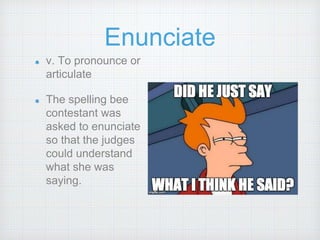
Enunciate
v. To pronounce or
articulate
The spelling bee
contestant was
asked to enunciate
so that the judges
could understand
what she was
saying.
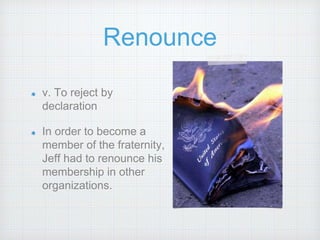
Renounce
v. To reject by
declaration
In order to become a
member of the fraternity,
Jeff had to renounce his
membership in other
organizations.
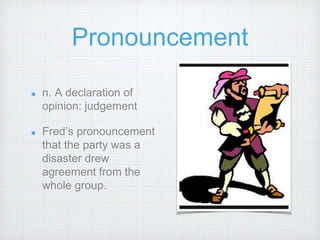
Pronouncement
n. A declaration of
opinion: judgement
Fred’s pronouncement
that the party was a
disaster drew
agreement from the
whole group.
VOC/VOK
Latin Vocare, vocatus “to call”
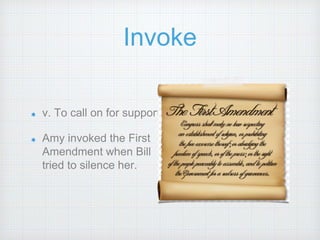
Invoke
v. To call on for support
Amy invoked the First
Amendment when Bill
tried to silence her.
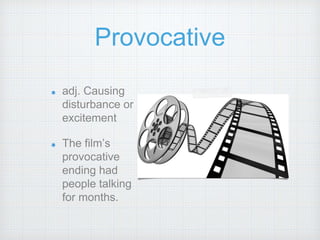
Provocative
adj. Causing
disturbance or
excitement
The film’s
provocative
ending had
people talking
for months.
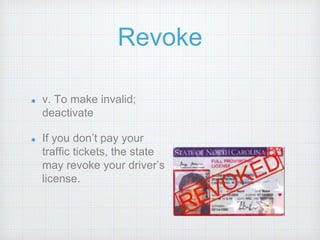
Revoke
v. To make invalid;
deactivate
If you don’t pay your
traffic tickets, the state
may revoke your driver’s
license.
FA
Latin For, Fari “to speak”
Ineffable
adj. Unutterable; indescribable
Many religions writers speak of
the ineffable wisdom of the divine
being.
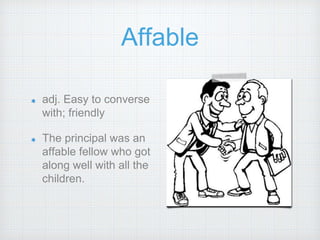
Affable
adj. Easy to converse
with; friendly
The principal was an
affable fellow who got
along well with all the
children.
DIC/DICT
Latin Dicere, Dictum “to say, to tell”
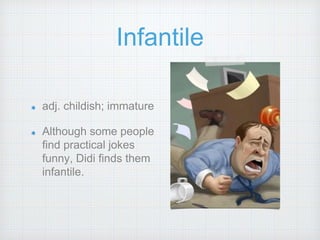
Infantile
adj. childish; immature
Although some people
find practical jokes
funny, Didi finds them
infantile.
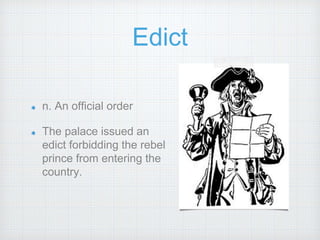
Edict
n. An official order
The palace issued an
edict forbidding the rebel
prince from entering the
country.
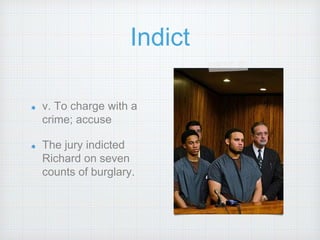
Indict
v. To charge with a
crime; accuse
The jury indicted
Richard on seven
counts of burglary.
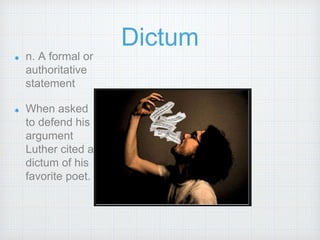
Dictum
n. A formal or
authoritative
statement
When asked
to defend his
argument
Luther cited a
dictum of his
favorite poet.

Vocabulary Unit 2