#1 Key Point: Introduce yourselves, qualify pain points, ask discovery questions
Talk Track: Here’s what I’m going to talk about today, but before I do that, I want to get an idea of what’s going on with your business and your goals within the cloud.
#2 Key Point: To introduce CloudHealth as the leading and most trusted multicloud management portfolio to leverage.
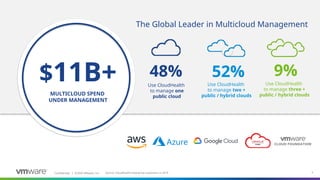
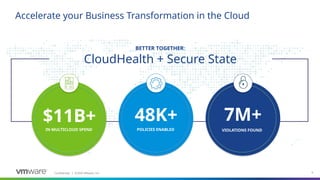
Talk Track: CloudHealth is the leader in multicloud management, driving increasing business value at every stage of your cloud journey. We partner with some of the largest cloud consumers in the world and manage more than $11B in cloud spend annually. We support customers on all leading public and hybrid cloud providers, and on average help them achieve 25% cost savings. Our vast experience in working with customers and our strategic partners have established us as “the most trusted software platform used to accelerate business transformation in the cloud.”
VMware acquired CloudHealth in October 2018 and is now leading VMware’s multi-cloud management story.
Today, the CloudHealth business unit within VMware has more than 400 employees supporting our 10,000+ customers and channel partners worldwide.
#3 Key Point: Establish that we understand the market trends and the customers pain points
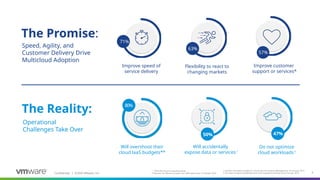
Talk Track: Some of the top reasons that customers adopted multi-cloud are to take advantage of new and innovative services, deliver product faster and be more agile….
[click]
…But once they got there, they were challenged with loss of control, staying ahead of security risks, and constantly escalating cloud bills.
These problems are even more complex when operating at scale. Across multiple teams who start using multiple clouds and deploying hundreds of workloads, cloud operations becomes a big challenge with traditional tools or processes.
#4 Key Point: CloudHealth offers a robust multicloud management platform that they can use to save money, reduce risk, and let teams spend less time on menial tasks
Talk track: Let me walk you through the CloudHealth platform so you can understand how it works:
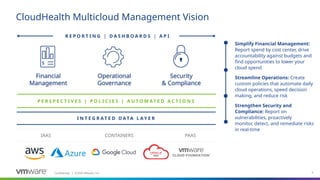
It starts by ingesting data from whatever cloud platforms you use today, as well as your containerized or data center environments. It will also connect and pull data from third party tools that you use for application performance management, provisioning, configuration management, security management, etc, allowing you to use CloudHealth as your single source of truth for multicloud management across your entire portfolio.
It ingests and aggregates all of this data into an integrated data layer that includes rich metadata. The CloudHealth Platform will then normalize across all of these assets and data to perform analysis on cost, usage, performance, and security.
Customers can use this rich data set to serve the following use cases:
Visualize and report: CloudHealth lets you categorize and view your assets by any logical business group -- line of business, environment, application, etc. You then use these groupings to create and subscribe to reports and dashboards to discover trends.
Optimize and recommend: Get actionable recommendations to reduce cost, improve security, and streamline performance. This includes everything from RI recommendations, flagging security vulnerabilities, untagged infrastructure or underutilized assets across ALL of your public and private clouds.
Govern via policies: Define what the desired state should be in your cloud environment, and then get alerted anytime cost, usage, configuration, performance, or security drifts from the desired state.
Automate via actions: Now, once you’ve set up governance policies, you can allow CloudHealth to take actions, such as start, stop, terminate, or resize assets when certain policy conditions are met. For example, you might set a policy to flag unattached disk storage after 14 days, alert the owner, take a snapshot, and then terminate it. This allows you to spend less time hands-on running your cloud environment, yet maintaining high levels of optimization and security.
#5 Key point: We work with organizations across all stages of their cloud journey, regardless of size, industry and maturity. You’re on this journey somewhere, we help you get to the next level.
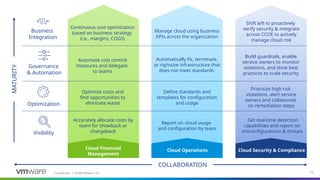
Talk track: CloudHealth has worked with thousands of customers at all different stages in their cloud journey. There are three areas of excellence – financial management, operations, and security and compliance – that organizations focus on, and within each area there are phases of maturity.
Cloud financial management: The process of continuously optimizing and aligning cloud investments with strategic business initiatives.
A mature cloud financial management function must:
Profoundly understand how all components of a modern cloud environment contribute to TCO
Make business decisions based on accurate ROI analysis
Cultivate financial accountability and ownership across groups
Cloud operations: The process of managing and delivering cloud services that meet the availability, performance, recoverability, quality, and scalability needs of the business.
A mature multicloud operations function must:
Ensure operations meet and exceed business requirements
Identify and act on areas to improve operational efficiency
Drive operational consistency across groups
Cloud security and compliance: The process of proactively detecting and remediating vulnerabilities in your cloud environment.
A mature multicloud security and compliance function must:
Ensure continuous compliance with relevant standards
Stay up to date with the changing threat and compliance landscape
Translate business requirements into cloud security standards
As organizations moves through their cloud maturity journey, CloudHealth is here to help their business fuel innovation and enable competitive differentiation.
Visibility
A typical cloud journey begins with trying to address challenges around gaining visibility into a decentralized multicloud environment. Without visibility across all clouds broken down by business group, companies struggle with predicting and forecasting cost, quickly identifying security vulnerabilities, and maintaining consistent infrastructure. Cost is often the first area that an organization will tackle with regards to visibility, but usage, configuration, performance, and security are all equally, if not more, important.
Optimization
The next step is optimization, which is the process of finding opportunities to be more efficient, whether it’s in cost savings, time savings due to operational improvements, or tightening security parameters. At this phase, optimization processes may be manual, but organizations should start documenting approaches they find beneficial, for use across teams.
Governance & Automation
Governance consists of defining the “ideal state” so you can monitor when drift occurs. Some companies equate this to setting up guardrails for their environment. Typically, the “ideal state” is an optimized state, whether it’s cost, security, or usage optimization related. Once governance policies are established, the next phase is to automate response and remediation of these policies, freeing up employee time for more critical tasks. Many organizations find that as their cloud grows, staff can’t keep up with the sheer volume of information and the complexity of running production workloads across multiple clouds.
Business Integration
At this phase, you’ve truly integrated your cloud processes and KPIs into core business processes and evaluation of the overall health of your organization. Optimizations are made continuously and automatically to align with the key drivers of your business, for example your go-to-market strategy for packaging and pricing. Once you’ve reached this stage, you have transparency into the key KPIs for the business at the customer level and also have the ability to identify new sales opportunities. Cost and security violations are automatically remediated and cloud costs are fully integrated into finance systems to enable chargeback.
#6 Key Point: To highlight how CloudHealth and CloudHealth Secure State fit in the same portfolio.
Talk Track: At CloudHealth by VMware, we help our customers drive increasing business value at every stage of their cloud journey. VMware acquired CloudHealth in 2018 for its leading multicloud management platform and because of the people led services that differentiated the business. Since then, VMware has recognized CloudHealth as the leading solution for VMware’s multicloud management strategy. As part of that strategy, the Secure State platform (also acquired by VMware in 2018) became part of the CloudHealth portfolio to help customers recognize the full value from effective multicloud management.
Working with our customers we have learned that their Cloud Center of Excellence has three focus areas – financial management, operational governance, and security and compliance. Together, CloudHealth and Secure State can help accelerate your business transformation in the cloud.
#7 Key Point: (OPTIONAL SLIDE) To introduce CloudHealth Secure State
Talk Track: Secure State is an intelligent cloud security solution that helps organizations minimize security risk and proactively mitigate threats across AWS and Azure. Secure State builds an interconnected cloud services model of your infrastructure, enabling users to explore and understand relationships between cloud objects. Secure State’s smart, real-time security approach uses machine learning algorithms to detect critical misconfigurations, violation chains across objects and anomalies that elevate the risk of a security breach. The service then correlates these security findings with activity logs and delivers instant alerts on security violations to service owners with investigation context, visual graphs of interconnected objects and recommended solution.
VMware acquired both Secure State and CloudHealth in 2018. Together, the two platforms lead VMware’s multicloud management story.
#8 Key Point: Emphasize the business-level results CloudHealth allows customers to achieve.
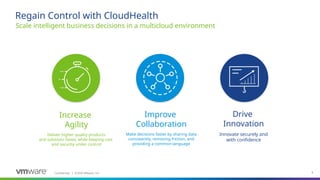
Talk track:CloudHealth allows customers to get back to focusing on the reasons they adopted public cloud in the first place: driving competitive advantage through agility, flexibility, and innovation. CloudHealth enables customers to regain and control and:
Deliver higher quality products and solutions faster, while keeping cost and security under control. With complete visibility into spend across public and private clouds as well as containerized environments, customers are confident that they have control over their cloud journey.
Improve cross-organizational collaboration and communication. From finance to engineering to IT operations, when organizations use CloudHealth, business units and departments are better aligned and can make decisions faster. This allows customers to drive consistent best practices throughout the organization, improve collaboration, and communication.
Spend more time on innovation, less time on menial tasks. With CloudHealth, companies can set guardrails to be notified, or take automated action, when infrastructure violates policy. This provides freedom to innovate and try new services, knowing that their cloud aligns to their business.
#9 Key Point: Show real world results to back up our claims on the previous slide.
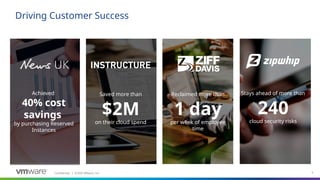
Talk track: Let's take a closer look at how some of our customers have achieved some of these benefits in the real world:
Achieve significant cost savings. CloudHealth helped News UK discover 1,000 unattached EBS volumes and achieve 40% cost savings by purchasing Reserved Instances.
Stay on budget & run efficiently. Customers like Instructure rely on CH to get automatically alerted when teams are at risk of going over budget, get recommendations for additional savings
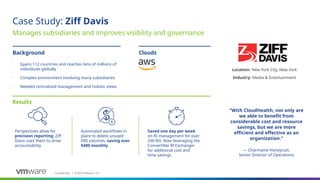
Focus on innovation. Customers like Ziff Davis save time and money using CH to automate basic processes like deleting unused infrastructure, making RI exchanges, and Rightsizing. They estimate that with CH’s RI management alone they are saving 1 day of employee time per week. That’s over 400 hours per year.
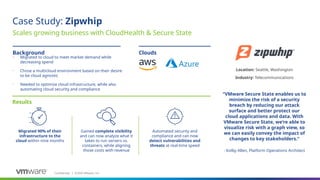
Stay ahead of security risks. Zipwhip relies on VMware Secure State to identify public cloud misconfigurations, visualize at-risk infrastructure, correlate cross-cloud threat activity, and automate security and compliance reporting across teams.
#10 These logos are approved for public use in the Corp Overview deck.
Key Point: The goal is to align customer examples to the prospect to whom you are presenting.
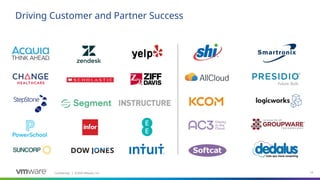
Talk track: Here are some examples of customers and partners who are using the CloudHealth Platform to optimize and govern their multicloud environments.
Change Healthcare – Company manages a fleet of RIs worth millions and needed a cost management solution. With CloudHealth, they are able to save several thousand dollars in a week. Per year: they are saving hundreds of thousands of dollars.
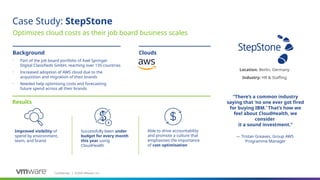
StepStone/Axel Springer – Needed to control AWS spend as they scaled. From day one, StepStone saw immediate cost savings by being able to identify assets, such as SQL Servers and databases. Driving a culture of accountability.
Dow Jones/NewsCorp – They were in need of a cost management solution for public cloud. With CH, they are able to take advantage of 10,000 different levers that control costs. NewsCorp needed a solution for cloud cost management. CH discovered 1,000 unattached EBS volumes and achieved 40% cost savings. All of this from one single platform.
EE – Wanted to increase cloud efficiency; uses CH to gain visibility into cost, utilization; takes advantage of governance.
Infor – One of the largest privately held tech company in the world; deploys cloud apps primarily on AWS; uses CH for Utilization and performance management; Gov Polices and Cloud Automation.
Instructure – Instructure needed an AWS Cloud Management solution; gains value from CH from a cost, visibility and optimization perspective; saved approx. $2M overall
Scholastic – In need of cost management for their cloud environment; CH has saved the company countless man hours, as well as 38-50% of monthly AWS costs.
SunCorp
Yelp – Uses CH for container environment cost management and visibility. Drove decision making for containers using CH.
ZenDesk – CH is saving them millions every year by keeping their massive EC2 fleet at over 80% reserved; uses CH rightsizing reports; simplified RI management; native Datadog integration
Ziff Davis – Long-time customer; the company needed a cloud management solution that offered automation capabilities. With CH, the company set up automated workflows to delete unused EBS volumes. That alone saves the company hundreds a month.
Acquia – Uses CH as a strategic partner to run infrastructure more efficiently and support changing digital needs of customers. Utilized CH's Cost Optimization workshop to tackle new approaches to infrastructure tagging, perspective development, and optimization insights. The workshop has helped Acquia create a true culture of awareness for every team.
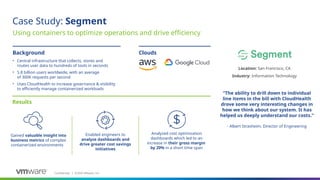
Segment – With over 5.8 billion end users worldwide, Segment’s dynamic cloud environment requires increased governance and visibility to efficiently manage their containerized workloads; CH cost dashboards have helped engineers understand the cost problem; CH's auto-alerts help more closely manage cloud spend; With CloudHealth, Segment has increased their gross margin by 20% in a short time span.
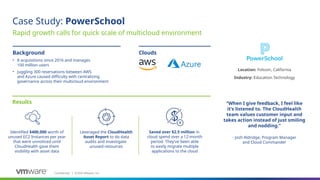
PowerSchool – Leading provider of K-12 EdTech solutions supporting more than 45 million students in over 80 countries. Needed help managing 300 reservations between AWS and Azure, and CH helped them save $2.5M over a 12-month period. Customized cost dashboards and reports allow them to identify immediate cost-savings.
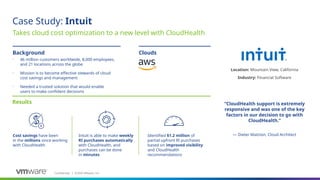
Intuit – One of the world's most innovative companies with 46 million customers worldwide. Needed help easily managing costs; CH has helped them saved millions of $$; CH's ability to modify workloads has saved Intuit over $100K per year; With CH's automation processes, they're able to purchase RIs every week vs. 1-2 times per months and purchases can be done in minutes.
#11 Key Point – These logos are approved for public use in the Corp Overview deck. The goal is o align customer examples to the prospect to whom you are presenting.
Dow Jones/NewsCorp – In need of a cost management solution. With CH, they are able to take advantage of 10,000 different levers that control costs. NewsCorp Needed a solution for cloud cost management. CH discovered 1,000 unattached EBS volumes and achieved 40% cost savings.
EE – Wanted to increase cloud efficiency; uses CH to gain visibility into cost, utilization; takes advantage of governance.
Infor – Largest privately held tech company in the world; deploys cloud apps primarily on AWS; uses CH for Utilization and performance management; Gov Polices and Cloud Automation.
StepStone/Axel Springer – Needed to control AWS spend as they scaled. From day one, StepStone saw immediate cost savings by being able to identify assets, such as SQL Servers and databases. Driving a culture of accountability.
Zendesk – CH is saving them millions every year by keeping their massive E2C fleet at over 80% reserved; uses CH rightsizing reports; simplified RI management; native Datadog integration
#12 Key Point – These logos are approved for public use in the Corp Overview deck. The goal is o align customer examples to the prospect to whom you are presenting.
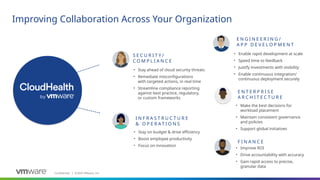
#13 Key Point: To highlight how CloudHealth can be a platform that helps teams realize their desired goals and drive more collaboration.
Talk track: In a multicloud world, actions and responsibility is distributed out to many teams and roles. What often happens is that everyone brings their own tools, and information gets very siloed. This slows down decision making and gets in the way of sharing best practices across groups.
With CloudHealth, companies can start to break down these information silos and provides a common communication language for teams to use and collaborate on improving overall cloud governance.
Here are some examples of how we could work with some of the different roles in your organization:
Finance and business teams need a solution to help them gain visibility into cloud costs for chargeback and showback, as well as find opportunities to reduce spend
IT Ops teams need to a solution to help drive efficiency in both cloud spending, and employee time, as well as ensure their cloud operations are secure
Application development teams want to focus on building and developing at speed and scale, without getting distracted by having to justify their investments to finance and IT Ops
Enterprise architects need a solution that can help them define and maintain governance policies across all teams and environments
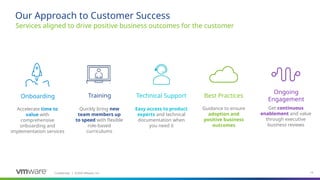
#14 Key Point: To establish credibility that we have a formal & robust process dedicated to ensuring our customers are successful.
Talk track: From our experience working directly with over over a thousand customers, CloudHealth has identified five key areas that are critical for customer success:
Onboarding: We have a proven 90 day methodology for on-boarding new customers to make sure you get the full value of the platform as quickly as possible, as well as optional professional services.
Training: With a mix of self-paced, virtual instructor-led training, or onsite training, we provide comprehensive training offerings that meet the needs of all the different types of users in your environment. This training is not only during your onboarding, but during your life as a customer.
Technical Support: Our global support team is ready to help with any technical issues that arrive, and will quickly respond and provide best in class service.
Best Practices: With the rate of change in the public cloud, the best practices for management are constantly evolving as well as the capabilities of the CloudHealth platform. CloudHealth continuously communicates these best practices and also can benchmark your performance managing the public cloud against our thousands of other customers and over $10B in cloud spend under management.
Ongoing engagement: The value doesn’t stop after onboarding and training. Throughout your whole contract, you will get executive business reviews with your designated Customer Success team where the team will identify opportunities for you to get further value from the platform and help ensure our customer success approach evolves with your business goals and organization.
#15 Key point: Reiterate customer priorities and how we can help, bridge into demo
Talk track: Based on your current cloud use, priorities and challenges, here’s where CloudHealth can help you… Let’s take a few minutes to look at a live demo that will illustrate how we can help you achieve some of these goals
#16 CloudHealth has worked with thousands of customers at all different stages in their cloud journey, and identified patterns and best practices for maturity. Within the cloud maturity framework, there are three areas of excellence – financial management, operations, and security and compliance – that organizations focus on, and within each area there are phases of maturity.
A typical cloud journey begins with trying to address challenges around gaining visibility into a decentralized multicloud environment. Without visibility across all clouds broken down by business group, companies struggle with predicting and forecasting cost, quickly identifying security vulnerabilities, and maintaining consistent infrastructure.
The next step is optimization, which includes identifying cost savings, time savings due to operational efficiency improvements, or tightening security parameters. At this phase, optimization processes may be manual, but organizations should start documenting approaches they find beneficial, for use across teams.
Then there is governance, which consists of defining the “ideal state” so you can monitor when drift occurs. Some companies equate this to setting up policies for their environment. Once governance policies are established, the next step is to automate the response and remediation of these policies, freeing up employee time for more strategic tasks.
At the final phase, you’ve truly integrated your cloud processes and KPIs to align with the key drivers of your business. Once you’ve reached this stage, optimizations are made continuously and automatically, and you have the ability to identify new sales opportunities.
As organizations move through this cloud maturity journey, CloudHealth is here to help their business fuel innovation and enable competitive differentiation.




![Getting Started with Apache Spark: Big Data Made Simple [Free Meetup]](https://cdn.slidesharecdn.com/ss_thumbnails/apachesparkgettingstarted-260203175547-8361bcc3-thumbnail.jpg?width=640&height=640&fit=bounds)


