Role of vitamins in nutrient
metabolism
Presented by Dr. Vineetha P G
VITAMINS
• Vitamins are organic compounds required in
tiny amounts for essential metabolic reactions
• Absence or deficiency of vitamins causes
deficiency disorders
CLASSIFICATION
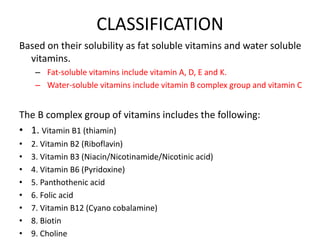
Based on their solubility as fat soluble vitamins and water soluble
vitamins.
– Fat-soluble vitamins include vitamin A, D, E and K.
– Water-soluble vitamins include vitamin B complex group and vitamin C
The B complex group of vitamins includes the following:
• 1. Vitamin B1 (thiamin)
• 2. Vitamin B2 (Riboflavin)
• 3. Vitamin B3 (Niacin/Nicotinamide/Nicotinic acid)
• 4. Vitamin B6 (Pyridoxine)
• 5. Panthothenic acid
• 6. Folic acid
• 7. Vitamin B12 (Cyano cobalamine)
• 8. Biotin
• 9. Choline
VITAMIN A
• Synthesis of glycoprotein to maintain integrity of
epithelial cells
• In bone formation synthesis of mucopolysacharides
• Synthesis of the visual pigment Rhodopsin
• Retinol and retinoic acid (RA) are essential for
embryonic development during fetal development.
VITAMIN B
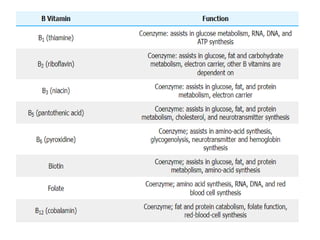
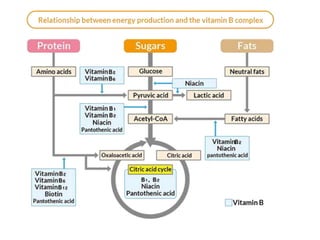
• All of the B vitamins play a role in energy metabolism
• Functional parts of enzymes involved in metabolism-
Coenzymes -assist in converting a substrate to an
end product- either in catabolic pathways (i.e.
breaking down substances) and play a role in
many anabolic pathways (i.e. building substances).
VITAMIN B1
• Thiamine is important in glucose metabolism
• It acts as a cofactor for enzymes that break down
glucose for energy production
• Plays a role in the synthesis of ribose from glucose
and is therefore required for RNA, DNA, and ATP
synthesis.
Riboflavin (B2)
• Riboflavin- an essential component of flavoproteins, which
are coenzymes involved in many metabolic pathways of
carbohydrate, lipid, and protein metabolism.
• Flavoproteins aid in the transfer of electrons in the electron
transport chain, thus the production of energy or ATP.
• The active form is flavin adenine dinucleotide (FAD) or flavin
mononucleotide (FMN).
• Furthermore, the functions of other B-vitamin coenzymes,
such as vitamin B6 and folate, are dependent on the actions of
flavoproteins.
• The “flavin” portion of riboflavin gives a bright yellow color to
riboflavin.
Niacin (B3)
• Niacin is found as nicotinamide (niacinamide) or nicotinic acid.
• It is a component of the coenzymes nicotinamide adenine
dinucleotide (NAD) and its phosphorylated form (NADP), which
are involved in the metabolism of carbohydrates, lipids, and
proteins.
• NADH is the predominant electron carrier and transfers
electrons to the electron transport chain to make ATP.
• NADPH is required for the anabolic pathways of fatty acid and
cholesterol synthesis.
• In contrast to other vitamins, niacin can be synthesized by
humans from the amino acid tryptophan
Pantothenic Acid (B5)
• Pantothenic acid, forms coenzyme A, which is the main
carrier of carbon molecules in a cell.
• Acetyl-CoA is the carbon carrier of glucose, fatty acids, and
amino acids into the citric acid cycle.
• Coenzyme A is also involved in the synthesis of lipids,
cholesterol, and acetylcholine (a neurotransmitter).
• Pantothenic acid functions as a constituent of two
coenzymes—coenzyme A and Acid phosphatase.
• Coenzyme A is found in all tissues -important coenzymes -
involving the metabolism of carbohydrates, proteins, and
lipids, and the synthesis of lipids, neurotransmitters, steroid
hormones, porphyrins, and hemoglobin.
• Coenzyme A functions as a carrier of acyl groups in enzymatic
reactions involved in synthesis of fatty acids, cholesterol, and
sterols; in the oxidation of fatty acids, pyruvate, and
ketoglutarate; and in biological acetylations.
Pyroxidine (B6)
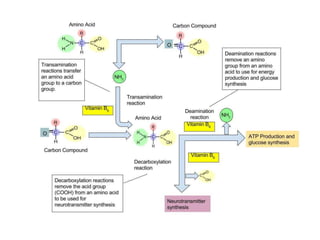
• Pyroxidine is the coenzyme involved in nitrogen transfer
between amino acids and therefore plays a role in amino-acid
synthesis and catabolism.
• It functions to release glucose from glycogen in the catabolic
pathway of glycogenolysis.
• It is required by enzymes for the synthesis of multiple
neurotransmitters and hemoglobin
• Vitamin B6 in the form of PLP (pyridoxal phosphate), andto a
lesser degree pyridoxamine phosphate, plays an essential role
in the interaction of amino acid, carbohydrate, and fatty acid
metabolism and citric acid cycle.
• More than 60 enzymes are known to depend on vitamin B6
coenzymes.
• The largest group of the vitamin B6-dependent enzymes are
the transaminases.
• Aminotransferases are involved in interconversions of a pair of
amino acids into their corresponding keto acids.
Biotin (B7)
Biotin is involved in conversion of carbohydrate to protein as
well as conversion of protein and carbohydrate to fat.
• Biotin maintains normal blood glucose levels from
metabolism of protein and fat when dietary intake of
carbohydrate is low.
• Biotin functions as a carboxyl carrier in four carboxylase
enzymes:pyruvate carboxylase, acetyl CoA carboxylase,
propionyl CoAcarboxylase, and 3-methylcrotonyl CoA
carboxylase.
• As a component of these carboxylating enzymes, there is
the capacity to transport carboxyl units and to fix carbon
dioxide (as bicarbonate) in tissue.
• The energy-producing citric acidcycle dependent on
the presence of this vitamin. It is suggested that partof
the effect of biotin on energy production is through
stimulation ofphosphorylation pathways
• Glucokinase activity is affected by biotin, with activity
of the enzyme decreasing with biotin deficiency
• In protein metabolism, biotin enzymes are important in
protein synthesis,amino acid deamination, purine
synthesis, and nucleic acid metabolism.
Folate/Folic acid
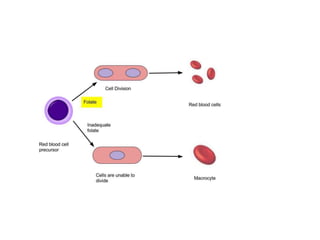
• Folate is a required coenzyme for the synthesis of the amino acid
methionine, and for making RNA and DNA.
• Therefore, rapidly dividing cells are most affected by folate
deficiency.
• Folacin, in the form 5,6,7,8-tetrahydrofolic acid, is indispensable in
transfer of single-carbon units in various reactions, such as those
occurring in the biosynthesis of lipids, proteins, nucleic acid
derivatives, hormones and neurotransmitters—a role analogous to
that of pantothenic acid in the transfer of two-carbon units.
• The one-carbon units can be formyl, formimino, methylene, or
methyl groups.
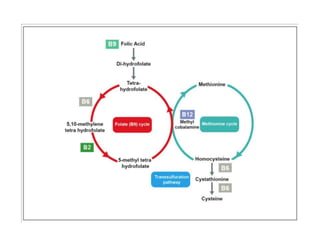
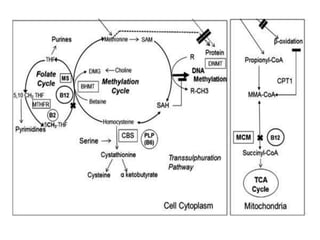
• The major in vivo pathway providing methyl groups involves
transfer of a one-carbon unit from serine to
tetrahydrofolate to form 5,10-methylenetetrahydrofolate,
which is subsequently reduced to 5-
methyltetrahydrofolate.
• Methyltetrahydrofolate then supplies methyl groups to
remethylate homocysteine in the activated methyl cycle,
providing methionine for synthesis of the important methyl
donor agent S-adenosylmethionine.
• These one-carbon units are generated primarily during
amino acid metabolism and are used in the metabolic
interconversions of amino acids and in the biosynthesis of
the purine and pyrimidine components of nucleic acids that
are needed for cell division.
Choline
• Plays an essential role in fat metabolism in the liver.
• The first discovered function of dietary choline dealt
with prevention of fatty liver in depancreatized dogs,
and later in rats, chicks, and other species.
• Owing to the basic function of choline in membrane
structure, the lack of choline is manifested in a
variety of phospholipid-related functions, such as
fatty liver and lesions of the kidney and impairment
of lipoprotein metabolism.
• Choline prevents abnormal accumulation of fat (fatty
livers) by promoting its transport as lecithin or by
increasing the utilization of fatty acids in the liver
itself.
• Choline is thus referred to as a lipotropic factor
because of its function of acting on fat metabolism
by hastening removal or decreasing deposition of fat
in liver.
Cobalamin (B12)
• Cobalamin contains cobalt-only vitamin that contains a
metal ion.
• Cobalamin is an essential part of coenzymes.
• It is necessary for fat and protein catabolism, for folate
coenzyme function, and for hemoglobin synthesis.
• An enzyme requiring cobalamin is needed by a folate-
dependent enzyme to synthesize DNA.
• Thus, a deficiency in cobalamin has similar
consequences to health as folate deficiency.
VITAMIN C
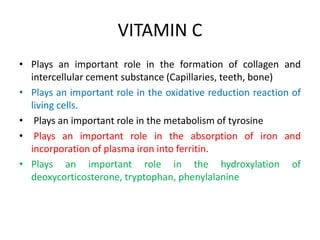
• Plays an important role in the formation of collagen and
intercellular cement substance (Capillaries, teeth, bone)
• Plays an important role in the oxidative reduction reaction of
living cells.
• Plays an important role in the metabolism of tyrosine
• Plays an important role in the absorption of iron and
incorporation of plasma iron into ferritin.
• Plays an important role in the hydroxylation of
deoxycorticosterone, tryptophan, phenylalanine
VITAMIN D
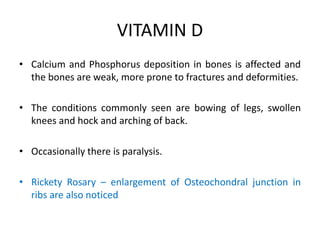
• Calcium and Phosphorus deposition in bones is affected and
the bones are weak, more prone to fractures and deformities.
• The conditions commonly seen are bowing of legs, swollen
knees and hock and arching of back.
• Occasionally there is paralysis.
• Rickety Rosary – enlargement of Osteochondral junction in
ribs are also noticed
VITAMIN E
• Vitamin E functions in the animal mainly as biological antioxidant
• In association with the selenium-containing enzyme glutathione
peroxidase, it protects cells against oxidative damage caused by
free radicals.
• This protection is important in preventing oxidation of
polyunsaturated fatty acids. Oxidation of unsaturated fatty acids
produces hydroperoxides, which also damage cell tissues and more
lipid free radicals so that prevention of such oxidation is of
importance in maintaining the health of the animal.
• Vitamin E also plays an important role in the development and
function of the immune system.
VITAMIN K
• Vitamin K is required for optimal bone metabolism.
• Vitamin K is also critical for blood clotting.
REFERENCES
• Pan, X., Nan, X., Yang, L., Jiang, L., & Xiong, B. (2018). Thiamine status,
metabolism and application in dairy cows: A review. British Journal of
Nutrition, 120(5), 491-499.
• Vijayalakshmy,K., Virmani, M., Malik,R., Rajalakshmi and Kasthuri
.2018.The Role of B Vitamins in Livestock Nutrition .J Vet Med Res 5(10):
1162 (2018)
• Watanabe F. Vitamin B12 sources and bioavailability. Exp. Biol. Med. 2007;
232: 1266-1274.
• Watanabe F, Bito T. Vitamin B12 sources and microbial interaction. Exp Biol
Med (Maywood). 2018 Jan;243(2):148-158.

vitamins in nutrient metabolism.pptx

  • 1.
    Role of vitaminsin nutrient metabolism Presented by Dr. Vineetha P G
  • 2.
    VITAMINS • Vitamins areorganic compounds required in tiny amounts for essential metabolic reactions • Absence or deficiency of vitamins causes deficiency disorders
  • 3.
    CLASSIFICATION Based on theirsolubility as fat soluble vitamins and water soluble vitamins. – Fat-soluble vitamins include vitamin A, D, E and K. – Water-soluble vitamins include vitamin B complex group and vitamin C The B complex group of vitamins includes the following: • 1. Vitamin B1 (thiamin) • 2. Vitamin B2 (Riboflavin) • 3. Vitamin B3 (Niacin/Nicotinamide/Nicotinic acid) • 4. Vitamin B6 (Pyridoxine) • 5. Panthothenic acid • 6. Folic acid • 7. Vitamin B12 (Cyano cobalamine) • 8. Biotin • 9. Choline
  • 4.
    VITAMIN A • Synthesisof glycoprotein to maintain integrity of epithelial cells • In bone formation synthesis of mucopolysacharides • Synthesis of the visual pigment Rhodopsin • Retinol and retinoic acid (RA) are essential for embryonic development during fetal development.
  • 5.
    VITAMIN B • Allof the B vitamins play a role in energy metabolism • Functional parts of enzymes involved in metabolism- Coenzymes -assist in converting a substrate to an end product- either in catabolic pathways (i.e. breaking down substances) and play a role in many anabolic pathways (i.e. building substances).
  • 6.
    VITAMIN B1 • Thiamineis important in glucose metabolism • It acts as a cofactor for enzymes that break down glucose for energy production • Plays a role in the synthesis of ribose from glucose and is therefore required for RNA, DNA, and ATP synthesis.
  • 7.
    Riboflavin (B2) • Riboflavin-an essential component of flavoproteins, which are coenzymes involved in many metabolic pathways of carbohydrate, lipid, and protein metabolism. • Flavoproteins aid in the transfer of electrons in the electron transport chain, thus the production of energy or ATP. • The active form is flavin adenine dinucleotide (FAD) or flavin mononucleotide (FMN). • Furthermore, the functions of other B-vitamin coenzymes, such as vitamin B6 and folate, are dependent on the actions of flavoproteins. • The “flavin” portion of riboflavin gives a bright yellow color to riboflavin.
  • 8.
    Niacin (B3) • Niacinis found as nicotinamide (niacinamide) or nicotinic acid. • It is a component of the coenzymes nicotinamide adenine dinucleotide (NAD) and its phosphorylated form (NADP), which are involved in the metabolism of carbohydrates, lipids, and proteins. • NADH is the predominant electron carrier and transfers electrons to the electron transport chain to make ATP. • NADPH is required for the anabolic pathways of fatty acid and cholesterol synthesis. • In contrast to other vitamins, niacin can be synthesized by humans from the amino acid tryptophan
  • 9.
    Pantothenic Acid (B5) •Pantothenic acid, forms coenzyme A, which is the main carrier of carbon molecules in a cell. • Acetyl-CoA is the carbon carrier of glucose, fatty acids, and amino acids into the citric acid cycle. • Coenzyme A is also involved in the synthesis of lipids, cholesterol, and acetylcholine (a neurotransmitter).
  • 10.
    • Pantothenic acidfunctions as a constituent of two coenzymes—coenzyme A and Acid phosphatase. • Coenzyme A is found in all tissues -important coenzymes - involving the metabolism of carbohydrates, proteins, and lipids, and the synthesis of lipids, neurotransmitters, steroid hormones, porphyrins, and hemoglobin. • Coenzyme A functions as a carrier of acyl groups in enzymatic reactions involved in synthesis of fatty acids, cholesterol, and sterols; in the oxidation of fatty acids, pyruvate, and ketoglutarate; and in biological acetylations.
  • 11.
    Pyroxidine (B6) • Pyroxidineis the coenzyme involved in nitrogen transfer between amino acids and therefore plays a role in amino-acid synthesis and catabolism. • It functions to release glucose from glycogen in the catabolic pathway of glycogenolysis. • It is required by enzymes for the synthesis of multiple neurotransmitters and hemoglobin
  • 12.
    • Vitamin B6in the form of PLP (pyridoxal phosphate), andto a lesser degree pyridoxamine phosphate, plays an essential role in the interaction of amino acid, carbohydrate, and fatty acid metabolism and citric acid cycle. • More than 60 enzymes are known to depend on vitamin B6 coenzymes. • The largest group of the vitamin B6-dependent enzymes are the transaminases. • Aminotransferases are involved in interconversions of a pair of amino acids into their corresponding keto acids.
  • 14.
    Biotin (B7) Biotin isinvolved in conversion of carbohydrate to protein as well as conversion of protein and carbohydrate to fat. • Biotin maintains normal blood glucose levels from metabolism of protein and fat when dietary intake of carbohydrate is low. • Biotin functions as a carboxyl carrier in four carboxylase enzymes:pyruvate carboxylase, acetyl CoA carboxylase, propionyl CoAcarboxylase, and 3-methylcrotonyl CoA carboxylase. • As a component of these carboxylating enzymes, there is the capacity to transport carboxyl units and to fix carbon dioxide (as bicarbonate) in tissue.
  • 15.
    • The energy-producingcitric acidcycle dependent on the presence of this vitamin. It is suggested that partof the effect of biotin on energy production is through stimulation ofphosphorylation pathways • Glucokinase activity is affected by biotin, with activity of the enzyme decreasing with biotin deficiency • In protein metabolism, biotin enzymes are important in protein synthesis,amino acid deamination, purine synthesis, and nucleic acid metabolism.
  • 16.
    Folate/Folic acid • Folateis a required coenzyme for the synthesis of the amino acid methionine, and for making RNA and DNA. • Therefore, rapidly dividing cells are most affected by folate deficiency. • Folacin, in the form 5,6,7,8-tetrahydrofolic acid, is indispensable in transfer of single-carbon units in various reactions, such as those occurring in the biosynthesis of lipids, proteins, nucleic acid derivatives, hormones and neurotransmitters—a role analogous to that of pantothenic acid in the transfer of two-carbon units. • The one-carbon units can be formyl, formimino, methylene, or methyl groups.
  • 17.
    • The majorin vivo pathway providing methyl groups involves transfer of a one-carbon unit from serine to tetrahydrofolate to form 5,10-methylenetetrahydrofolate, which is subsequently reduced to 5- methyltetrahydrofolate. • Methyltetrahydrofolate then supplies methyl groups to remethylate homocysteine in the activated methyl cycle, providing methionine for synthesis of the important methyl donor agent S-adenosylmethionine. • These one-carbon units are generated primarily during amino acid metabolism and are used in the metabolic interconversions of amino acids and in the biosynthesis of the purine and pyrimidine components of nucleic acids that are needed for cell division.
  • 21.
    Choline • Plays anessential role in fat metabolism in the liver. • The first discovered function of dietary choline dealt with prevention of fatty liver in depancreatized dogs, and later in rats, chicks, and other species. • Owing to the basic function of choline in membrane structure, the lack of choline is manifested in a variety of phospholipid-related functions, such as fatty liver and lesions of the kidney and impairment of lipoprotein metabolism.
  • 22.
    • Choline preventsabnormal accumulation of fat (fatty livers) by promoting its transport as lecithin or by increasing the utilization of fatty acids in the liver itself. • Choline is thus referred to as a lipotropic factor because of its function of acting on fat metabolism by hastening removal or decreasing deposition of fat in liver.
  • 23.
    Cobalamin (B12) • Cobalamincontains cobalt-only vitamin that contains a metal ion. • Cobalamin is an essential part of coenzymes. • It is necessary for fat and protein catabolism, for folate coenzyme function, and for hemoglobin synthesis. • An enzyme requiring cobalamin is needed by a folate- dependent enzyme to synthesize DNA. • Thus, a deficiency in cobalamin has similar consequences to health as folate deficiency.
  • 26.
    VITAMIN C • Playsan important role in the formation of collagen and intercellular cement substance (Capillaries, teeth, bone) • Plays an important role in the oxidative reduction reaction of living cells. • Plays an important role in the metabolism of tyrosine • Plays an important role in the absorption of iron and incorporation of plasma iron into ferritin. • Plays an important role in the hydroxylation of deoxycorticosterone, tryptophan, phenylalanine
  • 27.
    VITAMIN D • Calciumand Phosphorus deposition in bones is affected and the bones are weak, more prone to fractures and deformities. • The conditions commonly seen are bowing of legs, swollen knees and hock and arching of back. • Occasionally there is paralysis. • Rickety Rosary – enlargement of Osteochondral junction in ribs are also noticed
  • 28.
    VITAMIN E • VitaminE functions in the animal mainly as biological antioxidant • In association with the selenium-containing enzyme glutathione peroxidase, it protects cells against oxidative damage caused by free radicals. • This protection is important in preventing oxidation of polyunsaturated fatty acids. Oxidation of unsaturated fatty acids produces hydroperoxides, which also damage cell tissues and more lipid free radicals so that prevention of such oxidation is of importance in maintaining the health of the animal. • Vitamin E also plays an important role in the development and function of the immune system.
  • 29.
    VITAMIN K • VitaminK is required for optimal bone metabolism. • Vitamin K is also critical for blood clotting.
  • 30.
    REFERENCES • Pan, X.,Nan, X., Yang, L., Jiang, L., & Xiong, B. (2018). Thiamine status, metabolism and application in dairy cows: A review. British Journal of Nutrition, 120(5), 491-499. • Vijayalakshmy,K., Virmani, M., Malik,R., Rajalakshmi and Kasthuri .2018.The Role of B Vitamins in Livestock Nutrition .J Vet Med Res 5(10): 1162 (2018) • Watanabe F. Vitamin B12 sources and bioavailability. Exp. Biol. Med. 2007; 232: 1266-1274. • Watanabe F, Bito T. Vitamin B12 sources and microbial interaction. Exp Biol Med (Maywood). 2018 Jan;243(2):148-158.