Visualization of Networked Collaboration in Digital
Ecosystems through Two-mode Network Patterns

 International Conference on Management of Emergent Digital
EcoSystems (MEDES’11), San Francisco, November 21-23, 2011


              Felix Mödritscher, Wolfgang Taferner
              Vienna University of Economics and Business, Austria
              Ahmet Soylu, Patrick De Causmaecker
              Department of Computer Science, K.U. Leuven, Belgium


                                                                     © role-project.eu
Overview

1. Motivation and conceptual approach
      Application of two-mode networks for analyzing collaboration in Digital Ecosystems


2. Related work
      Visualization techniques, network modes, & pattern mining in networked structures


3. Comparison of different network visualizations
      Methodology, network modes, pattern detection, & homogeneity considerations


4. Conclusions & future work
      Pros and cons of this research; next steps


21-23/11/2011                  MEDES’11, San Francisco, 2011                   2/11 , © role-project.eu
1. Motivation and research design

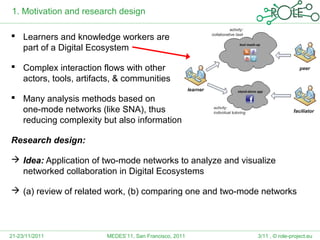
 Learners and knowledge workers are
  part of a Digital Ecosystem

 Complex interaction flows with other
  actors, tools, artifacts, & communities

 Many analysis methods based on
  one-mode networks (like SNA), thus
  reducing complexity but also information

Research design:

 Idea: Application of two-mode networks to analyze and visualize
  networked collaboration in Digital Ecosystems

 (a) review of related work, (b) comparing one and two-mode networks


21-23/11/2011           MEDES’11, San Francisco, 2011       3/11 , © role-project.eu
2. Related work: Visualization techniques & network modes

Visualization techniques
    linear structures, hierarchies, networks, multi-dim. spaces, maps [Andrews 2002]
    exploration environments for discovering relationships, data & document mining,
     analyzing mass data-sets, creating visual awareness etc. [Fayyad et al. 2002]
    Web 2.0: harnessing the collective intelligence of Digital Ecosystems (Facebook,
     Google, Bing, Apple Stores, Mendeley, Flickr etc.)
Network modes
    network visualization can “help users to
     understand and manage the complexity of
     large, structured hypermedia collections”
     [Andrews 1998]
    however, one-mode networks in most cases
     (SNA, tag networks, citation networks etc.)
    two-mode networks: bipartite graphs
    e.g. ‘Deep South’ project [Davis et al. 1941]
21-23/11/2011                MEDES’11, San Francisco, 2011             4/11 , © role-project.eu
2. Related work: Pattern mining in networked structures

Network pattern: defined according to relations between nodes as well as
  thresholds for metrics on nodes and edges (rules)
PALADIN [Klamma et al. 2006]: patterns in
  social networks (roles like conversionalists
  or trolls)
   restricted to one-mode networks
gSpan [Yan & Han 2002]: performant
  technique for graph-based substructure
  pattern mining
   not applicable for bipartite graphs
Blockmodeling approach [Dorejan et al. 2004]:
   identifying patterns in k-partite graphs
    very costly processing (not performant)


21-23/11/2011           MEDES’11, San Francisco, 2011       5/11 , © role-project.eu
3. Comparison of visualizations: Methodology

 Development of own algorithms to pre-process data, generate two-
  mode networks and visualize collaboration in Digital Ecosystems
 Focus on MediaWiki instances
       Wiki of the SONIVIS project (19 contributors, 342 articles, 600 relations)
       German version of Wikiversity (1.695 contributors, 9.751 articles, 21.288
        relations)
       German version of Wikiquote (25.911 contributors, 9.120 articles, 136.383
        relations)
 Raw data from MySQL database, transformed according to a
  specific data model (used by the SONIVIS software)
 Imported into the R framework, an open source software for
  statistical computing and graphics
 Creation of two-mode networks and visualizations with R


21-23/11/2011               MEDES’11, San Francisco, 2011             6/11 , © role-project.eu
3. Comparison of visualizations: One vs. Two-mode Networks

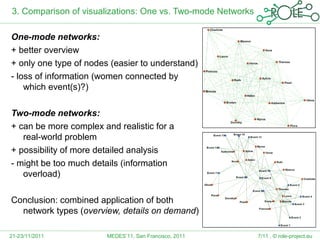
One-mode networks:
+ better overview
+ only one type of nodes (easier to understand)
- loss of information (women connected by
    which event(s)?)

Two-mode networks:
+ can be more complex and realistic for a
   real-world problem
+ possibility of more detailed analysis
- might be too much details (information
   overload)

Conclusion: combined application of both
  network types (overview, details on demand)

21-23/11/2011           MEDES’11, San Francisco, 2011        7/11 , © role-project.eu
3. Comparison of visualizations: Pattern detection

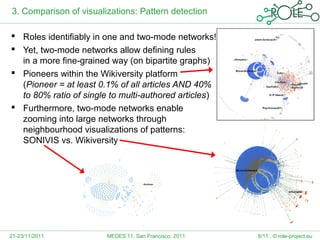
 Roles identifiably in one and two-mode networks!
 Yet, two-mode networks allow defining rules
  in a more fine-grained way (on bipartite graphs)
 Pioneers within the Wikiversity platform
  (Pioneer = at least 0.1% of all articles AND 40%
  to 80% ratio of single to multi-authored articles)
 Furthermore, two-mode networks enable
  zooming into large networks through
  neighbourhood visualizations of patterns:
  SONIVIS vs. Wikiversity


21-23/11/2011           MEDES’11, San Francisco, 2011   8/11 , © role-project.eu
3. Comparison of visualizations: Homogeneity of networks

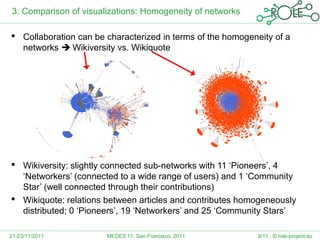
 Collaboration can be characterized in terms of the homogeneity of a
  networks  Wikiversity vs. Wikiquote


 Wikiversity: slightly connected sub-networks with 11 ‘Pioneers’, 4
  ‘Networkers’ (connected to a wide range of users) and 1 ‘Community
  Star’ (well connected through their contributions)
 Wikiquote: relations between articles and contributes homogeneously
  distributed; 0 ‘Pioneers’, 19 ‘Networkers’ and 25 ‘Community Stars’

21-23/11/2011          MEDES’11, San Francisco, 2011         9/11 , © role-project.eu
4. Conclusions and future work

Discussion of our pattern approach for two-mode networks:
 More detailed analysis and semantics for real-world problems (no
  loss of information)
 Possibility to define, identify and visualize patterns of
  collaboration in Digital Ecosystems (like Wikis)
 Possibility to zoom into large networks (avoiding information
  overload)
 Depending on scenario, one-mode network visualization might be
  better (to reduce complexity or the network size)

Future work:
 Application of the pattern-based analysis and visualization
  approach to other domains (like personal learning environments)
 Further exploration studies with other Wikis

21-23/11/2011          MEDES’11, San Francisco, 2011   10/11 , © role-project.eu
Thanks for your attention!


     The research leading to these results has received funding from the European
     Community's Seventh Framework Programme (FP7/ 2007-2013) under grant
     agreement no 231396 (ROLE project).

21-23/11/2011               MEDES’11, San Francisco, 2011            11/11, © role-project.eu

Visualizing Networked Collaboration

  • 1.
    Visualization of NetworkedCollaboration in Digital Ecosystems through Two-mode Network Patterns International Conference on Management of Emergent Digital EcoSystems (MEDES’11), San Francisco, November 21-23, 2011 Felix Mödritscher, Wolfgang Taferner Vienna University of Economics and Business, Austria Ahmet Soylu, Patrick De Causmaecker Department of Computer Science, K.U. Leuven, Belgium © role-project.eu
  • 2.
    Overview 1. Motivation andconceptual approach Application of two-mode networks for analyzing collaboration in Digital Ecosystems 2. Related work Visualization techniques, network modes, & pattern mining in networked structures 3. Comparison of different network visualizations Methodology, network modes, pattern detection, & homogeneity considerations 4. Conclusions & future work Pros and cons of this research; next steps 21-23/11/2011 MEDES’11, San Francisco, 2011 2/11 , © role-project.eu
  • 3.
    1. Motivation andresearch design  Learners and knowledge workers are part of a Digital Ecosystem  Complex interaction flows with other actors, tools, artifacts, & communities  Many analysis methods based on one-mode networks (like SNA), thus reducing complexity but also information Research design:  Idea: Application of two-mode networks to analyze and visualize networked collaboration in Digital Ecosystems  (a) review of related work, (b) comparing one and two-mode networks 21-23/11/2011 MEDES’11, San Francisco, 2011 3/11 , © role-project.eu
  • 4.
    2. Related work:Visualization techniques & network modes Visualization techniques  linear structures, hierarchies, networks, multi-dim. spaces, maps [Andrews 2002]  exploration environments for discovering relationships, data & document mining, analyzing mass data-sets, creating visual awareness etc. [Fayyad et al. 2002]  Web 2.0: harnessing the collective intelligence of Digital Ecosystems (Facebook, Google, Bing, Apple Stores, Mendeley, Flickr etc.) Network modes  network visualization can “help users to understand and manage the complexity of large, structured hypermedia collections” [Andrews 1998]  however, one-mode networks in most cases (SNA, tag networks, citation networks etc.)  two-mode networks: bipartite graphs  e.g. ‘Deep South’ project [Davis et al. 1941] 21-23/11/2011 MEDES’11, San Francisco, 2011 4/11 , © role-project.eu
  • 5.
    2. Related work:Pattern mining in networked structures Network pattern: defined according to relations between nodes as well as thresholds for metrics on nodes and edges (rules) PALADIN [Klamma et al. 2006]: patterns in social networks (roles like conversionalists or trolls)  restricted to one-mode networks gSpan [Yan & Han 2002]: performant technique for graph-based substructure pattern mining  not applicable for bipartite graphs Blockmodeling approach [Dorejan et al. 2004]: identifying patterns in k-partite graphs  very costly processing (not performant) 21-23/11/2011 MEDES’11, San Francisco, 2011 5/11 , © role-project.eu
  • 6.
    3. Comparison ofvisualizations: Methodology  Development of own algorithms to pre-process data, generate two- mode networks and visualize collaboration in Digital Ecosystems  Focus on MediaWiki instances  Wiki of the SONIVIS project (19 contributors, 342 articles, 600 relations)  German version of Wikiversity (1.695 contributors, 9.751 articles, 21.288 relations)  German version of Wikiquote (25.911 contributors, 9.120 articles, 136.383 relations)  Raw data from MySQL database, transformed according to a specific data model (used by the SONIVIS software)  Imported into the R framework, an open source software for statistical computing and graphics  Creation of two-mode networks and visualizations with R 21-23/11/2011 MEDES’11, San Francisco, 2011 6/11 , © role-project.eu
  • 7.
    3. Comparison ofvisualizations: One vs. Two-mode Networks One-mode networks: + better overview + only one type of nodes (easier to understand) - loss of information (women connected by which event(s)?) Two-mode networks: + can be more complex and realistic for a real-world problem + possibility of more detailed analysis - might be too much details (information overload) Conclusion: combined application of both network types (overview, details on demand) 21-23/11/2011 MEDES’11, San Francisco, 2011 7/11 , © role-project.eu
  • 8.
    3. Comparison ofvisualizations: Pattern detection  Roles identifiably in one and two-mode networks!  Yet, two-mode networks allow defining rules in a more fine-grained way (on bipartite graphs)  Pioneers within the Wikiversity platform (Pioneer = at least 0.1% of all articles AND 40% to 80% ratio of single to multi-authored articles)  Furthermore, two-mode networks enable zooming into large networks through neighbourhood visualizations of patterns: SONIVIS vs. Wikiversity 21-23/11/2011 MEDES’11, San Francisco, 2011 8/11 , © role-project.eu
  • 9.
    3. Comparison ofvisualizations: Homogeneity of networks  Collaboration can be characterized in terms of the homogeneity of a networks  Wikiversity vs. Wikiquote  Wikiversity: slightly connected sub-networks with 11 ‘Pioneers’, 4 ‘Networkers’ (connected to a wide range of users) and 1 ‘Community Star’ (well connected through their contributions)  Wikiquote: relations between articles and contributes homogeneously distributed; 0 ‘Pioneers’, 19 ‘Networkers’ and 25 ‘Community Stars’ 21-23/11/2011 MEDES’11, San Francisco, 2011 9/11 , © role-project.eu
  • 10.
    4. Conclusions andfuture work Discussion of our pattern approach for two-mode networks:  More detailed analysis and semantics for real-world problems (no loss of information)  Possibility to define, identify and visualize patterns of collaboration in Digital Ecosystems (like Wikis)  Possibility to zoom into large networks (avoiding information overload)  Depending on scenario, one-mode network visualization might be better (to reduce complexity or the network size) Future work:  Application of the pattern-based analysis and visualization approach to other domains (like personal learning environments)  Further exploration studies with other Wikis 21-23/11/2011 MEDES’11, San Francisco, 2011 10/11 , © role-project.eu
  • 11.
    Thanks for yourattention! The research leading to these results has received funding from the European Community's Seventh Framework Programme (FP7/ 2007-2013) under grant agreement no 231396 (ROLE project). 21-23/11/2011 MEDES’11, San Francisco, 2011 11/11, © role-project.eu