Visualization of Knowledge Distribution
across Development Teams using
2.5D Semantic Software Maps
IVAPP | February 8th
2022, Vienna
Daniel Atzberger, Tim Cech, Adrian Jobst, Willy Scheibel,
Daniel Limberger, Matthias Trapp, and Jürgen Döllner
Hasso-Plattner-Institute, Digital Engineering Faculty, University of Potsdam, Germany
08.02.2022
Introduction | Motivation
”The people working in a software organization are its greatest
assets. It is expensive to recruit and retain good people, and it is up
to software managers to ensure that the engineers working on a
project are as productive as possible. In successful companies and
economies, this productivity is achieved when people are respected
by the organization and are assigned responsibilities that reflect
their skills and experience.”
I. Sommerville, Software Engineering. 9th Ed., Harlow 2016, p. 652
2 Visualization of Knowledge Distribution across Development Teams using 2.5D Semantic Software Maps Tim Cech 08.02.2021
Introduction | Problem Statement
• Focus of existing approaches: Mining expertise of developers from different domains, e.g.
source code (e.g. Linstead et al. (2007) Mining Developer Contributions via
author-topic models)
• In general, no interactive visualization provided for understanding raw analyses
• Idea: Visualize correlation between concepts and developer expertise on a 2,5D-map
3 Visualization of Knowledge Distribution across Development Teams using 2.5D Semantic Software Maps Tim Cech 08.02.2021
Introduction | Challenges
1 | Mining developer expertise
• Formal description of developer similarity based on their coding activities
• Extracting skill levels in general concepts, e.g., „machine learning“, or „blockchain“
2 | Visualization Requirements
• Displaying similarity between developers
• Displaying attributes of developers
• Interaction techniques for analyzing knowledge distributions
4 Visualization of Knowledge Distribution across Development Teams using 2.5D Semantic Software Maps Tim Cech 08.02.2021
Introduction | Idea & Approach
1 | Mining developer expertise
• Get meaningful corpus with natural language processing (NLP) techniques
• Application of Latent Dirichlet Allocation (LDA) on the commit history of developers
• Training an Labeled LDA (LLDA) model on a corpus of GitHub projects for extracting
vocabulary of a concept
2 | Visualization Requirements
• Based on extracted topics and document-topic distributions developers are placed on a
2D reference space
• Distances display semantic relatedness
• Data related to the expertise of developers mapped onto the visual variables of 3D glyphs
5 Visualization of Knowledge Distribution across Development Teams using 2.5D Semantic Software Maps Tim Cech 08.02.2021
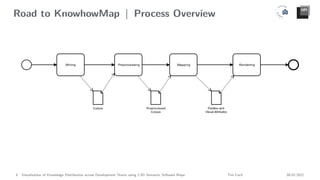
Road to KnowhowMap | Process Overview
6 Visualization of Knowledge Distribution across Development Teams using 2.5D Semantic Software Maps Tim Cech 08.02.2021
Road to KnowhowMap | Mining Expertise
Assumption: Developers knowledge is directly encoded in the source code.
• Similar developers use a common vocabulary (e.g. Saxena and Pedanekar (2017): [...]
Mining candidate expertise from github repositories)
• Statistical language models can be used to describe developers as high-dimensional feature
vectors (e.g. Linstead et al. (2007): Mining eclipse developer contributions via
author-topic models)
7 Visualization of Knowledge Distribution across Development Teams using 2.5D Semantic Software Maps Tim Cech 08.02.2021
Road to KnowhowMap | Preprocessing – NLP
• Crawling source code files
• Remove symbols and split up words
• Remove very common words (stop words)
• Get corpus per concept and developer
8 Visualization of Knowledge Distribution across Development Teams using 2.5D Semantic Software Maps Tim Cech 08.02.2021
Road to KnowhowMap | Preprocessing – Vocabulary
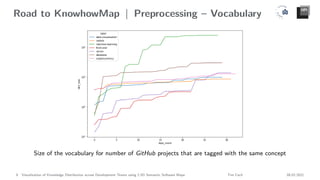
Size of the vocabulary for number of GitHub projects that are tagged with the same concept
9 Visualization of Knowledge Distribution across Development Teams using 2.5D Semantic Software Maps Tim Cech 08.02.2021
Road to KnowhowMap | Preprocessing – LDA
10 Visualization of Knowledge Distribution across Development Teams using 2.5D Semantic Software Maps Tim Cech 08.02.2021
Road to KnowhowMap | Concept Mining with LLDA
• Document has only a non-zero value in a topic, when it is marked with its associated tag
• Training on a corpus of GitHub projects, leads to concept-specific vocabulary
• Locating keywords of a concept in the commit history of developer results in a skill level
Machine Learning Cryptocurrency Database Server Data Visualization
th order db request chart
tensor crypto table server series
self binance key header axis
cuda price name http pixi
model trade value body datum
license wallet opt response point
layer exchange sql message style
11 Visualization of Knowledge Distribution across Development Teams using 2.5D Semantic Software Maps Tim Cech 08.02.2021
Road to KnowhowMap | Layout Computation
• Input
• Vocabulary V
• Corpus of source code files C
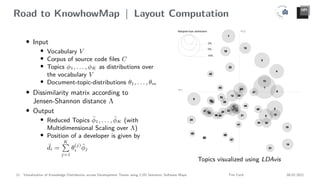
• Topics ϕ1, . . . , ϕK as distributions over
the vocabulary V
• Document-topic-distributions θ1, . . . , θm
• Dissimilarity matrix according to
Jensen-Shannon distance Λ
• Output
• Reduced Topics ϕ̄1, . . . , ϕ̄K (with
Multidimensional Scaling over Λ)
• Position of a developer is given by
¯
di =
K
P
j=1
θ
(j)
i ϕ̄j
Topics visualized using LDAvis
12 Visualization of Knowledge Distribution across Development Teams using 2.5D Semantic Software Maps Tim Cech 08.02.2021
Visualization Approach | Visual Mapping
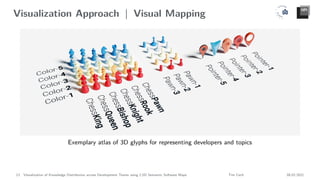
Exemplary atlas of 3D glyphs for representing developers and topics
13 Visualization of Knowledge Distribution across Development Teams using 2.5D Semantic Software Maps Tim Cech 08.02.2021
Visualization Approach | Annotations
On demand further details about the skills of a developer are displayed
14 Visualization of Knowledge Distribution across Development Teams using 2.5D Semantic Software Maps Tim Cech 08.02.2021
Visualization Approach | Example result
KnowhowMap for the Bitcoin Core project (github.com/bitcoin/bitcoin) based on 2000 commits.
15 Visualization of Knowledge Distribution across Development Teams using 2.5D Semantic Software Maps Tim Cech 08.02.2021
Conclusions
Contributions
• 2.5D visualization, showing semantic relatedness between developers based on their
source code activities
• Novel method for extracting skills in high-level concepts by training an LLDA model on a
dynamically generated corpus of GitHub projects
• Allows various visual mappings for different use cases
Future Work
• Further evaluation of the proposed expertise mining technique
• User study to evaluate the effectiveness of our visualization approach
16 Visualization of Knowledge Distribution across Development Teams using 2.5D Semantic Software Maps Tim Cech 08.02.2021
Contact
• Daniel Atzberger
• Tim Cech,
tim.cech@hpi.uni-potsdam.de
• Adrian Jobst
• Willy Scheibel
• Daniel Limberger
• Dr. Matthias Trapp
• Prof. Dr. Jürgen Döllner
Acknowledgements
This work is part of the „Software-DNA“ project, which is funded
by the European Regional Development Fund (ERDF or EFRE in
German) and the State of Brandenburg (ILB). This work is part of
the KMU project „KnowhowAnalyzer“ (Förderkennzeichen
01IS20088B), which is funded by the German Ministry for
Education and Research (Bundesministerium für Bildung und
Forschung).
17 Visualization of Knowledge Distribution across Development Teams using 2.5D Semantic Software Maps Tim Cech 08.02.2021
References I
[Atzberger et al., 2022] Atzberger, D., Cech, T., Jobst, A., Scheibel, W., Limberger, D., Trapp,
M., and Döllner, J. (2022). Visualization of knowledge distribution across development
teams using 2.5d semantic software maps. In Proc. 13th International Conference on
Information Visualization Theory and Applications, IVAPP ’22. INSTICC, SciTePress.
[Blei et al., 2003] Blei, D. M., Ng, A. Y., and Jordan, M. I. (2003). Latent dirichlet allocation.
Journal of Machine Learning Research, 3:993–1022.
[Cox and Cox, 2008] Cox, M. A. and Cox, T. F. (2008). Multidimensional scaling. In
Handbook of Data Visualization, pages 315–347. Springer.
[Kuhn et al., 2008] Kuhn, A., Loretan, P., and Nierstrasz, O. (2008). Consistent layout for
thematic software maps. In Proc. 15th Working Conference on Reverse Engineering, WCRE
’08, pages 209–218. IEEE.
[Linstead et al., 2007] Linstead, E., Rigor, P., Bajracharya, S., Lopes, C., and Baldi, P. (2007).
Mining eclipse developer contributions via author-topic models. In Proc. 4th International
Workshop on Mining Software Repositories, MSR ’07, pages 30:1–4.
18 Visualization of Knowledge Distribution across Development Teams using 2.5D Semantic Software Maps Tim Cech 08.02.2021
References II
[Ramage et al., 2009] Ramage, D., Hall, D., Nallapati, R., and Manning, C. D. (2009).
Labeled LDA: A supervised topic model for credit attribution in multi-labeled corpora. In
Proceedings of the 2009 Conference on Empirical Methods in Natural Language Processing,
pages 248–256, Singapore. Association for Computational Linguistics.
[Saxena and Pedanekar, 2017] Saxena, R. and Pedanekar, N. (2017). I know what you coded
last summer: Mining candidate expertise from github repositories. In Companion of the 2017
ACM Conference on Computer Supported Cooperative Work and Social Computing, pages
299–302.
[Sievert and Shirley, 2014] Sievert, C. and Shirley, K. (2014). Ldavis: A method for visualizing
and interpreting topics. In Proc. Workshop on Interactive Language Learning, Visualization,
and Interfaces, pages 63–70. ACL.
19 Visualization of Knowledge Distribution across Development Teams using 2.5D Semantic Software Maps Tim Cech 08.02.2021

Visualization of Knowledge Distribution across Development Teams using 2.5D Semantic Software Maps

  • 1.
    Visualization of KnowledgeDistribution across Development Teams using 2.5D Semantic Software Maps IVAPP | February 8th 2022, Vienna Daniel Atzberger, Tim Cech, Adrian Jobst, Willy Scheibel, Daniel Limberger, Matthias Trapp, and Jürgen Döllner Hasso-Plattner-Institute, Digital Engineering Faculty, University of Potsdam, Germany 08.02.2022
  • 2.
    Introduction | Motivation ”Thepeople working in a software organization are its greatest assets. It is expensive to recruit and retain good people, and it is up to software managers to ensure that the engineers working on a project are as productive as possible. In successful companies and economies, this productivity is achieved when people are respected by the organization and are assigned responsibilities that reflect their skills and experience.” I. Sommerville, Software Engineering. 9th Ed., Harlow 2016, p. 652 2 Visualization of Knowledge Distribution across Development Teams using 2.5D Semantic Software Maps Tim Cech 08.02.2021
  • 3.
    Introduction | ProblemStatement • Focus of existing approaches: Mining expertise of developers from different domains, e.g. source code (e.g. Linstead et al. (2007) Mining Developer Contributions via author-topic models) • In general, no interactive visualization provided for understanding raw analyses • Idea: Visualize correlation between concepts and developer expertise on a 2,5D-map 3 Visualization of Knowledge Distribution across Development Teams using 2.5D Semantic Software Maps Tim Cech 08.02.2021
  • 4.
    Introduction | Challenges 1| Mining developer expertise • Formal description of developer similarity based on their coding activities • Extracting skill levels in general concepts, e.g., „machine learning“, or „blockchain“ 2 | Visualization Requirements • Displaying similarity between developers • Displaying attributes of developers • Interaction techniques for analyzing knowledge distributions 4 Visualization of Knowledge Distribution across Development Teams using 2.5D Semantic Software Maps Tim Cech 08.02.2021
  • 5.
    Introduction | Idea& Approach 1 | Mining developer expertise • Get meaningful corpus with natural language processing (NLP) techniques • Application of Latent Dirichlet Allocation (LDA) on the commit history of developers • Training an Labeled LDA (LLDA) model on a corpus of GitHub projects for extracting vocabulary of a concept 2 | Visualization Requirements • Based on extracted topics and document-topic distributions developers are placed on a 2D reference space • Distances display semantic relatedness • Data related to the expertise of developers mapped onto the visual variables of 3D glyphs 5 Visualization of Knowledge Distribution across Development Teams using 2.5D Semantic Software Maps Tim Cech 08.02.2021
  • 6.
    Road to KnowhowMap| Process Overview 6 Visualization of Knowledge Distribution across Development Teams using 2.5D Semantic Software Maps Tim Cech 08.02.2021
  • 7.
    Road to KnowhowMap| Mining Expertise Assumption: Developers knowledge is directly encoded in the source code. • Similar developers use a common vocabulary (e.g. Saxena and Pedanekar (2017): [...] Mining candidate expertise from github repositories) • Statistical language models can be used to describe developers as high-dimensional feature vectors (e.g. Linstead et al. (2007): Mining eclipse developer contributions via author-topic models) 7 Visualization of Knowledge Distribution across Development Teams using 2.5D Semantic Software Maps Tim Cech 08.02.2021
  • 8.
    Road to KnowhowMap| Preprocessing – NLP • Crawling source code files • Remove symbols and split up words • Remove very common words (stop words) • Get corpus per concept and developer 8 Visualization of Knowledge Distribution across Development Teams using 2.5D Semantic Software Maps Tim Cech 08.02.2021
  • 9.
    Road to KnowhowMap| Preprocessing – Vocabulary Size of the vocabulary for number of GitHub projects that are tagged with the same concept 9 Visualization of Knowledge Distribution across Development Teams using 2.5D Semantic Software Maps Tim Cech 08.02.2021
  • 10.
    Road to KnowhowMap| Preprocessing – LDA 10 Visualization of Knowledge Distribution across Development Teams using 2.5D Semantic Software Maps Tim Cech 08.02.2021
  • 11.
    Road to KnowhowMap| Concept Mining with LLDA • Document has only a non-zero value in a topic, when it is marked with its associated tag • Training on a corpus of GitHub projects, leads to concept-specific vocabulary • Locating keywords of a concept in the commit history of developer results in a skill level Machine Learning Cryptocurrency Database Server Data Visualization th order db request chart tensor crypto table server series self binance key header axis cuda price name http pixi model trade value body datum license wallet opt response point layer exchange sql message style 11 Visualization of Knowledge Distribution across Development Teams using 2.5D Semantic Software Maps Tim Cech 08.02.2021
  • 12.
    Road to KnowhowMap| Layout Computation • Input • Vocabulary V • Corpus of source code files C • Topics ϕ1, . . . , ϕK as distributions over the vocabulary V • Document-topic-distributions θ1, . . . , θm • Dissimilarity matrix according to Jensen-Shannon distance Λ • Output • Reduced Topics ϕ̄1, . . . , ϕ̄K (with Multidimensional Scaling over Λ) • Position of a developer is given by ¯ di = K P j=1 θ (j) i ϕ̄j Topics visualized using LDAvis 12 Visualization of Knowledge Distribution across Development Teams using 2.5D Semantic Software Maps Tim Cech 08.02.2021
  • 13.
    Visualization Approach |Visual Mapping Exemplary atlas of 3D glyphs for representing developers and topics 13 Visualization of Knowledge Distribution across Development Teams using 2.5D Semantic Software Maps Tim Cech 08.02.2021
  • 14.
    Visualization Approach |Annotations On demand further details about the skills of a developer are displayed 14 Visualization of Knowledge Distribution across Development Teams using 2.5D Semantic Software Maps Tim Cech 08.02.2021
  • 15.
    Visualization Approach |Example result KnowhowMap for the Bitcoin Core project (github.com/bitcoin/bitcoin) based on 2000 commits. 15 Visualization of Knowledge Distribution across Development Teams using 2.5D Semantic Software Maps Tim Cech 08.02.2021
  • 16.
    Conclusions Contributions • 2.5D visualization,showing semantic relatedness between developers based on their source code activities • Novel method for extracting skills in high-level concepts by training an LLDA model on a dynamically generated corpus of GitHub projects • Allows various visual mappings for different use cases Future Work • Further evaluation of the proposed expertise mining technique • User study to evaluate the effectiveness of our visualization approach 16 Visualization of Knowledge Distribution across Development Teams using 2.5D Semantic Software Maps Tim Cech 08.02.2021
  • 17.
    Contact • Daniel Atzberger •Tim Cech, tim.cech@hpi.uni-potsdam.de • Adrian Jobst • Willy Scheibel • Daniel Limberger • Dr. Matthias Trapp • Prof. Dr. Jürgen Döllner Acknowledgements This work is part of the „Software-DNA“ project, which is funded by the European Regional Development Fund (ERDF or EFRE in German) and the State of Brandenburg (ILB). This work is part of the KMU project „KnowhowAnalyzer“ (Förderkennzeichen 01IS20088B), which is funded by the German Ministry for Education and Research (Bundesministerium für Bildung und Forschung). 17 Visualization of Knowledge Distribution across Development Teams using 2.5D Semantic Software Maps Tim Cech 08.02.2021
  • 18.
    References I [Atzberger etal., 2022] Atzberger, D., Cech, T., Jobst, A., Scheibel, W., Limberger, D., Trapp, M., and Döllner, J. (2022). Visualization of knowledge distribution across development teams using 2.5d semantic software maps. In Proc. 13th International Conference on Information Visualization Theory and Applications, IVAPP ’22. INSTICC, SciTePress. [Blei et al., 2003] Blei, D. M., Ng, A. Y., and Jordan, M. I. (2003). Latent dirichlet allocation. Journal of Machine Learning Research, 3:993–1022. [Cox and Cox, 2008] Cox, M. A. and Cox, T. F. (2008). Multidimensional scaling. In Handbook of Data Visualization, pages 315–347. Springer. [Kuhn et al., 2008] Kuhn, A., Loretan, P., and Nierstrasz, O. (2008). Consistent layout for thematic software maps. In Proc. 15th Working Conference on Reverse Engineering, WCRE ’08, pages 209–218. IEEE. [Linstead et al., 2007] Linstead, E., Rigor, P., Bajracharya, S., Lopes, C., and Baldi, P. (2007). Mining eclipse developer contributions via author-topic models. In Proc. 4th International Workshop on Mining Software Repositories, MSR ’07, pages 30:1–4. 18 Visualization of Knowledge Distribution across Development Teams using 2.5D Semantic Software Maps Tim Cech 08.02.2021
  • 19.
    References II [Ramage etal., 2009] Ramage, D., Hall, D., Nallapati, R., and Manning, C. D. (2009). Labeled LDA: A supervised topic model for credit attribution in multi-labeled corpora. In Proceedings of the 2009 Conference on Empirical Methods in Natural Language Processing, pages 248–256, Singapore. Association for Computational Linguistics. [Saxena and Pedanekar, 2017] Saxena, R. and Pedanekar, N. (2017). I know what you coded last summer: Mining candidate expertise from github repositories. In Companion of the 2017 ACM Conference on Computer Supported Cooperative Work and Social Computing, pages 299–302. [Sievert and Shirley, 2014] Sievert, C. and Shirley, K. (2014). Ldavis: A method for visualizing and interpreting topics. In Proc. Workshop on Interactive Language Learning, Visualization, and Interfaces, pages 63–70. ACL. 19 Visualization of Knowledge Distribution across Development Teams using 2.5D Semantic Software Maps Tim Cech 08.02.2021