Visual Thinking Strategies in the Early YearsClaire Greensit BA(Hons) QTS EYPS Honeybeez Childcare
I was intrigued by the research of Whitescar and Cossentina published in the June 2011 edition of Montessori International.It showed how a Montessori teacher had applied the Visual Thinking Strategies principles and materials to her Early years Group – (YR)I was interested to see if this could be applied to younger children to engage them with art and artefacts.  The Starting Point:
Developed by Jacqueline Cossentino and Keith Whitescarver in Boston USA.It asks children to engage with works of art by asking a series of key questions which progressively encourage the child to think carefully about the content of an image or work of art. It is not about the history of the picture or the artist – this can be looked at, at a later stage – if the child shows an interest in this. What is Visual Thinking Strategies?
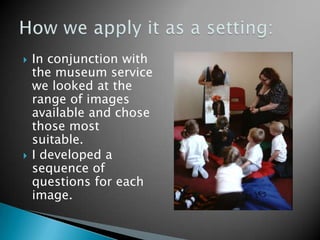
In conjunction with the museum service we looked at the range of images available and chose those most suitable.
I developed a sequence of questions for each image. How we apply it as a setting:
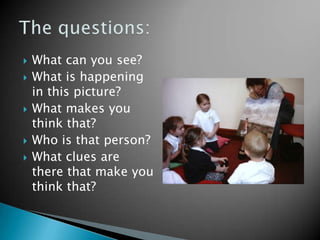
What can you see?What is happening in this picture?What makes you think that?Who is that person?What clues are there that make you think that?The questions:
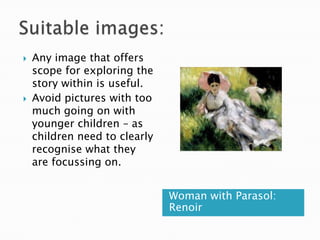
Suitable images: Any image that offers scope for exploring the story within is useful.Avoid pictures with too much going on with younger children – as children need to clearly recognise what they are focussing on. Woman with Parasol: Renoir
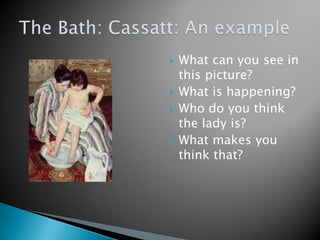
What can you see in this picture?What is happening?Who do you think the lady is?What makes you think that? The Bath: Cassatt: An example
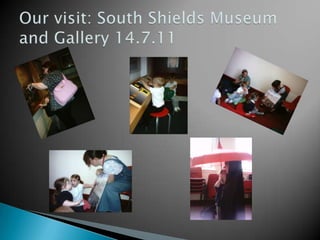
Our visit: South Shields Museum and Gallery 14.7.11

Visual thinking strategies in the early years

  • 1.
    Visual Thinking Strategiesin the Early YearsClaire Greensit BA(Hons) QTS EYPS Honeybeez Childcare
  • 2.
    I was intriguedby the research of Whitescar and Cossentina published in the June 2011 edition of Montessori International.It showed how a Montessori teacher had applied the Visual Thinking Strategies principles and materials to her Early years Group – (YR)I was interested to see if this could be applied to younger children to engage them with art and artefacts. The Starting Point:
  • 3.
    Developed by JacquelineCossentino and Keith Whitescarver in Boston USA.It asks children to engage with works of art by asking a series of key questions which progressively encourage the child to think carefully about the content of an image or work of art. It is not about the history of the picture or the artist – this can be looked at, at a later stage – if the child shows an interest in this. What is Visual Thinking Strategies?
  • 4.
    In conjunction withthe museum service we looked at the range of images available and chose those most suitable.
  • 5.
    I developed asequence of questions for each image. How we apply it as a setting:
  • 6.
    What can yousee?What is happening in this picture?What makes you think that?Who is that person?What clues are there that make you think that?The questions:
  • 7.
    Suitable images: Anyimage that offers scope for exploring the story within is useful.Avoid pictures with too much going on with younger children – as children need to clearly recognise what they are focussing on. Woman with Parasol: Renoir
  • 8.
    What can yousee in this picture?What is happening?Who do you think the lady is?What makes you think that? The Bath: Cassatt: An example
  • 9.
    Our visit: SouthShields Museum and Gallery 14.7.11