Visual Programming forVisual Programming for
Hybrid User InterfacesHybrid User Interfaces
Nisha ThapaNisha Thapa
Mixed Reality UIs
• potential to address the need for proper system control
–integration into VR UIs difficult and expensive
• combine virtual 3D content with real-world interfaces such as
conventional 2D desktop interfaces
• => hybrid UIs
• -heterogenous display and interaction devices –provide "best" UI
for diverse interaction tasks
• system control well understood in 2D desktop GUIs
• engineering problem with 2D-3D MR UIs: lack of development tools
•"glue" that integrates the 2D and 3D components into a seamless hybrid user interface
•input event distribution between 2D and 3D components •physical integration of 2D and 3D UIs •visual programming support •scripting support (Inventor, XML)
Thekla Software System: Overview
• "glue" that integrates the 2D and 3D components into a seamless
hybrid user interface
• input event distribution between 2D and 3D components
• physical integration of 2D and 3D UIs
• visual programming support
• scripting support (Inventor, XML)
Thekla Software System: Overview [2]
• extends the MR framework Studierstube
–based on a number of mature components:
–Coin3D: scene graph library
–OpenTracker: tracking data flow library
–Muddleware: blackboard communication tool
• uses Qt for cross-platform GUI development
–excellent development tools
–Qt designer: visual UI editor
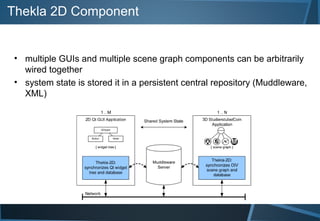
Thekla 2D Component
• multiple GUIs and multiple scene graph components can be arbitrarily
wired together
• system state is stored it in a persistent central repository (Muddleware,
XML)
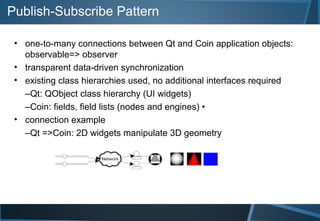
Publish-Subscribe Pattern
• one-to-many connections between Qt and Coin application objects:
observable=> observer
• transparent data-driven synchronization
• existing class hierarchies used, no additional interfaces required
–Qt: QObject class hierarchy (UI widgets)
–Coin: fields, field lists (nodes and engines) •
• connection example
–Qt =>Coin: 2D widgets manipulate 3D geometry
Thekla Client API
• employed by 2D/3D application components
• provides methods to publish and subscribe observables and to
establish connections
Thekla Studierstube Components
• set of Coin3D engine classes
• allow to script connections
directly in Inventor script files
• resulting scripts are devided into
three sections
Thekla Qt Designer Plugin
• integrates with Qt's visual programming frontend
• widgets created as part of a GUI design can be published as
observables
• extends Qt Designer's C++ code generator
–produces immediately executable and testable GUIs
–scheduled observables are published at runtime
–automatic synchronization of the system state through Thekla
• development process for Qt GUIs remains largely unaltered
compared to desktop development
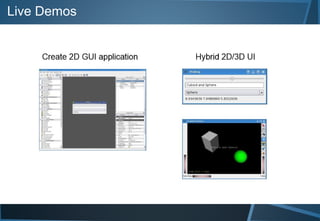
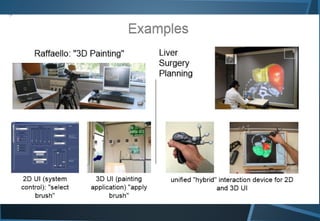
Live Demos
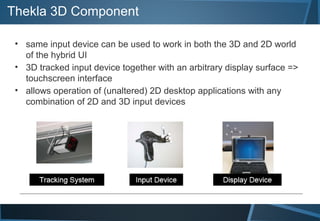
Thekla 3D Component
• same input device can be used to work in both the 3D and 2D world
of the hybrid UI
• 3D tracked input device together with an arbitrary display surface =>
touchscreen interface
• allows operation of (unaltered) 2D desktop applications with any
combination of 2D and 3D input devices
Thekla 3D Component [2]Thekla 3D Component [2]
•"mouse position" device
intersects the screen cuboid
=> mouse events are
generated
•concurrent usage of multiple
screens possible
•screens can be moved freel
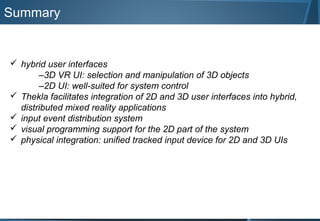
Summary
 hybrid user interfaces
–3D VR UI: selection and manipulation of 3D objects
–2D UI: well-suited for system control
 Thekla facilitates integration of 2D and 3D user interfaces into hybrid,
distributed mixed reality applications
 input event distribution system
 visual programming support for the 2D part of the system
 physical integration: unified tracked input device for 2D and 3D UIs
References
[1] Christian Pirchheim Dieter Schmalstieg Alexander Bornik University of Technology Graz /
Austria http://www.icg.tugraz.at/ {cpirch,schmalstieg,bornik}@icg.tugraz.at
[2] D. A. Bowman, E. Kruijff, J. J. LaViola, and I. Poupyrev. 3D User Interfaces: Theory and
Practice. Addison-Wesley, 2005.
[3] P. Strauss and R. Carey. An object oriented 3D graphics toolkit.In ACM SIGGRAPH’92, 1992.
[4] Trolltech. Qt. http://www.trolltech.com/products/qt
[5] D. Schmalstieg, A. Fuhrmann, G. Hesina, Z. Szalavàri, L. M. Encarnacao, M. Gervautz, and W.
Purgathofer. The studierstube augmented realityproject. Presence: Teleoper. Virtual Environ.,
11(1):33–54, 2002.
[6] G. Reitmayr and D. Schmalstieg. OpenTracker: A flexible softwaredesign for three-
dimensional interaction. Virtual Real., 9(1):79–92, 2005.
[7] D. Wagner and D. Schmalstieg. Muddleware for Prototyping Mixed Reality Multiuser
Games. In Proceedings of IEEE Virtual Reality 2007 (VR2007). IEEE, IEEE, March 2007.
[8] S. Feiner and A. Shamash. Hybrid user interfaces: breeding virtually bigger interfaces for
physically smaller computers. In UIST ’91: Proceedings of the 4th annual ACM symposium on
User interface software and technology, pages 9–17, New York, NY, USA, 1991. ACM Press.
Visual programming for hybrid user interfaces

Visual programming for hybrid user interfaces

  • 1.
    Visual Programming forVisualProgramming for Hybrid User InterfacesHybrid User Interfaces Nisha ThapaNisha Thapa
  • 2.
    Mixed Reality UIs •potential to address the need for proper system control –integration into VR UIs difficult and expensive • combine virtual 3D content with real-world interfaces such as conventional 2D desktop interfaces • => hybrid UIs • -heterogenous display and interaction devices –provide "best" UI for diverse interaction tasks • system control well understood in 2D desktop GUIs • engineering problem with 2D-3D MR UIs: lack of development tools
  • 3.
    •"glue" that integratesthe 2D and 3D components into a seamless hybrid user interface •input event distribution between 2D and 3D components •physical integration of 2D and 3D UIs •visual programming support •scripting support (Inventor, XML) Thekla Software System: Overview • "glue" that integrates the 2D and 3D components into a seamless hybrid user interface • input event distribution between 2D and 3D components • physical integration of 2D and 3D UIs • visual programming support • scripting support (Inventor, XML)
  • 4.
    Thekla Software System:Overview [2] • extends the MR framework Studierstube –based on a number of mature components: –Coin3D: scene graph library –OpenTracker: tracking data flow library –Muddleware: blackboard communication tool • uses Qt for cross-platform GUI development –excellent development tools –Qt designer: visual UI editor
  • 5.
    Thekla 2D Component •multiple GUIs and multiple scene graph components can be arbitrarily wired together • system state is stored it in a persistent central repository (Muddleware, XML)
  • 6.
    Publish-Subscribe Pattern • one-to-manyconnections between Qt and Coin application objects: observable=> observer • transparent data-driven synchronization • existing class hierarchies used, no additional interfaces required –Qt: QObject class hierarchy (UI widgets) –Coin: fields, field lists (nodes and engines) • • connection example –Qt =>Coin: 2D widgets manipulate 3D geometry
  • 7.
    Thekla Client API •employed by 2D/3D application components • provides methods to publish and subscribe observables and to establish connections
  • 8.
    Thekla Studierstube Components •set of Coin3D engine classes • allow to script connections directly in Inventor script files • resulting scripts are devided into three sections
  • 9.
    Thekla Qt DesignerPlugin • integrates with Qt's visual programming frontend • widgets created as part of a GUI design can be published as observables • extends Qt Designer's C++ code generator –produces immediately executable and testable GUIs –scheduled observables are published at runtime –automatic synchronization of the system state through Thekla • development process for Qt GUIs remains largely unaltered compared to desktop development
  • 10.
  • 11.
    Thekla 3D Component •same input device can be used to work in both the 3D and 2D world of the hybrid UI • 3D tracked input device together with an arbitrary display surface => touchscreen interface • allows operation of (unaltered) 2D desktop applications with any combination of 2D and 3D input devices
  • 12.
    Thekla 3D Component[2]Thekla 3D Component [2] •"mouse position" device intersects the screen cuboid => mouse events are generated •concurrent usage of multiple screens possible •screens can be moved freel
  • 14.
    Summary  hybrid userinterfaces –3D VR UI: selection and manipulation of 3D objects –2D UI: well-suited for system control  Thekla facilitates integration of 2D and 3D user interfaces into hybrid, distributed mixed reality applications  input event distribution system  visual programming support for the 2D part of the system  physical integration: unified tracked input device for 2D and 3D UIs
  • 15.
    References [1] Christian PirchheimDieter Schmalstieg Alexander Bornik University of Technology Graz / Austria http://www.icg.tugraz.at/ {cpirch,schmalstieg,bornik}@icg.tugraz.at [2] D. A. Bowman, E. Kruijff, J. J. LaViola, and I. Poupyrev. 3D User Interfaces: Theory and Practice. Addison-Wesley, 2005. [3] P. Strauss and R. Carey. An object oriented 3D graphics toolkit.In ACM SIGGRAPH’92, 1992. [4] Trolltech. Qt. http://www.trolltech.com/products/qt [5] D. Schmalstieg, A. Fuhrmann, G. Hesina, Z. Szalavàri, L. M. Encarnacao, M. Gervautz, and W. Purgathofer. The studierstube augmented realityproject. Presence: Teleoper. Virtual Environ., 11(1):33–54, 2002. [6] G. Reitmayr and D. Schmalstieg. OpenTracker: A flexible softwaredesign for three- dimensional interaction. Virtual Real., 9(1):79–92, 2005. [7] D. Wagner and D. Schmalstieg. Muddleware for Prototyping Mixed Reality Multiuser Games. In Proceedings of IEEE Virtual Reality 2007 (VR2007). IEEE, IEEE, March 2007. [8] S. Feiner and A. Shamash. Hybrid user interfaces: breeding virtually bigger interfaces for physically smaller computers. In UIST ’91: Proceedings of the 4th annual ACM symposium on User interface software and technology, pages 9–17, New York, NY, USA, 1991. ACM Press.