Visual dimension of urban design
 Elias asaye
 Kaleb derebe
 Nahom antenhe
• The visual dimension is purely focused on the aesthetic of the space.
Ultimately a city is perceives by the ‘faculty of sight’
• The visual experience of a city is known as the kinaesthetic experience
as a result of human movement
Three key issues
• Aesthetic preferences
• PATTERNS AND AESTHETIC ORDER
• Principles of organization and coherence
Aesthetic preferences
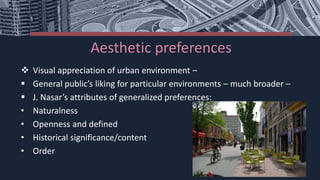
 Visual appreciation of urban environment –
 General public’s liking for particular environments – much broader –
 J. Nasar’s attributes of generalized preferences:
• Naturalness
• Openness and defined
• Historical significance/content
• Order
PATTERNS AND AESTHETIC ORDER
• Patterns and Aesthetic Order
 Experience of whole, rather than any single part
 Appreciation of environments as ensembles
 Visually coherent and harmonious
Principles of organization and coherence
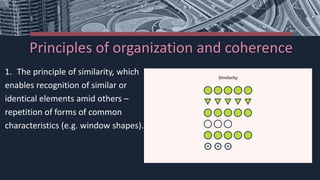
1. The principle of similarity, which
enables recognition of similar or
identical elements amid others –
repetition of forms of common
characteristics (e.g. window shapes).
The principle of proximity
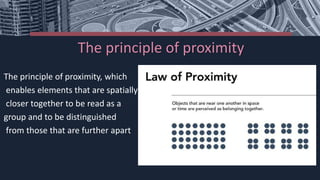
The principle of proximity, which
enables elements that are spatially
closer together to be read as a
group and to be distinguished
from those that are further apart
The principle of common ground
3. The principle of common ground and common enclosure, whereby an
enclosure or a ground defines a field or group. Those elements within the
field or ground are distinguished from what lies outside.
The principle of orientation
• The principle of orientation, whereby elements are grouped through
their common orientation, either through parallelism or convergence
towards a void or solid.
The principle of closure
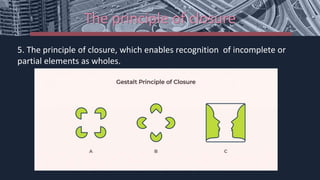
5. The principle of closure, which enables recognition of incomplete or
partial elements as wholes.
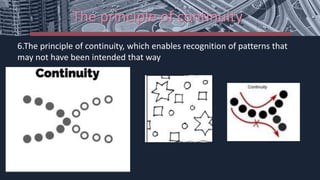
The principle of continuity
6.The principle of continuity, which enables recognition of patterns that
may not have been intended that way
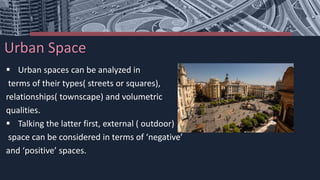
Urban Space
 Urban spaces can be analyzed in
terms of their types( streets or squares),
relationships( townscape) and volumetric
qualities.
 Talking the latter first, external ( outdoor)
space can be considered in terms of ‘negative’
and ‘positive’ spaces.
– Positive and Negative space
• Positive space has a districts and definite shape.
• Defined by building, trees, walls, level, changes etc…
• the boundary need not be continuous.
• Negative space
• is shapeless.
• Its is ‘inconvisable’ , it lack perceivable edges
• Its difficult to imagine the space begin filled with a liquid because, quite
simply its is difficult to conceive of the space.
Streets and squares
• Two types of positive urban spaces
1. Streets(road, path, avenues, lane,
alleys etc).
Streets are dynamic spaces with a sense of
movement.
2. Square( plazas, circuses, courts etc..)
Squares are static space with less sense of
movement.
Formal and Informal spaces
 Formal spaces have a strong sense of enclosure
 Orderly floorspace and arrangement of furniture
 Surrounding building that enhance formality
 Often symmetrical in layout
 Informal space
 Relaxed character
 Wide variety of surrounding architecture
 Often asymmetrical in layout
Factors within visual design
• Bulk
Appearance
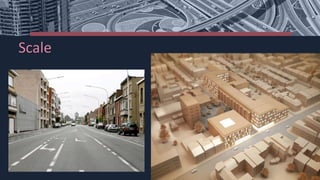
Scale
• Thank you

Visual dimension.pptx

  • 1.
    Visual dimension ofurban design  Elias asaye  Kaleb derebe  Nahom antenhe
  • 2.
    • The visualdimension is purely focused on the aesthetic of the space. Ultimately a city is perceives by the ‘faculty of sight’ • The visual experience of a city is known as the kinaesthetic experience as a result of human movement
  • 3.
    Three key issues •Aesthetic preferences • PATTERNS AND AESTHETIC ORDER • Principles of organization and coherence
  • 4.
    Aesthetic preferences  Visualappreciation of urban environment –  General public’s liking for particular environments – much broader –  J. Nasar’s attributes of generalized preferences: • Naturalness • Openness and defined • Historical significance/content • Order
  • 5.
    PATTERNS AND AESTHETICORDER • Patterns and Aesthetic Order  Experience of whole, rather than any single part  Appreciation of environments as ensembles  Visually coherent and harmonious
  • 6.
    Principles of organizationand coherence 1. The principle of similarity, which enables recognition of similar or identical elements amid others – repetition of forms of common characteristics (e.g. window shapes).
  • 7.
    The principle ofproximity The principle of proximity, which enables elements that are spatially closer together to be read as a group and to be distinguished from those that are further apart
  • 8.
    The principle ofcommon ground 3. The principle of common ground and common enclosure, whereby an enclosure or a ground defines a field or group. Those elements within the field or ground are distinguished from what lies outside.
  • 9.
    The principle oforientation • The principle of orientation, whereby elements are grouped through their common orientation, either through parallelism or convergence towards a void or solid.
  • 10.
    The principle ofclosure 5. The principle of closure, which enables recognition of incomplete or partial elements as wholes.
  • 11.
    The principle ofcontinuity 6.The principle of continuity, which enables recognition of patterns that may not have been intended that way
  • 12.
    Urban Space  Urbanspaces can be analyzed in terms of their types( streets or squares), relationships( townscape) and volumetric qualities.  Talking the latter first, external ( outdoor) space can be considered in terms of ‘negative’ and ‘positive’ spaces.
  • 13.
    – Positive andNegative space • Positive space has a districts and definite shape. • Defined by building, trees, walls, level, changes etc… • the boundary need not be continuous. • Negative space • is shapeless. • Its is ‘inconvisable’ , it lack perceivable edges • Its difficult to imagine the space begin filled with a liquid because, quite simply its is difficult to conceive of the space.
  • 15.
    Streets and squares •Two types of positive urban spaces 1. Streets(road, path, avenues, lane, alleys etc). Streets are dynamic spaces with a sense of movement. 2. Square( plazas, circuses, courts etc..) Squares are static space with less sense of movement.
  • 16.
    Formal and Informalspaces  Formal spaces have a strong sense of enclosure  Orderly floorspace and arrangement of furniture  Surrounding building that enhance formality  Often symmetrical in layout  Informal space  Relaxed character  Wide variety of surrounding architecture  Often asymmetrical in layout
  • 18.
    Factors within visualdesign • Bulk
  • 19.
  • 20.
  • 21.