Augmented
Reality and
Virtual Reality
Sneha
Agenda
Introduction
Core
Components
Types Applications
Benefits
AR and VR
AR
Introduction
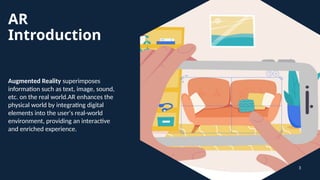
Augmented Reality superimposes
information such as text, image, sound,
etc. on the real world.AR enhances the
physical world by integrating digital
elements into the user's real-world
environment, providing an interactive
and enriched experience.
3
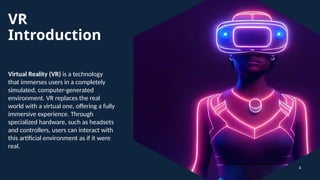
VR
Introduction
Virtual Reality (VR) is a technology
that immerses users in a completely
simulated, computer-generated
environment. VR replaces the real
world with a virtual one, offering a fully
immersive experience. Through
specialized hardware, such as headsets
and controllers, users can interact with
this artificial environment as if it were
real.
4
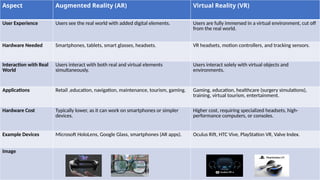
Aspect Augmented Reality (AR) Virtual Reality (VR)
User Experience Users see the real world with added digital elements. Users are fully immersed in a virtual environment, cut off
from the real world.
Hardware Needed Smartphones, tablets, smart glasses, headsets. VR headsets, motion controllers, and tracking sensors.
Interaction with Real
World
Users interact with both real and virtual elements
simultaneously.
Users interact solely with virtual objects and
environments.
Applications Retail ,education, navigation, maintenance, tourism, gaming. Gaming, education, healthcare (surgery simulations),
training, virtual tourism, entertainment.
Hardware Cost Typically lower, as it can work on smartphones or simpler
devices.
Higher cost, requiring specialized headsets, high-
performance computers, or consoles.
Example Devices Microsoft HoloLens, Google Glass, smartphones (AR apps). Oculus Rift, HTC Vive, PlayStation VR, Valve Index.
Image
Core
Components
7
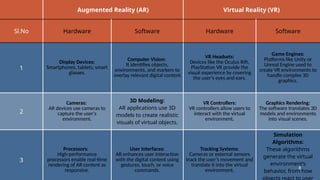
Augmented Reality (AR) Virtual Reality (VR)
Sl.No Hardware Software Hardware Software
1
Display Devices:
Smartphones, tablets, smart
glasses.
Computer Vision:
It identifies objects,
environments, and markers to
overlay relevant digital content
VR Headsets:
Devices like the Oculus Rift,
PlayStation VR provide the
visual experience by covering
the user's eyes and ears.
Game Engines:
Platforms like Unity or
Unreal Engine used to
create VR environments to
handle complex 3D
graphics.
2
Cameras:
AR devices use cameras to
capture the user's
environment.
3D Modeling:
AR applications use 3D
models to create realistic
visuals of virtual objects.
VR Controllers:
VR controllers allow users to
interact with the virtual
environment.
Graphics Rendering:
The software translates 3D
models and environments
into visual scenes.
3
Processors:
High-performance
processors enable real-time
rendering of AR content as
responsive.
User Interfaces:
AR enhances user interaction
with the digital content using
gestures, touch, or voice
commands.
Tracking Systems:
Cameras or external sensors
track the user’s movement and
translate it into the virtual
environment.
Simulation
Algorithms:
These algorithms
generate the virtual
environment’s
behavior, from how
8
Types
9
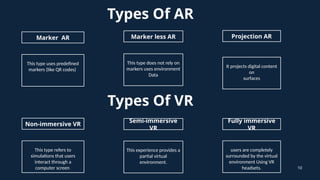
Types Of AR
Marker AR
This type uses predefined
markers (like QR codes)
Marker less AR
This type does not rely on
markers uses environment
Data
Projection AR
It projects digital content
on
surfaces
10
Non-immersive VR
This type refers to
simulations that users
interact through a
computer screen
Semi-immersive
VR
This experience provides a
partial virtual
environment.
Fully immersive
VR
users are completely
surrounded by the virtual
environment Using VR
headsets.
Types Of VR
Applications
11
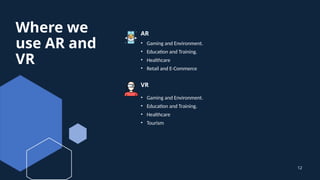
Where we
use AR and
VR
AR
• Gaming and Environment.
• Education and Training.
• Healthcare
• Retail and E-Commerce
VR
12
• Gaming and Environment.
• Education and Training.
• Healthcare
• Tourism
Benefits
13
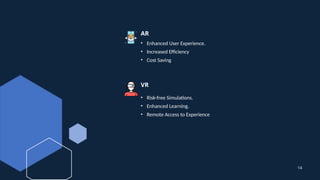
AR
• Enhanced User Experience.
• Increased Efficiency
• Cost Saving
VR
14
• Risk-free Simulations.
• Enhanced Learning.
• Remote Access to Experience
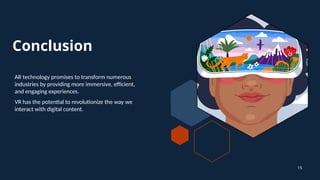
Conclusion
AR technology promises to transform numerous
industries by providing more immersive, efficient,
and engaging experiences.
VR has the potential to revolutionize the way we
interact with digital content.
15
Thank you
Do you have Any Questions for me ?

Augmented Reality vs Virtual Reality PPT

  • 1.
  • 2.
  • 3.
    AR Introduction Augmented Reality superimposes informationsuch as text, image, sound, etc. on the real world.AR enhances the physical world by integrating digital elements into the user's real-world environment, providing an interactive and enriched experience. 3
  • 4.
    VR Introduction Virtual Reality (VR)is a technology that immerses users in a completely simulated, computer-generated environment. VR replaces the real world with a virtual one, offering a fully immersive experience. Through specialized hardware, such as headsets and controllers, users can interact with this artificial environment as if it were real. 4
  • 6.
    Aspect Augmented Reality(AR) Virtual Reality (VR) User Experience Users see the real world with added digital elements. Users are fully immersed in a virtual environment, cut off from the real world. Hardware Needed Smartphones, tablets, smart glasses, headsets. VR headsets, motion controllers, and tracking sensors. Interaction with Real World Users interact with both real and virtual elements simultaneously. Users interact solely with virtual objects and environments. Applications Retail ,education, navigation, maintenance, tourism, gaming. Gaming, education, healthcare (surgery simulations), training, virtual tourism, entertainment. Hardware Cost Typically lower, as it can work on smartphones or simpler devices. Higher cost, requiring specialized headsets, high- performance computers, or consoles. Example Devices Microsoft HoloLens, Google Glass, smartphones (AR apps). Oculus Rift, HTC Vive, PlayStation VR, Valve Index. Image
  • 7.
  • 8.
    Augmented Reality (AR)Virtual Reality (VR) Sl.No Hardware Software Hardware Software 1 Display Devices: Smartphones, tablets, smart glasses. Computer Vision: It identifies objects, environments, and markers to overlay relevant digital content VR Headsets: Devices like the Oculus Rift, PlayStation VR provide the visual experience by covering the user's eyes and ears. Game Engines: Platforms like Unity or Unreal Engine used to create VR environments to handle complex 3D graphics. 2 Cameras: AR devices use cameras to capture the user's environment. 3D Modeling: AR applications use 3D models to create realistic visuals of virtual objects. VR Controllers: VR controllers allow users to interact with the virtual environment. Graphics Rendering: The software translates 3D models and environments into visual scenes. 3 Processors: High-performance processors enable real-time rendering of AR content as responsive. User Interfaces: AR enhances user interaction with the digital content using gestures, touch, or voice commands. Tracking Systems: Cameras or external sensors track the user’s movement and translate it into the virtual environment. Simulation Algorithms: These algorithms generate the virtual environment’s behavior, from how 8
  • 9.
  • 10.
    Types Of AR MarkerAR This type uses predefined markers (like QR codes) Marker less AR This type does not rely on markers uses environment Data Projection AR It projects digital content on surfaces 10 Non-immersive VR This type refers to simulations that users interact through a computer screen Semi-immersive VR This experience provides a partial virtual environment. Fully immersive VR users are completely surrounded by the virtual environment Using VR headsets. Types Of VR
  • 11.
  • 12.
    Where we use ARand VR AR • Gaming and Environment. • Education and Training. • Healthcare • Retail and E-Commerce VR 12 • Gaming and Environment. • Education and Training. • Healthcare • Tourism
  • 13.
  • 14.
    AR • Enhanced UserExperience. • Increased Efficiency • Cost Saving VR 14 • Risk-free Simulations. • Enhanced Learning. • Remote Access to Experience
  • 15.
    Conclusion AR technology promisesto transform numerous industries by providing more immersive, efficient, and engaging experiences. VR has the potential to revolutionize the way we interact with digital content. 15
  • 16.
    Thank you Do youhave Any Questions for me ?